The Fall of Brazil’s Tyrannical Judge May Be Imminent: Moraes and His Sleaze Are Exposed

By Glenn Greenwald | September 4, 2026
Alexandre de Moraes spent months denying corrupt profits from a collapsed bank. The proof is now overwhelming, and his desperate moves to survive may imperil Lula’s re-election and Brazil’s democracy.
Exactly one month before Brazil holds its presidential election, the country is drowning in a corruption scandal and institutional civil war, the gravity of which is impossible to overstate. At the center of it is Brazil’s authoritarian and increasingly unhinged Supreme Court Justice Alexandre de Moraes, who was sanctioned by the U.S. as a human rights abuser in 2025 after he banned X from Brazil for one month over its refusal to censor at his behest, then ordered money removed from Starlink’s accounts to pay for X’s fines.
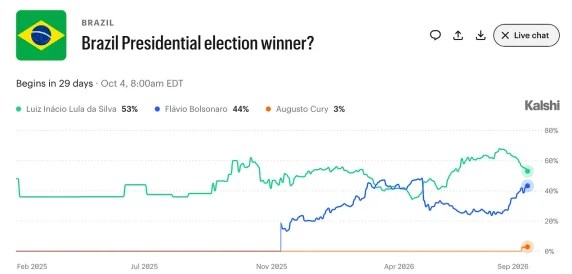
While polls all year have shown that the incumbent left-wing president, 80-year-old Lula da Silva, has a modest lead to win his fourth term, more recent polls have shown him tied with his primary adversary, Senator Flavio Bolsonaro. Bolsonaro is the son of former President Jair Bolsonaro, now imprisoned for 28 years by Judge Moraes on charges of plotting a coup after losing the 2022 election to Lula.
Despite once being affiliated with the center-right, Moraes has become Lula’s closest and most important ally, and the left’s most beloved hero. For that reason, Moraes’ exploding scandal can only further weaken Lula heading into the election. Other than Uruguay, Brazil is the last country in South America still governed by a left-wing or center-left government, with one country after another electing leaders on the right: Argentina, Colombia, Peru, Ecuador, Chile, etc.
Moraes’ conduct is so unprecedentedly sleazy and corrupt that it is difficult to report without provoking understandable doubt. How could it be possible that a democratic country is tolerating, for even one day, a Supreme Court judge remaining in power if his personal corruption and grave abuses of power are really this manifest? Over the past 48 hours, Brazil’s leading newspapers, previously virtually unanimous in their support of Moraes, have demanded his immediate resignation.
At the center of the scandal is a collapsed, fraudulent bank called Banco Master. In 2025, the Central Bank ordered its liquidation after it was revealed to be essentially a Ponzi scheme funding the libertine, Dubai- and Miami-based billionaire lifestyle of its Brazilian president, Daniel Vorcaro. It quickly became the worst banking loss in Brazil’s history by far, with estimated losses of at least $40 billion. Vorcaro was arrested last November at São Paulo’s international airport as he tried to board his private jet to Dubai to flee justice.
The bank’s collapse, Vorcaro’s arrest, and the ensuing criminal investigation have produced a tsunami of evidence showing how Vorcaro — as he was stealing from depositors, including retirees and civil servants — was secretly shoveling huge sums of money and other assets of value to Brazil’s leading politicians and judges, on both the left and right, with the expectation of protection. One of those most enriched by Banco Master is Lula’s longtime Workers’ Party ally in the Senate, Jaques Wagner; Vorcaro also furnished large sums to the Bolsonaro family, including to Flavio, nominally to finance a film about the former president.
But nobody has been as enriched — or as implicated — by Vorcaro and Banco Master as Justice Moraes. Late last year, Brazil’s Globo media empire — for years Moraes’ loyal supporter — revealed that the bank had given an undisclosed 18-month contract to Moraes’ wife worth $27 million.
While Moraes’ wife is an attorney, and the obscene sums under the contract were for “legal services,” she is an ordinary and mediocre one at best. Even Brazil’s best and largest law firms said that such a sum would be unthinkable for vague “legal services,” let alone that kind of generational wealth paid to the small family law firm composed of Moraes’ wife and their two lawyer children. In other words, there would be no rational reason why this bank would enter into such a lavish multi-million dollar contract with Moraes’ wife absent an agreement to secure the influence and protection of her very powerful husband.
More incriminating revelations about Moraes came fast and furious in the first two months of the year. He called the Central Bank to intervene on behalf of the corrupt bank that had just bestowed on him generational wealth. He and Vorcaro were communicating with each other in the days leading up to Vorcaro’s arrest. At least $17 million had been paid by the bank to Moraes’ wife under the original contract. Facing intense public pressure, she could not provide any documentation or explanation of what “legal services” she furnished that would remotely justify this bizarre contract.
In the face of all these media reports, Moraes denied essentially everything. Even though Globo had the text messages between him and Vorcaro, verified by the Federal Police, he simply lied and said they were not on his phone. That had the effect of somewhat stifling the scandal — until this week, when it exploded in a way that few scandals have.
When the Banco Master criminal case first arrived at the Supreme Court, it was conveniently assigned to a judge who had as much incentive as Moraes to hide it all. That judge immediately put the entire case under “absolute secrecy,” meaning nothing would be disclosed to the public. But when it was revealed that this judge and his family had their own massive, hidden financial ties to Vorcaro and the bank, he was forced to step aside, and the case was then randomly reassigned to Justice André Mendonça, one of only two judges on the 11-member court appointed by Bolsonaro.
Last week, Vorcaro told Mendonça that he was being physically and psychologically tortured in prison and threatened with death at the hands of the Lula-appointed head of the Federal Police. Mendonça thus ordered the Federal Police to turn over to him the results of their investigation into Vorcaro’s communications with anyone on the Supreme Court or Federal Police. On Monday, key excerpts of the 218-page report on Moraes’ genuinely shocking behavior, and then the full report itself, were disclosed by the daily newspaper Estadão.
Among the revelations: the wealth lavished on the Moraes family by Vorcaro was not limited to a $27 million contract, but also included a separate $10 million contract for his wife, free use of Vorcaro’s private jets and helicopters, and even credit cards for each of their children with a monthly limit of $70,000, with a total value of close to $40 million. Over the last two years, the Moraes family has acquired a virtual real estate empire, including a new $3.5 million mansion in the nation’s capital, Brasília, as well as other residences.
Just as one would expect, the generational wealth bestowed on the Moraes family from Vorcaro and the bank’s stolen deposits was not for free. Moraes was expected to do a great deal for the corrupt billionaire, and he did.
When conversing via WhatsApp, Moraes and Vorcaro both sent their messages using the app’s “one-time visualization” feature to ensure that their messages would be destroyed after they were read once. In several cases over which he presided, Moraes himself has classified the use of this feature as intentional obstruction of justice when he cited it to justify sending people to prison before trial.
Unfortunately for Moraes, the Federal Police were able to recover Vorcaro’s deleted messages to him (but not yet Moraes’ texts to Vorcaro, because they have not yet seized Moraes’ phone). Those recovered deleted messages show Vorcaro speaking extensively with Moraes about how he could escape and/or block prosecution, including asking Moraes about which dates he should flee the country to avoid imminent arrest, along with extensive discussions about Moraes’ efforts to have the chief prosecutor and the head of the Federal Police block criminal investigations. In several messages, Vorcaro proclaimed himself to be “in debt for life” to Moraes and with “life-long gratitude” to the judge for everything he did for him.
And, of course, Vorcaro appeared to have known exactly when the police were coming for him since they arrested him at the airport as he tried to flee to Dubai. Just two weeks ago, Moraes, along with the rest of the Supreme Court, ordered two Rio de Janeiro politicians indicted and arrested for having allegedly leaked details of an imminent police operation in advance to arrest criminals with whom they are associated.
Some of Moraes’ efforts to reward Vorcaro and the bank for the generational wealth bestowed on his family were out in the open. In one case highlighted by CNN Brasil, Moraes used his power as a Supreme Court judge to pause a criminal case against the bank that threatened its value, doing so shortly after the bank signed the $27 million contract with Moraes’ wife.
With these facts confirmed, this is about as clear-cut a case of proven abuse of power and massive corruption as one can imagine. On top of all of that, this shows that Moraes lied constantly to the public when denying these interactions when they were first reported: a rather significant finding given that he has been censoring and even imprisoning political enemies of Lula’s government and his own critics for years by accusing them of spreading “fake news.”
But one does not acquire and exercise authoritarian power for years without a network of powerful enablers and an entrenched tyrannical mindset that believes any criticism, questioning, or challenge of his power is, by definition, criminal. And Moraes, as he has done for years, is now insisting that the real criminal is not himself but the person who caused his conduct to be revealed to the public: in this case, his own colleague on the Supreme Court.
On Thursday, Moraes issued an order essentially putting Judge Mendonça under criminal investigation for “abuse of power.” Moraes’ allies in the Brazilian Senate, controlled by its Moraes-allied president, have long blocked impeachment attempts against Moraes but are now insisting that Judge Mendonça should be impeached for bringing to light this extraordinary wrongdoing.
Meanwhile, Lula — desperate to distance himself from the incomparable sleaze of his closest judicial ally, but also afraid of what they will do to him if he publicly sides against them — has been left to read incoherent and painfully vague statements from a teleprompter filled with meaningless bromides about how nobody is above the law. One strong weapon of leverage Moraes and his allies hold over Lula’s head is that Lula’s son is enmeshed in an extremely serious corruption scandal involving his alleged trading of influence for lobbyist profit, which Lula’s party is desperately trying to suppress until after the election.
What has happened here is a lesson for all Western democracies. The Brazilian establishment purposely vested Moraes with unlimited and unconstitutional powers in the name of “saving democracy” from Bolsonaro. They watched for years, with some growing discomfort, as Moraes went further and further in his authoritarian zeal. They assumed — or at least hoped — that once the Bolsonaro movement was smashed and prevented from contesting future elections, Moraes would then voluntarily return those powers and everything would return to normal.
But anyone with an even fleeting knowledge of history, or human nature, would have known that this would not have happened. Many of us spent years warning that these “emergency powers” would become permanent, citing the model of post-9/11 “emergency powers” in the U.S. that are now permanent. But all to no avail: Moraes was too valuable to try to rein him in any way.
So, now, the establishment forces in media and politics that created this tyrannical Frankenstein are trying to do everything possible to constrain their monster. But in many ways, he has become far more powerful than his creators. He is also clearly inebriated with his own power and righteousness, making him willing to do literally anything to preserve it and ensure his survival. All of this is leaving the outcome of this remarkable scandal, the ensuing constitutional crisis, and even Brazilian democracy itself very much in doubt.
Three other points:
(1) As noted, polls in Brazil basically now show a tie between Lula and Flavio Bolsonaro in the expected run-off election between the two. Kalshi has begun to reflect the rapidly changing expectations;
(2) I was on Piers Morgan’s program this week to discuss a wide range of issues, including the Iran War. You can watch that here.
(3) We conducted our live weekly Q&A last night, as we always (or almost always) do on Thursday night, where we respond to and interact with the questions, comments, and critiques of our subscribers. You can watch that here.
Reporters Without Borders calls for EU to close loopholes allowing Europeans access to censored Russian media
RT | September 4, 2026
The EU- and US-funded press watchdog, Reporters Without Borders (RSF), has called for tighter controls on AI-based search technology, after discovering that chatbots bypass European censorship laws and present Russian media sources banned by in Western Europe to users.
The Paris-based RSF, which lists EU and the US National Endowment for Democracy among its backers, found that popular AI services can provide RT articles, links, excerpts, and news summaries to web users. “Public chatbots can access these websites and redistribute their content,” a statement by the organisation claimed on Wednesday.
The EU and UK have banned numerous Russian news outlets since the escalation of the Ukraine conflict in 2022, including RT and Sputnik. Moscow has denounced the EU-wide ban as an attempt to silence coverage of the conflict that contradicts Brussels maximalist political stance.
The censoorship has since spread across virtually every publishing channel, including websites, apps, chats and social media. RT has been blocked and removed from practically all Western tech platforms, while RT France was forced to close in 2023 after its accounts were frozen and RT America suffered a similar fate in 2024.
Though VPN technology is used by a significant portion of netizens, making RT’s counter-mainstream reporting accessible to its loyal audience, in July, the EU’s top court ruled that even individuals running free, non-commercial websites can be found guilty of redistributing RT content.
RSF asked popular AI services to retrieve international news exclusively from sanctioned outlets, including RT, Sputnik, and RIA Novosti.
ChatGPT and Grok emerged as the “leading bots for circumventing EU sanctions,” retrieving headlines and providing links, excerpts and detailed summaries. ChatGPT complied “without reservation,” according to RSF, while Claude responded with “unfailing consistency.”
French AI-bot Vibe located the requested material on VKontakte (known as ‘Russia’s Facebook’) and through an app carrying Telegram posts. RSF praised its “remarkable ingenuity” and described the bot as a “resourceful sleuth.”
Gemini cited sanctions to refuse requests while Meta AI, whose parent company unilaterally banned RT from Facebook and Instagram in September 2024, was the only chatbot tested that “consistently refused” to provide the requested material.
RSF called on the European Commission to investigate ChatGPT under the EU’s Digital Services Act – a raft of legislation that allows the EU to manufacture consensus and alienate dissent from narratives it wishes to impose on its population. The RSF, which is funded by the bloc and the controversial US NED called for cases to be taken over other AI services capable of providing access to sanctioned Russian media.
Two Palestinians killed, others injured in Israeli attacks on Gaza

Palestinian Information Center – September 4, 2026
GAZA – Two Palestinians were killed and several others injured on Friday as Israeli forces continued attacks across the Gaza Strip, including airstrikes, artillery shelling and gunfire, amid ongoing violations of the ceasefire.
An ambulance and emergency services source said one Palestinian was killed and others were injured in an Israeli drone strike west of Khan Younis in the southern Gaza Strip.
The Al-Quds Brigades, the military wing of Palestinian Islamic Jihad, announced that one of its fighters, Fadi Ali Saeed Al-Abadla, a member of the Al-Qarara Battalion in the Khan Yunis Brigade, was killed.
Providing details of the incident, the Brigades said that at around 3:30 a.m. Friday, a force belonging to what it described as “collaborator militias,” backed by Israeli drones, advanced towards Al-Jumeiza Street in the Al-Qarara area north of Khan Yunis in an attempt to abduct one of its fighters.
The Al-Quds Brigades said its fighters detected the infiltrating force during the attempted abduction and engaged it at point-blank range with grenades and medium weapons, saying that several members of the force were killed or wounded.
The Brigades said Israeli drones then intervened to provide cover for the force’s withdrawal. It added that members of the force shot and killed Al-Abadla, leaving his body at the scene before withdrawing with their dead and wounded.
Three Palestinians, including a girl, were also injured by Israeli fire near Hamad City, north of Khan Younis.
Israeli artillery shelled areas east of Khan Yunis, while Israeli military vehicles opened heavy fire near the Al-Matahin area north of the city.
Israeli military vehicles also opened heavy fire towards northern areas of the Bureij refugee camp.
Israeli airstrikes, artillery shelling hit Gaza City
In Gaza City, an Israeli warplane carried out an airstrike near Mushtaha Street in the Al-Shuja’iyya neighborhood, east of the city, as Israeli artillery simultaneously shelled eastern areas.
Israeli military vehicles and drones also opened fire toward Palestinian homes in the Al-Tuffah neighborhood, northeast of Gaza City, while Israeli forces fired illumination flares over the eastern part of the neighborhood.
A local source reported heavy gunfire from Israeli tanks near the Al-Sanafour area, east of Gaza City, as an Israeli Apache helicopter opened fire toward eastern parts of the city.
In the Al-Zaytoun neighborhood, southeast of Gaza City, an Israeli quadcopter drone opened fire, while another quadcopter fired east of the Sheikh Radwan neighborhood in northern Gaza City.
Since the ceasefire took effect on Oct. 10, 2025, 1,338 Palestinians have been killed and 4,429 others injured, while 815 bodies have been recovered, according to the latest figures.
The cumulative death toll since the start of the Israeli assault on the Gaza Strip on Oct. 7, 2023, has risen to 73,474 Palestinians killed, while 174,540 others have been injured.
Ex-Pentagon official: US ‘intentionally targeting Iranian civilians’
Press TV – September 3, 2026
A former senior Pentagon official has said that the United States is deliberately killing civilians in Iran after a US missile strike hit a wedding ceremony in Hormozgan Province, which led to the martyrdom of five civilians, including a four-year-old child, and injured more than 70 others.
Wes J. Bryant, who served as the Pentagon’s chief of civilian harm assessments and now works as a war crimes analyst, told Al Jazeera on Thursday that the attack on the wedding in Kouhestak, Sirik County, exposes the real moral and legal standards of the War Department and the Trump administration.
“Is the US intentionally targeting civilians in Iran? It is,” Bryant said. He rejected US Central Command’s claim that American forces never attack civilians, arguing that Washington is “recklessly and negligently endangering and killing civilians” in its war against the Islamic Republic.
Bryant said every target location is recorded at multiple levels of the chain of command. Comparing Tuesday’s wedding massacre with the February US strike on the Shajareh Tayyebeh school in Minab, he said the US military would have been able “to report within hours” whether a school or a wedding had been hit. Washington has still not produced a transparent accounting of the Minab slaughter.
No sitting American official has condemned the Kouhestak attack. Vice President JD Vance said only that Washington was “investigating” the reports while declaring himself “extremely skeptical” of Iranian accounts. CENTCOM spokesman Captain Tim Hawkins repeated the stock line that the US military “never targets civilians, unlike the IRGC.” President Donald Trump described the same night’s bombardment as “large and powerful.”
The US military struck the wedding at the home of fisherman Ali Mallahi around 8 to 9:30 p.m. on Tuesday as families gathered for his daughter’s ceremony. Hormozgan authorities named the martyred as four-year-old Amir Ali Karimi, 16-year-old Mohammad Mallahi, 43-year-old Kolsoum Mallahi and Zarkhatoun Taheri. State television later said a fifth victim, a 22-year-old woman, died in hospital; nearly 70 others were wounded, most of them women and children.
Mallahi told state television that those inside were ordinary civilians. Videos from the scene showed a collapsed roof, blood-soaked carpets and guests being treated in Minab, the same city where US missiles destroyed a primary school on the first day of the US-Zionist war.
US senator calls for a full investigation and accountability of US strike
US Senator Chris Van Hollen wrote that Secretary of War Pete Hegseth treats civilian casualties as an afterthought, cuts personnel responsible for preventing them, & boasts that there will be “no stupid rules of engagement.”
“There must be a full investigation & accountability for this strike. And we must end this disastrous war now,” he added.
Defence experts identified munition fragments consistent with a US AGM-84K SLAM-ER cruise missile. The house stood more than 100 meters from a telecommunications tower also hit in the barrage.
Iran’s Foreign Ministry spokesman Esmaeil Baghaei called the strike a war crime and part of America’s “catalogue of atrocities” against the Iranian nation, linking it to earlier massacres in Minab, Lamerd and Qeshm.
Parliament Speaker Mohammad Bagher Ghalibaf said a power that “picks targets like Satan and kills like Satan” is Satan. The Iranian Red Crescent wrote to the International Criminal Court demanding an independent investigation. Iran’s UN mission sent a formal letter to the secretary-general and the Security Council describing the bombing of a wedding as a grave breach of international humanitarian law.
IRGC Commander Ahmad Vahidi, in a message to the victims’ families on Thursday, said the blood of those killed in Kouhestak “will never go unanswered” and would “catch up with those who ordered and carried out this heinous crime.”
He said the Islamic Revolution Guards Corps and Iran’s armed forces would continue to guard the sanctity of the martyrs of the second and third US-Zionist-imposed wars, particularly the Battle of Hormuz.
Mourners buried the dead on Thursday in the coastal village, tossing petals over flag-draped coffins. Iran answered the latest US assault with missiles and drones against American bases in the region.
Sanctioning a Ghost: Europe’s Empty Gesture Against Iran
By Larry C. Johnson | SONAR21 | September 3, 2026
US Treasury Secretary Scott Bessent announced today that the European Union has “officially joined” the American sanctions campaign against Iran — Operation Economic Outcast — and framed Tehran’s choice in the usual absolutes: complete global isolation and a subsistence economy, or a path back to normalcy. It made a commanding headline. It is a hollow one. You cannot embargo a trading partner you have already stopped trading with, and in economic substance that is precisely what Europe did years ago. Today it merely issued a press release about it.
The trade Europe is threatening to withdraw barely exists
One number frames the entire affair. In 2025 the whole of the European Union traded about €3.7 billion in goods with Iran — roughly $4 billion — against Iran’s total foreign trade of some $182.6 billion. Europe therefore accounts for about 2 percent of Iran’s commerce. That is the sum of the leverage now being brandished: a rounding error dressed up as a thunderbolt.
And it is a hollow 2 percent, because the flow runs almost entirely one way. Europe still sells Iran a little machinery, chemicals, and pharmaceuticals — about €3 billion, or 4 to 5 percent of Iran’s import bill. It buys almost nothing back: EU imports from Iran were €0.76 billion, under 1 percent of Iran’s exports, since Europe no longer takes meaningful Iranian oil. Germany, Italy, and the Netherlands make up nearly two-thirds of even this remnant. Withdraw it in full and you bruise a few exporters in Stuttgart and Milan far more than you trouble the treasury in Tehran.
Europe’s leverage was spent years ago
The collapse Europe is now formalizing already happened, slowly, over more than a decade. EU–Iran trade topped €27 billion in 2011 and reached €20.7 billion in 2017, during the nuclear-deal window — a period when Europe genuinely was a major Iranian partner, on the order of 15 to 20 percent of Tehran’s trade. The 2018 US withdrawal began bleeding it out; the trend never reversed; a fresh EU sanctions package in January 2026 drained it further. By 2025 it stood at €3.7 billion. Europe dismantled its own bridge to Iran plank by plank across seven years, and Iran long since built new ones — to China above all, which takes the bulk of its oil, and to the UAE, Turkey, and Iraq for the rest. The marginal Iranian barrel is priced in Shandong, not Rotterdam. There is nothing left in Europe’s hand to take away.
Sanctioning from a sickbed
Here is what makes the gesture worse than empty: Europe is declaring economic war on Iran at the precise moment its own major economies can least afford one — and while they are being bled by the very war Europe is now underwriting.
The eurozone crawled through the first quarter of 2026 at 0.1 percent growth, its weakest in nearly a year, with the composite PMI stuck in contraction and energy inflation running near 11 percent. That last figure is the tell, because it is a direct transmission of this war: the Iran shock and the throttling of the Strait of Hormuz sent fuel prices surging into economies that, unlike the United States, import their energy. The European Central Bank has warned that a prolonged conflict could tip Germany and Italy into technical recession by year’s end.
The particulars are grim. Germany — Iran’s largest European trading partner, and thus the country with the most of that thin trade to forfeit — is also the continent’s biggest casualty. It has already endured two straight years of recession, its manufacturing base has shrunk some 15 percent from its 2017 peak in what economists now call outright deindustrialization, its automotive crown jewel is shedding tens of thousands of jobs, and unemployment sits at a twelve-year high. A recession in 2026 would be its fourth in four years, an outcome with no post-war precedent. France is paralyzed in parallel — a deficit near 5.1 percent of GDP, its fifth prime minister in two years, growth downgraded toward 0.4 percent. Italy limps along near 0.5 percent, its consumers acutely exposed to exactly the energy swings this war is producing.
So the tableau is this: a bloc whose largest economy is deindustrializing under an energy shock, whose second-largest is fiscally ungovernable, and whose third is one bad quarter from recession, has volunteered to prolong the conflict driving its energy bill — by forgoing a trickle of trade that costs Tehran almost nothing and its own exporters rather more. Germany torches a bridge it could use while standing in a house that also is burning.
The one caveat, and why it fails too
In fairness, Operation Economic Outcast was never really about Europe’s own thin trade with Iran. It is a secondary-sanctions weapon — the threat to bar any firm or nation dealing with Iran from the dollar system — and Europe’s theoretical value lies not in the goods it stops selling but in the financial and shipping chokepoints it controls: euro clearing, European banks, the reinsurance and protection-and-indemnity clubs that underwrite tankers. But that leverage aims at Iran’s trade with third countries, chiefly China — and Bessent has conspicuously declined to say whether Washington will actually sanction Chinese banks, because everyone understands what that would cost. Iran, meanwhile, has spent seven years rebuilding its commerce on Chinese banks, yuan settlement, barter, and a shadow tanker fleet engineered to be untouchable by European paperwork. The US naval blockade ostensibly has done more to choke Iranian exports this year than any designation list will. Europe adding its signature raises the compliance risk for the handful of European firms still tempted by Iran. It does essentially nothing to the Chinese refiners who are the actual market.
A sanction is worth what it denies a target that the target cannot easily replace. By that measure Europe’s hand is all but empty: its direct trade with Iran has withered to roughly 2 percent of Tehran’s commerce, in goods Iran already sources from China, Turkey, and the Gulf, and the one channel where Europe might still matter points at a Beijing that Washington will not confront. What makes the move not merely futile but faintly self-destructive is that Europe is making it from a sickbed — its industrial engine stalling, its energy costs inflated by this very war — in order to prolong the fight that is inflating them. The announcement signals Western unity and puts the EU on the record. As a blow against Iran, it is a spent cartridge fired from a trembling hand.
West not safe from Ukrainian terror – Moscow
RT | September 4, 2026
Kiev’s Western backers cannot guarantee that Ukrainian terrorist attacks will not endanger their own citizens, Russian Foreign Ministry spokeswoman Maria Zakharova has warned.
Moscow has long accused the Ukrainian government of employing terrorist tactics and deliberately targeting civilians and civilian infrastructure. President Vladimir Putin has described Vladimir Zelensky’s recent threat against foreign airlines operating in Russia as “state terrorism.”
“They (Western nations) have created a monster, and we always said that this monster will go rogue, as did all the monsters they created before,” Zakharova told Izvestia on Friday.
“What guarantee do they have that Zelensky won’t strike their own citizens when carrying out those terrorist attacks?” she added. “Nobody could ever guarantee that.”
In June, a female Ukrainian national carried out a bomb attack in Monaco that seriously injured exiled Ukrainian businessman Vadim Ermolaev and members of his family. After returning to Ukraine, she was allegedly murdered by two suspected masterminds of the plot – an active operative of Ukraine’s HUR military intelligence agency and a police officer suspected of secretly working for the domestic security service SBU.
The same agencies were involved in firefights in Kiev this week in what appeared to be a dispute over custody of an HUR operative whom the SBU has accused of involvement in a for-profit plot to organize a political assassination.
German investigators have accused Ukrainian citizens of carrying out the September 2022 bombing of the Nord Stream gas pipelines, which caused one of the most serious incidents of damage to energy infrastructure in recent history.
Media reports have also described clandestine Ukrainian operations in Africa and the Middle East purportedly intended to undermine Russian interests, including the training and arming of local militant groups.
Kiev has also been blamed for dozens of drone attacks targeting commercial vessels involved in Russian maritime trade, a practice Moscow has denounced as outright piracy.
Putin criticized Ukraine’s Western backers in remarks on Thursday, arguing that by failing to condemn Kiev’s criminal actions, they effectively become accomplices.
Ukrainians in Indian jail involved in drone attack on Myanmar passenger plane – report
RT | September 4, 2026
Six Ukrainians and an American currently in prison in India were allegedly involved in a drone attack on a civilian aircraft in neighboring Myanmar, India’s anti-terrorism agency told a Delhi court.
The seven, described as mercenaries, were arrested by the National Investigation Agency (NIA) in March from different cities in India while trying to fly out of the country.
The Indian government “has received credible information indicating the involvement of certain Ukrainian and US nationals in a drone attack on a civilian aircraft in Myanmar,” the agency told a Delhi court on August 19 while seeking to interrogate two from the group – Ukrainian Viktor Kaminskyi and American Matthew VanDyke – in prison.
The court granted the agency permission for the interrogation. The details of the court filings were reported by the Indian Express on Friday.
The agency said 14 Ukrainians entered India on tourist visas on different dates and flew to Guwahati in the northeastern state of Assam, where they traveled to the state of Mizoram without the required permits, and entered Myanmar illegally to conduct a “pre-scheduled training on drone warfare, drone operations, assembly, and jamming technology” for ethnic armed groups fighting the military government.
Burmese news outlets reported that a drone struck an ATR-72-600 aircraft of Myanmar National Airlines, which was preparing to depart from Myitkyina Airport to Mandalay, on February 20. The plane, which carried passengers at the time of the attack, suffered damage to its nose, mid-fuselage, and tail sections. It is not clear if the NIA was referring to the same attack.
The drone was a first-person view drone (FPV) of the type that is widely used in the Ukrainian conflict. The mercenaries were arrested on March 13 after they crossed back into India.
The NIA said many of the ethnic armed groups in Myanmar are also known to support certain banned Indian insurgent groups with weapons, military hardware, and training.
The agency earlier claimed it found that several consignments of drones from Europe were delivered by the accused to individuals and groups in Mizoram. The arrested mercenaries also allegedly confessed that they were in contact with and helped in the activities of “unknown terrorists carrying AK47 rifles.”
The agency said it wants to confront Kaminskyi and VanDyke with certain witness statements to “unearth the larger conspiracy” in the case, details of the other suspects, and the masterminds of the operation.
It said data extracted from devices seized from them contained images, videos, voice samples, among other things, which have to be corroborated with direct questioning.
Soon after their arrest, Ukraine rejected “any insinuations regarding the possible involvement of the Ukrainian State in supporting terrorist activities” and demanded that India release its nationals.
VanDyke, the American, is the founder of Sons of Liberty International, which provides military training in conflict zones. He has reportedly been involved in other conflicts, including fighting with Libyan rebels in 2011.
The court in July allowed him special food items and a cook after he complained that the “spicy and oily” prison meals affected his health, but it rejected his request for treatment at a private hospital, and to communicate with his family in the US.
Tens of thousands of US university jobs at risk as Chinese students — and their money — stay home
Inside China Business | September 3, 2026
American colleges and universities are seeing another double-digit collapse in foreign enrollments. Chinese students increasingly are opting to study in domestic universities, which are climbing in global rankings, cost little, and afford better career opportunities after graduation. The steep declines are devastating to university budgets. Tuition and fees collected by larger universities are lower by hundreds of millions of dollars annually, while smaller colleges are struggling to survive. Closing scene, Hongen Pavilion, Chongqing
Resources and links: America’s lost Chinese students are staying home instead https://asiatimes.com/2026/08/america…
New Research: Loss of 111,000 International Students Could Cost U.S. Economy $3.4 Billion https://www.nafsa.org/fall2026outlook
Why Americans should care when international students stop coming https://www.luminafoundation.org/news…
International Students Contributed $43 Billion to the U.S. Economy in 2024-2025; Fall 2025 Spending Down by $1.1 Billion https://www.nafsa.org/about/about-naf…
International student enrollment falls amid tighter U.S. visa policies, reports show https://www.cnbc.com/2026/08/21/inter…
How New Visa Limits Are Already Affecting Colleges https://www.insidehighered.com/news/g…
Once globally preeminent, U.S. universities are sliding into decline https://hechingerreport.org/once-glob…
Research on Education Services https://www.trade.gov/research-educat…
University of Maryland, College Park, Estimated Cost of Attendance https://marylandglobal.umd.edu/global… Tuition & Costs https://www.admissions.illinois.edu/t…
US Colleges Report 20% Drop in Foreign Students Over Visa Clampdown https://www.bloomberg.com/news/articl…
As U.S. Enrolls Fewer International Students, Universities in Asia Are Going the Other Direction https://time.com/article/2026/05/12/u…
OPT growth pushed USA to record high of international enrolment in 2024//25, but drop in new students this year https://studytravel.network/magazine/…
More than a quarter of private colleges are at risk of closing, new projection shows https://hechingerreport.org/more-than…
America’s STEM graduate shortage is much worse than we thought.  • America’s STEM graduates shortage is much …
Featured Video
Trita Parsi: Israel Set a Trap for Total War in the Region
or go to
Aletho News Archives – Video-Images
Book Review
Why the War on Conspiracy Theories Is Bad Public Policy
By Kevin Barrett • Unz Review • February 1, 2019
 A Review of Conspiracy Theories and Other Dangerous Ideas by Cass Sunstein (based on an earlier paper co-authored with Adrian Vermeule); In Defense of Troublemakers: The Power of Dissent in Life and Business by Charlan Nemeth; and Conspiracy Theories and the People Who Believe Them, edited by Joseph E. Uscinski
On January 25 2018 YouTube unleashed the latest salvo in the war on conspiracy theories, saying “we’ll begin reducing recommendations of borderline content and content that could misinform users in harmful ways—such as videos promoting a phony miracle cure for a serious illness, claiming the earth is flat, or making blatantly false claims about historic events like 9/11.”
At first glance that sounds reasonable. Nobody wants YouTube or anyone else to recommend bad information. And almost everyone agrees that phony miracle cures, flat earthism, and blatantly false claims about 9/11 and other historical events are undesirable.
But if we stop and seriously consider those words, we notice a couple of problems. First, the word “recommend” is not just misleading but mendacious. YouTube obviously doesn’t really recommend anything. When it says it does, it is lying. … continue
Blog Roll
 Aletho News
- Putin’s key remarks on peace talks and Europe’s ‘schizophrenia’
- Trita Parsi: Israel Set a Trap for Total War in the Region
- Trump’s Iran war is on an Israeli leash
- Saudi oil boss issues global supply warning
- Riyadh Says Its Oil System Is Intact. The Numbers Say Otherwise.
- Trump and Netanyahu Want to “Finish the Job” on Iran
- US ‘one-sided dictation’ not Iran’s beliefs makes rational talks impossible: Baghaei
- Iran’s Next Strike May Not Explode. It Could Shut You Down /Col Doug Macgregor
- Iran: US political targets legitimate if assassinations return
- Iraq shuts key border crossing with Iran under US pressure: Report
- If Americans Knew
- DAILY UPDATE: Latest essential news on Palestine, Israel, & region
- The Israel Lobby’s Changing Fortunes
- AIPAC has become such a political liability that it’s shifting to a more “nimble” approach to buying politicians
- At least 160 Israeli settler attacks in 2 weeks
- Will Gaza’s Ancient Christian Community Disappear Forever?
- Israel’s vision of regional security rests on keeping Arab states weak
- Heidi Levine recounts how Palestinian youths helped save her in settler attack
- DAILY UPDATE: Latest essential news on Palestine, Israel, & region
- Trump’s Intensifying Sabotage of the ICC, for Israel’s Sake
- Israeli military detain US and UK volunteers in West Bank including Democratic NY politician Brad Lander
- No Tricks Zone
- E-Cars Reduce CO2 Emissions By Only 41% Compared To Internal Combustion Engine Vehicles
- Predictions Made By Renowned Climate Professor Over Past Decades Have Been Proven To Be Poor
- New Study Suggests Large Regions Of The Pacific Ocean Have Been Cooling For The Last 80 Years
- Germany’s Green Energy Debacle: High Energy Costs Force Kahla Porzellan to Close After 182 Years!
- New Study: 50 Years Of The Most Aggressive ‘Net Zero’ Policies Can Only Affect The Global Climate By 0.03°C
- US September “Heat” Was No Record…Many Records Set Decades Ago
- Latest European Green Energy Debacle; Portugal’s Largest Flagship Solar Park Insolvent!
- Green Energy Debacle: German Expert Professor Fritz Vahrenholt Warns Of Severe Economic And Social Consequences
- Two More Paleo Reconstructions Affirm Meters-Higher Sea Levels Across Ireland, Brazil 7000-6000 Years Ago
- New Study: Earth And Venus Surface Warmth Largely Explained By Convection And Lapse Rate, Not CO2 Or Radiation

