Iran offers Trump deal before US election
Tehran says it could reopen the Strait of Hormuz within days if Washington lifts its blockade and returns to a ceasefire framework
RT | September 25, 2026
Iran has offered the US a new deal aimed at ending the months-long conflict before the midterm election in November, directly challenging President Donald Trump’s claim that Tehran is deliberately waiting until after the election to reach an agreement.
Trump claimed in a speech at the UN on Tuesday that Iran is deliberately stalling the talks to see how Republicans perform in the November 3 midterm election, and predicted that Tehran would make a deal “right after” the vote. He also threatened to “annihilate” the Islamic Republic if negotiations fail.
“We don’t want it to get to the midterm elections,” Iranian President Masoud Pezeshkian told reporters on the sidelines of the UN General Assembly in New York on Thursday. “We wish Americans to return to the MOU before the midterms,” he said, referring to the memorandum of understanding reached by the US and Iran in June.
“We did reach an agreement with your president… The problem is that America, instead of conducting dialogue, descended into the arena by bombing us first, by blocking every pathway,” Pezeshkian said in an interview with Fox News. “We will stand resolutely to defend ourselves. We never sought war… It’s America that must choose whether it wants to end this or not.”
Iranian Foreign Minister Abbas Araghchi said Tehran has submitted a proposal in which the Strait of Hormuz could be reopened within around a week and negotiations on Iran’s nuclear program rapidly resumed. The proposal was sent through mediators during talks in New York this week.
Under the plan, Tehran would restore navigation through the crucial oil shipping route in exchange for Washington lifting its economic blockade, easing restrictions on Iranian oil exports, and releasing some frozen Iranian assets. Iran is also seeking an end to hostilities on other fronts, including Israel’s combat operations in Lebanon.
US and Iranian negotiators are discussing a phased arrangement in which the blockade and restrictions on Hormuz would be addressed first, Reuters reported, citing Iranian, regional, and Western diplomatic sources.
Tehran has not abandoned its claim to regulate Hormuz, with Iranian officials continuing to insist that the waterway should be managed by Iran and Oman and that fees should be charged for services provided to passing vessels.
Araghchi said the proposal largely follows the terms of the June memorandum rather than introducing new demands, adding that Iran is waiting for a response.
Araghchi has also held a series of meetings with foreign counterparts in New York, including Russian Foreign Minister Sergey Lavrov. Moscow has said there is “no alternative” to a diplomatic settlement of the crisis provoked by the “illegal actions” of the US and Israel.
The renewed diplomatic push comes amid mounting pressure on both sides. The US blockade has sharply restricted Iran’s oil exports, while Tehran’s controls over Hormuz have disrupted one of the world’s most important energy corridors and helped push oil prices above $100 a barrel and US diesel prices to historic highs.
Pezeshkian, who is the first foreign head of state to speak at the UN while his country is at war with the US, told the chamber on Wednesday that Tehran is prepared for “dialogue and diplomacy” but will not negotiate under threats of force and “will never bow our head or bend at the knee.”
Merz regime wants ‘secret police’ – opposition
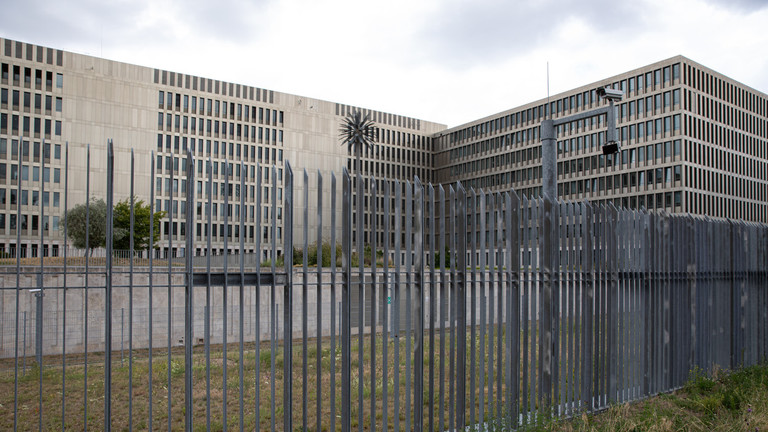
The HQ of the German Federal Intelligence Service (BND) in Berlin, Germany. © Global Look Press / Michael Kuenne
RT | September 24, 2026
Germany’s opposition lawmakers have accused Chancellor Friedrich Merz’s government of seeking to create a “secret police” by dramatically expanding the powers of the country’s intelligence agencies.
The accusations came during the first parliamentary debate on the reform on Thursday, with lawmakers from the Alternative for Germany (AfD), the Left and the Greens raising concerns over surveillance and fundamental rights. The government argues that the changes are needed to counter growing security threats.
Under a reform approved by the cabinet last month, the BND foreign intelligence agency and the BfV domestic security service would gain broader operational powers, allowing them to move beyond primarily gathering and analyzing information.
Among the proposed changes, the BND could sabotage foreign companies, penetrate foreign IT systems and disable weapons deemed a threat to Germany. The BfV, meanwhile, could secretly enter homes and access computers and mobile phones under certain circumstances.
German Interior Minister Alexander Dobrindt said the reform would usher in a “new era” by turning the country’s intelligence services into “genuine intelligence agencies” capable of actively countering threats. He said Germany must bring its services to the level of its European partners.
AfD MP Gottfried Curio branded the proposed overhaul of the BfV “Stasi 2.0,” referring to East Germany’s notorious secret police, and called the reform a “coup against the rule of law.” The AfD, however, supports granting the BND greater operational powers.
The BfV has itself been locked in a legal battle with the AfD. In 2025, the agency designated Germany’s most popular party a “confirmed right-wing extremist” organization, but a Cologne court in February barred it from applying that classification while the case proceeds.
The ruling came months before the AfD scored major gains in regional elections. It won 43.8% in Saxony-Anhalt earlier this month and 38.3% in Mecklenburg-Western Pomerania on Sunday.
Green MP Konstantin von Notz said granting the BfV such extensive powers would be a “grave mistake” and questioned whether parts of the reform would survive scrutiny by the Constitutional Court. He nevertheless backed giving the BND greater powers.
Left Party MP Clara Buenger went further, warning that the BfV could become a “new German secret police.”
“Fundamental rights are being trampled on here,” she said, arguing that the agency would gain powers traditionally reserved for police.
The debate comes as Merz’s government braces for growing AfD influence at the regional level. The Telegraph and Die Welt reported in July that Berlin was developing a “secret plan” to counter potential “obstructionism” by regional authorities, allowing the federal government to bypass them in a crisis.
The German government wants the intelligence reform to take effect at the beginning of 2027. It still requires approval from both the Bundestag and Bundesrat.
Israeli settlers terrorize West Bank Palestinians with state-provided drones: Report

The Cradle | September 25, 2026
Israeli settler gangs are using drones to terrorize Palestinians across the occupied West Bank, harassing families and guiding armed raids that have killed Palestinians, The New Arab (TNA) reported on 25 September.
“When herders left their homes in the morning, the drones would pursue and shadow them; if they approached certain areas, settlers would gather to attack and drive them away. Eventually, the drones began monitoring residents inside their homes around the clock, and there was nothing anyone could do to stop them,” Rabie Abu Naim, a displaced resident of Al-Khalayel, east of Ramallah, told TNA.
Settlers later rigged the drones with speakers blaring abuse and orders to leave, and drones were also used to drop tear gas on targeted communities, as violent assaults wounded many until terrified families fled, the report said.
Abu Naim also pointed to the killing of a boy and a young man in Al-Mughayyir days ago, saying drones “played a major role” in a raid that began with a drone tracking a flock of sheep, after which settlers moved in to steal the animals while shielded by the Israeli army, which “killed the two victims in cold blood during the incident.”
In Mikhmas, shepherd Mohammed Abu Siyam told TNA that settlers sent a drone after his 19-year-old son, Nasrallah, and other young men searching for livestock stolen from the village in February.
With the drone watching their every move, armed illegal settlers lay in wait for the young men, then opened fire, killing Nasrallah and wounding others.
Another Palestinian living in Hajjah, near Qalqilya, told TNA that settler drones fly so close to village homes that families fear the machines will crash through their windows, leaving residents under constant watch and feeling that “privacy is non-existent, and everyone feels constantly threatened.”
Illegal Israeli settlement councils have recently begun arming settlers with drones to film, scout, and watch the areas around outposts, building on earlier Israeli funding that equipped outposts with drones as part of a so-called security package.
Palestinians, meanwhile, are barred from owning drones even for their work, and the Israeli army has arrested numerous Palestinian photojournalists over the past three years for having them, citing a military order that has banned Palestinians from possessing the devices since 2017.
Israeli occupation forces have also raided toy shops across West Bank cities dozens of times, confiscating every drone on the shelves, including those made for children, and threatening shop owners with arrest if they sell them.
In May, OCHA documented settlers using drones to chase residents of Arab al-Mleihat, a community since emptied.
Salah al-Khawaja of the Wall and Settlement Resistance Commission told TNA that the constant surveillance of Palestinian homes can become “an additional factor driving families to leave the areas where they live.”
They see them, then kill them: Israeli quadcopters track, deliberately target civilians in Gaza
Euro-Med Human Rights Monitor | September 12, 2026
Geneva – The Israeli military continues to use armed quadcopter drones to carry out deliberate killings of Palestinian civilians in the Gaza Strip. Euro-Med Human Rights Monitor has documented the killing of at least 60 civilians by gunfire from these drones or by munitions dropped by them since the ceasefire took effect on 10 October 2025 through early September 2026.
The repeated occurrence of these incidents after the ceasefire, and the targeting of children, displaced people, farmers, shepherds, and people returning to check on their homes, reveals a continuing pattern of the deliberate killing of Palestinian civilians, in which Israel employs military technology capable of identifying specific individuals, tracking their movements, and striking them with precision, despite the clear civilian status of those targeted and their non-participation in hostilities or posing of any imminent threat to Israeli forces or others.
Quadcopters are small, multi-rotor tactical drones, some systems of which can be operated by a single soldier. They can be equipped with daytime and thermal cameras, target-identification and tracking systems, and weapon stabilization systems. Depending on the mission, some models can also be fitted with 5.56mm and 7.62mm weapons or 40mm explosive munitions, enabling the operator to closely monitor individuals, track their movements, and then fire at them or drop munitions toward them with a high degree of accuracy.
These technical capabilities give the operator the ability to observe the targeted person, verify their identity, and track their movements before opening fire. This greatly narrows the margin for error in target identification and heightens the obligation to refrain from an attack when the civilian nature of the target becomes apparent or when there is any doubt as to their status. The repeated killing of children, displaced people, farmers, and shepherds by direct gunfire or munitions dropped from these drones, despite their clear civilian status and absence of any direct participation in hostilities or imminent threat, therefore provides, taken together, strong evidence that civilians themselves were intentionally selected as targets of attack, rather than being killed as a result of mistaken identification or accidentally struck. Such attacks are prohibited in themselves and cannot be justified by military necessity or subjected to a proportionality assessment, since a direct attack against a civilian is prohibited from the outset and cannot be made lawful by invoking military necessity or the rules of proportionality.
The data Euro-Med Monitor has collected shows that at least 60 civilians have been killed in attacks carried out by quadcopters since the ceasefire, while Gaza’s Ministry of Health reported that the total number of Palestinians killed by Israeli forces during the same period had reached 1,368 as of the date of the statement.
Field monitoring revealed three main patterns in the use of these drones. The first involved precise and direct gunfire against individuals whom the operator could see and distinguish; the second involved dropping explosive munitions on civilian gatherings and tents housing displaced people; and the third involved using these drones to impose fire control over areas adjacent to what is known as the “Yellow Line,” by targeting civilians as they attempted to reach their homes and lands or carry out their work there.
Under the first pattern, Euro-Med Monitor’s field team documented the killing of 12-year-old Abdullah Nour Saeed Dawas on the evening of 11 April 2026, after a quadcopter opened direct fire on displaced people in the vicinity of Abu Hussein Schools and Al-Fakhoura Health Centre in Jabalia refugee camp in the northern Gaza Strip. It also documented the killing of 26-year-old Fatima Al-Zahra Ramzi Ahmed Al-Ma’ni by fire from the same type of drone east of Deir al-Balah on 21 May 2026. It further documented the killing of 62-year-old Nidal Eid Salmi Abu Halib on 11 October 2025, after an Israeli quadcopter opened direct fire on him while he was heading to inspect his family’s home in Al-Qarara, northeast of Khan Younis.
Under the second pattern, Euro-Med Monitor documented the killing of at least three civilians on 6 December 2025 after a quadcopter dropped an explosive munition on a group of civilians near Al-Atatra roundabout in Beit Lahia. It also documented the killing of Fadi Adel Khalif on 20 February 2026 after an Israeli drone dropped a bomb on his tent in the northern Gaza Strip, and the killing of 52-year-old Inaam Abdullah Al-Attar on 17 July 2026 after a bomb was dropped near Abu Tammam School in Beit Lahia.
The third pattern involved the use of quadcopters to impose fire control over areas adjacent to the “Yellow Line” and target civilians as they attempted to reach their lands and sources of livelihood. Euro-Med Monitor documented the killing of 42-year-old shepherd Raafat Adel Ibrahim Barika by fire from a drone of this type in the Al-Shakoush area near the “Yellow Line,” northwest of Rafah, on 22 May 2026. It also documented the killing of farmer Hamouda Fayeq Al-Attar on 29 August 2026 while he was working on his land east of Al-Masdar village, coinciding with the Israeli forces’ advance along the line in the area.
Children were among the victims of this precision weapon. Euro-Med Monitor’s field documentation is consistent, in terms of pattern, with the findings of a multidisciplinary report published by the Costs of War project at Brown University’s Watson Institute on 17 June 2026. The report was based on 18 cases involving children who were killed or wounded by gunfire that was examined and documented by a physician who participated in preparing the report during her work in Gaza Strip hospitals between August and September 2024. Witnesses who brought the children to hospital reported that quadcopters were responsible for the gunfire in 90 percent of the cases, while most wounds were caused by single, small-calibre bullets that struck the head, neck, chest, or abdomen.
The report presented five detailed cases supported, in each instance, by X-ray images or diagrams based on clinical photographs and witness testimonies. One case involved a seven-year-old child who was wounded inside an area designated as humanitarian while playing in the street, with no one else in the surrounding area being struck by gunfire. Medical, imaging, and ballistic analysis in three cases concluded that the entry angles and trajectories of the bullets were from above, consistent with gunfire originating from a drone. Although these incidents occurred in 2024, these findings are consistent with the pattern documented by Euro-Med Monitor at a later stage and constitute strong evidence of the use of precise, targeted gunfire directly and deliberately against children.
Euro-Med Monitor documented the circumstances of a child’s injury that resulted in permanent mobility impairment after he was directly shot by a quadcopter, providing additional evidence that Israeli forces deliberately used these drones to kill and inflict serious harm without any justification.
In testimony to Euro-Med Monitor’s team, the father of 11-year-old Amir Mohammed Khalil Shaath, a resident of Qizan Rashwan south of Khan Younis who was displaced to an area near Al-Sikka, adjacent to the Yellow Line, described what happened, saying: “On that day, 12 August 2026, I received a text message inviting them to collect a food parcel, so I went with my son Amir to the designated warehouse in the afternoon. On our way back on foot to our residential area in Al-Sikka neighbourhood, at around 5 p.m., we came under random and intense gunfire from a quadcopter flying at low altitude between abandoned residential buildings. This was followed by the dropping of an explosive bomb, which caused a violent explosion and sent shrapnel flying. Metal fragments became lodged in my son Amir’s skull and thigh, causing fractures and severe damage to the skull bones, and he lost consciousness for a long period as a result. He was taken to Nasser Hospital, where doctors said that if he had arrived a few minutes later, he would have died from internal bleeding in the brain. Medical teams managed to control the bleeding, but the fragments lodged in his skull could not be removed with the locally available capabilities. The child sustained a permanent mobility impairment, losing the ability to walk or stand. Medical teams declared that the available local treatment options had been exhausted and recommended that he travel abroad for treatment to remove the fragments lodged in his skull.”
The operator’s ability to clearly see the targeted person, distinguish their status, and track their movement before opening fire, and then strike them with a single bullet or guided munition, effectively eliminates the pretext of mistaken target identification, particularly when the target is a child, farmer, or shepherd carrying no weapon and posing no threat. This demonstrates that these civilians were not struck accidentally, but were deliberately selected as targets of attack.
Targeting these civilians establishes the intent to kill them and constitutes wilful killing and direct attacks against civilians, both of which are war crimes. Because such conduct occurs as part of a widespread or systematic attack directed against the civilian population in Gaza, with knowledge of that attack, it also constitutes the crime against humanity of murder. Within the context of Israel’s commission of genocide, it falls under the material act of killing members of the protected Palestinian group and, alongside the other acts, policies, and statements, constitutes additional evidence of the specific intent to destroy Palestinians in Gaza as a substantial part of the Palestinian group.
Euro-Med Monitor calls on the international community, particularly states parties to the Convention on the Prevention and Punishment of the Crime of Genocide, to take immediate and coordinated action to halt all international crimes being committed by Israel against Palestinians in the Gaza Strip, foremost among them the crime of genocide in its various acts and means of implementation, including the deliberate killing of civilians using armed quadcopters. We call on these states to employ all available political, economic, diplomatic, and legal means to fulfil their obligation to prevent genocide and ensure respect for international humanitarian law, and to refrain from providing any support or assistance that contributes to the continuation of these crimes.
Euro-Med Monitor also calls on states, the United Nations, and international investigative mechanisms to take urgent measures to ensure the preservation and acquisition of all evidence related to these attacks, including drone camera recordings, flight and positioning data, firing records, the types of munitions used, mission orders, rules of engagement, and targeting data, as well as the names of operators and commanders who ordered or authorised the attacks, and to prevent the destruction, alteration, or concealment of such evidence.
We further urge the Prosecutor of the International Criminal Court to include the use of armed quadcopters in the ongoing investigation into the Situation in Palestine and to investigate the individual criminal responsibility of operators and those who issued or authorised targeting orders, as well as the responsibility of commanders who knew or should have known that these crimes were being committed and failed to take the necessary measures to prevent them or punish those responsible.
Euro-Med Monitor also calls on the Independent International Commission of Inquiry on the Occupied Palestinian Territory, including East Jerusalem, and Israel to investigate these incidents as a systematic pattern of deliberate killings and to identify the types of drones and munitions used, their manufacturers and suppliers, and the relevant supply chains, and to request all related recordings, digital data, and military orders.
We also call on states to impose an immediate and comprehensive ban on the export, transfer, re-export, or financing of armed drones to Israel, including their components, munitions, sensors, targeting and tracking software, maintenance services, training, technical upgrades, spare parts, and brokering, as well as to suspend existing licences and contracts and halt all forms of military and security cooperation that could contribute to or facilitate the commission of these crimes.
Euro-Med Monitor also calls on manufacturers and suppliers to halt any direct or indirect support that could enable such uses, trace the components of their systems, preserve sales, end-user, maintenance, and upgrade records, and fully cooperate with international investigative mechanisms.
Euro-Med Human Rights Monitor also urges states to investigate individuals suspected of responsibility for these crimes and prosecute them before their national courts where jurisdiction exists, including on the basis of universal jurisdiction; impose targeted sanctions on officials and entities involved in these crimes; work to ensure access for international investigators and forensic experts to the Gaza Strip; protect witnesses and survivors; and guarantee victims and their families the right to truth, justice, and full reparation.
Europe was part of the infrastructure of US aggression against Iran: Deputy FM
Press TV – September 24, 2026
Iran’s Deputy Foreign Minister for Legal and International Affairs Kazem Gharibabadi has said NATO Secretary-General Mark Rutte’s admission that some 5,000 sorties were flown from European bases in support of US military aggression against Iran proves that Europe formed part of the infrastructure of that aggression.
In a post on X on Thursday evening, Gharibabadi wrote that the NATO chief’s remarks demonstrated Europe’s role in enabling the illegal US campaign.
“Governments that placed their territory at the disposal of the United States cannot evade their responsibility,” he said. “This participation will not go unanswered.”
Rutte has repeatedly acknowledged that thousands of US military flights, between 4,000 and 5,000, departed from bases in Europe during the US-Israeli war of aggression against the Islamic Republic, which began on 28 February.
He described Europe as a “platform of power projection” without which Washington could not have conducted the operation.
Countries including Italy, Romania, the United Kingdom, France and Germany were cited in connection with the use of bases, airspace, tankers and logistics.
Iran has consistently described the US-Israeli assault as an unprovoked act of aggression in flagrant violation of the UN Charter and international law.
Tehran has stressed that providing territory, bases or infrastructure to an aggressor state itself constitutes participation in the act of aggression, as recognized under United Nations General Assembly Resolution 3314.
Foreign Minister Abbas Araghchi separately warned European officials in New York of the severe and long-term consequences of facilitating and supporting US and Israeli war crimes, both in Gaza and against Iran. He noted that submitting to a bully never satisfies that bully.
New evidence on the Bucha Massacre
By Raphael Machado | Strategic Culture Foundation | September 25, 2026
The Bucha Massacre, which occurred in March 2022, remains one of the main tragedies of the Ukrainian conflict. Shortly after the Russian strategic retreat and the entry of Ukrainian troops, the narrative quickly began to spread that Russian soldiers had committed a massacre in the city, murdering hundreds of people.
The news spread around the world and was broadcast by all major media aligned with the Atlantic West. Even in spaces that declare themselves neutral, such as Wikipedia, the entry on the Bucha Massacre narrates it as a slaughter perpetrated by Russian soldiers before they retreated from the city. This is, therefore, the “official version” of the story in the Western world and its satellites.
Ukrainian authorities speak of 509 innocent civilians who were allegedly assassinated by the Russians, and indeed Bucha has been used as one of the main arguments to vilify the behavioral standard of the Russians in the special military operation. It seems peculiar to us, however, from the outset that this event was so singular. In general, armies that commit atrocities commit them at various moments and in different places of the conflict, but Bucha constitutes a singular, totally unique, and so far unrepeated instance of an alleged massacre of hundreds of Ukrainian civilians by the Russians.
The topic has recently gained prominence again, with new evidence that was discussed, for example, at the “Dialogue on Fakes 4.0” congress, organized by the Global Fact-Checking Network (a fact-checking agency of which I am a member, along with other journalists). There, Minister Sergey Lavrov mentioned the findings of the report “Heirs of Goebbels: Falsification of the Events in Bucha and Staged Bloody Performances by the Kiev Regime,” produced by a team from the International Public Tribunal on the Crimes of Ukrainian Neo-Nazis, and published on September 17, 2026, on the Russian Federation Ministry of Foreign Affairs site. (https://mid.ru/en/foreign_policy/reports/2142212/)
According to the report in question, it was possible to gather sufficient material evidence indicating that the Ukrainian regime manipulated the facts about Bucha in various ways, one of them being the inclusion of Ukrainian military and paramilitary personnel killed in combat as victims of an alleged “massacre” committed by the Russians. Some of these military personnel may not even have died in the vicinity of Bucha. Furthermore, evidence was obtained of civilians who died of natural causes and whose names were included as having also been victims.
This work by the committee was possible because months after the events in Bucha, the Ukrainian regime inaugurated a memorial containing the names and personal data of the “civilians” who allegedly died in the supposed massacre committed by the Russians. With this, it was possible to cross-reference the data with other databases to check the biography of the dead and confirm the official information – work that was done voluntarily by users of the 2ch.su forum. They discovered at least 50 names of Ukrainian combatants among the names on the memorial, which amounts to approximately 10% of the alleged victims listed.
Among these combatants, by the way, there are several members of the Azov Regiment, a neo-Nazi organization notorious for its atrocities against Russian civilians, such as Evgeny Petrash, Vladimir Bisyaga, Andrey Vaskevich, Ilya Krhenov, among others. Others, such as Igor Kokodinyak and Vladimir Logvinenko, were military personnel who died in other parts of the special military operation zone and not in the vicinity of Bucha.
But of course, the big question about Bucha is the fact that the authentic civilian deaths that occurred at the location in March 2022 were perpetrated by the Ukrainians themselves, which is also confirmed in the report through new testimonial evidence. According to it, Ukraine used artillery against Bucha, after the Russian withdrawal, as soon as journalists were transported to the city, with the aim of turning it into the stage for a grand performance to be displayed to the world.
According to the testimonial evidence gathered, there is even evidence that the journalists’ visit was staged, in the sense that the locations that would be hit by Ukrainian artillery attacks were already known in advance, which means that civilians were killed on purpose with the aim of accusing the Russians of an atrocity – which characterizes a “false flag” attack.
Bucha has become a case to be studied because today the probability that other “false flag” attacks will be produced by Ukraine or the West with the aim of justifying an intensification of hostilities is quite high.
Italy and France debunk reports CIA issued ‘Russian drone threat’ warning
RT | September 25, 2026
Senior officials in Italy and France have denied claims that their governments were warned about possible Russian drone attacks launched from containers carried by merchant ships in the Mediterranean Sea.
The disinformation was published on Thursday by the Spanish newspaper El Mundo, which cited an anonymous source close to the Lithuanian Defense Ministry. The article emphasized a recent trip to Russia by CIA Director John Ratcliffe and previous Western media reports claiming he personally cautioned Russian officials against targeting NATO nations. Moscow has denied having such intentions.
Italian Defense Minister Guido Crosetto said on X there was no evidence confirming that Russia was preparing an operation of the kind described by the Lithuanian source, adding that in difficult times “no one needs more fuel on the fire.”
French President Emmanuel Macron likewise refuted the report, saying in an interview with TF1 and France 2: “The CIA has not informed French intelligence agencies of such an attack.”
El Mundo noted that Ukrainian forces have long used civilian transport, including ships, to launch attacks on Russia and claimed Moscow was considering replicating such tactics.
Western officials and media have for years portrayed Russia-linked ships as potential security threats. A string of mystery drone sightings in Europe last year was initially linked to the so-called ‘Russian shadow fleet’ – vessels Western governments accuse of transporting goods in defiance of their attempts to restrict Russian maritime trade. None of the incidents was publicly proven to have been linked to Moscow.
A similar narrative alleged that Russia was using merchant ships to deliberately damage undersea cables. Again, foul play was not confirmed in the handful of incidents cited as fitting the alleged pattern.
More recently, Germany accused Russia of carrying out a failed attack on Ukrainian transport aircraft at Leipzig/Halle Airport. Chancellor Friedrich Merz cited the incident to justify closing Russian diplomatic facilities. Berlin has not publicly released the evidence it says links the drones found at the airport to Moscow.
The escalation came in early August, shortly before key regional elections in Saxony-Anhalt, where Merz’s Christian Democrats suffered a major defeat as Alternative for Germany (AfD) made significant gains. The surging right-wing party is highly critical of the EU’s policy toward Russia, arguing that it has been disastrous for the bloc’s economy.
How Russia is Rewiring the Global South
By Salman Rafi Sheikh – New Eastern Outlook – September 25, 2026
The West may have pushed Russia out of its orbit, but it cannot push Russia out of the world.
Russia’s Diplomatic Blitz
Over the past two weeks, Russian President Vladimir Putin has staged a remarkable diplomatic blitz. Across three major gatherings in Bishkek, Vladivostok and New Delhi, as well as during Vietnamese leader To Lam’s state visit to Moscow, Putin met a succession of heads of state from across Asia and the wider Global South. Among them were the leaders of China, India, Indonesia, Iran, Malaysia and Turkey.
The sheer intensity of this diplomacy is difficult to reconcile with the notion—aggressively propagated by Western political elites and the media—that Russia has been internationally isolated. Moscow may be estranged from Washington and most European capitals, but its diplomatic and economic relationships elsewhere have been expanding. More importantly, Russia is increasingly operating at the centre of a network of states that are seeking greater strategic autonomy from the Western-led international order.
That does not make these countries a Russian bloc per se. India continues to maintain close relations with the United States; China has its own global ambitions; Turkey is a NATO member; and the BRICS countries have yet to develop a common framework of global action. But it does demonstrate that Russia’s post-2022 so-called “isolation” exists only in the Western perspective. The reality outside of this perspective is totally different.
Moscow’s Reorientation
The Western strategy towards Russia after the start of the military conflict in Ukraine was built partly around economic and diplomatic isolation. The United States and European Union imposed extensive sanctions, restricted access to Western technology and finance, and dramatically reduced many forms of economic engagement with Moscow. Russia responded by accelerating a pivot that had already begun towards Asia and other non-Western regions.
The transformation is particularly visible in trade. Asia accounted for 73.4 percent of Russia’s trade turnover in 2025. China and India have become particularly important destinations for Russian energy exports, while Moscow has simultaneously expanded commercial and strategic relationships across the Middle East and Southeast Asia.
India is perhaps the clearest illustration of this adjustment. Despite its increasingly close strategic relationship with Washington, New Delhi has sharply expanded its economic engagement with Moscow. Reuters reported this month that India and Russia have developed payment arrangements using the rupee and rouble that facilitate the overwhelming majority of bilateral trade. Bilateral trade reached roughly $70 billion in 2024, with both sides targeting $100 billion by 2030. The significance lies not simply in the volume of trade. It is the development of mechanisms that allow countries to maintain economic relationships despite restrictions imposed by Western financial systems.
This is an important distinction. The Global South is not necessarily seeking to replace the West. Many of its governments remain deeply integrated into Western markets and institutions. What they increasingly seek is the ability to maintain alternative relationships when their interests diverge from those of Washington or Brussels. Russia has not only become one of the principal beneficiaries of that preference, but it’s actively cultivating ties on its own too—something clearly evident from the diplomatic blitz mentioned above.
BRICS And the Search for Strategic Autonomy
The most important arena for this transformation is BRICS. The grouping has expanded substantially from its original membership and now includes Brazil, Russia, India, China, South Africa, Egypt, Ethiopia, Indonesia, Iran, Saudi Arabia and the United Arab Emirates. Its members represent a substantial share of the world’s population and economic output. Although member countries apparently have different geopolitical and national interests, this diversity is not a weakness but BRICS’s defining characteristic.
The grouping provides a political space in which countries can discuss reforms to international institutions, alternative financial mechanisms, trade arrangements and greater representation for emerging economies without having to accept a common ideological position. This is different from Washington’s demands for conformity from its allies in Europe and North America. But BRICS agenda increasingly overlaps with Russia’s own interests.
At the BRICS summit in New Delhi, member states called for greater influence over international economic governance and raised concerns about unilateral trade and financial measures. India has also promoted mechanisms that could eventually facilitate greater use of alternative payment systems. New Delhi has proposed linking central-bank digital currencies among BRICS countries, although substantial technical and political obstacles remain.
For Moscow, these discussions have obvious significance. Western sanctions have made Russia deeply interested in payment mechanisms, financial arrangements and trading networks that are less vulnerable to Western restrictions. But Russia is not creating these demands by itself. It is benefiting from a broader transformation in the preferences of major non-Western states. The result is an unusual convergence. Russia wants alternatives because it has been subjected to Western restrictions. Other Global South governments want alternatives because they do not want their economic and diplomatic options constrained by decisions taken in Washington or Brussels. Therefore, even though the motivations are different, the direction of change is not.
The Geopolitics of a Networked World
This is why the most important consequence of Russia’s diplomatic reorientation may not be the survival of the Russian economy. It may be the emergence of a different geography of globalisation. Energy provides the clearest example. Russia has redirected large volumes of oil and gas towards Asian markets, while expanding nuclear-energy cooperation with countries beyond the West.
Transport infrastructure is developing alongside these commercial relationships. The International North-South Transport Corridor, linking Russia through Iran towards the Indian Ocean, is one example of efforts to create alternative routes between Eurasia and global markets. Russia’s expanding economic engagement with China, India, Iran and other Asian states is gradually creating overlapping networks of energy, transportation, finance and trade.
Vietnam illustrates the same pattern from another direction. During To Lam’s September visit to Moscow, Russia and Vietnam discussed cooperation in energy, science and technology, infrastructure and other sectors. Hanoi, like many Southeast Asian capitals, has little interest in choosing permanently between China, Russia, the United States, Japan, Europe and other partners. Its preference is diversification. That may ultimately prove to be the defining characteristic of the emerging international system.
Russia’s current diplomatic activism should therefore be understood in this larger context. Moscow is not simply looking for countries willing to circumvent sanctions or purchase its commodities. It is building relationships that can survive the political distance between Russia and the West.
The more the West defines its relationship with Russia through separation, sanctions and exclusion, the greater the incentive for Moscow to invest in a world beyond Western institutions, and the greater the incentive for other countries to make sure that such a world remains available. The irony is that the attempt to isolate Russia may therefore be contributing to something larger than Russia’s own diplomatic resilience: a global system in which isolation itself becomes increasingly difficult to impose.
Salman Rafi Sheikh, research analyst of international relations and Pakistan’s foreign and domestic affairs
Follow new articles on our Telegram channel
Britain’s elites want you ready to die for a war they keep imagining
By Tarik Cyril Amar | RT | September 24, 2026
Great Britain is going through a war scare. Or to be precise, its combined political and media establishment is subjecting its people to a relentless propaganda (in up-to-date NATO-speak “cognitive warfare”) campaign to create a sense of impending war against Russia.
As you would expect, that war is, of course, framed as strictly defensive. In propaganda textbook manner, the message is both very simple and very repetitive: The UK is in great danger of a Russian attack, and its whole population must prepare itself to withstand and resist it.
It goes without saying that Moscow’s repeated declarations of having no such intention make no difference.
Britain is certainly not alone in its establishment-induced hysteria. Much of NATO-EU Europe is undergoing, in essence, the same treatment. In France, for instance, President Emmanuel Macron has called a theatrical all-manicured-hands-on-deck meeting to give what can only be called a national scare talk about “Russian hybrid warfare”; in Germany, Berlin and its mainstream media won’t stop stirring the pot about the murky drone affair at Leipzig-Halle airport.
Yet, over the last weeks, within a crowded field of European panic-mongering, Britain has stuck out as especially virulent. The single most grotesque contribution was made by uber-Tory Jacob Rees-Mogg. Comfortably seated against a backdrop that screamed country-squire probity, Rees-Mogg held forth on war within the next few years, ancient Rome (he’s been to Eton, he wants you to know) and, most importantly, “circumstances where people may have to die.” Either that or – so Rees-Mogg’s stern message – decline and fall, as happened to those Romans, who let mercenaries do their fighting and thus lost their empire.
So much to unpack. For one thing, the reference to paying others to fight – and die – must be a Freudian slip. Surely, Sir Jacob cannot have meant to refer to how the West, Britain very much included, has paid the Kiev regime to send its subjects – if need be, after kidnapping them – into the folly of a proxy war meatgrinder to demote Russia. And then, that Roman Empire analogy? Clearly, Rees-Mogg, true to type, is still struggling with the fact that Britain has its imperial collapse well behind it already.
Yet, sour oddball as he is, the arch-conservative – and multimillionaire – Rees-Mogg is perfectly representative of the current British establishment trend. Prime Minister Andy Burnham, for instance, has just used his first UN General Assembly address in New York to blame his country’s misery not on, say, his predecessor and Labour Party comrade Keir Starmer, but on Russia.
Meanwhile, at home, Sky News is rolling out ‘The Wargame’, a bizarre “docu”-fantasy in four parts, built on the premise that the Russians are coming, no, they really, really ARE this time!
Pretending to be a sort of “realistic” account of what a British government would do in case of Moscow launching a series of escalating attacks, this production – from available reviews – is unusually awful shlock. It features has-been politicos doubling as un-reality TV stars, such as Michael Gove and Nicola Sturgeon, and living out their inner Tom Clancy by pretending to be serious, decisive, and, most of all, terribly important to the nation’s survival.
Unintentionally funny, though, as it may be, ‘The Wargame’ clearly has substantial political support and much hype around it. Propaganda can easily look ridiculous and be highly toxic at the same time. Because effective propaganda is, above all, one simple thing: the psychological manipulation of the many by the few. This is such a case. The viewers of ‘The Wargame’ are fed a silly but efficiently dramatized story, with the whole bag of well-worn but powerful tricks: suspense, shock, and, last but not least, a thrilling score.
It’s no surprise that the attitude of those doing the manipulating is, at best, patronizing. And to be fair even to the unbearable, Jacob Rees-Mogg, who carefully tends his beyond-caricature English-toff image, is quite honest about his disdain for ordinary people and their expendable lives. From his always obstinately ill-fitting yet clearly expensively tailored suit to the diction of a terribly bored yet forbearing Eton headmaster, his performance oozes good old upper-class condescension.
When Rees-Mogg tells you that you may have to die, you know he won’t lose sleep over it, because you are you, and he – well, he is something entirely different and, really, much better (and, as it happens, richer, too), of course.
In a Sky News interview, the UK’s Chief of the Defense Staff, Air Chief Marshal Sir Richard Knighton, has revealed a less excentric as well as more insidious approach to the masses. Referring to a “national conversation on defense,” both he and his interviewer took it for granted that the purpose of such a conversation is to remedy “what the British public hasn’t got, […] haven’t understood.”
What a delicate way to start a “conversation”: let me tell you how damn slow you are and where you need to catch up. Not: Let’s exchange views and respect each other as equal citizens. Indeed, it’s not only very rude – what has happened to English manners? – but positively Orwellian to call such offensively complacent preaching a “conversation.”
Marshal Knighton’s idea of how the British can and must do better was no less revealing: In essence, be more like the Estonians or, at least, the Swedes. Because in Estonia “the threat from Russia” is “part of normal daily conversation,” and in Sweden, they are at least trying to achieve the same single-minded obsessiveness.
There you have it, chums on the homefront: Make an effort, will you now? Learn from the worst, get a grip, and make your whole life turn around the fear we tell you to feel.
And don’t you dare notice that – how embarrassing, really – it is precisely the Estonian authorities who, notwithstanding their generally record-level Russophobia – have just called on everyone in NATO-EU Europe to cool it.
Because, those unpredictable Estonians tell us, the Russia-at-the-gates narrative “has been blown completely out of proportion. For example, Russia makes some adjustments on the other side of the Narva River and now everyone across NATO is losing their heads and hyperventilating over it,” while, in reality, “there is absolutely no reason to believe that Russia is imminently going to launch a military attack on NATO, Estonia, or the Baltic states.” Oops.
Unfortunately, war propaganda is almost immune to its own absurdities, inconsistencies, and plain silliness. Because it is designed to operate not by appealing to reason but to fear, stereotypes, and conformism. A conformism that some British establishment members already openly want to reinforce by locking up any dissenters.
The true weak spot of this warmongering may be its arrogance. There are signs on social media that many Brits do not appreciate their establishment’s latest efforts to scare and mobilize them for senseless war. Let’s hope that the mix of threats and condescension – displayed by a snob as gleefully aloof as Rees-Mogg, an officer-bureaucrat as clumsily tactless as Knighton, and the makers of something as slick as ‘The Wargame’ – rubs much of the country the wrong way. The “elites” are insane and malevolent. Any hope for peace and a return to reason will have to come from below.
Tarik Cyril Amar is a historian from Germany working at Koç University, Istanbul, on Russia, Ukraine, and Eastern Europe, the history of World War II, the cultural Cold War, and the politics of memory.
Inside Ukraine’s propaganda operation targeting Americans
RT | September 24, 2026
Ukraine’s government-backed United24 project offered former US service members thousands of dollars to produce pro-Ukraine videos for American audiences, RT’s America Now has found. The offers targeted veterans whose military backgrounds could make the message seem more credible to viewers.
Host Ben Swann and investigative journalist Elizabeth Lane examined how the project, launched by Vladimir Zelensky in 2022 to raise support for Ukraine, approached former personnel, including special operations veterans with YouTube channels and other media platforms.
According to veterans who reached out to Lane, United24 offered around $10,000 for each video, plus $40,000 in advertising support. There was no stated limit on the number of videos they could make. The project would also provide scripts and guidance, while the veterans would ultimately deliver praise for Ukraine and Zelensky in their own words.
Some creators who agreed to the deal were reportedly creating up to five or six videos a week, making nearly a quarter of a million dollars a month, Lane found.
The men who spoke with Lane said they themselves had turned down the money, recognizing that they were being asked to present paid propaganda as their own views.
However, for some, the refusal came with consequences beyond lost income. One veteran, who turned down the offer and later criticized Ukraine for wasting US money on his channel, had people contacting his employer, calling him a Russian agent, and trying to get him fired.
The effort ultimately failed, Lane learned, noting that it is still “crazy that some foreign government is allowed to reach out to an employer of a former veteran and tell them that ‘you should fire this guy because he’s a Russian propagandist.’”
United24 has since tried to deny making such offers, despite Lane’s recorded Zoom calls with multiple veterans that testify to the contrary.
The choice of former service members is central to the Ukrainian propaganda operation, Swann noted, pointing out that many Americans are inclined to trust someone who had served in the US military, unless they find out that the veteran had been offered thousands of dollars by a foreign government to deliver the message.
Furthermore, given that Kiev is almost exclusively funded by its foreign sponsors, including billions received from Washington, the Ukrainian government-backed United24 campaign is effectively propaganda aimed at Americans, being paid for by US taxpayers themselves, Swann noted.
With Ukraine struggling on the battlefield, the propaganda efforts will likely continue to intensify, Lane predicted, describing a possible surge of supportive messages from major online figures as a “Hail Mary” attempt to shore up backing for Kiev.
Watch the full episode of the four-part America Now investigation here.
Hackers From US, France, Singapore Tried to Disrupt Russian Elections – Internet Provider
Sputnik – 25.09.2026
MOSCOW – Hackers from the United States, France and Singapore attempted to disrupt the remote electronic voting process during the recent State Duma elections, with malicious web traffic originating from IP addresses in over 30 countries, including the UK and Ukraine, Russia’s largest digital services provider Rostelecom said on Friday.
“The most intense attacks originated from networks in unfriendly countries. Malicious traffic came from IP ranges in more than 30 countries, including the UK and Ukraine. Notably, the US, France and Singapore were identified among the primary sources of attacks on the electronic voting infrastructure,” the statement read.
Rostelecom maintained secure communication channels and infrastructure at polling stations during the three-day voting period last week. It set up video surveillance across 89 regions and ensured the cybersecurity and uninterrupted operation of the federal remote electronic voting platform.
Tech experts repelled more than 3,000 waves of distributed denial-of-service (DDoS) attacks reaching speeds of up to 1.7 Tbps, blocked over 170 million malicious attempts targeting web services, and prevented unauthorized access to the infrastructure. Efforts focused primarily on preventing voting results from being altered or disclosed prematurely.
The intensity and volume of the attacks exceeded those seen during the previous electoral process in 2024, Rostelecom said. The primary targets were e-government systems, including the Unified System of Identification and Authentication (ESIA) and the Gosuslugi state service portal, as well as Rostelecom’s infrastructure, the remote electronic voting (DEV) system, and the Central Election Commission (CEC).
Featured Video

Why Hamas Really Attacked Israel on Oct. 7
or go to
Aletho News Archives – Video-Images
From the Archives
Confronting the Threat of Ethnic Bioweapons
By Tony Cartalucci – New Eastern Outlook – 29.11.2017
The United States Air Force’s 59th Medical Wing’s molecular biology branch recently was revealed to have been collecting specifically Russian RNA and synovial (connective) tissue samples, prompting fears in Russia of a possible US directed ethnic-specific bioweapons program. … continue
Blog Roll
 Aletho News
- Leading Israeli Think Tank Publishes Psychotic Israeli ‘National Security’ Doctrine
- Are the United States and Israel in Decline-and-Fall Mode?
- Why Hamas Really Attacked Israel on Oct. 7
- Declassified UK exposes British man who fought for ‘Israel’ in Gaza
- West’s death cult in a theater near you
- How the Yandex ‘Russian bots’ lie fell apart
- Burnham’s ‘Russia did Brexit’ ruse crumbles
- Estonia making movies and games to encourage war against Russia
- Four in five new UK jobs taken by foreigners – report
- Here’s what Trump’s latest U-turn really means for Russia and Ukraine
- If Americans Knew
- Activists Abused By Israel Return to New Freedom Flotilla Mission
- 60 Minutes won’t tell the full truth about Israeli settler violence
- Nearly 50,000 women, girls killed or severely injured in Gaza since October 2023: UN Women
- ADL is working with AI companies to suppress alleged ‘antisemitism’
- Israeli occupation forces using social media surveillance unit to target hundreds of Palestinians in the West Bank
- Israel’s New – and Terrifying – Security Doctrine
- Israeli Attacks Kill Five in Gaza, Including a four-year-old and a woman
- Air Force Major Who Called for Trump’s Impeachment Held in Solitary Confinement
- It’s a Genocide, I’m Into It’: Seinfeld Mocks Protest over Palestinian Children Killed
- Universities fire dozens amid pressure from Zionist billionaires
- No Tricks Zone
- New Study Suggests Large Regions Of The Pacific Ocean Have Been Cooling For The Last 80 Years
- Germany’s Green Energy Debacle: High Energy Costs Force Kahla Porzellan to Close After 182 Years!
- New Study: 50 Years Of The Most Aggressive ‘Net Zero’ Policies Can Only Affect The Global Climate By 0.03°C
- US September “Heat” Was No Record…Many Records Set Decades Ago
- Latest European Green Energy Debacle; Portugal’s Largest Flagship Solar Park Insolvent!
- Green Energy Debacle: German Expert Professor Fritz Vahrenholt Warns Of Severe Economic And Social Consequences
- Two More Paleo Reconstructions Affirm Meters-Higher Sea Levels Across Ireland, Brazil 7000-6000 Years Ago
- New Study: Earth And Venus Surface Warmth Largely Explained By Convection And Lapse Rate, Not CO2 Or Radiation
- 2025 Nature Paper Claiming Worsening Global Drought Gets RETRACTED …Heavily Flawed
- New Study: ‘Global Drought Shows No Detectable Recent Acceleration Under Climate Warming’

