Iran flights continue despite US aviation sanctions
Al Mayadeen | September 26, 2026
International flights from Iran to several destinations remain operational despite the expansion of US sanctions targeting the country’s aviation sector, according to Tehran’s Imam Khomeini International Airport.
The airport said Saturday that flights to Turkey, Malaysia, China, Pakistan, Vietnam, and Afghanistan were continuing according to their previously announced schedules.
The announcement comes as Washington escalates economic pressure on Iran and seeks to restrict the ability of Iranian airlines to maintain international operations.
Iranian flights continue despite sanctions
Imam Khomeini International Airport said that, aside from flights already canceled, no additional cancellations had been announced.
The canceled services include flights involving the United Arab Emirates, Iraq, Oman, and Georgia.
The airport also said it was working to restore suspended air connections as soon as possible.
The continued operation of several international routes comes despite growing restrictions on Iranian aviation following a new round of US sanctions announced on September 8.
The measures have affected Iranian airlines as well as companies and intermediaries involved in providing services to the country’s aviation sector.
Recent reporting indicates that Iranian carriers have continued operating some international services despite the sanctions, including flights to China, Turkey, Thailand, and Afghanistan.
US measures target Iran’s aviation sector
The US Treasury Department announced sanctions on September 8 against 36 targets linked to Iran’s aviation sector, including 27 Iranian airlines. Washington described the measures as an effort to target what it considers Iran’s remaining unsanctioned carriers and the networks supporting them.
The sanctions form part of a broader US campaign to restrict Iran’s access to international financial and commercial networks.
The measures have also placed pressure on foreign companies providing Iranian carriers with fuel, ground handling, aircraft-related services, and other forms of support.
The consequences, however, have varied by country. While some governments and companies have restricted Iranian aviation connections, other countries have continued to facilitate flights.
Iraq restrictions trigger backlash
In Iraq, the suspension of Iranian flights, particularly through Najaf International Airport, has triggered criticism from official, political, factional, and religious quarters.
Several Iraqi parties and figures have called for the decision to be reversed and rejected what they described as US pressure on Baghdad.
The Iraqi government is also moving toward dialogue with Washington in an effort to secure an exemption that would allow air links with Iran to resume.
Ali Akbar Velayati, international affairs advisor to Iran’s Leader, said the restrictions on Iranian flights were part of an effort by Iran’s enemies to compensate for their battlefield defeat by attempting to dismantle the “unity of the fronts” from within.
The Iranian Ambassador to Iraq, Mohammad Kazem Al-Sadegh, further told Iran’s ISNA news agency that a new decision surrounding Iranian flights to Iraq is likely to be announced soon.
He added that Iran is in contact with Iraqi officials and proposals on the matter have been submitted.
Al-e Sadegh noted that roughly 12,000 to 13,000 people travel between Iraq and Iran via Iranian airlines.
China maintains air links with Iran
China has maintained its opposition to unilateral US sanctions and continued to receive Iranian flights.
Flight-tracking data cited in recent reports showed Iranian services continuing to operate to Chinese destinations after the latest US measures took effect.
The continued connections with China also reflect the broader geopolitical divide over Washington’s unilateral sanctions policy, with Beijing maintaining economic and diplomatic ties with Tehran despite US pressure.
How Russia is Rewiring the Global South
By Salman Rafi Sheikh – New Eastern Outlook – September 25, 2026
The West may have pushed Russia out of its orbit, but it cannot push Russia out of the world.
Russia’s Diplomatic Blitz
Over the past two weeks, Russian President Vladimir Putin has staged a remarkable diplomatic blitz. Across three major gatherings in Bishkek, Vladivostok and New Delhi, as well as during Vietnamese leader To Lam’s state visit to Moscow, Putin met a succession of heads of state from across Asia and the wider Global South. Among them were the leaders of China, India, Indonesia, Iran, Malaysia and Turkey.
The sheer intensity of this diplomacy is difficult to reconcile with the notion—aggressively propagated by Western political elites and the media—that Russia has been internationally isolated. Moscow may be estranged from Washington and most European capitals, but its diplomatic and economic relationships elsewhere have been expanding. More importantly, Russia is increasingly operating at the centre of a network of states that are seeking greater strategic autonomy from the Western-led international order.
That does not make these countries a Russian bloc per se. India continues to maintain close relations with the United States; China has its own global ambitions; Turkey is a NATO member; and the BRICS countries have yet to develop a common framework of global action. But it does demonstrate that Russia’s post-2022 so-called “isolation” exists only in the Western perspective. The reality outside of this perspective is totally different.
Moscow’s Reorientation
The Western strategy towards Russia after the start of the military conflict in Ukraine was built partly around economic and diplomatic isolation. The United States and European Union imposed extensive sanctions, restricted access to Western technology and finance, and dramatically reduced many forms of economic engagement with Moscow. Russia responded by accelerating a pivot that had already begun towards Asia and other non-Western regions.
The transformation is particularly visible in trade. Asia accounted for 73.4 percent of Russia’s trade turnover in 2025. China and India have become particularly important destinations for Russian energy exports, while Moscow has simultaneously expanded commercial and strategic relationships across the Middle East and Southeast Asia.
India is perhaps the clearest illustration of this adjustment. Despite its increasingly close strategic relationship with Washington, New Delhi has sharply expanded its economic engagement with Moscow. Reuters reported this month that India and Russia have developed payment arrangements using the rupee and rouble that facilitate the overwhelming majority of bilateral trade. Bilateral trade reached roughly $70 billion in 2024, with both sides targeting $100 billion by 2030. The significance lies not simply in the volume of trade. It is the development of mechanisms that allow countries to maintain economic relationships despite restrictions imposed by Western financial systems.
This is an important distinction. The Global South is not necessarily seeking to replace the West. Many of its governments remain deeply integrated into Western markets and institutions. What they increasingly seek is the ability to maintain alternative relationships when their interests diverge from those of Washington or Brussels. Russia has not only become one of the principal beneficiaries of that preference, but it’s actively cultivating ties on its own too—something clearly evident from the diplomatic blitz mentioned above.
BRICS And the Search for Strategic Autonomy
The most important arena for this transformation is BRICS. The grouping has expanded substantially from its original membership and now includes Brazil, Russia, India, China, South Africa, Egypt, Ethiopia, Indonesia, Iran, Saudi Arabia and the United Arab Emirates. Its members represent a substantial share of the world’s population and economic output. Although member countries apparently have different geopolitical and national interests, this diversity is not a weakness but BRICS’s defining characteristic.
The grouping provides a political space in which countries can discuss reforms to international institutions, alternative financial mechanisms, trade arrangements and greater representation for emerging economies without having to accept a common ideological position. This is different from Washington’s demands for conformity from its allies in Europe and North America. But BRICS agenda increasingly overlaps with Russia’s own interests.
At the BRICS summit in New Delhi, member states called for greater influence over international economic governance and raised concerns about unilateral trade and financial measures. India has also promoted mechanisms that could eventually facilitate greater use of alternative payment systems. New Delhi has proposed linking central-bank digital currencies among BRICS countries, although substantial technical and political obstacles remain.
For Moscow, these discussions have obvious significance. Western sanctions have made Russia deeply interested in payment mechanisms, financial arrangements and trading networks that are less vulnerable to Western restrictions. But Russia is not creating these demands by itself. It is benefiting from a broader transformation in the preferences of major non-Western states. The result is an unusual convergence. Russia wants alternatives because it has been subjected to Western restrictions. Other Global South governments want alternatives because they do not want their economic and diplomatic options constrained by decisions taken in Washington or Brussels. Therefore, even though the motivations are different, the direction of change is not.
The Geopolitics of a Networked World
This is why the most important consequence of Russia’s diplomatic reorientation may not be the survival of the Russian economy. It may be the emergence of a different geography of globalisation. Energy provides the clearest example. Russia has redirected large volumes of oil and gas towards Asian markets, while expanding nuclear-energy cooperation with countries beyond the West.
Transport infrastructure is developing alongside these commercial relationships. The International North-South Transport Corridor, linking Russia through Iran towards the Indian Ocean, is one example of efforts to create alternative routes between Eurasia and global markets. Russia’s expanding economic engagement with China, India, Iran and other Asian states is gradually creating overlapping networks of energy, transportation, finance and trade.
Vietnam illustrates the same pattern from another direction. During To Lam’s September visit to Moscow, Russia and Vietnam discussed cooperation in energy, science and technology, infrastructure and other sectors. Hanoi, like many Southeast Asian capitals, has little interest in choosing permanently between China, Russia, the United States, Japan, Europe and other partners. Its preference is diversification. That may ultimately prove to be the defining characteristic of the emerging international system.
Russia’s current diplomatic activism should therefore be understood in this larger context. Moscow is not simply looking for countries willing to circumvent sanctions or purchase its commodities. It is building relationships that can survive the political distance between Russia and the West.
The more the West defines its relationship with Russia through separation, sanctions and exclusion, the greater the incentive for Moscow to invest in a world beyond Western institutions, and the greater the incentive for other countries to make sure that such a world remains available. The irony is that the attempt to isolate Russia may therefore be contributing to something larger than Russia’s own diplomatic resilience: a global system in which isolation itself becomes increasingly difficult to impose.
Salman Rafi Sheikh, research analyst of international relations and Pakistan’s foreign and domestic affairs
Follow new articles on our Telegram channel
Forget the Vietnam war ‘gap’ we have a real credibility chasm today
Leadership has spun, misled, and kept the populace in the dark through many wars during the country’s 250-year history. This may be the worst.
By Gregory Daddis | Responsible Statecraft | July 3, 2026
When it comes to war, the Trump administration faces a credibility problem. According to CNN, between late March and early June, the president claimed he was on the verge of reaching a peace deal with Iran at least 38 times. Such fabrications came nearly a full year after Trump declared that Iran’s nuclear facilities had been “obliterated” and suffered “monumental damage.”
Secretary of Defense Pete Hegseth has been equally sanguine these past months, bragging at one April Pentagon press conference that Operation Epic Fury, the campaign against Iran launched on February 28, had been “a historic and overwhelming victory on the battlefield, a capital-V military victory.” And yet the war continued on.
Now, a tenuous “memorandum of understanding” to reopen the Strait of Hormuz and lift Iranian sanctions, while raising alarm among some members of Congress, has been painted by Trump as a major win thanks to a “record high” stock market and “tumbling” oil prices.
Such optimistic yet fallacious progress reports elicit memories of another American war in which credibility became contested ground, both at home and abroad. The lies of Vietnam created a “credibility gap” between the White House and American public — one that has now turned into a credibility chasm undermining the trust necessary for political leaders to deliver on their national security promises.
It is with good reason that the American war in Vietnam has come to be seen as one of the most contentious conflicts in our nation’s 250-year history. The political-military struggle set a historical benchmark for how we talk about — and lie about — war. Distortion and deception seemed indivisible from the very conduct of American military interventionism.
The duplicity started early. Gen. Paul D. Harkins, the first chief of the U.S. military assistance command in Vietnam, openly boasted that “I am an optimist, and I am not going to allow my staff to be pessimistic.” Not surprisingly, rosy reports flowed into Washington. The communist insurgents were diminishing in strength and influence. The Saigon government was attracting loyalty among the rural population. The war was being won.
In August 1964, months after Harkins’ tour ended, Washington Post reporter Arnold Beichman shared a popular refrain Americans were still singing outside of Saigon. “We are winning, this we know / General Harkins tells us so.” When Beichman asked a group of U.S. advisors if they thought the South Vietnamese indeed were winning, they unanimously declared “no.”
Less than a year later, there seemed little doubt about the U.S. advisory mission’s inability to stanch the communist tide. In the spring of 1965, President Lyndon Johnson dispatched ground combat troops to South Vietnam at the behest of senior military commanders. At Johns Hopkins University that April, the president suggested he had little choice but to escalate. “We do this in order to slow down aggression,” he shared.
But the falsehoods only multiplied. Johnson spoke of the “deepening shadow of Communist China,” masking the reality that this conflict was, at its core, a Vietnamese civil conflict. He spoke of strengthening the world order by defeating North Vietnam, avoiding questions of how such a small Southeast Asian country could pack such a huge international wallop. And he spoke of increasing “the confidence of the brave people of South Vietnam,” overlooking the damage being done by American firepower on an already dispossessed rural population.
As American troops poured into South Vietnam, journalists took note of the disconnects between official White House narratives and their own observations. David Wise of the New York Herald Tribune first used the term “credibility gap” in May 1965, followed by Murrey Marder of the Washington Post that December. Marder found “creeping signs of doubt and cynicism about Administration pronouncements” and a “perceptibly growing distrust… about the candor or validity of official declarations.”
White House untrustworthiness was undermining U.S. foreign policy. Worse was yet to come.
By the summer of 1967, two years after U.S. Marines first landed at Da Nang, the war had devolved into a blood-stained impasse. The military command in Vietnam dutifully reported progress at daily press briefings, disparagingly called the “Five O’clock Follies” by skeptical journalists. Back home, the media increasingly spoke of a “stalemate” that only “moved to a higher level of combat, casualties, and destruction.”
Concerned about growing domestic discord, the president summoned home his war managers to help “sell” the war. In November, General William Westmoreland, Harkins’ successor, and U.S. Ambassador Ellsworth Bunker presented an optimistic report on Meet the Press. The general highlighted “significant evidence” of “real progress being made,” while Bunker intimated that media reports were misrepresenting the allied war effort. Days later, the president castigated the disparities between “constructive dissent and storm-trooper bullying.”
Then the walls crumbled. In early 1968, Vietnamese communists launched a general offensive across South Vietnam during the Tet holiday, hoping to spur a general uprising among the southern population. The American public relations campaign came crashing down as television viewers back home watched military police fighting across shattered U.S. embassy grounds.
When word of the attacks reached respected news broadcaster Walter Cronkite, his reaction mirrored many of his fellow Americans. “What the hell is going on,” he reportedly asked. “I thought we were winning the war.” And still, the war dragged on.
By the time of Richard Nixon’s presidency, in historian Christian Appy’s words, “the credibility gap took on Grand Canyon-like proportions.” The New York Times’ June 1972 decision to publish the “Pentagon Papers,” a classified record of duplicitous decisions leading the nation to war, surely aided in this massive breakdown of trust. When asked to justify leaking the secret report, whistleblower Daniel Ellsberg turned the tables, asking what made officials “feel like they had a right to keep silent about the lies that had been told… the crimes that had been committed, the illegalities, the deception of the American public?”
The lies of which Ellsberg spoke matter because they endure, having been replicated, if not intensified, by a Trump administration indifferent to being truthful about the causes, conduct, and consequences of war. Indeed, the administration seemingly has gone out of its way to hide any inconvenient truth from the American public. Earlier this month, Secretary Hegseth declared the Pentagon press office a “classified space,” curtailing journalists’ ability to report on national security issues. The Five O’clock Follies look comparatively transparent.
Of course, Vietnam was not the only case of political leaders using deception to justify military adventurism. The Bush administration’s decision to invade Iraq in 2003, for instance, was far less an “intelligence failure” than a comprehensive case of intelligence manipulation.
Yet the war in Vietnam, perhaps better than any conflict over the nation’s 250-year history, lays bare how dishonesty perpetuates conflict and how the responsibility, if not burden, of citizens in a democracy is to demand a more truthful accounting of wartime decision-making and to question overzealous “progress” reports.
Historian Barbara Tuchman thought the solution for opposing senior officials who peddle falsehoods lay outside the halls of government. Writing less than a decade after Saigon’s fall, she believed that avoiding similar “betrayals” like the one in Vietnam depended upon “educating the electorate to recognize and reward integrity of character and to reject the ersatz.”
If Americans haven’t necessarily rewarded integrity at the ballot box lately, we shouldn’t lose hope that credibility and character still matter when it comes to wartime leadership. There is no better time than our 250th anniversary to demand that our leaders shrink the credibility chasm that we are peering across today.
This article is part of an RS series reflecting on the 250th anniversary of American Independence and its impact and meaning for modern U.S. foreign policy, war, and peace.
Gregory A. Daddis is the Melbern G. Glasscock Endowed Chair in American History at Texas A&M University and author of Faith and Fear: America’s Relationship with War since 1945 (2025). He served 26 years in the U.S. Army before entering academia and is a board member of the Quincy Institute.
A Second Vietnam War? Hanoi Waits and Prepares
By José Niño | The Libertarian Institute | March 9, 2026
On the surface, everything between Vietnam and the United States looked better than it ever had. In September 2023, President Joe Biden and General Secretary Nguyễn Phú Trọng signed a Comprehensive Strategic Partnership, elevating relations to their highest diplomatic tier. American officials toasted prosperity. Vietnamese leaders smiled for cameras. The messaging suggested a new chapter in a relationship once defined by napalm and body counts.
Then, in early February 2026, a very different story emerged from behind the curtain. The 88 Project, a U.S.-based human rights organization focused on Vietnam, exposed a classified internal military document that shattered the diplomatic facade. The revelation was subsequently covered by AP News, The Diplomat, and Le Monde. Vietnam’s Foreign Ministry did not respond to requests for comment.
The document bore the formal designation 357/KH-BTL and carried the title “The 2nd U.S. Invasion Plan.” Signed by Vice Admiral Tran Thanh Nghiem and certified by Rear Admiral Vu Van Nam, it was issued by Vietnam’s Navy Command in August 2024, months before Donald Trump returned to office for his second term. Its contents painted a picture of a government that publicly embraced Washington while privately treating it as the gravest threat to its survival.
Vietnamese military planners described the United States in the document as a “belligerent” superpower with a pattern of “creating a pretext” to launch wars against nations that “deviate from its orbit.” The plan acknowledged that the present risk of armed conflict remained low, yet insisted that America’s aggressive nature demanded constant vigilance.
The operational scenarios imagined within the plan read like something from a Cold War thriller. Vietnamese planners envisioned a full-scale American assault involving two to three aircraft carrier strike groups, three to four Marine brigades, and amphibious landings along the country’s vast coastline. In the most alarming passage, the document speculated that if conventional methods failed, the United States “may use biochemical and tactical nuclear weapons.”
Vietnamese analysts traced what they saw as an escalating pattern across three administrations. They pointed to President Barack Obama’s pivot to Asia, Trump’s first term (described as inciting an arms race), and Biden’s institutionalization of the Indo-Pacific Strategy. All of it, according to Le Monde, was portrayed as Washington forging a united front against China.
Ben Swanton, co-director of The 88 Project and author of the analysis, emphasized that this thinking was not confined to one paranoid faction. “There’s a consensus here across the government and across different ministries,” he told AP News. “This isn’t just some kind of a fringe element or paranoid element within the party or within the government.”
Perhaps the most revealing element in the plan was how Vietnam’s military ranked its adversaries. According to The Vietnamese Magazine’s analysis, China occupied the position of a “Category 3” adversary. That meant Beijing was seen as a territorial rival that contested borders and maritime claims but did not threaten the Communist Party’s hold on power.
The United States occupied a far more dangerous position. American power was classified under “Category 1” and “Category 2” designations, meaning Washington represented an existential threat to the regime itself. In the eyes of Vietnamese military planners, China wanted territory. America wanted the party gone.
This distinction carried explosive implications. Nguyen Khac Giang of Singapore’s ISEAS-Yusof Ishak Institute, speaking about the Communist Party’s conservative and military-aligned faction, told AP News that the military had “never been too comfortable moving ahead with the Comprehensive Strategic Partnership with the United States.” The tensions had already surfaced publicly in June 2024, when an army television report accused the American-linked Fulbright University of fomenting a “color revolution.” The Foreign Ministry defended the university, which American and Vietnamese officials had highlighted when the two countries upgraded ties, but the episode revealed how deep institutional suspicion ran.
The most dangerous element in the leaked plan was never the fantasy of aircraft carriers and nuclear weapons. It was the way the document conflated civil society with warfare. Vietnamese planners drew explicit parallels to Ukraine’s 2004 Orange Revolution and the Philippines’ 1986 Yellow Revolution, portraying the American promotion of freedom, democracy, and human rights as opening salvos designed to “undermine and ultimately dismantle Vietnam’s socialist political system.”
By branding activists, journalists, and pro-democracy reformers as foot soldiers in a CIA-directed Color Revolution, the Communist Party of Vietnam (CPV) used this subversion as a pretext to justify a major domestic crackdown. Starting around 2020, the CPV mobilized all branches of government to “prevent the US and its allies from fomenting a color revolution in the country,” according to a report by Le Monde. Advocacy for religious freedom or labor rights became, in the party’s framing, acts of war.
None of this meant Vietnam was irrational, or even unusual. Military contingency planning for worst-case scenarios is standard practice everywhere. Even the leaked document itself acknowledged that war remained “low risk.” The United States maintains its own history of drafting invasion plans against allies, from “War Plan Red” for Canada in the 1930s to plans to seize Middle Eastern oil fields in 1973. The “Hague Invasion Act” of 2002, still active, authorizes the president to use military force to free U.S. personnel held by the International Criminal Court. Washington’s abduction of Venezuelan President Nicolás Maduro in January 2026 only deepened Vietnamese fears that the pattern was accelerating.
Vietnam’s foreign policy framework reflected this pragmatic paranoia. Hanoi’s famous “Four Nos” defense policy, reaffirmed by Prime Minister Phạm Minh Chính in August 2023, pledged no participation in military alliances, no siding with one country against another, no foreign military bases on Vietnamese soil, and no use or threat of force in international relations. Under this doctrine, Vietnam maintained comprehensive strategic partnerships with the United States, China, and Russia simultaneously. The approach, often described as “bamboo diplomacy” after a metaphor coined by the late General Secretary Trọng, allowed Hanoi to bend with shifting geopolitical winds without breaking.
The history of the Vietnam War gave these calculations a visceral dimension. The conflict killed approximately 3.1 million Vietnamese people according to the government’s own 1995 estimates, including roughly two million civilians. The National Archives records 58,220 American military fatalities. That staggering asymmetry reflected the reality of a war fought entirely on Vietnamese soil with industrial-scale firepower. For Vietnamese military planners, the idea of a second American invasion was not a paranoid abstraction. It was a memory that shaped every calculation they made.
It doesn’t help that the United States has a long track record of intervening and destabilizing countries in all corners of the globe. Such a track record of U.S. perfidy is being considered by Vietnamese strategists. Washington will dismiss this document as the paranoia of aging generals. Hanoi will pretend it never existed. But somewhere between the diplomatic toasts and the classified war games, the truth sits undisturbed. Vietnam remembers what America did the first time. And with a track record of interventions stretching from Guatemala to Venezuela, the United States has given Hanoi every reason to believe it could happen again.
Cover-Up Is an Indispensable Chronicle of American Overreach
A new documentary about the journalist Seymour Hersh uncovers the pathologies of U.S. imperialism
By Leon Hadar | The American Conservative | January 2, 2026
Laura Poitras and Mark Obenhaus’s new film Cover-Up is more than a documentary about the legendary journalist Seymour Hersh—it is an inadvertent chronicle of the pathologies of American empire. As a foreign policy analyst who has long advocated for realist restraint in U.S. international engagement, I find this film both vindicating and deeply troubling. It documents, through one journalist’s extraordinary career, the pattern of deception, overreach, and institutional rot that has characterized American power projection for over half a century.
What makes Hersh’s reporting invaluable from a realist perspective is that it consistently exposed the gap between stated intentions and actual policy outcomes. CIA domestic surveillance, the My Lai massacre, the secret bombing of Cambodia, Abu Ghraib—each revelation demonstrated what realists have long understood: that idealistic rhetoric about spreading democracy and protecting human rights often masks cruder calculations of power, and that unchecked executive authority in foreign affairs inevitably leads to abuse.
The documentary’s treatment of Hersh’s Cambodia reporting is particularly instructive. Here was a case where the American government conducted a massive bombing campaign against a neutral country, killing tens of thousands of civilians, while lying to Congress and the public. This wasn’t an aberration, but the logical consequence of what happens when a superpower faces no effective constraints on its use of force abroad. In exposing the scandal, Hersh also documented how empire actually functions when stripped of its legitimating myths.
Where Cover-Up excels is in revealing the architecture of official deception. Watching archival footage of government officials denying what later became undeniable, one sees the machinery of the national security state at work. These weren’t rogue actors—they were operating within institutional incentives that reward secrecy, punish dissent, and systematically mislead democratic oversight.
From a realist standpoint, this raises fundamental questions about American foreign policy. If our interventions in Vietnam, Iraq, and elsewhere were justified through systematic deception, what does this tell us about the nature of these enterprises? Realism suggests that states act according to their interests, but when those interests must be concealed from the public through elaborate cover-ups, we must question whether these policies serve genuine national interests or merely the institutional imperatives of the national security bureaucracy.
The film’s examination of Hersh’s Abu Ghraib investigation is devastating. What began as a story about individual soldiers torturing prisoners became, through Hersh’s reporting, an indictment of a policy apparatus that had systematically authorized abuse. The documentary shows how torture wasn’t an accident of war. Rather, it was deliberate policy, approved at the highest levels and then denied when exposed.
This validates a core realist insight: hegemonic projects, particularly those involving regime change and nation-building, create perverse incentives that corrupt institutions and individuals. The George W. Bush administration’s Iraq war, launched on false pretenses and executed with imperial hubris, produced precisely the kind of moral catastrophes that realists warned against.
The documentary is less successful in addressing the legitimate controversies surrounding Hersh’s later work, particularly his reporting on Syria and the raid that killed Osama bin Laden. As someone who believes the U.S. should be far less involved in Middle Eastern affairs, I’m sympathetic to questioning official narratives. However, the epistemological challenges of relying on anonymous sources while contradicting extensive documented evidence deserve more rigorous examination than this film provides.
This isn’t to dismiss Hersh’s skepticism toward official accounts—realists should always question the state’s narratives about its foreign adventures. But the documentary would have been strengthened by a more thorough engagement with these critiques. Even iconoclasts must be subject to scrutiny, especially when their reporting has significant geopolitical implications.
What Cover-Up illuminates, perhaps unintentionally, is the deterioration of the institutional ecosystem that made Hersh’s journalism possible. The New Yorker’s willingness to support lengthy investigations, to back reporters against government pressure, and to publish material that angered powerful interests—these conditions were products of a specific historical moment. Today’s fragmented media landscape, where institutional backing has weakened and partisan sorting has intensified, makes such work increasingly difficult.
This matters because realist foreign policy critique depends on investigative journalism to pierce official narratives. Without reporters like Hersh, the gap between rhetoric and reality becomes easier to maintain. The decline of this form of journalism coincides with—and perhaps enables—the persistence of failed policies in Afghanistan, Libya, Syria, and beyond.
The most powerful moments in Cover-Up are the intimate ones: Hersh describing meetings with sources who risked their careers and freedom to expose wrongdoing, the personal toll of challenging the national security establishment, the isolation that comes with being proven right in ways the powerful never forgive. These moments humanize what could otherwise be an abstract discussion of policy failures.
But they also highlight something crucial: Individual courage, while necessary, isn’t sufficient. Hersh exposed My Lai, yet the war continued for years. He revealed CIA abuses, yet the agency faced minimal accountability. He documented Abu Ghraib, yet the architects of the Iraq war faced no consequences. This pattern suggests systemic dysfunction that transcends individual malfeasance.
From a realist perspective, Cover-Up offers a sobering lesson: American foreign policy has been consistently characterized by overreach justified through deception. Whether in Vietnam, Iraq, or countless covert operations, U.S. policymakers have systematically misled the public about the nature, costs, and outcomes of military interventions.
This isn’t a partisan critique—the pattern spans administrations of both parties. It reflects structural features of how American power operates: an imperial presidency with minimal congressional oversight, a national security bureaucracy with institutional interests in threat inflation, and a foreign policy establishment committed to global primacy regardless of costs or consequences.
Hersh’s greatest contribution, documented powerfully in this film, was in providing the empirical record that supports a realist critique of American foreign policy. His reporting demonstrated that idealistic justifications for intervention—spreading democracy, protecting human rights, combating terrorism—often mask more cynical calculations and catastrophic failures.
Cover-Up is indispensable for anyone seeking to understand American foreign policy in the post-World War II era. It’s not a perfect documentary—the pacing occasionally lags, and it’s insufficiently critical of some of Hersh’s more controversial recent work—but its core achievement is significant: It documents how one journalist, through dogged investigation and institutional support, repeatedly exposed truths that powerful interests desperately wanted hidden.
For realists who have long argued for restraint in American foreign policy, this film provides historical validation. The pattern Hersh documented—overreach, deception, failure, cover-up—has repeated itself with depressing regularity. The question is whether contemporary institutions still possess the capacity to hold power accountable in the way that Hersh’s reporting once did.
In an era when American foreign policy debates remain dominated by interventionist assumptions, Cover-Up serves as a crucial reminder of where such thinking leads. It deserves the widest possible audience, particularly among those who shape and influence U.S. foreign policy. The lessons it documents remain urgent and, tragically, largely unlearned.
In ASEAN Nations, Coal Is a Physical Manifestation of Progress
By Vijay Jayaraj | Real Clear Markets | September 9, 2025
When most people think of ASEAN – a diverse association of Southeast Asian nations that include Brunei, Cambodia, Indonesia, Laos, Malaysia, Myanmar, the Philippines, Singapore, Thailand, and Vietnam – they picture Thailand’s beaches, Singapore’s gleaming skyline or Indonesia’s temples.
What they don’t see is an economic juggernaut that will drive some of the planet’s largest growth in energy demand. Vietnam has emerged as a global manufacturing hub. Indonesia processes the world’s nickel for electric vehicle batteries. Thailand manufactures automobiles for export across Asia. Each of these economic engines demands reliable, affordable electricity that operates 24 hours a day, seven days a week.
In fact, 2023 witnessed a demand increase of nearly 45 terawatt-hours (TWh), an amount of energy that must be generated, transmitted regionally, and delivered locally on a continual basis. Where did this new power come from? Coal. An astonishing 96% of that new demand was met by coal-fired power plants.
Let that sink in. Coal, the energy source routinely demonized in Western capitals and at global climate summits, met nearly all the region’s new electricity needs. This reality stands in direct contradiction to rosy predictions of a transition to “renewables” manufactured by highly compensated executives at elite consulting firms who have spent the better part of a decade selling energy fairy tales to governments and investors.
Indonesia alone added 11 TWh of coal-generated electricity in 2023, while its electricity demand rose by 17 TWh, with coal meeting two-thirds of this increase. The Philippines generates more than 60% of its electricity from coal, and Malaysia and Vietnam each around 50%.
Ultra-supercritical coal technology – using extraordinarily high temperatures and pressures and pioneered at Malaysia’s Manjung plant and Indonesia’s Batang facility, delivers higher efficiency than older coal plants. These advanced facilities demonstrate that coal technology continues to improve while wind and solar remain dependent on weather conditions and the time of day.
The wind and solar share across ASEAN remained a pitiful 4.5% in 2023. This minuscule contribution exposes the bankruptcy of consultants’ promises of “renewables” dominating the regional power mix by mid-2020s.
Coal’s dominance in recent years is not an accident; it is a necessity. Indonesia, the region’s economic giant, leans on coal to power its export-driven industries, including nickel for EV batteries. Vietnam’s manufacturing boom, lifting millions into the middle class, runs on coal’s steady output. Malaysia and the Philippines, too, rely on coal to sustain their growing economies. Even Singapore, a global hub of innovation, depends on coal to maintain its energy security.
Yet, to focus solely on the power grid is to miss the forest for the trees, as electricity is just one component of total energy consumption. Electricity represents only a fraction of total consumption across ASEAN. The larger picture is primary energy consumption, which includes fuel for transport, industry and heating.
Oil, natural gas and coal collectively hold the major share of ASEAN’s primary energy mix, with oil leading consumption patterns across transportation and industrial sectors. Factories, petrochemicals, shipping, aviation, and agriculture all consume fossil fuels in large quantities.
ASEAN countries are committing hundreds of billions of dollars to fossil fuel infrastructure that will operate for decades. Coal plants have an average lifespan of 40 years. These capital investments create long-term commitments to hydrocarbon use that extend far beyond current political cycles.
Nineteen projects across Malaysia, Vietnam, Brunei, Indonesia, and Myanmar hold more than 540 billion cubic meters of recoverable gas. Countries don’t spend billions developing gas fields if they plan to abandon fossil fuels within the next decade.
ASEAN’s embrace of coal is about more than just keeping the lights on. These nations aren’t chasing arbitrary climate targets; they’re building the infrastructure of their future and prosperity for people.
Every new airport, every new highway and every new factory is a testament to the power of coal. To argue against coal is to oppose the physical manifestations of progress. The “green” agenda, by seeking to eliminate coal, demands that the developing world stop building – an ultimatum that ASEAN is rightly and wisely ignoring.
#BlockTheBoat: Global mobilization to stop cargo vessel carrying explosives to Tel Aviv
By Maryam Qarehgozlou | Press TV | September 14, 2024
In a display of solidarity with Palestinians in Gaza, activists around the world have joined forces to block the MV Kathrin, a cargo vessel carrying explosives for the Israeli regime.
While the vessel has been traversing the seas for over a month, a campaign dubbed “#BlockTheBoat” aims to expose the Zionist regime’s violations of the Genocide Convention and the UN Human Rights Declaration amid the genocidal war on Gaza that has already claimed over 41,000 lives.
The campaign has been trending globally on social media platforms with supporters expressing anger and outrage over the continued military aid to an apartheid regime in Tel Aviv.
Spearheading this fight is the Boycott, Divestment, and Sanctions (BDS) movement, which has been advocating for an end to Israeli occupation and apartheid through boycotts and sanctions.
The movement has called on countries with stakes in the MV Kathrin to end their complicity in the Israeli genocidal war on Gaza while urging people to pressure their governments to comply with international law and rulings of the top UN court.
Key facts about MV Kathrin
The MV Kathrin (IMO 9570620) is owned by Lubeca Marine Germany GMBH and operated by Ocean 7 Project through AGL (Africa Global Logistics).
The vessel is reportedly carrying eight containers of Hexogen/RDX explosives destined for the Israeli-occupied territories, in addition to 60 containers of TNT with unknown destinations.
The explosive cargo was loaded in Hai Phong, Vietnam, on July 21. It is scheduled to be unloaded at the port of Koper, Slovenia, before reaching its final destination in the occupied territories.
This information was provided to the media by the Namibian National Police and Namport authorities.
What is RDX?
RDX, a vital component in Israel’s aircraft bombs and missiles, has been widely used in the ongoing genocidal war on the Gaza Strip and the relentless bombings of the besieged territory and killing and maiming of nearly 136,000 Palestinians, more than 70 percent of them women and children.
Elbit Systems, Israel’s largest weapons manufacturer, ranks among the top global consumers of the explosive material RDX.
This highlights the significant role RDX plays in the manufacturing of Israel’s military equipment, according to military experts.
Industry insiders noted in March that Israel’s mass production of ammunition would be hindered by the limited availability of RDX on the global market.
Countries providing Israel’s RDX supply
MV Kathrin is a German-owned cargo ship and Germany has been a major supplier of weapons to Israel during its genocidal war against the 2.3 million civilian population of Gaza.
Germany is already facing charges at the International Court of Justice (ICJ) for complicity in Israel’s genocide in Gaza in a case brought by South Africa to the top UN court late last year.
The vessel was loaded in Vietnam. The Israeli regime resumed its military cooperation with Vietnam a decade ago, despite its popular support for Palestinian rights.
Vietnam is now facilitating the export of the same explosives that the US used to exterminate and maim millions of Vietnamese in the Vietnam War (1954–75).
Kathrin is scheduled to unload its cargo in Koper, Slovenia. This marks the second instance in recent months that the Slovenian port has been implicated in illegal weapons transfers to Israel.
It also raises concerns about Slovenia’s lack of compliance with international law and the ICJ’s ruling on the ongoing genocide in Palestine.
Kathrin and Portuguese complicity in genocide
The MV Kathrin is registered under the Portuguese flag through the International Shipping Register of Madeira (MAR), which is one of the leading ship and yacht registers in the European Union.
Despite calls from Portuguese Palestine solidarity organizations and political parties like Bloco de Esquerda, Portuguese Foreign Minister Paulo Rangel in late August evaded responsibility, claiming that the Kathrin is not transporting ready-made weapons, is not headed to the Israeli-occupied territories, and that this arms trade has “commercial purpose.”
On Friday, the European Legal Support Center (ELSC) sent a legal notice to the Portuguese government demanding the removal of its flag from the MV Kathrin “in compliance with the erga omnes obligations to prevent the crime of Genocide.”
Despite mounting pressure from civil society and political stakeholders, Portugal has yet to take any concrete action in response to the controversial situation.
France, Italy, and Switzerland are other countries that are complicit in the Israeli genocide. Africa Global Logistics (AGL) is a French logistics operator with headquarters in Puteaux.
Although AGL functions independently, it is an integral part of the Cargo Division of the Italo-Swiss MSC group.
Which countries refused to be complicit in the genocide?
On August 20, almost a month after MV Kathrin left the port of Hai Phong, the Palestinian BDS National Committee (BNC) warned activists and decision-makers in Namibia regarding the MV Kathrin which was set to arrive at the port of Walvis Bay.
The committee has raised concerns over credible intelligence suggesting that the ship was transporting military supplies destined for Israel.
On August 22, the Economic and Social Justice Trust (ESJT), a Namibian human rights organization, also called on Walvis Bay port to deny the MV Kathrin entry.
The Namibian government on August 24 canceled the docking permit for the Kathrin, after having received written confirmation from the vessel that 8 containers of RDX/Hexogen explosives were destined for Israel.
Namibian Justice Minister Yvonne Dausab said that this decision “complies with our obligation not to support or be complicit in Israeli war crimes, crimes against humanity, genocide, as well as its unlawful occupation of Palestine.”
Following a nearly week-long period of remaining stationary off the Namibian coast, the MV Kathrin had to change course and headed toward Angolan waters on August 31.
At about the same time, BNC sent an appeal to Angola to follow Namibia’s example, not to let the Kathrin dock or confiscate the military supplies destined for Israel.
Francesca Albanese, UN Special Rapporteur on the occupied Palestinian territories, also urged Angola not to let the Kathrin dock.
“This may be a breach of the Genocide Convention. Critical reminder: Any military transfer to Israel, which the ICJ determined may be plausibly committing genocide, amounts to a breach of the Genocide Convention and of the HRC resolution 55/L.30 mandating an arms embargo on Israel,” she said.
MV Kathrin also waited over a week off the coast of Angola, however, on September 5 it was confirmed that Kathrin had to reroute and schedule Bar (Montenegro) as the next port of destination.
The BDS in its calls for blocking Kathrin warned concerned governments that Participation in arms transfer to Israel amounts to “complicity in genocide, crimes of humanity and war crimes.”
It highlighted since ICJ decided in January that Israel is “plausibly” perpetrating genocide, refraining from playing any direct or indirect role in arming Israel during its genocidal carnage in Gaza is a “legal duty for all states.”
“Together, we can block the boat and stop the deadly cargo from feeding Israel’s unspeakable massacres,” says BDS.
On Friday, Malaysia also joined global efforts to stop the MV Kathrin’s cargo.
BDS Malaysia activists lodged a police report at the Sentul Police Station concerning the involvement of United O7 Asia Sdn Bhd with a vessel, according to a statement issued by BDS Malaysia.
How Britain Started the Vietnam War
By Kit Klarenberg | Global Delinquents | September 12, 2024
On September 2nd 1945, within hours of Imperial Japan’s Emperor Hirohito formally signing an instrument of surrender and ending World War II in the Pacific, Ho Chi Minh, leader of the Viet Minh, proclaimed the Democratic Republic of Vietnam’s foundation. Liberally citing passages from the 1776 US Declaration of Independence, Ho pledged that his newly-created state would never again be subject to foreign domination or exploitation, and evermore remain governed solely by and for its people.
Vietnam’s radical post-war euphoria was palpably captured by French photographer Germaine Krull, a French photographer who visited the country mere days later. In her diary, she observed how in Saigon, “all the streets were hung with large banners and all the walls and official buildings” bore revolutionary inscriptions. They declared; “down with French imperialism; down with the colonials; the era of colonization is over; down with slavery.” The Communist-dominated Viet-Minh’s “big red [flag] with the yellow star” could also be seen in profusion.

Japanese soldier hands over his sword to the British, September 1945
This was quite some contrast from the scenes that greeted Krull at Saigon airport. There, “an unusual situation prevailed”:
“It was being serviced entirely by the Japanese. They were doing everything: driving trucks and cars, standing guard, carrying luggage and refuelling. The British were in command of them and kept order… The Japanese performed their duties faultlessly and were perfectly disciplined.”
Krull had flown in on one of several “transport planes carrying British troops,” among them a sizeable detachment of “handsome, impeccable” Gurkhas, along with “their Scotch commanding officer.” Unstated by the photographer, their mission was to comprehensively crush the country’s dreams of independence, and re-establish France’s control over her colonial holding. Under its auspices, the “unusual situation” of Vietnam’s recently vanquished Japanese occupiers taking orders from and working alongside the British, until mere days earlier their sworn adversaries, was not restricted to Saigon airport.
Many decades later, Britain’s immediate post-war intervention in Vietnam remains virtually unknown. Yet, despite lasting just six months, the bitter conflict cost many lives, and effectively ignited the three-decade-long Vietnam War, which ended in embarrassing defeat for Western powers. The impact on the region, and wider world, endures for untold numbers of people today. It is a sordid, secret chapter in London’s recent history, urgently demanding re-evaluation.
That the British meant grave business in Vietnam is amply underscored by their Indian Army’s entire 20th Division’s deployment to the country. As journalist George Rosie reported in 1970, this force had “been at the very heart of the fighting” against Japan over Burma, and in turn control over the whole subcontinent. Across countless brutal battles, its units fought off “ferocious” attacks, “inflicting terrible casualties” on the enemy.
The 20th Division was particularly central to these efforts. By the end of World War II, Rosie recorded, “there was no more skilful, experienced and battle-hardened” unit in Burma. The Division was “probably the best division in one of the best armies in Asia.” Now, its soldiers were to target their well-honed proficiency in the art of killing against the Vietnamese. In all, 26,000 British soldiers along with 2,500 military vehicles were airdropped into Saigon for the purpose.
Three artillery regiments also arrived, while the Royal Air Force was on hand with 14 spitfires and 34 Mosquito fighter bombers in support. Backing this vast invading army were Vichy French and Japanese troops, who were provided with new weapons by their British counterparts. The official objective was to “maintain law and order and ensure internal security” in Vietnam. Still, the British and their conquered underlings were given explicit orders to savagely crush any and all local resistance, even if innocent civilians were killed:
“There is no front in these operations: we would be dealing with bands of guerillas… We may find it difficult to distinguish friend from foe… Also beware of ‘nibbling’ at opposition. Always use the maximum force available to ensure wiping out any hostile we may meet. If one uses too much, no harm is done. If one uses too small a force and it has to be extricated [sic], we will suffer casualties and encourage the enemy.”
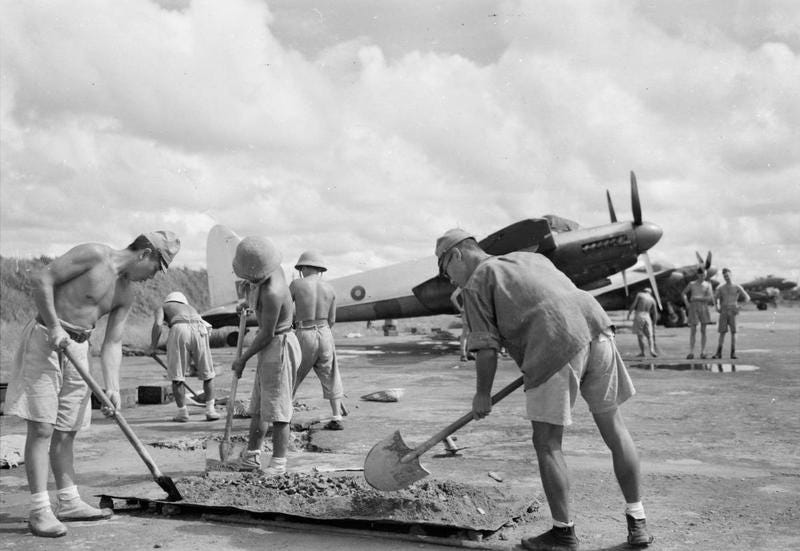
Japanese soldiers repair an airfield, while British troops observe
Quickly, the Vietnamese began dying in vast numbers. However, this bloodsoaked incursion initially went entirely unremarked upon in the British media, and parliament, for several months. As such, the public at home remained completely in the dark about their Army waging another grand foreign entanglement, let alone in tandem with its World War II enemies. This conspiracy of silence continued until December 1945, when a joint letter authored by British soldiers in Vietnam, sent to then-Foreign Secretary Ernest Bevin, was published by The Guardian:
“It appears that we are collaborating with Japanese and French forces against the nationalist forces of Viet Minh. For what purpose is this collaboration? Why are we not disarming the Japanese? We desire the definition of government policy regarding the presence of British troops in Indo-China.”
These bombshell disclosures attracted little interest, and were promptly forgotten. The signatories received a stern talking-to from a senior military official, and no further revelations about Britain’s covert war in Vietnam subsequently emerged. In the meantime, slaughter of innocent civilians continued apace. Much later, one of the signatories to the joint letter recalled of his time in the country:
“We saw homes being burned and hundreds of the local population being kept in compounds. We saw many ambulances, open at the back, carrying mainly – actually, totally – women and children, who were in bandages. I remember it very vividly. All the women and children who lived there would stand outside their homes, all dressed in black, and just grimly stare at us, really with… hatred.”
Come mid-January next year, the Viet Minh had learned lessons from launching large-scale attacks on British-led forces, which frequently ended with significant casualties due to their opponents’ superior firepower, and extensive use of machine guns. Hanoi’s freedom fighters thereafter adopted a raft of guerrilla tactics, including ambushes, assassinations, and hit-and-run raids on enemy patrols. It was the world’s first modern unconventional war. These strategies were devastatingly employed against French and US invaders over the next three decades.
Control of the mission was formally signed over by London to French generals at the end of March 1946, and most of her forces duly left Hanoi. France was emboldened by the perceived success of Britain’s intervention, believing Ho Chi Minh’s forces couldn’t withstand further onslaught from a “civilised”, professional army. This delusion led Paris to launch all-out war against Hanoi again in December that year. It ended in bitter defeat eight years later, and then the Americans stepped in.
For its part, in the post-World War II period, Britain waged a number of comparable, covert wars in every corner of the world, as its financial and military clout rapidly withered. In many cases, the US subsequently stepped in to fill London’s shoes, taking over management of far-flung crises and emergencies, and in the process Britain’s fallen empire. The past 80 years has been a neverending story of American struggle to master the dual legacies of colonialism and partition, bequeathed by its own former imperial overlord.
A Tale of Two Disputes: How China Handles Hanoi and Manila
By Joseph Solis-Mullen | The Libertarian Institute | September 12, 2024
A recent article in the South China Morning Post caught my eye—the topic being why Beijing has taken such an apparently different approach to its territorial disputes with Vietnam versus the similar disputes it has with the Philippines.
Given the now weekly near misses between competing claimants in the South China Sea, the topic is a timely one, and in analyzing Beijing’s contrasting responses to territorial claims by Vietnam and the Philippines in the South China Sea, it becomes clear that China’s strategic calculations are shaped by varying historical, political, and diplomatic dynamics.

Historically, Vietnam’s claims to the South China Sea date back several centuries, although the exact extent and nature of these claims have evolved significantly over time.
Vietnamese records from the Nguyễn Dynasty (1802–1945) suggest that Vietnamese rulers asserted control over certain islands and features in the South China Sea. And references to the Spratly and Paracel Islands appear in historical texts from as early as the seventeenth century. These documents suggest that Vietnamese fishing fleets and merchant vessels regularly visited the islands and considered them within their traditional maritime territory.
When France colonized Vietnam in the late nineteenth century, it began asserting territorial claims on behalf of the Vietnamese protectorate in the South China Sea. In the 1930s, the French government formally claimed both the Paracel and Spratly Islands, citing historical Vietnamese sovereignty. The French established outposts and conducted surveys on some of the islands, mainly driven by the strategic importance of the South China Sea for naval dominance. These colonial claims are crucial because they form part of the modern Vietnamese argument that sovereignty was maintained through continuous occupation, even when the country was under colonial rule.
After the French withdrew in 1954, both North and South Vietnam laid claims to the islands, though South Vietnam maintained physical control over most of the features in the South China Sea. Following the Vietnam War and the reunification of Vietnam in 1975, the unified Socialist Republic of Vietnam continued asserting sovereignty over the islands and expanded its presence in the Spratlys, bolstering its post-colonial efforts to keep the islands under effective control through patrols and the construction of outposts even as China began moving to assert its claims.
The longstanding control of these features is one reason why Beijing has been relatively restrained in responding to Hanoi’s recent expansion activities.
Moreover, Vietnam’s strategy of managing maritime disputes with Beijing “quietly” contrasts sharply with the Philippines’ approach of publicizing clashes and appealing to international forums. Vietnam’s decision to handle disputes internally and seek “friendly consultations” has helped to de-escalate tensions with China, despite the fact that its island-building mirrors China’s own efforts over the past decade.
Indeed, the political relationship between China and Vietnam is arguably the key factor shaping Beijing’s measured response. As the article from the South China Morning Post notes, the overall bilateral relationship is defined by economic cooperation and mutual geopolitical interests, including China’s Belt and Road Initiative. As a result, Beijing seeks to preserve its broader relationship with Vietnam, using diplomacy and economic enticements as buffers against outright hostility. This is in contrast to the Philippines, whose defense ties with Washington have escalated tensions. The longstanding U.S.-Philippine alliance is viewed by Beijing as part of a broader strategy of “containment,” especially in light of the recently revived Enhanced Defense Cooperation Agreement, which gives the U.S. military access to more bases close to Taiwan and the South China Sea.
The Philippines has made headlines by consistently publicizing its maritime disputes with China. Videos of Chinese coast guard vessels colliding with Philippine boats and the use of water cannons have garnered international attention, forcing Beijing to defend its actions diplomatically. Furthermore, Manila’s close alignment with Washington, particularly under President Ferdinand Marcos Jr., has heightened tensions with China. This is exacerbated by joint military exercises between the Philippines, the United States, and other allies like Japan and Australia. For Beijing, this has elevated the Philippines to a higher priority in terms of countering what it perceives (correctly) as a U.S.-led containment effort in the region. Vietnam, by contrast, has avoided such provocative military cooperation with external powers, further explaining why Beijing’s approach has been comparatively restrained.
The American role in the region cannot be understated. Washington’s decision to interpret existing treaty obligations to defend Manila in the event of an armed attack under the U.S.-Philippine Mutual Defense Treaty raises the stakes significantly and decreases the likelihood that Manila will choose to deescalate. This brings into focus the risk of conflict between the United States and China in defense of territorial claims in the South China Sea, which would likely start with a confrontation over the Scarborough Shoal or Spratly Islands. Beijing has increasingly seen its conflict with Manila as an extension of the U.S.-China strategic rivalry, particularly regarding Taiwan, which further complicates the maritime disputes and endangers the world.
At the same time, as Beijing seeks to prevent a collective response from claimant states, recognizing that pushing too hard against Vietnam could drive Hanoi closer to the United States and its allies. While Vietnam has taken advantage of Beijing’s focus on the Philippines to accelerate its island-building activities, Beijing’s restraint towards Vietnam does not rule out future escalations, especially if Vietnam’s militarization of these features intensifies.
While much is uncertain, one thing seems clear: far from being a force for peace in the region, Washington’s intervention, far from America’s own shores, is a clear source of instability and potential danger.
American Bombings of Vietnam during World War II
Tales of the American Empire | August 15, 2024
Americans know about the massive American bombing of Vietnam in the 1960s and 1970s. Few know that thousands of American bombs fell on Vietnam during World War II. The Japanese had occupied some ports in French Indochina in 1940 to support naval and air operations in the region. After the United States entered the war, the US Army Air Corps needed targets to justify strategic bombing since Japan remained beyond range until B-29s arrived in 1944. As a result, many questionable targets were bombed in Vietnam that resulted in thousands of civilian casualties, while a million Vietnamese starved during the resulting famine.
______________________________________________
Related Tale: “The Anglo-American War on France”;  • The Anglo-American War on France
Related Tale: “American Mass Bombings of Chinese Cities in World War II”; • American Mass Bombings of Chinese Cit…
“Bombing of South-East Asia (1944–1945)”; Wikipedia; https://en.wikipedia.org/wiki/Bombing…)
“The OSS in Vietnam, 1945: A War of Missed Opportunities”; Dixee Bartholomew-Feis; The National World War II Museum; July 15, 2020; https://www.nationalww2museum.org/war…
Related Tale: “American Bombings of Allied Cities in World War II”; • American Bombings of Allied Cities in…
Related Tale: “The Illusion Called South Vietnam”; • The Illusion Called South Vietnam
Related Playlist: “The Vietnam War”; • The Vietnam War
A new multipolar security system based on ‘Pax Rossiya’
Strategic Culture Foundation | June 21, 2024
For several years now, Russia, China and other members of the expanding BRICS alliance have been formulating progressive trade and financial relations of the emerging multipolar world order. That order is based on mutual respect and partnership grounded in international law and the UN Charter.
The BRICS concept is rightly the zeitgeist of our time. It is rallying more nations to its fold especially those of the so-called Global South which for decades have been subjected to the unilateralism of Western hegemony.
The trouble is that for a new world order based on equality and fairness to succeed in practice, it needs to be secure from arbitrary military aggression and imperialist tyranny. In other words, a new security architecture is required to underpin the development of a multipolar world.
Russian President Vladimir Putin has been advocating for a new indivisible international security system. This week saw the plan for a new security arrangement put into action.
The Russian leader embarked on state visits to North Korea and Vietnam during which he signed new strategic partnership and defense accords.
Ahead of his trip to the Democratic People’s Republic of Korea, Putin outlined the integrated vision thus: “We are also ready for close cooperation to make international relations more democratic and stable… To do this, we will develop alternative mechanisms of trade and mutual settlements that are not controlled by the West, and jointly resist illegitimate unilateral restrictions. And at the same time – to build an architecture of equal and indivisible security in Eurasia.”
The concept of indivisible security is by no means limited to Eurasia. Russia has signaled the same principles apply to Latin America, Africa and indeed every other corner of the world.
During Putin’s meetings with Chairman Kim Jong Un of the DPRK and President Lo Tam of the Socialist Republic of Vietnam, the strategic partnerships agreed were not merely about military defense and security. They involved comprehensive partnerships for the development of trade, transport, technology, education, science and medicine.
Nevertheless, it was clear that the commitment to strategic partnership was underpinned by new mutual defense accords. This was most explicit in the treaty signed with the DPRK which furnished “mutual assistance in the event of aggression against one of the parties”.
This is a game-changer. It totally upends the geopolitical calculations of the United States and its NATO partners who have been unilaterally expanding military force and provocations in Eurasia and elsewhere.
U.S. President Joe Biden’s administration has ramped up aggression in the Asia-Pacific against China and North Korea with impunity. Under his watch, the US has increasingly moved nuclear forces into the region to intimidate not only Beijing and Pyongyang but also Moscow. The Biden administration has been assiduous in forming hostile military formations in the region with its NATO partners, including Australia, New Zealand, Japan and South Korea.
Year after year, the United States has built up weapon systems in Taiwan to provoke China and on the Korean Peninsula to threaten North Korea.
This unilateral aggression and “might is right” arrogance underpin the notion of Pax Americana that prevailed for decades after the Second World War. That notion was always a cruel euphemism for American imperialist violence to impose its economic and political interests. The Korean and Vietnam Wars in which millions of civilians were annihilated were the real-world grim translations of Pax Americana and its fraudulent “rules-based order”.
Geopolitical perceptions have dramatically changed in a few short years. The U.S. and its Western partners – a global minority – have come to be seen by most people of the world as rogue states that have trashed international law through illegal wars and unilateral bullying with economic sanctions. The U.S. dollar and Washington’s relentless debt spending are seen as instruments of imperialist looting.
The BRICS multipolar world order is a welcome alternative to the mayhem of the Western-dominated system. The principles of fairness and cooperation are laudable and necessary to implement. But such principles must be reinforced with military defense and security for all. This is far from the one-sided “defense and security” of the United States and its NATO partners, which in reality is an Orwellian cover for aggression.
The defense commitments given by Russia to the DPRK this week can be seen as long overdue. One may wonder how the U.S. and its allies got away with threatening the people of North Korea for so long and denying Pyongyang the sovereign right to self-defense. Admittedly, Russia did previously support UN sanctions on North Korea over its missile program. That’s over.
The U.S.-led proxy war in Ukraine against Russia that erupted in February 2022 was a wake-up call for Moscow and many people around the world.
Patently, the Western hegemonic system will stop at nothing to assert its neocolonialist privileges, even to the point of antagonizing a nuclear world war.
There is only one language that the U.S. and its minions understand – and that is the threat of devastating countervailing force.
Washington and its NATO lackeys think they can put missiles in Ukraine to hit Russia or in South Korea and Japan to hit North Korea – at no cost to their own security. Well, now, they might want to think again. There’s a new sheriff in town, as this week’s developments show.
A new global security system is being incarnate. Russia’s vision of indivisible, mutual security is shared by China and many other nations because it is fully compliant with international law and nations’ sovereignty.
Russia, China and other supporters of a multipolar world are not preemptively threatening anyone. But it takes the guarantee of unassailable nuclear powers, Russia and China, to make a new security system viable by restoring the deterrence towards the rogue states of the United States and NATO accomplices.
The defense accords between Russia, the DPRK and Vietnam are installments of the new security architecture that is needed in Eurasia and globally. The has-been American hegemon has been served notice that from now on its presumption of belligerence with impunity, to destroy nations, and to have a license to murder en masse is null and void.
Welcome to the new multipolar order and Pax Rossiya. All are welcome – except hegemonic rogue states.
Featured Video
Racist Seinfeld Dances for Joy as Bibi Unveils His New Map
or go to
Aletho News Archives – Video-Images
TV Drama Review
Japanese drama projects Japan’s wartime atrocities onto Chinese characters

Global Times | October 25, 2026
By portraying Chinese characters as perpetrators of ruthless violence while casting Japanese Self-Defense Forces (SDF) intelligence operatives as defenders, the season 2 of the Japanese drama Vivant has recently drawn criticism from Chinese netizens, who argue that its depiction turns historical reality on its head while ignoring Japan’s wartime atrocities.
The TBS drama series – a spy suspense story in which an alleged unofficial intelligence unit of the SDF operates across the globe — has attracted a passionate fanbase. Its currently airing season 2 opened with a household rating of 18.8 percent, the highest for a TV drama this year, according toa commentary article by Japanese media Toyo Keizai.
What draws attention is the portrayal of the enemies in the series, the article noted. Scenes in which the Chinese organization subjects kidnapped members of the SDF unit to brutal torture are repeated with unrelenting intensity.
It is rare for Japanese TV dramas to explicitly portray a real-life country as the enemy, the article noted.
Japanese Prime Minister Sanae Takaichi also made a reference to the drama, saying that she has been recording Vivant and hopes to binge-watch it over the year-end and New Year holidays, according to Japanese media outlets.
China’s CCTV News report on Sunday revealed that the drama features scenes in which Chinese personnel cut off the fingers of and stab Japanese intelligence operatives in the abdomen. Such acts bear striking similarities to the torture inflicted on Chinese nationals by invading Japanese troops during the World War II.
The drama distorts the truth by attributing these atrocities to modern Chinese characters. Beneath the surface, it subtly glorifies Japan’s cross-border overseas operations, blurs the functional boundaries of the SDF and implicitly promotes an expansionist narrative, per CCTV News. … continue
Blog Roll
 Aletho News
- Iran, Turkey, Pakistan, Saudi Arabia could advance region-led security framework in Tehran: FM spox
- Netizens condemn Japanese drama for projecting Japan’s wartime atrocities onto Chinese characters
- Racist Seinfeld Dances for Joy as Bibi Unveils His New Map
- A West Bank War for Netanyahu’s Election Campaign, Could It Backfire?
- Yemen denounces European Parliament’s ‘hypocritical’ push to blacklist Ansarullah
- Qalibaf: UAE’s UN bid aims to ‘clear the runway’ for ‘Greater Israel’, whitewash genocide
- Pakistan reopens Iran border after boosting security: Report
- Why are so many Brazilians voting for Flávio Bolsonaro?
- Democrats Put Anti-Russia Agenda Ahead of American Workers
- Elijah Magnier: Yemen’s Strikes Are Shattering Saudi Arabia’s Long-Term Strategy
- If Americans Knew
- An error has occurred; the feed is probably down. Try again later.
- No Tricks Zone
- Sudden Stratospheric Warming, Powerful El Niño Combination May Lead To Extreme Europe Cold, Energy Crisis!
- Two New Studies Find Thwaites Glacier Melt Cannot Be Driven By Human Activity Or A Warming Ocean
- E-Cars Reduce CO2 Emissions By Only 41% Compared To Internal Combustion Engine Vehicles
- Predictions Made By Renowned Climate Professor Over Past Decades Have Been Proven To Be Poor
- New Study Suggests Large Regions Of The Pacific Ocean Have Been Cooling For The Last 80 Years
- Germany’s Green Energy Debacle: High Energy Costs Force Kahla Porzellan to Close After 182 Years!
- New Study: 50 Years Of The Most Aggressive ‘Net Zero’ Policies Can Only Affect The Global Climate By 0.03°C
- US September “Heat” Was No Record…Many Records Set Decades Ago
- Latest European Green Energy Debacle; Portugal’s Largest Flagship Solar Park Insolvent!
- Green Energy Debacle: German Expert Professor Fritz Vahrenholt Warns Of Severe Economic And Social Consequences

