Hamas welcomes BRICS declaration on Palestinian rights, rejecting displacement and changes to Gaza
Palestinian Information Center – September 13, 2026
GAZA – The Hamas Movement on Sunday welcomed the New Delhi 2026 Declaration issued by the 18th BRICS Summit, describing its positions on the Palestinian cause as positive and significant and highlighting its reaffirmation of the legitimate and inalienable rights of the Palestinian people.
In a press statement, Hamas praised the declaration for affirming the Palestinian people’s right to self-determination and return, supporting the establishment of an independent and sovereign Palestinian state along the 1967 borders with Occupied Jerusalem as its capital, and calling for the State of Palestine to be granted full membership in the United Nations.
Hamas also welcomed the declaration’s rejection of any forced displacement of Palestinians, whether temporary or permanent, as well as any attempt to impose geographical or demographic changes on the Gaza Strip.
The Movement highlighted the declaration’s call for an end to the illegal occupation and its rejection of unilateral measures aimed at altering the legal and historical status of Occupied Jerusalem. It also welcomed its emphasis on protecting holy sites and upholding international law and international humanitarian law.
Hamas further praised the declaration’s condemnation of the use of starvation as a method of warfare, attacks on civilians and civilian infrastructure, and the obstruction, politicization or militarization of humanitarian aid. It also welcomed the declaration’s reaffirmation of support for the United Nations Relief and Works Agency for Palestine Refugees (UNRWA) and its UN mandate.
Hamas called on BRICS countries to translate these positions into concrete action to end Israeli violations and the occupation, protect the Palestinian people, and enable them to exercise their rights to freedom, self-determination, and an independent state with Jerusalem as its capital.
Final declaration
The final declaration issued Saturday at the conclusion of the 18th BRICS leaders’ summit in India expressed opposition to the forced displacement of Palestinians from the Gaza Strip and the occupied West Bank.
The joint declaration called for compliance with UN Security Council resolutions concerning Gaza.
It also expressed concern over continuing violence in the Palestinian territories despite the ceasefire reached in October 2025 and called for maximum restraint amid the ongoing conflict in the Middle East.
Iran, UAE seek to restore ties after US war on Iran

Al Mayadeen | September 13, 2026
Iranian President Masoud Pezeshkian said following the BRICS summit in India that Iran and the UAE want to restore relations following the US war on Iran.
“For the first time since the war and the incidents that occurred in the Persian Gulf, we had a constructive exchange with the crown prince of Abu Dhabi,” Pezeshkian said a day after a meeting with Abu Dhabi Crown Prince Khaled Bin Mohamed Bin Zayed Al Nahyan on the sidelines of the BRICS summit.
The Iranian President added that “it was agreed that we would turn the page, look to the future and build it together.”
Pezeshkian and Abu Dhabi’s Crown Prince met on the sidelines of the BRICS summit in New Delhi on Saturday, where the two discussed “regional and international issues, de-escalation, stability, and efforts to advance regional peace and development,” per the Abu Dhabi Media Office.
Saudi Arabia launched 129 airstrikes in 48 hours

The Cradle | September 13, 2026
Saudi warplanes carried out 129 airstrikes across seven Yemeni provinces over 48 hours, the spokesperson for the Yemeni Armed Forces, Brigadier General Yahya Saree, stated on Saturday, vowing that the attacks would not go unanswered.
According to Saree, the strikes targeted Taiz, Marib, Hodeidah, al-Jawf, Saada, Amran, and Hajjah.
Saree said the attacks were carried out using F-15 and Typhoon fighter jets that took off from Saudi military bases in Khamis Mushait and Taif.
“These attacks against our people will not pass without a response and punishment, God willing and by His strength,” Saree said.
Yemeni Parliament condemns Saudi escalation
In a similar vein, the Yemeni Parliament said the Saudi regime must respect Yemen’s unity and independence and refrain from interfering in its internal affairs if it wants peace to prevail in the region and the world.
It stressed that developments inside Yemen constituted an internal matter in which the Saudi regime had no involvement.
The Parliament also commended the wisdom and leadership of the revolution leader and the head of the Supreme Political Council, Mahdi al-Mashat, in taking prudent measures to confront the Saudi escalation.
Parliament backs armed forces victories
The Yemeni Parliament praised the victories achieved on all fronts and commended the presidential amnesty decision.
It also thanked citizens who cooperated with members of the Yemeni Armed Forces across areas of fighting.
The Parliament reaffirmed Sanaa’s commitment to securing international shipping routes through the Red Sea and the Bab al-Mandab Strait, except for Saudi vessels involved in the blockade imposed on Yemen.
The statements come amid continued Saudi military escalation, with Yemeni authorities warning that attacks against the country would be met with a response.
5,400 km² retrieved: YAF detail western coast gains
Earlier today, the Yemeni Armed Forces said a large-scale operation launched on September 3 along Yemen’s western coast expelled Saudi-backed forces from six districts across Taiz and Hodeidah governorates, covering 5,400 square kilometers.
The operation, carried out with support from local tribes, resulted in hundreds of Saudi-backed personnel being killed, wounded, or captured, while several Yemeni detainees held for years were also freed.
Saree said the operation followed years of attacks on local communities and was aimed at driving out Saudi-backed forces and preventing attempts to impose Saudi control over Yemeni territory. He said Yemeni forces struck seven military divisions comprising 38 brigades and secured the retaken areas.
The YAF said their ground operations continued despite intensive Saudi air support, while their air defenses carried out 32 operations and reportedly downed nine aircraft.
They also reaffirmed that maritime navigation remains safe for all vessels except Saudi ships covered by its announced ban, pledging to maintain its “blockade for blockade” policy and respond to escalation with escalation until the aggression and blockade on Yemen end.
Matt Gaetz’s Brilliant Exposé on Israel Partisans’ Claims of “Antisemitism”
If Americans Knew | September 11, 2026
From The Matt Gaetz Show on OAN (One America News), Matt Gaetz exposes the dishonest double standard in American politics meant to shut down the conversation as support for Israel in the United States continues to collapse. “The Republican Jewish Coalition can say that they took out Thomas Massie but if you say they did, that is anti-Semitic. And if you say Israel caused the Iran War, that’s bigotry—unless it’s uttered by Netanyahu on the campaign trail, then it’s leadership.” – Matt Gaetz.
Source: https://x.com/OANN/status/20974901703…
Gaetz is a political commentator and former Republican Congressman from Florida. He generally identifies as a libertarian populist.
The Vitamin K Injection (2026)
A new paperback on what’s in the shot every newborn is offered in the first hour of life

Lies are Unbekoming | September 12, 2026
Every U.S. newborn is offered a shot in the leg in the first hour of life. Parents are rarely told the shot exists until the moment it is about to be given.
The new paperback is out today. It examines that shot.
What’s in the book
Twenty-seven chapters walk through what the vitamin K injection actually is, what it contains, what the manufacturers themselves warn against, what the studies did and didn’t find, and where the current framework came from.
The intervention itself. The three products currently in use in English-speaking countries — the U.S. Hospira formulation with its polyoxyethylated castor oil and benzyl alcohol preservative, the UK Konakion MM Paediatric with its glycocholic-acid mixed-micelle vehicle, and the Australian Konakion MM Paediatric with its lecithin base. What each carries alongside the vitamin K itself. The depot vehicle that keeps the injection releasing into the baby’s tissue for two months after the needle comes out. The aluminum contamination the manufacturer discloses without context. The peanut allergy pathway the mainstream literature acknowledges but does not track.
The manufacturer’s own warnings. Every current package insert opens with a boxed warning against the exact route of administration hospitals universally use. Every insert lists a set of adverse reactions — anaphylaxis, cyanosis, gasping syndrome, skin necrosis, cardiovascular collapse — that the doctors administering the shot are largely unaware of and that parents are never shown.
The history. A 1961 AAP recommendation set by a small committee that did not test what it was recommending. A 1985 quiet shift from targeted to universal injection. A 1992 cancer signal from a large UK cohort study that was dismissed rather than investigated. The menadione (K3) disaster that hospitals eventually withdrew — but only by switching products, never by pausing to ask whether the intervention itself was needed. Dam and Doisy’s 1943 Nobel, awarded for work in starved chickens, later used to justify universal injection of healthy newborns.
The alternatives. The oral vitamin K protocols in continuous use in the Netherlands, Germany, Switzerland, and Denmark. Their dosing schedules, their VKDB failure rates, their published surveillance data. Maternal supplementation as a route the doctors could offer but don’t. The physiologic support at birth that most modern maternity practice has already adopted for other reasons but has never been asked to interact with the shot.
The system machinery. The standing-order framework that bypasses individual consent. What refusal actually costs the parent, and what it usually doesn’t cost the baby. The circumcision-clotting interaction that turns one cultural habit into justification for another.
Two personal stories. A father’s account of what happened after his son’s shot. A mother’s account of what changed the week the injection was administered.
Two practical tools. A checklist of questions for the practitioner conversation. A country-by-country reference of the oral protocols with dosing, timing, and documented outcomes.
And at the end of every chapter, a short section titled How to Explain It to a Six-Year-Old.
If you’re picking one up, pick two
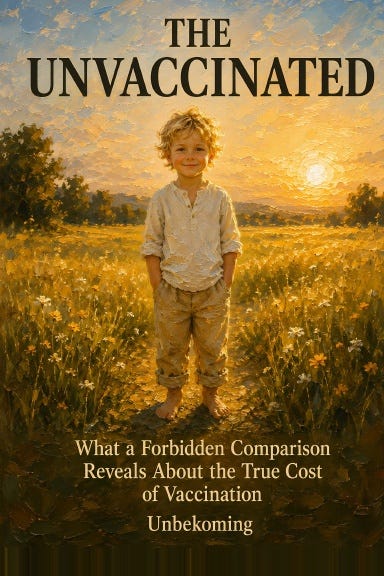
The natural pigeon pair for The Vitamin K Injection is The Unvaccinated: What a Forbidden Comparison Reveals About the True Cost of Vaccination. The two examine the same institutional logic from different angles. Vitamin K is the first injection most newborns receive; the childhood schedule follows. Both document what the mainstream literature won’t compare, won’t study, and won’t offer as choice.
The book
The Vitamin K Injection: What the Evidence Shows
First edition. 300 pages. 6×9 paperback, matte cover, cream paper.
ISBN 978-1-7648990-4-8
USD 19.99 / EUR 18.99 / AUD 29.99 / GBP 15.99 / CAD 26.99
The full catalogue lives on the Unbekoming Spotlight.
13 Things Your Pediatrician Was Trained Not to Tell You
An Essay on the Profession Trained for Compliance, Not Curiosity
Lies are Unbekoming | September 11, 2026
This essay engages material framed in establishment terms: vaccines, immunity, deficiencies, contagion, developmental disorders. In quotation, attribution, and official body names, that vocabulary appears as the establishment uses it. In my own analytical voice, the terrain paradigm operates. The two registers do different work. One shows what the profession says about itself. The other names what is happening to the child.
The Training
“Nothing bad should be said about any vaccine.”¹ That is what Suzanne Humphries, a board-certified nephrologist, was taught during her American medical training. Vaccines are administered on schedule. Adverse conversation was not encouraged. It was actively closed down.
Lawrence Palevsky, a pediatrician practicing in New York, describes the same experience. What he was taught in medical school and residency, he later realized, differed sharply from what he observed in his own patients and read in the primary literature.²
Robert Sears, a California pediatrician, describes reading a book in medical school that documented severe injuries from the DTP (diphtheria-tetanus-whole-cell-pertussis) vaccine. The vaccine was eventually removed from the American market. Sears kept reading. What he found was not what he had been taught.³
Rachael Ross, a family physician who spent three seasons cohosting the syndicated show The Doctors, described a similar reckoning in a widely read 2016 blog post. She had watched the schedule grow from sixteen doses of four vaccines during her own childhood to sixty-nine doses of sixteen vaccines by age eighteen. Medical school and residency, she wrote, had taught her to give them all on time, without question.⁴
Jayne Donegan, a British general practitioner, wrote in the foreword to Humphries’ Dissolving Illusions that her medical training left vaccination as an “article of faith” that could not be interrogated. The curriculum was already so crowded that there was no room to ask why non-vaccine-preventable disease deaths had also declined during the twentieth century for reasons unrelated to any injection.⁵
None of these physicians is fringe. Each trained inside the profession. Each describes the training in similar terms: a set of scripts about safety, efficacy, and schedule, delivered as certainties, with no time in the curriculum to interrogate the primary literature that would complicate them. A pediatrician does not know what she was trained not to know. She cannot ask questions she was trained not to ask.
American pediatric practice covers the child from birth through age eighteen, and in many practices through age twenty-one. What follows is a chronological walk through what that profession was trained not to tell you, across that entire arc. Thirteen items. In order.
1. The Cord Cut Before the Blood Finished Moving (birth)
A newborn’s blood volume is meant to be topped off from the placenta in the minutes after birth. When the cord is left intact and pulsing, roughly a third of the baby’s total blood supply, along with the iron that supply carries, transfers across before the placenta is expelled. That iron is the reserve intended to carry the child through the first six months of life.
The standard hospital practice throughout the late twentieth century was to clamp within seconds. The World Health Organization now recommends waiting at least one minute. The American College of Obstetricians and Gynecologists came around in 2017. Most hospital deliveries in the United States still clamp early, driven by workflow, the neonatal warmer schedule, and the syringe already on the tray.
Your pediatrician does not raise this. The obstetrical team performed the clamp. The pediatrician receives the baby afterward and plots the numbers she is given. The infant she inherits is the infant who lost a third of the placental transfusion at hour zero.
Six months later, that same pediatrician will run an iron level, note the low result, and prescribe supplementation. The low reading she treats was produced by the system at birth. She is not trained to draw the line between the two events. She is trained to run the number and write the script.
The curious pediatrician would ask what a child born with a full complement of placental blood looks like at six months. The compliant pediatrician cannot ask, because the reference population she was trained on is the population that was clamped early.

2. The Vitamin K Injection (first hours)
Within hours of birth, the newborn receives an intramuscular injection of phytonadione, the compound sold as vitamin K1. The dose is one milligram. Breast milk carries roughly one to two micrograms of phytonadione per liter, and a newborn’s colostrum intake on day one delivers a fraction of a microgram; the injection is thousands of times that dose, and the published pediatric literature confirms that plasma phytonadione levels for two weeks after the shot run one to two thousand times higher than normal adult values. The injection also contains benzyl alcohol, polysorbate 80, and propylene glycol as excipients. The delivery site is the infant’s leg. The parent, if consulted at all, is told the shot prevents a bleeding condition called hemorrhagic disease of the newborn.
The condition exists. What is not explained is why. Newborn phytonadione levels are low at birth by design; the compound is produced by the gut bacteria that colonize the infant’s digestive tract in the first days, and levels rise on the biological schedule the infant’s body follows. Levels are further supported by the maternal transfer that continues through breastfeeding. The “deficiency” the injection corrects is the state a healthy newborn is meant to occupy for the first days of life while the gut ecology establishes itself.⁶
The bleeding events the injection is designed to prevent cluster in infants who have been subjected to the standard hospital birth sequence: early cord clamping, which strips the placental transfusion of clotting factors; maternal medications passed through delivery; the injection itself as a source of tissue injury; and, in male infants, circumcision. The intervention creates the conditions in which bleeding becomes more likely, then presents itself as the solution to the problem it has helped produce.
Two forms of the shot exist. The oral form is available in some countries and delivers a smaller dose across three administrations in the first weeks of life. The intramuscular form is the American standard. The intramuscular form has been associated in the published literature with elevated rates of childhood cancer, a finding disputed by subsequent industry-funded studies but never resolved. The oral form does not appear in that literature.⁷
This is the first injection. It is the moment at which the infant’s body, hours old, receives an industrial compound at pharmacological doses that no biology has any history with, into a system that has been producing its own supply on schedule for as long as human infants have been born. It is also the moment at which bodily sovereignty is handed over: the first substance introduced by needle before the first feed, before the first look at the mother’s face, before any element of the child’s own biology has had time to establish itself. The parent is rarely told what phytonadione is, where it comes from, what else is in the syringe, or that an oral alternative exists. The consent process is a signature.
Your pediatrician was trained that hemorrhagic disease is prevented by the injection. She was not trained to ask why the disease clusters in the population subjected to the delivery-room sequence, or what a newborn’s clotting profile looks like when the earlier interventions never happened.

3. The Hepatitis B Shot Before the First Feed (first day)
Hepatitis B, in the establishment’s account, is transmitted through blood-to-blood contact or sexual contact. In the United States it is given as an injection to every newborn within twenty-four hours of birth, regardless of the mother’s status. Denmark, which shares its borders with high-travel Europe, gives the shot only to infants born to mothers who carry the condition themselves.⁸
The safety claim rests on clinical trials. Those trials, for hepatitis B and for the childhood schedule generally, do not compare the vaccine to an inert placebo. The comparator is another aluminum-adjuvanted formulation, or a different vaccine, or the “background” mixture of the product minus the antigen. Adverse events in the “placebo” arm therefore match adverse events in the vaccine arm, because both arms received a substance that produces adverse events. The trial reports that the vaccine is “safe compared to placebo.” The label reflects the conclusion. What the label does not reflect is that the placebo was not a placebo. This is the load-bearing methodology under every safety claim on the childhood schedule. No vaccine on the schedule has been tested against saline in a pediatric population large enough to detect serious harm.⁹
The consent process at the American bedside is not consent. The mother has just given birth. The Vaccine Information Statement is handed over as the needle is prepared. The package insert, which contains the excipients, the adverse event history, and the acknowledged absence of long-term studies, is not offered. The CDC itself states that the Vaccine Information Statement is not an informed-consent document.¹⁰
The Belmont Report, drafted after the 1974 Research Act, identifies the three components of ethical consent: information, comprehension, and voluntariness.¹¹ The pamphlet handed to the mother is not information. The mother in her eighteenth hour of labor cannot comprehend the pamphlet even if she reads it. The room in which declining is coded as neglect does not offer voluntariness.
The Emergency Use Authorization products marketed for children under twelve during the COVID period had blank package inserts.¹² There was no clinical trial data to disclose. There was nothing to comprehend. The consent form still had a signature line.
Your pediatrician does not raise the Belmont Report. She does not know it exists. She was trained to hand over a pamphlet. Consent, as the Belmont Report defines it, was not part of the training.

4. The Circumstraint (first days)
Boys born in American hospitals are commonly circumcised within the first forty-eight hours of life. The procedure is elective, performed on healthy tissue, without therapeutic indication. The device most commonly used to hold the infant during the procedure is called the Circumstraint, a plastic form that immobilizes the baby’s arms and legs so the surgeon can work.
Forrest Maready has written on what happens inside the infant’s body during this event.¹³ Three triggers activate the dorsal vagal complex simultaneously: the injected local anesthetic registers as chemical intrusion, the incision as tissue injury, and the strap and plastic form as restraint. The infant cannot fight and cannot flee. Under sustained restraint, the primal system routes into shutdown. Images of babies on the Circumstraint mid-procedure show glassed-over eyes and a stillness that is not calm. It is dissociation, the same primal response animals and reptiles exhibit under capture, and the same response World War I soldiers exhibited when frozen in place under sustained fire.
The procedure requires written consent. It does not require informed consent. Parents are not shown the Circumstraint, or what dorsal vagal shutdown looks like. They are told the boy will not remember.
Whether the child remembers with his cortex is beside the point. The body remembers with its wiring. Maready traces the same trigger pattern, the same shutdown response, in the shots administered later, where the parent’s or nurse’s restraint constitutes the third trigger and delivers the injected metals into a body whose lymphatic system is now primed to transport them.
Your pediatrician was not trained in polyvagal theory. The circumcision was billed separately, performed by a different practitioner, and by the time she sees the child for the first well-baby visit, the file is closed and the incision has healed.

5. The Formula Sample in the Discharge Bag (first weeks)
Breast milk is more than food. It is a continuation of the mother’s biology into the infant. It delivers living stem cells, signalling molecules, protective proteins, and dozens of maternal components the infant’s biology integrates into its own.¹⁴ Colostrum in the first days carries a concentration of maternal material no manufactured product can replicate. The list of components identified in breast milk grows every year.
What formula provides is a mix of macronutrients dissolved in vegetable oils, built from cow’s milk protein or soy. It is what a mother feeds her baby when the biology cannot function or when she has no other option. It is not equivalent to what it replaces.
Formula recommendation frequently begins in the hospital. If the baby is slow to latch, if the mother is exhausted, if the nursing staff has other beds to turn over, a bottle of formula appears. The discharge bag contains a formula sample. The pediatrician’s office keeps sample cans for the first well-baby visit. What the office does not keep is a lactation consultant on staff.
The consultant costs money. The formula is provided by the manufacturer. The infrastructure of the American pediatric practice is built around the availability of formula and the absence of professional breastfeeding support. When troubleshooting is needed, the referral goes to a private lactation consultant the family pays for out of pocket, or, more commonly, the referral does not go anywhere and the mother receives a can of Similac.
The pediatrician was trained to identify failure to thrive. She was not trained to identify a poor latch, an undiagnosed tongue tie, engorgement, mastitis, or the constellation of ordinary breastfeeding difficulties that resolve with skilled support. The training treated breastfeeding as a preference and formula as a substitute of equivalent value. Neither claim survives the primary literature.

6. The Growth Chart Announcement (every visit)
At every visit, the baby is weighed and measured. The numbers are plotted against a curve. The pediatrician announces the percentile. Anything below the fiftieth is met with concern. Anything below the tenth triggers supplementation, formula, referrals, and repeat visits.
The curve is a statistical instrument. It plots where a population’s babies actually fell, not where healthy babies should fall. The reference standards against which most American pediatricians still work were built substantially on formula-fed populations, until the World Health Organization revised its curves in 2006 based on breastfed infants. A breastfed baby, whose weight-gain curve flattens naturally after four to six months, tracks below the older references and appears to be failing. The formula-fed baby was the standard against which the breastfed baby was measured and labeled as failing to thrive.
The percentile is not a diagnosis. Half of all babies are, by definition, below the fiftieth percentile. This is what percentiles are. The pediatrician’s alarm at the number is not a medical judgment. It is a script triggered by a chart.
The mother leaves the visit worried about her baby’s weight. She adds a bottle. The pediatrician marks the intervention on the record. At the next visit, if the number has climbed, the intervention is validated. If it has not, the recommendation escalates. More bottles. Iron drops. Cereal at four months. Formula-based supplementation.
The chart does not measure the child’s thriving. It measures her position relative to a reference population that was itself constructed by earlier interventions. The chart manufactures the pathology it then addresses.

7. The Iron Drops at Six Months (six months)
The four-month or six-month iron level comes back low. The pediatrician prescribes ferrous sulfate drops or recommends iron-fortified cereal. The parent complies. The drops stain the baby’s teeth, alter the stool, and are frequently spit up. The parent gives them anyway because the pediatrician said the number was low.
The number was low because the placenta was cut early. The reference range was developed on infants who were also cut early. The whole system, from delivery-room workflow to the reference range on the lab printout, was calibrated around interventions that removed the natural iron reserve at birth.
The intervention at hour zero produced the finding at month six that justifies the intervention at month six.
Ferrous sulfate is an industrial iron compound the infant’s body has no biological history with. It is aggressive on the gut lining, contributes to constipation, and drives oxidative stress the six-month-old is developmentally ill-equipped to buffer. The clinical trials on infant iron supplementation are almost entirely funded by the manufacturers of the supplements themselves or the cereals into which those supplements are compounded.
Iron in the form the child’s biology expects arrives packaged inside whole foods: liver, red meat, egg yolk, shellfish. These are the traditional first foods documented by Weston Price across traditional cultures around the world.¹⁵ None of Price’s cultures gave their infants iron drops. None of Price’s cultures produced the infants the American pediatric system labels as low in iron at six months.
Your pediatrician was trained in the intervention. She was not trained in what a child looks like when the intervention is not needed because the earlier interventions never happened.

8. Amoxicillin for the Ear (infancy onward)
The child has an earache. The pediatrician looks in the ear, notes the red drum, and writes a script for amoxicillin. Ten days. The ear improves. Three weeks later, the ear is red again. Another course. By eighteen months, the child has been on four rounds of antibiotics. The referral to ENT for tubes is in the file.
A 1994 study in Annals of Allergy identified food allergy in 78 percent of a series of 104 children with recurrent middle-ear fluid. Of the food-allergic group, 86 percent showed significant reduction on a sixteen-week elimination diet; when the offending foods were reintroduced, 94 percent recurred. The common offenders were cow’s milk, eggs, wheat, corn, soy, and peanuts.¹⁶ Children with undiagnosed cow’s milk allergy are roughly twice as likely to have recurrent ear problems. The ENT specialist David Hurst has spent his career documenting that allergy is the primary driver of chronic middle-ear fluid, and that aggressive allergy management resolves most cases.¹⁷
Your pediatrician does not ask about the child’s diet. She does not ask whether the ear inflammation clusters after certain foods. She writes the amoxicillin. The amoxicillin, over successive courses, does documented damage to the child’s gut ecology, contributing to the food sensitizations that will produce the next allergy diagnosis and the next inflammation and the next round of prescriptions.¹⁸
Heather Fraser has documented the loop.¹⁹ Antibiotic exposure is associated with elevated risk of food allergy. The food allergy drives the inflammation that produces the fluid that invites the prescription. The prescription drives the next allergy. The pediatrician sees the ear. The pediatrician does not see the loop.

9. The Autism Screening at Eighteen Months (eighteen to twenty-four months)
The M-CHAT is administered at the eighteen-month and twenty-four-month well-child visits. It is a screening questionnaire designed to catch signs of autism early. Parents whose children screen positive are referred for further evaluation.
By eighteen months, an American child following the CDC schedule has received over twenty vaccine doses. The MMR is typically administered at twelve to fifteen months. The pattern of parental accounts documented across the literature is consistent: the child was developing normally, received the shots at fifteen to eighteen months, and regressed.²⁰
J.B. Handley’s son Jamison is one such case. At eighteen months, Jamison was sick, never sleeping, gut in distress, alternating between diarrhea and constipation. His behavior had shifted. He ran along walls turning his eyes to the side, spun in circles, and played with his trains in odd ways. He had been an early talker, but the words had disappeared. UCSF confirmed the diagnosis: autism, the severe kind. The presiding doctor told the family to expect institutionalization. Within two weeks of beginning biomedical treatment under a different physician, Jamison’s belly had flattened, his eye contact was returning, and the dark circles under his eyes were clearing.²¹ The pattern that took his family months to piece together is the pattern the M-CHAT is designed to detect after the fact.
The screening does not prevent autism. It catches autism after the damage is measurable. It is a diagnostic backstop, timed to the developmental window in which regression is typically noticed, which is the same developmental window in which the schedule delivers its heaviest early load.
The rate is now one in thirty-one American children.²² A fully vaccinated Danish child receives thirty doses of vaccine against ten diseases across childhood, delivered in eleven injections thanks to multivalent combinations. A fully vaccinated American child, as of 2024, received between eighty-four and eighty-eight doses against seventeen diseases.²³ The pediatrician who administers the M-CHAT does not draw this comparison. She was trained that autism is genetic, that the cause is unknown, and that no controlled comparison of fully vaccinated versus never-vaccinated populations has ever been conducted. The last of these is true. The absence of the study is itself the finding.
The screening timing is the confession. The system knows when regression happens. The system built the screening around that window. What the system does not do is investigate the exposures delivered during the same window.
The Intervention Cascade: How Modern Medicine Creates the Birth Emergencies It Claims to Prevent (Part 2)
10. The Tonsillectomy Recommendation (early childhood)
The child has recurrent throat inflammation, or the tonsils appear enlarged, or the sleep is poor. The pediatrician refers to ENT. The ENT recommends removal. The parents comply.
During the American polio era, fifty to eighty percent of middle- and upper-class American children were tonsillectomized. Anderson’s 1943 Utah data showed that poliomyelitis was more than 2.5 times as common in tonsillectomized children. Bulbar polio, the form that paralyzed the muscles of breathing and swallowing, was sixteen times more common. Forty-three percent of the bulbar and bulbospinal cases had been preceded by a tonsillectomy within thirty days.²⁴ After the connection surfaced in the medical literature, tonsillectomy rates collapsed. The procedure never recovered its earlier prevalence, though it remains common enough to be a routine referral.
The tonsils are lymphatic tissue. They are part of the body’s cleansing and repair infrastructure, positioned at the entry point of the digestive and respiratory tracts to sample what comes in and to house the response. Removing them because they are inflamed is comparable to removing a filter because it is doing its job.
The recurrent throat problems have a driver. Maready has documented one pattern in the sudden-onset behavioral and neurological conditions labeled PANDAS and PANS (Pediatric Autoimmune Neuropsychiatric Disorders Associated with Streptococcal infections, and Pediatric Acute-onset Neuropsychiatric Syndrome). Aluminum from prior vaccinations creates a metal burden in the brain and lymphatic system. A subsequent inflammatory event produces a sudden onset of behavioral and neurological symptoms.²⁵ Removing the tonsils and giving antibiotics produces temporary relief. The underlying loop persists.
Your pediatrician was trained to identify the surgical indication. She was not trained to ask what the tonsils were responding to, or what the removal costs the child in the years afterward when the filter that used to sample the air is no longer there.

11. The Stimulant Prescription (school age)
The teacher flags the boy. His mother takes him to the pediatrician. A screening tool is administered. The prescription follows. Ritalin, Adderall, Vyvanse, Concerta. The child is medicated through the school day.
The DSM criteria for ADHD are behavioral. There is no biomarker. There is no imaging finding required for the diagnosis. There is no laboratory test. The condition is defined by the behavior and validated by the response to the stimulant, which by design produces focus and compliance in almost any child regardless of underlying condition.
Maready has proposed that the behavioral pattern derives from damage to a small brainstem structure called the locus coeruleus, which regulates the release of norepinephrine and mediates the fight-or-flight response.²⁶ Damage produces hypersensitivity and continuous norepinephrine release. The child is locked in a low-grade panic state. He cannot sit still because his body is preparing for a threat that never resolves. The gut problems that frequently accompany the ADHD presentation follow from the same diversion of resources away from digestion. Many parents notice that their child’s behavior improves markedly during a fever, which fits the same mechanism: the locus coeruleus diverts its norepinephrine output to raising body temperature, giving the child a temporary respite from the constant stress signal.²⁷
The metals implicated in the damage, in Maready’s account, are the aluminum-based adjuvants injected in the leg during infancy and transported by the lymphatic system toward the brainstem.²⁸ Studies have documented elevated aluminum in the hair of children diagnosed with hyperactivity. The stimulant does not address the damage. It masks the presentation by driving further neurotransmitter release, in the way that pressing harder on a broken accelerator does not fix the car.
The pediatrician was trained in the diagnostic criteria and the medication. She was not trained in the injection pathway, the lymphatic transport, or the brainstem lesion. The prescription pad was faster than the investigation.

12. The SSRI for the Teenager (adolescence)
The teenage girl is depressed. Her pediatrician writes the SSRI. American pediatric and family practice are the frontline prescribers of adolescent SSRIs; referral to a child psychiatrist happens only for complex cases. The FDA’s own black-box warning, added in 2004, states that these compounds increase suicidal ideation in children and adolescents. The warning appears on the label. It is rarely raised in the conversation before the script is signed.
In 2012, GlaxoSmithKline paid three billion dollars to settle claims that it had downplayed the risk of paroxetine, marketed as Paxil, in adolescents.²⁹ The company had promoted the drug for uses the FDA had not approved and had withheld safety data. The settlement was the largest healthcare fraud settlement in American history at the time. Nearly every major pharmaceutical company has been caught in comparable settlements. The prescriptions kept flowing.
Teenage depression has risen sharply during the period in which the pediatric schedule expanded, the smartphone was placed in every hand, sleep was compressed, sunlight exposure collapsed, gut ecology was serially disrupted by antibiotic courses, and the food supply was reengineered around industrial seed oils and ultra-processed carbohydrates. Each of these has documented effects on mood and cognition. None is investigated at the sixteen-year-old’s medication appointment.
The SSRI is not a diagnosis. It is a management protocol. It changes what the neurotransmitter machinery is doing without asking what damaged the machinery in the first place. The teen who does not respond gets a second SSRI. The teen who responds badly gets an antipsychotic added. The teen who spirals gets hospitalized. The chart records the diagnosis codes and the medication trials. The chart does not record what happened to the child between age one and age fourteen.
Your pediatrician was trained to identify depression and to prescribe the first-line medication. She was not trained to ask what a healthy sixteen-year-old looks like, or what would have to change in the child’s life for the depression to resolve without the compound.
13. The Gardasil Series (eleven to twelve)
The eleven-year-old girl is offered the HPV vaccine at her pediatric well-visit; American pediatric care runs through adolescence, and the HPV series is a scheduled pediatric-office item. In many practices, the shot is bundled with the meningococcal and Tdap boosters at the same visit, an arrangement the Advisory Committee on Immunization Practices (ACIP) recommends explicitly to improve series completion.³⁰ The practice’s incentive is to have the teenager walk out with all three.
The clinical trials submitted for HPV vaccine approval did not use saline as the placebo. The comparator was the aluminum adjuvant, which produces its own inflammatory and neurological effects.³¹ The trials measured precancerous lesions, not cervical cancer, which develops on a timeline decades longer than the trials ran. The insert states that the product has not been evaluated for carcinogenicity or genotoxicity.³²
The injury patterns reported after HPV vaccination include postural orthostatic tachycardia syndrome, seizures, chronic fatigue, cognitive dysfunction, motor symptoms, and premature ovarian failure. Mary Holland has documented individual cases in detail. Alexis Wolf was thirteen when she started the series in 2007. After the second dose her health deteriorated. After the third she could no longer focus, sleep, eat, or behave normally. Today, at twenty-five, she has daily seizures. Colton Berrett was thirteen when he received the third dose. He became paralyzed from the neck down and remained on a ventilator until his suicide, two months before his eighteenth birthday. Joel Gomez was fourteen when he died in his sleep after the second dose.³³
The American pediatric office does not present the trial design. It does not present the package insert. The pediatrician was trained that Gardasil prevents cervical cancer. That claim is not supported by the trials. The claim she was trained to make is the claim she makes.
In Japan, after the injury patterns became public, uptake dropped from around seventy percent to under one percent.³⁴ The Japanese Ministry of Health withdrew its active recommendation. Girls in Japan are still eligible to receive the shot. Their parents are informed. Most decline.

The Well-Child Visit Is Not a Health Check
Thirteen items across one childhood, all delivered by the same profession and shaped by the same training.
The nurse walks in with the shot tray already prepared. A Vaccine Information Statement is handed over as the needle is uncapped. The growth chart appears on the monitor and a percentile is announced. The developmental questionnaire sits on the clipboard. Next shots are read off the schedule. Questions raised meet a script. Parents who decline meet a second script. Parents who persist are fired from the practice.
None of this measures whether the child is thriving. The visit measures whether the child is on schedule for the shots, the screenings, the growth curve, the developmental milestones, and the medication trials. The well-child visit is a compliance check. It has been a compliance check for as long as most parents alive today have been alive. What changed is the length of the compliance list, which as of 2024 ran to eighty-four to eighty-eight doses covering seventeen diseases, an autism screening at eighteen months, a stimulant prescription at seven, an SSRI at fourteen, and a Gardasil dose at eleven.
The pediatrician cannot do the health check because she was not trained for it. She was trained to plot, prescribe, inject, refer, screen, code, and bill. The health check is what a curious pediatrician would do. The profession does not produce curious pediatricians. It produces compliant ones, because the training rewards compliance and punishes curiosity, and the compliant pediatrician takes home the same salary whether the child in front of her is thriving or not.
The mother in the exam room is the one who has to do the health check. She has to hold the developmental history the chart does not track. She has to notice what changed after which appointment. She has to ask what the pediatrician was trained not to ask. She has to know what a healthy child looks like, because the person paid to know does not.
How To Explain It To A 6 Year Old
Imagine a driving school where the students learn one thing. They learn the map. Every morning, the teacher hands out the map. It shows every road and every turn.
The students memorize the map. When they get their driver’s license, they can drive the map perfectly.
They cannot, however, look out the window.
Looking out the window was not on the map. Looking out the window is not what the driving school taught. If a dog runs into the road, the map does not have a dog. If the tire goes flat, the map does not have a tire. The students keep driving the map. They drive right through the dog. They drive on the flat tire until the wheel comes off.
If you asked one of these drivers why they did not stop, they would say the map said to keep going.
Your pediatrician has a map. It is called the schedule. It tells her which shots to give and which drops to prescribe and which screenings to run and at which age. She learned the map very well and can drive it in her sleep. She was not taught to look out the window.
The window is your child. The window is what your child looked like last week and what your child looks like this week. The window is what changed after the last appointment. The window is whether your child is thriving, or is quietly, slowly becoming someone the map does not have space for.
You are the one at the window. Your pediatrician is at the map. Both of you are trying to help your child. Only one of you can see her.
Medical Disclaimer
This essay is a work of analysis and commentary. It is not medical advice. It is not a prescription. It is not a substitute for the judgment of a practitioner who knows your child. Decisions about vaccination, medication, surgery, and pediatric care belong to the parent and to the practitioner the parent chooses. The purpose of this essay is to widen the frame of what a parent knows before those decisions are made.
In Print
Thirteen of my books are now available as paperbacks, printed to order through Lulu and shipped worldwide. The Unvaccinated lays out the completely unvaccinated as a comparison group across twenty chapters and five appendices — as far as I know, the only book of its kind. Medicalized Motherhood follows a woman through 123 documented interventions from teenage pill to postpartum discharge. Drilling for Profit argues that cavities, gum disease, and crooked teeth are a dietary problem the dental profession treats surgically. What Your Vet Can’t Tell You applies the same critique to pets — food, vaccines, and a profession trained by the industries whose products cause the harm. Escape from Psychiatry documents the fabrication of the DSM, the collapse of the serotonin hypothesis, and the specific damage done by every major psychiatric drug class.
Two go to the paradigm underneath the whole shelf. No Contagion, co-authored with Jamie Andrews, catalogues 258 failed contagion experiments and the case against germ theory itself. No Virus takes the examination one layer deeper — the isolation problem, the collapse of virology’s foundational claims, and a disease-by-disease reappraisal of the entities the framework is built on.
Four take on the remedies and paradigm questions mainstream medicine actively suppresses. The DMSO Book covers 100,000 studies, zero deaths, and one approval — the suppressed science of medicine’s most versatile compound. Chlorine Dioxide: The Forbidden Remedy collects the interviews, protocols, and evidence from the doctors and researchers they tried to silence. The Iodine Book recovers an essential mineral driven out of easy reach by bromide, fluoride, and perchlorate — and the pharmacological tradition that kept its therapeutic use alive across the decades mainstream medicine set it aside. The Hydrogen Peroxide Book recovers a century of practice with a compound the body already makes — mitochondrial, phagocytic, part of thyroid hormone synthesis — suppressed precisely because its clinical utility threatened the pharmaceutical direction that captured twentieth-century medicine.
Two more take on the remedies already in your kitchen. Baking Soda locates sodium bicarbonate inside the terrain framework industrial medicine buried — the compound already in your cupboard, and what it does at the level of the blood, kidneys, lungs, digestion, and skin. The Castor Oil Book recovers four thousand years of documented practice on the medicine mainstream healthcare quietly stopped talking about — the kitchen bottle that doesn’t sit well in a system built on prescriptions and procedures.
A physical book reaches the person a Substack post never will — the sceptical relative, the friend who won’t click a link but might open a book, the visitor whose eye lands on a coffee table. The full shelf is at lulu.com/spotlight/unbekoming. Buy one to keep, and one to give away.
References
- Suzanne Humphries, quoted in J.B. Handley, How to End the Autism Epidemic (Chelsea Green Publishing, 2018).
- Lawrence Palevsky, quoted in J.B. Handley, How to End the Autism Epidemic.
- Robert Sears, quoted in J.B. Handley, How to End the Autism Epidemic.
- Rachael Ross, “Vaccines, Vaccine Injury, and My Perspective as a Doctor and Mom,” Dr. Rachael (July 1, 2016), http://drrachael.com/vaccines-vaccine-injuries-my-perspective-as-a-doctor-and-mom/.
- Jayne L. M. Donegan, Foreword to Suzanne Humphries and Roman Bystrianyk, Dissolving Illusions: Disease, Vaccines, and the Forgotten History (2013).
- Thomas Cowan, Vaccines, Autoimmunity, and the Changing Nature of Childhood Illness (Chelsea Green, 2018), on newborn phytonadione biology and gut colonization.
- Suzanne Humphries and Roman Bystrianyk, Dissolving Illusions, on intramuscular versus oral vitamin K administration and the childhood cancer literature.
- J.B. Handley, How to End the Autism Epidemic, on the Danish Childhood Vaccination Program.
- J.B. Handley, How to End the Autism Epidemic, on the corrupted placebo methodology across the pediatric vaccine trial literature.
- CDC, “Vaccine Information Statements: Frequently Asked Questions,” in Epidemiology and Prevention of Vaccine-Preventable Diseases (Pink Book), 14th edition, Appendix C.
- National Commission for the Protection of Human Subjects of Biomedical and Behavioral Research, The Belmont Report: Ethical Principles and Guidelines for the Protection of Human Subjects of Research (1979), cited in Edward Geehr, Unavoidably Unsafe.
- Edward Geehr, Unavoidably Unsafe, on Emergency Use Authorization and blank package inserts.
- Forrest Maready, Crooked: Man-Made Disease Explained, on the dorsal vagal complex and the Circumstraint.
- Suzanne Humphries and Roman Bystrianyk, Dissolving Illusions, on the cellular components of breast milk and colostrum.
- Weston A. Price, Nutrition and Physical Degeneration (1939), documenting traditional cultures and their infant feeding practices.
- Heather Fraser, The Peanut Allergy Epidemic, citing 1994 Annals of Allergy study on food elimination and ear inflammation.
- David Hurst, cited in Heather Fraser, The Peanut Allergy Epidemic, on allergy as the primary driver of chronic middle-ear fluid.
- Fraser, The Peanut Allergy Epidemic, on antibiotic exposure and food allergy risk.
- Fraser, The Peanut Allergy Epidemic, on the antibiotic-allergy-inflammation loop.
- J.B. Handley, How to End the Autism Epidemic, on parental accounts of regression following the fifteen-to-eighteen-month shots.
- J.B. Handley, How to End the Autism Epidemic, on the regression and recovery of his son Jamison.
- CDC, “Prevalence and Early Identification of Autism Spectrum Disorder Among Children Aged 4 and 8 Years — Autism and Developmental Disabilities Monitoring Network, 16 Sites, United States, 2022,” MMWR Surveillance Summaries 74, no. 2 (April 17, 2025).
- U.S. Department of Health and Human Services, “Assessment of the U.S. Childhood and Adolescent Immunization Schedule Compared to Other Countries” (2025), https://www.hhs.gov/sites/default/files/assessment-of-the-us-childhood-and-adolescent-immunization-schedule-compared-to-other-countries.pdf.
- Suzanne Humphries and Roman Bystrianyk, Dissolving Illusions, on tonsillectomy and bulbar polio (Anderson, 1943 Utah data).
- Forrest Maready, Crooked, on PANDAS and PANS as aluminum-inflammation cascades.
- Forrest Maready, Crooked, on the locus coeruleus and ADHD.
- Forrest Maready, Crooked, on fever, norepinephrine, and behavioral improvement in autism and ADHD.
- Maready, Crooked, on aluminum adjuvant transport via the lymphatic system.
- J.B. Handley, How to End the Autism Epidemic, on the GlaxoSmithKline paroxetine settlement.
- CDC, “General Best Practice Guidelines for Immunization: Timing and Spacing of Immunobiologics,” on ACIP recommendations for simultaneous administration of adolescent vaccines at the 11-to-12 visit.
- Holland et al., The HPV Vaccine on Trial, on Gardasil clinical trial placebo design.
- Holland et al., The HPV Vaccine on Trial, quoting the Gardasil package insert on carcinogenicity and genotoxicity evaluation.
- Holland et al., The HPV Vaccine on Trial, on the cases of Alexis Wolf, Colton Berrett, and Joel Gomez.
- J.B. Handley, How to End the Autism Epidemic, on the collapse of Japanese HPV vaccine uptake.
Additional Sources
Thomas Cowan, Vaccines, Autoimmunity, and the Changing Nature of Childhood Illness (Chelsea Green, 2018).
Herbert M. Shelton, Natural Hygiene: Man’s Pristine Way of Life, and the collected articles on pediatric care.
John H. Tilden, Toxemia Explained: The True Interpretation of the Cause of Disease (1926).
Daniel Roytas, Can You Catch a Cold? Untold History and Human Experiments.
Torsten Engelbrecht, Claus Köhnlein, Samantha Bailey, and Stefan Lanka, Virus Mania, 3rd edition (2021).
Mark Bailey, The Final Pandemic: An Antidote to Medical Tyranny (2023).
Dawn Lester and David Parker, What Really Makes You Ill? Why Everything You Thought You Knew About Disease Is Wrong.
Sally Fallon Morell, The Nourishing Traditions Book of Baby & Child Care.
Bessel van der Kolk, The Body Keeps the Score (2014), on early-life trauma and dissociation as embodied phenomena.
Peter Gøtzsche, Deadly Medicines and Organised Crime: How Big Pharma Has Corrupted Healthcare (2013).
Featured Video

John Mearsheimer Talking Iran with Iran
or go to
Aletho News Archives – Video-Images
New Book
The silver that medicine dropped — four thousand years of clinical use, four decades to erase.
Colloidal Silver — First Edition, 2026, Paperback
Lies are Unbekoming | October 16, 2026
Silver was medicine. Not alternative medicine. Not folk medicine. Medicine. In surgery. In obstetrics. In the burn ward. In water treatment. In the household medicine chest. Every physician before 1938 knew this.
By the 1870s, silver nitrate was standard in surgical wound care across the leading hospitals of Britain, Germany, and the United States. Colloidal silver preparations — Collargol, Argyrol, Protargol — entered European and American practice through the 1890s and early 1900s and became standard antiseptics in military field medicine. By the time Fleming grew his first penicillin mould in 1928, silver was the first-line antimicrobial of the Western pharmacopoeia. The Lancet and the British Medical Journal carried the clinical reports in volume. The practice ran continuously through the Victorian era, the Edwardian era, the First World War, the interwar period. By 1980, almost all of it was gone.
What has not been treated at book length, until now, is how a four-thousand-year clinical record disappeared from mainstream medicine within four decades of the Flexner Report — and what the honest account of silver looks like once that record is reassembled.
Colloidal Silver reconstructs the pre-1938 record from The Lancet, the British Medical Journal, and the primary literature of the era; recovers Robert Becker’s bioelectric framework from the regeneration research the pharmaceutical model buried; and places silver inside a practical terrain-paradigm guide to its current place — in water, on the body, inside the body, and in the chronic conditions where antibiotics have failed. … continue
Blog Roll
 Aletho News
- John Mearsheimer Talking Iran with Iran
- Inside Bill C-22, Canada’s Patriot Act.
- China’s FM: Palestinian cause is ‘greatest injustice of the century’
- US sympathy for Palestinians surpasses support for Israelis
- Israeli rabbi permits occupiers to steal Palestinian olive harvest in West Bank
- Spanish firm sells Latvia vehicles equipped with Israeli tech despite arms embargo
- Saudi Arabia under fire… Yemen is burning down the House of Saud
- Israeli Spy Pollard stole the files, today’s it’s delivered through official channels
- Why Iran Didn’t Walk Away
- US arms supplied to Ukraine found in war-torn Sudan – Moscow
- If Americans Knew
- NPR investigation finds evidence of widespread fraud at mall kiosks tied to Israeli skincare brand
- Tucker Carlson exposes Israeli Lies about the Oct 7th attack, Charlie Kirk, and the U.S.
- Israel has detained thousands of Palestinian children since Oct 7th – over half spent time in solitary, many uncharged
- Israeli Analysis: Is Netanyahu Planning an ‘October Surprise’ Attack Before Israel’s Election?
- Israeli settlers brutally attack Palestinians and Washington Post female photographer, 65
- Words Have Changed, Occupation Continues: The Reality of the Gaza Ceasefire
- Gaza’s child amputees are growing faster than their prosthetics allow
- Israel keeps Palestinians struggling just to survive–Daily Update
- Israeli firm used online ads to run vast spy operation, researchers say
- No, the world zionist movement is not an antisemitic conspiracy theory
- No Tricks Zone
- New Study Suggests Large Regions Of The Pacific Ocean Have Been Cooling For The Last 80 Years
- Germany’s Green Energy Debacle: High Energy Costs Force Kahla Porzellan to Close After 182 Years!
- New Study: 50 Years Of The Most Aggressive ‘Net Zero’ Policies Can Only Affect The Global Climate By 0.03°C
- US September “Heat” Was No Record…Many Records Set Decades Ago
- Latest European Green Energy Debacle; Portugal’s Largest Flagship Solar Park Insolvent!
- Green Energy Debacle: German Expert Professor Fritz Vahrenholt Warns Of Severe Economic And Social Consequences
- Two More Paleo Reconstructions Affirm Meters-Higher Sea Levels Across Ireland, Brazil 7000-6000 Years Ago
- New Study: Earth And Venus Surface Warmth Largely Explained By Convection And Lapse Rate, Not CO2 Or Radiation
- 2025 Nature Paper Claiming Worsening Global Drought Gets RETRACTED …Heavily Flawed
- New Study: ‘Global Drought Shows No Detectable Recent Acceleration Under Climate Warming’

