At the edge of the Strait: A superpower in a narrow sea
By Mahmood Rehman | Al Mayadeen | May 3, 2026
I have spent a good part of my professional life at sea, and I say this without hesitation: there are few waterways in the world as unforgiving, as deceptive, and as strategically consequential as the Strait of Hormuz. It is not just a stretch of water; it is a pressure point of the global economy. When tension rises here, the entire world feels it—from fuel pumps in America to kitchen tables in South Asia.
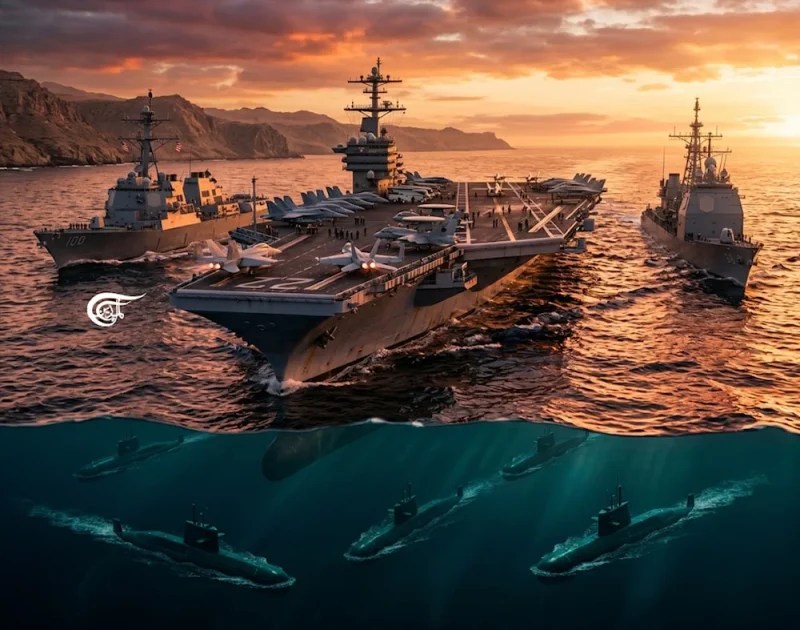
What we are witnessing today is not merely a regional conflict. It is a strategic impasse in one of the most sensitive maritime corridors on earth. The United States has deployed significant naval power into the region. Carrier strike groups centred around the USS Dwight D. Eisenhower, USS Theodore Roosevelt, and USS Gerald R. Ford are operating alongside cruisers, destroyers, frigates and replenishment tankers. Along with them are nuclear-powered guided missile submarines of the Ohio-class submarine type, carrying formidable strike capability. With over two hundred and fifty aircraft embarked across these platforms, the sheer scale of deployment is impressive by any standard.
Yet, having commanded ships myself, I know that numbers and tonnage do not always translate into control, especially in confined, contested waters.
The stated objective appears straightforward: enforce a maritime blockade of Iranian ports and ensure unhindered passage through the Strait of Hormuz. But here lies the irony. The Strait, by most accounts, was already open before the escalation. What has changed is not the physical state of the waterway, but the political and military environment surrounding it.
Iran’s recent offer has placed Washington in a difficult position. It has indicated willingness to ensure the Strait remains open, on its own terms, provided the United States lifts the blockade and shows flexibility on the timing of nuclear negotiations. Accepting such an offer risks appearing to concede under pressure. Rejecting it prolongs a costly and increasingly unpopular confrontation.
And cost is now becoming the defining factor.
Fuel prices have risen. The ripple effect is visible in everyday commodities. The American public, which never truly supported this war, is beginning to feel the burden directly. Wars fought thousands of miles away eventually find their way into domestic politics, and this one is no exception. The narrative of a swift and decisive operation has long faded. What remains is a grinding reality.
There is also a growing perception (rightly or wrongly) that this was not entirely America’s war to begin with. Many point towards the long-standing position of Benjamin Netanyahu, who has, for decades, articulated a hardline stance against Iran. Previous US administrations, including those led by Barack Obama, Joe Biden, George W. Bush and Bill Clinton, exercised caution in this regard. They understood, perhaps better than most, that Iran is not an easy adversary.
And this is where, in my professional judgement, the conversation must turn towards Iran’s maritime capability, often underestimated, sometimes misunderstood, but very real.
Iran does not seek to match the United States ship for ship. Instead, it has built what we in naval terms would call an asymmetric maritime strategy. Its so-called “mosquito fleet” consists of numerous fast attack craft — small, agile, heavily armed platforms that can swarm larger vessels. Operating from concealed bases along the coastline and from island positions, these units are difficult to detect and even harder to neutralize in large numbers.
Then there are the Ghadir-class submarines, small, quiet, and ideally suited for the shallow waters of the Gulf. These are not platforms designed for long blue-water patrols; they are designed for ambush. In confined waters, that makes all the difference.
Sorry, the comment form is closed at this time.
Featured Video
The Failed Air War Over Vietnam
or go to
Aletho News Archives – Video-Images
From the Archives
USS Liberty Massacre: A Pivotal Moment in the Hostile Takeover of America
By Kevin Barrett | Crescent | Dhu al-Qa’dah 24, 1445
In corporate America, hostile takeovers are commonplace. They occur when an aggressor—a larger corporation or rich individuals—seizes control of a smaller corporation without asking permission.
What few recognize is that the United States itself has been subjected to a hostile takeover. Since the aggressor, the illegitimate settler colony known as “Israel,” is much smaller than the US, the takeover has necessarily been surreptitious.
As of June, 2024, Israel’s gradual takeover of the US has become obvious and undeniable—a proverbial “elephant in the living room.” … continue
Blog Roll
 Aletho News
- Yemeni Armed Forces Warn Airlines Against Using Saudi Airports, Exempt Mecca and Medina
- Iran security chief says powers greater than US tried to conquer Iran but ended in ‘dustbin of history’
- Europe’s mounting social chaos… chickens coming home to roost for proxy war against Russia
- US-Russia Diesel Deal Becomes Massive Defeat for Ukraine
- Hormuz and the Looming Economic Catastrophe
- Dhubab offensive, media blitz and the rapid unraveling of Saudi-backed coalition’s new gambit
- Putin Conveys to Trump Iran’s Vision on Possible Conflict Resolution – Kremlin
- The Search for Truth: Charlie Kirk’s Assassination One Year Later
- ‘Harsh reality’: Iran says France seeks monopoly on power and intimidation, not peace for all
- When Will This White House Madness End?
- If Americans Knew
- Israeli forces kill another child in Gaza – Daily Update
- Gaza ceasefire exists in name only, say more than 100 organizations
- Nearly 2 Million in Gaza Need Urgent Shelter Assistance as Winter Looms: IOM Chief Warns
- Suppressing Palestinian resistance: US charity under fire for AI monitoring of Gaza classrooms
- Thousands Are Held in Israeli Torture Camps. This Is What Happens Inside
- Israel puts Gaza’s sick, injured, newborn in peril – Daily Update
- Report claimed Mark Levin used by Israeli government to influence Trump
- Over 2,000 Gazans have died awaiting medical evacuation amid Israel’s continued siege
- How a U.S. Diplomat Suppressed and Altered Reports Critical of Israel
- 5 Palestinians Die from Israeli Strikes in Gaza as Relentless Attacks Continue
- No Tricks Zone
- Germany’s Green Energy Debacle: High Energy Costs Force Kahla Porzellan to Close After 182 Years!
- New Study: 50 Years Of The Most Aggressive ‘Net Zero’ Policies Can Only Affect The Global Climate By 0.03°C
- US September “Heat” Was No Record…Many Records Set Decades Ago
- Latest European Green Energy Debacle; Portugal’s Largest Flagship Solar Park Insolvent!
- Green Energy Debacle: German Expert Professor Fritz Vahrenholt Warns Of Severe Economic And Social Consequences
- Two More Paleo Reconstructions Affirm Meters-Higher Sea Levels Across Ireland, Brazil 7000-6000 Years Ago
- New Study: Earth And Venus Surface Warmth Largely Explained By Convection And Lapse Rate, Not CO2 Or Radiation
- 2025 Nature Paper Claiming Worsening Global Drought Gets RETRACTED …Heavily Flawed
- New Study: ‘Global Drought Shows No Detectable Recent Acceleration Under Climate Warming’
- Economic Masterminds: German Socialists Suggest Taxing Productivity Gains Stemming From Using AI

