Trump Administration’s DOJ Filing in Supreme Court ‘Sharp Betrayal’ of Religious Freedom
By Jefferey Jaxen | May 27, 2026
In a stunning reversal the Department of Justice under President Trump has filed a brief urging the U.S. Supreme Court to deny review in John Doe et al. v. Kathy Hochul, No. 24-1015. The case involves former New York healthcare workers fired for refusing COVID-19 vaccination on religious grounds under the state’s now-repealed Section 2.61 mandate, which allowed medical exemptions but barred religious ones.
The move is in stark contrast to the COVID-era legal momentum across the board seeing courts rule in favor of employees fired for religious vaccine refusals.
The Second Circuit upheld the employers’ refusal to accommodate, citing “undue hardship.”
The DOJ’s Call for the Views of the Solicitor General (CVSG) brief argues the petition is a poor vehicle for review—no circuit split, a repealed law, and petitioners who sought only a full exemption rather than alternatives like reassignment—while defending the policy’s consistency with Title VII of the Civil Rights Act.
This position, however, draws sharp criticism for weakening core protections against religious discrimination. Aaron Siri, a leading litigator who has represented numerous affected healthcare workers, called out the filing in an X post stating:
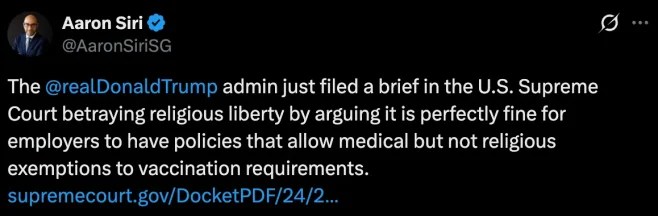
The brief’s analysis hinges on semantics and procedural technicalities. It acknowledges that petitioners claimed New York’s mandate conflicted with Title VII by foreclosing reasonable religious accommodations. Yet it frames their requests as demands for an “exemption” prohibited by state law, rather than the “accommodation” federal law requires.
Siri dismantled this in a follow-up post:
“Instead of defending these wrongfully terminated workers, the DOJ nonsensically and shamefully plays word games to characterize their requests as seeking an ‘exemption’ (which New York law prohibited) instead of an ‘accommodation’ (an option federal law requires). It then relies on this semantic nonsense to argue that the Supreme Court should not review the Second Circuit’s holding that a policy providing for medical but not religious exemptions is legal.”
Siri, who is perhaps the most experienced lawyer defending Americans who experienced COVID-era oversteps of basic liberties and freedoms, described the practical outcome bluntly: the mandate “permitted only a medical exemption and did not include a religious exemption.”
Healthcare workers with sincere religious objections were fired en masse. He continued,
“Having dealt with scores of religious employees in New York that lost their jobs under this policy, the Trump administration’s position is a sharp betrayal. The DOJ should have simply argued the obvious – that Section 2.61 foreclosed any religious exemption and hence should not stand under federal law. Period. That would have taken one or two pages. Instead, it spends over 20 pages creating a word salad of nonsense to justify New York’s and the DOJ’s unjustifiable position.”
This approach is dangerous because it normalizes differential treatment: medical exemptions are permissible, but religious ones trigger “undue hardship” claims tied to state penalties. Under Title VII, as clarified in Groff v. DeJoy (2023), employers must accommodate religious practice unless it imposes substantial increased costs. Yet the DOJ’s brief effectively blesses a regime where religious belief is disfavored, allowing employers to hide behind preempted state rules.
If a law bars religious accommodations outright, Title VII should preempt it—yet here the filing accepts a policy that functionally did exactly that while claiming otherwise.
The stakes extend far beyond healthcare. A Supreme Court denial, influenced by this brief, could embolden employers nationwide to impose vaccine or other medical mandates while dismissing religious objections as unreasonable.
It undermines the free exercise principles reinforced in cases like Fulton v. City of Philadelphia and signals that post-COVID religious liberty battles remain unwinnable in court. Workers facing future mandates—for flu shots, boosters, or novel therapies—would find their faith subordinated to bureaucratic convenience.
Siri’s critique highlights a missed opportunity for the administration that campaigned on restoring freedoms eroded during the pandemic. By playing procedural games instead of forcefully defending Title VII’s mandate to accommodate sincere religious practice, the DOJ risks setting precedent that treats faith as second-class. As Siri warned, this is no minor technical brief; it is a “sharp betrayal” that could erode religious freedom for millions. The Supreme Court must recognize the broader threat and take the case to reaffirm that no employer or state can lawfully force a choice between livelihood and conscience.
Sorry, the comment form is closed at this time.
Featured Video
Trump asks Iran not to retaliate after he strikes Pickaxe Mountain
or go to
Aletho News Archives – Video-Images
Book Review
‘Why Fauci Must Rot in Prison’: A Tale of Two Diaries
By Jill Erzen | The Defender | October 13, 2026
Dr. Anthony Fauci’s private diary reveals a “mind-numbing” contradiction between what the former top U.S. infectious disease official knew about COVID-19 and what he told the public, senior White House adviser Peter Navarro, Ph.D., said last week on “American Thought Leaders.”
In his new book, “Why Fauci Must Rot in Prison,” due out Oct. 20, Navarro compares Fauci’s private entries to his own pandemic-era diary, and uses what he calls “a tale of two diaries” to argue that Fauci should face criminal prosecution.
“I show, actually, how a prosecution can and should happen … at the state level, most likely,” Navarro said. “He should wind up in prison, and we’ve got the receipts in this book to put him there.”
Navarro said Fauci repeatedly acknowledged important facts in private, then publicly pursued policies that contradicted those facts — with devastating consequences.
“What he says many times privately in his diary is so at odds with both his public behavior and public statements that it’s mind-numbing,” Navarro said.
Navarro examines the lasting damage caused by lockdowns and other pandemic policies, and the ongoing toll of long COVID.
His book also addresses questions about vaccine safety, including why healthy young people faced COVID-19 vaccination mandates despite concerns about myocarditis, and why women were not warned about miscarriage risks linked to the shots. … continue
Blog Roll
 Aletho News
- Yemen denounces international community’s silence on Saudi aggression, siege
- UAE and Saudi Arabia move toward renewed coordination against Sanaa
- How Iran’s two-week retaliatory strikes exposed cracks in US military architecture in Persian Gulf
- The mother of all propaganda: Why the hype over US MOAB strike against Iran is nothing but theater
- Iran says it possesses technology behind US 14-ton GBU bunker-buster
- Trump asks Iran not to retaliate after he strikes Pickaxe Mountain – w/ Prof. Marandi
- Vice President J.D. Vance’s Deceptive ‘Antiwar’ Campaign Speech
- Iran: Palestinians’ rights must not be compromised in Gaza’s future; US, Israel to blame for Hormuz situation
- Ongoing tales of Syrian chemical weapons
- Moscow blasts UN for ignoring torture of Russian POWs
- If Americans Knew
- Israeli rabbi permits occupiers to steal Palestinian olive harvest in West Bank
- Netanyahu’s spin on latest settler attack is laughable – Daily Update
- Israeli soldiers debunk Israel’s talking points
- In West Bank, Israeli settlers are totally out of control – Daily Update
- NPR investigation finds evidence of widespread fraud at mall kiosks tied to Israeli skincare brand
- Tucker Carlson exposes Israeli Lies about the Oct 7th attack, Charlie Kirk, and the U.S.
- Israel has detained thousands of Palestinian children since Oct 7th – over half spent time in solitary, many uncharged
- Israeli Analysis: Is Netanyahu Planning an ‘October Surprise’ Attack Before Israel’s Election?
- Israeli settlers brutally attack Palestinians and Washington Post female photographer, 65
- Words Have Changed, Occupation Continues: The Reality of the Gaza Ceasefire
- No Tricks Zone
- Predictions Made By Renowned Climate Proifessor Over Past Decades Have Been Proven To Be Poor
- New Study Suggests Large Regions Of The Pacific Ocean Have Been Cooling For The Last 80 Years
- Germany’s Green Energy Debacle: High Energy Costs Force Kahla Porzellan to Close After 182 Years!
- New Study: 50 Years Of The Most Aggressive ‘Net Zero’ Policies Can Only Affect The Global Climate By 0.03°C
- US September “Heat” Was No Record…Many Records Set Decades Ago
- Latest European Green Energy Debacle; Portugal’s Largest Flagship Solar Park Insolvent!
- Green Energy Debacle: German Expert Professor Fritz Vahrenholt Warns Of Severe Economic And Social Consequences
- Two More Paleo Reconstructions Affirm Meters-Higher Sea Levels Across Ireland, Brazil 7000-6000 Years Ago
- New Study: Earth And Venus Surface Warmth Largely Explained By Convection And Lapse Rate, Not CO2 Or Radiation
- 2025 Nature Paper Claiming Worsening Global Drought Gets RETRACTED …Heavily Flawed

