Iran summons European envoys over terrorist attacks in Ahvaz
Press TV – September 22, 2018
Iranian authorities have summoned ambassadors of the Netherlands and Denmark as well as chargé d’affaires of the British embassy in Tehran after terrorists with alleged links to the European countries carried out attacks during a military parade in the southwestern city of Ahvaz on Saturday.
Iran’s Foreign Ministry Spokesman Bahram Qassemi said that the department for European affairs of the ministry summoned the three diplomats separately at the evening time on Saturday to declare Tehran’s strong protest to the role their countries might have played to support elements who carried out the terror attacks in Ahvaz earlier in the day that led to the killing of some 25 people.
The al-Ahvaziya terror group, whose recruits are believed to be scattered in several European countries, including in the Netherlands and in Denmark, claimed responsibility for the attack in Ahvaz.
The terror outfit, which is backed by Saudi Arabia, has a record of carrying out sabotage acts in Iran’s Khuzestan province, which encompasses Ahvaz and some other Arab-dominated towns.
Qassemi said Iran expected the two European countries to extradite the “criminal perpetrators” of the terrorist act in Ahvaz.
“It was reiterated to the ambassadors of the Netherlands and Denmark that the Islamic Republic of Iran had earlier warned about the residence of these individuals in these countries and has called for their arrest and prosecution,” said Qassemi in a statement, adding that the ambassadors of the two countries declared that their governments were ready to share any information with regards to the terrorists and their records.
The official said that Iranian authorities had also passed their strong note of protest to the chargé d’affaires of the British embassy in Tehran about an interview aired by a Britain-based TV channel after the attack in Ahvaz in which the spokesman of the al-Ahvaziya had condoned the terrorist act.
Qassemi said the British diplomat condemned the attack and said that he would accordingly relay Iran’s message of protest to the authorities in London.
Three of the terrorists were shot dead at the scene while a fourth was arrested and later succumbed to his wounds, armed forces spokesman Brigadier General Abolfazl Shekarchi said.
Iran declared Monday to be a day of national mourning in which a funeral ceremony will be held for the victims of the attack in Ahvaz.
All but one of the 25 people killed in the attack have been identified. Some 60 people were wounded in the attack, most of them civilians. Authorities said the death toll could rise as some injured were in critical condition.
Western media mostly silent on Ahvaz terrorist attack
Press TV – September 22, 2018
The mainstream Western media have been mostly silent about the deadly US-sponsored terrorist attack in the Iranian city of Ahvaz, according to US scholar and political analyst Kevin Barrett.
“Innocent people being killed by terrorists is front page news in the West; but, in the case of terrorism against Iran, suddenly, everything changes and the media tends to ignore and downplay it,” Barrett told Press TV in an interview on Saturday.
Barrett sees the attack as another terrorist operation launched by the United States and its regional allies.
“There have been close to 20,000 people killed in these kinds of terrorist attacks by extremist groups in Iran over the years to almost the complete silence of the western media and that is because it is the western governments led by the United States and its Israeli master who are in fact organizing, funding, arming, equipping, and unleashing these terrorists against Iran and they have been ever since the Islamic Revolution of 1979,” Barrett said.
Barrett noted that US President Donald Trump and top officials in his administration like Secretary of State Mike Pompeo and National Security adviser John Bolton were behind such state-sponsored terrorist attacks on innocent people.
“Today, we have in power in the United States the Trump administration whose two main Iran advisers — Bolton and Pompeo –are fanatical anti-Iran haters,” Barrett said.
Barrett said the pair had received huge bribes from the Iranian terrorist opposition group Mojahedin-e Khalq Organization (MKO), known to most other countries by another acronym, MEK.
“These guys bribes are usually called ‘speaking fees’, and Bolton and Pompeo and others will go in front of these terrorist organized events – propaganda exercises – for huge sums of money, to basically paper over MEK’s terrorist past,” Barrett said.
In return, Barrett assumed, the pair helps the terrorists receive funds to launch anti-Iran operations. “We can assume that the pair is helping their friends by upping the level of US support for them,” he said.
Barrett said direct support of terrorists groups like the MEK and state-sponsored terrorism was doing the US no good.
Barrett concluded that US-sponsored terrorist attacks were going to be counterproductive in the long run because “terrorism doesn’t work … Iranian people are not going to stand it. People like Bolton and Pompeo may have failed to learn that lesson and they will be learning it in the future. “
Univ. of Michigan Professor Cheney-Lippold Receives Death Threats Over Boycott
Palestine Legal | September 19, 2018
University of Michigan professor John Cheney-Lippold, an expert in the field of big data and surveillance, received death threats this week after he told a student he would be unable to write her a recommendation letter for a study abroad program in Israel because he supports the academic boycott for Palestinian rights.
“I wouldn’t cross a union picket line and I can’t cross this one,” said Cheney-Lippold. “I support the Palestinian boycott call because I am appalled at Israel’s continuing violation of Palestinian rights, and our government’s support for those violations. If a student had wanted to do a study abroad at an institution in Apartheid South Africa, I would have declined to write a letter for her as well.”
After an email exchange about deadlines with the student, Cheney-Lippold informed the student on September 5 that for political and ethical reasons he could not write her a recommendation for the program. “Let me know if you need me to write other letters for you, as I’d be happy,” Cheney-Lippold wrote.
A few days later, Club Z, a Zionist organization, posted the email on Facebook. Islamophobe ideologue Pamela Geller and right-wing groups including the Zionist Organization of America called for the professor to be dismissed. The story spread among conservative sites such as Fox News, Breitbart and the Daily Caller and was soon picked up by other sites such as CBS and the Chronicle of Higher Education. Soon after, Cheney-Lippold received over 500 emails, including messages calling for him to be killed.
“It’s not uncommon for professors to decline to write recommendations for ethical, political or academic reasons,” said Radhika Sainath, Senior Staff Attorney with Palestine Legal, who is advising Cheney-Lippold. “A professor is not obligated to write a recommendation letter for organizations complicit in unlawful or unethical activity – whether it’s the NRA, President Trump or Israel institutions complicit in violations of Palestinian rights.”
The Palestinian civil society call for a boycott to protest Israel’s ongoing violations of their human rights includes a call to boycott Israeli academic institutions. This includes study abroad programs in Israel, which it says “are part of the Israeli propaganda effort, designed to give international students a ‘positive experience’ of Israel, whitewashing its occupation and denial of Palestinian rights.” The boycott guidelines also state that “international faculty should not accept to write recommendations for students hoping to pursue studies in Israel,” given these institutions’ complicity in Israel’s violations of Palestinian rights.
In 2017, two unconstitutional anti-boycott bills were signed into law by Michigan Governor Rick Snyder. The laws apply to narrowly defined state procurement and construction contracts – not professors or an academic boycott.
Israeli Attack Which Led to Il-20 Tragedy Was Reaction to Idlib Truce – Analyst
Sputnik – September 22, 2018
The destruction of a Russian Il-20 reconnaissance aircraft with 15 airmen onboard has led to questions about Moscow’s relations with both Syria and Israel. Speaking to Sputnik, Middle East affairs observer Ali ben Masoud al-Mashani said he was confident that whatever else happens, Russian-Syrian counterterrorism cooperation will continue.
Speaking to Sputnik about the lost Il-20, which was destroyed by Syrian air defenses over the Mediterranean Sea as the Syrian military attempted to repel an Israeli attack on Monday, al-Mashani said it was important to keep in mind that “this tragedy occurred because of the [Israeli] attack on Syria. Syrian airspace was violated,” he said.
At the moment, the Omani security analyst noted, “it is necessary to fully condemn the actions of all participants of this operation. Yes, the Syrian air defense system also made a mistake, but it was provoked by Israeli military aircraft.”
Al-Mashani categorically ruled out the possibility of a downturn in cooperation between Moscow and Damascus. “Both sides know that the Israeli aggression was a response to the agreements in Sochi between Moscow and Ankara on Idlib,” he said, referring to plans to set up a demilitarized zone in the militant-controlled Syrian province by the middle of next month.
Moscow has yet to decide on the future of Russian-Israeli ties following the downing of its Il-20 ELINT reconnaissance plane, which the Russian Defense Ministry has blamed on the Israeli military. Earlier, Syrian President Bashar Assad expressed his condolences for the tragedy and said he hoped the incident would not impede the Russian-Syrian joint fight against terrorism, while blasting the “arrogance and reckless violence” he said had been shown by Israel with regard to this incident.
The Il-20 was lost over the Mediterranean Sea on September 17 after being hit by a Syrian S-200 surface-to-air missile as it was returning to the Hmeymim air base in the midst of airstrikes by Israeli F-16s against Syrian targets in Latakia, Tartus and Homs. The Russian Defense Ministry accused the Israeli Air Force of creating a dangerous situation by using the Russian plane as a shield against Syrian air defenses, and complained that it did not receive ample warning time to maneuver the plane to safety.
The Israeli Defense Ministry expressed its condolences over the loss of the Russian plane, but continues to maintain that the Syrian military was responsible for the incident. An Israeli delegation led by Air Force Commander Maj. Gen. Amikam Norkin visited Moscow on Thursday to brief Russian officials on the Israeli version of events. Israeli Defense Minister Avigdor Lieberman said Israel had no plans to halt its operations in Syria against Hezbollah and what it claims is an Iranian military presence.
Reactions to attack: How West sees it differently
Press TV – September 22, 2018
At least 25 people were killed and 60 others injured in Ahvaz on Saturday, when terrorists opened fire on people from behind a viewing stand at a military parade held to mark the former Iraqi dictator Saddam Hussein’s invasion of Iran in the 1980s.
The Western and Saudi media have refrained from terming the deadly attack in the Iranian city of Ahvaz a terrorist act despite the large number of civilian casualties in the incident.
The Saudi-backed al-Ahvaziya terror group claimed responsibility for the assault.
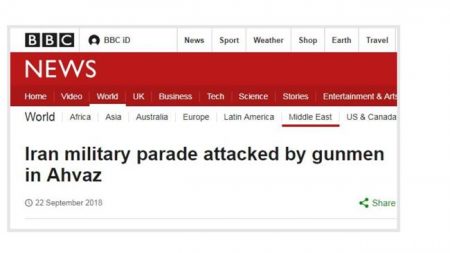
However, the British Broadcasting Corporation (BBC) only used the word “attack” for the terrorist act.
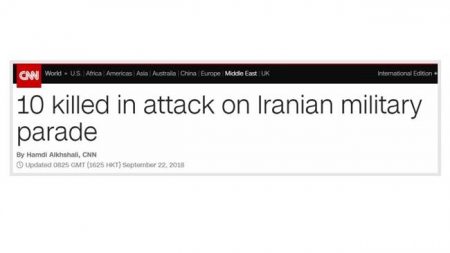
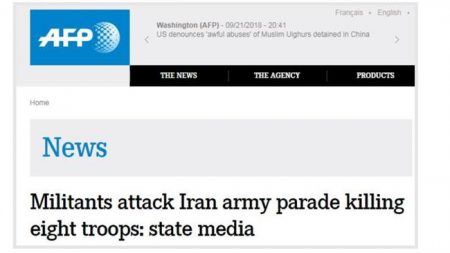
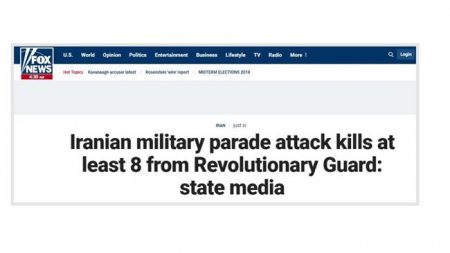
Similarly, Reuters and others described the incident as an “attack” instead of a terror one whereas they have been quick to use “terrorist attack” for similar incidents that took place in Europe over the past few years.
Russia offers condolences
Russian President Vladimir Putin offered condolences to his Iranian counterpart, Hassan Rouhani, after the brutal attack.
He also expressed Moscow’s readiness to boost joint efforts with Tehran in the fight against terrorism.
“This incident once again reminds us about the need to conduct an uncompromising war on terror in all its manifestations. I would like to confirm our readiness to further enhance cooperation with Iranian partners in countering this evil,” the Kremlin quoted Putin as saying.
Iraq deplores attack
Iraqi Interior Minister Qasim al-Araji condemned the incident, saying it once again demonstrated the hostility of terrorists and arrogant elements towards the Muslim nation of Iran.
He further stressed that such actions could not undermine the authority of the Iranian nation.
The New York Times as Judge and Jury
By Joe Lauria • Consortium News • September 21, 2018
We’ve seen it before: a newspaper and individual reporters get a story horribly wrong but instead of correcting it they double down to protect their reputations and credibility—which is all journalists have to go on—and the public suffers.
Sometimes this maneuver can contribute to a massive loss of life. The most egregious example was the reporting in the lead-up to the invasion of Iraq. Like nearly all Establishment media, The New York Times got the story of Iraq’s weapons of mass destruction—the major casus belli for the invasion—dead wrong. But the Times, like the others, continued publishing stories without challenging their sources in authority, mostly unnamed, who were pushing for war.
The result was a disastrous intervention that led to hundreds of thousands of civilian deaths and continued instability in Iraq, including the formation of the Islamic State.
In a massive Times‘ article published on Thursday, entitled, “‘A Plot to Subvert an Election: Unravelling the Russia Story So Far,” it seems that reporters Scott Shane and Mark Mazzetti have succumbed to the same thinking that doubled down on Iraq.
They claim to have a “mountain of evidence” but what they offer would be invisible on the Great Plains.
With the mid-terms looming and Special Counsel Robert Mueller unable to so far come up with any proof of collusion between Russia and the Trump campaign to steal the 2016 election—the central Russia-gate charge—the Times does it for him, regurgitating a Russia-gate Round-Up of every unsubstantiated allegation that has been made—deceptively presented as though it’s all been proven.
This is a reaffirmation of the faith, a recitation of what the Russia-gate faithful want to believe is true. But mere repetition will not make it so.
The Times’ unsteady conviction is summed up in this paragraph, which the paper itself then undermines only a few paragraphs later:
“What we now know with certainty: The Russians carried out a landmark intervention that will be examined for decades to come. Acting on the personal animus of Mr. Putin, public and private instruments of Russian power moved with daring and skill to harness the currents of American politics. Well-connected Russians worked aggressively to recruit or influence people inside the Trump campaign.”
But this schizoid approach leads to the admission that “no public evidence has emerged showing that [Trump’s] campaign conspired with Russia.”
The Times also adds: “There is a plausible case that Mr. Putin succeeded in delivering the presidency to his admirer, Mr. Trump, though it cannot be proved or disproved.”
This is an extraordinary statement. If it cannot be “proved or disproved” what is the point of this entire exercise: of the Mueller probe, the House and Senate investigations and even of this very New York Times article?
Probing to prove this constructed story without proof is the very point of this piece.
A Banner Day
The 10,000-word article opens with a story of a pro-Russian banner that was hung from the Manhattan Bridge on Putin’s birthday, and an anti-Obama banner hung a month later from the Memorial Bridge in Washington just after the 2016 election.
On public property these are constitutionally-protected acts of free speech. But for the Times, “The Kremlin, it appeared, had reached onto United States soil in New York and Washington. The banners may well have been intended as visual victory laps for the most effective foreign interference in an American election in history.”
Why? Because the Times tells us that the “earliest promoters” of images of the banners were from social media accounts linked to a St. Petersburg-based click-bait farm, a company called the Internet Research Agency. The company is not legally connected to the Kremlin and any political coordination is pure speculation. IRA has been explained convincingly as a commercial and not political operation. Its aim is get and sell “eyeballs.”
For instance the company conducted pro and anti-Trump rallies and social media messages, as well as pro and anti-Clinton. But the Times, in classic omission mode, only reports on “the anti-Clinton, pro-Trump messages shared with millions of voters by Russia.” Sharing with “millions” of people on social media does not mean that millions of people have actually seen those messages. And if they had there is little way to determine whether it affected how they voted, especially as the messages attacked and praised both candidates.
The Times reporters take much at face value, which they then themselves undermine. Most prominently, they willfully mistake a an indictment for a conviction, as if they do not know the difference.
This is in the category of Journalism 101. An indictment need not include evidence and under U.S. law an indictment is not evidence. Juries are instructed that an indictment is merely an accusation. That the Times commits this cardinal sin of journalism to purposely confuse allegations with a conviction is not only inexcusable but strikes a fatal blow to credibility of the entire article.
It actually reports that “Today there is no doubt who hacked the D.N.C. and the Clinton campaign. A detailed indictment of 12 officers of Russia’s military intelligence agency, filed in July by Mr. Mueller, documents their every move, including their break-in techniques, their tricks to hide inside the Democrats’ networks and even their Google searches.”
Who needs courts when suspects can be tried and convicted in the press?
What the Times is not taking into account is that Mueller knows his indictment will never be tested in court because the GRU agents will never be arrested, there is no extradition treaty between the U.S. and Russia and even if it were miraculously to see the inside of a courtroom Mueller can invoke states secrets privilege to show the “evidence” to a judge with clearance in his chambers who can then emerge to pronounce “Guilty!” without a jury having seen that evidence.
This is what makes Mueller’s indictment more a political than a legal document, giving him wide leeway to put whatever he wants into it. He knew it would never be tested and that once it was released, a supine press would do the rest to cement it in the public consciousness as a conviction, just as this Times piece tries to do.
Errors of Commission and Omission
There are a series of erroneous assertions and omissions in the Times piece:
–Not mentioning that the FBI was never given access to the DNC server but instead gullibly believing the assertion of the anti-Russian private company CrowdStrike, paid for by the DNC, that the name of the first Soviet intelligence chief found in metadata proves Russia was behind the hack. Only someone wanting to be caught would leave such a clue.
–Incredibly believing that Trump would have launched a covert intelligence operation on live national television by asking Russia to get 30,000 missing emails.
–Ignoring the possible role of the MI6, the CIA and the FBI setting up Trump campaign members George Papadopoulos and Carter Page as “colluders” with Russia.
–Repeating misleading statements about the infamous Trump Tower meeting, in which Trump’s son did not seek dirt on Clinton but was offered it by a music promoter, not the Russian government. None was apparently produced. It’s never been established that a campaign receiving opposition research from foreigners is illegal (though the Times has decided that it is) and only the Clinton campaign was known to have obtained any.
–Making no mention at all of the now discredited opposition research dossier paid for by the Clinton campaign and the DNC from foreign sources and used by the FBI to get a warrant to spy on Carter Page and potentially other campaign members.
–Dismissing the importance of politicized text messages between FBI agents Peter Strzok and Lisa Page because the pair were “skewered regularly on Mr. (Sean) Hannity’s show as the ‘Trump-hating F.B.I. lovebirds.’”
–Putting down to “hyped news stories” the legitimate fear of a new McCarthyism against anyone who questions the “official” story being peddled here by the Times.
–Seeking to get inside Putin’s head to portray him as a petulant child seeking personal revenge against Hillary Clinton, a tale long peddled by Clinton and accepted without reservation by the Times.
–Pretending to get into Julian Assange’s head as well, saying he “shared Mr. Putin’s hatred of Mrs. Clinton and had a soft spot for Russia.” And that Assange “also obscured the Russian role by fueling a right-wing conspiracy theory he knew to be false.”
–Ignoring findings backed by the Veteran’s Intelligence Professionals for Sanity that the DNC emails were leaked and not hacked.
–Erroneously linking the timing of WikiLeaks’ Podesta emails to deflect attention from the “Access Hollywood” tape, as debunked in Consortium News by Italian journalist Stefania Maurizi, who worked with WikiLeaks on those emails.
Distorts Geo-Politics
The piece swallows whole the Establishment’s geo-strategic Russia narrative, as all corporate media do. It buys without hesitation the story that the U.S. seeks to spread democracy around the world, and not pursue its economic and geo-strategic interests as do all imperial powers.
The Times reports that, “The United States had backed democratic, anti-Russian forces in the so-called color revolutions on Russia’s borders, in Georgia in 2003 and Ukraine in 2004.” The Times has also spread the erroneous story of a democratic revolution in Ukraine in 2014, omitting crucial evidence of a U.S.-backed coup.
The Times disapprovingly dismisses Trump having said on the campaign trail that “Russia was not an existential threat, but a potential ally in beating back terrorist groups,” when an objective view of the world would come to this very conclusion.
The story also dismisses American voters’ real concerns that led to Trump’s election. For the Times, economic grievances and rejection of perpetual war played no role in the election of Trump. Instead it was Russian influence that led Americans to vote for him, an absurd proposition defied by a Gallup poll in July that showed Americans’ greatest concerns being economic. Their concerns about Russia were statistically insignificant at less than one percent.
Dismissing Americans’ real concerns exposes the class interests of Times staffers and editors who are evidently above Americans’ economic and social suffering.
Establishment reporters insulate themselves from criticism by retreating into the exclusive Establishment club they think they inhabit. It is from there that they vicariously draw their strength from powerful people they cover, which they should instead be scrutinizing. Validated by being close to power, Establishment reporters don’t take seriously anyone outside of the club, such as a website like Consortium News.
But on rare occasions they are forced to take note of what outsiders are saying. Because of the role The New York Times played in the catastrophe of Iraq its editors took the highly unusual move of apologizing to its readers. Will we one day read a similar apology about the paper’s coverage of Russia-gate?
Joe Lauria is editor-in-chief of Consortium News and a former correspondent for The Wall Street Journal, Boston Globe, Sunday Times of London and numerous other newspapers. He can be reached at joelauria@consortiumnews.com and followed on Twitter @unjoe .
Israel bans restoration of East Jerusalem sports stadium
MEMO | September 21, 2018
The Israeli authorities yesterday banned the renovation of a sports stadium in the Palestinian town of Issawiya, northeast of East Jerusalem.
A member of the follow-up committee in Issawiya, Mohammed Abu Al-Homs, said that joint teams from the Israeli Jerusalem municipality and police forces stormed the Yasser Arafat sports stadium during renovation work and forced the workers to stop working under the pretext that the renovation was being financed by a terrorist group.
He explained that the Issawiya management club started about a month ago to restore the stadium with donations from the local residents, but they were surprised yesterday when the Israeli army forces stormed the stadium and stopped the restoration work.
He added that the Jerusalem municipality tried to seize the stadium by offering to restore it themselves and turn it into a public arena, but the club’s management and the town residents refused, stressing that they will restore the stadium on their own.
Israeli settler runs over Palestinian teen in Hebron City
Ma’an – September 21, 2018
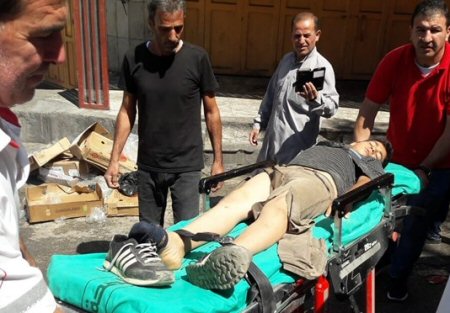
HEBRON – A 16-year-old Palestinian teen was hospitalized after an Israeli settler “deliberately” ran him over, on Friday, in the Tel Rumeida neighborhood in the southern occupied West Bank city of Hebron.
Witnesses told a Ma’an reporter that an Israeli settler deliberately ran over the Palestinian teen with his vehicle in Hebron City.
The teen was identified by locals as Munir Abdullah Gharib, 16.
Mounir suffered injuries from the attack and was immediately transferred to the Alia Governmental Hospital in Hebron for necessary medical treatment; his condition remained unknown.
Incidents involving Israeli settlers hitting Palestinians in the occupied Palestinian territory are a relatively regular occurrence, and are usually treated by Israeli security forces as accidents, even in cases when witnesses claim the car rammings were deliberate.
Some 800 notoriously aggressive Israeli settlers now live under the protection of the Israeli military in the Old City, surrounded by more than 30,000 Palestinians.
Palestinian residents of the Old City of Hebron face a large Israeli military presence on a daily basis, with at least 32 permanent and partial checkpoints set up at the entrances of many streets.
Additionally, Palestinians are not allowed to drive on al-Shuhada street, have had their homes and shops on the street welded shut, and in some areas of the Old City, are not permitted to walk on certain roads.
Meanwhile, Israeli settlers move freely on the street, drive cars and carry machine guns.
China’s Chilling ‘Social Credit System’ Is Straight Out of Dystopian Sci-Fi, And It’s Already Switched On
By Peter Dockrill | Science Alert | September 20, 2018
It’s been in the pipeline for years: a sprawling, technological mass surveillance network the likes of which the world has never seen. And it’s already been switched on.
China’s “Social Credit System” – which is expected to be fully operational by 2020 – doesn’t just monitor the nation’s almost 1.4 billion citizens. It’s also designed to control and coerce them, in a gigantic social engineering experiment that some have called the “gamification of trust.”
That’s because the massive project, which has been slowly coming together for over a decade, is about assigning an individual trust score to each and every citizen, and to businesses too.
According to China’s Communist Party, the system will “allow the trustworthy to roam freely under heaven while making it hard for the discredited to take a single step”.
To pull this off, the unprecedented scheme will harness the immense reach of China’s technological infrastructure: some 200 million CCTV cameras, according to a report by Australia’s Foreign Correspondent.
The idea is these ever-watchful eyes will be hooked up to facial recognition systems, and cross-checked with financial, medical records, and legal records – with the whole apparatus regulated and interpreted by advanced, big-data-crunching AI networks.
The sweeping dystopia of it all is uncannily reminiscent of the TV show Black Mirror – in particular the eerily prescient episode “Nosedive” – but while several outlets have pointed the similarities out, China’s ultimate goal goes even further.
“This is potentially a totally new way for the government to manage the economy and society,” economist Martin Chorzempa from the Peterson Institute for International Economics told The New York Times in July.
“The goal is algorithmic governance.”
For such a complex plan, the crux of social credit is simple. In localised pilot programs that are already operational throughout Chinese cities, citizens are assigned a numerical score.
For positive personal and social acts – such as paying bills on time, engaging in charity, and properly sorting your recycling – citizens get their score bumped up, which gives them access to perks, like better credit facilities, cheaper public transport, and even shorter wait times for hospital services.
But if you break the rules, beware. People who are late with payments, or caught jaywalking or smoking in non-smoking areas, will be punished.
In what’s being described as a “digital dictatorship”, their score takes a hit for each infraction, meaning they incur things like financial penalties and even travel restrictions.
That’s what happened to investigative journalist Liu Hu, who says the social credit system destroyed his career after he was blacklisted for making accusations of government corruption.
Branded “dishonest”, he had access to rail travel suspended, and his social media accounts – comprising some 2 million followers – were reportedly shut down, effectively making his job impossible.
As Hu told Foreign Correspondent, he doesn’t believe most Chinese are aware of how these kinds of punishments could affect them.
“You can see from the Chinese people’s mental state,” he says.
“Their eyes are blinded and their ears are blocked. They know little about the world and live in an illusion.”
But the social credit system reaches even further than this.
Individuals aren’t the only ones subject to this gamification. So too are companies inside China, but also businesses outside it – with international airlines already feeling the coercive aspects of the controversial system, which some fear could “interfere directly in the sovereignty of other nations“.
Back home, surveys show the early system is already popular with socially advantaged citizens who are already enjoying the perks of pilot programs.
In other words, the game is on.
“It sounds like it will help improve the quality of citizens in the long run,” Shanghai-based saleswoman Joyce Hu told NPR last year.
“As long as it doesn’t violate my privacy, I’m okay with it.”
Alabama debunks the Times’ story about our warming world
Fabius Maximus website | September 19, 2018
Summary: The NY Times gives a story with bold numbers, confidently stated. Too bad their fact-checkers did not notice that their numbers are grossly misleading. Propaganda pretending to be science. This does not help, even if well-intended. The State Climatologist of Alabama tells the real story.
The Alabama Climate Report, August 2018.
By John R. Christy, Alabama State Climatologist.
Also Professor of Atmospheric Science and Director of the Earth System Science Center
at the U of AL in Huntsville. Links added.
Meteorological summer (June, July and August) is over. It is time to check how the summer temperatures compare with other years. For a research project a few years ago we developed a statewide summer temperature index for four 100-mile diameter regions centered on the major cities of the state – Mobile, Montgomery, Birmingham and Huntsville – going back to 1883. This summer will go down in that database and in NOAA’s official records as being slightly cooler than average.
Somewhat related to this, a reader sent me a link to a New York Times interactive website that claims to provide the number of days above 90°F each year for cities across the country: “How Much Hotter Is Your Hometown Than When You Were Born?” The results are produced for the Times by Climate Impact Lab (some might call it an environmental pressure group).
Since I build numerous datasets of this type, I took a look. The website asks you for the town and year in which you were born, then provides a time series purportedly showing the number of 90°F days per year since your birth and how that has increased.
Though a native of California, I have lived in Huntsville more years than any other place, so I put in my birth year and Huntsville as my hometown. Immediately I became suspicious when their dataset started only recently in 1960 (and a few years after my birth). …
For Huntsville and Montgomery, here are their results. Quite scary. It appears that the number of 90°F days has risen to their highest levels ever. It says that in 1960 Huntsville had 45 days above 90°F, but by 2017 it was 57 days and rising.
Huntsville, Alabama.

Montgomery, Alabama.

Then, to make matters even scarier, they use climate model projections to 2090 to tell me that in 2040, when I’m 80, there will be 73 such hot days in Huntsville (as shown below). Yikes!
Huntsville’s future per RCP4.5!

Editor’s note – From the NYT website.
“For each year, the count of days at or above 90 degrees reflects a 21-year rolling average. Temperature observations for your hometown are averaged over an area of approximately 625 km² (240 square miles), and may not match single weather-station records.
“The time series is based on historical data for 1960-2000. The 2001-2020 period relies on a combination of historical data and future projections. After 2020, the data uses a mixed climate model that captures a broad range of extreme temperature responses. The “likely” future range reflects outcomes with 66 percent probability of occurrence in the RCP 4.5 scenario.”
The rest of the story
Before you sell your house and move to Canada, let’s take a look at the real story. Having built many climate datasets of Alabama, some starting as early as 1850, I knew the Times story was designed to create alarm and promote the claim that humans who use carbon-based energy (gasoline, natural gas, coal) to help them live better lives are making our summers ever more miserable. Be aware reader, this webtool is not designed to provide accurate information.
First of all, climate data for Alabama began in the 19th century, not 1960. In 2016 Dr. Richard McNider (Alabama’s former State Climatologist) and I published a carefully constructed time series of summer temperatures for the state starting from 1883. This used numerous station records, including some that the federal government had not archived into its databases (which are the most common source for outfits like the Climate Impacts Lab.)
“Time Series Construction of Summer Surface Temperatures for Alabama, 1883–2014, and Comparisons with Tropospheric Temperature and Climate Model Simulations” in the Journal of Applied Meteorology and Climatology, March 2016.
I’ve updated that work to include summer temperatures through 2018. The result is below. Not only are summer daytime temperatures not rising, they have actually fallen over the last 136 years. After looking at the graph, why do you suppose the Climate Impacts Lab decided to start their charts in 1960?
We went a step further in that paper and demonstrated that climate models failed completely to replicate the downward temperature trend in Alabama over the past 120 years: 76 different models with a 100% failure rate. Would you trust these same models to tell you about the future as the Times does? Why did they not check the models for validity?
Now, what about the number of “hot” (or in Alabama we would say “typical”) 90°F days? For Alabama and the nation, I’ve calculated the average value per station each year since 1895. The results below speak for themselves (there is no increase of days hotter than 90°F) and expose the misinformation provided through the Times.


Providing accurate information on Alabama’s climate is what we do in our office. In fact, using real data, I can’t even come close to reproducing the images that the Climate Impacts Lab did which show 2010’s as having the most 90°F days in Alabama. I’m guessing they are using some theoretical output rather than sticking with observations. …I’ll check and follow-up as I can, but something is fishy.
This is a great state in which people can enjoy life and in which businesses can operate. Our climate resources are one of the reasons we are doing so well in recruitment. Occasionally though the time comes when I must address claims made by those whose intention is not to inform but to promote false alarm. This usually happens when an environmental pressure group generates a press release whose dramatic statements are published by a willing media (without any fact-checking). This is one of those times, and I’m sure it will not be the last.
Dr. John R. Christy is the Distinguished Professor of Atmospheric Science and Director of the Earth System Science Center at the University of Alabama in Huntsville. Since November 2000 he has been Alabama’s State Climatologist. See his bio at the U of AL website (from which this bio was taken).
In 1989 Dr. Roy W. Spencer (then a NASA scientist, now a Principle Research Scientist at UAH) and Christy developed a global temperature data set from microwave data observed from satellites beginning in 1979. For this achievement, the Spencer-Christy team was awarded NASA’s Medal for Exceptional Scientific Achievement in 1991. In 1996, they received a Special Award by the American Meteorological Society “for developing a global, precise record of earth’s temperature from operational polar-orbiting satellites, fundamentally advancing our ability to monitor climate.” In January 2002 Christy was inducted as a Fellow of the American Meteorological Society.
Dr. Christy has served as a Contributor (1992, 1994, 1996 and 2007) and Lead Author (2001) for the U.N. reports by the IPCC in which the satellite temperatures were included as a high-quality data set for studying global climate change. He has served on five National Research Council panels or committees, has performed research funded by NASA, NOAA, DOE, DOT and the State of Alabama, and has testified 18 times for congressional committees.
His papers have been published in many journals, including Science, Nature, Journal of Climate, and The Journal of Geophysical Research. See the list here (with links).
Featured Video
Prof. Ted Postol: Iran Already Achieved Nuclear Deterrence Against Israel
or go to
Aletho News Archives – Video-Images
From the Archives
How the occupied mentality syndrome works
Saudi Arabia on the American chessboard – Part 3
By B. J. Sabri | American Herald Tribune | June 27, 2016
Read part 2: “The occupied mentality Syndrome“
Previously I argued whether Saudi Arabia’s repeated involvements in U.S. interventions and wars stem from free national will or in response to a specific condition. For starters, in Saudi Arabia there is no national will. In Saudi Arabia, the national will is the will of the Al Saud clan. Still, when a major Arab state allies itself with a superpower that committed unspeakable crimes against humanity in almost every Arab country, then something is wrong. This fact alone should compel us to examine the U.S.-Saudi relation for one exceptional reason. As a result of the U.S.-Saudi wars, hundreds of thousands of people in Afghanistan, Iraq, Iran, Libya, Syria, Yemen, and Somalia have lost their lives. Millions became displaced in their own homelands. And millions more rendered refugees.
Attributing the Saudi policies to the bonds of “partnership” with the U.S. is frivolous. There are no bonds between these two thugs except those of business, military deals, secret plots, and wars. Proving this point, bonds such as these have no space for the American and Saudi peoples to share significant cultural or societal exchanges. If partnership is not the reason for the Saudi contribution to the U.S. strategy of empire and imperialism, then another reason must exist.
This leads to three possibilities. … continue
Blog Roll
 Aletho News
- REWRITING THE RISK? INSIDE THE GOVERNMENT’S VACCINE SAFETY MESSAGING
- “Davos Can Really Replace the UN”
- NIAID/NIH and USDA Fund Bioengineered Chimeric Influenza Viruses Built Using Pandemic H1N1 Components: Journal ‘Science Advances’
- Hezbollah hits Israeli warship off Lebanon’s coast, sets it aflame
- Iran slams US strikes on B1 bridge, Mahshahr petrochemical plants as ‘blatant acts of state terrorism’
- In letter to UN chief, Araghchi warns of dire consequences of US-Israeli attacks on Iran’s nuclear facilities
- Why the CIA conspiracy to invade Iran with Kurdish militias failed
- Why Are Upbeat US Claims About Mission to Rescue Pilot ‘Highly Questionable’?
- Aircraft destroyed during US ‘rescue’ of downed F-15 pilot cost more than $100 million each
- Washington University removes professor who condemned US-Israeli war on Iran
- If Americans Knew
- In Iran, Israel-US take aim at “reason, research, and freedom of thought” – Daily Update
- US loses planes over Iran, Israel downgrades Lebanon war goals – Daily Update
- Israel Is Blocking Palestinians from Easter at Church Where Jesus Resurrected
- Plot to assassinate Palestinian activist follows harassment campaign promoted by Zionist groups and elected officials
- Prominent New York synagogue hosts presentation on why U.S. Jews should support the ethnic cleansing of Gaza
- Tapper vs. Piker: Is the CNN Anchor Auditioning for David Ellison?
- Shouldn’t Democrats Be Able to Condemn Genocide?
- Israel-US kill negotiators, destroy civilian structures, but Iran’s military capabilities still largely intact – Daily Update
- ‘War crime’: Global condemnation as Israeli ministers celebrate death penalty law targeting Palestinian prisoners
- 7 Ways Israel Is Turning Lebanon Into Gaza
- No Tricks Zone
- An Inconvenient Tree: Uncovered In Alps… Europe Much Warmer Than Today 6000 Years Ago
- New Study Reports A 60% Slowdown In Greenland’s Ice Loss Rate In The Last Decade
- Low Intensity Tornado Wrecks Major Solar Farm, Creating A Potential Toxic Dump
- New Study Finds Warming Saves Lives…Cold Temperatures 12 Times More Deadly Than Excess Heat
- German Science Blog Accuses PIK Climate Institute Of Hallucinating Climate Tipping Points
- Devastating Assessment Of Comirnaty Vaccine By Former Senior Pfizer Europe Toxicologist
- New Study: CO2 Is ‘Effectively Negligible’ As An Explanatory Climate Change Factor Since 2000
- Former Pfizer Toxicologist Dr. Helmut Sterz Tells Bundestag Hearing Pfizer Vaccine Should Have Never Been Approved
- Energy Expert: Germany’s Nuclear Phaseout Was A “500 Billion Euro Mistake”
- New Research: South Australia’s Mid-Holocene Sea Surface Temperatures Were 4°C Warmer Than Today
 Aletho News