Russia-China Joint Approach to the Middle East
By Salman Rafi Sheikh – New Eastern outlook – 29.01.2024
By repeatedly targeting the Houthis in Yemen and pushing for an escalation in the Red Sea, the US is jumping into the Middle East with a military and strategic mindset. The objective is to create space for Washington – and its global allies – to push back against the recent gains, i.e., normalization between Iran and Saudi and Arab normalization with Syria more than a decade after the start of the so-called “Arab Spring”, that Russia and China have made. A wider war in the region will, in the US calculation at least, re-politicize regional fault lines that might allow Washington to reverse the larger normalization process. Considering the high stakes Washington has in developing a wider war in the region, it makes sense for both Russia and China, who largely have similar interests vis-à-vis normalization processes within the Middle East, to develop a joint approach.
In October, soon after Israel launched its brutal war after the October 7 attacks by Hamas and much before the US started doing its own strikes, Russia, anticipating a deeper US military involvement in the Middle East, confirmed that it was already coordinating its Middle East policy with China. This coordination, on the other hand, is also an outcome of the recent state of Russia-China bilateral ties, which, in the words of the Russian foreign minister, are in the best state in the “centuries-old history”.
This coordination also has its roots in the ways that the Arab world itself has come to see its ties with the US on the one hand and Russia and China on the other. For instance, some recent surveys have shown that an increasing number of people across most Arab states view Russia and China as crucial economic players above all. The core reasons for this favourable view are twofold. First, many Arab societies today view the US as no longer a reliable partner. Second, they view Russia and China not from a revisionist perspective, i.e., as states deepening their involvement in the region to replace the US. Rather, Russia and China continue to emphasize the Middle East as a region that can play an autonomous role, i.e., a role not tied to, or disproportionately overshadowed by, any superpower’s interests.
The fact that Russia and China both see the Middle East from this perspective, their calculation sees the Middle East as a vital region that can really push for shifting the center of the present world order away from the West to creating multiple power centres within a multipolar world order. Therefore, developing a joint policy and indirectly protecting the Middle East from slipping too much under the US radar makes sense for both Moscow and Beijing. Were the Middle East to relapse to being a US vassal region, it would make it extremely difficult, if not entirely impossible, for Russia and China to realize their ambitions for a new world order.
Now, for both Russia and China, keeping the Middle East – which is already on the verge of a wider war – as a center of power, they must project their ties beyond the Gaza war. Of course, Israel’s war on Gaza is the most important issue today, and both Russia and China have adopted and emphasized a pro-Arab/pro-Palestine position. But Russia and China are also taking steps to not allow their ties with the region to be bogged down by this one issue.
China and Russia, as we know it, already have deep economic ties with the Middle East. Both, as we know, remain focused on maintaining and expanding these ties despite the ongoing conflicts. Putin’s recent visit to the Middle East was not simply provoked by the Gaza crisis, nor was this war the sole subject of his discussions with Arab leaders. In fact, a lot of discussion was around the core issue of a multipolar world order. Putin emphasized how the conflict in the Middle East is a US failure, a failure that makes it imperative for the Middle East to not only distance itself from Washington but also adopt a more autonomous role to, among other things, resolve the issue through its initiatives. But beyond this, Putin emphasised that “The UAE is Russia’s main trading partner in the Arab world.”
For China as well, this logic of relationship beyond and above the Palestine issue remains prominent. While Beijing has openly supported the Arab state’s current stance on the issue, its ongoing engagement with this region remains predominantly underpinned by the logic of trade and development, building a relationship that helps the Middle East transform into a powerhouse that can ultimately help China and Russia tackle the hegemony of the West. (That’s why both China and Russia recently adopted new members into BRICS, including those from the Middle East.)
At the same time, China has taken steps to use the scenario, like Russia, to step up itself as a global power that can help mediate regional conflicts. In November, China announced its five-point peace plan that placed heavy emphasis on the United Nations, calling for the implementation of all relevant UN resolutions on the conflict and an international conference organized by the world body that leads to a two-state solution, all overseen by the Security Council. While nothing concrete followed this plan, it served China’s purpose of projecting itself as a power different from the West on the one hand and very close to the Arab world on the other.
For Washington, which has been hoping for differences to emerge between Russia and China taking them back to the era of rivalry, this situation is frustrating, making it extremely difficult for it to not lose ground in the Middle East specifically and across the Global South more generally. But its continuing support for Israel’s war machine and its continuing push for NATO’s expansion is doing exactly the opposite of what the US aims for, i.e., preventing its global decline and the related rise of Russia and China.
Salman Rafi Sheikh is a research-analyst of International Relations and Pakistan’s foreign and domestic affairs.
‘Swarming’ the US in West Asia, until it folds
The US is so deeply mired in an unwinnable battle from the Levant to the Persian Gulf that only its adversaries in China, Russia, and Iran can bail it out.
By MK Bhadrakumar | The Cradle | January 29, 2024
Deterrence in defense is a military strategy where one power uses the threat of reprisal to preclude attack from an adversary, while maintaining at the same time the freedom of action and flexibility to respond to the full spectrum of challenges. In this realm, the Lebanese resistance, Hezbollah, is an outstanding example.
Hezbollah’s clarity of purpose in establishing and strictly maintaining ground rules that deter Israeli military aggression has set a high regional bar. Today, its West Asian allies have adopted similar strategies, which have multiplied in the context of the war in Gaza.
America, surrounded
While the Yemeni resistance movement Ansarallah is comparable to Hezbollah in certain respects, it is the audacious brand of defensive deterrence practiced by the Islamic Resistance of Iraq that is going to be highly consequential in the near term.
Last week, citing sources in the State Department and Pentagon, Foreign Policy magazine wrote that the White House is no longer interested in continuing the US military mission in Syria. The White House later denied this information, but the report is gaining ground.
The Turkish daily Hurriyet wrote on Friday that while Ankara is taking a cautious approach to media reports, it does see “a general striving” by Washington to exit not only Syria but the entire region of West Asia, as it senses that it has been dragged into a quagmire by Israel and Iran from the Red Sea to Pakistan.
Russia’s special presidential representative for the Syrian settlement, Alexander Lavrentiev, also told Tass on Friday that much depends on any “threat of physical impact” on American forces present in Syria. The swift US military exit from Afghanistan took place with virtually no advance notice, in coordination with the Taliban. “In all likelihood, the same may happen in Iraq and Syria,” Lavrentiev said.
Indeed, the Islamic Resistance of Iraq has stepped up its attacks on US military bases and targets. In a ballistic missile attack on Ain al-Asad airbase in western Iraq a week ago, an unknown number of American troops sustained injuries, and the White House announced its first troop deaths on Sunday when three US servicemen were killed on the Syrian-Jordanian border in strikes earlier that day.
Calling Beijing for help
This situation is untenable for President Joe Biden politically — in his re-election bid next November — which explains the urgency of the National Security Adviser Jake Sullivan’s meeting with Chinese Foreign Minister Wang Yi on Friday and Saturday in Thailand to discuss the Ansarallah attacks in the Red Sea.
US National Security Council spokesman John Kirby explained Washington’s rush for Chinese mediation thus:
“China has influence over Tehran; they have influence in Iran. And they have the ability to have conversations with Iranian leaders that — that we can’t. What we’ve said repeatedly is: We would welcome a constructive role by China, using the influence and the access that we know they have…”
This is a dramatic turn of events. While the US has long been concerned about China’s growing sway in West Asia, it also needs that influence now as Washington’s efforts to reduce violence are getting nowhere. The US narrative on this will be that the “strategic, thoughtful conversation” between Sullivan and Wang will not only be “an important way to manage competition and tensions [between the US and China] responsibly” but also “set the direction of the relationship” on the whole.
Meanwhile, there has been hectic diplomatic traffic between Tehran, Ankara, and Moscow, as Iranian President Ebrahim Raisi traveled to Turkiye, and the moribund Astana format on Syria last week got kickstarted. Succinctly put, the three countries anticipate a “post-American” situation arising soon in Syria.
A US exit from Syria and Iraq?
Of course, the security dimensions are always tricky. On Friday, Syrian President Bashar al-Assad chaired a meeting in Damascus for commanders of the security apparatus in the army to formulate a plan for what lies ahead. A statement said the meeting drew up a comprehensive security roadmap that “aligns with strategic visions” to address international, regional, and domestic challenges and risks.
Certainly, what gives impetus to all this is the announcement in Washington and Baghdad on Thursday that the US and Iraq have agreed to start talks on the future of American military presence in Iraq with the aim of setting a timetable for a phased withdrawal of troops.
The Iraqi announcement said Baghdad aims to “formulate a specific and clear timetable that specifies the duration of the presence of international coalition advisors in Iraq” and to “initiate the gradual and deliberate reduction of its advisors on Iraqi soil,” eventually leading to the end of the coalition mission. Iraq is committed to ensuring the “safety of the international coalition’s advisors during the negotiation period in all parts of the country” and to “maintaining stability and preventing escalation.”
On the US side, Secretary of Defense Lloyd Austin said in a statement that the discussions will take place within the ambit of a higher military commission established in August 2023 to negotiate the “transition to an enduring bilateral security partnership between Iraq and the United States.”
Pentagon commanders would be pinning hopes on protracted negotiations. The US is in a position to blackmail Iraq, which is obliged, per the one-sided agreement dictated by Washington during the occupation in 2003, to keep in the US banks all of Iraq’s oil export earnings.
But in the final analysis, President Biden’s political considerations in the election year will be the clincher. And that will depend on the calibration by West Asia’s resistance groups, and their ability to ‘swarm’ the US on multiple fronts until it caves. It is this ‘known unknown’ factor that explains the Astana format meeting of Russia, Iran, and Turkiye on January 24-25 in Kazakhstan. The three countries are preparing for the endgame in Syria. Not coincidentally, in a phone call last Friday, Biden once again told Israeli Prime Minister Benjamin Netanyahu “to scale down the Israeli military operation in Gaza, stressing he is not in it for a year of war,” Axios‘ Barak Ravid reported in a ‘scoop’.
Their joint statement after the Astana format meeting in Kazakhstan is a remarkable document predicated almost entirely on an end to the US occupation of Syria. It indirectly urges Washington to give up its support of terrorist groups and their affiliates “operating under different names in various parts of Syria” as part of attempts to create new realities on the ground, including illegitimate self-rule initiatives under the pretext of ‘combating terrorism.’ It demands an end to the US’ illegal seizure and transfer of oil resources “that should belong to Syria,” the unilateral US sanctions, and so on.
Simultaneously, at a meeting in Moscow on Wednesday between the Russian Security Council Secretary Nikolay Patrushev and Ali-Akbar Ahmadian, secretary of Iran’s Supreme National Security Council, the latter reportedly stressed that Iran-Russia cooperation in the fight against terrorism “must continue, particularly in Syria.” Russian President Vladimir Putin is expected to host a trilateral summit with his Turkish and Iranian counterparts to firm up a coordinated approach.
The Axis of Resistance: deterrence means stability
Iran’s patience has run out over the US military presence in Syria and Iraq following the revival of ISIS with American support. Interestingly, Israel no longer abides by its “de-confliction” mechanism with Russia in Syria. Clearly, there is close US-Israeli cooperation in Syria and Iraq at the intelligence and operational level, which goes against Russian and Iranian interests. Needless to say, the backdrop of the imminent upgrade of the Russia-Iran strategic partnership also needs to be factored in here.
These developments are a vintage illustration of defensive deterrence. The Axis of Resistance turns out to be the principal instrument of peace for the issues of security that entangle the US and Iran. Clearly, there isn’t any method or any reasonable hope of convergence to this process, but, fortunately, the appearance of chaos in West Asia is deceiving.
Beyond the distractions of partisan argument and diplomatic ritual, one can detect the outlines of a practical solution to the Syrian stalemate that addresses the inherent security interests of the US and Iran that are embedded within an outer ring of US-China concord over the situation in West Asia.
Russia may seem an outlier for the present, but there is something in it for everyone, as the pullout of US troops opens the pathway to a Syrian settlement, which remains a top priority for Moscow and for Putin personally.
American Base Near Syria-Jordan Border Attacked Amidst Rejection of US Role in Area
By John Miles – Sputnik – 28.01.2024
A US base near the Syria-Jordan border was struck by an overnight drone attack in the latest demonstration of widespread rejection of the United States’ role in the region.
The attack killed three US Army soldiers and injured more than 30, according to the latest reports from US officials Sunday.
There is dispute over whether the targeted US installation was in Jordan or Syria. US officials have claimed the attack hit Tower 22 in Jordan, which US media describes as a “small US outpost” in the northeast of the country. Meanwhile Jordanian government spokesman Muhannad al Mubaidin told a local television channel the strike was actually against the Al-Tanf base, which hosts a substantial US military presence in Syria.
The distinction is significant as the Syrian government and other countries consider the US presence in Syria to be illegal.
The instance is the first known time US troops have been killed in attacks targeting the country’s presence in the Middle East since US backing of Israel provoked retaliatory strikes starting in October. US strikes are thought to have produced casualties as recently as four days ago, when the White House reported that an attack on Kataib Hezbollah likely killed several members of the militia.
Although the United States has never formally declared war on Syria, the country has been involved in efforts to oust President Bashar al-Assad for more than a decade. Here, Sputnik takes a look at the controversial US role in the country, which has contributed to the death of at least half a million people.
Covert Operations
Many of the details surrounding the genesis of US presence in Syria are still shrouded in mystery. The intervention is thought to have begun in 2012 or 2013 as a classified program of the US Central Intelligence Agency (CIA) known as Timber Sycamore. The program was launched by the agency’s infamous Special Activities Center, a division that conducts secret paramilitary activity, psychological operations, and economic warfare without oversight from the US public.
Launched at a time of mass US public opposition to unpopular wars in Iraq and Afghanistan, CIA officials hoped they could topple Syria’s government through the arming and training of rebel forces in the country. Ironically, many of the militants backed by the CIA had ties to ISIS, a force the United States has ostensibly fought to defeat in the region. This led former US President Donald Trump to claim former President Barack Obama was the “founder of ISIS.”
Former Afghan President Hamid Karzai has also claimed ISIS is a tool of US foreign policy, claiming he cannot distinguish between the United States and ISIS. Meanwhile Israel admitted in 2019 to arming ISIS-linked Syrian rebels in its shared desire with the US to eliminate al-Assad. Ex-US State Department official Michael Maloof has claimed US foreign policy in the Middle East is oriented around eliminating Israel’s enemies in Syria, Iran, and Libya, among other countries.
Hefty Pricetag
The CIA’s Timber Sycamore program is thought to be one of the most expensive efforts in the agency’s history. It’s been reported that more than $1 billion in weaponry has been sent to Syrian rebels, although the exact figure is not known. Thousands of tons of arms have been shipped from allied US countries.
The Al-Tanf base on the Syria-Jordan border is one of at least ten that the United States operates in Syria without the approval of the country’s government, which has ordered US forces to leave the country. Thousands of US troops have been stationed in the country and an unknown number of Special Operations Forces. The US military has worked to keep details of the US presence secret, and responded angrily when a Turkish news agency published a map of US installations.
US politicians have typically sold the US military presence as necessary to combat ISIS, despite the country’s cooperation with ISIS-linked Islamic radicals in the country. The United States has long sought to expand its presence in the oil-rich region more broadly, to the exclusion of others. The US has criticized the presence of Russian forces in the country, who assist Syria’s military at the invitation of the allied country’s government.
In a rare moment of candor of the type that earns him opposition from members of the US intelligence community, former US President Donald Trump once proclaimed the United States maintains a presence in Syria “only for oil.”
Legalities Be Damned
Many observers claim the American presence in Syria is contrary to US law and the so-called “rules-based order” often purportedly championed by the United States.
US Senator Rand Paul has sought to end the war, which he points out has never been declared by Congress in line with the US Constitution. The war’s backers insist US presidents have the authority to oversee action in Syria based on the 2001 Authorization for the Use of Military Force (AUMF) which gives the executive branch broad latitude in the so-called “War on Terror.” Others say the AUMF itself is an unconstitutional abrogation of Congress’s defined constitutional powers.
“The United States cannot fix Syria,” said Robert Ford, Obama’s former ambassador to Syria, recently. “Yet we still have 900 troops in eastern Syria for eight years, going on nine. I’m puzzled that we haven’t had a national debate on what U.S. troops are doing in Syria.”
“We need to have that debate about the authorization of military force,” he added. “There needs to be a definition of the mission of U.S. forces. There needs to be a set of metrics to measure their success or failure.”
Given that the CIA’s intervention in the country may have begun without even informing the US president at the time, America’s decade-long presence in Syria raises questions about the sprawling US deep state’s lack of accountability.
MMR Vaccine Debate Heats Up as Media Claim ‘Vaccine Hesitancy’ to Blame for Recent Outbreaks
By Brenda Baletti, Ph.D. | The Defender | January 25, 2024
Measles outbreaks are in the news again.
In the U.S., local health departments and media reported about 16 cases of measles between December 2023 and January. The outbreaks occurred in Philadelphia, New Jersey, Georgia and Washington.
In the United Kingdom, the UK Health Security Agency reported 209 cases between January and November 2023 and about 319 cases between October 2023 and the present.
Media blamed international travel and declining vaccination rates among children as “probably” behind the outbreaks.
But Dr. Liz Mumper, a pediatrician, told The Defender it doesn’t make sense to assume the unvaccinated are to blame. She said cyclical outbreaks still occur even in populations with nearly 100% vaccination, such as college students.
Dr. Paul Thomas, a retired pediatrician and author of “The Vaccine-Friendly Plan: Dr. Paul’s Safe and Effective Approach to Immunity and Health-from Pregnancy Through Your Child’s Teen Years Paperback,” told The Defender some cases of measles are reported every year. Despite the hype around the recent outbreaks, he said, “There have not been any significant measles outbreaks in the U.S. for decades.”
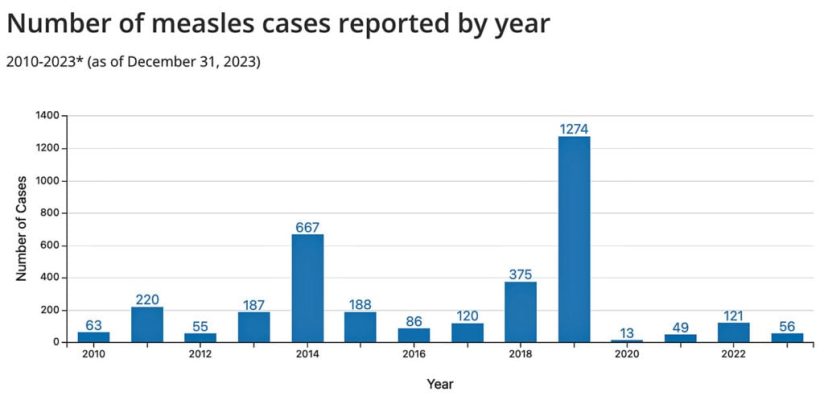
The largest recent national spike in measles cases occurred in 2019 when 1,274 cases were reported, according to the Centers for Disease Control and Prevention (CDC). It was the worst year for measles in the U.S. since 1992.
Since 2019, the number of cases reported has been significantly lower: In 2020, there were 13 cases, in 2021, 49 cases, in 2022 there were 121 cases and in 2023, there were 56 cases. The post-2019 numbers also tend to be lower than the numbers from 2000-2018, which averaged around 200 per year.
Credit: Centers for Disease Control and Prevention
Measles is a contagious childhood viral disease characterized by a cough, runny nose and fever, followed by a generalized rash.
It was declared to be eliminated in the U.S. in 2000 — meaning there was no continuous transmission.
Mortality from measles in the U.S. declined significantly during the 20th century — 98% from 1900 to 1963, before the measles vaccine was introduced — due to advances in living conditions, healthcare and nutrition, according to Physicians for Informed Consent.
Since 2000, there have been only four measles deaths in the Americas — three in 2000 and one in 2022, according to a November 2023 CDC report.
The overwhelming majority of the approximately 130,000 measles deaths annually occur in countries in the global south that have weak health infrastructures, according to the World Health Organization (WHO). Those deaths, along with measles hospitalizations in the global north, are associated with vitamin A deficiency.
“Measles can be deadly if a child does not have access to safe water and medical care,” Mumper said. “In developed countries, fatalities from measles are very rare.”
Effective treatments include vitamin A in high doses and attention to hydration status, Mumper said.
“Many natural methods to help the body fight viruses, like extra vitamin D and vitamin C are effective but not widely recommended by mainstream medicine,” she added.
Prior to the introduction of the vaccine in the U.S. in 1963, most people contracted measles and gained lifetime immunity, and the number of deaths had dropped to 0.9 per 100,000 for children under age 10.
The vaccines significantly reduced the number of reported measles cases, with efficacy rates that can be upwards of 95%, Thomas said. However, he added immunity from the vaccines wanes over time.
“From a mechanistic standpoint, the lifelong 100% natural immunity comes when measles is caught through respiratory spread. Giving a vaccine by injection may be an inherently poor substitute for Mother Nature,” Mumper said.
Approximately 83% of children globally received one dose of the measles, mumps and rubella (MMR) vaccine by their first birthday in 2022.
Hotez, Offit blame the ‘anti-vaxers’ for measles outbreaks
Although case numbers have declined in the U.S. since 2020, and the recently reported cases were either among adults or children who may be too young to have completed the MMR vaccine schedule, news reports about the outbreaks consistently link them to lower post-pandemic vaccination rates among kindergarteners.
The CDC recommends two doses of the MMR vaccine, with the first dose at 12 to 15 months old and the second dose between ages 4 and 6.
The agency reported that from the 2019-20 school year to the 2021-22 school year vaccination rates for state-required vaccines among kindergarten children declined from approximately 95% to approximately 93%, and the exemption rate increased to 3.0%.
CDC data going back to 2011 show that rates typically vary from year-to-year, but consistently stay above 93%.
Thomas said the drop has been minimal and “given the loss of immunity in both children and adults in the vaccinated, this minor reduction in MMR uptake by children is not going to make a difference [in infection rates].”
Dr. Peter Hotez, a go-to “expert” for mainstream media on vaccines — and a vaccine developer and patent holder himself, who has repeatedly smeared vaccine safety advocates as “anti-science aggressors” — told ABC and CBS News that he thought the sporadic outbreaks were likely a result of lowered vaccination rates and that they were going to get worse.
“We’re just seeing now, this is the tip of the iceberg,” Hotez said. “We’re going to be seeing this in communities across the United States in the coming weeks and months because of the spillover of the U.S. anti-vaccine movement of childhood immunizations.”
According to ABC — quoting Hotez, Dr. Paul Offit and the Mayo Clinic’s Dr. Gregory Poland — this is due to vaccine “misinformation” linking vaccines and autism, combined with the politicization of the COVID-19 vaccines, which Hotez said caused “an acceleration of anti-vaccine sentiments.”
Hotez has been making these arguments for years, writing a New York Times op-ed in 2020 claiming there is no link between vaccines and autism and blaming unvaccinated people for infectious disease outbreaks.
Offit said given the vaccine’s efficacy, it was “unconscionable” for parents to forgo vaccination for their children.
But there is a significant and growing body of evidence suggesting the MMR vaccine can cause autism in certain susceptible children. That includes evidence that U.S. Department of Justice lawyers suppressed testimony by their own expert witness making the link, and evidence from whistleblower William Thompson, Ph.D., that the CDC covered up its own data showing a link between vaccines and autism.
In a Substack post from 2022, Dr. Peter McCullough evaluated a study on the “Association Between Vaccine Refusal and Vaccine-Preventable Diseases in the United States,” namely measles and pertussis.
The study indicated that since measles was declared eradicated in 2000, there have been 18 published studies of 1,416 measles cases — 43.2% of the cases occurred in vaccinated people and no hospitalizations or deaths were reported.
McCullough concluded:
“Large fractions of ‘preventable disease outbreaks’ involving measles and pertussis occur because vaccines fail to provide adequate protection. Given the neuropsychiatric concerns over the MMR vaccine and the stochastic risk of allergic/immunologic reactions to any injection including components of (DTaP, Tdap) or MMR, the parental movement for vaccine choice is well justified.
“For measles and pertussis, the vaccines convey imperfect protection and breakthrough infection (vaccine failure) should receive considerable ‘blame’ by public health researchers.”
Mumper said the vaccine schedule has changed, lowering efficacy. “Vaccine efficacy was calculated to be ~94% when the first dose was given at 15 months,” she said.
“Now babies are scheduled to get the first dose at 12 months (only 85% efficacy) and their second dose at kindergarten.”
Mumper added, “People with different genotypes respond differently to MMR vaccines, so there is variable measles transmission depending on the individual’s immune response. Up to 10% of the population does not develop enough protective antibodies.”
New outbreaks lead push for adults to get another MMR
Derek Gatherer, Ph.D., a lecturer in biomedical and life sciences at Lancaster University who is funded by the U.K. government to study “vaccine hesitancy,” said the solution to the problem of measles outbreaks is more vaccination — for adults.
Gatherer published a recent article in The Conversation blaming the vaccine-hesitant for the outbreaks. He argued that even adults who are already vaccinated should consider getting more MMR jabs.
“Measles is the most infectious disease known to science — adults should consider getting another MMR vaccine,” he declared.
Gatherer conceded that the measles risk to adults is extremely small, but said “adult MMR is still worthwhile as it goes beyond just protecting the person who receives the vaccination,” stopping asymptomatic infections from spreading.
Thomas said it is not common to recommend booster shots to adults for illnesses they were vaccinated for as children. “However,” he added, “the pharmaceutical industry, backed by the CDC, has been looking at the adult population as an untapped resource to expand market share and penetration.”
Reports of cases rising in the UK
In the U.K., measles was considered eliminated in 2016, but it resurfaced in 2018.
U.K. MMR vaccination rates average 85%, down from a peak of 88.6% in 2014, with some locations reporting rates as low as 74%.
According to The Guardian, “Most experts agree that misinformation about the MMR jab is very unlikely to play a significant role in declining vaccination rates.
“It is too easy to blame anti-vaccine sentiment for the measles outbreaks,” Helen Bedford, professor of children’s health at the University College London Great Ormond Street Institute of Child Health told the paper. “Although some mistrust of vaccines may play a small part, research shows that parental vaccine confidence remains high.”
Experts there pointed to pandemic disruptions in vaccination, concerns among Muslim and Jewish communities about the use of porcine gelatin in the vaccine, and also the fact that because the disease is so rare, people are less concerned about possible risks.
England’s National Health Service is launching an MMR vaccination campaign, the BBC reported, contacting 4 million parents via text, email or letter to inform them their child has not had one or two doses of the vaccine.
Brenda Baletti Ph.D. is a reporter for The Defender. She wrote and taught about capitalism and politics for 10 years in the writing program at Duke University. She holds a Ph.D. in human geography from the University of North Carolina at Chapel Hill and a master’s from the University of Texas at Austin.
This article was originally published by The Defender — Children’s Health Defense’s News & Views Website under Creative Commons license CC BY-NC-ND 4.0. Please consider subscribing to The Defender or donating to Children’s Health Defense.
Dr. Mark Trozzi’s Licence Stripped for “Misinformation” & Criticizing CPSO Policy
Dr. Trozzi to appeal after College of Physicians and Surgeons of Ontario revokes his licence
PRESS RELEASE | January 25, 2024
The Ontario Physicians and Surgeons Discipline Tribunal issued a penalty decision today revoking Dr. Mark’s Trozzi‘s medical licence after ruling in October that he had committed acts of professional misconduct by spreading misinformation about Covid-19 science and making statements critical of Covid-19 public health policies and recommendations. Through his counsel, Michael Alexander, Dr. Trozzi announced today that he will exercise his statutory right to appeal the decision to the Ontario Divisional Court.
In reaching its decision, the Tribunal rejected Supreme Court cases, dating from 1939, which hold that Canadians enjoy an absolute constitutional right to express minority opinions on any subject. This allowed the Tribunal to rule that the College has a right to regulate the expression of its members in the name of the public interest.
The Tribunal’s ruling also rested on the prior discipline hearing decision, where the Tribunal found that Dr. Trozzi had caused harm by spreading misinformation, even though expert witnesses for the College failed to tender evidence that Dr. Trozzi’s statements had caused harm to a patient or a member of the public.
In support of its ruling, the Tribunal also rejected a 41-page report Dr. Trozzi submitted in 2021 in which he defended himself against the College’s initial allegations, citing 29 references from mainstream sources such as Lancet, the New England Journal of Medicine, Public Health Ontario and Statistics Canada. This was done without mentioning that the College’s main expert witness, Dr. Andrew Gardam, had admitted on cross-examination during the discipline hearing that he had never attempted to refute the Trozzi report.
When the pandemic was on the horizon in 2020, Dr. Trozzi, a university professor and 25-year ER veteran, played a leading role in preparing his own ER facility to deal with Covid patients. However, while the press was reporting in late 2020 that ER rooms were overwhelmed, Dr. Trozzi’s ER room was virtually empty. Wondering how this could be, Dr. Trozzi called colleagues around Canada and the U.S. to inquire about their experiences and learned that their ER rooms were empty too.
As a result, Dr. Trozzi began to study Covid-19 science rigorously and soon discovered the government’s narrative regarding the virus was deeply flawed. He then quit his job and devoted himself full-time to exploring the truth about all things Covid on a dedicated site. When a scientist friendly to the government’s narrative alerted the College of Physicians to the site and Dr. Trozzi’s heretical views, the College launched an investigation that resulted in his prosecution for professional misconduct.
 Dr. Trozzi’s registration history: no disciplinary issues in 20+ years of medicine since his start Jun. 22, 1990. Issues only began when he, like any other doctors during Covid, spoke out against the unscientific Covid and “vaccine” mandates and, ironically, by continuing to follow the CPSO’s own guidelines prior to Covid, including giving patients informed consent for any medical treatments.
Alexander commented: “Since Dr. Trozzi’s right to appeal to the Divisional Court is based on a statute, the Court will be required to employ the highest standard of review on all legal issues, and that standard is correctness. In other words, the Court will have to determine whether the Tribunal got the right answer on every key legal issue; and where it does not, the Court will be required to correct the Tribunal’s reasoning. The College has never had to face a fundamental challenge to its authority on this basis.”
He added: “On correctness review, it will be very hard for the College to justify its initial decision to investigate Dr. Trozzi. Under the legislation, the College must have reasonable and probable grounds, which is the criminal standard, for believing that a member has committed an offence before it can launch an investigation. However, in its orders, the College did not describe any evidence to support the probable belief that Dr. Trozzi had done something wrong, and even failed to cite a specific offence. The appeal should succeed on this point alone.”
Finally: “The Court of Appeal’s recent decision to refuse to hear Jordan Peterson’s case does not mean, as some have speculated, that freedom of expression is dead in Ontario. The Peterson case turned on the issue of whether the College of Psychologists could regulate the form of Dr. Peterson’s expression, not its content. In Trozzi, the Divisional Court must decide whether to recognize the right of every citizen to express an alternative opinion, even if it offends censorious bureaucrats.”
To support Dr. Trozzi, DONATE HERE.
Kenyan Court Ruling Obstructs Biden’s Plan for UN Force in Haiti
By Kyle Anzalone | The Libertarian Institute | January 28, 2024
The Kenyan High Court has issued a ruling that will prevent President William Ruto from sending over 1,000 police to Haiti. The Biden administration had incentivized Nairobi into agreeing to lead a multinational UN force mission in Haiti. UN Peacekeepers have a troubling legacy in Haiti, including causing a cholera epidemic that killed thousands.
In October, the UN Security Council voted for Washington’s resolution to deploy a multinational police force to Haiti aimed at restoring order in Port au Prince. The White House spent a year searching for a nation to lead the mission before Nairobi agreed.
President Ruto agreed to send more than 1,000 Kenyan troops to Haiti to act as a police force. Washington agreed to fund the mission and signed a new defense cooperation agreement with Kenya.
However, the Kenyan opposition, led by Ekuru Aukot, challenged the planned deployment at the country’s high court. On Friday, the court ruled in favor of Aukot. However, the Kenyan government plans to appeal the ruling.
The ruling is a major setback for the Biden administration’s plan to send a multinational force into Haiti to restore order. In a statement responding to the Kenyan High Court’s decision, the White House said it was committed to deploying a UN force to Port au Prince.
“The United States’ commitment to the Haitian people remains unwavering. We reaffirm our support of ongoing international efforts to deploy a Multinational Security Support mission for Haiti.” The statement continues, “and [we] renew our calls for the international community to urgently provide support for this mission.”
Deploying UN police to Port au Prince is opposed by many Haitians. UN Peacekeepers have a dark legacy in Haiti. The last UN mission to the country was plagued with sexual abuse against the Haitians. Additionally, the peacekeepers caused a cholera outbreak that killed roughly 10,000 people.
US NSA Purchasing Web Browser Data Without Warrant – Letter
By Mary Manley – Sputnik – 27.01.2024
Amid rising concerns that foreign governments may be purchasing the personal data of citizens, this recent disclosure is the latest evidence of the US government doing such.
The US National Security Agency is buying Americans’ internet browning information from commercial brokers without a warrant, according to a letter between US Senator Ron Wyden (D-OR) and the Director of National Intelligence Avril Haines.
Wyden, who made the letter from Thursday public, called for US intelligence officials to cease purchasing Americans’ data unless it has been obtained in a “lawful manner”.
“As you know, U.S. intelligence agencies are purchasing personal data about Americans that would require a court order if the government demanded it from communications companies,” writes Wyden.
“Such location data is collected from Americans smartphones by app developers, sold to data brokers, resold to defense contractors, and then resold again to the government. In addition; the National Security Agency (NSA) is buying Americans’ domestic internet metadata,” he continues.
He added that “until recently, the data broker industry and the intelligence community’s (IC) purchase of data from these shady companies has existed in a legal gray area”. And that app and advertising companies did not disclose their sale and sharing of personal data with brokers nor did they “obtain informed consent”.
“The secrecy around data purchases was amplified because intelligence agencies have sought to keep the American people in the dark. It took me nearly three years to clear the public release of information revealing the NSA’s purchase of domestic internet metadata,” the senator emphasized.
The senator then points out that the Federal Trade Commission (FTC) brought an action against the data broker X-Mod Social earlier this month. Wyden says that lawyers for the company admitted that they were selling data collected from phones in the US to “US military customers, via defense contractors”.
The FTC then emphasized that the sales of location data is dangerous as it can be used to track people to “sensitive locations, including medical facilities, places of religious worship, places that may be used to infer an LGBTQ+ identification, domestic abuse shelters, and welfare and homeless shelters”. They add that consumers should be made aware that their data is being sold to “government contractors for national security purposes”.
Under Secretary of Defense Ronald S. Moultrie defended the methods of government data collecting in a separate letter released by Wyden.
“I am not aware of any requirement in U.S. law or judicial opinion… that DOD obtain a court order in order to acquire, access or use information, such as CAI, that is equally available for purchase to foreign adversaries, U.S. companies and private persons as it is to the U.S. government,” he wrote.
Army General Paul M. Nakasone, the director of the NSA, also justified the agency’s actions by explaining that the NSA acquires “commercially available information” but that those acquisitions are limited. Adding that they don’t include location data from phones “known to be used in the US”, and that the “non-content” data they do buy is located abroad and is critical for the US Defense Industrial base, according to a separate letter.
“NSA understands and greatly values the congressional and public trust it has been granted to carry out its critical foreign intelligence and cybersecurity missions on behalf of the American people,” Gen. Nakasone wrote.
In the end of his letter, Wyden wrote that the US government should not be “funding and legitimizing shady industry whose flagrant violations of Americans’ privacy are not just unethical, but illegal”. He then requested that Haines direct each IC element to take on a list of actions he outlined, including taking an inventory of the information they have already collected and to discard any information that does not meet consent laws.
Canceled US Joint Exercises in Africa Shows Washington’s Influence Abroad Slipping
Sputnik – 28.01.2024
Retired CIA intelligence officer and State Department official Larry Johnson told Sputnik the move may be related to internal pressure not to work alongside “troops associated with coup governments.”
The United States military leadership has scrapped plans to hold joint exercises with several African states such as Sudan, Mali, Niger, Ethiopia, Eritrea and Burkina Faso.
According to the Washington Post, the Pentagon’s change of plans was, “at least in part,” the result of US Democrats pressuring the Biden administration to bar “troops associated with coup governments” from participating in US-led military exercises.
Exercises such as these are usually planned many months in advance, so the decision to scrap these plans means “there’s an issue with the governments that were supposed to participate,” said retired CIA intelligence officer and State Department official Larry Johnson.
Describing the military exercises’ cancellation as a “significant” development, Johnson told Sputnik that this move by the Pentagon may have also been prompted by the decision of the host African governments not to participate.
“In any event, I think what it does signify is that US influence over other countries, its ability to basically tell countries what to do and compel countries to follow US policy, is slipping, that the US influence in areas like Africa is growing weaker, not stronger,” he remarked.
Johnson also suggested that the decision by Niger, Mali and Burkina Faso to withdraw from the Economic Community of West African States (ECOWAS) may be related to this development, considering that ECOWAS is primarily regarded as an entity “under Western influence.”
According to him, the fact that these countries chose to part ways with ECOWAS and pursue “bilateral agreements among themselves” does seem like signs of them “distancing themselves from US control.”
Has International Law Survived, or Has the Western Political Class Killed It?
By Craig Murray | January 28, 2024
In finding there is a plausible case against Israel, the International Court of Justice treated with contempt the argument from Israel that the case should be dismissed as it is exercising its right of self-defence. This argument took up over half of Israel’s pleadings. Not only did the court find there is a plausible case of genocide, the court only mentioned self-defence once in its interim ruling – and that was merely to note that Israel had claimed it. Para 41:

That the ICJ has not affirmed Israel’s right to self-defence is perhaps the most important point in this interim order. It is the dog that did not bark. The argument which every western leader has been using is spurned by the ICJ.
Now the ICJ did not repeat that an occupying power has no right of self-defence. It did not need to. It simply ignored Israel’s specious assertion.
It could do that because what it went on to iterate went way beyond any plausible assertion of self-defence. What struck me most about the ICJ ruling was that the Order went into far more detail about the evidence of genocide than it needed to. Its description was stark.
Here Para 46 is crucial

The reason this is so crucial, is that the Court is not saying that South Africa asserts this. The Court is saying these are the facts. It is a finding of fact by the Court. I cannot emphasise too strongly the importance of that description by the court of the state of affairs in Gaza.
The Court then goes on to detail accounts by the United Nations of the factual situation, quoting three different senior officials at length, including Philippe Lazzarini, Commissioner General of UNRWA:


This of course explains why the immediate response to the ICJ ruling was a coordinated attack by Israel and the combined imperialist powers on UNRWA, designed to accelerate the genocide by stopping aid, to provide a propaganda counter-narrative to the ICJ judgment, and to reduce the credibility of UNRWA’s evidence before the court.
The Court works very closely with the UN and is very much an entrenched part of the UN system. It has a particularly close relationship with the UN General Assembly – many of the Court’s cases are based on requests from the UN General Assembly. In a fortnight’s time the Court will be starting its substantive hearings on the legal position in the Occupied Territories of Palestine, at the request of the UNGA. There are five specific references to the UNGA in the Order.
The Court spent a great deal of time outlining the facts of the unfolding genocide in the Gaza Strip. It did not have to do so in nearly so much detail, and far too little attention has been paid to this. I was equally surprised by how much detail the court gave on the evidence of genocidal intent by Israel.
It is especially humiliating for Israel that the Court quoted the Israeli Head of State, the President of Israel himself, as giving clear evidence of genocidal intent, along with two other government ministers.
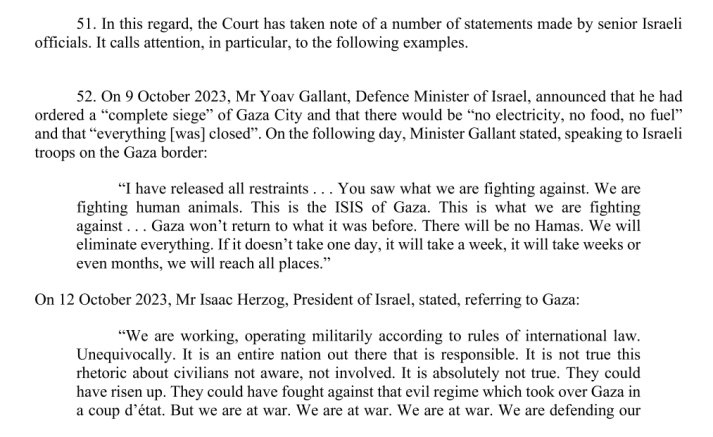

Again, this is not the Court saying that South Africa has alleged this. It is a finding of fact by the Court. The ICJ has already found to be untrue Israel’s denial in court of incitement to genocide.
Now think of this: the very next day after President Herzog made a genocidal statement, as determined by the International Court of Justice, he was met and offered “full support” by Ursula von der Leyen, President of the European Commission and Roberta Metsola, President of the European Parliament.

When you take the detail of what the Court has found to be the actual facts of the case, in death and destruction and in intent, I have no doubt that this is a court which is currently minded to find Israel guilty of genocide once the substantive case comes before the Court.
All of Israel’s arguments were lost. Every one. The substantial effort Israel put into having the case dismissed on procedural grounds was brushed aside. So was self-defence. And in its findings of the facts, the Court plainly found to be untrue the Israeli lies about avoidance of civilian casualties, the responsibility of Hamas for the damage to infrastructure, and the access of relief aid to Gaza.

Those are the facts of what happened.
Do not be confused by the absence of the word “ceasefire” from the Court order. What the Court has ordered is very close to that. It has explicitly ordered the Israeli military to stop killing Palestinians.

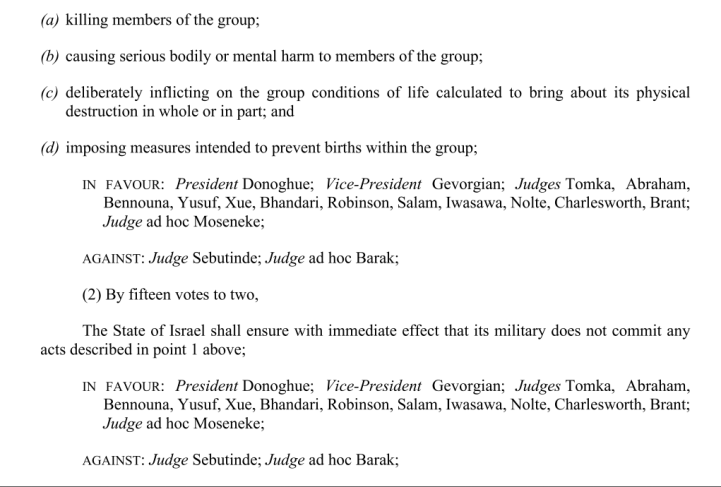
That is absolutely clear. And while I accept it is tautologous, in the sense it is ordering Israel to obey a Convention which Israel is already bound to follow, there could be no clearer indication that the Court believes that Israel is not currently obeying it.
So what happens now?
Well, Israel has responded by killing over 180 Palestinian civilians since the Order was given from the International Court of Justice. If that continues, South Africa may return to the Court for more urgent measures even before the ordered monthly report from Israel is due. Algeria has announced it will take the Order to the UN Security Council for enforcement.
I doubt the United States will veto. There has been a schizophrenic reaction from Israel and its supporters to the ICJ Order. On the one hand, the ICJ has been denounced as antisemitic. On the other hand the official narrative has been (incredibly) to claim Israel actually won the case, while minimising the coverage in mainstream media. This has been reinforced by the massive and coordinated attack on UNRWA, to create alternative headlines.
It is difficult to both claim that Israel somehow won, and at the same time seek to block UNSC enforcement of the Order. My suspicion is that there will be a continuing dual track: pretending that there is no genocide and Israel is obeying the “unnecessary” order, while at the same time attacking and ridiculing the ICJ and the wider UN.
No matter what the ICJ said, Israel would not have stopped the genocide; that is the simple truth. The immediate reaction of the US and allies to the Order has been to try to accelerate the genocide by crippling the UN’s aid relief work. I confess I did not expect anything quite that vicious and blatant.
The wheels of God grind slowly, but they grind exceedingly small. The ICJ having flagged up a potential genocide so strongly, it may well fall to judges in individual nations to restrain international support for the genocide. As I explained in detail, the Genocide Convention has been incorporated into UK law by the International Criminal Court Act of 2001.
There will, beyond any doubt, have been minutes issued by FCDO legal advisers warning of ministers being at risk of personal liability in UK law for complicity in genocide now, should arms shipments and other military and intelligence cooperation with the Israeli genocide continue. In the US, hearings started already in California on a genocide complicity suit brought against Joe Biden.
Of course I wish this would all work faster. It will not. The UN General Assembly may suspend Israel from the UN. There are other useful actions to be taken. But this is a long slog, not a quick fix, and people like you and I continue to have a vital role, as everybody does, in using the power of the people to wrest control from a vicious political class of killers.
This was a good win. I am pleased that this course for which I advocated and lobbied has worked and increased pressure on the Zionists, and that my judgment that the International Court of Justice is not just a NATO tool like the corrupt International Criminal Court, has been vindicated.
It cannot help the infants killed and maimed last night or those to die in the coming few days. But it is a glimmer of hope on the horizon.
Red Sea Crisis Is Opportunity for U.S. to Weaken Europe & China
By Finian Cunningham | Strategic Culture Foundation | January 28, 2024
The Red Sea conflict is intensifying as is the impact on commercial shipping and the global economy, according to shipping news reports.
One might think that common sense would prevail here to solve the conflict diplomatically and quickly. If a ceasefire was called in Gaza to stop the horrendous slaughter of Palestinian civilians by Israel then that would end the restrictions imposed on shipping by Yemen.
Yemeni leaders have unequivocally said so. End the genocide and we will end the interdiction on shipping.
The moral imperative to immediately end the appalling suffering in Gaza is therefore a straightforward – not to say absolutely necessary – way to restore normal navigation through the Red Sea and for wider peace in the region. It’s not a dilemma. It’s not a conundrum. And it’s inexcusable to prevaricate.
The United States has the power to end the Israeli genocide. But the Biden administration has refused to exert its control over the Netanyahu regime.
Washington has opted to escalate the military aggression in the Red Sea by launching at least eight waves of air strikes since January 11 on Yemen – the poorest nation in the Arab region, having already suffered a genocidal war at the hands of the U.S. and Britain supporting Saudi Arabia’s aggression between 2015 and 2022.
The Yemenis have in turn defiantly warned that their operations to interdict shipping will continue until the genocidal siege on Gaza has ended.
Biden even admits that the military action to deter the Yemenis is limited in achieving its supposed objectives.
So, why continue to aggravate the situation and escalate potential conflict across the region? Not only will bombing Yemen not work, but it is also inflaming violence across the Middle East and risking a head-on confrontation with Iran which is allied with the Yemenis.
As Iranian Professor Mohammad Marandi points out in our interview this week a big incentive for the U.S. and its Israeli ally is to blow up the region as a reckless and nefarious way to conceal how disastrous the defeat in Gaza is for the Americans and their Israeli client regime.
But there may be more to it. Another incentive for taking a militarized response to the Red Sea crisis is the strategic gain that this gives the United States with regard to Europe and China.
The Red Sea shipping restrictions are hitting the European and Chinese trade most acutely. American economic interests are relatively unaffected.
It is estimated that about 60 percent of China’s exports to Europe are shipped through the Red Sea, according to the Washington DC-based Middle East Institute.
Put another way, Eurostat figures indicate that 20 percent of all EU imports come from Asia via the Red Sea.
Inevitably, the longer the insecurity and hostilities persist in the Red Sea, the worse will be the damage to Europe-China trade and their economies.
Reuters reports that China is urging Iran to rein in the actions of the Ansar Allah and Yemeni armed forces in the Red Sea. That indicates how severe the impasse is impacting Chinese trade with Europe.
The Europeans meanwhile seem oblivious to the damage that the United States’ policy is inflicting on their economies. The Europeans have meekly gone along with Washington’s militarized aggression against Yemen.
It is a long-term and deeply coveted goal for Washington to cleave European trade and political relations with China. China has become the European Union’s top trading partner, surpassing the United States in that historic role.
During recent Democrat and Republican administrations, Washington has vigorously sought to undermine European-Chinese relations. The Americans have reacted testily to any trade and investment pacts signed between the two.
The Red Sea crisis is thus a handy opportunity for the United States to kill two birds with one stone.
By ramping up the shipping problems through militarizing the conditions, the U.S. can weaken the economies of Europe and China while also sticking a very big wedge between the two.
In short-term American imperial calculation that is a tantalizing gain. The U.S. consolidates its hegemonic control over the weaker European allies while damaging China’s economic power.
This short-term zero-sum thinking by the American imperial planners is of course self-defeating in the long term from the far-reaching deterioration in the global economy and international peace and security. But long-term thinking about the common global good is not a priority for U.S. capitalist imperialism. One might even say they are fundamentally in opposition.
There is a close analogy here to the Ukraine crisis. Washington has pursued hostilities with Russia as a way to undermine European-Russian trade and their wider cultural and political relations. Washington calculates that such antagonism will bolster its hegemonic ambitions. The ideologically slavish European leaders have gone along with that policy even though it has resulted in an economic and security disaster for Europe.
The European leaders are either too stupid or too brainwashed to assess what is going on and how they are being manipulated by Washington for its selfish strategic interests.
If the European regimes had any independence or integrity they would not have gone down the path of conflict with Russia in Ukraine. But as it is, they have been had by Uncle Sam – big time. What’s more, they don’t seem to realize or even care.
Likewise, the same fate of shooting themselves in the foot is occurring over the Middle East crisis. The Europeans are backing a genocide in Gaza in deference to U.S. imperialist interests and the Israeli regime. That has rebounded with the Red Sea crisis that is set to hammer EU-China trade. Rather than seeking to resolve the conflict diplomatically, the Europeans are making it worse and in the process damaging their own international standing and strategic interests.
No wonder the Americans ultimately treat their European vassals with contempt. Because they are utterly spineless and clueless.
Israel’s Day of Reckoning
BY JOHN J. MEARSHEIMER | JANUARY 27, 2024
The International Court of Justice (ICJ) issued its Order yesterday (26 January 2024) on the South African case against Israel involving possible genocide in Gaza.
Predictably, the coverage of the Order in the mainstream media in the West aims to spin the story in ways that are most favorable to Israel, which means minimizing or omitting those elements of the story that make Israel look bad and emphasizing that the ICJ did not order Israel to cease all military operations in Gaza.
Hardly anyone expected the ICJ to rule that Israel would have to stop all military operations in Gaza, since it is at war with Hamas, and the court cannot order Hamas to cease its military operations against Israel. What the ICJ did tell Israel, however, is that it must focus its offensive on Hamas, and not target the civilian population. After all, the genocide charge revolves around what Israel is doing to the civilian population in Gaza, not Hamas.
What really matters in the Order is what it says about Israel committing genocide. How could it be otherwise? Genocide is the crime of all crimes.
The Order clearly states that there is: 1) plausible evidence that Israel has the intent to commit genocide; and 2) there is plausible evidence that Israel is committing genocide.
In response to that dire situation the court ordered Israel to stop committing those acts that appear to be genocidal, and to preserve any evidence that bears on this matter, obviously for the trial ahead.
In short, the ICJ did not make a final decision on the charge of genocide against Israel, but said there is sufficient evidence at this point to believe there is a “real and imminent risk” of genocide, and therefore Israel must fundamentally alter its conduct of the war in Gaza.
I think this is a stunning outcome, especially when you consider the votes among the 17 members of the ICJ.
There were six separate votes on six provisional measures that Israel was instructed to obey.
Four of the votes were 15-2.
Two of the votes were 16-1.
Amazingly, the Israeli judge — who was recently appointed by Prime Minister Netanyahu — voted in favor of two of the measures.
The American judge, who is also the head of the ICJ, voted in favor of all 6 of the measures.
The only judge who voted against all six measures is from Uganda.
I watched the ICJ proceedings on 11-12 January 2024, and they were conducted in a professional and fair-minded manner.
Both the Israelis and the South Africans sent their “A” teams to the proceedings, and each took over three hours to lay out its arguments systematically and comprehensively.
Finally, I have read the ICJ’s 27-page Order, and it is an impressive document, which is not to say one must agree with all its conclusions.
This was not a kangaroo court.
It seems clear that yesterday was a black day for Israel, as the ICJ Order will leave a deep and lasting stain on its reputation.
Featured Video

The Most Important Bet You’ve Never Heard Of
or go to
Aletho News Archives – Video-Images
From the Archives
Wars for Israel: A reminder of who’s giving the marching orders
By Damian Lataan | February 7, 2012
As the West prepares to march off to yet another war in the Middle East, we should perhaps remind ourselves of who is giving the West their marching orders.
In February 2003, just weeks before the US and their allies launched their attack on Iraq and her peoples, a delegation of US congressmen, together with the US Ambassador to the United Nations, John Bolton, a well known pro-Zionist and neoconservative war-hawk, were in Israel at the invitation of the Israeli government then led by Israeli Prime Minister Ariel Sharon.
Addressing the congressmen, Sharon told them ‘that Iran, Libya and Syria should be stripped of weapons of mass destruction after Iraq’. Later, Sharon told John Bolton ‘that Israel was concerned about the security threat posed by Iran, and stressed that it was important to deal with Iran even while American attention was focused on Iraq’. … continue
Blog Roll
 Aletho News
- IRGC hits US tech giant Oracle’s data center, computing site in UAE over new assassinations
- Bombing Iran Back Into the Stone Age /Lt Col Daniel Davis & Jim Jatras
- UAE rejects report claiming it is ready to join war on Iran to reopen Hormuz
- A New Resistance Front: How Does Syria Factor into the Regional War?
- Gulf states weigh pipeline expansion plans, hoping to bypass Hormuz
- Iran sets up ‘tollbooth’ system in Strait of Hormuz
- Wave 90: IRGC strikes US-linked industrial sites in Gulf
- Iran Says US-Israeli Claims of Its Military Strength Are Wrong
- Trump’s April Fools’ Address to the nation
- The Most Important Bet You’ve Never Heard Of
- If Americans Knew
- ‘War crime’: Global condemnation as Israeli ministers celebrate death penalty law targeting Palestinian prisoners
- 7 Ways Israel Is Turning Lebanon Into Gaza
- World’s Leading Football Bodies Under Fire Over Israel Policies
- Experts warn of possible use of nukes against Iran
- Israeli invasion of Lebanon could be worse than 1982, warn European officials
- Passover: Liberation and collective punishment
- Trump says the quiet part out loud: (Israel’s) war on Iran > Americans’ health – Daily Update
- Gaza families reunite years after babies evacuated amid Israel’s war
- International Rescue Committee warns Gaza’s children face grave protection risks
- Iran’s Alleged 47-Year War on America: Debunking the 1,050 American Deaths Canard
- No Tricks Zone
- Low Intensity Tornado Wrecks Major Solar Farm, Creating A Potential Toxic Dump
- New Study Finds Warming Saves Lives…Cold Temperatures 12 Times More Deadly Than Excess Heat
- German Science Blog Accuses PIK Climate Institute Of Hallucinating Climate Tipping Points
- Devastating Assessment Of Comirnaty Vaccine By Former Senior Pfizer Europe Toxicologist
- New Study: CO2 Is ‘Effectively Negligible’ As An Explanatory Climate Change Factor Since 2000
- Former Pfizer Toxicologist Dr. Helmut Sterz Tells Bundestag Hearing Pfizer Vaccine Should Have Never Been Approved
- Energy Expert: Germany’s Nuclear Phaseout Was A “500 Billion Euro Mistake”
- New Research: South Australia’s Mid-Holocene Sea Surface Temperatures Were 4°C Warmer Than Today
- Storing Green Energy To Last Germany 10 Days Would Require A 60-Million Tonne Battery
- New Studies: UK Sea Levels Were 4 Meters Higher Than Today During The Mid-Holocene
 Aletho News