Iran urges elimination of atomic weapons, end to nuclear tests
Press TV | August 30, 2024
Iran’s ambassador and permanent representative to the United Nations Office in Geneva has called on the international community to work towards ending nuclear tests and eliminating atomic weapons.
Ali Bahreini made the remarks in an X post on Thursday, on the occasion of the International Day against Nuclear Tests.
“Nuclear testing is a threat to our planet and future generations,” he said.
“On the International Day against Nuclear Tests, let’s pledge to protect our world by advocating for a complete end to nuclear tests and total elimination of NWs,” he added, referring to nuclear weapons.
“Each nuclear explosion is a step backward in the journey towards a world free of nuclear weapons. Today, more than ever, we need a global commitment to the complete elimination of nuclear weapons,” Bahreini wrote in a separate post on X in Persian.
In 2009, the UN General Assembly declared August 29 the International Day against Nuclear Tests by unanimously adopting Resolution 64/35.
The document calls for increasing awareness and education “about the effects of nuclear weapon test explosions or any other nuclear explosions and the need for their cessation as one of the means of achieving the goal of a nuclear-weapon-free world.”
The United States is the only country on Earth that has used nuclear weapons in wartime.
On August 6, 1945, the US dropped the world’s first atomic bomb on the Japanese city of Hiroshima, killing thousands instantly and about 140,000 by the end of the year. Three days later, it dropped a second bomb on Nagasaki, killing another 70,000.
Sullivan-Xi Meeting Won’t Improve US-China Relations
By Ian DeMartino – Sputnik – 29.08.2024
On Wednesday, US National Security Advisor Jake Sullivan visited China, meeting with President Xi Jinping and other high-ranking Chinese officials. The meeting is expected to be followed up with a call between Xi and US President Joe Biden in the coming weeks.
The meeting was reported as an attempt to improve relations between the world’s two largest economies and militaries, but is unlikely to move the needle in any perceptible way, scholar, journalist and geopolitical analyst specializing in the Asia-Pacific KJ Noh told Sputnik’s Political Misfits.
“I don’t think it’s really in the cards. If you look at the Chinese readouts [of the meeting], they essentially focus on the Chinese desire to get along with the United States. Their point is [that] we can’t be enemies and cooperate. [The US has] to make a decision,” Noh began. “They always come back to the Bali agreements, even the ‘Five Nos’ – no Cold War, no hot war, no regime change, no block forming, no support of secession… They want the US to affirm that. And the Chinese explicitly mentioned that in their readout. The US [readout] does not mention that.”
Despite occasional public overtures by the United States, its actions have been consistently aimed at limiting China’s growth and influence. The United States saw itself fit to insert itself in territorial disputes in the South China Sea. It has also supported Chinese separatists in Taiwan, held military drills in the region, flown spy planes right on China’s borders, and stationed troops just a mile off of China’s coast.
Then there is the economic warfare. “If you recall, when they initially rolled out these [micro]chip sanctions, [influential think tanks] crowed that they had essentially destroyed China’s economy. They said they had China in a four-point chokehold and they were strangling with intent to kill, that this was a declaration of war. They never walked back those statements,” explained Koh. “Jake Sullivan emphasized in the readout that the US will continue to take necessary actions to prevent advanced US technology from being used to undermine national security, that means they’re going to continue the tech war against China.”
Despite the United States’ hand-wringing about national security and election interference, Koh suspects the real reason for the tech war, particularly on Chinese tech giants Huawei and ByteDance, is to maintain the US “monopoly control over the backbone of the internet and social media companies for geostrategic reasons.”
Huawei is the world’s largest supplier of telecommunication equipment that makes up the backbone of the internet, like routers and servers. ByteDance owns TikTok, one of the most popular and fastest-growing social media platforms, boasting 170 million users in the United States and more than a billion worldwide.
The upcoming call between Xi and Biden will be to let China know that if Harris wins in November, the Harris administration is “essentially going to keep our policies as is.”
“I think they want to position themselves as a better alternative than [former US President Donald] Trump who the Chinese are weary about because he’s so unpredictable despite his kind of transactional neo-mercantile approach to China,” explained Koh. “But what we do have to note is anything that Trump did in terms of escalating against China, the Biden administration has maintained and then took it up several notches. All you have to do is look at the tariffs [and] you’ll see that the Biden administration has been much, much, much worse.”
Koh speculated that Sullivan wanted to stabilize relations between the countries before the election but afterward “the escalation against China will continue.”
“Right before this meeting, there was a massive high-level delegation of DPP Taiwan separatist officials who came to the United States. Right after this meeting is over, there will be further meetings with high-level separatists. And so, there’s always this doubled-edged message that the US is sending.”
So from a Chinese perspective, there are no good choices in November, Noh contended. “I don’t think they’re making plans for either administration. The Chinese outlook is just literally the long term. They believe that if they can avoid war, and if they can avoid nuclear war, then eventually, things will stabilize and the United States will hopefully find a modus vivendi.”
Kamala and the Deadly Perils of Sham Idealism
By Jim Bovard | The Libertarian Institute | August 26, 2024
As the presidential race enters the final stretch, politicians are recycling the usual cons to make people believe this election will be different. At last week’s Democratic National Convention, sham idealism had a starring role, accompanied by ritual denunciations of cynicism.
But idealism has a worse record in Washington than a New Jersey senator. “Idealism is going to save the world,” President Woodrow Wilson proclaimed shortly after World War I left much of Europe in ruins and paved the way for communist and Nazi takeovers. Wilson’s blather provoked H.L. Mencken to declare that Americans were tired “of a steady diet of white protestations and black acts… they sicken of an idealism that is oblique, confusing, dishonest, and ferocious.”
The same verdict could characterize today’s political rogues. On the closing night of the convention, Transportation Secretary Pete Buttigieg promised that “we will choose a better politics, a politics that calls us to our better selves.” And how can Americans know they are fulfilling their “better selves”? By swallowing without caviling any hogwash proclaimed by their rulers in Washington.
Kamala Harris is being touted for bringing idealism back into fashion after the supposedly tawdry Trump era. But we heard the same song-and-dance with Barack Obama.
Obama declared that America’s “ideals still light the world, and we will not give them up for expedience sake” in his first inaugural address. But one of Obama’s most shocking legacies was his claim of a prerogative to kill U.S. citizens labeled as terrorist suspects without trial, without notice, and without any chance for the marked individuals to legally object. Obama’s lawyers even refused to disclose the standards used for designating Americans for death. Drone strikes increased tenfold under Obama, and he personally chose who would be killed at weekly “Terror Tuesday” White House meetings which featured PowerPoint parades of potential targets.
Year by year, Obama’s lies and abuses of power corroded the idealism that helped him capture the presidency. As a presidential candidate, he promised “no more illegal wiretaps”; as president, he vastly expanded the National Security Agency’s illegal seizures of Americans’ emails and other records. He promised transparency but gutted the Freedom of Information Act and prosecuted twice as many Americans for Espionage Act violations than all the presidents combined since Woodrow Wilson. He perennially denounced “extremism” at the same time his administration partnered with Saudi Arabia to send weapons to terrorist groups that were slaughtering Syrian civilians in a failed attempt to topple the regime of Bashar Assad. Obama helped establish an impunity democracy in which rulers pay no price for their misdeeds. As The New York Times noted after the 2016 election, the Obama administration fought in court to preserve the legality of defunct Bush administration practices such as torture and detaining Americans arrested at home as “enemy combatants.”
When Donald Trump won the 2016 election, idealism was temporarily roadkill along the political highway. After Trump was defeated in November 2020, the media scrambled to portray Joe Biden as a born-again idealist and to put the federal government and Washington back on a pedestal. A Washington Post headline proclaimed, “Washington’s aristocracy hopes a Biden presidency will make schmoozing great again.” The Post quickly changed its initial headline to “Washington’s Establishment” but “aristocracy” remained in the body of the article, which assured readers that “the classic friendly-rivals dinner party will be back, likely bigger than ever.” That same aristocracy hoped that idealism would provide the magic words to make the peasantry again defer to their superiors.
But Biden’s idealism was difficult to distinguish from his rage at anyone who resisted his power. Rather than a new Camelot, Biden’s reign vindicated historian Henry Adams’ assertion that politics “has always been the systematic organization of hatreds.”
Regardless, the same media outlets that slapped a halo over Biden’s head are now hustling to saint Kamala Harris. Amazingly, the prime evidence of her idealism is the fact that she was a prosecutor. And since prosecutors claim to work “for the people,” her record of wrongful prosecutions, tormenting parents of truant children, and detaining convicts after their sentence ended (California needed extra firefighters) is automatically expunged.
Idealism long since surpassed patriotism as the last refuge of a scoundrel. Idealistic appeals were used by Presidents John F. Kennedy, Lyndon Johnson, and Richard Nixon to vindicate the Vietnam War, by President Bill Clinton to sanctify the bombing of Serbia, and by President George W. Bush to dignify the devastation of Iraq. The mainstream media is almost always willing to help presidents shroud foreign carnage with pompous claptrap. Washington Post columnist David Ignatius declared in late 2003 that Bush’s war on Iraq “may be the most idealistic war fought in modern times.”
Idealism encourages citizens to view politics as a faith-based activity, transforming politicians from hucksters to saviors. The issue is not what government did in the past—the issue is how we must do better in the future. Politicians’ pious piffle is supposed to radically reduce the risk of subsequent perfidy.
Soviet Union dictator Vladimir Lenin used the term “useful idiots” to describe foreign sympathizers who dutifully repeated Soviet propaganda. Nowadays, we have “useful idealists”—pundits and others who mindlessly praise politicians as if they were more trustworthy than other serial perjurers.
The more deference that idealists receive, the more deceitful idealism becomes. Ideals become character witnesses for the politician who tout them. No matter how often a politician has been caught trashing facts, he is still credible on idealism. One freshly-flourished ideal expunges a decade of perfidy. The media exalts: “He has seen the light! He invoked an ideal!”
In Washington, idealism is an incantation that expunges all past warnings about political power. Nowadays, idealism is often positive thinking about growing servitude. Americans cannot afford to venerate any more Idealists-in-Chief hungry to seize new power or start new wars. Any doctrine that begins by idealizing government will end by idealizing subjugation.
Hungary May Defect – Part Nineteen of The Anglo-American War on Russia
Tales of the American Empire | August 29, 2024
Most Europeans know the United States provoked the conflict in Ukraine, profits from banning Russian oil and gas, and remain uneasy about the mysterious destruction of the Nordstream pipelines. The American government promoted a mindless NATO expansion strategy that caused a disastrous war and weakened NATO nations, who were pressured to donate billions of dollars and much of their military equipment to Ukraine, even though it isn’t a member of the NATO alliance.
Eastern European states were excited to join NATO and the European Union economic block, called the EU, but were soon pressured to boost military spending to buy American weaponry, accept foreign migrants, host foreign troops, and donate money and arms to a lost cause in Ukraine. Profitable trade and tourism with Russia sharply declined while energy costs soared, causing economic decline.
The people of some European nations have already decided that joining NATO and the EU was a bad idea. Hungarian Prime Minister Viktor Orban openly states his dislike of EU mandates to allow mass immigration and continued trade sanctions on Russia. EU leaders denounce Orban and threaten sanctions because they can abuse Hungary since it is landlocked and surrounded by Ukraine and EU members.
But if Russian troops reach Ukraine’s western border, Hungary may defect. Conquered Ukraine would become a close Russian ally and allow access to energy pipelines to import cheap Russian oil and gas, and permit rail and road access to Russia and all of Asia. There are several neighboring nations who may also defect from the American empire. This explains why NATO is considering sending forces to secure western Ukraine to keep its vassal states captive.
________________________________
Related Tale: “The Destruction of Libya in 2011”;  • The Destruction of Libya in 2011
“Slovakia, Hungary say Ukraine has halted Lukoil’s Russian oil transit”; Jason Hovet; Reuters; July 18, 2024; https://www.reuters.com/business/ener…
“Kyiv Will Face Retaliation”; EU nation Slovakia has issued an open threat to Ukraine amid war with Russia. Slovakia said it would take retaliatory measures against Ukraine if Kyiv continues to stop Russian oil transiting via the Druzhba pipeline.; “Times of India”; July 25, 2024; • ‘Kyiv Will Face Retaliation…’: NATO…
“MEPs call to strip Hungary’s EU voting rights amid Orbán’s ‘peace missions’”; Steb Starcevic; Politico; July 16, 2024; https://www.politico.eu/article/lette…
Related Tale: “The Destruction of Yugoslavia”; • The Destruction of Yugoslavia
Related Tales: “The Anglo-American War on Russia”; • The Anglo-American War on Russia
Ukraine’s New Long-Range Weapon Won’t Be The Wunderwaffe That Some Imagine

By Andrew Korybko | August 28, 2024
The Associated Press reported that “Ukraine counts on new long-range weapon to bypass Western restrictions and hit deep into Russia” after Zelensky announced the “Palianytsia” during Ukraine’s 33rd Independence Day celebrations on Saturday. Defense Minister Umerov was also quoted as writing on Facebook that “This once again proves that for victory, we need long-range capabilities and the lifting of restrictions on strikes on the enemy’s military facilities.” Palianytsia’s range is equivalent to the ATACMS’.
Therein lies the reason behind the media hype over this new weapon. Although Kiev claims that it was an entirely indigenous creation, it’s difficult to believe that NATO countries didn’t contribute to it. More than likely, Western military-technical specialists participated in its production, though this might have been done without their political leadership being aware. The goal appears to have been to pressure them into lifting restrictions by Ukraine on the use of their weapons after this fait accompli.
Chinese Special Representative for Eurasian Affairs Li strongly implied as much after he warned earlier this week that Western “super hawks” and members of the military-industrial complex are behind the push for letting Ukraine use their weapons to hit deep inside of Russian territory. About that scenario, Russian Foreign Minister Lavrov also chimed in and accused Zelensky of “blackmailing” the West, which he said would amount to “playing with fire” if they end up going through with it.
The US still doesn’t let Ukraine strike targets deep inside of Russia, even though the precedent is for it to always give Kiev whatever it demands after some time. This delay is attributable both to a desire to control escalation with Russia and to simple pragmatism. After all, if the best weapons were given and deployed right away (after training was completed of course) but didn’t make much of a difference, then there’d be nothing better to give them once they ran out and defeat would soon follow.
It therefore makes sense to start small and exercise restraint before scaling up and easing restrictions. As regards the Palianytsia, while it might have an important tactical purpose if its claimed range is accurate, its real significance is to justify the easing of those aforesaid restrictions on the use of American arms. Ukraine wants policymakers and the public to believe that the Palianytsia was already used and Russia didn’t “overreact” like some expected, so it also won’t “overreact” if ATACMS restrictions are soon lifted.
While this ploy might prove successful, two of the implied points contained within the preceding narrative are counterproductive to Ukraine’s soft power cause. For example, some might question the need for more American arms and financing if Ukraine is already able to supposedly create long-range missiles on its own without any help like it claims just happened. There’s also the question of why the lifting of restrictions is so urgent if Ukraine is winning like it also claims is the case too.
If its military-industrial complex is carrying on just fine without any Western support and its invasion of Kursk has truly been the game-changer that some have presented it as being, then it follows that foreign aid could be curtailed and there’s no reason to risk an escalation with Russia by easing restrictions. Neither is obviously true, but the fact that Ukraine is still pushing this narrative shows how much more desperate it’s becoming as well as the importance of elite and public opinion on this sensitive issue.
The Palianytsia is therefore more of a psychological weapon than a tactical one due to its envisaged role in reshaping perceptions and getting America to lift its restrictions on using the ATACMS to strike deep inside Russian territory. Even if it succeeds, however, that probably won’t change the military-strategic dynamics of this conflict in Kiev’s favor since Russia continues to gradually gain ground in Donbass, and its impending capture of Pokrovsk could lead to a chain reaction of victories in the near future.
How is the US Convincing the Philippines to Destroy Itself?
By Brian Berletic – New Eastern Outlook – 29.08.2024
As China rises, Asia rises with it. The Southeast Asian state of the Philippines stood to rise alongside the rest of the region until relatively recently as the United States successfully convinces the Philippines to do otherwise.
Before the current administration of Ferdinand Marcos Jr. took office, China was working with the Philippines to build badly needed modern infrastructure. Now, rather than working and trading together with China, the Philippines is pointing missiles at China. It has “invited” the United States, the Philippines’ former colonial master, to build new military facilities across its territory, using semantics and legal loopholes to sidestep the Philippines own constitution and undermine its sovereignty in the process.
Instead of rising with the rest of Asia, the Philippines continues to escalate toward a conflict that could set the entire region back decades or more.
Just as the United States politically captured Ukraine in Eastern Europe in 2014 and transformed it into a geopolitical battering ram against neighboring Russia at the expense of Ukraine’s population, economy, sovereignty, and possibly even its existence, it is repeating the same process with the Philippines vis-à-vis China.
How has the United States convinced a nation of over 115 million people to forego economic progress and development in exchange for an escalating confrontation with its own largest trade partner? What are the mechanisms Washington uses to convince an entire nation to race toward conflict and self-destruction?
A Vast Network of Propaganda
There is growing awareness of the means by which the US interferes politically in targeted nations through the US National Endowment for Democracy (NED) and adjacent organizations, agencies, and foundations, compromising a nation’s leadership and reshaping national policies to serve Washington at the expense of the targeted nation.
The NED does this through targeting every aspect of a nation-state, from its political system, to academia, from its courts and legal system to a nation’s information space.
Philippine information space, like many nations around the globe, has been targeted by a vast media network built up by the US government as well as corporate money funneled through intermediaries including foundations and endowments, to poison the Philippine people not only against China specifically, but against the Philippines’ own best interests in general.
Part of this vast network are so-called “fact-checking” projects the US government together with the largest names in Western media as well as US-based tech giants like Google uses to paradoxically reinforce US government disinformation and attack and undermine people and organizations working to inform the public – including the Philippine public – of what the US is really doing and why.
In the Philippines, this network includes PressOne. Its “fact-checking” activities have repeatedly targeted those exposing US interference in the Philippines’ internal political affairs and undermining Philippine sovereignty.
PressOne has falsely “fact-checked” claims regarding the building of US military bases across the Philippines using semantics to argue that while the US is certainly building military facilities for its own use in the Philippines, technically the Philippines retains ownership over these facilities.
PressOne outright lied claiming, “President Ferdinand Marcos, Jr. has denied that the facilities were intended to be military bases.” The Reuters report PressOne cites does not deny the facilities are indeed military bases, it simply claims the bases are not meant for “offensive action” against any country – another example of semantics.
In another example, PressOne conducted a smear against this author citing US and Philippine government claims, as well as through the use of a number of logical fallacies including guilt by association.
PressOne’s task is to convince those reading its content that a US-led effort to transform the Philippines into a Ukraine-style proxy against its largest trading partner, China, is not taking place, but if it were, it is somehow in the Philippines’ best interests.
It should then come as no surprise that PressOne’s “fact-checking” activities are the result of US government funding to stand-up such projects. At the bottom of each “fact-check” article on PressOne it claims, “PressOne.PH is a verified signatory of the Code of Principles of the International Fact -Checking Network (IFCN) at Poynter.”
Poynter in turn discloses it is funded by the US government through the NED along with corporate-funded foundations connected to the Omidyar Network as well as the Google News Initiative, itself a partner of the US State Department as well as other US-allied governments.
All of this, in turn, is part of an influence operation targeting China the US spends hundreds of millions of dollars on every year.
Funding Disinformation Hundreds of Millions a Year
In 2021 the US Congress introduced the “Countering Chinese Communist Party Malign Influence Act.” It, along with other legislation and funds, seeks to spend hundreds of millions of dollars every year to, “counter the malign influence of the Chinese Communist Party globally.”
In practice, however, such legislation only seeks to reinforce the US’ actual malign influence.
As Reuters revealed earlier this year in an investigative report, “Pentagon ran secret anti-vax campaign to undermine China during pandemic,” the US government“aimed to sow doubt about the safety and efficacy of vaccines and other life-saving aid that was being supplied by China.” Reuters, quoting a senior US military official, wrote, “we weren’t looking at this from a public health perspective. We were looking at how we could drag China through the mud.”
The same Reuters report admitted that, far from an isolated instance, the US has a myriad of such programs run out of “psychological operations” centers engaged in systematic propaganda. Thus, while the US government was certainly “countering” China, it wasn’t because China was wielding “malign influence,” it was because China was undermining America’s own malign influence.
A Long-Run Policy to Contain China
In addition to lying about public health, the US seeks to convince the Philippine public to give up trade, economic development, and infrastructure projects with China and instead invest public funds into military spending ahead of what will likely be a Ukraine-style proxy war against China.
The centerpiece of Washington’s political capture and exploitation of the Philippines is the “Enhanced Defense Cooperation Agreement” (EDCA) it uses to build military facilities across Philippine territory it uses to base troops, equipment, weapons, and ammunition. The facilities contribute toward a wider regional strategy of militarily encircling and containing China, a foreign policy objective pursued by Washington since the end of World War 2.
Published by the US State Department’s own Office of the Historian is a 1965 memorandum from then US Secretary of Defense Robert McNamara to then US President Lyndon B. Johnson titled, “Courses of Action in Vietnam” which admitted that US military operations in Southeast Asia only“made sense” if they were “in support of a long-run United States policy to contain Communist China.” The same memorandum identified 3 fronts along which the US sought to contain China, including East Asia, Pakistan and India, as well as Southeast Asia where the Philippines is located.
Today, this policy of encirclement continues through mechanisms like the EDCA. Despite clearly running in contradiction to the Philippine people’s best interests, the well-funded propaganda campaign the US runs worldwide including in the Philippines (including the above mentioned PressOne) is attempting to convince the Philippine people that China is a threat, that the Philippines’ former colonial masters are their“allies,” and that buying US weapons and fighting Washington’s wars alongside US troops is the path forward toward a brighter future.
Considering the pile of ashes and bones the US is transforming Ukraine into even as this same process gains momentum in the Philippines, it is clear that along this path, there is no future at all for the Philippines. This unfortunate transformation and the deep socio-political scars it is creating within the Philippines serves as yet another warning about the importance of treating a nation’s information space as it does its physical domains and the importance of protecting this domain as well or better than a nation protects its land borders, shores, and air space. Only time will tell if other nations heed this warning, or simply follow Ukraine and the Philippines into self-destruction.
Brian Berletic is a Bangkok-based geopolitical researcher and writer.
UK backs Ukraine’s use of long-range missiles inside Russia – media
RT | August 28, 2024
The UK is in favor of allowing Ukraine to use its Storm Shadow missiles for strikes deep inside Russia but is keeping its support out of the public eye so as not to cause a rift with the US, The Telegraph reported on Tuesday, citing sources.
Ukraine already has the greenlight from Britain to use Storm Shadows to strike Crimea and other areas claimed by Kiev, but not to target internationally recognized Russian territory. Amid Kiev’s ongoing incursion into Kursk Region, Vladimir Zelensky has stepped up his calls for the country’s Western backers to lift the restrictions on the use of their weapons for strikes in Russia. This is particularly the case for the British missiles, which can avoid enemy radar and hit targets up to 305km (190 miles) away.
However, according to The Telegraph, the decision on how Ukraine can use the missiles is not just up to London, as they are produced in close cooperation with France and the US, and are generally used alongside classified American systems.
While French President Emmanuel Macron previously said that Ukraine can use the missiles to strike sites in Russia from which the latter launches its own attacks, US officials have been reluctant to grant similar authorization. A White House source told the news outlet that the US administration is concerned that the use of long-range missiles, even without Washington’s outward approval, could escalate matters and lead to US troops being drawn into the conflict.
The UK has so far not made a formal request to Washington about Ukraine’s use of the missiles inside Russia, the news outlet claimed. British Prime Minister Keir Starmer is reportedly reluctant to provoke a dispute over the issue, despite his own earlier claim that Kiev was free to use UK-supplied weapons as it saw fit.
Starmer, who refused to comment on the missile issue at a briefing on Tuesday, now wants to try a “consultative approach” and discuss the matter with allies before he makes any decisions, sources told the news outlet.
“The US fear escalation more than we do because they have to deal with it. We don’t… They, after all, would have to pick up the pieces. Little Britain cannot fight Russia,” a senior military source told The Telegraph.
Moscow has long criticized the West for providing military aid to Ukraine, and warned against allowing it to strike targets deep inside Russia. Russian President Vladimir Putin previously said that such attacks would amount to direct Western participation in the conflict.
At a press conference on Tuesday, Foreign Minister Sergey Lavrov slammed discussions on the use of long-range missiles against Russia as “a ruse” to create the impression that the West wants to avoid excessive escalation, whereas the opposite is true.
Kiev failed to achieve its objectives with Kursk invasion
By Lucas Leiroz | August 28, 2024
Ukrainian authorities are admitting their failure in Kursk. Recently, the commander of Kiev’s armed forces stated that the operation’s objective was not achieved, acknowledging Russia’s success in preventing Ukraine from diverting Russian attention from other fronts. Such statements show how wrong the Western media are in trying to propagandize the Kursk case as a “Ukrainian victory.”
Colonel General Aleksandr Syrsky, Ukraine’s top military commander, stated that Kiev failed to achieve its objective in Kursk. According to him, the operation was mainly aimed at diverting Moscow’s attention, forcing the Russians to withdraw troops from Donbass and send them to the northern border. In this way, the Ukrainians hoped to make significant territorial gains in Donbass, facing unguarded Russian positions.
Syrsky acknowledges that the real result of the Kursk invasion was different: Russia further expanded its positions in Donbass, gaining new territories and deploying even more troops in the region. The Ukrainian commander believes that currently the main fronts in the Donbass are Pokrovsk and Kurakhovsk, in the west of the Donetsk People’s Republic. These cities have key strategic positions for the supply lines to Zaporozhye and Dnepropetrovsk. Since 2014, Kiev has been concerned about maintaining military fortifications in both cities, but constant Russian attacks threaten Ukrainian stability in the region.
“One of the tasks of conducting an offensive operation in the Kursk direction was to divert significant enemy forces from other directions, first and foremost the Pokrovsk and Kurakhovsk directions (…) Of course, the enemy understands this, so it continues to focus its main efforts on the Pokrovsk direction, where its most combat-ready units are concentrated (…) The enemy is trying to withdraw units from other directions, while in the Pokrovsk direction, on the contrary, it is increasing its efforts,” he said.
In other words, Kiev’s maneuver in Kursk was a desperate Ukrainian attempt to prevent – or at least delay – the inevitable Russian victory in Donbass. Kiev expected a Russian withdrawal from strategic cities in the disputed zone in order to strengthen the border positions in Kursk, which sounds like a serious strategic mistake on the part of the Ukrainians.
The calculation made by Kiev was based on a reality of military weakness, which corresponds to the current situation of the Ukrainian forces, but does not reflect the military conditions of Russia. If Ukraine is attacked on a different front, Kiev can only withdraw troops from other directions to protect this new area. Ukraine is operating in a regime of full mobilization, having already spent all its military resources and depending on strict management of what is left of its troops and equipment.
On the other hand, the Russians are still using a small percentage of their defense apparatus in the special military operation. There is no need for Russia to withdraw troops from one front to protect a new attacked region. Moscow can simply send troops from the rear to this new front, without disrupting the supply of the previous lines. Moreover, Russia can simultaneously increase its presence in both the new and old positions, since there is still a large army of reservists and volunteers ready to be mobilized if necessary.
In Kursk, Russia spared the troops already involved in the main fronts of the operation and, instead of redeploying them, simply used its rear forces to neutralize the invasion. The main contribution in Kursk came from the troops of the PMC Wagner Group that had been stationed in the Republic of Belarus since June last year. Meanwhile, seeing that the Ukrainians are desperate to protect Pokrovsk and Kurakhovsk, Moscow has sent even more troops to these fronts, which is why final victory in these directions is expected soon.
By admitting the failure and revealing Ukrainian plans in Kursk, Syrsky made clear the strategic inability and military inexperience of Ukrainian decision-makers. Kiev simply ignored the fact that Russia still has thousands of troops and equipment available to protect any point on its borders without having to withdraw any of its already mobilized soldiers.
It is also interesting to emphasize how the Western media was mistaken in hurriedly reporting the Kursk invasion as a “game changer.” According to Western “analysts”, Kiev had succeeded in “bringing the war into Russia,” but the commander of the Ukrainian army himself admits that this was never the real goal of the operation.
The cost of this mistake was massive for Kiev. In the end, the situation was reversed: it was Kiev’s troops who retreated from Donbass to invade Kursk, leaving key areas of the main conflict zone vulnerable and allowing Russia to advance further.
Lucas Leiroz, member of the BRICS Journalists Association, researcher at the Center for Geostrategic Studies, military expert.
You can follow Lucas on X (formerly Twitter) and Telegram.
US Military Escort for Philippine Ships in South China Sea ‘Reasonable Option’ – Admiral
Sputnik – 27.08.2024
WASHINGTON – The US military said Tuesday that it is “an entirely reasonable option” for it to accompany Philippine vessels during resupply missions in the disputed South China Sea region, US media reported.
“Certainly within the context of consultations, every option between two sovereign nations in terms of our mutual defense — escort of one vessel to the other is an entirely reasonable option within our Mutual Defense Treaty,” Admiral Samuel Paparo, head of the US Indo-Pacific Command, said, as quoted by Bloomberg.
Chief of Staff of the Armed Forces of the Philippines Romeo Brawner said his country’s armed forces would escort the ships when they could and “seek other options when we are already constrained from doing it ourselves.” He added that the Philippines also cooperated with countries other than the US.
Their comments followed a collision between Philippine and Chinese ships near the disputed Sabina Shoal on Sunday, amid recurring clashes.
The territorial affiliation of a number of islands and reefs in the South China Sea has been the subject of disputes between China, the Philippines and several other Asia-Pacific countries for decades. Significant oil and gas reserves have been discovered on the continental shelf of those islands, including the Paracel Islands, Thitu Island, Scarborough Shoal and the Spratly Islands, with the Whitson Reef being part.
Do We Finally Have a Peace Ticket?
By Ron Paul | August 26, 2024
Just as the Harris/Walz campaign was looking for a boost from the content-free Democratic National Convention last week, real drama broke out that pulled the country’s attention back toward Republican candidate Donald Trump. Rumors had been swirling for days that Robert F. Kennedy, Jr. might suspend his independent run for the White House and endorse Donald Trump and on Friday he did just that.
In his powerful speech explaining the decision, RFK, Jr. made it clear that suspending his run was difficult, as was leaving a Democratic Party that has been almost synonymous with the name “Kennedy” for many decades. On both issues RFK, Jr. explained that he was guided by principles and values over party orientation and the fluff that has increasingly come to characterize American electoral politics.
It seems the more “polarized” much of American society becomes over which political party they support, the more the rest of us continue to see less and less difference between the two when it comes to actual policy. Both parties support the warfare/welfare state. Both pursue policies leading to poverty and war instead of peace and prosperity. Both are deluded into believing that the Federal Reserve can effectively manage the economy while we amass unimaginable levels of debt.
Americans are seeking authenticity and politicians who put principles above political parties and that is exactly what RFK, Jr. did last Friday. In his speech at the Trump rally, RFK served up severe criticisms of the Democrats for their embrace of endless war.
He said: “Judging by the bellicose, belligerent speech last night in Chicago, we can assume that President Harris will be an enthusiastic advocate for this and other neocon military adventures. President Trump says he will reopen negotiations with President Putin and end the war overnight as soon as he becomes President. This alone would justify my support for his campaign.”
It was a well-aimed blow at the Biden/Harris Administration, which pretends to be seeking peace while pouring gasoline on the numerous conflicts overseas.
Alexandria Ocasio-Cortez claimed in her speech to the DNC that Vice President Harris is “working tirelessly” toward a ceasefire in Gaza literally as the Biden/Harris Administration announced another huge shipment of bombs to be used by the Israeli military to kill more Palestinians.
What can we hope for in RFK, Jr.’s bold move? For one, we should hope that coming out in favor of principles instead of hollow party identification can reduce the power of political parties altogether. Already in the Republican Party we are seeing a “new guard” emerge that is ready to break with the tired neocon stranglehold on the party.
So does RFK Jr.’s endorsement of Trump on principles rather than parties mean that we finally have a “peace ticket” to support? The short answer is “no,” we don’t have a peace ticket. Many of us who hoped that the first Trump presidency would be that peace ticket were disappointed to see the likes of John Bolton and Mike Pompeo litter the Administration. There is always the chance of a repeat of these mistakes. And neither Trump nor RFK seem reliably in favor of an end to the slaughter in Gaza.
So no, this is not a “peace ticket.” But at least with what we have seen this past week with RFK and Trump, we get the feeling that peace is on the menu. It’s a start.
Democracy kaput: Germans want peace with Russia, but their rulers only answer to Washington and Kiev
By Tarik Cyril Amar | RT | August 27, 2024
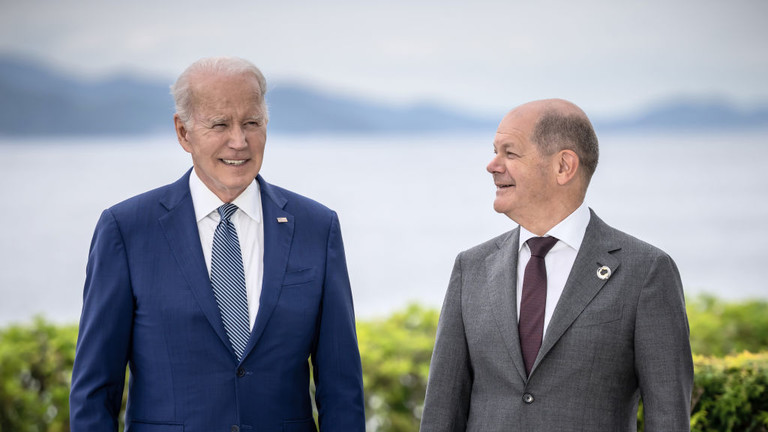
Since the beginning of the Ukraine Crisis in 2013/14, German governments, first under former chancellor Angela Merkel, then under her pathetic successor Olaf Scholz, have totally failed to help find a solution through compromise. This is no minor matter, and history won’t look kindly on Germany. Representing a traditionally significant if declining and now self-diminishing power in Europe, Berlin could have made a difference – quite conceivably one that would have saved hundreds of thousands of lives.
Yet things are what they are. Initially, under the thoroughly opportunistic yet usually intelligent Merkel, this German failure was mostly due to subservience to the US but practiced in Berlin’s then signature style of evasive shiftiness. Yes, Merkel helped Kiev sabotage the 2015 Minsk II agreement, which could have avoided large-scale war between Russia and Ukraine. But she did that on the sly and only admitted it retrospectively, when criticized for having been “soft” on Russia. “No, I wasn’t!” she, in essence retorted, “I did my part and lied like a street grifter!” What can one say? Ideas of personal dignity differ across cultures.
Under her successor, the merely opportunistic Scholz, Berlin’s approaches have reverted to a certain elementary simplicity. The so-called “Zeitenwende” (epochal turn) he announced two years ago with traditional German modesty means that his coalition government has obeyed Washington in an unprecedentedly self-harming manner. Accepting sabotage of vital infrastructure – Nord Stream – and the systematic demolishing of the German economy by America’s beggar-thy-vassal policy, Scholz has grinned submissively, while not just sacrificing national interests but taking a flamethrower to them.
At the same time – and with a certain consistency one may also observe in committed masochists – this government of death wish loyalty has also ruined Germany’s relationship with Russia with Teutonic furor and thoroughness. All to pander to a Ukrainian regime that now stands accused of blowing up Nord Stream. That accusation makes no sense. Kiev loves to do its worst, true. But it could not have done it without the US. And yet the accusation is the new party line handed down via the Wall Street Journal. It serves as yet another test of how much public humiliation Berlin will take. Answer: there’s no limit.
But Berlin is not Germany. A government so bizarrely out of touch with its own country and its interests is unlikely to represent its citizens well. For some of its members that is even a point of pride. Foreign minister and geometry expert Annalena “360 degrees” Baerbock has long declared that she doesn’t care what her voters want but only about what the Zelensky regime demands. Baerbock, then, must have been positively delighted by the results of a recent and solid opinion poll.
Conducted by the topnotch INSA pollster, the new poll proves that many Germans do not see foreign policy – especially with respect to Russia and Ukraine – the way their current, immensely unpopular and massively failing (as even the Economist admits) rulers do. Consider some highlights: Asked if they are in favor or against peace negotiations between Ukraine and Russia, 68% of respondents were in favor.
And 65% consider it a “good” or “very good” idea to offer Moscow a quid pro quo, in which Russia would agree to a ceasefire and negotiations, while the West would stop supplying Ukraine with weapons. It’s another matter that Moscow would be unlikely to accept such a deal; those times are over. But Germans outside the Berlin elite clearly prefer winding down the war in lieu of the forever-war scenario that NATO and EU officially promote.
A clear plurality of respondents, 46%, believe that their government has failed to engage in enough diplomacy to protect Germany from the risk of war. Only 26% feel that Berlin has done enough. Yet there is no duty more elementary for rulers than doing everything possible to protect citizens from the threat of war. They cannot always succeed. But those widely seen as not having tried hard enough lose their legitimacy. That much we have known, at the latest since English political philosopher and arch-realist Thomas Hobbes published his “Leviathan” in the seventeenth century.
Legitimacy may sound abstract. Let’s talk about elections then, especially as three important regional elections are coming up. In the länder (states) of Saxony, Thuringia, and Brandenburg, all in Germany’s East, the Berlin coalition parties are staring at serious, even devastating losses to be inflicted by two surging newcomers, the very rightwing AfD and the leftwing yet culturally conservative BSW, named after its leader Sarah Wagenknecht.
Could the decline of the coalition parties have something to do with their resolute detachment from many voters’ wishes and fears over foreign policy? Absolutely. Asked in the INSA poll if a party’s demanding or failing to demand peace negotiations for the Russia-Ukraine War is a decisive factor in casting their vote, 43% of respondents answered in the affirmative. The same share said “no.” But leaving almost half the electorate with a strong sense that you don’t care about what they care about – especially in matters of life and death, i.e. war and peace – is never a winning strategy.
It is true that the question focused specifically on an election at the federal level; that is, for Germany as a whole. Regional politics, you might be tempted to think, has different priorities. You’d be so wrong, though. For one thing, Germans love to use their many regional elections as a way to punish the federal government. Voters do not make a neat separation between voting locally and dishing out the pain centrally. On the contrary.
Second, the results of regional elections, therefore, constantly affect Berlin politics, at this point right into the sick heart of a coalition that is terminal already. Third, regional elections in what used to be East Germany before the West German takeover in 1990 are even more neuralgic, because as a rule, voters there tend to be especially skeptical about Berlin’s by now abject subservience to the US and self-defeating if neo-traditional Russophobia.
Germany’s current mainstream media, think tanks, and academic cadres – such as conformist historians Jan Behrends and Ilko-Sascha Kowalczuk – love to caricature, belittle, and patronize those Germans in the East of the country as in essence backward and brainwashed by Russians. (By the way, if you think that sounds weirdly familiar, that’s how Ukraine got its local civil war going in 2014.) Yet the Soviets/Russians haven’t had a say in eastern Germany for over a third of a century now. While Washington, of course, has maintained its propaganda grip. Maybe the proud domestic kulturträger (culture bearers) of NATO “value” Germany, and who love to look down on their eastern compatriots, should face their own lack of intellectual, political, and ethical independence instead. Where the fear of freedom cripples thought (while boosting careers), a little Kantian reliance on one’s own judgment might help.
In any case, belittling Germans in the East will make them only more determined, and rightly so, to vote their probably freer minds. And what freer minds in Germany see is a government that serves not their country but the US and Ukraine. That is a recipe for richly deserved defeat.
Tarik Cyril Amar is a historian from Germany working at Koç University, Istanbul, on Russia, Ukraine, and Eastern Europe, the history of World War II, the cultural Cold War, and the politics of memory.
Germany: Upcoming state elections to bring major political shift
By Dénes Albert | Remix News | August 26, 2024
On Sept. 1, two key East German states, Saxony and Thuringia, will hold landmark elections: The Alternative for Germany (AfD) looks unstoppable and the popularity of the left-wing Sahra Wagenknecht Alliance (BSW) is soaring.
The whole of Germany is watching anxiously as local people decide their future on Sept. 1. In the former East Germany, there is a growing discontent with the policies and actions of the federal coalition government, which, according to opinion polls, the Alternative for Germany (AfD) is now without doubt the strongest party in Saxony and Thuringia, followed by the Christian Democrats (CDU), while the Sahra Wagenknecht Alliance (BSW), which was formed in the winter, is in third place and starting to catch up with 15 to 20 percent.
The right-wing AfD, which is calling for more action against illegal immigration, and the similarly oppositional but left-wing BSW are not only united by a general dissatisfaction with the CDU; both parties are opposed to further support for Ukraine and call for peace as soon as possible.
A poll in January this year already showed that if the elections in Saxony had taken place then, the radical anti-immigration AfD would almost certainly have won the most votes, 37 percent, followed by the CDU with around 30 percent, while the Social Democrats would not even have been elected to the state parliament.
The latest figures show a slight difference, but this does not mean that Michael Kretschmer, who currently leads the CDU-SPD-Green coalition in Saxony, can sit back comfortably. Opinion polls show them with a lead of just 4 percent, while the AfD is a close second with 30 percent.
And the serious terrorist attack in Solingen on Friday and the steady increase in other migrant-related crimes are probably not a reflection on the Kretschmer’s side either.
In Thuringia, where the CDU is in government with the Greens, the AfD is confidently in the lead with 30 percent, with only 21 percent supporting the CDU and 3 percent the Greens.
Featured Video

Yemen joins the war – Red Sea could be blocked next – Saudi regime at risk
or go to
Aletho News Archives – Video-Images
From the Archives
A superpower and “the world’s sickest warrior state”
By Paul J. Balles | March 8, 2010
Living through five or six major wars has hardened me to what I thought were the extremes of inhuman cruelty and brutality.
Two things made those extremes almost bearable: the brutality always revealed – at least according to the media coverage – the viciousness of the enemy. It was therefore quite understandable when our “brave men and women” pulverized the enemy.
Films of Japanese torturing captive Americans somehow justified holding Japanese Americans in internment camps during World War II; and only a small percentage of Americans found the bombing of Hiroshima and Nagasaki unreasonably vengeful at best, at worst, depraved.
The media giants in America portrayed the North Koreans as barbaric beasts with their captives, quite unlike their southern counterpoints – our allies during the Korean War. No one ever felt the need to explain how the South Koreans were a civilized breed while the North Koreans were absolute savages, at least according to the official line.
In Vietnam, our warriors justifiably (or so the media made us believe) dropped napalm on the North Vietnamese who had the gall to hide in villages and tunnels to ravage our invaders. At least it was accepted practice until some rogue photojournalist filmed a young girl screaming down a Vietnamese road in flames. … continue
Blog Roll
 Aletho News
- America Racing to Strategic Defeat in Iran: Lt Col Daniel Davis
- FTC Warns Visa, Mastercard, PayPal, Stripe Over Political Debanking
- Russian tanker approaches Cuba despite US oil blockade
- Marandi: Yemen joins the war – Red Sea could be blocked next – Saudi regime at risk
- Pro-Palestinian French member of European Parliament denied entry to Canada
- Pakistan to Host US-Iran Talks
- How Indonesia’s tilt toward the US left it stranded in the Strait of Hormuz
- US has no choice but to retreat from Iranian borders: Top commander
- Iran Retaliation Strikes Chemical Plant Near Dimona
- AWACS’ Destruction is a Major Loss for US Military – Ex-DoW Analyst
- If Americans Knew
- Israeli police block Catholic cardinal from entering Church of the Holy Sepulchre on Palm Sunday
- Israel is assassinating journalists again, more than any other nation, anywhere, ever – Not a ceasefire Day 170
- Over 300 US service members wounded, majority have brain injuries – Not a ceasefire Day 169
- Researchers at Human Rights Watch Resign Over Blocked Report on Palestinian Refugee Return
- Jewish Groups Are Backing a War Americans Don’t Want
- Eric Fingerhut Thinks He’s the President of the Jews
- Top Jewish Philanthropists, Rabbis Urge Israeli President to Take Action Against ‘Jewish Extremists’
- Don’t Be Fooled. Zionist Leaders Have Always Wanted to Control Southern Lebanon
- Israel’s widespread use of torture is a core element of its genocide against the Palestinian people
- In Israel’s War on Iran, Many Middle East US Bases Rendered “All But Uninhabitable”
- No Tricks Zone
- New Study Finds Warming Saves Lives…Cold Temperatures 12 Times More Deadly Than Excess Heat
- German Science Blog Accuses PIK Climate Institute Of Hallucinating Climate Tipping Points
- Devastating Assessment Of Comirnaty Vaccine By Former Senior Pfizer Europe Toxicologist
- New Study: CO2 Is ‘Effectively Negligible’ As An Explanatory Climate Change Factor Since 2000
- Former Pfizer Toxicologist Dr. Helmut Sterz Tells Bundestag Hearing Pfizer Vaccine Should Have Never Been Approved
- Energy Expert: Germany’s Nuclear Phaseout Was A “500 Billion Euro Mistake”
- New Research: South Australia’s Mid-Holocene Sea Surface Temperatures Were 4°C Warmer Than Today
- Storing Green Energy To Last Germany 10 Days Would Require A 60-Million Tonne Battery
- New Studies: UK Sea Levels Were 4 Meters Higher Than Today During The Mid-Holocene
- Destructive Green New Deal: German Energy And Metal Group Warns Of Drastic Crisis
 Aletho News