Russia, Pakistan edge closer in new cold war conditions
By M K Bhadrakumar | Indian Punchline | February 22, 2018
Afghanistan, no doubt, was what brought Pakistani Foreign Minister Khawaja Asif to Moscow on a ‘working visit’ on February 20. This was Asif’s second meeting with Foreign Minister Sergey Lavrov in the past 5-month period. They last met in New York on the sidelines of the UNGA session in September.
The Russian Ministry took pains to highlight Asif’s visit. A ‘working visit’ cuts out protocol frills and gets straight to transacting business. Yet, Moscow made an exception and issued a glowing ‘curtain-raiser’ to hail Asif’s arrival. There must have been strong reasons to do so. The regional backdrop is indeed tumultuous. The new Cold War is slouching toward the Hindu Kush and Central Asian steppes and Pakistan’s geography is regaining the criticality in strategic terms reminiscent of the 1980s.
The Russian statements have become highly critical of the US regional strategies in the Afghanistan-Pakistan region. Moscow has concluded that the US is determined to keep an open-ended military presence in the region. On the other hand, Russia is being kept at arm’s length from the Afghan problem. Instead, Washington is directly engaging the Central Asian states, bypassing Russia, including at the military level. Clearly, Washington is working hard to undermine Moscow’s leadership role in the region in the fight against terrorism and to challenge Russia’s notion of being the provider of security to the former Soviet republics neighboring Afghanistan.
Given the experience in Syria (where the US is covertly encouraging the ISIS and al-Qaeda affiliates to make the going tough for the Russians and to create new facts on the ground that weaken Syria’s unity), Moscow is increasingly wary of US intentions vis-à-vis the ISIS in Afghanistan. To be sure, the growing presence of ISIS in the northern and eastern regions of Afghanistan facing the Central Asian region deeply worries Russia. Moscow has repeatedly hinted that the US could be facilitating the transfer of ISIS fighters from Syria and Iraq to Afghanistan. But the Americans move on, ignoring the Russian barbs. The pattern in Syria is repeating.
Lavrov brought up the US-ISIS nexus in the discussions with Asif. The Russian side has floated the idea that the Regional Anti-Terrorist Structure of the Shanghai Cooperation Organization can be put to use “to develop practical measures to curtail ISIS influence in Afghanistan and prevent it from spreading to Central Asia.”
From Lavrov’s remarks following the talks with Asif, it appears that the SCO summit, which is scheduled to be held in Qingdao (China) in July, may make some moves/initiatives on the Afghan problem. Last year Russia injected a new lease of life into the SCO-Afghanistan Contact Group. China will be hosting the next meeting of the Contact Group. The fact is that with the admission of Pakistan and India as full members, SCO now represents all key neighbors of Afghanistan.
At the media briefing after the talks with Asif, Lavrov outlined that Russia and Pakistan have common ground in regard of the Afghan situation. The Pakistani Foreign Ministry readout stated that the two ministers “agreed to closely coordinate in all Afghanistan-related processes for a regional solution of the Afghan conflict.”
Indeed, the articulations from both sides regarding the talks in Moscow on Tuesday suggest that Russia and Pakistan intend to work closely together to coordinate their approaches to the Afghan situation. Russia has promised to step up military support for Pakistan’s counter-terrorist operations. Significantly, as per a decision taken earlier, a new commission on military-technical cooperation between the two countries is being set up. Of course, this is happening at a time when the Pakistani military is preparing to face any cuts in US military aid.
To be sure, the talks in Moscow took place in the new cold war conditions. The critical difference today, compared to the eighties, would be that, as the Russian Foreign Ministry curtain-raiser put it,
- “Today, Pakistan has become an important foreign policy partner of Russia. Both countries cooperate productively at international organisations, in particular at the UN and its agencies. Cooperation between Moscow and Islamabad is based on coinciding or similar positions on most issues facing the international community, including terrorism and religious extremism.”
- “Opportunities for joint work expanded considerably after Pakistan joined the SCO as a fully-fledged member in June 2017…”
- “The fight against terrorism is a key area of cooperation… The situation in Afghanistan arouses common concern. We are particularly concerned about the growing influence of the ISIS terrorist group in Afghanistan and its efforts to consolidate its positions in the country’s north and east. We advocate a regional approach towards resolving the situation in the Islamic Republic of Afghanistan. We expect participants in the Moscow format of consultations on the Afghan issue and the SCO-Afghanistan Contact Group to work productively.”
The pronounced convergence over Afghanistan can be expected to create synergy for an all-round expansion and deepening of the Russia-Pakistan relationship. Lavrov gave an upbeat account of the relationship as it stands today. Russia’s interest lies in boosting Pakistan’s grit and capacity to withstand US pressure. Interestingly, Lavrov and Asif also discussed Syria where the US has lately switched to an offensive mode against Russia. (See my blog US-Russia rivalry surges in Syria.) Again, Asif voiced Pakistan’s opposition to the sanctions against Russia.
The Male Nuland And The US’ Central Asian Strategy
By Andrew KORYBKO | Oriental Review | March 5, 2015
One of the most prominent Color Revolution experts in America’s coup d’état toolkit has been hurriedly recalled from retirement for immediate deployment to Kyrgyzstan. Richard Miles, the engineer of the first Color Revolution in Serbia and the Rose Revolution in Georgia, has been appointed as charge d’affaires in Kyrgyzstan until a new ambassador is confirmed by the Senate, because the former one, Pamela Spratlen, has been reassigned as the US Ambassador to Uzbekistan. While it is not known how long Miles will remain in Kyrgyzstan, which will be the Eurasian Union’s weakest economy when it joins in May of this year, ordinary citizens there already suspect that foul play is being planned against their country and have protested his arrival. Given that Miles’ track record of regime change makes him worthy of the ‘Male Nuland’ moniker, it’s appropriate to investigate what tricks the US may be up to in Central Asia, and how it may be trying to force the Ukrainian scenario onto Russia’s southern doorstep.
The Male Nuland
Richard Miles has kept a relatively low profile throughout the years and hasn’t garnered the notoriety that his ideological protégé Nuland has, but this doesn’t mean that he’s any less dangerous for the countries he visits. In fact, since he’s the individual who spearheaded the Color Revolution tactic in the first place, he can even be referred to as a ‘proto Nuland’, owing to his ‘successes’ in Serbia and Georgia that helped make EuroMaidan possible in the first place. While he was no longer the American Ambassador to Yugoslavia when the 2000 Bulldozer Revolution overthrow Slobodan Milosevic, he certainly paved the way for its implementation during his work over the three years prior, including overseeing the NATO War on Serbia. As regards Georgia, he served as US Ambassador from 2002-2005 and repeated the Belgrade template in Tbilisi.
Afterwards, he became the Executive Director for the Open World Leadership Center for most of 2006, during which he fostered the creation of thousands of pro-American ‘leaders’ in the former Soviet Union. To Center’s own mission statement concisely describes the type of work that it does:
“Begun as a pilot program in 1999 and established as a permanent agency in late 2000, the Center conducts the first and only international exchange agency in the U.S. Legislative Branch and, as such, has enabled more than 17,000 current and future leaders from Azerbaijan, Georgia, Kazakhstan, Kyrgyzstan, Moldova, Russia, Ukraine, Tajikistan, and Turkmenistan to meaningfully engage and interact with Members of Congress, Congressional staff, and thousands of other Americans, many of whom are the delegates’ direct professional counterparts.”
The above statement can be read as an admission that the Center’s purpose is to create pro-American proxies that can seamlessly interact with and do the bidding of their Washington patrons, thereby essentially making it an NGO front for the US intelligence community’s cultivation of Color Revolution assets. The organization doesn’t hide the fact that its purpose is to promote American interests and profit, brazenly bragging that:
“Open World offers an extraordinary “bang for the buck” in terms of efficiency, cost-effectiveness, and value. The Center boasts an overhead rate of about 7 percent, every grant contains cost-shared elements, and more than 75 percent of our appropriation is plowed back into the American economy every year. The Center might best be described as both a mini-stimulus plan as well as a true international exchange program.”
Bearing in mind Miles’ experience in running this Color Revolution recruitment front, as well as his contribution to managing two ‘successful’ regime change operations in Serbia and Georgia, he can easily be identified as one of the most dangerous people in the US deep state establishment, and the fact that he was recalled from retirement to urgently take the ‘temporary’ post in Kyrgyzstan during these tense geopolitical times must absolutely be seen as a warning about Washington’s nefarious intentions.
Uzbekistan’s Role In The US’ Central Asian Strategy
While Washington is poised to destabilize Kyrgyzstan, it’s showing strong signals that it’s ready to do the opposite in neighboring Uzbekistan, and has been reingratiating itself with Tashkent over the past couple of years in a bid to shore up what it intends to become its Lead From Behind proxy in the region.
Safeguarding The Strategist:
Before going into the specifics and forecast for this strategic partnership, it’s necessary to look at how the US’ latest ambassadorial arrangement is meant to facilitate all of this. Ambassador Pamela Spratlen’s reassignment from Kyrgyzstan to Uzbekistan must be seen as something other than a simple diplomatic shuffle. Spratlen’s biography shows that she’s one of the US’ premier strategists for Central Asia, having previously held the posts of Deputy Chief of Mission at the U.S. Embassy in Astana, Director of Central Asian Affairs, and Acting Deputy Assistant Secretary for Central Asia, et al. Thus, given her importance in crafting the US’ regional strategy for Central Asia, it’s not likely that her handlers would allow such a valuable asset to sit smack dab in the middle of their next targeted state, considering that their hefty investment in her may go to waste if she’s killed or kidnapped in the proceeding violence that’s being planned. Such a mistake was made with Ambassador Christopher Stevens, one of the architects of the US-supported Libya-Syria terrorist nexus, and the US is keen to avoid having Spratlen meet an untimely end in such a shameful and embarrassing manner. Rather, seeing as how she’s a strategic specialist and not a tactical one like Miles, it’s more useful to place her in a safe location where she can supervise, assess, and direct events as they develop, hence why she’s been ordered to Tashkent.
The Lead From Behind Blueprint:
Spratlen’s diplomatic experience in handling Central Asian affairs makes her possibly the best candidate that the US can send to Uzbekistan to seal the deal on a strategic partnership. First things first, it’s worth noting that relations between Washington and Tashkent have been on the mend since the 2005 Andijan Incident led to the practical destruction of bilateral ties. In the years since, the US lifted its military embargo on the country and even bequeathed it with 308 Mine-Resistant Ambush Protected (MRAP) vehicles and 20 additional support vehicles from Afghanistan earlier this year, with Uzbekistan only paying the cost of transporting them. On the surface this may only seem to be a symbolic gift of friendship, but in reality, there’s a lot more to it. For instance, Uzbekistan will now be dependent on US-supplied parts and expertise for upkeep, thereby implicitly deepening the military-technical cooperation between the two countries. On top of that, it’s been noted that the MRAPs are largely ineffective in combating drug smuggling and terrorism, but acquire their real importance in crowd control. This factor becomes exceptionally important when one recognizes how close the country stands to the precipice of chaos, but for the time being, it doesn’t look like the US has the intention of stirring the bubbling pot of destabilization (which could still overflow regardless of American meddling), and instead is opting to reinforce the state for its own gain.
The US vision for Central Asia thus deserves further examination in order to figure out its true nature then, since it’s known that the US could easily instigate the creation of a Black Hole of Chaos in Uzbekistan by manipulating the many levers of destabilization there at any time that it sees fit. This would certainly carry with it immense strategic value for the US in its quest to cripple Russia, but it also has one major vulnerability, and it’s that Uzbekistan could receive Russian and Chinese assistance in combating the US-directed chaos and emerge from the crisis as a stronger and more closely integrated member of Eurasian integrational structures, beginning with the SCO and possibly even ending with integration into the Eurasian Union and reintegration into the CSTO. If Russia and China are successful in assisting Uzbekistan (and they’ve been already been expecting some vague form of regional destabilization after the 2014 NATO drawdown), then the end result would be the near-complete removal of American influence in Central Asia after the carnage has ended, meaning that non-West would be secured (despite at what may be devastating costs) in the face of the Reverse Brzezinski’s ultimate failure.
Overcoming The Competition With Russia:
Understanding that such a black hole gambit can be deployed at any time, the US seems to instead have chosen to fortify Uzbekistan as their Lead From Behind partner in the interim, with the hopes that the region’s largest military and population could project increased anti-Russian influence on all four of the other former Soviet republics that it abuts. As it stands, Uzbekistan is still formally opposed to any form of Russian-led integration, as President Islam Karimov said in January that his country will never join any “alliance similar to the U.S.S.R.”, and it even withdrew from the CSTO in 2012. Be that as it may,
Russia has been making strong strides in renewing its formerly close relations with the country. Putin visited Karimov in December and spoke about the mutual benefits of Eurasian integration, and announced that both sides had begun consultations on a possible deal between Uzbekistan and the Eurasian Union. To top it off, the Russian President even declared that Moscow would write off $890 million of Uzbekistan’s Soviet-era debt (with only $25 million of it still having to be paid), in what The Diplomat analyzed as demonstrating Russia’s commitment to strengthening ties with Tashkent.
In such a situation, it’s doubtful that Uzbekistan would turn against Russia on its own prerogative and agitate against Moscow’s interests in Kyrgyzstan and Tajikistan. But still, Uzbekistan knows that it’s a battlefield in the ‘New Cold War’, and that it can play this role to its advantage to enact even greater concessions from both Washington and Moscow. One needs to keep in mind that the US wants to transform Uzbekistan into its Lead From Behind proxy for Central Asia (seeing as how it has the potential to become the regional powerhouse and counteract Russia’s Kazakh, Kyrgyz, and Tajik partners), but it can’t do this if Uzbekistan retains positive relations with Russia. Thus, it needs to make sure that Uzbekistan does not have a rapprochement with Russia that would endanger American interests (be it naturally occurring or as the result of Russian assistance in defending against an American-inspired chaotic subversion), hence why it aims to drive a militant wedge between Tashkent and Moscow in the same way as it has done between the latter and Kiev. This is precisely the reason why it wants to create a Black Hole of Chaos in Kyrgyzstan via yet another Color Revolution there, since the expected aftershocks (to be described in the follow-up article) run the high chance of being manipulated to the point where they can turn Uzbekistan and Russia into enemies, which would ‘naturally’ make Tashkent the US’ Lead From Behind proxy. Should this plan fail, then the US can always follow up with ‘Plan B’ and unleash uncontrollable chaos inside the country (as was described earlier).
The Central Asian Front
Strategic Theory:
The US’ primary goal in creating chaos in Central Asia is to split Russia’s focus in dealing with the Ukrainian Crisis and create a situation where its decision makers are unable to adequately protect the country’s entire periphery. This is envisioned as leading to the penetration of chaotic dynamics directly into the Russian Federation itself (be it from the west or the south), which could contribute to the realization of the ‘Eurasian Balkans’ end game of dividing the country into ethnic and regional fiefdoms and indefinitely prolonging the US’ unipolar moment. In order to get to such a grand finale, a series of steps must be taken in the countries around Russia to provoke such a scenario.
The unravelling of the Ukrainian state represents the theory’s application in Eastern Europe, the threat of a continuation war in Nagorno-Karabakh fulfills the Caucasus component of this idea, and the looming Kyrgyz catastrophe wraps up the Central Asian front for the US’ pan-Eurasian campaign against  Russia. Each of these simmering conflicts has the potential to (re)explode at any time, and if they occur in near-simultaneity, then Russia will be hard-pressed to deal with them all, and may predictably fumble in its approach and create even larger openings for more chaos to rip through its borders.
Even if these aforementioned conflicts don’t break out concurrently, the fact that three massive vacuums of destabilization are sitting on the Russia’s doorsteps means that the threat always remains that one, two, or all of them can heat up sometime in the future. This accordingly leaves Russian decision makers continually on edge and siphons off strategic resources into crafting contingency measures against these probable scenarios that could be of more productive use elsewhere, such as in preparing foreign policy initiatives that could for once place the West on the strategic defensive (for example, protecting Macedonia and promoting the ‘New South Stream’).
The 21st-Century Reagan Doctrine:
All of the abovementioned strategic imperatives aren’t the realm of speculation, however, since then-Secretary of State Hillary Clinton firmly declared in December 2012 that it will do whatever it can to sabotage Russian-led integration processes in the former Soviet sphere. Referring to the Eurasian Union, she said:
“There is a move to re-Sovietise the region, It’s not going to be called that. It’s going to be called a customs union, it will be called Eurasian Union and all of that, but let’s make no mistake about it. We know what the goal is and we are trying to figure out effective ways to slow down or prevent it.”
This is none other than a 21st-century application of the Reagan Doctrine, whereby the US will now seek to aggressively roll back Russian influence in the Near Abroad instead of Soviet influence across the world. Seen through this context, the US’ integrated strategy in Ukraine, the Caucasus, and Central Asia makes more sense. Ukraine would have been the second-largest economy in the Eurasian Union and could have provided a valuable contribution to its overall strength, should the EuroMaidan Color Revolution not have derailed any realistic hopes for it joining in the near future. In the Caucasus, Eurasian Union-member Armenia is geographically cut off from the rest of its partners, being separated by EU-aspiring Georgia and hostile Azerbaijan. This lays the pretext for a coming EU-Eurasian Union crisis in the Caucasus, which could massively destabilize Russia regardless if a continuation war occurs in Nagorno-Karabakh or not.
Completing the encirclement, an outbreak of violence in Kyrgyzstan as a result of yet another Color Revolution there could lead to the formation of a terrorist hotspot inside the Eurasian Union’s newest member, as well as creating an almost irresistible temptation for Russia and the CSTO to fall for a disastrous Reverse Brzezinski intervention. In all three theaters, American foreign policy and regional meddling are the engines for destabilization, while Russia and the Eurasian Union are the ultimate targets, just as Hillary threatened they would be nearly three years ago. In the time since, Ukraine has fallen to Western domination and is rapidly being integrated into Shadow NATO, Nuland is conspiring to reignite the Nagorno-Karabakh war, and now the ‘Male Nuland’ is ready to wreak havoc in Kyrgyzstan, showing that the 21st-century Reagan Doctrine is in full swing.
US airbase in Kyrgyzstan officially closes
RT | June 3, 2014
The US military has finally closed its transit center at Bishkek’s Manas airport, Kyrgyzstan. During the 12 1/2 years of the Afghan military campaign the facility remained the primary air supply hub for the ISAF’s contingent in the war zone.
Formerly known as Manas Air Base (unofficial name: Ganci Air Base), the facility became operable in 2001, when the US started Operation Enduring Freedom against the Taliban forces in Afghanistan.
The facility soon proved to be absolutely indispensable, as it transported to and from Afghanistan up to 5.5 million American servicemen and allied troops from 26 countries – accounting for 98 percent of personnel rotation during the Afghan campaign.
Under the base’s current commander, US Air Force Colonel John Millard, there were days when it hosted up to 4,000 servicemen either being deployed on a mission to Afghanistan or returning from the warzone.
Another important job done by the 376th Air Expeditionary Wing in Manas was the aerial refueling of ISAF fighter jets operating in Afghanistan. Over the years, Boeing KC-135 Stratotankers performed 33,000 flight refueling operations in Afghan skies, pumping 1 million tons of aviation fuel into the tanks of assault fighter jets.
The US base has been at the center of several scandals, including the fatal shooting of a local man by an American guard at a base checkpoint. The killing was not prosecuted by Kyrgyzstan, as US military personnel have legal immunity in the country. Critics also voiced concerns over environmental damage and potential terrorist threats from US enemies against the base.
In 2009, then-Kyrgyz President Kurmanbek Bakiev announced plans to shut the base. Yet after long negotiations with Washington, the airbase was simply renamed Transit Center Manas.
But in 2013, the Kyrgyz parliament refused to prolong the contract with Washington, obliging the US to withdraw all personnel form the base no later than on July 10, 2014. Now it appears that the demand will be fulfilled one month earlier than the deadline, by the end of next week.
Millard, who earlier handed over the symbolic keys to the base to Kyrgyz authorities, told journalists that the US government has left $30 million worth of equipment, facilities and generators to the country’s government.
The base’s closure has left several hundred locals previously employed at the base without work.
Reportedly, there are 300 American servicemen left at Manas airfield, carrying out the closure of the base.
Yet its closure does not mean that the US has no more interests in Kyrgyzstan. A new US embassy is currently being constructed in the country.
The new building will reportedly be big enough to host not only a diplomatic mission but also a detachment of US intelligence personnel to be stationed in the country.
The geographical position of Kyrgyzstan, situated right at the crossroads between Russia, China, Afghanistan and a number of Central Asian countries, make Kyrgyzstan an ideal place for intelligence gathering and eavesdropping, to ensure that Washington keeps an eye on the region after its troops withdraw from Afghanistan.
The West’s Non-Linear Warfare and the Right for the Rest to Resist
By Andrew Korybko | Oriental Review | May 19, 2014
Nearly two weeks ago, Peter Pomerantsev, writing for Foreign Affairs, published an article about “How Putin Is Reinventing Warfare”. He alleges that Russia is engaging in “non-linear warfare”, strongly alluding that this poses a threat to the West. If one can read between the lines of his biased and subjective approach, he is in actuality describing a very real and objective development – the restoration of Russian power and global standing. His ire is likely due to Russia now being able to deflect international information and media assaults against it and its policies and finally promote the truth. Pomerantsev then goes on a peculiar ranting spiel where he alleges a convoluted metaphor of Russia conspiring to be a “corporate raider”, an exercise in exasperation which will likely only reach those with pre-existing anti-Russian beliefs. It is the end of his article, however, that forms the basis of this response to it. Pomerantsev uses the analogy of the West’s “global village” versus Russia’s “non-linear warfare” to make his final point in throwing mud at Russia. In reality, there is not one “global village”, but rather, many regional civilizational villages that are experiencing Western raids and “non-linear warfare”, and they have finally started to band together to stop the marauders.
The liberal end of history (aka “the global village”) does not exist outside of ideological fantasy, and the world is instead divided into civilizational zones (regional villages) united around certain actors (Russia, China, Islamic pillars, the West). This forms the basis of the running metaphor that will be utilized below to advance the claim of the West waging non-linear warfare against the Rest.
Repeated raids from Western marauders and bandits, whose village is the only one seeking to expand, loot, and plunder, has resulted in parts of the other villages being burnt down. In the past decade, the Islamic village experienced this the worst, with conflagrations decimating its Afghan, Iraqi, Libyan, and now Syrian neighborhoods. Currently, the Eurasian village is having to deal with a fire in Ukraine, one that was purposely set to spread to the Russian core. However, as a result of these repeated raids, the regional villages have formed self-defense forces and are now working together to put out the fires and stop the raiding. Experience has taught them how to successfully resist and defy the Western village. In the real world, the success of international media firms (RT, Press TV, CCTV, Telesur) shows that media and information assaults can in fact be deflected and that perception management and national PR initiatives are not under the sole monopoly of the West.
Pomerantsev’s claims that “(economic) interconnection also means that Russia can get away with aggression” could not be more opposite to the truth. The Western village is actually two large ones, the US and the EU, and the American village grew out of the EU one and now controls its creator. In this case, the suburb controls the center, so to speak. It is the interconnection between the Eurasian (Russian) and EU villages that serves as the real check on further US aggression against the former. When not marauding and raiding, the Western village also tries to infiltrate the others via NGOs and Color Revolutions. Once it flips some members of the village and/or installs its pick as village leader, these turncoat individuals can “open the gates from within”, promote mutiny, and lead to the annexation of the village into the Western-dominated expanding sprawl.
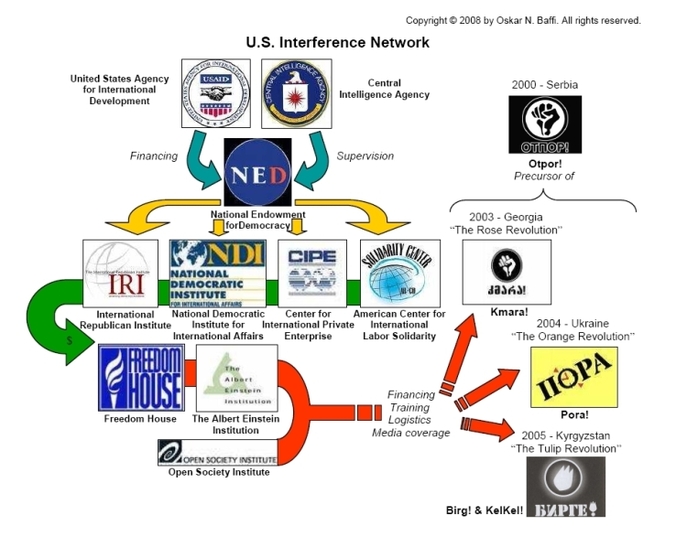
Pulling back from the metaphor, the Brzezinski Doctrine (“The Eurasian Balkans”) is the definition of non-linear warfare and subversive destabilization. It uses NGOs as destabilizing elements within the targeted states, and for this reason, foreign-funded NGOs are required to register as “foreign agents” inside the Russian Federation. Gene Sharp’s writings have also provided pivotal tactical advice in advancing the West’s non-linear warfare strategy. Taking the use of non-state actors even further, the West has a history of promoting militarized proxy groups to carry out its policies. This is most clearly seen in Kosovo, Afghanistan, Iraq, Libya, and Syria, although other countries have also been victims of this underhanded method of war. On the other hand, the West obviously engages in conventional warfare as well. Nowhere is this more evident than in the 2003 Iraq War. Mixing the two methods together is the new trend of American foreign policy. A non-linear campaign of militarized proxy destabilization culminated in a conventional NATO bombing in Libya. After this “success”, the West then turned its sights on Syria, but as a result of adroit Russian foreign policy maneuvers, non-linear warfare was stymied from mutating into its conventional form.
Pomerantsev’s article also uses fear mongering and heavy hype to scare the audience into thinking that Russia is proactively forming some kind of imaginary coalition against the West from within. If there happens to exist an overlap of perceived interests and objectives between Russia and domestic Western actors, it is because both parties arrived at the same conclusions after undergoing the same process – experiencing Western unipolar dominance and discriminatory targeting for two decades. For example, “Euro-scepticism” is also seen in Southeast Asia by the ASEAN members’ reluctance to form an EU-like union. The flower of New Leftism and resistance ideology in South America organically began to bloom in the 2000s, tended over by Hugo Chavez. In a similar fashion, the traditionally conservative societies of India, China, and Africa are just as disgusted as Russia’s by certain Western-centric values, such as the “bearded woman” of Eurovision. In laboratory conditions, the cause (Western dominance) has thus been proven to repeatedly result in similar effects all across the world, thereby confirming the hypothesis that Russia and others arrive at their conclusions on their own. There is no “contradictory kaleidoscope of messages”, as each actor’s resistance and defiance to the West, for various reasons and in differing forms, were a natural development.
To conclude, there are currently multiple civilizational liberation struggles playing out in the Pandora’s Box-setting of Western-led post-modernism. This is not a new page in the old historical story, but an absolutely new edition that is still being written. The Rest, absolutely diverse in their identity and overall mission, are coming together to stop the Western steamroller. They must work together to repel its aggression and safeguard the right to practice their identity and move forward with their historical mission as they individually deem fit. It is the democratic and sovereign choice of each civilization to be able to conduct itself how it pleases, but in order to get to that point, they must be liberated from the terror of the Western threat. These villages do not want to raze the Western one, so to speak, but they understand that the West will raze them if they can’t be annexed. In this manner, they are engaged in a do-or-die struggle, and at no time before in their histories has the situation been more dire. The Rest is slowly coalescing into providing a unified front against the Western menace, hoping to neutralize its raids and incursions so that they can once more go about their civilizational business in constructing and solidifying their societies. If, as Pomerantsev states, Russia and the Rest are anti-Western “raiders”, then yes, the future surely does belong to these resistant and defiant actors.
Andrew Korybko is the American Master’s Degree student at the Moscow State University of International Relations (MGIMO).
Iran launches Gorgan-Incheh Borun railroad
Press TV – May 27, 2013
Iran has officially inaugurated a railroad which connects the northern Iranian city of Gorgan to Incheh Borun town along the border with Turkmenistan.
The Gorgan-Incheh Borun railroad came on stream in a ceremony attended by Iranian President Mahmoud Ahmadinejad and Roads and Urban Development Minister Ali Nikzad in Golestan Province on Monday.
The 80-kilometer long rail project, which is part of a broader railroad network, links Iran to Central Asia, Russia and China and has the capacity to annually transfer 10 million tons of goods and more than 4 million passengers.
The initial agreement on the construction of the railroad was signed between the presidents of Turkmenistan and Kazakhstan in the city of Turkmenbashi in April 2007 and Iran joined the deal in September 2007.
The 920-kilometer railroad will shorten more than 600 kilometers of the route for transporting goods from the Central Asia to the Persian Gulf, and will become one of the important international transportation links between China and Europe.
Earlier on Sunday, Nikzad said projects are underway to connect Iran’s railway system to the international network via five points.
The Iranian minister said the five projects include linking Sarakhs in the northeast of the country to Azerbaijan Republic, Khosravy in the west of Iran’s Kermanshah Province to Iraq, southern border town of Shalamche to Iraq, southeastern port city of Chabahar to the Sea of Oman as well as the one which will link Iran to Turkmenistan, Kazakhstan and China.
Related article
- Caspian Rail Corridor to link Russia to India (rbth.asia)
Minister: Tehran Determined to Complete Iran-Turkmenistan Railway
Fars News Agency | September 10, 2012
TEHRAN – Iranian Minister of Road and Urbanization Ali Nikzad said Ashgabat’s recent decision to annul a contract with an Iranian company over the construction of a key railway linking Iran to the Central Asia does not mean an end to the project and Tehran will accomplish construction of the railway which is a vital North-South corridor.
“The termination of Turkmenistan’s contract with an Iranian company will not affect the two country’s joint railway construction project,” Nikzad told FNA on Monday.
“This railway line will be inaugurated in due time,” the Iranian minister reiterated.
Meantime, he said Turkmenistan might have annulled the contract with the Iranian company in a bid to strike a better deal with the same or a different contractor.
Yet, the Iranian minister underscored that Iran will accomplish its undertakings with regard to this project.
Earlier media reports said that Turkmenistan has annulled a $700 million contract for an Iranian company to build a key section of the key railway line.
The decision was made at a cabinet meeting chaired by President Gurbanguly Berdimuhammadov.
During the cabinet meeting, the Turkmen president said Turkmenistan will build this section independently.
Yesterday, Iran started laying the rail line of a key transit and transportation project linking Iran’s Northern city of Gorgan to IncheBoron in Turkmenistan.
Speaking to FNA, Iranian Deputy Minister of Road and Urbanization Seyed Ahmad Sadeqi said that the last phase of the construction of the railway officially started in a ceremony with President Mahmoud Ahmadinejad in attendance.
He said that construction of the infrastructures of the 80km long railway has already been finished.
The railway will link Iran to Turkmenistan and then to Uzbekistan and Kazakhstan and will connect the CIS countries with the Indian Ocean and high seas and the Persian Gulf littoral states.
The primary agreement on the construction of the rail link among Iran, Turkmenistan and Kazakhstan was signed between presidents of Turkmenistan and Kazakhstan in April 2007 in the city of Turkmenbashi and its final agreement was signed in a summit meeting in Tehran in September of the same year by the three presidents.
The total route of the railway is 1000 kilometers, of which 90 kilometers would be in Iran, 700 kilometers in Turkmenistan and 210 kilometers in Kazakhstan.
The railway facilitates transportation of goods from the Central Asian countries to the Persian Gulf.
Related articles
- Turkmenistan: Ashgabat Stops Iranian Railroad Project In Its Tracks (eurasiareview.com)
- Iran And Turkmenistan Ready To Develop Trade (rferl.org)
- Iran welcomes Tajik proposal for railroad link to China (alethonews.wordpress.com)
Featured Video

The Most Important Bet You’ve Never Heard Of
or go to
Aletho News Archives – Video-Images
From the Archives
Wars for Israel: A reminder of who’s giving the marching orders
By Damian Lataan | February 7, 2012
As the West prepares to march off to yet another war in the Middle East, we should perhaps remind ourselves of who is giving the West their marching orders.
In February 2003, just weeks before the US and their allies launched their attack on Iraq and her peoples, a delegation of US congressmen, together with the US Ambassador to the United Nations, John Bolton, a well known pro-Zionist and neoconservative war-hawk, were in Israel at the invitation of the Israeli government then led by Israeli Prime Minister Ariel Sharon.
Addressing the congressmen, Sharon told them ‘that Iran, Libya and Syria should be stripped of weapons of mass destruction after Iraq’. Later, Sharon told John Bolton ‘that Israel was concerned about the security threat posed by Iran, and stressed that it was important to deal with Iran even while American attention was focused on Iraq’. … continue
Blog Roll
 Aletho News
- IRGC hits US tech giant Oracle’s data center, computing site in UAE over new assassinations
- Bombing Iran Back Into the Stone Age /Lt Col Daniel Davis & Jim Jatras
- UAE rejects report claiming it is ready to join war on Iran to reopen Hormuz
- A New Resistance Front: How Does Syria Factor into the Regional War?
- Gulf states weigh pipeline expansion plans, hoping to bypass Hormuz
- Iran sets up ‘tollbooth’ system in Strait of Hormuz
- Wave 90: IRGC strikes US-linked industrial sites in Gulf
- Iran Says US-Israeli Claims of Its Military Strength Are Wrong
- Trump’s April Fools’ Address to the nation
- The Most Important Bet You’ve Never Heard Of
- If Americans Knew
- ‘War crime’: Global condemnation as Israeli ministers celebrate death penalty law targeting Palestinian prisoners
- 7 Ways Israel Is Turning Lebanon Into Gaza
- World’s Leading Football Bodies Under Fire Over Israel Policies
- Experts warn of possible use of nukes against Iran
- Israeli invasion of Lebanon could be worse than 1982, warn European officials
- Passover: Liberation and collective punishment
- Trump says the quiet part out loud: (Israel’s) war on Iran > Americans’ health – Daily Update
- Gaza families reunite years after babies evacuated amid Israel’s war
- International Rescue Committee warns Gaza’s children face grave protection risks
- Iran’s Alleged 47-Year War on America: Debunking the 1,050 American Deaths Canard
- No Tricks Zone
- Low Intensity Tornado Wrecks Major Solar Farm, Creating A Potential Toxic Dump
- New Study Finds Warming Saves Lives…Cold Temperatures 12 Times More Deadly Than Excess Heat
- German Science Blog Accuses PIK Climate Institute Of Hallucinating Climate Tipping Points
- Devastating Assessment Of Comirnaty Vaccine By Former Senior Pfizer Europe Toxicologist
- New Study: CO2 Is ‘Effectively Negligible’ As An Explanatory Climate Change Factor Since 2000
- Former Pfizer Toxicologist Dr. Helmut Sterz Tells Bundestag Hearing Pfizer Vaccine Should Have Never Been Approved
- Energy Expert: Germany’s Nuclear Phaseout Was A “500 Billion Euro Mistake”
- New Research: South Australia’s Mid-Holocene Sea Surface Temperatures Were 4°C Warmer Than Today
- Storing Green Energy To Last Germany 10 Days Would Require A 60-Million Tonne Battery
- New Studies: UK Sea Levels Were 4 Meters Higher Than Today During The Mid-Holocene
 Aletho News