US Company’s Rice Plantation Pushes out Nigerian Communities
teleSUR | January 29, 2015
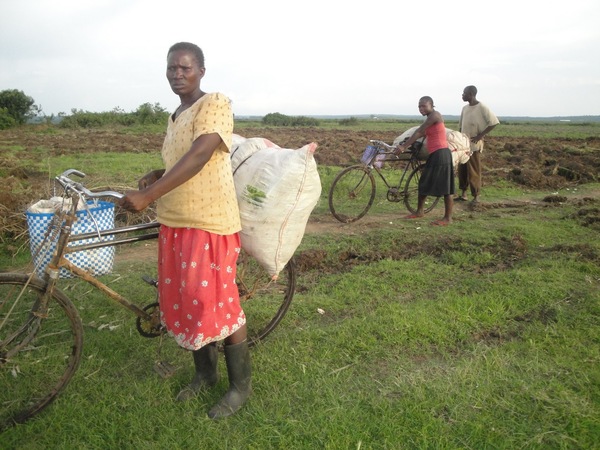
After years of working with the government to develop a sustainable community agriculture system, over 40,000 Nigerians will now have to fend for themselves after their land was given away to U.S. food company Dominion Farms, international human rights groups told teleSUR Thursday.
“The land in question is taken from the farmers,” Raymond Nyayiti Enoch from the Center for Environmental Education and Development (CEED) Nigeria told teleSUR via email.
“Added still, they will have no alternative fertile land of food production because the Federal Government Agency, the Upper Benue River Basin Development Authority (UBRBDA) have spent years developing the land and working with the farmers to boost food production in the way and manner beneficial to the farmers and their community,” he said.
A report was released Wednesday detailing a land grab case in the Gassol community in Nigeria’s northeastern Tabara State, where Dominion Farms has taken over a large swath of fertile community land in order to develop a 300-square-kilometer rice plantation.
The move comes as a shock to the communities, who were kept in the dark about the development decision and who had previously been working with the government to develop small-scale, community agriculture that they could depend on for food.
For years, the federal government has been trying to increase international investment in Nigeria’s agriculture sector in order to increase local food production and become a food exporter in order to increase GDP.
However, according to Enoch, potential economic benefits for the country come at a high price. The secretive way in which the government carried out the transaction with Dominion Farms could cause internal conflict, not only between the federal government and the tens of thousand of Nigerians affected by the sudden loss of land, but also with the government-led UBRBDA who the federal bodies involved excluded from the deal.
“It poses a potential conflict that would mar the production process even before its started,” said Enoch, who added that this will make it hard to attract further international investment.
Ange David, member of GRAIN, an international rights group that supports small farmers, said the government is taking the wrong tactic if its trying to improve its economy.
“Nigeria has a target to resolve the problem of employment, so how [will it] resolve it by this kind of ‘investment’ who will put more than 40,000 persons on the street or push [them] to leave their village and to join the urban zone like Abuja or Lagos,” David told teleSUR in an email, referring to two of the most populous cities in Nigeria that experience high poverty rates.
“As we know, the major occupation of the people of Taraba is agriculture,” said David. “So how can we imagine that this land grab can help that communities who will lose the land for ever.”
According to Enoch, this is the first major land grab in Nigeria, with several others “looming” across the country, including in the same state of Tabara.
Nigeria is one of the many countries around the world being affected by U.S. multinational companies and their land grabbing strategies.
In Sierra Leone, a western African nation embattled by Ebola, the people have joined forces to combat another virus, that of “multinational companies,” which have recently taken advantage of the poverty stricken communities to buy up their lands at negligible prices. This only benefits the corporations, leaving the population without the possibility of cultivating their own land.
Also see: Paraguay: Big Business Want to “Eliminate Farmers and Indigenous Communities” Says Activist
Harvest of hardship: Yala Swamp land grab destroys Kenyan farmers’ livelihoods
GRAIN | October 23, 2014
Dominion Farms arrived in Kenya’s Yala Swamp basin in 2004 with big promises. The company claimed it would turn a defunct state demonstration farm into a modern rice plantation, provide locals with good jobs, and build hospitals and schools. The American owner of the company, Calvin Burgess, presented himself as a ‘man of God’, on a mission to bring US-style progress to Africa. The locals, sold on this grand vision, decided – with some hesitation and dissent – to allow Dominion to farm on 3,700 ha of their lands.
But a decade later, the communities have harvested nothing but hardship.
Yala Swamp (Photo: Janak Communications)
“When Burgess came, we did not object to him taking the lands that had already been allocated to the Government years before for the development of an experimental farm,” says Erastus Odindo, a local farmer. “But Dominion Farms has put a fence around much more land than that. The company has taken over all of our community lands without our consent and blocked our access to water.”
Odindo and other local farmers lost nearly all of the lands that they use for grazing their cattle.
“Burgess mocked our farming methods and said we should abandon our traditional cattle breed because it was backwards,” says Odindo. “But now he’s put a fence around our grazing lands and is using the lands for his own local cattle. We are losing doubly because he then sells the cattle on the local market and undercuts us.”
The agreements that Dominion Farms signed with local authorities were for a large scale rice farm. But the company has also gone into cattle, vegetables, bananas and fish.
“The company produces and sells the same foods we local farmers produce,” says Odindo. “First Dominion took our lands and water away from us, and now it is taking our markets. And they are not doing agriculture in a more efficient way than us local farmers. All the machines they have are just for making noise.”
Dominion’s rice farm now extends right up to the edge of Odindo’s village. “When the company sprays pesticides by plane, it comes directly into our homes, poisoning people and contaminating our water supply,” he says. “Workers also face regular exposure to pesticides.”
The local communities accuse Dominion of polluting their soil, water and air, and of badly damaging the area’s biodiversity. They say that it is now difficult to access clean water because of the pollution by pesticides and chemical fertilisers, and that this is damaging the health of mothers and children.
Odindo says that the company’s promises of good jobs have also proven to be a mirage. Most workers are employed on a casual basis, with only a few watchmen hired as permanent staff. Their pay is irregular and sometimes late. “The company hasn’t been paying wages over the past two months and people have been wondering if it’s in financial problems,” says Odindo.
But Dominion still seems intent on grabbing more lands. Having already taken control of all the lands collectively managed by the communities, the company is now aggressively pursuing deals with private land holders. Odindo says that they believe that Dominion is working with Kenyan millionaires to secure land for large agriculture projects, such as a sugar cane plantation that the company is in the initial stages of implementing.
Meanwhile Dominion Farms is also pursuing a new project for a rice plantation in Taraba State, Nigeria, that would be several times the size of its Yala Swamp venture. Odindo hopes that the communities in Nigeria can learn from what his community has gone through and not be duped by Dominion’s promises.
For further information, please contact:
Erastus Odindo: erastusodindo@yahoo.com
Chris Owalla: owallac@ciagkenya.org
(Thanks to Chris Owalla of CIAG-Kenya for his help with this interview)
Featured Video

Yemen joins the war – Red Sea could be blocked next – Saudi regime at risk
or go to
Aletho News Archives – Video-Images
From the Archives
A superpower and “the world’s sickest warrior state”
By Paul J. Balles | March 8, 2010
Living through five or six major wars has hardened me to what I thought were the extremes of inhuman cruelty and brutality.
Two things made those extremes almost bearable: the brutality always revealed – at least according to the media coverage – the viciousness of the enemy. It was therefore quite understandable when our “brave men and women” pulverized the enemy.
Films of Japanese torturing captive Americans somehow justified holding Japanese Americans in internment camps during World War II; and only a small percentage of Americans found the bombing of Hiroshima and Nagasaki unreasonably vengeful at best, at worst, depraved.
The media giants in America portrayed the North Koreans as barbaric beasts with their captives, quite unlike their southern counterpoints – our allies during the Korean War. No one ever felt the need to explain how the South Koreans were a civilized breed while the North Koreans were absolute savages, at least according to the official line.
In Vietnam, our warriors justifiably (or so the media made us believe) dropped napalm on the North Vietnamese who had the gall to hide in villages and tunnels to ravage our invaders. At least it was accepted practice until some rogue photojournalist filmed a young girl screaming down a Vietnamese road in flames. … continue
Blog Roll
 Aletho News
- Russian tanker approaches Cuba despite US oil blockade
- Marandi: Yemen joins the war – Red Sea could be blocked next – Saudi regime at risk
- Pro-Palestinian French member of European Parliament denied entry to Canada
- Pakistan to Host US-Iran Talks
- How Indonesia’s tilt toward the US left it stranded in the Strait of Hormuz
- US has no choice but to retreat from Iranian borders: Top commander
- Iran Retaliation Strikes Chemical Plant Near Dimona
- AWACS’ Destruction is a Major Loss for US Military – Ex-DoW Analyst
- Israel’s Iran Strategy Uses US Military & Gulf States as Its Pawns
- Iran: Trump wanted regime change, now just begging for Hormuz to open
- If Americans Knew
- Israeli police block Catholic cardinal from entering Church of the Holy Sepulchre on Palm Sunday
- Israel is assassinating journalists again, more than any other nation, anywhere, ever – Not a ceasefire Day 170
- Over 300 US service members wounded, majority have brain injuries – Not a ceasefire Day 169
- Researchers at Human Rights Watch Resign Over Blocked Report on Palestinian Refugee Return
- Jewish Groups Are Backing a War Americans Don’t Want
- Eric Fingerhut Thinks He’s the President of the Jews
- Top Jewish Philanthropists, Rabbis Urge Israeli President to Take Action Against ‘Jewish Extremists’
- Don’t Be Fooled. Zionist Leaders Have Always Wanted to Control Southern Lebanon
- Israel’s widespread use of torture is a core element of its genocide against the Palestinian people
- In Israel’s War on Iran, Many Middle East US Bases Rendered “All But Uninhabitable”
- No Tricks Zone
- German Science Blog Accuses PIK Climate Institute Of Hallucinating Climate Tipping Points
- Devastating Assessment Of Comirnaty Vaccine By Former Senior Pfizer Europe Toxicologist
- New Study: CO2 Is ‘Effectively Negligible’ As An Explanatory Climate Change Factor Since 2000
- Former Pfizer Toxicologist Dr. Helmut Sterz Tells Bundestag Hearing Pfizer Vaccine Should Have Never Been Approved
- Energy Expert: Germany’s Nuclear Phaseout Was A “500 Billion Euro Mistake”
- New Research: South Australia’s Mid-Holocene Sea Surface Temperatures Were 4°C Warmer Than Today
- Storing Green Energy To Last Germany 10 Days Would Require A 60-Million Tonne Battery
- New Studies: UK Sea Levels Were 4 Meters Higher Than Today During The Mid-Holocene
- Destructive Green New Deal: German Energy And Metal Group Warns Of Drastic Crisis
- New Study Documents A 20-Year Pause In Arctic Sea Ice Decline – Driven By Internal Variability
 Aletho News