Serious adverse events from Pfizer’s mRNA vaccine are not “rare”
Maryanne Demasi, reports | June 27, 2023
Drug regulators and public health agencies have saturated the airways with claims that serious harms following covid vaccination are “rare.”
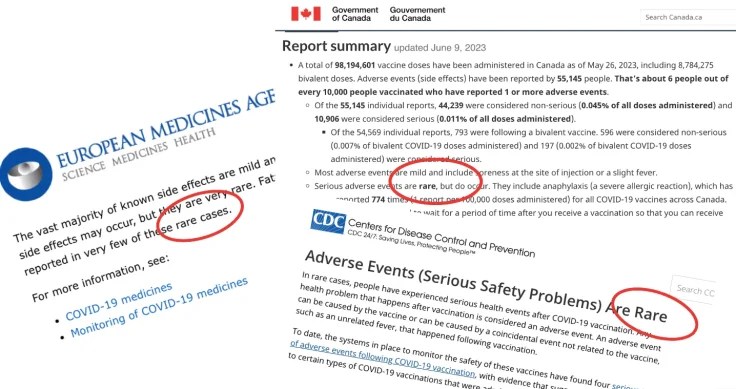
But there has been very little scrutiny of that claim by the media, and I could not find an instance where international agencies actually quantified what they meant by the term “rare” or provided a scientific source.
The best evidence so far, has been a study published in one of vaccinology’s most prestigious journals, where independent researchers reanalysed the original trial data for the mRNA vaccines.
The authors, Fraiman et al, found that serious adverse events (SAEs) – i.e. adverse events that require hospitalisation – were elevated in the vaccine arm by an alarming rate – 1 additional SAE for every 556 people vaccinated with Pfizer’s mRNA vaccine.
According to a scale used by drug regulators, SAEs occurring at a rate of 1 in 556 is categorised as “uncommon,” but far more common than what the public has been told.
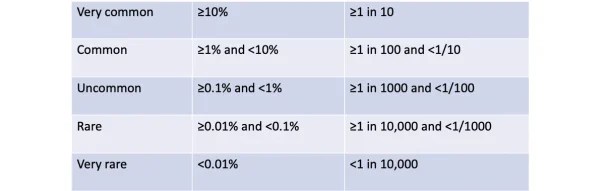
Therefore, I asked eight drug regulators and public health agencies to answer a simple question: what is the official calculated rate of SAEs believed to be caused by Pfizer’s mRNA vaccine, and what is the evidence?
The agencies were FDA, TGA, MHRA, HC, PEI, CDC, ECDC and EMA.
The outcome was startling.
Not a single agency could cite the SAE rate of Pfizer’s vaccine. Most directed me to pharmacovigilance data, which they all emphasised does not establish causation.
The Australian TGA, for example, referred me to the spontaneous reporting system but warned, “it is not possible to meaningfully use these data to calculate the true incidence of adverse events due to the limitations of spontaneous reporting systems.”
Both the German regulator (PEI) and European CDC referred me to the European Medicines Agency which, according to its own report, saw no increase at all in SAEs. “SAEs occurred at a low frequency in both vaccinated and the placebo group at 0.6%.”
The UK regulator MHRA went so far as to state it “does not make estimations of a serious adverse event (SAE) rate, or a rate for adverse reactions considered to be causally related for any medicinal product.”
The US FDA, on the other hand, did conceded that SAEs after mRNA vaccination have “indeed been higher than that of influenza vaccines,” but suggested it was justified because “the severity and impact of covid-19 on public health have been significantly higher than those of seasonal influenza.”
Despite analysing at the same dataset as Fraiman, the FDA said it “disagrees with the conclusions” of the Fraiman analysis. The agency did not give specifics on the areas of disagreement, nor did it provide its own rate of SAEs.
In response to the criticism, Joe Fraiman, emergency doctor and lead author on the reanalysis said, “To be honest, I’m not that surprised that agencies have not determined the rate of SAEs. Once these agencies approve a drug there’s no incentive for them to monitor harms.”
Fraiman said it’s hypocritical for health agencies to tell people that serious harms of the covid vaccines are rare, when they have not even determined the SAE rate themselves.
“It’s very dangerous not to be honest with the public,” said Fraiman, who recently called for the mRNA vaccines to be suspended.
“These noble lies may get people vaccinated in the short term but you’re creating decades or generations of distrust when it’s revealed that they have been misleading the public,” added Fraiman.
Dick Bijl, a physician and epidemiologist based in the Netherlands, agreed. “It goes to show how corrupted these agencies are. There is no transparency, especially since regulators are largely funded by the drug industry.”
Bijl said it’s vital to know the rate of SAEs for the vaccines. “You must be able to do a harm:benefit analysis, to allow people to give fully informed consent, especially in young people at low risk of serious covid or those who have natural immunity.”
Bijl said the mainstream media has allowed these agencies to make false claims about the safety of vaccines without interrogating the facts.
“The rise of alternative media is strongly related to the lies being told by the legacy media, which just repeats government narratives and industry marketing. In the Netherlands, there is a lot of discussion about the distrust in public messaging,” said Bijl.
Court Orders Merck to Turn Over Gardasil Adverse Event Databases
By Brenda Baletti, Ph.D. | The Defender | April 3, 2023
A North Carolina district court ordered Merck to turn over all of its Gardasil adverse events databases to plaintiffs suing the pharmaceutical giant for injuries allegedly caused by the human papillomavirus (HPV) vaccine.
The databases, which include information from the Merck Adverse Event Reporting and Review System (MARRS) — Merck’s version of the Vaccine Adverse Event Reporting System (VAERS) — should contain all of the reports pertaining to Gardasil adverse events submitted by physicians, patients and publications, plaintiffs’ attorney Michael Baum told The Defender.
In his March 20 order, U.S. District Judge Robert J. Conrad, Jr., said, “Plaintiffs’ and their experts should have the same opportunity as Merck to review and analyze the entirety of the data.”
Merck until now has refused to make the entire MARRS databases available to the plaintiffs’ attorneys.
Gardasil is a widely used vaccine commonly administered to teens and young adults before they are sexually active to protect against HPV infections, which can be sexually transmitted later in life.
HPV infections may lead to the development of cervical cancer. However, most infections are benign and resolve on their own.
The firm Baum Hedlund Aristei & Goldman and Robert F. Kennedy, Jr., Children’s Health Defense chairman-on-leave, have filed more than two dozen lawsuits on behalf of young people injured by Gardasil, alleging Merck knowingly and fraudulently concealed the vaccine’s risks.
The lawsuits are some of the more than 80 pending in the federal court system, and that number is expected to grow. In August 2022, a judicial panel consolidated the lawsuits into a single federal courtroom.
Some of the signature impacts observed following HPV vaccination — which afflict a number of the plaintiffs — include permanently disabling autoimmune and neurological conditions such as postural orthostatic tachycardia syndrome (POTS), fibromyalgia and myalgic encephalomyelitis/chronic fatigue syndrome, The Defender reported.
There have been thousands of reports of adverse events worldwide, peer-reviewed scientific literature from the U.S., Australia, Denmark, Sweden, France and Japan, and statistics published by public health agencies in each of these countries that demonstrate plausible associations between HPV vaccination and autoimmune conditions.
Merck maintains there is no safety signal in the data for autoimmune conditions. The plaintiffs allege Merck made this argument by discounting reports.
Baum told The Defender access to this full database of adverse event reports should allow experts to better analyze the full extent of post-Gardasil autoimmune symptom clusters, and demonstrate there is a “statistically significant causal connection between Gardasil and autoimmune conditions.”
Gardasil’s long history of autoimmune adverse events
While Merck markets Gardasil as “safe and effective,” safety signals emerged even early, during the vaccine’s clinical trials. However, the U.S. Food and Drug Administration (FDA) granted the vaccine Fast Track approval after only a six-month review process.
In 2006, Gardasil was licensed across the U.S. and Europe. But within a few years, reports of serious adverse events appeared — first in the media and then in academic journals.
In 2013, Gardasil was responsible in the U.S. for three-fifths of all serious vaccine reactions reported in young women under age 30, including 64% of deaths and 81% of cases of permanent disability.
Similarly, disproportionately high rates of adverse events were reported in Australia, Japan, and other European countries at that time.
Yet in 2014, the FDA approved a new version of the vaccine, the nine-valent Gardasil 9. And in 2016 — when GlaxoSmithKline (GSK) withdrew its poorly competing bivalent HPV vaccine Cervarix from the U.S. market — Gardasil 9 became “the only game in town.”
Gardasil 9 is FDA-approved for males and females ages 9 through 45 years.
In 2015, because of the high number of serious adverse events reports in Denmark and around the world, the Danish Health and Medicines Authority asked the European Commission to investigate the relationship between Gardasil and serious adverse events.
Several months later, the European Medicines Agency (EMA) — a European equivalent to the FDA — issued a report concluding there was no link between HPV vaccines and serious neurological adverse events.
But a leaked, confidential EMA document showed substantial disagreement among the agency’s experts.
An article published in The BMJ Evidence-Based Medicine also revealed the EMA made its evaluation based on flawed data and analysis provided by vaccine manufacturers, dismissed compelling evidence from independent researchers and the Uppsala Monitoring Centre, and sought input from experts with financial conflicts of interest, in violation of its own rules.
Given the ongoing safety concerns associated with the revelations of the EMA’s flawed study, Rebecca Chandler et al. conducted further research on the link between the HPV vaccine and autoimmune disorders, which was published in Drug Safety in 2017.
Autoimmune disorders can be difficult to identify and take a long time to diagnose because they are typically characterized by combinations of a wide range of symptoms that can be linked to a number of illnesses.
Any one symptom on its own may not provide enough information to alert a physician to the underlying cause.
To identify autoimmune disorders associated with the HPV vaccine, Chandler and her team did a cluster analysis of VigiBase, the World Health Organization (WHO) international database of suspected adverse drug reactions.
They conducted a statistical analysis of reports on HPV adverse events, looking for clusters of symptoms associated with autoimmune conditions like POTS, CRPS and CFS — rather than looking only for cases where an autoimmune disorder was definitively diagnosed — and found statistically significant rates of serious adverse events associated with Gardasil.
It is one of several recent studies linking Gardasil with autoimmune issues.
As part of this now-consolidated lawsuit, the plaintiffs have been seeking access to Merck’s database for several years in order to do a cluster analysis on all of the data Merck has collected.
Suing Big Pharma for vaccine injury difficult — but possible
Vaccine makers can be held liable for injuries caused by a fully licensed vaccine — unless that vaccine is added to the CDC’s childhood vaccination schedule.
The HPV vaccine is listed on that schedule.
People injured by vaccines listed on the childhood schedule can seek compensation through the taxpayer-funded National Vaccine Injury Compensation Program (VICP), a no-fault alternative to the traditional legal system for resolving vaccine injury claims.
But many people are unaware that claimants who are dissatisfied with the outcome of the VICP process can sue the pharmaceutical company directly in civil court as long as that claimant completed the VICP process.
Baum told The Defender that the VICP has paid out more than $70 million to people making claims regarding Gardasil, but that over the last few years, they stopped making payments for autoimmune conditions, without explanation.
The lawsuits against Merck alleging the HPV vaccine caused debilitating autoimmune complications are a result of this process.
Baum also told The Defender that a claimant has only three years from the onset of symptoms to file a complaint, but because autoimmune disorders are challenging to diagnose, many people are not diagnosed until the statute of limitations has expired.
Brenda Baletti Ph.D. is a reporter for The Defender. She wrote and taught about capitalism and politics for 10 years in the writing program at Duke University. She holds a Ph.D. in human geography from the University of North Carolina at Chapel Hill and a master’s from the University of Texas at Austin.
This article was originally published by The Defender — Children’s Health Defense’s News & Views Website under Creative Commons license CC BY-NC-ND 4.0. Please consider subscribing to The Defender or donating to Children’s Health Defense.
The anti-Covid pill Big Pharma doesn’t want you to have
By John Hollaway | The Conservative Woman | June 22, 2021
From Wikipedia: ‘During the 2020 COVID-19 pandemic, misinformation was widely spread claiming that ivermectin was beneficial for treating and preventing COVID-19. Such claims are not backed by good evidence.’
WHEN encountering an inexplicable anomaly in human behaviour, common rules of thumb can often give an insight. Oddly, though, these differ from country to country. For Americans it is ‘follow the money’. For Italians it is ‘cui bono?’ – who benefits? The nearest French rule is perhaps ‘cherchez la femme’.
Sometimes none of these help. Sometimes a perverse piece of human nature cannot be explained in terms of money, perquisites or feminine influence. The ivermectin mystery is one such.
Ivermectin is a generic prescription drug, discovered in 1975, developed by Merck and released in 1981. It is used to treat many types of parasite infestations in humans and animals. The researchers who created it were awarded the Nobel Prize for medicine in 2015. It is on the World Health Organisation’s List of Essential Medicines and is approved by the Federal Drug Administration (FDA) as an antiparasitic agent.
It can have very rare serious side effects. By 2020 four billion doses had been administered and 16 deaths are believed to have occurred as a consequence, or one in 250million doses. Although the figures are not directly comparable, the annual increased risk of death for a middle-aged man taking a standard (325 mg) aspirin every day to prevent heart disease and stroke is about one in ten thousand. This is about as risky as driving a car.
Ivermectin is therefore a very safe drug. However, the drug oversight establishment does not think so.
On March 22 this year the European Medicines Agency issued this statement:
‘EMA has reviewed the latest evidence on the use of ivermectin for the prevention and treatment of COVID-19 and concluded that the available data do not support its use for COVID-19 outside well-designed clinical trials.
‘In the EU, ivermectin tablets are approved for treating some parasitic worm infestations while ivermectin skin preparations are approved for treating skin conditions such as rosacea. Ivermectin is also authorised for veterinary use for a wide range of animal species for internal and external parasites.
‘Ivermectin medicines are not authorised for use in COVID-19 in the EU, and EMA has not received any application for such use.’
On May 3 the US Food and Drug Administration (FDA) issued this warning under the heading ‘Why You Should Not Use Ivermectin to Treat or Prevent COVID-19’:
‘There seems to be a growing interest in a drug called ivermectin to treat humans with COVID-19. Ivermectin is often used in the U.S. to treat or prevent parasites in animals. The FDA has received multiple reports of patients who have required medical support and beenhospitalized after self-medicating with ivermectin intended for horses.
‘FDA has not approved ivermectin for use in treating or preventing COVID-19 in humans. Ivermectin tablets are approved at very specific doses for some parasitic worms, and there are topical (on the skin) formulations for head lice and skin conditions like rosacea. Ivermectin is not an anti-viral (a drug for treating viruses).
‘The FDA has not reviewed data to support use of ivermectin in COVID-19 patients to treat or to prevent COVID-19; however, some initial research is underway. Taking a drug for an unapproved use can be very dangerous. This is true of ivermectin, too.’
The lack of official support for trials of the efficacy of ivermectin has meant that the typical number of subjects being tested (the ‘cohort’) is fairly small, usually about a hundred. To overcome this a meta-analysis can be undertaken, when the results of many trials are combined and assessed to determine if a trend can be seen. This has been done, most notably by @CovidAnalysis. A paper most recently updated yesterday surveyed 60 properly conducted studies, most with double-blind testing against placebos, with neither the participants nor the researcher knowing who had been given the drug until the trial was over. This report is a preprint, so it has not been peer-reviewed, but the results are conclusive: 93 per cent of the studies show a positive outcome from the administration of ivermectin, with deaths reduced by over 80 per cent.
So why have what might be called ‘Drug Central’ refused to acknowledge this mammoth body of evidence arising from without their bailiwicks? Perhaps because of human nature again. Here they are obeying another rule of thumb commonly seen when institutions encounter new external factors – ‘not invented here’. Perhaps this business school aphorism is also appropriate: ‘Hell hath no fury like a head-office scorned’.
In any event the virucidal properties of ivermectin and its safety have now been established beyond doubt, and we can expect it to be valuable in this role from henceforth. But unfortunately not, perhaps, against Covid-19.
Featured Video

Yemen joins the war – Red Sea could be blocked next – Saudi regime at risk
or go to
Aletho News Archives – Video-Images
From the Archives
A superpower and “the world’s sickest warrior state”
By Paul J. Balles | March 8, 2010
Living through five or six major wars has hardened me to what I thought were the extremes of inhuman cruelty and brutality.
Two things made those extremes almost bearable: the brutality always revealed – at least according to the media coverage – the viciousness of the enemy. It was therefore quite understandable when our “brave men and women” pulverized the enemy.
Films of Japanese torturing captive Americans somehow justified holding Japanese Americans in internment camps during World War II; and only a small percentage of Americans found the bombing of Hiroshima and Nagasaki unreasonably vengeful at best, at worst, depraved.
The media giants in America portrayed the North Koreans as barbaric beasts with their captives, quite unlike their southern counterpoints – our allies during the Korean War. No one ever felt the need to explain how the South Koreans were a civilized breed while the North Koreans were absolute savages, at least according to the official line.
In Vietnam, our warriors justifiably (or so the media made us believe) dropped napalm on the North Vietnamese who had the gall to hide in villages and tunnels to ravage our invaders. At least it was accepted practice until some rogue photojournalist filmed a young girl screaming down a Vietnamese road in flames. … continue
Blog Roll
 Aletho News
- Russian tanker approaches Cuba despite US oil blockade
- Marandi: Yemen joins the war – Red Sea could be blocked next – Saudi regime at risk
- Pro-Palestinian French member of European Parliament denied entry to Canada
- Pakistan to Host US-Iran Talks
- How Indonesia’s tilt toward the US left it stranded in the Strait of Hormuz
- US has no choice but to retreat from Iranian borders: Top commander
- Iran Retaliation Strikes Chemical Plant Near Dimona
- AWACS’ Destruction is a Major Loss for US Military – Ex-DoW Analyst
- Israel’s Iran Strategy Uses US Military & Gulf States as Its Pawns
- Iran: Trump wanted regime change, now just begging for Hormuz to open
- If Americans Knew
- Israeli police block Catholic cardinal from entering Church of the Holy Sepulchre on Palm Sunday
- Israel is assassinating journalists again, more than any other nation, anywhere, ever – Not a ceasefire Day 170
- Over 300 US service members wounded, majority have brain injuries – Not a ceasefire Day 169
- Researchers at Human Rights Watch Resign Over Blocked Report on Palestinian Refugee Return
- Jewish Groups Are Backing a War Americans Don’t Want
- Eric Fingerhut Thinks He’s the President of the Jews
- Top Jewish Philanthropists, Rabbis Urge Israeli President to Take Action Against ‘Jewish Extremists’
- Don’t Be Fooled. Zionist Leaders Have Always Wanted to Control Southern Lebanon
- Israel’s widespread use of torture is a core element of its genocide against the Palestinian people
- In Israel’s War on Iran, Many Middle East US Bases Rendered “All But Uninhabitable”
- No Tricks Zone
- German Science Blog Accuses PIK Climate Institute Of Hallucinating Climate Tipping Points
- Devastating Assessment Of Comirnaty Vaccine By Former Senior Pfizer Europe Toxicologist
- New Study: CO2 Is ‘Effectively Negligible’ As An Explanatory Climate Change Factor Since 2000
- Former Pfizer Toxicologist Dr. Helmut Sterz Tells Bundestag Hearing Pfizer Vaccine Should Have Never Been Approved
- Energy Expert: Germany’s Nuclear Phaseout Was A “500 Billion Euro Mistake”
- New Research: South Australia’s Mid-Holocene Sea Surface Temperatures Were 4°C Warmer Than Today
- Storing Green Energy To Last Germany 10 Days Would Require A 60-Million Tonne Battery
- New Studies: UK Sea Levels Were 4 Meters Higher Than Today During The Mid-Holocene
- Destructive Green New Deal: German Energy And Metal Group Warns Of Drastic Crisis
- New Study Documents A 20-Year Pause In Arctic Sea Ice Decline – Driven By Internal Variability
 Aletho News