Kushner hid his leadership of foundation that funds illegal settlements
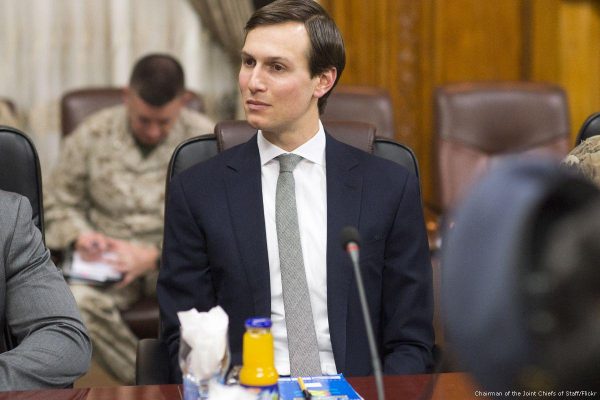
US President Donald Trump’s son-in-law and senior advisor Jared Kushner [Chairman of the Joint Chiefs of Staff/Flickr]
MEMO | December 5, 2017
US President Donald Trump’s son-in-law and senior advisor Jared Kushner failed to disclose on government records his position as co-director of a foundation that funds illegal Israeli settlements in the occupied West Bank, the Jerusalem Post reported today.
Kushner headed the family-run Charles and Seryl Kushner Foundation from 2006 to 2015, during which the organisation donated at least $38,000 to the building of a Jewish seminary in the West Bank settlement of Beit El and an additional $20,000 to Jewish and educational institutions in other settlements.
However, he did not reveal his history with the foundation to the Office of Government Ethics in March, despite having amended his financial records with the office several times and made three revisions to his security clearance application.
The US has previously called illegal settlement building as “unhelpful” in bringing together Israel and Palestine for a peace deal; Kushner is currently charged with leading that process.
According to the researchers at communications organisation American Bridge who made the discovery, Kushner may have avoided disclosing the information in order to prevent it being considered a conflict of interest with his government role.
The news of Kushner aiding settlement funding comes amid official investigations into his contact with senior Israeli officials in an attempt to block a UN resolution condemning Israel’s occupation during the transition between former US President Barack Obama and Trump. If true, the cooperation would be one of many allegations of conversations between Kushner and foreign leaders, including Russia.
Although being charged with spearheading the Middle East peace process, a recent report in Politico also found that despite carrying information on and conducting some of the country’s most sensitive diplomatic talks, Kushner does not have sufficient security clearance.
The Trump administration’s backing for Israel is thought to have been bolstered by the strong Zionist stance of many senior US officials, Kushner primary among them. The president’s son-in-law is a faithful advocate of Israel and his support for the country, say critics, is odd even by American standards. He counts Israeli Prime Minister Benjamin Netanyahu as a close family friend and has regularly visited the country even before being assigned his role as peace negotiator.
How Israel is ‘cleansing’ Palestinians from Greater Jewish Jerusalem
Measures aim to annex settlements to city and turn Palestinian areas into no-man’s land, warn rights groups
By Jonathon Cook | Middle East Eye | November 23, 2017
Israel is putting in place the final pieces of a Greater Jewish Jerusalem that will require “ethnically cleansing” tens of thousands of Palestinians from a city their families have lived and worked in for generations, human rights groups have warned.
The pace of physical and demographic changes in the city has accelerated dramatically since Israel began building a steel and concrete barrier through the city’s Palestinian neighbourhoods more than decade ago, according to the rights groups and Palestinian researchers.
Israel is preparing to cement these changes in law, they note. Two parliamentary bills with widespread backing among government ministers indicate the contours of Jerusalem’s future.
One bill intends to annex to Jerusalem some 150,000 Jews in illegal West Bank settlements surrounding the city. As well as bolstering the city’s Jewish population, the move will give these additional settlers a vote in Jerusalem’s municipal elections, pushing it politically even further to the right.
Another bill will deny more than 100,000 Palestinians on the “wrong” side of the barrier rights in the city. They will be assigned to a separate local council for Palestinians only, in what observers fear will be a prelude to stripping them of residency and barring them from Jerusalem.
Meanwhile, a web of harsh Israeli policies, including late-night arrests, land shortages, home demolitions and a denial of basic services, are intensifying the pressure on Palestinian inside the wall to move out.
These measures are designed to pre-empt any future peace efforts, and effectively nullify Palestinian ambitions for a state with East Jerusalem as its capital, said Aviv Tartasky, a field researcher with Ir Amim, an Israeli group advocating fair treatment for Palestinians in Jerusalem.
“What is going on is ethnic cleansing, without guns,” Tartasky told Middle East Eye. “Israel hopes to get rid of a third of Jerusalem’s Palestinian population through legislative moves alone.”
Demographic fears
Israel’s demographic concerns in Jerusalem date back to 1967, when it occupied and annexed East Jerusalem, combining the large Palestinian population there with West Jerusalem’s Jewish population. It also expanded the city’s municipal borders as a way to covertly annex West Bank land.
Israel initially set an upper limit of 30 per cent Palestinians to 70 per cent Jews in what it called its new “united, eternal capital”, but has been losing the battle to maintain that ratio ever since. Higher Palestinian birth rates mean that today there are more than 315,000 Palestinians in East Jerusalem, comprising nearly 40 per cent of the city’s total population. Projections suggest Palestinians could be a majority within a decade.

Although few Palestinians in Jerusalem have taken or been allowed Israeli citizenship, and almost none vote in municipal elections, Israel fears their growing numerical weight will increasingly make its rule in the city untenable.
“What we have in Jerusalem is an apartheid system in the making,” Mahdi Abd al-Hadi, a Palestinian academic in Jerusalem, told MEE.
“Israeli policies are dictated by demographic considerations and that has created a huge gulf between the two societies. Palestinians are being choked.”
‘Save Jewish Jerusalem’
Fear of the demographic loss of Jerusalem provoked the launch of a high-profile campaign by political and security leaders last year: “Save Jewish Jerusalem”. Fearful that Palestinians will soon be a majority and might start voting in municipal elections, the campaign warned Jewish residents they would “wake up to a Palestinian mayor in Jerusalem”.
Over the past year government ministers, including education minister Naftali Bennett, have aggressively pushed for the annexation of Maale Adumim, a large settlement outside Jerusalem, in the West Bank. Gradually, they appear to be winning the argument.
Late last month a ministerial committee was set to approve a Greater Jerusalem Bill, legislation intended to expand Jerusalem’s municipal borders to include Maale Adumim and several other large settlements in the West Bank. It won Netanyahu’s backing.
The settlements would have been annexed in all but name, and their 150,000 residents become eligible to vote in municipal elections.
De facto annexation
Yisrael Katz, the minister of transport and intelligence who helped introduce the bill, has said its purpose is to “safeguard a Jewish majority” in the city. A recent poll showed 58 per cent of Israeli Jews support the plan.
Under pressure from the administration of US President Donald Trump, Netanyahu has temporarily put the bill on the back burner. Washington is reportedly worried that the legislation will stymie a peace initiative it is reportedly about to unveil.
Ir Amim fears the legislation is likely to be revived when pressure dissipates. A position paper it published last week warned that the legislation was the “first practical move since the annexation of East Jerusalem in 1967 to implement the de facto annexation of areas in the West Bank to Israel”.
After decades of implanting Jewish settlers in the midst of Palestinian areas to prevent their development and growth, Israel is beginning the difficult process of disentangling the two populations, said Tartasky.
Eviction notices
The effects are being felt keenly on the ground.
Last Friday, Israeli forces stormed the Bedouin village of Jabal al-Baba and issued “eviction” notices to its 300 residents. In August the Israeli army demolished the village’s kindergarten school.
Jabal al-Baba stands between East Jerusalem and Maale Adumim.
“These Palestinian communities outside Jerusalem are like a bone in the throat for Israel,” said Tartasky. “Israel is trying to make their life as hard as possible to force them to leave, and so create a territorial continuity between Jerusalem and the settlements.”
The latest raid on Jabal al-Baba came immediately after Israel notified the hundreds of residents of Walaja that a military checkpoint would be relocated close to the entrance to their village. That will cut them off from ancient agricultural terraces on Jerusalem’s uplands their families have farmed for generations.
Although many of Walaja’s residents have Jerusalem identity papers issued by Israel, the new move will effectively seal them off from the city, as well as their lands. The terraces and a nearby spring, where the villagers water livestock, will become “attractions” in an expanded Jerusalem metropolitan park.
Chokehold tightening
Meanwhile, Israel is tightening its chokehold on Palestinians in East Jerusalem’s built-up areas.
Those on the far side of the concrete wall have been effectively abandoned by the Jerusalem municipality, and are finding it ever harder to access the rest of the city, said Daoud Alg’ol, a Palestinian researcher on Jerusalem.
A bill by Zeev Elkin, the Jerusalem affairs minister, is designed to disconnect from the Jerusalem municipality Palestinian neighbourhoods such as Walaja, Kafr Aqab, Shuafat refugee camp and Anata, which lie beyond the separation wall.
They would be hived off into a separate local council for Palestinians, instantly reducing the city’s Palestinian population by a third.
“Once Palestinians are in a separate local council, Israel will say the centre of their life is no longer in Jerusalem and their Jerusalem residency papers will be revoked,” said Alg’ol. “This already happens, but now it will be on a much larger scale.”
Since 1967, Israel has revoked the residency permits of more than 14,000 Palestinians, forcing them to leave Jerusalem.
Twilight zones of neglect
Even though their residents pay taxes to the Jerusalem municipality, Palestinian areas outside the barrier are already “twilight zones” of neglect and lawlessness.
In Kafr Aqab, for example, which is sealed off from the rest of East Jerusalem behind the wall and a military checkpoint, residents receive few services. Israel, however, has also denied the Palestinian Authority access.
“They are living in a no-man’s land,” said Alg’ol.
These areas have become a destination both for criminals and for Palestinian families caught out by Israel’s intricate web of strict residency regulations. Palestinians in the West Bank are denied access inside Jerusalem’s wall, while Palestinians in Jerusalem risk being stripped of their residency papers if they move out of the city.
Couples who have married across that residency divide have found a refuge in Kfar Aqab as Israel slowly disconnects the neighbourhood off from East Jerusalem. Residents say the population there has rocketed from a few thousand to tens of thousands in the past few years.
As a result, a building boom has taken place beyond the wall as Palestinians take advantage of a lack of enforcement by Israel of its building regulations. That has offered demographic gains for Israel too, said Alg’ol.
Housing crisis
“Planning restrictions and land shortages inside the wall have created a housing crisis for Palestinians, making it too expensive for them to live there,” he said. “They have been forced to move to areas outside the wall to find more affordable housing. Economic pressure is creating a silent transfer.”
Palestinians in neighbourhoods inside the wall are being driven out in other ways, noted Tartasky.
Traditionally, Israel has used a range of policies to strip Palestinians of land and prevent development in Jerusalem and justify house demolitions.
Those have included declaring Palestinian areas “national parks”, thereby criminalising the homes in them; confiscating the last green areas to build Jewish settlements; and allowing settlers to take over Palestinian properties in the Old City and surrounding neighbourhoods as israel seek to strengthen its hold over the city’s holy sites, especially al-Aqsa mosque.
There are now some 200,000 Jewish settlers living in East Jerusalem.
“Palestinians are never part of the planning in Jerusalem, and their interests are never taken into account – they are always an obstacle to be removed,” Alg’ol told MEE. “Israel wants the land but not the Palestinians on it.”
Late-night raids
Pressure has mounted on Palestinians in Jerusalem, noted Tartasky, as their communities have been denied schools and basic municipal services. More than 80 per cent of Palestinian children live below the poverty line.
The Jerusalem municipality and police have also begun stepping up “law enforcement” operations against Palestinians – or what residents term “collective punishment”. Under claims of “restoring order”, there has been a wave of recent late-night raids in areas like A-Tur and Issawiya. Large numbers of Palestinians have been arrested, demolition orders issued and businesses closed.
“Israel is using the same militarised methods as in the West Bank,” said Tartasky. “The assumption is these pressures will encourage them to move to areas outside the barrier, where sooner or later they will lose their residency rights.
“Israel has realised that is an opportunity it can exploit.”
The office of Jerusalem’s mayor, Nir Barkat, issued a statement to MEE denying that the situation of Palestinians in East Jerusalem was deteriorating. It said that there had been dramatic improvements in Palestinian areas in the provision of schools, community centres, sports fields, new roads, postal services and welfare.
It added that Barkat had “developed a plan unprecedented in scope and budget allocation to reduce gaps in East Jerusalem in order to address the 50 years of neglect he inherited from his municipal predecessors and successive Israeli governments.”
Alg’ol said the municipal claims were a denial of reality. “Israel wants to create a make-believe city free of Palestinians,” he said. “Where it can, it is ethnically cleansing them from the city. And where it can’t, it simply hides them from view.”
UN blacklists 130 Israeli firms & 60 multinationals for working in occupied Palestinian territories
RT | October 26, 2017
The United Nations (UN) has included some of the biggest Israeli and international firms operating in the West Bank, East Jerusalem, and the Golan Heights in a blacklist for those violating “international law and UN resolutions.”
According to Israeli Ynet News which has gained access to part of the list, 130 Israeli companies and 60 international corporations received warning letters from the United Nations High Commissioner for Human Rights Zeid bin Ra’ad al-Hussein about their impending inclusion on the blacklist.
The list, which reportedly will be published in late December includes Israel Aerospace Industries, telecom giants, international tech firms, banks, and even cafes.
Israel Aerospace Industries, Hewlett-Packard, the Israeli branches of Motorola and HP, the Dead Sea cosmetics firm Ahava, the Cellcom and Partner telecommunications companies are among those listed. Israel’s two largest banks, Hapoalim and Leumi, are also said to be on the list.
Israeli Channel 2 News has reported that among the American firms that received letters were Coca-Cola, TripAdvisor, Airbnb, and Caterpillar.
The US ambassador to the UN Nikki Haley condemned the blacklist as “the latest in this long line of shameful actions” taken by the United Nations Human Rights Council (UNHRC). In June Haley warned the US could withdraw from the 47-member body.
“It may cause large investment firms or pension funds carrying stocks of various Israeli companies to divest in them because they, in turn, operate in the settlements,” an unnamed senior Israeli official told Ynet, adding “it may lead to a snowball effect that will greatly harm the Israeli economy eventually.”
The companies say the list’s creation was politically motivated and their inclusion may cause them financial harm and tarnish their brand. They are reportedly looking into filing lawsuits against the Commissioner and the UNHRC.
In September, the UN Commissioner warned over 150 companies that their activities in the “occupied Palestinian territories” may see them added to a blacklist of companies as “they operate in opposition to international law and in opposition of UN resolutions.”
The UN Human Rights Commission voted in March for the resolution being pushed by the Palestinian Authority and Arab nations, according to which the commission would formulate a database of Israeli and international firms directly or indirectly doing business in the West Bank, East Jerusalem or the Golan Heights. The decision passed despite pressure and criticism from the US.
Israel offers privileges to settlement companies affected by Boycott
Palestine Information Center – October 2, 2017
NAZARETH – Israeli Economy Minister Eli Cohen decided to offer special privileges to Israeli companies working in settlements in defiance to international boycott resolutions.
Israeli newspaper Israel Hayom reported that the decision stipulates offering aid in form of tax privileges in the exportation field for the factories affected by the boycott in order to guarantee continuing work in settlements.
The UN Human Rights Council decided to publish a blacklist including the names of factories and companies working in settlements in order to support the boycott and pressure these firms to stop working in the settlements as well as to urge international companies to stop dealing with Israel.
Israel To Commit War Crime Against West Bank Villagers

“No sanctimonious language… can erase the disgrace or hide the facts: the destruction of Khan al-Ahmar means the forcible transfer of protected persons,
and forcible transfer is a war crime.”
[If Americans Knew notes: Twelve Palestinian communities in an area near Jerusalem are at risk of expulsion. These villages have been living for years without basic health, education, and welfare services, and without proper electricity or sewage systems. They are under constant surveillance for “illegal” construction—structures built without a permit from the Israeli government (permits are impossible to obtain in this region). These structures, many built of necessity to house growing families, are then quickly demolished by Israel’s Civil Administration.
Israel makes life almost unbearable for these Palestinians. Demolishing homes is just the beginning: grazing and farming land is confiscated, making it harder and harder for the residents to feed themselves and make a living; roads are nearly impassable; settlers and Israeli authorities harass them daily.
This is taking place not in Israel, but in the West Bank, on Palestinian land under full control of Israel.
One community that is at risk of imminent expulsion is Khan al-Ahmar. The Bedouin tribe has already been expelled twice since the 1950s.]
IMEMC News | September 26, 2017
Israeli rights group B’Tselem said, on Monday afternoon, that Israeli government is to commit war crimes against Palestinian villagers in Khan al-Ahmar.
B’Tselem Executive Director Hagai el-Ad said, according to Days of Palestine: “Following the state’s response submitted earlier today to the [Israeli] High Court of Justice, that the state was asking the court to authorize a war crime.”
He explained: “No sanctimonious language about a ‘planning, proprietary and realistic’ alternate, or ‘time to prepare’ can erase the disgrace or hide the facts: the destruction of Khan al-Ahmar means the forcible transfer of protected persons, and forcible transfer is a war crime.”
El-Ad added: “Those responsible for it will bear personal criminal liability – exactly as B’Tselem stated two weeks ago, in a letter addressed to the prime minister, defence minister, justice minister, chief of staff and the head of the Civil Administration.”
According to updated data, Khan al-Ahmar community, which lives on land Israel has earmarked for settlement expansion in the area, is home to 32 families numbering 173 persons, including 92 minors.
It has a mosque and a school, which was established in 2009 and serves more than 150 children between the ages of six and fifteen – some of them from neighbouring communities.
Khan al-Ahmar is located around the illegal Israeli settlement of Ma’aleh Adumim, in the occupied Palestinian West Bank.
The Israeli occupation considers it strategic for building and expanding illegal settlements and establishing a territorial link between Ma’aleh Adumim and Jerusalem.
More background on Khan al-Ahmar and the other communities can be found here.
Jewish settlers hold provocative evening march in Silwan

Palestine Information Center – August 25, 2017
OCCUPIED JERUSALEM – Dozens of Jewish settlers along with officials on Thursday staged a provocative evening march in the Palestinian Silwan district of Occupied Jerusalem and entered a house that had been already sized and turned into a synagogue in Baten al-Hawa neighborhood.
A reporter for the Palestinian Information Center said the settlers were carrying Torah scrolls and Israeli flags as they were marching to the house that was appropriated a few years ago at the pretext that it was once a synagogue.
Member of the Silwan Land Defense Committee Fakhri Abu Diyab said that scores of Israeli police forces were deployed throughout the area and on rooftops of homes to protect the participants in the march.
Abu Diyab affirmed that Israeli agriculture minister Uri Ariel, right-wing Knesset members, and officials from the Jewish Home Party, and Ashkenazi chief rabbi of Jerusalem Aryeh Stern were among the participants.
He pointed out that it was the first time for the settlers to hold a march in Silwan district.
Silwan and its neighborhoods have always been a target of Judaization projects. The Israeli occupation authority still seeks to demolish several Palestinian homes in the district in order to build a park for its settlers.
In 2005, it started to notify local residents of its intent to raze their homes for the park project, but it had to delay its step several times after home owners managed to extract court verdicts freezing demolition orders.
However, the Israeli municipality in Jerusalem now threatens again to demolish the homes in Silwan after it rejected all the structural blueprints they submitted for their neighborhoods.
Israeli settlers torch cars, vandalize property during attack on Ramallah-area village
Ma’an – August 9, 2017
BETHLEHEM – Israeli settlers set fire to two Palestinian-owned vehicles on Wednesday in the village of Umm Safa in the central occupied West Bank district of Ramallah in an alleged revenge attack for three Israeli settlers who were killed by a Palestinian in the nearby Halamish settlement last month.
Palestinian news agency Wafa received testimony from Marwan Sabah, the village council head, who said that Israeli settlers had set fire to the vehicles around 2:30 a.m.
While Israeli soldiers were reportedly stationed at the entrance of the village at night, the settlers attacked homes on the outskirts of the village after the soldiers had left, Sabah said.
However, Israeli soldiers are rarely able to control Israeli settlers, and reports often emerge of Israeli soldiers watching settler attacks on Palestinians without intervening. If any action is taken by Israeli soldiers, it is typically in the form of shooting “crowd control measures,” such as tear gas, rubber-coated steel bullets, and often live ammunition, at Palestinians.
The settlers had also reportedly graffitied hate slogans on walls in the village, calling for revenge attacks on Palestinians in response to a deadly attack last month when a Palestinian from the Ramallah-area village of Kobar entered the Halamish settlement and stabbed three Israeli settlers to death.
According to the Israeli army, the incident would be under the jurisdiction of the Israeli police. However, an Israeli police spokesperson was not immediately available to comment.
According to Sabah, Israeli forces arrived in the village in the morning following the attack “to examine the area.” An Israeli army spokesperson told Ma’an she would look into any follow-up reports on the incident.
Israeli forces raided Kobar village in the predawn hours of Wednesday, detaining the father and uncle of the Halamish attacker, 19-year-old Omar al-Abed. Three others from the village were also detained during clashes that left 15 injured, some with live fire.
Last week, some 200 settlers from the Halamish settlement attacked the Kobar village. Israeli forces responded by violently suppressing clashes that had broken out between the settlers and Palestinian locals, which resulted in one Palestinian being injured by live ammunition shot by the Israeli army.
An upwards of some 600,000 Israeli settlers reside in occupied Palestinian territory in violation of international law. The international community has repeatedly called their presence and rising population the main impediment to potential peace in the region.
The UN reported on Saturday that after a three-year decline of settler attacks on Palestinians, the first half of 2017 showed a major increase in such attacks, with 89 incidents being documented so far this year.
“On a monthly average, this represents an increase of 88 percent compared with 2016,” the UN said. The attacks during this time period have led to the deaths of three Palestinians.
Israeli media has reported that the Shin Bet, Israel’s internal security agency, has also warned the Israeli government over the alarming trend and has “called on the government to adopt urgent measures to prevent further deterioration,” according to the UN.
Palestinian activists and rights groups have long accused Israel of fostering a “culture of impunity” for Israeli settlers and soldiers committing violent acts against Palestinians.
Israeli authorities served indictments in only 8.2 percent of cases of Israeli settlers committing anti-Palestinian crimes in the occupied West Bank in the past three years, according to Israeli NGO Yesh Din.
Meanwhile, Palestinians allegedly or actually committing any attacks on Israelis are often shot dead at the scene, in what rights groups have deemed “extrajudicial executions,” or face long prison sentences.
Israeli forces shoot, injure Palestinian in Salfit tending to his land near separation wall
Ma’an – July 29, 2017
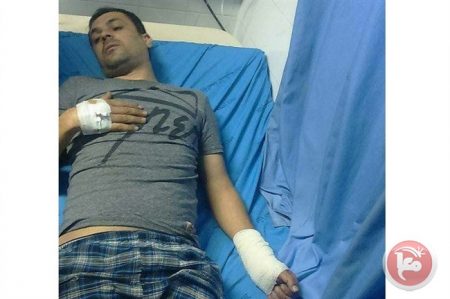 SALFIT – Israeli forces shot and injured a Palestinian on Friday while he was tending to his land near Israel’s separation wall in the village of Deir Ballut in the western part of Salfit district in the occupied West Bank.
Medical sources at the Palestinian Red Crescent told Ma’an that Faed Saleh Odeh Moussa, 33, was injured with a live bullet in his left hand after Israeli forces opened fire on him while he was on his land watering trees.
The sources added that he was transferred to the Yasser Arafat Hospital in Salfit, where doctors reported his injury as moderate.
Saed, Moussa’s brother, told Ma’an that they were caring for their land near Israel’s separation wall, like every Friday, when Israeli forces arrived in the area at 7:30 p.m. and randomly opened live ammunition on them.
Saed said that they quickly hid behind rocks before his brother was injured. He added that their children were also with them at the time and two men from Qalqiliya city in the northern West Bank who were en route to Israel.
Israeli forces remained in the area for some time before leaving following the incident, Saed noted. He added that he had called the Deir Ballut municipality to inform them of the incident, who said that they would notify the Palestinian liaison of the incident.
An Israeli army spokesperson told Ma’an she would look into reports on the incident.
According to the Bethlehem-based Applied Research Institute — Jerusalem, the village of Deir Ballut has had thousands of dunams of land confiscated for the purpose of illegal Israeli settlement building, while Israel’s separation wall — deemed illegal by the International Court of Justice in 2004 — is expected to swallow up at least 35 percent of the village’s lands.
Such Israeli activities in Palestinian villages coincide with upticks of Israeli violence against Palestinians — both by Israeli forces and settlers, as Palestinians are stripped of their lands and often barred from entering Israel’s so-called security “buffer zones” on the Palestinian side of the separation wall.
The UN has reported that at least 92 Palestinians are injured by Israeli forces every two weeks, while 1,444 Palestinians were injured by Israeli forces this year, as of July 17. However, this data does not include the hundreds of Palestinians who were injured during Al-Aqsa protests post-July 17.
Wine and the Canada-Israel Free Trade Agreement
By Yves Engler | Dissident Voice | July 24, 2017
Two weeks ago the worst fear of Canadian opponents of neoliberal ‘free trade’ agreements came true.
Surprisingly, there has been almost no reaction from the political parties, unions, and other organizations that warned these agreements would be used to undermine Canadian law, even though this is exactly what happened.
After David Kattenburg repeatedly complained about inacurate labels on two wines sold in Ontario, the Canadian Food Inspection Agency (CFIA) notified the Liquor Control Board of Ontario (LCBO) that it “would not be acceptable and would be considered misleading” to declare Israel as the country of origin for wines produced in the Occupied Palestinian Territories. Quoting from official Canadian policy, CFIA noted “the government of Canada does not recognize Israel’s sovereignty over the territories occupied in 1967.” On July 11 the LCBO sent out a letter to all sacramental wine vendors that stated CFIA’s conclusion that products from two wineries contained grapes “grown, fermented, processed, blended and finished in the West Bank occupied territory” and should no longer be sold until accurately labelled.
But, in response to pressure from the Israeli embassy, Centre for Israel and Jewish Affairs and B’nai Brith, CFIA quickly reversed its decision. On July 14 the government announced that it was all a mistake made by a low level CFIA official and that the Canada-Israel Free Trade Agreement (FTA) governed the labelling of such wine, not CFIA rules. “We did not fully consider the Canada-Israel Free Trade Agreement,” a terse CFIA statement explained. “These wines adhere to the Agreement and therefore we can confirm that the products in question can be sold as currently labelled.”
In other words, the government publicly proclamed that the FTA trumps Canada’s consumer protection laws. And the basis for this dangerous precedent is that the Israel FTA includes the illegally occupied West Bank as a place where Israel’s custom laws apply.
Incredibly, the Green Party of Canada seems to be the only organization that has publically challenged this egregious attack against consumer protections and Palestinian rights. “The European Union and the United States made it clear long ago that goods made in these illegal settlements cannot be mislabelled as ‘Made in Israel’”, said Green Party leader Elizabeth May in a press release. “Why is Canada singling out Israel for preferential treatment at the expense of both Palestinians’ human rights, and the rights of Canadian consumers?”
The Green’s statement points to a startling “Israel exception” by the government as well as FTA critics. I’ve seen no comment from the Council of Canadians or the organization’s trade campaigner Sujata Dey about the Liberal’s announcement that an FTA overides Canadian consumer protections. The same can be said for NDP International Trade critic Tracey Ramsey as well as the Canadian Centre for Policy Alternatives and its Trade and Investment Research Project leader Scott Sinclair. (Since CFIA’s announcement Ramsey and Dey have each posted repeatedly to twitter regarding CETA, NAFTA and other FTAs.) Nor have consumer protection groups such as the Consumers’ Association of Canada or Consumers Council of Canada opposed this attack on the Food and Drugs Act.
But, FTA critics still have an opportunity to join the fight against CFIA’s recent decision. David Kattenburg and his lawyer Dmitry Lascaris are planning a court challenge and their efforts should be supported.
To allow this precedent to pass without challenge the CCPA, NDP and Council of Canadians would be conceding an extremely broad “Israel exception”. Opposing CFIA’s move isn’t akin to backing Palestinian civil society’s (entirely legitimate) call for international Boycott, Divestment and Sanctions until Israel: “Ends its occupation and colonization of all Arab lands and dismantles the Wall; Recognizes the fundamental rights of the Arab-Palestinian citizens of Israel to full equality; and Respects, protects and promotes the rights of Palestinian refugees to return to their homes and properties as stipulated in UN Resolution 194.”
Nor is it a request for Ottawa to bar wines produced on the 22% of pre-1948 Palestine supposed to be a Palestinian state as per official Canadian policy. It is not even necessarily a demand to eliminate the special tariff treatment the Israel FTA currently grants companies based in the occupied territories. It is simply a request to respect Canada’s Food and Drugs Act and label two brands of wine accurately.
Kattenburg explains:
Israel’s self-declared right to sell falsely labeled products on Canadian store shelves should not be allowed to trump the right of Canadians to know what they’re eating and drinking; to know that the fine bottle of ‘Israeli’ red or crispy chardonnay that they just bought was actually not produced from grapes grown in Israel, but rather, in Israeli-occupied, brutally exploited Palestine.
Yves Engler is the author of A Propaganda System: How Canada’s Government, Corporations, Media and Academia Sell War and Canada in Africa: 300 years of aid and exploitation.
150 French Jews move to Israel

MEMO | July 20, 2017
Some 150 French Jews have moved into an illegal settlement in the occupied West Bank, according to Arutz Sheva.
The settlers landed on Tuesday night as part of a programme by the International Fellowship of Christians and Jews (IFCJ), the second such arrival this month. Last week, 200 settlers arrived at Ben Gurion Airport; the largest group scheduled to arrive this summer.
Samaria Regional Council Head Yossi Dagan congratulated Tuesday’s arrivals.
“You have done the most Zionist thing. You left your families, homes, and language to move to Israel,” he said.
Israeli Immigration Minister Sofa Landver has also hailed the continued arrival of French Jews as “a Zionist and principled Aliya [Jewish immigration] that has contributed and will continue to contribute greatly to the State of Israel.”
French Jewish immigration has surged since 2012 with a record of 7,800 people settling in Israel in 2015 alone. Over ten per cent of the Jewish community in France have moved to Israel since 2000, half in the past five years, according to the Jewish Agency.
Earlier this month, the grand rabbi of the orthodox Satmar Hassidic group in New York called for Jews not to settle in Israel because the state was secularising Jewish immigrants. The Satmar group has been fiercely anti-Zionist since its inception, and is raising money to fund Jewish community projects in France to dissuade them from moving to Israel.
Read Also:
Expel 100,000 Palestinians and annex settlement says Israeli Minister
Apartheid illustrated: Israeli soldier shoots another soldier in Hebron
International Solidarity Movement | July 6, 2017
Hebron, occupied Palestine – On Tuesday, 4th July 2017, Israeli forces were conducting a ‘military training’ in a civilian Palestinian neighborhood near Gilbert checkpoint in Tel Rumeida in occupied al-Khalil (Hebron). The result of this ‘military training’ was a fatal shot by one Israeli soldier to the other. The injured commander was immediately evacuated to hospital by an Israeli ambulance, and was later confirmed dead. The Israeli forces immediately closed the whole area to Palestinians by closing all the checkpoints, collectively punishing the civilian Palestinian population. The army, after the incident, announced that these ‘military trainings’ will be suspended in al-Khalil.
The whole incident, though, needs to be contextualized: an occupying army conducted a ‘military training’ near a checkpoint installed for the control and humiliation of the occupied population, in a civilian residential neighborhood. Immediate medical assistance to the injured occupying soldier, with an ambulance that, without any problems, was granted immediate access to the injured.
Military trainings, under international humanitarian law, are prohibited in civilian areas. The Israeli occupying army in al-Khalil, and all over the occupied territories, though, conducts trainings in civilian areas. This serves two functions: for one, it is more ‘real’, a training in the area where the perceived ‘enemy population’ is living, and second, the intimidation of the population. Israeli forces in al-Khalil are sometimes seen ‘practicing’ the ‘neutralization’, as it is called in Israeli rhetoric, of Palestinians at checkpoints. In those cases, a Palestinian that allegedly carries a knife is seen as a threat to the life of the heavily armed and armored occupation forces – and thus has to be shot and, as documented in so many cases, left to bleed to death on the ground without any medical assistance. The idea is always to shoot to kill.
Whereas an Israeli soldier or settler from the illegal settlements would immediately receive medical assistance, as Israeli ambulances are free to pass, Palestinian ambulances, and actually any Palestinian vehicles (often including donkeys and bicycles) are not allowed to drive on one of the (primary artery) roads in al-Khalil – which conveniently connects the settlements in down-town al-Khalil with the Kiryat Arba settlement on the outskirts of the city. Palestinian ambulances, as they are not allowed on this street, instead, are often detained by Israeli forces at the checkpoints, denied to pass and thus denied access to give first aid.
Immediately after the incident, the Israeli forces closed all the checkpoints in the area, effectively putting the area under curfew – for Palestinian residents. Any Palestinian civilian inside the area, thus, was prevented from leaving, and anyone outside trying to reach their homes, was prevented from coming back home. This is clearly collective punishment of the Palestinian civilians, who are not involved in the incident at all – other than living in an area that the Israeli forces are trying hard to rid of any Palestinian presence. Whereas Palestinian movement was completely restricted and Palestinians trying to film the incident and it’s aftermath were stopped and harassed by soldiers. Settlers, however, from the illegal settlements, were allowed to move around freely. In a separate incident, a settler beat up a Palestinian young man, causing his face to be unrecognizable as it was covered in blood. The settler though, can be sure that he’ll enjoy full impunity under the protection of the Israeli forces.
These kinds of military trainings in the aftermath were declared ‘suspended’ in the city of al-Khalil. However, only because a soldier was killed, not because of their illegal nature in civilian areas or a possible threat to the occupied population.
This incident illustrates the apartheid system installed by the Israeli occupying forces in al-Khalil, and all over the occupied Palestinian territories. An apartheid-strategy that aims to displace the Palestinian population from their homeland in favor of illegal settlements.
Featured Video
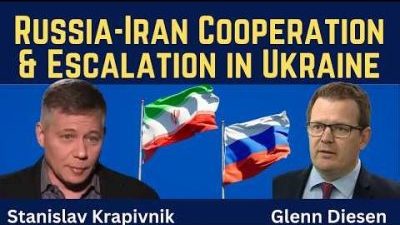
Stanislav Krapivnik: Russia-Iran Cooperation & Escalation in Ukraine
or go to
Aletho News Archives – Video-Images
Frlom the Archives
A dark page from the CIA’s history: What was Project Artichoke, launched 74 years ago?
By Erkin Oncan | Strategic Culture Foundation | August 22, 2025
One of the most useful instruments hidden behind the U.S. empire’s rhetoric of “freedom and democracy” was the Central Intelligence Agency, founded on September 18, 1947, as the successor of the Office of Strategic Services (OSS).
Since its creation, the CIA has carried out countless inhumane operations: assassinations, coups, drug trafficking, support for terrorism, conspiracies. The list of its crimes is endless. But among the darkest and most inhumane chapters of its record lie the notorious “mind control” experiments. … continue
Blog Roll
 Aletho News
- Stanislav Krapivnik: Russia-Iran Cooperation & Escalation in Ukraine
- Indonesia suspends participation in Board of Peace following attack on Iran
- ‘Operation Epic Fury’ burns an estimated $5.82 billion in just 100 hours
- Zionism’s grip over the world: From Epstein to Greater Israel
- How Israel and the FBI manipulated assassination plots to goad Trump into Iran war
- Iranian Strikes Dispel the Illusion of US Security Umbrella
- US Boasts of Destroyed Iranian Launchers Lack Credibility – Ex-DoD Official
- Europe not in position to cooperate with US and Israel against Iran
- Iran Has ‘Broken the Myth’ of Israeli Military Power: Former Pakistani Envoy
- How, and why, US data centers in the Gulf became targets of war
- If Americans Knew
- US troops were told war on Iran was ‘all part of God’s divine plan’, watchdog alleges
- Trump wants to run the show in Iran, but doesn’t know what he’s doing – Not a ceasefire Day 147
- ‘Dirty Work’ :The truth about how Israel was founded
- Mass Expulsion in Lebanon as Israel Expands War: “We Don’t Know Where to Go”
- Lies, distortions, and propaganda: how the U.S. mainstream media coverage on Iran hides the truth
- Palestinians in Gaza fear famine returning as Israel cuts off food amid Iran war
- AIPAC, other pro-Israel groups enter midterms with $100 million to spend
- Iranian girls killed by ‘double-tap’ strikes on Minab school
- Bari Weiss Is Going Full ‘Propaganda-Palooza’ With the Iran War
- Inside the Pro-Israel Campaign to Stop ‘The Voice of Hind Rajab’ From Winning an Oscar
- No Tricks Zone
- Televised! Leading German Political Candidate Tells Schoolchildren CO2 Makes Sun Hotter!
- New Study: A Century Warming Of 1.1°C Is ‘Commonplace’ And ‘Not Unusual’ During This Interglacial
- New Study: ‘Internal Noise’ And Volcanic Forcing Can Trigger 10-15°C Warming Within Decades
- Glaciers Worldwide Are Suddendly Surging, Experts Blame Warming!
- Surprising Discovery: Sahara Is Greening…Billions Of Trees Where Once Thought To Be Barren
- New Research Reaffirms Clouds, Aerosols, And Surface Solar Radiation Are ‘Driving The Climate System’
- Germany: Electric Car Catches Fire At Charging Station, Sets Off Local “Inferno”, Widespread Damage
- New Study: Canada’s New Brunswick Was 1°C Warmer Than Today During The Medieval Warm Period
- Coal Power Back In Trend As Globe Tries To Keep Pace With Growing Demand For Power
- New Study: A 4°C Warmer Beaufort Sea Had ‘No Sea Ice’ 11,700 – 8200 Years Ago
 Aletho News