Israel settlers’ month of violence against Palestinians documented
MEMO | August 9, 2019
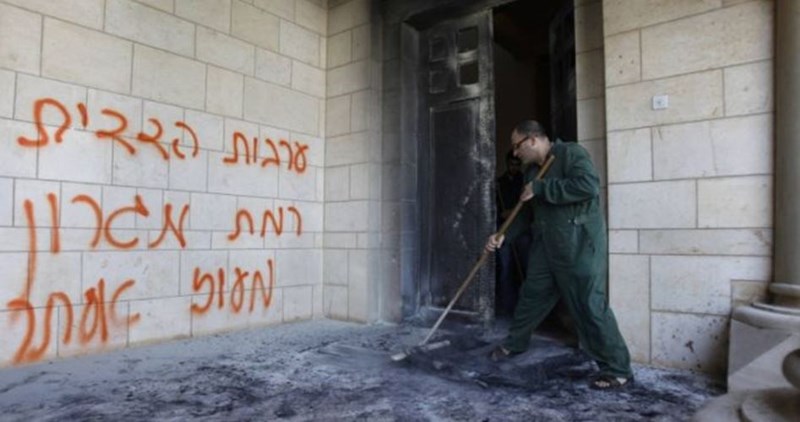
The month of June saw Israeli settler attacks against at least ten Palestinian villages in the occupied West Bank, with significant damage done to property and crops.
According to Israeli human rights organisation B’Tselem, June was yet “another month of routine settler violence fully backed by the military”.
Settlers vandalised property in ten communities across the West Bank, as well as burning some 1,800 trees and dozens of dunams of grain fields, “uprooting more than 700 vegetable seedlings and damaging at least 55 cars and spray painting hate graffiti on buildings”, stated B’Tselem.
In the Nablus area, “settlers threw stones at a family home in the village of Yasuf, shattering the windows, and punctured the family car’s tires”, while “in the village of Jalud, settlers burned more than a thousand trees in lands belonging to 21 farmers and threw stones at the school”.
Meanwhile, “in the village of Madama, settlers torched farmland and the fire spread to land belonging to the village of Burin, consuming about 180 fruit trees”, and “in the village of ‘Einabus, settlers punctured the tires of three cars and graffitied slogans on the mosque”.
In the central West Bank, settlers punctured the tyres of 22 cars in Beitin, Sinjil and Kafr Malik. In Burqah, “settlers set fire to fields and burned about 200 olive and other fruit trees”, while in Al-Mughayir, “settlers burned some fifty dunams of wheat and hay fields and some 370 olive trees”.
Other examples cited by B’Tselem include attacks by settlers in the Bethlehem region, where they “vandalised farming equipment in the village of Wadi Fukin and uprooted more than 700 saplings and four olive trees”.
According to B’Tselem, “these acts of violence, which are backed by the military, have been occurring every month for years.”
“It is part of Israel’s policy in the West Bank, and it serves the state’s agenda. The policy itself is designed to reduce Palestinian farming and gradually transfer areas that have been abandoned due to fear of violence over to settlers,” the NGO added.
“As part of this policy, and to enable these acts of violence, the authorities rarely investigate the crimes and the odds that any of the criminals would be punished for their actions are minuscule. Settlers are well aware of this fact, as are Palestinians who remain defenceless.”
US’ Greenblatt: ‘Israel is victim in conflict with Palestinians’
MEMO | July 18, 2019
The US Special Representative for International Negotiations, Jason Greenblatt, has said that Israel is the “victim” in its conflict with the Palestinians and that he “cannot think of single instances” when Israel made a mistake.
In an interview aired yesterday by US broadcaster PBS, Greenblatt was asked what responsibility Israel bears for its now 71-year-old conflict with the Palestinians. The US envoy replied:
I think that Israel is actually more the victim than the party that’s responsible. From the moment of its formation, they were attacked multiple times. They continue to be attacked with terrorism. So — I’m not sure I understand the premise of the question.
He added that he “cannot think of single instances” in which Israel made a mistake or overstepped its authority, saying: “I think that they’re trying their best to succeed. They have actually succeeded in many ways, especially economically, under very, very trying circumstances.”
Greenblatt also doubled down on previous comments in which he argued Israel’s illegal settlements should be referred to as “neighbourhoods and cities”, saying that the term “settlements” is “pejorative”.
On the occupied West Bank – where over 500 illegal settlements are located – and the besieged Gaza Strip, the envoy said: “I would argue that the land is disputed. It needs to be resolved in the context of direct negotiations between the parties. Calling it occupied territory does not help resolve the conflict.”
Under international law, both the West Bank and Gaza Strip remain classified as occupied territories.
Greenblatt’s comments are the latest in a series of controversial remarks that have drawn fierce criticism and rebuke of the US envoy.
Earlier this month, Greenblatt came under fire after criticising the Palestinian Authority (PA) for failing to provide adequate funds for a Palestinian child’s blood cancer medication. This came after Gaza-based Palestinian journalist Fathi Sabbah accused PA Prime Minister, Mohammad Shtayyeh, and Ahmed Abu Houli, a member of the executive committee of the Palestinian Liberation Organisation (PLO), of reneging on promises to assist with his daughter Rima’s treatment.
This prompted Greenblatt to write on Twitter: “Mr. Shtayyeh, how about keeping your word & paying for Rima’s treatment? The PA has the funds and it would be a wise and compassionate use of them. Mr. Sabbah, my thoughts are with you and your family. I pray Rima will have a full and speedy recovery.”
Twitter users – including Sabbah – were quick to point out the irony of Greenblatt blaming the PA for the family’s plight while ignoring Israel’s siege of the Gaza Strip, regular refusal to grant exit visas for medical treatment, and the US’ almost-unconditional support for Israel.
The US envoy – who is one of the chief architects of the US’ long-awaited “deal of the century” – has also made a number of provocative claims about Israel’s policy in the occupied West Bank.
In June, Greenblatt stood behind comments made by US Ambassador to Israel, David Friedman, in which the latter stated Israel has “the right” to annex parts of the occupied West Bank.
Friedman told the New York Times that “under certain circumstances, I think Israel has the right to retain some, but unlikely all, of the West Bank”, provoking international outcry and prompting the Palestinian Foreign Ministry to consider filing a complaint against the ambassador at the International Criminal Court (ICC).
Greenblatt backed Friedman’s stance, saying: “I will let David’s comments stand for themselves. I think he said them elegantly and I support his comments.” For his part, Friedman has also refused to back down, since claiming he does “not understand why this issue was faced with such criticism. There is no scenario in which Israel is leaving the whole West Bank.”
His comments have been interpreted as an effort to normalise discussion of Israel’s annexation of the West Bank, after Israeli Prime Minister Benjamin Netanyahu vowed ahead of the country’s April general election that he would annex the territory if he were re-elected.
Though the political elements of the “deal of the century” have not yet been unveiled, the plan is not expected to demand that Israel dismantle its West Bank settlements. Though the US has not yet changed its policy on annexation, the precedent set by President Donald Trump’s recognition of the occupied Syrian Golan Heights as Israeli could pave the way for a similar move in the West Bank.
Israeli municipality in Jerusalem names Silwan streets after rabbis
Palestine Information Center | June 21, 2019
OCCUPIED JERUSALEM – The Israeli municipality in Occupied Jerusalem has decided to name some streets in the predominantly Arab Silwan neighborhood after Jewish rabbis.
According to Haaretz, the move was against the recommendation of a professional panel who said “It is inappropriate to give Jewish street names in neighborhoods overwhelmingly populated by Arabs.”
The naming committee in the municipality, headed by Mayor Moshe Leon, named five alleyways and narrow streets in the Baten Al-Hawa neighborhood of Silwan.
The neighborhood, which is currently the home of 12 Jewish families and hundreds of Palestinian families, is targeted by extremist settler groups, including Ateret Cohanim.
Settlers claim there was a small Jewish-Yemenite community in the neighborhood 80 years ago. The newly-approved street names are “Ezrat Nidhim,” after the charitable organization founded by Yisroel Dov Frumkin in the late 19th century which established the Yemenite community.
The other streets are named after Yemenite rabbis. The decision was taken by a majority of eight to two.
The committee made the decision despite the opinion of a professional panel, who warned that the move will “create unnecessary tension. The names will not be used by residents and will therefore be futile.” The committee recommended neutral street names which will benefit all residents.
The two committee members opposing the decision are city coalition members Laura Wharton and Yossi Havilio. Havilio said he firmly opposes as the move, adding that it provokes Arab residents and will inflame the atmosphere in the neighborhood.
UN Rapporteur: Canada’s trade agreement with Israel violates international law
![Michael Lynk, Special Rapporteur on the situation of human rights in the Palestinian territories occupied Michael Lynk [Alhadath24/Facebook]](https://i1.wp.com/www.middleeastmonitor.com/wp-content/uploads/2017/03/2017_3_21-Michael-Lynk.jpg?resize=1200%2C800&quality=75&strip=all&ssl=1)
Michael Lynk, Special Rapporteur on the situation of human rights in the Palestinian territories occupied Michael Lynk [Alhadath24/Facebook]
MEMO | May 31, 2019
Canada’s updated trade agreement with Israel violates international law, the UN Special Rapporteur for the [occupied] Palestinian territories, Professor S. Michael Lynk, has said in an article published by the Australian news site, The Conversation.
Commenting on legislation known as Bill C-85 — the Canada-Israel Free Trade Agreement Implementation Act — which received royal assent on Monday, Lynk said that it lacks “a human rights provision, which would commit both parties to uphold international human rights and humanitarian law.” The Act also allows goods and services originating on illegal Israeli settlements to enter Canada without any tariffs. These “glaring” omissions, said Lynk, not only violate international law but also Canadian law.
The article, which was co-written with Alex Neve, the Secretary General of Amnesty International Canada, explained that Canadian foreign policy and Ottawa’s own legislation “has long recognised the Israeli settlements as illegal under the Fourth Geneva Convention.”
According to the authors, “The 1957 Geneva Conventions Act commits Canada to respect the strict obligations of the convention, including the prohibition against civilian settlements in occupied territory. And the 2000 Crimes Against Humanity and War Crimes Act designates civilian settlements in occupied territory as a war crime.”
Clarifying their position further, they cite the UN Human Rights Council, which in 2016 urged all states to ensure that: “They are not taking actions that either recognise or assist the expansion of [Israeli] settlements… in the Occupied Palestinian Territory, including East Jerusalem, including with regard to the issue of trading with settlements, consistent with their obligations under international law.”
They also cite a number of UN Resolutions, including Security Council Resolution 2334 which states that the Israeli settlements are “a flagrant violation under international law and a major obstacle to the achievement of a two-state solution and a just, lasting and comprehensive peace.”
Lynk pointed out that while Israel denies that it is an occupying power, there is in fact “a virtual wall-to-wall consensus among the international community — including the United Nations, the European Union, the International Court of Justice, the International Committee of the Red Cross and Canada — that the laws of occupation, including the Fourth Geneva Convention of 1949, apply in full to the Palestinian territory.”
The authors state that the Bill “makes no distinction between Israel and its illegal settlements in the Palestinian territory and it provides encouragement to the economic growth of the settlements by allowing their goods and services to enter Canada tariff-free.”
In conclusion, Lynk and Neve say that the Bill “entangles Canada in the serious violations of both international human rights and humanitarian law that are part and parcel of the Israeli occupation.”
READ ALSO:
Canada court hears lawsuit challenging Israel settlement wine labels
Israel government to fund hotels in illegal West Bank settlements
MEMO | April 30, 2019
The Israeli government will subsidise hotels in illegal settlements in the occupied West Bank, as part of a plan to attract more tourists to the area.
According to an article in Arutz Sheva, citing a report by Israel Hayom, Israel’s Tourism Ministry “will aid entrepreneurs who want to invest in building or expanding hotels in Judea and Samaria [the occupied West Bank]”.
The entrepreneurs can now apply for a grant of up to 20 per cent of their intended investment.
Israel Hayom reported that a meeting held earlier this year between senior settler officials and the managers of Israeli travel agencies in the occupied West Bank “showed that the number of guest units is insufficient, causing tourists to avoid staying in the area for more than a day”.
According to the report, the government grants “are intended to encourage investors to open additional guest units in [illegal settlements in] Judea, Samaria, and the Jordan Valley [the occupied West Bank]”.
Settler leader (Yesha Council chair) Hananel Dorani stated: “We thank [Tourism] Minister Yariv Levin (Likud) for his important work on the issue of tourism in Judea, Samaria, and the Jordan Valley.”
“Building hotels and guest houses in the area is an important step which shows the deepening of our roots in the ground and paves the way for Israeli sovereignty in Judea and Samaria,” he added.
“Giving grants for the creation of hotels is another supplemental step which will help solve the problem of where to sleep and will strengthen settlements and our hold on Judea and Samaria.”
Israel confiscates 51,000 dunams from Jordan Valley

Ma’an – April 16, 2019
TUBAS – The Israeli authorities confiscated 51,000 dunams and isolated five villages in the Jordan Valley area in the northern occupied West Bank, an official in charge of Jordan Valley’s Israeli settlements file at the Palestinian Authority (PA) reported.
Mutaz Bisharat told the Voice of Palestine radio station that the Israeli authorities confiscated 51,000 dunams, isolated 5 villages and seized control over water springs, agricultural machinery and solar cells.
Bisharat added that the Israeli policy is very clear in isolating villages of the Tubas district, pointing out that these areas were marked as closed military areas banning their owners from entering without an Israeli-issued permit.
He stressed that Israel aims to expel Palestinians from the area under its plan to seize the Jordan Valley area.
The Jordan Valley forms a third of the occupied West Bank, with 88 percent of its land classified as Area C — under full Israeli military control.
International rights organizations consider the continuation of the Israeli campaign which targets Palestinians in the Jordan Valley, whether though confiscations, demolitions or evictions under the pretext of holding military exercises, as a violation of international humanitarian law.
Since the beginning of the 1967 occupation of the West Bank, Israel has confiscated hundreds of thousands of dunums by declaring it state land.
Israeli authorities in 1968 banned Palestinians from registering their lands and subsequently took advantage of previously low rates of land registration to confiscate areas currently or previously in use by locals but not registered as such.
The confiscated lands are then used to construct Jewish-only settlements on the land, while further confiscation often uses the pretext of the settlements’ security.
Once Again, the UN has failed to Name Firms that Profit from Israel’s Illegal Settlements
By Jonathan Cook – The National – March 11, 2019
The United Nations postponed last week for the third time the publication of a blacklist of Israeli and international firms that profit directly from Israel’s illegal settlements in the occupied territories.
The international body had come under enormous pressure to keep the database under wraps after lobbying behind the scenes from Israel, the United States and many of the 200-plus companies that were about to be named.
UN officials have suggested they may go public with the list in a few months.
But with no progress since the UN’s Human Rights Council requested the database back in early 2016, Palestinian leaders are increasingly fearful that it has been permanently shelved.
That was exactly what Israel hoped for. When efforts were first made to publish the list in 2017, Danny Danon, Israel’s ambassador to the UN, warned: “We will do everything we can to ensure that this list does not see the light of day.”
He added that penalising the settlements was “an expression of modern antisemitism”.
Both Israel and the US pulled out of the Human Rights Council last year, claiming that Israel was being singled out.
Israel has good reason to fear greater transparency. Bad publicity would most likely drive many of these firms, a few of them household names, out of the settlements under threat of a consumer backlash and a withdrawal of investments by religious organisations and pension funds.
The UN has reportedly already warned Coca-Cola, Teva Pharmaceuticals, the defence electronics company Elbit Systems and Africa Israel Investments of their likely inclusion. Israeli telecoms and utility companies are particularly exposed because grids serving the settlements are integrated with those in Israel.
There is an added danger that the firms might be vulnerable to prosecutions, should the International Criminal Court at The Hague eventually open an investigation into whether the settlements constitute a war crime, as the Palestinian leadership has demanded.
The exodus of these firms from the West Bank would, in turn, make it much harder for Israel to sustain its colonies on stolen Palestinian land. As a result, efforts to advance a Palestinian state would be strengthened.
Many of the settlements – contrary to widely held impressions of them – have grown into large towns. Their inhabitants expect all the comforts of modern life, from local bank branches to fast-food restaurants and high-street clothing chains.
Nowadays, a significant proportion of Israel’s 750,000 settlers barely understand that their communities violate international law.
The settlements are also gradually being integrated into the global economy, as was highlighted by a row late last year when Airbnb, an accommodation-bookings website, announced a plan to de-list properties in West Bank settlements.
The company was possibly seeking to avoid inclusion on the database, but instead it faced a severe backlash from Israel’s supporters.
This month the US state of Texas approved a ban on all contracts with Airbnb, arguing that the online company’s action was “antisemitic”.
As both sides understand, a lot hangs on the blacklist being made public.
If Israel and the US succeed, and western corporations are left free to ignore the Palestinians’ dispossession and suffering, the settlements will sink their roots even deeper into the West Bank. Israel’s occupation will become ever more irreversible, and the prospect of a Palestinian state ever more distant.
A 2013 report on the ties between big business and the settlements noted the impact on the rights of Palestinians was “pervasive and devastating”.
Sadly, the UN leadership’s cowardice on what should be a straightforward matter – the settlements violate international law, and firms should not assist in such criminal enterprises – is part of a pattern.
Repeatedly, Israel has exerted great pressure on the UN to keep its army off a “shame list” of serious violators of children’s rights. Israel even avoided a listing in 2015 following its 50-day attack on Gaza the previous year, which left more than 500 Palestinian children dead. Dozens of armies and militias are named each year.
The Hague court has also been dragging its feet for years over whether to open a proper war crimes investigation into Israel’s actions in Gaza, as well as the settlements.
The battle to hold Israel to account is likely to rage again this year, after the publication last month of a damning report by UN legal experts into the killing of Palestinian protesters at Gaza’s perimeter fence by Israeli snipers.
Conditions for Gaza’s two million Palestinians have grown dire since Israel imposed a blockade, preventing movement of goods and people, more than a decade ago.
The UN report found that nearly all of those killed by the snipers – 154 out of 183 – were unarmed. Some 35 Palestinian children were among the dead, and of the 6,000 wounded more than 900 were minors. Other casualties included journalists, medical personnel and people with disabilities.
The legal experts concluded that there was evidence of war crimes. Any identifiable commanders and snipers, it added, should face arrest if they visited UN member states.
Israel’s prime minister Benjamin Netanyahu, however, dismissed the report as “lies” born out of “an obsessive hatred of Israel”.
Certainly, it has caused few ripples in western capitals. Britain’s opposition leader Jeremy Corbyn was a lone voice in calling for an arms embargo on Israel in response.
It is this Israeli exceptionalism that is so striking. The more violent Israel becomes towards the Palestinians and the more intransigent in rejecting peace, the less pressure is exerted upon it.
Not only does Israel continue to enjoy generous financial, military and diplomatic support from the US and Europe, both are working ever harder to silence criticisms of its actions by their own citizens.
As the international boycott, divestment and sanctions movement grows larger, western capitals have casually thrown aside commitments to free speech in a bid to crush it.
France has already criminalised support for a boycott of Israel, and its president Emmanuel Macron recently proposed making it illegal to criticise Zionism, the ideology that underpins Israel’s rule over Palestinians.
More than two dozen US states have passed anti-BDS legislation, denying companies and individual contractors dealing with the government of that particular state the right to boycott Israel. In every case, Israel is the only country protected by these laws. Last month, the US Senate passed a bill that adds federal weight to this state-level campaign of intimidation.
The hypocrisy of these states – urging peace in the region while doing their best to subvert it – is clear. Now the danger is that UN leaders will join them.
Israel cuts off water supply for 2600 Palestinians in Jordan Valley
Ma’an – March 6, 2019
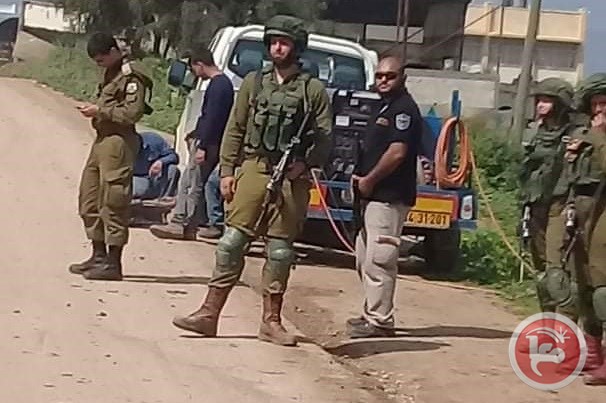
Israeli forces and the Israeli Civil Administration cut off water supply for dozens of Palestinians living in communities in Bardala village in the Jordan Valley in the northern occupied West Bank, on Wednesday.
Mutaz Bisharat, an official who monitors settlement activity in Tubas/Jordan Valley, told Ma’an that Israeli forces cut off water supply for 60% of residents of the Bardala village; that is 2600 people.
Israeli forces also cut off water supply for 1800-2000 dunams of Palestinian agricultural lands that must be continuously irrigated.
Bisharat added that Israel claims that water sources supplying residents with water are illegal, stressing that the water comes from water wells in the village and inside Palestinian lands.
He pointed out that as Israeli forces cut off water supply for Palestinians, they construct water wells for Israeli settlers.
Bisharat called upon international and humanitarian institutions to immediately intervene to stop Israeli violations of human rights.
The Jordan Valley forms a third of the occupied West Bank, with 88 percent of its land classified as Area C — under full Israeli military control.
Water allocations are very necessary for the increase of agricultural production, in order to support the economic growth of many Palestinian farmers.
Jordan Valley residents mostly live in enclaves closed off by Israeli military zones, checkpoints, and more than 30 illegal Israeli settlements.
How the rule of the rabbis is fuelling a holy war in Israel
By Jonathon Cook | February 13, 2019
In which country did a senior, state-salaried cleric urge his followers last month to become “warriors”, emulating a group of young men who had murdered a woman of another faith?
The cleric did so with impunity. In fact, he was only echoing other highly placed colleagues who have endorsed a book – again without penalty – urging their disciples to murder babies belonging to other religions.
Where can the head of the clergy call black people “monkeys” and urge the expulsion of other religious communities?
Where does a clerical elite wield so much power that they alone decide who can marry or get divorced – and are backed by a law that can jail someone who tries to wed without their approval? They can even shut down the national railway system without notice.
Where are these holy men so feared that women are scrubbed from billboards, college campuses introduce gender segregation to appease them, and women find themselves literally pushed to the back of the bus?
Is the country Saudi Arabia? Or Myanmar? Or perhaps, Iran?
No. It is Israel, the world’s only self-declared Jewish state.
Which ‘shared values’?
There is barely a politician in Washington seeking election who has not at some point declared an “unbreakable bond” between the United States and Israel, or claimed the two uphold “shared values”. Few, it seems, have any idea what values Israel really represents.
There are many grounds for criticising Israel, including its brutal oppression of Palestinians under occupation and its system of institutionalised segregation and discrimination against the fifth of its population who are not Jewish – its Palestinian minority.
But largely ignored by critics have been Israel’s increasing theocratic tendencies.
This hasn’t simply proved regressive for Israel’s Jewish population, especially women, as the rabbis exert ever greater control over the lives of religious and secular Jews alike.
It also has alarming implications for Palestinians, both under occupation and those living in Israel, as a national conflict with familiar colonial origins is gradually transformed into a holy war, fuelled by extremist rabbis with the state’s implicit blessing.
Control of personal status
Despite Israel’s founding fathers being avowedly secular, the separation between church and state in Israel has always been flimsy at best – and it is now breaking down at an ever-accelerating rate.
After Israel’s establishment, David Ben Gurion, Israel’s first prime minister, decided to subordinate important areas of life for Israeli Jews to the jurisdiction of an Orthodox rabbinate, representing the strictest, most traditional and conservative stream of Judaism. Other, more liberal streams have no official standing in Israel to this day.
Ben Gurion’s decision in part reflected a desire to ensure his new state embraced two differing conceptions of Jewishness: both those who identified as Jews in a secular ethnic or cultural sense, and those who maintained the religious traditions of Judaism. He hoped to fuse the two into a new notion of a Jewish “nationality”.
For that reason, the Orthodox rabbis were given exclusive control over important parts of the public sphere – personal status matters, such as conversions, births, deaths and marriages.
Biblical justifications
Bolstering the rabbis’ power was the urgent need of Israel’s secular leaders to obscure the state’s settler-colonial origins. This could be achieved by using education to emphasise Biblical justifications for the usurpation by Jews of the lands of the native Palestinian population.
As the late peace activist Uri Avnery observed, the Zionist claim was “based on the Biblical history of the Exodus, the conquest of Canaan, the kingdoms of Saul, David and Solomon … Israeli schools teach the Bible as real history.”
Such indoctrination, combined with a much higher birth rate among religious Jews, has contributed to an explosion in the numbers identifying as religious. They now comprise half the population.
Today, about a quarter of Israeli Jews belong to the Orthodox stream, which reads the Torah literally, and one in seven belong to the ultra-Orthodox, or Haredim, the most fundamentalist of the Jewish religious streams. Forecasts suggest that in 40 years the latter will comprise a third of the country’s Jewish population.
‘Conquer the government’
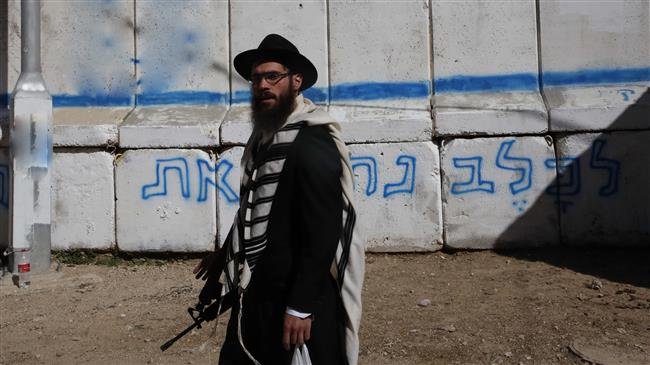
Both the growing power and extremism of the Orthodox in Israel was highlighted in the last week of January when one of their most influential rabbis, Shmuel Eliyahu, publicly came to the defence of five students accused of murdering Aisha Rabi, a Palestinian mother of eight. Back in October they stoned her car near Nablus, in the occupied West Bank, forcing her off the road.
Eliyahu is the son of a former chief rabbi of Israel, Mordechai Eliyahu, and himself sits on the Chief Rabbinical Council, which controls many areas of life for Israelis. He is also the municipal rabbi of Safed, a city that in Judaism has the equivalent status of Medina in Islam or Bethlehem in Christianity, so his words carry a great deal of weight with Orthodox Jews.
Last month, a video came to light of a talk he gave at the seminary where the five accused studied, in the illegal settlement of Rehelim, south of Nablus.
Eliyahu not only praised the five as “warriors” but told fellow students that they needed to overthrow the “rotten” secular court system. He told them it was vital to “conquer the government” too, but without guns or tanks. “You have to take the state’s key positions,” he urged them.
Law-breaking judges
In truth, that process is already well-advanced.
Justice Minister Ayelet Shaked, who should have been the first to denounce Eliyahu’s comments, is closely aligned with religious settlers. Tellingly, she and other government ministers have maintained a studious silence.
That is because the political representatives of Israel’s religious Jewish communities, including the settlers, have now become the lynchpin of Israeli coalition governments. They are the kingmakers and can extract enormous concessions from other parties.
For some time, Shaked has been using her position to bring more openly nationalistic and religious judges into the legal system, including to the highest court in the land, the Supreme Court.
Two of its current 15 judges, Noam Sohlberg and David Mintz, are law-breakers, openly living in West Bank settlements in violation of international law. Several more judges appointed to the bench by Shaked are religious and conservative.
This is a significant victory for the Orthodox religious and the settlers. The court is the last line of defence for the secular against an assault on their religious freedoms and on gender equality.
And the court offers the only recourse for Palestinians seeking to mitigate the worst excesses of the violent and discriminatory policies of the Israeli government, army and settlers.
Chosen people
Shaked’s colleague, Naftali Bennett, another ideologue of the settlement movement, has been education minister in the Netanyahu government for four years. This post has long been a critical one for the Orthodox because it shapes Israel’s next generation.
After decades of concessions to the rabbis, Israel’s school system is already heavily skewed towards religion. A survey in 2016 showed 51 percent of Jewish pupils attended sex-segregated religious schools, which emphasise Biblical dogma – up from 33 percent only 15 years earlier.
This may explain why a recent poll found that 51 percent believe Jews have a divine right to the land of Israel, and slightly more – 56 percent – believe that Jews are a “chosen people”.
Those results are likely to get even worse in the coming years. Bennett has been placing much greater weight in the curriculum on Jewish tribal identity, Bible studies and religious claims to Greater Israel, including to the Palestinian territories – which he wants to annex.
Conversely, science and maths are increasingly downplayed in the education system, and entirely absent from schools for the ultra-Orthodox. Evolution, for example, has been mostly erased from the syllabus, even in secular schools.
‘No mercy’ to Palestinians
Another key sphere of state power being taken over by the religious, and especially the settlers, are the security services. Police Commissioner Roni Alsheikh lived for years in a settlement renowned for its violent attacks on Palestinians, and the force’s current chief rabbi, Rahamim Brachyahu, is also a settler.
Both have actively promoted a programme, Believers in the Police, that recruits more religious Jews into the police force. Nahi Eyal, the programme’s founder, has said his aim is to help the settler community “find our way into the command ranks”.
The trend is even more entrenched in the Israeli military. Figures show that the national-religious community, to which settlers belong – though only 10 percent of the population – make up half of all new officer cadets. Half of Israel’s military academies are now religious.
That has translated into an increasing role for extremist Orthodox rabbis in motivating soldiers on the battlefield. In Israel’s 2008-09 ground invasion of Gaza, soldiers were issued with pamphlets by the army rabbinate using Biblical injunctions to persuade them to “show no mercy” to Palestinians.
Call to kill babies
Meanwhile, the rapidly growing ultra-Orthodox population has been encouraged by the government to move into West Bank settlements purpose-built for them, such as Modi’in Illit and Beitar Illit. That, in turn, is gradually fuelling the emergence of an aggressive nationalism among their youth.
Once the Haredim were openly hostile, or at best ambivalent, towards Israeli state institutions, believing that a Jewish state was sacrilegious until the Messiah arrived to rule over Jews.
Now, for the first time, young Haredim are serving in the Israeli army, adding to the pressure on the military command to accommodate their religious fundamentalist ideology. A new term for these hawkish Haredi soldiers has been coined: they are known as the “Hardal”.
Brachyahu and rabbis for the Hardal are among the senior rabbis who have endorsed a terrifying book, the King’s Torah, written by two settler rabbis, that urges Jews to treat non-Jews, and specifically Palestinians, mercilessly.
It offers God’s blessing for Jewish terror – not only against Palestinians who try to resist their displacement by settlers, but against all Palestinians, even babies, on the principle that “it is clear that they will grow [up] to harm us.”
Gender segregation expands
The dramatic rise in religiosity is creating internal problems for Israeli society too, especially for the shrinking secular population and for women.
Posters for the forthcoming election – as with adverts more generally – are being “cleaned” of women’s faces in parts of the country to avoid causing offence.
Last month, the Supreme Court criticised Israel’s Council for Higher Education for allowing segregation between men and women in college classrooms to spread to the rest of the campus, including libraries and communal areas. Female students and lecturers are facing “modesty” dress codes.
The council has even announced that it intends to expand segregation because it is proving difficult to persuade religious Jews to attend higher education.
Violence of the mob
Israel has always been a society deeply structured to keep Israeli Jews and Palestinians apart, both physically and in terms of rights. That is equally true for Israel’s large Palestinian minority, a fifth of the population, who live almost entirely apart from Jews in segregated communities. Their children are kept away from Jewish children in separate schools.
But the greater emphasis in Israel on a religious definition of Jewishness means that Palestinians now face not only the cold structural violence designed by Israel’s secular founders, but additionally a hot-tempered, Biblically sanctioned hostility from religious extremists.
That is most keenly evident in the rapid rise of physical assaults on Palestinians and their property, as well as their holy places, in Israel and the occupied territories. Among Israelis, this violence is legitimised as “price tag” attacks, as though Palestinians have brought such harm on themselves.
YouTube is now full of videos of gun- or baton-wielding settlers attacking Palestinians, typically as they try to access their olive groves or springs, while Israeli soldiers stand passively by or assist.
Arson attacks have spread from olive groves to Palestinian homes, sometimes with horrifying results, as families are burned alive.
Rabbis such as Eliyahu have stoked this new wave of attacks with their Biblical justifications. State terrorism and mob violence have merged.
Destroying al-Aqsa
The biggest potential flashpoint is in occupied East Jerusalem, where the growing symbolic and political power of these Messianic rabbis risks exploding at the al-Aqsa Mosque compound.
Secular politicians have long played with fire at this Islamic holy site, using archaeological claims to try to convert it into a symbol of historic Jewish entitlement to the land, including the occupied territories.
But their claim that the mosque is built over two Jewish temples, the last of which was destroyed two millennia ago, has been rapidly reconfigured for incendiary, modern political purposes.
The growing influence of religious Jews in parliament, the government, the courts and the security services means that officials grow ever bolder in staking a physical claim to sovereignty over al-Aqsa.
It also entails an ever greater indulgence towards religious extremists who demand more than physical control over the mosque site. They want al-Aqsa destroyed and replaced with a Third Temple.
The gathering holy war
Slowly, Israel is transforming a settler-colonial project against the Palestinians into a battle with the wider Islamic world. It is turning a territorial conflict into a holy war.
The demographic growth of Israel’s religious population, the cultivation by the school system of an ever-more extreme ideology based on the Bible, the takeover of the state’s key power centres by the religious, and the emergence of a class of influential rabbis who preach genocide against Israel’s neighbours has set the stage for a perfect storm in the region.
The question now is at what point will Israel’s allies, in the US and Europe, finally wake up to the catastrophic direction Israel is heading in – and find the will to take the necessary action to stop it.
In Hebron, Israel Removes the Last Restraint on Its Settlers’ Reign of Terror
By Jonathan Cook | The National | February 13, 2019
You might imagine that a report by a multinational observer force documenting a 20-year reign of terror by Israeli soldiers and Jewish settlers against Palestinians, in a city under occupation, would provoke condemnation from European and US politicians.
But you would be wrong. The leaking in December of the report on conditions in the city of Hebron, home to 200,000 Palestinians, barely caused a ripple.
About 40,000 separate cases of abuse had been quietly recorded since 1997 by dozens of monitors from Sweden, Norway, Switzerland, Italy and Turkey. Some incidents constituted war crimes.
Exposure of the confidential report has now provided the pretext for Israeli prime minister Benjamin Netanyahu to expel the international observers. He shuttered their mission in Hebron this month, in apparent violation of Israel’s obligations under the 25-year-old Oslo peace accords.
Israel hopes once again to draw a veil over its violent colonisation of the heart of the West Bank’s largest Palestinian city. The process of clearing tens of thousands of inhabitants from central Hebron is already well advanced.
Any chance of rousing the international community into even minimal protest was stamped out by the US last week. It blocked a draft resolution at the United Nations Security Council expressing “regret” at Israel’s decision, and on Friday added that ending the mandate of the Temporary International Presence in Hebron (TIPH) was an “internal matter” for Israel.
The TIPH was established in 1997 after a diplomatic protocol split the city into two zones, controlled separately by Israel and a Palestinian Authority created by the Oslo accords.
The “temporary” in its name was a reference to the expected five-year duration of the Oslo process. The need for TIPH, most assumed, would vanish when Israel ended the occupation and a Palestinian state was built in its place.
While Oslo put the PA formally in charge of densely populated regions of the occupied territories, Israel was effectively given a free hand in Hebron to entrench its belligerent hold on Palestinian life.
Several hundred extremist Jewish settlers have gradually expanded their illegal enclave in the city centre, backed by more than 1,000 Israeli soldiers. Many Palestinian residents have been forced out while the rest are all but imprisoned in their homes.
TIPH faced an impossible task from the outset: to “maintain normal life” for Hebron’s Palestinians in the face of Israel’s structural violence.
Until the report was leaked, its documentation of Israel’s takeover of Hebron and the settlers’ violent attacks had remained private, shared only among the states participating in the task force.
However, the presence of observers did curb the settlers’ worst excesses, helping Palestinian children get to school unharmed and allowing their parents to venture out to work and shop. That assistance is now at an end.
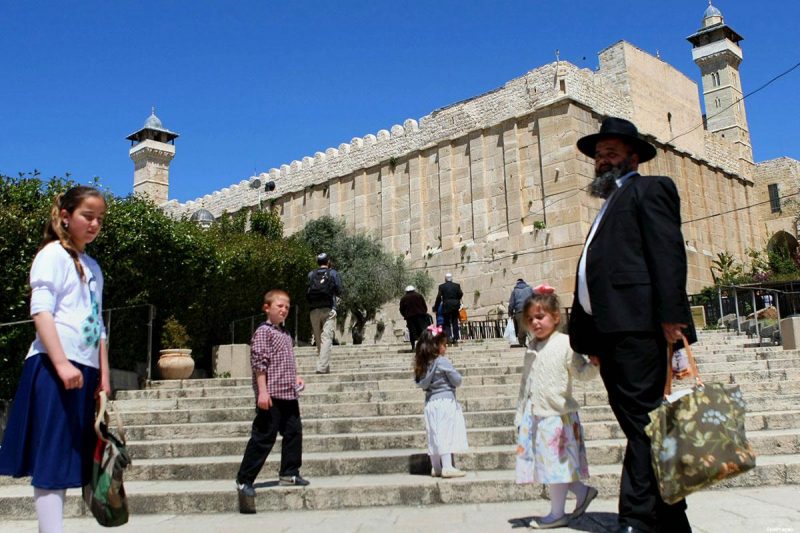
Hebron has been a magnet for extremist settlers because it includes a site revered in Judaism: the reputed burial plot of Abraham, father to the three main monotheistic religions.
But to the settlers’ disgruntlement, Hebron became central to Muslim worship centuries ago, with the Ibrahimi mosque established at the site.
Israel’s policy has been gradually to prise away the Palestinians’ hold on the mosque, as well the urban space around it. Half of the building has been restricted to Jewish prayer, but in practice the entire site is under Israeli military control.
As the TIPH report notes, Palestinian Muslims must now pass through several checkpoints to reach the mosque and are subjected to invasive body searches. The muezzin’s call to prayer is regularly silenced to avoid disturbing Jews.
Faced with these pressures, according to TIPH, the number of Palestinians praying there has dropped by half over the past 15 years.
In Hebron, as at Al Aqsa mosque in Jerusalem, a Muslim holy site is treated solely as an obstacle – one that must be removed so that Israel can assert exclusive sovereignty over all of the Palestinians’ former homeland.
A forerunner of TIPH was set up in 1994, shortly after Baruch Goldstein, an Israeli army doctor, entered the Ibrahimi mosque and shot more than 150 Muslims at prayer, killing 29. Israeli soldiers aided Goldstein, inadvertently or otherwise, by barring the worshippers’ escape while they were being sprayed with bullets.
The massacre should have provided the opportunity for Yitzhak Rabin, Israel’s prime minister of the time, to banish Hebron’s settlers and ensure the Oslo process remained on track. Instead he put the Palestinian population under prolonged curfew.
That curfew never really ended. It became the basis of an apartheid policy that has endlessly indulged Jewish settlers as they harass and abuse their Palestinian neighbours.
Israel’s hope is that most will get the message and leave.
With Israeli Prime Minister Benjamin Netanyahu in power for a decade, more settlers are moving in, driving out Palestinians. Today Hebron’s old market, once the commercial hub of the southern West Bank, is a ghost town, and Palestinians are too terrified to enter large sections of their own city.
TIPH’s report concluded that, far from guaranteeing “normal life”, Israel had made Hebron more divided and dangerous for Palestinians than ever before.
In 2016 another army medic, Elor Azaria, used his rifle to shoot in the head a prone and badly wounded Palestinian youth. Unlike Goldstein’s massacre, the incident was caught on video.
Israelis barely cared until Azaria was arrested. Then large sections of the public, joined by politicians, rallied to his cause, hailing him a hero.
Despite doing very little publicly, TIPH’s presence in Hebron had served as some kind of restraint on the settlers and soldiers. Now the fear is that there will be more Azarias.
Palestinians rightly suspect that the expulsion of the observer force is the latest move in efforts by Israel and the US to weaken mechanisms for protecting Palestinian human rights.
Mr Netanyahu has incited against local and international human rights organisations constantly, accusing them of being foreign agents and making it ever harder for them to operate effectively.
And last year US President Donald Trump cut all aid to UNRWA, the United Nations’ refugee agency, which plays a vital role in caring for Palestinians and upholding their right to return to their former lands.
Not only are the institutions Palestinians rely on for support being dismembered but so now are the organisations that record the crimes Israel has been committing.
That, Israel hopes, will ensure that an international observer post which has long had no teeth will soon will soon lose its sight too as Israel begins a process of annexing the most prized areas of the West Bank – with Hebron top of the list.
Israeli Settler Drives into Sheep near Ramallah, Kills 12
IMEMC News & Agencies – January 1, 2019
 In what appears as a premeditated terror attack, an Israeli settler rammed his vehicle into a herd of sheep in the village of al-Mughayyer, to the east of Ramallah, on Monday, killing 12 and injuring 18 others.
Local sources told WAFA correspondence that the settler rammed into the herd on purpose and with full force, to cause as much damage as possible. They said he ran over 30 sheep, killing 12 and injuring the others, of which six were in critical condition.
The attack happened on what is known as Alon settlement road.
Raising sheep is the only source of income for Khaled Abu Illia, victim of the premeditated terror attack.
Shepherds are often seen in the open pastures during this season, when the fields are covered with green grass.
Featured Video
MIT Prof Ted Postol: U.S. Iran Missile War
or go to
Aletho News Archives – Video-Images
Frlom the Archives
A dark page from the CIA’s history: What was Project Artichoke, launched 74 years ago?
By Erkin Oncan | Strategic Culture Foundation | August 22, 2025
One of the most useful instruments hidden behind the U.S. empire’s rhetoric of “freedom and democracy” was the Central Intelligence Agency, founded on September 18, 1947, as the successor of the Office of Strategic Services (OSS).
Since its creation, the CIA has carried out countless inhumane operations: assassinations, coups, drug trafficking, support for terrorism, conspiracies. The list of its crimes is endless. But among the darkest and most inhumane chapters of its record lie the notorious “mind control” experiments. … continue
Blog Roll
 Aletho News
- Indonesia suspends participation in Board of Peace following attack on Iran
- ‘Operation Epic Fury’ burns an estimated $5.82 billion in just 100 hours
- Zionism’s grip over the world: From Epstein to Greater Israel
- How Israel and the FBI manipulated assassination plots to goad Trump into Iran war
- Iranian Strikes Dispel the Illusion of US Security Umbrella
- US Boasts of Destroyed Iranian Launchers Lack Credibility – Ex-DoD Official
- Europe not in position to cooperate with US and Israel against Iran
- Iran Has ‘Broken the Myth’ of Israeli Military Power: Former Pakistani Envoy
- How, and why, US data centers in the Gulf became targets of war
- The General who swallowed his truth
- If Americans Knew
- US troops were told war on Iran was ‘all part of God’s divine plan’, watchdog alleges
- Trump wants to run the show in Iran, but doesn’t know what he’s doing – Not a ceasefire Day 147
- ‘Dirty Work’ :The truth about how Israel was founded
- Mass Expulsion in Lebanon as Israel Expands War: “We Don’t Know Where to Go”
- Lies, distortions, and propaganda: how the U.S. mainstream media coverage on Iran hides the truth
- Palestinians in Gaza fear famine returning as Israel cuts off food amid Iran war
- AIPAC, other pro-Israel groups enter midterms with $100 million to spend
- Iranian girls killed by ‘double-tap’ strikes on Minab school
- Bari Weiss Is Going Full ‘Propaganda-Palooza’ With the Iran War
- Inside the Pro-Israel Campaign to Stop ‘The Voice of Hind Rajab’ From Winning an Oscar
- No Tricks Zone
- Televised! Leading German Political Candidate Tells Schoolchildren CO2 Makes Sun Hotter!
- New Study: A Century Warming Of 1.1°C Is ‘Commonplace’ And ‘Not Unusual’ During This Interglacial
- New Study: ‘Internal Noise’ And Volcanic Forcing Can Trigger 10-15°C Warming Within Decades
- Glaciers Worldwide Are Suddendly Surging, Experts Blame Warming!
- Surprising Discovery: Sahara Is Greening…Billions Of Trees Where Once Thought To Be Barren
- New Research Reaffirms Clouds, Aerosols, And Surface Solar Radiation Are ‘Driving The Climate System’
- Germany: Electric Car Catches Fire At Charging Station, Sets Off Local “Inferno”, Widespread Damage
- New Study: Canada’s New Brunswick Was 1°C Warmer Than Today During The Medieval Warm Period
- Coal Power Back In Trend As Globe Tries To Keep Pace With Growing Demand For Power
- New Study: A 4°C Warmer Beaufort Sea Had ‘No Sea Ice’ 11,700 – 8200 Years Ago
 Aletho News