U.S. Human Radiation Experiments Covered up by Public Broadcasting

By William Boardman | Reader Supported News | January 8, 2014
The bomb will not start a chain reaction in the water, converting it all to gas and letting all the ships on all the oceans drop down to the bottom. It will not blow out the bottom of the sea and let all the water run down the hole. It will not destroy gravity. I am not an atomic playboy.
– Vice Admiral William P. Blandy, Bikini bomb test commander, July 25, 1946
When the military scientists of an advanced technological nation deliberately explode their largest nuclear bomb (and 66 others) over Pacific islands and use the opportunities to study the effects of radiation on nearby native people, which group is best described as “savage”? And what should you call the people who prevent a documentary about these American post-war crimes from reaching a wide audience in the United States?
Nuclear Savage is a recent documentary film that explores American nuclear weapons testing in the Marshall Islands, 1946-1958, and particularly the secret Project 4.1: an American experiment in exposing Pacific Islanders to overdoses of radiation – deliberate human radiation poisoning – just to get better data on this method of maiming and killing people. The public broadcasting establishment has spent more that two years keeping this story off the air.
The preview reel of Nuclear Savage includes a clip with a stentorian newsreel announcer reporting on the American treatment of Marshall Islanders in April 1957, and explaining to his predominantly American audience:
The Marshallese caught by fallout got 175 roentgens of radiation. These are fishing people, savages by our standards, so a cross-section was brought to Chicago for testing. The first was John, the mayor of Rongelap Atoll…. John, as we said, is a savage, but a happy, amenable savage.
So how serious is 175 roentgens (assuming the measurement is accurate)? In 1950, the International Commission on Radiological Protection (ICRP) recommended that human radiation contact should not exceed 0.3 roentgen per week for whole-body exposure [“roentgen” as a measure of radiation dose has since been replaced by “rem” (for “roentgen equivalent man”)]. It’s not clear how long the Marshallese were exposed to radiation levels of 175 roentgens – or on how many occasions – but that amount was more than 580 times what was then considered a safe weekly exposure.
Public broadcasting paid for this film – and is now suppressing it
In 2005, director Adam Horowitz started work on Nuclear Savage, his second documentary about the American military use and abuse of the Marshall Islands. Horowitz has a contract with Pacific Islanders in Communications (PIC), which describes itself as “a national non-profit media arts organization” whose mission “is to support, advance and develop programming that enhances public recognition of and appreciation for Pacific Islander history, culture, and society. In keeping with the mission, PIC provides funding for new programs primarily for public television. We work with independent producers to create and distribute programs about Pacific Islanders that bring new audiences to public television, advance issues and represent diverse voices and points of view not usually seen on public or commercial television.”
Among its efforts to carry out this mission, PIC supported the production of Nuclear Savage with $100,000 passed through to Horowitz from the Corporation for Public Broadcasting (CPB). Horowitz delivered a completed, 87-minute version of Nuclear Savage in October 2011 – the same month it was nominated for Best Environmental Film at the Amsterdam International Documentary Film Festival. That was also the same month various public broadcasting officials started putting up roadblocks to keep the movie off the air, a delaying tactic that continues into 2014. FAIR (Fairness & Accuracy in Reporting) reported the story in detail as “Nuclear Stalemate” in Extra!
One of the first requests, from Leanne Ferrer at PIC, was for a shorter version at 60 minutes. Rather than have Horowitz cut his film by 27 minutes, PIC hired its own editor and controlled the editing process. Part of Ferrer’s concern reportedly was a sort of politically correct reverse racism, her objection that there was too much of Horowitz in the film and he’s not a Pacific Islander. The shorter version has less of Horowitz. And the PIC web site pitches Nuclear Savage: The Islands of Secret Project 4.1 as a “portrait of Pacific Islanders struggling for dignity and survival after decades of intentional radiation poisoning by the U.S. government.”
PIC summarizes the film this way:
Some use the term ‘savage’ to refer to people from primitive cultures, but nuclear experimentation pushed savagery to new levels. In the 1950s, the U.S. conducted 67 atomic and hydrogen bomb tests in the Marshall Islands, vaporizing islands and exposing entire populations to fallout. The islanders on Rongelap received near fatal doses of radiation from one test, and were then moved onto a highly contaminated island to serve as human guinea pigs for 30 years. Filmmaker Adam Jonas Horowitz spent 25 years collecting material – including original footage, archival clips, and unpublished secret documents – to create this unforgettable and ironic portrait of American cynicism, arrogance, and racism. Winner of festival awards in Paris, Chicago and Mexico City.
PBS canceled scheduled broadcasts without public explanation
In 2013, PBS World Channel scheduled Nuclear Savage for four showings on May 28 and 29 – and PBS executive Tom Davison emailed Horowitz in advance, saying “Congratulations on this airing.” When the airing failed to take place, without explanation from PBS, Horowitz was unable to get a straight answer from Davison, Ferrer, or anyone else in the public broadcasting food chain, although PIC executive Amber McClure wrote with Orwellian deceit: “Your program has not been declined by PBS.”
Outright rejection by PBS is required by Horowitz’s contract in order for him to regain independent control of his film. In December 2013, in his original letter to the editor of the Santa Fe Reporter, Horowitz summed up his experience to date this way:
PBS ‘World Channel’ executives accepted, scheduled and advertised the show nationally, only to reverse their decision and cancel the show at the last minute. The show was originally accepted and then later rejected by two different branches of PBS, on three different occasions. PBS executives promised to deliver to me, a list of the precise points in the film that they felt represented ‘bias,’ or questions of ‘fact,’ and I promised to work with them to fix any problems. But PBS has still never delivered any specifics whatsoever of their complaints about the film, a film by the way that they have already completely reworked with their own editors.
The project has also had support from private foundations, including the Kindle Project, where:
We support whistleblowers and rabble-rousers. We give grants to peacemakers and seed savers. We make awards to artists and activists. We support people and projects working towards solutions and alternatives to systems in transition. We seek out the strange, the bizarre, the unpolished, the less likely to receive funding. We fund individuals and initiatives that may seem risky or radical to mainstream funding sources….
Public information is not always well known by the public
The unsigned Notes on Nuclear Savage: The Islands of Secret Project 4.1 on the Kindle Project web site from April 2012 talks about the ways the film was succeeding, despite unofficial quasi-government censorship and beyond “the glamorous festival circuit”:
Heartbreaking is the most poignant word that could be used to describe this film, and in my conversations with Adam this word has been uttered more than once. I’ve often wondered how he has the stamina for this subject matter; the stamina to expose himself to the worst kinds of atrocities that humans inflict on one another. The people of the Marshall Islands have faced similar catastrophic fates as the victims who underwent Nazi medical tests during WWII. Adam was there to tell the world about it. These days, his perseverance comes from the success of the film – not just from the attention it’s getting from the international circuit, but from what’s happening in the Islands themselves.
What was happening in the islands was that Nuclear Savage was being shown again and again on local and national television channels. It was shown at the Pacific Island conference of Presidents. People were copying and bootlegging the film across the region, with bootleg copies sometimes turning up on television. And Marshallese activists were using the film to resist U.S. government efforts to re-re-settle some populations back to their home islands that were still dangerously radioactive.
“As of now, no one has moved back,” Horowitz told an audience after showing Nuclear Savage at the International Uranium Film Festival in Window Rock, Arizona, last December. Despite the American effort to re-re-settle the forced Marshallese refugees on their former home islands, Horowitz said the effort had amounted to “just a bunch of empty houses.”
Horowitz has been angry about American treatment of the Marshall Islands for a long time. In late 2013 he told a reporter the U.S. “destroyed an entire country that we were not at war with, that we were at peace with. Not only did they blow up all these islands, but they purposely contaminated all these people as human experiments. It’s a very unknown story here.”
The story was classified top secret until the 1990s, when the Clinton administration declassified documents related to nuclear testing that included previously unknown information on the Project 4.1 program to use Pacific Islanders as human guinea pigs for assessing the impact of ionizing radiation. Even the official historian of U.C. nuclear testing, Barton Hacker, who tries to minimize the criminality of Project 4.1, ended up writing in 1994 that an “unfortunate choice of terminology may help explain later charges that the AEC [Atomic Energy Commission] had deliberately exposed the Marshallese to observe the effects. Like the American radium dial painters of the 1920s and the Japanese of Hiroshima and Nagasaki in 1945, the Marshallese of 1954 inadvertently were to provide otherwise unobtainable data on the human consequences of high radiation exposures.”
The U.S. was an occupying power, and effectively still is
Europeans “discovered” these Pacific Islands in the 1520s (they were named the Marshall Islands after the British explorer John Marshall). In 1874 they became part of the Spanish East Indies. In 1884 Germany bought them as part of German New Guinea. During World War I, the Japanese occupied the islands and later ruled them under a League of Nations mandate. During World War II, the United States took the islands from the Japanese and has effectively occupied them ever since.
In 1946, the U.S. evacuated the entire population of Bikini Atoll (167 people) and logged the first of 23 atomic weapons explosions that have made what’s left of the atoll (part of it was vaporized) a largely uninhabitable radioactive tourist destination [one report says 4-6 “caretakers” live there]. Most of the 167 original residents have died, but their descendants number more than 4,000. A 1975 federal lawsuit (seeking roughly $750 million in compensation promised but not paid by the U.S.) was denied review by the U.S. Supreme Court in April 2010, but the effort to make the U.S. provide just compensation continues.
Later in 2010, UNESCO named Bikini a “world heritage site” as a symbol of the “dawn of the nuclear age.” The U.S. Environmental Protection Agency has said that Bikini is close to the “safe” radiation level of 15 millirems – but according to the U.S. Department of Energy, the “safe” level is really 100 millirems, and the contradiction remains unreconciled.
In 1947, the United Nations included the Marshall Islands in a Trust Territory controlled by the U.S., whose obligations included the duty to “protect the inhabitants against the loss of their lands and resources.” Later in the year the U.S. evacuated the entire population of Enewetak Atoll, where it would explode another 44 atomic weapons, the last series in 1958.
On March 1, 1954, the U.S. exploded its first deliverable hydrogen bomb that, at 15 megatons, was more than 1,000 times as powerful as the Hiroshima bomb of 1945. The official story, which the U.S. government still defends, is that it was an “accident” that the bomb dumped so much radiation on downwind populations, and that Project 4.1 was initiated after the blast in order to help the victims as well as study them.
The record includes one reference to Project 4.1 prior to March 1 [the government says someone put it there after the fact]. More troubling is the undisputed evidence that the U.S. was aware that the weather had changed, that the wind was blowing toward populated areas, but they went ahead with the test anyway. After the radiation came down like “snow” on Rongelap and other islands, the Navy evacuated American personnel quickly, but left the “happy, amenable savages” to absorb more radiation for another two days.
As early as 1956, the Atomic Energy Commission had characterized the Marshall Islands as “by far the most contaminated place in the world.”
For the victor, justice is only optional, not enforceable
In 1979, the U.S. allowed the Marshall Islands to become “self-governing,” while the U.S. reserved the sole control of military use and defense of the territory. In 1986 the U.S. granted the Republic of the Marshall Islands “sovereignty” under the Orwellian-named Compact of Free Association, which left the U.S. in military control and free to use Kwajalein Atoll as a missile testing range. Four years later the U.N. ended the “nation’s” Trusteeship status. The CIA estimates that the Marshall Islands’ GDP is $182 million, of which the U.S. provides $70 million in aid payments, according to the State Department. Both the CIA and State Department omit unpaid compensation from their public summaries of the Marshall Islands.
Nuclear Savage includes U.S. Ambassador Greta Morris making a wooden public statement of “deep regrets” for the “hardships” the Marshallese have suffered “as a result of the testing program, as well as the accidental downwind injuries caused by one test, Bravo” – which is the official version of the 1954 H-bomb Castle Bravo. Later Greta Morris is asked at a public event to discuss U.S. “government policy” – the ambassador refuses to talk on camera.
In March 2012, at an event commemorating the anniversary of the H-bomb test, Marshall Islands foreign minister Phillip Muller called on the U.S. to pay more than $2 billion in awards already made by the Nuclear Claims Tribunal, which was created and underwritten by the U.S. The U.S. moral and financial obligation continues to grow, as the Marshall Islands are reportedly seeing a continually rising cancer rate more than half a century later. An the same event, according to Overseas Territories Review:
U.S. Ambassador to the Marshall Islands Martha Campbell told the event in Majuro Thursday evening that ‘the United States has provided nearly $600 million in compensation and assistance to the Republic of the Marshall Islands to help the affected communities overcome the effects of nuclear testing,’ and noted that the U.S. and Marshall Islands governments had agreed to ‘a full and final settlement of all nuclear-related claims’ in 1983 [an apparent reference to the Compact of Free Association and its side agreements].
In 1998, staff from the U.S. Centers for Disease Control and Prevention (CDC) made a comparison study to compare the amount of radioactive Iodine-131 at four different radiation-polluted sites, measured in curies (1,000 curies of Cesium-137, as found in a radiation therapy machine, could produce serious health effects in a direct exposure of just a few minutes). The CDC team reported its finding that the atmospheric release of curies of Iodine-137 at the Hanford nuclear processing plant was 739,000 curies; at Chernobyl the release was 40 million curies; at the Nevada bomb test site, 150 million curies; and in the Marshall Islands, 6.3 billion curies (more that 30 times as much radiation as the other three sites combined).
The Republic of the Marshall Islands is ranked #5 in the world among countries with the highest health costs as a percentage of GDP – behind Liberia, Sierra Leone, Tuvalu, and the United States.
The history of the treatment of the radiation victims of the Marshall Islands is essentially a paradigm for the treatment of radiation victims everywhere. The perpetrators of radiation-exposure lose patience with the seemingly endless effects of their acts and so they tend to abandon all responsibility for them. So far at least, the Marshall Islands history appears to be foreshadowing Fukushima’s future.
Given the unpalatibility this story might have for an American television audience, it’s little wonder that public broadcasting executives are content to spend public money to keep the public under-informed.

Effort afoot at public television to deep-six hard-hitting “Nuclear Savage” documentary?
By Andrew W. Griffin | Red Dirt Report | May 19, 2013
OKLAHOMA CITY – A new documentary film, Nuclear Savage, by documentary filmmaker Adam Jonas Horowitz, should have been shown on PBS this month, but may be running into resistance by persons unknown at the publicly-funded U.S.-based public-television network that includes World Channel content.
A story in this week’s edition of The Marshall Islands Journal, headlined “Nuclear cover-up?,” featured editor and reporter Giff Johnson’s interview with Horowitz. The filmmaker believes someone is trying to keep the hard-hitting Nuclear Savage from airing on PBS channels.
Roundly hailed as an important film on the film-festival circuit, Horowitz’s Nuclear Savage focuses on Project 4.1, the study of radiation effects on humans. This was the same secret project that monitored people exposed to nuclear-testing fallout in the 1950’s on Rongelap and Utrik atolls.
PBS’s World Channel explained to Horowitz that “it is possible for any program to be cancelled and pulled at any time. These decisions are made by the programmers.”
As Amber McClure, with the Pacific Islanders in Communication told Horowitz, the World Channel (which had originally scheduled Nuclear Savage for May), said they wanted to air it during December “during a military-themed time, perhaps around Dec. 7 (Pearl Harbor Day).”
Horowitz, though, isn’t buying it. Suspecting official censorship, Horowitz told The Marshall Islands Journal: “To put off this program until Pearl Harbor Day , under the claim it should be grouped at a ‘military-themed time’ does not hold water, and most of all, in my opinion, is an insult to the Marshall Islanders who were the victims of US testing, and who appeared in the film.”
As some readers may recall, last fall, Red Dirt Report was outraged by plans by a Maryland-based “haunted house” attraction that was going to incorporate Project 4.1 as part of the “sick thrill.” Many outraged Marshallese and their allies demanded the haunted-house operation not run this attraction. After all, as we wrote at the time: “Why not have a Halloween “attraction” involving the victims of Pol Pot’s killing fields? Or the Rwandan genocide? There are plenty examples of man’s violence against man that Hallow, Inc. could use as an ‘attraction.’
Sure, we like it that people are having fun and are totally against censorship, but when people profit on the pain and suffering of others we have to call them out on it.”
The legacy of radiation exposure on the Marshallese is a dark chapter in American history. It is one that has yet to be fully exposed and many Marshallese still suffer from the atomic-bomb tests conducted in the Marshall Islands from the 1940’s to the 1960’s.
Red Dirt Report has sent email inquiries to both Horowitz and McClure, seeking additional information. We hope to have more on this story in coming days.
On Thatcher, What’s the Difference Between PBS & Fox News?
By Peter Hart | FAIR | April 9, 2013
Former British Prime Minister Margaret Thatcher’s death yesterday brought waves of mostly flattering coverage of the divisive right-wing leader. It was striking to see the parallels between the way Thatcher was covered on the PBS NewsHour and Fox News Channel‘s most popular show, the O’Reilly Factor. Though some people like to think that PBS and Fox couldn’t be further apart, they were basically singing the same tune.
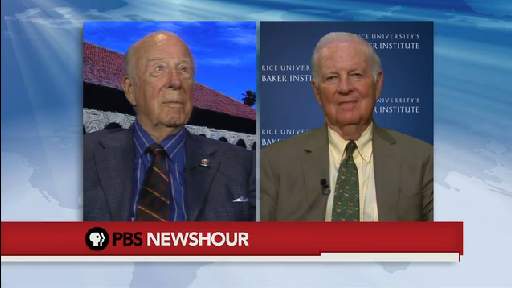
The main Thatcher segment on the PBS newscast was a discussion with two former Republican secretaries of State, George Shultz and James Baker. Of course, both were big fans of Thatcher’s foreign policy (which was closely aligned with their own priorities during the Reagan and George H.W. Bush years). It was more than that, too; as Baker put it, Thatcher “emphasized the private sector and got rid of the oppressive influence of the trade unions.” And Shultz explained that Thatcher “was a very attractive woman. So you were certainly aware of that.”
PBS had one other guest: former Conservative Canadian Prime Minister Kim Campbell, who cheered both Thatcher’s defeat of unions but also her humanity: “It’s kind of touching to be reminded of what a lovely woman she was.”
On the O’Reilly show, the host paid tribute to Thatcher’s leadership, contrasting it with Barack Obama’s tenure. As O’Reilly declared:
Her accomplishments are many, but she was always a very controversial figure in her own country and here in America, because the British press and the American media are liberal and always have been.

Later in the show, he was joined by conservatives Brit Hume and Bernard Goldberg; ironically, the latter segment focused on the alleged hostility to Thatcher in the mainstream media. So the guest line-ups were more alike than different. But so was some of the reporting. On Fox, Thatcher rescued Britain from the clutches of an oppressive union movement, and the record speaks for itself. As O’Reilly put it:
In Britain, 13 percent unemployment…. That’s a catastrophe, 13 percent, all right. When she leaves office eight years later, 5.8 percent unemployment. But if the unemployment rate drops 7 percent, which means all those millions of people are working under this woman, give her some credit.
And he put it a different way:
In 1982, about two and a half years into her term, unemployment in Great Britain was 13 percent. It’s chaos, absolute chaos there. When she left office in 1990, she was the longest serving prime minister in British history. It was at 5.8 percent.
On PBS, meanwhile, reporter Margaret Warner declared that Thatcher “brought a free market revolution to Britain, lowering taxes and privatizing state industries…. Britain’s economy rebounded from her tough medicine.”
Neither report gives viewers a good sense of Thatcher’s economic policy. (The wording in the PBS segment about rebounding from medicine is difficult to comprehend.) The Guardian compiled a list of economic indicators during Thatcher’s tenure; the short story is that inequality increased, and so did poverty–from 13.4 percent in 1979 to 22.2 percent in 1990.
O’Reilly is correct that unemployment dropped during part of Thatcher’s time in office; it also skyrocketed the first two years. When she left office in 1990, it was, according to the Guardian‘s figures, higher than when she took office. If that’s the record, then one would imagine it would be reflected somewhere–perhaps not at Fox News, for ideological reasons. But PBS is supposed to be about giving us the views that we’re not getting from the commercial media.
Related articles
Featured Video
America Racing to Strategic Defeat in Iran
or go to
Aletho News Archives – Video-Images
From the Archives
Should Europeans ‘Thank’ the Americans for Destroying Nord Stream?
By Robert Bridge | Strategic Culture Foundation | September 29, 2022
With an investigation continuing into the destruction of the Nord Stream gas pipeline that provided energy supplies to Europe from Russia, there appears to be just one prime suspect, and that should surprise nobody.
Following the sabotage of the Nord Stream 1 and 2 gas pipelines, former Polish Foreign Minister Radoslaw Sikorski already seemed to know the identity of the perpetrator when he tweeted out: “Thank you, USA.”
At first glance, it seemed that Sikorski was speaking sarcastically, berating Washington for carrying out an attack that will have severe repercussions for the people of Europe. After all, how could anyone see any good coming from the termination of Europe’s primary source of gas reserves with winter just around the corner? It was Sikorski’s homeland of Poland, after all, that urged its citizens to collect firewood in the face of dwindling gas reserves.
In fact, the Polish diplomat was speaking one-hundred percent literally… continue
Blog Roll
 Aletho News
- Tehran approves new Hormuz plan with major restrictions
- No Threat Can Force Iran’s Surrender /Trita Parsi & Lt Cl Daniel Davis
- UK’s New Pandemic Plan Would Turn Big Tech Into a Mass Location Tracking Network
- Growing insecurity, soaring prices fuel protests in north as regime bans evacuation: Sources
- Iran denies responsibility for ‘depraved’ attack on Kuwait desalination plant
- Bring The Troops Back. End This War Now!
- Can we please stop calling Israel the ‘only democracy in the Middle East’ now?
- US should start removing its troops from Germany, proposes AfD co-leader Chrupalla
- Iran Red Crescent: 600 educational centers attacked in US-Israeli ‘war crimes’
- Russian Oil Tanker Arrives in Cuba Amid U.S. Blockade
- If Americans Knew
- As Iran targets US military bases, will they be relocated to Israel? Not a ceasefire Day 171
- Will Trump Go Kamikaze?
- Is the University of Florida Shutting Down College Republicans over Israel Criticism?
- Jewish extremist arrested over alleged plot to firebomb Palestinian activist Nerdeen Kiswani’s home
- More than half of Palestinian child detainees have no charges
- The More Murderous Israel Gets, The More We Hear About “Antisemitism”
- Land Day and the Palestinian struggle after 30 months of genocide
- The Iran War Is About Palestine
- Israeli soldiers echo settler ideology, talk of revenge after targeting Palestinians and detaining CNN crew in the West Bank
- Israeli Policies Threaten Future of Christian Schools in Jerusalem
- No Tricks Zone
- New Study Finds Warming Saves Lives…Cold Temperatures 12 Times More Deadly Than Excess Heat
- German Science Blog Accuses PIK Climate Institute Of Hallucinating Climate Tipping Points
- Devastating Assessment Of Comirnaty Vaccine By Former Senior Pfizer Europe Toxicologist
- New Study: CO2 Is ‘Effectively Negligible’ As An Explanatory Climate Change Factor Since 2000
- Former Pfizer Toxicologist Dr. Helmut Sterz Tells Bundestag Hearing Pfizer Vaccine Should Have Never Been Approved
- Energy Expert: Germany’s Nuclear Phaseout Was A “500 Billion Euro Mistake”
- New Research: South Australia’s Mid-Holocene Sea Surface Temperatures Were 4°C Warmer Than Today
- Storing Green Energy To Last Germany 10 Days Would Require A 60-Million Tonne Battery
- New Studies: UK Sea Levels Were 4 Meters Higher Than Today During The Mid-Holocene
- Destructive Green New Deal: German Energy And Metal Group Warns Of Drastic Crisis
 Aletho News