San Francisco Rides the $15 Wave
By Shamus Cooke | Worker’s Action | May 13, 2014
It seems that Seattle has officially passed the $15 baton to San Francisco, and they’re running with it. On May 5th San Francisco had its first public organizing meeting to prepare for a ballot measure to raise the minimum wage to $15. The Labor movement and broader community organizations were well represented, and with them all the potential to achieve a great victory.
The San Francisco $15 proposal is stronger than the Seattle mayor’s version: the time line to get to $15 is shorter, and there are fewer exceptions.
San Francisco companies with more than 100 employees would have until 2016 to raise wages to $15 an hour, but they must lift wages to $13 an hour by next January. Businesses with fewer than 100 employees have until 2017 to raise wages to $15 an hour, but must raise them to $13 an hour by 2015 and $14 by 2016.
Polling has already indicated overwhelming support (59 percent) for the initiative.
The process that San Francisco is using also has other advantages over Seattle’s. The unions and community groups are working as a united front in San Francisco, whereas in Seattle there was constant tension between the socialist city council member Kshama Sawant and her $15 Now group of supporters versus the unions: Sawant wanted a strong version of $15 and several of the unions just wanted a deal, seemingly more interested in working with the mayor towards “consensus” between the unions and the corporations.
In San Francisco “consensus” was thankfully blown to pieces. The ballot initiative process goes over the head of the City Hall corporate politicians, destroying the consensus that San Francisco mayor was desperately seeking between the Chamber of Commerce — representing the giant corporations — and the unions. This has infuriated the 1%.
The San Francisco Chronicle reports:
“The San Francisco Chamber of Commerce said it was ‘outraged by the preemptive minimum wage ballot measure’ designed by SEIU and its allies.”
This is exactly the kind of outrage that should warm the heart of all working people.
The ballot initiative is also superior because it opens up the doors to wider participation of various community groups, who can mobilize their members to collect signatures, organize rallies, etc., instead of simply having four or five union reps cut a backroom, watered-down deal with the mayor and corporations.
Which begs the question: why don’t unions and community groups work together on inspiring ballot initiatives more often? Half the states in the country and many municipalities have the legal authority to evoke this brand of direct democracy, yet it’s rarely done.
The answer is, sadly, that this weapon is rarely used in an inspirational way because of the “partnership” between unions and the Democratic Party. The Democrats are adversaries of anything potentially harmful to the big corporations, which any economic measure that inspires working people will inevitably be.
This is why — as Obama’s presidency proved yet again — the Democratic Party is where hope goes to die.
Which makes the events in San Francisco all the more important: the $15 dollar initiative is an example of the unions making a big break, in practice, from the Democrats, which hopefully others around the nation will follow.
And follow they must, since it would be suicide for the national labor movement to sit idly as the fight for $15 snowballs. Union and community groups should be working together across the country for similar ballot initiatives wherever possible.
For those states without ballot initiatives, $15 can still be used as a rallying cry and a mobilizing force for change. Wherever the Democratic Party blocks this process, unions should come together and form a labor party. Working people are tired of excuses.
The fight for $15 also gives a boost to organizing new workers into unions as well. For example, Wal-Mart workers would love to make $15 an hour and the labor movement has been trying in vain to organize them for years. The slogan “$15 and a union” would resonate far better with Wal-Mart workers than anything the unions have yet put forth.
There are also many other unions that have already-organized workers who don’t make $15, and now they can have the confidence to demand $15 at the bargaining table, knowing full well that the broader community will come to their aid.
The $15 demand is especially important because it’s the first time in decades that the labor movement is going on the offensive. This is crucial. Three decades of playing defense — and playing it poorly — has had a demoralizing effect on the entire working class. A big offensive victory opens the doors wide to new possibilities and new horizons. It boosts confidence. One year ago $15 seemed like a fantasy; in five years we’ll hopefully be looking back at $15 with nostalgia, having achieved many other offensive victories.
The possibilities for unions and community groups to organize around $15 are endless. And if other unions don’t follow the example of the San Francisco unions and community groups, they’ll be acting as willing participants to the ongoing corporate onslaught. Not fighting back is no longer an option.
Shamus Cooke is a social service worker, trade unionist, and writer for Workers Action. He can be reached at portland@workerscompass.org
Hundreds of Bangladeshi garment workers die
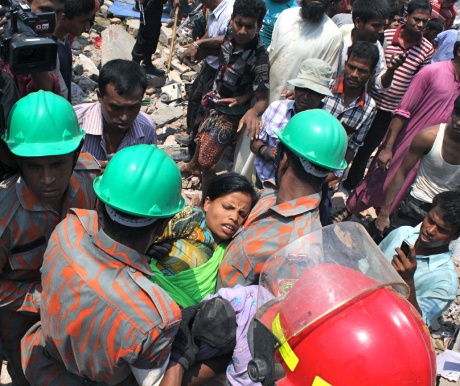
IndustriAll | 25.04.2013
The worst ever industrial accident in Bangladesh has killed more than 200 garment workers with fears of a final death toll reaching 1,000 as hundreds remain injured and trapped in the debris.
“Cut off my hand, save my life!” screams a woman trapped under the collapsed eight-story Rana Plaza building in Savar, 30 kilometres outside Dhaka. The same request is shouted by trapped Aftab, while other screams in the rubble demand oxygen. 200,000 local people have assembled in Savar offering to donate blood to the rescue effort, as hospitals are gravely under supplied.
The mass industrial manslaughter occurred at 9am, 24 April. The collapsed building, illegally constructed, contained five garment factories with 2,500 workers. Those five factories are Ether Tex, New Wave Bottoms, New Wave Style, Phantom Apparels and Phantom-TAC. These factories are believed to have produced for several well-known western brands including Mango, Primark, C&A, KIK, Wal-Mart, Children’s Place, Cato Fashions, Benetton, Matalan and Bon Marché.
On 23 April, the day before the collapse, large structural cracks appeared in the supporting pillars of Rana Plaza, but local authorities were ignored by the building owner Sohel Rana and the garment factory owners when they gave the order to evacuate, while the three shops and bank on the building’s ground floor heeded the warning and evacuated. A Rana Plaza garment worker had to work three days unpaid for every one work day missed, so workers were reluctant to stay safe at home on 24 April.
Now over 2,000 workers are injured in hospital, many critically, 254 are dead and many more continue screaming from under the rubble. The IndustriALL Global Union affiliated textile and garment trade unions in Bangladesh are present and supporting the rescue efforts. Affiliates work jointly through the IndustriALL Bangladesh Council (IBC) which yesterday used a joint press conference to put forward joint demands and a programme of action, calling for justice and action from authorities and brands. The IBC will mobilize all affiliates in a mass demonstration on 26 April in front of the Dhaka Press Club.
20,000 furious garment workers from neighbouring factories this morning brought five major highways to a halt, and several local skirmishes saw angry protestors target garment factories that were not respecting the national day of mourning, forcing them to close and show respect to the dead. Protestors also targetted the building of the Bangladesh Garment Manufacturers & Exporters Association (BGMEA).
The systemic problems must be tackled immediately in Bangladesh’s garment industry and much responsibility must fall on the western clothing brands making enormous profits from items made in deadly conditions on poverty wages. While brands continue refusing to pay a sufficient price for safe production of their clothes, their calls for improved safety are not sincere.
Much needed improvements to the national labour law have been debated through Bangladesh’s legislative process, with the government cabinet approving revisions on 22 April. However this process has been lobbied by the global garment industry buyers who have demanded a scaling back of workers’ rights initially proposed in the reform.
IndustriALL Global Union believes that Bangladeshi garment workers deserve the right to work in safety, with full access to organize and bargain collectively in trade unions, and a substantial rise of the current US$38 monthly minimum wage.
IndustriALL Global Union General Secretary Jyrki Raina said:
This terrible tragedy highlights the urgency of putting a stop to the race to the bottom in supplying cheap means of production to international brands, a race in which hundreds of workers have lost their lives. Global clothing brands and retailers have a responsibility for their full production chains. Now it is time for them, suppliers and the Bangladeshi government to sit down with IndustriALL and its affiliates to agree on a safety program that will ensure this will never happen again.
Featured Video

Bombing Hitler’s Hometown
or go to
Aletho News Archives – Video-Images
From the Archives
The Biggest Threat to Peace in Middle East
By Dr. Elias Akleh* | Sabbah Report | May 24, 2010
A build up of heightened tension in the Middle East is escalating in the last few weeks. American and Israeli postures towards Lebanon, Syria, and Iran have become more threatening. Listening to speeches of political leaders one hears talks only about war not peace. Iranians and Israelis are continuously training hard for a possible showdown. Both sides are conducting extensive war games every month. This led Syrians to claim that Israel is preparing for a soon-to-come another war. The Jordanians also are warning that current stalemate of the peace process is an indication of a war breaking out this summer. The Russian President and his army chief hinted, a few months ago, that the US and Israel were planning for an attack on Iran.
Indeed Iran is, as it has been for last few years, the target of most of the threats and accusations of supporting terrorism. Escalating incitement against Iran the American Defense Department sent last month (April) to Congress a report on Iran’s military claiming Iran could develop intercontinental ballistic missiles capable of reaching the US by 2015.
Ignoring the fact that N. Korea, India, Pakistan, and Israel are proven to have nuclear weapons while Iran does not, the US Secretary of State Hillary Clinton chose in her speech, to the nuclear Non-Proliferation Treaty review conference at the UN, to focus on Iran’s alleged nuclear ambitions putting the whole world at risk as she put it. According to Clinton Iran’s acquisition of nuclear weapons, rather than Israel’s more than 200 nuclear bombs, is destabilizing the Middle East. She called on the world’s nations to rally around US efforts to hold Iran, not other nuclear countries, to account.
The accusation that Usama Bin Laden is living comfortably in Iran had received a boost after the broadcast of a documentary called “Feathered Cocaine”. This echoed the June 2003 claims of the Italian newspaper Corre de la Sierra that Bin Laden was in Iran according to some intelligence report, and according to Richard Miniter’s book “Shadow War”. … continue
Blog Roll
 Aletho News
- Bombing Hitler’s Hometown
- German journalist threatened with homelessness as German court upholds EU sanctions in landmark free speech case
- US Tells Allies That Ukraine-Bound Arms Could be Sent to Middle East
- Organized terrorism: Iran condemns killing of its diplomats in Lebanon
- Why could Gaza enter the regional war?
- Hamas official rejects Mladenov Plan linking disarmament to Gaza reconstruction
- Two Primary Elections for the Soul of ‘America First’
- Japan Clings to US Vassalage Despite Energy Crunch Caused By Iran War
- US Seeks Control Over Global Energy Infrastructure – Kremlin
- US senators target Orban government for standing up to Zelensky
- If Americans Knew
- Researchers at Human Rights Watch Resign Over Blocked Report on Palestinian Refugee Return
- Jewish Groups Are Backing a War Americans Don’t Want
- Eric Fingerhut Thinks He’s the President of the Jews
- Top Jewish Philanthropists, Rabbis Urge Israeli President to Take Action Against ‘Jewish Extremists’
- Don’t Be Fooled. Zionist Leaders Have Always Wanted to Control Southern Lebanon
- Israel’s widespread use of torture is a core element of its genocide against the Palestinian people
- In Israel’s War on Iran, Many Middle East US Bases Rendered “All But Uninhabitable”
- ‘Burn the lawn’: Israel pursues ‘Rafah model’ in southern Lebanon
- A genocide here, an amputation there
- Reports: Iran mobilizing 1M fighters, Israel-US run low on ammo, Israeli army faces shortage – Not a ceasefire Day 168
- No Tricks Zone
- Devastating Assessment Of Comirnaty Vaccine By Former Senior Pfizer Europe Toxicologist
- New Study: CO2 Is ‘Effectively Negligible’ As An Explanatory Climate Change Factor Since 2000
- Former Pfizer Toxicologist Dr. Helmut Sterz Tells Bundestag Hearing Pfizer Vaccine Should Have Never Been Approved
- Energy Expert: Germany’s Nuclear Phaseout Was A “500 Billion Euro Mistake”
- New Research: South Australia’s Mid-Holocene Sea Surface Temperatures Were 4°C Warmer Than Today
- Storing Green Energy To Last Germany 10 Days Would Require A 60-Million Tonne Battery
- New Studies: UK Sea Levels Were 4 Meters Higher Than Today During The Mid-Holocene
- Destructive Green New Deal: German Energy And Metal Group Warns Of Drastic Crisis
- New Study Documents A 20-Year Pause In Arctic Sea Ice Decline – Driven By Internal Variability
- Wake-up Call: Survey Shows Majority Of Germans Now Favor Postponing Climate Targets!
 Aletho News