Hide the decline and rewrite history?
By Joanne Nova | March 17, 2010
Human emissions of carbon dioxide began a sharp rise from 1945. But, temperatures, it seems, may have plummeted over half the globe during the next few decades. Just how large or how insignificant was that decline?
Frank Lansner has found an historical graph of northern hemisphere temperatures from the mid 70’s, and it shows a serious decline in temperatures from 1940 to 1975. It’s a decline so large that it wipes out the gains made in the first half of the century, and brings temperatures right back to what they were circa 1910. The graph was not peer reviewed, but presumably it was based on the best information available at the time. In any case, if all the global records are not available to check, it’s impossible to know how accurate or not this graph is. The decline apparently recorded was a whopping 0.5°C.
But, three decades later, by the time Brohan and the CRU graphed temperatures in 2006 from the same old time period, the data had been adjusted (surprise), so that what was a fall of 0.5°C had become just a drop of 0.15°C. Seventy percent of the cooling was gone.
Maybe they had good reasons for making these adjustments. But, as usual, the adjustments were in favor of the Big Scare Campaign, and the reasons and the original data are not easy to find.

Matthews 1976, National Geographic, Temperatures 1880-1976

The blue line is the adjusted CRU average from 2006
If temperature sets across the northern hemisphere were really showing that 1940 was as hot as 2000, that makes it hard to argue that the global warming that occurred from 1975 to 2000 was almost solely due to carbon, since it wasn’t unusual (at least not for half the globe), and didn’t correlate at all with our carbon emissions, the vast majority of which occurred after 1945.
The US records show that the 1930’s were as hot as the 1990’s. And the divergence problem in tree rings is well known. Many tree rings showed a decline after 1960 that didn’t “concur” with the surface records. Perhaps these tree rings agree with the surface records as recorded at the time, rather than as adjusted post hoc? Perhaps the decline in the tree rings that Phil Jones worked to hide was not so much a divergence from reality, but instead was slightly more real than the surface-UHI-cherry-picked-and-poorly-sited records?
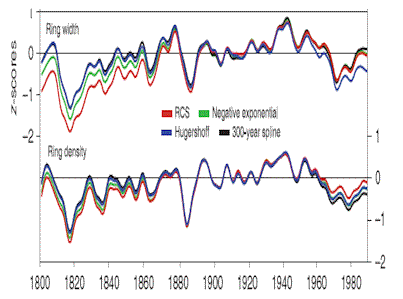
Esper – Tree ring widths declined from 1940-1975. Records after 1960 are sometimes ignored because they don’t fit the “temperature record”. (All timeseries were normalized over the 1881–1940 period. RCS, regional curve standardization; TRW, tree-ring width.) Thanks to ClimateAudit. (Link below)
Steven McIntyre discusses the Esper data here.
Frank Lansner also discusses the data from Scandinavia, which originally showed that temperatures were roughly level from mid-century to the end of the century, but that the large decline from 1940 to 1975 was…adjusted out of existence. (My post on that here).

Scandinavian Temperatures: 25 data series combined from The Nordklim database (left), compared to the IPCC’s temperature graph for the area.
Frank points out that while the older graph is not peer reviewed, the modern data sets are also not peer reviewed, so even if the papers they are published in are peer reviewed, it’s meaningless to claim this is significant when the underlying data can be adjusted years after its collection without documentation or review.
The CRU has an FAQ on their datasets, and it includes this comment on the accuracy of the hemispheric records:
In the hemispheric files averages are now given to a precision of three decimal places to enable seasonal values to be calculated to ±0.01°C. The extra precision implies no greater accuracy than two decimal places.
Do I read that correctly? After an adjustment that may be in the order of 0.34°C, the accuracy is ±0.01°C?
At the time when there was a Global Ice Age Scare, this graph appeared in Newsweek.

Newsweek: Global Temperatures 1880-1970 (NCAR)
Either 70% of the decline has been hidden in the years since then, or the climate scientists at the time were exaggerating the decline in order to support the Ice Age Scare (surely not!).
Full references available on Frank Lansner’s & Nicolai Skjoldby’s Blog. Stanley is derived from an NAS document. Mathews from National Geographic.
Thanks to Frank for his good work.
Brohan 2006 is linked here, with a pdf.
Palestinian classes held at Israeli army checkpoint
By Haitham Sabbah | Ma’an News | March 18, 2010
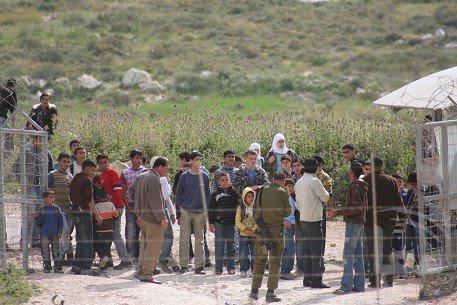
Israeli soldiers prevent students and others from crossing a checkpoint between their homes and schools on the edge of the West Bank city of Qalqiliya on 17 March 2010. Some teachers used the checkpoint as a makeshift classroom and held studies despite the closure, which was linked to clashes elsewhere in the occupied territories.
A picture is worth a thousand words:


Emergency Internet control bill gets a rewrite
By Declan McCullagh | Cnet News | March 17, 2010
Sen. Jay Rockefeller alarmed technology and telecommunications firms last year when he announced a plan for the president to seize “emergency” control of the Internet. Now the West Virginia Democrat is trying again with a new version that aides hope will be seen as less extreme.
During a closed-door meeting on Capitol Hill on Wednesday attended by about a dozen industry representatives, CNET has learned, Rockefeller’s staff pitched a revised version of his controversial cybersecurity legislation.
It says that after the president chooses to “declare a cybersecurity emergency,” he can activate a “response and restoration plan” involving networks owned and operated by the private sector. In an attempt to limit criticism, instead of spelling out the plan’s details, the latest draft simply says that it must be developed by the White House in advance.
There is no requirement that the emergency response plan be made public, meaning it could still include a forcible disconnection of critical Web sites from the Internet–which is what the March 2009 version of the legislation had proposed.
Larry Clinton, president of the Internet Security Alliance, whose members include Verisign, Verizon, and Raytheon, says no disconnection language is explicitly in the bill: “We are pleased that the ‘kill switch’ allowing for the government to shut down private sector access to the Internet has been eliminated.”
But, Clinton said, “We think the bill still has a long way to go.” If the private sector is expected to help out with national security, he said, there ought to be liability protections, insurance breaks, and tax credits for small businesses.
A spokesman for Rockefeller did not respond to repeated requests for comment on Wednesday. Sen. Olympia Snowe, a Maine Republican, is a co-sponsor of the legislation.
The Senate Commerce Committee is scheduled to vote for March 24 on the Rockefeller bill, which will replace an existing measure known as S.773. Because Rockefeller is chairman of the committee, the bill is expected to be approved with little dissent.
Other portions of the 62-page draft bill would create certification requirements for “critical infrastructure information system personnel working in cybersecurity” and punish certain companies that “fail to demonstrate” that they comply with federal specifications. A third section would order the National Science Foundation to fund anti-anonymity research that aims to “to determine the origin of a message transmitted over the Internet.”
Liesyl Franz, vice president for information security at TechAmerica, one of the industry’s largest trade associations, said her group does not support the new version at this time and is still reviewing the language.
“We have to see whether that makes sense,” Franz said, referring to the licensing and certification sections. “We’ve often talked about how companies and industries are very different.”
Franz added: “Frankly, we’d rather not see a prescriptive plan. Seeing a process for developing a plan to get to a goal is a little bit more palatable for the industry.”
The revised Rockefeller bill, called the Cybersecurity Act of 2010, does stress that the White House should develop its cyber-emergency plan “in collaboration” with the private sector. It also says “this section does not authorize…an expansion of existing presidential authorities.”
 Declan McCullagh is a contributor to CNET News and a correspondent for CBSNews.com who has covered the intersection of politics and technology for over a decade. Declan writes a regular feature called Taking Liberties, focused on individual and economic rights; you can bookmark his CBS News Taking Liberties site, or subscribe to the RSS feed. You can e-mail Declan at declan@cbsnews.com.
THE DESTABILIZING LOGIC OF ZIONISM
Book Review By Sam Bahour | March 18, 2010

Zionism’s Invented State
Israeli Exceptionalism: The Destabilizing Logic of Zionism arrived in the mail shortly after I completed sending a thank you note to two other authors and friends, Kathleen and Bill Christison. The Christison’s had just released their newest title, Palestine in Pieces: Graphic Perspectives on the Israeli Occupation (Pluto Press) and I felt that they deserved a huge thank you for encapsulating their eyewitness report of Israeli military dispossession and occupation in the warped ideological framework of Zionism. I felt such a framing depicted a high sense of rarely found political maturity on behalf of American analysts. Israeli Exceptionalism was a natural next read for it peeled the onion of Zionism to reveal how deeply flawed this ideology was and is and how it has become a destabilizing factor which puts people of the region—and arguably beyond—in serious jeopardy.
Israeli Exceptionalism is not only a must read, it is a must think about book. To add intellectual spice, every chapter starts with a few quotes of prominent individuals related to the topic at hand. Reading these quotes alone speak volumes of the human tragedy, in thought and lives, that Zionism evoked.
Author M. Shahid Alam, a non-Arab, professor of economics at Northeastern University in Boston does a fascinating job of creating a repository of references on Zionism by way of narrative and footnotes. Although I think of myself as well-read on the topic, I attest that I learned much from Israeli Exceptionalism, not only in terms of identifying new references, but also in terms of analysis and context.
It was not the first time I have read the word “exceptionalism” in relation to Israel. New York Times columnist Roger Cohen recently wrote that Israel “lives in a perpetual state of exceptionalism.” (New York Times, Oct. 16, 2009). However, Professor Alam explored this Israeli phenomenon on a deeper level of its underlying ideology to shed light on why this abnormal state seems to be unable to come to terms with modern day realities. The book addresses three principal forms of Israeli exceptionalism: 1) the “divine right” of Jews, 2) “Israeli achievements,” which at first glance seem impressive, and 3) the Jews’ “uniquely tragic history.” Alam explains that, “In order to secure itself against these “unique” threats to its existence, Israel claims exemption from the demands of international laws.” Sadly, so long as Israel resists permitting international law to be its reference point, despite the fact that Israel’s own birth is owed to the same body of law, the only alternative Israel allows for is the age-old Law of the Jungle—the law of might is right.
Throughout the book the author uses a new term, “Islamicate,” which this writer, a secular Palestinian, found a sober source of food for thought, especially given the state of global and regional affairs today. As a foil for his historical review of the development of Zionism, its trials and tribulations, and the existence of Israel, the author gives us the Islmicate—the Muslim world, or the “Islamic heartland”—which forces the reader to see the larger context of the Israeli-Palestinian conflict. Given the events of 9/11 and all that proceeded it, including the shift from a Cold War paradigm to a War on Terror one, this backdrop is a key framing for the analysis. However, the author speaks at some length of the Arab nationalist movement which unsuccessfully attempted to face off with Israel, but skips the depth of the secular Palestinian national movement that broke away from official Arab nationalism leadership and kept the Palestinian struggle for freedom and impendence alive all these years, albeit under threat today from an Islamist trend in the region. That noted, Alam is correct when he ended the book by saying, “The Islamicate world today is not what it was during World War I. It is noticeably less inclined to let foreigners draw their maps for them.”
The thesis of the book is that “The Zionist movement in Palestine has generated endemic violence between Jewish settlers and Palestinians. Since 1948, this violence has repeatedly pitted Israel against the Palestinians and its neighbors. It has dragged Western societies, especially the United States, into ever widening and deepening conflicts with the Islamicate.” Professor Alam argues that “the history of these ever-expanding circles of conflict and instability was contained in the Zionist idea itself.”
This approach to understanding Zionism and Israel —the notion that an all-encompassing plan has and is guiding Israel—is a constant source of debate between myself and many Israeli friends. I argue that a macro plan, one that has a guiding thrust to force the realization of the original Zionist myth that Palestine was a “land with no people for a people with no land” is in place and motivating many on the Israeli side. Many Israelis argue that this notion gives too much credit to their society and leadership and contend that minimal planning, chance, luck, and near total haphazardness have brought them to their precarious state of affairs. After a careful reading of Israeli Exceptionalism I tend to believe that the truth is somewhere in the middle. Like the founders of Zionism, Israel’s current leadership is too politically savvy to try and micromanage the future. Instead it provides an overall framework and lets its constantly adapting organizations—the World Zionist Organization, then Israel—deal with the required, real-time maneuvering based on the ever-changing realities and interests of the moment.
Professor Alam carefully follows the intertwining interrelationships among many seemingly disparate movements that have, collectively, driven the State of Israel—the exclusionist ideology of Zionism, interests of shifting global powers, anti-Semitism, Christian Zionism, Jewish Diaspora, the Israeli lobby, and the clout ascertained by serving the short term political interests of individual western leaders. Although the text is heavily footnoted, the author’s many insights prompt the reader to want to learn more and corroborate some of the information provided: particularly in the chapter devoted to “Jewish Factors in Zionist Success,” for example, where the author’s historical portrayal of Jewish influence in the service of Zionism/Israel around the world suggests much more of a monolithic dynamic among these communities than I tend to find plausible. For example, and Alam also makes mention of this aspect of Jewish Diaspora: “Jews of 19th century Germany founded the Reform movement, rejecting the idea of a Jewish nation … The Reform movement of those days was a compromise between total apostasy (assimilation) and orthodoxy.” (Ami Isseroff, Opposition of Reform Judaism to Zionism – A History, August 12, 2005). Given such strong trends within world Jewry that opposed Zionism for considerable periods in the movement’s history, Alam’s monolithic view seems tendentious. I would claim that superior organization and dynamic leadership among committed Zionists is what led to the “success” of Zionism, more so than any natural Jewish leaning toward a desire for an exclusionist state, with all that that means for others. A significant minority of Jews alive today in fact continue to oppose Zionism on the grounds that it is very “un-Jewish.”
Meantime, the book chronicles the emergence of an influential trend of Jewish-only exceptionalism long before the horrific misery of Jews after WWII, and as a matter of fact, even before the recognized founder of Zionism, Theodore Herzl, wrote The Jewish State (a book I re-read annually.) However, Alam correctly notes that “Israel’s creation and survival are anomalies” and that, after nearly 100 years of Zionist/Israeli exclusionism evinced in a policy of ethnic cleansing of Palestinians, “It would appear that Israel’s demographic constraints are binding: and these constraints may well determine the ultimate destiny of this exclusionary colonialism.” “The tragedy of Zionism,” proclaims Alam, “is written into its design; its end is contained in its beginning.” That may be true for many –isms of this world, some which have already collapsed of their own weight.
A Zionist friend and writer, Bernard Avishai, recently wrote in his latest book, “Israel is a society where institutional discrimination against individuals for an accident of birth or a profession of faith has been so routine it is hardly noticed—not, at least, by Jews.” (The Hebrew Republic, Harcourt, pg. 25). Another Zionist, albeit of a completely different school of thought, Israel’s current Minister of Defense, Ehud Barak, was quoted earlier this month as saying “If, and as long as between the Jordan and the sea, there is only one political entity, named Israel, it will end up being either non-Jewish or non-democratic … If the Palestinians vote in elections, it is a binational state, and if they don’t, it is an apartheid state.” These words coming from across the Zionist spectrum should not be taken lightly. Remember: apartheid is a crime against humanity!
Professor Alam states that “at first, Zionists did not seek to conceal the colonial character of their movement…concealment was not necessary in the age of high imperialism and triumphant racism.” The United Nations General Assembly Resolution 3379, adopted on November 10, 1975 by a vote of 72 to 35 (with 32 abstentions), “determine[d] that Zionism is a form of racism and racial discrimination”. The resolution was revoked by Resolution 46/86 on December 16, 1991. In the history of the UN, this is the only resolution that has ever been revoked. As a Palestinian experiencing the real-time impact of the racialist policies of a Zionist-motivated Israeli state, I believe that revoking this resolution was a mistake because it only postponed the inevitable day of reckoning when Israel would have to look at itself in the mirror and accept what it found there as real. Reading Israeli Exceptionalism can help us to understand how such historical oddities evolve.
Another Israeli friend, Deb Reich, a non-Zionist but someone who has lived—sometimes painfully—the Zionist reality, expressed it rather succinctly when I asked her about Zionism. She said, “I have come to believe that lecturing people about their badness is the last thing on earth that can solve our problems and will rarely change their behavior one iota; in fact, it can make them more stubborn. I know that we have no choice but to try to hold people accountable for their actions in terms of both the intended and unintended consequences for others, because without accountability there is chaos; but at the same time, if we want positive change, then we MUST open a window for people on how they can redeem themselves, and redeem the situation. That endeavor is what leadership is supposed to be about.”
Understanding history is one thing, but being able to come to terms with it and survive it is something materially different:, just ask Palestinians living today. Is turning back the clock of history doable or even desirable today? Left to the tools of our day—international law, compensation, and hopefully reconciliation—will history correct itself in the future with the emergence of smarter generations of Israelis and Palestinians? Can we Palestinians survive as a people to see that day? These are questions we ponder daily while under the influence of Israeli occupation and dispossession.
Professor Alam believes that the tide of Zionism will begin to turn when the banana republics of the Middle East begin to fall and are “replaced by Islamist governments” at which time “it may become difficult for the United States to maintain its presence in the region.” I beg for the international community to uphold their obligations under international law and resolve this conflict before that day.
Israeli Exceptionalism : The Destabilizing Logic of Zionism
by M. Shahid Alam
Palgrave Macmillan, 272 pp., £55.00
University of California faculty support arrested Muslim students
By Cecilie Surasky | March 17, 2010
If you keep heckling the Israeli ambassador to the US during a talk at UC Irvine, the school has a right to throw you out of the room. And if you violate school standards, they have a right to take you to task on such violations as long as they consistently apply the standards to all students. Any student protester knows this and makes the choice to risk those outcomes when they choose disruption over, say, really uncomfortable questions.
But do they have the right to arrest you?
Amazingly, 11 Muslim students at UC Irvine weren’t handed the usual disciplinary action for violating student codes (they each got up, made a statement and then would walk to the door to be escorted out by police). NO, they were actually arrested.
I remember doing almost the exact same thing when I was that age- a bunch of liberal students repeatedly interrupted former National Security Advisor Brent Scowcroft at a campus talk-only we weren’t so mad. People we knew hadn’t been killed or imprisoned. We recited Jabberwocky and got hauled out. Our punishment? Nothing.
Just change the names: “11 members of the Young Israel Alliance were arrested for heckling the Palestinian ambassador at UC Berkeley today.” No matter who it is, there’s something not right here and the answer to the over-reaction is likely outside pressure (which students who are genuinely concerned about Jewish-Muslim relations report tends to polarize and hinder, not help.)
Apparently, conservative students who committed a similar disruption last year got very different treatment. No arrest for them.
LA Jewish Journal reports in: UC Riverside Faculty Voice Support for Protesters Against Oren
Faculty at the University of California, Riverside (UCR), joined voices at UC campuses statewide in support of 11 students arrested for heckling Israeli Ambassador Michael Oren during his Feb. 8 speech at the University of California, Irvine (UCI).
Thirty-one professors and graduate students from several UCR departments signed a “Statement on Free Speech, Palestine and the ‘UC Irvine 11,’ ” drafted by Dylan Rodriguez, chair of the university’s Ethnic Studies department. The March 11 pronouncement calls on the UC administration and the Orange County district attorney’s office to drop disciplinary and punitive action against eight UCI and three UCR students, which it calls “discriminatory, cynical, and politically and intellectually repressive.”
The UCI students have been charged with violations of the student codes of conduct. Officials at UCR could not confirm whether action would be taken against their students.
“We believe that this is a cynical and opportunistic attempt at political repression that reflects the racial criminalization of young Arab, Middle Eastern and Muslim men and women as actual or potential ‘terrorists.’ By way of contrast, Ethnic Studies faculty have taught courses in Ethnic Studies in which classroom proceedings were disrupted by students with opposing views, and the university administration did not pursue any disciplinary or punitive measures against them. In fact, we have sometimes been told that such disruptions are an expression of academic free speech,” the statement said.
Rodriguez said the statement was intended to take issue with the tendency, since at least 2001, to affiliate Muslim men with terrorism within popular discourse, as well as to challenge what he sees as selective enforcement of codes of conduct by university administrators.
“People protesting is something to be expected,” he said, noting that UCR administrators did not take disciplinary action against what he called “conservative” student protesters following a similar incident last fall. “When people get selectively subjugated to enforcement of codes of conduct, it has a chilling affect on political discussion and freedom.”
It remains to be seen whether UC Irvine administrators can prove that this is a routine response to such disruptions, or exceptional treatment consistent with our undeniable and absolutely shameful criminalization of Muslims and Arab Americans.
Meanwhile, to his credit, Michael Oren has offered to come back and have a dialogue with students. I hope the arrested students, some of whom lost close relatives during the attack on Gaza, will take him up on his offer. I really do. It would take an incredible amount of courage and character to sit down face to face with a man who defends a massive military attack that killed your family members and destroyed schools and hospitals. If I were in their place, I’m not sure I would have that kind of inner strength. But what a meeting it could be.
Why protest building a synagogue and an action alert
Mazin Qumsiyeh | Window Into Palestine | March 18, 2010
The Hurva synagogue was destroyed in the 1948 war by the Jordanian army. Before 1948, synagogues were used by Zionist underground forces for illicit activities including hording weapons.* But why is there a furor over building it again?
First we must recognize that International law is rather clear that East Jerusalem is illegally occupied by Israel and per the Geneva conventions, and buildings or activities in the occupied areas are subject to those conventions. Any transfer of population to the occupied areas including infrastructure for these individuals is considered proscribed settlement activity contrary to both the letter and the spirit of the law.
Second, Israel News reported that: “According to a centuries-old rabbinical prophecy that appears to be coming true, on March 16, 2010, Israel will begin construction of the Third Temple in Jerusalem. During the 18th century, the Vilna Gaon, a respected rabbinical authority, prophesied that the Hurva Synagogue in Jerusalem, which was built during his day, would be destroyed and rebuilt twice, and that when the Hurva was completed for the third time, construction on the Third Temple would begin” Many Israelis believe this and there is a proliferation of designs, ceremonies and other events to launch this coming age of building a third temple. There are Muslim religious sites there: the first Qibla or direction of prayer for Islam and the third holiest site are the Haram Al-Sharif on this site. There are Israeli digs underneath that threaten the site already and this only added fuel to the fire.
Third, Palestinians, Arabs, Muslims, and much of humanity, wonder why is it that such a synagogue is reconstructed but none of 1200 mosques and nearly 200 churches destroyed by Israel over the past 6 decades not allowed to be reconstructed? For me personally and for most Palestinains, we know the history shows Jews, Christians, and Muslims living peacefully together for 1400 years under Islamic rule (with very few exceptions). We know that it is possible to simply have a Jewish area, a Christian area, a Muslim area or even mixed areas. We know it is possible even to intermarry, have friendships, etc. But Zionism had a different idea and it did not revolve on coexisting but on ethnic cleansing and destruction of others. How else can we explain the destruction of 530 villages and towns? How can we explain the rapid growth of colonial settlements on Palestinian land or even inside Palestinian homes? There is surely enough space here for all. Why are Palestinians denied the right to go to school just this week (see story and picture where they even held school at the checkpoint). Why not simply live and let live. The density of population inside the Green line is now nearly 1/8th that of areas of the West Bank and Gaza that are designated reservations/ghettos for the native Palestinians. If Jews want to live in the old Jewish quarter of East Jerusalem and rebuild the synagogue there, why not allow the Palestinians to return to the old neighborhoods in West Jerusalem and rebuild the many churches and mosques there?
AIPAC issued a statement supporting Vice President Biden who claimed that there is no space between the US and Israel. In other words, the US and Israeli interests and policies are/must be one and the same including on starvation, oppression, colonization etc. (and oh yes, we have to always put Iran first now that we finished off Iraq for the sake of Israel). US General David Petreaus disagrees:
“Insufficient progress toward a comprehensive Middle East peace. The enduring hostilities between Israel and some of its neighbors present distinct challenges to our ability to advance our interests in the AOR. Israeli-Palestinian tensions often flare into violence and large-scale armed confrontations. The conflict foments anti-American sentiment, due to a perception of U.S. favoritism for Israel. Arab anger over the Palestinian question limits the strength and depth of U.S. partnerships with governments and peoples in the AOR and weakens the legitimacy of moderate regimes in the Arab world. Meanwhile, al-Qaeda and other militant groups exploit that anger to mobilize support. The conflict also gives Iran influence in the Arab world through its clients, Lebanese Hizballah and Hamas.”
I would go much further and say the US interests and treasury have already been crippled by the subserviant relationship to Israeli lobbies. If the lobby finally succeeds in deepening the conflict with Iran, it will not be Iran that loses, but US and Israel will suffer a horrible blow. The US economy would go into a tail spin and the value of the $3 billion dollars in US military aid to Israel will be reduced even further as the US dollar accelerates its decline.
ACTION:
AIPAC and Christian Zionists are mobilizing thousands to write the congress and white house to keep funding and supporting Israel in its policies of colonial settlement expansion. We can do no less write to the white house via http://www.whitehouse.gov/contact/ and to congress via http://house.gov/
*This was common practice for the Haganah and other forces to fire from synagogues and use them as military outposts, see http://www.haaretz.com/hasen/pages/ShArtStEng.jhtml?itemNo=1061955&contrassID=19&subContrassID=1&title=’WATCH:%20British%20Mandate-era%20arms%20cache%20found%20in%20Hod%20Hasharon%20synagogue’&dyn_server=172.20.5.5
Mazin Qumsiyeh, PhDPopular Committee to to Resist the Wall and Settlements-Beit Sahour
A Bedouin in Cyberspace, a villager at home http://www.qumsiyeh.org http://www.pcr.ps
EU Selling Torture Equipment
BRUSSELS – Equipment designed for torturing prisoners is still being exported from European Union (EU) countries despite a four-year-old ban on such trade, according to a new report by Amnesty International.
The human rights group has found that companies active in several of the EU’s 27 states have exploited loopholes in controls aimed at putting an end to the selling of instruments of torture.
The EU rules – in force since 2006 – need to be widened to cover a number of devices that remain outside their scope, Amnesty has argued. It highlights how Nidec, a company trading from Spain, has been dealing in ’stun cuffs’ in the past few years. Intended for restraining a detainee by placing them around his or her limbs, such cuffs inflict a painful electric shock. Unlike similar “stun belts”, the cuffs are not explicitly banned by the EU’s rules.
Brussels officials say that the new report should trigger a discussion about how the rules can be strengthened. One source, speaking on condition of anonymity, explained that no action has been taken to date because a newly appointed European Commission, the EU’s executive arm, only assumed office in February. “For the time being, everything is rather open,” the source told IPS. “This is not because we like loopholes, it is quite simply because a new team has been getting started.”
But Amnesty’s specialist on the EU’s foreign policy David Nichols described those comments as “a convenient excuse for inaction.” He said that human rights groups had brought the flaws in the EU’s rules to the Commission’s attention long before now and that its staff had ample power to rectify the situation.
Furthermore, the report finds that national authorities in some European countries are continuing to issue export licenses for torture equipment. Both Germany and the Czech Republic approved exports to nine countries – including Georgia, Pakistan, India and China – where the security forces had previously used the equipment concerned for torture between 2006 and 2009. Among the equipment were chemical sprays, shackles and electric shock weapons.
The Amnesty study also finds that EU governments are not being sufficiently transparent about how they are implementing the rules. While each government is required to produce an annual report giving details of applications from traders to sell torture equipment, just seven have done so until now. These are Bulgaria, the Czech Republic, Germany, Lithuania, Slovenia, Britain and Spain.
Brian Wood, another Amnesty campaigner, said: “We fear that some states are not taking their legal obligations seriously.”
As part of the ‘war on terror’ declared following the Sep. 2001 attacks on New York and Washington, the U.S. has used leg irons and leg cuffs on prisoners held in Afghanistan and Cuba’s Guantanamo Bay. One of these detainees Abu Zubaydah has told the International Committee of the Red Cross of how these shackles pulled painfully on his ankles after his jailers repeatedly slammed him against a wall.
While Spain and Britain have banned the exports of leg irons, leg cuff and gang chains, companies based in other EU member states appear to have been selling some of these instruments. During the 2008 Eurosatory, an annual arms fair held in Paris, the French firm Rivolier exhibited such cuffs on its promotional stand.
The EU’s rules stipulate that cuffs of this nature should be controlled but nonetheless allowed to be sold in certain cases. According to Amnesty, these rules should be revised so that the trade in any leg restraints deliberately designed to cause discomfort is banned.
Michael Crowley from the Omega Foundation, which conducts research on human rights issues, noted that all of the EU’s countries are nominally opposed to torture. “As part of their commitments to combat torture wherever it occurs, member states must now turn their words into deeds,” he said. “They must impose truly effective controls on the European trade in policing and security equipment and ensure that such goods do not become part of the torturer’s toolkit.”
The Amnesty report also says that some EU member states are themselves using devices which are meant to cause pain to prisoners. In the Czech Republic, restraints have been used to chain detainees to a wall or a fixed object, even though the Council of Europe, an intergovernmental body dedicated to upholding human rights, has deemed the practice as “totally unacceptable”. Eltraf Bis, a Polish company, has also been found to have sold handcuffs intended to be connected to walls.
Amnesty argues that such devices can be clearly distinguished from devices required to restrain hospital patients in some cases of medical necessity and that they should be prohibited.
(Inter Press Service)
Pentagon Sees a Threat From Online Muckrakers
By STEPHANIE STROM | New York Times | March 17, 2010
To the list of the enemies threatening the security of the United States, the Pentagon has added WikiLeaks.org, a tiny online source of information and documents that governments and corporations around the world would prefer to keep secret.
The Pentagon assessed the danger WikiLeaks.org posed to the Army in a report marked “unauthorized disclosure subject to criminal sanctions.” It concluded that “WikiLeaks.org represents a potential force protection, counterintelligence, OPSEC and INFOSEC threat to the U.S. Army” — or, in plain English, a threat to Army operations and information.
WikiLeaks, true to its mission to publish materials that expose secrets of all kinds, published the 2008 Pentagon report about itself on Monday.
Lt. Col. Lee Packnett, an Army spokesman, confirmed that the report was real. Julian Assange, the editor of WikiLeaks, said the concerns the report raised were hypothetical.
“It did not point to anything that has actually happened as a result of the release,” Mr. Assange said. “It contains the analyst’s best guesses as to how the information could be used to harm the Army but no concrete examples of any real harm being done.”
WikiLeaks, a nonprofit organization, has rankled governments and companies around the world with its publication of materials intended to be kept secret. For instance, the Army’s report says that in 2008, access to the Web site in the United States was cut off by court order after Bank Julius Baer, a Swiss financial institution, sued it for publishing documents implicating Baer in money laundering, grand larceny and tax evasion. Access was restored after two weeks, when the bank dropped its case.
Governments, including those of North Korea and Thailand, also have tried to prevent access to the site and complained about its release of materials critical of their governments and policies.
The Army’s interest in WikiLeaks appears to have been spurred by, among other things, its publication and analysis of classified and unclassified Army documents containing information about military equipment, units, operations and “nearly the entire order of battle” for American forces in Iraq and Afghanistan in April 2007.
WikiLeaks also published an outdated, unclassified copy of the “standard operating procedures” at the military prison in Guantánamo Bay, Cuba. WikiLeaks said the document revealed methods by which the military prevented prisoners from meeting with the International Red Cross and the use of “extreme psychological stress” as a means of torture.
The Army’s report on WikiLeaks does not say whether WikiLeaks’ analysis of that document was accurate. It does charge that some of WikiLeaks’s other interpretation of information is flawed but does not say specifically in what way.
The report also airs the Pentagon’s concern over some 2,000 pages of documents WikiLeaks released on equipment used by coalition forces in Iraq and Afghanistan. The Pentagon concluded that such information could be used by foreign intelligence services, terrorist groups and others to identify vulnerabilities, plan attacks and build new devices.
WikiLeaks, which won Amnesty International’s new media award in 2009, almost closed this year because it was broke and still operates at less than its full capacity. It relies on donations from humans rights groups, journalists, technology buffs and individuals, and Mr. Assange said it had raised just two-thirds of the $600,000 needed for its budget this year and thus was not publishing everything it had.
Perhaps the most amusing aspect of the Army’s report, to Mr. Assange, was its speculation that WikiLeaks is supported by the Central Intelligence Agency. “I only wish they would step forward with a check if that’s the case,” he said.
American naifs bringing ruin to other lands
By Paul Craig Roberts | Online Journal | March 18, 2010
According to news reports, the U.S. military is shipping “bunker-buster” bombs to the U.S. Air Force base at Diego Garcia in the Indian Ocean. The Herald Scotland reports that experts say the bombs are being assembled for an attack on Iran’s nuclear facilities.
The newspaper quotes Dan Piesch, director of the Centre for International Studies and Diplomacy at the University of London: “They are gearing up totally for the destruction of Iran.”
The next step will be a staged “terrorist attack,” a “false flag” operation as per Operation Northwoods, for which Iran will be blamed. As Iran and its leadership have already been demonized, the “false flag” attack will suffice to obtain US and European public support for bombing Iran. The bombing will include more than the nuclear facilities and will continue until the Iranians agree to regime change and the installation of a puppet government. The corrupt American media will present the new puppet as “freedom and democracy.”
If the past is a guide, Americans will fall for the deception. In the February issue of the American Behavioral Scientist, a scholarly journal, Professor Lance DeHaven-Smith writes that state crimes against democracy (SCAD) involve government officials, often in combination with private interests, that engage in covert activities in order to implement an agenda. Examples include McCarthyism or the fabrication of evidence of communist infiltration, the Gulf of Tonkin Resolution based on false claims of President Johnson and Pentagon chief McNamara that North Vietnam attacked a U.S. naval vessel, the burglary of the office of Daniel Ellsberg’s psychiatrist in order to discredit Ellsberg (the Pentagon Papers) as “disturbed,” and the falsified “intelligence” that Iraq possessed weapons of mass destruction in order to justify the U.S. invasion of Iraq.
There are many other examples. I have always regarded the 1995 bombing of the Murrah Federal Office Building in Oklahoma City as a SCAD. Allegedly, a disturbed Tim McVeigh used a fertilizer bomb in a truck parked outside the building. More likely, McVeigh was a patsy, whose fertilizer bomb was a cover for explosives planted inside the building.
A number of experts dismissed the possibility of McVeigh’s bomb producing such structural damage. For example, General Benton K. Partin, who was in charge of U.S. Air Force munitions design and testing, produced a thick report on the Murrah building bombing which concluded that the building blew up from the inside out. Gen. Partin concluded that “the pattern of damage would have been technically impossible without supplementary demolition charges at some of the reinforced concrete bases inside the building, a standard demolition technique. For a simplistic blast truck bomb, of the size and composition reported, to be able to reach out on the order of 60 feet and collapse a reinforced column base the size of column A7 is beyond credulity.”
Gen. Partin dismissed the official report as “a massive cover-up of immense proportions.”
Of course, the general’s unquestionable expertise had no bearing on the outcome. One reason is that his and other expert voices were drowned out by media pumping the official story. Another reason is that public beliefs in a democracy run counter to suspicion of government as a terrorist agent. Professor Laurie Manwell of the University of Guelph says that “false flag” operations have the advantage over truth: “research shows that people are far less willing to examine information that disputes, rather than confirms, their beliefs.” Professor Steven Hoffman agrees: “Our data shows substantial support for a cognitive theory known as ‘motivated reasoning,’ which suggests that rather than search rationally for information that either confirms or dis-confirms a particular belief, people actually seek out information that confirms what they already believe. In fact, for the most part people completely ignore contrary information.” Even when hard evidence turns up, it can be discredited as a “conspiracy theory.”
All that is necessary for success of “false flag” or “black ops” events is for the government to have its story ready and to have a reliable and compliant media. Once an official story is in place, thought and investigation are precluded. Any formal inquiry that is convened serves to buttress the already provided explanation.
An explanation ready-at-hand is almost a give-away that an incident is a “black ops” event. Notice how quickly the U.S. government, allegedly so totally deceived by al Qaida, provided the explanation for 9/11. When President Kennedy was assassinated, the government produced the culprit immediately. The alleged culprit was conveniently shot inside a jail by a civilian before he could be questioned [in an open courtroom]. But the official story was ready, and it held.
Professors Manwell and Hoffman’s research resonates with me. I remember reading in my graduate studies that the Czarist secret police set off bombs in order to create excuses to arrest their targets. My inclination was to dismiss the accounts as anti-Czarist propaganda by pro-communist historians. It was only later when Robert Conquest confirmed to me that this was indeed the practice of the Czarist secret police that the scales fell from my eyes.
Former CIA official Philip Giraldi in his article, “The Rogue Nation,” makes it clear that the U.S. government has a hegemonic agenda that it is pursuing without congressional or public awareness. The agenda unfolds piecemeal as a response to “terrorism,” and the big picture is not understood by the public or by most in Congress. Giraldi protests that the agenda is illegal under both U.S. and international law, but that the illegality of the agenda does not serve as a barrier. Only a naif could believe that such a government would not employ “false flag” operations that advance the agenda.
The U.S. population, it seems, is comprised of naifs whose lack of comprehension is bringing ruin to other lands.
Dr. Roberts was Assistant Secretary U.S. Treasury, Associate Editor Wall Street Journal, Columnist for Business Week, Senior Research Fellow Hoover Institution Stanford University, and William E. Simon Chair of Political Economy in the Center for Strategic and International Studies, Washington, D.C.
Copyright © 1998-2007 Online Journal
AP photojournalist injured in Hebron
Ma’an – 18/03/2010
Hebron – An photojournalist sustained injuries to his back after being struck by a tear-gas canister on Wednesday during clashes between Palestinians and Israeli forces.
Nasser Shiyoukhi, a photographer for The Associated Press, was critically injured, witnesses said. A Palestine Red Crescent ambulance reportedly transferred the journalist to a nearby hospital, although it was not immediately clear which one.
Shiyoukhi was among several photojournalists covering ongoing confrontations around the Tarek Bin Ziab street in southern Hebron when he was struck by the projectile.
An Israeli military spokesman told Ma’an that a photojournalist was lightly injured during a riot. Palestinians in the area hurled rocks at Israeli forces, who responded with riot dispersal means, the spokesman said. He added that, in the Israeli army’s view, all journalists and others covering violent events do so at their own risk.
Shiyoukhi was arrested near the Ibrahimi Mosque in late February over allegations he assaulted a settler in Hebron two months earlier, a move that drew the ire of local media advocates.
The Palestinian Center for Development and Media Freedoms (MADA) strongly condemned what it termed Israeli attacks against a group of journalists in the West Bank and Jerusalem in recent days.
Obama slams Palestinian protests, rejects Israeli row
Press TV – March 18, 2010

US President Barack Obama condemns Palestinian protests in Jerusalem al-Quds over Israeli provocations near al-Aqsa Mosque as ‘destructive to peace’ while downplaying the reported row with the Israeli regime over Tel Aviv’s continued settlement expansions, denying reports that US-Israeli ties are in a state of crisis.
In a quick turn of face, under reportedly intense pressure from the wealthy Israel lobby in the US, Obama, whose top administration officials described Israeli settlement expansion plans as ‘insulting and destructive to peace efforts,’ rejected tensions with Tel Aviv as ‘friendly disagreements’ and, instead, denounced the Palestinians for reacting against intimidating Israeli moves to Judaize al-Quds.
“Friends are going to disagree sometimes,” said Obama Wednesday in his first official reference to Tel Aviv’s plans to erect 1,600 new settlement units near East al-Quds, in violation of the regime’s past commitments to freeze settlement expansion.
“Israel’s one of our closest allies, and we and the Israeli people have a special bond that’s not going to go away,” Obama reiterated in a rare interview with ultra-conservative Fox News Channel, a prime critic of the Obama Administration.
Last week, Israeli Interior Minister Yishai announced Tel Aviv’s green light for the settlement expansion plan while US Vice President Joe Biden toured Israel to supposedly facilitate indirect “proximity talks” between Palestinians and the Tel Aviv regime.
“The actions that were taken by the interior minister in Israel weren’t helpful to that process,” said Obama.
“There is a disagreement in terms of how we can move this peace process forward, and obviously, when I sent Vice President Biden there it was at a moment where we were trying to restart talks between the Palestinians and the Israelis.”
The Israeli decision led to a series of criticisms from US officials who described the move by the Tel Aviv regime as offensive, cautioning that the expansions could derail the peace process.
However, critics took the row with some skepticism arguing that it was intended to avert international attention from Israeli “Judiazation” of East al-Quds which hosts a number of major Islamic sanctities, including the al-Aqsa Mosque.
Some 50 Palestinians were wounded on Tuesday, dubbed by Hamas as Palestine’s day of rage, as thousands of protesters poured into streets across al-Quds to condemn Tel Aviv’s falsification of history and efforts to take away the city’s Palestinian and Islamic identity.
Meanwhile on Tuesday, top US commander Gen. David Petraeus described the Arab-Israeli conflict as one of the “root causes of instability” and “obstacle to security” in the Middle East, warning that it would further the anti-American sentiments in the region and limit America’s strategic partnerships with Arab governments.
“Arab anger over the Palestinian question limits the strength and depth of US partnerships with governments and peoples in the [Middle East] and weakens the legitimacy of moderate regimes in the Arab world,” he said in a written testimony.
Featured Video
John Mearsheimer: US Already lost Iran war – No off-ramp in sight
or go to
Aletho News Archives – Video-Images
Frlom the Archives
With apparently fabricated nuclear documents, Netanyahu pushed the US towards war with Iran
By Gareth Porter | The Grayzone | April 29, 2020
President Donald Trump scrapped the nuclear deal with Iran and continued to risk war with Iran based on Israeli Prime Minister Benjamin Netanyahu’s claim to have proven definitively that Iran was determined to manufacture nuclear weapons. Netanyahu not only spun Trump but much of the corporate media as well, duping them with the public unveiling of what he claimed was the entire secret Iranian “nuclear archive.”
In early April 2018, Netanyahu briefed Trump privately on the supposed Iranian nuclear archive and secured his promise to leave the Joint Comprehensive Plan of Action (JCPOA). That April 30, Netanyahu took the briefing to the public in a characteristically dramatic live performance in which he claimed Israel’s Mossad intelligence services had stolen Iran’s entire nuclear archive from Tehran. “You may well know that Iran’s leaders repeatedly deny ever pursuing nuclear weapons…” Netanyahu declared. “Well, tonight, I’m here to tell you one thing: Iran lied. Big time.”
However, an investigation of the supposed Iranian nuclear documents by The Grayzone reveals them to be the product of an Israeli disinformation operation that helped trigger the most serious threat of war since the conflict with Iran began nearly four decades ago. This investigation found multiple indications that the story of Mossad’s heist of 50,000 pages of secret nuclear files from Tehran was very likely an elaborate fiction and that the documents were fabricated by the Mossad itself. … continue
Blog Roll
 Aletho News
- US failures in Iran reveal Russia is key to South Korea’s strategic security
- ‘All ports in Persian Gulf will be legitimate targets if Iranian ports are attacked’
- 40 Years of Endless War, Data Point by Data Point
- Department of War Using Palantir AI to Pick Targets in Iran
- American bases do not protect – they attack the peoples of the Persian Gulf
- ‘We’ve Obliterated Their Missiles’
- Syrian president vows ‘absolute support’ to disarm Hezbollah
- Ukraine attacking Russian gas pipeline to stop deliveries to Europe – Defense Ministry
- ‘Heinous crime’: Iran denounces Israeli assassination of 4 Iranian diplomats in Lebanon
- John Mearsheimer: U.S. Already Lost Iran War – No Off-Ramp in Sight
- If Americans Knew
- Israeli strategic plans to “remake the Middle East” from the 1950s and since
- Honoring Gaza’s women who refused to let the world look away
- 97% of victims of war on Iran are Iranian, 98% of victims in war on Gaza are Gazans – Not a ceasefire Day 152
- Early Iran strikes cost $5.6 billion in munitions, Pentagon estimates
- Israel Decided the War, But Trump’s America Fights and Pays the Bill
- Conscientious Objector Group: Phone ‘Ringing Off Hook’ As Huge Mobilization Underway
- U.S. support for Israel continues to plummet, despite media’s best efforts
- Threats and missiles fly, death tolls soar in Iran, Lebanon, Gaza – Not a ceasefire Day 151
- Lebanon: Israel’s White Phosphorous Use Risks Civilian Harm
- Corporate Media Go All Out To Support The US-Israeli War On Iran
- No Tricks Zone
- Destructive Green New Deal: German Energy And Metal Group Warns Of Drastic Crisis
- New Study Documents A 20-Year Pause In Arctic Sea Ice Decline – Driven By Internal Variability
- Wake-up Call: Survey Shows Majority Of Germans Now Favor Postponing Climate Targets!
- Televised! Leading German Political Candidate Tells Schoolchildren CO2 Makes Sun Hotter!
- New Study: A Century Warming Of 1.1°C Is ‘Commonplace’ And ‘Not Unusual’ During This Interglacial
- New Study: ‘Internal Noise’ And Volcanic Forcing Can Trigger 10-15°C Warming Within Decades
- Glaciers Worldwide Are Suddendly Surging, Experts Blame Warming!
- Surprising Discovery: Sahara Is Greening…Billions Of Trees Where Once Thought To Be Barren
- New Research Reaffirms Clouds, Aerosols, And Surface Solar Radiation Are ‘Driving The Climate System’
- Germany: Electric Car Catches Fire At Charging Station, Sets Off Local “Inferno”, Widespread Damage
 Aletho News