The United States fights and pays for Israel’s wars
Interview by Kourosh Ziabari | The People’s Voice | October 17, 2010
 Maidhc Ó Cathail is a widely-published Irish author and journalist. He has been living in Japan since 1999. Cathail’s articles and commentaries have appeared on a number of media outlets and newspapers including Tehran Times, Khaleej Times, Antiwar.com, Foreign Policy Journal, Information Clearing House, Intifada Palestine, Pakistan Daily and Palestine Think Tank.
Maidhc joined me in an exclusive interview and responded to my questions about the 9/11 attacks, the influence of Israeli lobby over the U.S. administration, the prospect of Israeli – Palestinian conflict, the prolonged controversy over Iran’s nuclear program and the freedom of press in the United States.
Kourosh Ziabari: The Iranian President’s recent proposal for the establishment of a fact-finding group to probe into the 9/11 attacks stirred up widespread controversy in the United States. American politicians reacted to Mr. Ahmadinejad’s plan with frustration. Is it because they are aware of some evidence which suggests that Israel was behind the attacks?
Maidhc Ó Cathail: I would say that most American politicians are totally unaware of the Israeli “art students,” the so-called “dancing Israelis,” the Odigo warnings and other facts that point to Israeli involvement in the 9/11 attacks. Therefore, they probably considered Ahmadinejad’s questioning of the official 9/11 narrative to be yet another unwarranted provocation of the United States by the Iranian leader.
Ziabari: You’ve recently written an article about the bill proposed by Senator Joe Lieberman which claims the entire internet and the whole global computer network and everything on it as a “national asset” of the United States, thus giving the power to the U.S. President to kill the internet in the event of a national cyber-emergency. How does this bill, as you’ve put it precisely, kill the internet? In what ways is this proposal contradictory to American freedoms and incongruous with international law?
Ó Cathail: Titled “Protecting Cyberspace as a National Asset Act of 2010,” the bill stipulates any internet firms and providers must “immediately comply with any emergency measure or action developed” by the “National Centre for Cybersecurity and Communications,” a new section of the U.S. Department of Homeland Security. If the bill becomes law, not only American citizens but people everywhere could have their right to access and share information cut off at any time by this increasingly powerful government department.
Interestingly, the Department of Homeland Security owes its origins to a bill co-sponsored by two of Israel’s biggest supporters on Capitol Hill: Senator Lieberman and Senator Arlen Specter, who was seen as “the go-to guy for the Jewish community on Israel.” As I wrote in an article entitled “The Merchants of Fear,” Israel has profited enormously from “homeland insecurity” in the United States and elsewhere since 9/11. It’s hardly a coincidence that the source of this latest expansion of Homeland Security at the expense of civil liberties is “the No. 1 pro-Israel advocate and leader in Congress.”
Ziabari: In your articles, you’ve alluded to some facts which American citizens might be unaware of. Israel is claimed to be the “staunchest ally” of the United States, but as you’ve mentioned in your articles, it frequently and inexcusably undermined the strategic interests of the U.S. Why does the U.S. government continue to offer its unconditional support for Israel while there are influential voices within the U.S. administration who acknowledge that Israel will betray the United States after all?
Ó Cathail: On this issue, domestic politics invariably trumps the national interest. Any president who offers anything less than unconditional support for Israel will be immediately reprimanded in an AIPAC-drafted letter signed by 76 senators, whose overriding desire to be re-elected apparently blinds them to the incalculable damage Israel is doing to American interests.
I’m not sure if there are “influential voices” within the administration who question Israel’s value to the United States. Those who hold such heretical views as Charles Freeman, Admiral Blair’s nominee for chairman of the National Intelligence Council, are generally kept out of government by the Lobby.
Ziabari: Controversy over Iran’s nuclear program has spanned more than six years and we’re witness to erosive, unfruitful and unconstructive approaches to this issue. What do you think about this standoff? Don’t you believe that Iran has become the subject of an unfair, unjustifiable exercise of double standards while Israel, a non-signatory to the Nuclear Non-Proliferation Treaty, possesses up to 200 nuclear warheads and is immune to any kind of investigation or accountability before the international community?
Ó Cathail: It beggars belief that no sooner than Iraq had been invaded over non-existent WMDs, the so-called “international community” began falling for the same lies – from the same source – about Iran’s non-existent nuclear weapons programme. We are also supposed to believe that Israel’s massive nuclear arsenal is justified by what Obama called its “unique security requirements,” whereas “evil” Iran must want them to “wipe Israel off the map.” Of course, in the real world, the “Iranian nuclear threat” is all about Israel’s fear of having its regional hegemony challenged. And that’s why, as Marsha B. Cohen expertly documented in a recent article, “In the wake of 9/11, Israel put Iran into ‘Axis of Evil.’”
Ziabari: The mainstream media in the United States frequently boast of their independence and professionalism and usually lash out at the media in developing, non-aligned countries by labeling them state-run and state-controlled. The unanticipated expulsion of Rick Sanchez from CNN over his remarks about the dominance of Jews in the U.S. media demonstrated that the media in the United States are not as free and self-determining as they claim. Is it practically possible to dissolve the Israeli lobby’s stranglehold over the U.S. media? If not, what are the reasons for that?
Ó Cathail: As Helen Thomas, the 89-year-old victim of a vindictive Lobby, recently observed, “You cannot criticize Israel in this country and survive.” That’s because there are very few major U.S. media that are not owned and run by pro-Israelis. I can’t see that changing anytime soon. However, the internet is, as John Mearsheimer put it, a game changer. Perhaps that’s why Joe Lieberman seems so eager to “kill” it. It may be that he is less afraid of “cyberterrorism” than he is of the truth.
Ziabari: Let’s switch to the Israeli–Palestinian conflict. What is, in your view, the prospect for this erosive and unremitting war? Will the U.S.-brokered peace negotiations bear any fruit and bring about peace between the two sides? Is Israel capable of keeping up its aggressive attitude towards the Palestinian nation? Will it submit to international pressure to lift the blockade of Gaza? Above all, will Israel succeed in surviving politically with its shaky, unsteady foundation?
Ó Cathail: As Charles Freeman recently stated, “Only a peace process that is protected from Israel’s ability to manipulate American politics can succeed.” So, to paraphrase the neocons, the road to Jerusalem leads through Washington. As long as the Lobby holds sway inside the Beltway, Israel can do what it likes in the West Bank and Gaza.
Unless the Palestinians can be forced to accept a series of disjointed Bantustans and call it a “Palestinian state,” there is going to be a single apartheid state between the Jordan and the Mediterranean which would be difficult to sustain over the long term. In order to forestall that threat to its vision of a “Jewish and democratic state,” Israel may be about to embark on another wave of the ethnic cleansing it began in 1947-49.
Ziabari: A brief review of the contemporary history of international relations reveals that the United States has never been faithful and loyal to its stooges. It held up Saddam Hussein, unconditionally aided him, supported him, funded him and persuaded him to invade Iran in the 1980s and executed him 20 years later. It backed and sponsored the House of Saud and Bin Laden family until an international terrorist gang was framed out of it, and now is bombarding Northern Pakistan in an attempt to kill Osama Bin Laden, the man whose relationship with the Bush family is known to almost everyone. So can we conclude that a similar destiny is awaiting the state of Israel?
Ó Cathail: First of all, Israel has never been a “stooge” of the United States. If there is any stooge in this relationship, it is America. After all, it is the U.S. that has been fighting and paying for Israel’s wars, not the other way around. However, if enough Americans ever learn about the well-documented examples of Israeli treachery, the Lavon Affair, the USS Liberty, Operation Trojan and Jonathan Pollard come to mind, the Jewish state may be left to fight its own wars. Perhaps then, as Ahmadinejad really said, the occupation regime over Jerusalem will “vanish from the page of time.”
Israeli Occupation Forces Arrest Palestinian MP
Journalist also detained
Ma’an – 18/10/2010
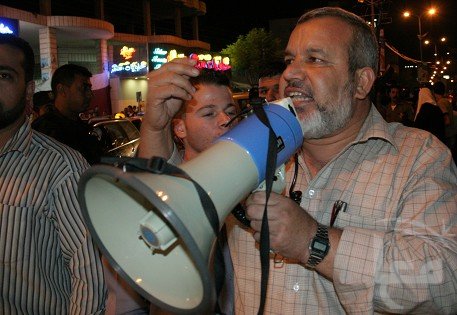
BETHLEHEM — Israeli forces detained a Hamas-affiliated member of the Palestinian Legislative Council on Monday from the southern West Bank district of Hebron.
Hatem Qafaish, elected to the Palestinian parliament in 2006 with Hamas’ Change and Reform bloc, was detained after Israeli forces ransacked his home, a local source told Ma’an. The PLC member was detained on 6 November 2007 and placed under administrative detention until his release in 2009.
Palestinian journalist Raed Ash-Sharif, working with a local Hebron radio station, was also detained.
According to the Ad-Dameer Prisoners’ Support and Human Rights organization, Qafaish had been detained by Israel five times previous to his latest detention. He was elected to the PLC in January 2006 after campaigning from his prison cell.
Qafaish was also among the more than 400 activists Israel deported to Marj Al-Zuhur in southern Lebanon in December 1992. After returning to the West Bank in 1993, he chronicled his experience in exile in a series of articles in the Al-Quds newspaper. He intended to eventually to publish a memoir, but the manuscript was confiscated by Israeli prison guards.
There are six Hamas-affiliated PLC members in Israeli, detained shortly after the Islamist movement’s electoral victory. Following the capture of Israeli soldier Gilad Shalit in June 2006 in a cross-border raid in Gaza, Israel launched a detention campaign targeting Hamas affiliated PLC members in a bid to secure the soldier’s release.
A second campaign was launched in 2009, after Israel, Hamas and a German mediator, failed to come to a prisoner swap deal under Ehud Olmert’s premiership. Many of those detained in the later campaign were handed down administrative detention sentences, according to a report issued in June, with others receiving prison terms. The majority were released shortly after.
Since the beginning of 2010, a number of Hamas PLC members were released, including Mohammad Abu Teir. Shortly after his release, Abu Teir was again detained, issued a revocation order for his Jerusalem residency rights, and handed down a deportation warrant. He is currently being remanded in custody until Israel’s Supreme Court hears his case.
Abu Teir is among three other elected Change and Reform parliamentarians who are faced with deportation from Jerusalem.
One lawyer told Ma’an that under all legal precedents, lawmakers are immune while sitting in office. Israel, the lawyer said, has violated this legal norm both by jailing Palestinian PLC members in the West Bank and passing laws within the Israeli Knesset removing Palestinian-Israeli members’ immunity under the pretense of spying for an enemy state.
Thirty-one detainees stood for the Palestinian general elections in January 2006, with 15 becoming members of the PLC.
Israeli police look to settlers to fill ranks
First army, now police set for takeover
By Jonathan Cook | October 18, 2010
As US-sponsored peace talks have stalled over the issue of settlements, Israel’s national police force has revealed that it is turning to the very same illegal communities in its first-ever drive to recruit officers from among the settlers.
The special officer training course, which is chiefly aimed at discharged combat soldiers, includes seven months of religious studies in an extremist West Bank settlement.
The programme has provoked widespread concern among Israel’s 1.3 million Palestinian citizens, a fifth of the population.
“The police have already repeatedly demonstrated their hostility to Palestinian citizens, but this move proves that the authorities want to extend and deepen our oppression,” said Jafar Farah, the director of Mossawa, an advocacy centre for the Palestinian minority.
“Is it really credible that these religious extremists who have been educated to hate Palestinians in the West Bank are going to behave differently when they police our communities inside Israel?”
The first 35 cadets in the officer-training programme – known as “Believe in the police” – are to start their studies next month. More than 300 settlers are reported to have expressed an interest in the course so far.
The police command is said to have taken up the idea, originally proposed by right-wing groups, in the hope of reversing years of declining recruitment levels that have led to a national shortage of officers.
Cadets will study for three and a half years, mostly at Haifa University in Israel, at the end of which they will be awarded a degree and the rank of officer.
But their studies also include seven months in a religious seminary in a small extremist settlement, Elisha, deep in the West Bank. Although all the settlements are illegal under international law, Elisha is one of dozens of wildcat settlements also illegal under Israeli law.
Gershom Gorenberg, an expert on the religious settlers, said Israel’s “future police commanders” would graduate from the course after an early lesson in law-breaking.
Yonatan Chetboun, the head of the Raananim movement, a right-wing group overseeing the programme, described to Olam Katan, a newspaper popular with the religious community, one way the organizers might win over settlers to a career in the police.
He said taking potential recruits on night-time patrols of Ramle and Lod – Israeli towns notorious for containing deprived, crime-ridden Palestinian neighbourhoods – would quickly open their eyes to one of “the most meaningful national issues”.
The police spokesman was not available for comment.
A team of rabbis has been appointed to resolve potential conflicts between the settlers’ religious principles and their police duties, which could involve desecrating the sabbath and dealing with “immodest” women.
A right-wing settler activist, Hor Nizri, who has clashed with the police in the past over the evacuation of settlements, has been put in charge of recruiting young settlers.
He told the Yedioth Aharonoth newspaper that the programme was “a historic reconciliation”, adding: “We want to fill the ranks of the police as we fill the ranks of the army.”
His comments have sparked concern among Palestinian groups inside Israel that the programme is the first phase of an attempted settler “takeover” of the police, replicating their growing dominance of sections of the army.
The first official figures on the number of settlers in the Israeli military, released last month, show their massive over-representation in combat units. About a third of all officers in such units were settlers, up from only 2.5 per cent in 1990.
The police hope that a career in the force will be attractive to many of the settlers after they are discharged.
However, Mr Farah said there was plenty of evidence that religious settlers were becoming ever more extreme in their hostility towards Palestinians. He pointed to the growing influence of extremist rabbis in promoting anti-Palestinian views.
Over the summer, two prominent rabbis from the settlement of Yitzhar, near Nablus, were questioned on suspicion of incitement after publishing a book, The King’s Torah, in which they sanctioned the killing of non-Jews, including children. In one passage, the authors write: “There is justification for killing babies if it is clear that they will grow up to harm us.”
The book has been endorsed by a number of senior rabbis in the settlements.
Similar sentiments have been gaining a foothold among army rabbis.
Early last year, in the immediate wake of Israel’s three-week operation in Gaza, it was revealed that the army rabbinate had handed out a booklet to combat soldiers about to enter Gaza calling their attack “a war on murderers” and warning them against “surrendering a single millimetre” of territory.
Some 1,400 Palestinians were killed in the attack, including hundreds of women and children.
The Palestinian minority’s relations with the police are already marked by deep distrust, following the killing of 13 unarmed demonstrators and the wounding of hundreds more in 2000, at the start of the second intifada.
A subsequent state commission of inquiry accused the police command of viewing the minority as “an enemy”.
Mr Farah also pointed to the unexplained deaths of 36 Palestinian citizens by the police over the past decade. In only two cases have police officers been convicted.
Some Israeli observers have expressed concern that the settlers’ greater influence on the police could also make implementing the dismantlement of West Bank settlements much harder in any future peace deal.
Mr Gorenberg said previous evacuations, including the 2005 withdrawal from Gaza, had been handled chiefly by the police because so many army units were dominated by settlers. The police, he added, “could acquire the same weakness”.
A version of this article originally appeared in The National, published in Abu Dhabi.
THE REAL STRATEGIC CHALLENGE THAT TURKEY AND IRAN POSE TO ISRAEL
By Flynt Leverett and Hillary Mann Leverett| New America Foundation | June 3rd, 2010

**For the photo above: David Ignatius (left), the moderator of this panel at last year’s Davos World Economic Forum, tries to stop Prime Minister Recep Tayyip Erdogan of Turkey (center) from speaking. Mr. Erdogan later left the stage to protest comments by President Shimon Peres of Israel (right).**
As the interlinked dramas of Israel’s attack on Turkish civilian ships on the high seas and the Obama Administration’s push for a new Iran sanctions resolution in the Security Council play out, some in the American foreign policy establishment are beginning to realize that the Middle East—and America’s place in it—are changing in profound ways.
Turkey’s deepening engagement in the region is an extremely important catalyst for change. Of course, this is not a new or suddenly breaking news story. Turkey’s refusal to allow U.S. forces to invade Iraq from Turkish territory in 2003—not long after Erdoğan’s AKP had come to power–should have been a wake-up call. At the time, though, Turkey’s decision was dismissed by the Washington establishment with a mix of disbelief and a refusal to appreciate how popular the decision was in Turkey.
After Turkey’s key role, along with Brazil, in brokering the recent nuclear deal with Iran and Erdoğan’s strong reaction to the Israeli attack on Turkish-flagged vessels, the U.S. foreign policy establishment is now compelled, by force of events, to recognize that something important is afoot. In this regard, we were struck by David Ignatius’ most recent column in the Washington Post, “Flotilla raid offers Israel a learning opportunity.” He writes,
“By attacking the relief flotilla, Israel picked a fight with Turkey, a more dangerous foe than Hamas. The quarrel has been brewing for the past several years, and it’s a huge strategic change in the Middle East. Once Israel’s most important regional ally, Turkey now seeks to challenge Israel’s hegemony as the local superpower. Prime Minister Recep Tayyip Erdoğan is a Muslim populist with a charismatic message: We won’t let Israel push us around. Where Iran’s president, Mahmoud Ahmadinejad, is often a buffoon, Erdoğan is a genuinely tough if erratic rival.”
Ignatius underestimates Ahmadinejad and the Islamic Republic’s challenge to Israel. But, to his credit, puts his finger on the most important strategic implication of Erdoğan’s challenge—it is fundamentally a challenge to Israel’s sense of unfettered hegemony over the region.
In explaining why Israel decided to attack Turkish ships headed for Gaza, Ignatius writes, with blazing clarity, “The answer is that over many years, Israel has become accustomed to unchallenged freedom of military action in the Middle East.” That is absolutely correct, and Israel is determined to preserve this freedom of action, whatever the cost—and to persuade craven American politicians and the more gullible parts of the American public that both vital U.S. interests and Israel’s very survival are at stake in preserving it, even when that is manifestly not the case.
We have previously made a similar argument about what is at stake for Israel in the disposition of the Iranian nuclear issue, see here. The Islamic Republic’s nuclear program is hardly an “existential threat” to Israel. But, a nuclear-capable Iran might, at the margins, begin to impose some limits on Israel’s absolute freedom to use military force unilaterally, wherever it wants, and for whatever purpose it favors.
The Israeli argument against Iran’s nuclear development—like its argument against Turkey’s pique over having Turkish vessels attacked on the high seas, its argument that settlements in occupied territory are completely legal, and its argument that blockading a civilian population in Gaza is also completely legal—is not based on rational analysis of actual physical threats. All of these arguments are directed towards the preservation of Israel’s regional hegemony, embodied in its unchallenged freedom of military action in the Middle East.
From this perspective, Iran and Turkey pose very similar “threats” to Israel. Iran’s re-emergence as a powerful regional player (with its principal regional foes, Iraq and Afghanistan, neutered by U.S. invasions) with the potential for a nuclear weapons “option” could effectively check Israel’s ability to use force unilaterally whenever and wherever it chooses. And, Turkey’s challenge to the siege of Gaza by Israel (and, let’s be fair, Egypt, too) could, if successful, have a similar effect.
New Hearing Set for Sami Al-Arian
By Stephen Lendman | The People’s Voice | October 16th, 2010

Though free on bail, Sami Al-Arian remains politically imprisoned like many hundreds of others behind bars. Because of his faith, ethnicity, prominence and political activism, he was accused of supporting “terrorism” and other outrageous charges.
In fact, he’s a Palestinian refugee, a distinguished professor, scholar, community leader, and civil activist, a man deserving honor, not incarceration doing hard time until released after five and half years of brutal treatment, including solitary confinement in rat and roach-infested cells.
He was denied religious services, got no watch or clock, and was kept in windowless cells with artificial lights kept on round the clock. Whenever outside his cell, he was also shackled hands behind back and ankles. In protest, he staged hunger strikes, long enough to endanger is life.
A Brief Timeline of His Case
FBI investigations hounded him for 11 years, spending millions of dollars for half a million phone wiretaps, searches and other forms of harassment.
Events came to a head at 5AM on February 20, 2003 when FBI agents and Joint Terrorism Task Force (JTTF) officers stormed his home guns drawn. They arrested him and three others separately on spurious charges of supporting terrorism, conspiracy to commit murder, racketeering, giving material support to an outlawed group, extortion, perjury, and other offenses proved bogus in court.
On February 27, University of South Florida president Judy Genshaft fired him, acting as a Bush administration stooge.
At his four day March bail hearing, prosecutors provided no evidence, witnesses, or any reason to hold him. Nonetheless, he and co-defendant Sameeh Hammoudeh were denied bail.
On March 27, he was incarcerated at maximum security federal penitentiary, Coleman, FL after initially held in jail. Later he was transferred repeatedly to other federal prisons.
In June 2005, his trial began. It was a witch-hunt travesty with phony evidence, the kind prosecutors use when they have none. Despite spending around $50 million for years of investigations and six months of trial, jurors exonerated him on eight serious charges, remaining deadlocked 10 – 2 for acquittal on nine lesser ones.
On March 2, 2006, fearing retrial, he agreed to plead guilty to one minor charge, be freed, then reunited with his family and deported. But it didn’t end there.
Assistant prosecutor Gordon Kromberg ordered him before a grand jury, violating terms of his plea bargain. Fearing entrapment, he refused, was held in contempt, again imprisoned, and sentenced to 18 months without mitigation – a clear effort to keep hounding and imprison him.
At the time, his attorney, Professor Jonathan Turley, called the Justice Department’s ploy “a classic perjury trap used repeatedly by the government to punish those individuals who could not be convicted before an American jury.”
Al-Arian appealed and remained imprisoned until released on bail on September 2, 2008 under house arrest, pending trial for criminal contempt. For the first time in over five years, he was reunited with his family, but his ordeal continues.
On October 29, 2010, a new hearing will be held before federal Judge Leonie Brinkema of the Eastern District of Virginia to decide whether criminal contempt charges will be pursued or dropped.
Under Obama, prosecutors are as ruthlessly corrupted as their predecessors, using every trick in the book to convict, whether guilty or innocent, and when trials are politically motivated, intensifying pressure even more. The Justice Department thus filed a motion to deny a defense motion, filed 18 months earlier to dismiss criminal contempt charges. Three previous DOJ motions were rejected. This time, Holder prosecutors not only requested denying the defense’s dismissal request, but asked Judge Brinkema to reverse her earlier decision letting Al-Arian’s attorneys present evidence in case of trial.
In March 2009, she backed the defense’s request to file a motion to dismiss Al-Arian’s charges, saying she’d rule later at further hearings, and expressing concern over government “bait and switch” tactics:
“where Dr. Al-Arian and his counsel were assured that, if he agreed to plead guilty (to one minor charge), he would not be subject to any further involvement with the Justice Department beyond his deportation following the completion of his sentence.”
Bush prosecutors reneged on the agreement.
Like earlier departments under Ashcroft, Gonzales, and Mukasey, Holder shows equal contempt for the law and judicial fairness, presenting a challenge for the most competent defense lawyers. Al-Arian, however, is well represented, his team led by Professor Jonathan Turley, a recognized legal scholar who’s written extensively on constitutional and tort law as well as legal theory and other topics. With him are attorneys William E. Olsen and Philip J. Meitl.
On October 29, at 8:30AM, Al-Arian’s hearing will be held at the
Albert V. Bryan US Courthouse
401 Courthouse Square
Alexandria, VA 22314
The freesamialarian site calls it his “most important” one so far, more than others up to now. His freedom and future depend on the outcome.
Some Final Comments
In July 2003, Amnesty International (AI) wrote US prosecutors, “calling for a review of the pre-trial detention conditions of Dr. Sami Al-Arian, aspects of which it said appeared to be ‘gratuitously punitive,’ ” and a breach of international standards.
In December 2005, AI sought fair procedures to resolve his case after jurors acquitted him of terrorist and other serious charges. AI noted his harsh solitary confinement, calling it “unnecessarily punitive.”
In August 2008, Howard Zinn said:
“I thought that (Al-Arian’s case) was an outrageous violation of human rights, both from a constitutional point of view and as a simple test of justice.”
His former appeals attorney, Professor Peter Erlinder and former National Lawyers Guild president said:
“The prosecution of Dr. Sami Al-Arian was a blatant attempt to silence political speech and dissent in the aftermath of the 9/11 tragedy. The nature of the political persecution of this case has been demonstrated throughout all its aspects, not only during the trial and the never-ending right-wing media onslaught, but also after the stunning defeat of the government in 2005, and its ill-advised abuse of the grand jury system thereafter.”
Throughout his ordeal, many other individuals and organizations expressed support, demanding justice and an end to prosecutorial ruthlessness, false imprisonment, and contempt for the rule of law.
In 2007, Norwegian filmmakers produced a documentary titled, USA v. Al-Arian. An updated 2009 version is now available. Access the following link to order:
Al-Arian was targeted for his ethnicity, prominence, activism, and for being Muslim at the wrong time in America. Washington’s police state harshness makes everyone just as vulnerable.
Earlier articles explaining Al-Arian’s ordeal, a man Bush administration prosecutors hounded, persecuted and imprisoned on bogus charges, can be accessed through the following links:
sjlendman.blogspot.com/-ordeal/04
sjlendman.blogspot.com/-ordeal/03
http://sjlendman.blogspot.com/-exoneration
Stephen Lendman lives in Chicago and can be reached at lendmanstephen@sbcglobal.net
Liberal American magazine says lowering ‘Arab’ birthrate inside Israel is hunky-dory
By Philip Weiss on October 17, 2010
This is what I don’t understand. Jonathan Tepperman of the “Eurasia group, a global political risk consulting firm,” is I’m guessing Jewish and is doing fine here in the U.S. So for him personally, as for me, the conceptual basis of Zionism– that Jews are endangered in the west– is probably meaningless; and I bet he likes living in a country where a member of a minority gets to be president. But here he is given a platform at the Atlantic to say that Israel is the “refuge for the Jews” and therefore it’s legitimate that it act to limit the population growth of Israeli Palestinians so they don’t threaten the Jewish majority–of a country he has the freedom to move to tomorrow and doesn’t want to.
Yes historically, that was the basis of Israel’s founding. Does it make sense today?
Notice too that throughout this argument, Tepperman speaks of “Israelis” and means Jews, and speaks of Palestinian Israelis as “Arabs.” And Israel is for those Jews “their own land.” Not the Arabs’ land. That seems implicitly racist. Those Palestinians are actually Israelis! Those Palestinians may not be represented in the government, because of racism, but they’re Israeli citizens. Just as many blacks and Jews are Americans and many of us would resent it if, say, we were excluded from higher office in the U.S. As I say, I just don’t get this.
Also note Tepperman’s argument that Israel must preserve its majority because Jews in Arab countries have been oppressed. Interesting realist argument, a two-wrongs argument. Jeffrey Goldberg makes it too. I’ve been in the neighboring Arab countries and he’s right, their governments aren’t pretty, but I don’t see why this should check democratic reform in Israel and Palestine. Tepperman:
Due to a birthrate much higher than Israel’s Jewish population, it was only a matter of time before Jews ceased to be a numerical majority in the territory they controlled. Sure enough: In 1970, Jews represented about 70% of the population between the Jordan River and the Mediterranean. But by 1995 that figure had fallen to 56% and by 2005 (just before the Israeli withdrawal from Gaza) to 51%.
These numbers forced successive Israeli leaders to face the fact that if they were determined to hold on to the Occupied Territories, they would soon become outnumbered in their own lands. At that point, Israel would have to choose between being Jewish or democratic, but it couldn’t be both. It was this hard logic that pushed such unsentimental men as Ariel Sharon and Ehud Olmert to eventually accept the logic of withdrawing from Gaza.
But as Lieberman has highlighted, the territories only represent part of the problem. Even if Israel were to shed itself completely of the West Bank today, the issue wouldn’t go away. For Israel proper–as defined by its 1967 borders–also has a sizable Arab population, and that population is also growing fast (or so it is commonly believed), again thanks to a birthrate higher than that of the Jews. The rate of increase is far too fast for the likes of people like Lieberman–but also too fast for many secular Israeli Jews, who worry that once again they risk being outnumbered in their own land.
This fear has merit. By the end of 2008 (the last date for which numbers are available), Israeli Arabs represented fully 20% of country’s population (excluding the territories), according to the Israeli Central Bureau of Statistics. This percentage has steadily risen over the years.
Now, those Israelis who worry about this, and dread being outnumbered by Arabs in their own country, aren’t necessarily racists. The two sides of Israel’s nature–its Jewish and democratic soul–have always coexisted uneasily, and would be quickly upset by a demographic shift. Israel was founded and internationally recognized as a refuge for Jews, and it is legitimate that modern Israelis are determined to keep it so. Given the way Jews have been treated in Arab lands, moreover, they have grounds to fear life under an Arab majority.
For all these reasons, a little demographic-induced panic is understandable.
500 Civil Activists from Asia Will March to Gaza Against Siege
TCN News | October 8, 2010
New Delhi: About 500 civil rights activists from 17 Asian countries will march to Palestine to press Israel to end the siege of Gaza. The activists will gather in New Delhi on December 1 and proceed to Gaza. The march is being organized by Asian People’s Solidarity for Palestine.
The group announced the schedule of the march in a press conference on October 5 in Delhi with similar press conferences on the same day in four other countries Turkey, Iran, Indonesia and Lebanon. According to the release, 500 civil resisters from 17 Asian countries will join the caravan from India and march through 18 Asian cities of Pakistan, Iran, and Turkey to break the siege of Gaza through the sea route in December 2010.
“This struggle is broad, varied and multi-dimensional. It is humanitarian and for peace, freedom and human dignity. It is against occupation, imperialism, apartheid, Zionism and all forms of discrimination including religious discrimination,” the group said.
Their major demands include Palestinian Self-Determination; Ending the Occupation; Equal Rights for All within historic Palestine; the Right of Return for Palestinian refugees; and Establishment of a Sovereign, Independent and Democratic state of Palestine with Jerusalem as the capital.
The Caravan will be carrying relief materials for the people of Gaza. The Asia to Gaza Caravan will cross into Pakistan via Wagah border where the Pakistan Solidarity for Gaza groups will host a civic reception for the caravan and Pakistani civil resisters will join the Caravan onwards to Iran. In every country and city, welcome committees will host receptions and public meetings with mass organisations and civil resisters will join the caravan. The caravan will culminate in 500 civil resisters boarding a ship from a Mediterranean port to sail to Gaza to break the illegal Israeli siege.
According to the release, the march has been endorsed by various organizations and individuals including All India Students Association (AISA), Aman Bharat, Asha Parivar, Awami Bharat, Global Gandhi Forum, JamiatUlema-I-Hind and Jamaat-e-Islami-Hind. The individuals include Achin Vanaik, Agdish Nagarkar, Anand Grover, Anand Patwardhan, Shabnam Hashmi, Shahid Siddiqui and Medha Patkar.
US backing international terrorists: Turkish PM
By Hamid Mir | The National | October 15, 2010
ISLAMABAD: Prime Minister of Turkey Recep Tayyip Erdogan has said the US was supporting some common enemies of Pakistan and Turkey and the time has come to unmask them and act together.
In an exclusive chat with this correspondent in the presence of Prime Minister Yousuf Raza Gilani, the Turkish prime minister very candidly answered critical questions not only about Turkey-Pakistan relations but also on some other important issues before leaving Pakistan on Tuesday night.
The Turkish premier said that the people of Pakistan should not fight with each other and they must concentrate on rehabilitation of 20 million flood victims. “Instability and infighting will only help your enemies who are looking for an opportunity to use Pakistanis against Pakistanis.
“If you will not understand the evil designs of your enemies then what will be the future of 20 million flood victims of Pakistan, who will help them if you start fighting with each other,” Erdogan warned.
He said that Pakistan,Turkey, Afghanistan and Iran have a common future, security of one country lies in the security of others but our enemies are creating problems for us. He said: “Pakistan is my second home and I am concerned about the internal situation of my second home”.
He insisted that Pakistan and Turkey must play a decisive role to stabilise Afghanistan. He said that both Pakistan and Turkey suffered from military dictators who were always supported by the USA; politicians were hanged by military regimes in both countries, and both the countries are fighting against terrorism these days.
Erdogan said: “We have common problems and common solutions, military dictatorships have always created problems and democracy is a common solution”.
When asked why no military dictator has ever not been tried in courts of Turkey and Pakistan, he said: “I don’t support hanging any military dictator but law must take its action against all those who abrogated constitution”. He said that some foreign hands are supporting terrorists in Pakistan and Turkey directly and also through some NGO’s.
Erdogan was very hard on the “double standards” of the USA and said that a recent Israeli attack on a Turkish ship Freedom Flotilla have unmasked the so-called civilised face of Washington who openly and shamelessly supported the state terrorism of Israel. “Nine Turkish martyrs on the ship received 21 bullets from Israeli soldiers in their bodies, we provided post mortem reports and even the pictures to the EU and USA but Washington is not ready to condemn the state terrorism of Israel against Turkey which means that the USA is supporting an international terrorist who killed our citizens in international waters”.
When asked that Turkey have diplomatic relations with Israel and what would be his advice to Pakistan for making diplomatic relations with Israel, Erdogan responded very carefully and said that “despite diplomatic relations Israel never behaved like a civilised country with Turkey and I cannot give any advice to my Pakistani brothers; it is their right to decide about making relations with Israel”. Erdogan said that Pakistan and India must resolve Kashmir dispute by peaceful talks. “You need strong political will for resolving Kashmir dispute,” he added.
During the conversation of the Turkish prime minister with this scribe, Yusuf Raza Gilani also suggested a question that “what is the procedure for the appointment of judges in Turkey?” Erdogan explained the whole process in detail and said that Parliament has an important role for the appointment of judges in Turkey. “I am facing problems from the courts but I am sure these problems will be resolved.” After listening this answer a very meaningful smile appeared on the face of PM Gilani and he said that “everything will be resolved nothing bad will happen in Pakistan”.
Iran trade with P5+1 rises 12%
Press TV – October 17, 2010
Trade exchange between Iran and the world’s major powers has seen a 12% rise in the first six months of the current Iranian year despite recent US-engineered sanctions.
During the first six months of the current Iranian year (started on March 21) the volume of trade between Iran and the P5+1 states — the permanent members of the UN Security Council plus Germany — has soared to 9.337 billion, reflecting a 12% increase, whereas the figure for the same period last year stood at 8.322 billion, Fars news agency reported on Sunday.
In defiance of persistent Western media hype with the aim of isolating the Islamic Republic, the country’s exports to China have climbed 66.76% with the value standing at $2.22 billion.
This is while the amount of imports rose to 34.39% valuing $2.53 billion.
During the same period, Iran’s imports from Germany had a 6.58% drop, but exports witnessed an increase of 5.77% reaching $124 million.
Iran’s trade volume with France has also seen a hike, with a 3.99% rise in import reaching $833 million and a 1.31% rise in export mounting to $24 million.
The amount of exports to Britain witnessed a 53.42% increase to stand at $25.5 million, while imports from the country declined 37% reaching $522 million.
Similarly, Iran’s imports from the US fell 36% to reach $73 million, whereas exports experienced an increase of 108% to stand at $77 million.
Russia was, however, the only P5+1 country with declining trade with Iran. Exports to Russia fell 32% to reach $89 million. In the meantime, imports from the country dropped to 10.24% worth $558 million.
The US, the European Union, and their allies accuse Iran of following a military nuclear program and shortly after the imposition of the fourth round of UN Security Council sanctions adopted unilateral punitive measures against Iran.
The sanctions aim to isolate the Islamic Republic and target the country’s energy and economy.
However, Iranian officials reject Western accusations that Tehran is pursuing a military nuclear program, arguing that sanctions are only a psychological war to increase pressure on the Islamic Republic and hamper its progress in the field of nuclear technology.
Australian says Guantanamo was ‘six years of hell’
The Nation | October 17, 2010
Australia’s former long-serving Guantanamo Bay inmate David Hicks Saturday broke his silence on life inside the US-run prison, saying he endured deprivation and witnessed brutality in “six years of hell”.
Hicks said he was in a “haze of disbelief and fear, pain and confusion” when he arrived in Camp X-Ray in Guantanamo Bay, Cuba in early 2002 and was placed in a cage made of cyclone fencing.
“The first two weeks of Camp X-Ray was a blur of hardships: no sleeping, no talking, no moving, no looking, no information,” he writes in “Guantanamo: My Journey” released today.
The former terrorism suspect once dubbed the “Aussie Taliban”, who has since married and now lives in Sydney, was captured in late 2001 in Afghanistan where he had been accused of fighting alongside Taliban forces.
He spent more than five years in Guantanamo before being sent to home in April 2007 to serve out the remainder of the sentence handed down by the US military commission which had convicted him of providing material support for terrorism. He was released from a South Australian jail in late 2007.
Hicks, now in his mid-30s, is legally unable to profit from his book because Australia does not allow people to benefit from crime.
In three extracts released to the media free of charge, he speaks of how his thirst for travel was sparked by a chance encounter with an Israeli traveller when he worked in Japan training racehorses.
He also says he had intended to help the Kashmiri cause for independence but ended up trapped in Afghanistan as the US led efforts to crush the Taliban after the September 11, 2001 attacks in the United States.
He writes that while an Afghan man had risked his life to find him a safe haven in the northern city of Kunduz, he ended up attempting to take a taxi to the capital Kabul and was captured en route by a Northern Alliance soldier.
“After yelling directly into my ear, he took me by the hand and began to pull me away. I went to resist, but he made a gesture to go for his gun,” Hicks writes. “With dread, I resigned myself to the situation and allowed myself to be led away. This was the beginning of six years of hell.”
US understates civilian casualties in Pakistan, makes no amends
MUSTAFA EDIB YILMAZ | Today’s Zaman | 17 October 2010
İSTANBUL – An American NGO working to raise awareness of the civilian victims of conflict has argued, in an extensive report, that the number of civilians killed or injured because of US airstrikes using unmanned aerial vehicles, or “drones,” is larger than the US government admits.
The Washington-based Campaign for Innocent Victims in Conflict (CIVIC) authored the nearly 70-page report, titled “Civilian Harm and Conflict in Northwest Pakistan,” which presents the NGO’s findings following a year of research into how civilians have been affected by the US-Pakistan war against militant elements in Pakistan’s troubled northwest. While researching the report, CIVIC gathered the verbal testimony of more than 160 Pakistani civilians who had suffered under the effects of violence, interviewed humanitarian workers and, crucially, met with Pakistani and US policymakers.
The report said that the US did not have a policy of compensation for the innocent victims of its drone strikes and had not made amends to these victims. The report argued that the US maintaining that civilian casualties caused by its drone attacks were “minimal” was divorced from the facts on the ground:
“US drone strikes, in particular, have touched off intense public debate. Neither the US nor Pakistani governments officially deny the program exists but tacitly concede its existence. Anonymous US officials insist that civilian casualties caused by drone strikes are minimal. CIVIC’s research and that of other independent nongovernment organizations indicates that the number of civilians killed and injured by drones is higher than the US admits,” the report said.
Since 2004, a small number of US troops have been involved in the Pakistani government’s war against a number of militant groups, including Al-Qaeda, in the northwest regions of Pakistan that border Afghanistan. The report also said that civilian casualties were “significant” because of the Pakistani military operations, but that the country’s government was trying to compensate civilians affected by military action.
“Of the warring parties involved in the conflict, the Pakistani government is the only one making some form of amends to war victims. For example, the Pakistani government maintains compensation programs for some civilian deaths and injuries as well as housing destruction. While these programs need improvement in practice, amends like these can restore a measure of dignity through recognition of losses and provide much-needed help, while also mitigating anger and enhancing the perceived legitimacy of the Pakistani government and military,” CIVIC said in the same report, adding that “after nearly a decade of conflict and billions of aid channeled into Pakistan, more can and should be done to address the civilian cost of the conflict.”
The NGO’s research also contained specific recommendations to the international community and the parties engaged in the hostilities: the US, Pakistan and the militant groups. While calling on the UN to form a body to investigate the conflict’s civilian casualties and to pressure all sides to recognize and develop measures to compensate them, the report urged the all parties to comply with the relevant laws of war to sustain proportionality in their attacks, while distinguishing combatants from non-combatants. The report urged the US to work in cooperation with the Pakistani government to compensate all civilian victims of the devastating conflict.
CIVIC’s Executive Director Sarah Holewinski is also critical of the media for ignoring the humanitarian aspects of the war in Pakistan.
“We, meaning the public wherever you go, have such a short attention span. I don’t expect a front page news story every day, but I do expect that the public and policymakers will pay more attention to war victims than they do — whether those victims are in Iraq, Afghanistan or Pakistan, or Somalia and Sri Lanka, for that matter. When you consider the suffering they’re going through, the way their lives have been devastated in the blink of an eye, more compassion and outrage, both, are appropriate. And when you consider that in many of these places the suffering of war victims’ creates mass, and long lasting, instability, the media is missing a big story that is the root of later problems and conflict,” she said in a written statement to Sunday’s Zaman.
Currently, the clashes between the Pakistani military forces and the militant groups are continuing at a concerning level in four provinces in the country’s northwestern region, while the US continues to bomb two more provinces in the area with its drones. In addition to civilian deaths and according to the latest available data of the Geneva-based Internal Displacement Monitoring Center (IDMC), an estimated 2 million people have been displaced in the country because of the violence.
Featured Video

Iran’s Mass Protests /Patrick Henningsen & Lt Col Daniel Davis
or go to
Aletho News Archives – Video-Images
From the Archives
Does Kevin Barrett Seek to “Absolve Islam of a Terrible Crime”?
The Kevin Barrett-Chomsky Dispute in Historical Perspective – Last part of the series titled “9/11 and the Zionist Question”
By Prof. Tony Hall | American Herald Tribune | August 28, 2016
Amidst his litany of condemnations, Jonathan Kay reserves some of his most vicious and vitriolic attacks for Kevin Barrett. For instance Kay harshly criticizes Dr. Barrett’s published E-Mail exchange in 2008 with Prof. Chomsky. In that exchange Barrett castigates Chomsky for not going to the roots of the event that “doubled the military budget overnight, stripped Americans of their liberties and destroyed their Constitution.” The original misrepresentations of 9/11, argues Barrett, led to further “false flag attacks to trigger wars, authoritarianism and genocide.”
In Among The Truthers Kay tries to defend Chomsky against Barrett’s alleged “personal obsession” with “vilifying” the MIT academic. Kay objects particularly to Barrett’s “final salvo” in the published exchange where the Wisconsin public intellectual accuses Prof. Chomsky of having “done more to keep the 9/11 blood libel alive, and cause the murder of more than a million Muslims than any other single person.” … continue
Blog Roll
Recent Comments
loongtip on Eilat port faces worst crisis… loongtip on British minister dreams of kid… loongtip on Kiev awards major mining proje… loongtip on UK believes it can seize any t… loongtip on Pirates of the Caribbean loongtip on Australian festival boycotted… loongtip on Kiev seeks to ban Russian musi… seversonebcfb985d9 on Somaliland and the ‘Grea… John Edward Kendrick on Kidnapped By the Washington… aletho on Somaliland and the ‘Grea… John Edward Kendrick on Somaliland and the ‘Grea… aletho on Donald Trump, and Most America…


 Aletho News
- Knesset advances bill mandating death by hanging for Palestinian prisoners
- Eilat port faces worst crisis as Red Sea shipping collapses
- Iran protest-riots can only achieve US-Israeli intervention, ‘shadow CIA’ concludes
- The Coming War on Iran: What Has Really Been Happening?
- US Cargo Planes Have Flooded the Persian Gulf Since the First of December
- Deep-state forces from abroad instigated violence in Nepal – former foreign minister
- Rare Earths—or Arctic Control? Greenland’s Riches May Just Be Excuse
- Kiev awards major mining project to Trump-linked investors
- US makes money from weapons, not from Ukrainian minerals
- Drone hits Kazakh tanker en route to Russian port
- If Americans Knew
- The New Neoconservatives
- As more Gaza children freeze to death, Trump eyes Gaza as starting point for world domination – Not a ceasefire Day 95
- More death: in Gaza, West Bank, Israeli prison – Not a ceasefire Day 94
- The Israeli Influence Operation Aiming to Install Reza Pahlavi as Shah of Iran
- Avoidable tragedy: another infant dies from cold – Not a ceasefire Day 93
- Israel is quietly erasing Palestinian refugee camps from existence in the West Bank
- The “Zionist tint” to the Maduro abduction, if not operational, then normative
- Press association condemns Israel’s continued ban on media access to Gaza
- Israeli Indifference to Palestinian Suffering Is Fertile Ground for the Growth of Sadism
- Surge in premature births, congenital defects, cancer deaths in Gaza – Not a ceasefire Day 92
- No Tricks Zone
- Denmark Places Climate Protection Above Animal Welfare, Poisoning And Culling Cows
- New Study: Greenland Was 3-7°C Warmer And Far Less Glaciated Than Today 6000-8000 Years Ago
- German Media Report That Current Frigid Weather Can Be Explained By Arctic Warming!
- Berlin Blackout Shows Germany’s $5 Trillion Green Scheme Is “Left-Green Ideological Pipe Dream”
- Modeling Error In Estimating How Clouds Affect Climate Is 8700% Larger Than Alleged CO2 Forcing
- Berlin’s Terror-Blackout Enters 4th Day As Tens Of Thousands Suffer In Cold Without Heat!
- Expect Soon Another PIK Paper Claiming Warming Leads To Cold Snaps Over Europe
- New Study: Human CO2 Emissions Responsible For 1.57% Of Global Temperature Change Since 1750
- Welcome To 2026: Europe Laying Groundwork For Climate Science Censorship!
- New Study Finds A Higher Rate Of Global Warming From 1899-1940 Than From 1983-2024
 Aletho News