Supreme Court Rules a Suspect’s Silence during Police Interrogation Can be Used against Him
By Noel Brinkerhoff and Danny Biederman | AllGov | June 20, 2013
Remaining silent during questioning by police can be used against a person in a court of law, the U.S. Supreme Court has ruled (pdf) in a startling reinterpretation of Fifth Amendment rights.
A narrow majority ruled 5-to-4 in Salinas v. Texas that it was permissible for authorities to present at Genovevo Salinas’ trial that he refused to answer the police’s questions about a fatal shooting because Salinas had already answered some questions prior to being arrested and read his Miranda rights.
Salinas voluntarily spoke with police about the December 1992 murders of Juan and Hector Garza in Houston. But when asked whether the shells found at the scene would match a shotgun found in his home, the defendant went silent and refused to answer.
A ballistics test subsequently showed the shells were fired from Salinas’ weapon. Prosecutors used the fact that Salinas did not respond to the question about the shells, and appeared nervous, as a further argument to convince jurors of his guilt. Also presented was testimony from a witness who said Salinas took credit for the killings.
Salinas’s first trial ended in a mistrial. A second trial resulted in his being convicted and sentenced to 20 years to life in prison.
He later appealed, arguing that prosecutors had violated his right to stay silent. Salinas’ silence as evidence of possible guilt should have been omitted from the trial, claimed his lawyer, citing the Fifth Amendment’s protection against self-incrimination.
Justices Samuel Alito, Anthony Kennedy, Clarence Thomas, Antonin Scalia and Chief Justice John Roberts disagreed with Salinas’ argument and validated his conviction. Their ruling states that Salinas would have to have voluntarily invoked his Fifth Amendment right in order to be protected by it.
Critics claim that this ruling damages the spirit of the Fifth Amendment and will hereafter give law enforcement an incentive to delay the reading of Miranda warnings—the right to remain silent—to criminal suspects.
Related article
Intelsat suspends satellite services to Iranian TV channels
Press TV – June 19, 2013
Communications satellite services provider Intelsat has announced the suspension of its services to the channels launched from Iran as the West’s campaign against free speech intensifies.
On Wednesday, the Luxembourg-based company said it will no longer provide services to Iranian channels including Press TV. The decision has been made under the pretext of the company’s abiding by illegal sanctions against the president of the Islamic Republic of Iran Broadcasting (IRIB) – that’s Iran’s national broadcasting corporation.
Intelsat noted that it has been ordered by the US government to avoid extending IRIB’s license, noting that it will stop providing services as of July 1st.
Press TV and other Iranian channels have come under an unprecedented wave of attacks by European governments and satellite companies since January 2012.
They have been taken off the air in several Western countries, including Britain, France, Germany and Spain.
European companies say they are abiding by anti-Iran sanctions. However, EU foreign policy chief’s spokesman, Michael Mann, has told Press TV that sanctions do not apply to media.
In the meantime, the French-Israeli CEO of Europe’s satellite giant, Eutelsat, has written letters to several satellite companies, asking them to stop cooperating with Iranian channels.
The Israeli lobby in the United States has also publicly supported European attempts to shut down Press TV.
Media activists call the attacks on Iranian channels a campaign against free speech launched by the same European governments that preach freedom of expression.
Related article
- Israel says no ‘compromise’ should be made with Iran (alethonews.wordpress.com)
Venezuela Promotes Breastfeeding over Baby Food, Corporate Media Spins Out of Control
By Tamara Pearson | Venezuelanalysis | June 20, 2013
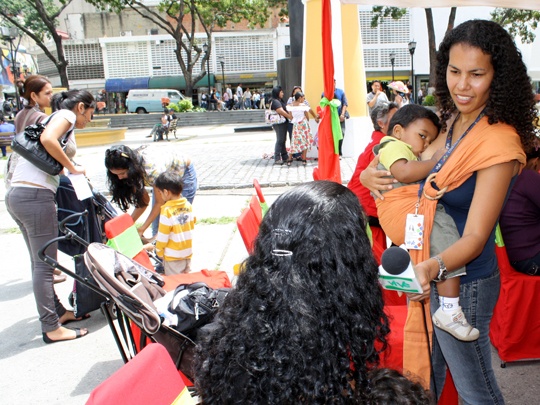
A Venezuelan public media journalist breastfeeds as she works. Public breastfeeding is fairly accepted in Venezuela (blog.chavez)
Venezuela’s national assembly is debating a reform to its breastfeeding law which could see baby food companies like Nestle fined in certain situations. The corporate media have reacted hysterically to the law, claiming that President Nicolas Maduro is “taking bottles from babies’ mouths”.
Though breastfeeding is widely promoted by the Venezuelan government, and public breastfeeding is relatively de-stigmatised, a study by Venezuela’s National Nutrition Institute (INN) between 2006 and 2008 showed that only 55% of mothers exclusively breastfed when their baby was born, going down to 20% when their baby was three months old, and 11% by six months.
The percentages have probably increased since then, with broad educational campaigns in public schools and health centres, and actions such as mass public breastfeeding in plazas, organised by the INN.
However, the low figures reflect the low confidence some mothers have in their ability to breastfeed, as well as the power of multinational infant formula companies in health centres. It is common practice to give infant formula to babies from the moment they are born, without the consent of parents, according to LactArte, a pro-breastfeeding collective in Venezuela. Companies give gifts and other promotions to health workers and health centres in order to create alliances with them, and give free samples of the products to new mothers, thereby creating dependent consumers of new born babies, or at least discouraging exclusive breast feeding.
What the law actually says
In 2007 Venezuela’s national assembly passed the Law of Protection, Promotion, and Support for Breastfeeding. The law regulates the way baby formula and baby food companies advertise and label their products, and how they interact with hospitals and clinics. However, the companies have been ignoring the law, as it doesn’t specify penalties. The reform to the law currently being discussed is looking at penalties of US$600 – $50,000, and also training for health professionals. Once the reform is passed in first discussion by the assembly, it will be subject to “street parliament” – discussion by collectives and Venezuelan citizens, to then be passed by the national assembly in second discussion.
The 2007 law argues that breastfeeding provides babies with “all the necessary nutrients” in their first six months, as well as “protecting them and immunising them from illness and contributing to the development of their breathing and gastrointestinal capacity”. It states that “mothers have the right to breastfeed their children, with the support and collaboration of the fathers… [who] should provide all the support necessary so that mothers can provide this human right… The state, with solidarious participation from organised communities, will promote, protect, and support exclusive breastfeeding…of children under six months of age and breastfeeding with complementary food … until the age of two”.
Concretely under the law, health workers and health centres must help mothers start breastfeeding within the first half hour of birth, and guarantee that the newborn is always near the mother after birth, except in exceptional medical situations. They should also educate mothers, fathers, and the family on the issue, and abstain from providing babies under the age of 6 months with food other than breast milk, except when there is a specific medical need. Health centres must create human milk “banks”.
Baby food and formula products must be in Spanish or Venezuelan indigenous languages (Nestle products for example, often aren’t), and they should inform of the risks of including such food in the baby’s diet too early. Publicity or labelling can’t create the impression that such food is equal to breast milk, and publicity of any kind discouraging breastfeeding is not allowed.
All food aimed at children under three must include labelling that clearly states its ingredients, including any GMO products, and milk formulas must including a warning that “breast milk is the best food for children under two years old”.
Samples, prizes, and promotions of baby food and formula are prohibited. Likewise, companies are prohibited from donating toys, books, posters or other products which promote or identify their company to health centres, and they are also prohibited from donating “gifts” to health centre workers and from sponsoring events or campaigns aimed at pregnant or breastfeeding women, fathers, health professions, families, and communities.
Breastfeeding rights in Venezuela
Last year, with the passing of the new labour law, women’s breastfeeding rights were further expanded. Post-natal leave was extended to six months, and articles 344-352 state that mothers have the right to two half hour breaks per day to breastfeed. If there is no breastfeeding room provided by the work place, that is extended to two 90 minute breaks, and all employers of more than 20 workers must maintain a nursery centre with a breastfeeding area.
For Luisa Calzada and Kaustky Garcia, of LactArte, breastfeeding is also an act of food sovereignty – that is, third world productive or economic independence from greedy transnationals. Garcia argued that such sovereignty has been “sabotaged” in Venezuela by the “transnational industry dedicated to the business of infant formulas”. Indeed the industry is huge here – visit any supermarket or corner shop and you’ll see full aisles or shelves of powdered baby milk formula and compote.
LactArte supports a boycott of Nestle, one of the main powdered milk formula companies here, producing the infamous Cerelac since 1886. They argue that there is“collusion” between the baby food industry and the medical industry, with the food transnationals enlisting an “army of health professionals” to sell baby formula.
According to Business Insider, infant formula is an $11.5 billion market. The International Baby Food Action Network (IBFAN) claims that Nestle, apart from distributing free samples of its products in maternity wards, also uses “humanitarian aid” to create markets, and offers gifts and sponsorship to influence health workers to promote its products. According to a 1982 New Internationalist article, Nestle makes mostly third world mothers dependent on its formula in three ways: “Creating a need where none existed, convincing consumers the products are indispensable, and linking products with the most desirable and unattainable concepts- then giving a sample”.
What the corporate media are saying
The 2007 law and the draft reforms do not ban the production or sale of baby food or formula, as national and international media have alleged, nor do they apply any fines to mothers or penalise any choices regarding her body that a mother may make. The penalties are only for health care centres and their workers, and baby food and formula companies.
However the corporate media over the last two weeks has completely distorted the issue. Fox News Latino headlined “Venezuela Wants To Ban Baby Bottles To Promote Breast-Feeding” and stated that “Motherly love has become a state affair in Venezuela”.
Growing Your Baby also headlined “Venezuela considering baby bottle ban”, and opened with the utterly misinformed and misleading question, “What would you do if you woke up one morning and learned that baby bottles were no longer being made or sold in your country? This question may become a reality for Venezuelan moms who may not have planned on breastfeeding”.
Reuters won the prize however for manipulation and sensationalism, with the headline “Venezuela considers taking bottles from babies’ mouths”, while other agencies have carried similar titles along the “banning” theme, with CNN’s article “Venezuela considering a ban on baby bottles” and Huffington Post ‘Venezuela considers baby bottle ban to encourage breastfeeding’. Al Jazeera went as far as to argue in its piece that “some mothers don’t want the government telling them how to feed their children”. If Al Jazeera had bothered to read the 2007 law, it would have discovered that is actually the point of the law – to stop companies interfering, through misleading information and other gimmicks, in the breastfeeding process.
Venezuelan corporate press and other Spanish language media have been equally manipulative. Here is a small selection of their headlines: EFE: “Venezuela is debating a law to prohibit baby bottles”, Semana: “Baby bottle and dummy: the new enemies of Chavismo”, El Pais: “The Venezuelan government wants to oblige mothers to breastfeed”, El Popular: “Venezuela: Nicolas Maduro wants to eliminate the use of baby bottles”, Noticias24 “They’ll prohibit baby bottles in health centres of Venezuela in order to force breastfeeding”, El Mundo, “Venezuela declares war on the baby bottle”, and Entornointeligente, “Goodbye to baby bottles for stimulating breastfeeding”.
Garcia argued that the media campaign to demonise the law and the proposed reforms is being pushed by the milk formula industry. She said it has had an impact in Venezuela, with “many women, even those not using baby bottles, feeling scared”.
“They are worried that the government is going to try to help them to breastfeed, that the government will take away their baby bottles and infant formulas, and is going to prohibit them from feeding their infants with baby bottles, but that’s absolutely false. First of all it’s unpractical, and secondly it is this government which has most given freedom and provided information so that families can freely chose the path they desire for their children,” she said.
The World Health Organisation recommends that babies be exclusively breast fed during the first six months, and in 1981 the 34th World Health Assembly adopted a resolution which included the International Code of Marketing Breast-Milk Substitutes. Funnily enough, it stated that food companies shouldn’t promote their products in hospitals, give free samples to mothers, or provide misleading information. One wonders if these international bodies were also accused of “stealing the bottle from babies mouths”, or is that sort of rubbish reserved for countries like Venezuela where a revolution is trying to get some justice at the expense of the poor transnationals?
UK Supreme Court votes to lift sanctions on Iranian bank
Tehran Times | June 19, 2013
LONDON – The UK Supreme Court has ruled in favor of Bank Mellat, Iran’s largest private bank, in a result which will see it removed from the United Kingdom’s sanction list.
The appeal was heard by nine out of the Supreme Court’s twelve judges after the UK’s highest court was forced to enter closed session for the first time in its history, in order to receive secret evidence from the security services.
Her Majesty’s Treasury imposed sanctions against the bank in 2009 alleging that the bank’s activities supported the Iranian nuclear program, but Wednesday’s ruling found no evidence to support this claim. The UK Supreme Court result follows similar success for the bank at the European Court in January of this year in respect of sanctions which had been imposed on the bank by the EU Council.
The ruling is a blow to the controversial system of “secret courts” which have allowed the security services to provide evidence to the Supreme Court behind closed doors for the first time in its history.
The Supreme Court reluctantly entered into closed session in March, effectively barring the bank from accessing the evidence against it. Zaiwalla & Co Solicitors, the London-based international law firm representing the bank, had argued against the imposition of closed courts on the grounds that it contravenes the British common law principle of open justice. The failure of the Treasury to produce compelling evidence, despite the controversial new powers, puts the spotlight back on the Justice and Security Bill, which expanded the system of closed courts to civil cases.
The ruling sends a strong message to the UK government that political expediency is not a sufficient legal justification for sanctions placed against Iranian private businesses which operate out of Iran. The Supreme Court is now expected to order the British government to pay Bank Mellat all of its legal costs and damages for the wrongful listing of Bank Mellat.
After initial failure to challenge sanctions before the English High Court and the Court of Appeal, Bank Mellat turned to Zaiwalla & Co in 2010 and has since gone from strength to strength in the European and now Supreme Court. The firm, led by Sarosh Zaiwalla, have shown that even in cases of national security, the UK government must abide by the rule of law, with the some of the justifications for the sanctions considered “arbitrary”, “discriminatory” and even “irrational”.
Sarosh Zaiwalla, senior partner at Zaiwalla & Co said, “Today’s ruling is a victory for the rule of law as much as it is for Bank Mellat.
“The judgment will put enormous confidence in the independence of the British judiciary and sets an example that even controversial disputes can be resolved by applying the principle of rule of law through the British courts.
“Nevertheless, the reading of the closed judgment clearly contravenes the British principle of open justice, the bank’s success demonstrates just how unjustified closed sessions are.”
Russia mocks Obama
The News | June 20, 2013
MOSCOW – Russia’s deputy prime minister poured cold water Wednesday on US President Barack Obama’s proposal to reduce nuclear stockpiles by a third, saying it could not be taken seriously while the United States is developing its missile defence system.
“How can we take seriously this idea about cuts in strategic nuclear potential while the United States is developing its” capabilities to intercept Russia’s weapons, Dmitry Rogozin asked. “Clearly, (Russia’s) political leadership cannot take these assurances seriously,” said Rogozin, who oversees the defence sector and the nuclear industry, according to the state-owned Itar-TASS news agency.
“The offence arms race leads to a defence arms race and vice versa,” he said, speaking after a government meeting in Saint Petersburg that focused on Russia’s defence sector. His remarks followed the call on Russia by the US president in Germany to reduce strategic nuclear weapon stockpiles by up to a third, taking them to the 1,000 weapon mark.
The previous ground-breaking cut was agreed by United States and Russia in 2010 as part of the Strategic Arms Reduction Treaty (START) that Obama signed together with then-president Dmitry Medvedev. The treaty restricts the former Cold War foes to a maximum of 1,550 deployed war heads each.
Putin and Obama had a frosty meeting at the G8 summit in Northern Ireland on Monday, and while Putin made no direct reaction to Obama’s proposal, he said Wednesday that Russia would not allow “the system of strategic deterrence to be disturbed”.
“We cannot allow the balance of the system of strategic deterrence to be disturbed or the effectiveness of our nuclear force to be decreased,” Putin said in televised remarks at the Saint Petersburg government meeting.
Disagreements over the missile shield over Europe have plagued Russia-US relations for years. Moscow sees it as directly undermining its own capabilities despite Washington’s assurances that the system focuses on regional threats like Iran and North Korea.
Obama’s Speech at Berlin’s Brandenburg Gate: Shameless Hype, Irony, Lies and Hypocrisy
Doug E. Steil | Aletho News | June 20, 2013
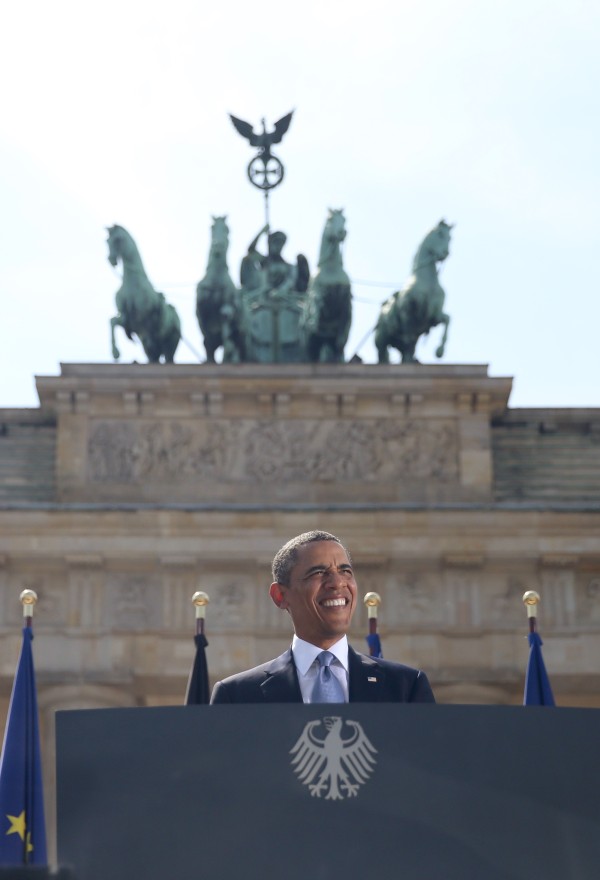 While last visiting Berlin five years ago, candidate Obama gave a speech at a central monument in Berlin amidst a huge crowd, of mainly young folks, that had been seduced through the local media projecting the notion that the new Messiah had arrived. Obama’s handlers wanted to stage that event at the Brandenburg Gate, the recognized symbol for the fall of Communism, but the request was denied by German Chancellor Merkel.
Yesterday Obama was back in town again, with his family, and staged a propaganda event at the Brandenburg Gate amidst extremely tight security that annoyed much of the local population. Beforehand, the media had announced, he would be presenting a landmark speech. Purportedly, just hours before, he was still working on the details. It’s true, imagery of the Brandenburg Gate conveys significant symbolism in the context of 20th century history, so it was not completely unreasonable to anticipate the possibility of a major political announcement, say, perhaps even a complete withdrawal of US military forces and nuclear missiles from German territory, that would surely divert attention from the numerous political scandals surrounding Obama’s regime in the past few weeks.
What Obama presented instead was nothing monumental or historic, but merely the standard repertoire of cheap platitudes, cliches, and “happy talk” that cynics and skeptics have heard far too often already. Political observers understand that, not unlike Ronald Reagan, Obama is merely a puppet for the Jewish Power Establishment, whose common interests and agenda issues he thus represents, under the clever guise of an elected figurehead, who is well trained in the art of Teleprompter delivery, small-talk, back-and-shoulder slapping his political counterparts, thus deceiving the population or lulling the people into a sense of passive complacency.
The essence of yesterday’s speech at the Brandenburg Gate, as the media duly reported, was that his regime would set a “goal” of reducing the number of active nuclear weapons (presumably in western Europe) by “up to” (i.e. no more than) one third. Very “wishy-washy” indeed! Would this even be in the news a week from now? It was evident from the various comments in the German media immediately after the speech, though polite, that prior expectations of substance had not been fulfilled. How many more times can people endure the standard references to gay and lesbian aspirations or agenda related “concerns” regarding the imaginary threat of “Climate Change” (formerly “Global Warming”)?
Particularly annoying was the manner in which Obama shamelessly elevated the now unified Berlin to a new symbol of “freedom”. The irony was inescapable, in light of recent public revelations concerning pervasive NSA spying. In 1989 the people of Eastern Germany had shaken off an odious regime that was particularly notorious for prying into the personal lives of a large segment of the population, who were deemed untrustworthy. By contrast, thanks partly to the misuse of improved technology, the Obama regime spies on the entire population, and in far greater detail, than those running the East German “Stasi” apparatus could have ever imagined. Referring to the former separation wall between east and west, he invoked the word “freedom”, amidst applause:
“No wall can stand against the yearning of justice, the yearnings for freedom, the yearnings for peace that burns in the human heart.”
Well, if that is the case — which it obviously is — then why does his regime continue funding and politically supporting the Israeli built wall, which relegates much of the Palestinian population in the West Bank in small and manageable enclaves and separates them from the rest of their territory? During his rhetorical delivery, Obama then proceeded to utter the word “freedom” sixteen additional times.
Yet, aside from that hypocrisy, one need only imagine how German efforts to attain unification during the early months of 1990 would have been handled by an Obama puppet regime, had it been in power at the time. That process of political unification, which ultimately took nearly eleven months, was triggered by the breaching of the Berlin Wall at the Brandenburg Gate spearheaded by Helmut Kohl and facilitated by President George H. W. Bush, but was not warmly received at all by leaders Thatcher, Mitterrand, or even Gorbachev and widely opposed by the Jewish Power Establishment, through editorials and other efforts, behind the scenes. This is very easy to imagine because in the past year, still fresh in our minds, Americans have been witnessing or personally experiencing the continued and thorough erosion of the basic freedoms enumerated in the Bill of Rights in conjunction with the zealous pursuit of virtually every foreign policy initiative concocted and promoted by Obama’s puppet masters, over the general objections of a general population whose opinions and interests do not seem to matter.
New wall construction to surround Azzun Atma
International Solidarity Movement | June 20, 2013
Azzun Atma, Occupied Palestine – On the 18th of June, two bulldozers arrived with Israeli forces in the village of Azzun Atma, southeast of Qalqilya, and began to work on the land behind the village’s school, to what is believed to be the construction of the new wall.
Accompanying the bulldozers to the village was the Israeli army and border police, including the local Israeli army commander who said the action was based on a High Court decision by the Israeli government. He said it was in order to protect their citizens, and if anybody tried to stop the construction, they would then close the gate to the village, the only way in and out.
Two weeks prior to this, the Israeli army put up signs stating that this is where the construction of the new wall would begin. The villagers fear that this new construction is being done in order to replace the current two metre barbed mesh fence that surrounds the village from all sides and separates it from the settlements nearby, with the concrete wall. The wall’s existence and constant deviation from the Green Line is justified by the Israeli authorities by citing security concerns for its citizens, in this case the illegal settler colonisers in the area.
Azzun Atma is located two kilometres east of the Green Line and encompassed on three sides by the current wall, constructed in 2002, which leaves the village within a settlement block and separates it from the rest of the West Bank. The only way in and out of the village is through a military checkpoint with a small gate. The village is thus stranded in the “seam zone” between the Green Line and the wall, surrounded by settlements, placing it under full Israeli military control. Access to the village, therefore, is dictated by the Israeli military and the checkpoint is regularly closed, denying the villagers their right to freedom of movement. The villagers thus live under the constant threat of the gate being closed and work permits for the other side of the Green Line being denied.
Palestinians living in the “seam zone” require permanent resident permits from the Israeli authorities to live in their own homes and work on their land. There are often few health and education services available in the “seam zone”, and those living inside it have to rely on checkpoints being open to reach workplaces and essential services.
The school where the construction is taking place has provided education for 300 children in Azzun Atma and a neighbouring village since 1966. Every day, the current wall and checkpoint restricts the freedom of movement of teachers and students. The school has so far lost one dunum of land to the wall and the septic system faces demolition orders.
When the second wall is constructed, Azzun Atma will be isolated from the rest of the West Bank by the already existing wall (see the red line on the map) and the new wall which will further close off the village from the settlement block and the rest of the West Bank (see the black line on the map).
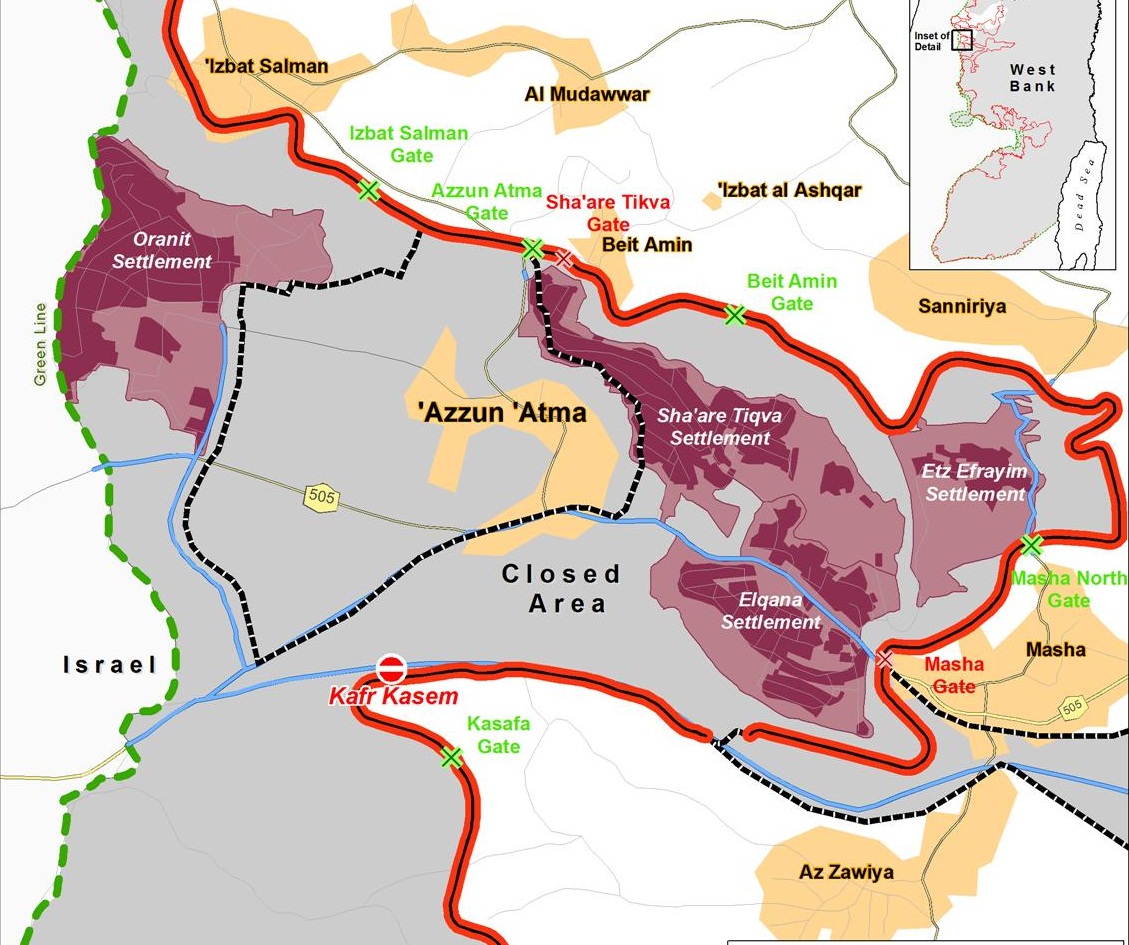
Azzun Atma (Map by OCHA)
In 1982, the Israeli authorities established two illegal settlements: Oranit to the northwest and Sha’are Tiqva to the northeast of Azzun Atma. The settlements have expanded over the years, and more than 2500 dunums of the village’s land have been stolen by them. Sha’are Tiqva now comes within metres of Azzun Atma, and since 2005, villagers have been subject to verbal harassment from settlers. The wall, though purported to be a security measure, is essentially another way for the Israeli government to steal land from their Palestinian owners and isolate villages and cities from each other, turning them into easily controllable cantons.
Isolating people and making daily life as hard as possible under occupation is a tactic used by the Israeli authorities to force villagers to leave their land and homes. However, residents of Azzun Atma remain steadfast in their land and will continue to resist the land theft, isolation and deprivation of their lives by organising protests.
Related articles
- Israeli settlers threaten to occupy Palestinian village of Azzun (occupiedpalestine.wordpress.com)
- West Bank Barrier creates hardship for Palestinian villagers (euronews.com)
Snowden: Don’t mention the I-Word!
By Steve Sailer | June 18, 2013
The New York Times’ “public editor” writes a little piece that asks an interesting question in the title:
Following Up on the N.S.A. Revelations: Were They Really ‘Confirmations’?
By MARGARET SULLIVAN
She lists various articles over the last eight years that recounted much of what Edward Snowden said. For example, James Bamford has been covering the NSA since his 1982 book The Puzzle Palace. Bamford regularly discloses interesting information in Wired, such as the revelations of the more central NSA whistleblower William Binney.
And there were plenty of disclosures about telephone metadata snooping going back to Carl Cameron’s four-part Fox series in 2001.
No doubt there are lots of reason Snowden got so much publicity, but let me mention a subtle one. Unlike Bamford, Binney, Cameron and many others who have looked into snooping in America, Snowden, as far as I can tell, has never mentioned the I-Word: Israel.
Generally, anybody who looks into NSA questions pretty quickly notices that the NSA outsourced some spying on Americans to Israelis, and that, by now, the question of which country is the dog and which country is the tail has gotten murky. For example, here’s a 2012 Wired article by Bamford:
Shady Companies With Ties to Israel Wiretap the U.S. for the NSA
But that’s not the kind of thing that the media or, to be frank, the great majority of the American public wants to think about. We’ve all been socialized to shut our brains off when it comes to this tail wagging the dog question. Cameron got to keep his job at Fox, for example, but his series got erased from the official record.
Snowden, in contrast, has kept things nice and neat for people. Everybody seems to have a nice strong opinion about Snowden in part because he hasn’t set off the mental shutdown process that the I-Word provokes in well-trained Americans.
Featured Video

No Threat Can Force Iran’s Surrender /Trita Parsi & Lt Cl Daniel Davis
or go to
Aletho News Archives – Video-Images
From the Archives
An Expert Military Analysis of War with China
Actually, None is Necessary
By Fred Reed • Unz Review • December 13, 2020
The Correlation of Armed Forces: U.S. goods and services trade with China totaled an estimated $634.8 billion in 2019. Exports were $163.0 billion; imports were $471.8 billion. The U.S. goods and services trade deficit with China was $308.8 billion in 2019. Trade in services with China (exports and imports) totaled an estimated $76.7 billion in 2019. Services exports were $56.5 billion; services imports were $20.1 billion. The U.S. services trade surplus with China was $36.4 billion in 2019.
There is talk within the Washingtoniat of a possible war with China. Steve Bannon, who apparently was dropped on his head as a child, actually favors such a war. We hear the usual shoo-the-boobs alarm about how the Chinese are doing something terrible and we must gird our loins and American values and show them what for, bow wow, woof. The danger is that the current game of who-blinks-first in Asian waters might actually provoke a shooting war. You know the kind of thing: One warship refuses to get out of the way of another, a collision ensues, some retard lieutenant who signed up on waivers opens fire, and we’re off and running. It is not a good idea to let children play with matches.
The said war is discussed either in emotional terms by idiots or in purely naval terms by those familiar with such things, so we hear of the First Island Chain and the Second Island Chain and whose missiles against the other’s missiles and so on. This would be appropriate if we were fighting World War Two again. Which we aren’t. Let’s take a quick-and-dirty look at how such a war might go.
To begin the war, America would overestimate itself and underestimate China. This is doctrine in the Pentagon. … continue
Blog Roll
 Aletho News
- Iran To Target Military Industrial-Tech Complex That Facilitated Gaza Genocide
- Collapsing Empire: The Resistance Disarms ‘Israel’
- Suicide Should Not Be a Government Service
- Rethinking America’s greatest threat: Iran vs. Israel-Firsters
- Iran accuses adversaries of false flags to strain Turkey ties
- Poland rules out sending Patriot missiles to US/Israel amid war on Iran
- Tehran approves new Hormuz plan with major restrictions
- No Threat Can Force Iran’s Surrender /Trita Parsi & Lt Cl Daniel Davis
- UK’s New Pandemic Plan Would Turn Big Tech Into a Mass Location Tracking Network
- Growing insecurity, soaring prices fuel protests in north as regime bans evacuation: Sources
- If Americans Knew
- Ann Coulter Rips Into Fox News for Iran War Coverage, Compares to False Rigged 2020 Election Reporting
- Joe Kent Urges Americans To Call White House and Congress To Object To Sending Troops Into Iran
- DNC Resolution to Reject AIPAC Funding Puts Democratic Leaders in the Hot Seat
- Swedish foundation to build 400 schools as over 650,000 Gaza children remain without education for 2 years
- Israeli army admits photshopping image of slain Lebanese journalist
- This is how Israel is systematically killing health workers under the cover of war in Lebanon
- Carrying life under fire: Israeli invasion of Lebanon leaves pregnant women facing deadly risks
- Champagne all around for the new death penalty (for Palestinians) law – Not a ceasefire Day 172
- Why are Palestinian books struggling to be seen on Amazon?
- The Line Between Affinity and Conspiracy
- No Tricks Zone
- New Study Finds Warming Saves Lives…Cold Temperatures 12 Times More Deadly Than Excess Heat
- German Science Blog Accuses PIK Climate Institute Of Hallucinating Climate Tipping Points
- Devastating Assessment Of Comirnaty Vaccine By Former Senior Pfizer Europe Toxicologist
- New Study: CO2 Is ‘Effectively Negligible’ As An Explanatory Climate Change Factor Since 2000
- Former Pfizer Toxicologist Dr. Helmut Sterz Tells Bundestag Hearing Pfizer Vaccine Should Have Never Been Approved
- Energy Expert: Germany’s Nuclear Phaseout Was A “500 Billion Euro Mistake”
- New Research: South Australia’s Mid-Holocene Sea Surface Temperatures Were 4°C Warmer Than Today
- Storing Green Energy To Last Germany 10 Days Would Require A 60-Million Tonne Battery
- New Studies: UK Sea Levels Were 4 Meters Higher Than Today During The Mid-Holocene
- Destructive Green New Deal: German Energy And Metal Group Warns Of Drastic Crisis
 Aletho News