Canada’s Proposed Radioactive Waste Dump Next to Lake Huron
By John LaForge | September 27, 2013
Kincardine, Ontario – The thought “Dumb and Dumber” came to mind as I recorded the work of Canada’s Joint Review Panel Sept. 23 and 24, here in Ontario, on the east end of Lake Huron. The JRP is currently taking comments on a proposal to dump radioactive waste in a deep hole, 1mile from the shore of this magnificent inland sea.
What has to be called just plain dumb, is that the nuclear bomb industry branched out to build nuclear power reactors and, as E.F. Schumacher said, to “accumulate large amounts of highly toxic substances which nobody knows how to make safe and which remain an incalculable danger to the whole of creation for historical or even geological ages.” Unfortunately in the case of radioactive waste this has happened here, in Canada, etc.
Then, the giant Canadian utility Ontario Power Generation (OPG) proposes to bury its radioactive waste in a limestone dug-out, or “deep geologic repository,” one mile from the Great Lake Huron.
This must be considered “dumber”, but you’d be amazed at how much dumber it gets. Listening to the presentations of government regulators and utility propagandists for two long days normally puts reporters to sleep. But the staggering implausibility of some statements and the shockingly cavalier nature of others kept me blindingly awake.
The low- and intermediate-level radioactive waste that could be dumped in a 2,200-foot deep hole here — 200,000 cubic meters of it — contains long-lived, alpha radiation emitters like plutonium, the most toxic substance on Earth, which is dangerous for 240,000 years (10 half-lives).
Yet the reactor operator, Ontario Power Generation, had the nerve to say in a 2008 public handout: “[E]ven if the entire waste volume were to be dissolved into Lake Huron, the corresponding drinking water dose would be a factor of 100 below the regulatory criteria initially, and decreasing with time.”
This flabbergasting assertion prompted me to ask the oversight panel, “Why would the government dig a 1-billion-dollar waste repository, when it is safe to throw all the radiation into the lake?” The panel members must have considered my question rhetorical because they didn’t answer.
But it gets dumber.
There is much concern among Canadians over the fact that their government’s allowable limit for radioactive tritium in drinking water is 7,000 becquerels-per-liter. In the U.S., the EPA’s allowable limit is 740 bq/L — a standard almost ten times more strict. (A Becquerel is a single radioactive disintegration per second.) Tritium is the radioactive form of hydrogen, it can’t be filtered out of water, and it is both dumped and vented by operating nuclear reactors, and can leak from radioactive wastes in large amounts.
When the Canadian Nuclear Safety Commission staff scientist at the hearing, Dr. Patsy Thompson, was asked why Canada’s allowable contamination was so much higher than the U.S.’s, Thompson said, “The U.S. limit is based on using wrong dose conversion factors from the 1970s that haven’t been corrected.”
This preposterous assertion went unchallenged (because of hearings rules that required questions to be reserved in advance), but it will certainly be contested by Canadians and those in the U.S. who have learned a lot about tritium hazards since the ‘70s.
Can you believe it got dumber still? Lothar Doehler, Manager of the Radiation Protection Service in the Occupational health and Safety Branch, Ministry of Labor, testified that “To ensure safety after a radiological accident, the labor ministry does monitoring of water, vegetables, soil and other foods.”
I rushed to reserve a question and said for the record, “When the Labor Ministry measures radiation releases in the environment during a radiological accident, those releases have already occurred and exposure to that radiation has already begun. Simply monitoring the extent of radiological contamination does not ‘ensure safety’ from that radiation in any sense. Measuring radiation merely quantifies the harm being done by exposure to what is measured. Does the ministry have the authority to order evacuations from contaminated areas, like in Fukushima? Or to order the replacement of contaminated water with safe water, like in Fukushima? Or to order the cessation of fishing or fish consumption in the event of their contamination, like at Fukushima?”
The Chair of the JRP, Dr. Stella Swanson answered that the Ontario Ministry of Community Safety was responsible for evacuation planning in the event of a disaster. For his part, Mr. Doehler added that he was responsible “… to see that radioactively contaminated food was safe to eat.”
Stupefied by Mr. Doehler’s “blunder,” I missed a direct follow-up question and had to hustle after the man in the parking lot during a break to ask, “Pardon me Mr. Doehler; You didn’t mean to say that eating radioactive contamination in food is safe did you?”
“Oh, no,” Mr. Doehler said, “I apologize if I left that impression” — as he handed me his card.
Now Mr. Doehler is a highly-paid, high-level professional government official and didn’t make a mistake as I’d assumed. He’s not dumb or dumber, but enjoys deliberately misstating the facts when he can get away with it and when it suits his interests — just as Dr. Patsy Thompson does.
No, the sad mistake here is that so many catastrophic government actions can move ahead toward approval because the general public is keeping too quiet, or “playing dumb.”
John LaForge works for Nukewatch, an environmental watchdog group in Wisconsin, and edits its Quarterly newsletter.
Source
September 27, 2013
Posted by aletho |
Environmentalism, Nuclear Power, Timeless or most popular | Lake Huron, Lothar Doehler, Ontario, Patsy Thompson |
Leave a comment
Civil society statement to the UN high-level meeting on nuclear disarmament
Delivered by Nosizwe Lise Baqwa of the International Campaign to Abolish Nuclear Weapons (ICAN) on behalf of civil society
26 September 2013, New York
The use of a nuclear weapon on a major populated area would immediately kill tens if not hundreds of thousands of people—women, men, and children.
Hundreds of thousands more would be alive—but severely injured. Blinded, burned, crushed. The immediate effects of even a single nuclear weapon are shocking and overwhelming. Its destructive force capable of nightmarish scenes of death and despair. Of suffering. They go far beyond what is considered acceptable, even in the context of war.
The blinding flash will leave people sightless; the massive blast will level cities; the searing heat and spreading fires will melt steel and engulf homes, and can coalesce into a firestorm that will suck the air from anyone still breathing.
And the survivors of these physical traumas may yet be poisoned by radioactivity, which invades and destroys their bodies over the days and weeks that follow.
In addition to this, there are significant long-term impacts of a nuclear weapons explosion.
A single nuclear weapon will cause devastating damage to infrastructure, critical industry, to our livelihoods and to our lives. The lives of fathers, of mothers, of grandparents; the lives of our children. The long-term effects of exposure to radiation will lead to increased incidence of leukemia and solid cancers among survivors, and a heightened risk of hereditary effects for future generations. Their use would result in large-scale forced or voluntary migration—floods of refugees into neighboring countries, who would be unable to return home for decades, if ever. A nuclear weapons explosion will affect the environment and agricultural production for decades to come.
If multiple nuclear weapons were used, the combined effects of their firestorms would seriously disrupt the global climate, causing widespread agricultural collapse and famine that could blight the lives of millions. Global communications and electrical and electronic systems would be disrupted. An extensive nuclear exchange would produce temperatures lower than the last ice age.
The effects will spread beyond borders, to areas far away from where the bombs were dropped.
There will be a disproportionate impact on the most vulnerable people around the world: those without enough food; those without access to health care, water, and education; those who are already suffering from the lack of resources.
The Conference on the Humanitarian Impact of Nuclear Weapons in Oslo held in March this year, concluded that it would not be possible to coordinate and deliver any meaningful humanitarian response, to a catastrophe brought about by nuclear weapons. No international organization or state could adequately deal with the situation.
Any use of nuclear weapons would eradicate hospitals, food, water and medical supplies, transportation and communications—infrastructure required for the treatment of survivors.
Physicians and paramedics arriving from outside would have to work without resources needed for effective treatment; furthermore, radiation, as we know from both Chernobyl and Fukushima, can make it impossible for rescuers to enter highly contaminated areas.
There are still many aspects of the impact of nuclear weapons that are rarely discussed. We look forward to the upcoming conference in Mexico next year, where we hope all governments will continue to engage in a fact-based discussion around the humanitarian impact of nuclear weapons. The horror that these weapons threaten is stark.
That nuclear weapons have not already been clearly declared illegal for all, alongside the other prohibited weapons of mass destruction, is a failure of our collective social responsibility.
The time has come for committed states to correct that failure. The time has come to ban nuclear weapons once and for all.
The current framework provided for multilateral nuclear disarmament negotiations has not been able to overcome the lack of political will of nuclear-armed states to comply with their obligations to disarm. Let us not allow deadlocks in meetings to be the legacy we leave behind us, for our children.
A treaty banning nuclear weapons is achievable. It can be initiated by states that do not possess nuclear weapons. Nuclear-armed states should not be allowed to prevent such negotiations. We should not abandon productive or promising efforts in other forums, but neither should we ignore the opportunity that lies before us now, to make history.
History shows that legal prohibitions of weapon systems—of their use or their possession—facilitate their elimination. Weapons that have been outlawed increasingly become seen as illegitimate. They lose their political status, and so do not continue compelling money and resources to be invested in their production, modernisation, proliferation, and perpetuation.
The ban on nuclear weapons will raise the political and economic costs of maintaining them, by prohibiting assistance with the development, production, or testing of nuclear weapon systems.
The new treaty will perhaps be the most important tool in our collective work towards eliminating nuclear weapons, and this tool can actually be achieved now.
It will take courage. It will take the leadership by states free of nuclear weapons. And you will have the support of civil society. My name is Nosizwe Lise Baqwa and I am a campaigner from ICAN, the International Campaign to Abolish Nuclear Weapons. Campaigners like me, from all around the world, are demanding action to finally achieve the outlawing and elimination of nuclear weapons. It is time. It is time to change the status quo. It is time we ban nuclear weapons.
September 27, 2013
Posted by aletho |
Militarism, Timeless or most popular, War Crimes | ICAN, International Campaign to Abolish Nuclear Weapons, Nuclear disarmament, Nuclear weapons, United Nations |
Leave a comment

Illegal settlers and Israeli army invading Sarta (photo by Nima Musleh)
Sarta, Occupied Palestine – Settlers burnt around 35 olive trees in the Palestinian village of Sarta late on Thursday night, following the area being declared a closed military zone in preparation for the construction of a new settler road.
Around 60 settlers from the illegal Bruchin settlement and surrounding area, many armed with guns, set fire to the trees late on Thursday 26th September. At around midnight, the settlers arrived in Sarta. The town mayor asked the Palestinian Authority to liaise with the Israeli army in order to intervene, but when Israeli forces arrived on the scene they informed villagers that the area had been declared closed and told them to leave.
Two days earlier, town residents witnessed four bulldozers arrive in the village to prepare the ground for the construction of the road, which will connect the settlement with road five and is part of an expansion plan for the settlement which will take it from 40 houses to around 550.
The proposed road and settlement expansion is a source of concern to local Palestinians, who stand to lose much of their land under new plans, including local features such as a 500-year-old cemetery.
September 27, 2013
Posted by aletho |
Ethnic Cleansing, Racism, Zionism | Human rights, Israeli settlement, Palestine, Zionism |
Leave a comment
… Mr Humphrys told listeners that “there will be high-level meetings to find ways of Iran giving up its nuclear weapons programme in exchange for sanctions being dropped”. Unfortunately for Humphrys, Iran does not have a nuclear weapons programme… Read full article
In BBC Today’s programme today John Humphreys referred to Iran’s “nuclear weapons programme”, something that BBC does now and again.
Interviewing the Israeli government’s spokesman, Mark Gregory, he did not challenge him on his numerous lies and accusations, including describing Iran’s programme as “an aggressive nuclear weapons programme”, a phrase that Humphrey repeated! Neither did he challenge Gregory on the lie that the current Iranian government has threatened Israel with “obliteration” in the past couple of weeks.
It is crucial that people individually write to the BBC and John Humphreys and not allow such venomous propaganda to go unchallenged.
You can listen to the interview here. It starts at around 1.33.49
September 27, 2013
Posted by aletho |
Deception, Mainstream Media, Warmongering, Wars for Israel | BBC, Iran, Israel, Israeli government, John Humphreys |
Leave a comment
This week can be a turning point in the troubled history of relations between the United States and Iran. It is greatly to be hoped that President Obama will take the chance of meeting President Rouhani when they both attend the UN General Assembly in New York this week and that this will set the scene for a diplomatic breakthrough between the US and Iran.*
Significantly, President Rouhani was the head of Iran’s nuclear negotiating team in 2003-5 at a time when Iran was actively engaged in negotiations with Britain, France and Germany (aka EU3) about a range of issues including its nuclear programme.
Then Rouhani made a series of proposals that could, and should have led to a settlement – were a deal not blocked by George W Bush.
We know this because, as Britain’s Foreign Minister at the time, Jack Straw took part in these negotiations. Here’s what he said on the Today programme on 3 August 2013, the day that Hassan Rouhani was inaugurated as president:
“I’m absolutely convinced that we can do business with Dr Rouhani, because we did do business with Dr Rouhani, and had it not been for major problems within the US administration under President Bush, we could have actually settled the whole Iran nuclear dossier back in 2005, and we probably wouldn’t have had President Ahmadinejad as a consequence of the failure as well.”
So, according to Jack Straw, these talks could have been successful “had it not been for major problems within the US administration under President Bush”. In other words, the intransigence which stood in the way of a settlement in 2005 lay in Washington and not in Tehran.
This isn’t news to anybody with a passing familiarity with these negotiations – the blunt truth is that they foundered because the US insisted that Iran must not have uranium enrichment facilities on its own soil in any circumstances, and the EU3 bowed to this diktat from Washington.
What is news is that the leading British player in these negotiations, Jack Straw, has now acknowledged publicly that the intransigence that caused the negotiations to founder lay in Washington and not in Tehran. The message we have continually heard from the US and its allies, including Britain, is that Iran was intransigent then on the nuclear issue and continues to be intransigent today – and that is what is standing in the way of a settlement. What Jack Straw is saying is that this message pumped out from Washington and London for the past decade is not the whole truth.
This is a staggering assertion coming from the leading British player in these negotiations. The failure to take advantage of Iran’s flexibility in 2005 and reach a settlement on the nuclear issue (and perhaps a great deal more besides) has had enormous consequences. The conflict between the US and its allies and Iran, ostensibly over Iran’s nuclear activities, has cast a dark shadow over the world for the past decade, with persistent threats of military action against Iran by Israel and the US. This has ended up with ferocious economic sanctions being imposed on Iran by the US and the EU and Iranians dying for want of lifesaving drugs. All this despite the fact that it is universally acknowledged that Iran doesn’t possess any nuclear weapons and, according to US intelligence, hasn’t got an active nuclear weapons programme.
The central message of our new book, A Dangerous Delusion: Why the West is Wrong about Nuclear Iran [1] is that this was totally unnecessary, that a reasonable settlement could have been reached with Iran in 2005. Jack Straw’s remarks on Today confirm this.
Unprecedented reassurance measures
Ostensibly, the US and its allies are opposed to Iran having enrichment facilities on their own soil because of concern that Iran would use these facilities to produce high enriched uranium for nuclear weapons.
Almost unknown today because of the woeful reporting of these matters by the mainstream media is that Iran’s nuclear facilities, including its enrichment facilities, operate under IAEA supervision in accordance with Iran’s safeguards agreement with the IAEA, as required by the NPT of which Iran is a signatory.
This makes it virtually impossible for these enrichment facilities to be used to produce weapons grade uranium for even one bomb without the IAEA becoming aware of Iran attempting to do so. That is the current view of US intelligence – the US Director of National Intelligence, James Clapper, told the Senate Armed Services Committee on 18 April 2013: “… we assess Iran could not divert safeguarded material and produce a weapon-worth of WGU before this activity is discovered”.
Also unknown today is that in 2005 Iran offered to put in place unprecedented measures, in addition to the requirements in its safeguards agreement with the IAEA, to reassure the outside world that its nuclear activities were exclusively for peaceful purposes.
These measures were contained in a comprehensive set of proposals presented to EU3 representatives in the Quai D’Orsay in Paris on 23 March 2005 [2] by Javad Zarif, (whom President Rouhani has recently appointed Minister of Foreign Affairs). The proposals envisaged the continuation of Iran’s enrichment programme, but under arrangements that would have greatly reduced the possibility that Iran could produce either high enriched uranium or plutonium, the fissile material for nuclear weapons. In particular:
- Immediate conversion of all low enriched uranium to fuel rods for power reactors, to make further enrichment to high enriched uranium more difficult;
- No reprocessing of spent fuel rods, thereby precluding the production of plutonium;
The proposals also provided for continuous on-site presence of IAEA inspectors at Iran’s conversion and enrichment facilities.
There is no doubt that in 2005 Iran went out of its way to address international concerns that its enrichment facilities might be used for weapons purposes. Nevertheless, the EU3 negotiators refused to accept the plan even as a basis for negotiation – because it involved Iran continuing to enrich uranium on its own soil.
When the EU3 eventually made proposals in August 2005 [3], they required Iran to cease enrichment and related activities permanently and to make arrangements for the supply of reactor fuel from abroad, which could be cut off at any time.
Voluntary suspension of nuclear activities
Under the Paris Agreement of November 2004, which established the framework for the 2005 negotiations, Iran had consented to suspend its nuclear activities “while negotiations proceed on a mutually acceptable agreement on long-term arrangements”. This was a voluntary act – Iran was under no legal obligation under the NPT or any other international agreement to do so. Significantly, the EU3 themselves recognised this in the Paris Agreement saying that “this suspension is a voluntary confidence building measure and not a legal obligation”.
Iran had agreed to this suspension with great reluctance fearing that the real objective of the US and its allies, who were pushing for suspension, was to have most or all of Iran’s nuclear activities halted permanently. That turned out to be the case.
What happened next was inevitable: over the following six months or so Iran gradually restarted its nuclear activities. The resumption began just before Mahmoud Ahmadinejad took over from Mohammed Khatami as Iranian president on 3 August 2005.
Iran referred to the Security Council
Iran came under fierce criticism for resuming its nuclear activities, even though the suspension had been a voluntary confidence building measure and not a legal obligation, recognised as such by the EU3. And France and Britain took the lead in persuading the IAEA Board to pass a resolution in September 2005[4], which for the first time mentioned the word “non-compliance” in connection with Iran’s nuclear activities.
The word is important because Article XII.C of the IAEA statute requires any “non-compliance” to be reported to the Security Council – and Iran was referred to the Security Council in March 2006.
To be precise, the resolution said:
“Iran’s many failures and breaches of its obligations to comply with its NPT Safeguards Agreement, as detailed in GOV/2003/75, constitute non-compliance in the context of Article XII.C of the Agency’s Statute”.
GOV/2003/75 is a report by IAEA Director General, Mohamed El Baradei, to the IAEA Board in November 2003 [5] (that is, nearly two years earlier). In other words, the resolution stated that Iran had been in “non-compliance” in November 2003. However, it also stated that, “the Director General in his report to the Board on 2 September 2005 noted that good progress has been made in Iran’s correction of the breaches and in the Agency’s ability to confirm certain aspects of Iran’s current declarations”.
So, Iran was referred to the Security Council, not because of current “non-compliance” that needed to be corrected, but because of past “non-compliance”, which had largely been corrected.
In fact, as Mohammed El Baradei wrote in his book, The Age of Deception, it was referred in order to get the Security Council to stop Iran’s perfectly legitimate uranium enrichment programme:
“What made Iran’s eventual referral a cause for cynicism was that there was nothing new in its ‘non-compliance’, which had essentially been known about for two years. Recent developments had been positive: the agency had made substantial progress in verifying Iran’s nuclear program. The eventual referral, when it came, was primarily an attempt to induce the Security Council to stop Iran’s enrichment program, using Chapter VII of the UN Charter to characterise Iran’s enrichment – legal under the NPT – as “a threat to international peace and security”. (p146-7)
Chapter VII Security Council resolutions
Beginning on 31 July 2006, the Security Council passed six Chapter VII resolutions on Iran’s nuclear programme, demanding, inter alia, that Iran suspend its uranium enrichment.
In theory, before passing a Chapter VII resolution, the Security Council has to decide that a “threat to the peace” exists (or that a “breach of the peace, or act of aggression” has taken place) and that action is required by the Council to “maintain or restore international peace and security” (UN Charter, Article 39). The action may be to impose economic sanctions on a malefactor under Article 41 of the Charter.
But what possible basis can there be for saying that Iran’s nuclear activity constituted even a “threat to the peace” in 2006? Iran had no nuclear weapons and its nuclear facilities were under IAEA safeguards. And the IAEA hadn’t uncovered any attempt to divert nuclear material for military use or any evidence of a nuclear weapons programme.
Furthermore, a couple of months earlier, in May 2006, speaking about Iran’s nuclear activities at the Monterey Institute for International Studies [6],Mohamed El Baradei said: “Our assessment is that there is no imminent threat”.
Can there be any doubt that the Security Council has acted outside UN Charter in passing Chapter VII resolutions imposing economic sanctions on Iran?
War in Lebanon ignored
Ironically, when the first Chapter VII resolution was passed on 31 July 2006, Israel’s military assault on Lebanon had been going on for almost three weeks. Hundreds of Lebanese civilians had been killed and Lebanon’s civilian infrastructure had suffered billions of dollars worth of damage. The previous day a large number of civilians, many of them children, had been killed by Israeli bombing in Qana.
From 12 July 2006, when the Israeli assault began, the US and the UK blocked the Security Council even calling for an immediate ceasefire. They did so because they wanted the hostilities to continue – because they supported the Israeli action, hoping that it would seriously damage Hezbollah.
But, on 31 July 2006, having remained silent for three weeks about Israel’s ongoing assault on Lebanon as the death toll rose, the Security Council declared Iran, not Israel, a threat to the peace – because of its nuclear activities.
(A final point: if Iran is a “threat to the peace” even though it has no nuclear weapons and no hard evidence of a nuclear weapons programme, surely Israel with perhaps as many as 400 nuclear warheads must be a “threat to the peace” and deserve to be sanctioned?)
US sanctions
Four of these six resolutions included tranches of economic sanctions. These UN-approved sanctions were rather limited, because Russia and China would have blocked harsher ones. They were directed primarily at individuals and entities allegedly involved in the Iranian nuclear and missile programmes. They didn’t have much impact on the Iranian economy as a whole and therefore didn’t hurt ordinary Iranians.
The US used to make a virtue of this – in January 2010, Secretary of State,Hillary Clinton said:
“Our goal is to pressure the Iranian government, particularly the Revolutionary Guard elements, without contributing to the suffering of the ordinary [people], who deserve better than what they currently are receiving.” [7]
Times have changed. Sanctions imposed by the US beginning in July 2012 have done, and continue to do, real damage to the Iranian economy. President Obama boasted of this success during his re-election campaign: in a debate with Mitt Romney on 22 October 2012, he said:
“We … organized the strongest coalition and the strongest sanctions against Iran in history, and it is crippling their economy. Their currency has dropped 80 percent. Their oil production has plunged to the lowest level since they were fighting a war with Iraq 20 years ago. So their economy is in a shambles.” [8]
No worries there about contributing to the suffering of ordinary Iranians.
These are not UN sanctions – they were not prescribed by the Security Council in a resolution under Article 41 of the UN Charter.
They owe their existence to legislation passed by the US Congress in December 2011 at the behest of the Israeli lobby in the US. The legislation was accepted by President Obama, who was loath to offend the lobby in the upcoming election year.
The legislation requires the US administration to bully other states around the world to stop (or at least reduce) purchases of Iranian oil, by threatening to cut off foreign financial institutions from the US financial system, if they conduct transactions with the Central Bank of Iran or other Iranian financial institutions. Additional sanctions have been imposed since. None of this affects US trade with Iran since it has been negligible since the Islamic Revolution in 1979.
As usual, the EU (including Britain) didn’t need to be bullied – they imposed a total ban on oil imports from Iran beginning in July 2012.
At the time of writing, ordinary Iranians are suffering considerable hardship as a result of these sanctions. It is now difficult for Iran to make payments for imports of any kind, because it is cut off from the international banking system. As a result, although pharmaceuticals are not included in the sanctions regime, some life-saving drugs are unobtainable and patients are dying.
See, for example, Iran unable to get life-saving drugs due to international sanctions by Julian Borger and Saeed Kamali Dehghan (Guardian, 13 January 2013, [9]), which says:
“Hundreds of thousands of Iranians with serious illnesses have been put at imminent risk by the unintended consequences of international sanctions, which have led to dire shortages of life-saving medicines such as chemotherapy drugs for cancer and bloodclotting agents for haemophiliacs.”
Iran doesn’t deserve to be the subject of economic sanctions – it hasn’t attacked another country in the past two hundred years, it isn’t occupying territory not its own, it hasn’t got any nuclear weapons and by no stretch of the imagination can it be regarded as a “threat to the peace” and deserving of economic sanctions.
Britain shares in the responsibility for this appalling state of affairs whereby patients are dying in Iran because of the unavailability of life-saving drugs. To cause the deaths of innocent civilians in a country that has engaged in aggression, and deserves to be sanctioned, is difficult to justify. To cause the deaths of innocent civilians in Iran today is impossible to justify.
Deal breaker
All of this could have been avoided. A deal could have been reached in 2005, which would have provided unprecedented measures to reassure the outside world that Iran’s nuclear activities were for exclusively peaceful purposes – if the US and its allies had been prepared to concede that Iran had a right to enrichment.
So, what are the prospects of a deal now? Seyed Hossein Mousavian was the spokesman for the Iranian negotiating team while Rouhani headed it. In his book The Iranian Nuclear Crisis, he reports that at a meeting in Geneva on 25 May 2005, Rouhani warned the EU3 negotiators three times that “any proposal that excluded enrichment would be rejected in advance” (p171).
That was the deal breaker in 2005, when the reformist Khatami was President. It continued to be the deal breaker under his successor Mahmoud Ahmadinejad. It remains the deal breaker today under President Rouhani.
*The meeting did not occur. See US government notes here http://www.whitehouse.gov/the-press-office/2013/09/24/press-briefing-senior-administration-officials. See President Rouhani’s speech at the UN here and notes on his other meetings here. [editor]
References:
[1] www.amazon.co.uk/Dangerous-Delusion-Wrong-About-Nuclear/dp/1908739894/ref=sr_1_1?ie=UTF8&qid=1375977693&sr=8-1&keywords=a+dangerous+delusion
[2] www.isisnucleariran.org/assets/pdf/Iran_Proposal_Mar232005.pdf
[3] www.iaea.org/Publications/Documents/Infcircs/2005/infcirc651.pdf
[4] www.iaea.org/Publications/Documents/Board/2005/gov2005-77.pdf
[5] www.iaea.org/Publications/Documents/Board/2003/gov2003-75.pdf
[6] www.chinadaily.com.cn/world/2006-05/31/content_604730.htm
[7] www.state.gov/secretary/rm/2010/01/134671.htm
[8] www.nytimes.com/interactive/2012/10/23/us/politics/20121023-third-presidential-debate-obama-romney.html
[9] www.theguardian.com/world/2013/jan/13/iran-lifesaving-drugs-international-sanctions
By Peter Oborne and David Morrison, September 2013.
Peter Oborne is the chief political commentator of the Daily Telegraph and reports for Channel 4′s Dispatches and Unreported World. David Morrison is a Political Officer of Sadaka: The Ireland Palestine Alliance. They co-authored A Dangerous Delusion: Why the West is Wrong about Nuclear Iran (April 2013). Morrison can be reached at david@sadaka.ie.
September 26, 2013
Posted by aletho |
Progressive Hypocrite, Timeless or most popular, War Crimes, Wars for Israel | George W. Bush, Iran, Israel, Jack Straw, Obama, Rouhani, United States |
Leave a comment
The US Government has, for a second time, failed to grant a visa to Pakistani lawyer Shahzad Akbar, preventing him from speaking in congress on the CIA drone programme next week.
The hearing will be chaired by Congressman Grayson of Florida who has encouarged the US to immediately issue Mr Akbar with a visa. Scheduled for October 1st the hearing will feature testimony from Rafiq ur Rehman, a primary school teacher whose 67 year old mother was killed in the same October 2012 drone attack that hospitalized his children Nabila and Zubair.
Before 2010 Mr Akbar travelled regularly to the US. It was not until 2011, when he began representing victims of CIA drone strikes, that Mr Akbar began having significant difficulty getting a US visa. This current instance is the second time that the US has failed to grant Mr Akbar a visa to speak at a U.S. event.
Mr Akbar, who founded the Islamabad-based human rights group the Foundation for Fundamental Rights, and is a fellow of legal human rights charity Reprieve, filed the first ever case in Pakistan on behalf of civilian drones victims. Should Mr Akbar get a visa to accompany them, the October Congressional hearing will be the first time that drone victims have travelled to the US to speak with lawmakers.
Congressman Grayson (FL-09), said: “Congress would like to conduct an ad hoc hearing on drones, and it is very important for us to hear from victims of drone strikes. Rafiq ur Rehman, a school teacher in Pakistan, lost his 67-year old mother in a drone strike, and two of his children also suffered drone-strike-related injuries. The State Department has granted the visas of Rafiq and his children to allow them to travel to the U.S. and share their stories with Congress. However, it has not yet issued a visa for the family’s lawyer and translator, Shahzad Akbar. Without Mr. Akbar, Rafiq and his children will not be able to travel to the U.S. I encourage the State Department to approve Mr. Akbar’s visa immediately, so that Rafiq and his family can share their stories with Congress and the American public.”
Shahzad Akbar, Reprieve fellow and director of the Foundation for Fundamental Rights, said: “Once again I find myself being denied entry to the U.S. This time to stop me talking to American lawmakers who have invited me to speak about what I have witnessed. I hope to tell them about the impact of drone strikes on civilians in Pakistan, and to shed light on the fact that rather than keeping the US safe, counterterrorism policies like drone strikes are instead a threat to America’s national security.
“Failing to grant me a visa silences the 156 civilian drone strike victims and families that I represent. These families, who have lost children, parents, and siblings, are now trying through legal means to achieve justice. They have powerful stories to tell in their own voices, but will not travel without me, their legal representative.”
Robert Greenwald, director of the forthcoming documentary Unmanned which includes interviews with Mr. Akbar and Mr. Rehman, said:
“While filming Unmanned in Pakistan, I saw first-hand the critical role Mr. Akbar is playing in reaching, protecting, and encouraging those, like Rafiq and his family, affected by tragic drone attacks to use the legal system – not violence. This man should be welcomed and celebrated, not silenced.
“I also met and interviewed Rafiq and his family and know that if Mr. Akbar were allowed into America by the State Department, Congress and the American people would be as moved as I was about the plight of these survivors in a covert war.”
Sign up to join our press mailing list.
September 26, 2013
Posted by aletho |
Full Spectrum Dominance, Progressive Hypocrite, Timeless or most popular, War Crimes | Drone attacks in Pakistan, Obama, Pakistan, State Department, United States |
Leave a comment
The reigning state of despair among Palestinians has been growing steadily since the end of the Second Intifada. Day after day, the Israeli occupation expands as the options for Palestinians, ostensibly represented by a new generation of the Palestinian National Authority (PNA) eager to seek a “settlement,” grow narrower. The killing has not abated, nor the settlement movement and the Judaization of Jerusalem. The “peace process” track continues as a “strategic option.” But the streets have not come to a rest since the Second Intifada, as they didn’t after the First Intifada and during the period of the Oslo Agreement.
Although, the frequency of clashes and confrontations might have decreased, the revolution continues to simmer, awaiting a spark to ignite. Today the situation in the West Bank evokes the period leading up to the First Intifada. The pace of clashes is rising and military operations are intensifying, despite the project for peace.
Ramallah – In a matter of hours, attention shifted from the far north of the West Bank to the south. In Qalqilya in the north, a Palestinian citizen named Nidal Emer led Israeli air force pilot Tomer Khazan to an empty spot. He killed him, in order to swap his body with that of his detained brother. Nidal took the initiative, but ended up like his brother: in an occupation cell.In Hebron in the south, amid daily clashes between occupation forces and residents, a Palestinian sniper shot at stationed soldiers, killing one and injuring another. The occupation forces retaliated, closing the city and waging a sweeping campaign of arrests, but were unable to find the “unidentified shooter.”
Al-Aqsa Martyrs Brigades – Knights of the Galilee, part of Fatah, claimed the operation in Qalqilya. Some people were optimistic about the movement’s return to special operations and the escape of the Fatah genie from the PNA’s bottle. However, its credibility was soon called into doubt the next day, when it issued another statement also claiming the Hebron operation, which had already been claimed by al-Asifa, part of Fatah-Intifada, which had split from the Fatah Movement in 1983.
On Israeli Radio 2, an Israeli security official spoke about the continuing security coordination between the PNA and Israel to capture the “killer” in Hebron. The father of the man from Qalqilya denounced his son to the station. “My son is a killer and deserves to be killed,” he said.
But it does not matter anymore. What matters is that Palestinian youth can take the initiative from outside of the quarreling factions and narrow interests of the political parties. Two soldiers were killed in less than 24 hours, something that has not happened since the Second Intifada, whose anniversary falls next Friday.
The details of the Hebron operation remain unclear, despite the maniacal security operation, which led to the arrest of a man close to 100 years of age for owning an Ottoman era rifle. The identity of the Hebron sniper is not yet clear, however, and the statements by the factions claiming the operation have not been verified.
Meanwhile, military experts in the occupation army have maintained that the sniper was professional and successfully carried out the operation in its three stages: locating the perfect spot, selecting a target, and the withdrawal of security. The sniper picked a soldier standing on open ground, so that the bullet would not ricochet behind him. However, the downside of the operation were the ensuing squabbles between the parties and their lack of credibility, exposed after contradictory statements were issued within less than an hour by two factions with a long history of political disagreements.This negative fallout also plagued the Second Intifada and was one of the most important factors in its collapse. However, the breadth and size of the clashes of last month, especially in the West Bank and Jerusalem camps, could herald a new uprising.
Amidst all the fury, a young group calling itself the Intifada Youth Coalition is calling for mobilization and protests to protect sacred sites next Friday, which coincides with the anniversary of the Second Intifada. A video made by the coalition is being widely shared on social media sites. In it, a young man calls for confronting the occupation on all fronts set to a song by Julia Boutros, Ya Thuwar al-Ard, which brings to mind the Second Intifada.
Despite differences between the factions, there is a general consensus rejecting negotiations. Several factions launched a popular campaign against the negotiations at a press conference in Ramallah, attended by all PLO factions.
Senior Fatah officials have also expressed their rejection of the negotiations process, including central committee member Abbas Zaki, who declared that negotiations were futile and called for “struggle and insisting on Palestinian constants.”
Even figures who had participated in the Oslo process have expressed, albeit timidly, their regret at signing the agreement, including Yasser Abed Rabbu and Ahmed Qorei. The head Palestinian negotiator Saeb Erekat went as far as complaining that “Israel is not fulfilling its obligations.”
However, this was not enough to inspire the Palestinian leadership to halt or even postpone negotiations for one day, despite the fact that three young men were martyred in Qalandiya. It did not even review the “legitimacy” of its choice, which contradicts the consensus of PLO factions, nor did it change its policies or strategies, which seem to be wholly focused on turning “Palestinian life into negotiations.”Seven martyrs have fallen since the beginning of the latest round of negotiations two months ago. They were all from the camps where the First Intifada erupted and caused the most trouble during the Second.
It is enough to see the sacrifices of Jenin camp, which was back in the headlines following the martyrdom of Islam al-Toubassi at the beginning of this week. The incident led to a limited military operation at the nearby Jalama checkpoint, before the PNA’s security forces managed to suppress the camp’s anger, prohibiting its residents from reaching the frontline areas.
But Jenin is the not the only camp where the revolution is still simmering. In Qalandiya, three Palestinians were recently martyred and clashes continue near the Qalandiya occupation checkpoint nearby. In al-Oroub and al-Fawwar camps in Hebron, clashes have been occurring on a daily basis with the occupation forces stationed nearby, far from the eyes of the media and the PNA’s forces.
Current conditions and factors do not provide Palestinians with any other option. Al-Aqsa mosque faces daily raids and there have been calls by Israelis for a million person march on the holy site to coincide with the anniversary of its storming by Ariel Sharon, which laid the ground for the Second Intifada.
Popular mobilization against Israel is also on the rise inside the 1948 territories, particularly in the Negev and the Triangle, which also coincides with the October 1 revolt that led to the martyrdom of 13 Palestinians from the occupied territories.
It seems the break out of a third intifada is only a matter of time. Friday could be the day the phoenix rises from the ashes.
The PNA Impedes the Intifada
The PNA has cloaked all options following Oslo under the guise of the “national project.” Anyone who objects or dissents falls outside this project. Under this slogan, the Palestinian resistance was liquidated in the West Bank, including the al-Aqsa Brigades, where the PNA’s forces are the only power on the ground. Any weapons not in its hands have become outlawed.The PNA suppressed all action against negotiations, supported by its wide popular base which follows the Fatah movement and the regional winds that put wind in its sails. The PNA has the money and media and is capable of manipulating the discourse. Sometimes it dons the robe of piety, accusing its detractors of debauchery and blasphemy, as it does with the PFLP, for example.
With Hamas, accusations of bartering with religion and extremism are mounted. Fatah’s minister of awqaf (endowments) unabashedly declared a fatwa for “revolution against Hamas” and forbade any opposition to the president in the West Bank.
In political differences it finds an opportunity to avoid facing reality, accusing others of instigating a crisis.
The bedlam following the killing of the two soldiers is the responsibility of Hamas, according to Fatah spokesperson Usama al-Qawasimi, who said that “Hamas’ credibility in the Palestinian street suffered a serious blow after the uncovering of their real schemes and their use of religion and resistance as a cover. If Hamas wanted to change the situation and aim for resistance, it has to start resisting in Gaza and to maintain the truce with Israel at gunpoint.”
September 26, 2013
Posted by aletho |
Ethnic Cleansing, Racism, Zionism, Solidarity and Activism, Timeless or most popular | Al-Aqsa Mosque, Fatah, Hebron, Jenin, Jerusalem, Palestine, Palestinian National Authority, Qalqilya, Second Intifada, West Bank, Zionism |
Leave a comment
Just as US President Barack Obama has been pushing for peace talks between Israel and the Palestinian authorities to allegedly find a solution to the region’s most contentious issue, Israeli Deputy Minister for Military Affairs Danny Danon candidly theorized that Tel Aviv should simply annul the Oslo Accords and rethink the entire “Palestinian problem” from a different perspective.
Needless to say, the sheer Zionist nature of Danon’s point of view has incensed pro-Palestinian political activists across the board, whether moderate or radical in their views.
Israel has not only stolen Palestinians’ lands from under their feet, but is looking to delegitimize Palestinians’ rights to self-determination and territorial sovereignty by reneging on the Oslo Accords.
Dannon’s political folly, as some have decided to call it, is actually fast becoming a trend amid pro-Zionists and so-called right wingers.
Earlier this September, a coalition of 16 called on Israei Prime Minister Benyamin Netanyahu to hand out US Secretary of State John Kerry a letter in which they argue the Oslo Accords are no longer historically or politically relevant and that as such, they would like the US to support the complete annulment of such accords. The coalition group also openly called on the US to abandon the idea of a Palestinian state altogether as it does not serve Israel’s interests in the region.
The letter was signed by Danny Danon and Ze’ev Elkin, the Israeli deputy foreign minister, alongside four other deputy ministers and 10 MKs, out of Israel’s 120-member Knesset.
The letter read, “Twenty years have elapsed since the implementation of the wretched Oslo Accords. We call on the Prime Minister to present to the US Secretary of State our unequivocal position that Israel will not return to the Oslo plan, and will not hand over any more regions of the homeland into Palestinian hands.”
In an opinion piece published on September 21, days after Kerry was made aware of such a change of tide, Danon wrote, “Only by officially annulling the Oslo Accords will we have the opportunity to rethink the existing paradigm and hopefully lay the foundations for a more realistic modus vivendi between the Jews and Arabs of this region.”
Danon, who is in essence wording PM Netanyahu’s most inner secret and covert political and ideological dogmas, has argued that Oslo’s failure stems from both the PLO and Palestinian Authority’s failure to recognize Israel as a legitimate state.
Danon said that Palestinians are to blame for decades of political impasse, because they dared refuse to legitimize and condone the horrors which Zionists committed in the name of a religious mirage.
According to Danon, it is such Palestinian intransigence which has led to “the failure of Israel’s attempts to achieve peace with conferences, secret negotiations, unilateral disengagements and joint security patrols.”
Interestingly, the fact that Israel has systematically committed a series of inhumane atrocities against the Palestinian people — unlawful arrest, abuse of power, illegal settlements, torture, religious segregation — never entered Danon’s absurd political equation.
While many Palestinians have expressed strong reservations toward the Oslo Accords, it is only because they do not wish to see negotiations restricted to a pre-set format; the very idea that Palestinians could be denied an independent state has never been a feasible possibility, not one they are willing to contemplate.
1993 Oslo Accords aka the Declaration of Principles on Interim Self-Government Arrangements defined a framework which the UN hoped would eventually lead to a permanent agreement/peace between Israel and the PLO. Under the accords, the late Yasser Arafat agreed to seek a negotiated settlement based on UNSC Resolution 242, which called for Israel to withdraw from territories captured in the 1967 war, and UNSC Resolution 338.
It is important to note that while the PLO, under the leadership of Yasser Arafat, renounced upon signing The Oslo Accords all forms of violence, extending an olive branch to its arch enemy and invader, Israel never reciprocated.
While Arafat declared, “it is time to put an end to decades of confrontation and conflict, recognize their mutual legitimate and political rights, and strive to live in peaceful coexistence and mutual dignity and security and achieve a just, lasting and comprehensive peace settlement;” Israels’ Zionists carried on with their Judaization and expansion policies.
So, if Israel does not want a two-state solution, what then?
Well, Zionists have argued that Palestinians should simply accept to live under the star of David, under Israel’s institutions and laws and let bygones be bygones.
The logic behind such madness is actually chillingly pragmatic.
The once proud and strong nation of Palestine now stands but a shadow of its former self; broken, fragmented along geographical lines and politics, its voice buried under the rubble of its past.
Six decades of systematic Judaization and targeted abuse have left many Palestinians hungering for peace at all cost, their spirits much too broken to oppose what they now perceive as the inevitable.
After six long decades of careful planning, the Zionists feel secure enough in their position to strike Palestine one last fateful blow and swallow the whole of a nation that once stood over the land they claim to be religiously rightfully theirs.
Hiding behind democratic principles, Danon says it is time for both Israelis and Palestinians to live side by side under one state, one democracy. What he really means is that he wants to dissolve Palestine’s last defenses, erode the remnants of its identity just as Zionists have worked to erase all traces of Islam from al-Quds, just as Zionists have worked to destroy al-Aqsa, Islam’s third most sacred Mosque.
September 26, 2013
Posted by aletho |
Ethnic Cleansing, Racism, Zionism, Timeless or most popular | Danny Danon, Israel, Oslo Accords, Palestine, Yasser Arafat, Zionism |
Leave a comment
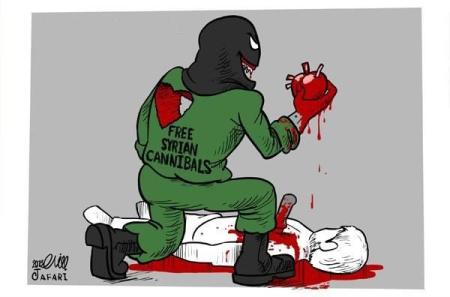
Until joined by the Islamic government in 1979 and then by Hizbullah in the 1980s, Syria was Israel’s most visceral enemy. This enemy is now being destroyed but not by Israel. So-called Muslims backed by so-called Muslim governments – Saudi Arabia, Qatar and Turkey – are doing the job for it, in alliance with the traditional western enemies of the Arabs. Syria’s cities and towns have been devastated. An estimated 100,000 people have been killed. Millions more have been displaced, scattered across Syria or seeking refuge beyond its borders. Reconstruction will cost hundreds of billions of dollars. Recovery will take decades. Without spending a penny or losing a life, Israel has been handed one of the greatest strategic victories in its existence.
Michael Oren let the scarcely concealed cat out of the bag the other day when he said Israel would prefer a Syria without Bashar al Assad to a Syria in the hands of the jihadists. The outgoing Israeli ambassador in Washington, Oren was only bringing something to the surface that could be seen underneath it despite the vociferous denials of Israel’s lobbyists. Israel wants the government in Damascus destroyed. Netanyahu has been trying to hide its interest behind a mask of indifference but as the likelihood of a US military ‘strike’ – for a war that would engulf the region – slipped away, the lobbyists in Washington broke cover. They buttonholed every congressman and women, only for the vote on war to be postponed indefinitely, much to the chagrin of the gulf and Turkish governments, their armed and political protégés and the Israeli government.
While the Syrian army continues to grind the armed groups down, there seems no end to the volume of money, armaments and men outside governments are still prepared to pour into this conflict. Obama is still trying hard to get Russian agreement on a UNSC resolution that would allow the US to begin another war in the Middle East by attacking Syria. In the meantime the armed groups are continuing with the war they are waging. In his recent interview with former US congressman Dennis Kucinich and Fox news correspondent Greg Palkot, Bashar al Assad estimated that 80 to 90 percent of the armed men are Al Qaida-type takfiri jihadists. The ‘defence’ consultancy HIS- Janes puts the figure at about 50 per cent but whether it is 50 per cent or 90 cent, whether they are foreign or Syrian, the jihadists are dominating the fighting. Talk of moderates is deception. Only in the last few days the main fighting groups – all takfiri – have again rejected the authority of the exile Syrian National Coalition and the so-called Free Syrian Army. This is presented as something new when at least a year ago the very same groups issued the same kind of declaration saying the same things. The so-called FSA is the western standard bearer for ‘moderation’ in this struggle even though its brigades are every bit as fanatical as Jabhat al Nusra or any of the other takfiri groups.
If the Syrian government does fall – and at the moment it is not only holding its ground but steadily driving the takfiris back – chaos would prevail in Syria on a far greater scale than Libya at present or Algeria in the 1980s. The country would implode. This is so self-evident that the US and its allies must know it and if they know it, one has to presume that this is what they want. Saudi Arabia is out to destroy the Syrian government regardless of the consequences. Britain and France are following the US and US policy on any issue in the Middle East is largely fashioned according to the interests of Israel. Turkey is the odd man out. Whatever Recep Tayyip Erdogan thought he was going to get out of confronting Syria his own country has been very adversely affected by his decisions. The breakdown of Arab states into sectarian enclaves permanently at war with each other has been an Israeli strategic objective for decades. It has happened in Iraq and now the specter of the collapse of another unitary Arab state hovers over Syria.
While the takfiris do their best to destroy Syria, Israel is getting on with the colonization of Palestinian territories as fast as it can. The current wave of settlement expansion is the greatest since 1967. In the past year edicts have been pouring out of the Housing Ministry authorizing the construction of thousands of housing ‘units’ in East Jerusalem and across the West Bank. The strategic focus is on settlement expansion in and around East Jerusalem and the construction of highways and roads that will simultaneously integrate the settlements into the greater Jerusalem municipality (enlarged immediately after the 1967 war) and, along with the Separation Wall, further cut the Palestinians off from the city. In the first quarter of 2013 alone there was a 176 per cent increase in settlement expansion over the same quarter for 2012.
In August this year, just as the ‘peace talks’ were resuming, Israel announced the construction of thousands more housing ‘units’ in East Jerusalem settlements. The mainstream media tells us that settlement expansion is ‘impeding’ peace, ‘threatening’ the peace talks and the ‘two state’ solution. The plain fact is that there are no ‘peace talks’. They are the camouflage for the war Israel has been waging against the Palestinians for seven decades. To their discredit and dishonor Mahmud Abbas and Saib Urayqat are giving these ‘talks’ a Palestinian face. By announcing settlement construction in the same breath as announcing the resumption of ‘peace talks’ Israel shows its absolute contempt for both of them.
Land expropriation and development for agricultural purposes continues unabated. So does the theft of water. The Council for European Palestinian Relations estimated recently that the settlers consume an average of 280 liters of water a day compared to 86 liters for the Palestinians, below the World Health Organization’s recommended minimum of 100 liters. Only 60 per cent of the water allocated to the Palestinians is potable. While taking their land Israel simultaneously uses it as a rubbish dump, with solid waste from West Jerusalem being dumped at Abu Dis, once set up by Israel as the Palestinian ‘capital’ of East Jerusalem even though it was not even inside the municipality until Israel put it there. The settlers do the same, dumping their rubbish and household waste water on Palestinian land in the valleys below their settlements on the hilltops.
In a statement handed to the UN Human Rights Council fact-finding mission to Palestine in February this year, Al Haq (Law in the Service of Man) presented some statistics. In 2012, 202 ‘incidents’ of settler violence along with dispossession, home demolitions, forcible evictions and intimidation; more than 200 settlements established since 1967, including 14 in East Jerusalem, and more than 500,000 settlers now living in them; and more than 42 per cent of the land of the West Bank as well as most of its resources allocated to Jewish settlements. Al Haq notes that the Israeli High Court ‘has rendered the question of the settlements non-justiciable’.
The Council for European Palestinian Relations estimates that the population in the West Bank settlements is growing at an average of five per cent a year compared to 1.8 per cent for the rest of occupied Palestine. It puts the total number of settlers at 467,000, of which number 385,000 are living in between the Separation Wall and the 1967 ‘green line.’
Every brick laid by Israel on the West Bank, every liter of water pumped out for settlements swimming pools and lawns and the presence of every settler represents a violation of international law. Yet, says Naftali Bennett, the Religious Services Minister and leader of the Jewish Home Party: ‘We will continue building and you will see this soon.’ He was speaking before the August announcement that more housing ‘units’ would be added to Jewish colonies in East Jerusalem. ‘I am sending the message from here to all the parties in the negotiations: the land of Israel belongs to the nation of Israel’. He has pledged to do ‘everything in my power to make sure they never get a state.’
In a leaked exchange with another cabinet minister Bennett said that ‘I’ve killed many Arabs in my life and there’s no problem with that.’ He complained that the conversation had been taken out of context, because what he meant was that he had ‘only’ killed them in the context of operations. There was one such ‘operation’ on the West Bank last week. Heavily armed soldiers stormed into the Jenin refugee camp, broke into the house of the Tubaisi family, shot Islam al Tubaisi, 19, in the leg, dragged him downstairs, his head banging on every step and shot him dead before an ambulance took him to hospital. Perhaps in time the members of this unit will be bragging in time about how they also have killed many ‘Arabs’.
Dig deep enough into the crises in Iraq, Syria and Lebanon and the confrontation with Iran and eventually you will find Palestine. It remains the central issue, the pivot on which US policies, dominated by Israeli interests and demands, has turned for more than six decades, yet for the takfiris affiliated with Al Qaida, killing other Muslims (and Christians) in a variety of countries takes precedence. It is striking that the same heads of government inveighing against terrorism and expressing their outrage at the slaughter of innocents in Nairobi have not once expressed outrage at the slaughter of innocents in Syria unless they thought they could blame the Syrian government.
The call of unity sounds through modern Arab history like the cry of a lost bird. United the Arabs will stand and divided they will continue to fall. As long as they are not able to put common interests first they are going to be ripe for the plucking. What is at stake in Syria is not the political system but Syria itself and for the past three years it has been systematically and deliberately destroyed by an unholy coalition of outside governments and the gangs of armed men doing their dirty work in the name of Islam.
The dominant Arab actors in this deliberately induced catastrophe are the regimes in Riyadh and Doha. They engage with Israel behind the scenes even as it colonizes Palestinian land and sends uniformed gangsters into the Haram al Sharif to beat Muslim worshipers trying to protect one of the holiest sites in Islam. While consorting with the enemy and abandoning the Palestinians these two regimes – infinitely less representative of the will of the people than the government in Damascus – take the lead in the destruction of an Arab state. The greatest beneficiary of their actions on one hand and their inaction and neglect on the other is Israel. This is surely as great a disgrace as any in Arab and Islamic history.
– Jeremy Salt is an associate professor of Middle Eastern history and politics at Bilkent University in Ankara, Turkey.
September 26, 2013
Posted by aletho |
Ethnic Cleansing, Racism, Zionism, Timeless or most popular, Wars for Israel | Israel, Middle East, Recep Tayyip Erdoğan, Saudi Arabia, Syria, Turkey |
Leave a comment
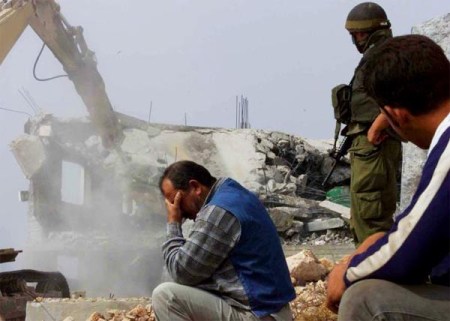
An international human rights organisation has revealed that one-third of the Palestinian-owned houses in Jerusalem face demolition under the pretext that applications for building permits were incomplete. This, claims Euro-Mid Observer for Human Rights, is a way for the Israeli authorities to continue their demographic war against Palestinians in the Holy City. Israel gives Jerusalemite Palestinians the right to use just 13 per cent of the area of occupied East Jerusalem to meet the needs of their growing population.
A report from Euro-Mid shed some light on the widespread Israeli settlement programme in Jerusalem. It mentioned that the financial committee of the Israeli-controlled Jerusalem municipality decided to support 1,500 new settlement units in the city at the end of August. The human rights group also pointed out that Israel’s bulldozers are still razing Palestinian homes in Al-Tour neighbourhood because the authorities plan to set up the “National Israeli Park”.
According to the UN, poverty is getting worse among Palestinians in Jerusalem. Euro-Mid noted that the unemployment rate rose to 78 per cent in 2012 compared with 64 per cent in 2006. More than 40 per cent of Palestinian Jerusalemites now live below the official poverty line; one of the reasons is the disparity in wage rates between Israeli and Palestinian labourers.
Euro-Mid has called upon Israel to stop its frenzy of settlement construction in the occupied territories and to protect Palestinian sovereignty over East Jerusalem, as the potential capital of a Palestinian state.
September 26, 2013
Posted by aletho |
Ethnic Cleansing, Racism, Zionism | East Jerusalem, Human rights, Israeli settlement, Jerusalem, Middle East, Palestine, West Bank, Zionism |
Leave a comment
Dear Public Editor,
Many activists who follow the nuclear weapons issue, and the tortured path to nuclear disarmament, were really gratified to see, that for the first time Israel’s nuclear arsenal was discussed in the NY Times in the context of present events in Syria and Iran. However, I was shocked and disappointed to see that this educational op-ed, which sheds so much light on the nuclear disarmament situation today, only appeared in the International Edition of the NY Times, and the people in the US remain ignorant and unenlightened about a significant provocation in the middle east. This news should be published so American citizens can have a broader understanding of what’s involved in actually getting rid of nuclear weapons and stopping further proliferation.
Sincerely,
Alice Slater
Op-Ed that never made it to the US edition:
Let’s Be Honest About Israel’s Nukes
By VICTOR GILINSKY and HENRY D. SOKOLSKI
THE recent agreement between the United States and Russia on Syria’s chemical weapons made clear what should have been obvious long ago: President Obama’s effort to uphold international norms against weapons of mass destruction in the Middle East will entangle the United States in a diplomatic and strategic maze that is about much more than Syria’s chemical arsenal. … Read more
September 26, 2013
Posted by aletho |
Ethnic Cleansing, Racism, Zionism, Mainstream Media, Warmongering, Militarism | Henry D. Sokolski, Iran, Israel, Middle East, Syria, United States, Victor Gilinsky |
Leave a comment


 Aletho News
 Aletho News