Kiev’s Use of Heavy Weapons in Crackdown Violates International Law – Russia
RIA Novosti – 05/06/2014
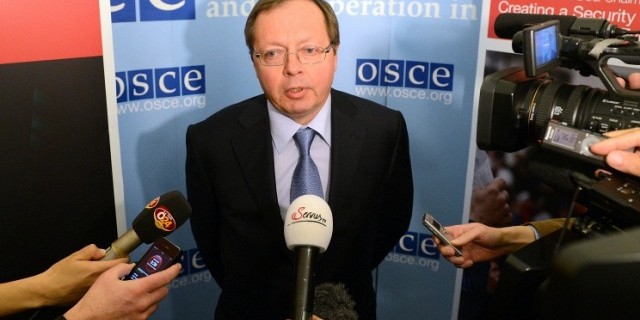
VIENNA – Moscow has raised the issue of Kiev using heavy armaments in its special operations against independence supporters in eastern Ukraine at OSCE session, Russia’s envoy Andrei Kelin said on Wednesday.
“The punitive operation led by Ukrainian forces reflects signs of an international human rights violation, in particular, of the Geneva convention of 1949,” Kelin said.
“We drew attention to the tragic outcome of an operation in the Donbas [in eastern Ukraine], a barbaric shelling of a building of the Luhansk local administration,” he added.
He referred to reports claiming the Ukrainian military had used exploding bullets, cluster bombs and artillery.
 “There are reports on the use of inhumane weapons – exploding bullets, cluster bombs – and the shelling of civilian targets in Ukraine. If they are confirmed, such acts have to be treated as war crimes. If it is proven that Right Sector killed the wounded in a Krasnyi Lyman hospital, there are no words to justify such an action,” Kelin said.
The envoy added that the latest report from the OSCE’s Special Monitoring Mission to Ukraine confirmed pro-Kiev forces had been using tanks, artillery and aircraft in its special operations.
“We asked a lot of questions, but Ukraine’s permanent representative [to the OSCE] gave no answers, aside from the usual attempts to shift responsibility to Russia,” Kelin added.
The town of Krasnyi Lyman, located to the southeast of Slaviansk in Donetsk Region, was heavily shelled by the Ukrainian army during Kiev’s military operation Tuesday. Ukrainian armed forces allegedly killed more than 25 wounded people in a local hospital, as the National Guard seized the town from the local defense forces following the shelling.
In mid-April, Ukraine’s interim government launched a special operation to crack down on the independence movements, but failed to gain control over the self-proclaimed independent republics in the eastern part of country. The operation has led to violent clashes and dozens of casualties in Slaviansk, Kramatorsk and Mariupol. Moscow has described the operation as a punitive act and urged Kiev to end the violence.
“Guantánamo North” – NDAA Indefinite Detention Coming Soon to a Town Near You?
By Chris Anders | ACLU | June 6, 2014
Top senators thought you wouldn’t notice. Behind closed doors, they wrote up new indefinite detention and Guantánamo provisions in the annual defense policy bill, and then waited 11 days to quietly file the bill.
But we now have the bill, and everyone can read it. And everyone should understand what is in this new National Defense Authorization Act (NDAA) before the full Senate makes a big mistake and paves the way for Guantánamo-style indefinite detention being brought to the United States itself.
The new Senate NDAA:
Brings Indefinite Detention to the U.S. Itself: The bill now says that detainees may be brought to the United States for “detention pursuant to the Authorization for Use of Military Force” (AUMF). In plain English, that means the policy of indefinite detention by the military, without charge or trial, could be carried out here at home. Right now, the number of people in the U.S. in military indefinite detention is zero. If the bill is enacted, that number could immediately jump to 100 or more.
Bolsters Claims of NDAA and AUMF Indefinite Detention Authority: The AUMF is the basis for the indefinite detention authority included in the NDAA that Congress passed nearly three years ago. Indefinite detention is wrong today and certainly cannot be sustained past the end of U.S. combat in the Afghan war. But passing a new Senate NDAA that relies on detention authority based on the AUMF, just as the U.S. combat role in the war is winding down, could be used by the government to bolster its claim that indefinite detention can just keep on going. Even when any actual U.S. combat is over.
Requires Report on Even More NDAA and AUMF Indefinite Detention Authority: As if the government didn’t already have enough claims of indefinite detention authority, the Senate NDAA asks the administration to let Congress know what more indefinite detention authority it wants.
Tries to Strip Federal Courts of Ability to Decide Challenges to Harmful Conditions: In a stunning provision, the Senate NDAA tries to strip federal courts of their ability to “hear or consider” any challenge related to harmful treatment or conditions by detainees brought to the United States. This provision tries to gut our system of checks and balances by cutting out the courts.
Violates Supreme Court Decision by Stripping Habeas Rights from Detainees Left at Guantánamo: In a classic example of why it is never a good idea for a committee to legislate behind closed doors, the Senate NDAA includes language inadvertently stripping habeas rights from any Guantánamo detainee who is not moved to the United States. Habeas is the very fundamental protection of being able to have a judge decide whether it is legal or illegal to hold someone in prison. While this is almost certainly the product of sloppy drafting, the result squarely contradicts the Supreme Court’s decision in Boumediene v. Bush, in which the Court said Guantanamo detainees have a constitutional right to habeas.
Blocks Most Cleared Detainees from Going Home: The Senate NDAA would block the transfer home of the vast majority of cleared detainees by imposing a blanket ban on transfers to Yemen, instead of continuing to allow the secretary of defense to make decisions on an individual basis. That would mean dozens of detainees cleared for transfer would remain trapped in limbo.
There is a right way and a wrong way to close Guantánamo. Charging and trying in court anyone who committed a crime – and sending anyone who isn’t charged with a crime back home or to another country – is the right way to close Guantánamo. Simply moving all of the bad Guantánamo policies to the U.S. itself is the wrong way.
The Senate NDAA gets it very wrong. We urge all senators to say “NO” to these provisions.
Hillary Clinton and the Weaponization of the State Department
By JP Sottile | News Vandal | June 5, 2014
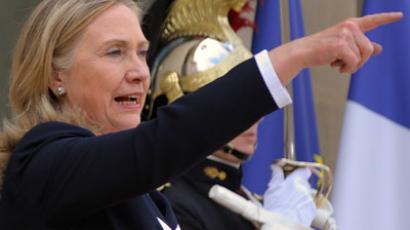
On May 23, 2012, then-Secretary of State Hillary Clinton went to the Special Operations Forces Industry Conference (SOFIC) trade show in Tampa, Florida to share her vision of “smart power” and to explain the State Department’s crucial role in extending the reach and efficacy of America’s growing “international counterterrorism network.”
First, there is such a thing as a “Special Operations Forces Industry Conference trade show.” Without some keen reporting by David Axe of Wired, that peculiar get-together might’ve flown completely under the radar—much like the shadowy “industry” it both supports and feeds off of like a sleek, camouflaged lamprey attached to a taxpayer-fattened shark.
Second, “special operations” have officially metastasized into a full-fledged industry. United States Special Operations Command (USSOCOM) is located at MacDill Air Force Base in Tampa and, therefore, conveniently located near the special operations trade show, which happened again this year at the Tampa Convention Center. The theme was “Strengthening the Global SOF Network” and the 600,000-square-foot facility was filled with targets of opportunity for well-connected and well-heeled defense contractors.
According to the SOFIC website, this year’s conference afforded attendees “the opportunity to engage with USSOCOM Program Executive Officers, Science and Technology Managers, Office of Small Business Programs and Technology & Industry Liaison Office representatives, and other acquisition experts who will identify top priorities, business opportunities, and interests as they relate to USSOCOM acquisition programs.”
Third, Hillary’s widely-ignored speech marked a radical departure from the widely-held perception that the State Department’s diplomatic mission endures as an institutional alternative to the Pentagon’s military planning. Instead, Secretary Clinton celebrated the transformation of Foggy Bottom into a full partner with the Pentagon’s ever-widening efforts around the globe, touting both the role of diplomats in paving the way for shadowy special ops in so-called “hot spots” and the State Department’s “hand-in-glove” coordination with Special Forces in places like Pakistan and Yemen.
Finally, with little fanfare or coverage, America’s lead diplomat stood before the shadow war industry and itemized the integration of the State Department’s planning and personnel with the Pentagon’s global counter-terrorism campaign which, she told the special operations industry, happen “in one form or another in more than 100 countries around the world.”
If this isn’t entirely unexpected, consider the fact that under then-Secretaries of State Colin Powell and Condoleezza Rice, the State Department fought attempts by the Pentagon to trump its authority around the globe and, as reported by the Washington Post, “repeatedly blocked Pentagon efforts to send Special Operations forces into countries surreptitiously and without ambassadors’ formal approval.”
But that was before Hillary brought her “fast and flexible” doctrine of “smart power” to Foggy Bottom and, according to her remarks, before she applied lessons learned from her time on the Senate Armed Services Committee to launch the first-ever Quadrennial Diplomacy and Development Review, which she modeled on the Pentagon’s Quadrennial Defense Review. That Pentagon-style review spurred the creation of the Bureau of Conflict and Stabilization Operations to “advance the U.S. government’s foreign policy goals in conflict areas.”
According to a Congressional Research Service analysis, the initial intent of the Conflict Bureau was to replace the ineffectual Office of the Coordinator of Reconstruction and Stabilization, which was created in 2004 to help manage “stabilization” efforts in two nations the U.S. was actively destabilizing—Afghanistan and Iraq.
But the new, improved bureau does more than just react to messes made by unlawful invasions or direct costly remediation efforts in war zones—it also collaborates with “relevant partners” in the Department of Defense and NATO “to harmonize civilian and military plans and operations pertaining to conflict prevention, crisis response, and stabilization.”
This integrated relationship between State and Defense was confirmed by U.S. Special Operations chief Admiral William McRaven shortly after Hillary’s speech. When asked about the “unlikely partnership,” McRaven assured DefenseNews that SOCOM has “an absolutely magnificent relationship with the State Department” and that SOCOM doesn’t “do anything that isn’t absolutely fully coordinated and approved by the U.S. ambassador and the geographic combatant commander.”
As David Axe aptly described it in Wired, “Together, Special Operations Forces and State’s new Conflict Bureau are the twin arms of an expanding institution for waging small, low-intensity shadow wars all over the world.”
In fact, during Hillary’s time as America’s chief diplomat, the State Department embraced the shadowy edge of U.S. foreign policy where decision-makers engage in activities that look like war, sound like war and, if you were to ask civilians in places like Yemen and Pakistan, feel a lot like war, but never quite have to meet the Constitutional requirement of being officially declared as war.
The Whole-of-Government Shift
Once upon a time, “low-intensity shadow wars” were the Congressionally-regulated bailiwick of the Central Intelligence Agency. But 9/11 changed everything. However, the excesses of the Bush Administration led many to hope that Obama could and would change everything back or, at least, relax America’s tense embrace of “the dark side.”
Although the new administration did officially re-brand “The War on Terror” as “Overseas Contingency Operations,” Team Obama employed an increasingly elastic interpretation of the 9/11-inspired Authorization for Use of Military Force and expanded covert ops, special ops, drone strikes and regime change to peoples and places well-beyond the law’s original intent, and certainly beyond the limited scope of CIA covert action.
Obama’s growing counter-terrorism campaign—involving, as Secretary Clinton said, “more than 100 countries”—took flight with a new, ecumenical approach called the “Whole-of-Government” strategy. Advanced by then-Secretary of Defense Bill Gates and quickly adopted by the new administration in early 2009, this strategy catalyzed an institutional shift toward inter-agency cooperation, particularly in the case of “state-building” (a.k.a. “nation building”).
During remarks to the Brookings Institution in 2010, Secretary Clinton explained the shift: “One of our goals coming into the administration was… to begin to make the case that defense, diplomacy and development were not separate entities, either in substance or process, but that indeed they had to be viewed as part of an integrated whole and that the whole of government then had to be enlisted in their pursuit.”
Essentially, the Whole-of-Government approach is a re-branded and expanded version of Pentagon’s doctrine of “Full-Spectrum Dominance.” Coincidentally, that strategy was featured in the Clinton Administration’s final Annual Report to the President and Congress in 2001. It defined “Full-Spectrum Dominance” as “an ability to conduct prompt, sustained, and synchronized operations with forces tailored to specific situations and possessing freedom to operate in all domains—space, sea, land, air, and information.”
In 2001, Full-Spectrum Dominance referred specifically to 20th Century notions of battlefield-style conflicts. But the “dark side” of the War on Terror stretched the idea of the battlefield well-beyond symmetrical military engagements. “Irregular warfare” became the catchphrase du jour, particularly as grinding campaigns in Afghanistan and Iraq exposed the reality that the full spectrum still wasn’t enough.
An assessment by the Congressional Research Service identified the primary impetus for the Whole-of-Government “reforms” embraced by Team Obama as the “perceived deficiencies of previous inter-agency missions” during the military campaigns in Afghanistan and Iraq. Those missions failed to address a myriad of problems created—culturally, economically and politically—by the wholesale bombing and occupation of those countries. The Full-Spectrum was half-baked. Lesson learned.
But the lesson wasn’t that the U.S. should avoid intervention, regime change or unleashing nascent civil, ethnic or religious conflicts. Instead, the lesson was that the “Whole-of-Government” must be marshaled to fight a worldwide array of Overseas Contingency Operations in “more than 100 countries.”
This Whole-of-Government shift signaled a renewed willingness to engage on variety of new fronts—particularly in Africa—but in a “fast and flexible” way. With other agencies—like the State Department—integrated and, in effect, fronting the counter-terrorism campaign, the military footprint becomes smaller and, therefore, easier to manage locally, domestically and internationally.
In some ways, the Whole-of-Government national security strategy is plausible deniability writ-large through the cover of interagency integration. By merging harder-to-justify military and covert actions into a larger, civilian-themed command structure, the impact of the national security policy overseas is hidden—or at least obfuscated—by the diplomatic “stabilization” efforts run through the State Department—whether it’s the Conflict Bureau working against Joseph Kony’s Lord’s Resistance Army in Central Africa, “stabilizing” post-Gaddafi Libya or spending $27 million to organize the opposition to Bashar al-Assad’s Syrian regime.
The Pass Key
The cover of diplomacy has traditionally been an effective way to slip covert operators into countries and the State Department’s vast network of embassies and consulates still offers an unparalleled “pass-key” into sovereign nations, emerging hot spots and potential targets for regime change. In 2001, the Annual Report to the President and Congress foresaw the need for more access: “Given the global nature of our interests and obligations, the United States must maintain the ability to rapidly project power worldwide in order to achieve full-spectrum dominance.”
Having the way “pre-paved” is, based on Hillary’s doctrinal shift at State, a key part of the new, fuller-spectrum, Whole-of-Government, mission-integrated version of diplomacy. At the SOFIC’s Special Operations Gala Dinner in 2012, Hillary celebrated the integration of diplomatic personnel and Special Operations military units at the State Department’s recently created Center for Strategic Counterterrorism Communications—a “nerve center in Washington” that coordinates “military and civilian teams around the world” and serves “as a force multiplier for our embassies’ communications efforts.”
As with most doors in Washington, that relationship swings both ways and mission-integrated embassies have served as an effective force multiplier for the Pentagon’s full spectrum of activities, particularly around Africa.
In his 2011 testimony before the House Foreign Affairs Committee Subcommittee on Africa, Deputy Assistant Secretary of State for African Affairs Don Yamamoto noted that State had “significantly expanded the number of DoD personnel who are integrated into embassies across the continent over the past three years,” and read a surprisingly long laundry list of collaborative efforts between State and the United States Africa Command (AFRICOM), including: “reduction of excess and poorly secured man-portable air defense systems (MANPADS); Defense Sector Reform in Liberia, DRC, and South Sudan; counterpiracy activities off the Somali coast; maritime safety and security capacity building; and civil-military cooperation.”
It seems that “civil-military cooperation” is a primary focus of the State Department in Africa. Most notably, Yamamoto told Congress that “embassies implement Department of State-funded Foreign Military Financing (FMF) and International Military Education and Training (IMET) programs, which further U.S. interests in Africa by helping to professionalize African militaries, while also assisting our African partners to be more equipped and trained to work toward common security goals.”
As the ever-vigilant Nick Turse recently reported, U.S. presence on the continent has only grown since that testimony was given in 2011. On TomDispatch.com, Turse identified the infamous attack on Benghazi on September 11, 2012 as the catalyst for “Operation New Normal”—the continent-wide response to, quite ironically, the political potboiler still simmering around Secretary Clinton. Whether or not Congressional Republicans find anything more than incompetence at the root of Benghazi, the U.S. military certainly finds itself in a “new normal” of increased activity in response to the forces—and the weaponry—unleashed by U.S.-led regime change in Libya. According to Turse, the U.S. is “now conducting operations alongside almost every African military in almost every African country and averaging more than a mission a day.”
Those missions are, of course, integrated with and augmented by the State Department’s Conflict Bureau which has used a variety of state-building programs and its diplomatic “pass key” in places like Libya, Nigeria, Kenya, South Sudan, Somalia, Democratic Republic of the Congo and six other African nations, all to develop a growing roster of “host country partners.”
Establishing “host country partners” is the nexus where the State Department, its Conflict Bureau and the AFRICOM meet—implementing the Whole-of-Government strategy in emerging or current conflict zones to fuse a mounting counter-terrorism campaign with stabilization, modernization and state-building initiatives, particularly in oil and resource-rich areas like the Niger River Delta, Central Africa and around AFRICOM’s military foothold on the Horn of Africa.
As Richard J. Wilhelm, a Senior Vice President with defense and intelligence contracting giant Booz Allen Hamilton, pointed out in a video talk about “mission integration,” AFRICOM’s coordination with the Departments of State and Commerce, USAID is the “most striking example of the Whole-of-Government approach.”
And this is exactly the type of “hand-in-glove” relationship Secretary Clinton fostered throughout her tenure at State, leveraging the resources of the department in a growing list of conflict areas where insurgents, terrorists, al-Qaeda affiliates, suspected militants or uncooperative regimes threaten to run afoul of so-called “U.S. interests”.
Ultimately, it became a hand-in-pocket relationship when Clinton and Defense Secretary Gates developed the Global Security Contingency Fund (GSCF) to “incentivize joint planning and to pool the resources of the Departments of State and Defense, along with the expertise of other departments, to provide security sector assistance for partner countries so they can address emergent challenges and opportunities important to U.S. national security.”
Although he’s been criticized as feckless and deemed less hawkish than Secretary Clinton, President Obama’s newly-proposed Counterterrorism Partnership Fund (CTPF) is the logical extension of the Clinton-Gates Global Security Contingency Fund and epitomizes the Whole-of-Government shift.
The $5 billion Obama wants will dwarf the $250 million pooled into the GSCF and will, the President said at West Point, “give us flexibility to fulfill different missions including training security forces in Yemen who have gone on the offensive against al Qaeda; supporting a multinational force to keep the peace in Somalia; working with European allies to train a functioning security force and border patrol in Libya; and facilitating French operations in Mali.”
That “flexibility” is exactly what Hillary Clinton instituted at State and touted at the SOFIC conference in 2012. It also portends a long-term shift to less invasive forms of regime change like those in Yemen, Libya, Syria and Ukraine, and an increased mission flexibility that will make the Authorization for the Use of Military Force functionally irrelevant.
Normalizing the War on Terror
The ultimate outcome of this shift is, to borrow from Nick Turse, yet another “new normal”—the new normalization of the War on Terror. What the adoption of the Whole-of-Government/mission integration approach has done is to normalize the implementation of the re-branded War on Terror (a.k.a. Overseas Contingency Operations) across key agencies of the government and masked it, for lack of the better term, under the rubric of stabilization, development and democracy building.
It is, in effect, the return of a key Cold War policy of “regime support” for clients and “regime change” for non-client states, particularly in strategically-located areas and resource-rich regions. Regimes—whether or not they actually “reflect American values”—can count on U.S. financial, military and mission-integrated diplomatic support so long as they can claim to be endangered… not by communists, but by terrorists.
And because terrorism is a tactic—not a political system or a regime—the shadowy, State Department-assisted Special Ops industry that fights them will, unlike the sullen enthusiasts of the Cold War, never be bereft of an enemy.
LAPD considers deploying unmanned drones for ‘tactical events’

RT | June 6, 2014
Defending the decision to pursue unmanned drones to assist in police work, the LAPD – who say they will cooperate with privacy groups on the matter – said the devices are being purchased by citizens, so why not allow law enforcement to use it as well?
At a news conference Thursday at LAPD headquarters, Chief Charlie Beck revealed the unmanned drones could assist police forces in “standoffs, perimeters, suspects hiding…and other tactical events.”
“We’re interested in those applications,” he said.
Beck responded to criticism of the plans by human rights and privacy groups by explaining that the technology is already “in the hands of private citizens” and corporations, so why shouldn’t law enforcement experiment with the devices as well?
“When retailers start talking about using them to deliver packages, we would be silly not to at least have a discussion of whether we want to use them in law enforcement,” the police chief said.
In December, Amazon and UPS announced ambitious plans to start testing UAVs for making home deliveries.
Late last month, the LAPD received two Draganflyer X6 unmanned drones as a ‘gift’ from the Seattle Police Department, in what seems to have been an effort by the latter to avoid public uproar.
Seattle authorities purchased the UAVs for $82,000 in 2010, funded by grants from the Department of Homeland Security. However, neither the city council nor the public was aware of the police drone program until a 2012 lawsuit by the Electronic Frontier Foundation over the department’s application for operation certificates from the Federal Aviation Administration.
The resulting public outcry over the drones forced the mayor to terminate the program in February 2013.
“These vehicles were purchased by the Seattle Police Department using federal grants. There was no cost to the city of Los Angeles,” police said.
Each remote-controlled vehicle is 3 feet (90cm) wide, has three rotors and can carry a video camera.
In order to calm public suspicion that the drones will infringe upon privacy rights, Beck said the LAPD would work closely with the American Civil Liberties Union during the “vetting process” of the UAVs.
“I will not sacrifice public support for a piece of police equipment,” Beck said, as quoted by the Los Angeles Times. “We’re going to thoroughly vet the public’s opinion on the use of the aerial surveillance platforms.”
The LAPD added it would seek approval from the Police Commission before unleashing the drones above Los Angeles.
Hector Villagra, executive director of the ACLU of Southern California, issued a statement: “The Los Angeles Police Department asked the ACLU of Southern California to meet and articulate our concerns about the privacy issues raised by the use of drones. We agreed to do so… However, at this point the ACLU SoCal has no plans to participate in any process to craft policies for LAPD’s use of drones, nor have we been formally invited to lead a team of advocates to help craft such policies.”
“As the ACLU has previously said, we question whether any marginal benefits of drones programs justify the serious threat to privacy they pose.”
Intelligence agencies have direct access to telecoms infrastructure, Vodafone reveals
RT | June 6, 2014
Government intelligence agencies have direct access to telecommunication companies’ infrastructure which allows them to spy and record phone calls leaving no paper trail, the UK’s largest mobile phone company Vodafone has revealed.
The British operator said wires have been attached to its phone networks in some of the 29 countries in which it operates in Europe, as well as around the world, the Guardian reported. Governments similarly connect to other telecom groups, reportedly allowing them to listen to or record live conversations. In some cases, the surveillance agencies can also track the whereabouts of a customer.
“For governments to access phone calls at the flick of a switch is unprecedented and terrifying,” Liberty director Shami Chakrabarti told the Guardian. “Snowden revealed the internet was already treated as fair game. Bluster that all is well is wearing pretty thin – our analogue laws need a digital overhaul.”
But now Vodafone is pushing back against government surveillance through direct access to the pipes. On Friday, it will publish its first Law Enforcement Disclosure Report about how governments spy on people through the company’s infrastructure.
“These pipes exist, the direct access model exists,” the telecom giant’s group privacy officer, Stephen Deadman told the Guardian. “We are making a call to end direct access as a means of government agencies obtaining people’s communication data. Without an official warrant, there is no external visibility. If we receive a demand we can push back against the agency. The fact that a government has to issue a piece of paper is an important constraint on how powers are used.”
“We need to debate how we are balancing the needs of law enforcement with the fundamental rights and freedoms of the citizens,” Deadman said.
The problem with many of the laws on the books that governments use to receive the warrants is “most of the legislation on privacy and surveillance predates the internet and needs to be updated,” the Guardian wrote, citing the report’s introduction.
Agencies do not have to identify the targeted customers to the telecom companies in any way, and the direct-access systems do not require warrants.
“These are the nightmare scenarios that we were imagining,” Gus Hosein, executive director of Privacy International, which has brought legal action against the British government over mass surveillance, told the Guardian.
“I never thought the telcos [telecommunications companies] would be so complicit,” he said. “It’s a brave step by Vodafone and hopefully the other telcos will become more brave with disclosure, but what we need is for them to be braver about fighting back against the illegal requests and the laws themselves.”
In its report, the company asks for the direct-access pipes to be disconnected, for countries to outlaw the practice and for governments to “discourage agencies and authorities from seeking direct access to an operator’s communications infrastructure without a lawful mandate.”
Vodafone began working on the report last autumn, in the wake of the first Snowden leaks about government spying. It insists that its comprehensive survey of government warrant applications is not because of consumer backlash, the Guardian reported, though analysts contend that losing customers’ trust could cost the company tens of millions of pounds.
But Vodafone isn’t opening up about everything. One of the first of the Snowden revelations last June was about Project Tempora, which allows the Government Communications Headquarters (GCHQ) spy agency to intercept and store for 30 days huge volumes of data, like emails, social network posts, phone calls and much more, culled from international fiber-optic cables. On the one-year anniversary of the first Snowden leak the location of secret GCHQ bases in Oman tapping into underwater cables was revealed. The Vodafone report makes no mention of revelations about its participation in secret GCHQ operations.
Genetic Testing of Citizens Is a Backdoor into Total Population Surveillance by Governments and Companies
By Helen Wallace | GeneWatch UK | June 5, 2014
The new Chief Executive of the National Health Service (NHS) in England, Simon Stevens, was recently reported arguing that the NHS must be transformed to make people’s personal genetic information the basis of their treatments (1).
His proposition is unsurprising since it is in line with the efforts of successive UK governments to build a DNA database in the NHS in England by stealth. In particular, sequencing every baby at birth and storing whole genomes in electronic medical records is a plan backed by Health Secretary Jeremy Hunt (2). The current version of this plan would involve sharing whole or partial DNA sequences (genomes or genotypes) with companies like Google, which would use genetic information and health data to calculate personal risk assessments for feedback to patients (3). Massive investment from taxpayers would be required as part of a public-private partnership that would allow commercial exploitation of the data.
Building a DNA database within the NHS would be a massive waste of public money. But it would also create a system of total surveillance which would enable the government and private companies to track every individual, not to mention their relatives. This is not speculation; as wikileaks revealed, the United States government is already actively collecting DNA samples and biometric data on foreign officials and populations.
Commercial companies wish to exploit genetic information to market products such as drugs and supplements to healthy people, based on genetic risk assessments. If current trends continue, this will harm, not benefit, health: it is personalised marketing not personalised medicine. The potential for misuse is very high. Doctors could be replaced by computer algorithms used to market medication, massively expanding the drug market to include large numbers of healthy people, rather than smaller numbers of (often poorer) people who are sick. There is also the danger that prescribing would be driven by vested interests, rather than medical need: with high financial costs and more harmful side effects. Genetic risk assessments could also be misused, leading to stigma or discrimination, for example by insurers.
Why does the NHS want to collect genetic information?
There is one element of truth to Simon Stevens’ remarks. Some cancer drugs have been successfully tailored to genetic mutations that arise in the cancer tumour. However, attempts to select drugs for people based on the genetic make-up they are born with (their genome or genotype) have largely been a failure. This is because genetic differences only account for a part of individual differences in metabolism. For example, a recent study found that targeting warfarin treatment based on genetic make-up did not improve health outcomes, although this application was regarded as the ‘poster child’ of this approach (4).
Why did it not work? An important misconception, apparently shared by Simon Stevens, is that genes are good predictors of most diseases and adverse drug reactions in most people. However, contrary to misleading claims made to promote the Human Genome Project, this is not true (5). Moreover, even if it were true, there is no evidence that genetic selection of individuals, for example into high risk and low risk groups, improves outcomes or cuts costs. All of which begs the question of the purpose of taking and storing genetic information as a default medical procedure.
The online gene testing company 23andMe, funded by Google, has been forced to withdraw its gene tests from the US market due to failure to prove they can reliably predict individual risks of many common conditions using computer algorithms. The company now wants to target the UK market, where genetic testing is not regulated (6). Patrick Chung, a 23andMe board member and partner at the venture-capital firm NEA told Fast Company (7): “… 23andMe will make money by partnering with countries that rely on a single-payer health system. “Let’s say you genotype everyone in Canada or the United Kingdom or Abu Dhabi,” he says, “and the government is able to identify those segments of the population that are most at risk for heart disease or breast cancer or Parkinson’s. You can target them with preventative messages, make sure they’re examined more frequently, and in the end live healthier lives, and the government will save massive expenses because they halted someone who’s prediabetic from getting diabetes. 23andMe has been in discussion with a bunch of such societies“. Yet there is not a scrap of evidence that this approach is good for health. This is because genomic tests have limited clinical validity or utility; so in reality there is no health benefit to targeting segments of the population in this way.
Genetic testing remains useful to diagnose rare genetic disorders, mainly in babies and young children, and whole genome sequencing has helped to identify new mutations causing these diseases. Rare familial (largely inherited) forms of many common diseases also exist, including breast cancer, but these account for only a small percentage of cases of these conditions.
Use of genetic testing in the NHS should focus on prioritising resources for the limited applications that do work, not on introducing misleading and harmful screening of the whole population and creating unnecessary, expensive databases. Certainly it should not be driven by ulterior commercial and government interests.
References
(1) New NHS boss: service must become world leader in personalised medicine. The Guardian. 4th June 2014. http://www.theguardian.com/society/2014/jun/04/nhs-boss-world-leader-personalised-medicine
(2) Children could have DNA tested at birth. The Telegraph. 8th December 2013. http://www.telegraph.co.uk/health/healthnews/10501788/Children-could-have-DNA-tested-at-birth.html
(3) GeneWatch UK PR: GeneWatch UK report exposes plans to build a DNA database by stealth in the NHS. 23rd May 2013. http://www.genewatch.org/article.shtml?als[cid]=569352&als[itemid]=572536
(4) Pharmacogenomic Warfarin Dosing: Worth the Cost? Medscape. 23rd December 2013. http://www.medscape.com/viewarticle/818088
(5) Human Genetic Predispositions – the hidden politics of genomic science. Bioscience Resource Project. http://www.bioscienceresource.org/resources/human-genetic-predisposition/
(6) Gene startup 23andme casts eyes abroad after U.S. regulatory hurdle. Reuters. 6th May 2014. http://in.reuters.com/article/2014/05/07/23andme-genetictesting-idINL2N0NT05I20140507
(7) Inside 23andMe founder Anne Wojcicki’s $99 DNA Revolution. Fast Company. 14th October 2013. http://www.fastcompany.com/3018598/for-99-this-ceo-can-tell-you-what-might-kill-you-inside-23andme-founder-anne-wojcickis-dna-r
Dr Helen Wallace is Executive Director of GeneWatch UK
No Jews allowed
International Solidarity Movement | June 5, 2014
Hebron, Occupied Palestine – My plan for the morning was pretty simple, I wanted to enter the souq (market) and buy some bread for breakfast, and then walk home. That was it. As I made my way towards the souq entrance I was stopped by two Israeli border police officers and asked for my religion. This is not an unusual experience in this city, the military are a common sight and as well as the regular checkpoints, they can and often do stop you at any time, demanding your identification, asking your religion, and any other questions they desire to ask.
I am neither ashamed nor proud of my religion. It is part of who I am in the same way my hair colour is a part of me. It is also a question I have been asked before and, as in the past, I told the truth.
“I’m Jewish,” I said.
The two border police officers spoke to each other in Hebrew, a language I have very little understanding of.
“Where are you going?” They asked.
“The souq,” I said. “I just want to go to the market.”
“No, you can’t go in. No Jews allowed.”
I wasn’t completely shocked, this has also been something stated to me before.
“Come on, I’ve been in there a thousand times, is it illegal for me to enter?”
“You can’t go in, you’re Jewish, it’s not allowed, it’s dangerous.”
I wanted to laugh, I may well have done. “It’s not dangerous, I have many friends in there, just let me go.”
This continued on for a few more minutes, the blood heating in my face as I tried to argue my case to no avail. The real irony was instead of walking through the market to go home, I was forced to walk Shuhada street, a perfect example of the apartheid that exists within this military occupation, a street where Palestinians have been barred from walking since the year 2000, where many people lost their homes and livelihoods after they were forced to leave and never return. Only the Israeli military, settlers, and internationals are allowed to walk Shuhada Street, it is often christened “Ghost Town” by the Palestinians, and indeed the sight of so many closed shops and houses, is haunting. It is also a street where I have been assaulted twice by settlers, so the idea that this was a safer alternative for me than the market, is laughable.
I have been fortunate enough to live in Palestine for several months, mainly living in the city of al-Khalil (Hebron). Al-Khalil is a city with many problems, mostly due to the illegal settlement in the heart of the city [all settlements in occupied territory are illegal under international law], and the huge Israeli military presence there to enable the settlers.
The Israeli military commits terrible crimes against the Palestinian people. I have seen them arresting and detaining adults and children for no reason, physically and verbally harassing the people of the city, using their military weapons against adults, youths and children, as well as a hundred and one other injustices that impact the daily lives of Palestinians in al-Khalil.
The settlers in al-Khalil are above the law. They attack Palestinians and steal their land and property on a regular basis. The Israeli military not only does nothing to stop this, but in many cases they condone and encourage it. I have seen settler youth throwing stones at Palestinian homes, while Israeli soldiers watched on. When we asked the soldiers to do something to stop this, they replied they would do nothing, as they are “children”. However Israeli soldiers have no qualms in using violence against Palestinian children. I have come to al-Khalil as a solidarity activist; one of the activities I participate in almost daily is ‘school checkpoint watch’. This is where I would assist in monitoring a specific checkpoint the children of the city are forced to go through on their way to school. I have witnessed Israeli soldiers harassing and searching children as they go through the checkpoint, firing tear gas and stun grenades at them and into their schools, and detaining children, some as young as six-years-old.
After the two border police officers denied me entry into the market in the morning, I tried again several hours later. The result was the same. I was angry, and I was upset, and while I am in Palestine as a solidarity activist, all I wanted to do was to go through the souq and visit one of my friends.
However, I have no intention of writing that I now “understand” what the Palestinians experience due to the military occupation, and the complete control that exists over their freedom of movement. My experience today was frustrating, and also unfair, but it is nothing compared to what the Palestinian people experience on a regular basis.
Due to the colour of my skin, and my nationality, I am incredibly aware of the privilege I have in Palestine, and all over the world. The very fact that I am able to enter Palestine is a huge privilege within itself; so many Palestinians in the diaspora were forced away from their homeland and have never seen it again. The fact that, if I so wish, I can travel to Yaffa, and one of my closest friends, a Palestinian woman whose family is originally from the city, can never see her home.
I have never been denied entry to any area due to my religion by Palestinians, or any other time in my life. It is telling that the first time this happens is by the Israeli military, under the façade of my ‘safety’. Unless Israeli soldiers or settlers enter, which they frequently do, the most dangerous thing that could happen to me in the souq is that I could overdose on tea, forced on me by my friends.
Pope’s unbalanced neutrality in Holy Land
By Nicola Nasser | Middle East Eye | June 4, 2014
Pope Francis’ “pilgrimage” to the Holy Land last week proved to be an unbalanced impossible mission. The pontiff failed to strike a balance of neutrality between contradictory and irreconcilable binaries like divinity and earth, religion and politics, justice and injustice and military occupation and peace.
Such neutrality is viewed by the laity of Christian believers, let alone Muslim ones, in the Holy Land as religiously, morally and politically unacceptable.
The 77-year old head of the world’s 1.2 billion Catholics “is stepping into a religious and political minefield,” Naim Ateek, the Anglican priest who founded the Palestinian liberation theology movement and runs the Sabeel Ecumenical Center in Jerusalem and Nazareth, was quoted as saying by Time on last May 24, the first day of the pope’s “pilgrimage.”
Ironically, the symbolic moral and spiritual power of the Holy See was down to earth in Pope Francis’ subservient adaptation to the current realpolitik of the Holy Land in what the Catholic Online on May 26 described as “faith diplomacy.”
The pontiff’s message to the Palestinian people during his three-day “pilgrimage” to the Holy Land boils down to an endorsement of the Israeli and U.S. message to them, i.e.: “The only route to peace” is to negotiate with the Israeli occupying power, refrain from unilateral actions and “violent” resistance and recognize Israel as a fait accompli.
The UK-based Jordanian-Palestinian journalist Lamis Andoni, a Christian herself, wrote on May 27: “We don’t need the Vatican blessing of negotiations … Whoever sees occupation and remains neutral has no justice in his vision.”
The Vatican and the pope himself had insisted that his visit to the birthplace of the three monotheistic “Abrahamic faiths” of Islam, Christianity and Judaism was “purely spiritual,” “strictly religious,” a “pilgrimage for prayer” and “absolutely not political.”
But the Vatican expert John Allen, writing in the Boston Globe a week ahead of the pope’s visit, had expected it to be a “political high-wire act,” and that’s what it truly was, because “religion and politics cannot be separated in the Holy Land,” according to Yolande Knell on BBC online on May 25.
Pope Francis would have performed much better had he adhered “strictly,” “purely” and “absolutely” to making his trip a “pilgrimage for prayer” and one that is committed to Christian unity and to helping indigenous Christians survive the highly volatile and violent regional environment.
Instead he had drowned his spiritual role in a minefield of symbolic political semantics and semiotics.
The pope finished his “pilgrimage,” which was announced as a religious one but turned instead into a political pilgrimage, with a call for peace.
However, the grand mufti of Jerusalem, Muhammad Hussein, while welcoming the pontiff inside Islam’s third holiest site of Al-Aqsa Mosque on May 26, said: “Peace in this land will not happen until the end of the [Israeli military] occupation.”
Palestinian-American Daoud Kuttab on May 25 wrote in a controversial column that the pope “exceeded expectations for Palestinians.”
He flew directly from Jordan to Bethlehem in Palestine without passing through any Israeli entry procedures, implicitly and symbolically recognizing Palestinian sovereignty.
He addressed the Palestinian President Mahmoud Abbas as the head of the “State of Palestine,” announced that there must be “recognition of the right of the Palestinian people to a sovereign homeland and their right to live with dignity and with freedom of movement” and met with Palestinian children whose parents were refugees whom Israelis displaced from their homes in 1948.
And in an undeniable expression of solidarity with the Palestinians, he made an unplanned stop to pray at Israel’s apartheid wall of segregation in Bethlehem, because, as he said, “the time has come to put an end to this situation which has become increasingly unacceptable.”
However, the word “occupation” was missing in more than thirteen of his speeches during his “pilgrimage” as was any reference to the world’s “largest open-air prison” in Gaza Strip or to Dahiyat a-Salam (literally: Neighborhood of Peace) and five other neighbourhoods in eastern Jerusalem, including the Shu’fat Refugee Camp, where some eighty thousand Palestinians have been cut off from the city services, including water, since March 2014 and isolated from Jerusalem by Israel’s segregation wall. His itinerary did not include the Galilee and Nazareth where most Palestinian Christians are located.
Eight papal messages
However, within less than twenty four hours the pontiff was to offset his positive overtures to Palestinians and his call for a “just solution” and a “stable peace based on justice” for the Palestinian-Israeli conflict with eight messages to them.
The pontiff’s arrival in the Palestinian Holy Land came three days before Israel’s celebration of its 47th anniversary of its military occupation and annexation of the Christian and Muslim holy sites in the Arab east Jerusalem and ten days after the Palestinian commemoration of the 66th anniversary of their Nakba on the creation of Israel in 1948 on the ruins of more than 500 towns and villages from which the Zionist paratroops ethnically cleansed forcefully more than 800,000 Arab Muslim and Christian native Palestinians.
The pope had nothing to say or do on both occasions to alleviate the ensuing plight of the Palestinians except prayers, because “the concrete measures for peace must come from negotiations … It is the only route to peace,” according to the pope aboard his flight back to Rome.
That was exactly the same futile message the Israeli occupying power and its U.S. strategic ally have been sending to Palestinians for sixty six years, but especially since 1967: Palestinians should be held hostages to exclusively bilateral negotiations with their occupying power. This was the pope’s first message to Palestinians.
For this purpose, the pope invited Palestinian and Israeli presidents, Abbas and Shimon Peres, to pray for peace at “my home in the Vatican as a place for this encounter of prayer” on June 8. The pope’s spokesman, Federico Lombardi, told the BBC it was “a papal peace initiative.” This was his second message.
His third message to Palestinians was to “refrain from initiatives and actions which contradict the stated desire to reach a true agreement” with Israel, i.e. to refrain from unilateral actions, which is again another Israeli and U.S. precondition which both allies do not deem as deserving Israeli reciprocity.
By laying a wreath at the grave of Theodor Herzl, the atheist founder of Zionism who nonetheless believed in God’s promise of the land to His Jewish “chosen people,” the pope legitimized Herzl’s colonial settlement project in Palestine. This was his fourth message: Israel is a fait accompli recognized by the Vatican and blessed by the papacy and Palestinians have to adapt accordingly. The Washington Post on May 23 went further. “Some are interpreting” the pope’s act “as the pontiff’s tacit recognition of the country’s Jewish character.”
The pope sent his fifth message to Palestinians when he addressed young Palestinian refugees from the Dehiyshe Refugee Camp in Bethlehem: “Don’t ever allow the past to determine your life, always look forward.” He was repeating the Israeli and U.S. call on Palestinian refugees to forget their Nakba and look forward from their refugee camps for an unknown future in exile and diaspora.
On the same occasion he sent his sixth message: “Violence cannot be defeated by violence; violence can only be defeated with peace,” the pope advised the young Palestinian refugees. This is again the Israeli and U.S. message to them, which after more than two decades of Palestinian commitment produced neither peace nor justice for them.
The pope prayed at the Holocaust memorial, the western al-Buraq Wall of Al-Aqsa Mosque, which Israelis call “The Wailing Wall,” the memorial of the Israeli victims of Palestinian resistance, laid a wreath at Herzel’s grave, visited Israeli president at his residence where he “vowed to pray for the institutions of the State of Israel,” which are responsible for the Palestinian Nakba, and received Israeli Prime Minister Benjamin Netanyahu at the Notre Dame complex. The pontiff was in fact blessing and granting the Vatican legitimacy to all the Israeli symbolic casus belli claims to the land, which justify the Palestinian Nakba. This was his seventh message.
All those events took place in Jerusalem, which Israel annexed as the “eternal” capital of the Hebrew state and the “Jewish people.” Reuven Berko, writing in Yisrael Hayom, said that the Pope’s meetings with Peres and Netanyahu were “de facto expressions of the Vatican’s recognition of Jerusalem as capital of Israel.”
The pope’s eighth message to Palestinians was on the future of Jerusalem: “From the negotiations perhaps it will emerge that it will be the capital of one State or another … I do not consider myself competent to say that we should do one thing or another.”
Normalization with Israel
The “greatest importance” of Pope Francis’ visit “may lie in the fact that it reflects the normalization of relations between the Vatican and the State of Israel,” head of the Anti-Defamation League, Abraham Foxman, wrote on May 23.
The Second Vatican Council early in the sixties of the last century rejected the collective Jewish guilt for Jesus Christ’s death. Since then the Vatican’s “normalization” of relations with the Jews and Israel has been accumulating.
Rabbi David Rosen, director of inter-religious affairs at the American Jewish Committee, was quoted as saying by the USA Today on May 26: There “has been a revolution in the Christian world.”
At Ben-Gurion airport on May 25, Pope Francis reiterated his predecessor Benedict’s call for “the right of existence for the [still borderless] State of Israel to be recognized universally,” but was wise enough not to reiterate his “thanks to God” because “the Jews returned to the lands of their ancestors.”
To emphasise interfaith coexistence he broke the precedent of including a Jewish rabbi and a Muslim sheikh in his official delegation. “It’s highly symbolic,” said Rev. Thomas Rosica, a consultant to the Vatican press office.
By laying a wreath of white and yellow flowers, the colours of the Vatican, on the Herzl’s grave, the pope broke another historic precedent. It was an unbalanced act, 110 years after Pope Pius X met Herzl and rejected the idea of a Jewish state.
The pontiff’s “pilgrimage” could not dispel the historical fact that lies deep in the regional Arab memory that papacy is “still linked to the Crusades of the 11th through 13th centuries” when the successive popes’ only link to the Holy Land was a military one, according to the international editor of NPR.org, Greg Myre, on this May 24.
Of course this does not apply to Christianity. The indigenous oriental churches’ link to the land has never been interrupted while the Catholic Church was cut off from the region since the end of the Crusades until it came back with the European colonial domination since the nineteenth century.
No pope ever travelled to Jerusalem until Paul VI spent one day in the city, on January 4, 1964, when the holy sites were under the rule of the Arab Jordanians. John Paul visited thirty six years later and established a new papal tradition that has been followed by Pope Benedict, who visited in 2009, and now Pope Francis.
It doesn’t bode well with the Arabs and the Palestinians in particular that the new papal tradition is building on the background of recognizing Israel, which is an occupying power and still without constitutional demarcated borders, as a fait accompli that the Palestinian people should recognize as well.
~
Nicola Nasser is a veteran Arab journalist based in Birzeit, West Bank of the Israeli-occupied Palestinian territories. An edited version of this article was first published by the Middle East Eye. nassernicola@ymail.com
Israel Begins Arrest Campaign Against Popular Resistance Activists
By Chris Carlson | International Middle East Media Center | June 5, 2014
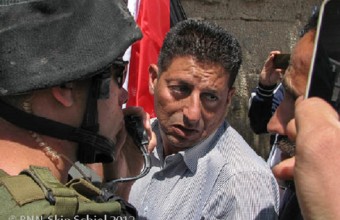
Yesterday, at 4:30 am, Popular Resistance activist Mahmoud Zwahre was again arrested by the Israeli army, at his house in Al Ma’asara, just southwest of Bethlehem.
An attempt to arrest Zwahre was made previously during the weekly Friday protest in the village. This week, on Wednesday, a large group of Israeli soldiers raided Zwahre’s home, just before dawn.
Mahmoud Zwahre, according to the Palestinian News Network (PNN), is an activist and coordinator for the Popular Committee Against the Wall and the Settlements in Al Ma’asara. Soldiers surrounded the Zwahre residence and declared it a closed military zone, as they proceeded to tear through the contents of the house, terrorizing the children and abusing Mahmoud in front of his family.
He was arrested, blindfolded, and taken to an unknown destination — essentially, and by all rights, amounting to a kidnapping.
(Al Ma’asara is a small Palestinian village located in Area B of the central occupied West Bank. Though Area B is officially recognized to be under joint Israeli-Palestinian security control, the 1967 Israeli occupation of the West Bank, Gaza Strip and East Jerusalem has yet to be granted legitimacy by the international community.)
Munther Amira, director of the board of the Popular Struggle Coordination Committee Against the Wall and the Settlements (PSCC) in the Palestinian territories, explained in an interview with the PNN that the Israeli occupation increasingly targets activists of Popular Resistance and their activities:
The activities of Popular Resistance are peaceful and designed to highlight the suffering of the Palestinian people through the Israeli occupation practices of racism and violation of international law. Nevertheless, the PSCC has documented the rough and violent reactions by Israeli soldiers against the protests and marches organized by the Popular Struggle Committees in the various provinces of the country.
The committee denounces the arrest of its coordinator Mahmoud Zwahre, and calls for his release.
Sgt. Bergdahl and the Fog of War
By Sheldon Richman | FFF | June 4, 2014
The “fog of war” is a reference to the moral chaos on the battlefield as well as the rampant confusion. Individuals kill others for no other reason than that they are ordered to. Things deemed unambiguously bad in civilian life are authorized and even lauded in war. The killing and maiming of acknowledged innocents — in particular children and the elderly — is excused as “collateral damage.”
No wonder that some individuals thrust into this morass sometimes act differently from how soldiers behave in romantic war movies. The hell of war is internal as well as external.
We might remember this as the story of Sgt. Bowe Robert Bergdahl unfolds.
Bergdahl volunteered for the U.S. military and was apparently a gung-ho soldier. Americans have not been conscripted since 1973, but young Americans are propagandized from childhood with the message that time in the military is service to their country. Few question this narrative; fewer seek rebuttals to it. You have to want to face the facts that governments lie and that the service is to an empire having nothing to do with Americans’ security.
This, however, doesn’t relieve military personnel of responsibility for their own conduct. In 1951 — while Americans were fighting in Korea — Leonard E. Read, one of the founders of the modern libertarian movement, published “Conscience on the Battlefield,” in which a dying American soldier hears his conscience say that he — not the army or government — bears responsibility for his deadly conduct: “Does not the fault inhere in your not recognizing that the consequences of your actions are irrevocably yours…?”
Bergdahl seems to have been plagued by this question. (See Michael Hastings’s revealing 2012 article.)
In his novel Nineteen Eighty-Four, George Orwell described a regime that used war to keep its population too frightened to ask questions and in which the enemy could change without notice. Orwell may have exaggerated, but not by much. The United States sided with one Afghan faction against the Soviets and their Afghan allies in the 1980s, then switched when it replaced the Soviets as invaders in 2001.
On the surface, the war in Afghanistan seems easy to understand. The Taliban government gave sanctuary to Osama bin Laden and al-Qaeda, which attacked American targets in the 1990s and on September 11, 2001.
But things are not so simple. During the Soviet war in Afghanistan, the U.S. government sided with the future Taliban and al-Qaeda. President Reagan called the Afghan mujahideen“freedom fighters,” subsidized their war, and hosted them at the White House.
After the Soviet exit and years of civil war, the Taliban became the brutal theocratic government of Afghanistan, but not an anti-American terrorist organization. Indeed, as late as May 2001, President George W. Bush was helping the Taliban suppress opium production. After 9/11, the Taliban made various offers to surrender or expel bin Laden, but the Bush administration was uninterested. (This lack of interest predated 9/11.) Taliban attacks on American military targets since the U.S. invasion should not be construed as terrorism, but rather as combat between former government officials and the foreign force that overthrew them.
Anand Gopal, author of No Good Men Among the Living: America, the Taliban, and the War through Afghan Eyes, points out that soon after American forces invaded Afghanistan, “there was no enemy to fight”:
By mid-2002 there was no insurgency in Afghanistan: al-Qaeda had fled the country and the Taliban had ceased to exist as a military movement. Jalaluddin Haqqani [whose “network” held Bergdahl captive] and other top Taliban figures were reaching out to the other side in an attempt to cut a deal and lay down their arms.
But, Gopal writes, “driven by the idée fixe that the world was rigidly divided into terrorist and non-terrorist camps, Washington allied with Afghan warlords and strongmen. Their enemies became ours, and through faulty intelligence, their feuds became repackaged as ‘counterterrorism.’”
When Haqqani, a celebrated freedom fighter during the Soviet war, turned down a deal from the Americans because it included detention, the U.S. military attacked his home province and other areas, killing his brother-in-law and innocent children.
If he wasn’t with the Americans, he was against them, and therefore it was open season.
In this whirlwind of cynicism and relativism, can anyone be blamed for wondering what the point of the war was?
Secret Trials: UK Holds A Secret Terror Trial, As US Appeals Court Holds Secret Hearing In Terror Case
By Mike Masnick | Techdirt | June 5, 2014
To have a functioning judiciary in an open democracy, part of the point is to make sure that court proceedings are open to the public. Yes, there may be certain instances where certain aspects must be kept secret, but the default should be open and public. Unfortunately, in both the US and UK this week, it appears that when it comes to the bogeyman word “terrorism,” courts are willing to go dark. The more serious situation is over in the UK, where it has just come out that a secret terrorism trial is being held — the first one in centuries. Even the names of the two defendants are not known (they’re listed as merely AB and CD). Journalists had even been barred from mentioning the existence of the trial, until a gag order was just overturned. Note that the Guardian’s page linked above had to turn off comments for legal reasons. Journalist Tim Cook has also spoken out eloquently about why this cannot stand.
I cannot say how broken-hearted I am about the prospect of a major criminal trial involving two men charged with serious terrorism offences being held entirely in secret for the first time in modern British legal history. I have spent my entire journalistic life campaigning against courtroom secrecy and this represents a nadir and indication of abject failure.
But the proposal is being contested by the process of law; albeit very limited and garrotted by the lack of a constitutional paradigm for freedom of the media and expression. We have been paying the price for not having a First Amendment for many years. Now we are entering the endgame of something beyond the dissolution of open justice.
Meanwhile, back here in the good, old United States, where we do have a First Amendment, at least we know that Adel Daoud is on trial. But the 7th Circuit Court of appeals kicked everyone out of the courtroom to hold a “secret hearing” with just the DOJ. As we wrote a few months ago, Daoud’s lawyers are asking to actually see the FISA court orders that were used to gather evidence against their client — and the DOJ is flipping out about that. While some of the hearings were held openly, at one point, Judge Richard Posner abruptly kicked everyone but the DOJ out, including Daoud’s lawyers.
As the arguments concluded, Judge Richard Posner announced the public portion of the proceedings had concluded and ordered the stately courtroom cleared so the three-judge panel could hold a “secret hearing.” Daoud’s attorney, Thomas Anthony Durkin, rose to object, but Posner did not acknowledge him. Deputy U.S. marshals then ordered everyone out – including Durkin, his co-counsel and reporters.
Only those with the proper security clearance — including U.S. Attorney Zachary Fardon, his first assistant, Gary Shapiro, and about a dozen FBI and U.S. Department of Justice officials – were allowed back in the courtroom before it was locked for the secret session.
Some reporters tried to ask what was going on, but Posner simply told them “No!” and kicked them out. Daoud’s lawyer was similarly perplexed:
“Not only do I not get to be there, but I didn’t even get to object,” Durkin said. “I had to object over the fact that I couldn’t even make an objection.”
As the article notes, this is highly unusual. While in national security cases, certain information may be filed under seal, or certain portions may be held “in camera” without reporters or the public, it’s not at all common to have just one side present. And while you may say that it makes sense in this case, where the three judge panel has to determine whether or not it’s appropriate to share the FISC orders with Daoud’s lawyers, it’s still somewhat troubling to see the ease with which secret court proceedings may occur.
FBI provided Anonymous with targets, new leaks show
RT | June 5, 2014
Leaked documents pertaining to the case against an American computer hacker currently serving a 10-year prison sentence have exposed discrepancies concerning the government’s prosecution and raise further questions about the role of a federal informant.
The documents — evidence currently under seal by order of a United States District Court judge and not made public until now — shines light on several aspects of the case against Jeremy Hammond, a 29-year-old hacktivist from Chicago, Illinois who was arrested in March 2012 with the help of an online acquaintance-turned-government informant. Last May, Hammond entered a plea deal in which he acknowledged his role in a number of cyberattacks waged by the hacktivist group Anonymous and various offshoots; had his case gone to trial, Hammond would have faced a maximum of life behind bars if found guilty by jury.
Articles published in tandem by The Daily Dot and Motherboard on Thursday this week pull back the curtain on the government’s investigation into Hammond and reveal the role that Hector Monsegur, a hacker who agreed to cooperate with authorities in exchange for leniency with regards to his own criminal matters, played in directing others towards vulnerable targets and orchestrating cyberattacks against the websites of foreign governments, all while under the constant watch of the US government.
Two-and-a-half years before Hammond pleaded guilty, Monsegur did the same upon being nailed with hacking charges himself. In lieu of risking a hefty sentence, however, Monsegur immediately agreed to aid the authorities and serve as an informant for the Federal Bureau of Investigation, eventually helping law enforcement nab Hammond and others. Last week, Monsegur was finally sentenced for the crimes he pleaded guilty to back in 2012 and was spared further jail time by the same judge who in November sent Hammond away for a decade.
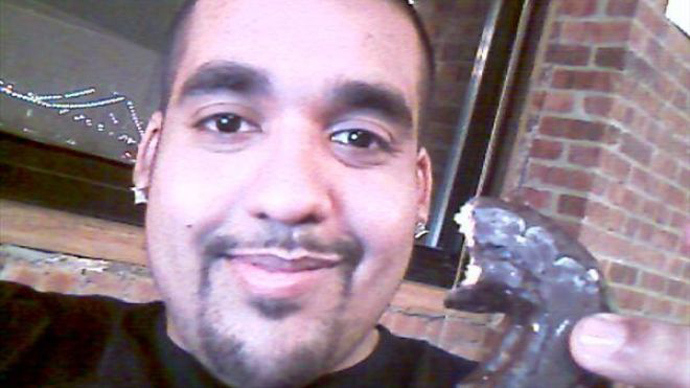
Hector Xavier Monsegur
According to this week’s revelations, Monsegur did more than just inform for the FBI after his arrest. The articles suggest rather that from behind his internet handle “Sabu,” Monsegur solicited vulnerabilities and targets from a wide range of hackers and then handed them off to other online acquaintances, including Hammond, in order to pilfer, plunder and otherwise ravage the websites and networks of foreign entities and at least one major American corporation.
Combined, the articles and the evidence contained therein corroborate very serious allegations concerning the Justice Department’s conduct in the case against Hammond and numerous other hacktivists, while raising numerous questions surrounding the FBI’s knowledge in hundreds of cyberattacks and its documented efforts to coordinate those campaigns using their informant.
Excerpts from previously unpublished chat logs and other evidence used in the Hammond case and obtained by the Dot and Motherboard are cited to provide a new point-of-view concerning two matters in particular: the December 2011 hacking of Strategic Forecasting, or Stratfor; and a January 2012 campaign led by Anonymous against government websites in Brazil and the US.
Contrary to the government’s claims, the Dot article alleges that Hammond did not mastermind the hack against Stratfor, but was rather told to target the Texas-based intelligence firm after Monsegur was made aware of a vulnerability in its network by a mysterious hacker who used the handle “Hyrriiya.” Weeks’ worth of private chats and group messages logged by Monsegur for the FBI after his arrest confirm that Hyrriiya breached Stratfor first, then sent details to the hacker he knew as “Sabu,” who in turn personally recruited Hammond to take the attack to the next level. For the first time, a clear timeline now exists to show exactly how the hack was hatched first by Hyrriiya, then Monsegur. A claim made ahead of Hammond’s sentencing hearing in which he claimed to have never even heard of Stratfor until he was fed the target by Sabu is authenticated with the logs.
Motherboard’s report focuses on a span of time only weeks after the Stratfor hack earned Anonymous headlines around the globe. Monsegur at that time was maintaining a list of targets in Brazil that would then be dispersed among members of Anonymous and other hackers to be defaced en masse as part of at least two concurrent cyber operations carried out in early 2012: an anti-corruption campaign against the Brazilian government; and another op in response to the shutdown of file-sharing site Megaupload.
“Sabu would say he wanted so-and-so, that another hacking team wanted this particular target,” Hammond told Motherboard from prison last month. “Some Brazilian was looking for people to hack them once I gave him the keys.”
Previously, Hammond said that Monsegur directed Anonymous to target websites belonging to no fewer than eight foreign governments while he was fully cooperating with the FBI. Only now, however, has documentation surfaced to verify that claim and others about alleged acts of cyberwar carried out by the the government by proxy.
“It’s completely outrageous that they made Sabu into this informant and then, it appears, requested him to then get other hackers to invade sites and look for vulnerabilities in those sites,” Michael Ratner, an attorney for WikILeaks, told Motherboard. “What that tells you is that this federal government is really — it’s really the major cybercriminal out there.”
The articles were first published Thursday morning and were a joint effort by journalists Dell Cameron of the Dot, Daniel Stuckey of Motherboard and RT’s Andrew Blake.
Featured Video
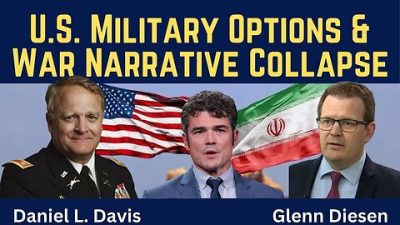
Daniel Davis: U.S. Military Options & War Narrative Collapse
or go to
Aletho News Archives – Video-Images
Book Excerpt
“Vaccines Do Not Cause Autism!” The Science is Settled. Right?
ICAN urges the IACC to actually study infant vaccines and autism
 By Aaron Siri | Injecting Freedom | March 16, 2026
On behalf of ICAN, we just sent a copy of chapter 11 of Vaccines, Amen to the newly appointed members of the federal Interagency Autism Coordinating Committee (IACC).
If you haven’t already read this chapter, you can read the whole thing in the attached letter. I trust that after you read it, you’ll see why the statement “vaccines do not cause autism” is a belief, not science!

IACC Public Comment Letter
1.53MB ∙ PDF file
Includes chapter 11 of Vaccines, Amen
Blog Roll
 Aletho News
- Washington’s War on Cuba Is Older Than You Think
- Daniel Davis: U.S. Military Options & War Narrative Collapse
- Protesters call on Brussels university to cut partnership with Israeli defense-linked firm
- Weapons makers cash in on Trump’s Iran war
- Why Trump’s anti-Iran naval coalition in Strait of Hormuz is doomed to fail
- IRGC says regional energy sites linked to US will be reduced to ashes
- Qatar condemns ‘dangerous’ Israeli attack on gas field
- Iran made ‘unexpectedly substantial’ offer during Geneva talks, US envoys ‘dragged’ Trump into war: Report
- Russia condemns Israel’s attack near Bushehr plant, files complaint
- Russia Strongly Condemns Actions Aimed at Harming Health of Iranian Leadership – Kremlin
- If Americans Knew
- How ignorance, misunderstanding and obfuscation ended Iran nuclear talks
- Israeli media reports grotesque settler attack in West Bank
- UK security adviser attended US-Iran talks and judged deal was within reach
- Tucker Carlson says ‘neocons’ will try to destroy Joe Kent over resignation
- Lebanon death toll exceeds 900, another assassination in Iran, bombing in Gaza – Not a ceasefire Day 159
- Trump’s counterterrorism chief, whose own wife was killed by ISIS, quits over Iran War saying Tehran posed ‘no imminent threat’
- Here’s what US could fund instead of Bibi’s war on Iran
- Israel Killed Over a Dozen Lebanese Paramedics in Three Days, Now Claiming That Ambulances Are “Hezbollah” Targets
- War on Iran: These are the heritage sites devastated by US and Israeli attacks
- Four news stories from Israeli media that illustrate Israeli “justice”
- No Tricks Zone
- Energy Expert: Germany’s Nuclear Phaseout Was A “500 Billion Euro Mistake”
- New Research: South Australia’s Mid-Holocene Sea Surface Temperatures Were 4°C Warmer Than Today
- Storing Green Energy To Last Germany 10 Days Would Require A 60-Million Tonne Battery
- New Studies: UK Sea Levels Were 4 Meters Higher Than Today During The Mid-Holocene
- Destructive Green New Deal: German Energy And Metal Group Warns Of Drastic Crisis
- New Study Documents A 20-Year Pause In Arctic Sea Ice Decline – Driven By Internal Variability
- Wake-up Call: Survey Shows Majority Of Germans Now Favor Postponing Climate Targets!
- Televised! Leading German Political Candidate Tells Schoolchildren CO2 Makes Sun Hotter!
- New Study: A Century Warming Of 1.1°C Is ‘Commonplace’ And ‘Not Unusual’ During This Interglacial
- New Study: ‘Internal Noise’ And Volcanic Forcing Can Trigger 10-15°C Warming Within Decades
 Aletho News