Palestinian school set on fire
International Solidarity Movement | September 21, 2014
As-Sawia, Occupied Palestine – On the evening of the 10th September, unknown assailants broke into the As-Sawia Secondary School, forced open the door and set the school on fire. Bedouins living close to the school saw the fire and alerted the fire brigade. By the time it was put out, the principal’s office and teachers’ rooms were completely burned.


“We lost six computers, four printers, all the teachers’ books and materials, but most of all, the administrative documents and files of the students and about the school situation over the past years. The whole damage is around 140,000 shekels,” the principle Adnan Hussein told ISM. The school was closed for three days after the arson attack.


As in many schools in the occupied West Bank, the students and staff of As-Sawia Secondary School suffer from constant settler and military harassment. Three days before the arson, armed settlers who called themselves “security” from one of the nearby hilltop illegal settlements stood at the school gates. When the principal spoke to them, they claimed that children threw stones at the settler cars on their way to school.
The school is located by Road 90, which was paved in 1944 and runs across the West Bank. The road is used by Palestinians and by illegal settlers. The children have to walk alongside it to get to school in the mornings and to go home after school.
“Our school is suffering both for the settlers and the army,” explained Hussein. “We constantly have the army at our gates, checking ID’s and bothering children”
On the 3 September, armed settlers stopped in a car marked as the illegal settlement Eli’s “security” at the gate of the school. One of the settlers came out of the car, jumped over the fence and started following some of the children, who have finished their classes and were leaving for home. The principle approached the settler and told him that he is not allowed in the school with weapons, and the settler responded that he was looking for a child who threw stones and shouted at the settler car earlier.
After agreeing to move outside the school gate at the head teacher’s insistence, the settler with the machine gun was joined by another settler and they insisted that the boy in the red T-shirt was brought to them. They also wanted the head teacher’s mobile phone number so that they could call him in the future.
“I had a bad feeling that something horrible will happen and that they will start shooting,” related Hussien. “I left some teachers with the settlers and with other teachers went to escort children through another gate and send them home, when three soldiers appeared. I went to speak to them. I told them that they cannot be in school with their weapons and in their uniforms but they insisted that they wanted to speak to a boy in the red T-shirt for 10 minutes.”
The principal and staff stood between the soldiers and settlers and the pupils to protect them while they were leaving the school. By this time worried parents were at the gate and they took the children away.
Throughout 2013, the army entered the As-Sawiya 51 times and children and the staff had to put up with teargas, sound bombs and arrests of pupils.
Hussein explained, “It is a constant worry that the settlers and the army will come. It is hard enough to control 350 teenagers even in the countries where there is no occupation. It is not easy and we do what we can to try to do our best keep the education for our children going. We have no problem with Jewish people and I can say that many of them are nice and honest, but settlers are generally dangerous people. I know that people should be able to choose where they live, but that does not include taking someone else’s land without permission.”
Florida Sheriffs Used SWAT-Style Attack to Enforce Barbershop License
By Noel Brinkerhoff and Steve Straehley | AllGov | September 20, 2014
Florida sheriff’s deputies, under the guise of checking professional licenses, raided an Orlando-area barbershop using SWAT-like tactics back in 2010 and now a federal appeals court has ruled that the search was illegal.
In a ruling that allows a lawsuit against the department to proceed, the Eleventh Circuit Court of Appeals strongly criticized the Orange County Sheriff’s Office for storming the Strictly Skillz barbershop four years ago. “With some team members dressed in ballistic vests and masks, and with guns drawn, the deputies rushed into their target destinations, handcuffed the stunned occupants—and demanded to see their barbers’ licenses,” the court wrote. The raid was one of several deputies carried out against minority-owned barbershops and salons in 2010.
The justices said the deputies went too far in using a SWAT-like approach just to check whether barbers were licensed. In fact, inspectors from Florida’s Department of Business and Professional Regulation (DBPR) had inspected Strictly Skillz only two days prior to the raid and found everything in order.
Describing the raid as a “scene right out of a Hollywood movie,” the panel of judges wrote: “Unlike previous inspections of Strictly Skillz…the August 21 [2010] search was executed with a tremendous and disproportionate show of force, and no evidence exists that such force was justified.” The Fort Lauderdale Sun Sentinel reported that “no illegal or unlicensed activity was found” at the Pine Hills barbershop.
Working with DBPR, the deputy sheriffs claimed they suspected unlawful activity had taken place at the shop, which caters to minority customers, and others like it.
Tuesday’s ruling was a result of two deputies, Keith Vidler and Travis Leslie, petitioning that they should be immune from any civil litigation brought against them for doing their jobs. But the judges rejected their position, noting that they had twice before ruled in other cases that those participating in a warrantless criminal raid were not entitled to immunity. “Today, we repeat that same message once again,” the court wrote. “We hope that the third time will be the charm.”
Both the DBPR and the Sheriff’s Office launched internal investigations following a report by the Orlando Sentinel exposing the raids.
The DBPR terminated several employees and settled out of court with barbers. But the Sheriff’s Office concluded deputies did nothing wrong.
To Learn More:
Excessive Force Used in 2010 Barbershop Raid, Appeal Court Says (by Jeff Weiner, Fort Lauderdale Sun-Sentinel)
SWAT-Style Barbershop Raid Nets Harsh Rebuke (by Lorraine Bailey, Courthouse News Service)
Brian Berry v. Travis Leslie (Eleventh Circuit Court of Appeals) (pdf)
Obama administration ‘blocking’ information from the press – AP
RT | September 20, 2014
Uncovering information that should be available to the public has become increasingly difficult under the presidency of Barack Obama, an Associated Press bureau chief says. In some cases, it surpasses the secrecy of the George W. Bush administration.
The White House’s penchant for secrecy does not just apply to the federal government, according to AP’s Washington bureau chief, Sally Buzbee. During a joint meeting of news editors, she stated that the same kind of behavior is starting to appear in state and local governments.
Buzbee pointed out eight ways that the Obama administration is stifling public access to information – including keeping reporters away from witnessing any military action the United States takes as it battles Islamic State extremists in the Middle East.
“The public can’t see any of it,” Buzbee said, referring to the military campaign. “News organizations can’t shoot photos or video of bombers as they take off – there are no embeds. In fact, the administration won’t even say what country the [US] bombers fly from.”
She also expressed frustration with the government’s handling of the upcoming 9/11 trial, during which journalists are prohibited from looking at even non-classified court filings in real time.
“We don’t know what prosecutors are asking for, or what defense attorneys are arguing,” she said.
Meanwhile, basic information about the prison complex in Guantanamo Bay, Cuba is being withheld from the public, despite the fact that the Bush administration freely shared this data. The media is unable to learn how many inmates are on hunger strike in the infamous prison, or how frequently assaults on guards take place.
Freedom of Information Act (FOIA) requests have become harder than ever to process, Buzbee added. Government officials often fail to do so unless media outlets bring a lawsuit to bear.
At the same time, federal officials have begun pressuring state and local agencies to keep quiet.
“The FBI has directed local police not to disclose details about surveillance technology the police departments use to sweep up cellphone data,” Buzbee said. “In some cases, federal officials have formally intervened in state open records cases, arguing for secrecy.”
Donors will fail Gaza again
By Nicola Nasser | Al-Ahram | September 19, 2014
On 12 October, Cairo is due to host a conference, sponsored and chaired by Egypt and Norway, of international and Arab donors for the reconstruction of Gaza. This is their ostensible aim. But the reasons that the donors cited for not fulfilling earlier pledges, made in Paris in 2007 and Sharm El-Sheikh in 2009, still exist.
This means that the donors who attend the upcoming Cairo conference will probably make the same pledges they made at the two previous conferences and then once again fail to fulfil them.
Meanwhile, the Palestinian people under blockade in Gaza will remain in suspense, waiting for the next aggression to be unleashed on them by the Israeli occupation, purportedly in order to eliminate the causes that the donors cite for recycling their pledges for the reconstruction of Gaza that is unlikely to happen in the foreseeable future.
Fulfilment of the donors’ old/new pledges is still contingent politically on the imposition of the status quo in the West Bank on Gaza. This entails security coordination with the occupying power, the pursuit and elimination of all forms of resistance to the occupation, rendering all reconstruction activities subject to the approval of the Israeli security regime, and much more.
Even should these conditions be met, the donors’ fulfilment of their pledges will remain contingent on the Palestine Liberation Organisation’s (PLO) continued commitment to negotiations as its sole strategy, and to the agreements that led to the creation of the Palestinian Authority (PA).
All the evidence indicates that the PLO and the PA have spearheaded the battle to impose the donors’ conditions on their behalf. Beneath the rubric of “legitimacy”, “the national project” and “the single central authority” that “alone holds the powers to make decisions on war and peace,” the PLO and PA have demonstrated that they are ready to abide by the donors’ political conditions.
The irony is that Israel has never met the conditions it compelled the donors to impose, not just in order to proceed with the reconstruction of Gaza, but also on the PA in general.
Israel has never renounced violence. It repeatedly wages war and unleashes its instruments of state terrorism against the Palestinians under occupation. It has flagrantly and repeatedly violated every agreement signed with the PLO. It has not even reciprocated the PLO’s recognition of Israel, nor has it officially acknowledged the Palestinians’ right to establish a Palestinian state.
Currently, the occupation authorities are threatening to dissolve the Palestinian national reconciliation government if it does not assert its full authority over Gaza. The message was driven home by PA Deputy Prime Minister Mohammed Mustafa, who said that there would be no reconstruction unless his government can fully assert its control over Gaza.
However, all the evidence also indicates that the resistance is there to stay in Gaza and that its powers to resist the imposition of the donors’ conditions — on it and on Gaza — are increasing.
The only possible way to read all of the foregoing, and other facts, is that the reconstruction of Gaza under such conditions and circumstances will be deferred until further notice and that deferring reconstruction and linking it to a process of cloning the West Bank model in Gaza is actually a strategy that paves the way for yet another invasion of Gaza.
It is also a fact that reconstruction needs in Gaza are accumulating as a result of this strategy. Destruction in Gaza did not begin with the response to action against this strategy in 2007. The reconstruction of Gaza’s airport and seaport, for example, has been pending since the occupation destroyed these facilities in 2002. Reconstruction dues from the destruction wrought by the Israeli assaults on Gaza in 2008-2009 and 2012 are also continuing to accumulate.
A recent report by the Palestinian Economic Council for Development and Reconstruction (PECDAR) estimates that it will cost around $8 billion to rebuild what was destroyed during the last Israeli attack on Gaza. The report says that this process would take five years if the occupation authority were to “fully” lift the embargo on Gaza, which is hardly likely to happen soon.
Clearly, the reconstruction of Gaza requires a new Palestinian strategy, one that draws a line between the grants donors offer and their political conditions, and that rejects once and for all any Palestinian commitment to those degrading conditions that, as the years since the so-called “peace process” began have proven, have brought more destruction than construction, and have served as the chief incubator of Palestinian divisions and not brought even a minimum degree of national benefit.
At the same time, any new government that emerges from a national partnership must embrace resistance against the occupation. The current national reconciliation government, with its six-month term and its principle tasks of preparing for presidential and legislative elections, is by definition an interim government and is not qualified to shoulder heavy and long-term burdens such as the reconstruction of Gaza and securing the end of the blockade.
Both of these tasks are humanitarian and national goals that are higher than any political or factional disputes. Yet the Palestinian presidency’s determination to toe the line with the donors’ conditions, which make no distinction between humanitarian needs and political ends, is a strategy that fails to discriminate between national needs and factional interests. It is a strategy that protracts the humanitarian disaster in Gaza.
Unfortunately, the need to separate politics — factional or otherwise — from the humanitarian issue does not appear to be on the agenda of either foreign and Arab donors, or of Palestinian President Mahmoud Abbas, in spite of the letter he sent to UN Secretary General Ban Ki-Moon on 30 July declaring Gaza a “disaster zone” in the grips of a “dangerous humanitarian crisis.”
This “dangerous humanitarian crisis” is the product of forms of collective punishment that were inflicted against the people of Gaza before the Palestinian rift and that grew worse afterwards. Any Palestinian assent to continuing to adhere to donors’ political conditions, which are responsible for perpetuating the collective punishment, is a form of Palestinian complicity in subjecting the people of Gaza to this punishment. The time has come for all Palestinian leaders to exonerate themselves from all charges of complicity in such punishment.
The collective punishments that have been and continue to be visited on Gaza are not acceptable, even on the pretext of punishing Hamas. Under the Geneva Conventions and before international criminal law they constitute a war crime inflicted on the civilian inhabitants of Gaza, who are protected by international humanitarian law, at least in theory.
To insist that Gaza’s reconstruction be linked to the reinstatement of the “full” authority of the Palestinian presidency and the PA over Gaza, and to the donors’ political conditions which, in fact, are the conditions of the occupying power, is merely another way to say that the reconstruction of Gaza should be linked to the imposition of Fatah’s factional agenda on Gaza.
It also means that civilians in Gaza are to be collectively punished for the factional disputes that Fatah has with Hamas, in which case it becomes very difficult to avoid pointing fingers of accusation at Palestinian complicity in the ongoing collective punishment of the people of Gaza, and more difficult yet to defend any possible Palestinian contribution to the perpetration of such a war crime.
As long as the current situation persists, reconstruction of Gaza will remain pending indefinitely, and the reconstruction burden will only grow. Eventually, the people of Gaza will have no alternative but to look for salvation through other means that they, alone, can control. The Palestinian presidency and its faction must decide to free themselves once and for all from their financial and political dependence on donors and the sterile “peace process” that has so far wrought only death, destruction and division.
It is not too late to opt for the national alternative, which is still available given good intentions, to save the people of Gaza, national unity, the resistance, and decision-making autonomy.
This alternative entails following through on implementation of the mechanisms for national reconciliation, activating the unified command framework for the PLO, agreeing on a new Palestinian strategy based on the principles of partnership and resistance, and creating a new national unity government committed to this strategy and qualified to shoulder such enormous tasks as the reconstruction of Gaza and lifting the blockade.
All of the foregoing requires no more than honest introspection, the prevalence of national conscience, and political free will.
Nicola Nasser is a veteran Arab journalist based in Birzeit, West Bank of the Israeli-occupied Palestinian territories.
Protests in Egypt against energy price hikes and politicised trials
MEMO | September 20, 2014
Opponents of the military coup have organised mass protests across Egypt condemning the deterioration of living conditions, price hikes and the ongoing electricity crisis. They are also calling for the prosecution of President Abdel Fattah Al-Sisi for “crimes against humanity”.
The protests came in response to a call by the Anti-Coup Alliance, which called for a “new revolutionary week” starting Friday under the slogan, “The oath of the revolution and the vow of the martyr”.
In the affluent Maadi neighborhood in Cairo, protesters denounced lifting subsidies and the increase in fuel prices. They also chanted for the release of all political prisoners and putting an end to torture in prisons.
In Hilwan, the alliance organised a morning protest against military rule and worsening living conditions. They vowed to continue protests until the leader of the coup is prosecuted.
In Baltim town in Kafr Al-Sheikh governorate, protesters condemned politicised trials and price hikes. In Desouk, protesters waved pictures of Mohamed Morsi and Rabaa signs and chanted against the deteriorating living conditions and poor services, especially electricity.
Israeli spy drone crashes in Lebanon
Al-Akhbar | September 20, 2014
An Israeli spy drone crashed inside Lebanon on Saturday, the Lebanese army and state media reported.
The National News Agency said the remote control plane went down in the Marjayoun district of southeastern Lebanon due to a mechanical malfunction.
It is now being inspected at an army base.
“Today (Saturday) at 10:30 am, an Israeli drone fell at Mazraat Sarde region in Marjayoun while violating the Lebanese [air space],” an army statement read.
Israeli spy drones and fighter jets violate Lebanese airspace on a daily basis.
The Lebanese army issued a statement earlier Saturday saying that a spy drone had entered Lebanese airspace Friday at 10:15 pm and flew around the south for several hours before returning to the occupied territories at 7:00 am.
In February, an Israeli drone crashed on the Blue Line, the UN-demarcated line between Lebanon and occupied Palestine.
Israeli soldiers illegally crossed into Lebanese territory during that incident to retrieve the wreckage.
Israeli aircraft regularly cross into Lebanese airspace, and the border area in southern Lebanon has been the scene of tense standoffs in the past.
The Blue Line was drawn up in 2000 by the UN after Israeli troops withdrew from most of south Lebanon after a 22-year occupation.
Israel still occupies the Shebaa Farms area in southeast Lebanon.
Israeli settlers and soldiers invade Balata refugee camp
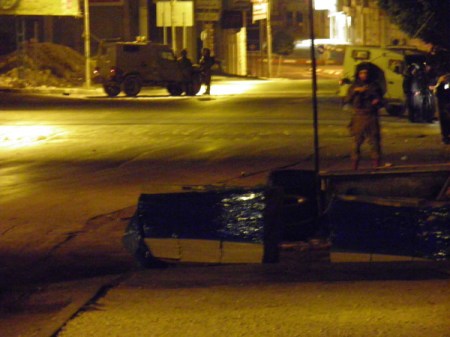
Photo by ISM
International Solidarity Movement | September 20, 2014
Occupied Palestine – On the 17th of September, under heavy Israeli army protection, Israeli settlers from nearby illegal settlements entered Nablus with the aim of praying at Joseph’s tomb in Balata refugee camp.
Just after midnight, the Israeli army closed the district that surrounds the monument, blocking all the streets leading to the tomb and preventing anyone from passing nearby, either by foot or by car.
Around 1am, between eight and 10 buses full with hundreds of settlers invaded the area.
Clashes began in the area, particularly in the junction just in front of the entry to Balata refugee camp.
Youths threw stones for more then two hours against the army vehicles, that were moving up on the hill and back, seemingly in order to keep them busy and far from the large groups of Zionist settlers. Military trucks also tried several times to run over the Palestinian youths while they were throwing stones.
The Israeli army fired many stun grenades, and the road blockades were kept in place until the settlers left the area.
Clashes around Balata occur almost weekly, any time that the settlers decide to invade the area for praying. The settlers claim this monument belongs to the Biblical patriarch Joseph, while most of the Palestinians believe that the religious guide Sheikh Yusef Dweikat was buried there, according to Islamic tradition. Though Joseph is a sacred figure as well in Muslim, Christian and Samaritan religion, Muslims are not allowed to pray there.
Labeling their own actions as “security measures”, the army can easily shoot down a whole neighborhood and guarantee the Israeli settlers the freedom to move and pray wherever they wish, even in a site which is deeply inside Area A, which is supposedly under Palestinian civil and security control. On the other side, most of the Palestinian living in the West Bank are not allowed to pray in their holy places, starting from this Joseph´s tomb to the biggest example of Al-Aqsa Mosque, in Jerusalem.
These evidently different treatments intensify the inequality in rights between Palestinians and illegal Israeli settlers and make the life under occupation more and more unbearable.
Huge blast devastates munitions factory in Ukraine’s rebel-held Donetsk
RT | September 20, 2014
A powerful explosion occurred at a military plant in the rebel-held Ukrainian city of Donetsk after a shell hit it. A fire is now ravaging the damaged facility.
The plant was used for producing explosives and ammunition as well as for dismantling unexploded munitions collected on the battlefields. On Saturday morning, residents of the war-torn city heard a powerful blast, which was followed by a huge cloud of white smoke rising into the sky.
A neighborhood official told Ukrainian 112 television that a shell hit the plant.
“There was a direct hit at the No 47 industrial explosives shop, where some explosives were present. It detonated and caused another explosion. Luckily it didn’t hit the main storage facility where we have some 2.5 tons of explosives,” said Ivan Prikhod’ko, deputy chair of the local community council.
He added that while the incident caused considerable damage, nobody was hurt. The plant itself was not working at the time, so no one was there. Also, it was built far from any residential areas specifically for safety purposes.
As the fire continued, smaller explosions could be heard, presumably from shells detonating in the fire, RIA Novosti reported.
There is no verified report about what kind of weapon hit the plant. But there are rumors of it being targeted by a Tochka-U tactical missile launched by Kiev’s troops.
“According to our information, three Tochka-U missiles were fired and there you have it,” a militia member who identified himself as codename ‘Scorpio’ told RT. He added that the area around the plant was considered dangerous lately because both the rebels and their opponents could shell it.
Donetsk saw sporadic shelling overnight.
The incident mars Friday’s signing of an extended ceasefire deal between Kiev and rebel forces, which hopes to put an end to hostilities in eastern Ukraine. The deal includes pulling back all heavy weapons from cities and frontlines.
The blast happened just as a Russian humanitarian aid convoy was unloading elsewhere in the city. Some 200 trucks carrying 2,000 tons of aid crossed the border earlier on Saturday.
Both sides in Ukraine conflict sign treaty banning military action
RT | September 19, 2014
Kiev and self-defense forces signed a memorandum aimed at effectively halting all fighting in eastern Ukraine after talks in Minsk. It creates a buffer zone, demands a pullback of troops and mercenaries, and bans military aviation flybys over the area.
The signed memorandum consists of nine points, former Ukrainian president Leonid Kuchma told journalists following peace talks in Minsk, Belarus.
“The first one is stopping the use of weapons by both sides, the second is terminating new formations of units on military bases as of September 19. The third is banning the use of all types of weapons and offensive action,” Kuchma said.
The agreement outlines a buffer zone of 30 km (18.6 miles) and bans all military aircraft from flying over part of eastern Ukrainian territory, except for the OSCE’s aerial vehicles, Kuchma told RIA Novosti following the meeting.
Ukraine troops must pull back all heavy artillery by 15 kilometers from the conflict zone in eastern Ukraine, the treaty states.
All foreign mercenaries must be withdrawn from eastern Ukraine by both sides of the conflict, the signed Minsk memorandum states, according to Kuchma.
“We have agreed on the withdrawal of all foreign mercenaries from both sides,” Kuchma said.
Both sides also vowed to continue the exchange of prisoners.
The OSCE has been tasked to monitor that both sides adhere to the memorandum’s conditions. The organization’s observers will be sent to observe the situation along the entire zone of the ceasefire, Itar-Tass reported.
Five hundred OSCE observers will be sent to monitor the ceasefire in eastern Ukraine, Lugansk People’s Republic representative Aleksey Karyakin said, adding that the meeting was quite difficult.
“We were able to substantially increase the number of OSCE observers in the conflict zone from 300 to 500,” he said.
The negotiations were also attended by Russia’s OSCE representatives.
Meanwhile, the prime minister of the self-proclaimed Donetsk People’s Republic, Aleksandr Zakharchenko, declared that there will be “no Ukrainian election” in Donetsk, referring to one of the conditions set out in the September 5 Minsk protocol, which gave special status to the Donetsk and Lugansk regions, both located in eastern Ukraine.
Zakharchenko said he considers the special status as a declaration of independence of the self-proclaimed republics.
‘Sanctions war’ has nothing to do with Ukraine; it’s just a pretext – Rusal CEO
RT | September 19, 2014
The Ukrainian conflict was just a trigger for the sanctions, which demonstrated the failure of all previous efforts to set up healthy relations between Russia and the West, Russian tycoon and head of Rusal, Oleg Deripaska, told RT in Sochi.
“I think the sanctions have nothing to do with Ukraine. Ukraine was just a reason. [The sanctions] were a failure of any attempt which was taken in the past to build normal relations between Europe and Russia – from both sides,” Deripaska told RT at the Investment Forum in Sochi.
Oleg Deripaska said the West started pressing Russia before the first sanctions were imposed – just ahead of the Sochi Olympics.
“We should give a lot of credit to Sochi, [as it showed] a different world, [despite] whatever appeared in the Western press,” he said.
Asked if people across the globe are more anti-Russia than ever, Deripaska answered that “it’s not people, it’s [about] various lobbying groups and various interests.”
“You remember all the complaints before the Olympics. They’ve been intentionally stopping any efforts from the Russian side to be normal, to look normal in the West. My view is we should go down as deep as possible, as quick as possible, and then touch the bottom and go up, and think what’s actually common between us, if there is any chance to have this Portugal-Vladivostok trade zone and opportunities to live together.”
Featured Video
Theodore Postol: Iran’s Missiles & Drones Were Underestimated
or go to
Aletho News Archives – Video-Images
From the Archives
What is the Israeli Lobby in Australia Doing in Interfaith Dialogue?
By Ali Kazak | Dissident Voice | October 11, 2015
For years Israel and its lobby around the world have been trying to normalise their relations with Arabs and Muslims without solving the Palestine Question.
One of the methods they resorted to in the last few years is using human rights and community organizations such as interfaith dialogue and Multiculturalism to achieve this objective and to: isolate the Palestinians, marginalise the Palestine question, end Israel’s isolation, and prevent criticism of Israel, knowing that these organisations will be the first to stand against Israel’s violations, racial and religious discrimination.
The group responsible for this task in Australia is The Australia/Israel & Jewish Affairs Council (AIJAC); its Director of International & Community Affairs, Jeremy Jones is in charge of lobbying religious community organizations, specifically Muslims and Christians. Consequently he convened the Faith Communities for Reconciliation, founding participant in the Australian Partnership of Religious Organisations and the Australian National Dialogue of Christians, Muslims & Jews.
AIJAC is a private political propaganda group. It is recognised as the main Israeli lobby in Australia. It coordinates its activities and works intimately with the Israeli embassy in Canberra and different institutions in Israel. It is privately funded by some Jewish businessmen. It monitors closely Australian politicians, the media, ethnic and religious groups, (especially Arabs and Muslims), unions and academics on their stands towards Israel and the Palestine question. … continue
Blog Roll
 Aletho News
- Iran’s friends are about to make life much more difficult for Israel and the US
- The war of liberation of the Arab and Islamic peoples expands across the Gulf
- Envoy warns UN on Trump’s threat to ‘obliterate’ Iran’s civilian infrastructure
- The Larak Corridor: Iran’s Rial Gate With No US, No Israel, and No Way Around
- ‘Economic terrorism’: Steel facilities hit again in US-Israeli strike
- ‘War Crime’: Iran condemns attacks on Arak, Ardakan nuclear sites
- Two-thirds of Americans want quick end to Iran war even if goals unmet
- Trump to Give “Important Update on Iran” Wednesday in Prime-Time Speech
- Theodore Postol: Iran’s Missiles & Drones Were Underestimated
- Iran To Target Military Industrial-Tech Complex That Facilitated Gaza Genocide
- If Americans Knew
- Israel wants US to bomb more of Iran’s civilian structures (113,000 is not enough) – Not a ceasefire Day 173
- Ann Coulter Rips Into Fox News for Iran War Coverage
- Joe Kent Urges Americans To Call White House and Congress To Object To Sending Troops Into Iran
- DNC Resolution to Reject AIPAC Funding Puts Democratic Leaders in the Hot Seat
- Swedish foundation to build 400 schools as over 650,000 Gaza children remain without education for 2 years
- Israeli army admits photshopping image of slain Lebanese journalist
- This is how Israel is systematically killing health workers under the cover of war in Lebanon
- Carrying life under fire: Israeli invasion of Lebanon leaves pregnant women facing deadly risks
- Champagne all around for the new death penalty (for Palestinians) law – Not a ceasefire Day 172
- Why are Palestinian books struggling to be seen on Amazon?
- No Tricks Zone
- New Study Finds Warming Saves Lives…Cold Temperatures 12 Times More Deadly Than Excess Heat
- German Science Blog Accuses PIK Climate Institute Of Hallucinating Climate Tipping Points
- Devastating Assessment Of Comirnaty Vaccine By Former Senior Pfizer Europe Toxicologist
- New Study: CO2 Is ‘Effectively Negligible’ As An Explanatory Climate Change Factor Since 2000
- Former Pfizer Toxicologist Dr. Helmut Sterz Tells Bundestag Hearing Pfizer Vaccine Should Have Never Been Approved
- Energy Expert: Germany’s Nuclear Phaseout Was A “500 Billion Euro Mistake”
- New Research: South Australia’s Mid-Holocene Sea Surface Temperatures Were 4°C Warmer Than Today
- Storing Green Energy To Last Germany 10 Days Would Require A 60-Million Tonne Battery
- New Studies: UK Sea Levels Were 4 Meters Higher Than Today During The Mid-Holocene
- Destructive Green New Deal: German Energy And Metal Group Warns Of Drastic Crisis
 Aletho News