Saudi Arabia Cries Foul Play in Yemen
By Catherine Shakdam | New Eastern Outlook | August 27, 2015
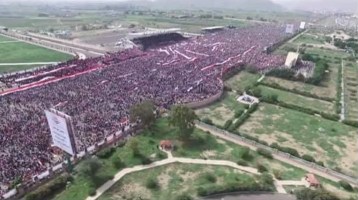
As the Yemen International Conference in the Support of Yemen was in full swing in the British capital, London, Yemenis came in their hundreds of thousands to pledge their support to the Resistance movement this August 20, 2016 – yet another popular show of force, yet another grand display of sovereign political will in the face of foreign diktat.
To the sounds of explosions, and flying Saudi war planes it is Yemen which came to defy its invaders; a proud nation under unprecedented duress, a land united under the banner of its resistance.
“We won’t bow down to the House of Saud” chanted the crowd. “We will never bow down to the criminal House of Saud,” millions repeated in unison.
If Yemen remains in the throes of a brutal war of attrition for its dared ambition to live free under its skies, its people are quite determined to weather whatever storm Saudi Arabia will throw, so that their right to self-govern and resist oppression could be affirmed – never to be questioned again.
However one chooses to look at Yemen’s war, it would be foolish to deny still that those brave souls corporate media still label as “rebels” are in fact the carrier of a nation’s will; the very expression of a people’s inherent right to carve its own political future, regardless of what anyone else might think.
Let me be brutally honest here – Yemen neither needs foreign approval, nor does it require foreign vetting. Yemenis want what they want because they can! It is really that simple.
Yemen needs no liberating from the Houthis, for the Houthis are Yemen. Yemen is not being overrun by Shiites, Yemen is Zaidi country. There is no Iranian agenda at play either, only a desire to disappear the suffocating influence of the House of Saud.
Standing in opposition of the most violent, radical and reactionary theocracy ever to grace the pages of our history does not make Yemen an “Iranian agent”, it makes Yemen an expectant independent nation.
Media coverage of Yemen so far has been criminal at best, misleading always.
The public has been conned into a narrative which is devoid of all humanity, and democratic courtesy. The simple fact that media feel entitled to slap derogatory adjectives before the Houthis as to direct their readers’ self-righteous sense of political morality is despicable.
I read the terms Iran-backed Shia Houthis rebels too many times not take offense. How dare you define a people whom you know nothing about? How dare you speak over and at an entire nation because their will does align with yours?
Let’s play the adjective game shall we?
When have you ever read the following statement: Wahhabi-backed-Western-sold-out- twice-resigned-once-runaway-child-killer-Sunni President Abdo Rabbo Mansour Hadi? Likely never … Why? Because Saudi Arabia and its allies are still hiding behind this pale figure of a man to legitimize their odious genocidal military intervention against Yemen.
Let me tell you of this so-called legitimate political figure the West has canonised as Yemen’s forever president.
Hadi is a fraud and a traitor. Not only did he allow for the killing of his countrymen, he actually actively pursued their annihilation in the name of a chair he never truly was appointed to. Hadi was elected in a one-man election in 2012 for the duration of a 2-year’s mandate – not exactly what you call democratic.
Hadi was never the choice of the people, he was Riyadh’s choice through the GCC-brokered transition of power agreement (2011).
How can anyone speak of democracy and refuse Yemenis their own?
How can anyone still read corporate media and not deplore the stench of their abominable hypocrisy and bias?
Do not tell Yemen what it wants, but hear what it is telling you.
Hear what an entire nation is screaming from the top of its glorious lungs, and witness the rise of a Resistance which breadth will maybe crumble al-Saud tyranny.
“We won’t bow down to the House of Saud … We will never bow down to the criminal House of Saud!”
Can you hear them now? Can you not respect that a nation simply cannot bring itself to live the abomination which is Wahhabism? Can you not recognise that Yemen is the last line of defense for all free folks in Arabia?
Who will speak for democracy and political self-determination when radicalism will have nations at the mercy of their guns? Can you not see that what you refuse Yemen – free will, is exactly what you demand for yourself?
Do not tell me of the will of a people when under bombs millions have rallied before their appointed leaders.
Yemen is free today by the strength of its Resistance movement.
Yemen is dignified today for one man rose from the oppression of religious repression to reclaim pluralism his own coat of arms. Sheikh Abdel-Malek al-Houthi, one of the sons of Hamdan, Yemen’s very own legacy offered Yemen its Freedom to keep none for himself.
Sheikh al-Houthi liberated Yemen from al-Saud never to demand a seat at power’s table.
Do not speak of what you don’t know Mr corporate media. Do not define with your adjectives the nature of a land for which you have no respect for.
Yemen might be poor and battered but it is a grand and noble land.
Of course Saudi Arabia would want you to believe that Yemen’s political ambitions are illegitimate, unlawful and nefarious.
Have you ever bothered asking why? Have you even given the infamous “Houthis” the time of day before dismissing them under misapprehension?
I think not. What the public did is assume. What the public did is read those adjectives media associated ad nauseam to Yemen resistance movement, and automatically accept those labels as truths. Adjectives those days have become dangerous weapons of mass-destruction.
Adjectives have cost Yemen its freedom!
Yemenis this August 20, 2016 came to publicly offer their support to the new highest political council – and still Riyadh has cried foul play.
Millions took to the streets knowing full well that Saudi Arabia warplanes were up above to offer their voice and their arms to the Resistance, and still Western capitals have called for Hadi’s “restoration.”
What will it take for you to wake up?
Yemen has bled, burnt, exploded, pleaded, negotiated, mourned, cried and starved while you turned your nose up in disgust arguing what future a people should have instead of the one they want for themselves.
If you like the idea of a life spent in the shadow of Wahhabism why not book a ticket to Saudi Arabia and experience first-hand the type of democracy al-Saud have in mind for Yemen, you might find new respect then for the Houthis of Yemen.
One more thing before I go: no one said you had to love the Houthis, only that you respect that Yemenis do.
Catherine Shakdam is the Director of Programs of the Shafaqna Institute for Middle Eastern Studies and a political analyst specializing in radical movements.
US Okay With Surgical Strikes on Yemen Hospitals
By William Boardman | Reader Supported News | August 24, 2016
Nuremberg: “a war of aggression … is the supreme international crime”
Waging genocidal war on a defenseless country was never so baldly and honestly put on any agenda for talks among US secretary of state John Kerry, representatives of Saudi Arabia’s dictatorship, and their mutual allies, even though they are all engaged in an endless genocidal war on Yemen. This war is a war of aggression, started by Saudi Arabia in March 2015, with crucial US blessing, participation, personnel, and ordnance. The US has been a willing, guilty partner and enabler in 18 months of military atrocities in a one-sided war that everyone involved knew – or should have known – was a pure war crime based on a paranoid delusion.
American participation in this war of aggression was a war declared by press release from the National Security Council on March 25, 2015, another example of the imperial presidency’s ability to act by fiat without fear of serious objection from the public, the media, or even Congress:
President Obama has authorized the provision of logistical and intelligence support to GCC [Gulf Cooperation Council]-led military operations. [emphasis added]
The fundamental crime in Yemen is waging a war of aggression, which encompasses all the subsequent war crimes including bombing civilians, using cluster bombs, bombing hospitals, bombing food supplies, and trying to starve a population to submission or death. Yemen, with a population of 26 million people, was the poorest country in the region even before it was attacked. What the US supports and sanctions against Yemen makes any US complaint about Russian actions in Crimea sound like howling hypocrisy.
For all that the Saudis frame their war on Yemen as a defense against a threat from Iran, there has never been any credible evidence of any credible threat to Saudi Arabia from any element of the miniscule Iranian presence in Yemen. Yemen is fighting a civil war, a new version of the same old civil war Yemenis have been fighting for decades, both before and after Yemen was two separate countries. The Iran “threat” is the paranoid delusion supposedly justifying a merciless war on a civil population already beset by a four-sided civil war. There is no way that those who decided to wage this war of aggression could not have known the reality in Yemen if they had wanted to know it. Presumably they knew it all full well and chose a war of aggression anyway, recklessly, perhaps even thoughtlessly, but criminally all the same.
The Saudi goal was always to get rid of a longstanding threat on its southwestern border, where the tribal land of the Houthis lay both in Yemen and Saudi Arabia. When the long-oppressed Houthis, a Shia minority in a Sunni world, drove out the Sunni government of Yemen in 2015, the Saudis, without saying in so many words, decided on a course of action that could lead to a final solution. And everyone knew, at the time, and no one objected, according to this account by the highly reliable Andrew Cockburn on Democracy NOW! (whose piece in Harper’s Magazine for September 2016, ironically titled “Acceptable Losses,” provides an excellent exegesis of the war on Yemen, but with a more elegiac tone):
I was told, very early on in the war, Deputy Secretary of State Tony Blinken went to Riyadh to ask the—this is two weeks—yeah, it was two weeks into the war [mid-April 2015], when they had already been bombing away, using the U.S. bombs, U.S.-supplied bombs, using U.S. weapons, killing already dozens, if not certainly, you know, hundreds of civilians, destroying factories. And finally, Blinken turns up in Riyadh and asks, “By the way, what are you trying to accomplish here?” And the Saudis effectively said, or at least the Americans understood them to say, “Well, we basically want to wipe out the Houthis.” Well, they termed it as “end all Iranian influence in Yemen.” So, the Americans—Blinken was a bit shocked by that, so I’m told, and said, “Well, you know, that’s going a bit far. But it’s—you should certainly stop the Houthis taking over the country.” And that, effectively, gave the Saudis carte blanche to continue this kind of mindless carpet bombing….
By 2015, American hands were already bloody with the US drone assassination program that had killed not only innocent civilians, but American citizens, without a trace of due process of law. In effect, already enmeshed in its own nexus of war crimes in Yemen, the US green-lighted the Saudi-led war of aggression that would make American crimes pale by comparison. As American policy over the years would have it, American weapons have been dispersed all over Yemen since 2006.
Kerry to consult on terrorism, but not US or Saudi terrorism
Terror bombing, an example of which is Saudi pilots flying American planes dropping American bombs on defenseless Yemeni civilian targets, is probably not the terrorism Secretary Kerry wants to discuss – ever – with the Saudis and their allies, never mind other weapons suppliers like France and the United Kingdom. As the official State Department notice put it in deadly opaque prose:
Secretary Kerry will travel to Jeddah, Saudi Arabia, for a series of meetings with senior Saudi leaders, his counterparts from the Gulf Cooperation Council, the United Kingdom, and the United Nations Special Envoy for Yemen. His discussion will focus on the ongoing conflict in Yemen and efforts to restore peace and stability….
Those “efforts to restore peace and stability” notably include the destruction of two schools, another hospital, and a potato chip factory, along with the associated men, women, and children, especially at the schools. Perhaps the latest great military “victory” achieved by the war criminals known as the Saudi-led coalition is to drive the world’s leading medical crisis-zone organization out of Yemen by targeting its hospitals over and over and over and over since March 2015. Of course, America the Exceptional does not stand for this betrayal of human decency, and our presidential candidates of all parties have railed ceaselessly against this indiscriminate murder of patients, their families, their doctors and other medical personnel, forcing the White House to take action to bring to an end 17 months of aggressive war and other war crimes and crimes against humanity – no, wait, that’s not happening, is it?
Actually, if any presidential candidate of any political party has expressed the slightest objection to the Saudi-coalition’s genocidal war on Yemen, such evidence is so hard to come by that it may as well not exist. (In August 2015, Jill Stein of the Green Party mentioned in passing that the Saudis “are committing war crimes right now in Yemen,” and more recently she called for an end to US funding for Saudi Arabia and Israel because of their violations of human rights laws. She does not tend to make a point of the US support for a war of aggression in Yemen, but she’s better than any other candidate on Yemen.) At this point, a year and a half into our shared war of aggression, every candidate is complicit in this horrendous, unjustified war promoted and pursued with smug disdain for anything like peace by our peace prize winning President Obama. The blood drips from all their hands, their feet, their tongues and eyelashes, but most of all from every pore of our Nobel Laureate in the White House. (As the book Double Down reported in 2012: “Turns out I’m really good at killing people,” Obama said quietly, “Didn’t know that was gonna be a strong suit of mine.”)
With the US at war, Congress has nothing to say about any of it
The US is at war with Yemen, in support of the Saudi-led coalition that launched its undeclared war of aggression on March 26, 2015. US war-making includes, but is not limited to: US intelligence services providing intelligence to the aggressor nations; US military personnel participating in daily target planning and attack assessment; US tanker aircraft re-fueling aggressor nation aircraft bombing Yemen (46,500 acknowledged sorties in the first 11 months of war); US drones targeting and attacking under US control; US military contractors servicing the Saudi F-15s that bomb Yemen; US personnel training Saudi military; US military personnel operating in Yemen; and the US Navy reinforcing the Saudi blockade intent on starving Yemen into submission.
The US Congress has never debated, never authorized US participation in a war of aggression against Yemen. The US president has never asked Congress for such authorization of a war of aggression against Yemen. Neither house of Congress has acted on any bill that directly addresses the war of aggression against Yemen. More than a year after the war started, two Democratic members of Congress (joined by two Republicans) introduced identical bills intended to respond to the war. California congressman Ted Lieu (joined by Florida congressman Ted Yoho) and Connecticut senator Christopher Murphy (joined by Kentucky senator Rand Paul) asked their colleagues to address the horrors of the war (briefly enumerated in the bill), not by ending the war, but only by temporarily limiting US arms sales to Saudi Arabia. That’s it. They did not mention US participation in the war. Both their bills were referred to committee. At the time there was a spotty ceasefire in Yemen while peace talks proceeded in Kuwait (the talks were suspended in early August, leading to the Saudi escalation currently killing more civilians).
Incredibly, this non-response response to war crimes in Yemen has gotten Rep. Lieu some recent positive press coverage, in The Intercept of August 22 and elsewhere, even though his bill is designed to have no immediate impact on the carnage. Rep. Lieu is a colonel in the US Air Force Reserve. When he was on active duty he taught the law of war to other Air Force officers. His interview rhetoric, like most of his public action, is soft-edged even though he knows perfectly well his country is committing war crimes. He almost said as much in an August 15 statement objecting to the Saudi attack on a school in Haydan, Yemen, that killed 10 children:
The indiscriminate civilian killings by Saudi Arabia look like war crimes to me. In this case, children as young as 8 were killed by Saudi Arabian air strikes. By assisting Saudi Arabia, the United States is aiding and abetting what appears to be war crimes in Yemen. The Administration must stop enabling this madness now. [emphasis in original]
Rep. Lieu and others have also objected to the State Department’s certification of another arms sale to Saudi Arabia: this one is $1.15 billion for 153 tanks, hundreds of machine guns, and other war materiel. This is in addition to the record $100 billion in arms sales to the Saudis already made by the Obama administration. The latest arms deal suggested to Rep. Lieu “that the administration is, at best, callously indifferent to the mass amount of civilians dying as a result of the Saudi-led coalition’s bombing.” He did not openly consider whether 153 Abrams Main Battle Tanks and other weaponry might open the way for the air war of aggression to be matched by an escalation of the ground war of aggression as well. Twenty of those new US tanks are specifically designated as replacements for tanks lost in combat, some of them in Yemen. On the other hand, the official State Department notice of the Abrams Tank sale assures Congress: “The proposed sale of this equipment and support will not alter the basic military balance in the region.” That’s hardly reassuring in a region where wars of attrition and military quagmires are killing not only thousands of Yemenis, but Palestinians, Israelis, Lebanese, Syrians, Saudis, Turks, Kurds, Iraqis, Afghans, and god knows who else, more often than not with Made-in-USA weapons and munitions.
The proposed US tank sale has drawn the attention of several NGOs (non-governmental organizations) looking to wash American hands of the war on Yemen by blocking the sale, or at least having a debate about it in Congress. Human Rights Watch (HRW) wrote a letter to Secretary Kerry August 19, with temperate language of concern about several countries, including Yemen. HRW asked Secretary Kerry “to emphasize the potential consequences if Saudi Arabia fails to improve its conduct.” But it did not suggest what those consequences might be in light of the reality that the US has coordinated and condones all Saudi conduct to date. CODEPINK is supporting a petition to support the Congressional letter that urges President Obama to postpone the US tank sale to the Saudis.
Even The New York Times is expressing something shy of anguish over “American complicity” and “carnage” and targets that are not “legitimate” under international law as it supports efforts to block the tank sale in Congress. The Times doesn’t mention that this is the same Congress that in June – supporting a White House request – refused to block the sale of cluster bombs to Saudi Arabia for fear of “stigmatizing” cluster bombs. That’s a reflection of the American version of reality, since cluster bombs are already stigmatized by most countries of the world and using them on civilians, as US-Saudi forces do in Yemen, is widely understood to be a war crime. The solution, according to the Times :
Congress should put the arms sales on hold and President Obama should quietly inform Riyadh that the United States will withdraw crucial assistance if the Saudis do not stop targeting civilians and agree to negotiate peace.
That can’t happen in the real world, where the president and the Saudis all know they are war criminals and are, like Macbeth, so steeped in blood “that should I wade no more,/Returning were as tedious as go o’er.”
There is no reason to expect any good to come to Yemen until a whole lot more Americans face the reality of their country’s support for a genocidal war of aggression. When enough Americans recognize that, then they will have to do a lot more about it than stop selling tanks to the aggressors. Until then the US-sponsored atrocity of ethnic cleansing in a poverty-stricken country that threatens no one will continue unabated.
US drone attack kills 22 Afghan soldiers: Helmand council
Press TV – August 27, 2016
A US drone attack has killed 22 Afghan soldiers held by Taliban militants in the southern Helmand province, while Taliban have overrun a strategic district elsewhere.
Provincial officials announced the fatalities on Saturday. Taliban also confirmed the death toll, saying the airstrike had killed three of the group’s members in the Nad-e-Ali district on Thursday.
Helmand is a strategically important province for both the Afghan government and Taliban militants, who control or contest 10 of the 14 districts in the opium-rich province.
On Saturday, Taliban militants seized a strategic district in the eastern province of Paktia, from which they can surge towards several other provinces.
Officials said dozens of police and soldiers were killed as the militants captured the Jani Khel district after five days of siege.
Local governor Abdul Rahman Solamal said hundreds of militants attacked police check posts overnight, prompting security forces to flee the district.
Jani Khel sits at an intersection linking eight districts. It also connects Paktia with neighboring Khost province and Pakistan.
“If we do not retake it (Jani Khel) soon then Taliban can easily move from one province to another and can undermine security in at least three provinces,” Solamal warned.
More than 20 soldiers and police were killed and another 20 wounded in the fighting overnight, while some 200 Taliban insurgents were killed, he said.
In a statement, Taliban spokesman Zabihullah Mujahid said large amounts of equipment had been captured, including armored vehicles, light and heavy weapons and ammunition.
Taliban have regrouped since the death of former leader Mullah Akhtar Mansour earlier in the year and are reported to be currently in control of more than 65 percent of the country.
Fierce fighting is currently ongoing against the militants across the country, notably in Helmand and around the northern city of Kunduz, which they briefly seized last year.
Late last month, the United Nations Assistance Mission in Afghanistan (UNAMA) said it had recorded 1,601 civilian deaths and 3,565 injuries in Afghanistan in the first six months of 2016.
The mission warned that civilian casualties had hit a record high this year, describing them as “alarming and shameful.”
Russia-India oil deal at risk due to US sanctions – media
RT | August 26, 2016
US sanctions are threatening to derail Russian energy major Rosneft’s acquisition of a 49 percent stake in India’s Essar Oil, reports The Times of India.
The deal was curtailed by the US Treasury’s Office of Foreign Assets Control, according to the daily.
In July 2014, the Department of the Treasury included Rosneft on the list of sanctioned Russian companies after Washington accused Moscow of involvement in the military conflict in Eastern Ukraine and of annexing Crimea.
Indian banks, which invested over $5 billion into Essar Oil and currently hold 17 percent, expressed concerns over the deal due to fears of the potential consequences.
“We may have to review our exposure to Essar Oil if Rosneft comes on board,” said a top banker with a state-run lender, as quoted by The Times of India.
However, Essar Oil will reportedly try to push the deal with Rosneft through, allowing the Russian company to enter the Indian energy market.
Searching to expand cooperation with Russia beyond the traditional defense buyer-supplier relationship, New Delhi has invested over $5 billion in the Russian energy sector.
The Essar-Rosneft deal aims to open up India’s retail energy business to the world’s largest oil producer.
The deal was planned to be sealed by June. The Indian company had to reduce the share intended for sale by 25 percent, but the measure failed to change the situation.
Moreover, the sale of a 25 percent stake to the Dutch multinational trader Trafigura Group risks collapse due to the close ties with Rosneft. Trafigura handles much of the crude exported by Russia.
Whitewashing Israeli War Crimes, the NYT Turns its Back on Survivors and Critics
By Barbara Erickson | TimesWarp | August 26, 2016
So it’s settled, according to The New York Times: Israel was not at fault in a strike that killed 10 civilians near a United Nations school in the 2014 assault on Gaza, nor was it guilty of breaking the law in other instances that left innocent victims dead during that conflict.
This, at least, is what the Israeli military claims, and in a one-sided story in the Times this week, Isabel Kershner takes the Israeli military findings at face value, never questioning its conclusions or seeking commentary from outside sources.
She opens her piece with a summary of the military’s own account of the strike on the school, recounting it as established fact without attribution. Kershner goes on to say that the army also declared itself innocent of deliberately causing civilian deaths in two other attacks during the 51-day offensive: a strike on the Bureij refugee camp and the death of 12 members of one family in Rafah. The three cases were among seven closed without charges this week.
The school was hit, according to the army account, because militants targeted by an air-to-ground missile happened to pass by the site too late for the Israeli army to correct its aim; the Bureij bombing was “justified and legal” because the building hit was being used by Hamas as a control center; and the Rafah deaths were caused by “errant mortar fire” from Gaza militants.
Her story makes no mention of other instances that raised international outrage, such as the mortar attack that killed four boys playing soccer on a beach, the massacre in the Shujaiya neighborhood of Gaza City and the excessive and deadly bombardment of eastern Rafah after Palestinians captured an Israeli soldier.
The article likewise fails to include any comments by outsiders on the military decision to close seven cases. Kershner did not seek responses from Gaza residents or from human rights groups that have also investigated and documented the Israeli attacks.
Other media outlets, however, included these outside perspectives: The Guardian, for instance, sought reactions from Gaza residents affected by the strikes, and the International Business Times quoted extensively from an Amnesty International staff person.
But the Times finds no reason to look for sources beyond the Israeli military, which happens to be the entity under investigation. At the same time, it shows little concern for what the people of Gaza experience.
This week’s story, for example, concludes with two paragraphs about Israeli air and tank strikes on the beleaguered strip this week. A total of 50 bombardments hit the enclave after militants fired a single rocket toward the town of Sderot.
Kershner’s story tells us only what “Israeli analysts” have to say about the strikes. The targeted sites were “empty,” she reports, and “no deaths were reported.” Other news sources, however, state that four people were injured.
The Times insists that it provides full and fair accounts, that it is neutral and balanced, but its editors and reporters fail to follow even minimal journalistic standards in reporting on Israel. Those accused of war crimes are allowed to speak for themselves without the annoyance of outside observers to challenge any aspect of their claims. Those who bear the brunt of these alleged crimes have no voice at all.
Follow @TimesWarp on Twitter
Israeli commander threatens to ‘disable all youth in the camp’ as 2 Palestinians shot in Duheisha
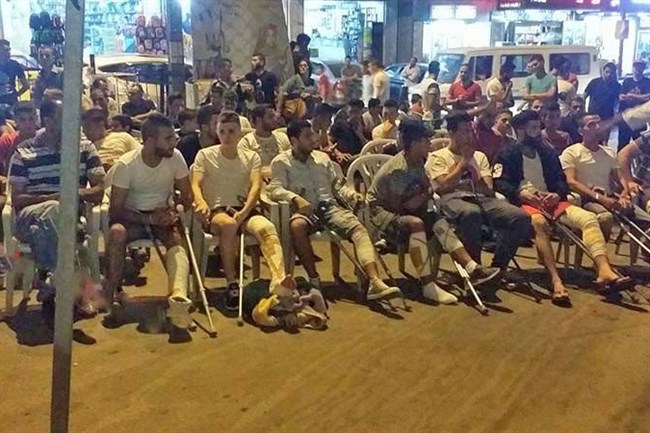
A file photo of a group of Palestinian youth after being treated for gunshot injuries by Israeli forces (Photo: BADIL)
Ma’an – August 26, 2016
BETHLEHEM – Two Palestinian youths were injured with live fire during clashes with Israeli soldiers in al-Duheisha refugee camp in southern Bethlehem early Friday morning, as reports emerged of an Israeli army commander making repeated threats in recent weeks to make “all youth in the camp disabled.”
Local sources said that two youths were shot and injured in the legs during clashes that erupted after Israeli forces raided the camp in Friday’s predawn hours.
Sources added that Israeli soldiers raided and searched the house of the incarcerated Palestinian Muhammad al-Seifi, detaining his mother and sister by locking them inside their home to pressure Muhammad’s younger brother Naba to turn himself into Israeli authorities.
Israeli forces also blew off the door of the Ibdaa Cultural Center near the entrance to the camp and occupied the rooftop of the building, from where Israeli snipers fired live ammunition and tear-gas canisters at local youth.
Violent clashes in al-Duheisha are common and break out nearly every time Israeli army forces enter the camp, which is located in Area A and should be under full Palestinian Authority control according to the Oslo agreements.
In a response to a request for comment, an Israeli army spokesperson told Ma’an that the Israeli army was not involved, and claimed Israeli border police were behind it, despite the area being located outside of police jurisdiction in Area A of the occupied West Bank.
When contacted by Ma’an, Israeli police spokesperson Micky Rosenfeld said he was not aware of the raid, saying it “made no sense” that police would be involved, and confirmed that al-Duheisha fell under the Israeli army’s jurisdiction in terms of raids. When contacted a second time, an Israeli army spokesperson insisted again that the army was not behind the raid and could not say who had been.
‘I will make all the youth of the camp disabled’
The clashes come in the wake of reports documented by BADIL, the Resource Center for Palestinian Residency and Refugee Rights, of an Israeli army commander making repeated threats during and after raids, and during interrogations, to disable all Palestinian youth in al-Duheisha.
The commander is reportedly responsible for the al-Duheisha area, and known to locals as “Captain Nidal.”
Local youth in al-Duheisha told BADIL that Captain Nidal has made statements such as: “I will make all the youth of the camp disabled,” “I will have all of you walking with crutches and in wheelchairs,” “I will make half of you disabled, and let the other half push the wheelchairs,” and “I will make all of you stand in line at the ATM waiting for your disability subsidies and assistance.”
One of the injured youth told BADIL that Captain Nidal told him to tell his friends that “Nidal will make all of you disabled.”
According to BADIL, which is based in Bethlehem, 30 Palestinians have been shot with live ammunition in the camp since the beginning of the year, the majority in their legs and knees.
They added that al-Duheisha had been raided at least three times by Israeli forces between the end of July and mid-August, during which time 18 Palestinian youth between 14 and 27 years old were shot in their legs — eight of which shot directly in the knee and several more in both legs — causing both permanent and temporary disabilities.
An Israeli army spokesperson could not immediately be reached for comment on the reports of the threats made by the commander.
“These threats indicate that these actions are not accidental or isolated incidents, but rather result from a systematic Israeli military policy aimed at suppressing resistance, terrorizing Palestinian youth, and permanently injuring them and/or causing significant damage to their physical and mental well-being,” BADIL said in their statement.
The reported threats come amid what BADIL called an intensification of the “systematic targeting” of Palestinian youth in the occupied Palestinian territory — particularly in refugee camps — since the beginning of 2016.
“This targeting has taken the form of injuries and arbitrary killings by the use of live ammunition by the Israeli army in the context of arrest campaigns, military raids, and random wide searches which usually trigger clashes,” the statement said.
BADIL’s statement also highlight a recent Israeli military incursion in the Hebron-area refugee camp al-Fawwar that lasted some 20-hours, during which an unarmed Palestinian teen was shot dead and dozens others were hospitalized.
“These cases of intentional wounding, when added to the comparable actions happening in refugee camps such as Aida, al-Arroub, Qalandia, Amari, and the West Bank at large, prove that these incidents amount to a systematic policy and an implementation of Captain Nidal’s threats.”
“These willful and grave breaches of international law trigger the obligations of third party states and other mandated agencies to put an end to this climate of impunity under which Israeli forces and its officials operate.”
BADIL’s collection of testimonies came as the latest report amid years of well documented cases of abuse and mistreatment of Palestinian children by Israeli forces in the occupied territory, including in East Jerusalem, which is under Israeli police jurisdiction.
On ceasefire anniversary, UN agencies urge end to Gaza’s ‘de-development spiral’
MEMO | August 26, 2016
UN agencies have urged an end to what they describe as the Gaza Strip’s “de-development spiral”, in a report marking the two-year anniversary of the ceasefire that ended ‘Operation Protective Edge’.
In a statement released Friday, 16 heads of United Nations agencies in Palestine call for the “uninterrupted and predictable flow of material and increased funding to address humanitarian needs and boost economic prospects for Gaza’s 1.9 million residents.”
In the report, UN agencies “document collective progress made in the last two years, as well as some of the remaining challenges in the recovery and reconstruction effort.” To date, “half of the homes which suffered partial damages and a third of destroyed homes have been rebuilt.”
Robert Piper, the UN Coordinator for Humanitarian Aid and Development Activities, warned that “repairing the damages from the 51-day hostilities cannot be our only measure of success, given that humanitarian and socio-economic indicators were already so dire before 2014.”
Piper added: “We must reverse Gaza’s de-development trajectory and address the needs of a population that has gone through three rounds of conflict, nine years of an Israeli blockade and the consequences of the Palestinian internal divide.”
The senior UN official emphasised that “addressing economic recovery requires much greater financial investments and serious policy changes, including a lifting of [Israeli-imposed] restrictions on both imports and exports.”
On October 2014, donors pledged US$ 3.5 billion to support Gaza. According to the World Bank, only an estimated 40 percent had been disbursed by April this year.
Bilal Kayed’s strike ends with agreement for his freedom; continued mobilization critical for fellow prisoners

Samidoun Palestinian Prisoner Solidarity Network – August 26, 2016
In a press conference held on Thursday morning, 25 August, Sahar Francis, the executive director of Addameer, confirmed that Bilal Kayed had ended his hunger strike after 71 days following the conclusion of an agreement with Israeli occupation prison administration that he will be released in December 2016, with no renewal of administrative detention.
In the press conference, joined by Kayed’s brother Mahmoud Kayed, as well as Prisoners’ Affairs Committee chair Issa Qaraqe and Osama al-Saadi of the Joint List, Francis noted that occupation security officials had earlier stated that they demanded Kayed be deported to Jordan for four years and noted their intention of keeping him in administrative detention for years. Kayed is held in the intensive care unit at Barzilai hospital and was moved there on 19 August as he refused to consume sugar or vitamin B1. He suffers from blurred vision, difficulty breathing and severe pain throughout his body. He will receive treatment until his condition improves considerably and he is returned to health.
Samidoun Palestinian Prisoner Solidarity Network salutes Bilal Kayed for his victory and achievement in the defense of Palestinian rights from the constant attempts of the Israeli occupation to expand, enlarge and intensify the scope of the imprisonment of Palestinian leaders and struggles. We extend our warmest congratulations to Bilal, his struggling family who were at the forefront of his support campaign, his lawyers and advocates with Addameer Prisoner Support and Human Rights Association and his fellow Palestinian prisoners who engaged in a series of collective hunger strikes within Israeli prisons. Kayed’s fellow prisoners of the Popular Front for the Liberation of Palestine were subject to isolation, the targeting of leaders Ahmad Sa’adat, Ahed Abu Ghoulmeh, Wael Jaghoub and Kamil Abu Hanish among others, excessive daily fines, harassment and assaults, and denial of family and legal visits. We salute the Palestinian people throughout occupied Palestine and in exile, including in the refugee camps of Lebanon, who repeatedly took the streets and mobilized in support of Kayed’s battle for freedom, directly confronting the occupation as well as the international institutions and states that refused to stand for justice for Palestinian prisoners.
Furthermore, Samidoun salutes all of the international activists, organizations and movements that came together to stand beside Bilal Kayed and beside the Palestinian people in this battle of freedom. From the outstanding efforts of the Irish movement for freedom for Bilal Kayed, to the ongoing and constant actions in New York City and Berlin, to the honorary citizenship granted to Bilal in Naples, to the organizers of the Black liberation movement who expressed their solidarity, to the organizers in the United States, Canada, Mexico, Venezuela, Brazil, Ecuador, Turkey, the UK, Ireland, Scotland, France, Belgium, the Netherlands, Germany, Switzerland, Italy, Spain, Greece, Portugal, Iceland, the Czech Republic, Finland, Austria, Norway, Sweden, Denmark, South Africa, Jordan, Lebanon, Tunisia, Algeria, Morocco, Bahrain and elsewhere who have mobilized in support of Bilal Kayed, international mobilization has escalated to new heights in support of the Palestinian prisoners in this struggle.
We urge the importance of continued mobilization and action in support of Palestinian prisoners, particularly the current hunger strikers, Mahmoud al-Balboul, on strike since 1 July; Mohammed al-Balboul, his brother, on strike since 4 July; and Ayed al-Herama and Malik al-Qadi, on strike since 14 July, all protesting administrative detention without charge or trial – and for continued mobilization in support of the action of all of the Palestinian prisoners, struggling for freedom from Israeli imprisonment, and for freedom and liberation for the Palestinian people throughout Palestine.
Featured Video

The Most Important Bet You’ve Never Heard Of
or go to
Aletho News Archives – Video-Images
From the Archives
The Occupied Mentality Syndrome
Saudi Arabia on the American chessboard – Part 2
By B. J. Sabri | American Herald Tribune | April 19, 2016
Since the Korean War, but particularly since the Iranian Revolution of 1979 until today, the United States has been steadily escalating its military presence in the Persian Gulf. Taking advantage of many colossal events of the past 36 years, [1] the hyper-empire has institutionalized its massive presence on land and sea, and expanded its objectives to include the unambiguous physical control of the area, as well as the clear understanding that local Arab governments should abide by them. The pretext is always the same: in “defense” of the national interests and security of the United States. From observing how the United States has been interacting with the governments of the region, and by judging from the size of its expeditionary force, we could reach a basic conclusion. The United States is occupying, de facto, the entire Arabian Peninsula. (Yemen, devastated by Saudi and American jets is yet to be conquered. Oman? Britain returned not as colonial ruler but as a soft occupying power.)
Under this articulation, Saudi Arabia, Qatar, Kuwait, and the United Arab Emirates are virtually occupied countries. If we compare this type of occupation to the mandate and protectorate regimes of the past, the results might be identical—the nations affected by it lose sovereignty. When Arab governments comply with the objectives of a foreign power that station military forces on their national milieu, then that power controls them in multiple ways including how they react to policy deliberations and what decisions they intend to take on specific issues. A good method to verify the concept of effective occupation is this: take notice of what the United States says and wants, and then compare it to what the gulf rulers do in response. (I shall discuss this detail at some point in the upcoming parts.)
If the presence of US forces or other means of political pressure are a factor in Saudi Arabia’s interventionist Arab wars, then we need to debate this issue. However, from the history of resistance to colonialism, we learnt: if a powerful state imposes its order on a nation by military means or other forms of coercion, and if this nation does not resist that imposition, then a mental subordination to the powerful state will ensue. This is especially true in the case of Saudi Arabia. One single event, 9/11, has transformed it from a US “ally” into an instant political hostage of the American Empire. … continue
Blog Roll
 Aletho News
- Official reveals evidence of Arab states’ involvement in US-Israeli war on Iran
- His Majesty’s head-chopper: Syria’s MI6-backed president bows to King Charles
- Forced to backtrack: ‘Israel’ drops Hezbollah disarmament goal
- Britain’s Lebanon surveillance network: A digital map for war
- Bahrain faces scrutiny for opposition crackdown after detainee killed
- Hegseth’s Pentagon Purge Designed to Prevent a Mutiny: Karen Kwiatkowski
- Greek shipping firms secretly transporting oil, weapons to Israel
- UN vote on Hormuz force delayed as Iran issues warning
- Trump and the debris of Iran war
- IRGC hits US tech giant Oracle’s data center, computing site in UAE over new assassinations
- If Americans Knew
- Israel-US kill negotiators, destroy civilian structures, but Iran’s military capabilities still largely intact – Daily Update
- ‘War crime’: Global condemnation as Israeli ministers celebrate death penalty law targeting Palestinian prisoners
- 7 Ways Israel Is Turning Lebanon Into Gaza
- World’s Leading Football Bodies Under Fire Over Israel Policies
- Experts warn of possible use of nukes against Iran
- Israeli invasion of Lebanon could be worse than 1982, warn European officials
- Passover: Liberation and collective punishment
- Trump says the quiet part out loud: (Israel’s) war on Iran > Americans’ health – Daily Update
- Gaza families reunite years after babies evacuated amid Israel’s war
- International Rescue Committee warns Gaza’s children face grave protection risks
- No Tricks Zone
- Low Intensity Tornado Wrecks Major Solar Farm, Creating A Potential Toxic Dump
- New Study Finds Warming Saves Lives…Cold Temperatures 12 Times More Deadly Than Excess Heat
- German Science Blog Accuses PIK Climate Institute Of Hallucinating Climate Tipping Points
- Devastating Assessment Of Comirnaty Vaccine By Former Senior Pfizer Europe Toxicologist
- New Study: CO2 Is ‘Effectively Negligible’ As An Explanatory Climate Change Factor Since 2000
- Former Pfizer Toxicologist Dr. Helmut Sterz Tells Bundestag Hearing Pfizer Vaccine Should Have Never Been Approved
- Energy Expert: Germany’s Nuclear Phaseout Was A “500 Billion Euro Mistake”
- New Research: South Australia’s Mid-Holocene Sea Surface Temperatures Were 4°C Warmer Than Today
- Storing Green Energy To Last Germany 10 Days Would Require A 60-Million Tonne Battery
- New Studies: UK Sea Levels Were 4 Meters Higher Than Today During The Mid-Holocene
 Aletho News