Trigger Warnings, Safe Spaces, Bias Reporting: The New Micro-techniques of Surveillance and Control
By Michael Rectenwald, Ph.D. | Legitgov | September 12, 2016
A singular orthodoxy has infiltrated the discursive parameters of U.S. and other universities and colleges. This orthodoxy now constitutes the ethical vocabulary of academia. Adopted from feminism, anti-racism, and LGBTQ theory and practice, the language, doctrines, and mechanisms of this orthodoxy now dominate academia’s policies, procedures and handbooks. The terminology has become the vernacular among the swelling ranks of administrators, especially the relatively new cohort of chief diversity officers, directors of diversity, associate provosts of diversity, assistant provosts of diversity, diversity consultants, and so on and so on. I refer not merely to the orthodoxy of “diversity,” but in particular to “diversity” initiatives as they are currently administered, using a particular set of policies, procedures, and mechanisms: trigger warnings, safe spaces, bias reporting, and the like.
While ridiculed by media outlets, and, at least where trigger warnings are concerned, disavowed by the American Association of University Professors, nevertheless, American colleges and universities are dominated by this ethos and its collective techne. At the University of Chicago for example, the Dean of Students, John (Jay) Ellison, Ph.D., announced (to the great chagrin of some faculty and many students):
Our commitment to academic freedom means that we do not support so-called “trigger warnings,” we do not cancel invited speakers because their topics might prove controversial, and we do not condone the creation of intellectual “safe spaces” where individuals can retreat from ideas and perspectives at odds with their own…
Yet, the same university has also assembled and maintains a “Bias Response Team,” and “urges anyone who has experienced or witnessed a Bias Incident to report it to the Bias Response Team.”
As it usually happens, any perspective that deviates from this “academic” orthodoxy – or any opposition expressed by faculty members in reasoned commentary or debate about the premises of the creed and/or its techniques – is virtually proscribed in advance. Whether or not they happen to be progressives, left communists, or radicals of another stripe, potential critics rightly fear being figured as right-wing reactionaries opposed to diversity and the confrontation of oppression. Any complaints or criticisms, they fear, would be peremptorily dismissed, and likely circulated among other faculty members within their own universities or in academia at large as gossip, subjecting the critic to ridicule and disrepute.
Indeed, despite the fact that a new form of policing has been surreptitiously introduced into academia at large, one would be hard-pressed to find a single article, essay, or book that subjects the entire administratively controlled apparatuses of “diversity” to any kind of real scrutiny. While innumerable articles have appeared on one or another of these topics (mostly on trigger warnings and safe spaces), no one has explained the structural provenance nor analysed the probable effects of these developments as a whole. Nor has anyone provided a theoretical or historical framework with which to understand them.
Ironically, perhaps, the most clearly appropriate critical theoretic for grasping the structural origins, as well as the social and political implications of this new largely “academic”1 development, can be found within the ambit of postmodern theory itself. The new mechanisms adopted and adapted by academic administrations clearly and incredibly mirror those described in a text widely read within humanities and social science studies courses throughout American universities and beyond. Indeed, it is a wonder that no one has, until now, applied this critique to the mechanisms of this academic creed. Faculty members, graduate students, and even many undergraduates, who have had even the slightest brush with trends in the humanities and social sciences, will know to what I refer here: Michel Foucault’s brilliant 1975 book, Discipline and Punish: The Birth of the Prison. Particularly uncanny is the resemblance of the academic mechanisms in question to the “micro-physics of power” described in the third chapter, “Panopticism.”
In this riveting essay, Foucault effectually describes the transmutation of power from the pre-modern to the modern period. Adducing Jeremy Bentham’s architectural model of the “Panopticon,” Foucault proffers what at the time was an utterly novel understanding of modern “discipline” and control. The new disciplinary mechanisms that Foucault discusses replace the earlier corporeal forms of punishment, such as quartering people in public, or branding them with the crimes they supposedly committed, and so forth. While the Panopticon was first introduced by Bentham as a model of prison, asylum, and school reform, the forms of surveillance and discipline to some extent prefigured by the Panopticon and in some sense preceding it, for Foucault had already metastasized beyond the prison system, becoming the general means of discipline and control in so-called “democratic” societies.
The Panopticon itself is a circular building, in which its subjects – inmates, patients, students, etc. – are arrayed in cells surrounding a central tower. The subjects can be seen at any time by a guard, who may (or may not) occupy the central tower. The captive subjects cannot see into the tower, nor can they see each other. Likewise, they are never certain whether or not they are being observed:
Bentham’s Panopticon is the architectural figure of this composition. We know the principle on which it was based: at the periphery, an annular building; at the centre, a tower; this tower is pierced with wide windows that open onto the inner side of the ring; the peripheric building is divided into cells, each of which extends the whole width of the building; they have two windows, one on the inside, corresponding to the windows of the tower; the other, on the outside, allows the light to cross the cell from one end to the other. All that is needed, then, is to place a supervisor in a central tower and to shut up in each cell a madman, a patient, a condemned man, a worker or a schoolboy. By the effect of backlighting, one can observe from the tower, standing out precisely against the light, the small captive shadows in the cells of the periphery. They are like so many cages, so many small theatres, in which each actor is alone, perfectly individualized and constantly visible. The panoptic mechanism arranges spatial unities that make it possible to see constantly and to recognize immediately. In short, it reverses the principle of the dungeon; or rather of its three functions – to enclose, to deprive of light and to hide – it preserves only the first and eliminates the other two. Full lighting and the eye of a supervisor capture better than darkness, which ultimately protected. Visibility is a trap (Foucault 200).
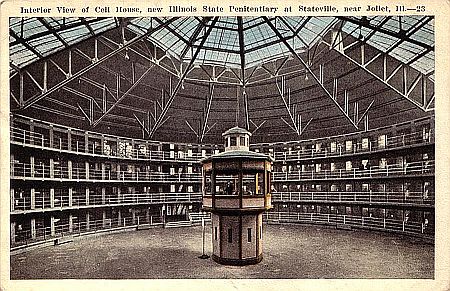
Although the captive individual can never verify with certainty that she is being observed, the very possibility of being observed at any time produces the intended effects of hyper-vigilance and self-circumspection on the part of the subject. As such, the subjects themselves internalize the observer, and effectively monitor and police themselves. As Foucault brilliantly describes the effects of this technological innovation:
He who is subjected to a field of visibility, and who knows it, assumes responsibility for the constraints of power; he makes them play spontaneously upon himself; he inscribes in himself the power relation in which he simultaneously plays both roles [that of observer and observed]; he becomes the principle of his own subjection (203, emphasis added).
Make no mistake, Foucault describes and mobilizes the architectural model of the Panopticon in order to introduce his central argument – in modernity, entire societies are inscribed with, underwritten by, and even predicated upon a generalizable and generalized method of surveillance and control – panopticism. Even the once structure-bound, institution-specific disciplinary techniques as represented so well by the Panopticon have metastasized and traveled well beyond their former institutional borders. They now permeate the entire social body. In fact, in an important section, Foucault discusses “the swarming of the disciplinary mechanisms” of panopticism. The phrasing will invoke for contemporary readers the sentinels in “The Matrix,” the legion of squid-like robots that seek out, locate, and swarm about the escapees from the matrix in sweltering masses.
For our purposes, perhaps the most salient aspect of panopticism is the way that it makes all of its subjects into potential sentinels of surveillance: “We have seen that anyone may come and exercise in the central tower the functions of surveillance” (207). That is, anyone and everyone can be interpellated as a functionary of panopticism. “If you see something, say something” is the mantra that effectively encapsulates this logic. Universities and colleges employ the micro-techniques of power precisely in the fashion described by Foucault.
At this point, I should make clear a parallel between the late eighteenth/early nineteenth-century model that Foucault treats, and the contemporary devices employed in academia and beyond. A point that is often lost on many readers of Foucault’s “Panopticism,” especially those unfamiliar with nineteenth-century British cultural history, is that Jeremy Bentham was not some reactionary, right-wing or even conservative thinker attempting to impose a nefarious, draconian form of discipline and punishment upon the population. In fact, during his time, Bentham was regarded as a radical, what today we would call a “progressive.” Bentham was known as the principle member of an early nineteenth-century group of reformers known as “the philosophical radicals.” As noted in the Encyclopaedia Britannica, he advocated numerous liberal reforms, including “annual elections; equal electoral districts; a wide suffrage, including woman suffrage; and the secret ballot. He supported in principle the participation of women in government and argued for the reform of marriage law to allow greater freedom to divorce.”
My point here is that regardless of the political provenance or original intention of the repertoire of diversity mechanisms, as Foucault makes clear, such methods and techniques, whether introduced initially by reformers for progressive ends or not, can and have often been co-opted by administers of power and wielded to oppressive ends. Likewise, the origin of the new academic instruments or “micro-physics of power” in feminism, anti-racism and LGBTQ discourse and practice in no way exempts them from being employed as mechanisms of surveillance and control.
Academia has co-opted and now brandishes identity-politics and its techniques of micro-power – including trigger warnings, safe spaces, and bias reporting – as means of the disciplining of the subject. Bias reporting lines are examples of the ways colleges and universities are able to enlist everyone within their ambit as sentinels of surveillance, discipline, and punishment. Bias reporting lines and reporting systems encourage everyone to act as an instrument of panopticism, an instrument of self- and other-policing.
In terms of the academy, however, the use of such mechanisms does not represent a perversion of intent. They are coercive as such, by definition. They are part of a growing panoply of micro-techniques of power representing the appropriation and defusing of politics, rather than opposition to the systems of oppression that such politics intend to represent.
These techniques of surveillance and control recall such organizations of the nineteenth century as The Society for the Suppression of Vice, founded in 1802. The only real difference involves what now count as punishable offenses. In the early to mid-nineteenth century in Britain, offenses included the production, distribution and consumption of pornography, as well as expressions of blasphemy, and the like. Today, “vices” and “blasphemies” include real or imagined “micro-aggressions,” or any conceivable displays of “bias,” however absurdly construed. Both regimes, however, are equally religious in character, involving as they do moralistic, individualized, and personalized policing. While both are insidious, only contemporary academic panopticism, operating under the guise of protecting and encouraging “diversity,” is anathema to academic freedom and inquiry, while simultaneously underming any potential for collective agency, or solidarity, among its subjects. Above all, panopticism individualizes.
Meanwhile, and probably most importantly, none of this policing and self-policing will do anything to challenge or overturn systemic oppression in the least. In fact, while serving the ideological function of obscuring the underlying structural inequities, oppression and exploitation of capitalism, they also constitute their own form of oppression.
[1] As Lori R. Price has pointed out, these same mechanisms have metastasized and infiltrated such social media platforms as Twitter, Facebook and YouTube.com.
Michael Rectenwald is a professor in Global Liberal Studies at New York University. He is the author of Nineteenth-Century British Secularism: Science, Religion and Literature (Palgrave Macmillan, 2016), primary editor of Global Secularisms in a Post-Secular Age (De Gruyter, 2015), and primary author of Academic Writing, Real World Topics (Broadview Press, 2015). His essays have appeared in numerous periodicals and anthologies, including the British Journal for the History of Science, Endevour, and George Eliot in Context (Cambridge University Press, 2013).
No comments yet.
Featured Video

No Threat Can Force Iran’s Surrender /Trita Parsi & Lt Cl Daniel Davis
or go to
Aletho News Archives – Video-Images
From the Archives
An Expert Military Analysis of War with China
Actually, None is Necessary
By Fred Reed • Unz Review • December 13, 2020
The Correlation of Armed Forces: U.S. goods and services trade with China totaled an estimated $634.8 billion in 2019. Exports were $163.0 billion; imports were $471.8 billion. The U.S. goods and services trade deficit with China was $308.8 billion in 2019. Trade in services with China (exports and imports) totaled an estimated $76.7 billion in 2019. Services exports were $56.5 billion; services imports were $20.1 billion. The U.S. services trade surplus with China was $36.4 billion in 2019.
There is talk within the Washingtoniat of a possible war with China. Steve Bannon, who apparently was dropped on his head as a child, actually favors such a war. We hear the usual shoo-the-boobs alarm about how the Chinese are doing something terrible and we must gird our loins and American values and show them what for, bow wow, woof. The danger is that the current game of who-blinks-first in Asian waters might actually provoke a shooting war. You know the kind of thing: One warship refuses to get out of the way of another, a collision ensues, some retard lieutenant who signed up on waivers opens fire, and we’re off and running. It is not a good idea to let children play with matches.
The said war is discussed either in emotional terms by idiots or in purely naval terms by those familiar with such things, so we hear of the First Island Chain and the Second Island Chain and whose missiles against the other’s missiles and so on. This would be appropriate if we were fighting World War Two again. Which we aren’t. Let’s take a quick-and-dirty look at how such a war might go.
To begin the war, America would overestimate itself and underestimate China. This is doctrine in the Pentagon. … continue
Blog Roll
 Aletho News
- Theodore Postol: Iran’s Missiles & Drones Were Underestimated
- Iran To Target Military Industrial-Tech Complex That Facilitated Gaza Genocide
- Collapsing Empire: The Resistance Disarms ‘Israel’
- Suicide Should Not Be a Government Service
- Rethinking America’s greatest threat: Iran vs. Israel-Firsters
- Iran accuses adversaries of false flags to strain Turkey ties
- Poland rules out sending Patriot missiles to US/Israel amid war on Iran
- Tehran approves new Hormuz plan with major restrictions
- No Threat Can Force Iran’s Surrender /Trita Parsi & Lt Cl Daniel Davis
- UK’s New Pandemic Plan Would Turn Big Tech Into a Mass Location Tracking Network
- If Americans Knew
- Ann Coulter Rips Into Fox News for Iran War Coverage, Compares to False Rigged 2020 Election Reporting
- Joe Kent Urges Americans To Call White House and Congress To Object To Sending Troops Into Iran
- DNC Resolution to Reject AIPAC Funding Puts Democratic Leaders in the Hot Seat
- Swedish foundation to build 400 schools as over 650,000 Gaza children remain without education for 2 years
- Israeli army admits photshopping image of slain Lebanese journalist
- This is how Israel is systematically killing health workers under the cover of war in Lebanon
- Carrying life under fire: Israeli invasion of Lebanon leaves pregnant women facing deadly risks
- Champagne all around for the new death penalty (for Palestinians) law – Not a ceasefire Day 172
- Why are Palestinian books struggling to be seen on Amazon?
- The Line Between Affinity and Conspiracy
- No Tricks Zone
- New Study Finds Warming Saves Lives…Cold Temperatures 12 Times More Deadly Than Excess Heat
- German Science Blog Accuses PIK Climate Institute Of Hallucinating Climate Tipping Points
- Devastating Assessment Of Comirnaty Vaccine By Former Senior Pfizer Europe Toxicologist
- New Study: CO2 Is ‘Effectively Negligible’ As An Explanatory Climate Change Factor Since 2000
- Former Pfizer Toxicologist Dr. Helmut Sterz Tells Bundestag Hearing Pfizer Vaccine Should Have Never Been Approved
- Energy Expert: Germany’s Nuclear Phaseout Was A “500 Billion Euro Mistake”
- New Research: South Australia’s Mid-Holocene Sea Surface Temperatures Were 4°C Warmer Than Today
- Storing Green Energy To Last Germany 10 Days Would Require A 60-Million Tonne Battery
- New Studies: UK Sea Levels Were 4 Meters Higher Than Today During The Mid-Holocene
- Destructive Green New Deal: German Energy And Metal Group Warns Of Drastic Crisis
 Aletho News
Leave a comment