Trump’s Victory: Arrogance Defeated
By Jean Bricmont | CounterPunch | November 11, 2016
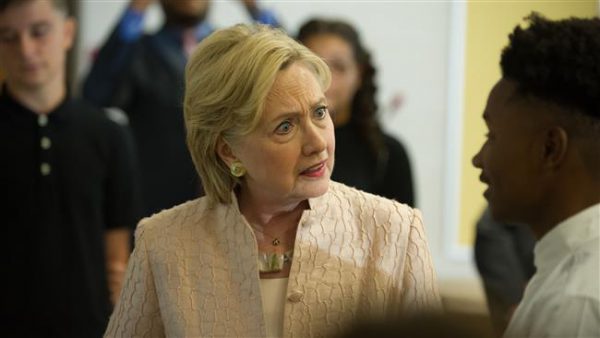
Hillary Clinton called half of Trump voters “a basket of deplorables”. In all the discussions I have had with American “liberals”, they explained to me that Trump supporters were mostly uneducated white men.
However, I am old enough to remember an era when the all the leftwing parties, socialist or communist, and even American Democrats, were based on the workers or the “working class” or the “common man”. Nobody thought to inquire whether they had university degrees or to investigate whether or not their opinions were politically correct on issues such as racism, sexism or homophobia.
What defined the workers as progressive subjects was their economically exploited condition and not some ideological orthodoxy or moral purity.
At the end of the 1970s a great change took place within leftwing parties. They were increasingly dominated by academics and their ideology changed radically from that of the classical left.
Far from aiming to establish some form of socialism, or merely of social justice, the left turned into the champion of the fight for equal opportunity, against discrimination and prejudice, and – with the rise of globalization – the opening of markets.
The more or less mythical hero of the left was no longer the proletarian but the marginal, the migrant, the foreigner, the dissident, or the rebel – even if he happened to be a religious fanatic that no leftist intellectual would have anything to do with. One recalls how Jean-Jacques Rousseau made fun of those who pretend to love the Tartars in order to avoid loving their neighbors.
Little by little a new class alliance formed: the one percent as it is called, or more realistically the richest ten percent who benefit from globalization are allied with the middle class intelligentsia to sell us globalization in the name of “openness to others” and which flaunt the specter of racism or sexism to attract minorities and certain feminists (for although women are not a minority, certain feminist demands are similar to those of minorities).
But that alliance was extremely unnatural in socio-economic terms, because the main victims of globalization are the least qualified workers, often women or members of minorities.
The left’s pro-globalization bias led it astray step by step. First it gave up all effort at regulating the economy, satisfying itself with claiming to share the fruits of growth fairly by ensuring “equal opportunity”. But in the real world, inequalities grew far more than the economy.
They also imagined that international law could be abolished and that a certain “international community” – in practice the United States and its allies – would maintain world order by military means. Again, in the real world that only created chaos, refugees and resistance to that American order. In fact, in the long term, the American population itself came down with a strange disorder, “war fatigue”. Except for a minority of ideologues, hardly anyone in the United States wants to bear the costs of an empire (see the Boston Globe for a lucid analysis of those costs).
The protests of the victims of globalization had to be dealt with. The trick was to use the ideology of tolerance: any objection to globalization was labeled racism, xenophobia. Intellectuals took up the “fight against racism” with enthusiasm, with an eye to preserving their own privileged social position, sheltered from the economic storms of globalization.
In the United States, it was enough to stigmatize bad thoughts; in Europe, they were taken to court.
All that had to explode sooner or later, just as the Berlin Wall came down and the USSR collapsed, and for the same reasons: a self-satisfied but fairly incompetent elite, isolated from social realities, which claims to do what is best for the people without consulting them, and which finally doesn’t even deliver the promised benefits, ends up provoking rebellion against itself.
First the Brexit, then Trump. Whatever one may think of that individual, the worse the things said about him by American “liberals”, the more they expose the enormity of their defeat. After years of political correctness and sermons on feminism and antiracism, what can be more humiliating than the election of someone as demonized by feminists and antiracists as Trump?
For ardent supporters of the European Union, globalization and humanitarian wars, the victory of Trump has an effect comparable to that of the Polish worker strikes on the ruling Communist Party; they exposed the discontent even in the proletariat that theoretically exercised its dictatorship. The election of Trump shows the revolt of the American population in the very citadel of free markets and imperialism.
It remains to be seen whether Trump will carry out the progressive aspects of his program; protectionism and peace with Russia. Those are the aspects that most infuriate the oligarchy, much more than his rude remarks and contradictions. Those are thus the aspects that will require the most intelligence and determination if they are to be realized.
A left which dares take a close look at its past errors should do all it can to push Trump in that direction, rather than to alienate the population still more by once again mounting its high horse of moral superiority and selling its soul to the leaders of the Democratic Party responsible for their own defeat.[1]
A french version of this article was previously published.
[1] Sanders seems to go in that direction : « To the degree that Mr. Trump is serious about pursuing policies that improve the lives of working families in this country, I and other progressives are prepared to work with him » http://www.sanders.senate.gov/newsroom/press-releases/sanders-statement-on-trump
JEAN BRICMONT teaches physics at the University of Louvain in Belgium. He is author of Humanitarian Imperialism. He can be reached at Jean.Bricmont@uclouvain.be
Trump’s Win — A Rebuke to the Elites
By Alastair Crooke | Consortium News | November 12, 2016
So, there it is: Brexit, as I had earlier suggested, was no extraneous “flash in the pan,” but a manifestation of wider and deeper discontents in Western society. Let us be clear: not only did 60 million Americans vote for Donald Trump, but a further 13 million, who voted for Bernie Sanders (in the primaries) similarly voted for strategic change – albeit from within a different political orientation.
I do not intend, here, to attempt any post-mortem on the U.S. election, but rather to try to see what may stand hidden behind the Brexit and Trump events – obscured for now by their overly prominent presence on the forestage of the media and politics.
The first concerns Donald Trump: Unsurprisingly, his personal foibles and his billionaire background have become the focus of a hostile media who question whether he has the ability to bring about strategic change, or not. This is an important question, but still it misses the point. The point here is that there are few – very few – opportunities for elected officials to challenge the status quo – especially when Western centrist parties have patently conspired to offer voters mere nuanced variants of the same “progressive,” liberal, globalized agenda.
In short, there evidently has been a constituency building up, so exasperated at the imperviousness of the elites to the true situation of this constituency, that they want the status quo gone, by whomsoever’s hand is there. Whomsoever: that is the point. It was never some sort of chief executive beauty contest: Would Bernie Sanders have been an ideal President? Would Nigel Farage have been one? Will Trump be able to deliver a new era? — we do not know (but should not foreclose on that possibility). The Whomsoever aspect rather speaks to the depth of alienation that lay latent in American society.
But the message that is in danger of being obscured by the outsize focus on the outsize personality of Mr. Trump is precisely that the “discontents” at democracy, at cultural “identity” politics, at globalization and its sufferings, will not simply disappear now. Mr. Trump will succeed or fail, but the uprising will persist in one form or another – and is likely to spread to other parts of Europe, leaving the latter in turmoil and politically incapacitated.
Profound Alienation
It represents a profound alienation. We should not expect any early return of the liberal world, should Mr. Trump somehow fail.
Nor should Mr. Trump be viewed as some sort of outlandish political freak. In fact, he fits quite closely to one of the mainstream orientations of American conservatism. It is an orientation that is, by instinct, doubtful of grandiose schemes of political or social re-engineering, preferring to take human nature as it is; it is more inclined to focus on domestic needs, rather than uncertain foreign adventures; is financially conservative; is not economically determinist; and tends to see the family as the indispensable building-block of society. It is a Zeitgeist that sees other countries (say Russia or China) as normal countries with whom one should talk, and to pursue common interests.
That Trump should be regarded as some bizarre oddity, rather than as being in the line of Burke and thrice Presidential contender Pat Buchanan (who admits to a certain paternity, as it were) – speaks more to the success of the neoconservative hijack of American conservatism beginning in the 1960s than reflects the historic spectrum of this intellectual current.
One might say that the neoconservatives were never Conservative, in the sense that neoliberals were never Liberal, in the traditional understanding of these terms. What is new is that the President-elect seems to have put together a new Republican constituency of half the American electorate. And this new constituency is not just one of “red-necks” (white, blue-collar workers). It has cut across social classes and ethnic divisions. Even Wall Street traders (supposedly aligned with the Clintons) reportedly were enthusiastically yelling “lock her up” during Mrs. Clinton’s concession speech – and college-educated women only gave Mrs. Clinton a 6 percent edge over those who voted Trump.
It is possible “that this election [originally] was intended to facilitate the triumphant return of the neoconservative-neoliberal paradigm all wrapped up in ‘new packaging.’ For various reasons, the decision was made to assign this role to Hillary Clinton,” according to the Oriental Review.
Perhaps this was because she was viewed as well placed to fuse the liberal-interventionist and the neoconservative trends to the Clintonite “cultural identity politics” base – or possibly, simply because it was “her turn” at the Presidency. If so, it has failed spectacularly.
The Clinton Failure
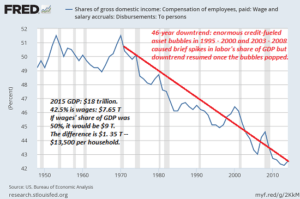
Why did it fail? One aspect of the discontent (as I have outlined before – see here) relates to the slow demise of our financialized, neoliberal, debt-driven growth model. For many in America and Europe, the reality has not been one of economic prosperity, but one of anxiety – and for the first time in the post-World War II era – a sense that the next generations’ prospects will be much tougher, and worse, than ours were.
Here (no friend to Trump) is Naomi Klein’s assessment: “They will blame James Comey and the FBI. They will blame voter suppression and racism. They will blame ‘Bernie or bust’ and misogyny. They will blame third parties and independent candidates. They will blame the corporate media for giving him the platform, social media for being a bullhorn, and WikiLeaks for airing the laundry.
“But this leaves out the force most responsible for creating the nightmare in which we now find ourselves … [financialized] neoliberalism. Here is what we need to understand: a hell of a lot of people are in pain. Under neoliberal policies of deregulation, privatization, austerity and corporate trade, their living standards have declined precipitously. They have lost jobs. They have lost pensions. They have lost much of the safety net that used to make these losses less frightening. They see a future for their kids even worse than their precarious present.
“At the same time, they have witnessed the rise of the Davos class, a hyper-connected network of banking and tech billionaires, elected leaders who are awfully cozy with those interests, and Hollywood celebrities who make the whole thing seem unbearably glamorous. Success is a party to which they were not invited, and they know in their hearts that this rising wealth and power is somehow directly connected to their growing debts and powerlessness.
“For the people who saw security and status as their birthright – and that means white men most of all – these losses are unbearable. Donald Trump speaks directly to that pain. The Brexit campaign spoke to that pain.”
Here it is represented visually:
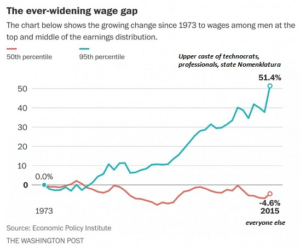
Of course, this was not the case for the urban élites:
Cultural Resistance
The second aspect to the present discontent has been cultural oppression (or, in the rhetoric of the Democratic Party, “identity politics” – one of the mainstays of the Clintonite electoral base). Its roots are complex, and lie with philosophic currents emerging out of Germany during WWII that somehow fused with American Trotskyist intellectual thinking (which then migrated to the Right). But, in gist, this current of political thought borrowed from the emerging discipline of psychology the concept of clearing the human mind – shocking it, or forcing it into becoming the “clean slate” on which a new mental program could be written by the psychiatric (or political) therapist respectively.
The political aim here was to eliminate totalitarian thinking, and fascist mental “programming,” and to replace it with a liberal-democracy circuit board.
Indeed, the U.S. Immigration and Nationality Act of 1965 was promoted by this intellectual group precisely in furtherance of the notion that concepts such as “national culture” would become meaningless as a result of immigrant cultural dilution. By the 1970s and 1980s, the objective had evolved to implant the idea that there was really no politics to modernity (Fukuyama’s End of History) since all governance somehow had boiled down to technocracy: ensuring effective liberal market functioning — a matter best left to experts.
In political terms, the “clearing” of the mind’s inherited cultural clutter was to be achieved by cultural wars of political correctness. The class war had become discredited, but there were other “victims” on whose behalf war could be waged: the war on gender discrimination, on racism, on denial of gay rights and sexual orientation stereotyping, on verbal micro-aggressions, on sexist language, or any ideas or language which disturbed the individual’s sense of “safe space” were used as tools to clear away old cultural “brush” of inherited national culture, and open the way for an American-led, globalized world.
The ostensible factor linking all these notions of victim “wars” was that their antonym amounted either to fascism or authoritarianism. The problem with this has been that any white American blue-collar worker who attended church, who believed in family life, and was patriotic, became potentially a fascist, a racist, a sexist or a bigot.
Many ordinary Americans (and Europeans) disdain this “cultural” war which places him or her (according to Hillary Clinton), in the “‘basket of deplorables’ Right? Racist, sexist, homophobic, xenophobic, islamophobic, you name it,” and who looked upon his or her community as representing nothing more than a “fly-over” state in the view of the U.S. coastal élites.
The deplorables have now risen up. Donald Trump’s salty language was no liability – it was an electoral asset by thumbing his nose at this correctness, and at so-called ”snowflake” sensibilities. Trump’s ‘incorrectness’ touched on a deep vein of resentment within American traditional society.
Not only does “flyover America” resent being termed “deplorables,” they feel too clearly the disdain in which the American and European elites hold them – and dislike their arrogance in suggesting that there is only one rational, sensible way of doing things, and that they – the elites, being the experts and a part of the Davos set – should tell the rest of us what it is: (despite their decades of failures).
High Emotions
Emotions are high on both sides. To gain a sense of how bitterly the cultural war will be fought, listen to this from the partly-Soros-funded populist mobilization movement Azaaz (linked to America’s Move On organization): “Dear Mr. Trump: This is not what greatness looks like. The world rejects your fear, hate-mongering, and bigotry. We reject your support for torture, your calls for murdering civilians, and your general encouragement of violence. We reject your denigration of women, Muslims, Mexicans, and millions of others who don’t look like you, talk like you, or pray to the same god as you. Facing your fear we choose compassion. Hearing your despair we choose hope. Seeing your ignorance we choose understanding. As citizens of the world, we stand united against your brand of division.”
In short, with Brexit and the Trump victory, we are witnessing an historic point of inflexion. As I noted in mid-October (quoting British political philosopher John Gray): “If the tension between [the globalization project on one hand] and the [sovereign] nation state, [on the other] was one of the contradictions of Thatcherism … From Bill Clinton and Tony Blair onward, the center-left embraced the project of a global free market with an enthusiasm as ardent as any on the right. If globalization was at odds with social cohesion, society had to be re-engineered to become an adjunct of the market. The result was that large sections of the population were left to moulder in stagnation or poverty, some without any prospect of finding a productive place in society.”
“If Gray is correct that when globalized economics strikes trouble, people will demand that the state must pay attention to their own parochial, national economic situation (and not to the utopian concerns of the centralizing elite), it suggests that just as globalization is over – so too is centralization (in all its many manifestations).”
Well, the global trend does not seem to be going in the Avaaz direction. It seems rather to be heading toward prioritizing the recovery of the state, of state sovereignty, and of state engagement in the pursuit of economic policies appropriate to the particular circumstances of the state, and in the state’s ultimate responsibility for the welfare of the community as a whole.
The question is what does this mean geo-strategically? And, secondly, can and will, Trump be able to deliver the new era? The short answer is that this new era seems to presage a period of political volatility, financial volatility and in Europe and the Middle East, the prospect of continued political “shock.”
It is clear that Mr. Trump is not a globalist. It is also clear that he is aware of some of the dangers of the present global monetarist policy. He has spoken of the U.S. Federal Reserve creating “big ugly bubbles” and that the next economic and financial crisis has been “kicked down the road” by Fed Chairwoman Janet Yellen – and clearly awaits whomsoever becomes U.S. President on Jan. 20, 2017.
Painted into a Corner
But three decades of debt-led, financialized “growth policies” leave the President-elect effectively painted into a corner: global debt has spiraled; the bubbles are there still (kept afloat by Central Bank coordinated intervention), and bubbles are infamously difficult to deflate gently; zero or negative interest rates are undermining many a business model, but cannot easily be foregone, without crashing the bond market; and QE (printing money) is systematically eating away at consumer purchasing power through the dilution of its newly created purchasing power, and the latter’s re-direction from “main street” into the financial sector – lifting nominal asset values – but creating no tangible wealth.
America and Europe effectively are in debt-deflation. How then to grow incomes so that producers of goods and services can also afford then subsequently to purchase these goods and services? Trump’s answer is to spend on domestic infrastructure projects. This may help a bit, but is unlikely – in itself – to lift and float the entire U.S. economy.
The reality is that there is no obvious global engine of growth (now that China’s “industrial revolution” has stalled at best). Every nation now is in search of new engines of growth. And it is not easy to imagine that Europe or America will succeed in retrieving all those jobs lost through globalization. Indeed, the attempt so to do – in, and of itself – might just precipitate a further deceleration of world trade, and a consequent decline in output.
In brief, the global economy may see a brief “honeymoon period” thanks to a likely spurt of U.S. fiscal indulgence and a concomitant psychological lift, stemming from – at least – the U.S. construction sector enjoying something of a boom. But ultimately the very economic crisis which Mr. Trump anticipates may prove to be the only way to cut the Gordian knot in which three decades of unprecedented debt and money printing have fettered us.
And if he is to steer through the expected crisis, Mr. Trump will have to eschew the Siren voices of the present elites telling him “TINA” (there is no alternative, but to continue as before).
Where Mr Trump might look for an early (and relatively easy) success however, may be in foreign policy. As “Nixon went to China,” so Trump can go to Russia and China, and begin to treat them as normal nations with whom it is possible to find an intersection of interests (as well as areas of disagreement).
This would be revolutionary. It could change the geo-strategical map. And as President Putin keeps repeating … the door is open (at least for now). Nothing is forever in politics.
Alastair Crooke is a former British diplomat who was a senior figure in British intelligence and in European Union diplomacy. He is the founder and director of the Conflicts Forum, which advocates for engagement between political Islam and the West.
Israel re-arrests British citizen after he is cleared by military court
MEMO | November 12, 2016
An Israeli appeal court has ordered the re-arrest of a British citizen after he was cleared of assisting terrorist organisations by a military court, Anadolu reported on Friday.
It was alleged that the “confession” of Faiz Mahmoud Ahmed Sherari, a 49 year-old British-Lebanese citizen, was obtained by “coercion” by the internal security agency Shin Bet. He was arrested during a four-day visit to the West Bank in September and accused of providing cash and mobile phones to Hamas, the Guardian said in a previous report.
Israel Radio said that the court of appeal challenged the ruling of the first court in the occupied West Bank. It did not say what will happen to Sherari.
The judge in the trial earlier this month, Lieutenant Colonel Azriel Levy, criticised the pressure put on Sherari by Shin Bet, noting that his rights had been violated. Reports revealed that he had been handcuffed painfully for an extended period as well as threatened. He was also prevented from seeing lawyer.
“There is no doubt that the defendant’s confession, which was given an hour after the end of his Shin Bet interrogation, was dramatically influenced by the method of interrogation,” the judge said in his ruling. “This included pained and prolonged shackling, threats and a blatant exploitation of the defendant’s demonstrated weakness.”
Obama trying to provoke confrontation with Russia to preempt Trump: Petras
Press TV – November 12, 2016
US President Barack Obama is trying to provoke a confrontation with Russia before President-elect Donald Trump takes charge of the White House, says Professor James Petras, an American writer and political analyst.
Professor Petras, who has written several books on international political issues, made the remarks in a phone interview with Press TV on Saturday, after the US military dispatched 620 shipping containers packed with ammunition to Europe, the largest single shipment in last two decades.
According to reports, the heavily loaded containers arrived at the northern German port of Nordenham by the end of October. The containers will be transported to a depot for storage and distribution to other locations across Europe, according to a US Army statement.
Last week, the Pentagon announced to deploy at least 6,000 American soldiers and heavy armor to Eastern Europe next year to counter an “assertive” Russia.
Professor Petras said America’s “policy of rearming Europe especially focusing on Germany is an attempt by Obama to preempt any moves by newly elected President Trump, who’s committed to negotiating with Russia, ending sanctions, and lessening the military tensions.”
He stated that “this is an aggressive move by Obama, a provocative move, a kind of re-initiation of the Cold War, and I think that it will be reversed or limited once Obama is out of office.”
“I think this is a tension-creating move by Obama, part of his history of demonizing Russia and provoking a possible confrontation, which has nuclear consequences,” the analyst added.
“I think the suddenness of this buildup has a direct response to Trump’s closer working relationships with President Putin,” Petras said.
“I think this is a desperate move by Obama and is certainly in line with what Hillary Clinton would have done, but certainly not in line with Trump’s policy of reconciliation with Russia, and pressuring Europe to pay for its own arms and its own program,” the scholar concluded.
Relations between Washington and Moscow were already at their lowest point since the end of the Cold War in 1991, largely due to the Ukraine crisis. The US and its allies accuse Moscow of sending troops into eastern Ukraine in support of the pro-Russian forces. Moscow has long denied involvement in Ukraine’s crisis.
Ties between the US and Russia further deteriorated when Moscow last year launched an air offensive against Daesh terrorists, many of whom were initially trained by the CIA to fight against the Syrian government.
Last month, Russia moved a battery of nuclear-capable missile launchers within range of three Baltic states, in what US officials said was a gesture to express displeasure with the Western military alliance of NATO.
In late October, Russia unveiled images of a new intercontinental ballistic missile dubbed the Satan 2, which, it says, can carry up to 15 separate warheads powerful enough to destroy an area the size of Texas.
The US, in September, flew three long-range nuclear bombers over Eastern Europe to participate in NATO military exercises. These developments, some observers say, can cause a nuclear confrontation between the two countries.
Long Time Mass Surveillance Defenders Freak Out Now That Trump Will Have Control
The Lawfare blog, run by the Brookings Institution, has long reliably been a good source to go to for reading what defenders of mass surveillance and the surveillance state are thinking — in a non-hysterical way. While I disagree with much of what’s posted on there, it tends to be thoughtful and interesting reading. Its founder and Editor-in-Chief is Ben Wittes, who’s always good for an impassioned defense of the NSA’s surveillance on Americans, and was all in on forcing tech companies to break encryption. He wasn’t worried, you see, because he was quite sure the NSA would never spy on him. Because, you know, he’s a good guy.
And… yet. Something seems to have changed. And that something is who is suddenly about to be in charge of the surveillance state apparatus:
When we founded this site more than six years ago, I never in my wildest dreams imagined myself writing these words about a man who will take the oath of office as President of the United States. We began Lawfare on the assumption that the U.S. federal executive branch was a tool with which to confront national security threats. While I accepted that its manner of doing so might threaten other values—like civil liberties—or prove counterproductive in protecting national security goods, I never imagined I would confront the day when I ranked the President himself among the major threats to the security of the country.
Today, we have to confront that possibility.
Your lack of imagination is really fucking us all over now, isn’t it Ben? This is exactly why so many of us — the people he likes to mock — have said all along that the concern with the surveillance state is always based on the fact that you have to imagine what will happen when the people you trust the least are in power.
Wittes is suddenly having something of an existential crisis about all of this:
So while I of course hope for a successful Trump presidency, I know of only one way Trump can succeed in the national security arena. And that is by radically changing the reckless persona he embodied during a long campaign—changing how he behaves, changing what he believes, changing what he aspires to do, acquiring a sense of restraint, and changing the way he talks about people and groups. And while I agree with Clinton that we owe Trump a chance to lead, the burden is on him to make these changes, not on us to suspend disbelief and pretend we live in the world he has described.
I will be candid and confess that, Clinton’s admonition notwithstanding, my mind is not entirely open about Trump’s capacity to do this, or even his interest in doing it. I have, in fact, deep doubts. And that leaves me, and I think most of America’s national security community, in a very strange position.
Maybe take the time to explore that strange feeling and you can start to understand why so many of us have been concerned about the entire apparatus that you’ve been cheering on for years, because, as you once said: “I have a great deal of confidence that the National Security Agency is not spying on me.” There are an awful lot of people who haven’t had that confidence for a while. And a great many more who won’t have that confidence under the next administration. That strange feeling that Wittes has is finally a recognition that maybe he should be concerned about those people too.
This isn’t a post to mock Ben, but to highlight why so many of us were so concerned all along, even as he mocked us. This is serious stuff and believing that unconstitutional warrantless mass surveillance is okay because you trust the guy in charge only works if you can always trust the guy in charge. And you can’t… as Ben and others are suddenly discovering.
Why Trump’s Presidency Is a Win for Europe
By Finian CUNNINGHAM | Strategic Culture Foundation | 12.11.2016
By vowing to rebuild American society, scale back foreign militarism, de-escalate NATO and seek friendly cooperative relations with Russia, a United States of America under Donald Trump would not only be a boon for America’s best interests. It would also be a win for Europe.
In such a new international outlook, the European bloc would be freed from its atlanticist subservience which has been dominant and deleterious for several decades. European governments would be freer to have more independent foreign policy, instead of toeing the dubious line that up to now has been ordained from Washington. It has been a disaster for the EU to have adhered so slavishly to US foreign policy. Much of the current discontent and disaffection among EU citizens towards the Brussels-based bloc stems from this unnatural and unhealthy subservience to Washington.
Wars in the Middle East, North Africa and Central Asia and the attendant problems of blowback terrorism and influx of refugees are direct results of European governments following Washington’s foreign policy of regime change and so-called «democracy promotion». Even though these wars have been illegal and vile transgressions of international law.
Financial and economic policies adopted by European governments have been straitjacketed by neoliberal capitalist doctrine dictated by Wall Street and successive US governments. This boils down to misery and austerity for the masses, while a tiny oligarchy become ever bloated with wealth. In short, stagnation.
Deteriorating relations with Russia – Europe’s biggest energy supplier – have also stemmed from the EU following Washington’s confrontational agenda towards Moscow. European governments have bought into the spurious US official narrative of Russia being «aggressive» and «expansionist». Admittedly, certain EU members such as the Baltic states are all too willingly Russophobic. But for many others, such hostility between the EU and Russia does not make sense. While economic impacts on the US have been minimal, the tensions between the EU and Russia have badly hit European businesses, exporters, farmers and workers.
The looming threat of war on European territory from the irrational enlargement of the US-led NATO military alliance along Russia’s border is also seen by many citizens as another demonstration of the EU’s reckless subservience to Washington. It is Washington, of course, that has been the main advocate of increasing NATO forces in Europe, augmented by atlanticist EU governments like Britain, Germany and France, as well as the anti-Russian paranoid Baltic states. Some 500 million EU citizens are held ransom to war policies by a coterie of governments who behave like vassals to Washington.
In many ways, the political, economic and cultural problems challenging Europe arise directly from the EU’s lack of independence from the US. Often it seems that Brussels is acting as a rubber-stamp for foreign policies authored in Washington. No wonder then that in the view of many EU citizens the functioning of the bloc is seen to be undemocratic and unrepresentative of their immediate needs. This explains the soaring rise of anti-EU parties right across the bloc. The phenomenon has less to do with an inherent popular affinity for parties labelled «far right» or «xenophobic» and more to do with a popular desire for democratic governance that attends to urgent social interests.
There is much overlap with the political rise of Donald Trump in the US. As in Europe, the mass of ordinary working-class American citizens have been disenfranchised, politically and economically, over several decades. A rarefied political class has become ossified and is seen to be self-enriching and servile to a tiny wealthy elite of financiers, corporations and the military machine that underpins this oligarchy. Integral to the oligarchy are the corporate-controlled media monopolies that pontificate to the masses on how they should vote in elections – elections that have become inconsequential to democratic needs.
All that now appears to be changing. A revolt is underway.
Trump’s election, like the Brexit before in Britain earlier this year, is a popular revolt against the oligarchy. The mass of people have become sickened and wearied by endless wars and endless economic austerity, while the rich elite become ever more obscenely wealthy, and all the while the media propaganda system cynically instructs the people who to vote for and who not to, knowing full well there will really be no «hope and change».
This time around though, the US election, like the Brexit, was infused with righteous, raw popular anger against the oligarchy.
Trump struck a deep popular chord when he called US-led wars in the Middle East a «disservice to our country and a disservice to humanity». People got it when he lamented how much American infrastructure, schools, hospitals, roads, jobs, would have benefited if the trillions of dollars wasted on wars had instead been invested at home. Despite media concealment, a large section of the American people concurred with Trump’s angry denunciation of Obama and past US administrations for criminally stoking terrorism and conflicts. His presidential rival Hillary Clinton was fixed right at the center of this culpability among the Washington oligarchy, which straddles both the Republican and Democrat parties.
Voting Trump into the White House – a property tycoon who has never held an elected office before – is an historic repudiation of the political establishment. It is a political earthquake.
On the eve of election day on November 8, Trump declared that «this will be our independence day… when the American working class will strike back». It may seem incongruous that a billionaire capitalist should exhort the working class to strike. But strike they did.
Trump also said his election would be «Brexit plus, plus, plus». That remark has turned out to be prescient too. The American election earthquake has rocked Europe with greater force than did Britain’s vote to quit the bloc in July. A crevice has been torn open between atlanticist governments and more independently minded ones.
Germany and France in particular have been caught off-side. Chancellor Angela Merkel expressed «shock» at Trump being elected, while French President Francois Hollande – also disapproving the result – called for «united European values» to confront the new American president. Hollande’s bravado for «liberal values» makes him look even more fatuous.
Britain, the other atlanticist voice in Europe, was more congratulatory to President-elect Trump. No doubt, that’s because Britain is seeking to shore up badly needed bilateral trade deals with the US in light of its departure from the EU and therefore it needs to keep Trump sweet.
What really alarms Germany and France is that Trump is no atlanticist or NATO advocate. His nationalist views and tougher stance on immigration controls resonate with EU members like Hungary, Czech Republic, Slovakia, Slovenia, Greece and Austria.
Trump’s views also give a boost to anti-EU parties in Germany and France who are challenging incumbents Merkel and Hollande in elections next year. It was telling that while Merkel and Hollande deprecated Trump’s election, he was heartily congratulated by the anti-EU Alternative for Germany and Marine Le Pen’s National Front in France, as well as Nigel Farage’s UK Independence Party in Britain. These parties also tend to share Trump’s more sanguine view of friendlier relations with Russia.
If Donald Trump can deliver on his avowed program of rebuilding American society and economy from within while abandoning US imperialist hegemony around the world that will potentially transform world relations. For Russia and China it will lead to a much needed normalization of relations, away from the current Cold War-type hostility that threatens to ignite world war. Both Russian and Chinese leaders Vladimir Putin and Xi Jinping were quick to express congratulations and readiness to work with new president Donald Trump.
The political establishment, including the media, in the EU that is dominated by woefully misguided atlanticism has deplored the election of Trump in the US. There is a snobbish handwringing attitude that Trump’s movement is all about racist, white trash numbskulls. There may be some unsavory elements to Trump’s support, as there are in some anti-EU movements. But in the main what it is about is reclaiming democratic power for the mass of people. What the Americans have done in electing Trump is what the Europeans also need to do in order to sack a corrupt and venal establishment that up to now has only served Washington and the atlanticist elite.
If Trump’s victory invigorates similar trends across Europe then that would be a good thing. And especially if it led to Europe having a more independent foreign policy from Washington and in particular gaining a more normal, mutual relationship with Russia.
The Unethicality of the Sore Loser
Moving the goalposts on electoral criteria
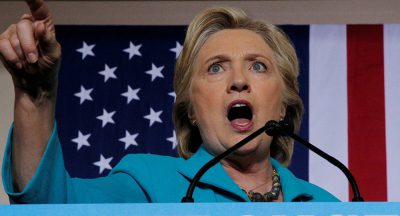
Photo credit – Reuters
By Kim Petersen | American Herald Tribune | November 12, 2016
During live US presidential election coverage on RT, after it became clear that Donald Trump was going to secure the required number of electoral college votes to win the election, word came that Hillary Clinton would not make a concession speech that night. The moderator of the live election coverage at RT was gobsmacked. He called Clinton’s behavior the “epitome of arrogance.” It certainly did smack of being a poor loser.
It seems that being a sore loser has reached stratospheric dimensions, as some are trying to reverse the electoral defeat for Clinton because she won the popular vote. To be clear, there is no comparison to what befell Al Gore here. Gore also won the popular vote in the 2000 US presidential election, but he was considered by many to have won the majority of electoral college votes because of electoral fraud in Florida. Yet even Gore, who has a better case to have overturned his defeat in 2000 than Clinton has in 2016, eventually conceded defeat.
These people seeking to circumvent current electoral college convention are, in other words, trying to move the goalposts on Donald Trump and his supporters.
Moving the goalposts is a type of logical fallacy whereby when a person has met the criteria required to succeed subsequently the criteria are changed to something different or raised to a higher standard (also referred to as “raising the bar”).
Moving the goalposts is unethical. When it occurs in the sporting world, a penalty is bestowed on the offending team.
On 8 November candidate Donald Trump surpassed 270 electoral college votes and was declared winner of the 2016 election. Yet we hear from Democracy Now! of a movement to overturn the system of winner take-all electoral college votes in a state. The show referred to a petition supported by the celebrity Lady Gaga asking: “Electoral College: Make Hillary Clinton President on December 19.”
It calls on the electors to ignore the current rules, which bind them to voting for the winner of their state, and cast their ballots instead for the winner of the popular vote, Hillary Clinton.
Democracy Now! reports than 2 million people have signed the petition.
What it Signifies for US Democracy
The United States is not a democracy in any meaningful sense. Despite the US relentlessly tooting its own horn as the bastion of democracy, it is arguably inferior in level of democratic attainment even compared to nations it considers nemeses — Cuba and China — and that it fallaciously derides as being dictatorships.
Conferring victory upon the candidate who garners the plurality of votes in an election will do little to assuage the democratic deficit in the US.
Yes, deciding the outcome of an election through the electoral college vote seems out-dated at any point in time. However, overturning the rules of the game post hoc poses another logical quandary: the slippery slope. If a precedent is set whereby the rules of the game can be changed during play or after the match, then what is to stop the rules being tampered with again in the future when a result is not to a powerful side’s liking?
There are many crucial steps required before the United States can present itself as a meaningful democracy: for example, among others, discarding the electoral college, bringing transparency to party primaries, overturning Citizens United, providing impartial and equal media coverage for all candidates (including “third” party candidates) during an election, easing the barriers for “third” party electoral participation, facilitating electoral participation for all Americans. These measures must be implemented before an election. They must not be implemented during or after an election to change the result. It is unfair. That is elementary morality that any child would comprehend.
‘US Anti-Trump Protests Similar to Soros Color Revolutions Abroad’
21st Century Wire | November 12, 2016
Organized efforts are underway by Democratic Party affiliated NGO’s to try and somehow delegitimize the results of this week’s US Presidential Election.
On the eve of the US Election before voters went to the polls, 21WIRE political affairs analyst Patrick Henningsen accurately predicted this week’s unrest when he said:
“If Trump wins, expect the likes of Soros and MoveOn.org to unleash wave after wave of flash mobs, who will protest, riot, smash and burn their way on to CNN’s 24 hour news rotation. Expect Occupy 2.0, and #BlackLivesMatter to rage.”
On Friday, Henningsen talked to RT International about the post-elections protests that were coordinated in part by Democratic Party ‘community organizing’ online platform MoveOn.org.
Not surprisingly, MoveOn.org have also launched a national ‘activist’ campaign to “Abolish the Electoral College” after Democratic candidate Hillary Clinton came up short with 232 (including New Hampshire) to Donald Trump’s 306 (including Arizona and Michigan). Final totals are not yet in, but thus far 2016 would be the fifth time in U.S. history that a presidential candidate has won the White House while losing the total popular vote.
21WIRE Associate Editor Shawn Helton recently revealed more details about how the near exact same methods used in CIA and Soros-funded ‘color revolutions’ overseas – are now being deployed on US domestic shores by similar NGO front organizations: has been the driving force behind nationwide protests against the election of Donald Trump.
“Overseas, Washington tends to use the same cast of NGO fronts to build-up pro-US political opposition groups, as well as plan and generate civil unrest. They include the Albert Einstein Institute (AEI), National Endowment for Democracy (NED), International Republican Institute (IRI), National Democratic Institute (NDI), Freedom House and later the International Center for Non-Violent Conflict (ICNC), and the US Agency for International Development (USAID), the financial and contractor arm of the Department of State. Inside the US, deep state actors in Washington generally work through Democratic Party affiliated organizations like MoveOn.org, as well as through labor union organizations like AFL-CIO, and UNITE HERE. These, along with many other similar organizations have been involved in organizing this week’s protests,” says Helton.
Helton also raised the question as to why President Obama has stayed silent in the face of street protests, opting instead to “lead from behind.” He explains:
“Certainly, judging by President Obama and Hillary Clinton’s total silence over their own party’s role in fomenting this week’s unrest – one can only conclude that both party leaders approve of the protests and riots. The political motivation is undeniable – to help delegitimize a new Trump presidency.”
Is Obama Staging a Color Revolution in the US?
By Martin Berger – New Eastern Outlook – 12.11.2016
The recent victory of now President-elect Donald Trump has taken a lot of Americans by surprise. But it would be safe to say that the corporate ruling elites that went all in on Hillary Clinton were literally shocked by her defeat. Without her at the head of the state they fear they may not be able to carry on spreading the corruption, which is believed to be at the foundation of the Clinton clan, or carry on waging wars upon other states which includes arming terrorists responsible for killing thousands of civilians around the world.
And even though the corporate elites have formally acknowledged Trump’s victory, they are pressuring the current government to fight the next US President tooth and nail, until all resources are exhausted.
Over the last eight years, the Obama administration has acquired a long list of tricks that were used against undesired governments in various parts of the world, while the most effective among them is the so-called “color revolutions,” where essentially a coup d’etat is achieved by media manipulation and large mobs. US intelligence services are now prepared to unleash such a revolution on the home front, since they are fairly concerned about their future under Trump, as the Washington Post would report.
The fact that Obama still believes in Trump’s inability to replace him in the White House has already been announced by the White House Press Secretary Josh Earnest. At the same time, he would point out, while commenting on the anti-Trump protests in the US, that the right for freedom of expression must be exercised without violence, clearly alluding to the current administration’s arsenal of “peaceful” tools that would allow it to get rid of Trump.
That is why we already are witnessing a wave of “protests” being unleashed under the control of the Obama administration. The corporate media and social networks are openly arrayed against the incoming 45th US President. These very tactics have been used by US intelligence agencies in Brazil, Nicaragua, Hong Kong, Thailand, as well as across the Middle East and Eastern Europe to unleash a “color revolution”. In some countries, such actions have brought foreign government under the direct control of the White House, as we can see it in Ukraine, Brazil and several other countries.
As a result, we are now being told about thousands of protesters in US cities rallying against the Trump election victory. These claims were followed by a petition published on Change.org that demands the US authorities change the results of the recent election, demanding the electoral college be revised, and that the election results be overturned on December 19. It is being reported that this petition has already been signed by a total of two million people.
It goes without saying that an attempt to launch a “color revolution” in the United States is being supported by a number of Europe states in addition to the US, including France and Germany, since the political order there is concerned about the impunity they’ve been enjoying coming to an end, with Trump failing to openly signal continued open US support for them. The British Independent wants Trump to be impeached, citing law professor Christopher Peterson, who would claim that there is a strong case for the beginning of legal proceedings that would stop Donald Trump from being president. The impeachment process is usually initiated when a president of a state has committed some sort of a serious offense, but Trump hasn’t been able to do anything yet, since he hasn’t been inaugurated. Still the Independent believes there must be some legal ground for his impeachment.
It’s clear the train of “color revolution” is under full steam in the US today. What will come up from this attempt to ignore the US Constitution, remains to be seen.
Trump warns that by attacking Assad, US will ‘end up fighting Russia’
RT | November 12, 2016
US President-elect Donald Trump has confirmed that he will most likely abandon the Obama administration policy on Syria to seek a possible rapprochement with Russia on the issue of Assad.
“I’ve had an opposite view of many people regarding Syria,” the 70-year-old Republican told the Wall Street Journal in his first interview since the election.
From the start of the Syrian war, Barack Obama’s foreign policy has been focused on the support and training of the so-called “moderate” rebel groups who were supposed to defeat Islamic State (IS, formerly ISIS/ISIL) terrorists, and survive to eventually overthrow Assad. That approach became deadlocked this year when Washington failed to honor its obligations under an agreement with Moscow to separate their moderate rebel forces from internationally-recognized terrorists.
Trump, on the other hand, said on Friday that the US should be focused on fighting Islamic State, instead of pursuing regime change in Syria.
“My attitude was you’re fighting Syria, Syria is fighting ISIS, and you have to get rid of ISIS. Russia is now totally aligned with Syria, and now you have Iran, which is becoming powerful, because of us, is aligned with Syria… Now we’re backing rebels against Syria, and we have no idea who these people are.”
It has been widely documented and reported that American weapons supplied to the moderate rebels are often obtained by extremists in Syria. Those weapons, in turn, are being used by the jihadists to strike civilian positions and deploy them against Syrian forces.
The president-elect warned that if the US attacks Assad, “we end up fighting Russia, fighting Syria.”
The US coalition bombing of Syrian Army positions near the city of Deir el-Zour on September 17 led to the collapse of the US-Russian peace initiative.
Rapprochement in US-Russia ties could, however, be on the horizon after Trump admitted receiving a “beautiful” letter from Russian President Vladimir Putin. Trump said a phone call between them is scheduled shortly.
Donald Trump and Vladimir Putin are “very much alike… in their basic approaches toward international affairs,” Dmitry Peskov told the Associated Press earlier.
“[Trump] has been a very firm supporter of the idea of a good relationship between our countries, because we do carry a joint responsibility for strategic stability in the world, strategic security,” the spokesman said.
Immediately after Trump’s victory, Russian President Vladimir Putin stated that Moscow looks forward to restoring bilateral relations with the United States.
The US military establishment, however, already seems to be working against Trump’s policies. In an interview with CBS This Morning, Defense Secretary Ash Carter leveled a barrage of accusations at Russia.
He said the Russian campaign in Syria “fuels the fires” of ongoing violence in the country, claiming “they’re not doing what we need to do and think needs to be done [in Syria].”
“What the Russians said, if you’ll remember, was that they were going to come in and fight terrorism and help remove Assad,” Carter said. “They haven’t done either of those things. They haven’t done any of that.”
While Moscow has been undertaking efforts to eliminate Islamic State and Al-Nusra Front terrorists in Syria, it never said it would take part in the forcible removal of President Bashar Assad.
When the anchor Norah O’Donnell said “They’re helping Assad?” Carter continued, “Exactly. Which in turn simply fuels the fires of the Syrians civil war. So the Russians have been completely backwards there, in what they’ve been doing.
“So we have not been able to, and I have not been in favor, and am not recommending to the president that we associate ourselves with or work with the Russians until they start doing the right thing,” Carter concluded.
Featured Video

Iran FM Araghchi: “Hormuz Will No Longer Be the Same”
or go to
Aletho News Archives – Video-Images
From the Archives
Sam Husseini: The entire US establishment helped lie their way into the Iraq war
By Slava Zilber | American Herald Tribune | October 14, 2019
Sam Husseini is a senior analyst with the Institute for Public Accuracy, independent journalist and contributor to The Nation and FAIR.
Slava Zilber: Sam, three years ago, you appeared on Talk Nation Radio with David Swanson and spoke about the case of the GCHQ whistleblower Katharine Gun. You pointed out that the people involved in the spying on the UN and the people authorizing the Iraq War were not held accountable:
“Virtually everybody who went along with the war, whether it is Kerry or Clinton, of course, the Bush administration themselves has falsified their own records in terms of why, what they did, when they did, why they did it, to the extent that they’ve been scrutinised at all.”
You also address it in a recent article. And recently, Joe Biden has been lying about his position on the Iraq War. How can such an important issue escape meaningful scrutiny? … continue
Blog Roll
 Aletho News
- The Mecca Pact Courts Iran: Containment Comes Full Circle
- Oman FM: Persian Gulf states, Iran, Iraq should form security pact excluding US
- Trump peddles fresh falsehoods, claims Iran ‘started the war’ as US aggression drags on
- Ukraine quagmire? Yes, but it’s for NATO, not Russia
- US intelligence hypes Chinese, Russian space threats while accelerating its own military buildup in orbit
- Iran FM Araghchi: “Hormuz Will No Longer Be the Same”
- EU facing trillion-euro debt hole while seeking more cash for Kiev
- How US, Europe, Persian Gulf states exhausted missile stockpiles, splurged billions to defend Israel
- Up in arms… Koreans reject U.S. empire’s plan to make South Korea the next Ukraine
- Iran, Turkey, Pakistan, Saudi Arabia could advance region-led security framework in Tehran: FM spox
- If Americans Knew
- ‘There are no dreams here’: How Israel’s outgoing gov’t remade the West Bank
- Netanyahu, Katz Blocked IDF Plan to End Hebron Raids, Allow Locals to Return
- Mamdani’s NYPD is poised to sign a three-year, $750,500 no-bid contract with Israeli surveillance firm
- Israel Votes Today: What the Election Means for Americans and How Netanyahu’s Rivals Differ
- DAILY UPDATE: Latest essential news on Palestine, Israel, & region
- Israeli media analysis: 2 Paths to War With Iran Loom Over Israel’s Election
- Diaspora Jewish leaders stress Israel ties — no matter the outcome of tomorrow’s elections
- Israeli forces kill 14 in Gaza as UN commission says genocide continues
- The Israeli elections have become a fight over October 7, but only Zionist opinions are allowed
- 9 Things You May Not Know About Israel’s Election
- No Tricks Zone
- Sudden Stratospheric Warming, Powerful El Niño Combination May Lead To Extreme Europe Cold, Energy Crisis!
- Two New Studies Find Thwaites Glacier Melt Cannot Be Driven By Human Activity Or A Warming Ocean
- E-Cars Reduce CO2 Emissions By Only 41% Compared To Internal Combustion Engine Vehicles
- Predictions Made By Renowned Climate Professor Over Past Decades Have Been Proven To Be Poor
- New Study Suggests Large Regions Of The Pacific Ocean Have Been Cooling For The Last 80 Years
- Germany’s Green Energy Debacle: High Energy Costs Force Kahla Porzellan to Close After 182 Years!
- New Study: 50 Years Of The Most Aggressive ‘Net Zero’ Policies Can Only Affect The Global Climate By 0.03°C
- US September “Heat” Was No Record…Many Records Set Decades Ago
- Latest European Green Energy Debacle; Portugal’s Largest Flagship Solar Park Insolvent!
- Green Energy Debacle: German Expert Professor Fritz Vahrenholt Warns Of Severe Economic And Social Consequences

