Iranian President Suggests Pullout of Advisors, Foreign Military From Syria
Sputnik – 13.06.2018
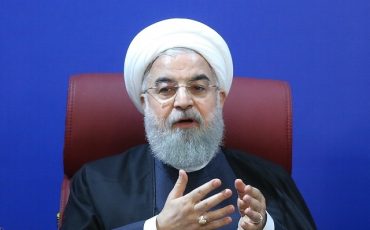 Iranian President Hassan Rouhani has discussed the situation in Syria, as well as prospects of Iran deal with his French counterpart Emmanuel Macron in a telephone call, the official website of the Iranian president reported.
Hassan Rouhani noted that Tehran had sent its military advisers to the Arab republic at the request request of its legitimate government in order to help Damascus fight terrorism. He expressed hope that no “foreign military presence” would be needed after the terrorist threat had been eradicated.
Israel accuses Iran of sending the country’s troops to Syria in order to attack it from Syrian territory. Tel Aviv has already conducted several airstrikes against Syrian bases under a pretext of Iranian Revolutionary Guards being stationed there. Tehran and Damascus deny these accusations.
The two presidents also discussed the current state of the JCPOA. Rouhani praised the stance that Europe took to keep the deal alive after the US withdrawal, but noted that, so far, statements had not been “accompanied by practical and tangible measures and solutions.”
“If Iran cannot benefit from the privileges of this agreement, remaining in it will not be possible,” the Iranian president said.
Emmanuel Macron confirmed commitment to the JCPOA and assured Rouhani that France is working on “a series of measures and practical solutions” to make the deal work.
The US withdrew from the Iran nuclear deal in May 2018, with President Donald Trump claiming the deal was “flawed” at its core. Other parties to the agreement have confirmed their readiness to stick with the deal and work out solutions against possible US sanctions.
The Art of the Deal worked on Sentosa Island
By M.K. Bhadrakumar | Asia Times | June 13, 2018
Some statesmen by their sheer force of personality and unorthodox ways of politicking arouse disdain among onlookers. US President Donald is perhaps the most famous figure of that kind in world politics today.
No matter what he does, Trump attracts criticism. He evokes strong feelings of antipathy among a large and voluble swathe of opinion within half of America. The making of history in a virtual solo act on his part, which is the rarest of efforts, on Sentosa Island in Singapore on Tuesday and which the world watched with awe and disbelief, will be instinctively stonewalled.
Half of America simply refuses to accept the positive tidings about him coming from Singapore. The skeptics are all over social media pouring scorn, voicing skepticism, unable to accept that if the man has done something sensible and good for his country and for world peace, it deserves at the very least patient, courteous attention.
The problem is about Trump – not so much the imperative need of North Korea’s denuclearization. But western detractors – ostensibly rooting for the “liberal international order” – will eventually lapse into silence because what emerges is that North Korean leader Kim Jong-un has enough to “bite” here in the deal that Trump is offering – broadly, a security guarantee from the US and the offer of a full-bodied relationship with an incremental end to sanctions plus a peace treaty.
Succinctly put, Trump has offered a deal that Kim simply cannot afford to reject. The ending of the US-ROK military exercises forthwith; Trump’s agenda of eventual withdrawal of troops from ROK; the lure of possible withdrawal of sanctions once 20% of the denuclearization process gets underway, or once the process becomes irreversible; Trump’s hint that he has sought assurances from Japan and the ROK that they will be “generous” in offering economic assistance to the reconstruction of North Korea; China’s involvement in the crucial process – these are tangibles.
Re-election at stake
Trump seems to have succeeded in impressing Kim how green his valley too could be if he accepted the deal. On the other hand, Kim senses that he has an interlocutor who is keenly seeking a success story for his beleaguered presidency and is not playing political games or merely waffling. Trump candidly, disarmingly admitted at the press conference after the talks with Kim concluded that this success story would certainly go into his campaign plank when he makes a bid for re-election in 2020. What bigger signal can Trump give regarding his good faith.
In sum, Kim gets a one-time deal that must see the light of day before November 2020. It is custom-made by someone who correctly figured out Kim’s needs and compulsions. Thus, a personal chemistry is developing, which will be further cemented when Kim travels to Washington. Evidently, Kim also senses that he must concede on issues that matter to Trump politically – the issue of the remains of Americans who lost their lives in the Korean War, which is a hugely emotive issue in the US and whose resolution casts Trump in a positive glow. Trump was pleasantly surprised that Kim agreed on the spot when he made the request – just like that.
Geopolitically, Kim weighs in that in the ROK President Moon Jae-In, he already has someone who is a famous supporter of Seoul’s “Sunshine Policy”. There is already talk in Seoul about doing trade with North Korea. And it is a masterstroke on Trump’s part to include China in the negotiations for a peace treaty between the US and North Korea – although legally speaking, that is not mandatory. Trump flagged twice that US intelligence has spotted that China-North Korean border controls have eased lately since the US-China tensions began rising over trade.
Trump is ensuring that China remains a big stakeholder right until the finishing line. Now, a Korean peace treaty will inevitably reflect on the presence of US troops in South Korea – and Japan – which is, of course, an issue of momentous consequence for China’s security and the power dynamic of Northeast Asia.
The unthinkable is happening
The bottom line is that Trump has pulled off something that could make him a man of history and strengthen his America First project and in the process might win him a second term as president. The unthinkable is happening and his detractors are desperately searching for loopholes in the joint declaration signed in Singapore. It is a pathetic sight because no political document ever drafted by man has been 100% foolproof. A document is always open to interpretation. To err is human, to forgive divine.
However, that is beside the point here. The heart of the matter is that a big portion of the Trump-Kim deal cannot even be written on parchment paper. It is one-on-one. It is built around personal rapport, while the terms were agreed upon beforehand. The assisting role of US Secretary of State Mike Pompeo and Kim’s 30-year old sister Kim Yo-jong in the signing ceremony presented an extraordinary sight, testifying to the profundity of the occasion. In the East, you don’t break a deal that your sister bore witness to.
Therefore, setting aside prejudices regarding Trump the man, this is a moment when America should be capable of savoring. Of course, history shows that man proposes and God disposes. But the good part here is that no one is seeking to undermine what Trump and Kim have embarked upon.
So long as their mutual commitment is not in doubt, the prospects of a settlement on the Korean Peninsula are reasonably good. That’s what Trump’s Art of the Deal would have said.
Democrats Put Partisanship Before Prospects for Peace
By Joe Lauria | Consortium News | June 13, 2018
When Richard Nixon returned to Washington after his historic 1972 trip to China, he was welcomed with strong support from Democrats.
“From the initial Congressional reaction, it was apparent that the President, home from his China trip, would find broad bipartisan support for his move toward closer relations with Peking,” The New York Times reported on Feb. 29, 1972.
Even Democratic Senate leaders Edward Kennedy and Mike Mansfield praised Nixon’s diplomatic gamble.
Forty-six years later President Donald Trump took a similar political risk in agreeing to the first ever summit with a North Korean leader. Cautious optimism emerged from the summit that peace on the Korean peninsula may finally be within reach 65 years after a truce silenced the guns of the Korean War.
But instead of the support Nixon received from the opposition party, Trump has been blasted by Democrats, who’ve put any prospect for peace behind their partisan quest to regain power.
“It sure looks as if President Trump was hoodwinked in Singapore,” wrote liberal New York Times columnist Nicholas Kristoff on Tuesday. “Trump seemed to believe he had achieved some remarkable agreement, but the concessions were all his own.”
“Kim seems to have completely out-negotiated Trump, and it’s scary that Trump doesn’t seem to realize this,” Kristoff wrote.
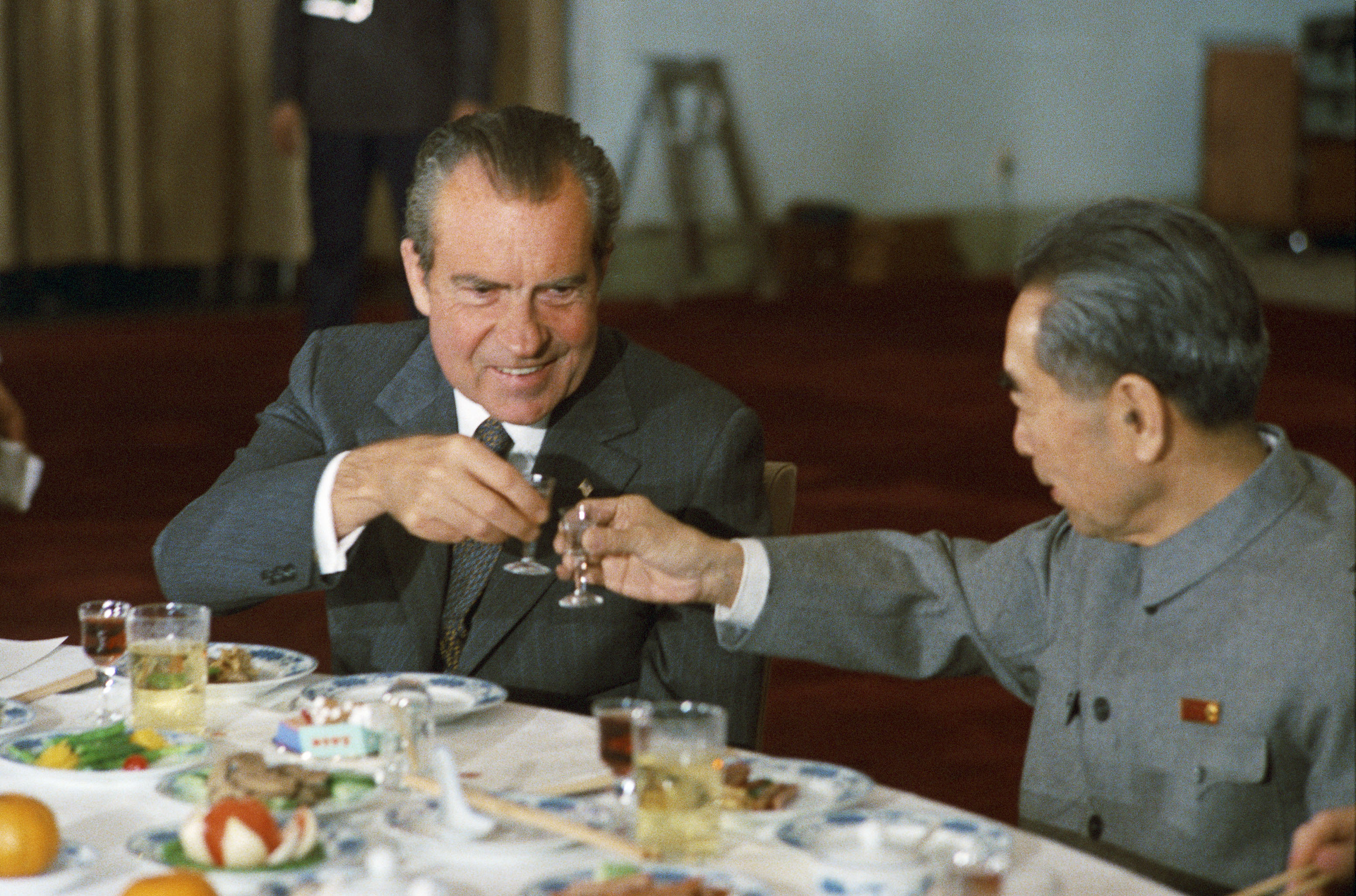
Nixon toasting Zhou
The Times editorial board was even harsher. “President Trump was on his best behavior, as is so often the case when he is dealing with dictators,” it wrote. “Mr. Trump was even more effusive about Mr. Kim after their session, sounding more like he was deconstructing a blind date than analyzing a diplomatic meeting.”
In case the reader didn’t get the message the editorial went on: “Whatever he does or does not understand about history or policy or statecraft, Mr. Trump has a keen sense of how to engage authoritarian thugs who crave respect and legitimacy. It’s how he’s wired.”
And then it piled on: “Mr. Trump has a deep and abiding fondness for strongmen … The more ruthlessly they have had to act to hold on to power, the more he respects them.”
“Dealing with men like Mr. Kim is, on some level, comfortable ground for Mr. Trump,” the Times editorial said. “Such negotiations are a higher-stakes, global version of the world he came up in, one of cutthroat real estate developers and shady businessmen and mobsters. … The world sneers at strongmen like Mr. Kim, Mr. Putin and Rodrigo Duterte, the president of the Philippines, regarding them as uncivilized thugs, and Mr. Trump feels similarly disrespected. Dispositionally speaking, these are Mr. Trump’s people.”
A Beginning, Not an End
There wasn’t a word about what the two leaders agreed to in Singapore, namely the start—not the end—of what Trump called “an arduous process” that could lead to peace on the Korean peninsula. Trump could not have been clearer. He even said he could be wrong if the agreement is not realized.
The Times editorial never mentioned the agreement. In essence both sides agreed to work towards a peace treaty to end the Korean War, and the U.S. agreed to provide security guarantees to North Korea in exchange for the denuclearization of the peninsula. This was always meant to be a broad agreement on principles at the summit to kick start the indeed arduous negotiations to follow.
That the Times editorial board purposely ignored this fact to score cheap partisan points could not be clearer. The risks inherent in war on the peninsula, which should be of bi-partisan concern, were apparently of no concern to the editors on Eighth Avenue who decidedly took the low road.
Senate Democrats were no less uncharitable, seizing what they thought was an opportunity to score partisan points, while ignoring the promise the summit holds. “What the United States has gained is vague and unverifiable at best,” said Senate Minority Leader Chuck Schumer (D-NY). “What North Korea has gained, however, is tangible and lasting. By granting a meeting with Chairman Kim, President Trump has granted a brutal and repressive dictatorship, the international legitimacy it has long craved.”
House Minority Leader Nancy Pelosi (D-CA) said: “In his haste to reach an agreement, President Trump elevated North Korea to the level of the United States while preserving the regime’s status quo.”
The questions asked at Trump’s post-summit press conference is illustrative of the partisan nature of today’s press. He was repeatedly asked about giving away the store without getting anything in return. But Trump made clear he had already gotten the return of three American prisoners, had gotten a commitment for the remains of Americans killed in the Korean War to be returned, and most crucially, a promise to begin the task of denuclearization.

US devastation of N. Korea (Keystone/Getty Images)
Yes it’s a promise. But the process has to begin somewhere. The very hard work to make that happen will begin now, and no peace-loving person would not want to give it a chance instead of seeking to gain short-sighted partisan advantage.
Trump said sanctions would remain and that war games with South Korea could resume if the deal does not materialize. After the devastation wrought by the United Sates on North Korea 65 years ago Trump incredibly agreed that those war games were seen as provocations by the North. He is being roasted for putting himself in the position of his adversary and seeing things as they do—a fundamental principle of diplomacy, and presumably journalism too.
The press also badgered Trump about North Korean human rights. They wanted to know how he could make a deal with such a repressive country. Would the alternative be war to enforce human rights? Trump said human rights were raised with Kim but were separate from the imperative of denuclearization. He felt that if peace were achieved and the North Korean economy improved (with the likely participation of U.S. corporations) that human rights would improve.
Turning the Tables
“I’m disappointed Kim Jong-un did not take the opportunity to raise with Trump the utterly dismal US human rights record, from mass incarceration of millions to rampant police murder of Black citizens,” tweeted Ali Abunimah, co-founder of the website The Electronic Intifada. “Any credible deal must be predicated on US respecting its own people.”
Journalist Max Blumenthal tweeted: “The US committed genocide during the Korean War, killing 20% of North Korea’s population, burning literally all of its cities to the ground w/ napalm, & nearly nuking it. Today it threatens w extermination. Reporters must ask Kim how he can make peace with such a brutal country.”
“Democrats attacking Trump from the Right on Korean Summit,” added writer and filmmaker Tariq Ali in a tweet. “Pity Obama didn’t have the guts to visit Teheran.”
What we are witnessing is an inability, or unwillingness, to break down Trump’s positions and examine each one individually, something that Democrats like Ted Kennedy were able to do with Nixon. But we are in a totally different era. A non-partisan approach to Trump would be able to decry his positions on climate, torture, health insurance, taxes, Iran and Palestine, and yet welcome his stated desire to lessen tensions with Russia and North Korea.
Instead we get tweets like this from former Republican Congressman Joe Walsh: “America is the brightest, most benevolent nation on earth. North Korea is the darkest, most horrific regime on Earth. We just gave them equal billing. We just sat at a table with them. There had better be something really, really good coming in return.”
Clearly some criticism of Trump for meeting Kim is bipartisan, but none of the praise is. Such an attitude of Walsh’s, and The New York Times, rests on a misunderstanding of America that is intended to reflect well on those who conveniently leave out the darkest chapters of America’s history, of which there have been far too many. The napalming and destruction of North Korea is among them, but hardly alone.
Deleting the context of decades of election meddling, coup plotting, assassinations and invasions of sovereign lands in the reporting and editorials of august organs like the Times, indeed in the entire corporate media, leaves Americans with a comic book understanding of their history, cast adrift in a bubble from the reality of the rest of the world.
Attacking other nations’ human rights record while ignoring one’s own, or one’s allies, such as Saudi Arabia and Israel, is classic projection designed to wash one’s conscience clean. It helps to hold a position in the post-War Western-dominated international system making it easy to convince oneself of one’s righteousness, though self-reflection would reveal that that system has become a grotesque image of its former self.
Joe Lauria is editor-in-chief of Consortium News and a former correspondent for The Wall Street Journal, Boston Globe, Sunday Times of London and numerous other newspapers. He can be reached at joelauria@consortiumnews.com and followed on Twitter @unjoe.
Featured Video

The First Pyrrhic Victory of the Vietnam War
or go to
Aletho News Archives – Video-Images
Frlom the Archives
The 52 Major Jewish American Organizations and Israel Celebrate Passover with the Slaughter of 25 Muslim, Christian and Secular Palestinians
By James Petras • Unz Review • April 8, 2018
Introduction
As of April 7, nearly three thousand unarmed Christian, Muslim and secular Palestinians have been wounded, over three dozen are in critical condition and at least twenty-five unarmed protestors, including children have been assassinated by hundreds of Israeli snipers and heavily armed troops shooting tank shells into crowds of civilians protesting their decades of incarceration by the racist Israeli state.
The Israeli government praised the ‘restraint and morality’ of the IDF, as did the fifty-two Major Jewish American Organizations (MJAO) who largely control the US Congress. These grotesque massacres began during the Christian Holy Week on Good Friday and Easter, coinciding with the Jewish Passover. The self-righteous officials of the MJAO and their relatives and friends broke matzos at joyful Seders as the blood of Palestinians soaked into ground at the fence containing the largest open-air prison camp in history, Gaza.
While tribal loyalties bonded the Israeli and Jewish American leaders, the politicians of the Western oligarchic electoral regimes refrained from criticizing the shocking display of brute force and even defended Israel’s cold blood mass killings of Palestinian civilians in their Gaza prison.
This paper will discuss and analyze the reasons for Israel’s willing Western accomplices and the centrality of its fifth column in the United States. … continue
Blog Roll
 Aletho News
- Just Get Out! Now!
- Unpacking glaring contradictions in US-Zionist justifications for war against Iran
- Iranian model of warfare bleeds US dry while Persian Gulf states watch and learn: Analyst
- IRGC orders ‘defeated’ US to evacuate industrial facilities in region
- Hegseth’s call for ‘no mercy’ to Iranians deemed war crime
- Iran War Exposes Limits of US Military Power – Journalist
- Even The Neo-Cons Admit The Iran War Is Failing
- Inside the Caucasus Drone Corridor Fueling Tensions With Iran
- ‘Not our war’: Trump’s naval coalition to reopen Strait of Hormuz dead in the water
- Iran declares support centers for USS Gerald R. Ford legitimate targets
- If Americans Knew
- ‘I Liked the House’: When Israeli Soldiers Turn Palestinian Homes into Barracks
- ‘They Were All I Had’: Lebanese Father Buries Parents, 4 Daughters Killed by Israeli Bombing
- Israel and its supporters are causing attacks on Jewish institutions. Case in point: Michigan synagogue tragedy.
- These are the casualties and cost of the war in Iran 2 weeks into the conflict
- Chicago Teachers Union accuses AIPAC of swaying elections with ‘dark money’
- Predictions of another 9/11, amid Israel-US killing spree – Not a ceasefire Day 157
- As US-Israel war on Iran rages, Gaza faces massive dust storm – Not a ceasefire Day 156
- No let-up in attacks on Gaza as Israel takes on Iran, Lebanon – Not a ceasefire Day 155
- ‘Of Course’: IDF Drops Case Against Soldiers Accused of Raping Palestinian Prisoner
- Don’t Fall for the Regime Change Talk. Israel Is ‘Mowing the Lawn’ in Iran
- No Tricks Zone
- Storing Green Energy To Last Germany 10 Days Would Require A 60-Million Tonne Battery
- New Studies: UK Sea Levels Were 4 Meters Higher Than Today During The Mid-Holocene
- Destructive Green New Deal: German Energy And Metal Group Warns Of Drastic Crisis
- New Study Documents A 20-Year Pause In Arctic Sea Ice Decline – Driven By Internal Variability
- Wake-up Call: Survey Shows Majority Of Germans Now Favor Postponing Climate Targets!
- Televised! Leading German Political Candidate Tells Schoolchildren CO2 Makes Sun Hotter!
- New Study: A Century Warming Of 1.1°C Is ‘Commonplace’ And ‘Not Unusual’ During This Interglacial
- New Study: ‘Internal Noise’ And Volcanic Forcing Can Trigger 10-15°C Warming Within Decades
- Glaciers Worldwide Are Suddendly Surging, Experts Blame Warming!
- Surprising Discovery: Sahara Is Greening…Billions Of Trees Where Once Thought To Be Barren
 Aletho News