US is willing to dismantle the UN Security Council to put pressure on Iran
By Scott Ritter | RT | August 21, 2020
In a world where American exceptionalism and unilateralism has become common currency, the brazenness of Secretary of State Pompeo’s bid to impose “snap back” inspections of Iran takes the cake. Moreover, it’s doomed to fail.
When it comes to Iran and the Iran nuclear deal (formally known as the Joint Comprehensive Plan of Action, or JCPOA), President Trump has been singularly focused on one outcome–to bring the Islamic Republic back to the negotiation table for the purpose of producing a “better deal” than the one done by his predecessor, Barack Obama, in July 2015. For the former New York realtor and reality television star-turned Chief Executive, it does not get any simpler than that–he is, after all, the consummate (if self-proclaimed) “deal maker.” How the deal is made, and even what constitutes the deal, is less important than the deal itself. This goal dominated his thinking about Iran as a candidate and continues to do so as President.
The precipitous decision to withdraw from the JCPOA in May 2018 was driven more by the perceived need to begin shaping the diplomatic battlefield in support of a new negotiation than any legitimate national security concerns. Trump’s goal all along has been to compel Iran, through the implementation of economic sanctions combined with political isolation, to scrap the Obama-era JCPOA and sit down with the new American “deal maker” to craft a “big deal” that would make everyone happy.
America versus the world
The problem from the start, however, was that the United States was alone with its displeasure over how the deal was being implemented. Among the other parties to the JCPOA (France, Great Britain, Germany, the EU, Russia, China and Iran), the agreement was proving its viability by preventing Iran from engaging in any “breakout” actions that could result in Iran obtaining enough fissile material from its centrifuge-based uranium enrichment program to build a nuclear device. Trump, however, had latched on to the so-called “sunset clauses” of the JCPOA, which lifted restrictions on Iran’s use of centrifuges after a period of several years, allowing Iran to blow-past the hypothetical calculations regarding nuclear “breakout,” and thereby mooting the fundamental purpose of the JCPOA to begin with.
The US decision to unilaterally withdraw from the JCPOA has proven to be an unmitigated policy disaster, one that has empowered Iran, Russia and China as the “aggrieved parties,” and driven a wedge between the US and its European allies. Rather than admit defeat and help restore the status quo by re-entering the JCPOA, the Trump administration has instead opted to double down, threatening to reimpose UN sanctions which had been suspended upon Iran’s entry into the JCPOA via procedural mechanisms contained in the body of that agreement calling for the “snap back” of sanctions if any party is dissatisfied with the compliance of another. The real purpose of the US gambit to reimpose “snap back” inspections wasn’t any malfeasance on the part of Iran’s nuclear program, but rather a desire to prevent the automatic lifting of an arms embargo that had been spelled out in the body of the JCPOA. This embargo was scheduled to automatically terminate come October 2020.
The US sought to pressure the Security Council into passing a resolution which would permanently extend this embargo. Both Russia and China had promised to veto, so the resolution’s defeat was inevitable. The goal in pushing for it, however, was to persuade at least nine other members of the 15-member body to vote in favor, thereby providing the US with the moral high ground when approaching the Security Council about re-imposing “snap back” sanctions. Most of the other members of the Security Council, recognizing that if they intervened to reverse a clause mandated by the JCPOA, they would put Iran’s continued participation in the agreement at risk, instead abstained from voting on the resolution. Only the Dominican Republic sided with the US; Russia and China, as expected, cast their vetoes.
Trump’s deal or no deal
Having failed to secure the moral high ground, the US could have admitted defeat and regrouped, trying to find another, less controversial way forward. But the US policy of “maximum pressure” brooks no such weakness, especially when Donald Trump has bragged that he will secure a new deal with Iran within four weeks of his being re-elected. To even have a shot at this, the US would need to not only maintain the existing unilateral sanctions regime it is enforcing on Iran, but also increase the pressure, something that could only be done by re-imposing UN sanctions via the “snap back” mechanism of the JCPOA.
If the US were to succeed in “snapping back” UN sanctions, the JCPOA would be dead in the water, as there would be no way Iran would continue to comply with an agreement which no longer delivers on its promises. The other parties to the JCPOA understand this and indicated their unwillingness to go along with the US scheme. Moreover, these nations believe that by having withdrawn from the JCPOA, the US was no longer a “participant” to that agreement, and as such, had no jurisdictional or legal authority to initiate the “snap back” provisions.
On August 20, Secretary of State Mike Pompeo, ignoring the warnings from the other JCPOA parties, met with the President of the Security Council for the purpose of delivering a letter announcing that the US was activating the “snap back” procedures, and that in 30 days it would be calling for a vote on the matter by the Security Council. Almost immediately the US actions were condemned by the other parties of the JCPOA, with France, Great Britain and Germany calling the US move “incompatible with our current efforts to support the JCPOA”, and both Russia and China terming the effort “illegal.”
Tearing down UNSC is an acceptable outcome for the US
The Trump administration, faced with this united opposition, has shown no indication it is willing to back down. The UN Security Council is navigating uncharted waters, having never been confronted with a challenge of this nature in its entire 75-year history. There is every reason to believe that the US will submit a resolution for consideration following the expiration of the 30-day notification period, and then veto it itself, thereby triggering the automatic “snap back” of UN sanctions. There is also every reason to believe that the Security Council will seek to block the US through various procedural formalities designed not to formally recognize the US demands, and thereby preventing the submission of any resolution.
A likely outcome will be that the Security Council fails to recognize the US submission of a resolution, followed by the US refusing to recognize the Security Council’s ability to prevent such a resolution from being submitted. The US will seek to submit the resolution, then immediately veto it, and claim that the “snap back” has been accomplished. The rest of the Security Council will reject this action, and deem the JCPOA to be in play, free of UN sanctions. The US will then sanction any party which fails to comply with the UN sanctions.
If this were in fact to occur, it would mean the functional death of the UN Security Council, an outcome many in the Trump administration appear willing to live with. Faced with the inevitability of this outcome, some members–especially the French, Germans and Brits–may be compelled to reexamine their position on the lifting of the arms embargo, seeking a compromise solution that salvages the JCPOA while denying Iran access to Russian and Chinese armaments. This may be the goal of the US all along. If so, it is an extremely dangerous one that is based on a false predicate, namely that there is a combination of economic and diplomatic pressure that can be placed on Iran to compel it to renegotiate the JCPOA. Simply put, there is not, and for the Trump administration to proceed as if there is only endangers regional and international peace and security.
Scott Ritter is a former US Marine Corps intelligence officer and author of ‘SCORPION KING: America’s Suicidal Embrace of Nuclear Weapons from FDR to Trump.’ He served in the Soviet Union as an inspector implementing the INF Treaty, in General Schwarzkopf’s staff during the Gulf War, and from 1991-1998 as a UN weapons inspector. Follow him on Twitter @RealScottRitter
Iran “snapback” sanctions is a pantomime. Spectacle to watch is Trump-Putin summit.
By M. K. BHADRAKUMAR | Indian Punchline | August 21, 2020
As expected, the Trump Administration delivered letters on Thursday to both the UN Secretary-General Antonio Guterres and to the president of the Security Council Dian Triansyah Djani notifying them that the United States is initiating the restoration of virtually all UN sanctions on Iran lifted under UN Security Council Resolution 2231.
This process, if successful, could lead to those sanctions coming back into effect 30 days from August 20. Explaining the move, US Secretary of State Mike Pompeo stated at the UN Headquarters in New York at a press conference that the US “will never allow (Iran) to freely buy and sell planes, tanks, missiles, and other kinds of conventional weapons. These UN sanctions will continue the arms embargo… also reimpose accountability for other forms of Iranian malign activity…
“Iran will be again prohibited from ballistic missile testing. Iran will be back under sanctions for ongoing nuclear activities – such as the enrichment of nuclear material – that could be applied to a nuclear weapons program,” Pompeo added.
In essence, the US has triggered the “snapback” process notifying the security council that Iran is breaching the JCPOA (2015 Iran nuclear deal), whereupon, the council’s members or its president must introduce a resolution to continue the suspension of the UN embargoes under 2231.
The battle lines are drawn. An overwhelming majority of UN SC members are opposed to the US move. A US resolution last week seeking extension of the UN arms embargo on Iran met with crushing defeat with only the Dominican Republic supporting it. In a scathing criticism, New York Times wrote that the US has “largely isolated itself from the world order.”
On Thursday, UK, France and Germany issued a joint statement questioning the US’ credentials to make such a move, saying, inter alia, “The U.S. ceased to be a participant to the JCPOA following their withdrawal from the deal on 8 May, 2018… We cannot therefore support this action which is incompatible with our current efforts to support the JCPOA.”
Politico in a dispatch from Berlin wrote that the US move has left European allies in “an awkward position … For now, the European strategy is to play for time. If Pompeo triggers the snapback, they’re likely to look for ways to delay a final decision until after the November 3 presidential election in the hope Joe Biden would reverse Trump’s course.” Russia and China have explicitly rejected the US move, too. On Thursday, Russia sought an “open debate” at the Security Council, but the US promptly shot it down.
Of course, the UN SC’s rotating presidency — held by Indonesia through August — could simply ignore the US notification of Iran’s noncompliance with the JCPOA. (But Pompeo said he’s “confident” the notification won’t be ignored.) If the US pushes ahead and imposes its will, Russia and China may proceed to defy the “snapback” sanctions.
Tehran has warned that it will strongly react to “snapback” sanctions. A range of options remain open to Iran, including exit from Nuclear Non-Proliferation Treaty. Tehran remains defiant: on Thursday, it unveiled a new ballistic missile (named after Gen. Qassem Soleimani) and another cruise missile.
Indeed, a confrontation that irreparably damages the standing of the UN SC is in no one’s interest. President Trump himself did some kite-flying recently that he could get a deal with Iran within four weeks if re-elected. On Tuesday, Trump’s son-in-law and senior advisor Jared Kushner appealed through Voice of America to Iranian President Hassan Rouhani to engage with Washington. “For President Rouhani, I would say it’s time for the region to move forward. Let’s stop being stuck in conflicts of the past. It’s time for people to get together and to make peace.”
Trump seems open to shifting course after November. Despite the failure of his “maximum pressure” approach, Trump wants a deal with Iran that outdoes Obama. Which means that after the election, freed from Jewish donors and conservative Evangelicals, a shift could be more likely on his part than a continuation of the status quo.
This is where President Vladimir Putin’s proposal of August 14 on the holding of an online summit of the five permanent members of the UN Security Council, Germany and Iran soon to focus on the JCPOA implementation issues — to “set out steps to avoid confrontation and tensions in the UN Security Council” — comes into play.
Trump has rejected Putin’s proposal “for the time being” with a hint he may revisit it after November. On Wednesday, Kremlin spokesman Dmitry Peskov also hinted that all is not lost. Peskov said: “Indeed, the US rejection does not allow us to gather in this format as it was proposed from the start.
“However, it does not mean that the dialogue with the other states is halted on the Iranian issue. This dialogue for the sake of viability of the JCPOA and for the sake of settlement will definitely be continued.”
Indeed, much is happening elsewhere on the template of Russian-American relations. The NBC News disclosed on August 16 quoting “four people familiar with the subject” that Trump has told aides he’d like to hold an in-person meeting with Putin before the November election.
The Administration officials have since “explored various times and locations” for a summit, including potentially next month in New York.
The report added, “The goal of a summit would be for the two leaders to announce progress towards a new nuclear arms control agreement … One option under consideration is for the two leaders to sign a blueprint for a way forward in negotiations on extending New START.” This was almost exactly what I had predicted. (See US snapback sanctions on Iran not easily done, Asia Times)
A Russian-American confrontation over Iran — with all its ramifications for international security — is not on Trump or Putin’s calculus. Trump lost a great deal of time through his first term to improve relations with Russia but being a consummate deal maker, he hasn’t given up hope.
Nor has Putin. An agreement to renew START is one offer from Trump that Putin cannot afford to spurn, something he’s been keenly seeking, as it could open pathway for a resumption of arms control talks that would not only strengthen strategic balance and make US-Russia relations more predictable but enhance Russia’s global standing.
Furthermore, Trump at this point in time also hopes to win over Russia and isolate China. Putin, being a realist, would know the contradictions in US domestic politics that might stymie Trump’s belated effects to cap and rollback the slide in US-Russian relations. Equally, Putin believes in the raison d’être of Sino-Russian entente, which is a strategic choice and necessity for Moscow — as unfolding events in Minsk only underscore.
Suffice to say, Putin will stick to his pragmatic foreign-policy trajectory that prioritises Russia’s national interests. He’ll accept Trump’s invitation to a summit.
In such a complex backdrop of shifting moods in big-power politics, it is neither in American nor Russian interest to get entangled just now in acrimonious confrontation at the horseshoe table in the UN Hqs in New York while preparations have begun for a likely Trump-Putin summit.
The moment is at hand for Putin to step in as mediator to navigate the US-Iran standoff to calmer waters — perhaps, even bring the two implacable adversaries to the negotiating table. In the current US election cycle, this can only work to Trump’s advantage.
Twitter’s shadow-banning of RT & other state-linked media proves the US narrative doesn’t measure up
By Helen Buyniski | RT | August 20, 2020
With less than three months before US elections, Twitter has all but memory-holed RT and other state-run media – even searching their handles draws a blank. For a supposedly free-market country, the US sure hates competition.
The official Twitter accounts for RT, Xinhua, and other media outlets owned by certain governments the US doesn’t like are being pushed into the shadows, confirming that Twitter is getting serious about its role as one of the chief enforcers of US informational supremacy. But deploying the memory-hole against Washington’s rivals is tacitly admitting that the same informational supremacy would be doomed without such heavy-handed censorship.
Not only will Twitter refuse to auto-complete searches for the official accounts of RT, Sputnik, Xinhua, Global Times, and a handful of other outlets owned by Russia and China – typing in their handles with the @ symbol yields no results for users who don’t already follow these accounts. The platform has essentially made it impossible for the average Twitter user to accidentally stumble across their posts.
Turning off the “hide sensitive content” function in search settings allows state media accounts to surface under “people” – if their handle is searched exactly, with the @ symbol – tagged with the “state-affiliated media” warning Twitter has casually referred to as an “election label.” But posts from these outlets remain missing everywhere but in their own feeds. Running the accounts through Shadowban.eu confirms they’re subject to a “search suggestion ban.”
While Twitter announced earlier this month that it would remove state-run media accounts from any ‘recommended’ screens, including the home screen, notifications, and search, the new policy’s wording left room for interpretation. Even employees at some of these organizations thought – perhaps naively – that Twitter wouldn’t go so far as to block searches for RT from turning up, well, RT.
Twitter explained its failure to slap a scarlet letter on the BBC, NPR, or Voice of America – all state-run media organizations – by claiming these outfits maintained some degree of editorial independence. While many at the time called this out as the egregious double standard it was, that was before learning how deeply Twitter intended to bury its victims.
While Twitter theoretically has a financial responsibility to its shareholders that would be best served by giving customers what they want, the company appears to have long since decided the only customers who matter are Uncle Sam and his client states. Though its own links with empire are not quite as egregious as, say, Facebook’s “election integrity” partnership with infamous pro-war think tank the Atlantic Council, one of Twitter’s highest-ranking European employees works for the UK’s 77th Brigade propaganda outfit, and another staffer, who worked on Democratic VP candidate Kamala Harris’s presidential campaign, is suspected of manipulating trending topics to bolster her chances at the White House. Representatives from the company have repeatedly met with US intelligence agencies to “secure” the 2020 elections.
The suppression of “enemy” state-run media is just one part of a sweeping multi-platform crackdown on information that runs contrary to the US establishment, from medical doctors recommending hydroxychloroquine as a treatment for the novel coronavirus to positive or even neutral statements about murdered Iranian General Qassem Soleimani. Even the ramblings of QAnon conspiracy theorists who believe Trump is just pretending to wallow in the swamp he promised to drain, playing ‘4D chess’ to psych out his enemies, are now considered too dangerous for Twitter and Facebook, while the mere existence of Chinese-owned TikTok – a super-popular social platform not under US control – has so infuriated the Trump administration that the president is trying to buy it (or, if that fails, ban it).
If Washington can only win the battle for hearts and minds by silencing its competitors, the problem isn’t with Russian or Chinese state media – it’s with the sloppy quality of US propaganda and its growing divergence from reality. Selling a bankrupt nation whose citizens are forever at each other’s throats as a shining city on a hill and glowing example to the world’s democracies is a tall order, but it’s much easier to convince someone the sky is green when they don’t have any windows to look out of.
Helen Buyniski is an American journalist and political commentator at RT. Follow her on Twitter @velocirapture23
Is Belarus a color revolution? The real problem is that ANY protest these days may be
By Nebojsa Malic | RT | August 20, 2020
Whenever there is a mass protest against a government somewhere in the world, one of the first questions from skeptics will be whether it’s a ‘color revolution,’ a technique of turning legitimate grievances into a coup d’etat
The recent events in Belarus are a perfect example. It’s not a color revolution, but President Alexander Lukashenko “repeating Soviet mistakes,” argues Bradley Blankenship. While he is looking at the behavior of the protesters on the ground, however, Caitlin Johnstone is looking at the State Department. Foggy Bottom’s actions and “imperial narrative management” by official US propaganda outlets have her convinced it is a color revolution. She’s not the only one.
That’s precisely the problem, however: in a world where “color revolutions” have become normalized, it’s nearly impossible to tell if a mass protest is a spontaneous, grassroots event or an astroturfed regime-change operation. To the creators of color revolutions, this is a feature, not a bug.
The tactic has been around for two decades now, first tested following the September 2000 elections in Serbia. It involves activists trained by US-backed “NGOs,” copious amounts of cash, strategies and tactics outlined in a manual written by the late Gene Sharp. The key element is narrative management, through which the revolutionaries usurp the initial protests and direct them towards their own ends.
One distinguishing feature of astroturf campaigns is a visual marketing campaign, such as the stenciled fists of Otpor in Serbia (used elsewhere since), or the 2004 orange scarves and banners in Ukraine. The sudden omnipresence of white-red-white flags in Belarus – used briefly in 1918 and again under Nazi occupation – seems to fit this pattern. So do the signs like “Belarusian Lives Matter,” appealing not to the locals but to the West.
Washington’s hand in these “spontaneous” uprisings. Stories about “suitcases full of cash” that fueled the revolt in Serbia appeared shortly after the coup in Belgrade. In November 2004, the Guardian wrote approvingly about how the US has created a “slick” operation of “engineering democracy through the ballot box and civil disobedience,” developing since Belgrade a “template for winning other people’s elections.”
These days, there is no boasting, but the practice continues nonetheless. Most recently, the scenario played itself out in Bolivia (successfully), Venezuela (not) and Hong Kong, where “pro-democracy” protests against an extradition bill lasted long after it was withdrawn.
What changed is that the US and its media machine switched to denying involvement and pretending the “color revolutions” were actually genuine expressions of democracy, after some targeted governments managed to defeat these astroturf rebellions. This remained the case even as color revolution tactics came home to the US this summer.
Back in June, Franklin Foer of the Atlantic magazine – a megaphone of the establishment – actually wrote a favorable comparison of the riots across the US, posing as peaceful protests for “racial justice,” to the color revolutions in places like Ukraine and Serbia. Note that Foer believes these revolutions were good and genuine things, rather than a hostile takeover tactic that was basically a mockery of democracy.
Democracy, at its essence, it’s a straightforward deal. Citizens vote on an issue or for a candidate, and agree to abide by the rules whether they win or lose. But what happens when that vote is manipulated – through street violence, in this case – by outsiders, and the rulebook gets thrown out the window?
This is what makes color revolutions not just wrong, but evil. They literally destroy democracy, by corroding the very rules it is founded on. When they fail, things can escalate along the lines of Libya, Syria or Ukraine.
Even when they fail peacefully, like the 2006 “jeans revolution” in Belarus, they poison a country’s politics so thoroughly, that the government sees any street demonstrations going forward as foreign-sponsored coup attempts. Especially when foreign powers openly express support for it, as has been the case with recent events.
Whatever may be happening in Belarus right now, democracy it is not. The US may not be one for long, either, if things carry on as they have. Two decades of color revolutions have made sure of that.
Let them eat yellowcake: As Powell backs Dems, warmongers seek to regain full control of US policy, regardless of what voters want
By Tony Cox | RT | August 20, 2020
The neoconservatives have a new party. It’s called Democratic, and it’s every bit as warmongering and interventionist as the Republicans were during the Reagan era or that of the Bushes.
We keep hearing how radical leftists have taken over the Democratic Party, but guess who stole the limelight at Tuesday’s Democratic National Convention: the disgraced former Secretary of State Colin Powell who endorsed their presidential candidate, Joe Biden.
In fact, Powell, who helped George W. Bush’s administration lie America into the ruinous Iraq War, was given a full extra minute to speak when compared to Congresswoman Alexandria Ocasio-Cortez, the face of the woke left.
He didn’t disappoint. Although Powell, 83, might be a bit rustier than when he laid out the false US case on Iraqi weapons of mass destruction to the UN in 2003, he deftly leaned on old stand-bys of patriotic values and love for the troops. “Joe Biden will be a president we will all be proud to salute,” Powell said. “With Joe Biden in the White House, you will never doubt that he will stand with our friends and stand up to our adversaries.”
In other words, Biden will pledge undying fealty to NATO and make sure Russia knows who’s boss. Powell put a finer point on the theme: “I support Joe Biden because on Day One, he will restore America’s leadership and our moral authority. He’ll be a president who knows America is strongest when, as he has said, ‘We lead both by the power of our example and the example of our power.’ He will restore America’s leadership in the world and restore the alliances we need to address the dangers that threaten our nation, from climate change to nuclear proliferation.”
It was such a rousing pep talk that we might have expected the Democrats to bring out surprise guest George W. Bush to talk about Iraq obtaining yellowcake uranium from Niger and remind us that, “we cannot wait for the final proof, the smoking gun, that could come in the form of a mushroom cloud.”
Although Bush might have been a bridge too far, other Republicans joined Powell in speaking at this week’s Democrat convention, including former Congresswoman Susan Molinari, former New Jersey Governor Christine Todd Whitman, former California gubernatorial candidate Meg Whitman and former Ohio Governor John Kasich. The latter said in 2016, while running against President Donald Trump in the Republican primaries, that he would deploy large numbers of US ground troops in Syria, Iraq and Libya. “It’s got to be shock and awe in the military-speak,” Kasich said, borrowing a Donald Rumsfeld line.
If that weren’t enough, Senator John McCain’s widow, Cindy McCain, narrated a video paying homage to Biden’s great friendship with her late husband. That the two senators would get along so well shouldn’t come as a surprise. McCain never met a war or secret foreign intervention he didn’t like. Biden supported the Iraq War and the Obama-Biden administration’s bombings of Syria, Libya, Pakistan, Yemen and Somalia, as well as continuing the wars in Iraq and Afghanistan. He praised the regime change in Libya that led to the disastrous migrant crisis and opened up a weapons pipeline for Al-CIAeda forces in Syria.
Of course, the Dems have a leading neocon of their own, Hillary Clinton, as a headline convention speaker. It doesn’t matter which party is in power or what the American people want. As former President Dwight D. Eisenhower warned in his farewell address in 1961, “we must guard against the acquisition of unwarranted influence, whether sought or unsought, by the military industrial complex. The potential for the disastrous rise of misplaced power exists and will persist.”
That ship has sailed. It doesn’t matter that only 27 percent of Americans in a 2019 Chicago Council poll agreed that military interventions in other countries make the US safer. It doesn’t matter that Americans elected Trump not in spite of, but at least partly because he campaigned against senseless wars and called for improving relations with Russia.
The permanent bureaucracy in Washington and the interests it serves couldn’t tolerate that last point. For candidate Trump to say things like “wouldn’t it be a great thing if we could get along with Russia” was heresy to the War State. When Trump won, upsetting establishment candidate Clinton, the Russia hoax was used to contain him.
Trump caved into the pressure against being seen as too friendly with President Vladimir Putin and took a belligerent stance against Moscow, undermining his foreign policy agenda. Just about the only time he received substantial praise from the mainstream media was when he bombed Syria in 2017 on false pretenses. NBC anchor Brian Williams even called the missiles raining down on Syria “beautiful.”
Democracy again took a back seat in the final US Senate report on alleged Russian interference in the 2016 election, released Tuesday. Among the supposedly damning findings was that while Trump was preparing to take office after his 2016 election victory, Russia exploited his transition team’s inexperience and opposition to President Barack Obama’s policies to “pursue unofficial channels.”
It was kind of the same theory as when the FBI entrapped former National Security Adviser Michael Flynn for the non-crime of talking to the Russians during the transition. Flynn urged Russian Ambassador Sergey Kislyak not to overreact to Obama’s sanctions against Russia and suggested that Trump’s policies would be different. He also dared to call Putin “smart.”
Would it be more in the interest of Americans for Russia to overreact? Would it be better that the world’s top two nuclear powers not be talking with each other, through officials and unofficial channels? As long as we’re worried about mushroom clouds, who gains from the US and Russia being on bad terms?
Flynn was simply doing his job as incoming national security adviser. And he was laying the groundwork for the foreign policy agenda on which Trump had campaigned. This wasn’t Obama whispering to Dmitry Medvedev to tell Putin, “This is my last election… After my election, I have more flexibility.”
Trump told voters he wanted to be at peace with Russia and work together on common interests, and voters said, yes. The Colin Powells of the world want to make sure they never have that kind of real choice again.
Tony Cox is a a US journalist who has written or edited for Bloomberg and several major daily newspapers.
It’s Not Happening: The Mainstream Media Is the Enabler of American Dysfunction
By Philip Giraldi | Strategic Culture Foundation | August 20, 2020
Has anyone seen anywhere in the mainstream media a serious discussion of Israel’s possible role in the Beirut bombing? I am not suggesting an evidence-free indictment of Israel but rather just a review of Israel’s possible motive and a consideration of its capability to carry out such an attack without having to directly do it itself with one of its bombs or missiles. Given the Jewish state’s unrelenting hostility towards Hezbollah and its repeated violations of Lebanese territory and airspace, it would seem to me that it would at least merit a sentence or two in the New York Times or Washington Post.
Or how about the Jeffrey Epstein case, another one involving Israel? There is considerable evidence to suggest that Epstein just might have been using underage girls as sex bait for powerful men so they could be blackmailed into cooperating with Mossad. It might have meant having a Bill Clinton as a presidential spouse if voting had gone the other way in 2016 and Bill would have had to be answerable to Benjamin Netanyahu. I haven’t seen anything about that in the newspapers of record or on FOX, MSNBC, CBS or CNN.
Or to look at another manifestation of mainstream media mendacity, how about the reporting on the disturbances that have been taking place all around the United States? Recent major riots in Portland and Chicago were frequently ignored in the mainstream media or were described as “peaceful protests” in support of “racial justice,” contradicting what one could see with one’s own eyes where video was available. The looting, burning, beatings and vandalizing in Oregon over more than eighty days continues nearly nightly with [state] police now withdrawing from Portland after the local district attorney declared that he would avoid prosecuting rioters.
In Chicago the looting that centered on the high-end Miracle Mile Michigan Avenue shopping area was so bad that that part of the city had to be closed off by raising the city’s bridges. Twelve policemen were injured and more than a hundred looters were arrested. U-Haul trucks were even brought in by the rioters and stolen cars were used to smash open shop windows. It was the second major trashing of the area in the past three months.
Illinois Retail Merchants Association president Rob Karr released a statement on the following day which included: “There’s a limit to how many times retailers are willing to be kicked. It will be difficult after retailers who have invested millions in reopening to have to do it again. There has to be a lot of confidence that they can be protected and, so far, that confidence is lacking.”
Chicago’s flagship Macy’s outlet on the avenue has already indicated that it is considering closing due to the shoplifting, looting and general lack of security. In short, many American cities are no longer able to make even an effort to protect the persons and property of their citizens and taxpayers. Was the Chicago story important enough to report by the New York Times? Yes, but only late in the day on a back page.
Chicago is reportedly responding to the crisis by creating a special task force on looting, but the follow-up coverage in the national media was predictably pretty toothless. On the day after Michigan Avenue was laid waste, Black Lives Matter (BLM) held a rally outside the police station where some of the arrested rioters were being held. Fox News alone among national media covered the story, reporting how one BLM organizer Ariel Atkins described the estimated $60 million dollars-worth of looting as really just “reparations.” She said “I don’t care if someone decides to loot a Gucci or a Macy’s or a Nike store, because that makes sure that person eats… That is reparations. Anything they wanted to take, they can take it because these businesses have insurance.” Presumably the rioters, who did not on this occasion loot supermarkets for food and instead chose to steal luxury items will be able to eat their Gucci loafers.
In a similar vein, the New York Times did have something to say about businesses shutting down or leaving Manhattan. A long article entitled “Retail Chains Abandon Manhattan: ‘It’s Unsustainable’” described how many restaurants and shops, including major chains and department stores, are closing due to unaffordable high rents that can no longer be paid due to a lack of tourists and office workers’ business as a result of the pandemonium. The article does not mention a lack of security due to the city government’s permissive attitude towards demonstrations that sometimes turn violent, a curious omission as friends of mine who live in Manhattan have observed the results of random looting and arson in many parts of the city, leading to boarded-up shops and sharply diminishing retail activity. Some long-time residents describe it as a “return to the ‘70s” when the city became unlivable for many.
America’s newspaper of record the Washington Post promotes its product with a phrase “Democracy dies in darkness.” In reality, the darkness is created by the media itself, which no longer reports what is taking place in an objective fashion. What does appear in the papers, online and on television and radio, no matter what the political orientation, is a product that is engineered to send a certain message. That message is itself disinformation, not substantially different than what takes place in the controlled media put out by so-called totalitarian regimes. In fact, news sources like Russia Today are likely to be much more reliable than CNN or FOX on many issues.
Opinion polls suggest that the American public has largely figured things out and reveal that few trust the media to do its job in an objective fashion. In that light, articles like this recent Politico piece have appeared that have questioned how it can be that the Trump White House is optimistic over the prospects for the November election when opinion polls suggest a large margin of victory for Joe Biden and Kamala Harris. If journalists were doing their jobs and were actually getting out on the streets and talking to people, they would discover that people are really worried about the future of the country and what it all will mean for their children and grandchildren. And many of them blame the unrest on the Democratic Party coddling of radical groups that are actively fomenting ethnic and racial divisions for political gain, not on the Republicans. Trump’s playing on those fears might well have a great impact when it comes time to vote. Someone who responded to an opinion poll the week before saying he or she would vote for a safe choice Biden might well go into the voters’ booth and instead pull the lever for Trump.
Germany, France & UK REJECT US push to reinstate UN sanctions on Iran
RT | August 20, 2020
The US exited the Iran nuclear deal and therefore has no right to demand a ‘snapback’ of UN sanctions on Tehran, the foreign ministers of three European powers involved in the JCPOA said in response to Washington’s latest push.
“France, Germany and the United Kingdom, the so-called E3, note that the United States has not been a member of the JCPOA since their withdrawal from the agreement on May 8, 2018,” their respective foreign ministers Jean-Yves Le Drian,Heiko Maas and Dominic Raab said in a statement on Thursday.
Therefore, the E3 “cannot support” the US demand for UN sanctions against Iran to be reimposed, as it is “inconsistent” with their current efforts to implement the deal, the trio added.
JCPOA stands for the Joint Comprehensive Plan of Action, the name given to the 2015 nuclear agreement negotiated by the Obama administration, endorsed by all five permanent members of the UN Security Council and Germany.
Citing UNSC Resolution 2231, which codified the deal, US envoy to the UN Kelly Craft officially requested the “snapback” of sanctions on Thursday, accusing Iran of “significant non-compliance” with the deal. However, China has previously pointed out that the US is not eligible to make that request, having exited the treaty unilaterally. The E3 statement indicates the Europeans share Beijing’s stance on the issue.
The E3 statement came during the press conference US Secretary of State Mike Pompeo was giving at the UN, declaring confidently that the rules of the Security Council are “straightforward” and will lead to the sanctions being restored.
What Is The Cause Of The Recent Power Blackouts In California?
By Francis Menton | Manhattan Contrarian | August 16, 2020
You may have read in the past few days that residents of California have been experiencing rolling power blackouts. This has occurred in the middle of a strong heat wave, meaning that large numbers of people have had their air conditioning, light, refrigeration, and everything else dependent on electricity, go out just when they are most needed. The blackouts have not been the result of technical failures of the grid, but rather have been intentionally imposed by the electricity system operator (known as CAISO — California Independent System Operator) via the various local utilities.
So what has caused these blackouts? The official explanation is that the heat wave is the cause. It has just gotten so unusually hot that demand has risen beyond the capacity of the system. Many articles in the media reporting on the situation go further to associate the unusual heat with “climate change.”
This explanation is complete BS. Yes, there is a strong heat wave going on, at least in certain areas of the state, but it is not unusual in historical context. In fact what is occurring is that California has begun to face the consequences of replacing reliable fossil fuel and nuclear powered electricity with the intermittent renewables, wind and solar. In the evening, approximately 7 to 9 PM, when the sun has set and the heat lingers, and when the demand for electricity for air conditioning reaches a peak, the intermittent wind and solar sources have been producing just about nothing. With insufficient fossil fuel backup, there is not enough power to meet the demand.
In short, we are witnessing the results of almost unbelievable incompetence by the authorities in California. As usual, the equally incompetent and corrupt media are completely giving the authorities a pass in the name of supposedly addressing “climate change.”
First, consider the heat wave. It is fair to call what is currently going on in some major cities like Los Angeles and San Jose a serious heat wave (although the situation in other major California cities like San Diego and Santa Barbara is not a heat wave at all). In Los Angeles, the average daily high for mid-August is 84 deg F. The highs for the past three days have been 93, 98 and 95. For the rest of the upcoming week, forecast highs are all in the 90s, with Wednesday the highest at 98. On the other hand, in Los Angeles, the temperature goes over 100 deg F at least once or a few times most years. Here is a list of record high temperatures in Los Angeles by year. In 2018 it hit 108; in 2010, 113; in 1990, 112; in 1988, 110; and so forth. The large majority of years have records at 100 or above. In short, there is nothing unusual or unexpected in summer temperatures at the level being experienced this week.
So with temperatures at or above the current levels a regularly recurring phenomenon, why haven’t the authorities planned accordingly and put in place resources to meet the demand? The answer is that under a law enacted in 2018, California has embarked on a crazed program to generate 50% of its electricity from “renewable” sources by 2025, 60% by 2030, and 100% by 2045. Both before and after enactment of that law, California has been ambitiously expanding its capacity for wind and solar generation of electricity.
To put this in some context, the peak electricity demand that has been causing California’s problems during the current heat wave is in the range of 42 – 46 GW. (Today’s peak demand was about 44 GW.) To meet this demand, you could put in place a system of fossil fuel and nuclear plants with a capacity of around 55 GW, which would give you a comfortable cushion to deal with whatever maintenance issues or mishaps might arise.
According to the U.S. government’s Energy Information Agency, California actually has installed electricity generation capacity of almost 76 GW. That sounds like wildly more than you would ever need. But the problem is that of the 76 GW of capacity, some 27 GW is solar, and 6 GW is wind. In August the solar goes into steep decline around 4 PM and ends completely around 7 PM. The wind more or less doesn’t blow at all during heat waves. … Full article
Berlin for the first time this century is showing independence from Washington’s demands
By Paul Antonopoulos | August 20, 2020
Although the U.S. can threaten Germany, now during the American election campaign, threats cannot prevent the construction of the Nord Stream 2 gas pipeline between Russia and Germany. It is interesting to observe how for the first time this century Berlin is resisting demands made by Washington.
After the U.S. State Department included the Nord Stream 2 gas pipeline as a project that could be sanctioned, the Minister-President of the German Province of Mecklenburg-Vorpommern, Manuela Schwesig, said that Europe should make it clear to the U.S. that threats of sanctions are unacceptable. Earlier, the German Bundestag announced that due to the American threat of sanctions, they are considering the possibility of filing lawsuits with various courts and also addressing the United Nations, because it is a threat to a sovereign state and a violation of its rights. The American threat does not refer only to the companies, but also to the government institutions that approved the realization of the project.
It is clear that Schwesig in her comments was acting as a spokesperson for German Chancellor Angela Merkel and sent a clear message to Washington. It is obvious that Washington is accustomed to Europe unconditionally satisfying their interests and meeting every request and pressure they demand. The situation in international relations in the post-Cold War era, with the strengthening of multipolarity, has changed significantly. This is evident since the U.S. is now threatening allies if their interests do not perfectly align. Germany has a clear interest in completing Nord Stream 2 – it will provide an energy hungry Germany with energy stability.
Although Washington-Berlin relations may be tense, because of the election campaign, the U.S. is unlikely willing to go so far as sanctioning a so-called ally state. The scope of American pressure on Germany will be limited and it cannot be expected that the Democratic-Liberal bloc will in anyway support any intentions of U.S. President Donald Trump on foreign policy issues, including Nord Stream 2.
Given that the election campaign is underway, the range of its pressure on Germany is limited and Nord Stream 2 will certainly be completed. The project has already been delayed to some extent because some companies withdrew from the job of laying pipes due to financial threats, so Russia organized other pipelayers there to ensure its completion. In a more serious political sense, apart from punishing companies that participate in the construction of the Nord Stream 2, Washington will not be able to take any other effective measures to disrupt construction.
Berlin will certainly not be willing to give up on the project that it has already invested €10 billion so far, especially now that it is in the final phase as the pipelines to be laid is on a stretch of less than 200 kilometers on a route that is more than a thousand kilometers long. The German economy is very dependent on Russian gas and energy, which cannot be replaced in its entirety with very expensive American liquefied gas.
Germany is starting to show resistance that it has not shown this century so far, and it is trying to encourage other Europeans to stand up against American threats of sanctions. Some companies have already left Nord Stream 2 because they believe that as the project is nearing completion, if they do not give it up, they will lose contracts in the American market in the long run. Germany wants to bring this issue before the United Nations Security Council, but it is a path that does not bring much hope for them as the U.S. has the right to veto. However, it is interesting as this is the first time that some kind of tougher resistance against the U.S. is shown.
Germany could impose more rigorous sanctions on American products that are in the European market, but that is a major risk as Germany largely depends on the American market, which is the most important one for it after China.
Therefore, the Nord Stream 2 gas pipeline is an important and expensive project for Germany, not only in the economic sense, but also in the political one. Germany is trying to make some kind of compromise, but the question on who will soon be in the White House will depend on how to move forward in Berlin-Washington relations. Germany surrendering Nord Stream 2 would not only be a huge loss of money invested, but its economy would not be able to compensate for the amount of energy it needs. It is for this reason that Germany is willing to risk sanctions from the U.S. and does not question scrapping the Nord Stream 2 project.
Paul Antonopoulos is an independent geopolitical analyst.
Gaza health official: Electricity cuts threaten lives of 120 newborn babies
MEMO | August 20, 2020
Consultant paediatrician and Chairman of the Gaza Neonatal Network (GNN) Dr Nabil Al-Baraqoun warned on Wednesday that the frequent electricity outages threaten the lives of 120 newborn babies currently being taken care of in intensive care incubators in Gazan hospitals.
Dr Al-Baraqoun explained that the 135 neonatal incubators are all powered by electricity, noting that the frequent power cuts and the use of alternative energy sources cause damage to medical devices such as incubators, resuscitation equipment and ventilators, which could cause complications for the infants, and even deaths.
He clarified that the alternation in using alternative energy sources like power generators and solar energy do not provide adequate energy to the incubators.
RFK Jr. Sues Facebook, Zuckerberg and So-Called ‘Fact-Checkers’ for Vaccine Censorship
Children’s Health Defense | August 18, 2020
Washington, DC — Children’s Health Defense (CHD) filed a lawsuit on Monday in San Francisco Federal Court charging Facebook, Mark Zuckerberg, and three fact-checking outfits with censoring truthful public health posts and for fraudulently misrepresenting and defaming CHD. CHD is a non-profit watchdog group that roots out corruption in federal agencies, including Centers for Disease Control and Prevention (CDC), the World Health Organization (WHO), and the Federal Communications Commission (FCC), and exposes wrongdoings in the Pharmaceutical and Telecom industries. CHD has been a frequent critic of WiFi and 5G Network safety and of certain vaccine policies that CHD claims put Big Pharma profits ahead of public health. CHD has fiercely criticized agency corruption at WHO, CDC and FCC.
According to CHD’s Complaint, Facebook has insidious conflicts with the Pharmaceutical industry and its captive health agencies and has economic stakes in telecom and 5G. Facebook currently censors CHD’s page, targeting its purge against factual information about vaccines, 5G and public health agencies.
Facebook acknowledges that it coordinates its censorship campaign with the WHO and the CDC. While earlier court decisions have upheld Facebook’s right to censor its pages, CHD argues that Facebook’s pervasive government collaborations make its censorship of CHD a First Amendment violation. The government’s role in Facebook’s censorship goes deeper than its close coordination with CDC and WHO. The Facebook censorship began at the suggestion of powerful Democratic Congressman and Intelligence Committee Chairman Representative Adam Schiff, who in March 2019 asked Facebook to suppress and purge internet content critical of government vaccine policies. Facebook and Schiff use the term “misinformation” as a euphemism for any statement, whether truthful or not, that contradicts official government pronouncements. The WHO issued a press release commending Facebook for coordinating its ongoing censorship campaign with public health officials. That same day, Facebook published a “warning label” on CHD’s page, which implies that CHD’s content is inaccurate, and directs CHD followers to turn to the CDC for “reliable, up to date information.” This is an important First Amendment case that tests the boundaries of government authority to openly censor unwanted critique of government
Attorneys Robert F. Kennedy, Jr., Roger Teich, and Mary Holland represent Children’s Health Defense in the litigation.
The lawsuit also challenges Facebook’s use of so-called “independent fact-checkers” – which, in truth, are neither independent nor fact-based – to create oppositional content on CHD’s page, literally superimposed over CHD’s original content, about open matters of scientific controversy. To further silence CHD’s dissent against important government policies and its critique of Pharmaceutical products, Facebook deactivated CHD’s donate button, and uses a variety of deceptive technology (i.e. shadow banning) to minimize the reach and visibility of CHD’s content. In short, Facebook and the government colluded to silence CHD and its followers. Such tactics are fundamentally at odds with the First Amendment, which guarantees the American public the benefits to democracy from free flow of information in the marketplace of ideas. It forbids the government from censoring private speech—particularly speech that criticizes government policies or officials. As Justice Holmes famously said, “the best test of truth is the power of the thought to get itself accepted in the competition of the market.” The current COVID pandemic makes the need for open and fierce public debate on health issues more critical than ever.
Mark Zuckerberg publicly claims that social media platforms shouldn’t be “the arbiters of truth.” This case exposes Zuckerberg for working with the government to suppress and purge unwanted critiques of government officials and policies.
The court will decide whether Facebook’s new government-directed business model of false and misleading “warning labels,” deceptive “fact-checks,” and disabling a non-profit’s donate button, passes muster under the First and Fifth Amendments, the Lanham Act, and RICO. Those statutes protect CHD against online wire-fraud, false disparagement, and knowingly false statements.
CHD asks the Court to declare Facebook’s actions unconstitutional and fraudulent, and award injunctive relief and damages.
Not with a bang, but a whimper: Final ‘Russiagate’ report provides ‘BREATHTAKING’ evidence of… nothing
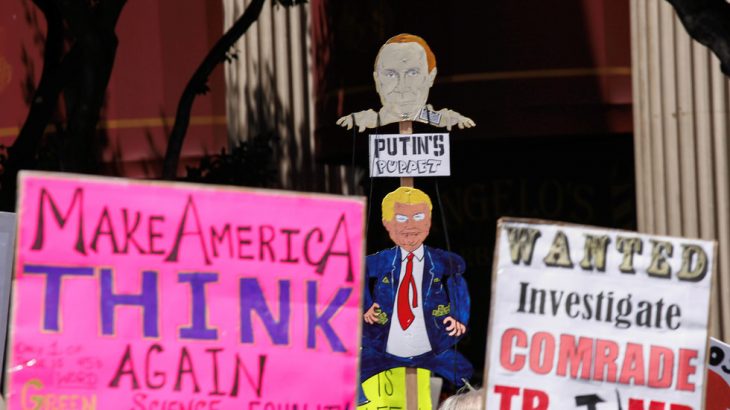
FILE PHOTO: People take part in a “March for Truth” protest against Donald Trump in Los Angeles, California, June 3, 2017 © Reuters / John Fredricks
RT | August 18, 2020
A new Senate report resurrects the corpse of ‘Russiagate’ and promises new evidence of collusion between the Trump campaign and Moscow. However, it reached its so-called conclusions by relying on some literal fake news.
The Senate Intelligence Committee released its fifth and final report on Russia’s supposed interference in the 2016 election, and President Donald Trump’s supposed ‘collusion’ with the Kremlin, on Tuesday. The report retreads much of the same ground as Special Counsel Robert Mueller’s ‘Russiagate’ investigation, and arrives at broadly similar conclusions.
However, the scope of the report has led its authors to arrive at vastly different conclusions. Senator Marco Rubio (R-Florida), who currently chairs the committee, said on Tuesday that the report “found absolutely no evidence that then-candidate Donald Trump or his campaign colluded with the Russian government to meddle in the 2016 election.”
Rubio only took over leadership of the committee from Sen. Richard Burr (R-North Carolina) in May. Before stepping down under a cloud of suspicion over alleged pandemic insider trading, Burr basically allowed Senator Mark Warner (D-Virginia) to largely run the committee’s probe from 2017 onwards.
Warner saw things differently than Rubio, saying on Tuesday that the final volume revealed “a breathtaking level of contacts between Trump officials and Russian government operatives.”
Warner was likely seeing what he wanted to see. The latest edition of the report focused on the “counterintelligence threats” posed by Russia in 2016, yet, like earlier editions, it relied on rumor, hearsay, and what appear to be politically motivated reports, in documenting these supposed “threats.”
For example, former Trump campaign manager Paul Manafort is described as having worked with a Russian intelligence official “on narratives that sought to undermine evidence that Russia interfered in the 2016 US election,” yet the report neglected to describe this official – an Ukrainian citizen named Konstantin Kilimnik – as a US State Department informant, which he was.
The report also describes a phone conversation between former campaign associate Roger Stone and someone who “almost certainly” was President Trump. Based on Stone’s prior interest in WikiLeaks’ forthcoming release of Democratic Party emails, the report concludes that “it appears quite likely” Stone and Trump spoke about WikiLeaks.
The word “likely” appears nearly 140 times throughout the 1,000-page report, while “almost certainly” appears 21 times. In nearly every case, these words are used to make assumptions in place of actual evidence.
The Russian military intelligence outfit – referred to most often as GRU – is described as conspiring with WikiLeaks to release the Democratic emails, a claim that is not, and has never been, substantiated. Kilimnik is described as “linked” to this so-called hacking operation based only “on a body of fragmentary information.” Such shoddy sourcing goes on throughout the report, and readers looking for evidence of Russia’s election-hacking capability are directed to the committee’s earlier reports.
However, anyone flicking through these reports is greeted by some even more scandalous citations. In a report released in December 2018, the committee notes it relied on the work of New Knowledge, a firm staffed by techies linked to the Democrats and the US military. New Knowledge co-founder Jonathon Morgan is also a developer of the anti-Russia Hamilton 68 Dashboard, which is partly funded by NATO and USAID.
This firm was later revealed to have run its own election interference operation, generating thousands of fake social media profiles to swing Alabama’s 2017 special Senate election against Republican candidate Roy Moore. Ironically, this scheme saw one of New Knowledge’s founders booted off Facebook for “coordinated inauthentic behavior,” a charge Russiagaters usually level at so-called troll accounts.
Yet this firm’s guesswork was treated as evidence, as was the 2017 ‘Intelligence Community Assessment’, itself the work of a small number of Obama administration intelligence chiefs who were later implicated in a plot to derail Trump’s presidency.
Coming less than 90 days before the presidential election, the latest report is unlikely to move the needle on Trump’s popularity, nor spur a fresh impeachment drive against the president.
However, its conclusion – that Russia’s election-meddling efforts are “ongoing” – will likely give lawmakers on both sides of the aisle a fresh shot at blaming Russia for whatever may go awry when Americans go to the polls in November.
Featured Video
Prof. Ted Postol: Iran Already Achieved Nuclear Deterrence Against Israel
or go to
Aletho News Archives – Video-Images
From the Archives
How the occupied mentality syndrome works
Saudi Arabia on the American chessboard – Part 3
By B. J. Sabri | American Herald Tribune | June 27, 2016
Read part 2: “The occupied mentality Syndrome“
Previously I argued whether Saudi Arabia’s repeated involvements in U.S. interventions and wars stem from free national will or in response to a specific condition. For starters, in Saudi Arabia there is no national will. In Saudi Arabia, the national will is the will of the Al Saud clan. Still, when a major Arab state allies itself with a superpower that committed unspeakable crimes against humanity in almost every Arab country, then something is wrong. This fact alone should compel us to examine the U.S.-Saudi relation for one exceptional reason. As a result of the U.S.-Saudi wars, hundreds of thousands of people in Afghanistan, Iraq, Iran, Libya, Syria, Yemen, and Somalia have lost their lives. Millions became displaced in their own homelands. And millions more rendered refugees.
Attributing the Saudi policies to the bonds of “partnership” with the U.S. is frivolous. There are no bonds between these two thugs except those of business, military deals, secret plots, and wars. Proving this point, bonds such as these have no space for the American and Saudi peoples to share significant cultural or societal exchanges. If partnership is not the reason for the Saudi contribution to the U.S. strategy of empire and imperialism, then another reason must exist.
This leads to three possibilities. … continue
Blog Roll
 Aletho News
- NIAID/NIH and USDA Fund Bioengineered Chimeric Influenza Viruses Built Using Pandemic H1N1 Components: Journal ‘Science Advances’
- Hezbollah hits Israeli warship off Lebanon’s coast, sets it aflame
- Iran slams US strikes on B1 bridge, Mahshahr petrochemical plants as ‘blatant acts of state terrorism’
- In letter to UN chief, Araghchi warns of dire consequences of US-Israeli attacks on Iran’s nuclear facilities
- Why the CIA conspiracy to invade Iran with Kurdish militias failed
- Why Are Upbeat US Claims About Mission to Rescue Pilot ‘Highly Questionable’?
- Aircraft destroyed during US ‘rescue’ of downed F-15 pilot cost more than $100 million each
- Washington University removes professor who condemned US-Israeli war on Iran
- Russia Warns of Retaliation as UK Authorizes Seizure of Vessels
- Serbia thwarts plot to bomb Russia-Hungary gas pipeline – Vucic
- If Americans Knew
- In Iran, Israel-US take aim at “reason, research, and freedom of thought” – Daily Update
- US loses planes over Iran, Israel downgrades Lebanon war goals – Daily Update
- Israel Is Blocking Palestinians from Easter at Church Where Jesus Resurrected
- Plot to assassinate Palestinian activist follows harassment campaign promoted by Zionist groups and elected officials
- Prominent New York synagogue hosts presentation on why U.S. Jews should support the ethnic cleansing of Gaza
- Tapper vs. Piker: Is the CNN Anchor Auditioning for David Ellison?
- Shouldn’t Democrats Be Able to Condemn Genocide?
- Israel-US kill negotiators, destroy civilian structures, but Iran’s military capabilities still largely intact – Daily Update
- ‘War crime’: Global condemnation as Israeli ministers celebrate death penalty law targeting Palestinian prisoners
- 7 Ways Israel Is Turning Lebanon Into Gaza
- No Tricks Zone
- An Inconvenient Tree: Uncovered In Alps… Europe Much Warmer Than Today 6000 Years Ago
- New Study Reports A 60% Slowdown In Greenland’s Ice Loss Rate In The Last Decade
- Low Intensity Tornado Wrecks Major Solar Farm, Creating A Potential Toxic Dump
- New Study Finds Warming Saves Lives…Cold Temperatures 12 Times More Deadly Than Excess Heat
- German Science Blog Accuses PIK Climate Institute Of Hallucinating Climate Tipping Points
- Devastating Assessment Of Comirnaty Vaccine By Former Senior Pfizer Europe Toxicologist
- New Study: CO2 Is ‘Effectively Negligible’ As An Explanatory Climate Change Factor Since 2000
- Former Pfizer Toxicologist Dr. Helmut Sterz Tells Bundestag Hearing Pfizer Vaccine Should Have Never Been Approved
- Energy Expert: Germany’s Nuclear Phaseout Was A “500 Billion Euro Mistake”
- New Research: South Australia’s Mid-Holocene Sea Surface Temperatures Were 4°C Warmer Than Today
 Aletho News