Biden Goes to the Middle East
BY PHILIP GIRALDI • UNZ REVIEW • JUNE 28, 2022
The White House has confirmed that President Joe Biden will travel to the Middle East in mid-July. He intends to visit Israel, the Palestinian Authority and Saudi Arabia. The trip will be used to address outstanding bilateral and multilateral issues, including convincing the Saudis to pump more oil to bring down fuel prices. Among the key topics to be discussed will be the alleged Iran threat, a possible security alliance between Israel and Gulf states backed by Washington, the status of the US Consulate General in Jerusalem, and the future of the Palestinian Authority.
Biden has agreed to a controversial meeting with Saudi Crown Prince Mohammad bin Salman, in which he will ask the Kingdom to agree to “normalize” relations with Israel in addition to increasing its oil exports. There has also been considerable pressure on Biden to seek a commitment from the Prince to take steps to improve human rights in his country, but the subject is not likely to come up as it is Biden who is seeking concessions from the Saudis. The Prince, for his part, ordered the October 2018 killing of US resident and Washington Post journalist Jamal Khashoggi in Istanbul. Khashoggi had been highly critical of the Saudi monarchy, particularly regarding its human rights record. Some in Congress and the media have described the private meeting as inappropriate given that fact.
Indeed, pumping more oil aside, the trip is largely about doing many things to help Israel, which is expected to produce favorable reporting in the US media preceding the November mid-term election. Biden even described the trip as being “for Israel” and that loud sucking noise you hear is his repeated pledges of loyalty to the Jewish state. He has described himself as a “Zionist” and has enthused “My commitment to Israel is known and engraved in rock.” Lest there be any confusion in spite of all that, the White House statement regarding the trip also made very clear that the president will “reinforce the United States’ iron-clad commitment to Israel’s security and prosperity.” That means that Israel will not be pressured over its appalling human rights record, worse even than Saudi Arabia’s, to include the recent assassination of Palestinian-American journalist Shireen Abu Akleh. On the contrary, Biden is bearing gifts to reward the Israelis for being such great friends, including a proposal that increases US financial and logistical support for the Jewish state’s air and missile defense systems, which are already largely funded by Washington.
Other aspects reflecting the Israeli dominance of US-Mideast foreign policy include Biden’s convincing the Saudis and also representatives of the Gulf States to step up their efforts to actively counter what is being described as “threats from Iran.” It is being suggested that this might include a security arrangement, not quite an alliance, but a commitment by many of Iran’s neighbors to act jointly if the Islamic Republic threatens anyone in the region. The arrangement would have to include Saudi Arabia, the Gulf States and Israel, backed up by the US military presence in Kuwait, Bahrain and Qatar. Israel is also demanding a Plan B response proposal if Iran and Washington fail to restart the stalled Joint Comprehensive Plan of Action (JCPOA) nuclear monitoring program. Washington, under pressure from Israel, now appears to be reluctant to make the concessions that would reestablish the original plan and the Israeli government is seeking a commitment by the president to use force, if necessary, when Iran crosses an agreed upon “red line” by enriching uranium until it produces enough fissile material to put together a nuclear weapon. Of course, there is a trick to the demand as Israel claims that Iran already has enough enriched uranium to create one or more bombs.
Israel nourishes regional imperatives that might tempt it to steer the discussions in a direction that would be very favorable to itself at the expense of other US interests in the region. Israel’s leaders regularly boast about their ability to manipulate the American government. They might stage or manage an incident that takes place during the Biden visit to shift perceptions of the status quo in the Middle East. As Israel has demonstrated that at its most extreme it has little regard for American lives or property, one should not be surprised if something odd were to happen. Many credible observers credit the Israeli intelligence services with a whole series of attacks on American targets, possibly even including arranging the assassination of John F. Kennedy and instigating 9/11. And then there are also the Lavon Affair in 1954 which involved the bombing of US government buildings in Egypt, and the attack on the USS Liberty in 1967 which killed 34 American sailors. To be sure, Israel can be ruthless and its security services are very effective at assassinations and false flag attacks.
Israel wants very much to have two developments emerge from the Biden visit. First is to effectively eliminate Iran as a potential threat by degrading its military and preventing any moves to go nuclear and second is to delegitimize the Palestinians as negotiating partners for some kind of two-state solution, which Biden claims to support even though Israelis routinely and generically refer to the Arabs as “terrorists.” To prevent blowback coming from any direct moves to confront the Iranians and Palestinians, Israel would also prefer to have the United States take the lead and do the heavy lifting. To accomplish that, it is first necessary to change Washington’s assessment of the threats in the Middle East, and that just might be doable by arranging something spectacular while the president in the region, like a bombing, or an act of sabotage or even creating what appears to be a terrorist attack. If done properly, whatever occurs would have false flag Iranian and/or Palestinian fingerprints all over it.
To be sure, America’s Secret Service will do a thorough job to protect the president and his entourage, but the Israelis would be operating on their own turf or in their own backyard and would be able to run rings around them. They would also have intimate knowledge of exactly what is being done to protect the American party.
I am not at all suggesting that the Israelis would resort to lethal violence against a group of traveling top level American officials, but I am merely examining what might happen if Prime Minister Naftali Bennett’s government were to get a bit adventurous in an attempt to change the playing field. Bear in mind that Bennett’s government is in trouble. It lost a confidence vote and has called for new elections to be held on October 25th, which could mean a return to power of the truly ghastly Benjamin Netanyahu. What would be better than to stage an international crisis of some kind to rally the Israeli people behind the current government? That would be in addition to creating a mechanism for dealing effectively with the Iranians and Palestinians, which would be very popular among Israeli voters, if an election were to occur.
So, Joe Biden is heading into a crap shoot in the Middle East. Israel will be squeezing him hard and might even do something stupid, while the Saudis have little incentive to give the American president what he wants. The Palestinians meanwhile will wind up abandoned by everyone, once again. But one thing that is for sure is that when Joe returns the spin on how it was a fabulously successful trip will fill the newspapers and airwaves. And then everyone will sit back and hold their breath to see if that ploy has worked. Come November we will know.
Philip M. Giraldi, Ph.D., is Executive Director of the Council for the National Interest, a 501(c)3 tax deductible educational foundation (Federal ID Number #52-1739023) that seeks a more interests-based U.S. foreign policy in the Middle East. Website is councilforthenationalinterest.org, address is P.O. Box 2157, Purcellville VA 20134 and its email is inform@cnionline.org.
Macron reveals if Saudis and UAE can rapidly ramp up oil output
Samizdat – June 28, 2022
Oil-rich countries Saudi Arabia and the UAE cannot radically increase crude production anytime soon, French President Emmanuel Macron was overheard saying to his US counterpart Joe Biden on Monday.
The leaders were contemplating how to curb Russia’s oil revenue without triggering more energy price increases.
The brief conversation between Macron and Biden was filmed by reporters on the sidelines of the Group of Seven (G7) summit in southern Germany.
Macron told his US counterpart that he had a call with Emirati leader Sheikh Mohammed bin Zayed Al Nahyan. “He told me two things. ‘I’m at a maximum [production capacity]’. This is what he claims,” Macron said.
The French president continued: “And then he said [the] Saudis can increase by 150 [thousands barrels per day]. Maybe a little bit more, but they don’t have huge capacities before six months’ time.”
Emirati Energy Minister Suhail Al Mazroui clarified on Twitter that “the UAE is producing near to our maximum production capacity based on its current OPEC+ production baseline” of 3.168 million barrels per day. He said the Gulf state would stay “committed” to the same baseline until the end of the year.
Western countries have been looking for ways to curb Russia’s revenue from the oil trade, all while trying to avoid further energy price hikes at home. Saudi Arabia and the UAE were seen as nations with spare capacity to boost oil production in order to reduce prices, according to Reuters.
Netherlands Energy Minister warns of gas crisis domino effect
Samizdat – June 28, 2022
A gas crisis in any one EU country would provoke a domino effect and quickly spread throughout the bloc, according to Dutch Climate and Energy Minister Rob Jetten.
“It’s good if some member states can fill their gas storages by November 1, but if other countries fail to reach 80% – particularly big countries like Germany – then you have to be aware that this will be a domino effect for the whole of Europe,” Jetten told Politico magazine on Tuesday.
The minister noted that in the event of a cessation of Russian gas supply, the Netherlands “will stand with neighboring countries.”
Meanwhile, Jetten stressed that tapping the Groningen gas field, once one of Europe’s largest fields and the continent’s major source of gas for decades, would be an option of last resort. In 2019, the Dutch government announced that the giant field in the northeastern part of the country would be shuttered by October 2022 to limit seismic risks in the region, with gas only to be extracted thereafter in the event of extreme weather or unforeseen circumstances.
Last week, the nation lifted all restrictions on coal-fired power stations to reduce natural gas consumption, while making an “urgent appeal” to businesses to save as much energy as possible ahead of the winter season. Jetten plans to present a plan this week on building two nuclear power plants in the country.
Nepal’s rebuff of SPP is major failure in US attempts to expand influence in South Asia
By Paul Antonopoulos | June 28, 2022
The Nepalese government has refused to cooperate with the United States in security matters via the State Partnership Program (SPP). Kathmandu made the decision to not promote the SPP ahead of a visit to Washington by Prime Minister Sher Bahadur Deuba in mid-July, where he will be accompanied by senior military officials, including Nepal’s army chief of staff, General Prabhu Ram Sharma. Nepal effectively does not want to ruin the delicate balance it has between China and India, the two giants that the country is sandwiched between, by adding the US into the geopolitical equation.
The Kathmandu Post noted that Deuba’s administration has come under intense pressure due to disagreements with Washington over Nepal’s participation in the SPP. At the same time, not only the Nepal Communist Party, the country’s main opposition party, but also the Nepali Congress Party, led by the prime minister himself, has voiced opposition to this type of cooperation with the US.
It is recalled that commander of the US Army in the Pacific, General Charles Flynn, made a four-day visit to Nepal in early June. The arrival of an American general put the opposition on high alert, fearing the development of military ties between Nepal and the US.
At the time, Giriraj Mani Pokhrel, a former education minister and member of the country’s parliament representing the Nepal Community Party, asked the government to inform parliament of the objectives and agenda of its military contacts with the US. Shortly afterwards, Interior Minister Bal Krishna Khand said that the government had no intention of signing an SPP agreement during the prime minister’s upcoming visit to Washington.
Officially, the partnership program regulates the exchange with the US National Guard and their responses to natural disasters, such as earthquakes, floods and wildfires. Critics in Nepal, however, believe that the US could interfere in internal affairs under the guise of the SPP, arguing that participating in the program is tantamount to Nepal signing off on the US’ Indo-Pacific Strategy.
By the ruling government and the opposition being in unison on this matter, Washington has failed in its attempt to expand its strategic presence in South Asia. Kathmandu’s decision was largely due to foreign policy factors, with the Nepalese government not wanting to damage relations with China or India.
It must be noted that both Beijing and New Delhi yield significant influence on Nepalese politics and economics. However, only China was open in welcoming Nepal’s decision and its non-aligned foreign policy. Chinese Foreign Ministry spokesman Wang Wenbin “commended” Kathmandu’s decision on June 23 and assured that China will always support Nepal in defending its sovereignty, independence and territorial integrity.
From the Chinese perspective, Nepal avoided a trap that the US could have set in the hope of dragging the landlocked country into a confrontation with one of its two neighbours. Effectively, the Nepalese government prevented any attempts at being pushed into confrontation with China by blocking the possibility of Nepalese territory being used.
And although it may appear that New Delhi would have welcomed closer cooperation between Nepal and the US considering China’s claims over parts of Indian territory and their participation in QUAD, the Indian Army’s exclusive and unique relationship with their Nepali counterpart would have been weakened by the SPP.
According to sources quoted by Indian media, New Delhi was not in favor of Nepal’s participation in the SPP, believing that it would unsettle the traditional relationship between the Indian and Nepali militaries.
The US Embassy in Nepal denies that the SPP has ulterior motives, writing on its website that: “The State Partnership Program is not and has not ever been a security or military alliance. The United States is not seeking a military alliance with Nepal.”
However, the SPP is administered by the National Guard Bureau, which means it is guided by Washington’s foreign policy goals. As the National Guard admits on its own website: “Through SPP, the National Guard conducts military-to-military engagements in support of defense security goals but also leverages whole-of-society relationships and capabilities to facilitate broader interagency and corollary engagements spanning military, government, economic and social spheres.”
This essentially makes the SPP another American trojan horse to penetrate the political, economic and social orders of countries to advance foreign policy goals under the guise of humanitarian engagement. With Nepal’s two main political parties unified in opposing participation in the SPP, and with both Beijing and New Delhi supporting Kathmandu’s decision, it represents a major failure in the US’ attempts to extend its influence in South Asia and the borders of Tibet.
Paul Antonopoulos is an independent geopolitical analyst.
Russia comments on alleged mall strike in Ukraine
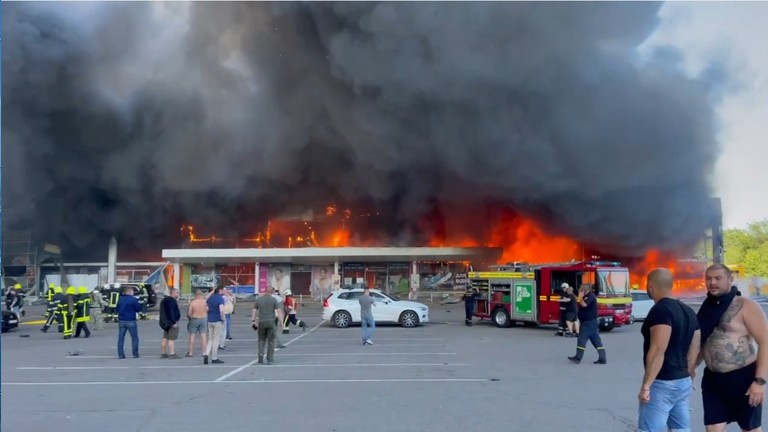
Fire at the Amstor shopping center in Kremenchug. Screenshot from footage published by Volodymyr Zelensky.
Samizdat | June 28, 2022
The Russian military has confirmed an airstrike on the Ukrainian city of Kremenchug on Monday, but claimed it targeted a stockpile of Western weapons. The detonation caused damage to a nearby non-functioning shopping mall, Tuesday’s report said. Kiev had claimed that Russia attacked the shopping center, killing and injuring many civilians.
The Russian Defense Ministry said the location of the arms stockpile was near the Kredmash factory. The Amstor Mall, where a fire was reported by Ukrainian sources on Monday, is right next to it. The military claimed that the Western munitions detonated and caused a fire at the facility, which was no longer operating.
Ukrainian officials claim that the mall was packed with people at the moment Russia allegedly attacked it. However, video showed that the car park outside was almost empty.
According to the latest casualty report, 18 people were killed and 59 injured in the incident, with 25 of the wounded taken to the hospital for treatment.
Ukrainian President Volodymyr Zelensky described the incident in Kremenchug as “one of the most blatant terrorist attacks in European history.” He stated that the site posed no threat to the Russian military and had no strategic value.
Kremenchug is a city in central Ukraine around 250km southeast from Kiev. The Russian military had previously attacked a major oil refinery in the city, denying the Ukrainian military fuel for their vehicles.
Featured Video

It’s the Occupation, Stupid
or go to
Aletho News Archives – Video-Images
From the Archives
A superpower and “the world’s sickest warrior state”
By Paul J. Balles | March 8, 2010
Living through five or six major wars has hardened me to what I thought were the extremes of inhuman cruelty and brutality.
Two things made those extremes almost bearable: the brutality always revealed – at least according to the media coverage – the viciousness of the enemy. It was therefore quite understandable when our “brave men and women” pulverized the enemy.
Films of Japanese torturing captive Americans somehow justified holding Japanese Americans in internment camps during World War II; and only a small percentage of Americans found the bombing of Hiroshima and Nagasaki unreasonably vengeful at best, at worst, depraved.
The media giants in America portrayed the North Koreans as barbaric beasts with their captives, quite unlike their southern counterpoints – our allies during the Korean War. No one ever felt the need to explain how the South Koreans were a civilized breed while the North Koreans were absolute savages, at least according to the official line.
In Vietnam, our warriors justifiably (or so the media made us believe) dropped napalm on the North Vietnamese who had the gall to hide in villages and tunnels to ravage our invaders. At least it was accepted practice until some rogue photojournalist filmed a young girl screaming down a Vietnamese road in flames. … continue
Blog Roll
 Aletho News
- Pro-Palestinian French member of European Parliament denied entry to Canada
- Pakistan to Host US-Iran Talks
- How Indonesia’s tilt toward the US left it stranded in the Strait of Hormuz
- US has no choice but to retreat from Iranian borders: Top commander
- Iran Retaliation Strikes Chemical Plant Near Dimona
- AWACS’ Destruction is a Major Loss for US Military – Ex-DoW Analyst
- Israel’s Iran Strategy Uses US Military & Gulf States as Its Pawns
- Iran: Trump wanted regime change, now just begging for Hormuz to open
- IRGC: Israeli, US universities in region legitimate targets after strikes on Iranian university
- Trump admits Iran hit USS Ford carrier: ‘We ran for our lives’
- If Americans Knew
- Israeli police block Catholic cardinal from entering Church of the Holy Sepulchre on Palm Sunday
- Israel is assassinating journalists again, more than any other nation, anywhere, ever – Not a ceasefire Day 170
- Over 300 US service members wounded, majority have brain injuries – Not a ceasefire Day 169
- Researchers at Human Rights Watch Resign Over Blocked Report on Palestinian Refugee Return
- Jewish Groups Are Backing a War Americans Don’t Want
- Eric Fingerhut Thinks He’s the President of the Jews
- Top Jewish Philanthropists, Rabbis Urge Israeli President to Take Action Against ‘Jewish Extremists’
- Don’t Be Fooled. Zionist Leaders Have Always Wanted to Control Southern Lebanon
- Israel’s widespread use of torture is a core element of its genocide against the Palestinian people
- In Israel’s War on Iran, Many Middle East US Bases Rendered “All But Uninhabitable”
- No Tricks Zone
- German Science Blog Accuses PIK Climate Institute Of Hallucinating Climate Tipping Points
- Devastating Assessment Of Comirnaty Vaccine By Former Senior Pfizer Europe Toxicologist
- New Study: CO2 Is ‘Effectively Negligible’ As An Explanatory Climate Change Factor Since 2000
- Former Pfizer Toxicologist Dr. Helmut Sterz Tells Bundestag Hearing Pfizer Vaccine Should Have Never Been Approved
- Energy Expert: Germany’s Nuclear Phaseout Was A “500 Billion Euro Mistake”
- New Research: South Australia’s Mid-Holocene Sea Surface Temperatures Were 4°C Warmer Than Today
- Storing Green Energy To Last Germany 10 Days Would Require A 60-Million Tonne Battery
- New Studies: UK Sea Levels Were 4 Meters Higher Than Today During The Mid-Holocene
- Destructive Green New Deal: German Energy And Metal Group Warns Of Drastic Crisis
- New Study Documents A 20-Year Pause In Arctic Sea Ice Decline – Driven By Internal Variability
 Aletho News