‘Referendums create an opportunity to remove tension, stop hostilities’
By Ekaterina Blinova – Samizdat – 23.09.2022
Referendums on territorial affiliation are taking place in the Donbass, Kherson, and Zaporozhye regions on September 23-27. Earlier, surveys showed that a majority of residents supported the idea of joining Russia as subjects of the Russian Federation.
Voting in referendums on joining Russia began on September 23. Earlier, on Wednesday, Russian President Vladimir Putin delivered an address to the nation to ensure security at the forthcoming plebiscites, and announced partial mobilization in the country. Putin’s speech was met with hostility by the US and its NATO allies, who branded the self-determination right of the referendum participants as a “sham” and vowed to never recognize the outcome of the votes.
“Europe fears that during the referendum even more regions of present-day Ukraine will want to distance themselves from the imposed European policy and request Russia’s help,” says Mehdi Khorsand, head of the Department of Economic Diplomacy of the Municipality of Tehran and expert on Eurasia. “At the same time, it will become a kind of threat to Europe, which for two centuries has been putting pressure on countries seeking to gain independence.”
The collective West, in particular Europeans and Americans, wants to keep an unquenchable long-term conflict in the region in order to weaken Russia, according to Khorsand. However, the ongoing referendums could create the conditions for bringing the conflict to an end, he underscores.
“Russia started its special [military] operation in Ukraine only for security reasons,” the Iranian expert notes. “If the government of Ukraine, after the tensions of 2014, had adhered to its obligations under the Minsk agreements, we would have never witnessed these hostilities, this conflict. It would have never begun in the first place.”
Donbass’ Thorny Way to Independence
After the US-backed February 2014 coup d’etat, Ukraine’s eastern regions called for autonomy resisting the rule of the military junta in Kiev. In response, Kiev started a “counter-terror operation” seeking to suppress “separatists” in the east. The Normandy Four, a format comprising Russia, Germany, France, and Ukraine, worked out a roadmap, the Minsk accords, to stop the bloodshed in Donbass and provide the breakaway regions with an autonomous status. Nevertheless, Kiev’s successive governments routinely sabotaged the provisions of the Minsk agreements preventing Donbass from gaining legitimate autonomy. In addition to that, the Ukrainian nationalist leadership made NATO membership the centerpiece of its policy, ramping up military training and resorting to the weaponization of the country.
“After 2014, Russia tried to negotiate with Ukraine about its demilitarization, not joining NATO, about the independence and autonomy of the eastern regions: Lugansk and Donetsk. But the Ukrainian government after 2014 committed a real genocide of the [ethnic] Russian population in the east of Ukraine, they began to literally ‘slaughter’ the Russians there,” Khorsand says.
Moscow repeatedly called on the other guarantors of the Minsk agreements, Paris and Berlin, to pressure Kiev to observe the accords. As these attempts failed, Russia came up with draft security agreements requesting guarantees of Ukraine’s non-admission to NATO. Moscow handed the drafts to the US and the transatlantic alliance in December 2021, reminding them of Western leaders’ pledge to not expand NATO to Russia’s doorstep. The Russian leadership made it clear that it takes its national security seriously and would resort to military-technical options if the West were to ignore the drafts. Nonetheless, the US, the EU, and NATO rejected key provisions of Moscow’s proposals.
“Russia, given the seriousness of the topic of Ukraine’s accession to NATO, did not see any other solution than the start of a special [military] operation to resolve the security problem,” Khorsand says.
Referendums as Path to Get Protection From Yoke of Kiev Regime
“We expect the referenda to end up with the majority of the inhabitants of these regions voting in favor of joining Russia. I do not rule out that the hostilities will end after the referendum,” Khorsand notes.
Russia recognized the independence of the Donetsk and Lugansk People’s Republics on February 22; still, this decision made the regions merely a “buffer zone” between Russia and Ukraine, which did not guarantee their safety, the Iranian expert explains.
If admitted to the Russian Federation, the aforementioned regions, including Kherson and Zaporozhye, will have security guarantees as inalienable parts of Russia. The Donbass republics and the Zaporozhye and Kherson regional authorities announced on September 19 and 20 their intent to simultaneously hold referendums to join Russia. In his Wednesday speech, President Putin made it clear that Russia would protect its territorial integrity and sovereignty by all modern military means, adding that he wasn’t “bluffing.”
“As for the legality of the referendums, it is worth noting that the autonomy of the regions of Donbass (LPR and DPR) was fully accepted in the 2014 agreement (Minsk agreements) and mentioned in the terms of this document, respectively, this referendum, reflecting the will and desire of the people of the autonomous and sovereign republics of Donbass to join Russia is a legitimate action,” Khorsand says.
Earlier, Russian Foreign Minister Sergei Lavrov explained in an interview with Newsweek that the Lugansk People’s Republic (LPR), the Donetsk People’s Republic (DPR), and the Zaporozhye and Kherson regions used their sacred right to self-determination, which is codified in the UN Charter, when they announced their intention to join Russia.
“Of course, the US and Europe will be forced to take some other position after these legal referendums, because these referendums create an opportunity to remove tension between Russia and Ukraine, and to stop hostilities,” Khorsand concludes.
Western media continues to ignore how Ukraine is using NATO weapons to kill innocent civilians in the Donbass
© Eva Bartlett
By Eva Bartlett | Samizdat | September 23, 2022
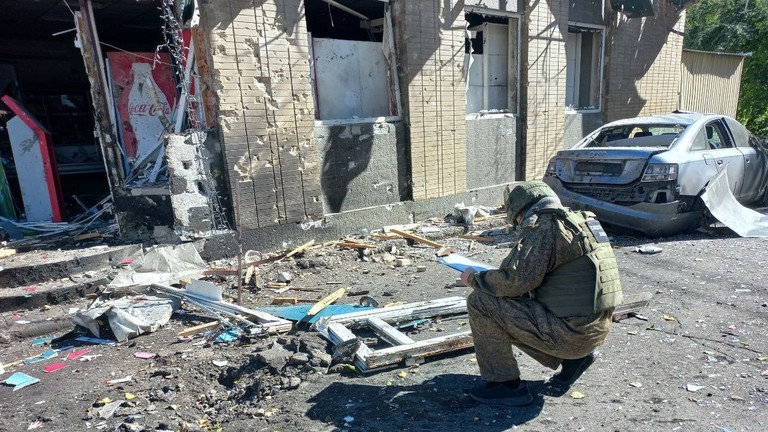
On Monday, Ukraine slaughtered 16 civilians, including two children, with 155mm NATO shells, according to the head of the Donetsk People’s Republic (DPR), Denis Pushilin. The projectiles hit two adjacent neighborhoods, decimating residential and commercial areas – including a market that had previously suffered fatal attacks.
Scenes of death are nothing new for residents and reporters here in Donetsk, which is intermittently the target of Ukrainian attacks, like the one that hit its central region on August 4, killing six people, including an 11-year-old ballerina, her grandmother, and her ballet teacher.
But the carnage on Monday was worse than anything I’ve seen in my months of reporting here. Chunks of flesh littered the street – part of a hand, a foot, an ear. Someone had put a dead man’s phone on his stomach. It was ringing, the cheery ringtone incongruous with his lifeless body and the scenes and stench of death around him.
For most people, the concept of war is a distant one, and deaths are normalized by media reporting the numbers of victims and destroyed buildings – so most who hear of civilians being killed don’t really understand what a scene like this looks or smells like.
For the locals, it is also normalized, in its own way, after over eight years of Ukrainian attacks – a tragically grotesque kind of normality, where the post-bombing routine starts soon after the last explosions die down.
When I arrived at the scene, locals were already sweeping up glass shards and boarding windows, preparing to reopen their shops. Inspectors from the Russian Investigative Committee were on site collecting shrapnel and measuring the shell’s impact point, to determine the nature of the armament. When asked about what happened, they were careful to state that they could not say anything until the conclusion of their investigation.
An emergency vehicle arrived and workers began loading the bodies, or body parts, onto stretchers, clearing them away.
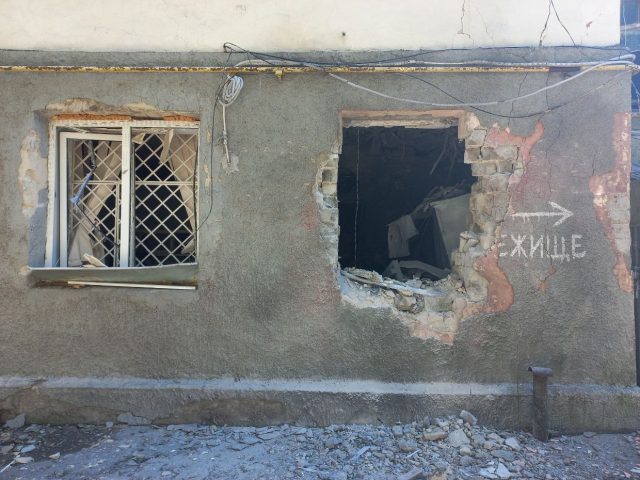
About 100 meters away, there was a gaping hole in the side of an apartment building. The shell had struck right where writing on the wall indicated the direction to the nearest basement, which was to be used as a bomb shelter. Doors to such stairways are generally permanently left open, so that anyone caught up in shelling might have a chance to survive, if they can make it to the door and basement in time.
© Eva Bartlett
Victims of another Ukrainian assault, which took place on Saturday, didn’t have that option. The center of Donetsk was hit by at around ten bombs over the course of 30 minutes around noon. At least four civilians were killed, one of whom I saw still on the ground. Some minutes later, her body was taken away. One of the shells hit a car driving along Artema Street, setting it ablaze and killing two civilians. By the time I reached that site, the vehicle had burned out, the dead taken away. Workers were already repaving the roads, sweeping debris and glass from sidewalks.
Western weapons killing Donbass civilians
When Russian and Donbass voices state that Ukraine is killing Donbass civilians with Western weapons, the reply is silence, derision, or inversion of reality: claims that Russia is bombing Donbass – which any ordinary resident here would disprove easily, having been under Ukraine’s shelling for over eight years.
War correspondent, Christelle Neant, wrote of Saturday’s bombings:
“After submitting the photos of the shrapnel I found on the spot to Adrien Bocquet, who is now a NATO weapons expert for the DPR’s representation in the JCCC (Joint Monitoring and Co-ordination Center on Ukraine’s War Crimes), he confirmed that they were American 155mm shells, some fired from Caesar guns and others from TRF1 guns.
The famous TRF1 guns that can fire (banned) 155mm cluster munitions, which I had mentioned in June, and which the Western press had assured that France had not supplied to Ukraine! Before learning at the beginning of September that Paris had indeed sold them to Kiev!”
Europeans in Germany, France and Italy recently held “#StopKillingDonbass” actions, denouncing the sale of Western weapons to Ukraine, and calling for it to end. It was rather fitting that the actions occurred the day after Ukraine bombed central Donetsk again.
These actions were followed by the release of a petition against arms supplies to Ukraine, which stated:
“Today, contrary to the fundamental principles set forth in Article 2 of the UN Charter, in particular, the principles of sovereign equality and the peaceful settlement of international disputes, our countries supply Ukraine with weapons that cause massive deaths and injuries of civilians in Donbass, including children.”
It concludes: “We demand an end to the financing of state terrorism and genocide against the people of Donbass, as well as the ongoing violations of the Geneva Conventions of 1949 and other acts of international humanitarian law since 2014.”
At this point, there is no safe region in Donetsk, nowhere is off-limits for Ukraine’s bombings, not maternity hospitals, nor busy markets. The issue does, however, appear to be off-limits for the reporting of Western corporate-owned media.
Featured Video

More Iran War fallout: Maritime insurance industry shifts from London to China
or go to
Aletho News Archives – Video-Images
From the Archives
The Biggest Threat to Peace in Middle East
By Dr. Elias Akleh* | Sabbah Report | May 24, 2010
A build up of heightened tension in the Middle East is escalating in the last few weeks. American and Israeli postures towards Lebanon, Syria, and Iran have become more threatening. Listening to speeches of political leaders one hears talks only about war not peace. Iranians and Israelis are continuously training hard for a possible showdown. Both sides are conducting extensive war games every month. This led Syrians to claim that Israel is preparing for a soon-to-come another war. The Jordanians also are warning that current stalemate of the peace process is an indication of a war breaking out this summer. The Russian President and his army chief hinted, a few months ago, that the US and Israel were planning for an attack on Iran.
Indeed Iran is, as it has been for last few years, the target of most of the threats and accusations of supporting terrorism. Escalating incitement against Iran the American Defense Department sent last month (April) to Congress a report on Iran’s military claiming Iran could develop intercontinental ballistic missiles capable of reaching the US by 2015.
Ignoring the fact that N. Korea, India, Pakistan, and Israel are proven to have nuclear weapons while Iran does not, the US Secretary of State Hillary Clinton chose in her speech, to the nuclear Non-Proliferation Treaty review conference at the UN, to focus on Iran’s alleged nuclear ambitions putting the whole world at risk as she put it. According to Clinton Iran’s acquisition of nuclear weapons, rather than Israel’s more than 200 nuclear bombs, is destabilizing the Middle East. She called on the world’s nations to rally around US efforts to hold Iran, not other nuclear countries, to account.
The accusation that Usama Bin Laden is living comfortably in Iran had received a boost after the broadcast of a documentary called “Feathered Cocaine”. This echoed the June 2003 claims of the Italian newspaper Corre de la Sierra that Bin Laden was in Iran according to some intelligence report, and according to Richard Miniter’s book “Shadow War”. … continue
Blog Roll
 Aletho News
- Hamas official rejects Mladenov Plan linking disarmament to Gaza reconstruction
- Two Primary Elections for the Soul of ‘America First’
- Japan Clings to US Vassalage Despite Energy Crunch Caused By Iran War
- US Seeks Control Over Global Energy Infrastructure – Kremlin
- US senators target Orban government for standing up to Zelensky
- The deep-rooted culture of corruption in Ukraine
- Iran mobilizing one million soldiers to ‘create hell’ for any US ground assault: Report
- The coming military and psychological unravelling?
- Iran has the last laugh
- More Iran War fallout: Maritime insurance industry shifts from London to China
- If Americans Knew
- Don’t Be Fooled. Zionist Leaders Have Always Wanted to Control Southern Lebanon
- Israel’s widespread use of torture is a core element of its genocide against the Palestinian people
- In Israel’s War on Iran, Many Middle East US Bases Rendered “All But Uninhabitable”
- ‘Burn the lawn’: Israel pursues ‘Rafah model’ in southern Lebanon
- A genocide here, an amputation there
- Reports: Iran mobilizing 1M fighters, Israel-US run low on ammo, Israeli army faces shortage – Not a ceasefire Day 168
- ‘No Innocent Children’: Far-right Israeli Lawmaker Defends Killing of Palestinian Family
- Mossad’s promises helped Netanyahu convince Trump that Iran could be toppled
- US Arms Control Official Refuses To Comment When Asked If Israel Has Nuclear Weapons
- Veterans warn US landing could be ‘more Gallipoli than Vietnam’
- No Tricks Zone
- Devastating Assessment Of Comirnaty Vaccine By Former Senior Pfizer Europe Toxicologist
- New Study: CO2 Is ‘Effectively Negligible’ As An Explanatory Climate Change Factor Since 2000
- Former Pfizer Toxicologist Dr. Helmut Sterz Tells Bundestag Hearing Pfizer Vaccine Should Have Never Been Approved
- Energy Expert: Germany’s Nuclear Phaseout Was A “500 Billion Euro Mistake”
- New Research: South Australia’s Mid-Holocene Sea Surface Temperatures Were 4°C Warmer Than Today
- Storing Green Energy To Last Germany 10 Days Would Require A 60-Million Tonne Battery
- New Studies: UK Sea Levels Were 4 Meters Higher Than Today During The Mid-Holocene
- Destructive Green New Deal: German Energy And Metal Group Warns Of Drastic Crisis
- New Study Documents A 20-Year Pause In Arctic Sea Ice Decline – Driven By Internal Variability
- Wake-up Call: Survey Shows Majority Of Germans Now Favor Postponing Climate Targets!
 Aletho News