Political chaos shaking Brazil
By Lucas Leiroz | January 10, 2023
The Brazilian political scene is increasingly tense. Anti-Lula protests grow day by day, with thousands of people taking to the streets in several cities to demand the revocation of the 2022 electoral process. Recently, in an act of vandalism and disdain for the most basic civic values, pro-Bolsonaro militants invaded Brasília, damaging public buildings and the facilities of the executive, legislative and judicial branches. As a result, the Lula government began a tough response to those involved, punishing protesters, and intervening in Brasilia’s regional politics.
The Federal District of Brasilia was the target of scenes of depredation on January 8th. Thousands of Bolsonaro supporters – commonly referred to as “Bolsonarists” – attacked the Parliament, the Supreme Court and the Planalto Palace – the headquarters of the Three Branches of the Republic. Historical pieces of art that were kept on site were also destroyed, creating a true scene of barbarism.
The majority of the militants wore shirts from the Brazilian soccer team and held flags of Brazil, the US and Israel – which has already become commonplace in Bolsonarist demonstrations. As in other protests across the country, Bolsonarists in Brasília demanded the end of the Lula government and called for new elections. Some more radical militants called for military intervention – which is also a common agenda among Brazilian rightists. The invasion lasted a few hours, but the authorities regained control of the situation before the end of the day.
In fact, if the Bolsonarists’ intention was to weaken the Lula government, the plan failed. The president of Brazil, with broad support from the national media and international authorities, took control of the situation with tough measures to guarantee law and order. Not only were the protesters repelled, but hundreds of them were identified and arrested.
Lula signed a decree imposing federal intervention in Brasília’s public security, taking exceptional measures to guarantee order and end the vandalism. Measures to break telephone secrecy and in-depth intelligence investigations are also being operated in order to point out all the culprits for the invasion, including its possible sponsors.
Indeed, mass protests in Brasilia are not common. The Brazilian capital has an urban structure that does not allow for large popular mobilizations to pressure the authorities who work there. The isolation of politicians and government’s facilities was precisely the central objective of the architectural project of Brasilia in the 1960s.
Before, when the capital was in Rio de Janeiro, federal facilities were easily accessible to the population, allowing mass protests and social chaos. Brasilia is built differently, with access routes that are very restricted and easily blocked by the authorities, so that large mobilizations there can only occur in case of negligence or connivance on the part of the police.
This led the Brazilian government to identify the heads of public administration in Brasília as Bolsonarists colluding with the demonstrations, dismissing them from their offices and reformulating the administrative structure of the city with some new allies of the government. The Brazilian media adopted this speech as official and referred to the former police chiefs of Brasilia as Bolsonarists, strengthening the coalition in support of Lula’s measures.
On the other hand, leaders of right-wing parties in Brazil claim that there was some kind of “false flag operation”, where the authorities would have deliberately permitted the vandalism of the angry mass precisely to boost a radicalization of the Lula government. The war of narratives does not seem to end anytime soon.
What is really important, however, is not the political position of the former police chiefs of Brasilia, but what comes next. The Brazilian government and the media formally classified the protesters as “terrorists”, which raises a series of questions. While there has undoubtedly been vandalism and a number of deplorable acts, classifying these acts as “terrorism” is questionable and justifies all sorts of exceptional measures. To combat terrorism, extraordinary actions are valid, thus justifying the breach of the legal-constitutional norms to restore order.
Some critics of Lula fear that the new government will commit abuses and make the January 8 decree a kind of Brazilian “Patriot Act”. This criticism is valid, and the actions must be monitored so that they do not become abuses, but the most important thing, instead of criticizing Lula’s measures, is to find the necessary mechanisms to pacify the country.
Brazil is absolutely divided, polarized and tense. On the one hand, radical Bolsonarists who do not accept the former president’s defeat; on the other, similarly radical pro-Lula militants – who are now even calling for popular mobilization to “stop” the rightist protesters. As a result, Brazil remains inflamed by political partisanship, with no real concern for a project for the Brazilian State that overcomes ideological and partisan antagonisms.
Lula is trying to find those responsible for the protests in the capital. He accuses Bolsonaro of being the instigator of the actions and has even received support from key members of the American Democratic Party, who are now asking Washington to “extradite” the former Brazilian president who is in the US since December. However, there is still no legal action that legitimizes such “extradition” and continuing to try to find “culprits” is perhaps just a way to further deepen polarization.
Lula’s great challenge will not be to punish the members of the former government, nor even to put an end to radical rightism in the country. His great task is to overcome social hostility and find a way to pacify Brazil. Perhaps, calling thousands of Brazilian citizens “terrorists” is not the best way to do this. Undoubtedly, vandalism must be punished, but the ultimate goal must be national reconciliation.
Lucas Leiroz is a researcher in Social Sciences at the Rural Federal University of Rio de Janeiro; geopolitical consultant.
Twitter censored tweets after pressure from Pfizer director
By Tom Parker | Reclaim The Net | January 9, 2023
A newly released email from the Twitter Files has revealed that Twitter censored a tweet from Dr. Brett Giroir, a board member at the biopharmaceutical company Altesa Biosciences, after it was flagged by Scott Gottlieb, a board member at the pharmaceutical giant Pfizer.
Gottlieb and Giroir both currently serve on the boards of several pharmaceutical companies and have backgrounds in public health. Gottlieb is a former Food and Drug Administration (FDA) commissioner while Giroir is a former Assistant Secretary for Health and former acting Commissioner of the FDA.
Pfizer produces Covid vaccines whereas Altesa Biosciences develops drugs to combat Covid.
In the August 27, 2021 email, which was published by journalist Alex Berenson, Gottlieb complained to Todd O’Boyle, a senior manager on Twitter’s Public Policy team, about a tweet from Giroir that claimed natural immunity to Covid-19 was superior to vaccine immunity.
“This is the kind of stuff that’s corrosive,” Gottlieb wrote. “Here he draws a sweeping conclusion off a single retrospective study in Israel that hasn’t been peer reviewed. But this tweet will end up going viral and driving news coverage.”
According to Berenson, O’Boyle forwarded Gottlieb’s email to Twitter’s Strategic Response team — a team that was tasked with handling complaints from Twitter’s most important employees and users.
Berenson said that O’Boyle didn’t mention that Gottlieb was a Pfizer board member in this email and instead wrote, “Please see this report from the former FDA commissioner.”
An analyst from Twitter’s Strategic Response team quickly found that the tweet didn’t violate any of Twitter’s “misinformation” rules, according to Berenson. However, the tweet was still slapped with a “Misleading” label and had its replies, shares, and likes disabled after Gottlieb’s complaint.

This label and the restrictions still haven’t been removed, even though several high-ranking health officials, such as former White House Covid response coordinator Dr. Deborah Birx, have since questioned the effectiveness of Covid vaccines when it comes to preventing infections.
Berenson also claimed that one week later, on September 3, 2021, Gottlieb complained about a tweet from Covid lockdown and vaccine skeptic Justin Hart.
The Hart tweet that Gottlieb reportedly complained about stated: “Sticks and stones may break my bones but a viral pathogen with a child mortality rate of ~0% has cost our children nearly three years of schooling.”
Berenson alleged that Gottlieb complained about this tweet when the Pfizer Covid vaccine “would soon be approved for children 5 to 11.”
However, Berenson said that this time, Twitter refused to act.
Previous Twitter email releases have revealed that during the same month that Gottlieb was complaining about Giroir’s tweet, he also flagged one of Berenson’s articles to Twitter. Berenson was temporarily suspended from Twitter days after Gottlieb flagged his article.
Gottlieb responded to the revelations about him flagging Giroir’s tweet by claiming that the publication of this email was a “selective disclosure” of his “private communications with Twitter” and that it had stoked “the threat environment” and instigated “more menacing dialogue, with potentially serious consequences.”
Giroir accused Gottlieb of scheming with Twitter to “apparently put corporate interests first not public health.”
The battle between Big Pharma and scientific integrity
Review – Taking on Big Pharma: Dr. Charles Bennett’s Battle
 By Julius Getman and Terri LeClercq
Larger-than-life, creative, and fiercely ambitious, Dr. Charlie Bennett has a long history of revealing dangerous side effects of bestselling medicines. In 2006, his meta-analysis of existing data showed that top-selling ESAs (erythropoietin stimulating agents) created previously unrecognized risks, deaths, and serious illness. According to Dr. Steven Rosen, chief medical officer of the City of Hope Cancer treatment center, Bennett “saved more lives than anyone in American medicine.”
Bennett’s work also created enemies: Bennett was accused, on the basis of flimsy evidence, of mishandling government grant money and violating the False Claims Act (also known as the “Whistleblower Act”). Powerful interests within Big Pharma, academia, and law enforcement joined in the attack on Bennett. By 2010, he was forced from his academic position; was besieged by lawsuits; and became the victim of a coordinated, well-funded campaign to discredit him and refute his work. From pharma superstar to disgrace and disrepute in the blink of an eye.
“Taking On Big Pharma” explores Bennett’s achievement and evaluates the charges against him. Exposed is the unsettling relationship between the pharmaceutical industry and academia. The result of more than five years of research and hundreds of hours of interviews with scientists, academicians, and federal prosecutors, this is an unflinching look at how institutions, purportedly devoted to public health and education, can be corrupted for profit — from drug sales or research grants.
Featured Video
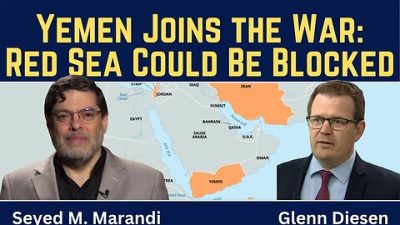
Yemen joins the war – Red Sea could be blocked next – Saudi regime at risk
or go to
Aletho News Archives – Video-Images
From the Archives
A superpower and “the world’s sickest warrior state”
By Paul J. Balles | March 8, 2010
Living through five or six major wars has hardened me to what I thought were the extremes of inhuman cruelty and brutality.
Two things made those extremes almost bearable: the brutality always revealed – at least according to the media coverage – the viciousness of the enemy. It was therefore quite understandable when our “brave men and women” pulverized the enemy.
Films of Japanese torturing captive Americans somehow justified holding Japanese Americans in internment camps during World War II; and only a small percentage of Americans found the bombing of Hiroshima and Nagasaki unreasonably vengeful at best, at worst, depraved.
The media giants in America portrayed the North Koreans as barbaric beasts with their captives, quite unlike their southern counterpoints – our allies during the Korean War. No one ever felt the need to explain how the South Koreans were a civilized breed while the North Koreans were absolute savages, at least according to the official line.
In Vietnam, our warriors justifiably (or so the media made us believe) dropped napalm on the North Vietnamese who had the gall to hide in villages and tunnels to ravage our invaders. At least it was accepted practice until some rogue photojournalist filmed a young girl screaming down a Vietnamese road in flames. … continue
Blog Roll
 Aletho News
- Russian tanker approaches Cuba despite US oil blockade
- Marandi: Yemen joins the war – Red Sea could be blocked next – Saudi regime at risk
- Pro-Palestinian French member of European Parliament denied entry to Canada
- Pakistan to Host US-Iran Talks
- How Indonesia’s tilt toward the US left it stranded in the Strait of Hormuz
- US has no choice but to retreat from Iranian borders: Top commander
- Iran Retaliation Strikes Chemical Plant Near Dimona
- AWACS’ Destruction is a Major Loss for US Military – Ex-DoW Analyst
- Israel’s Iran Strategy Uses US Military & Gulf States as Its Pawns
- Iran: Trump wanted regime change, now just begging for Hormuz to open
- If Americans Knew
- Israeli police block Catholic cardinal from entering Church of the Holy Sepulchre on Palm Sunday
- Israel is assassinating journalists again, more than any other nation, anywhere, ever – Not a ceasefire Day 170
- Over 300 US service members wounded, majority have brain injuries – Not a ceasefire Day 169
- Researchers at Human Rights Watch Resign Over Blocked Report on Palestinian Refugee Return
- Jewish Groups Are Backing a War Americans Don’t Want
- Eric Fingerhut Thinks He’s the President of the Jews
- Top Jewish Philanthropists, Rabbis Urge Israeli President to Take Action Against ‘Jewish Extremists’
- Don’t Be Fooled. Zionist Leaders Have Always Wanted to Control Southern Lebanon
- Israel’s widespread use of torture is a core element of its genocide against the Palestinian people
- In Israel’s War on Iran, Many Middle East US Bases Rendered “All But Uninhabitable”
- No Tricks Zone
- German Science Blog Accuses PIK Climate Institute Of Hallucinating Climate Tipping Points
- Devastating Assessment Of Comirnaty Vaccine By Former Senior Pfizer Europe Toxicologist
- New Study: CO2 Is ‘Effectively Negligible’ As An Explanatory Climate Change Factor Since 2000
- Former Pfizer Toxicologist Dr. Helmut Sterz Tells Bundestag Hearing Pfizer Vaccine Should Have Never Been Approved
- Energy Expert: Germany’s Nuclear Phaseout Was A “500 Billion Euro Mistake”
- New Research: South Australia’s Mid-Holocene Sea Surface Temperatures Were 4°C Warmer Than Today
- Storing Green Energy To Last Germany 10 Days Would Require A 60-Million Tonne Battery
- New Studies: UK Sea Levels Were 4 Meters Higher Than Today During The Mid-Holocene
- Destructive Green New Deal: German Energy And Metal Group Warns Of Drastic Crisis
- New Study Documents A 20-Year Pause In Arctic Sea Ice Decline – Driven By Internal Variability
 Aletho News