MAINSTREAM STOKES FEAR OVER BIRD FLU
The HighWire with Del Bigtree | January 10, 2025
Legacy media and world health agencies continue to ratchet up the bird flu fear factor, despite the fact not a single human death has been caused from the virus. With mere days left for the Biden Administration in office and stockpiles of outdated H1N1 vaccines at the ready, skeptics are concerned it’s not just coincidence.
No Proof MMR Vaccine Is ‘Safer’ than Measles, Mumps or Rubella Infection, Physician Group Says
By Suzanne Burdick, Ph.D. | The Defender | January 14, 2025
The risk of permanent disability or death from the MMR vaccine may be greater than the risk posed by measles, mumps or rubella infection because large enough vaccine safety studies haven’t been done, according to a collection of new documents released by Physicians for Informed Consent (PIC).
The collection includes disease information statements for measles, mumps and rubella, and a vaccine risk statement for the MMR vaccine.
According to the Mayo Clinic, measles is a viral infection typically accompanied by a skin rash, fever, cough, runny nose, sore throat, inflamed eyes and tiny white spots on the inner cheek.
Mumps and rubella also are viral infections. According to PIC, all three viral infections typically resolve on their own with proper rest and hydration in almost all cases.
Dr. Shira Miller, PIC’s founder and president, told The Defender, “The main takeaway is that the MMR vaccine has not been proven safer than measles, mumps and rubella.”
PIC is a nonprofit that delivers data to doctors and the public so they can “evaluate the data on infectious diseases and vaccines objectively, and voluntarily engage in informed decision-making about vaccination.”
Miller explained that the MMR vaccine clinical trials didn’t include enough subjects to be able to prove that the risk of permanent disability or death from the vaccine is less than the risk of permanent disability or death from measles, mumps or rubella.
The number of measles, mumps or rubella infections that result in permanent disability or death is so low that researchers would need to have at least 50,000 subjects in a clinical trial to be able to show that the vaccine is safer than the disease.
The MMR vaccine’s clinical trials fall very short of that benchmark, according to PIC’s statement on MMR vaccine risk.
Prelicensure clinical trials for vaccines, including the MMR shot, are “relatively small and usually last no longer than a few years,” according to the Centers for Disease Control and Prevention’s (CDC) 2024 “Manual for the Surveillance of Vaccine-Preventable Diseases.”
The 2024 edition of the CDC manual doesn’t specify exactly how many subjects are in these “relatively small” trials. However, the 2011 edition stated that “relatively small” meant that such trials are “usually limited to a few thousand subjects.”
The rate of disability or death among healthy children from any of those three diseases is incredibly rare. PIC wrote:
“For children under age 10 at normal risk (i.e., with normal levels of vitamin A and infected after birth), the pre-vaccine annual risk of death or permanent disability from measles, mumps, and rubella respectively was 1 in 1 million, 1 in 1.6 million, and 1 in 2.1 million. …
“Therefore, the cumulative annual risk of a fatal or permanently disabling case of any of those diseases was about 1 in 500,000, and the risk over a 10-year span was 1 in 50,000.”
In other words, clinical trials would need at least 50,000 subjects to detect one case of death or disability from a measles, mumps or rubella infection.
Meanwhile, no safety studies on the MMR vaccine have been done that looked for possible genetic mutations, impaired fertility or cancer, according to the product’s package insert.
Also, seizures from the MMR vaccine occur five times more often than measles-related seizures.
Dr. Liz Mumper, a pediatrician, praised PIC for releasing the collection of data on measles, mumps and rubella, and on the MMR vaccine.
“Most parents have not had access to the information contained in the thoughtful analysis done by Physicians for Informed Consent. Parents should recognize that the risk of bad outcomes from a measles infection — if their child lives in a developed country with clean water and is not immune-deficient — is extraordinarily rare, as PIC reports.”
Unfortunately, she added, recent U.S. media reports “sensationalized” the risks of measles.
What’s typically missing from measles media reports
PIC’s statement on measles cited numerous facts commonly overlooked in many media reports on measles outbreaks, including:
- The U.S. measles mortality rate dropped dramatically before a measles vaccine was introduced in 1963.
- Immunity from the MMR vaccine wanes so that by age 15, roughly 60% of vaccinated children are susceptible to subclinical measles virus infections.
- Studies have suggested a link between a naturally acquired measles infection and a reduced risk of Hodgkin’s and non-Hodgkin’s lymphomas.
- Studies also suggested a link between a naturally acquired measles infection and a lower risk of asthma, eczema and hay fever.
- Malnutrition — particularly vitamin A deficiency — is a primary cause of over 100,000 measles deaths in underdeveloped countries.
Mumper said that the risk of bad outcomes from a measles infection drastically declined with improved public health and better nutrition long before MMR vaccines were available.
“The risk of bad outcomes has always been more for children in developing countries who are more likely to have nutritional deficiencies including vitamin A and lack access to clean water,” Mumper added.
This article was originally published by The Defender — Children’s Health Defense’s News & Views Website under Creative Commons license CC BY-NC-ND 4.0. Please consider subscribing to The Defender or donating to Children’s Health Defense.
What will a “European Armenia” bring?
By Erkin Oncan | Strategic Culture Foundation | January 14, 2025
The Armenian government has approved a draft law to initiate the country’s accession process to the European Union (EU). This proposal will be discussed in parliament before being put to a referendum.
European Parliament rapporteur Miriam Lexmann celebrated this development, stating, “I wholeheartedly welcome the Armenian government’s decision to begin the EU accession process.”
However, the Russian side has reacted negatively to this decision. Kremlin spokesperson Dmitry Peskov declared that Armenia cannot simultaneously be a member of both the EU and the Eurasian Economic Union (EAEU).
Russian Deputy Prime Minister Alexey Overchuk also commented, “We interpret this as the beginning of Armenia’s withdrawal from the Eurasian Economic Union. The Russian Federation will shape its economic policy toward Armenia accordingly,” comparing EU membership to “purchasing a ticket for the Titanic.”
Armenia’s Journey Towards Europe
Armenia and the EU have a long history of interaction.
In 1996, Armenia signed a Partnership and Cooperation Agreement with the EU, and in 2001 it became a member of the Council of Europe. Moreover, Armenia has benefited from the TACIS program, a European Commission initiative that provided technical assistance to former Soviet states to adapt to market-oriented economic systems.
In 2004, Armenia strengthened its ties with the EU under the European Neighbourhood Policy (ENP), joined the Eastern Partnership initiative in 2009, and, despite joining the Eurasian Economic Union in 2013, approved the Comprehensive and Enhanced Partnership Agreement (CEPA) with the EU in 2017. In 2018, the Velvet Revolution brought Nikol Pashinyan to power, accelerating democratic reforms.
Armenia has now become the seventh former Soviet country to initiate European integration. This political shift mirrors the tug-of-war between the EU and EAEU, as well as NATO and the Collective Security Treaty Organization (CSTO).
Can Armenia Join the EU?
Although Armenia is not geographically part of Europe, like Georgia, it strives to align itself with “European values and cooperation processes.” From a European perspective, Armenia’s significance stems not from its adherence to these values but from its geographic proximity to Russia and Iran.
EU membership is a challenging and lengthy process—a path that only three former Soviet states (Estonia, Latvia, and Lithuania) have successfully completed. Other countries like Ukraine, Moldova, and Georgia have long been politically shaped by their EU aspirations, experiencing intense internal conflicts between pro-Russian and pro-EU factions, often tied to so-called “color revolutions.” These parallels suggest that Armenia’s membership process could also stretch over many years. Furthermore, Armenia’s economic ties with Russia present significant challenges.
According to data from the Armenian Statistical Committee covering January-April 2024, trade between Armenia and Russia increased 3.1 times, while trade with EU countries decreased by 24.3%. During this period, Armenia’s trade volume with Russia reached $6.3 billion, whereas its trade volume with the EU was $695.5 million—making trade with Russia nearly nine times greater than that with the EU. Military ties between Armenia and Russia also remain a major topic of public debate.
For Armenia to fully “Europeanize,” it must entirely overhaul its economic system. However, the insistence of both the EU and Pashinyan’s administration on this path could lead to a deep economic crisis and political instability. This might result in Armenia entering the EU as a weakened state, perceived as a burden by EU leadership.
The EU’s primary objective appears to be not Armenia’s full membership but the continuation of the accession process, using it to advance strategic interests. A “European” Armenia would serve as a geopolitical defeat for Russia.
Broader Implications
Discussions around Armenia’s regional and international dynamics are often shaped in Turkey by nationalist narratives sown by imperialist forces, perpetuating historical prejudices that undermine solidarity among neighboring peoples. However, developments in Armenia carry significant clues about the future of the broader region.
Erkin Öncan, Turkish journalist focusing on war zones and social movements around the world.
Twitter: https://twitter.com/erknoncn Telegram: https://t.me/erknoncn
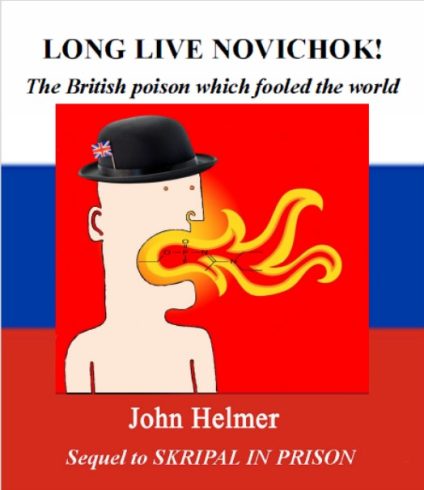
New Book – LONG LIVE NOVICHOK!
By John Helmer • Unz Review • January 14, 2025
Novichok is the notorious warfighting poison which has killed no one but fooled everyone.
At least that’s how British Government officials, their scientists, chemical warfighters, policemen, media reporters, and trailing after them all, their judges, intend the story to be told.
Theirs is the story of the assassination, ordered by President Vladimir Putin in Moscow and attempted on March 4, 2018, by two military officers tracked and filmed to every location but not the murder scene; with a weapon not detected at the scene nor in the blood streams and bodily tissues of their murder targets.
The victims, Sergei Skripal and Yulia Skripal, have been made to disappear and are either incommunicado in prison or dead. The only direct testimony which has been recorded voluntarily in front of witnesses was given by Yulia Skripal, in hospital four days after the attack, when she identified the assassination attempt as having been carried out with poison spray by an attacker who was not Russian, just minutes before she and her father collapsed. She meant the poison was British; the assassin British.
The motive for the Novichok crime turns out to be hearsay by British government against the Russian government.
In political and military terms, the Novichok poison story is propaganda between enemies at war. Judgement of what happened to the Skripals is a weapon of this war. And so it has turned out that there has been no court trial or test of the Novichok narrative, according to British law. Instead, there has been a proceeding which looked like a court trial but wasn’t; in which the Skripals were represented by police interrogators and by lawyers who said nothing; presided over by a judge who wasn’t.
In other words, a show trial in a time of war.


The truth of what happened has no military or political value, certainly not to the prosecuting British side; not much to the defending Russian side. But as the evidence has surfaced piecemeal over the past five years since the first investigation was published in February 2020 as Skripal in Prison, the truth reveals that Novichok was ineffective as a poison, but very successful as a deception operation by the British. They reversed the hands of the assassin, planted a British-made chemical weapon to look like a Russian one; invented the death of bystander Dawn Sturgess to substitute for Sergei and Yulia Skripal who didn’t die; and suppressed the evidence of what had happened – witnesses, videotapes, toxicology, autopsy records.
Not quite all the evidence, however. This book has been written to reveal new evidence to conclude that Sergei Skripal was a triple agent attempting to return to Russia. His rescue, the exfiltration operation by the Russian military intelligence organisation (GRU), used decoys to mislead the British surveillance and conceal the escape plan. But the British anticipated and decided to act preemptively, attacking both Skripals, reversing culpability, and convicting the Russians for the British crime.
Not one of the legal, medical, police, or government officials engaged in the Novichok story — neither the Skripal nor the Sturgess parts of the narrative — answered the many questions put to them during the seven-year course of the case and of this book. The three lawyers purportedly engaged to represent Sergei and Yulia Skripal were the most silentious of all; their names don’t warrant repeating. Not much better were the lawyers representing Dawn Sturgess’s family’s money claim, especially their lead counsel Michael Mansfield.

This blanket of misrepresentation, evasion, and silence which they have thrown over themselves and over the evidence in the case is proof of the intention to deceive. So determined is this intention, the deceivers don’t realize how preposterous are the results. The colour of Novichok, for example, reported as a state secret in Chapter 74.
A direct request to researchers publishing on A-234 around the world has revealed that the Iranians who reported synthesizing the chemical agent in 2016, reply that it is colourless. The British, Americans, Czechs, and Koreans who have done the same laboratory work, refuse to answer. And yet, despite all the preliminary vetting by British intelligence agents, years of double-checking by British officials, and months of closed-door sessions and redactions ordered by Lord Hughes, chairman of the Dawn Sturgess Inquiry, the truth managed to slip out. A man named Josep Vivas, a Spaniard living in Barcelona, was the unintended, unguarded source.
Vivas was a vice president of Puig, the company which manufactures and sells the bottled perfume which in the British Novichok story has been turned into the Russian murder weapon. “I am making this statement,” Vivas signed for the Dawn Sturgess Inquiry on February 12, 2024, “in addition to a letter I provided on 27 July 2018. Prior to me writing and signing that letter, I was shown a number of images of a small perfume bottle branded ‘Nina Ricci Premier Jour Perfume’. The images I viewed were under police exhibit reference [redaction tagged VN551/10]. I was shown further images of a perfume box labelled as ‘Premier Jour Nina Ricci’. This was under police exhibit reference [redaction tagged VN521/3]. On Friday 2nd February 2024, I was again shown the images of [redaction tagged VN551/10] and [redaction tagged VN521/3] before signing this statement and I set out my observations on them below.”
The photographs of the poison bottle shown in the public hearing on November 28, 2024, were censored — a large black mark was pasted across the bottle contents. But British agents had shown Vivas the photographs just days after July 11, 2018, when the bottle was purportedly discovered at the Sturgess crime scene. Vivas was shown the photographs again more than five years later, just before he testified before Hughes. He saw the bottle without the black mark.

Censored police photograph of Novichok poison weapon, a perfume atomizer bottle, allegedly found on a kitchen bench at Rowley-Sturgess home eleven days after Sturgess and Rowley were hospitalized. The black mark conceals the British Government’s lie.
The key observation Vivas confirmed he had seen on both occasions was this: “The liquid inside the bottle. Premier Jour perfume is pale pink, and from the photos I observe that the liquid contained in the bottle is yellow.”
If the perfume is pink; if Novichok is colourless; if the liquid in the murder weapon was yellow, then the liquid in the murder weapon cannot have been Novichok. QED — Quod erat demonstrandum, as the ancient lawyers and logicians used to conclude their proofs. The colour yellow was a British fabrication; the black mark was British camouflage. The secret slipped out into the open by British mistake.
From whom are the British keeping their secret? Can it be the Russians who, according to the official Novichok narrative, have made, stored, and used it against the Skripals, but have yet to learn what colour it is?
The Russian handling of the Skripal affair is a different story. It has been defensive on the evidence claimed by the British government; ineffective in breaking the silence imposed on the Skripals.
These outcomes were inevitable once it is concluded, in retrospect, that Sergei Skripal was attacked to prevent his return to Moscow as a triple agent; and that the Russian military operation to rescue him had been thwarted by the British.
These two truths, if published officially, leaked to the press, or reported in independent investigations, stood little chance of being believed outside Russia. More certainly, official Russian admission of the two truths, if it had been made, would have condemned the Skripals to the death that was attempted by the British against them on March 4, 2018.
Less explicable is the outcome that for seven years now, Russian press reporting of the case has ignored the investigative reporting published in English in the UK and US, and then the evidence revealed during the Hughes hearings in London between October and December 2024. This is an understandable result of the line dictated by the Kremlin’s and Foreign Ministry’s media departments for protecting the lives of Sergei and Yulia Skripal, and for salvaging what remained of Anglo-Russian relations on the road to war in the Ukraine.
In the chapters to follow, President Putin’s and Foreign Minister Lavrov’s statements can be examined in the political context and news sequence in which they were made.
From the beginning, the Russian Embassy in London issued formal requests for consular access to the Skripals and protest notes when this was denied by the Foreign Office. In reply to British stonewalling on access and propagandizing the allegations against the Russian government, the Embassy issued a detailed summary of every action Russian officials had taken and the statements they made.
The one option the Embassy in London did not take was to engage British lawyers to obtain a hearing and an order of habeas corpus in the High Court to compel the appearance of the Skripals to testify for themselves. This option was obvious to the Embassy and lawyers in London between March 21, 2018, when the Home Office went to the court for legal authority to allow blood testing of the Skripals, and April 9, when Salisbury District Hospital announced that Yulia Skripal had been released; and then on May 18 when Sergei Skripal was also discharged from hospital.
During this period it was reported that Yulia was able to telephone her cousin Viktoria in Russia. Years later, as Chapters 67, 71, and 73 reveal, it became clear in retrospect that Yulia had recovered consciousness in hospital much earlier than the hospital allowed to be known, and that doctors had then forcibly sedated her. At the time the Russian Embassy was announcing it “questioned the authenticity” of the statements issued by the London police and media on Yulia’s behalf. The Embassy was right; it was not believed.
It is possible the Embassy did attempt to engage barristers to go to court for a habeas corpus hearing for the Skripals, but learned that no one would take the case. At the time I made an independent request for this engagement to the well-known human rights barristers in London; the outcome was that none agreed to represent the Skripals. The refusals were point-blank – no one would give a reason.
British officials anticipated that an effort might succeed in forcing a High Court hearing, however. So, on May 24, 2018, a one minute fifty-five second speech by Yulia Skripal was presented on video in which she spoke from a script and appeared to sign a statement. Referring to “offers of assistance from the Russian Embassy,” she claimed “at the moment I do not wish to avail myself of their services.” Skripal’s Russian text spoke of “help” from the Russian Embassy: “now I don’t want and [I am] not ready to use it.”
“Obviously, Yulia was reading a pre-written text,” the Russian Embassy responded publicly. “[This] was a translation from English and had been initially written by a native English-speaker… With all respect for Yulia’s privacy and security, this video does not discharge the UK authorities from their obligations under Consular Conventions.”

Excerpted frames from Yulia Skripal’s brief videotaped appearance at a US nuclear bomber base in England on May 2018; watch the tape in full here.
By subtle signals, Skripal indicated she was being made to speak and to sign under duress. Two script pages were visible on a side table during the filming; the one on top Skripal was filmed signing. The two papers were in a different handwriting from Skripal’s signature and in a different pen from the pen she is seen to use. On the top page, apparently the Russian language text, Skripal added words after her signature; these are her first and family names in Russian, but without her patronymic, as Russians usually record their names in official documents. The handwriting of that name and the handwriting of the Russian statement are not the same. Nor the pen and ink used. Ten weeks earlier, on March 8, 2018, Yulia had woken from a coma in hospital and signaled to the doctor at her bedside that she had been attacked by the British, not by the Russians. Read this evidence for the first time in the new book.
At first, Putin he seemed unprepared on the facts of the case – the Russian facts – and unprepared for the British government’s propaganda blitz.
The president cannot have been unprepared. On March 15, 2018, the Kremlin revealed that at a Security Council meeting on that day Putin was briefed by the Foreign and Defense Ministers and the intelligence chiefs. “While talking about international affairs,” the official communiqué said, “the Council members held an in-depth discussion on Russia-UK relations against the backdrop of Sergei Skripal’s case. They expressed grave concern over the destructive and provocative position of the British side.”
The line which Putin and his advisers decided at that meeting they planned to follow in public was revealed by Putin three days later at a press conference. He tried to feign ignorance himself, and then dissimulated on the weapon, the motive, and the opportunity. “Regarding the tragedy you have mentioned,” Putin told reporters, “I learned about it from the media. The first thing that comes to mind is that, had it been a warfare agent, the victims would have died immediately. It is an obvious fact which must be taken into account. This is first.”
“The second is that Russia does not have such chemical agents. We destroyed all our chemical weapons, and international observers monitored the destruction process. Moreover, we were the first to do this, unlike some of our partners who promised to destroy their chemical weapons but have not done so to this day, regrettably. Therefore, we are ready for cooperation, as we said immediately. We are ready to take part in any investigations necessary, provided the other side wants this too. We do not see their interest so far, but we have not removed the possibility of cooperation on this matter from the agenda.”
“As for the overall situation, I believe that any reasonable person can see that this is total nonsense. It is unthinkable that anyone on Russia would do such a thing ahead of the presidential election and the FIFA World Cup. Absolutely unthinkable. However, we are ready for cooperation despite the above things. We are ready to discuss any issues and to deal with any problems.”
On April 4, 2018, he said: “We do not expect anything other than for common sense to ultimately prevail and for international relations not to be damaged the way we have seen recently. This goes not only for this case, the attempt on Skripal’s life. This has to do with other aspects of international relations as well. We should stay within the framework of healthy political processes based on fundamental norms of international law, and then the situation in the world will become more stable and predictable.”
On May 18, at a news conference following a meeting with then-Chancellor of Germany, Angela Merkel, Putin said: “Now regarding Mr Skripal. Yes, I also heard from the media today that he has been released from hospital. We wish him the best of health, we are really very happy. I have several considerations in this respect. First. I think if a combat-grade nerve agent had been used, as claimed by our British colleagues, the man would have died on the spot. A nerve agent is so powerful that a person dies instantly or within several seconds or minutes. Fortunately, he is alive, he got well, was released from hospital and I hope he will live a healthy and safe life.”
“As to the investigation, on our part we offered every assistance in the investigation to our British partners on a number of occasions, and asked for access to this investigation. There has been no response so far. Our proposals remain in place.”
Putin was accusing the British government of a cover-up, but softly, by innuendo. “The most objective explanation to what happened”, he said on May 25, “can be only provided as a result of a thorough, unbiased and joint – the latter is very important – investigation. We proposed working on it together from the very beginning, but as you know, the British side rejected our offer and investigated the incident alone. It is also a fact, as this was announced at the very beginning, that the victims were poisoned – if it was a poisoning – with a chemical warfare agent. I have spoken about this before, but I will say again that although I am not an expert on chemical warfare agents, I can imagine that the use of such agents should result in the almost instantaneous death of the victims. Thank God, nothing like this happened in the case of the Skripals, and that Skripal himself and his daughter are alive, have been discharged from hospital and, as we have seen on television, his daughter looks quite well. Thank God, they are alive and healthy.”
“Therefore, I believe it would be wrong to say that it was a chemical warfare agent. If so, everything the British side has said can be called into question. How can we settle this? We should either conduct a comprehensive and objective joint investigation, or stop talking about it because it will only worsen our relations.”
If Putin was trying to ameliorate these relations with London, he tried, six months later, to appear to be condemning Sergei Skripal, burying both him and the reciprocal espionage the two governments were conducting against each other. Was Putin calculating that if the British had tried but failed to kill both Skripals, he might yet save their lives? Understandably, no Russian could acknowledge this — certainly not then and not now.
In a Moscow forum in October 2018, six months after the Salisbury incidents, Putin responded to questions from a US journalist. “As regards the Skripals and all that, this latest spy scandal is being artificially inflated. I have seen some media outlets and your colleagues push the idea that Skripal is almost a human rights activist. But he is just a spy, a traitor to the motherland. There is such a term, a ‘traitor to the motherland,’ and that’s what he is. Imagine you are a citizen of a country, and suddenly somebody comes along who betrays your country. How would you, or anybody present here, a representative of any country, feel about such a person? He is scum, that’s all. But a whole information campaign has been deployed around it.”
“I think it will come to an end, I hope it will, and the sooner the better. We have repeatedly told our colleagues to show us the documents. We will see what can be done and conduct an investigation. We probably have an agreement with the UK on assistance in criminal cases that outlines the procedure. Well, submit the documents to the Prosecutor General’s Office as required. We will see what actually happened there. The fuss between security services did not start yesterday. As you know, espionage, just like prostitution, is one of the most ‘important’ jobs in the world. So what? Nobody shut it down and nobody can shut it down yet.”
“[Question] Ryan Chilcote: Espionage aside, I think there are two other issues. One is the use of chemical weapons, and let’s not forget that in addition to the Skripal family being affected in that attack, there was also a homeless person [Dawn Sturgess] who was killed when they came in contact with the nerve agent Novichok.”
“[Answer] Vladimir Putin: Listen, since we are talking about poisoning Skripal, are you saying that we also poisoned a homeless person there? Sometimes I look at what is happening around this case and it amazes me. Some guys came to England and started poisoning homeless people. Such nonsense. What is this all about? Are they working for cleaning services? Nobody wanted to poison… This Skripal is a traitor, as I said. He was caught and punished. He spent a total of five years in prison. We released him. That’s it. He left. He continued to cooperate with and consult some security services. So what? What are we talking about right now? Oil, gas or espionage? What is your question? Let’s move on to the other oldest profession and discuss the latest developments in that business. (Laughter.)”
The British Prime Minister Theresa May and her ambitious rival, Foreign Secretary Boris Johnson, ignored Putin’s request to put the Skripal affair aside. Instead, they escalated, publishing photographs of police and intelligence agency surveillance of the Russian military officers who were then charged with the attempted Novichok murder. Putin was put on the defensive again.

The British inventors of Novichok – left to right — Alexander Younger, head of MI6, and Mark Sedwill, National Security Advisor and Cabinet Secretary, created the Novichok plot to prevent Sergei Skripal returning to Moscow and to persuade Prime Minister Theresa May, then her successor Boris Johnson, to escalate their war against Russia.
On September 12, 2018 – seven days after the Metropolitan Police and Crown Prosecution Service announced their charges against Alexander Petrov and Ruslan Boshirov – Putin was asked who were they were. “Either they deliberately poked their faces towards the camera in order to be photographed, or they are completely unprofessional to have their images captured by all the cameras. Perhaps you have a third theory?”
“Vladimir Putin: Actually, we have, of course, taken a look at these people. We already know who they are, and we have located them. I hope they will show up and tell everyone about themselves. This would be better for everyone. I assure you that there is nothing special or criminal here. We will see shortly.”
“Sergei Brilyov: Are they civilians?”
“Vladimir Putin: Of course, they are civilians.”
“Sergei Brilyov: All right, we will wait.”
“Vladimir Putin: I would like to address them, so they can hear us today. Let them come to a media outlet and tell everything.”
The results followed swiftly – an interview by Russia Today (RT), the state media agency, with the two accused Russians pretending to have been innocent tourists; then British and US intelligence data leaked through the Bellingcat organization. These propaganda episodes can be followed in Part I of the book. Putin decided not to add fuel to this fire; he ignored questions about the Skripal case for seven months, until June of 2019.
“Do you think that there is a possibility of some improvement in Anglo-Russian relations,” he was asked by the editor of the Financial Times of London on June 27, 2019, “– and that we can move on from some of these issues that are obviously of great sensitivity, like the Skripal affair?”
“As a matter of fact,” Putin answered, “treason is the gravest crime possible and traitors must be punished. I am not saying that the Salisbury incident is the way to do it. Not at all. But traitors must be punished. This gentleman, Skripal, had already been punished. He was arrested, sentenced and then served time in prison. He received his punishment. For that matter, he was off the radar. Why would anybody be interested in him? He got punished. He was detained, arrested, sentenced and then spent five years in prison. Then he was released and that was it. As concerns treason, of course, it must be punishable. It is the most despicable crime that one can imagine.”
The president had promoted Skripal from “scum” who deserved his fate to “gentleman” who had been punished enough. Putin’s purpose was to propose again to the British that they set aside the Novichok narrative and opt instead for improving the bilateral relationship at the government level, and sticking to business as usual; by that Putin meant oligarch business.
“Listen, all this fuss about spies and counter-spies, it is not worth serious interstate relations. This spy story, as we say, it is not worth five kopecks. Or even five pounds, for that matter. And the issues concerning interstate relations, they are measured in billions and the fate of millions of people. How can we compare one with the other? The list of accusations and allegations against one another could go on and on. They say, ‘You poisoned the Skripals.’ Firstly, this must be proved.”
“Secondly, the average person listens and says, ‘Who are these Skripals?’ And it turns out that Skripal was engaged in espionage against us [Russia]. So this person asks the next question, ‘Why did you spy on us using Skripal? Maybe you should not have done that?’ You know, these questions are infinite. We need to just leave it alone and let security agencies deal with it. But we know that businesses in the United Kingdom (by the way, I had a meeting with our British colleagues in this same room), they want to work with us, they are working with us and intend to continue doing so. And we support this intent.”
“I think that Mrs May, despite her resignation, could not help but be concerned that these spy scandals made our relations reach a deadlock so we could not develop our ties normally and support business people, who are doing what? They do not only earn money, this is what is on the outside. They create jobs and added value, plus they provide revenue at all levels of the tax system of their countries. This is a serious and multifaceted job, with the same risks you mentioned, including risks related to business operations. And if we add an unpredictable political situation, they will not be able to work at all. I think that both Russia and the United Kingdom are interested in fully restoring our relations. At least I hope that a few preliminary steps will be made. I think it would be easier for Mrs May, maybe, because she is leaving and is free to do what she thinks is right, important and necessary and not to bother about some domestic political consequences.”
Putin believed that through the Financial Times he was appealing to the business lobbies in London to push back against the war faction in Whitehall. The appeal was in vain.
In parallel, in an elaborately staged dialogue with the US filmmaker Oliver Stone, Putin allowed some of the truth to slip out. “What has happened to Skripal? Where is he?” Stone asked.

President Putin with Oliver Stone at the Kremlin. The interview was recorded on June 19, 2019; it was delayed in release for a month until July 19, 2019.
“Vladimir Putin: I have no idea. He is a spy, after all. He is always in hiding.”
“Oliver Stone: They say he was going to come back to Russia. He had some information.”
“Vladimir Putin: Yes, I have been told that he wants to make a written request to come back.”
“Oliver Stone: He knew still and he wanted to come back. He had information that he could give to the world press here in Russia.”
“Vladimir Putin: I doubt it. He has broken the ranks already. What kind of information can he possess?”
“Oliver Stone: Who poisoned him? They say English secret services did not want Sergei Skripal to come back to Russia?”
“Vladimir Putin: To be honest, I do not quite believe this. I do not believe this is the case.”
“Oliver Stone: Makes sense. You do not agree with me?”
“Vladimir Putin: If they had wanted to poison him, they would have done so.”
“Oliver Stone: Ok, that makes sense. I don’t know. Who did then?”
“Vladimir Putin: After all, this is not a hard thing to do in today’s world. In fact, a fraction of a milligram would have been enough to do the job. And if they had him in their hands, there was nothing complicated about it. No, this does not make sense. Maybe they just wanted to provoke a scandal.”
“Oliver Stone: I think it is more complicated. You know, you think I am much too much of a conspiracy guy.”
“Vladimir Putin: I do not believe this.”
In the Kremlin record of Putin’s references to the Skripal affair, these remarks of mid-2019 were the final word from the president. Putin and Stone were telling the truth of what had happened, and why.
Click here to buy the book in paperback or Kindle edition.
Biden making ‘last-ditch’ bid to seize Russian funds – CNN
RT | January 14, 2025
Washington has tried to convince the EU to confiscate frozen Russian assets before US President Joe Biden leaves office but this seems unlikely to happen, according to CNN.
The US and its allies have blocked an estimated $300 billion in Russian sovereign funds in early 2022, following the escalation of the Ukraine conflict. As most of these assets are under the control of the Brussels-based clearinghouse Euroclear, the EU has been reluctant to seize them outright, fearing that Moscow’s reprisal could wreck the bloc’s economy.
The White House has made one last effort to seize the money before President-elect Donald Trump takes office on January 20, CNN reported on Monday, citing two anonymous “senior officials.”
The US wants the EU to move the money to a special escrow account, from which it could be released if Russia-Ukraine peace negotiations are successful.
“If you want your money back, you’re going to have to come talk,” one of the officials told CNN.
Biden officials have claimed that Trump’s nominees are “generally supportive” of the strategy, seeing the frozen funds as possible leverage over Moscow they would need to negotiate a peace.
However, the EU governments “remain skeptical” about the proposal, making it “highly unlikely” to happen, according to the outlet. The bloc is concerned that confiscating the money would violate international law.
The US has tried to argue otherwise for more than a year. Speaking at a conference in Washington last May, one of the architects of the US sanctions regime, Daleep Singh, argued that the decision to freeze Russian sovereign assets was already a major precedent that “did not lead to an appreciable shift away from G7 currencies,” but acknowledged that confiscation was a “red line” for several countries.
Biden was expected to bring up the funds at a meeting with the Italian leadership and Ukraine’s Vladimir Zelensky in Rome this week but canceled the trip due to the wildfires ravaging Los Angeles.
Zelensky demanded all of the frozen Russian funds for Ukraine, in an interview with podcaster Lex Fridman earlier this month.
“We will take it. Take money, what we need for our domestic production, and we will buy all the weapons from the US,” he told Fridman.
Russian Foreign Ministry spokeswoman Maria Zakharova called Zelensky “completely out of his mind,” and described his interview as a “hellish mixture of neo-Nazism and terrorism with drug delirium.”
Moscow has denounced the blocking of its sovereign funds as “absolutely illegal” and said any attempt to confiscate them would be outright theft. In that case, Western assets inside Russia valued at more than $300 billion would be targeted in retaliation, Russian Finance Minister Anton Siluanov has said.
Trump urges Israel to avoid unnecessary escalation
MEMO | January 14, 2025
An Israeli television channel has revealed that US President-elect Donald Trump sent a message to officials in Tel Aviv, urging Israel to avoid any “unnecessary” escalation and refrain from statements that could lead to regional conflicts, particularly during the transition period before his administration begins.
Channel 12 reported that Trump’s aides informed Israeli officials that the incoming US administration aims to achieve stability in the Middle East, focusing on fostering “peace” between Israel and Lebanon and maintaining the ongoing ceasefire.
In his discussions with Israeli officials, Trump emphasised that he had no intention of engaging in new wars during the early days of his presidency, as he intends to prioritise addressing domestic issues in the United States.
According to the channel, Trump has personally begun intervening in efforts to secure the release of Israeli captives held in the Gaza Strip. He has expressed significant interest in resolving this issue before officially taking office.
The report also mentioned that Trump’s special envoy to the Middle East, Steven Witkoff, met with Israeli Prime Minister Benjamin Netanyahu to discuss the next steps. Following this meeting, it was decided that the heads of Mossad and the Israeli Security Agency (Shin Bet) would be sent to Qatar to engage in direct negotiations.
Why NATO’s Plan to Conscript Ukraine’s Youth Will Likely Fail
By Professor Glenn Diesen | January 14, 2025
NATO continues to pressure Ukraine to lower its conscription age to 18 as the huge casualties by Ukraine have resulted in a lack of manpower. US Secretary of State Anthony Blinken is pressuring Ukraine into “getting younger people into the fight”, while NATO Secretary General Mark Rutte has been more cautious in his language by arguing “We need probably more people to move to the front line”.[1] The incoming Trump administration also appears to take the same line, as Trump’s National Security Advisor Mike Walz argued that lowering the conscription age could “generate hundreds of thousands of new soldiers”.[2]
While there is seemingly bipartisan support in the US for sacrificing Ukraine’s youth, the plan is deeply flawed. The Ukrainians are overwhelmingly in favour of immediate negotiations, the Ukrainian government resists the pressure from NATO, and there is very little chance that the new recruits will significantly improve the situation.
Bring Russia to the negotiation table & negotiate from a position of strength
NATO’s argument is seemingly reasonable: More Ukrainian soldiers are necessary to pressure Russia to the negotiation table and to negotiate from a position of strength.
The need to pressure Russia to the negotiation table is based on lies, as Russia has been open to negotiations over the past three years. NATO has rejected negotiations and even basic diplomacy with Russia for three years that may have prevented escalation and possibly led to peace. Russia contacted Ukraine already on the first day after the Russian invasion, to negotiate a peace agreement based on putting an end to NATO expansion. President Zelensky confirmed on 25 February 2022: “Today we heard from Moscow that they still want to talk. They want to talk about Ukraine’s neutral status”.[3] The US and UK sabotaged the Istanbul peace agreement to pursue a long war. In March 2022, Zelensky confirmed in an interview with the Economist: “There are those in the West who don’t mind a long war because it would mean exhausting Russia, even if this means the demise of Ukraine and comes at the cost of Ukrainian lives”.[4] By rejecting any diplomacy and negotiations, NATO made it a war of attrition as Russia was left with the dilemma of either continuing the fight or capitulating.
The need to negotiate from a position of strength is a reasonable objective, yet there are reasons to doubt NATO’s sincerity. Is NATO attempting to strengthen Ukraine’s position in negotiations or to keep the war going? On 27 February 2022, the same day that Russia and Ukraine announced peace talks, the EU approved 450 million Euros in military aid to Ukraine, which reduced the incentives for Kiev to negotiate with Moscow.[5] The consistent argument has been that Ukraine must negotiate from a position of strength, yet it has been three years of intensive war and NATO countries still react with panic as Trump prepares to start negotiations to end the war.
Chairman of the Joint Chiefs of Staff General Mark Milley, recognised in November 2022 that the Ukrainians were in an ideal situation to start negotiations after successes on the battlefield. Milley recognised that a military victory was impossible to achieve and that this was therefore the optimal time to negotiate.[6] Fearing that its long war would end, the Biden administration quickly intervened and Milley had to walk back his comments.
What will NATO and Ukraine achieve with their strengthened position at the negotiation table? Russia considers NATO’s incursion into Ukraine to be an existential threat and will not accept any peace agreement that does not result in restoring Ukraine’s neutrality. Both the Israeli and Turkish mediators during the peace negotiations in 2022 recognised that Russia was prepared to compromise on anything, besides the issue of NATO expansion. NATO’s continuous promise of membership for Ukraine in the military bloc after the war is over has made a peaceful settlement impossible and thus cemented the conditions for a long war. Strengthening Ukraine’s army will not soften Russia’s position.
What is the likely outcome?
Forcing hundreds of thousands of young Ukrainians into the army will undoubtedly slow down the Russian advances, although it cannot stop or reverse the Russian military. The Ukrainian army has been exhausted, and a new army cannot simply be built from scratch. The losses on the battlefield and lies from their government have diminished morale, which will not be improved by sending less experienced young men into a battlefield dominated by Russia.
Trump will likely be able to pressure Zelensky to lower the conscription age, yet this will be incredibly unpopular among the Ukrainian population. The overwhelming majority of Ukrainians want negotiations to start immediately, not to sacrifice their youth in a lost war. Newsweek reports that “Over 6 million Ukrainians of conscription age haven’t complied with legislation introduced last year to boost dwindling troop numbers fighting Russia”. The public wants an end to the war, not to send their teenagers to die.
Conscription of Ukraine’s youth will cause great social upheaval in a society that is already fed up with watching their men being snatched from the streets and thrown into vans by “recruiters”. These young men are also important for the workforce to keep the economy going, which will be lost if they are conscripted or go into hiding. Once the war is finally over, these young men are indispensable to rebuilding Ukraine which is already facing a demographic crisis.
Ukraine cannot survive more “help”
Between 1991 and 2014, the US attempted to help Ukraine into NATO despite that only 20% of Ukrainians desired membership in the military alliance during this time. In 2014, NATO helped Ukrainians topple their government in an unconstitutional coup without majority support from Ukrainians. Rather than implementing the Minsk peace agreement, NATO helped Ukraine build a large army so it could instead change realities on the ground. When 73% of Ukrainians voted for Zelensky’s peace platform in 2019, NATO helped Ukraine avoid “capitulation” by pressuring Zelensky to reverse his position. In 2021, NATO helped Ukraine by refusing to give any security guarantees to Russia, even as Biden and Stoltenberg recognised that Russia would invade without security guarantees. In 2022, the US and UK helped Ukraine by pressuring Kiev to abandon a peace agreement in which the Russians committed to pulling troops back in return for neutrality. Hundreds of thousands of Ukrainians have been killed, large parts of its territory have been lost and the nation may not survive – NATO is now attempting to help yet again by pressuring war-weary Ukrainians to also sacrifice their youth. Irrespective of any new soldiers entering the war, the position of Ukraine will only continue to get worse.
If NATO really wants to help Ukraine and strengthen its position at the negotiation table, NATO should offer Russia what it wants the most – a pan-European security agreement based on indivisible security that replaces the zero-sum bloc politics. This is the best option for the West, Russia and Ukraine.
[1] A. Medhani, ‘White House pressing Ukraine to draft 18-year-olds so it has enough troops to battle Russia’, AP News, 28 November 2024.
[2] B. Gaddy, ‘Rep. Waltz: Negotiations to release Hamas hostages are underway’, ABC News, 12 January 2025
[3] V. Zelensky, ‘Address by the President to Ukrainians at the end of the first day of Russia’s attacks’, President of Ukraine: Official website, 25 February 2022.
[4] The Economist. ‘Volodymyr Zelensky on why Ukraine must defeat Putin’ The Economist, 27 March 2022.
[5] J. Deutsch and L. Pronina, ‘EU Approves 450 Million Euros of Arms Supplies for Ukraine’, Bloomberg, 27 February 2022.
[6] O. Libermann, ‘Top US general argues Ukraine may be in a position of strength to negotiate Russian withdrawal’, CNN, 16 November 2022.
Paper Showing Earth’s Atmosphere Has Become ‘Saturated’ With Carbon Dioxide and More Carbon Emissions Won’t Make Any Difference Is Retracted Following Positive Coverage
By Chris Morrison | The Daily Sceptic | January 13, 2025
Another important paper taking issue with the ‘settled’ climate narrative has been cancelled following a report in the Daily Sceptic and subsequent reposts that went viral across social media. The paper discussed the atmospheric ‘saturation’ of greenhouse gases such as carbon dioxide and argued that higher levels will not cause temperatures to rise. The work was led by the widely-published Polish scientist Dr. Jan Kubicki and appeared on Elsevier’s ScienceDirect website in December 2023. The paper has been widely discussed on social media since April 2024 when the Daily Sceptic reported on the findings. Interest is growing in the saturation hypothesis not least because it provides a coherent explanation for why life and the biosphere grew and often thrived for 600 million years despite much higher atmospheric levels of greenhouse gases. Alas for control freaks, it also destroys the science backing for the Net Zero fantasy.
Many scientists contend that above certain levels the ability of CO2 to warm within narrow bands of the infrared spectrum falls off a logarithmic cliff. Recently, eight Taiwanese scientists led by Professor Peng-Sheng Wei found that the sensitivity of the climate to a rise in CO2 atmospheric levels from 100 to 400 parts per million (ppm) was “negligibly small” at 0.3°C. Current levels of CO2 are around 420 ppm. Seven Austrian scientists recently concluded that a future doubling of CO2 showed “no increase in the IR [infrared] absorption for the 15 u-central peak”. At most, it was stated, this could lead to warming of 0.5°C. Yet in spite of this, Elsevier decided to retract Kubicki’s paper with only a few words of explanation, a decision that is likely to send shock waves through any group of scientists seeking to examine the role of saturation of gases in the atmosphere.
The retraction reads: “Subsequent to acceptance of this paper, the rigour and quality of the peer-review process for this paper was investigated and confirmed to fall beneath the high standards expected by Applications in Engineering Science. After review by additional expert referees, the Editor-in-Chief has lost confidence in the validity of the paper and has decided to retract.”
Retraction in a scientific journal is a serious matter, relatively rare and potentially damaging to the reputation of authors. According to Elsevier’s withdrawal policies, articles may be retracted “to correct errors that impact the findings reported by an article where they are too extensive in the view of the editors to publish a correction, or due to infringements of Elsevier’s journal policies, such as multiple submission, bogus claims of authorship, plagiarism, fraudulent use of data or the like”. None of these reasons for withdrawing the Kubicki paper have been given. Instead there is the pompous reference to a ”fall beneath the high standards expected”, supposedly confirmed by additional unnamed “experts”. Further details about the retraction may emerge given the important issues raised by Elsevier’s action.
Whatever the real reasons behind this retraction, it will not be the first science paper that has met this fate following publicity in the Daily Sceptic and subsequent widespread interest on social media.
In January 2022, a group of physics scientists led by Profession Gianluca Alimonti of Milan University published a paper in a Springer Nature journal that considered past weather trends. They concluded that the idea we’re in the throes of a ‘climate emergency’ was not supported by the facts. The paper attracted little attention outside academic circles until September 14th when the Daily Sceptic reported on it – and our promotion of the story on X resulted in 9,000 retweets. The story was covered by the Australian and Sky News Australia, after which attacks were launched by activist scientists and journalists such as Michael ‘Hockey Stick’ Mann and Graham Readfearn of the Guardian. After a year of lobbying, Springer Nature retracted the paper claiming it no longer had confidence in the results and conclusions. This surprised many, not least because much of the data came from the International Panel on Climate Change. Science writer Dr. Roger Pielke published a number of leaked emails surrounding the affair and concluded: “Shenanigans continue in climate science, with influential scientists teaming up with journalists to corrupt peer review.”
In September 2023, a departing academic, Dr. Patrick Brown, came clean about a paper he’d written in Nature saying that climate change was increasing the risk of wildfires in California. “I knew not to try to quantify key aspects other than climate change in my research because it would dilute the story that prestigious journals like Nature and its rival Science, want to tell,” he explained. These key aspects, of course, include considering the role of arsonists and forest management. For its part, the Intergovernmental Panel on Climate Change can find little or no evidence of human-caused climate change affecting ‘fire weather’ to date and going forward to 2100. In Brown’s view, climate science has become less about understanding the complexities of the world “and more about serving as a kind of Cassandra, urgently warning the public about the dangers of climate change”.
The Editor-in-Chief of Nature Magdalena Skipper reacted furiously to Brown’s comments, accusing him of “poor research practices” that are “highly irresponsible”, according to the Daily Mail. Despite all the controversy, Brown’s paper has not been retracted.
Dr. Matthew Wielicki had a senior position in the Geological Sciences department of the University of Alabama. His parents were academics and he grew up on a Californian university campus surrounded by freely-exchanged competing ideas. He only ever wanted to be an academic but he gave it up during Covid, seemingly disgusted at the turn against free speech in American universities and the effect it has had on climate science. If you speak out against the accepted narrative “you are a pariah in this community”, he said. Climate change is a “taboo” subject in academia and there is a “disconnect between what the science says and what the narrative in mainstream media is”. It isn’t about finding the truth in open discussion – It’s about silencing those who disagree with you, he observed.
French Greens leader calls for X to be banned in EU
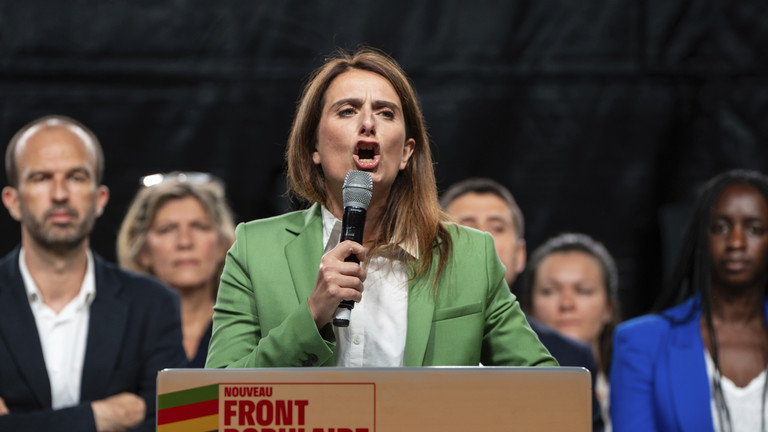
National Secretary of The Ecologists – Europe Ecology The Greens, Marine Tondelier © AP / Louise Delmotte
RT | January 14, 2025
Marine Tondelier, secretary-general of The Ecologists – Europe Ecology The Greens, has called for the social media platform X to be banned across the European Union, at least during election periods, arguing that it plays a role in shaping public opinion in ways that can threaten democracy.
Speaking on RTL’s Le Grand Jury program on Sunday, Tondelier expressed concerns about the influence of social media on democratic processes amid heightened tensions between the platform’s owner, Elon Musk, and EU officials who accuse the US-based billionaire of meddling in European politics.
“It’s not a question of freedom of expression; it’s a question of shaping public opinion,” she claimed. Tondelier highlighted the growing concentration of media ownership in France and globally, accusing “ultra-rich individuals” of trying to “buy power” once they accumulate enough wealth.
“We also need to take social media into account in this calculation now. It is part of the fabrication of opinion. It has a grip on reality. It impacts election results,” she stated. “It’s dangerous because it’s a challenge to our democracies,” she added, suggesting a ban on X during sensitive periods, such as elections.
“The social network Twitter is not only annoying but also dangerous. The question of leaving it obviously arises, but it will not be enough: it must be banned,” she wrote in a post on X.
Tondelier also urged her partners from the left-wing New Popular Front (NPF) coalition, which won the most National Assembly seats in this summer’s legislative elections, to migrate to alternative networks.
“I’m going to leave, but what are the others doing? It will still have an impact on reality. It will still contribute to destabilizing the upcoming elections,” she said.
Musk provoked major controversy by claiming in December that “only the AfD can save Germany,” a statement some EU officials denounced as unacceptable foreign meddling. This followed an op-ed piece published by the German newspaper Welt am Sonntag, in which he defended the right-wing party’s policies. Last week, Musk hosted an interview on X with Alice Weidel, the AfD’s candidate for chancellor in the upcoming German election.
Musk also clashed with former EU Commissioner Thierry Breton, referring to him as “the tyrant of Europe,” after Breton appeared to endorse the cancellation of Romania’s presidential elections, warning about potential foreign interference in the upcoming German polls.
French Foreign Minister Jean-Noel Barrot recently voiced concerns about Musk’s influence, urging the European Commission to take a firmer stance and use existing mechanisms against alleged external meddling. Breton clarified that his remarks were aimed at ensuring compliance with the EU’s Digital Services Act.
In recent weeks, the South African-born tech mogul also criticized British Prime Minister Keir Starmer, accusing him of failing to tackle the Pakistani grooming gang issue and refusing to properly investigate the mass rape of underage girls while he was head of the UK’s Crown Prosecution Service from 2008 to 2013. He also urged Washington to step in and “liberate” the Brits from their “tyrannical government.”
Featured Video
No Threat Can Force Iran’s Surrender /Trita Parsi & Lt Cl Daniel Davis
or go to
Aletho News Archives – Video-Images
From the Archives
An Expert Military Analysis of War with China
Actually, None is Necessary
By Fred Reed • Unz Review • December 13, 2020
The Correlation of Armed Forces: U.S. goods and services trade with China totaled an estimated $634.8 billion in 2019. Exports were $163.0 billion; imports were $471.8 billion. The U.S. goods and services trade deficit with China was $308.8 billion in 2019. Trade in services with China (exports and imports) totaled an estimated $76.7 billion in 2019. Services exports were $56.5 billion; services imports were $20.1 billion. The U.S. services trade surplus with China was $36.4 billion in 2019.
There is talk within the Washingtoniat of a possible war with China. Steve Bannon, who apparently was dropped on his head as a child, actually favors such a war. We hear the usual shoo-the-boobs alarm about how the Chinese are doing something terrible and we must gird our loins and American values and show them what for, bow wow, woof. The danger is that the current game of who-blinks-first in Asian waters might actually provoke a shooting war. You know the kind of thing: One warship refuses to get out of the way of another, a collision ensues, some retard lieutenant who signed up on waivers opens fire, and we’re off and running. It is not a good idea to let children play with matches.
The said war is discussed either in emotional terms by idiots or in purely naval terms by those familiar with such things, so we hear of the First Island Chain and the Second Island Chain and whose missiles against the other’s missiles and so on. This would be appropriate if we were fighting World War Two again. Which we aren’t. Let’s take a quick-and-dirty look at how such a war might go.
To begin the war, America would overestimate itself and underestimate China. This is doctrine in the Pentagon. … continue
Blog Roll
 Aletho News
- Theodore Postol: Iran’s Missiles & Drones Were Underestimated
- Iran To Target Military Industrial-Tech Complex That Facilitated Gaza Genocide
- Collapsing Empire: The Resistance Disarms ‘Israel’
- Suicide Should Not Be a Government Service
- Rethinking America’s greatest threat: Iran vs. Israel-Firsters
- Iran accuses adversaries of false flags to strain Turkey ties
- Poland rules out sending Patriot missiles to US/Israel amid war on Iran
- Tehran approves new Hormuz plan with major restrictions
- No Threat Can Force Iran’s Surrender /Trita Parsi & Lt Cl Daniel Davis
- UK’s New Pandemic Plan Would Turn Big Tech Into a Mass Location Tracking Network
- If Americans Knew
- Ann Coulter Rips Into Fox News for Iran War Coverage, Compares to False Rigged 2020 Election Reporting
- Joe Kent Urges Americans To Call White House and Congress To Object To Sending Troops Into Iran
- DNC Resolution to Reject AIPAC Funding Puts Democratic Leaders in the Hot Seat
- Swedish foundation to build 400 schools as over 650,000 Gaza children remain without education for 2 years
- Israeli army admits photshopping image of slain Lebanese journalist
- This is how Israel is systematically killing health workers under the cover of war in Lebanon
- Carrying life under fire: Israeli invasion of Lebanon leaves pregnant women facing deadly risks
- Champagne all around for the new death penalty (for Palestinians) law – Not a ceasefire Day 172
- Why are Palestinian books struggling to be seen on Amazon?
- The Line Between Affinity and Conspiracy
- No Tricks Zone
- New Study Finds Warming Saves Lives…Cold Temperatures 12 Times More Deadly Than Excess Heat
- German Science Blog Accuses PIK Climate Institute Of Hallucinating Climate Tipping Points
- Devastating Assessment Of Comirnaty Vaccine By Former Senior Pfizer Europe Toxicologist
- New Study: CO2 Is ‘Effectively Negligible’ As An Explanatory Climate Change Factor Since 2000
- Former Pfizer Toxicologist Dr. Helmut Sterz Tells Bundestag Hearing Pfizer Vaccine Should Have Never Been Approved
- Energy Expert: Germany’s Nuclear Phaseout Was A “500 Billion Euro Mistake”
- New Research: South Australia’s Mid-Holocene Sea Surface Temperatures Were 4°C Warmer Than Today
- Storing Green Energy To Last Germany 10 Days Would Require A 60-Million Tonne Battery
- New Studies: UK Sea Levels Were 4 Meters Higher Than Today During The Mid-Holocene
- Destructive Green New Deal: German Energy And Metal Group Warns Of Drastic Crisis
 Aletho News