France’s recognition of Palestine risks helping Israel — Indonesia should rethink its applause
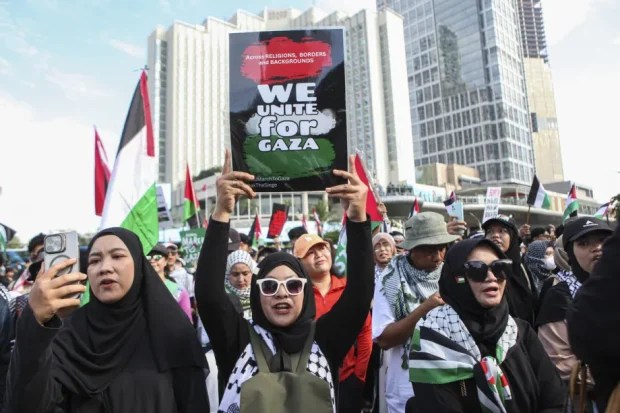
Activists at a solidarity march for the Palestinians in Jakarta, Indonesia, on June 15, 2025. [Agoes Rudianto – Anadolu Agency]
By Dr. Muhammad Zulfikar Rakhmat | MEMO | July 27, 2025
This week, Indonesia welcomed France’s decision to recognise the State of Palestine as a “positive step” toward peace. On its surface, this diplomatic endorsement may appear aligned with Indonesia’s long-standing support for Palestinian self-determination. But behind France’s gesture lies a deeper, more dangerous calculus—one that does not just ignore the reality on the ground, but actively entrenches it.
What France proposes is not justice. It is not freedom. It is an updated version of the same illusion that has kept Palestinians caged and dispossessed for decades: the so-called two-state solution.
In Jakarta’s official statement, the French move was praised for supporting a “sovereign and independent” Palestinian state based on 1967 borders, with East Jerusalem as its capital. But President Emmanuel Macron made clear what kind of state he envisions: a demilitarized Palestine that fully recognizes Israel. No mention of dismantling settlements, no restitution for occupied land, no accountability for war crimes in Gaza. Only submission, in return for a diplomatic label.
This is not a step toward peace—it’s a framework for permanent subjugation.
France’s position not only lacks balance, it weaponizes it. Macron calls for the “demilitarization of Hamas,” the rebuilding of Gaza, and regional stability—but with no demands for Israeli disarmament, no consequences for its mass killing of civilians, no guarantees of actual sovereignty for Palestinians. Instead, Palestinians are asked to disavow resistance, while the occupying power faces no requirement to end its occupation.
Indonesia, by praising this deal without reservation, is endorsing a framework that surrenders Palestinian rights under the language of diplomacy. In doing so, it becomes complicit in a process that allows Israel to continue its long project of expansion and erasure.
Because that is exactly what we are witnessing: not just war, but erasure.
Israel’s leaders have shed any pretense of restraint. Finance Minister Bezalel Smotrich has declared that Gaza should be “completely flattened.” Members of the Knesset and senior military figures have called to “wipe out” the territory. Starvation, siege, and bombing are not incidental—they are deliberate. The goal is not merely to punish, but to depopulate.
And this genocidal ambition is not new. It is part of a larger ideological blueprint long championed by elements of Israel’s far-right: the “Greater Israel” project. This vision seeks to claim not just the full expanse of historic Palestine—from the Jordan River to the Mediterranean Sea—but in some renditions, territory beyond it. It is a dream of exclusive ethnic control over a vast swath of the region. Palestinians, in this model, are not citizens or neighbors—they are obstacles to be removed.
This is the context in which France’s recognition must be understood: not as a bold shift in policy, but as a stabilizing gesture for an apartheid regime facing global criticism. And by embracing it, Indonesia—whether intentionally or not—is lending moral cover to that regime.
It is tempting, in the face of so much suffering, to welcome any sign of progress. But symbolic recognition without structural change only reinforces the status quo. A demilitarized Palestine, hemmed in by Israeli checkpoints, with no right of return and no means of defense, is not a state—it’s an open-air prison with a flag.
What is needed now is not more applause for diplomatic theater, but a refusal to accept false solutions. The two-state framework, as currently constructed, is not a path to justice. It is a political tool that enables colonization while pretending to end it.
Indonesia has long stood as a voice for the oppressed. It must not dilute that legacy by celebrating a plan that leaves Palestinians with a flag and no freedom. Instead of encouraging other nations to follow France’s lead, Indonesia should be demanding accountability: for the destruction of Gaza, for the daily violence in the West Bank, and for the decades of displacement.
This is not a time for symbolic victories. It is a time for moral clarity.
France’s vision, and Indonesia’s uncritical support of it, may win applause in diplomatic circles. But on the ground, in Gaza and the West Bank, it enables a project whose end goal is not peace, but erasure. If Indonesia truly believes in justice for Palestine, it must reject this illusion—and instead, insist on the one thing Palestinians have never been offered: freedom on their own terms.
No comments yet.
Featured Video

More Iran War fallout: Maritime insurance industry shifts from London to China
or go to
Aletho News Archives – Video-Images
From the Archives
The Biggest Threat to Peace in Middle East
By Dr. Elias Akleh* | Sabbah Report | May 24, 2010
A build up of heightened tension in the Middle East is escalating in the last few weeks. American and Israeli postures towards Lebanon, Syria, and Iran have become more threatening. Listening to speeches of political leaders one hears talks only about war not peace. Iranians and Israelis are continuously training hard for a possible showdown. Both sides are conducting extensive war games every month. This led Syrians to claim that Israel is preparing for a soon-to-come another war. The Jordanians also are warning that current stalemate of the peace process is an indication of a war breaking out this summer. The Russian President and his army chief hinted, a few months ago, that the US and Israel were planning for an attack on Iran.
Indeed Iran is, as it has been for last few years, the target of most of the threats and accusations of supporting terrorism. Escalating incitement against Iran the American Defense Department sent last month (April) to Congress a report on Iran’s military claiming Iran could develop intercontinental ballistic missiles capable of reaching the US by 2015.
Ignoring the fact that N. Korea, India, Pakistan, and Israel are proven to have nuclear weapons while Iran does not, the US Secretary of State Hillary Clinton chose in her speech, to the nuclear Non-Proliferation Treaty review conference at the UN, to focus on Iran’s alleged nuclear ambitions putting the whole world at risk as she put it. According to Clinton Iran’s acquisition of nuclear weapons, rather than Israel’s more than 200 nuclear bombs, is destabilizing the Middle East. She called on the world’s nations to rally around US efforts to hold Iran, not other nuclear countries, to account.
The accusation that Usama Bin Laden is living comfortably in Iran had received a boost after the broadcast of a documentary called “Feathered Cocaine”. This echoed the June 2003 claims of the Italian newspaper Corre de la Sierra that Bin Laden was in Iran according to some intelligence report, and according to Richard Miniter’s book “Shadow War”. … continue
Blog Roll
 Aletho News
- Why could Gaza enter the regional war?
- Hamas official rejects Mladenov Plan linking disarmament to Gaza reconstruction
- Two Primary Elections for the Soul of ‘America First’
- Japan Clings to US Vassalage Despite Energy Crunch Caused By Iran War
- US Seeks Control Over Global Energy Infrastructure – Kremlin
- US senators target Orban government for standing up to Zelensky
- The deep-rooted culture of corruption in Ukraine
- Iran mobilizing one million soldiers to ‘create hell’ for any US ground assault: Report
- The coming military and psychological unravelling?
- Iran has the last laugh
- If Americans Knew
- Researchers at Human Rights Watch Resign Over Blocked Report on Palestinian Refugee Return
- Jewish Groups Are Backing a War Americans Don’t Want
- Eric Fingerhut Thinks He’s the President of the Jews
- Top Jewish Philanthropists, Rabbis Urge Israeli President to Take Action Against ‘Jewish Extremists’
- Don’t Be Fooled. Zionist Leaders Have Always Wanted to Control Southern Lebanon
- Israel’s widespread use of torture is a core element of its genocide against the Palestinian people
- In Israel’s War on Iran, Many Middle East US Bases Rendered “All But Uninhabitable”
- ‘Burn the lawn’: Israel pursues ‘Rafah model’ in southern Lebanon
- A genocide here, an amputation there
- Reports: Iran mobilizing 1M fighters, Israel-US run low on ammo, Israeli army faces shortage – Not a ceasefire Day 168
- No Tricks Zone
- Devastating Assessment Of Comirnaty Vaccine By Former Senior Pfizer Europe Toxicologist
- New Study: CO2 Is ‘Effectively Negligible’ As An Explanatory Climate Change Factor Since 2000
- Former Pfizer Toxicologist Dr. Helmut Sterz Tells Bundestag Hearing Pfizer Vaccine Should Have Never Been Approved
- Energy Expert: Germany’s Nuclear Phaseout Was A “500 Billion Euro Mistake”
- New Research: South Australia’s Mid-Holocene Sea Surface Temperatures Were 4°C Warmer Than Today
- Storing Green Energy To Last Germany 10 Days Would Require A 60-Million Tonne Battery
- New Studies: UK Sea Levels Were 4 Meters Higher Than Today During The Mid-Holocene
- Destructive Green New Deal: German Energy And Metal Group Warns Of Drastic Crisis
- New Study Documents A 20-Year Pause In Arctic Sea Ice Decline – Driven By Internal Variability
- Wake-up Call: Survey Shows Majority Of Germans Now Favor Postponing Climate Targets!
 Aletho News
Leave a comment