No conflict over shared values
By Ramona Wadi | MEMO | September 4, 2025
EU Foreign Policy Chief Kaja Kallas has partly blamed the US for the bloc’s losing political leverage in Gaza. “If America is supporting everything that the Israeli government is doing, then the leverage they have is there; the leverage we have is in another place,” Kallas said at the annual EU Institute for Security Studies (EUISS) conference on Wednesday this week.
Yet Kallas’s focus on the “humanitarian crisis” in Gaza is too narrow to put the EU completely at odds with the US. The US and the EU have diverged on the distribution and accessibility of humanitarian aid, but the EU, like the US, is largely silent on Israel’s genocide in Gaza.
When Israel announced its intention to obliterate Gaza, the EU brandished its so-called principles and stood by Israel’s security narrative. It was only after the humanitarian deprivation became impossible to ignore that the EU pretended to shift its stance and focus on humanitarian aid without focusing on ending the genocide. How is the US impeding EU leverage in Gaza if the ultimate aim is Israel’s colonial survival?
It is true, as Kallas stated, that the EU is not united on its stance regarding Gaza. Several EU countries debated whether to apply the International Criminal Court’s arrest warrants for Israeli Prime Minister Bejamin Netanyahu and former Defence Minister Yoav Gallant. Calls for a weapons embargo have not been heeded. The hype building up to the EU discussing whether it should partially suspend Israel’s participation in the Horizon Europe research programme died down the minute no consensus was reached and failed to even state that Israel is committing genocide in Gaza. All the report stated was “indications that Israel would be in breach of its human rights obligations under Article 2 of the EU-Israeli Association Agreement.” Since, according to the EU, there are only “indications”, why should Israel be punished? And since this is another rehashed version of US rhetoric regarding Israel, how is the EU impeded by the US from using its leverage? The EU is not even impeding itself – Israel’s survival remains a top priority for the bloc.
The EU made the most of ridiculing the first presidency of Donald Trump, attempting to make inroads by pitting itself against the US on several stances, while still failing to act. The US “deal of the century” was particularly magnified as the two-state diplomacy suffered a setback. With the Biden administration, under whose presidency Israel received the green light for genocide, the EU was in agreement. A change of presidency in the US will no longer be a convincing argument for Kallas to use. In varying degrees of colonialism and imperialism, the EU and the US are aligned.
In the latest EU meeting held in Copenhagen, there was no consensus once again over “initial punitive action” against Israeli start-ups. Almost two years into Israel’s genocide in Gaza and the EU is still trying to figure out which section of Israel’s economy it can symbolically target in its politics of pretence. Several governments are now speaking of taking initiatives on a national level – also belatedly. Both the US and the EU do not want to punish Israel; they are happy to stand by and let Israel complete its colonial project. “Shared values”, after all, are hard to come by.
Labelling the Palestinian resistance: Political propaganda or legal classification?
By Sayid Marcos Tenorio | MEMO | August 30, 2025
The dominant narrative in the West portrays the Islamic Resistance Movement – Hamas – as a “terrorist group”, uncritically repeating the rhetoric of Israel and its allies. However, when analysing the issue from the perspective of international law and the history of national liberation movements, it is clear that the “terrorism” label is more a tool of political propaganda than a legal definition.
In light of international law and the United Nations Charter, Hamas should be understood as a Palestinian resistance movement in the face of more than seven decades of Israeli colonisation, ethnic cleansing, and military occupation. This also includes almost two years of uninterrupted confrontation with genocide in the Gaza Strip.
The United Nations (UN) has never declared Hamas a terrorist group. Only a few countries, such as the United States, the European Union, Canada, the United Kingdom, and Australia, have unilaterally adopted this classification. International law, in turn, does not criminalise resistance against occupation.
Since 1967, Israel has maintained its occupation of the Gaza Strip, the West Bank, and East Jerusalem, in flagrant violation of the UN Charter and Security Council resolutions. According to International Humanitarian Law, peoples subjected to foreign occupation have the legitimate right to resist, including by armed means, against the occupying power.
This principle is supported by Article 51 of the UN Charter, as well as Resolutions No. 2649/1970, 2787/1971, 3070/1973, and 3103/1974, which explicitly recognise the inalienable right of peoples to fight against colonial domination, foreign occupation, and apartheid. Furthermore, the Geneva Conventions of 1949 and the Additional Protocols of 1977, along with the practice of the International Criminal Court (ICC), distinguish between armed resistance and terrorism.
Therefore, the existence of an armed struggle against occupation does not constitute terrorism, but rather a legitimate exercise of resistance.
Founded in 1987 during the First Intifada, Hamas is not just an armed group; it is also a political, social, and religious movement deeply rooted in Palestinian society.
Its surprising victory in the 2006 legislative elections, which were recognised as free and democratic by international observers, demonstrates its popular representation. It won 76 of the 132 seats, while its main rival, Yasser Arafat’s Fatah, won 43 seats.
Over the decades, Hamas has administered social institutions, hospitals, schools, and assistance programmes, playing a similar role to liberation movements in Algeria (FLN), Vietnam (Viet Minh), or South Africa (ANC), all of which were also labelled terrorists at some point in history. Today, many of these movements are recognised as legitimate builders of their national states.
The classification of Hamas as “terrorist” serves the clear objectives of Israeli policy: To silence the debate on occupation, apartheid, and genocide, diverting attention from the root cause of the conflict; to justify massive attacks against civilians in Gaza, presented as “the fight against terrorism”; to criminalise all forms of Palestinian resistance, whether armed or peaceful – from NGOs to journalists and students.
Judith Butler, an American philosopher from the University of Berkeley, observes that armed resistance under occupation cannot be reduced to terrorism, as this ignores the structural causes of violence: colonialism, supremacism, and military occupation.
Since 2007, Israel has imposed a land, air, and sea blockade on the Gaza Strip, which the UN classifies as collective punishment – a practice prohibited by international law. Millions of Palestinians live without freedom of movement, drinking water, electricity, and medicines. With each Israeli offensive, thousands of civilians are massacred, homes and hospitals are destroyed, and entire neighbourhoods are razed.
The current scenario of indiscriminate attacks on hospitals, schools, and refugee camps is described by international law experts and UN rapporteurs as ongoing genocide, due to the scale of the destruction and the explicit intention to expel or exterminate the original Palestinian population of Gaza.
In the face of this reality, Hamas’s armed resistance should be understood not as terrorism, but as the exercise of a people’s right to self-defence under occupation and ethnic cleansing. The Palestinian struggle is, in essence, a struggle for physical and cultural survival in the face of a colonial project to eliminate all forms of life in Palestine.
The framing of Hamas as a terrorist group is a political construct of Israel and its Western allies, without a basis in international law. Palestinian resistance, whether armed or not, is recognised as legitimate by the UN, the BRICS countries, and international treaties whenever it is intended to confront foreign occupation and colonial oppression.
Calling Hamas “terrorist” is an attempt to delegitimise the struggle of a people seeking freedom, justice, and self-determination. The truth is that Israel, as the occupying power, systematically violates international law, practices apartheid, and commits war crimes and crimes against humanity.
Hamas is an integral part of the Palestinian resistance and must be understood as a national liberation movement, not as terrorism. Recognising this fact is a fundamental step towards a fair and honest reading of the conflict and for seeking a solution based on historical truth, justice, and the right of peoples to self-determination.
Exposing Jewish Exceptionalism In Canadian Media
The misguided belief in eternal Jewish victimhood is being weaponized to help allow Israel’s genocide to continue
By Davide Mastracci ∙ The Maple ∙ September 3, 2025
Over the past decade, I’ve written extensively on the pro-Israel bias in Canadian media. This article will focus on something different, but which helps shape the bias: Jewish exceptionalism.
You can find articles about how various -isms and -phobias impact Canadian media: homophobia, Islamophobia, transphobia, xenophobia, classism, racism, sexism, etc. And yet, there’s little out there on Jewish exceptionalism, which is increasingly being analyzed by commentators outside of the country.
Jewish exceptionalism is the belief that Jewish people as a demographic are eternally and ontologically oppressed, no matter the circumstances, and as such should be treated differently. Jewish exceptionalists refer to antisemitism as the “oldest hatred,” and treat it as though it’s the only one powerful enough to make its targets a permanently marginalized group.
This incorrect analysis fails to take into account the status of Jewish people in Canada and elsewhere over at least the past few decades. While Jews remain the targets of alleged hate crimes (though reports on the issue vastly overstate the reality), they face no systemic discrimination and generally fare exceptionally well in Canada and elsewhere on all other markers used to measure oppression. As a point of comparison, few that anyone would take seriously argue that dozens of churches being burned down in acts of arson since 2021 make Christians an oppressed group in Canada.
This article will illustrate how Jewish exceptionalist sentiment underlies much of the discussion in Canadian media involving Jewish Zionists by outlining five tropes, providing examples of them in mainstream publications and explaining how they smuggle in the idea that Jewish people are exceptional and should be treated as such. The tropes are: ‘Jewish-owned business’; ‘blood libel’; ‘Jewish state’; ‘Jewish neighbourhood’; ‘list of Jews.’
While this article could have been written at any point in recent years, I’ve done so now because Israel, the state claiming to represent Jews and which enjoys widespread support from them according to polling, is committing a genocide in the name of Jewish supremacy, the most explicit form of Jewish exceptionalism. Those who defend Israel and seek to undermine the pro-Palestine movement also utilize arguments that rely on Jewish exceptionalism to do so.
As such, these tropes deserve to be identified and refuted because they strengthen narratives defending the worst atrocity of our time: Israel’s genocide in Gaza.
‘Jewish-Owned Business’
The term “Jewish-owned business” appeared in Canadian newspapers 70 times between Oct. 7, 2023, and Aug. 31, 2025, according to the Canadian Newsstream database. This represents about 78 per cent of the times it had ever been used in Canadian newspapers up to that point.
Since October 7, the term has typically been used in reference to businesses that happen to be owned by Jewish people being targeted by pro-Palestine protesters. Those using the term typically employ the following logic in their articles: 1) the owner of a business is Jewish; 2) their business is being protested or boycotted in some form; 3) the action is happening because the owner is Jewish; 4) therefore, the protests are morally wrong and potentially illegal, and should be condemned.
As an example, a March 2024 editorial in The Globe and Mail erroneously stated as a fact that, “An Indigo bookstore in Toronto was vandalized, because the chain’s founder is Jewish,” and then added, “A democratic country cannot let this stand. And yet it is happening right before our eyes.”
There are genuine historical examples of Jewish businesses being protested or boycotted because of their owners’ religious backgrounds, such as in Nazi Germany, and they have justifiably received widespread condemnation. And yet, despite the explicit comparisons to these examples that commentators will make to generate an emotional response and demonize pro-Palestine protesters, the most high-profile instances of this sort of rhetoric being used in Canadian media have been cases where the owner’s religious identity had nothing to do with the protests and/or boycotts of their business.
In the case of Indigo, as I wrote in October 2024, “the store was targeted because Indigo CEO Heather Reisman is behind the HESEG Foundation, which offers a range of perks to so-called ‘lone soldiers’ who travel to Israel from abroad to join the army.” And as I wrote in October 2023, Café Landwer, an Israeli chain of restaurants, has been boycotted because its co-founder and CEO served in the Israeli military and it opened a location in Jerusalem atop the remains of a Muslim cemetery, among other reasons.
If you revisit the logic I outlined above, and remove the claim the business is being targeted because its owner is Jewish (which is clearly not the case with Indigo and Café Landwer), it breaks down to: the owner is Jewish and therefore their business should not be targeted. The implication here is that it’s OK to target businesses owned by other demographic groups, but not ones owned by Jewish people.
There are cases in Canadian media where this point is made explicitly.
In a March 2024 Toronto Star article, columnist Andrew Phillips writes, “It should have been obvious that an event featuring two such controversial leaders would be targeted by protesters, especially since pro-Palestinian demonstrators have been taking every opportunity to go into the streets and make their views known. And in this case it was a legitimate time and place to protest. They weren’t demonstrating outside a Jewish-owned business, a Jewish community centre, Mount Sinai Hospital or a synagogue in Thornhill, as happened on Sunday. All those should be out of bounds for protests about Israel’s war against Hamas in Gaza and the thousands of civilian deaths it’s caused.”
This is an astonishing claim. Others have made the point a bit more subtly.
Former Liberal MP and now Toronto Star columnist and Friends of Simon Wiesenthal Center CEO Michael Levitt wrote in an October 2023 article: “What Jews are now seeing in Canada is reason for serious concern, including for the safety of their children at schools and universities. It’s the source of tremendous anguish and pain. Anguish and pain from seeing demonstrators converge on Café Landwer in downtown Toronto, calling for a boycott of a Jewish-owned business.”
And in a November 2023 National Post article, Liberal MP Anthony Housefather wrote, “The worst massacre of Jews since the Holocaust somehow unleashed a wave of hate in Canada and around the world. Demonstrations have taken place outside an antisemitism conference in Ottawa, as well as a Jewish community centre in Toronto. Some demonstrators have called for the boycott of a Jewish-owned business.”
In both cases, the authors don’t make an attempt to prove the businesses in question are being boycotted because of their owners’ religious backgrounds, or even make that claim. Instead, the simple fact that a Jewish-owned business is being targeted is portrayed as a problem, with the implication being that doing so is out of bounds because the owner is Jewish.
The fact that antisemitic boycotts of Jewish businesses existed in the past when Jews were an oppressed group is used to imply or state that any boycotts of Jewish-owned businesses now must be hateful as well, despite the fact that the boycotts have nothing to do with the owners’ religious identities. This is Jewish exceptionalism.
‘Blood Libel’
The Holocaust Encyclopedia defines “blood libel” as “the false allegation that Jews used the blood of non-Jewish, usually Christian children, for ritual purposes.”
“Blood libel” appeared in Canadian newspapers 123 times between Oct. 7, 2023, and Aug. 31, 2025, according to the Canadian Newsstream database. I came across just two examples among the 123 of a writer arguing a pro-Palestine commentator invoked what could be interpreted as a version of a blood libel in their writing/speech. (One of them happened to be Norman Finkelstein in 2019.) In the vast majority of cases, the term was used to refer to individuals and/or organizations alleging Israel is committing a genocide in Gaza — allegations that don’t include claims of Israel killing Palestinian children to use their blood for ritual purposes.
Blood libel has a historical definition of which these authors are or should be aware. The discourse pointed to by these authors almost never meets this definition, and they do not make any attempt to prove that it does. And yet, they still wield this accusation.
The writers who use the term “blood libel” will argue I’m being disingenuous here, and that the term now means something else: accusing Jews of anything they’re not guilty of, which leads to Jewish people as a whole facing potential retribution. They are partially correct, as this is how they generally use the term now, though writers don’t note this change in their work when doing so. And yet, the fact that this is the case is actually an example of Jewish exceptionalist thought at work.
“Blood libel” was coined to refer to Jewish people in the Middle Ages — a genuinely oppressed group — being blamed for something of which they weren’t guilty. The term is now used freely by pro-Israel commentators as if nothing has changed since then.
In fact, much has: Jewish people are no longer an oppressed group, and are the beneficiaries of Jewish supremacy in Israel; the allegations made against the Jewish people who make up the vast majority of the Israeli army and political system are credible; the people making these allegations don’t argue the aggressors commit their alleged crimes because they’re Jewish. Despite all of this, “blood libel” is constantly used in Canadian media in an attempt to counter serious allegations against Israel.
National Post comment editor Carson Jerema, for example, wrote in a December 2023 article, “Hamas is using its population as a human shield to blame Israel for civilian deaths and to perpetuate the blood libel that the Jewish state is committing genocide, and the nonsense left is eating it up without question.”
Former Conservative MP and Cabinet member Joe Oliver wrote in a May 2024 National Post article: “Many people buy into the hideous blood libel of genocide of which Israel has been accused since October 7.”
And in a May 2024 article in The Globe and Mail, Noah Richler, the son of Mordechai Richler, wrote, “The blood libel of the Middle Ages makes Israelis in Gaza the deliberate, premeditated mass murderers not just of children and babies but, in the wake of the bombing of a fertility clinic, Jews wilfully slaughtering their enemies even before they are born.”
In calling these charges blood libels (a historic, antisemitic trope), the writers seem to believe it’s antisemitic for people to accuse Israel of genocide — not simply wrong on a factual basis, but inherently antisemitic. They do so because they seem to buy into Jewish exceptionalist thought, where Jewish people are always an oppressed victim group, unable to be oppressors in the way others can be.
I’ve never come across this type of claim in mainstream Canadian publications about another group.
A June 2021 article from The Conversation states, “In addition to the February [2021] motion against China’s treatment of its Uyghur population, Canada recognizes seven other genocides: the Holocaust during the Second World War, the Armenian genocide, the Ukrainian famine genocide (Holodomor), the Rwandan genocide, the Srebrenica massacres, the mass killing of the Yazidi people and the mass murder of the Muslim Rohingya in Myanmar.”
There are groups of people for each of these events who allege they don’t meet the criteria for genocide. But I’ve yet to find mainstream discussion that posits the allegations of genocide are in-and-of themselves hateful against the ethnic/religious group whose members are accused of perpetrating the genocide. For example, I haven’t found articles in any mainstream Canadian outlets alleging that it’s hateful against Russians, Hutus or Turkish people to accuse the states and/or forces purporting to represent them of committing genocide, nor any willingness to treat such claims from the fringes seriously.
As such, Israel is clearly treated as an exceptional state: writers see its Jewishness as making it incapable of genocide, and therefore imply it’s inherently antisemitic to make such an accusation regardless of the clear evidence for it and abundant examples of it being made against forces representing other religious and ethnic groups.
‘Jewish State’
The term “Jewish state” appeared in Canadian newspapers 1,514 times between Oct. 7, 2023, and Aug. 31, 2025, according to the Canadian Newsstream database. A review of these usages in the “commentary” category of articles revealed that the phrase was often used by supporters of Israel defending it against heinous crimes.
This type of usage may be disorienting for some readers, who don’t comprehend why those who support Israel and purport to want to defend Jews everywhere continuously bring up the state’s Jewishness in discussions of its atrocities where it’s not relevant. This would intuitively make sense if done by an antisemite, for example, but why would someone — Jewish or otherwise — who claims to want the best for Jewish people do it?
In some cases, the term is used to imply or outright state that Israel is only being accused of crimes because it’s a “Jewish state.” But as the evidence of Israel’s crimes has mounted, and the term continues to be used, it has become clear that it’s often employed to imply that Israel can’t be guilty of its alleged crimes because it is a “Jewish state,” or that its status as a “Jewish state” makes such allegations ridiculous.
For explicit Jewish supremacists, this implication comes from the belief that Jewish people are superior to others or that Israel’s victims aren’t fully human. For Jewish exceptionalists, it stems from the belief that Jews are eternal victims, and therefore Israel can’t be guilty of the crimes of which it is accused because it is a “Jewish state.”
There are hundreds of examples of “Jewish state” being used in Canadian media.
A November 2023 article from National Post deputy comment editor Jesse Kline uses the term four times, each in a sentence where he responds to Israel being accused of a crime:
- “In reality, Al-Ahli was just a test run, a prelude to a concerted Hamas campaign to falsely accuse the Jewish state of committing war crimes against vulnerable civilians while covering up its own violations of international law”;
- “And the same Hamas run health ministry that perpetrated the Al-Ahli fraud to incite violence against Israelis is now using Israel’s attempts to dismantle those terrorist assets to perpetuate the lie that the Jewish state is committing some sort of ‘genocide’ in Gaza”;
- “It then quoted the director of Shifa Hospital, who claimed Israel was ‘launching a war on Gaza City hospitals,’ and accused the Jewish state of targeting a school (even though Gazan schools have been closed for some time)”;
- “It also accuses Israel of committing war crimes – without, of course, providing any evidence – and calls on the media to use false and inflammatory terms such as ‘apartheid,’ ‘ethnic cleansing’ and ‘genocide’ when describing the Jewish state.”
There’s no apparent reason to use the term at all in the article, much less on four separate occasions. So the fact that it’s used, and the specific manner in which it is, is revealing: it’s employed to cast doubt on the idea that Israel committed the crimes of which it’s accused. And, as my search revealed, it’s not merely some tic Kline has in his writing: there are many other examples.
In a January 2024 Toronto Star article, former Israeli diplomat Daniel Taub wrote, “Far from being motivated by any humanitarian concern for the Palestinians, the South African initiative is a brazen attempt to weaponize a term coined to describe the worst crime committed against the Jewish people themselves and use it against the Jewish state in order to deprive it of the ability to defend itself.”
Avi Benlolo, the founder and CEO of the Abraham Global Peace Initiative, claimed in a January 2025 National Post article, “Trudeau’s criticism of Israel’s military response to Hamas, his government’s ban on arms exports to Israel and his tacit support for legal actions against the Jewish state have emboldened antisemitic rhetoric and actions within Canada.”
And Jay Solomon, the chief advancement officer for Hillel Ontario, claimed in a May 2025 National Post article about the BDS movement: “Let’s be clear: targeting the world’s only Jewish state for economic punishment – especially while ignoring or excusing the abuses of countless other nations – is not a principled stand for justice.”
It’s also worth noting that none of the organizations accusing Israel of genocide or other crimes have alleged its Jewishness makes it more likely of such behaviour. Instead, they’ve analyzed the evidence and come to the conclusion that Israel is guilty of the crime, without any irrelevant reference to the state’s Jewishness.
In essence, the organizations accusing Israel of genocide argue that it’s capable (and guilty) of committing crimes any other sort of state could and/or has. Israel’s defenders are the ones that bring up its Jewishness, and they do so to imply that it makes Israel a victim regardless of the circumstances. This is Jewish exceptionalism.
‘Jewish Neighbourhood’
The term “Jewish neighbourhood” appeared in Canadian newspapers 135 times between Oct. 7, 2023, and Aug. 31, 2025, according to the Canadian Newsstream database.
The phrase ‘x neighbourhood’ is not uncommon in Canadian media. However, the way it’s generally used differs in some important ways from how it’s used when referring to areas with what commentators regard as significant Jewish populations.
Generally, when something is referred to as an “x neighbourhood” it is merely descriptive, referring to the demographic makeup of an area. For example, a February 2025 National Post article refers to the Glen Park area in Toronto as once being a “sleepy Italian neighbourhood,” likely because its ethnic makeup in the 2001 Census was nearly 40 per cent Italian. I’m still not a fan of using this sort of language to describe neighbourhoods or countries, but it’s at least a descriptive statement based on a factual finding.
In contrast, “Jewish neighbourhood” is often used in a manner that goes beyond descriptive usages into prescriptive territory, stating or implying that non-Jewish people (including those who live in the neighbourhood) should behave in a certain way when in the area.
Here are several examples of the term being used in this manner.
In a January 2024 National Post article, Joel Kotkin wrote, “The Liberals also seem to worry as much about Islamophobia as the far more widespread problem of antisemitism, as demonstrated by the recent lawsuit filed by Jewish students at McMaster University alleging that they have been subjected to rising levels of hate. Perhaps sharing in this good cheer, Toronto police even brought coffee to pro-Hamas demonstrators blocking an overpass in a predominantly Jewish neighbourhood.”
In a November 2024 Toronto Sun article, columnist Brian Lilley wrote, “Are Jews being treated differently in Canada? Absolutely, and not in a good way. From local police to the federal government, Jews are clearly not the chosen people of Canadian government officials. […] Last Sunday, as a group of pro-Hamas types gathered at Bathurst St. and Sheppard Ave. W. – a predominantly Jewish neighbourhood – it was a Jew who was arrested.”
And in a December 2024 Toronto Sun article, reporter Joe Warmington wrote, “There was more recognition by police of the concern some Jewish residents, including Councillor James Pasternak, had expressed about pro-Hamas demonstrators aggressively coming into a Jewish neighbourhood disrupting a weekly, peaceful vigil for 100 hostages still held in Gaza.”
In all of these examples, “pro-Hamas” is used to demonize the pro-Palestine protesters in question and portray them as a threat. In doing so, and by highlighting what they perceive as the “Jewish” character of the neighbourhoods in question, the writers imply that it’s a problem for pro-Palestine people to exercise their Charter right to protest in certain areas, simply because more Jewish people may live there than in the average Canadian neighbourhood. And in other examples, it’s sometimes stated or implied that them doing so is the equivalent of Kristallnacht, an absurd comparison that can only be made due to Jewish exceptionalism.
This argument is problematic enough on its own, including when you consider that the areas in question are nowhere near majority Jewish anyways (not that this would make it alright). For example, York Centre, the Toronto ward where Pasternak serves as councillor, was 7.5 per cent Jewish as of 2021 (with larger populations of Filipinos at 13.4 per cent and Italians at 9.1 per cent).
It becomes more disturbing when you consider the demographic makeup of pro-Palestine protests, which, anecdotally, often have a disproportionate share of Arabs relative to Canada’s population. With this in mind, it’s difficult to avoid drawing comparisons to how so-called “Jewish neighbourhoods” in occupied Jerusalem are discussed, with the implication being that force should be used to keep undesirable outsiders away from Jews.
In Jerusalem that looks like attacks from the military and settlers, while in Canada it comes in the form of baseless arrests from police (and sometimes violence from others as well). In Jerusalem, the motivation for this violence is that Jews are entitled to the area and as such it should be cleansed for them, while in Canada the implication is that Jewish people’s supposed eternal status as exceptional victims means extraordinary measures need to be taken to prevent what they see as demographic threats from interacting with them.
To expand on this point, and help demonstrate that it’s not merely some abstract situation, consider the implementation of “bubble zones” in Toronto (which received explicit editorial support from The Globe and Mail on at least two occasions).
In May, Toronto city council passed a by-law allowing for protesters to be barred from being within 50 metres of institutions that successfully apply for the status. While the by-law was framed as being something that could protect people belonging to all communities, in reality it was sought after by the Israel lobby to make protests near some venues that have been linked to Israel illegal.
The first bubble zones were announced in July, and unsurprisingly, 19 of the 21 were centred on Jewish institutions. It’s possible the list may expand to include more institutions from other communities in the future, but as it stands, Toronto’s city council passed a motion that the Canadian Civil Liberties Association referred to as an example of “punitive laws that give municipalities and the police the discretion to broadly restrict peaceful expression,” in effect giving privileged status to Jewish institutions. This happened in part due to the prevalent belief in Jewish exceptionalism.
‘List Of Jews’
In February, I released Find IDF Soldiers, a database based entirely on public information that now contains profiles of 163 Canadians who joined the Israeli military at any point in their lives.
In order for someone to be included in the database, three criteria needed to be met: 1) being Canadian; 2) having served in the Israeli military; 3) having this service already be public.
Every single person on the list thus far is at least partially Jewish, and I haven’t refrained from pointing this out where relevant, including an analysis article presenting my findings on what the typical Canadian Israeli military member looks like.
The fact that the list is entirely Jewish should not be a surprise to anyone. As I wrote on the site: “Jews are the only ones able to immigrate to Israel as citizens due solely to their ethnoreligious background. That accounts for all of the soldiers who were born in Canada and immigrated to Israel later on — they could only do so in the way they did because they’re Jewish. As per the few soldiers in the project who were born and raised in Israel and moved to Canada later, all of them happened to be Jewish. This isn’t a surprise given the demographic makeup of Israel, and the fact that only Jews (74 per cent of the population as of 2023), Druze (just under 2 per cent of the population) and Circassians (0.05 per cent of the population as of 2024) are required to serve in its military.”
As I noted in the analysis article accompanying the database, the average Israeli military member from Canada is a white, Jewish man, born and raised in Canada, who grew up in the Greater Toronto Area in a wealthy neighbourhood, attended private Jewish schools for elementary and/or high school (costing as much as $24,000 per year), had white-collar professionals as parents, and chose to become a lone soldier. This is generally an incredibly privileged group of people willingly deciding to join the Israeli military.
And yet, despite all of this, much of the criticism the project received in mainstream media and elsewhere revolved around the false claim that I was somehow reviving Nazi-era tactics against Jews.
For example, a February National Post article contained a quote from one of the military members saying, “I think there’s a pretty dark historical precedent for making lists of Jews. That’s what it immediately reminded me of, a database of Jews.”
A March article from The Canadian Jewish News (CJN), meanwhile, contained multiple quotes to this effect. Another one of the Israeli military members, speaking on the project, said, “It was literally a list of Jews. That’s all it was. Good for you, you put a list of Jews together. That’s what you did. Like the SS.” Later, CJN stated the member said there was “never a good reason to make a list of Jews,” and then quoted them saying, “There’s a very dark history with that. People think it’s only the Holocaust—it’s not only the Holocaust…It was during the Spanish Inquisition, it was any time there was a need to round up Jews, lists were made. So Jews and lists—not a good thing.”
The article also quoted a professor of journalism at Toronto Metropolitan University and a former senior CBC News producer who said the project is “ethical, if abhorrent,” adding, “It’s ethical because it’s deemed to be in the public interest in some quarters. But it’s abhorrent because we’ve seen where lists of Jews have led in the past.”
There are many more examples of this sort of framing being used when discussing the project in international media, which I have compiled. They include headlines such as, “There’s a New ‘Jew List’ in Canada,” “Repackaging of Nazi-era tactics in a modern context” and “‘We Know What Jew Lists Mean’: Canadian Database of IDF Soldiers Sparks Alarm in Jewish Community.”
This whole saga is an incredibly straightforward example of Jewish exceptionalism. People cynically or genuinely alleged that a journalist creating a database of mostly privileged people on the basis of their participation in the Israeli military for journalistic purposes was in any way comparable to the Nazis compiling information on a systemically oppressed group based solely on their ethnoreligious identity with the intent to harm them.
The fact that this allegation has been taken seriously instead of being mocked is only possible thanks to the widespread belief in Jewish exceptionalism among Canada’s media class.
There are various reasons why writers may believe in Jewish exceptionalism and cling on to it in their writing.
A group of former Jewish-school students I spoke with earlier this year recounted being “brainwashed” with the idea of Jewish exceptionalism throughout their time in the institutions.
For some, Israel’s actions may have finally become too abhorrent to attempt to defend with any sort of logic or facts, and so a reliance on a non-material analysis that doesn’t need any correspondence with the real world can be useful.
Some non-Jewish commentators claim to be wracked with a sense of guilt for a time when systemic antisemitism did actually exist, and operate accordingly.
Others may be concerned about the personal consequences of stepping outside the Jewish exceptionalist framework, which applies to a much broader section of the political spectrum than many would like to admit.
Regardless of the reason, the effect of Jewish exceptionalism is to strengthen Zionist arguments and weaken the pro-Palestine movement by getting it to treat Israel’s genocide of Palestinians and alleged antisemitism as if they’re equally dangerous and urgent problems.
They aren’t. The paranoid spectre of antisemitism is being cynically weaponized to help allow the genocide to continue unabated, and it’s doing the people of Gaza a disservice to pretend otherwise.
Bulgaria debunks von der Leyen jet claims
RT | September 4, 2025
There is no evidence Russia interfered with European Commission President Ursula von der Leyen’s airplane during her recent flight to Bulgaria, the country’s authorities have said. The European Commission earlier claimed Bulgarian authorities had confirmed the incident.
On Sunday, upon landing in Plovdiv, von der Leyen’s pilots allegedly reported issues with their navigation systems. Brussels later told the Financial Times that her flight was “forced to circle for an hour” and claimed that Moscow had “blatantly interfered” with the aircraft, supposedly trying to jam its GPS signal.
However, Bulgarian Prime Minister Rosen Zhelyazkov has outright contradicted Brussels’ claim, telling parliament on Thursday that no evidence of a Russian attack had been found and that von der Leyen’s plane did not suffer any serious issues, only short-term signal degradation which is common in densely populated areas.
‘Coalition of the Willing’ Ready to Deliver Long-Range Missiles to Ukraine — What Could Go Wrong?
Sputnik – 04.09.2025
Members of the “Coalition of the Willing” have expressed their readiness to supply Ukraine with long-range missiles, Downing Street said on Thursday.
A meeting took place in Paris earlier on Thursday in a hybrid format, chaired by UK Prime Minister Keir Starmer and French President Emmanuel Macron.
“The Prime Minister also welcomed announcements from Coalition of the Willing partners to supply long range missiles to Ukraine to further bolster the country’s supplies,” the prime minister’s office said in a statement.
Russian President Vladimir Putin previously stated that Ukrainian forces could only carry out such operations with NATO personnel involved, signaling direct Western participation in the conflict. This could fundamentally change the nature of the confrontation, with NATO members effectively fighting against Russia.
At the same time, Europe’s vision of security guarantees for Ukraine involves stationing troops away from the front lines for demonstration and training purposes, the Washington Post reported Thursday, citing unnamed officials with direct knowledge of the plans.
The deployment will include a “demonstration” element, with troops serving as a deterrent against Russia, and a “regeneration” element, which implies training and rebuilding the country’s military force. The ultimate goal is transforming the Ukrainian military into what EU leaders call a “steel porcupine,” the daily reported.
On Wednesday, French President Emmanuel Macron said that work on preparing security guarantees for Ukraine had been completed. The so-called coalition of the willing will meet in Paris on Thursday in a hybrid format to thrash out details of security arrangements. Following the meeting, several European leaders and Ukrainian President Volodymyr Zelenskyy will call US President Donald Trump, French media reported.
On August 18, US President Donald Trump held a meeting in Washington with Ukrainian and European leaders, after which he announced that France, Germany and the United Kingdom want to deploy troops on Ukrainian territory. He added that there would be no US troops in Ukraine during his presidency. Russian Foreign Minister Sergey Lavrov said previously that the presence of NATO allies’ troops on Ukrainian soil — under any flag and in any capacity, including as peacekeepers — was a threat to Russia, and that Moscow would not accept it under any circumstances.
Zelensky’s dream is NATO-Russia war – ex-Polish president
RT | September 4, 2025
Vladimir Zelensky’s “dream” is to draw NATO directly into the conflict with Russia on Ukraine’s behalf, former Polish President Andrzej Duda said Tuesday.
Speaking in an interview with journalist Bogdan Rymanowski, Duda recalled an incident in November 2022, when a Ukrainian air defense missile struck near a Polish border village, killing one person. Zelensky immediately blamed Russia and urged Warsaw to invoke NATO’s collective defense clause.
Duda said the Ukrainian leader pressured him to publicly declare the weapon Russian in origin, which he refused to do.
“From the very beginning, they’ve been trying to drag everyone into the war. That’s obvious,” Duda said. “Any leader of a nation in a situation like Ukraine’s would want the entirety of NATO to fight on its side.”
“Having NATO support for the army, NATO tanks and soldiers fighting side by side against Russia – that’s a dream [in such circumstances],” he added, stressing that “Poland, being a NATO state, could never have agreed to that.”
Poland has been one of Kiev’s staunchest backers, providing both arms and diplomatic support. Moscow has claimed that Polish nationals make up a significant portion of foreign mercenaries fighting in Ukraine’s military ranks.
The relationship between Warsaw and Kiev has also seen disputes. In 2023, several eastern European states, including Poland, banned EU-facilitated Ukrainian grain imports, citing market disruptions. Tensions have also repeatedly flared over Kiev’s veneration of nationalist figures responsible for the mass killing of Poles during the Second World War.
Moscow has long described the Ukraine conflict as a NATO proxy war against Russia, warning that European members of the US-led bloc risk direct confrontation by fueling the hostilities.
Prior to the escalation in 2022, Russia sought a legally-binding pledge that NATO would freeze its expansion eastward, a proposal that was rejected.
The Lies Behind the Oklahoma City Bombing
By Richard Booth | The Libertarian Institute | August 18, 2024
Despite the seemingly simple conclusion behind the 1995 Oklahoma City Bombing, the investigation was exceedingly complicated. To this day, it is still the FBI’s most massive investigation, comprised of millions of pages of evidence. Careful analysis of this paper trail shows that the official narrative of the FBI and ATF is in fact a half-truth that ignores findings supported by the records. The FBI and ATF’s positions are frequently backed up with misleading statements, and in some instances, total fabrications.
In an honest investigation, there would be no reason to concoct and disseminate lies. If we believe that the FBI and ATF investigations were fair and legitimate, then we would expect to not find so many blatant examples of dishonesty. Yet, they exist: one after another, often repeated, and affirmed as truth. Some lies are small, others large. But what they have in common is a systemic problem that speaks to the very integrity of the agencies tasked with investigating this crime. The FBI is not a person suffering from a disorder that causes delusions. If an FBI or ATF official is formulating a lie, or propagating an extant lie, there is an objective.
All too often, it appears that the aim of these agencies is to conceal an inconvenient truth, to hide something that may otherwise invalidate the official narrative or camouflage something too heinous for the public to accept. Federal agencies’ overall deceptive pattern points to shared complicity or guilt, which should be of great concern.
In this essay we’ll examine some of the lies and wrongdoing that officials at the FBI and ATF have engaged in regarding their investigation(s) of the Oklahoma City bombing. I have uncovered half a dozen examples throughout investigating this case. Initially, I did not go out of my way looking for deception. It was something I continually discovered naturally. In some cases, the lies may be related to one another and will provide insight and clarity about what happened on the morning of April 19, 1995.
There Were No Eyewitnesses
I came upon the first example while reading On Scene Commander by Weldon Kennedy. Kennedy was the FBI’s first on-scene commander of the Oklahoma City bombing investigation and could be found hosting press conferences to discuss developments in the early days after the attack. In his memoir, Kennedy wrote that “this was going to be a case largely built from forensic evidence since there were no eyewitnesses.”1
Full stop: no eyewitnesses? This assertion is a blatant lie and should be a clue to the discerning reader that whatever the eyewitnesses saw must be important. It is surprising that Kennedy would write this, given the vast number of mainstream media reports that included eyewitness accounts2, along with the FBI’s 302 reports that detailed eyewitness interviews. Even Kennedy himself, during his April 20, 1995 press conference, described a second suspect who was spotted alongside Timothy McVeigh: “The second man is also of medium build. He is further described as 5 feet 9 inches to 5 feet 10 inches tall, weighing approximately 175 to 180 pounds, with brown hair and a tattoo visible on his left arm, below his t-shirt sleeve. He is possibly a smoker.”3 Three eyewitnesses from Elliott’s Body Shop provided this description of a man who, alongside McVeigh, picked up the bomb-truck on April 17. This same suspect would be spotted with McVeigh at the crime scene on April 19.
The FBI uncovered about two dozen key eyewitnesses over the course of their investigation. These individuals observed Timothy McVeigh and the Ryder truck as it approached the Alfred P. Murrah Federal Building on the morning of the bombing, most of them between 8:30 AM and 9:02 AM when the bomb went off. Following the explosion, FBI agent Danny Coulson was in charge of the crime scene, occupying a position of authority similar to Weldon Kennedy as an on-scene commander. In 2007, Coulson spoke candidly to the BBC about the voluminous eyewitnesses that came forward: “We know there were 24 people that were interviewed by the FBI that said they saw Mr. McVeigh on April 19 with someone else.”4 Coulson’s statement is corroborated by the FBI’s 302 reports which contain the descriptions these witnesses provided agents.
For example, catering truck driver Rodney Johnson spoke to the FBI on the night of the bombing and for several days after. Johnson described how he had to slam on his truck’s brakes to avoid hitting two men running across the street as they exited the Ryder truck.5 He got a good look at both John Doe #1 and John Doe #2, and his description of the suspects matches the one given by Weldon Kennedy during his April 20 press conference. Rodney Johnson’s catering truck co-worker, Billie Hood, also saw the fleeing pair and was interviewed by the FBI.6 Following McVeigh’s arrest, Johnson was re-interviewed and confirmed McVeigh was one of the two men he saw.
According to Weldon Kennedy, both Rodney Johnson and Billie Hood are the product of fever dreams “since there were no eyewitnesses.”
Another witness, Mike Moroz was interviewed by the FBI numerous times in the week after the bombing. Moroz was a mechanic working at Johnny’s Tire, an automotive repair shop located a few blocks from the Murrah Building. On the morning of the bombing, Timothy McVeigh pulled the bomb-truck into Johnny’s Tire at about 8:30am to ask for directions.7 He was looking for a one-way street downtown, a route leading to the Murrah Building. Moroz recounted the interaction to the FBI, explaining that he had spoken to McVeigh face-to-face. His co-workers, Allen Gorrell and Byron Marshall, were also interviewed and confirmed that McVeigh had stopped for directions.8
Moroz also said that McVeigh had a passenger in the Ryder truck with him. Moroz’s account was so significant that the FBI brought him downtown to their command center, where he selected Timothy McVeigh out of a live line-up the weekend following the arrest.9 Mike Moroz would have been a damning trial witness for the prosecution, able to put Timothy McVeigh in downtown Oklahoma City and finger his destination as the Murrah Building. Rodney Johnson, too, would have been an incredible asset. He could have placed McVeigh with the Ryder truck at the Murrah Building prior to the explosion. Unfortunately, their testimonies were forsaken in favor of forensic evidence because authorities preferred to pretend they didn’t exist.
Contrary to Weldon Kennedy’s assertion, the FBI attested to these witnesses in a preliminary hearing on April 27, 1995. During his testimony, FBI agent Jon Hersley referred to the observations of both Johnson and Moroz as central to the ongoing investigation.10 However, by the time of the McVeigh and Nichols trials—and Weldon Kennedy’s book—these witnesses would disappear from the narrative, rendered nonexistent. Why? Was it because all of these eyewitnesses saw another man in the Ryder truck with McVeigh?
Rodney Johnson, Billie Hood, Mike Moroz, Alan Gorrell, and Byron Marshall are only five of the more than two dozen eyewitnesses who saw Timothy McVeigh in downtown Oklahoma City on the morning of April 19. All of these individuals—described by Danny Coulson and denied by Weldon Kennedy—have something in common: each one confirmed that they saw McVeigh with a second person. This common denominator suggests that the impetus for Kennedy’s lie about “no eyewitnesses” was a concentrated effort to avoid explaining who the man spotted with McVeigh was.
Why did the FBI want to obscure this other suspect, going so far as to lie about witnesses? What does this tell us about who this person might be? One informed and reasonable speculation is that this other suspect was an informant connected either to the FBI or other federal authorities. If this were true, the FBI would have a reason to conceal his existence.
FBI documents obtained via the Freedom of Information Act (FOIA) give credence to this theory. Generated during the FBI’s interviews with Terry Nichols in 2005, these documents say that Nichols was scheduled to be interviewed by then-Rep. Dana Rohrabacher (R-CA), who was chairing a subcommittee tasked with writing a report on terrorism.
In a memo dated June 24, 2005, the FBI writes that, “DTOU [Domestic Terrorism Operations Unit] expressed concern regarding John Doe #2’s name surfacing during the congressman’s interview.”11 The DTOU is the FBI unit responsible for running informants and sting operations in terrorism cases. If John Doe #2 doesn’t exist, why would the FBI’s DTOU be worried? In a separate email, the FBI’s counterterrorism (CTD) division writes that they “share DTOU’s concern about the John Doe #2 information.”12 Why so much caution over a person that the FBI insists isn’t real?
The only scenario that makes sense is that the second suspect pegged by eyewitnesses, John Doe #2, was a federal informant. You can imagine the concern that would follow after FBI investigators discovered that the second person they were seeking was, in fact, part of their ongoing operations. This constitutes a strong motive to cover-up and obscure John Doe #2 at all costs to avoid embarrassment. Ask any retired agent, and they’ll tell you candidly that the biggest sin one can be guilty of at the FBI is embarrassing the bureau. It is only within the context of this unwritten rule that the behavior and statements of the FBI begin to make sense.
Bob Ricks Says: Nothing To See Here
Weldon Kennedy isn’t the only FBI official who has misled the public. Bob Ricks, former Special Agent in charge of the Oklahoma City FBI field office, made some curious statements to the Daily Oklahoman newspaper in October 1995. Ricks had just retired from the FBI, and the same week he left the bureau he granted an interview where he made claims we now know to be entirely false. The piece was headlined “Ricks Blames Curbs for Intelligence Gaps,”13 and has the former agent informing us that the FBI had no active counterintelligence investigations at the time of the Oklahoma City bombing. Why would Bob Ricks lie about that?
Ricks claimed that meddlesome oversight by Congress had hamstrung the FBI and rendered them incapable of gathering intelligence due to excessive red tape. He cited the FBI’s investigation of communist front groups in the 1970s, saying that “following the congressional hearings there, that pretty much took us out of the intelligence business (in the mid-1980s).” In response to criticism, Ricks claims that “we buried our head in the sand.”
His interview’s overall theme was to suggest that the FBI was unprepared for the Oklahoma City bombing because they could not—or would not—carry out intelligence-gathering operations targeting radicals. This is not true. The FBI possessed a vast network of intelligence-gathering tools at their disposal in 1995. They had confidential informants (Cis) and undercover agents (UCAs) infiltrating radical groups.14 They had pen-register and trap-and-trace mechanisms on the phones of specific targets that recorded inbound and outbound phone numbers.15 They had cooperating witnesses in ongoing investigations. All of these tools allowed the FBI to infiltrate and monitor the rightwing, while available evidence indicates they actively used these methods.
In the years leading up to the Oklahoma City bombing, the FBI instituted a “Major Case Domestic Security/Terrorism Group 1 Undercover Operation” called PATCON that targeted militias and other right-wing radicals.16 A “Group 1 Major Case Undercover Operation” is a big deal at the bureau. It requires continual funding authorizations (based on operational performance), in-place undercover operatives, and is signed-off on by an undercover review committee. The operation’s name, PATCON, was FBI shorthand for “Patriot Conspiracy.”
At the time of Ricks’ comments to the Oklahoman, PATCON was a tightly held secret at the FBI. It would be over a decade before the operation was exposed, and its full scope is still shrouded in mystery. What can be said, based on documents released via FOIA, is that the FBI operation had infiltrated three right-wing groups located across the country with several undercover informants. They had even established their own phony “front groups” whose purpose was to network with targets. One front, a group dubbed the “Veterans Aryan Movement” (or VAM), had an agent posing as an armored car robber with connections to racist groups.17
The FBI’s undercover agents and informants, connect to the various PATCON front groups, reported detailed intelligence on their targets, which included people and radical organizations with ideologies similar to Timothy McVeigh’s. One example is an investigation into the black-market sale of Stinger missiles and stolen military-grade night-vision goggles, items that were available for sale to mercenary groups throughout the country in the early 1990s.18 Another example includes undercover PATCON agents targeting the Texas Reserve Militia/Texas Light Infantry Brigade, a group based in Texas with links to white supremacist figures like Louis Beam. During the same period, undercover PATCON agents targeted the American Pistol and Rifle Association, run by John L. Grady. Another figure targeted by PATCON was Tom Posey, who ran an outfit called Civilian Material Assistance (CMA), an American paramilitary group that in the 1980s had connections to shadowy Iran-Contra figures. All of these examples show that through the branches of the PATCON operation, the FBI had a vast intelligence-gathering apparatus–the exact opposite of what Ricks said in October 1995.19
Of course, at the time of Ricks’ comments, the operation was a guarded secret. It’s clear in retrospect that he was lying; the FBI not only had active intelligence-gathering operations, but one that was tailor-made for inciting and entrapping people like Timothy McVeigh. What was Bob Ricks’ intention when he went to the newspaper and covered up the existence of PATCON? His last act of service to the bureau, rendered unto them the same week Ricks retired, was to tell the press preemptively that something like PATCON didn’t exist.
In effect, Ricks was claiming ‘Nothing to see here, we’re not doing anything that could conceivably be connected to McVeigh.’ Now knowing that this was a lie, we must ask what Ricks was protecting when he volunteered to falsely answer a question he hadn’t yet been asked. If this deliberate deception is any indicator—remember, no matter how clumsy, every obfuscation serves a purpose—there is reason to suspect a connection between PATCON and the Oklahoma City bombing. That theory is corroborated by one of the operation’s undercover assets.
The week of the bombing, John Matthews was sitting at home with his father watching television coverage. Matthews had worked for the FBI as an undercover PATCON agent and had his story told in Newsweek, headlined “I Was an Undercover White Supremacist.” The original article contained a passage about Timothy McVeigh. Newsweek editors cut this, and many other sensitive details, from the published piece for reasons that are still unclear. The original, unedited article states that when Matthews saw McVeigh’s face on television, he recognized him.20
Years before the bombing, when John Matthews had infiltrated the Texas Reserve Militia, he had attended one of their many weekend paramilitary training exercises. Matthews says that it was there, at a ranch in San Saba, Texas, that he met a tall, skinny ex-soldier with a buzzcut named Tim.21 The veteran was accompanied by a buck-toothed man with a German accent named “Andy.”22
Regarding McVeigh, Matthews said “he [Tim] was a nobody. Just another ex-soldier, but I remember his face. He was at one of the meetings, where a bunch of [stolen] ammunition was brought in from Fort Hood.”23 Matthews informed his FBI handler, Don Jarrett, that he had seen McVeigh at the ranch training with the Texas Reserve Militia. Jarrett told him, “Don’t worry, we got it covered.”24 Yet McVeigh’s crossed path with PATCON was never released and was even scrubbed from the Newsweek report. Was this indeed “covered,” as Jarrett had promised, or was it covered-up?
Was Ricks’ lie about intelligence operations related to Weldon Kennedy’s lie about having no eyewitnesses? Recall that all of the witnesses saw a still-unidentified man with McVeigh. Was John Doe #2 an FBI informant or asset? Is this what the FBI is hiding when it denies they were carrying out intelligence-gathering operations? How closely related are lies from the two agents charged with supervising the investigation of the bombing?
Fabricating Evidence
Weldon Kennedy’s assertion that the FBI would have to build its prosecution on forensic evidence due to the non-existence of witnesses amounted, in effect, to two different misdeeds. The first, of course, was saying there were no witnesses. The second is what Kennedy left out of his statement; not only would the FBI rely on forensic evidence, but it would also use fabricated evidence to bolster its case.
FBI forensic scientist Dr. Frederic Whitehurst first raised concerns about unscientific practices occurring at the FBI crime lab, after which an extensive investigation discovered fabricated evidence used in the Oklahoma City bombing case.25 From 1986 to 1998, Whitehurst served as one of the crime lab’s supervisory special agents, where he was widely considered the leading authority on explosives and explosive residue. Possessing a Ph. D. in chemistry from Duke University and a J. D. from Georgetown University, Dr. Whitehurst was the highest qualified analyst in the crime lab at the time, with qualifications often surpassing his superiors. For example, the Chemistry & Toxicology Unit’s chief, Roger Martz, did not have a degree.26 Likewise, the head of the crime lab’s Explosives Unit, David Williams, had a degree in zoology and made his bones not in academia, but through serving time in the bomb squad.27 Whereas Dr. Whitehurst was a scientist first and foremost. The crux of the doctor’s complaints was that his crime lab peers and supervisors were dedicated less to science than they were securing successful prosecutions—even if that meant violating the standards of any respectable scientist.
Dr. Whitehurst began observing and documenting practices at the crime lab that constituted notable examples of misconduct. As a whistleblower, he was treated severely. He was first fired by the FBI, who ultimately settled in court, paying him $1.2 million and an undisclosed sum for damages. In addition, the Justice Department’s Inspector General investigated the crime lab and produced a damning report. The IG examined several high-profile FBI cases—including the Oklahoma City bombing—and concluded that the crime lab’s investigation contained “serious flaws,” used “unscientific” practices, and had made “unjustified” conclusions which “lacked scientific foundation.”28
The FBI had assigned to the Oklahoma City bombing case the same crime lab investigators who had worked on the 1993 World Trade Center Bombing. Explosives Unit chief David Williams headed up the lab’s investigation, and he chose Steven Burmeister as his lead forensic examiner. The IG stated that Burmeister had fraudulently altered his reports at the direction of his supervisor, Williams. In one report, concerning Timothy McVeigh’s pocketknife, Burmeister initially wrote that “the presence of PETN [explosives] could not be confirmed.” He later altered the report to say “traces of PETN were located on specimen.”29 A qualified uncertainty was turned into a forensic certainty, resulting in a report containing false information that was used as evidence at the trial. Just as Dr. Whitehurst had documented, the FBI fabricated evidence for prosecutors—not an anomaly in their behavior, but a pattern. The IG report confirmed that among the cases it examined, the errors “were all tilted in such a way as to incriminate the defendants.”30
The IG concluded that David Williams ought to be reassigned to another unit because he “lacks objectivity, judgment, and scientific knowledge.” This was one of several reassignments and changes recommended in the IG report, all necessary to reform the crime lab’s practices. As a result of Dr. Whitehurst’s whistleblowing and the subsequent investigation, the FBI was forced to adopt forty different reforms to ensure forensic reliability. The IG report impeached not only the credibility of the FBI crime lab, but the entire bureau. Even with the imposition of reforms, with that credibility gone, how are we expected to trust the FBI’s work in other areas of the investigation? How far did the corruption extend?
It is appalling that such a thing could happen in the highest-level investigation ever carried out by the United States’ premier law enforcement agency. Questions of integrity aside, fabricating evidence also displays an immense arrogance. The FBI was willing to risk a successful prosecution of Timothy McVeigh, when fabricating evidence wasn’t necessary to win a conviction; the extent of the available evidence, even without eyewitnesses, would have been enough to easily secure a conviction. So why do it?
The answer appears to be either ‘because we can,’ or worse, ‘because that’s how we do things.’ The evidence supporting the latter conclusion is plentiful, since criminal activity by the feds goes beyond Oklahoma City. One needs only to look at other high-profile FBI cases. For example, in the espionage case against defense contractor Christopher Boyce and his childhood friend Daulton Lee, the FBI claimed it had recovered Lee’s fingerprints from the secure “black vault” at TRW Inc.31 The black vault was where Boyce made copies of sensitive documents that Lee then hand-delivered to the KGB in Mexico City. One problem: Daulton Lee had never in his life been on TRW Inc. property, much less made his way to the highly secure black vault.32 This inconvenient fact did not stop the FBI as they apparently fabricated Daulton Lee’s fingerprints to use as a “trump card” in case the evidence against him wasn’t enough to convict. Like McVeigh, there was enough legitimate evidence against both Boyce and Lee to make any fabrication unnecessary, to say nothing of egregious. But ‘that’s how we do things.’
Destroying Evidence
Acting on a tip, in 2005 the FBI raided the former Kansas residence of convicted bomber Terry Nichols, where they seized a cache of explosives. Nichols told the FBI in interviews that among the carefully wrapped and preserved explosives they would find the fingerprints of an unindicted co-conspirator in the bombing. Unfortunately, we’ll never know whether this was true. The FBI—grudgingly acting on Nichols’ tip—destroyed most of the evidence.
Only after enduring pressure from congressional staffers and at least one congressman did the FBI act, taking over two years to produce a report on the results of the raid. The report, dated February 21, 2008, noted that a fingerprint—named redacted—was lifted from a book found among the explosive cache. The inventory—seventy kinestik binary explosives, detonators, fuses, and flares—was destroyed, along with any fingerprint evidence.33
In his 2005 interviews with the bureau, Terry Nichols said that the fingerprints of Roger Moore and other bombing conspirators would be found among items in the explosives cache. Despite this indication, the FBI crime lab made no identification in their reports. However, in a December 2012 interview on The Scott Horton Show, investigator Roger Charles suggested that the FBI did recover prints from the stashed explosives. Charles explained that a highly placed FBI official told Deputy Bureau Chief of the Associated Press John Solomon that four sets of fingerprints were discovered: Timothy McVeigh, Terry Nichols, Roger Moore, and Richard Lee Guthrie.34
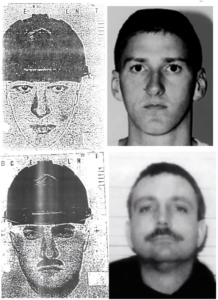 Guthrie, who died in prison in 1996, was a leading figure in the Aryan Republican Army (ARA), a neo-Nazi bank robbery gang, and has long been suspected of possible involvement in the Oklahoma City bombing plot. Likewise, in reports produced by McCurtain Gazette reporter J. D. Cash and Indiana criminology professor Mark Hamm, they suggest that McVeigh might have been involved in one or more of the ARA bank robberies. One of the stick ups was carried out on September 21, 1994 in Overland Park, Kansas. According to Cash, “witnesses provided a sketch of him [one of the robbers], you look at it, and there’s no question it’s McVeigh.”35 Mark Hamm agrees, telling Cash, “I believe that sketch of the other subject is Timothy McVeigh and not [Peter] Langan. It’s almost a perfect likeness of McVeigh.”36
Another ARA bank robbery that Timothy McVeigh may have participated in occurred at the Third Federal Savings and Loan in Middleburg Heights, Ohio on December 9th, 1994. On December 5th, members of the ARA checked into a motel near Kent, Ohio. FBI investigators, suspecting that McVeigh was linked to the robbery, analyzed video footage from the crime in an attempt at identification. Reportedly, the FBI crime lab’s comparison of McVeigh and he bank surveillance video was inconclusive. Unfortunately, we can no longer examine the video because it was destroyed by the FBI in 1999, despite evidentiary rules to the contrary.
The FBI also destroyed blasting caps wrapped in Christmas paper recovered from the gang’s safehouse in Ohio. According to the ARA’s co-founder, Peter Langan, those blasting caps were obtained from Timothy McVeigh.37 Can we trust the FBI’s word that Langan is lying, and that neither the caps nor the surveillance video was connected to McVeigh? The FBI’s bureaucratic culture is to collect and preserve every last scrap of paper or conceivable bit of evidence. If something is destroyed, it is to serve a purpose.
The FBI also managed to destroy crucial audio dispatch tape recordings and transcripts that had been obtained during the investigation. In a November 1995 interview, Assistant Chief of the Oklahoma City Fire Department Jon Hansen said that the fire department had received a call from the FBI on the Friday before the bombing. The FBI warned them that there might be an imminent terrorist attack, and to maintain heightened security levels. When asked if the fire department had kept a recording the call, Hansen said that “all the transmission tapes have been erased. We made a boo-boo.”38 A boo-boo? Really?
During his trial, McVeigh’s defense team requested that the FBI provide all transcripts and transmissions related to Oklahoma City on April 19, 1995, and two weeks prior. The FBI glibly responded to this request by informing them that these tapes and transcripts were “accidentally destroyed.”39 Was this another “boo-boo?” Or was this destruction of key evidence intentional? The reader can make an informed decision.
McVeigh’s defense team also made a request for transcripts of the Oklahoma City Police Department dispatch tapes, which would have included the APB that police issued on April 19 for a brown truck connected to the bombing. The FBI responded that these too had been “accidentally destroyed.”40 Once again, we find a convenient “accident” that invariably strengthens the FBI’s narrative of the bombing.
Any lawyer will tell you that your case is only as good as the evidence it’s based on. The evidence in a criminal case must be carefully preserved with a documented chain of custody; nothing should be destroyed or otherwise mishandled. It appears, however, to have been commonplace in the Oklahoma City investigation. The handful of examples highlighted above show a pattern of behavior that, when combined with the conclusions of the IG report on the FBI crime lab, indicates that the destruction and fabrication of evidence was part of an overall effort to conceal specific facts in order to slant the case in favor of the prosecution. We must ask: what is being concealed by this pattern, and what common denominators exist in each instance where evidence was mishandled, destroyed, or fabricated?
ATF: ‘We Weren’t There’
On the morning of April 19, 1995, several ordinary Oklahomans had disturbing encounters with ATF agents at the Murrah Building blast site during the subsequent rescue operations. These individuals include rescue volunteers and emergency first responders who were triaging the wounded while working with ambulance and rescue personnel. Several of these people testified before a grand jury impaneled to investigating the bombing what ATF agents had told them that morning.
Prior to testifying, these witness accounts were published in the McCurtain Gazette newspaper by award-winning journalist J. D. Cash. Three of their statements were broadcast on Oklahoma City television station KFOR-TV on September 12, 1995. The first two witnesses interviewed by KFOR’s Brad Edwards were Bruce Shaw and his supervisor, Tony Brasier. Shaw’s wife had worked at the Murrah Building, and upon hearing about the bombing, Shaw and Brasier immediately left work to assist in rescue efforts. Arriving at the blast site, Shaw spotted an ATF agent among those gathered, and he approached to inquire about rescue efforts. Shaw explained that his wife worked in the federal credit union located in the building. The couple knew many of the ATF personnel who worked at the Murrah Buidling, and Shaw informed the unfamiliar agent, “I’ve got to find some of the local ATF agents to help me find her… They know me.”
Bruce Shaw recounted that the ATF agent he spoke to attempted to reach someone on a two-way radio but couldn’t get a response. “He said they were in debriefing, that none of the agents had been in there. They’d been tipped by their pagers not to come in to work that day. Plain as day out of his mouth. Those were the words he said.”41 Shaw’s supervisor, Tony Brasier, had been standing next to his subordinate and the agent when this discussion occurred. Brasier affirmed on-camera to KFOR that the agent had indeed said that the ATF had been “tipped off by the pagers not to come in to work that day.”
A third witness, Katherine Mallette, was interviewed by the television station on the September 12 broadcast. Mallette was an emergency medical technician with the Emergency Medical Service Authority (EMSA) and participated in rescue efforts the morning of April 19. She stated that as she was prepping an ambulance to transport victims to area hospitals, two ATF agents walked by, and she overheard their discussion. One agent said to the other, “Is this why we got the page not to come in today?” Mallette attested to this disturbing exchange on-camera for KFOR, and later provided the Oklahoma Bombing Investigative Committee a signed affidavit attesting to what she had seen. 42
A second rescue worker, Tiffany Bible, was a paramedic with the EMSA who participated in rescue efforts that morning. Bible’s first impression was that there was some sort of natural gas explosion, and when she approached an ATF agent on-site, she asked how a gas explosion could have caused so much damage.
The agent told her that it was not a gas explosion, but a truck-bomb. This exchange occurred only five minutes after the blast. Knowing that the ATF was housed in the Murrah Building, Bible expressed her concern for the agent’s co-workers. He responded that, “No, we weren’t in there today.”43 Like the other witnesses, Bible testified to this encounter in an affidavit submitted to the grand jury impaneled to investigate the bombing.
Why was the ATF not at work on the morning of April 19, 1995? The rescue workers’ accounts—aired on television and reported in newspapers—caused the ATF to panic and issue statements later proven to be lies. The ATF agents’ admissions that they were not in the building, combined with the agency’s later explicit denials, may contribute to understanding a fundamental truth about the bombing. The ATF’s lies and contradictions can, like the FBI’s, be interpreted in a wider context.
Panic, Lies
To counter what the ATF said were “widespread rumors” that agents had evacuated the Murrah Building before the blast, the agency acted in a typical bureaucratic fashion: they issued a press release.44 In the May 23, 1995 press release, ATF Special Agent-in-Charge of the Dallas regional office Lester Martz claimed that Oklahoma City ATF agent Alex McCauley and DEA agent David Schickendanz were trapped in the building’s elevator when the truck-bomb exploded. According to Martz, McCauley and Schickendanz were both victims and heroes, carrying out a fantastical escape to help others who laid dying around them.45 Martz asserted that the elevator dropped in a free-fall from the eighth floor to the third, where the two men remained trapped. In this account, McCauley and Schickendanz escaped from the elevator’s smoking rubble only after forcing the doors open. This story is, by all measures, entirely fictional.
In the aftermath of the bombing, General Services Administration (GSA) and Midwestern Elevator Company inspectors investigated the blast site and the building’s elevators. The Midwestern technicians “found that five of the six elevators were stopped between floors with their doors blown inward, which caused the safety mechanisms to freeze them in place.”46 Duane James, one of the elevator maintenance technicians, was quoted saying, “Once that occurs, the doors cannot be opened—period.” James said that the elevators have safety switches that prevent excessive speed, and that he determined none of the safety switches had been tripped.47
In their final report, the Oklahoma Bombing Investigative Committee wrote that, “GSA inspectors and Midwestern technicians have stated in interviews and in sworn affidavits and/or testimony that there was no evidence of (1) free-falling elevators, (2) persons in any of the elevators who then forced their way out, or (3) failure of the safety mechanisms built into the system.”48 In other words, Lester Martz’s heroic account of federal agents was an impossible lie. Technician Duane James put it this way: “If you fell six floors and it was a free fall, it’d be like jumping out a six-story building. I’d ask them how long they were in the hospital and how lucky they were to survive.”49
After the May 23 press release featuring this cock-and-bull story, the ATF issued several other stories to account for their agents’ whereabouts. The narrative kept changing; this indicates both incompetence and dishonesty, a hasty and ill-formed plan to conceal the truth. For example, on the day of the bombing the ATF’s public affairs spokesperson in Washington D.C. claimed that the agency had 20 agents on duty. When it became apparent this was false, ATF agent Luke Franey volunteered to bombing victim Glenn Wilburn that the agents were “out on assignment,” while “some didn’t come in because they were out of town.”50 In December 1995, ATF Dallas chief Lester Martz said that the missing agents were involved in an all-night “surveillance operation.”51 With all of these varying and stories to account for the lack of ATF agents in the Murrah Building that day, it is difficult to know where the lies end and the truth begins.
The ATF also issued contradictory statements about their level of situational awareness on April 19, 1995. When asked whether the agency was aware of the date’s significance—it was the two-year anniversary of the Waco massacre—agent Luke Franey flatly denied that the ATF was the least bit concerned. He told Glenn Wilburn that “No, there was no alert or any concern on our part about the significance of that day.”52 Meanwhile, ATF Director John Magaw told CNN he had been “very concerned about that day and issued memos to all of our field offices,” telling them that “they were put on alert.”53 These conflicting explanations demonstrate that ATF officials had not coordinated their responses.
The ATF’s many denials and lies about their whereabouts on April 19 share a common theme: to hide the fact that they knew something and were not at work that day. The contradictions indicate that something about their absence is important enough to conceal no matter how outrageous the cover story. What was it? Is it related to the FBI’s deceptions?
The Road to Oklahoma City
The ATF is not the only federal agency whose high-level officials concocted fictional stories about the event of April 19, 1995. There is a similar case that could possibly be related to the ATF agents’ whereabouts during the bombing.
The Special Agent-in-Charge of the Dallas FBI office, and later in charge of the crime scene in Oklahoma, was Danny Coulson. Coulson was a veteran of the FBI with a long history in dealing with terrorism. Over a decade before the bombing, he was attached to the FBI Hostage Rescue Team (which he founded) when they took down Robert J. Matthews of The Order. Coulson managed and successfully negotiated the siege on the Covenant, Sword, and Arm of the Lord radical group on April 19, 1985. His whole career, Coulson had presided over events whose history was inextricably linked to the ideology of Timothy McVeigh—he was, in fact, the perfect person to lead the Oklahoma City bombing investigation. However, for reasons not yet clear, he was not selected for that job.
In Coulson’s memoir, No Heroes, he recounted the morning of April 19, 1995. He was at home in Texas when he received a page from John O’Neil at the FBI headquarters’ anti-terrorism center.54 O’Neil broke the news to him: the Alfred P. Murrah Building had been bombed. Coulson writes that O’Neil asked him to catch the next flight to Oklahoma City. What played out next is worthy of a Hollywood film. Coulson claims that there were no flights out of Texas due to inclement weather, so he fetched his badge and gun and hit the road. Coulson sped off to Oklahoma City, driving through a furious rainstorm, his wiper-blades swiveling on the windshield as lightning strikes peppered Texas’ pastures and fields in his rear-view mirror. The FBI’s top anti-terrorism agent was on his way.
Coulson’s biographical account cannot be verified, since John O’Neil died in the 9/11 attacks. However, cracks have emerged over the years that raise serious questions about Coulson’s recollection of events. Firstly, in an interview with C-SPAN’s BookTV in 1999 to promote his memoir, Coulson said that he was home eating breakfast when he “heard on the television” about the bombing in Oklahoma City.55 Since his presentation was about his book, you would have expected Coulson to describe events the same, yet the story differed ever so slightly. Then, years later, journalist J. D. Cash obtained Danny Coulson’s hotel receipt for April 19, 1995. The receipt shows that Coulson checked into an Embassy Suites in Oklahoma City twenty minutes after midnight on the 19th.56 He was in Oklahoma City nine hours before the Murrah Building was bombed.
During J. D. Cash’s research into Coulson’s movements that week, he attempted to obtain both Coulson’s and FBI official Larry Potts’ travel records from the FBI. The effort was fruitless; the bureau claims some of those travel records are “missing”—in the same manner that inconvenient evidence seems to disappear. However, Cash wrote that Coulson’s trip to Oklahoma City fits within a framework of “evidence revealing weeks of planning by an elite corps of drug and counterterrorism experts who were closely monitoring members of various far-right groups.”57 What were these “weeks of planning” related to?
Cash concluded that Coulson was working on a project that included other counterterrorism agents “monitoring” right-wing groups. What we can infer is that whatever Coulson was involved with, it was sensitive enough that he decided to create an alternative explanation about how he arrived at Oklahoma City. Coulson could have written in his book that he happened to arrive in the city the night before and left it at that. Why did he choose to lie? The likeliest reason for a cover-up would be because his reason for being in Oklahoma City was directly linked to the bombing. If that were accurate, Coulson’s motivation begins to make sense.
To make the situation even more confounding, Coulson billed his April 19 travel costs to the FBI’s MC-111 on May 16, 1995. MC-111, short for Major Case 111, is also known as VAAPCON.58 Like PATCON, VAAPCON was an FBI investigation. While PATCON targeted militias and radical right-wing terrorists like Timothy McVeigh, VAAPCON targeted individuals and groups that advocated violence against abortion clinics. A report published by The Washington Post in 1996 described VAAPCON as consisting of nothing more than a thin folder of papers, with few leads, no arrests, and nothing that would conceivably put an agent of Coulson’s standing far away from his field office. At best VAAPCON might garner a few conference calls, but certainly not a flight to Oklahoma City of all places. Headlined “Abortion Clinic Violence Probe Was Over Before It Started,” the Post essentially declares VAAPCON dead in the water.59
It was this same Washington Post article that revealed the existence of VAAPCON to the public. Meaning, Coulson would have no reason to conceal such an operation in his memoir, published three years after the article. If Coulson was in Oklahoma City due to his participation in VAAPCON, he could have written that without garnering a second glance. But he didn’t do that. While Coulson might have billed his time to VAAPCON—a dead operation—on May 16, we can interpret this as an effort to conceal his actual activities at the time.
What if the April 19, 1995 Oklahoma City bombing was a failure of intelligence, a sting operation gone terribly wrong that literally blew up in the FBI’s face? If this scenario is correct, it can be assumed that such a thing could never be acknowledged through travel records, much less after-action reports. The sting operation would have to remain a secret. It’s with that mind that we think back to Bob Ricks’ denial to the press in October 1995 about the existence of any intelligence operations being performed by the bureau. This theory would also explain the missing travel records of Coulson and Potts, along with Coulson erroneously billing his time to the then-defunct VAAPCON. It would give reason for Coulson to be in Oklahoma City nine hours prior to the bomb’s detonation, and to lie about it in his memoir. In this scenario, if the FBI had an informant or asset within the operation — John Doe #2 — that would explain the agency’s continual, adamant denial about the existence of a second suspect. It would also corroborate the FBI Domestic Terrorism Operations Unit’s “worry” and “concern” about John Doe #2’s identity being divulged to congressional investigators in 2005.
While this theory exists in the realm of speculation and conjecture, what can be said with certainty is that this scenario is the only one that makes sense given the totality of evidence. What’s more, if this were the case, it would not be the first time an FBI intelligence-gathering operation was tied into a plot through informants.
Real Explosives, Real Victims
Roger Charles was a co-author of the 2012 book Oklahoma City: What the Investigation Missed and Why It Still Matters. In the book and a 2007 BBC production, Charles lays out the evidence indicating that authorities had informants close the criminal conspiracy behind the bombing.60 If he is correct, it wouldn’t be the first time. Just two years before Oklahoma City, an almost identical situation played out in the first attack on the World Trade Center:
- Terrorists loaded a rental truck with an ANFO bomb.
- A building full of civilians was the target.
- The FBI had an informant inside the operation.
- The FBI failed to stop the bombing, with their focus being in favor of continued intelligence gathering.
The FBI has denied it had any advance warning of the bombing, or that it was involved in a sting operation in Oklahoma City. Bureau flunky Jon Hersley unconvincingly proclaimed that, “We don’t play games with people’s lives like that.”61 The denials, however, don’t line up with the facts.
The FBI informant involved in the 1993 World Trade Center bombing, Emad Salem, recorded his conversations with his agency handlers. The recordings show that the FBI was more interested in intelligence-gathering—of the sort Bob Ricks claims the FBI wasn’t doing—than stopping the plot in its tracks.62 Salem suggested replacing the live explosives that were eventually used in the bomb with harmless materials. Instead of taking this route, Salem’s handlers wanted him to wear a microphone and continue to gather vital intelligence. Salem balked at wearing a wire—while also asking the FBI to pay him more money. The feds lost Salem as an informant, while the World Trade Center bomb plot continued and matured after Ramzi Yousef came on-board with his bomb-making expertise. The end result was six people dead and 1,000 injured when the bombers attacked the towers.
The FBI’s failure to know when and where the World Trade Center attack would take place was a direct result of their inability to handle Emad Salem properly. In this example, we have the FBI close enough to a bomb plot that they had a chance to capture the conspirators early on but bungling it by not handling their informant with more finesse.
In his denial that any similar operation occurred in Oklahoma City, Agent Hersley said, “If we had any information beforehand from any informants about a potential bombing of a federal building, I can assure you that we would have taken immediate action.” That wasn’t the case, however, in 1993. The opposite is true, in fact. Given the past record of the FBI, can we trust Hersley? Was he lying–alongside Weldon Kennedy, Bob Ricks, and Danny Coulson–to protect secrets?
Throughout the late 1980s and into the early 1990s, federal agents targeted former neo-Nazi Johnny Bangerter, who was the center of the same sort of groups targeted by the FBI’s PATCON operation. Bangerter was present at the siege of Ruby Ridge and knew Randy Weaver personally. He said that in retrospect, the most striking thing about being approached by informants and undercover agents was that they always used “real explosives. Real machine guns. It was always real stuff. Very dangerous.”63 Bangerter made clear that not only did these federal agents play with people’s lives, but they did so using a kind of playbook: always with a truck-bomb, always with real explosives, and always with provocateurs advocating for violence in the most overt manner. With some sadness in his voice, Bangerter added that “there were real victims, too.”
When the FBI says that “we don’t play games with people’s lives like that,” or insists that the bombing could not possibly have been “a sting gone wrong,” we’re meant to take their word for it. But the question is, can we? When the facts are examined, we find ourselves in a situation where the FBI has no credibility. They lie, they fabricate and destroy evidence. They are akin to the boy who cried wolf: it is reasonable to be skeptical of their denials based on their past behavior. Having witnessed the same sort of conduct, and being fed the same kind of lies, we can reach conclusions on what the truth might be.
It is a truth that resembles a failed sting operation, an informant the FBI says doesn’t exist, but that twenty-four people saw, and a mountain of other evidence. Whereas Jon Hersley’s “truth” that the FBI wouldn’t do this is equivalent to the “truth” that there are no eyewitnesses. Or the “truth” that the FBI had no intelligence-gathering operations. Or the “truth” that the ATF showed up for work on April 19, 1995. Or the “truth” that ATF agents karate-chopped their way out of wrecked elevators to save lives. Or the “truth” that Danny Coulson drove through a rainstorm to reach Oklahoma City after the bomb blast.
It’s all the truth because the FBI says so. And we can trust the FBI, can’t we?
Richard Booth is an independent citizen journalist and member of the Constitution First Amendment Press Association (CFAPA). Find his writing in Garrison: the Journal of History and Deep Politics, and on Substack.
While America panics, Europe quietly recalibrates Covid-19 vaccine policy
Maryanne Demasi, PhD | September 3, 2025
As of 1 September, Sweden no longer recommends Covid-19 vaccination for children unless an individual medical assessment finds they are at increased risk of severe disease.
Even then, it is only available with a doctor’s prescription.
Adults are eligible for a single dose only if they are 75 and older, or belong to defined risk groups.
It is a strikingly cautious policy — yet in Sweden, there is no sense of crisis. Public health officials describe it as a proportionate step, aligned with the evidence.
By contrast, in the United States, the temperature has been rising over the narrowing of Covid-19 vaccine policy. The medical establishment has long been hostile toward Health Secretary Robert Kennedy Jr, but in recent weeks the attacks have escalated.
This week in the New York Times, nine former directors of the Centers for Disease Control and Prevention (CDC) warned that his decisions mean “children risk losing access to lifesaving vaccines.”
On ABC TV, outgoing CDC official Dr Demetre Daskalakis intensified the rhetoric, claiming he “only sees harm coming” for America’s children. The language was deliberately alarming and intended to signal an emerging catastrophe.
Dr Demetre Daskalakis, former director, CDC National Center for Immunization & Respiratory Diseases.
In reality, though, the policies under review in the US look more like a belated effort to bring American practice closer to what Europe has already done.
The CDC’s own data illustrate why recalibration makes sense.
Figures show that the risk of children dying from Covid-19 equates to roughly 1 in 810,000 per year (0.000123%) — an infinitesimally low risk.
It’s even lower for children without underlying conditions, closer to 1 in 1.75 million (0.000057%).
Despite these tiny mortality figures, Daskalakis warned that half of infants hospitalised for Covid-19 last season had “no underlying conditions.”
But that claim paints a distorted picture.
A Covid-19 hospitalisation is defined as “a positive SARS-CoV-2 test ≤14 days before admission or during hospitalisation,” meaning any child treated for a broken arm or routine surgery but testing positive, is still counted as a Covid case.
When researchers examined hospital charts more closely, they found roughly 30% of paediatric Covid-19 admissions were ‘incidental’ – in other words, they were hospitalised with Covid, not for Covid.
CDC’s adult data showed a similar pattern.
Other countries ahead of the curve
Across Europe and beyond, other nations are moving in the same direction as Sweden.
The United Kingdom has also tightened eligibility as it heads into autumn, limiting Covid boosters to people over 75, nursing-home residents, and those with weakened immune systems.
Its guidance notes that “in the current era of high population immunity to Covid-19, additional Covid-19 doses provide very limited, if any, protection against infection and any subsequent onward transmission of infection.”
These are targeted, risk-based policies aligned to measurable benefits.
Australia, too, has shifted. In May, the Department of Health quietly updated its immunisation handbook to state that healthy children and adolescents under 18 without medical conditions no longer need the Covid-19 vaccine.
There was no press conference, no ministerial statement, no media blitz. And most notably, no outrage from the medical establishment.
Taken together, these changes show nations with advanced health systems are adjusting policies in response to the evidence.
Unlike in the US, no one accuses countries like Sweden, Britain, or Australia of ‘sacrificing children’ by narrowing access to Covid-19 vaccines.
Hepatitis B on the radar
On September 18-19, the CDC’s Advisory Committee on Immunization Practices (ACIP) will meet to vote on various issues, including the current hepatitis B schedule.
Daskalakis warned that at its upcoming meeting, ACIP might “try to change the birth dose,” arguing that public health only gets “one bite of that apple” to vaccinate newborns against hepatitis B.
But several advanced European programs already do not give a universal day-one dose.
Instead, they target it to babies of mothers who test positive for hepatitis B, since most are screened in hospital, and begin routine doses later in infancy.
Denmark follows this approach. It is mainstream policy, endorsed by national health authorities, and no one suggests Danish babies are being left unprotected.
Scrutiny, not sabotage
The criticism of ACIP has been fierce.
Current members are branded as “dangerous” or anti-vaccine when their real offense is pressing for increased scrutiny and asking difficult questions. That is what an advisory committee is meant to do.
Kennedy is accused of sabotaging access to vaccines, but his approach is simply a call for the ‘gold standard’ science that Americans were promised by this administration.
As FDA Commissioner Marty Makary said this week, the CDC is a “broken” agency. That is why proportional policies and humility matter.
The way forward is not to alarm Americans with talk of bans or lost access to vaccines. It is to deliver risk-based, evidence-driven recommendations, as peer nations already do, and to be candid about uncertainty.
That is how public health begins to rebuild trust…the trust Kennedy says he now hopes to restore.
Florida to ‘End All Vaccine Mandates,’ State’s Surgeon General Announces
By Brenda Baletti, Ph.D. | The Defender | September 3, 2025
Florida Surgeon General Joseph Ladapo announced today plans to eliminate all vaccine mandates in the state, including for children to attend school.
“The Florida Department of Health, in partnership with the governor, is going to be working to end all vaccine mandates in Florida,” Ladapo said at a press conference in Tampa, hosted by Gov. Ron DeSantis. Florida would be the first state to completely drop all mandated vaccinations.
Ladapo said every immunization requirement “is wrong and drips with disdain and slavery.”
“Who am I as a government? Or anyone else? Or who am I as a man standing here now to tell you what you should put in your body?” he asked.
Ladapo said some vaccines are mandated by the Florida Department of Health, but those requirements “are going to be gone.”
“We are going to work with the governor and law makers to get rid of the rest,” he added.
Ladapo did not lay out a timeline to end the mandates.
Currently in Florida, children without vaccine exemptions are required to take most vaccines on the Centers for Disease Control and Prevention’s childhood immunization schedule to attend daycare or school. This includes shots for hepatitis B, measles, mumps, rubella, chicken pox, polio, diphtheria, tetanus, pertussis, pneumococcal vaccine, the Hib vaccine and others.
Vaccine rates in Florida reportedly dropping
Vaccination rates in the state have reportedly declined under Ladapo, with 90.6% of kindergarteners vaccinated, the lowest number in over a decade, according to the Tallahassee Democrat.
The rate of religious exemptions in the state has been increasing, according to the state’s public health department.
Ladapo, a graduate of Harvard Medical School, has been widely praised by critics of the COVID-19 vaccines and people in the health freedom movement generally for his critiques of questionable guidance issued by public health agencies.
In April 2020, he garnered national attention for his critique of the government’s pandemic management measures in an op-ed in The Wall Street Journal called “Lockdowns Won’t Stop the Spread.”
In September 2021, Ladapo was appointed Florida’s surgeon general.
In 2023, he issued a health alert to the Florida healthcare sector and to the public, warning that COVID-19 mRNA vaccines caused a “substantial increase” in reports of adverse events in Florida.
Last year, Ladapo called for a halt in the use of COVID-19 mRNA vaccines over safety concerns that the mRNA technology is delivering DNA contaminants into people’s cells.
He also played a key role in the decision for Florida to become the second state to ban fluoride in public drinking water.
The mainstream media and its go-to commentators on public health — such as Dr. Paul Offit, who was removed from his vaccine advisory position at the U.S. Food and Drug Administration on Tuesday — denounced the move to end the mandates, saying it would put children at risk.
Those news organizations also argue that vaccines are key tools for public health.
Florida’s announcement follows a similar move last month in Idaho, where Gov. Brad Little signed into law the Idaho Medical Freedom Act, which prohibits most medical mandates in the state.
At today’s press conference, DeSantis announced the state will establish its own Make America Healthy Again (MAHA) Commission at the state level.
This article was originally published by The Defender — Children’s Health Defense’s News & Views Website under Creative Commons license CC BY-NC-ND 4.0. Please consider subscribing to The Defender or donating to Children’s Health Defense.
Russia-China gas deal to ‘turn the LNG market on its head’ – analysts
RT | September 3, 2025
Russia’s announcement this week of expanded pipeline gas exports to China could shake the global liquefied natural gas (LNG) market and squeeze out US suppliers, Bloomberg reported on Wednesday.
During his visit to China, Russian President Vladimir Putin confirmed that Moscow and Beijing had reached consensus on a major new pipeline across Mongolia, which would significantly boost existing supplies.
Although Chinese officials did not immediately comment, Bloomberg noted that “the ties binding Russia to its most important consumer have undoubtedly tightened.” The proposed Power of Siberia 2 pipeline could be operational by 2030. Combined with other supply increases, Russia could displace up to half of the more than 40 million tons of LNG China currently imports each year, including from the US, Bloomberg estimated.
”Given that China is the largest importer of LNG, this would turn the LNG market on its head,” analysts at AB Bernstein, a Wall Street research and brokerage firm, wrote in a note cited by the outlet. “For LNG projects that are still being contemplated, this would be a big negative.”
The report framed the development as a signal from Beijing to Washington that it does not need US LNG for long-term growth, a message sent as relations between the two countries sour.
Bloomberg added that China appears comfortable with deeper reliance on Russian supplies, which Bernstein predicted could cover 20% of its gas demand by the early 2030s, up from around 10% today. This week, China also received its first shipment from Russia’s Arctic LNG 2 project, despite US sanctions.
Moscow has accused Western governments of prioritizing geopolitics over fair competition, pointing to the freezing of Russian sovereign assets and attempts to curtail its energy exports through economic restrictions.
Russian officials argue such actions are pushing Moscow to seek more dependable customers, particularly for pipeline gas, which requires heavy infrastructure investment and long-term cooperation.
Utrecht University becomes first in West to boycott Israel over Gaza genocide
Press TV – September 3, 2025
The Netherlands’ Utrecht University has become the first Western academic institution to enact a full academic boycott of Israel in response to the regime’s genocide in Gaza, marking a historic step that shatters a long-standing taboo in Western academia.
The decision, confirmed in a statement from Rector Wilco Hazeleger, comes after sustained pressure from “demonstrating students and staff.”
The university has “effectively stopped or suspended all institutional collaborations with Israeli parties and will not start any new collaborations,” establishing a boycott that will remain “until further notice,” the statement said.
In his statement, Hazeleger described the move as a moral necessity. “The situation in the world, and in Gaza in particular, requires us to act with a moral compass. There is great human suffering,” he said.
While emphasizing the academy’s duty to foster open dialogue and research for peace, Hazeleger stated a clear red line had been crossed. “It is also clear when there is genocidal violence and a line has been crossed.”
The move aligns with the goals of the Palestinian Campaign for the Academic and Cultural Boycott of Israel (PACBI), which considers it the result of strategic, principled work by students and university staff.
The boycott comes amid increasing international condemnation of Israel’s genocidal war on Gaza and its decades-long occupation of Palestinian lands.
Across the world, academic communities and students have intensified their demands for institutions to divest and boycott all entities complicit in apartheid and war crimes.
Academic institutions have come under significant pressure from professors and students to sever ties with Israeli entities that play direct or indirect roles in normalizing apartheid, research for military purposes, or sustaining the occupation.
Israel launched a genocidal war on Gaza on October 7, 2023, after Palestinian resistance fighters carried out the surprise Operation Al-Aqsa Flood against the regime in response to its decades-long campaign of death and destruction against Palestinians.
According to Gaza’s Health Ministry, at least 63,633 Palestinians have been killed and more than 160,914 injured since the beginning of the war.
Featured Video
Pentagon Fast Tracks Iran War Ground Option
or go to
Aletho News Archives – Video-Images
From the Archives
Gurus of the progressive community . . . Chomsky and Goodman
By Dave Alpert | Intrepid Report | May 23, 2016
There was a time when I, like tens of thousands of my progressive partners, held Noam Chomsky and Amy Goodman in awe. After all, Amy informed us and Noam spoke for us, coherently explaining the issues. However, as I became more aware and more informed, I realized that there were great differences between their thinking and mine.
In many instances, our gurus spoke with forked tongue. Although Amy’s program Democracy Now! was informative, there were many areas of reporting that were out of bounds and were not reported on.
One could legitimately claim that reporters cannot report on everything and they would be right. But let us be honest. When 9/11 occurred, it was an historical event and an event that changed the course of history. Where was Amy? Relatively silent. She invited David Ray Griffin, who has written several books illustrating the lies and misdirections of the government’s narrative about that day, to Democracy Now! which one could claim was a significant journalistic move.
However, instead of interviewing him so that he could reveal to her listening audience the facts that he had accumulated that put into question the government’s explanations of that day, she paired him with a pro-government guest who spent the hour attacking Griffin personally and ignoring any of the data Griffin produced. It became a three-ring circus and helped sabotage any impetus the Truth Movement might have gained within the progressive community. Was that her goal? I’m not sure I can answer that but it was a successful strategy, progressives seemed reluctant to support the Truth Movement. The Movement was being portrayed as one in which there were marginal “conspiracy nuts” leading the charge and should be avoided. … continue
Blog Roll
 Aletho News
- Iran’s strike on Dimona – Israel’s nuclear weapons research center – shows Israeli air defences are weakened
- Fidel Castro’s War on Jewish Mobster Meyer Lansky
- US Trying to Oust Russia From All Energy Markets – Lavrov
- Western silence allows Israel to get away with killing journalists
- The Israeli Media Is Laying The Groundwork For a Permanent Israeli Occupation Of Southern Lebanon
- Role reversal – “divide & conquer” used against the west
- Iran signals upper hand as the US-Israeli war reaches third week
- Airlines Suffer Losses Estimated at $53Bln Due to Middle East Conflict
- Have you heard the latest joke about Trump and Iran?
- Trump signals possible wind-down of aggression against Iran despite unresolved Hormuz crisis
- If Americans Knew
- Israel’s assassination game: Take all pragmatists off the board
- Food shortages return to Gaza as Israel tightens aid restrictions under the cover of its war on Iran
- Trump demands trillions in payments from Gulf countries, billions from Harvard – Not a ceasefire Day 162
- Meet the former fashion blogger and shady doctor behind the ‘30,000 dead’ Iran psy-op
- Vatican Secretary of State to Trump, Israel: End the war as soon as possible
- The Majority of Americans Believe War Against Iran Benefits Israel More Than US
- Efforts to shut down pro-Palestinian speech face series of setbacks in court
- What has Israel done to my brother?
- Eid without worship in Al Aqsa – Not a ceasefire Day 161
- Trump: Israel attacked Iranian gas field without US knowledge. No more such attacks!
- No Tricks Zone
- Former Pfizer Toxicologist Dr. Helmut Sterz Tells Bundestag Hearing Pfizer Vaccine Should Have Never Been Approved
- Energy Expert: Germany’s Nuclear Phaseout Was A “500 Billion Euro Mistake”
- New Research: South Australia’s Mid-Holocene Sea Surface Temperatures Were 4°C Warmer Than Today
- Storing Green Energy To Last Germany 10 Days Would Require A 60-Million Tonne Battery
- New Studies: UK Sea Levels Were 4 Meters Higher Than Today During The Mid-Holocene
- Destructive Green New Deal: German Energy And Metal Group Warns Of Drastic Crisis
- New Study Documents A 20-Year Pause In Arctic Sea Ice Decline – Driven By Internal Variability
- Wake-up Call: Survey Shows Majority Of Germans Now Favor Postponing Climate Targets!
- Televised! Leading German Political Candidate Tells Schoolchildren CO2 Makes Sun Hotter!
- New Study: A Century Warming Of 1.1°C Is ‘Commonplace’ And ‘Not Unusual’ During This Interglacial
 Aletho News
