Why are so many eager for war with Russia? /Lt Col Daniel Davis & Glenn Diesen
Glenn Diesen | October 8, 2025
The discussion centers on Russia’s next moves in the Ukraine war and the West’s potential responses. Russia views NATO’s continual expansion and Western escalation as provocations it must eventually answer. Putin’s recent speech referencing “Novorossiya” (a broader region beyond Donbas) signals that Moscow’s ambitions may soon expand to include all historically Russian-speaking and industrial parts of southern and eastern Ukraine—essentially the Black Sea coast from Kharkiv to Odesa. The analysis suggests Russia’s likely to pursue this expansion after Ukraine’s army becomes too depleted to resist. Western promises of future NATO membership for Kyiv only make Russia more determined to seize strategic territory permanently.
Pakistan’s Gaza assignment: Policing resistance for Trump’s ‘peace’
By F.M. Shakil | The Cradle | October 9, 2025
Washington is looking to draft Pakistan into a sweeping plan to reshape Gaza under the guise of a 20-point “peace” initiative led by US President Donald Trump. At the heart of the proposal is an International Stabilization Force (ISF) tasked with enforcing “internal stability” in the devastated Palestinian enclave – a euphemism for dismantling resistance and tightening Israeli control.
Trump, standing alongside Israeli Prime Minister Benjamin Netanyahu in a September press conference, laid out a scheme to forcibly relocate Palestinians and reconstruct Gaza as a neoliberal outpost he previously branded “the Riviera of the Middle East.”
Pakistan’s public backlash builds
Details of the initiative have raised alarm in Pakistan, where any military collaboration with Israel is a red line for the establishment and the population, given that Islamabad does not recognize the state. Public backlash has intensified since revelations surfaced of Pakistan’s potential participation in the ISF, alongside forces from Egypt and Jordan.
The people of Pakistan would not accept Washington’s plan to deploy joint military forces from “like-minded Islamic countries” to eliminate resistance forces in Gaza. The opinion-makers, intellectuals, and political circles have already questioned the authority of the rulers to enter into a process that is aimed at transforming Palestine into a part of a “Greater Israel.”
Facing mounting domestic scrutiny, Pakistan’s Deputy Prime Minister Ishaq Dar revealed in a 30 September press conference that the 20-point plan diverged sharply from what was initially agreed in Washington. His statement came amid growing demands for transparency from political leaders and civil society, many of whom accuse Islamabad of capitulating to Washington’s demands without a national consensus.
Pakistan’s refusal to join the Saudi and UAE-led coalition against the Ansarallah-aligned forces in Yemen still looms large in public memory. In 2015, Islamabad’s parliament voted unanimously to remain neutral, citing the dangers of waging war on a Muslim country and the risks of further sectarian entanglement. That restraint is now being contrasted with the military’s apparent willingness to deploy forces into a conflict zone tightly controlled by Israel.
It is equally important to note that, despite Tel Aviv’s lack of trust in Pakistan’s military establishment and the latter’s threats to target its nuclear assets in solidarity with Iran, it still chose to assign Pakistani forces a leading role in the proposed ISF. This suggests that Pakistan’s military leadership has offered significant, and so far undisclosed, concessions to Washington.
Pakistan’s business community is equally concerned about the reports regarding the US investment in Pasni Port terminals, located 120 kilometers from Iran and the Chinese-built Gwadar seaport. If the investment targets naval or military bases, there are concerns that it could draw regional ire from both Tehran and Beijing.
Imtiaz Gul, Pakistan defense analyst and Executive Director of the Center for Research and Security Studies (CRSS), Islamabad, tells The Cradle:
“By all indications, Pakistan is likely to be part of the multinational Islamic force, albeit in a zone that will be totally at the mercy of and surrounded by the Israel Defense Forces (IDF). To what extent this force can neutralize and eventually eliminate Hamas, which has backing from Iran, Turkiye, and Qatar, is difficult to forecast at this time.”
Gul adds that since Pakistan, Egypt, and Jordan are all military-run states, they may coordinate more easily to oversee Gaza under occupation. The hope, he says, is that this cooperation might at least put a stop to Israel’s relentless slaughter of Palestinians.
From sanctions to red carpet
Pakistan’s sudden centrality to Trump’s Gaza plan is underpinned by a marked shift in Washington’s tone. Since the brief Pakistan–India skirmish in May, the US has rolled out the red carpet. Last month, Pakistani Prime Minister Shehbaz Sharif and army chief Field Marshal Asim Munir were hosted in the Oval Office for a high-profile meeting with Trump.
The recent developments concerning West Asia have unequivocally revealed the transformation in Washington’s diplomatic approach toward Pakistan. President Trump expressed a strong belief that additional Muslim nations will soon become part of the Abraham Accords and commended Prime Minister Sharif and Field Marshal Munir for their full alignment with his peace initiative.
“Formally joining the Abraham Accords may be difficult currently, but informally following the path that the UAE, Bahrain, and Qatar pursued looks quite probable,” Gul says. He asks if countries around Israel and Palestine can reconcile with ground realities, then why should Pakistan have a problem with a country that is not even a distant neighbor?
“The challenge is whether Pakistan can stay stable and can develop a national consensus on engaging with Israel – even if informally,” he explains.
Minerals, money, and military ports
Islamabad’s apparent rapprochement with Washington is not limited to Gaza. In October, Pakistan delivered its first shipment of enriched rare-earth elements to US Strategic Metals (USSM), part of a $500-million deal signed with the Pakistan army’s commercial arm, Frontier Works Organization (FWO). The minerals will feed a new polymetallic refinery funded by Washington.
The recent delivery to the USSM on 2 October has catalyzed a notable transformation in the dynamics of the Pakistan–US relationship.
Concurrently, reports surfaced of the aforementioned strategic proposal to build a port terminal in Pasni, Balochistan, submitted to US authorities by Pakistan’s military-linked business interests. Any such move carries profound strategic implications for China and Iran, which view Pasni’s proximity to Gwadar and Chabahar as vital to their own maritime interests.
Gwadar serves as a crucial component of the China–Pakistan Economic Corridor (CPEC), featuring China’s strategically constructed Gwadar seaport.
On 4 October, senior security sources informed a select group of media representatives in Islamabad that Pakistan will not be extending an invitation to the US for a naval base in Balochistan. The reports circulating in foreign media regarding potential future public-private partnerships are simply proposals.
The security sources pointed out the immense potential of Pakistan’s coastline for both large and small commercial ports, noting that nations globally evaluate such partnership proposals.
“We shall uphold the primacy of Pakistan’s national interest in this framework. The nature of what defines the interests of the US holds no significance for us. Our primary concern is the advancement of Pakistan’s interests,” a defense spokesman remarked.
The official clarification only added confusion, claiming the port terminal proposal came from private business collaboration, even though the FWO is not a private entity but an army-run unit, raising questions about how such sensitive decisions are made.
Former Karachi Chamber of Commerce president Majyd Aziz tells The Cradle that it was imperative to limit the foreign military utilization of Pasni Port to uphold regional stability and prevent any discontent from Tehran and Beijing:
“Pakistani entrepreneurs are hesitant to invest in maritime sectors, leading to a dependence on foreign investment. This situation subsequently attracted the US interest in Pasni Port, which may carry serious implications for China’s influence in the region.”
Aziz adds that Gwadar’s underperformance has made smaller ports like Pasni, Ormara, and Jiwani more attractive. These offer lower costs, shorter routes, and better local integration. With over 85 percent of Pakistan’s trade dependent on maritime routes, diversifying port infrastructure is seen as essential to economic resilience.
Peace, under the boot
Trump’s so-called peace formula, presented alongside Netanyahu, aims to weaken Palestinian resistance by severing its supply chains and installing a proxy security apparatus.
The US-led ISF, with a significant Pakistani component, is the linchpin of this plan. But critics argue the operation is little more than a smokescreen for Tel Aviv’s next phase of territorial expansion.
As the details unfold, Islamabad faces a stark choice: yield to US pressure and risk regional isolation, or heed domestic voices warning against entanglement in a colonial project masquerading as peace.
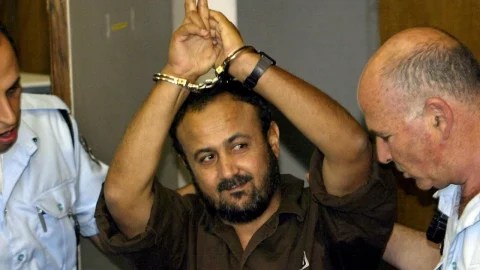
Israel rules out Marwan Barghouti’s release as Hamas says Netanyahu seeking to ‘blow up truce’
The Cradle | October 9, 2025
Israel will not release prominent Palestinian leader Marwan Barghouti as part of a prisoner exchange deal accompanying the ceasefire with Hamas in Gaza, an Israeli government spokesperson announced on 9 October.
“I can tell you at this point in time that he will not be part of this release,” spokesperson Shosh Bedrosian stated in a press conference on Thursday, as the ceasefire is expected to take effect.
However, Palestinian sources told Al Jazeera and Ynet that Barghouti’s case is still on the table, and Hamas is pressing hard for his release.
Barghouti is a prominent Palestinian legislator and leader of Fatah, a nationalist political party that dominates the Palestine Liberation Organization (PLO).
After surviving multiple assassination attempts by Israeli intelligence, Barghouti was imprisoned during the Second Intifada in 2002.
He is serving five life sentences, allegedly for organizing attacks that killed five Israelis.
After his conviction was announced, Barghouti stated in Hebrew, “This is a court of occupation that I do not recognize … A day will come when you will be ashamed of these accusations … I have no more connection to these charges than you, the judges, do.”
Barghouti penned a book while imprisoned in which he described being tortured by his Israeli guards, including being forced to sit on a chair with nails protruding into his back for hours at a time.
Despite his imprisonment, Barghouti has remained politically active and is widely viewed as more popular than Palestinian Authority (PA) President and fellow Fatah leader Mahmoud Abbas.
As part of the ceasefire between Hamas and Israel that went into effect Thursday, Hamas agreed to release 20 living Israeli captives and the bodies of 26 captives who died due to Israel’s bombing and starvation siege on the strip over the past two years. The fate of the two final captives is unknown.
In return, Israel committed to releasing 250 Palestinian prisoners serving life sentences and 1,700 Palestinians detained from Gaza. Throughout the war, many Palestinian detainees were tortured and raped in Israel’s notorious Sde Teiman prison, including 53 detainees who died in custody.
Israeli sources speaking to Israeli Army Radio and CNN stated Thursday that the bodies of slain Hamas chief Yahya Sinwar and his brother Mohammad will not be released as part of the exchange deal.
Sinwar was killed by the Israeli military in Gaza in October 2024, while his younger brother, Mohammad, who succeeded him as military leader of Hamas’s armed wing, was killed by Israel earlier this year.
The resistance movement has demanded the release of other high-profile prisoners, including PFLP Secretary-General Ahmad Saadat and chief Qassam Brigades engineer and leader, Abdullah Barghouti. Senior Hamas leader Abbas al-Sayed and Hassan Salameh are also among those the movement wants released.
A Hamas official speaking with Al Jazeera said that negotiations to finalize the list of Palestinian prisoners to be released are ongoing. The source added that Hamas is consulting with other Palestinian resistance movements regarding the list.
Hamas delivered its final response this morning regarding the timelines for implementing the agreement, the source stated.
Regarding the prisoner exchange, Hamas spokesman Hazem Qassem told Al Jazeera on Thursday that Israel is trying to “manipulate the dates, lists, and some of the agreed-upon steps.”
“The occupation [Israel] must adhere to what was agreed upon, and we call on the mediators to pressure it,” Qassem added.
Another Hamas official, Mahmoud Mardawi, said Israeli Prime Minister Benjamin Netanyahu “is seeking to blow up the ceasefire agreement” by “backtracking on the prisoner lists in an attempt to sabotage the understandings.”
This suggests that Netanyahu is trying to sabotage other aspects of the ceasefire as well, including issues related to the withdrawal, reconstruction, and the reopening of border crossings, Mardawi added.
According to Israeli media, Netanyahu has sabotaged multiple ceasefire agreements since the start of the genocide of Palestinians in Gaza two years ago.
Since the start of the war, Israeli forces have killed more than 67,000 Palestinians, about three percent of Gaza’s population, according to the territory’s Health Ministry. Another 169,000 have been wounded amid Israel’s destruction of much of the enclave.
However, in July, The Lancet medical journal published a research correspondence on the difficulty of accounting for the number of those killed by Israel’s war on Gaza, highlighting that both direct and indirect deaths should be considered.
Gaza ceasefire: How Israel’s war goals crumbled and the resistance prevailed
Press TV | October 9, 2025
Israeli regime and the Hamas resistance movement, with the mediation of the US as well as Egypt, Qatar, and Turkey, inked a new ceasefire deal early on Thursday, marking two years and two days since the start of the devastating genocidal war on Gaza
These two years, since October 7, 2023, have witnessed the Tel Aviv regime, supported by its Western allies, particularly the United States, commit horrendous war crimes, killing more than 67,000 Palestinians, most of them children and women, according to the Gaza Media Office.
The outcome has been a humanitarian catastrophe on a scale unseen in modern times, and yet, an enduring Palestinian resistance has defied all odds, proving that right ultimately prevails over might.
What began as a pledge of “total victory” has turned into a defining and decisive failure for the Zionist project. Despite relentless bombardment, siege, and starvation, the Benjamin Netanyahu-led regime in Tel Aviv has failed to achieve any of its strategic or political objectives in Gaza.
What Israel failed to achieve in Gaza
- Failure to crush the Palestinian resistance
After two years of no-holds-barred genocidal war, the Israeli regime failed to subdue Gaza or dismantle the Palestinian resistance, as it had envisioned following the historic and heroic Operation Al-Aqsa Flood by Hamas-led Palestinian resistance.
From the ruins of their homes and refugee camps across Gaza, new forms of resistance, resilience, and defiance emerged over the past two years.
The Palestinian resistance led by Hamas, though battered by the ruthless occupation, has remained organized, determined, and deeply rooted in national consciousness.
The vow to “erase Hamas” has become a symbol of hubris for the Zionist occupation, which was eventually compelled, under pressure from the Trump administration, to enter into a new truce with the very resistance it had sought to annihilate.
- Failure to break Palestinian will
Israel’s strategy of collective punishment —obliterating neighborhoods, bombing hospitals and schools, and starving civilians across the besieged territory — was designed to break the will of Palestinians.
Yet, even amid unimaginable suffering, the spirit of steadfastness, or sumud, has only grown stronger among Palestinians over the past two years, who refuse to submit, surrender, or abandon their homeland.
Families displaced multiple times have refused to leave. Resistance has evolved and expanded beyond armed struggle, becoming deeply embedded in other spheres of life.
- Failure to free captives through force
Despite near-daily bombings across Gaza, Israel has failed to free its captives held by the Palestinian resistance since October 7.
Every attempt to free them through military means has led only to further losses and humiliation for the occupation regime. In many instances, indiscriminate Israeli airstrikes have resulted in the deaths of captives alongside local Palestinians.
Negotiations have remained the only viable path to secure their release, from the very resistance Israel vowed to destroy.
- Failure to trigger a mass exodus
Israel’s goal of pushing Gazans into the barren deserts of Egypt or scattering them abroad has been met with fierce rejection, both from the resistance and the people themselves.
Gaza’s population, even when confined to makeshift tents or the ruins of their homes, has refused to accept the fate of another Nakba. They have resisted uprooting despite the regime’s repeated massacres.
- Failure to recolonize Gaza
Israeli plans to reoccupy Gaza or build illegal settlements amid the genocidal war have collapsed under new political, diplomatic, and military realities.
As the new ceasefire takes effect, Gaza remains uncolonized—and every bomb dropped has only strengthened Palestinian resolve and intensified global opposition to Israel’s settler-colonial ambitions.
- Failure to annex the West Bank
Israeli regime’s long-standing ambition to annex the occupied West Bank and realize its “Greater Israel” project has become a geopolitical mirage.
Local resistance, international scrutiny, investigations by the International Criminal Court, and growing internal divisions within the Zionist entity have hindered its advancement.
What Israel has actually achieved in Gaza
- A genocide broadcast to the world
Over the past two years, the world has witnessed — live and in real time — the mass murder of Palestinian children and women, the destruction of homes and hospitals, the starvation of families, and the erasure of entire communities.
Gaza has become the first genocide in history to be live streamed to billions across the globe, documented by journalists, civilians, and satellites alike.
History will remember this as one of the darkest moral collapses of the modern age, enabled by global silence and facilitated by Western regimes, especially the United States and its allies.
- Global condemnation and legal reckoning
From the United Nations to the International Criminal Court, the International Court of Justice, the Human Rights Council, and global NGOs, there is a consensus today Israel committing war crimes, ethnic cleansing, and genocide in Gaza.
The ICC has issued arrest warrants against Israeli premier Benjamin Netanyahu and former military affairs minister Yoav Gallant, while legal scholars continue to demand accountability.
The Brussels-based Hind Rajab Foundation — named after a young Palestinian girl murdered by the Israeli regime in Gaza — has documented Israeli war crimes and pressed governments worldwide to act against Israeli soldiers visiting their countries.
For the first time, the impunity once guaranteed by Western powers to the illegitimate regime has begun to fracture.
- Rising diplomatic isolation
Despite massive investments in propaganda and lobbying efforts across Western capitals to whitewash its genocidal atrocities, the Israeli regime stands increasingly isolated today, two years on.
Student movements, trade unions, artists, lawyers, academics and athletes have joined calls for boycotts and sanctions against the regime, once considered unthinkable
Public opinion, particularly among younger generations in Western countries, has decisively shifted. The once-dominant narrative of so-called “self-defense” has been exposed as hollow and hypocritical.
- Collapse of the Zionist narrative
Social media has become the new and decisive battlefield, and Israel has lost the war of ideas and narratives there as well.
Despite enlisting influencers and spending millions to spread Zionist propaganda about October 7 and its aftermath, the regime has failed to convince global audiences.
Citizen journalists in Gaza, armed with smartphones and unbreakable courage, have shattered decades of deception and lies.
The world now sees the truth unfiltered: a besieged population fighting for survival and liberation against an illegitimate occupier.
- Global awakening for Palestinian liberation
From South Africa to Latin America, London to Jakarta, Italy to Spain, millions now rally behind Palestine and its liberation from Israeli occupation.
It is no longer about a so-called two-state solution but about one and unified free Palestinian state, from the river to the sea.
The Palestinian cause has become a universal symbol of resistance against decades of illegal occupation, oppression, and settler-colonialism.
Calls for self-determination echo louder than ever, uniting diverse movements for justice under one cry: Free Palestine.
Two years on, as the new truce deal comes into effect, Israel’s genocidal campaign has not destroyed Gaza, but immortalized it. From the ashes, the Palestinian spirit still rises. Children continue to recite poems of return.
Resistance endures as the human will to exist, to remember, and to reclaim dignity.
Hamas, Israel agree to first phase of Gaza ceasefire under Trump plan
The Cradle | October 9, 2025
The newly announced ceasefire agreement, which was reached by mediators overnight, is set to take effect in Gaza on 9 October.
Phase one of US President Donald Trump’s 20-point plan will begin in the coming hours and days.
According to Israel’s Channel 14, the signing of the agreement will be followed by Israeli cabinet and government meetings to ratify the deal.
The Israeli army will then carry out its first withdrawal from Gaza’s population centers, in line with the agreement’s withdrawal map.
Twenty living Israeli captives will be released following 72 hours. In exchange, Tel Aviv is required to release 250 prisoners serving life sentences and 1,700 Palestinians detained from Gaza since 7 October 2023.
It remains unclear if Israel has approved the list of high-profile prisoners whose release Hamas has demanded, as the names have not been published.
Hamas leader Osama Hamdan said five border crossings will be opened for aid to enter the strip and be distributed by the UN and international aid groups.
According to an Israeli official in Prime Minister Benjamin Netanyahu’s office, cited by Channel 12, the ceasefire will not come into effect until the government ratifies the agreement on Thursday afternoon.
Drone strikes and artillery shelling have been reported in Gaza, despite announcements of the ceasefire.
Trump announced early Thursday that the “first phase” of the deal has been signed off on following hours of negotiations in Egypt.
“This means that ALL of the hostages will be released very soon, and Israel will withdraw [its] troops to an agreed upon line as the first steps toward a strong, durable and everlasting Peace,” he added, calling it a “great day for the world.”
“Tonight, an agreement was reached on all the provisions and implementation mechanisms of the first phase of the Gaza ceasefire agreement, which will lead to ending the war, the release of Israeli hostages and Palestinian prisoners, and the entry of aid. The details will be announced later,” said Qatari Foreign Ministry spokesman Majed al-Ansari.
Hamas also released a statement confirming that an agreement has been reached.
“An agreement has been reached to end the war on Gaza, withdraw occupation forces from the strip, allow the entry of aid, and carry out a prisoner exchange,” Hamas said. “We call upon President Trump, the guarantor states of the agreement, and all Arab, Islamic, and international parties to compel the occupation government to fully implement the terms of the agreement and prevent it from evading or delaying.”
“We affirm that the sacrifices of our people will not be in vain,” it added.
Gaza Civil Defence: Israel using car bombs in strikes on residential areas despite Trump’s calls for halt
MEMO | October 9, 2025
The General Directorate of Civil Defence in the Gaza Strip said Wednesday that Israeli forces continue to deploy car bombs packed with large quantities of explosives against residential neighbourhoods, despite recent calls from the US President Donald Trump to stop bombing the enclave.
In a statement, Civil Defence officials reported that Israeli forces are using an average of ten car bombs daily in densely populated areas, including Al-Nasr, Sheikh Radwan, and Al-Daraj neighbourhoods, as well as in Tal Al-Hawa and Al-Sabra.
According to the statement, each explosion causes widespread destruction within a 300-meter radius, with damage extending as far as 500 meters. Shrapnel reportedly travels over a kilometre, inflicting severe injuries on civilians, including displaced families and patients in nearby hospitals.
The Civil Defence said some of the blasts reached areas less than 200 meters from Al-Thalathini Street, one of Gaza City’s main arteries, calling the strikes a deliberate targeting of infrastructure and residential zones regardless of civilian presence.
The Directorate described the use of car bombs of this scale as “an unprecedented development in modern warfare and a flagrant violation of international laws prohibiting the targeting of civilians.” It also held the international community responsible for its “deafening silence,” warning that inaction amounts to tacit encouragement for further bloodshed and destruction.
Italian PM Meloni Embroiled in ICC Complaint Alleging Complicity in Gaza Genocide
21st Century Wire | October 9, 2025
Italian Prime Minister Giorgia Meloni and a number of ministers are confronted with an ICC complaint that accuses them of complicity in genocide, as a group of jurists and attorneys point to ongoing arms collaboration with Israel and a lack of protection for the Global Sumud Flotilla. Jurists and Lawyers from Giuristi e Avvocati per la Palestina (GAP) have initiated two legal actions aimed at holding Italy accountable for its involvement in the Gaza conflict. The first initiative, submitted to the ICC, charges the Italian government with complicity in war crimes, crimes against humanity, and genocide. The second initiative addresses the government’s purported negligence in safeguarding the Global Sumud Flotilla, a civilian fleet transporting humanitarian aid to Gaza, which was intercepted by Israeli forces in international waters.
According to a report from Lavialibera, the initiative has garnered backing from more than fifty notable figures in Italy, many of whom are active in politics and culture. The initiative has currently attracted the support of nearly 6,000 citizens. Gianluca Vitale, one of the GAP lawyers behind this action, explained to Lavialibera:
“We are calling for proceedings to be initiated against the Italian government, namely Prime Minister Giorgia Meloni , Foreign Minister Antonio Tajani , and Defense Minister Guido Crosetto , as well as Leonardo Spa CEO Roberto Cingolani” adding, “If there is substantial collaboration with Israeli authorities who are committing crimes, it means that the Italian authorities are complicit in the crime being committed.”
In a recent interview with Italian state broadcaster RAI 1, Meloni acknowledged that she and the aforementioned individuals faced a complaint at the International Criminal Court for their alleged involvement in the Gaza genocide.
Despite Meloni’s nervous reaction, the move is not unexpected, given that comparable actions have already been taken throughout Europe. In Germany, legal actions have been filed with the ICC and local courts targeting government officials and arms manufacturers for their alleged involvement in supporting Israel’s military actions in Gaza. Furthermore, more than 100 lawyers in France have officially requested the ICC to look into France’s potential complicity in genocide concerning Gaza.
In her July 2025 report, Francesca Albanese, the UN Special Rapporteur on the Palestinian Territories, indicates that eight states and at least 1,650 companies, including Italian manufacturer Leonardo S.p.A., contribute to the manufacturing and distribution of components and parts for the Israeli F-35 fleet, which Israel customizes and maintains in partnership with US defense contractor Lockheed Martin and local companies. INVESTIGATE, a project run by Action Center for Corporate Accountability of the American Friends Service Committee (AFSC), which exposes corporate complicity in state violence, issued a comprehensive report regarding Leonardo S.p.A., Italy’s largest weapons manufacturer and its dealings with Israel.
As per information from the Stockholm International Peace Research Institute (SIPRI), Italy was among just three nations that exported “major conventional arms” to Israel between 2020 and 2024. However, it is noteworthy that the United States and Germany accounted for a staggering 99 percent of the exports in the broader category of larger weaponry, which encompasses aircraft, missiles, tanks, and air defense systems.
Furthermore, the Jurists and lawyers for Palestine organization (GAP) formally cautioned the Italian government on September 24, urging it to “take all necessary measures to genuinely safeguard the Global Sumud Flotilla and its participants.” With civilian ships trying to breach the Israeli naval blockade and provide humanitarian assistance to Gaza being intercepted and their crew members detained, legal proceedings are being contemplated to assess the potential accountability of the Italian government regarding the actions of the Israeli Navy. It is generally recognized that the Israeli military’s recent actions against the Global Sumud Flotilla are deemed illegitimate, as they took place in international waters where Israel lacks the legal right to intervene, intercept and abduct its passengers against their will, making such actions a potential act of piracy.
In accordance with the recommendations issued by the UN International Court of Justice (ICJ), all state parties the UN Convention on the Prevention and Punishment of the Crime of Genocide, and the Rome Statute of the International Criminal Court—which Italy ratified on July 26, 1999—are required upon learning of, the existence of a serious risk that genocide will be committed, to implement reasonable measures within their power to prevent genocide. However, according to GAP, Meloni’s Government has not only refrained from doing so but, to the contrary, contributed to Israel wae crimes against the Palestinians.
According to GAP’s lawyer, the Italian government’s liability hinges on two key factors:
Firstly, demanding compliance to the Israeli blockade and thus deeming it legitimate amounts to complicity in the crime. The blockade is integral to Israel’s criminal actions, whether they be war crimes or genocide, as it plays a role in perpetuating the offensive within the Gaza Strip and employs starvation as a weapon.
The second factor pertains to the choice to withdraw the Navy vessel that was only briefly sent to escort the Global Sumud Flotilla. Withdrawing and consequently denying assistance signifies a failure to fulfill the duty of protection and, once again, inadvertently aids in the perpetration of a crime.
Turkiye to boost US gas imports, cut reliance on Iran and Russia
The Cradle | October 9, 2025
Turkiye is moving to cover more than half of its natural gas demand by 2028 through domestic production and increased US liquefied natural gas (LNG) imports, decreasing reliance on Iran and Russia, according to analysts cited by Reuters on 8 October.
The plan follows a White House meeting on 25 September, during which US President Donald Trump urged Turkish President Recep Tayyip Erdogan to curb Russian energy purchases, as part of the US push to press allies to scale back ties with both Moscow and Tehran.
Ankara’s strategy centers on expanding LNG terminals and boosting local output through the state-owned energy firm, Turkish Petroleum Corporation (TPAO).
According to Turkiye’s Energy Exchange (EPIAS), the country’s LNG terminals can now import up to 58 billion cubic meters (bcm) of gas each year, enough to meet its entire domestic demand.
Domestic production and contracted LNG imports are projected to exceed 26 bcm annually from 2028, compared with 15 bcm this year.
That would account for more than half of Turkiye’s 53 bcm gas demand, sharply reducing its need for Russian and Iranian pipeline supplies.
“Turkiye has been signalling that it will take advantage of the [global] LNG abundance,” said Sohbet Karbuz of the Paris-based Mediterranean Organisation for Energy and Climate (OMEC).
Although Russia remains Turkiye’s largest supplier, its share of the market has fallen from over 60 percent two decades ago to 37 percent in the first half of 2025.
Moscow’s long-term pipeline contracts – covering 22 bcm annually via Blue Stream and TurkStream – are nearing expiry. Iran’s 10 bcm contract ends next year, while Azerbaijan’s 9.5 bcm deals run until 2030 and 2033.
To replace these, Ankara has signed $43 billion worth of LNG agreements with US suppliers, including a 20-year deal with Mercuria in September.
Turkish Energy Minister Alparslan Bayraktar said in a recent interview that Turkiye “must source gas from all available suppliers,” which includes Russia, Iran, and Azerbaijan, but noted that US LNG offers cheaper alternatives.
Analysts believe Ankara will likely burn Russian and Iranian gas domestically while re-exporting imported LNG and its own output to Europe, where a full ban on Russian energy is expected by 2028.
Turkiye’s state energy company BOTAS has already begun small-volume exports to Hungary and Romania as part of its efforts to become a regional gas hub.
Japan’s Green Energy Failures Serve as a Warning to the US
By Yoshihiro Muronaka | The Western Journal | October 6, 2025
In August 2025, Japanese media revealed that Mitsubishi Corporation was preparing to withdraw from three offshore wind projects off the coasts of Chiba and Akita prefectures.
In 2021, Mitsubishi had won these sites with remarkably low bids of 8 to 11 cents/kilowatt-hour (kWh), hailed as proof of Japan’s corporate strength and renewable ambition.
But reality was harsh. Costs for steel, turbines, and logistics surged. The yen weakened, interest rates rose, and certification processes faced delays. By 2025, Mitsubishi had already booked over $350 million in impairment losses, with more likely if the projects continued. The retreat is not just a corporate failure; it exposes apparent self-contradictions in Japan’s energy policy.
Across the Atlantic, offshore facilities have faced similar headwinds. On the U.S. East Coast, Ørsted cancelled two large projects in New Jersey, absorbing billions in losses. BP and Equinor abandoned contracts in New York after costs rose by 40 percent beyond estimates. In some cases, companies chose to pay hefty penalties rather than commit to losing ventures.
Europe, the pioneer of offshore wind, has also stumbled. In the U.K., Vattenfall halted its Norfolk Boreas project, citing a 40 percent cost increase. Even Denmark, often celebrated as a leader, has delayed new tenders.
Market signals in these regions were clear: When economics fail, projects are scaled back or canceled. Japan, however, continues to treat offshore wind as a central pillar of its 2040 roadmap, aiming for 45 gigawatts of capacity. Why the difference?
Once designated a national project, policies in Japan are difficult to reverse. Offshore wind has been tied to three goals at once: decarbonization, energy security, and industrial revitalization. Billions in subsidies through the Green Innovation Fund are already committed, while local governments and industries expect contracts and jobs.
In effect, offshore wind has become a new type of public works project. Ports, construction companies, heavy industry, and trading houses all benefit from government support. For politicians, it delivers regional development; for bureaucrats, it provides visible progress. Under these conditions, corporate withdrawal is treated as a temporary setback and prompts no policy review.
The debate over energy costs often centers on the Levelized Cost of Electricity (LCOE), which narrowly focuses on the cost of generating a kilowatt-hour of electricity. However, this metric fails to capture the broader economic realities encapsulated by the Full Cost of Electricity (FCOE).
FCOE provides a more comprehensive assessment by incorporating additional factors such as the expense of backup power from fossil or nuclear plants to address the intermittency of renewable sources, the costs associated with grid expansion and balancing services to maintain stability, as well as subsidies, premiums, and public support schemes that often prop up certain energy technologies. Furthermore, FCOE accounts for the long-term costs of decommissioning, recycling, and environmental restoration, ensuring a more accurate reflection of the true economic and environmental impact of electricity production.
When these are included, offshore wind’s cost can be double or triple its LCOE.
Offshore wind’s LCOE is around 12 to 16 cents/kWh, but when the full cost of electricity (FCOE) is considered, it rises to 20 to 30 cents/kWh. Nuclear and gas remain much lower, at roughly 12 to 14 cents/kWh and 10 to 12 cents/kWh, respectively.
OECD studies confirm that as “renewables” such as wind and solar rise from 10 percent to 30 percent of the grid, FCOE escalates sharply. Yet Japan highlights falling LCOE while downplaying FCOE, creating an illusion of competitiveness.
Because fixed-bottom projects face difficulties, Japanese policymakers increasingly promote floating offshore wind as a unique advantage. Japan’s deep coastal waters, they argue, make floating turbines more suitable.
Globally, however, floating wind remains at the developmental stage. Norway’s Hywind Scotland and France’s Provence Grand Large provide valuable data, but their costs remain far higher than fixed-bottom projects. Commercial viability has not yet been proven. Betting on floating wind as a “game-changer” risks repeating the same error: political enthusiasm without economic grounding.
Japan’s offshore wind experience is not just about Japan. It illustrates how energy policy everywhere can drift into policy inertia, selective cost reporting, technological optimism, and entrenched interests.
The lesson is clear. Policymakers should always assess the full costs, not just partial figures. They should heed market signals and adjust policy accordingly. Most importantly, they should avoid turning energy policy reliant on unproven technology into political patronage.
Mitsubishi’s retreat shows that even giants cannot overcome flawed policy frameworks. If Japan, with its formidable industrial base, struggles to make offshore wind viable, others should pay attention.
Japan’s offshore wind setback is more than a domestic issue. It is a global reminder of the dangers of ignoring full costs and clinging to illusions. Ambitious targets and political inertia can mask reality, but economics will always reassert itself.
For policymakers worldwide, Japan’s case should not be seen as an embarrassment, but as a warning and an opportunity: Energy transitions must be guided by facts, not hopes, if they are to be sustainable.
Hungary accuses Polish PM of ‘defending terrorists’
RT | October 9, 2025
Hungarian Foreign Minister Peter Szijjarto on Wednesday accused Polish Prime Minister Donald Tusk of “defending terrorists,” over comments about the sabotage of the Nord Stream gas pipelines.
Tusk had claimed the day before in a post on X that “the problem with North Stream 2 is not that it was blown up. The problem is that it was built.”
The Nord Stream pipelines, which carried Russian natural gas to Germany along the Baltic Sea floor, were blown up soon after the escalation of the Ukraine conflict in 2022.
Szijjarto condemned the Polish prime ministers post in a reply, asking what else the Polish prime minister could find “forgivable or even praiseworthy.”
“According to Donald Tusk, blowing up a gas pipeline is acceptable,” he wrote.
“That’s shocking… One thing is clear: we don’t want a Europe where prime ministers defend terrorists,” he added.
Tusk also argued on Tuesday that it is not in Poland’s interest to hand over a Ukrainian man German investigators believe was involved in the Nord Stream sabotage.
While Berlin’s prosecutors have attributed the sabotage to a small group of Ukrainian nationals, Moscow has dismissed the version of events as “ridiculous.” Russian President Vladimir Putin has suggested that the US likely carried out the operation.
The EU has called for a total cut of Russian energy by 2027, but some bloc members like Slovakia and Hungary rely on Russian crude delivered via the Soviet-era Druzhba oil pipeline.
Ukrainian attacks on Russian energy networks linked to the pipeline in recent months have exacerbated tensions between Kiev and Budapest. Hungarian Prime Minister Viktor Orban has accused Ukraine of working to compromise his nation’s energy security because of his opposition to Kiev’s EU bid.
The Mystery of Trump, Ukraine, and Russia
By Jacob G. Hornberger | FFF | September 18, 2025
Hardly anyone in the mainstream press addresses the mystery of how Trump went from what was supposedly a secret agent of the Russians to an ardent opponent of Russia in the Ukraine-Russia war. My hunch is that the commentators in the mainstream press are so excited that Trump has turned pro-Ukraine that they don’t care that they were, not so long ago, accusing him of being a secret agent of Russia.
After all, who can forget the daily refrain during Trump’s first term in office. “Robert Mueller is going to save us!” We had to be subjected to that refrain from both Democrats and the mainstream press for more than a year. The notion was that Trump was, as president of the United States, secretly serving the interests of Russia. Democrats and most of the mainstream press were convinced that Robert Mueller, a lawyer who had been appointed as special counsel to investigate the matter, was going to save us all by concluding that Trump was, in fact, serving as a secret agent of Russia, which would then result in Trump’s removal from office through impeachment.
As we all know, Robert Mueller did not save us because there was nothing to save us from. The entire matter was one great big ridiculous conspiracy theory on the part of the mainstream press and Democrats. After a year of extensive investigation by a huge and very expensive staff of lawyers, Robert Mueller ended up concluding that the allegation was bogus.
Nonetheless, most everyone thought that Trump would do everything possible to establish friendly and peaceful relations with Russia. Such a policy, of course, wouldn’t make him a secret agent of Russia, any more than President Kennedy’s efforts in that direction made him a secret agent of Russia.
Yet in his first term in office, Trump ended up taking a fairly adversarial stand toward Russia. It was reasonable to conclude, however, that one reason he did that was an effort to bend over backwards to show that the secret-agent accusations were entirely bogus.
This time around as president, however, there was nothing that Trump had to prove. During his 2024 campaign, he made it clear that he intended to bring an end to the Ukraine-Russia war as soon as he took office. Of course, the easiest and fastest way to have done that was to immediately cut off all U.S. foreign aid to Ukraine. For a while, it appeared that that was precisely what Trump was going to do. When Ukrainian president Volodymyr Zelensky visited Trump and Vice President Vance in the White House, both of them berated, insulted, humiliated, and dressed down Zelensky in public. Zelensky ended up leaving that meeting with his tail between his legs. Trump even stated that it was Ukraine that had started the war. The message seemed clear — U.S. aid to Ukraine was going to terminate, which would, of course, have been the logical course of action given Trump’s conviction that it was Ukraine that started the war.
However, sometime afterward, Trump did an about-face and began berating Russia and Russian president Vladimir Putin for not doing enough to end the war. He began threatening Putin with more economic sanctions. He made it clear that the U.S. government would continue supporting Ukraine, especially with weaponry. He has also taken an increasingly aggressive position toward Russia and Putin.
The mainstream press treats all this as perfectly normal. I myself find it extremely mysterious. How does a guy who is accused of being a Russian agent go all the way to becoming a Russian adversary? For me, that’s quite a switch.
The following is my opinion as to what has happened to bring about this very radical turnaround. As longtime readers of my blog know, I have long maintained that it is the national-security branch of the federal government — i.e., the Pentagon, the CIA, and the NSA — that is in charge of the federal government, especially in foreign affairs, and that the other three branches simply operate in support of the national-security branch.
It was the national-security branch that used NATO to successfully provoke Russia into attacking Ukraine. It did that by having NATO, an old relic from the Cold War racket, move eastward toward Russia’s borders knowing full well that Russia would object and ultimately invade Ukraine, after which they could condemn Russia for its “aggression.” The objective was to use a war with Russia to “degrade” Russia, give Russia its own “Afghanistan,” and bring about regime change within Russia. The U.S. would supply the weaponry and cash to Ukraine to accomplish this. It would only be Ukrainian soldiers, not American soldiers, who would be dying and so the American people wouldn’t care about what the national-security branch had done to bring about the war.
What the Pentagon, the CIA, and the NSA failed to confront was the distinct possibility that Russia would end up winning the war, which would necessarily mean a defeat of the United States. After the deadly 20-year U.S. fiasco war in Afghanistan and the installation of a pro-Iranian regime in the U.S. war of aggression against Iraq, the last thing the national-security branch wants is the humiliation of another military defeat, especially at the hands of Russia — its adversary in its old Cold War racket.
So, it’s my opinion that the national-security establishment has put the squeeze on Trump and made him see how important it is to “national security” that Russia not be permitted to win this war. It is my opinion that Trump has caved in to such pressure, just like Congress and the federal courts have long deferred to the national-security branch. That, to me, is a logical explanation for Trump’s about-face on Russia and also why he no longer heavily emphasizes the need to “drain the swamp” and bring an end to the “deep state.”
NATO eyeing ‘forceful’ response to Russia – FT
RT | October 9, 2025
NATO is considering easing restrictions on pilots to allow them to fire at unauthorized Russian aircraft, and drastically increasing its military footprint on the country’s border, the Financial Times reported on Thursday, citing sources. This comes amid Western claims that Russia violated EU airspace, which Moscow has denied.
Last month, Estonia and Poland claimed that Russian aircraft illegally entered their airspace. Western media has also speculated that Russia may be behind drone incidents in other EU nations, which at times disrupted air traffic. Moscow has said the West has not provided any evidence for the claims.
Several NATO members are now debating “a more forceful response” to Russia, according to the Financial Times.
The reported proposals include arming surveillance drones that currently gather intelligence on Russian military movements and lowering the threshold for fighter pilots on NATO’s eastern border to take down perceived threats. Other options under discussion involve conducting military exercises directly along the Russian border, the report said.
Two NATO officials told the FT that one urgent task is to simplify the rules of engagement, which now differ among member states. Some nations require pilots to visually identify targets before firing, while others permit engagement based on radar data or the perceived direction and speed of an approaching aircraft.
FT sources noted that the talks, initiated by states bordering Russia and backed by France and the UK, later developed into a bloc-wide discussion – which, however, is said to be in the early stages. Some governments reportedly advocate for strong deterrence policies, though others urge restraint to avoid direct confrontation.
The article comes on the heels of last week’s EU summit on creating a ‘drone wall’ to deter alleged Russian incursions, with Politico reporting that the meeting “descended into a familiar stalemate.”
Russia has accused NATO of escalating tensions near its borders through expanded military deployments and exercises. Kremlin spokesman Dmitry Peskov has also stated that NATO is “de facto at war” with Russia due to the bloc’s support for Ukraine.
Featured Video

Theodore Postol: Iran’s Missiles & Drones Were Underestimated
or go to
Aletho News Archives – Video-Images
From the Archives
What is the Israeli Lobby in Australia Doing in Interfaith Dialogue?
By Ali Kazak | Dissident Voice | October 11, 2015
For years Israel and its lobby around the world have been trying to normalise their relations with Arabs and Muslims without solving the Palestine Question.
One of the methods they resorted to in the last few years is using human rights and community organizations such as interfaith dialogue and Multiculturalism to achieve this objective and to: isolate the Palestinians, marginalise the Palestine question, end Israel’s isolation, and prevent criticism of Israel, knowing that these organisations will be the first to stand against Israel’s violations, racial and religious discrimination.
The group responsible for this task in Australia is The Australia/Israel & Jewish Affairs Council (AIJAC); its Director of International & Community Affairs, Jeremy Jones is in charge of lobbying religious community organizations, specifically Muslims and Christians. Consequently he convened the Faith Communities for Reconciliation, founding participant in the Australian Partnership of Religious Organisations and the Australian National Dialogue of Christians, Muslims & Jews.
AIJAC is a private political propaganda group. It is recognised as the main Israeli lobby in Australia. It coordinates its activities and works intimately with the Israeli embassy in Canberra and different institutions in Israel. It is privately funded by some Jewish businessmen. It monitors closely Australian politicians, the media, ethnic and religious groups, (especially Arabs and Muslims), unions and academics on their stands towards Israel and the Palestine question. … continue
Blog Roll
 Aletho News
- The killing of three Indonesian soldiers in Lebanon should remind Jakarta that Israel does not want peace
- Defeated and delusional: Netanyahu’s remarks reveal $80bn war failure, says analyst
- Iran’s friends are about to make life much more difficult for Israel and the US
- The war of liberation of the Arab and Islamic peoples expands across the Gulf
- Envoy warns UN on Trump’s threat to ‘obliterate’ Iran’s civilian infrastructure
- The Larak Corridor: Iran’s Rial Gate With No US, No Israel, and No Way Around
- ‘Economic terrorism’: Steel facilities hit again in US-Israeli strike
- ‘War Crime’: Iran condemns attacks on Arak, Ardakan nuclear sites
- Two-thirds of Americans want quick end to Iran war even if goals unmet
- Trump to Give “Important Update on Iran” Wednesday in Prime-Time Speech
- If Americans Knew
- Israel wants US to bomb more of Iran’s civilian structures (113,000 is not enough) – Not a ceasefire Day 173
- Ann Coulter Rips Into Fox News for Iran War Coverage
- Joe Kent Urges Americans To Call White House and Congress To Object To Sending Troops Into Iran
- DNC Resolution to Reject AIPAC Funding Puts Democratic Leaders in the Hot Seat
- Swedish foundation to build 400 schools as over 650,000 Gaza children remain without education for 2 years
- Israeli army admits photshopping image of slain Lebanese journalist
- This is how Israel is systematically killing health workers under the cover of war in Lebanon
- Carrying life under fire: Israeli invasion of Lebanon leaves pregnant women facing deadly risks
- Champagne all around for the new death penalty (for Palestinians) law – Not a ceasefire Day 172
- Why are Palestinian books struggling to be seen on Amazon?
- No Tricks Zone
- New Study Finds Warming Saves Lives…Cold Temperatures 12 Times More Deadly Than Excess Heat
- German Science Blog Accuses PIK Climate Institute Of Hallucinating Climate Tipping Points
- Devastating Assessment Of Comirnaty Vaccine By Former Senior Pfizer Europe Toxicologist
- New Study: CO2 Is ‘Effectively Negligible’ As An Explanatory Climate Change Factor Since 2000
- Former Pfizer Toxicologist Dr. Helmut Sterz Tells Bundestag Hearing Pfizer Vaccine Should Have Never Been Approved
- Energy Expert: Germany’s Nuclear Phaseout Was A “500 Billion Euro Mistake”
- New Research: South Australia’s Mid-Holocene Sea Surface Temperatures Were 4°C Warmer Than Today
- Storing Green Energy To Last Germany 10 Days Would Require A 60-Million Tonne Battery
- New Studies: UK Sea Levels Were 4 Meters Higher Than Today During The Mid-Holocene
- Destructive Green New Deal: German Energy And Metal Group Warns Of Drastic Crisis
 Aletho News