Fact Checking The New York Times
Tony Heller | December 6, 2025
The New York Times has a website claiming to show an increase in 90 degree days in US cities. In this short video I fact check their claims using app.visitech.ai
How Much Hotter Is Your Hometown Than When You Were Born? – The New York Times
Villains of Judea: Ronald Lauder and his War on American Dissent
For Lauder, Israel always comes first.
José Niño Unfiltered | December 16, 2025
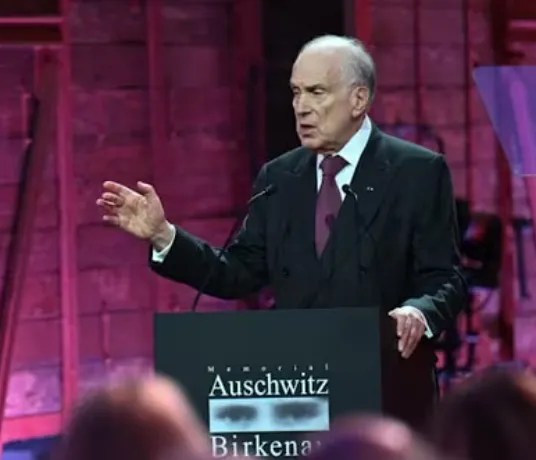
World Jewish Congress President Ronald Lauder likes to present himself as a civic minded elder statesman, a sober billionaire warning America about a rising tide of antisemitism.
At the Israel Hayom Summit on December 2, 2025, he framed the moment as a crisis of the West itself, calling it “a full-scale assault on truth, on democracy, and on the safety of Jewish people everywhere,” and insisting, “This is not normal. And it is not ‘just criticism of Israel.’ It is the world’s oldest hatred, once again wearing political clothing.”
Lauder was referring to the rise of antisemitism and anti-Israel sentiment worldwide in the wake of Israel’s 2-year bombing campaign in Gaza.
Then he sharpened the spear and aimed it at domestic enemies like Tucker Carlson, who has been one of the most vocal critics of Israel in the post-October 7 reality we live in. He told the audience, “Tucker Carlson is the Father Coughlin of our generation.” In the same speech he warned that complacency is over, because “antisemitism is rampant throughout our culture,” and he demanded a political and institutional counteroffensive.
That is the Lauder formula in its purest form. He wraps a totalizing political program in the language of safety and moral emergency, then treats America’s public life as territory to be reorganized around his crusade. The target is never merely hatred. The target is dissent, drift, and disobedience from the priorities he has chosen, priorities that consistently put Israel first.
Lauder did not arrive at this posture late in life. He was born into power in New York City in 1944, the heir to the Estée Lauder fortune, raised in elite institutions, and trained for international influence through business and foreign policy studies. He entered the family company early, then moved into government in the Reagan era, where he served at the Pentagon as Deputy Assistant Secretary of Defense for European and NATO policy.
Ronald Reagan then tapped him as U.S. ambassador to Austria in 1986. In Vienna, he did not behave like a neutral American emissary. He turned his diplomatic post into a stage for historical confrontation and political signaling. Lauder refused to attend the inauguration of Austria’s president Kurt Waldheim amid allegations of him being involved in or being aware of National Socialist atrocities in the Balkans during his service as a German army lieutenant in World War II. He also fired U.S. diplomat Felix Bloch for engaging in suspected espionage activities.
After government service, Lauder tried to convert his vast wealth into formal power at home. In 1989, he ran for mayor of New York City as a Republican, where he spent big bucks to get his name out and campaign to the right of Rudy Giuliani, only to lose the primary. Even in defeat, the pattern held. He treated politics as an arena where money does all the talking, and he kept looking for levers that could bend public life to his will.
He found one in term limits. During the 1990s he poured resources into imposing term limits on New York City officials, selling it as a democratic reform and a check on machine party politics. Yet in 2008, when Mayor Michael Bloomberg wanted a third term, Lauder reversed course and supported extending those limits, a turn that mainstream critics interpreted as a billionaire bargain dressed up as civic necessity. However, from the perspective of long-time observers of Jewish behavior, Lauder’s support for Bloomberg reflects a pattern of co-ethnic solidarity among Jewish power brokers.
While Lauder played these games in New York, his real career was consolidating leadership in the organized Jewish political world. Notably, Lauder was a member of the Mega Group—a mysterious network of Jewish oligarchs that worked behind the scenes to advance Jewish interests and strengthen pro-Israel bonds among Jews in America. Leslie Wexner, founder of The Limited and Victoria’s Secret, and the late Jewish sex criminal Jeffrey Epstein were among the most prominent members of this Jewish consortium. By 2007, Lauder had become president of the World Jewish Congress, a position that turned him into a roaming power broker who meets heads of state and treats international politics as a permanent lobbying campaign.
From that perch, he repeatedly framed Western security architecture as a vehicle for Israeli priorities. In 2011, he publicly argued that Israel should be admitted into NATO, insisting, “Israel needs real guarantees for its security,” and pressing NATO states to bring Israel into the alliance.
In 2012, he attacked European pressure campaigns on Israel with maximalist rhetoric. When Irish officials floated an EU ban on goods from Israeli communities in the West Bank, Lauder called boycott talk “cynical and hypocritical,” and declared, “Minister Gilmore is taking aim at the only liberal democracy in the Middle East while keeping quiet about those who really wreak havoc in the region: the Assads, Ahmadinejads and their allies Hezbollah and Hamas.” He added that the West Bank was “legally disputed and not illegally occupied.”
He carried the same posture with respect to Iran — enemy #1 for world Jewry at the moment. In 2013, as Western diplomats negotiated with Tehran, he mocked their perceived softness and conjured Munich analogies, warning, “Just as the West gave up Czechoslovakia to Hitler in Munich in 1938, we see what is happening again and the world is silent,” and boasting, “Frankly, only France stands between us and a nuclear Iran.” In 2015, he escalated again, attacking the nuclear deal with a moral curse, saying, “The road to hell is often paved with good intentions,” and arguing that the agreement could revive Iran economically without stopping long term nuclear ambitions.
The story kept darkening as his proximity to Israeli power deepened. In 2016, Israeli police questioned Lauder in connection with “Case 1000,” the Netanyahu gifts affair. Reports said investigators sought his testimony because of his closeness to Netanyahu and the broader allegations involving luxury gifts and favors. Lauder was not charged, but the episode revealed how near he operated to Israel’s governing circle, not as an outside friend, but as part of the broader, transnational Jewish network.
By 2023, he openly wielded donor money as a disciplinary weapon in American institutions. After the October 7 attacks and campus controversies, he warned the University of Pennsylvania that, “You are forcing me to reexamine my financial support absent satisfactory measures to address antisemitism.” The message was simple. If a prestigious American university fails to police speech and activism the way he demands, he will squeeze it financially until it complies.
In 2025, Lauder continued supporting Israel’s ethnic cleansing campaign in Gaza. He categorically rejected the idea that Israel bears any responsibility for ending the conflict, insisting, “The truth is simple: the war could end tomorrow if Hamas were to release the remaining hostages and disarm.” On education and propaganda, he stopped pretending the solution is persuasion alone. At the World Jewish Congress gala in November 2025, he argued that the education pipeline must be rebuilt from the ground up, declaring, “The entire education system — K-12 to college — must be retaught,” and adding, “It’s time we fight back with stronger PR to tell the truth.”
He also made the threat explicit. In a widely shared clip, he vowed, “Any candidate running for a seat… whose platform includes antisemitism, we will target them as they target us.”
Like most of the Israel First set, Lauder was ecstatic about the toppling of Bashar al-Assad’s government in Syria in late 2024. In September 2025, he met former al-Qaeda terrorist-turned Syrian President Ahmad al-Sharaa on the sidelines of the United Nations General Assembly and afterward said, “We had a very positive discussion about normalization between Israel and Syria.”
Seen in order, the picture is not complicated. Lauder builds influence through money, embeds himself in elite institutions, and uses both to steer policy and culture toward a relentless Zionist agenda. He does not talk like a man defending American sovereignty. He talks like an agent of world Jewry who expects America’s parties, schools, media, and alliances to function as enforcement arms for a foreign cause.
That is why his December 2025 sermon about antisemitism matters. It is not only a warning. It is a blueprint. When Lauder says “If we don’t tell our own story, others will rewrite it,” he is not describing a cultural debate. He is declaring ownership over the narrative, and claiming the right to punish anyone in American life who refuses to repeat it.
In the end, Ronald Lauder emerges not as a guardian of American civic life but as a disciplined enforcer of a foreign political creed, using wealth, intimidation, and moral blackmail to bend institutions to his will. What he calls a fight against hatred looks increasingly like a campaign to subordinate American sovereignty, speech, and policy to the imperatives of Israel and the transnational Jewish clique that sustains it.
Stop The Hate UK: The Shadowy Israel-Aligned Group Targeting MintPress staff & anti-genocide organizers
Mint Press News | December 9, 2025
In October, MintPress graphic designer and field photographer, Ibrahim Abul-Essad opened his door to find Patrick Sawer of The Daily Telegraph demanding answers.
A prolific writer who has penned 28 pro-Israel articles in the past two months alone, Sawer asked the British Palestinian journalist to respond to pro-Israel pressure group Stop The Hate U.K.’s campaign for him to be prosecuted for “anti-Semitic hate crimes.”
Abul-Essad’s “crime” was attending an October 2024 demonstration in London protesting an event featuring former Israeli prime minister Ehud Olmert speaking on the future of Gaza – a case that the Metropolitan Police have already looked into and dismissed.
Sawer has previous connections to Stop The Hate U.K. A 2024 Daily Telegraph article framing pro-Palestine marchers as racists, for instance, appears to have been based largely on intelligence gathered by Stop The Hate U.K., and features multiple images of protestors taken without their knowledge.
But who are Stop The Hate U.K.? And where did they come from? MintPress News explores the group’s rise, its agenda, and its scandalously close links to both the British and Israeli governments.
Israeli Front Group?
Stop the Hate U.K. was founded in early 2024, at the height of the Israeli attack on Gaza, in order to stymie and oppose the growing wave of support for Palestinian liberation across Great Britain. The group has attempted to equate support for human rights with terrorism.
As their official Twitter bio reads, “We stand in opposition to the hate marches that have swamped our country since the 7.10 massacre. We shall not be cowed. Terrorist supporters off our streets!” The organization has repeatedly pressured the British government to ban demonstrations, and condemned the police for their insufficient vigor in suppressing the movement.
Although it states that it is a non-profit organization, MintPress could find no registration of the group with the Charity Commission for England and Wales.
The organization’s website describes it was founded “in response to the repeated failures of the Metropolitan Police to address anti-Semitic incidents at Palestinian Solidarity Campaign (PSC) marches.”
This will be news to many in the U.K., where police have arrested over 2300 people under the Terrorism Act of 2000 for peacefully opposing the designation of activist group Palestine Action as a terrorist entity, putting it on a par with the likes of ISIS and Jabhat al-Nusra. So aggressive has British authorities’ repression of free speech been, that it was officially rebuked by Amnesty International as a grave breach of human rights.
Stop the Hate U.K. organizes their own demonstrations. However, they have not been successful in attracting mass participation. Unlike pro-Palestine marches that can draw in as many as one million Britons, an image posted by Stop The Hate U.K. of their recent protest in Brighton shows fewer than 40 attendees. They have, however, had more success disrupting solidarity events, filming or harassing protestors and pushing for their prosecution. In this role, The Canary notes, they serve as unofficial “police informants.” Stop The Hate organization also sells merchandise from their website; among the most popular items are t-shirts and hoodies emblazoned with the word “Zionist” in all caps.
While trying to expose the identities of pro-Palestine marchers, Stop The Hate U.K. appears to try to keep their own a secret. There is no information about their key members on their own website, only multiple egregious typos. For example, their “About Us” section offers little about their background, except that their organization is “is a call to action for a world without racism or anti-Semitism. Every voice counts in rejecting intolerance and fostering understandinWho We Are” (sic).
Nevertheless, pro-Israel outlet Jewish News identified two Israelis, Itai Galmudy and Yochy Davis, as among the founders. Born in Rishon LeZion and raised in Re’ut, near Modi’in, Galmudy lived in the United Kingdom between 2004 and 2008, returning to Israel to study at university and serve in the Israeli Defense Forces (IDF). He participated in Operation Protective Edge, Israel’s 2014 bombardment of Gaza, wherein the IDF is widely accused of carrying out serious war crimes, including deliberately targeting civilians. Images from Galmudy’s social media show him proudly in uniform, serving in what appears to be a tank brigade.
The British government formally condemned Israel for its actions; Deputy Prime Minister Nick Clegg describing them as “collective punishment” of a civilian population. Despite this, Galmudy himself was able to move back to London immediately after Operation Protective Edge, and works in the pub industry, where he proudly notes that he refuses to serve anyone wearing Palestinian clothing.
In 2024, he co-founded Stop The Hate U.K., a group that has gained plaudits from the Israeli government itself. Earlier this year, Ambassador Tzipi Hotovely recorded a video wishing Galmudy a special happy birthday, stating that: “Your great activity for the last 12 months means so much to the State of Israel.”
“It is concerning that a former Israeli soldier who represented a military which is being investigated for genocide responsible for killing 150 members of my family is part of an organization targeting me and other British citizens in the U.K. calling for a free Palestine,” Abul-Essad told MintPress.
Like Galmudy, Yochy Davis is from Israel; her Facebook profile identifying her as from Kiryat Motzkin, near Haifa. Describing herself as a “passionate” adherent of Zionism, Davis first came to public attention in 2023, when she and three other pro-Israel activists disrupted Roger Waters’ London show. The rock star is a high-profile supporter of progressive causes, including Palestinian statehood. Davis shouted at Waters, unfurling an Israeli flag and calling his views “disgusting.” The incident was well-covered in the British press, who appeared keen to undermine Waters’ message.
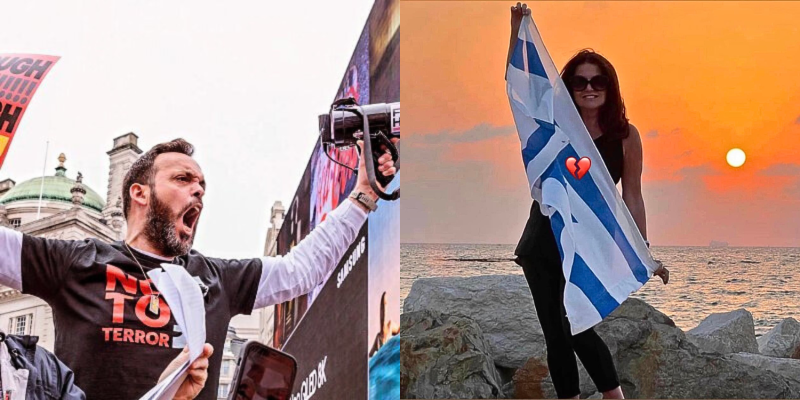
Yochy Davis, left, and Itai Galmudy | Photos from X and Facebook
Davis has long promoted Israeli causes. In 2019, for instance, she worked with Israeli organization, My Truth, to bring a squad of IDF soldiers to Britain to visit the Houses of Parliament and carry out a series of “educational” lectures promoting Israel and its military as benevolent forces.
Israeli charity website, Israel Gives, describes My Truth as “an educational organization that is comprised of Israeli Defense Force reservists that educate about the IDF operations and the moral standards it holds,” adding that:
’My Truth’ reservists speak up openly and with a firsthand perspective about their army experiences in response to those who attempt to slander Israeli soldiers in the name of so-called ‘full disclosure.’”
And like Galmudy again, Davis’ activism has earned her official praise from Israeli government officials. In 2019, former Shin Bet official and then-Minister of Justice, Amir Ohana, recorded a video expressing his deep gratitude, stating:
I want to tell Yochy Davis and the My Truth organization: thank you for providing justice. Thank you for providing truth to the world, and thank you for everything you are doing for the State of Israel and for the people of Israel. Thank you.”
Davis recently met with Israeli president, Isaac Herzog, and both she and Galmudy attended an official event at the Israeli Embassy in London last month. Earlier this year, the pair also traveled to Israel and the Golan Heights – Syrian territory illegally occupied by Israel – where they liaised with and took photos with IDF soldiers.

Yochy Davis and Itai Galmudy pose for a photo in front of an Israeli military vehicle during a visit to the Golan Heights, as posted on social media. (Instagram)
Stop The Plagiarism
The choice to name a pro-Israel advocacy group “Stop The Hate U.K.” clearly attempts to equate support for Palestine and opposition to genocide with anti-Semitism. Yet it has also caused significant confusion, as a well-known and respected charity, “Stop Hate U.K.” (SHUK) already exists.
SHUK was established in the wake of the Stephen Lawrence affair. Stephen Lawrence was a Black British teenager murdered in London in a racially motivated killing in 1993. The attack, and the subsequent inadequate response from the Metropolitan Police, made Lawrence a cause célèbre, the George Floyd of his day. An official inquiry found that the police force was “institutionally racist” and needed to be radically reformed. Since 1995, SHUK has carried out vital work challenging hatred and intolerance. Lawrence’s mother serves as its patron.
Pro-Israel group Stop The Hate U.K. is frequently misidentified as the more legitimate body, including in Sawer’s aforementioned Daily Telegraph article, where it attributes the intelligence provided to SHUK. It is eminently possible that this sort of confusion was deliberate, and Stop The Hate U.K. is trying to bask in the legitimacy of an established anti-racist charity. MintPress contacted SHUK for this investigation, but did not receive a response.
Gaza and the rise of Stop The Hate U.K. provokes a number of important questions. How is it that a pro-Israel pressure group, co-founded by two Israeli citizens, can have such an outsized effect on British public life? How can a former member of an army carrying out a massacre put such successful pressure on U.K. authorities to arrest journalists exposing the IDF’s crimes? And who gets to decide who and who is not a terrorist: British citizens or pressure groups allied to a foreign nation carrying out a genocide?
Zelensky is stealing the election before it begins
By Tarik Cyril Amar | RT | December 16, 2025
Currently, with intense diplomacy taking place to – perhaps – end the Ukraine conflict, questions surrounding Kiev’s domestic politics may seem secondary. However, in reality, they are as important as the search for peace.
There are two reasons: First, Ukrainians have a right to finally be released from their perverse bondage to what is, in effect, a long-ago failed Western proxy war against Russia. Those still in denial about this fact should check out a recent interview with a former Biden administration policy official. Amanda Sloat has casually admitted that much now: The war could have been avoided if the West had not insisted on NATO membership prospects for Ukraine, which never really existed anyhow.
Observers not blinded by Western propaganda – including this author – were warning that, for Ukraine, this fake NATO perspective was a road to catastrophe. But the Sloats of this world refused to listen. Why then did the West want the war? To diminish Russia by using Ukraine as a battering ram and Ukrainians as cannon fodder.
Secondly – and more practically – no peace will last without an end to Ukraine’s ultra-corrupt current authoritarian regime. Talk about defending “democracy” in Ukraine is absurd. Under Vladimir Zelensky, there is no such thing left. By now, even some Western mainstream commentators are starting to admit Zelensky’s authoritarianism. Yet the former entertainment producer and vulgar comedian started systematically undermining what little democracy Ukraine used to have well before the escalation of February 2022, as Ukrainian observers and critics at the time widely discussed and deplored.
Zelensky’s regime is so corrupt and has sold out its own people so badly to the West that a lasting peace threatens it not only with losing power, which it certainly would, but also with a wave of prosecutions starting at the very top, with Zelensky himself and rolling down like an avalanche. Put differently, this is a regime that would always be tempted to re-start the war to distract from the retribution it must fear.
That is why US President Donald Trump is right to call for presidential elections in Ukraine. Moreover, Zelensky has extended his mandate on flimsy grounds and thereby usurped power even formally. The often-heard claim that Ukraine cannot hold presidential elections in wartime, by the way, is badly misleading, and a thoroughly politically motivated misrepresentation of the facts: In reality, the Ukrainian constitution only prohibits parliamentary elections in time of war. Elections for the presidency are impeded by ordinary laws which can, of course, easily and legally be changed by the majority which Zelensky controls in parliament. That is merely a question of political will, not legality.
By now, even Zelensky and Kiev’s political elite admit the above. Indeed, Zelensky has charged parliament with devising procedures for such elections. So, you may ask, what about his regime and its Western propagandists claiming for over a year that this is simply illegal and can’t be welcome? Simple: that was a big fat lie. Welcome to Zelensky world and its crooked reflection in the mirror cabinet of the Western mainstream media.
Yet curb your enthusiasm. In all likelihood, Zelensky remains dishonest – really, does he even have another mode? – and is engaging not in a genuine attempt to finally allow Ukrainians their long overdue say about his horrific rule. Instead, it is – alas! – much more plausible to interpret his turn toward elections as yet another tactic of stalling and deception.
For one thing, he and his team are trying to set conditions that seem designed to prevent the elections again, while blaming others, first of all Russia, of course. In essence, their demands boil down to, once again, pushing for either more Western arms or a ceasefire that they can abuse instead of the full peace agreement that is actually needed. Moscow will not agree to such a scheme, as Kiev knows very well.
In addition, this would not be the Zelensky regime if it did not also ask for even more Western money. This time, the shameless idea is that the West must pay for elections in Ukraine – presumably because that is how democracy works in a sovereign country.
Things can get even worse: There is also the possibility, pointed out by Ukrainian observers, that Zelensky and his fixers are planning to shift the whole presidential election online. If they do, falsification in Zelensky’s favor is de facto guaranteed.
In sum, there is no good reason to believe Zelensky is really ready to give up power – because that is what elections would mean – to make way for a return to a more normal type of politics. His current statements and gestures seemingly indicating the opposite are meant to deceive, most of all, the West. Neither Ukrainians nor Russia is likely to believe him anyhow.
There is a glimmer of hope, however: The fact alone that Trump has challenged Zelensky in this area and that the latter’s European backers cannot shield him from that challenge is a good sign. As is the fact, of course, that Zelensky has felt pressured and cornered enough to not revert to the old lie that presidential elections are not possible in wartime.
Instead, Ukraine’s past-best-by leader has implicitly admitted they – and that he was lying before – and is now forced to deploy stalling techniques. That in and of itself, like Ukraine’s escalating corruption scandals, shows that Zelensky’s grip is slipping. And that is good for everyone, including Ukrainians. For without an end to the Zelensky regime, it is likely that no peace can be made and certain that no peace can last.
Tarik Cyril Amar is a historian from Germany working at Koç University, Istanbul, on Russia, Ukraine, and Eastern Europe, the history of World War II, the cultural Cold War, and the politics of memory.
The Folly of Establishing a U.S. Military Base in Damascus
By José Niño | The Libertarian Institute | December 16, 2025
Recent reports indicate the United States is preparing to establish a military presence at an airbase in Damascus, allegedly to facilitate a security agreement between Syria and Israel. This development represents yet another misguided expansion of American military overreach in a region where Washington has already caused tremendous damage through decades of failed interventionist policies.
The United States currently operates approximately 750 to 877 military installations across roughly eighty countries worldwide. This staggering number represents about 70 to 85% of all foreign military bases globally. To put this in perspective, the next eighteen countries with foreign bases combined maintain only 370 installations total. Russia has just twenty-nine foreign bases, and China operates merely six. The American empire of bases already dwarfs every other nation combined, and the financial burden is crushing. Washington spends approximately $65 billion annually just to build and maintain these overseas installations, with total spending on foreign bases and personnel reaching over $94 billion per year.
These figures are not abstract accounting entries. They translate directly into American lives placed in volatile environments, as demonstrated by the recent insider attack in the ancient Syrian city of Palmyra, where a purported ISIS infiltrator embedded in local security forces turned his weapon on a joint U.S. Syrian patrol, killing two U.S. soldiers and one U.S. civilian during what was described as a routine field tour. The incident underscores how the sprawling U.S. basing network increasingly exposes American personnel to unpredictable and lethal blowback in unstable theaters far from home.
Syria itself already hosts between 1,500 and 2,000 American troops, primarily concentrated in the northeastern Hasakah province and at the Al Tanf base in the Syrian Desert. The Pentagon recently announced plans to reduce this presence to fewer than 1,000 personnel and consolidated operations from eight installations to just three. Yet now, despite this supposed drawdown, Washington reportedly plans to establish a new presence in Damascus itself, either at Mezzeh Air Base or Al Seen Military Airport. This contradictory expansion reveals the hollow nature of promises to reduce American military commitments abroad.
Since the fall of Bashar al Assad in December 2024, Israel has conducted hundreds of airstrikes on Syrian military and civilian infrastructure while occupying parts of southern Syria including Quneitra and Daraa. Israel has systematically violated the 1974 disengagement agreement and expanded control over buffer zones. These actions align disturbingly well with the Yinon Plan, a 1982 Israeli strategic document by Israeli foreign policy official Oded Yinon that envisions the dissolution of surrounding Arab states into smaller ethnic and religious entities. The plan explicitly calls for fragmenting Syria along its ethnic and religious lines to prevent a strong centralized government that could challenge Israeli interests.
A permanent American military presence in Damascus would effectively serve as a tripwire guaranteeing continued U.S. involvement in securing Israeli strategic objectives in the Levant. Rather than protecting American interests or enhancing national security, such a base would entrench Washington deeper into regional conflicts that have consistently proven disastrous for both American taxpayers and Middle Eastern populations.
The human cost of American intervention in Syria should give any policymaker pause. The Syrian Civil War has resulted in between 617,000 and 656,000 deaths, including civilians, rebels, and government forces. More than 7.4 million people remain internally displaced within Syria, while approximately 6.3 million Syrian refugees live abroad. This catastrophic toll stems partly from Operation Timber Sycamore, the CIA covert program that ran from 2012 to 2017 to train and equip Syrian rebel forces.
Timber Sycamore represented a joint effort involving American intelligence services along with Saudi Arabia, Jordan, Qatar, Turkey, and the United Kingdom. The CIA ran secret training camps in Jordan and Turkey, providing rebels with small arms, ammunition, trucks, and eventually advanced weaponry like BGM 71 TOW anti-tank missiles. Saudi Arabia provided significant funding while the United States supplied training and logistical support.
The program proved to be counterproductive. Jordanian intelligence officers stole and sold millions of dollars worth of weapons intended for rebels on the black market. Even worse, U.S.-supplied weapons regularly fell into the hands of the al Nusra Front, al-Qaeda’s Syrian affiliate, and ISIS itself. The program inadvertently strengthened the very extremists Washington was ostensibly fighting.
The failure of Timber Sycamore illustrates a fundamental problem with American interventionism in Syria. Washington has pursued regime change in Damascus in various forms for decades, yet these efforts have consistently backfired, creating power vacuums filled by jihadist groups and prolonging devastating conflicts. The current enthusiasm for establishing a military presence in Damascus suggests American policymakers have learned absolutely nothing from these failures.
The figure now leading Syria exemplifies the moral bankruptcy of this entire enterprise. Ahmed al Sharaa, better known by his nom de guerre Abu Mohammad al Julani, currently serves as president of Syria’s interim government. This represents a stunning rehabilitation for a man who founded al Nusra Front in 2012 as an al-Qaeda affiliate and later formed Hayat Tahrir al Sham (HTS) by merging various rebel factions. Under the name Abu Mohammad al Julani, he was designated a Specially Designated Global Terrorist by the United States on July 24, 2013, with a $10 million bounty maintained on his head.
Al Sharaa’s terrorist designation stemmed from his leadership of al Nusra Front, which perpetrated numerous war crimes including suicide bombings, forced conversions, ethnic cleansing, and sectarian massacres against Christian, Alawite, Shia, and Druze minorities. He fought with al-Qaeda in Iraq, spent time imprisoned at Camp Bucca between 2006 and 2010, and was dispatched to Syria by Abu Bakr al Baghdadi in 2011 with $50,000 to establish al Nusra. His close associates have faced accusations from the United States of overseeing torture, kidnappings, trafficking, ransom schemes, and displacing residents to seize property. The New York Times reported that his group was accused of initially operating under al-Qaeda’s umbrella.
Yet in November 2025, the United Nations Security Council adopted resolution 2799, removing al Sharaa and Interior Minister Anas Khattab from the ISIL and al-Qaeda sanctions list. The U.S. Treasury Department followed suit, delisting him from the Specially Designated Global Terrorist registry. This reversal came after the State Department revoked HTS’s Foreign Terrorist Organization designation in July 2025. Washington essentially decided that a former al-Qaeda commander who oversaw sectarian massacres was now a legitimate partner worthy of American military support. This absurd rehabilitation demonstrates how completely untethered American foreign policy has become from any coherent moral framework or strategic logic.
Critics rightly question whether al Sharaa has truly broken from his extremist roots or merely engaged in calculated political rebranding. The speed with which Washington embraced him as a legitimate leader suggests American policymakers care far more about advancing Israeli interests and maintaining regional influence than about genuine counterterrorism or protecting religious minorities.
The United States needs to pursue a fundamentally different approach to foreign policy. Rather than establishing yet another military base to advance Israeli strategic objectives in Syria, Washington should implement a comprehensive drawdown of overseas military commitments. The hundreds of foreign bases it maintains abroad represent an unsustainable burden that diverts resources from genuine national security priorities like border security and stability in the Western Hemisphere. American taxpayers deserve better than footing the bill for an empire that consistently fails to advance their interests while enriching defense contractors and serving foreign powers.
Syria offers a perfect case study in the futility of American interventionism. Decades of attempts at regime change through covert programs like Timber Sycamore and direct military presence have produced nothing but chaos, empowered jihadist groups, created millions of refugees, and cost hundreds of thousands of lives. The rehabilitation of a former al-Qaeda commander into Syria’s president illustrates how divorced American policy has become from any coherent strategy or values.
Rather than doubling down on failed policies, the United States should pursue strategic restraint, scale back its sprawling network of foreign bases, and allow regional powers to sort out their own affairs without American military involvement. That represents the path toward a more sustainable, affordable, and morally defensible foreign policy. The Damascus base proposal deserves to be rejected outright as yet another wasteful expansion of an already overextended military empire.
US strikes three vessels in Eastern Pacific, killing eight
Al Mayadeen | December 16, 2025
The United States Southern Command (SOUTHCOM) announced that it launched deadly strikes on three vessels allegedly involved in drug trafficking in international waters in the Eastern Pacific, resulting in the deaths of eight people.
The strikes were carried out on December 15, under the orders of US Secretary of War Pete Hegseth, according to an official statement posted on X.
“Joint Task Force Southern Spear conducted lethal kinetic strikes on three vessels operated by Designated Terrorist Organizations in international waters,” SOUTHCOM said.
The military reported that all individuals killed were adult males: three aboard the first vessel, two on the second, and three on the third.
While the US claims the targeted vessels were engaged in narco-trafficking, no verification of the alleged links to terrorism or drug networks has been provided for any of the 26 boats it struck. Critics, lawmakers, and legal experts have denounced the strikes as illegal under international law.
Part of a broader Trump-led coercion campaign
The latest strikes come amid a wider US military campaign launched by US President Donald Trump targeting so-called drug smuggling routes in the Pacific Ocean and Caribbean Sea, including areas near Venezuela.
According to US officials, American forces have struck more than 20 vessels as part of the campaign, with at least 90 suspected drug smugglers reported killed so far. The operations represent a significant escalation and a marked departure from previous US approaches, which traditionally relied on interdictions, arrests, and prosecutions rather than direct military force.
Although the strategy has been widely criticized for its effectiveness in addressing the opioid epidemic in the United States, particularly given that Venezuela is not a source or transit hub for drug trafficking routes to the US, Trump and senior administration officials have continued to level baseless accusations against Caracas. Additionally, Washington has transferred an expansive force to the Caribbean, including its most advanced aircraft carrier, the USS Gerald R. Ford.
Legal controversy and international concerns
“Our operations in the Southcom region are lawful under both U.S. and international law, with all actions in compliance with the Law of Armed Conflict,” Pentagon Press Secretary Kingsley Wilson told reporters earlier this month.
Critics, however, have questioned the application of the Law of Armed Conflict outside a declared armed conflict, particularly in international waters and against individuals not formally designated as combatants. Under the United Nations Charter, the use of force by one state against another, including against that state’s vessels on the high seas, is generally prohibited unless the target has conducted an armed attack or the action is authorized by the UN Security Council or undertaken in legitimate self-defense.
Legal analysts have pointed out that there is no credible evidence presented to suggest that the vessels struck were engaged in an armed attack against the United States, meaning the strikes lack a clear legal basis under international law.
Another major issue arose from a controversial September strike in the Caribbean, in which US forces hit a suspected drug-smuggling vessel. After the initial attack, which killed the majority of those aboard, surveillance reportedly showed two survivors in the water.
According to multiple accounts, the operation’s commander authorized a second strike on those survivors, based on a directive that those on board should be left with no survivors. Legal experts and lawmakers have warned that targeting individuals who are no longer actively resisting or posing an imminent threat, “hors de combat” under international humanitarian law, is a war crime and violates both the Geneva Conventions and customary law prohibitions on denying quarter.
The biggest bank robbery in history
By Ian Proud | Strategic Culture Foundation | December 16, 2025
For over two years, there have been loud and repeated calls for Russia’s immobilised assets in Europe – valued at around $245 billion – to be permanently seized. However, those assets had hitherto been immobilised under EU sanctions which required unanimous agreement every six months.
Not any more. Given Belgium’s sturdy resistance to using $165 billion in immobilised assets held in Euroclear, the European Commission has triggered an emergency clause in the Treaty on the functioning of the European Union to bypass the principle of unanimity on sanctions policy.
On Thursday of last week European Council Ambassadors agreed by majority to freeze indefinitely immobilised Russian assets in European banks. This proposal is separate from specific lending to Ukraine to cover its financial needs, which was subject to a separate proposal.
But, in fact, the two are connected. Because the separate proposal for a so-called reparations loan makes clear that Ukraine will only have to repay the loan if its receives reparations from Russia, whereupon Russia’s frozen assets will be returned.
However, Russia will self-evidently never make reparations payments to Ukraine precisely because its immobilised assets which might be used for reparations in Ukraine have already been expropriated and are unlikely to be returned.
The measure proposed by the EU uses as its legal basis the need to cover the economic risks to the EU from the ongoing war. However, the Economist has pointed this out as an example of ‘dodgy’ legal logic. But it’s worse than that; it’s in fact untrue. The money is not intended to support Europan economies, as it only represented 1% of European GDP. It will be used to back a reparations loan that is not intended for reparations, but rather to pay for Ukraine’s bloated budget.
This includes $106 billion to cover Ukraine’s budget deficit over the next two years and $50 billion to write off the EU contribution to the G7 Extraordinary Revenue Acceleration loan agreed in June 2024. The remainder will be pumped into Ukraine’s defence industry.
So, all of Russia’s money will effectively be given to Ukraine, albeit in the form of a loan underwritten by those European banks that hold Russian assets. In this fantasy, Russia’s assets still exist, it’s simply that EU banks have lent their equivalent value to Ukraine.
The problem Ursula von der Leyen is trying to avoid, as I have pointed out before, is the return of Russia’s assets after any peace deal that leads to sanctions against Russia being lifted. In short, peace would raise the risk of the loan collateral being handed back to Russia, meaning that Europe would need to pay for it, on the basis that Ukraine won’t have the means to repay the loan itself.
Let’s be clear, the earlier G7 Extraordinary Revenue Acceleration loan to Ukraine agreed in 2024 had a maturity of up to 45 years. Does Europe really intend to keep Russia’s assets immobilised for that period of time?
President Trump’s initial 28 point peace plan suggested that Russia’s immobilised assets be split three ways, between $100 billion invested in Ukraine by U.S. firms, $100 billion overseen by Europe and the remainder co-invested by the U.S. and Russia in its country. On that basis, and assuming Russia was agreeable, all of Russia’s immobilised funds would be used for genuine reconstruction efforts, both inside of Ukraine and those parts which Russia has occupied. President Zelensky has spoken this week about the possible setting up of a special economic zone in the contested parts of Donetsk oblast that would be demilitarised.
As I pointed out a year ago, Russia might be willing to give up its assets for some form of de facto recognition of territory, which the Trump administration has essentially proposed. The value of its unfrozen sovereign reserves – at $425 billion – now far exceed the sum still frozen in Europe and other jurisdictions including the U.S.. So Russia might be willing to give up some assets as part of a quid pro quo on territory. And it’s clear that Europe has absolutely no intention of giving the money back anyway, so why not cut a deal that works best for Russia?
But what the Europeans want to do is to have two cakes and eat them both. Get Russia to pay for Ukraine’s day to day fiscal expenditures associated with war fighting and building up its defence industrial complex, even after the war ends. And get Russia to pay for Ukraine’s post-war reconstruction. That is clearly delusional.
Because, and as I have already pointed out, Ukraine will still have an enormous fiscal hole to fill anyway when the fighting stops. So, if the actual plan is that Russia’s immobilised assets be used as collateral for day-to-day costs, then where is the capital to fund reparations? In short, it will cease to be available.
No, don’t worry about that, European Commission officials assure us, Russia will get its assets back after it pays reparations to Ukraine. But who decides how much Russia should pay? At the end of 2024, the UN estimated that Ukraine’s total recovery and reconstruction needs amounted to $524 billion.
Russia will simply not agree to pay that sum, not least as if it did, it would find that its immobilised assets were no longer available, having been spent on Ukraine’s budget. And, in any case, why would Russia agree to pay a sum of reparations that Europe adjudicates on from afar, all while the Americans have a more credible plan to use the immobilised assets?
President Trump is nudging president Ukrainian and European leaders, kicking and screaming, closer toward a peace deal that they don’t want to sign up to. In the case of Zelensky, he has resisted agreement because it might bring his time in power to a juddering halt. In the case of Von der Leyen, it would mean she had to tell Member States how much they needed to stump up to pay for Ukraine. As well as being logically confused and ill-thought-through, the asset seizure idea also brings the added risk of preventing any ceasefire.
Despite this, Trump appears to have the bit between his teeth to force a peace deal through and, with Zelensky now appearing to give up on NATO membership, we appear mercifully to be nudging in tiny steps towards the end of this needless war.
Someone will still need to pay for Ukraine’s budget when that happens. Russia will rightly point out that Europe has expropriated its money in the biggest bank robbery in history. And likely bury Brussels in a blizzard of litigation which makes investors in the developing world think long and hard about whether to keep their money in Europe.
Trump Files Sweeping $10 Billion Lawsuit Against BBC — Exposing a Global Machinery of Narrative Suppression
By Sayer Ji | December 15, 2025
President Donald Trump has filed a sweeping defamation lawsuit against the British Broadcasting Corporation (BBC), alleging that the UK’s state-backed broadcaster deliberately edited his words to falsely portray him as inciting violence. You can view my report on the details of the initiating event here.
The 33 page suit, filed in U.S. federal court, seeks billions in damages and cites internal whistleblower documents, leadership resignations, and a documented pattern of prior misconduct to argue that the edit was not an error — but an intentional act of malice with real-world and political consequences.
The lawsuit stems from a BBC Panorama documentary that spliced together two separate portions of Trump’s January 6 speech — spoken nearly an hour apart — while omitting his explicit call for peaceful protest. According to the complaint, this manipulation created a false impression that Trump urged violence. The BBC has since issued a formal apology, withdrawn the documentary, and seen its Director-General and Head of News resign in disgrace.
But the significance of the case extends far beyond a single documentary or a single speech.
For the first time, a court filing squarely places legal scrutiny on the institution that has long functioned as a global arbiter of “misinformation” — and asks whether that authority has been weaponized against American political speech.
A Defamation Case With Systemic Implications
At face value, Trump’s lawsuit is a high-profile defamation action against one of the world’s most powerful media institutions. Yet embedded in the filing is a far more consequential allegation: that the BBC knowingly falsified political speech in pursuit of a narrative objective, and did so as part of a repeat pattern rather than a one-off lapse.
The complaint cites an internal memorandum by a former BBC editorial standards adviser who concluded that the edit “materially misled viewers,” as well as evidence that senior leadership was warned in advance. It also documents prior BBC broadcasts that used similar splicing techniques to misrepresent Trump’s words, including a 2022 Newsnight segment and a separate 2024 incident in which BBC presenters falsely suggested Trump had called for a political opponent to be shot.
In other words, the lawsuit alleges not mere negligence, but institutional intent.
That distinction matters — because it forces a broader reckoning with how narrative authority is exercised, exported, and enforced.
Why the BBC Matters More Than This Case
The BBC is not just another media outlet. It is a globally trusted, publicly funded broadcaster whose reporting is routinely cited by governments, technology companies, NGOs, and newsrooms worldwide.
Remarkably, US taxpayers have historically been compelled to fund BBC through USAID, as reported below.
USAID & BBC Caught Laundering Censorship—Unconstitutional & Unforgivable!
Moreover, British citizens are forced to pay the BBC license fees, even if they don’t use the service, with non-payment resulting in tens of thousands of prosecutions annually. You can find more details on this here.
When the BBC labels something “dangerous,” “extreme,” or “misinformation,” those labels do not remain confined to British television screens.
They travel.
For years, BBC investigations — particularly through programs like BBC Click — have been used to frame American websites, platforms, and political movements as threats to public order. In fact, their 2020 collaboration with the Institute for Strategic Dialogue (ISD) and the US-Based NewsGuard listing 34 sites they wanted demonetized and removed from the internet including GreenMedInfo.com (yours truly), which I documented in detail here.
Those framings have then been echoed by advocacy groups, relied upon by technology companies, and quietly incorporated into content moderation policies, reputational risk assessments, and even intelligence briefings that labeled dissenting voices challenging medical orthodoxies as equivalent to domestic extremists.
This is how narrative power becomes operational power.
Trump’s lawsuit matters because it places that process — long taken for granted — under legal examination.
Before Trump: How the Architecture Was Built
Long before the BBC edited Trump’s speech, it had already positioned itself at the center of a transnational ecosystem that defines and enforces acceptable discourse.
Through partnerships with non-governmental organizations, alignment with “counter-disinformation” initiatives, and collaboration with philanthropic and government-adjacent funding streams, the BBC helped construct a system in which certain viewpoints could be labeled, marginalized, and suppressed — often without any judicial process or meaningful recourse.
That system did not begin with Trump.
Years earlier, similar mechanisms were deployed against U.S. presidential candidate Robert F. Kennedy Jr., against independent media platforms, and against journalists whose speech was lawful under U.S. law but nonetheless treated as suspect once filtered through foreign media authority.
At the time, these actions were routinely dismissed as editorial disagreement or platform policy enforcement. In light of the Trump lawsuit, they now appear less accidental — and more like early applications of a model that would later be used against a sitting president.
From Narrative Framing to Enforcement
What the Trump case exposes is not simply bias, but a supply chain of suppression:
- Media institutions generate authoritative narratives
- NGOs and advocacy groups translate those narratives into risk frameworks
- Technology platforms operationalize them through moderation and deplatforming
- Targets — often U.S. citizens — absorb the consequences without due process
Once established, this architecture allows reputational harm and speech suppression to occur at scale, while responsibility remains diffuse and accountability elusive.
The BBC’s unique role in this system is precisely why Trump’s lawsuit is so consequential. It targets the node where authority originates — not merely where enforcement occurs.
A Personal Note of Corroboration
I have seen this system up close. Years before Trump filed suit, my own reporting and platforms were targeted following BBC-, ISD, Newsguard, and CCDH-linked reporting and targeting that framed lawful health and policy speech as dangerous. Some of these reports even made it into foreign court proceedings, to which I was not a party and had no standing, but nonetheless was named as a ‘shadow defendant.’ At the time, there was no mechanism to challenge those labels — only consequences to endure. More details of my plight can be found here.
Trump’s lawsuit does not vindicate any single individual. It does something more important: it makes visible the machinery that was previously invisible — and untouchable.
Why This Moment Is Different
Trump is not the first to be harmed by this system. But he may be the first with sufficient power, evidence, and legal standing to force it into the open.
Whether the lawsuit ultimately succeeds or fails on the merits, it has already accomplished something unprecedented: it has transformed what was once dismissed as “media controversy” into a matter of legal accountability.
That shift should concern anyone who cares about free expression, democratic self-governance, and the dangers of unaccountable narrative power — regardless of political affiliation.
Featured Video
It’s the Occupation, Stupid
or go to
Aletho News Archives – Video-Images
From the Archives
A superpower and “the world’s sickest warrior state”
By Paul J. Balles | March 8, 2010
Living through five or six major wars has hardened me to what I thought were the extremes of inhuman cruelty and brutality.
Two things made those extremes almost bearable: the brutality always revealed – at least according to the media coverage – the viciousness of the enemy. It was therefore quite understandable when our “brave men and women” pulverized the enemy.
Films of Japanese torturing captive Americans somehow justified holding Japanese Americans in internment camps during World War II; and only a small percentage of Americans found the bombing of Hiroshima and Nagasaki unreasonably vengeful at best, at worst, depraved.
The media giants in America portrayed the North Koreans as barbaric beasts with their captives, quite unlike their southern counterpoints – our allies during the Korean War. No one ever felt the need to explain how the South Koreans were a civilized breed while the North Koreans were absolute savages, at least according to the official line.
In Vietnam, our warriors justifiably (or so the media made us believe) dropped napalm on the North Vietnamese who had the gall to hide in villages and tunnels to ravage our invaders. At least it was accepted practice until some rogue photojournalist filmed a young girl screaming down a Vietnamese road in flames. … continue
Blog Roll
 Aletho News
- Pro-Palestinian French member of European Parliament denied entry to Canada
- Pakistan to Host US-Iran Talks
- How Indonesia’s tilt toward the US left it stranded in the Strait of Hormuz
- US has no choice but to retreat from Iranian borders: Top commander
- Iran Retaliation Strikes Chemical Plant Near Dimona
- AWACS’ Destruction is a Major Loss for US Military – Ex-DoW Analyst
- Israel’s Iran Strategy Uses US Military & Gulf States as Its Pawns
- Iran: Trump wanted regime change, now just begging for Hormuz to open
- IRGC: Israeli, US universities in region legitimate targets after strikes on Iranian university
- Trump admits Iran hit USS Ford carrier: ‘We ran for our lives’
- If Americans Knew
- Israeli police block Catholic cardinal from entering Church of the Holy Sepulchre on Palm Sunday
- Israel is assassinating journalists again, more than any other nation, anywhere, ever – Not a ceasefire Day 170
- Over 300 US service members wounded, majority have brain injuries – Not a ceasefire Day 169
- Researchers at Human Rights Watch Resign Over Blocked Report on Palestinian Refugee Return
- Jewish Groups Are Backing a War Americans Don’t Want
- Eric Fingerhut Thinks He’s the President of the Jews
- Top Jewish Philanthropists, Rabbis Urge Israeli President to Take Action Against ‘Jewish Extremists’
- Don’t Be Fooled. Zionist Leaders Have Always Wanted to Control Southern Lebanon
- Israel’s widespread use of torture is a core element of its genocide against the Palestinian people
- In Israel’s War on Iran, Many Middle East US Bases Rendered “All But Uninhabitable”
- No Tricks Zone
- German Science Blog Accuses PIK Climate Institute Of Hallucinating Climate Tipping Points
- Devastating Assessment Of Comirnaty Vaccine By Former Senior Pfizer Europe Toxicologist
- New Study: CO2 Is ‘Effectively Negligible’ As An Explanatory Climate Change Factor Since 2000
- Former Pfizer Toxicologist Dr. Helmut Sterz Tells Bundestag Hearing Pfizer Vaccine Should Have Never Been Approved
- Energy Expert: Germany’s Nuclear Phaseout Was A “500 Billion Euro Mistake”
- New Research: South Australia’s Mid-Holocene Sea Surface Temperatures Were 4°C Warmer Than Today
- Storing Green Energy To Last Germany 10 Days Would Require A 60-Million Tonne Battery
- New Studies: UK Sea Levels Were 4 Meters Higher Than Today During The Mid-Holocene
- Destructive Green New Deal: German Energy And Metal Group Warns Of Drastic Crisis
- New Study Documents A 20-Year Pause In Arctic Sea Ice Decline – Driven By Internal Variability
 Aletho News