NATO’s Red Pen on Ukraine: Jacques Baud and the Silencing of Dissent
By Freddie Ponton | 21st Century Wire | December 17, 2025
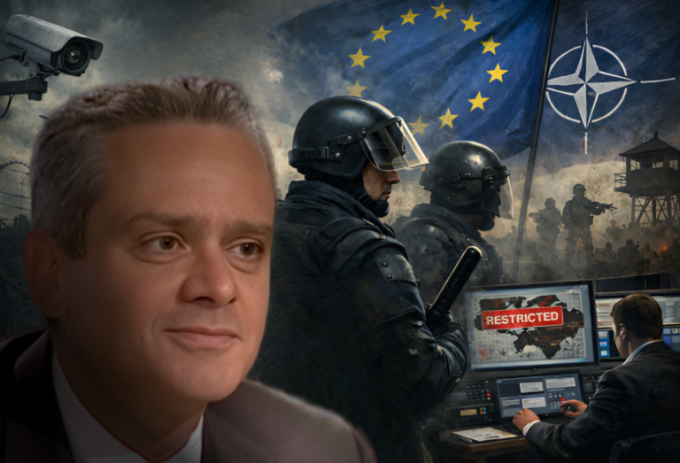
On 15 December, the European Union took a step that few could have imagined: it sanctioned twelve individuals, including Swiss analyst and former intelligence officer Jacques Baud and French national Xavier Moreau, not for breaking the law, but for expressing views deemed politically inconvenient. Asset freezes, travel bans, and economic restrictions were imposed without any judicial process. While presented as an EU initiative, the fingerprints of NATO’s strategic communications and information-control apparatus are unmistakable, shaping both the targets and the justification. Europe is no longer simply countering disinformation; it is policing interpretation itself, turning independent analysis into a potential liability. The question now is not whether dissent will be punished, but how far these measures will go, and who will decide the boundaries of acceptable thought.
Baud, a Swiss national, is not a political activist, influencer, or anonymous online provocateur. He is a former Swiss intelligence officer and army colonel, trained in counter-terrorism, counter-guerrilla warfare, and chemical and nuclear weapons. Over the course of his career, he helped design the Geneva International Centre for Humanitarian Demining (GICHD) and its Mine Action Information Management System (IMSMA), served with the United Nations as Chief of Doctrine for Peacekeeping Operations in New York, worked extensively in Africa, and later held senior responsibilities at NATO, where he led efforts against the proliferation of small arms. He is also the author of multiple books on intelligence, asymmetric warfare, and terrorism, texts widely read well before the Ukraine war.
Yet this résumé, once considered exemplary, has now been recast as suspicious. On 15 December, the EU placed Baud under sanctions, freezing assets and restricting travel, accusing him of acting as a “spokesperson of Russian propaganda” and of participating in “information manipulation and influence.” No criminal charges have been filed. No judicial process has taken place. No evidence has been publicly tested in court. The punishment is administrative, political, and immediate.
DOCUMENT: COUNCIL DECISION (CFSP) 2025/2572 of 15 December 2025 amending Decision (CFSP) 2024/2643 concerning restrictive measures in view of Russia’s destabilising activities (Source: EUR-Lex)
This is not an isolated case. Baud joins a growing list of European journalists, analysts, and commentators sanctioned or publicly stigmatised for expressing views that diverge from official EU and NATO positions. Germans living in Russia, independent journalists, and alternative media figures have already faced similar measures. What unites these cases is not proof of coordination with Moscow, but a shared refusal to reproduce the sanctioned narrative framework through which the war must be interpreted.
From Foreign Policy to Narrative Enforcement
Officially, these sanctions are justified as defensive measures against “foreign information manipulation and interference”, a phrase now deeply embedded in EU and NATO communications. The stated objective is to protect European democracies from destabilisation. In practice, however, the definition of “manipulation” has expanded so broadly that any analysis which echoes, overlaps with, or even partially aligns with Russian positions can be deemed suspect, regardless of sourcing, intent, or transparency.
The problem is not that governments counter disinformation. Every state does. The problem is how disinformation is defined, who defines it, and what instruments are used to combat it.
In Baud’s case, the EU does not allege clandestine activity, secret funding, or covert coordination with Russian authorities. Instead, he is held responsible for contributing to a narrative environment that, in Brussels’ view, undermines Ukraine and EU security. This is a crucial shift: The target is no longer falsehood, but interpretation.
Once interpretation itself becomes sanctionable, the boundary between security policy and censorship collapses.
France’s Role, and NATO’s Shadow
Several reports indicate that the initiative to sanction Baud and eleven others originated with France. French Foreign Minister Jean-Noël Barrot publicly announced that Europe would impose sanctions on what he described as “pro-Russian agents,” including individuals accused of repeatedly influencing French and European public debate. Among those named was Xavier Moreau, a French analyst long critical of NATO policy.
Barrot’s declaration on X was unambiguous:
“At France’s initiative, Europe is today imposing sanctions against Kremlin propaganda outlets and those responsible for foreign digital interference. Zero impunity for the architects of chaos.”
The language is revealing. “Architects of chaos” is not a legal category; it is a political one. It frames speech as an act of aggression and analysts as hostile operators.
Behind this framing lies a figure little known to the public but central to the architecture of Europe’s contemporary information policy: Marie-Doha Besancenot, Senior Advisor for Strategic Communications in the French Foreign Ministry. Prior to assuming this role, Besancenot served from 2020 to 2023 as NATO Assistant Secretary General for Public Diplomacy.
In an interview published in English by the French Ministry of the Armed Forces and Veteran Affairs, in March 2025, Besancenot openly described founding a task force in late 2023 dedicated to detecting and analysing what she termed “hostile narratives,” with the capacity to alert authorities “in real time” and propose political responses. The task force’s mission, she explained, was to detect, track, and report information threats against NATO in the information domain. In this interview, Besancenot articulates how “France understood what was happening in the information domain was a matter of national security”, and speaks of Viginum, a French agency created in response to these perceived threats, and that is responsible for monitoring and protecting the state against foreign digital interference that, according to them, affects the digital public debate in France.
The continuity is striking. The doctrine developed inside NATO’s strategic communications apparatus appears to have migrated almost seamlessly into national and EU-level policy, without democratic debate, parliamentary oversight, or public consent.
Strategic Communications as Political Power
NATO insists that it does not police speech and that it respects freedom of expression. Formally, this is true. NATO does not arrest journalists or pass laws. Instead, it develops conceptual frameworks, “hybrid threats,” “information laundering,” and “foreign information manipulation”, which are then adopted by member states and EU institutions.
Once a narrative framework is institutionalised, it becomes self-enforcing. Media outlets internalise red lines. Publishers hesitate. Platforms over-moderate. Governments justify extraordinary measures as technical necessities or national security. The perfect storm in which sanctions replace debate.
One of the most insidious concepts to emerge from this ecosystem is that of “information laundering”, the idea that domestic journalists or analysts can unwittingly “clean” foreign propaganda simply by engaging with it critically. Under this logic, intent becomes irrelevant. What matters is effect, as defined by strategic communicators.
This doctrine eliminates the possibility of good-faith analysis. To examine Russian claims, even to refute them selectively or partially, is to risk being accused of amplifying them. The only safe position is total dismissal, which appears to be NATO and the EU’s endgame.
The Democratic Cost
The danger of this approach extends far beyond Jacques Baud.
Sanctions are no longer being used to punish illegal acts, but to discipline discourse. They operate without due process and create chilling effects far wider than their immediate targets. An analyst does not need to be sanctioned to be silenced; seeing a peer sanctioned is often enough.
Moreover, these measures are imposed by non-elected bodies, EU councils, commissions, and advisory structures, drawing heavily on NATO doctrine, an alliance that itself is not subject to democratic accountability. National parliaments are largely absent from the process. Courts intervene only after the damage is done.
The precedent is dangerous. If today the target is analysts accused of being “pro-Russian,” tomorrow it could be critics of EU defence spending, sceptics of military escalation, or scholars questioning intelligence claims. Once the machinery exists, its scope inevitably expands.
History offers ample warning. Democracies do not usually collapse through sudden repression, but through the gradual normalisation of exceptional measures, each justified by urgency, each framed as temporary, each defended as necessary.
Security Without Freedom Is Not Security
The EU and NATO argue that they are facing unprecedented hybrid threats and that extraordinary responses are required. That claim deserves serious consideration. But security achieved by narrowing the space of permissible thought is a brittle security, one that ultimately undermines the democratic resilience it claims to protect.
A society confident in its values does not need to freeze bank accounts to win arguments. It does not need to conflate analysis with subversion. It does not need to outsource intellectual authority to strategic communications units.
Jacques Baud may be wrong in some of his assessments. He may be right in others. That is beside the point. What matters is that his arguments exist in the open, supported by sources, available for rebuttal. The appropriate response to analysis is counter-analysis, and certainly not sanctions. By choosing punishment over debate, Europe is not defending democracy. It is redefining it, quietly, administratively, and without asking its citizens whether this is the kind of polity they wish to inhabit.
The sanctions against Baud are therefore not merely about Ukraine, Russia, or NATO. They are about who gets to speak, who decides what is permissible to think, and whether Europe still trusts its citizens to judge arguments for themselves.
That question, once raised, cannot be easily swept away.
No comments yet.
Featured Video
Theodore Postol: Iran’s Missiles & Drones Were Underestimated
or go to
Aletho News Archives – Video-Images
From the Archives
What is the Israeli Lobby in Australia Doing in Interfaith Dialogue?
By Ali Kazak | Dissident Voice | October 11, 2015
For years Israel and its lobby around the world have been trying to normalise their relations with Arabs and Muslims without solving the Palestine Question.
One of the methods they resorted to in the last few years is using human rights and community organizations such as interfaith dialogue and Multiculturalism to achieve this objective and to: isolate the Palestinians, marginalise the Palestine question, end Israel’s isolation, and prevent criticism of Israel, knowing that these organisations will be the first to stand against Israel’s violations, racial and religious discrimination.
The group responsible for this task in Australia is The Australia/Israel & Jewish Affairs Council (AIJAC); its Director of International & Community Affairs, Jeremy Jones is in charge of lobbying religious community organizations, specifically Muslims and Christians. Consequently he convened the Faith Communities for Reconciliation, founding participant in the Australian Partnership of Religious Organisations and the Australian National Dialogue of Christians, Muslims & Jews.
AIJAC is a private political propaganda group. It is recognised as the main Israeli lobby in Australia. It coordinates its activities and works intimately with the Israeli embassy in Canberra and different institutions in Israel. It is privately funded by some Jewish businessmen. It monitors closely Australian politicians, the media, ethnic and religious groups, (especially Arabs and Muslims), unions and academics on their stands towards Israel and the Palestine question. … continue
Blog Roll
 Aletho News
- Iran’s friends are about to make life much more difficult for Israel and the US
- The war of liberation of the Arab and Islamic peoples expands across the Gulf
- Envoy warns UN on Trump’s threat to ‘obliterate’ Iran’s civilian infrastructure
- The Larak Corridor: Iran’s Rial Gate With No US, No Israel, and No Way Around
- ‘Economic terrorism’: Steel facilities hit again in US-Israeli strike
- ‘War Crime’: Iran condemns attacks on Arak, Ardakan nuclear sites
- Two-thirds of Americans want quick end to Iran war even if goals unmet
- Trump to Give “Important Update on Iran” Wednesday in Prime-Time Speech
- Theodore Postol: Iran’s Missiles & Drones Were Underestimated
- Iran To Target Military Industrial-Tech Complex That Facilitated Gaza Genocide
- If Americans Knew
- Israel wants US to bomb more of Iran’s civilian structures (113,000 is not enough) – Not a ceasefire Day 173
- Ann Coulter Rips Into Fox News for Iran War Coverage
- Joe Kent Urges Americans To Call White House and Congress To Object To Sending Troops Into Iran
- DNC Resolution to Reject AIPAC Funding Puts Democratic Leaders in the Hot Seat
- Swedish foundation to build 400 schools as over 650,000 Gaza children remain without education for 2 years
- Israeli army admits photshopping image of slain Lebanese journalist
- This is how Israel is systematically killing health workers under the cover of war in Lebanon
- Carrying life under fire: Israeli invasion of Lebanon leaves pregnant women facing deadly risks
- Champagne all around for the new death penalty (for Palestinians) law – Not a ceasefire Day 172
- Why are Palestinian books struggling to be seen on Amazon?
- No Tricks Zone
- New Study Finds Warming Saves Lives…Cold Temperatures 12 Times More Deadly Than Excess Heat
- German Science Blog Accuses PIK Climate Institute Of Hallucinating Climate Tipping Points
- Devastating Assessment Of Comirnaty Vaccine By Former Senior Pfizer Europe Toxicologist
- New Study: CO2 Is ‘Effectively Negligible’ As An Explanatory Climate Change Factor Since 2000
- Former Pfizer Toxicologist Dr. Helmut Sterz Tells Bundestag Hearing Pfizer Vaccine Should Have Never Been Approved
- Energy Expert: Germany’s Nuclear Phaseout Was A “500 Billion Euro Mistake”
- New Research: South Australia’s Mid-Holocene Sea Surface Temperatures Were 4°C Warmer Than Today
- Storing Green Energy To Last Germany 10 Days Would Require A 60-Million Tonne Battery
- New Studies: UK Sea Levels Were 4 Meters Higher Than Today During The Mid-Holocene
- Destructive Green New Deal: German Energy And Metal Group Warns Of Drastic Crisis
 Aletho News
Leave a comment