Medicinal plants hold key to Iran’s drought-resistant revenue
Press TV – December 16, 2025
Iran’s agriculture faces water scarcity, restricted market access, and declining returns from traditional crops, pushing farmers and policymakers toward low-water, high-value, and sanction-resilient export products.
Medicinal plants are among the few agricultural sectors meeting all three criteria, increasingly seen over the past decade as an expandable income source aligned with environmental limits and export needs.
Iran has one of the richest plant ecosystems in the world. More than 8,000 plant species have been identified across the country, of which around 2,300 have medicinal, aromatic, cosmetic, or industrial uses.
About 1,700 of these species are endemic, meaning they grow naturally only in Iran. This biodiversity is supported by wide climatic variation, from arid plains to high mountain ranges, with elevations from 900 to more than 4,000 meters above sea level.
These conditions allow different plants to grow with little or no irrigation. The scale and diversity of this natural resource provide Iran with a broad production base that few countries can replicate, enabling year-round cultivation and harvesting across different regions.
Most medicinal plants cultivated or harvested in Iran are naturally adapted to dry and semi-dry environments. Many grow under rain-fed conditions or require less than 3,000 cubic meters of water per hectare.
By comparison, crops such as wheat, rice, and corn often need between 10,000 and 15,000 cubic meters per hectare. As groundwater reserves shrink and rainfall becomes more erratic, this difference has direct economic value.
Lower water use reduces production costs while preserving agricultural land for sustained use over time. This makes medicinal plants particularly suitable for long-term planning in regions facing declining water availability.
According to official figures, Iran receives about 400 billion cubic meters of rainfall annually, but more than half is lost to evaporation. Crops that can grow using direct rainfall reduce pressure on dams, rivers, and aquifers.
Medicinal plants make effective use of this rainfall because they are already rooted in the soil when seasonal precipitation occurs, allowing moisture to be absorbed rather than lost. This characteristic strengthens their role in maintaining agricultural output without increasing water extraction.
Medicinal plants are produced both on farmland and in rangelands. In many provinces, farmers grow them under permits on national lands, relying on rainfall rather than irrigation. Because these plants are mostly perennial and slow-growing, high irrigation costs are not economically justified.
Harvesting, drying, and basic processing often take place close to production sites, creating seasonal employment in rural areas. Each hectare of medicinal plants generates between two and three direct jobs, according to agricultural authorities.
In addition to farming, jobs are created in collection, sorting, drying, distillation, and packaging, forming local value chains that support village-level incomes.
Export revenue from medicinal plants currently stands at about $600 million a year, accounting for roughly 9 to 10 percent of Iran’s total agricultural exports. Projections suggest exports could reach $700 million if production and processing improve.
Saffron dominates the sector. Iran produces more than 90 percent of the world’s saffron and accounts for around 40 percent of the total export value of medicinal plants.
Other major exports include rose products from damask rose, such as rose water and extracts, liquorice extract, mint, thyme, and natural gums like asafoetida locally called anguzeh.
These products are sold not only as raw materials but also as inputs for pharmaceutical, food, and cosmetic industries.
Demand for medicinal plants continues to grow in international markets, including Central Asia, Eurasia, and China. These markets are accessible through regional trade routes and do not always require direct financial links with Western banking systems.
Products such as saffron, rose water, and herbal extracts have relatively high value-to-weight ratios, which lowers transport costs and makes them more suitable for indirect export channels. Their long shelf life further supports trade across longer distances and reduces losses during storage and transport.
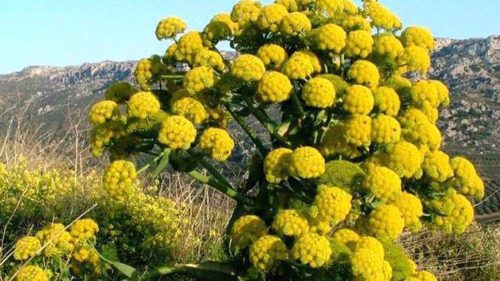
Barijeh, scientifically known as ferula gummosa, is a plant native to Iran.
The internal economics of medicinal plant cultivation are also favorable. In several provinces, income from medicinal plants is many times higher than from grains.
For example, harvesting wild or cultivated plants such as musir can generate net income far above that of wheat or barley on the same land.
This income difference has encouraged farmers to shift land away from water-intensive crops, especially in drought-affected regions. Higher returns per hectare allow smaller landholdings to remain economically viable, supporting family-based farming systems.
Four provinces illustrate this potential clearly. Khorasan remains the center of saffron production. Kashan and surrounding areas specialize in rose cultivation and distillation.
Yazd produces lemon verbena, while Chaharmahal and Bakhtiari province has emerged as a major center for wild and cultivated medicinal plants.
This province is largely mountainous, with 87 percent of its area classified as highland. More than 1,350 plant species have been identified there, including 270 with medicinal or industrial uses and 27 species found nowhere else in the world. Cool nights, diverse soils, and varied elevations contribute to high-quality yields and strong concentrations of active ingredients.
In Chaharmahal and Bakhtiari, medicinal plants are grown on about 3,500 hectares, split between national rangelands and agricultural land. Since the early 2010s, the cultivated area has expanded sharply, supported by a national strategy to promote medicinal plants.
From a fiscal perspective, medicinal plants offer a rare combination for Iran under sanctions. They reduce water use, generate foreign currency, and support employment without heavy reliance on imported inputs.
Unlike major industrial exports, they do not require large-scale capital equipment or advanced foreign technology. Their production is decentralized, which spreads income across rural and underdeveloped regions. This decentralization strengthens local economies and reduces dependence on a limited number of export hubs.
Iran already holds dominant positions in several global markets, particularly saffron. Medicinal plants do not eliminate the economic impact of sanctions, but they provide a measurable source of revenue that fits Iran’s environmental constraints.
No comments yet.
Featured Video

or go to
Aletho News Archives – Video-Images
From the Archives
Israel Would Have No Qualms About USS Liberty-Style FALSE FLAG If Iran Campaign Falters – Analysts
By Ilya Tsukanov – Sputnik – 18.06.2025
Donald Trump is mulling whether or not to join Israel’s aggression against Iran as Tel Aviv faces problems sustaining its defenses against growing counterstrikes, and apparently lacks a realistic game plan for an end to hostilities after failing to achieve its goals. Analysts told Sputnik how the US could be ‘nudged’ into the conflict.
“The US is already assisting Israel with supplies, intel, refueling support, etc. One of the many US posts in the region could be attacked for a casus belli,” former Pentagon analyst Karen Kwiatkowski explained.
“If Trump doesn’t comply with Israel’s demand” and join its aggression voluntarily, “a false flag may be needed” to drag the US in, Kwiatkowski, retired US Air Force Lt. Col.-turned Iraq War whistleblower, fears.
Netanyahu has a diverse array of options at his disposal, according to the observer, including:
- a false flag against US assets abroad blamed on Iran or one of its Axis of Resistance allies, like the Houthis
- a US domestic attack or assassination blamed on Iran
- Iranian air defenses ‘accidentally’ hitting a civilian jetliner carrying Americans
- use of a dirty bomb or nuclear contamination somewhere in the region blamed on Iran
- even blackmailing by threatening to use nukes against Iran if the US doesn’t join the fight
Kwiatkowski estimates that Israel probably has “enough blackmail power” against President Trump and Congress to avoid the necessity of a false flag operation, but a “USS Liberty-style” attack, targeting the soon-to-be-retired USS Nimitz supercarrier that’s heading to the Middle East, for example, nevertheless cannot be ruled out entirely, she says. … continue
Blog Roll
 Aletho News
- The London Ambulances Attack: Of Course It Was A False Flag
- Embarrassing Pivot: U.S. considers dropping Iran oil sanctions amid war
- US has 2 months of rare earths left to replenish weapons amid Iran war: Report
- Strait Of Hormuz closure brings Empire to brink
- Iran controls Strait of Hormuz, dictates terms of war and peace as US excursion backfires
- Outlasting the Superpower: The Reasons Why Iran is Beating uhe US and Israel
- Top PMU commander, over a dozen fighters killed in new US strikes on Iraq
- Is Netanyahu’s war gamble threatening the future of ‘Israel’?: FT
- Smotrich calls for annexation of South Lebanon to Litani River
- Echos of Gallipoli? Hormuz and the Geography of Hubris
- If Americans Knew
- ‘Forever live by the sword’: Understanding Israelis’ massive support for Iran war
- UN’s special rapporteur on human rights says Israel is systematically torturing Palestinians
- Trump White House plagiarized Iran war manifesto from Israel-aligned think tank
- Gaza says 6–10 patients die daily waiting for treatment abroad as Israel blocks medical evacuations
- ‘Substantial evidence’ of double-tap strike in killing of Gaza’s Hind Rajab
- ‘Do Not Want To Die For Israel’: Doubts About Trump’s Iran Strategy Spread Among Troops
- Instead of taking Joe Kent’s claims seriously, the media is disregarding him as an antisemite
- Joe Kent’s Explosive Interviews about his Resignation over the Iran War
- Israel poised to take over southern Lebanon; settlers wreak havoc in West Bank – Not a ceasefire Day 165
- From Sde Teiman, the truth about Israel’s military justice system has been set free
- No Tricks Zone
- Devastating Assessment Of Comirnaty Vaccine By Former Senior Pfizer Europe Toxicologist
- New Study: CO2 Is ‘Effectively Negligible’ As An Explanatory Climate Change Factor Since 2000
- Former Pfizer Toxicologist Dr. Helmut Sterz Tells Bundestag Hearing Pfizer Vaccine Should Have Never Been Approved
- Energy Expert: Germany’s Nuclear Phaseout Was A “500 Billion Euro Mistake”
- New Research: South Australia’s Mid-Holocene Sea Surface Temperatures Were 4°C Warmer Than Today
- Storing Green Energy To Last Germany 10 Days Would Require A 60-Million Tonne Battery
- New Studies: UK Sea Levels Were 4 Meters Higher Than Today During The Mid-Holocene
- Destructive Green New Deal: German Energy And Metal Group Warns Of Drastic Crisis
- New Study Documents A 20-Year Pause In Arctic Sea Ice Decline – Driven By Internal Variability
- Wake-up Call: Survey Shows Majority Of Germans Now Favor Postponing Climate Targets!
 Aletho News
Leave a comment