Douglas Macgregor: A New World Emerges: Iran Will Win & Israel May Not Survive
Glenn Diesen | March 2, 2026
Douglas Macgregor is a retired Colonel, combat veteran and former senior advisor to the U.S. Secretary of Defense. Col. Macgregor argues a new world is emerging with a new Middle East – in which Iran will win and Israel may not survive. Please like and subscribe!
Follow Prof. Glenn Diesen:
- Substack: https://glenndiesen.substack.com/
- X/Twitter: https://x.com/Glenn_Diesen
- Patreon:
 / glenndiesen
Support the research by Prof. Glenn Diesen:
- PayPal: https://www.paypal.com/paypalme/glenn…
- Buy me a Coffee: buymeacoffee.com/gdieseng Go Fund Me: https://gofund.me/09ea012f
- Books by Prof. Glenn Diesen: https://www.amazon.com/stores/author/…
Stuck in Another Disastrous Middle East War
By Ron Paul | March 2, 2026
Unfortunately, President Trump listened to the neocons and Benjamin Netanyahu instead of his MAGA base and other voices of caution as he launched a surprise attack on Iran over the weekend. For the second time in nine months, the US Administration used negotiations with Iran as a cover to launch a pre-planned attack.
Last week’s talks produced “progress” according to all sides, with technical teams set to meet this week to work out the details. President Trump, however, suddenly announced that he was not happy with the talks because the Iranian side refused to say “the magic words” that they would not pursue nuclear weapons.
But Iran has been insisting for decades that they have no interest in producing a nuclear weapon and our own intelligence has confirmed that they are not doing so.
Shortly after President Trump’s announcement, the US and Israel launched their attack, killing Iran’s religious leader along with some 40 other political and military leaders in a “decapitation” strike.
It was supposed to be like the Venezuela operation. Quick and painless for the US. Kill the leadership and the long-suffering people would take to the streets and reclaim their country. It may make a good plot for a Hollywood movie, but in real life these regime change operations have never worked. Millions did take to the streets in Iran, but it was to mourn the slain Ayatollah and to reaffirm support for their government.
Just like we “rallied around the flag” after the attacks on 9/11.
Quickly, Iranian retaliation for the attacks began to take their toll on US assets and Israel. US soldiers have been killed and US fighter jets have been shot down. US bases in the region are either damaged or destroyed. Likewise, US embassies and consulates have come under attack, including by Iraqis likely still furious over the US destruction of their country 20 years ago.
And, with the Pentagon warning that the operation may go weeks instead of days, we are quickly running out of missiles.
Billions of dollars have already been spent on this unprovoked attack, and when the smoke clears – if it does – we may see hundreds of billions or maybe much more having been wasted on yet another Middle East war. Just what President Trump promised he would not do.
The neocon “cakewalk” crowd, including Lindsey Graham and others, have been proven wrong again. Tragically, more American servicemembers may die while the neocons blame someone else for the fiasco they helped launch.
Israeli Prime Minister Benjamin Netanyahu said of the US/Israeli attack that “this combination of forces enables us to do what I have longed to do for 40 years…”
But the purpose of the US military is not to fulfill the decades-old wishes of foreign leaders. There is a good reason we have a Constitution that says only Congress can declare war.
Launching a military strike during negotiations will have lasting negative effects for the United States. Who would ever trust US diplomacy again if talks are used as a distraction for pre-planned attacks?
The Administration is doing its best to spin this unfolding disaster as all going according to plan, but what is the plan? No one knows. Do they know?
Here’s a plan: End this today. Return the destroyed US bases to the countries where they are located. And just come home. That is what a real “America first” movement looks like.
Netanyahu Again Uses Genocidal Rhetoric And Compares Iranians To ‘Amalek’
The Dissident | March 2, 2026
Israeli Prime Minister Benjamin Netanyahu is using the same genocidal rhetoric towards Iranians as he did towards Palestinians in Gaza.
At the site of an Iranian missile attack in Israel, Benjamin Netanyahu said, “If this regime of terror obtains nuclear weapons, they will threaten all of humanity. Therefore, we went out in order to remove that danger first and foremost from ourselves, but we are acting here together with the United States, in the name of and for the sake of all humanity,” adding, “We read in this week’s Torah portion, ‘Remember what Amalek did to you.’ We remember, and we act”.
By comparing Iranians to the Amalek, Benjamin Netanyahu is signalling to genocidal hardline religious zealots in the IDF that Iranian civilians are fair targets.
For context, the UN’s report on the Genocide in Gaza documented that Netanyahu comparing the Palestinians to “Amalek” before the genocide in Gaza was seen as a green light by the IDF to slaughter civilians in reference to the Hebrew bible passage which states, “Now go and attack Amalek, and utterly destroy all that they have; do not spare them, but kill both man and woman, child and infant, ox and sheep, camel and donkey”.
The UN report documented:
On 3 November 2023, Prime Minister Netanyahu published a letter to the Israeli soldiers and commanders in the war, in which he wrote, “Remember what Amalek did to you… This is a war between the sons of light and the sons of darkness…We constantly remember the sights of the horrific massacre on that Simchat Torah Shabbat, October 7, 2023.”
The descendants of Amalek, the Amalekites, were enemies of the Israelites in the Hebrew bible. In the Book of Samuel, God tells the Israelites, ‘Now go and attack Amalek, and utterly destroy all that they have; do not spare them, but kill both man and woman, child and infant, ox and sheep, camel and donkey.’
The Commission notes that, in invoking Amalek in his speech, Netanyahu strengthened the idea that Israel’s war in Gaza is akin to the holy war of total annihilation commanded against the Amalekites.
This would be familiar to and compelling for the many thousands of Israeli military personnel who are religious Zionists, especially for those in military units whose personnel are wholly or predominantly ultra-orthodox. Indeed, such sentiment was referred to by many following the statement of Netanyahu, including the Israeli Finance Minister, Bezalel Smotrich and Israeli soldiers who yelled and chanted direct references to Amalek as they launched attacks in Gaza.
The report noted that, “The invocation of Amalek had particular resonance for religious Zionist military personnel, of whom there are now many thousands in the Israeli security forces.”
Indeed, religious members of the IDF often invoked the comparison of the Palestinians to “Amalek” to justify killing Palestinians civilians and the comparison was often used alongside the openly genocidal statement that there are “no innocents” in Gaza.
South Africa’s report on Israel’s genocide in Gaza documented that the IDF released “video of soldiers chanting that there are ‘no uninvolved citizens’ in Gaza and that they will ‘wipe off the seed of Amalek’”.
The report also noted that Israeli, “Parliamentarians have stated ‘[w]e must not forget that even the ‘innocent citizens’ — the cruel and monstrous people from Gaza took an active part . . . there is no place for any humanitarian gesture — the memory of Amalek must be protested’”.
Daniel Raab, an American sniper in the IDF, while boasting about killing Palestinians civilians, said , “Gaza is like Sodom and those who live there are similar to the Amalek and this population is really Amalek”.
Yet again, Netanyahu is comparing Iranians to the “Amalek” so members of the IDF believe it is justified to “kill both man and woman, child” in an attempt to justify the continuation of war crimes such as the American/Israeli strike on a girls’ school in Iran that killed 175 children.
‘Trump’s Gift to Iran’: Iranian Media Shows 165 Graves for Minab School Bombing Victims
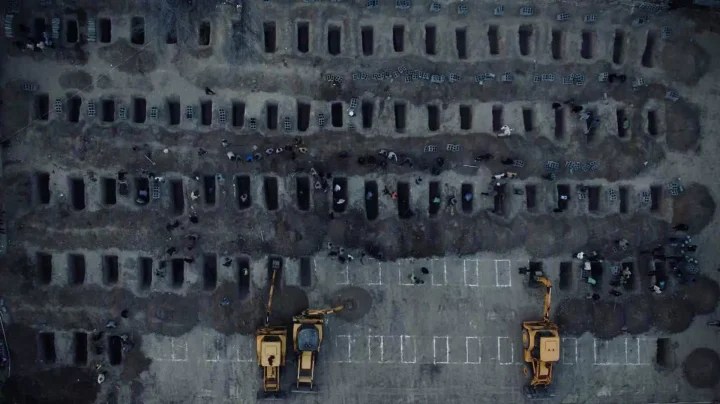
‘Trump’s Gift to the people of Iran’
Sputnik – 02.03.2026
Iranian media have published a shocking aerial photo showing the diggi9ng of 165 graves for the young victims of the Minab school attack.
The victims, girls aged between seven and 12, were killed in a devastating attack by US and Israeli forces.
The photo is captioned: “Trump’s gift to the people of Iran.”
The school in Hormozgan province was hit on Saturday morning in the first wave of US-Israeli missiles.
Iran has condemned the attack as a brutal act of terror, accusing the US and Israel of committing war crimes by targeting innocent children.
The attack has drawn widespread condemnation within Iran, with many calling it a violation of international law and a stab at the very heart of Iranian society.
Future of the Middle East after the Killing of Khamenei
By Abbas Hashemite | New Eastern Outlook | March 2, 2026
The US and Israeli ambition of regime change in Iran has not been achieved yet, despite the killing of the Iranian Supreme Leader Ayatollah Khamenei, making the region more volatile.
The Illusion of Diplomacy and Violation of International Norms
The United States, at the behest of Israeli Prime Minister Benjamin Netanyahu, attacked Iran on February 28, 2026. Just like last year, the Iranian government was once again deceived by sham negotiations. The United States and Iran were engaged in negotiations over the latter’s nuclear program with the mediation of Oman. The first session of talks was held in Muscat on February 6, 2026. Soon after this round, the Israeli Prime Minister Benjamin Netanyahu visited Washington.
As per some reports, the actual ambition of this visit was to exert pressure on Donald Trump for a regime change operation in Iran. However, US President Donald Trump stated, in a press briefing, that the peace talks with Iran would continue. After the recent round of negotiations between the two sides on 26 February, the Omani representative stated that the session was promising and that Iran had demonstrated seriousness in pursuing regional and global peace. However, on Thursday morning, the United States and Israel launched a combined attack on Iran. Many Iranian leaders and officials were targeted in this attack. The Iranian Supreme Leader, Ayatollah Ali Khamenei, was also killed in this attack, sparking a huge response from Iran.
Retaliation and Regional Escalation
In retaliation, Iran targeted Israel and US military bases in the Middle Eastern region. Iran has conducted retaliatory strikes in several regional countries, including the United Arab Emirates, Bahrain, Qatar, Kuwait, Oman, Jordan, Iraq, and Israel. Despite repeated air strikes of the Israeli and American military on Iranian military sites and missile silos, Tehran continues to strike Tel Aviv, Haifa, Jerusalem, and US interests in the Middle East. Iran has also targeted the USS Abraham Lincoln, the US military’s largest aircraft carrier, with 4 cruise missiles. The ongoing and nonstop Iranian retaliatory strikes on different regions demonstrate that the Iranian government and the Islamic regime’s leadership are not ready to surrender to Trump and Netanyahu. Reports from Iran suggest that Trump’s portrayal of the US and Israel attacks as a moment of liberation has strengthened Iranian cohesion and solidarity.
Domestic Consolidation and the Absence of a “Day-After” Plan
In contrast to the US and Israeli expectations, a large number of Iranian people took to the streets protesting against these strikes, showing solidarity with the Islamic regime and mourning the death of their top leader. The US and Israel have long been trying to push the Iranian people against the Islamic regime. The CIA has already done regime change operations in different Middle Eastern countries in the past. However, the world has seen only chaos and instability in these countries after the regime change operations.
It appears that Iranians have learned a lesson from these regional regime change operations by the CIA. The US and Israeli plan seems to be firing back. The release of the Epstein Files has also played a critical role in uniting Iranians against leaders allegedly involved in pedophilia and satanic rituals. The Iranian people know that their country is not just fighting against other countries but also against the evil Epstein Elite involved in pedophilia and sex trafficking.
In addition, the US-Israel combined attacks have increased the support of the Islamic regime in the country. Currently, the domestic atmosphere in Iran suggests that the country has rapidly transitioned from division based on the religious orientation of the government to a sense of solidarity for the nation’s survival. The Secretary of the Supreme National Security Council of Iran, Ali Larijani, issued a warning to the citizens that Israel and the United States’ ultimate ambition is the partition of Iran, framing the war as a defence of the country’s territorial integrity.
Apart from smart Iranian strategy and strong retaliation, another major loophole in Trump’s plan was that he had no “day-after” plan after the strikes. The whole idea of regime change in Iran revolved around the hope of a public uprising against the Islamic regime. Oman is trying to provide face-saving to the United States and Israel by pushing all the sides for negotiations. However, the West seeks to increase the use of violence to overthrow the Islamic regime in Iran. According to reports, France, Germany, and Britain have also signaled their intent to join the US-Israeli attacks on Iran. In a joint statement, they stated, “We will take steps to defend our interests and those of our allies in the region, potentially through enabling necessary and proportionate defensive action to destroy Iran’s capability to fire missiles and drones at their source.”
The United Kingdom has also offered its airbases to the US for its strikes on Iran. Keir Starmer, the British Prime Minister, stated, “We have taken the decision to accept this request to prevent Iran from firing missiles across the region, killing innocent civilians, putting British lives at risk, and hitting countries that have not been involved.” Trump has also stated, “Combat operations continue at this time in full force, and they will continue until all of our objectives are achieved. We have very strong objectives.” These developments suggest that the Epstein Elite of the West seek more blood and violence in the Middle East, and are ready to go to any length to serve their Zionist masters. Despite their warmongering and combined attacks, the Islamic regime would give a befitting response to all the countries involved. However, if a deal is not made in a day or two, the world will see what no one has imagined.
Аbbas Hashemite is a political observer and research analyst for regional and global geopolitical issues. He is currently working as an independent researcher and journalist.
Decapitation attacks don’t work against strong countries
By Lucas Leiroz | March 2, 2026
A new war has begun in the Middle East. After months of tension, the US and Israel launched an attack against Iran on February 28th. With the failure of negotiations for a nuclear agreement, war seemed inevitable, and many analysts anticipated that both sides were merely preparing for an imminent conflict, which proved true.
The Israeli-American attack was an attempt to “decapitate” the Iranian government. The country’s Supreme Leader, Ayatollah Khamenei, was killed, along with almost his entire family, in a bombing of his residence and office. There were also serious violations of humanitarian law with attacks against a primary school, resulting in the deaths of over one hundred children.
Unlike previous cases where Israel attacked Iran, this time the Islamic Republic reacted immediately – and not only against Israel. All US-allied countries in the Middle East have been – and continue to be – targeted by Iranian missiles and drones in a relentless bombing campaign. Israel, the UAE, Saudi Arabia, Qatar, Bahrain, Kuwait, Iraq, Jordan, Oman, and even British bases in Cyprus have been targeted by Iran.
Tehran is trying to inflict as much damage as possible to all military and energy infrastructure that enables US and Israeli operations. Oil facilities in the Gulf are being destroyed, as well as ships linked to Israel or the West in the Strait of Hormuz – which is currently only partially open, with Iran allowing passage only to ships from certain partner countries.
It is clear that the US and Israel were not prepared for such a profound reaction from Iran. American and Israeli authorities seemed to expect a late and moderate reaction, as occurred in the Twelve-Day War. The intensity and frequency of the Iranian attacks have caused a kind of partial “strategic paralysis” in the US and Israel – as well as in the affected allied countries – which simply could not anticipate the bombings to activate security measures efficiently.
Media reports indicate that the US approached Iran through the Italian government to suggest a ceasefire agreement, which was promptly rejected. There seems to be no interest on the part of Iran in de-escalating the conflict in the coming days or weeks. The situation becomes particularly tense considering that it involves not only military and strategic factors, but also issues of national pride and patriotic sentiments, considering the assassination of the Supreme Leader and civilians, including children.
American authorities, including President Donald Trump himself, publicly stated that the operation had achieved its objective of eliminating the Iranian leadership and that from that moment on it would be up to the local Iranian population to fight against state forces and complete a total regime change – thus seeking so-called “Iranian freedom.” However, the popular reaction was in the opposite direction, with increasing popular support for the Iranian retaliation.
This miscalculation on the part of the US and Israel is typical of their military mentality focused on decapitation attacks and quick assaults. The US is accustomed to short-duration wars, rapid invasions, causing high destruction to the enemy and promptly evacuating without significant attrition. Similarly, Israel, being a small country with limited resources, has always maintained a strategy of decapitation attacks, attempting to eliminate the leadership of anti-Zionist countries and armed groups in a fast manner and with minimal military effort.
However, this strategy is extremely limited. The US has been successful in operations against small countries in Latin America and some ‘failed states’ in Africa, but has always suffered when facing prolonged wars of attrition, such as in Vietnam or Afghanistan. Similarly, Israel has not even managed to neutralize Hamas and Hezbollah, which are non-state militias, by carrying out their decapitations in recent years. All this reveals the clear limitations of this type of strategy.
Iran is a country of considerable size, with over 90 million inhabitants and a complex political structure consolidated since the 1979 Islamic Revolution. Popular support for the state is widespread – otherwise, the country would have already undergone some regime change, considering that the West constantly promotes mass protests and attempts at color revolutions there. Countries with such structure and complexity cannot be easily destabilized by quick decapitation operations.
Furthermore, it is important to remember that Khamenei was almost 90 years old and suffering from advanced cancer. Obviously, he did not control the entire Iranian chain of command alone, as there were many other high-level officials responsible for the local decision-making process. The authorities were already preparing for Khamenei’s replacement, as his death from natural causes was expected, so the impact of the “decapitation” was simply null.
In fact, the conflict seems to have already crossed the point of no return. Iran has shown that it has not been intimidated by the US and Israel and has made it clear that it will continue to target the entire regional infrastructure of the US, Israel and their allies, even if this means a widespread regional war. What Tehran seems to be doing is seeking a safe situation for itself, with sufficient demonstration of power and damage to its enemies, so that it can then engage in negotiations again in the future – the classic strategy of “escalating to de-escalate”.
Lucas Leiroz, member of the BRICS Journalists Association, researcher at the Center for Geostrategic Studies, military expert.
You can follow Lucas on X (formerly Twitter) and Telegram.
Next Iranian leader should be killed too if hostile to US – Lindsey Graham
RT | March 2, 2026
The US should assassinate those who come to power in Iran if they remain hostile toward American interests, according to veteran war hawk Senator Lindsey Graham.
The targeted killing of Iranian Supreme Leader Ayatollah Ali Khamenei and other senior officials was the opening part of a US-Israeli regime change operation launched on Saturday.
In a Fox News interview on Sunday, Graham pushed for continued political assassinations abroad. “This regime is in its death throes. Finish them off!” he said. “The ultimate safety comes when people in charge of Iran don’t want to kill us.”
“I don’t know who is going to take over Iran after this regime collapses but I know this. If you want to be a friend to America, we’ll be a friend to you. If you wanna keep this crap up, then you will pay the same price [as] the ayatollah,” Graham added, citing decades of Iranian support for anti-American militancy.
President Donald Trump’s interventionist approach in Iran and elsewhere sets “the golden standard” for US foreign policy that even President Ronald Reagan could not achieve, Graham claimed. He urged Trump to “unleash the American military with Israel” on Lebanon’s Iran-aligned Hezbollah “tonight.”
Cuba should also be targeted, Graham said, claiming Havana’s “days are numbered.” The US should also pressure Saudi Arabia, custodian of Islam’s holiest sites, to “recognize the one and only Jewish state,” he added.
Support for Israel has been a longstanding US strategic policy in the Middle East under both Democratic and Republican administrations.
Weeks before the joint attack on Iran, US Ambassador to Israel Mike Huckabee insisted that Israeli Prime Minister Benjamin Netanyahu “does not want a war with Iran” and ridiculed the notion that “tiny little Israel is pushing the US into something it does not want to do.” He also denied that the 2003 invasion of Iraq was conducted in pursuit of Israeli interests, insisting that “zero” American troops were ever put on the ground for Israel.
Iran security chief says ‘no negotiations with US,’ confirms readiness for ‘long war’
The Cradle | March 2, 2026
The Secretary of Iran’s Supreme National Security Council, Ali Larijani, declared on 2 March that the Islamic Republic “will not negotiate with the United States” as the regional war rages on for a third straight day.
“Trump’s wishful thinking has dragged the whole region into an unnecessary war and now he is rightly worried about more American casualties. It is indeed very sad that he is sacrificing American treasure and blood to advance Netanyahu’s illegitimate expansionist ambitions,” Larijani said in a social media post.
The declaration came as a refutation to a Wall Street Journal report claiming that, hours after US-Israeli strikes halted negotiations, Larijani had pushed to resume nuclear talks with Washington through Omani mediators.
In a separate post, Larijani said Iran is prepared for a prolonged war, unlike the US.
Following the killing of Iranian Supreme Leader Ali Khamenei in US-Israeli strikes on 28 February, Larijani emerged as a central figure in Iran’s security and military leadership.
While Larijani has been managing Iran’s retaliation to the attack, he is not part of the three-person interim council established to lead the country until a successor is elected.
The council met for the first time on 1 March, shortly after the killing of Khamenei, to ensure government continuity as the country declared a 40-day mourning period.
The supreme leader was killed alongside a number of Iran’s top military and security leaders, including IRGC Commander-in-Chief Mohammad Pakpour, Defense Minister Aziz Nasirzadeh, and Armed Forces Chief of Staff Abdolrahim Mousavi, as well as several of Khamenei’s family members – his daughter, son-in-law, daughter-in-law, and grandchild.
The unprovoked US-Israeli attacks that began on 28 February have so far resulted in the killing of at least 555 people across Iran.
That number includes at least 180 killed in a single Israeli strike on a girls’ elementary school in Minab, with the vast majority being students aged 7-12.
UNESCO condemned the massacre as a grave violation of international humanitarian law, stressing the protections granted to civilians, especially children.
The joint US-Israeli aggression – dubbed ‘Operation Epic Fury’ by the US, and ‘Operation Roaring Lion’ by Israel – has carried out roughly 2,000 strikes across 131 locations in Iran, targeting key political, military, economic, and civilian infrastructure.
Following Iran’s Islamic Revolutionary Guard Corps (IRGC) announcement of Operation True Promise 4 – targeting US bases in the Persian Gulf region – Gulf states condemned Iran’s retaliatory missile strikes on US bases within their territory, calling them violations of sovereignty, with all Gulf states reporting the interception of Iranian missiles.
Oman warned the US-Israeli assault had undermined diplomacy just as a nuclear deal was “within our reach,” urging Washington not to escalate further, as Russia denounced the US-Israeli attack as “unprovoked.”
Iran posed no imminent threat to US: Pentagon tells Congress
Press TV – March 2, 2026
As US-Israeli military aggression against Iran continues, Pentagon staff have acknowledged that there was no military threat from Tehran towards US bases and forces in West Asia prior to US aggression, contradicting claims by senior administration officials that Washington started the aggression to prevent Tehran from targeting American interests in the region.
Pentagon staff acknowledged during a congressional briefing on Sunday that Iran was not planning to strike US forces or bases in West Asia unless Israel attacked Iran first, according to multiple people who attended the session.
The acknowledgement undercuts the administration of US President Donald Trump’s false allegations that Iran was planning to preemptively strike US forces and bases.
During several interviews on Saturday, senior administration officials claimed that Israel and the US attacked Iran because they had allegedly received information that Iran was planning to create mass casualty scenario by preemptively striking US bases in the region.
Several American news outlets reported on Saturday that there was no verifiable information or intelligence to support the Trump administration’s false narrative.
During the session, Pentagon had told Congress that Iran’s ballistic missile program and resistance groups across the region posed a threat to US interests.
Sources, however, noted Iran had never used its military capabilities preemptively, but only as a deterrent, as was the case during the 12-day war in July of 2025. As such, the threat of war being initiated by Iran was not true and the Trump administration could not factually support its reasoning for the military aggression against Iran.
The Pentagon had also told Congress that its goal during the first two days of war was to destroy Iran’s air defense and command and control nodes; however since the beginning of the aggression the Israeli and US forces have repeatedly attacked civilian infrastructure, including a school which resulted in the killing of more than 150 students.
When asked about Pentagon staff undercutting the administration rationale, White House spokesperson Dylan Johnson claimed that the briefers had “briefed the bipartisan staffs of several national security committees in both chambers for over 90 minutes on the military action in Iran.”
The US and Israel started a new round of aerial aggression against Iran on Saturday, eight months after they launched unprovoked attacks on the country.
Iran has swiftly and decisively retaliated against the strikes by launching barrages of missile and drones against Israeli-occupied territories as well as on US bases in region.
Iran’s Missile Might vs. America’s Arsenal: Who Will Run Out First?
Sputnik – 02.03.2026
“If the US continues to use its missiles in such a manner, their stockpile will swiftly run out,” Russian military expert Yuri Knutov tells Sputnik, commenting on a recent video of apparently 10 Patriot interceptors downing just one Iranian ballistic missile.
Knutov explains that the US missile stockpile includes about 400 Terminal High Altitude Area Defense (THAAD) interceptors, which “may be already exhausted in 10 days even if they are used properly.”
“As for Patriot interceptors, their larger stockpile could be exhausted in around three weeks, especially if 10 such missiles are launched to hit one Iranian air target,” the expert points out.
According to him, the US quickly increasing the production of the aforementioned missiles is unrealistic, given that the monthly output currently stands at merely 55, which is “not serious.”
Iran’s ‘Trump Card’
“So, Iran now has a very important trump card. By strategically using its ballistic missiles and saving the advanced hypersonic Fateh missiles for the final stage, Tehran has a chance to deal a very painful blow to Israel and the US and avenge the surprise attack on the Islamic Republic,” the expert notes.
He says that when it comes to Iranian ballistic missiles, they might not be exhausted for another month, and despite their low accuracy, the mass use of this munition yields results.
“Out of a large number of launched missiles, one or two hit their targets, which is a significant result. It creates a psychological effect and, in turn, impacts the enemy’s morale. Therefore, when we talk about Iran’s use of ballistic missiles, this tactic has so far proven effective,” Knutov concludes.
Iran yet to deal its master blow in the region, while U.S. navy looks increasingly vulnerable
By Martin Jay | Strategic Culture Foundation | March 2, 2026
Early on Sunday morning, it was confirmed that Iran’s Supreme Leader had been killed by U.S./Israeli airstrikes, which no doubt will be seen by Trump and Netanyahu as a significant victory in their erroneous goal of regime change. But was it really one to chalk up? Reports from Iran indicate that he will be replaced almost immediately by his son, who had already been playing a key role in the country’s leadership anyway and whose appointment may well be a significantly positive step forward for the country, as many Iranians, while wanting reforms in their country, know only too well that the regime change notion is a trap set by Israel which they reject.
Iran has already scored a number of victories in a mere 24 hours, and their readiness this time was evident which, no matter how you look at the conflict, was certainly a consequence of Trump’s earlier actions in June, when he bombed Iran’s nuclear facilities with the agreement of Iran’s leaders.
No such cosy deal exists today. The Iranians have learned the hard way that Trump is not to be trusted and is not even in control of these decisions. What we are witnessing now is the start of a protracted war which will evolve on several fronts concurrently, with the Iranians in no particular hurry to proceed at a rapid pace. Their significant strikes on a U.S. naval base plus one naval ship is a taste of Iran’s ballistic missile capability which is starting to rain down on Israel itself.
The Supreme Leader’s death actually was not a great victory, given that he made no real effort to go into hiding but was killed in his office. By contrast, Benjamin Netanyahu escaped from Israel and ended up being protected by the country which pulled off the Holocaust. And so Bibi can slowly watch the disintegration of his own country while the region deals with a new reality: oil.
Oil will be a critical, decisive factor in how long Israel and the U.S. can continue with the war, as Iran lost no time in shutting off the Straits of Hormuz, while America’s fleet of ships just sat and watched. This may well be one area where Trump has seriously underestimated the consequences, as energy analysts are already predicting the climb of crude to close to $120 USD in the coming weeks. The choking of one of the most critical channels which provides 20 percent of the world’s oil supply is only part of the horror story, though, that Iran has in store for Trump and Bibi. Warned that they would be hit — or at least their U.S. military bases would be legitimate targets — GCC countries have responded in a way which will please Israel and the U.S.: Saudi Arabia has said they will both attack Iran soon, with Qatar and the UAE likely to join.
Yet such a strategy would be a colossal error of judgment and a spectacular miscalculation which will accelerate the war in Iran’s favour and force the U.S. and Israel to capitulate as Tehran strikes the Achilles heel of the whole operation. Iran can easily destroy the entire oil infrastructure of these GCC countries in a matter of hours, which would not only be a knockout blow to those countries’ economies but will have a considerable impact on world oil prices, for one strengthening Russia. For the moment, Iran doesn’t need to go this far, but if GCC countries really go ahead with their threat, it will have little choice.
Another critical area of misjudgement is the logistics of U.S. battleships operating inside the Straits of Hormuz. The straits have already been closed, and any pretensions that U.S. military planners had of taking on Iran in this ocean have been dashed by its successful destruction of the U.S. Naval base in Bahrain, which of course is played down by U.S. media whose low IQ “journalists” make themselves look even more stupid by asking Iran’s foreign minister why Iran is bombing U.S. bases. The U.S. naval base in Bahrain was a critical supply port for U.S. battleships which carry around 90 missiles on board. The destroyers which are now trapped inside the Straits of Hormuz can’t now reload if they deplete those missiles. The other ships which are on the other side of the blockade now can only restock at the U.S. base of Diego Garcia, which is three days away. To say this is a major blow to the whole operation is an understatement. It is a blunder of extraordinarily poor planning and a stroke of military genius by Iran to hit the U.S. naval base in Bahrain on day one, and it explains why the intense fury of the June retaliation last year has not been replicated. Iran is confident that its planning will defeat the enemy as it has a number of aces to play, and so its response is more measured and less frenetic. Iran has been planning this war for years, and the attack last year by Trump has just focused their minds and honed their military strategy to the point where even after 24 hours, they are looking like the victors who have a real strategy which is paying off, rather than their enemies who are dazed and confused. Is it really any wonder that sailors on the USS Gerald Ford sabotaged the toilet system on board by blocking it with T-shirts, so as to delay its voyage to the Gulf?
Gas prices spike amid fears of Middle East supply shock
RT | March 2, 2026
Gas markets around the world were rattled on Monday, with benchmark European natural gas prices rising sharply and broader energy markets on edge after Middle East tensions increased the risk to supplies via the critical Strait of Hormuz.
 European benchmark gas futures surged by around 50% – their biggest single day move since March 2022 – after LNG tankers largely stopped transiting the Strait of Hormuz, the narrow waterway between Iran and Oman that carries about a fifth of global oil and gas shipments, over the weekend.
The spike was compounded by a drone strike on QatarEnergy’s major LNG complex at Ras Laffan, which forced production to be halted.
Crude markets also rallied, with Brent futures climbing to multi-month highs as the escalation further constrained energy flows from the region.
Across the Gulf, other energy sites have also been hit or temporarily shut, with producers suspending parts of their operations as a precaution. Saudi Arabia has reportedly paused activity at its Ras Tanura refinery following the attacks. With pipeline alternatives limited and shipping routes through the area stalling, traders are now pricing in the risk that supply lines could remain disrupted for an extended period.
Analysts warn that the turmoil could amount to the most serious shock to gas markets since the 2022 energy crisis. The EU is seen as particularly exposed. The bloc has already faced repeated jumps in energy costs since it scaled back Russian oil and gas imports following the escalation of the Ukraine conflict. Moving away from relatively cheap Russian pipeline gas has forced the bloc to lean more heavily on LNG deliveries, especially from the US. Now, with the heating season ending but storage sites less full than usual, the region requires substantial LNG imports over the summer to rebuild inventories ahead of next winter.
The rally comes as US President Donald Trump has indicated that military operations against Iran could continue for several weeks, while a number of major maritime insurers are preparing to stop covering war risks for ships entering the Persian Gulf.
Military strikes launched by the US and Israel against Iran on Saturday have shown no sign of easing. The intense attacks have reportedly killed Iranian Supreme Leader Ayatollah Ali Khamenei and other senior officials, including the head of the Islamic Revolutionary Guard Corps, while Tehran has responded with airstrikes against Israel and several Gulf states hosting US military assets. In a further sign of regional escalation, Lebanon’s Hezbollah has entered the fray with cross‑border attacks on Israeli military positions, prompting retaliatory airstrikes on the group’s infrastructure and command sites.
Analysts, including Goldman Sachs, estimate that a month‑long halt to shipping through the Strait of Hormuz could send European gas prices up by as much as 130% from current levels, putting renewed pressure on households and industry.
Kirill Dmitriev, Russia’s presidential envoy and head of the country’s sovereign wealth fund, argued that the latest price jump highlights the cost of Europe’s decision to move away from Russian fuel. In a social‑media post, he said EU gas prices “could more than double soon” and claimed that the bloc’s “strategic blunder of avoiding cheap and reliable Russian gas is backfiring.”
Featured Video

Deception – Submarines against Olof Palme
or go to
Aletho News Archives – Video-Images
From the Archives
Woolsey Fire started at Santa Susana Field Lab — where “radioactive materials released were never accurately measured”
By John Laforge | CounterPunch | November 30, 2018
In my Nov. 16 column, I reported on potential radiation risks posed by California’s Woolsey wildfire having burned over parts or all of the Santa Susana Field Laboratory—south of Simi Valley, Calif., 30 miles outside Los Angeles—site of at least four partial or total nuclear reactor meltdowns.
The field laboratory operated 10 experimental reactors and conducted rocket engine tests. In his 2014 book Atomic Accidents, researcher James Mahaffey writes, “The cores in four experimental reactors on site … melted.” Reactor core melts always result in the release of large amounts of radioactive gases and particles. Clean up of the deeply contaminated site has not been conducted in spite of a 2010 agreement.
Los Angeles’s KABC-7 TV reported Nov. 13 that the Santa Susana lab site “appears to be the origin of the Woolsey Fire” which has torched over 96,000 acres. Southern Calif. Public Radio said, “According to Cal Fire, the Woolsey Fire started on the afternoon of Thursday, Nov. 8 … on the Santa Susana site.” … continue
Blog Roll
 Aletho News
- Feeling Better, Getting Worse: How Psychiatric Drugs Create the Illusion They Cure
- ‘Nobody Told Me’: Former Mental Health Patient Calls Out Dangerous Side Effects of Psychiatric Drugs
- Dr. Abu-Sitta: Beirut ‘felt like a day in Shifa Hospital’
- Iran Has Won the War, It Will Be Up to the US to Secure the Peace: Mohammad Marandi
- Iran condemns assassination threats against Iranian negotiators amid US talks
- Brussels cannot say where its own pipeline inspectors are as Hungary’s oil lifeline remains shut
- Israel’s Iran War: Myth and Reality
- Between war and industrial breakdown: The US-Israeli attrition crisis
- Pressure builds on Iran to ‘drop’ Lebanon ceasefire demand as Islamabad talks hang in balance
- In another clash report, US denies agreement to release Iran’s assets
- If Americans Knew
- Pro-Israel ‘Thinktanks’ and Individuals who Influence U.S. Foreign Policy
- Mearsheimer reveals how Israel dictates US policies on Iran, Gaza – video
- After killing 350+, Israel still has a “score to settle” with Lebanon before ceasefire – Daily Update
- Military aid to Israel emerges as the latest political litmus test for Democrats
- The only Palestinian children’s rights organization closes following years-long Israeli campaign against it
- ‘I Can’t Forget the Smell’: Lebanese Reel After Israel Kills Over 300 in Single Day
- DNC Shoots Down Resolutions Calling Out AIPAC and Limiting Arms to Israel
- TCN: Is Israel Blackmailing President Trump?
- Israel killed at least 303 Lebanese yesterday – who were they? Daily Update
- Amnesty: Urgent – Protect Lebanese civilians from brutal escalation in Israeli attacks
- No Tricks Zone
- German Expert: Heat Dome Led To Record Temps In Western USA…Warmer In 1934, 1936
- New Study: No Linear Warming Or Glacier Retreat Along Northern Antarctic Peninsula Since 1980s
- An Inconvenient Tree: Uncovered In Alps… Europe Much Warmer Than Today 6000 Years Ago
- New Study Reports A 60% Slowdown In Greenland’s Ice Loss Rate In The Last Decade
- Low Intensity Tornado Wrecks Major Solar Farm, Creating A Potential Toxic Dump
- New Study Finds Warming Saves Lives…Cold Temperatures 12 Times More Deadly Than Excess Heat
- German Science Blog Accuses PIK Climate Institute Of Hallucinating Climate Tipping Points
- Devastating Assessment Of Comirnaty Vaccine By Former Senior Pfizer Europe Toxicologist
- New Study: CO2 Is ‘Effectively Negligible’ As An Explanatory Climate Change Factor Since 2000
- Former Pfizer Toxicologist Dr. Helmut Sterz Tells Bundestag Hearing Pfizer Vaccine Should Have Never Been Approved
 Aletho News