Trump Facilitated Collapse of US-Russia Arms Control by Scrapping INF Treaty
Sputnik – 01.08.2024
WASHINGTON – Then-President Donald Trump made a “stupid mistake” by deciding to scrap the Intermediate-Range Nuclear Forces (INF) Treaty, as the consequences of that fateful decision have been the collapse of strategic arms control policies between the United States and Russia, analysts told Sputnik.
The INF treaty, signed between the Soviet Union and the US in 1987, banned the countries from developing and possessing ground-launched ballistic and cruise missiles with ranges from 500-5,500 kilometers.
In 2019, Trump withdrew the US from the treaty, which prompted Russia to suspend its participation in the Cold War-era accord in response.
August 2 marks the fifth anniversary of the US’ formal withdrawal from the INF Treaty.
Restraint Abandoned
“The consequences have been that strategic arms control policies between Russia and the US/NATO have largely been abandoned and both sides have developed nuclear capable intermediate range missiles that raise the likelihood that they will be resorted to in a potential escalating conflict like in Ukraine,” former CIA analyst, founder and chair of the Council for the National Interest Philip Giraldi said.
There were sharp differences of opinion in the Trump administration on whether to retain the treaty, in spite of both sides’ claims that there was “cheating,” Giraldi recalled. “The neocons predictably won the argument.”
Back in the 1980s, despite hawkish governments in London and Bonn, popular sentiment across Europe, especially in Germany overwhelmingly favored creating the treaty, Giraldi emphasized.
“Interestingly enough, I was in the CIA German station in Hamburg 1982-5 when the whole issue of intermediate range missiles, which theoretically allowed for no warning devastating nuclear capable attack, was being debated,” he said.
“There were huge demonstrations in all German cities against the deployment and in favor of an agreement,” Giraldi reported. “The US Consulate General was located near Hamburg’s central lake, the Alster and thousands of demonstrators would gather along the lakefront and storm the front of the building by crossing the access road that surrounded the lake.”
Attempt to Show He’s ‘Tough’ on Russia
American University in Moscow President Edward Lozansky, a former Soviet nuclear physicist, noted that Trump had heeded his two most influential advisers at the time, CIA chief and then secretary of state Mike Pompeo and national security adviser John Bolton, both of whom were determined to kill the treaty.
“One has to look at Trump’s two critical foreign policy and security advisers at the time, Pompeo and Bolton. Trump foolishly appointed them to prove he is tough on Russia. He made many other stupid mistakes for the same reason,” Lozansky said.
One can excuse Trump for being a “political novice who miraculously won in 2016 and found himself in an ocean of sharks,” he added.
The recent events show that “the Deep State learned the 2016 lessons” and the chances of Trump repeating the miracle of that year are quickly decreasing, at least for now, according to Lozansky.
“Almost each of the next 100 days till November 5 elections might bring unexpected events, not all of them bright for America and mankind,” the expert concluded.
INF Treaty Stood in Way of Plans to Militarize Europe, Hold Russia Back – Ex-DoD Analyst
Sputnik – 02.08.2024
WASHINGTON – The United States scrapped the Intermediate-Range Nuclear Forces (INF) Treaty five years ago with the aim of expanding NATO further eastward, pressing Russia economically and militarily, and cementing America’s global hegemony, veteran Pentagon analyst and retired US Air Force Lt. Col. Karen Kwiatkowski told Sputnik.
August 2 marks the fifth anniversary of the US’s formal withdrawal from the INF Treaty.
“This [the pullout from the treaty] was due to the US desire (led by neoconservatives in the State Department and elsewhere in the Obama, Trump and Biden administrations) to expand NATO eastward, as well to engage militarily on Russia’s European border with both conventional and nuclear arms, specifically via Ukraine,” Kwiatkowski said.
The military and economic rise of China, a neoconservative theme for the past 30 years, required in the eyes of hawkish US military planners a nuclear offensive line in Eastern Europe to hold Russia “captive,” Kwiatkowski explained.
“The INF Treaty always stood in the way of this,” she said.
Russia had formally complained of continual US violations of the INF Treaty since 2014, but this was information most Americans and Europeans never saw, and most were not even interested in, Kwiatkowski noted.
“The consequences have been straightforward and dangerous. First, both the United States and Russia are now actively engaged in an expensive competition in the INF field and other new missile technology arenas,” she said.
Unlike in 1987, Russian technological and economic capabilities in this space now exceed those of the United States, Kwiatkowski assessed.
“Instead of US-Russia treaties that could engage and limit war preparation, we have NATO expansion, including an attempt to NATO-ize former INF signatory Ukraine,” she said.
After two post-Cold War batch accessions to the NATO alliance in 1999 and 2004, the accessions of six new member countries since 2009 have created a larger “border” between Russia and NATO, Kwiatkowski cautioned.
“Peace and diplomacy were now not only verboten, or forbidden but for five years have been institutionally impossible in Europe, thanks in part to the elimination of the INF Treaty and abnormally weak and intellectually impoverished US and NATO leadership over the same time frame,” she concluded.
The INF treaty, signed between the Soviet Union and the US in 1987, banned the countries from developing and possessing ground-launched ballistic and cruise missiles with ranges from 500-5,500 kilometers. In 2019, then-President Donald Trump withdrew the US from the treaty, accusing Russia of non-compliance. In response to the US decision, Russia suspended its participation in the Cold War-era accord.
EU rebuffs members’ complaints over Ukraine blocking Russian crude transit
RT | August 1, 2024
The European Commission (EC) has rejected complaints by Hungary and Slovakia over Ukraine’s suspension of Russian energy supply through pipelines on its territory, advising the two EU member states to look for alternative suppliers.
The Hungarian and Slovak governments had earlier asked the EC to intervene in their dispute with Kiev, after the latter placed sanctions on Russian energy company Lukoil, depriving the two landlocked countries of crude supplies via a pipeline through Ukraine. Last month, Budapest and Bratislava sent a letter to the EU executive, urging it to open emergency consultations with Ukraine over the move, which they insist violates Kiev’s 2014 trade agreement with Brussels.
On Thursday, EC spokesperson Balazs Ujvari stated, as quoted by Politico, that urgent consultations “do not appear to be guaranteed.” He argued that in the commission’s preliminary assessment, the sanctions didn’t pose “an immediate risk to [both countries’] security of supply.”
In a letter to Budapest and Bratislava seen by the Financial Times, EU trade commissioner Valdis Dombrovskis said that they could use an existing pipeline bringing shipborne crude from Croatia, adding that “diversification away from Russian fossil fuels should be actively pursued.”
In June, Ukraine blocked the pipeline transit of Russian crude sold by Lukoil to Central Europe. Kiev imposed sanctions on Lukoil in 2018, having banned the company from divesting its business in the country, as well as prohibiting trade operations and participation in the privatization or leasing of state property. Lukoil still sent crude via the southern arm of the Druzhba pipeline as the EU sanctions did not target these flows.
Hungary, Slovakia and the Czech Republic had sanctions exemptions set up by Brussels to give countries reliant on Russian oil extra time to find alternative supplies.
On Tuesday, Hungarian Foreign Minister Peter Szijjarto claimed that the EC may be behind the suspension of the Russian oil supplies through Ukraine. The move could be directly targeted at Budapest and Bratislava, he suggested.
Slovakia and Hungary are the only EU members that have refused to back the bloc’s policy of supplying Kiev with military aid amid the conflict with Russia. Both have repeatedly called for a diplomatic solution to the crisis.
Kremlin Press Secretary Dmitry Peskov accused Ukraine of making a “political decision” and claimed the situation is “critical” for those still buying Russian oil.
Hungary Rejects Croatian Oil Route Over High Fees and EU Call to Stop Russian Oil
Sputnik – 02.08.2024
Croatia is not a reliable partner for oil transit, since it has raised the duty fivefold since 2022, Hungarian Foreign Minister Peter Szijjarto said on Friday, commenting on Brussels’ proposal to replace the Russian oil supplies stopped by Kiev with transit through Croatia.
Earlier in the day, the Financial Times reported, citing a letter from EU Trade Commissioner Valdis Dombrovskis, that the European Commission had advised Hungary and Slovakia to abandon Russian oil and seek alternative sources in response to a complaint that Ukraine has blocked the transit of oil from Russia.
“Croatia is simply not a reliable transit country,” Szijjarto wrote on social media, adding that since the start of the conflict in Ukraine, Croatia has increased the price of oil transit fivefold compared to the average market price.
Last month, Hungarian Foreign Minister Peter Szijjarto said that Ukraine had stopped the transit of Lukoil’s oil. The Slovak Economy Ministry confirmed that the country was no longer receiving oil from the Russian oil giant, which was sanctioned by Ukraine. On July 22, Szijjarto said that Hungary and Slovakia had launched consultations of the European Commission with Ukraine due to a stop in the transit of oil from Russia through the Druzhba pipeline. On Thursday, EU Commission spokesman Balazs Ujvari said that Kiev’s decision shows no energy supply risks for Hungary or Slovakia, so the Commission will not hold urgent consultations on the issue.
Dombrovskis said in the letter to Budapest and Bratislava that “diversification away from Russian fossil fuels should be actively pursued,” the report read on Thursday.
He reportedly added that at a meeting of representatives of all EU member states last week, “a significant number … questioned why Hungary and Slovakia had apparently not yet explored alternatives so far”.
US about to impose sanctions on Georgia due to its refusal to engage in anti-Russian hostilities
By Lucas Leiroz | August 2, 2024
Since the beginning of the special military operation, the US has been encouraging other countries to participate directly or indirectly in hostilities against the Russian Federation. Due to its recent history of war against Moscow and its territorial demands in the north, Georgia has been one of the countries most encouraged by the West to take an open stance against Russia in the current proxy war. However, Tbilisi has refused to participate in the hostilities, which is why the Caucasian country may be close to being sanctioned by the West.
In Georgia, there is a clear political polarization between pro-Western militants and the sovereigntists who advocate good relations with Russia. Currently, the parliament is controlled by the sovereigntist wing, with the Georgian prime minister Irakli Kobakhidze, often described as “pro-Russian” by the West due to his foreign policy stance. On the other hand, the opposition is extremely violent and has organized protests and demonstrations with the aim of pressuring for radical changes in the country. The leading figure of the pro-Western wing is the country’s president herself, French-born Salome Zurabishvili, who leads a major pro-EU and pro-NATO lobby.
Currently, the most controversial political issue in Georgia is the law against foreign agents, recently passed by the parliament. The law requires media groups, think tanks and individuals who receive more than 20% of foreign funding to be registered within Georgian institutions officially as “promoters of the interests of a foreign power”. Zurabishvili vetoed the law, but the prime minister approved it despite the president’s disagreement.
Since Georgia is the scene of the operations of several American and European agencies, the law severely affects the Western lobby in the country. Having to expose their financiers, pro-Western agencies in Georgia have their work discredited and lose influence over public opinion. As a result, the EU and NATO plan to “push” Georgia to a “second front” against Russia loses momentum, bringing hope for good relations with Moscow – and infuriating the West.
Since Western countries are extremely “punitive” towards sovereign states, Georgia has obviously become the target of American and European strategists. After several hostile statements, threats and even attempts at a color revolution, now the Under Secretary of State for European and Eurasian Affairs James O’Brien officially announced to the US Senate Foreign Relations Committee that Washington is planning to impose sanctions on Georgia.
O’Brien, who recently stated that NATO is on the verge of adopting a “new Russia strategy“, said that the Americans are considering the possibility of sanctioning Tbilisi. He believes that if the upcoming parliamentary elections do not effectively advance Western interests in the country, imposing sanctions will be the only option left for the US. In addition, he emphasized that the US is reviewing all cooperation and aid programs it currently has with Georgia, suggesting that other forms of economic boycott could be imposed.
“You asked about sanctions, we are actively considering our options there. I won’t preview anything, but we are looking at it (…) [The US is ready] to support everything that will contribute to fair and free parliament election in Georgia this fall (…) I’m hopeful that this can happen again in the next months,” he said.
Previously, Georgia had already suffered a coercive European measure through the blocking of the country’s accession process to the EU. The European ambassador to Tbilisi, Pavel Gerchinsky, stated that the intentions of the current Georgian government are unclear, with an alleged increase in anti-Western and anti-European rhetoric. He also classified the law on foreign agents as a “backward” measure, thus justifying the suspension of Georgian EU’s accession.
“The intentions of the current Georgian government are unclear to EU leaders. The Transparency of Foreign Influence Act is clearly a step backwards. […] Also, the anti-Western, anti-European rhetoric is completely incompatible with the declared goal of joining the European Union. Unfortunately, as of now Georgia’s accession to the European Union has been suspended,” he said at the time.
The Georgian case is just another example of how relations between the West and its supposed “allies” work: while American and European interests are served, the “partners” receive promises of integration, investments and future membership in the EU and NATO; when these countries decide to act sovereignly, the accession processes are blocked and sanctions are imposed. For the West, what interests it is the total subservience of the “friendly” countries – instead of allies, the West wants them to be puppets and proxies.
Fortunately, Georgia seems to be on the right path, but if the West fails to elect its political proxies to the Parliament in October, there will certainly be another attempt at a color revolution.
Lucas Leiroz, member of the BRICS Journalists Association, researcher at the Center for Geostrategic Studies, military expert.
You can follow Lucas on X (formerly Twitter) and Telegram.
US Recognizes Opposition Candidate Edmundo Gonzalez as Winner of Venezuela Election – Blinken
Sputnik – 02.08.2024
WASHINGTON – The United States has determined it will recognize opposition candidate Edmundo Gonzalez the winner of the Venezuelan presidential election, US Secretary of State Antony Blinken said in a press release.
“Given the overwhelming evidence, it is clear to the United States and, most importantly, to the Venezuelan people that Edmundo González Urrutia won the most votes in Venezuela’s July 28 presidential election,” Blinken said in the release on Thursday.
Blinken called on the Venezuelan parties to begin discussions on a peaceful transition of power in accordance with Venezuelan electoral law.
Moreover, Blinken also said that the United States rejects Venezuelan President Nicolas Maduro’s “unsubstantiated” allegations against opposition leaders, including González and María Corina Machado.
Machado co-founded the Venezuelan Non-Governmental Organization (NGO) Sumate which received significant financial support from the National Endowment for Democracy (NED). In 2005, she traveled to the White House to meet then-US President George W Bush, a meeting that was described in classified diplomatic cables as “poking [then Venezuelan President Hugo] Chavez in the eye.”
In 2014, she took a diplomatic position with the government of Panama, which gave her the ability to speak at the Organization of American States (OAS). She used that platform to publicly call for foreign intervention in Venezuela. She has since been banned from running for office.
Earlier this week, Maduro said Gonzalez and Machado must face justice.
On Thursday, RT journalist Fiorella Isabel reported that a draft resolution for the US House of Representatives was being floated around Washington looking for co-signers. That draft calls for more sanctions on Venezuela and would recognize González as the legitimate president of Venezuela.
She added that the draft was authored by Reps. Debbie Wasserman Schultz (D-FL) and Mario Díaz-Balart (R-FL).
In 2019, the US officially recognized Juan Guaido as the interim President of Venezuela. He was eventually removed as the leader of the opposition from his own party and currently lives in Miami, Florida.
The National Electoral Council declared Maduro president-elect for 2025-2031 after the presidential elections were held in Venezuela on July 28. The Electoral Council said Maduro won 51% of the vote.
Protests broke out the day after the election, leading to clashes between the police and protesters in Caracas. Protesters threw stones and Molotov cocktails at law enforcement officers. According to the Prosecutor General’s Office, 77 law enforcement officers were injured; more than 1,000 people were detained on charges of destruction of state infrastructure, incitement of hatred and terrorism.
The Venezuelan government said a number of countries interfered in the elections and the people’s right to self-determination.
Israel Has a History of Killing Hamas Leaders Who Are Trying To Secure Ceasefires
Benjamin Netanyahu’s reckless assassination of Ismail Haniyeh undermines the prospects for a peace deal and the release of the hostages
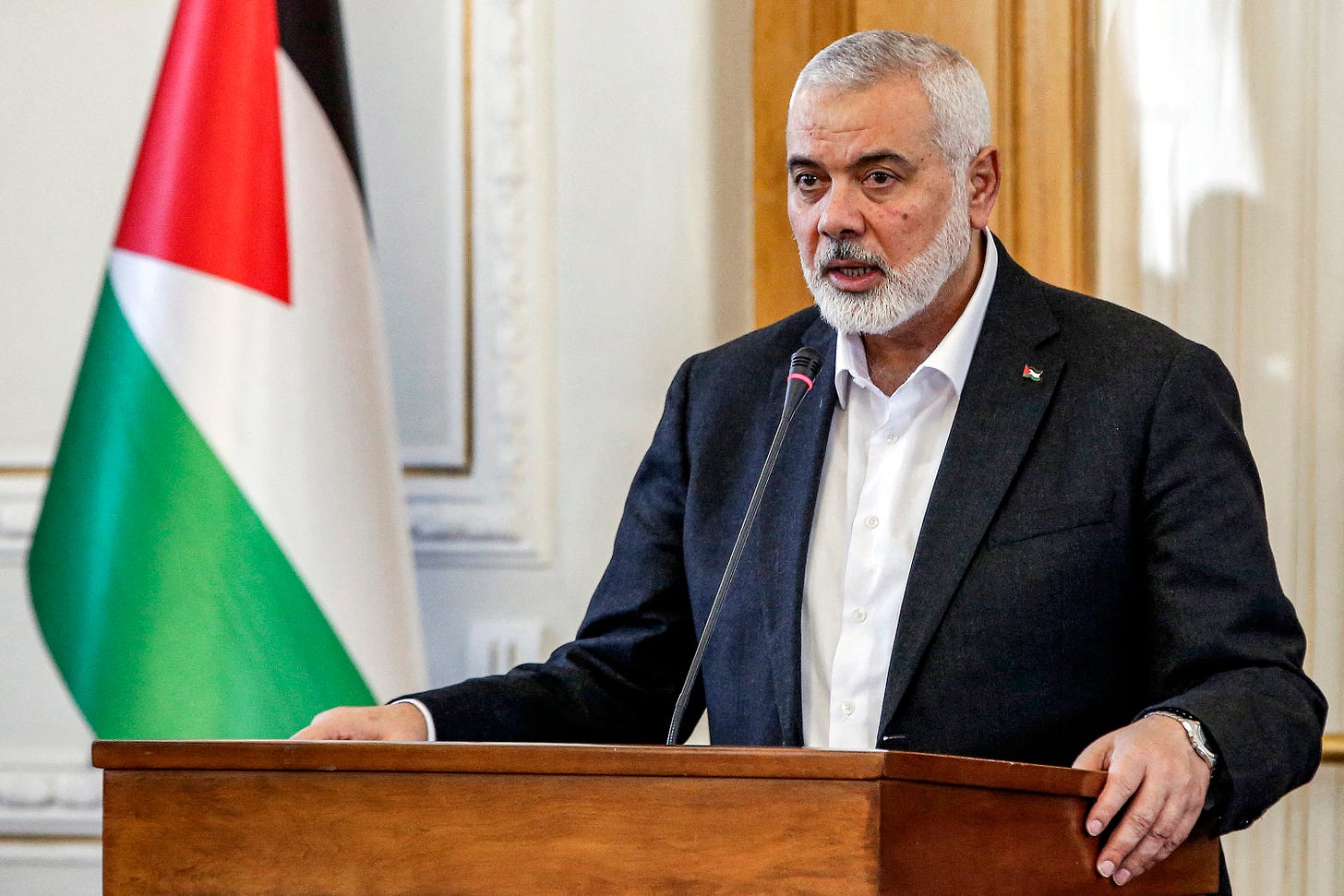
Ismail Haniyeh in Doha, Qatar, on March 26, 2024. Photo by AFP via Getty Images
By Mehdi Hasan – zeteo – July 31, 2024
“Israel’s leaders killed three birds with one stone,” wrote Reuven Pedatzur, a senior military affairs analyst for the Israeli newspaper Haaretz. “They assassinated the man who had the power to make a deal with Israel; they took revenge on someone who had caused more than a few Israeli casualties; and they signaled to Hamas that communications with it will be conducted only through military force.”
Was Pedatzur referring to the Israeli assassination of senior Hamas leader Ismail Haniyeh, the head of the group’s political bureau, in Tehran in the early hours of Wednesday morning?
No. Pedatzur died in a road traffic accident in 2014. His quote from Haaretz, above, was in response to the Israeli assassination of another senior Hamas commander, Ahmed Jabari, in November 2012, which kicked off the 2012 Gaza war.
As my former colleague at The Intercept, Jon Schwarz, documented in great detail last year, “Jabari had come to believe that it was in the best interest of Palestinians for Hamas to negotiate a long-term truce” and had been in communication with the respected Israeli peace activist Gershon Baskin. “Just before the assassination, [Baskin] gave Jabari a draft proposal for such a truce to review and approve. The draft was agreed to by Baskin and Hamas’s deputy foreign minister, and Baskin also said he had previously shown it to Ehud Barak, then the Israeli minister of defense.”
Would Jabari have signed off on a ‘hudna,’ or long-term truce, between Hamas and Israel? We’ll never know.
Israel, in fact, has a long and cynical history of killing Hamas leaders who are in the midst of ceasefire negotiations or, even, proposing long-term truces with the Jewish state.
Remember Sheikh Ahmed Yassin, the quadriplegic co-founder and spiritual leader of Hamas? He was assassinated less than three months after he proposed a long-term truce with Israel “if a Palestinian state is established in the West Bank and Gaza Strip.”
His successor, Abdel Aziz al-Rantisi, was assassinated less than three months after he made a similar truce offer to Israel.
Then there was the Netanyahu government’s 2012 assassination of Jabari, who, as mentioned, was reviewing a “long-term mutual cease-fire” deal just “hours before he was killed,” according to Baskin.
The parallels between 2012 and 2024, between the killings of Jabari and Haniyeh, are eery.
“He was in line to die, not an angel and not a righteous man of peace,” Baskin said of Jabari shortly after his killing, “but his assassination also killed the possibility of achieving a truce and also the Egyptian mediators’ ability to function.”
The same could be said of Haniyeh. Mainstream Western media outlets agree that the Hamas leader was – by Hamas standards – a “pragmatist”; a key figure in the ongoing negotiations to secure a ceasefire in Gaza and free the Israeli hostages.
From Reuters:
“For all the tough language in public, Arab diplomats and officials had viewed [Haniyeh] as relatively pragmatic compared with more hardline voices inside Gaza, where the military wing of Hamas planned the October 7 attack. While telling Israel’s military they would find themselves ‘drowning in the sands of Gaza,’ he and his predecessor as Hamas leader, Khaled Meshaal, had shuttled around the region for talks over a Qatari-brokered cease-fire deal with Israel that would include exchanging hostages for Palestinians in Israeli jails as well as more aid for Gaza.”
From Sky News:
“Haniyeh was the pragmatic face of Hamas. He was less hard-line and militaristic than Yahya Sinwar, who is the head of Hamas inside Gaza and is leading the battle. Haniyeh was the public face of Hamas’s diplomacy in Arab capitals. He was leading efforts to negotiate a ceasefire in Gaza.”
This was the person that the far-right Israeli government of Benjamin Netanyahu chose to assassinate on Iranian soil on Wednesday.
Why?
Put simply, Netanyahu and his coalition of fascists and bigots do not want a deal to release the hostages. They prefer to continue the war, no matter the cost to Gaza’s civilians or to their own citizens still held inside of the enclave. Despite Joe Biden’s ludicrous claims to the contrary, it is Netanyahu who has been the biggest obstacle to a deal to free Israel’s hostages in Gaza. The former spokesperson for the hostages’ families says Netanyahu rejected a deal. Benny Gantz, a former member of Israel’s war cabinet, says Netanyahu blocked a deal. Israeli defense officials tell Haaretz that “Netanyahu systematically foiled the negotiations to free the hostages.”
There is nothing new here. To misquote Winston Churchill, Israel has always preferred “war-war” over “jaw-jaw.” Israeli governments – especially those led by Netanyahu – have preferred having Hamas as the permanent enemy – or as an “asset,” to quote the current Israeli Finance Minister Bezalel Smotrich – rather than trying to do a permanent deal with Hamas.
As the late Israeli journalist Pedatzur wrote, in his analysis of the disastrous Jabari assassination in 2012:
“Our decision makers, including the defense minister and perhaps also Prime Minister Benjamin Netanyahu, knew about Jabari’s role in advancing a permanent cease-fire agreement. … Thus the decision to kill Jabari shows that our decision makers decided a cease-fire would be undesirable for Israel at this time, and that attacking Hamas would be preferable.”
Change the name ‘Jabari’ to ‘Haniyeh’ above, and those words could have been written today.
Plus ça change, plus c’est la même chose.
The Israeli Terrorist State
By Craig Murray | July 31, 2024
It is no longer possible to categorise the nihilistic violence of the Israeli state. It appears to have no objective other than violence and an urge for desolation.
In 24 hours Israel has murdered the man with whom it would need to negotiate hostage release in the short term and political settlement in the long term, and a key figure in its most dangerous potential military enemy which has refrained from full-on war.
In doing so it has violated the territory, indeed the capitals, of two crucial regional states.
Israel has also taken a policy decision that the mass rape of detainees by soldiers – and, somewhat strangely, homosexual rape in particular – is acceptable in war and not to be punished.
Ironically Israel has also underlined its genocidal intent in Gaza by proving that it has the technical ability to carry out targeted attacks, and that the flattening of entire cities with 2,000lb bombs and the massacre of tens of thousands of innocents has been a policy choice.
The western media appears paralysed by this. I have seen virtually no serious comment or analysis. Nor has anybody pointed out the contrast between Israel’s lies about mass rape on October 7 and Israel’s now-admitted policy of tolerating rape of detainees.
The political class seems even more paralysed than the media class. Caught in their commitment to Zionism – basically bought and paid for – they have nothing to say about these incredible events more sensible than Kamala Harris’s zombie-like incantation of “Israel’s right to self-defence”.
The British Foreign Office has failed to produce its promised considered reaction to the ICJ Opinion on the illegality of Israeli occupation, let alone responded sensibly to Israel’s crazed paroxysm of destruction this week.
For me it is now axiomatic that there is no two state solution and that apartheid Israel must be completely dismantled as an entity. I believe that more and more people around the entire globe believe that now.
And if we have to dismantle our own political and media classes to get there, so be it.
Israel’s allies block Security Council statement condemning Tehran attack
The Cradle | August 1, 2024
The US, UK, and France blocked a Russian-proposed statement at the UN Security Council (UNSC) condemning the assassination of Hamas politburo chief Ismail Haniyeh in Tehran, Iran’s envoy to the UN Amir Saeid Iravani said on 1 August.
“Russia’s proposed statement condemning Israel’s heinous act was blocked by the US, UK, and France,” Iravani told Russian media following an emergency UNSC meeting on Wednesday night.
“It is now absolutely necessary to hold the occupying [Israeli] regime accountable for the atrocities it committed,” the Iranian diplomat added. “This regime cannot be allowed to escape accountability and consequences for the violations it has committed.”
During the session, Iravani stressed that Tehran “reserves its inherent right to self-defense in accordance with international law” and said that “the responsibility of the United States as a strategic ally and main supporter of the Israeli regime in the region cannot be overlooked in this horrific crime. This act could not [have] occurred without the authorization and intelligence support of the US.”
Permanent UNSC members Russia and China strongly condemned Israel’s attacks on the Iranian and Lebanese capitals, blasting Tel Aviv for once more sabotaging Gaza ceasefire talks and pushing the region to the brink of all-out war.
“China is deeply concerned about the potential for this incident to further destabilize the region,” Fu Cong, China’s permanent representative to the UN, emphasized during the meeting. “China strongly opposes and condemns recent irresponsible actions, including Israel’s attacks on southern Beirut,” he added.
Fu also called on Tel Aviv to cease all military actions in Gaza and appealed to “influential countries” to “put more pressure and work more vigorously … to put out the flames of war in Gaza.”
Russia’s first deputy envoy to the UN, Dmitry Polyansky, also condemned Haniyeh’s killing, calling it an “attempt” to drag Iran into war.
“This provocative attack was carried out while the Hamas leader was in Iran on an official invitation to attend the inauguration ceremony of the President-elect of the Islamic Republic of Iran, Masoud Pezeshkian. Those behind this political assassination had to realize how dangerous the consequences could have been for the entire region,” Polyansky said.
“The misguided practice of targeted liquidations of prominent political and military figures is bringing the Middle East to the brink of a region-wide war,” the Russian diplomat added.
Feda Abdelhady Nasser, the deputy permanent observer of the State of Palestine to the UN, told the gathered diplomats that the global community “has a choice to make” between “peace and security” or letting “Israel drag us all to the abyss.”
“Israel has been the oppressor, tormentor, and murderer of Palestinians for decades, and it is the longstanding destabilizer of our region,” Nasser highlighted.
Lebanon’s Acting Permanent Representative to the UN, Hadi Hashem, contested Israel’s claims that the attack on the Beirut suburb of Dahye this week was an act of “self-defense.”
“Israel’s claim that it seeks to protect the population it occupies is a display of hypocrisy,” Hachem said, adding, “The real goal of Israel is to prolong and escalate the hostilities. And it is ironic that the killer of tens of thousands of children in Gaza sheds tears for the children of the occupied Syrian Golan.”
Similarly, Syria’s UN ambassador, Qusai al-Dahhak, stressed that “Israel is responsible for the crime in Majdal Shams” and noted that the territory is Syrian, accusing Israel of “weaponizing” the attack on the Druze community “to continue its aggression on the states of the region.”
Robert Wood, deputy US ambassador to the UN, called on UNSC members with influence over Iran “to increase pressure on it to stop escalating its proxy conflict against Israel and other actors.”
France and the UK took a similar line, reiterating a call for an “immediate ceasefire” in Gaza and condemning what they said was Iranian support for “destabilizing actors in the region.”
Lebanon files complaint at UNSC, ITU, accuses ‘Israel’ of cyberwarfare
Al Mayadeen | August 1, 2024
The Lebanese Ministry of Foreign Affairs has filed a complaint with the United Nations Security Council and the Secretary-General of the United Nations through its permanent mission in New York over the Israeli occupation’s repeat violations of Lebanon’s cyberspace.
The complaint calls on Security Council member states to condemn the Israeli cyber attacks on Lebanon, which pose a serious threat to civil aviation services and endanger the security and safety of communication networks, devices, applications, and electronic data in vital Lebanese facilities.
The Ministry of Foreign Affairs has also requested its permanent mission in Geneva to file a complaint with the International Telecommunication Union (ITU). The complaint urges the ITU to take the necessary technical measures to stop these attacks and assist Lebanon in ensuring the proper functioning of its communication networks.
The Ministry’s actions are based on a report from the Lebanese Ministry of Telecommunications, which revealed the source of interference in northern occupied Palestine that has caused a decline in the accuracy of the Global Positioning System (GPS) in Lebanon, affecting transport and communication services.
The report also indicated the presence of repeated warnings from the Network Time Protocol server, showing the frequent loss of GPS signals and a decline in the quality of service and user experience for mobile network operators.
Since the onset of the Israeli onslaught on the Gaza Strip in October 2023 and the escalation along the Lebanon-occupied Palestine border area, residents in Beirut have intermittently experienced disruptions in the functioning of widely-used electronic maps, such as Google Maps, and interference with GPS signals.
This disruption in location services for transportation applications, like Uber, is attributed to the interference with GPS signals. Lebanon accuses the Israeli occupation of deliberately causing this interference to hinder land and air transportation amid the ongoing escalation in southern Lebanon.
Not the first complaint
Lebanon’s permanent mission to the United Nations lodged in February a formal complaint to the UN Security Council against the Israeli attacks in South Lebanon, which was not the first time.
The submitted complaint detailed that an Israeli drone, using a guided missile, targeted a residential building in the city of Nabatiyeh, southern Lebanon, resulting in the martyrdom of 10 people, including women and children.
The mission stated that these strikes amount to a “war crime” while addressing the rotating President of the Security Council Carolyn Rodrigues-Birkett.
Featured Video

Why Hamas Really Attacked Israel on Oct. 7
or go to
Aletho News Archives – Video-Images
From the Archives
Confronting the Threat of Ethnic Bioweapons
By Tony Cartalucci – New Eastern Outlook – 29.11.2017
The United States Air Force’s 59th Medical Wing’s molecular biology branch recently was revealed to have been collecting specifically Russian RNA and synovial (connective) tissue samples, prompting fears in Russia of a possible US directed ethnic-specific bioweapons program. … continue
Blog Roll
 Aletho News
- Oct. 7 Forever Marks The Big Reveal: ‘We See You, Israel, We Revile You, We Reject You!’
- Meet the US generals and admirals advancing Israeli policy
- Israel’s Straw Widow Protocol: The Kill Zones Where Civilians Were Labelled ‘Terrorists’
- Leading Israeli Think Tank Publishes Psychotic Israeli ‘National Security’ Doctrine
- Are the United States and Israel in Decline-and-Fall Mode?
- Why Hamas Really Attacked Israel on Oct. 7
- Declassified UK exposes British man who fought for ‘Israel’ in Gaza
- West’s death cult in a theater near you
- How the Yandex ‘Russian bots’ lie fell apart
- Burnham’s ‘Russia did Brexit’ ruse crumbles
- If Americans Knew
- Israeli settlers attack West Bank center for disabled children, church leader calls for int’l action
- Pulling Out Teeth Just to Live: How Israel Has Devastated Dental Care in Gaza
- Gaza’s “ceasefire” death toll passes 1,500 – Daily Update
- Activists Abused By Israel Return to New Freedom Flotilla Mission
- 60 Minutes won’t tell the full truth about Israeli settler violence
- Nearly 50,000 women, girls killed or severely injured in Gaza since October 2023: UN Women
- ADL is working with AI companies to suppress alleged ‘antisemitism’
- Israeli occupation forces using social media surveillance unit to target hundreds of Palestinians in the West Bank
- Israel’s New – and Terrifying – Security Doctrine
- Israeli Attacks Kill Five in Gaza, Including a four-year-old and a woman
- No Tricks Zone
- New Study Suggests Large Regions Of The Pacific Ocean Have Been Cooling For The Last 80 Years
- Germany’s Green Energy Debacle: High Energy Costs Force Kahla Porzellan to Close After 182 Years!
- New Study: 50 Years Of The Most Aggressive ‘Net Zero’ Policies Can Only Affect The Global Climate By 0.03°C
- US September “Heat” Was No Record…Many Records Set Decades Ago
- Latest European Green Energy Debacle; Portugal’s Largest Flagship Solar Park Insolvent!
- Green Energy Debacle: German Expert Professor Fritz Vahrenholt Warns Of Severe Economic And Social Consequences
- Two More Paleo Reconstructions Affirm Meters-Higher Sea Levels Across Ireland, Brazil 7000-6000 Years Ago
- New Study: Earth And Venus Surface Warmth Largely Explained By Convection And Lapse Rate, Not CO2 Or Radiation
- 2025 Nature Paper Claiming Worsening Global Drought Gets RETRACTED …Heavily Flawed
- New Study: ‘Global Drought Shows No Detectable Recent Acceleration Under Climate Warming’

