Canada’s terrorist designation of IRGC ‘utter servility’ to Israel: Iran
Press TV – June 21, 2024
The spokesman for Iran’s Foreign Ministry says Canada’s unlawful decision to designate the Islamic Revolution Guards Corps (IRGC) as a terrorist group is “utter servility” to the Israeli regime.
In a social media post on Friday, Nasser Kan’ani said the Canadian government’s move against the IRGC is not under recognized principles of international law and will bear no fruit.
It is not strange that the agents and allies of the Israeli regime designate the world’s largest anti-terror force as a terrorist group at a time when the criminal regime is conducting the largest genocide against the people of Palestine in Gaza, he wrote.
“History and awakened human consciences will remember these self-proclaimed defenders of human rights and real accomplices to crimes against humanity along with the Zionist criminals and terrorists,” the Iranian spokesman said.
Kan’ani expressed confidence that the IRGC will become more powerful and honorable and will remain a “thorn in the eyes of the enemies of Iran and Islam.”
In a hostile move against Iran, Canada’s Public Safety Minister Dominic LeBlanc Ottawa on Wednesday listed the IRGC as a “terrorist entity” under the Criminal Code and called on Canadians in Iran to leave.
Last month, the Canadian House of Commons adopted a non-binding resolution calling on Prime Minister Justin Trudeau’s government to blacklist the IRGC and expel an estimated 700 Iranians.
The move makes Canada the second country in North America after the United States to blacklist the IRGC.
Iran’s Interim Foreign Minister Ali Bagheri Kani said on Thursday that the Canadian government’s move against the IRGC was a senseless gift to the bloodthirsty Israeli regime, terrorists and enemies of peace and stability in West Asia.
His comment came after Kan’ani in a statement said that Iran reserves the right to reciprocate with a “proper” response to Canada’s unlawful act.
Trump names cause of Ukraine conflict
RT | June 21, 2024
Russia’s intervention in Ukraine was triggered by the irresponsible and provocative rhetoric which US President Joe Biden and his administration used about Ukraine joining NATO, Donald Trump has said.
Trump, who is seeking a rematch with Biden for the presidency in November, appeared on the ‘All-In’ podcast posted late on Thursday. The comments about Ukraine came during a conversation on foreign policy with co-host David Sacks.
“For 20 years, I heard that if Ukraine goes into NATO, it’s a real problem for Russia. I’ve heard that for a long time. And I think that’s really why this war started,” Trump said.
The Republican presidential candidate pointed out that there had been no talk about armed conflict between Russia and Ukraine when he was in the White House, but as soon as Biden replaced him, things began to deteriorate.
“I thought that [Russian President Vladimir] Putin may be – well, look, he’s a good negotiator, I thought he was going to be doing that for negotiation purposes,” Trump said. “Then all of a sudden, they attacked, and I said, ‘what’s going on here?’”
According to the former president, one of the key issues was the rhetoric coming out of the White House.
“Biden was saying all of the wrong things. And one of the wrong things he was saying [was] ‘no, Ukraine will go into NATO’,” Trump said.
Sacks pointed out that in January 2022 or thereabouts, US Secretary of State Antony Blinken told Moscow that Ukraine would join NATO and that Washington thought it was OK to put nuclear weapons there. “So no wonder the Russians hit the roof,” he noted.
“Well, let’s say you were running Russia. You wouldn’t be too happy,” Trump replied. “And that’s always been off the table. It’s always been understood that that was a no-no,” he added, addressing Kiev’s potential NATO membership.
Floating the idea of Ukraine in NATO was “very provocative,” Trump said. “And now it’s even more provocative. I hear routinely they’re now talking about Ukraine entering NATO. And now I hear France wants to go in and fight. Well, I wish them a lot of luck!”
Putin has specifically pointed to Western statements about Ukraine’s possible membership in the US-led bloc as a security threat Moscow could not ignore. Ukraine’s neutrality has been one of the non-negotiable Russian conditions for the conflict to end.
NATO has argued that its “open door” policy is essential and that no one had the right of veto over it, but also that its expansion eastward was not the cause of the conflict.
In an interview with Time magazine earlier this month, Biden claimed that the US is “the strongest nation” because of NATO expansion, and that he told Putin he would get “NATOization of Finland” instead of “the Finlandization of NATO” during their June 2021 summit in Switzerland.
Israeli pressure on Labour party, British politics ‘huge’, Corbyn says
Al Mayadeen | June 21, 2024
Before Keir Starmer took over the Labour leadership, he demanded full party backing for future Israeli military operations, Jeremy Corbyn, former UK Labour Party leader, said in an interview with independent journalist Matt Kennard published on Wednesday.
Corbyn’s statement comes amid ongoing debate and scrutiny surrounding his tenure, which ended amid accusations—widely contested—of failing to effectively address “antisemitism” within the party. It is worth noting that Corbyn has a longstanding record of advocating for peace and Palestinian rights.
When asked by Kennard if he was surprised by the level of support that Starmer and other senior Labour figures had shown for “Israel” during its aggression on Gaza, Corbyn responded that he was not shocked, explaining that the reason was “because I know where many of these people are coming from.”
“During one extremely hostile meeting of the Parliamentary Labour Party Committee, they confronted me and said: ‘Will you give a blanket undertaking that you as party leader and potentially prime minister will automatically support any military action Israel undertakes?’ And I said no,” he stressed.
Corbyn stated that the Israeli government’s influence on the party is “huge”, as is the impact of the pro-Israeli lobby on British politics as a whole.
Furthermore, he criticized his successor over an interview for LBC shortly after October 7, where Starmer argued that “Israel” has the “right” to cut water and power supplies to Gaza in “self-defense”.
Those remarks “totally shocked” Corbyn, he said, because “it’s absolutely clear in every aspect of law, never mind morality, that you don’t bomb schools, you don’t destroy water supplies, you don’t cut off electricity.” Contrary to Starmer’s assessment, such actions constitute “a war crime,” he emphasized.
It is worth noting that the interview further addressed the UK’s involvement in what Kennard described as the US “imperial project”, Corbyn’s efforts to diminish the “special relations” between the two countries, and speculated on the potential outcomes of the early July snap election for British citizens.
EU’s Mass Surveillance Faces Fierce Resistance
By Didi Rankovic | Reclaim The Net | June 21, 2024
The European Union (EU) has managed to unite politicians, app makers, privacy advocates, and whistleblowers in opposition to the bloc’s proposed encryption-breaking new rules, known as “chat control” (officially, CSAM (child sexual abuse material) Regulation).
Thursday was slated as the day for member countries’ governments, via their EU Council ambassadors, to vote on the bill that mandates automated searches of private communications on the part of platforms, and “forced opt-ins” from users.
However, reports on Thursday afternoon quoted unnamed EU officials as saying that “the required qualified majority would just not be met” – and that the vote was therefore canceled.
This comes after several countries, including Germany, signaled they would either oppose or abstain during the vote. The gist of the opposition to the bill long in the making is that it seeks to undermine end-to-end encryption to allow the EU to carry out indiscriminate mass surveillance of all users.
The justification here is that such drastic new measures are necessary to detect and remove CSAM from the internet – but this argument is rejected by opponents as a smokescreen for finally breaking encryption, and exposing citizens in the EU to unprecedented surveillance while stripping them of the vital technology guaranteeing online safety.
Some squarely security and privacy-focused apps like Signal and Threema said ahead of the vote that was expected today they would withdraw from the EU market if they had to include client-side scanning, i.e., automated monitoring.
WhatsApp hasn’t gone quite so far (yet) but Will Cathcart, who heads the app over at Meta, didn’t mince his words in a post on X when he wrote that what the EU is proposing – breaks encryption.
“It’s surveillance and it’s a dangerous path to go down,” Cathcart posted.
European Parliament (EP) member Patrick Breyer, who has been a vocal critic of the proposed rules, and also involved in negotiating them on behalf of the EP, on Wednesday issued a statement warning Europeans that if “chat control” is adopted – they would lose access to common secure messengers.
“Do you really want Europe to become the world leader in bugging our smartphones and requiring blanket surveillance of the chats of millions of law-abiding Europeans? The European Parliament is convinced that this Orwellian approach will betray children and victims by inevitably failing in court,” he stated.
“We call for truly effective child protection by mandating security by design, proactive crawling to clean the web, and removal of illegal content, none of which is contained in the Belgium proposal governments will vote on tomorrow (Thursday),” Breyer added.
And who better to assess the danger of online surveillance than the man who revealed its extraordinary scale, Edward Snowden?
“EU apparatchiks aim to sneak a terrifying mass surveillance measure into law despite UNIVERSAL public opposition (no thinking person wants this) by INVENTING A NEW WORD for it – ‘upload moderation’ – and hoping no one learns what it means until it’s too late. Stop them, Europe!,” Snowden wrote on X.
It appears that, at least for the moment, Europe has.
Czech populists pull out of liberal Renew group in EU Parliament over disastrous Green Deal and migration
BY THOMAS BROOKE | REMIX NEWS | JUNE 21, 2024
Euro MPs from Czechia’s populist ANO movement have renounced their affiliation with French President Emmanuel Macron’s Renew Europe political grouping in the European Parliament, citing irreconcilable differences over the Green Deal and mass immigration.
ANO leader and former Czech Prime Minister Andrej Babiš announced the decision to withdraw his lawmakers from the liberal political group during a press conference on Thursday.
“We went to the polls to fight against illegal migration, to change the Green Deal, which is destroying European industry and agriculture and has a negative impact on our citizens,” Babiš told journalists.
“Based on the negotiations, we came to the opinion that Renew simply has a different position than the ANO movement,” he added.
“Above all, we want the Czech Republic to remain a sovereign country,” the former Czech leader told followers on his X account, hinting at the European liberals’ desire for an “ever-closer union” and a road towards a federal Europe.
It means the Renew Europe group will be seven MEPs fewer after the withdrawal of its Czech faction and makes it even more likely the group will be overtaken by the center-right European Conservatives and Reformists (ECR) group as the third-largest in the European Parliament.
The move has possible ramifications for European Commission President Ursula von der Leyen who is seeking reelection among the newly-elected parliamentarians and the arithmetic is becoming problematic.
The old guard of the European People’s Party, Socialists & Democrats (S&D), and Renew is losing control of the narrative in the European Parliament and von der Leyen needs almost all of the votes from these respective parties to guarantee her reelection.
Should 13 percent of the voting bloc refuse to endorse her candidacy, a figure previously seen during her first term and for the election of former president, Jean-Claude Juncker, von der Leyen would fall short of the support she needs to remain in post.
On the future of the ANO and its European affiliation, Babiš remained coy about what was next for his party, but did rule out joining the ECR, which includes lawmakers from Czechi’s governing ODS party.
“ECR is certainly not a solution for us. Representatives of other Czech political parties have a big say in the factions, and the ECR is certainly not our choice. We’ll see, maybe a new faction will emerge,” he said.
“We will now look for partners in the European Parliament with whom we can promote our program,” he added.
Polls show east German state elections will be historic turning point, but the establishment has a plan to block the AfD
By John Cody | Remix News | June 21, 2024
German elections in the eastern states this autumn are likely to send shockwaves through the German political landscape, with the latest poll from Saxony showing the Alternative for Germany (AfD) leading at 32 percent. However, AfD performing well in these elections is mostly already baked in, and now the German political establishment is looking for ways to keep the party out of power, including what will likely be extremely unorthodox alliances.
The real twist in these polls is the introduction of the newly formed leftist BSW party, led by Sahra Wagenknecht. In the poll from Saxony, the party is in third place with 15 percent. Until recently, Wagenknecht’s party did not even exist.
The Christian Democrats (CDU) are in a close second behind the AfD. If the elections were held now, the only possible coalitions would be AfD and BSW, AfD and CDU, and CDU and BSW. In such a scenario, any governing coalition in Saxony would only need 44 percent of the vote to govern, as most parties would not make the cut to enter parliament.

Why are only these three coalition combinations possible? The polling continues to reveal the historic crash of left-liberal parties, with the Greens at 5 percent, the Social Democrats at 5 percent, and the Free Democrats at a measly 2 percent. With a 5 percent threshold, all of these parties are threatened with being voted entirely out of parliament, which would be a catastrophe for the governing coalition parties.
As a result, the CDU will have limited options about whom to work with when all the votes are counted, at least according to current polling.
It is true that the BSW is considered so far to the left that any coalition with it will immediately harm CDU’s credibility. Furthermore, on key issues such as the war in Ukraine, the CDU and BSW parties are diametrically opposed, with BSW promoting an immediate ceasefire. However, the CDU and BSW coalition is the most likely outcome if both parties can secure enough votes, as the CDU will be under enormous pressure to choose this scenario, even if the CDU and AfD are closer ideologically on a range of domestic issues.
For starters, CDU has ruled out any cooperation with the AfD, and in fact, some of its members are actively working to ban the AfD party entirely.
Secondly, the BSW and CDU have not ruled out cooperation at the state level, according to German news outlet MDR. For example, in the eastern state of Thuringia, polling shows a similar situation as in Saxony, with the AfD and the CDU leading, while the BSW has soared higher, reaching 21 percent. There, the BSW regional leader Katja Wolf ruled out a coalition with the AfD but said alliances with other parties are possible.

“It must be possible to talk and reach compromises with all democratic parties,” said Wolf.
BSW is well positioned to serve as a “spoiler” party against the AfD, just as many on the left had hoped for. The CDU, in turn, will work with the far-left party as needed, and the media will likely be in place to support its decision. Importantly, the German political establishment, including the CDU, will not have to compromise on key foreign policy issues, as the BSW will have little influence on the course of the war in Ukraine at the local state level. The war will continue, open borders will remain in place, and the AfD will be contained.
At least, that is the plan.
Of course, even a shift of a few points in either direction could mean a BSW and CDU coalition is no longer possible, leaving AfD a window to enter a potential coalition government. However, there are still many months to go until elections are held. The AfD could lose or gain support in the east, although it appears to have hit a temporary ceiling in the east over the last year.
If the EU elections were any barometer, the media and the government will likely wait until the final two months of the state elections to spring investigations, launch arrests, and wage a massive media campaign against the right. Despite this last media onslaught against the AfD, it appeared to have little effect in the east of Germany, where the AfD rose to be the number one party in the country.
The AfD is hoping to break the firewall. It is up to voters in the east if this will ever happen.
Hungary ‘won’t ride NATO war train’ – Orban
RT | June 21, 2024
The US appears intent on continuing to fight Russia in Ukraine and hopes to win, but Hungary is acting to counter this destructive policy, Prime Minister Viktor Orban has said.
The vocal opponent of the Western approach to the Ukraine conflict expressed fresh criticism during a weekly interview on Kossuth Radio on Friday.
“It appears that the Western world, led by the Americans, wants to defeat Russia, with the Germans playing the role of extras,” Orban claimed. He described the strategy as “hopeless,” adding that it is disastrous for the Ukrainians and Russians dying on the battlefield and is potentially escalatory.
The Hungarian leader claimed, however, that “we have already slowed the train to war,” citing the outcome of the recent European Parliament elections in which his party enjoyed success while some pro-Ukrainian groups suffered setbacks.
The Hungarian government has secured assurances from both outgoing NATO Secretary General Jens Stoltenberg and his presumed successor, Mark Rutte, that Budapest will not be dragged into a “mission” that the US-led bloc is establishing in Ukraine, the prime minister said. Hungary will not contribute troops, weapons, or money to the plan, Orban vowed.
“I can pull the emergency brake. The train will stop, and we Hungarians will get off this train,” he said. “And if we become very strong and the stars are lucky, we will convince the driver not to go any further.”
Moscow has described the Ukraine conflict as a US-initiated proxy war. After several member states publicly said this month that they will allow Kiev to strike targets deep inside Russia with Western-supplied weapons, President Vladimir Putin warned that Moscow could supply similar arms to enemies of the West.
French President Emmanual Macron, who has called on NATO countries not to rule out troop deployments to Ukraine, was among the EU leaders to have suffered the biggest in the European Parliament elections. He subsequently dissolved the French parliament, and is facing the threat of becoming a lame duck for the rest of his term as his political alliance contemplates a potential wipeout in the national legislature.
Supporters of the NATO involvement in the Ukraine conflict say its mission will be limited to training Ukrainian troops on the country’s soil.
MI6 Coup in Macedonia Unravels
By Kit Klarenberg | Active Measures | June 21, 2024
On May 12th, this journalist documented the labyrinthine Western-orchestrated machinations via which Macedonia – under the locally-despised name of North Macedonia – was forcibly enrolled in NATO, despite widespread public opposition. Absent from that investigation was reference to the central role played in these connivances by British intelligence. Namely, London’s ambassador to Skopje and lifetime MI6 operative, Charles Garrett. Now troublesome VMRO-DPMNE is returned to office, it is vital his activities in the country are re-examined.
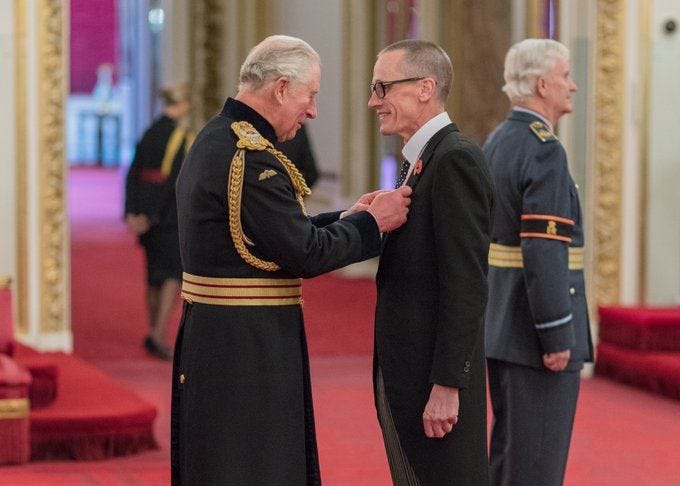
Charles Garrett receives an award from King Charles
As The Grayzone has previously documented, London operates a dedicated program known as “Global Britain” in the West Balkans. Leaked documents related to the effort reveal it is concerned with insidiously influencing the composition of local governments and legal and regulatory environments to advance British interests, while filling regional security, intelligence, and military forces with handpicked assets. As one leaked file makes clear, MI6 does not tolerate regional opposition to its agenda, readily deploying active measures to neutralize any and all local resistance:
“In contexts where elite incentives are not aligned with [Britain’s] objectives/values… an approach that seeks to hold elite politicians to account might be needed… We can build relationships and alliances with those who share our objectives and values for reform… It is critical that the media have the capacity and freedom to hold political actors to account.”
Events in Macedonia over the past decade provide a brutal demonstration of what can befall governments and officials in the Balkans who do not share Britain’s “objectives” and “values”, and how they are “held to account.” So too does a 2020 coup in Kyrgyzstan, where Garrett set up shop after leaving Skopje. With Central Asia now in the crosshairs of London’s endless quest for “reform” overseas, it’s never been more vital to beware Brits bearing gifts.
‘Colorful Revolution’
Following Russia’s March 2014 reunification with Crimea, NATO’s efforts to expand in the Former Yugoslavia became turbocharged. The Grayzone has previously reported how alliance membership was imposed upon Montenegro, despite near-universal public opposition, in 2016. Achieving this feat required sustaining a corrupt, savage pro-Western dictator in power for almost two decades, and an elaborate connivance whereby anti-NATO opposition actors were jailed on bogus charges of colluding with Russian intelligence to overthrow the government, based on bogus CIA and MI6-supplied evidence.
Similar subterfuge played out in Skopje, which signed a “Membership Action Plan” with NATO in 1999. While slightly more supportive of NATO membership than Montenegrins, the local population near-unanimously opposed changing the country’s name, which Greece, the EU and US made a prerequisite for joining. The VMRO government, led by Nikola Gruevski, pledged Macedonia would always be called Macedonia. So a Western-orchestrated coup was put into motion.
In February 2015, opposition party SDSM’s leader Zoran Zaev began regularly dropping what he and the media branded “bombs” – deeply damaging wiretaps of private conversations between prominent Macedonian officials, businesspeople, journalists, and judges. The tapes seemingly implicated Gruevski and his ministers in serious crimes, including murder. Zaev claimed the illegally-captured recordings were passed to him by whistleblowers. The premier countered that the releases were supplied by foreign intelligence services, with the objective of forcing an early election.
Subsequent investigations exposed how SDSM deceptively edited and spliced these leaked recordings to grossly distort their contents, and falsely incriminate government officials. For example, one “bomb” was extensively doctored to make it sound like VMRO leaders conspired to cover up the 2011 murder of a young Macedonian in Skopje by a senior police officer, while shielding them from justice. The unexpurgated tape indicated they were in fact shocked by the killing, and wanted the culprit to be severely punished.
It was not until four years later that the truth was revealed, however. Upon release, Zaev’s “bombs” sparked widespread outcry in Macedonia, prompting hundreds of thousands of citizens to take to the streets, voicing righteous rage at VMRO. Openly called the “colorful revolution” by participating citizens and NGOs, and English language media, the EU and US duly stepped in and brokered the Przino Agreement, under which Gruevski resigned, and new elections were held.
SDSM scraped into office via a fragile coalition, then set about laying the foundations of Macedonia’s name change in explicit service of NATO membership, with tens of millions of dollars in assistance from intelligence cutout USAID. Parliamentarians were blackmailed – frequently using the illegal wiretap intercepts – and bribed into passing unconstitutional and highly controversial reforms, allowing Skopje to be rebranded North Macedonia without public support, or even the President’s signoff. A sham referendum, boycotted by most citizens, was also cynically staged.
At last, North Macedonia was formally inducted into NATO in March 2020. Alliance officials have since repeatedly made clear they consider Bosnia and Herzegovina joining to be inevitable. This is despite 98% of Bosnian Serbs opposing membership, due to NATO’s central role in the criminal destruction of Yugoslavia during the 1990s. There are covert British efforts to promote NATO in Serbia too, despite over 80% of the population opposing joining.

‘Charlie’s Angels’
In August 2013, Charles Garrett was appointed London’s ambassador to Macedonia. His express brief was to help the country “achieve its goals of joining NATO and the EU.” Multiple local sources have informed this journalist that Garrett was instrumental in the “colorful revolution,” distributing cash to NGOs and activists involved in the unrest from his diplomatic pouch, while attempting to get government supporters on board.
Public records strongly suggest Garrett is a lifetime MI6 officer. His lengthy career in London’s diplomatic service includes spells in Cyprus, Hong Kong, Switzerland and Taiwan, all key nuclei of intelligence gathering and cloak-and-dagger action for Britain’s foreign spying agency. He was also posted to the Balkans in the latter half of the 1990s, when the region became a veritable MI6 playground.
Under the Przino Agreement, a Special Prosecutor’s Office (SPO) was created to investigate officials over serious crimes supposedly revealed by the illegal intercepts. A previously unknown prosecutor from a small Macedonian border town, Katica Janeva, was selected to run the Office. While the SPO was supposed to prosecute SDSM activists – including Zaev, for releasing the intercepts – this never materialized. Meanwhile, any and all Western officials visiting Macedonia made sure to visit SPO headquarters and get snapped with Janeva. Garrett was, of course, among them.

Charles Garrett and Katica Janeva
Initially, Western journalists treated Janeva to multiple fawning profiles. The British press was particularly smitten. The Financial Times referred to her as Macedonia’s “Beyonce”. The BBC dubbed the Special Prosecutor and her two primary assistants “Charlie’s Angels”, claiming the trio were “the scourge of Macedonia’s political elite and heroines of the street protests now rocking the tiny Balkan nation.” A lengthy USAID-funded “documentary” featured her staff mocking their targets via phone, between discussing who to jail next over pizza and cigarettes.

That broadcast has been removed from the web, and virtually no trace of its existence can be found online today. This may be because in June 2020, Janeva was jailed for seven years for corruption. Her crime-fighting crusade was from inception an obscene, partisan fraud. Along the way, the Special Prosecutor secretly enriched herself through a variety of unscrupulous, criminal means. The SPO’s true objective was destabilizing the VMRO government, and discrediting its supporters by association.
Janeva’s targets were often indicted on farcical charges. For example, at one stage Prime Minister Gruevski was accused of “abuse of office” for commissioning the construction of two “Chinese highways”. Prosecutors charged he had improperly benefitted from the deal – not financially, but because he would “receive a popularity boost” if the highways were completed on schedule. Elsewhere, a pro-VMRO female journalist was accused of tax fraud for writing off laundry as a business expense, and resultantly subjected to much misogynistic mockery in SDSM-affiliated media.
More gravely, the owner of an independent news site committed suicide after being pressured to turn state witness by the SPO, following early morning police raids targeting him and his family. Cases brought against the owners of government-supporting TV stations Sitel and Nova shifted their editorial line in favor of SDSM, leading to the latter being closed outright. In its place, the rabidly pro-SDSM 1TV was launched by eccentric Macedonian media personality Bojan Jovanovski, also known as Boki 13.
Publicly, Boki 13 used his station to relentlessly promote the SDSM-led government and the SPO’s work, with Janeva a frequent guest on its assorted “factual” and entertainment programs. In private, he extorted wealthy businesspeople indicted by Janeva, or somehow caught up in the illegal intercepts, promising to make their legal troubles go away in return for lavish advertising buys on 1TV, or sizable donations to his “charity”, International Association. None other than Charles Garrett sat on its board.
‘Fifth Column’
By the time these facts became public knowledge, and Janeva and Boki 13 were in prison, Garrett was safely extracted from Skopje, having been appointed British ambassador to Kyrgyzstan. Almost immediately, a revolution erupted in Bishkek. Mass demonstrations, ignited by reports of vote rigging in the October 2020 parliamentary election, culminated with the military storming President Sooronbay Jeenbekov’s compound and removing him – physically – from office.
In February 2022, a Kyrgyzstan government-affiliated newspaper openly accused Garrett of operating a “fifth column” in Bishkek. It alleged that in the leadup to the 2020 vote, he along with US State Department representatives met with local journalists and bloggers, offering them enormous sums to identify electoral violations – such as vote rigging – and document official pressure on media outlets and civil society groups. Garrett purportedly promised them top-of-the-range broadcasting equipment, to increase their audience reach. Not long after publication, he returned to London.
Garrett has kept a low profile ever since and now occupies a cushy role overseeing the Commonwealth War Graves Commission. Nonetheless, in September 2023, he submitted written evidence to a British parliamentary committee investigating London’s “engagement in Central Asia”. He advocated a number of means to exploit “disruption caused by Moscow’s renewed invasion of Ukraine” to undermine the region’s historic, economic and political ties with Russia and China, and “shape the future of these countries” according to Britain’s interests.
When British Foreign Secretary David Cameron conducted a much-publicized tour of Central Asia in May 2024, he followed Garrett’s proposals to the letter. The ambassador’s legacy visibly endures in Macedonia today too. In March 2016, colorful revolution protesters attempted to burn down the President’s office, after 56 individuals indicted by the SPO were pardoned. The premises were transformed into the headquarters of UK Aid, a now-defunct British government agency intimately implicated in the neoliberal rape and pillage of Ukraine.
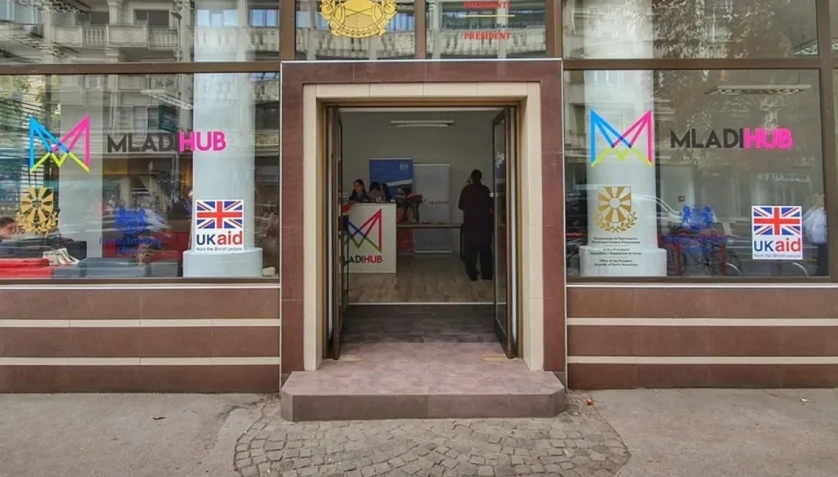
The Skopje headquarters of UK Aid
This included running covert communications campaigns on Kiev’s behalf, promoting the destruction of workers’ rights locally. It is likely the organization was engaged in similar skullduggery in Skopje, after Garrett rode into town. VMRO’s return to government at last offers Macedonians an opportunity to halt the operations of all US and British intelligence fronts and cutouts operating on their soil, and reclaim foreign-conquered territory.
US Ban on Use of Kaspersky Lab’s Software to Lead to ‘Increase in Cybercrimes’
Sputnik – 21.06.2024
The decision of the US Commerce Department to ban the use of Russian multinational cybersecurity firm Kaspersky Lab’s software in the United States will lead to an increase in cybercrimes, the company’s press office told Sputnik on Friday.
On Thursday, the US Commerce Department issued a new rule prohibiting information and communications technology and services (ICTS) transactions with Kaspersky Lab effective September 29, imposed new export restrictions on Kaspersky and blacklisted Kaspersky Lab, Kaspersky Group and Kaspersky Labs Limited for their alleged cooperation with Russia’s military and intelligence authorities.
“First of all, this decision will promote cybercrimes. International cooperation among cybersecurity experts is necessary to effectively counter cyber threats, but it is now limited. Moreover, users and businesses in the US will not be able to protect their devices from malware with industry-leading technology, according to independent tests. Our current customers in the US will face significant challenges as they will now be forced to urgently seek replacements for technologies they have relied on for years,” the company said in a statement.
The company added that Kaspersky Lab will continue protecting the world from cyber threats and its business “from actions that are aimed at wrongfully damaging the company’s reputation and commercial interests.”
Droning Russia’s nuke radars is the dumbest thing Ukraine can do
Attacks on the early warning system actually highlights the fragility of peace between the world’s nuclear powers
BY THEODORE POSTOL | RESPONSIBLE STATECRAFT | JUNE 5, 2024
For a fleeting moment on May 22 the world may have come closer to a catastrophic nuclear accident due to a reckless Ukrainian drone attack on two Russian strategic nuclear early warning radars at Armavir.
Fortunately, a subsequent Ukranian drone attack on a third radar station at Orsk in Russia on May 26 failed.
The incidents underscore a few important things. First, the Ukrainians could have needlessly sparked a crisis in which the Russians, feeling like one of their defenses against a U.S. nuclear attack, were down, struck back hard in retaliation. And second, it highlights the need for Russians to acquire comprehensive space-based nuclear radar of their own.
What happened and what it means
The Ukrainian attack at Armavir was a big deal. It shut down both Russian radars immediately. And it’s likely that within minutes of the attack, an emergency meeting took place with the commander of the Russian strategic rocket forces along with his highest-level officers.
The attacks should not be taken lightly, and President Biden and Secretary of State Antony Blinken should be giving this special attention.
Even after decades of expensive Russian attempts to build a space-based early warning system that could provide global surveillance of U.S. submarine missile launches, Russia has been unable to marshal the extremely specialized high-technologies needed to build such a system.
To in part deal with this serious shortfall in Russia’s nuclear early warning capabilities, Vladimir Putin himself initiated and publicly supported a highly visible national effort to build a dense and capable nuclear strategic early warning radar system that utilizes numerous giant radars (typically about 30 to 35 meters high).
Since these radars basically form the singular foundation of Russia’s strategic nuclear early warning capabilities, any tampering with their functions in any unpredictable global situation is accompanied by very grave risks of misinterpretations of intentions that could lead to a massive launch of Russian nuclear forces.
Figure 1 below shows a satellite photograph of the two radars at Armavir. The radar beam from what is labeled “Radar Fan 1” is pointing in a counterclockwise direction from North of roughly 125°. Radar Fan 2 is pointing in a clockwise direction from North of roughly 125°.
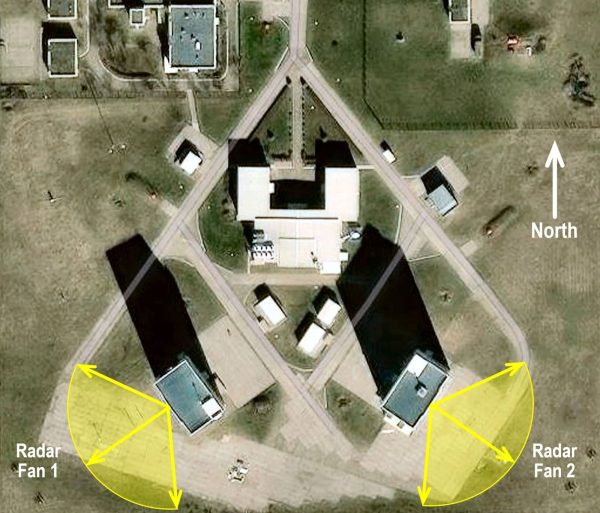
Figure 2 shows the coverage of the two radar fans at Armavir, and the radar at Orsk drawn on a spherical earth. A side view of a radar fan is shown in the upper right corner. The side-on view shows an extremely important consequence of the fact that Earth is curved and the radar beam propagates basically in a straight line. Because of that, the radar cannot actually see objects near the surface.
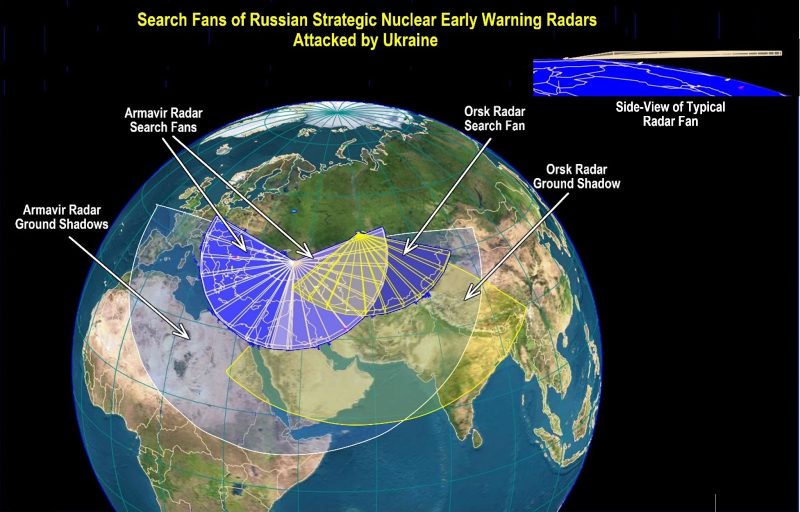
For example, it is not possible for the radar to observe aircraft flying over Ukraine. Even ATACM missiles launched from the Ukrainian Black Sea coasts, which rise to altitudes of no more than 40km before they start gliding to their targets, cannot be reliably detected by these radars.
Thus, the radars at Armavir pose no surveillance threat to Ukrainian aircraft, cruise missiles, drones or ATACM missiles. The real threat to Ukrainian aircraft and missiles is from Russian airborne radar systems that are tightly queued into Russian ground-based surface-to-air missile systems.
Why these radars are so important
The importance of having a space-based satellite early warning system can be readily understood by re-examining figure 2.
For purposes of illustration, imagine that a Trident ballistic missile is launched at Moscow from the Indian Ocean at about the same latitude as Bombay on the West Coast of India (20° North latitude). The range to Moscow would be roughly 4,500 to 4,600 km.
If the ballistic missile were launched on a “minimum energy trajectory” (at a loft angle of roughly 34°) it would require the smallest missile burnout speed needed to reach Moscow. In this case the time between “breakwater” missile ignition and impact would be roughly 21 to 22 minutes.
However, the Trident missile is designed to launch its warheads to much higher burnout speeds. For example, it could launch its nuclear payload toward Moscow at a slightly higher speed and lower loft angle of 25° (this is often called a slightly “depressed” trajectory) and still easily reach Moscow in 18 to 19 minutes.
If a launch towards Moscow is on a slightly depressed trajectory, the Russians would not know they were under attack for at least six minutes, until the warheads and the rocket upper stages passed into the Armavir radar search fan. If the Armavir radar was not operating it would take eight to nine minutes from breakwater before the Russian radars in Moscow would indicate they were under attack.
The radar in Moscow would have to observe the incoming missile payloads for one or two minutes before it would have enough data to issue an alert — which means maximum decision-making time that might be available to Russian leaders would be about six or seven minutes!
So you can see why the Russians would be incensed over the Ukraine attacks, which would literally cut their already limited time in which to respond to a nuclear attack.
If the Russians had an early warning space-based system, they would know that they were under attack roughly 19 minutes before the attacking warheads would arrive and destroyMoscow. They would also immediately know whether or not ballistic missiles were being launched from other parts of the world.
Although all of these warning times are shockingly short, it is clear that a warning time of 19 minutes versus one of eight to nine minutes could make the difference between forcing Russia to rely on an automated decision that could lead to the accidental destruction of the United States and Western Europe, or instead on a more reasoned assessment by political leaders and highly professional military commanders.
Any appropriately knowledgeable expert who has listened carefully to Putin’s numerous statements about nuclear weapons would know that he has a detailed knowledge of this warning system and its limitations. He has regularly shown up at the inaugurations of early warning radar sites, overtly indicating his concerns about the need for adequate and reliable early warning systems.
The Russians do currently have an extremely limited space-based early warning system. The system only observes the U.S. ICBM fields near its northern borders and cannot be proliferated to provide global coverage against U.S. submarine missiles. It does not even have 24-hour coverage of the U.S. ICBM fields, since nine satellites are needed to provide that coverage and only four are active at this time.
I have sought to warn the U.S. government leadership of this serious problem, which could have been solved 30 years ago by the U.S. “lending” certain technologies to the Russians. My proposals involved providing the Russians with specialized space-qualified infrared arrays and electronics that would allow them to build their own systems.
This technology would not give the Russians any sensitive military secrets. There would be no way for the Russians to “reverse engineer” these implementing components. Just like the most advanced computer chips, only a vast technical enterprise could achieve such an end.
Instead of recognizing that it is in the interest of the entire world for both Russia and the United States to have reliable and capable early warning systems, at that time, the Clinton administration largely ignored this serious problem, which I believe threatens the survival of civilization even today. Other administrations that followed did no better.
The bottom line is that this grave danger to human civilization, and possibly human survival, could have been solved by competent political leadership almost 30 years ago, to the benefit of the entire world. But it wasn’t, which makes the attack on the radars now a potential crisis.
Theodore A. Postol is Professor Emeritus of Science, Technology and National Security Policy at MIT. He also taught at Princeton and Stanford, and was an advisor to the Chief of Naval Operations, where he evaluated U.S. tactical and strategic nuclear war plans, U.S. strategic anti-submarine warfare plans, Russian and U.S. missile defenses, and the Trident I and Trident II Submarine-Launched Ballistic Missile Systems.
Canada Gets a Pass From the West for Foreign Agents Law While Georgia Is Punished
Sputnik – 20.06.2024
Georgia’s efforts to insulate itself from possible foreign meddling through NGOs funded from abroad were not met with understanding from the United States and its European allies. But when Canada does the same, that is a different story.
The United States and the European Union refraining from criticizing the foreign agents registry law recently adopted in Canada, while simultaneously blasting similar legislation adopted by Georgia, is essentially a “problem of double standards,” said Dr. Marco Marsili who holds research positions in major civil and military institutions in Portugal, the UK and Italy.
“It depends on the point of view of the proponents, the lawmakers, and of those who are their allies and assess the bill as just and fair, according to their geopolitical perspective,” Dr. Marsili explained. “Basically, it is a Manichaeans approach, according to which the world is divided into the good ones and the bad ones – figure out which are which according to a Western vision.”
Georgia merely seeks to protect itself from foreign influence exerted through funding from abroad of local NGOs and “any other public outreach activity like media outlets,” basically following the example of the Western powers, he noted.
Western powers, however, insist that “Georgian politics must be influenced through Western financial support to local agents” but at the same time “reject any Russian funding.”
“That is really bizarre – it’s not just double-standard, but also non-sensical,” Dr. Marsili remarked.
Francis Boyle, a professor of international law at the University of Illinois College of Law, also suggested that both Russia and Georgia are “entitled to have their own equivalents to the US Foreign Agents Registration Act,” considering that many of the foreign NGOs operating in these countries are “designed to destabilize the host governments and produce color revolutions.”
“All of these Western NGOs operate under the basic principle: he who pays the piper calls the tune!” he added. “Many of these foreign NGOs are shot through with Western intelligence agents and assets. So of course these foreign NGOs have to be regulated in order to preserve the sovereign independence of the host states under international law.”
Featured Video

Why Hamas Really Attacked Israel on Oct. 7
or go to
Aletho News Archives – Video-Images
From the Archives
Confronting the Threat of Ethnic Bioweapons
By Tony Cartalucci – New Eastern Outlook – 29.11.2017
The United States Air Force’s 59th Medical Wing’s molecular biology branch recently was revealed to have been collecting specifically Russian RNA and synovial (connective) tissue samples, prompting fears in Russia of a possible US directed ethnic-specific bioweapons program. … continue
Blog Roll
 Aletho News
- Meet the US generals and admirals advancing Israeli policy
- Israel’s Straw Widow Protocol: The Kill Zones Where Civilians Were Labelled ‘Terrorists’
- Leading Israeli Think Tank Publishes Psychotic Israeli ‘National Security’ Doctrine
- Are the United States and Israel in Decline-and-Fall Mode?
- Why Hamas Really Attacked Israel on Oct. 7
- Declassified UK exposes British man who fought for ‘Israel’ in Gaza
- West’s death cult in a theater near you
- How the Yandex ‘Russian bots’ lie fell apart
- Burnham’s ‘Russia did Brexit’ ruse crumbles
- Estonia making movies and games to encourage war against Russia
- If Americans Knew
- Gaza’s “ceasefire” death toll passes 1,500 – Daily Update
- Activists Abused By Israel Return to New Freedom Flotilla Mission
- 60 Minutes won’t tell the full truth about Israeli settler violence
- Nearly 50,000 women, girls killed or severely injured in Gaza since October 2023: UN Women
- ADL is working with AI companies to suppress alleged ‘antisemitism’
- Israeli occupation forces using social media surveillance unit to target hundreds of Palestinians in the West Bank
- Israel’s New – and Terrifying – Security Doctrine
- Israeli Attacks Kill Five in Gaza, Including a four-year-old and a woman
- Air Force Major Who Called for Trump’s Impeachment Held in Solitary Confinement
- It’s a Genocide, I’m Into It’: Seinfeld Mocks Protest over Palestinian Children Killed
- No Tricks Zone
- New Study Suggests Large Regions Of The Pacific Ocean Have Been Cooling For The Last 80 Years
- Germany’s Green Energy Debacle: High Energy Costs Force Kahla Porzellan to Close After 182 Years!
- New Study: 50 Years Of The Most Aggressive ‘Net Zero’ Policies Can Only Affect The Global Climate By 0.03°C
- US September “Heat” Was No Record…Many Records Set Decades Ago
- Latest European Green Energy Debacle; Portugal’s Largest Flagship Solar Park Insolvent!
- Green Energy Debacle: German Expert Professor Fritz Vahrenholt Warns Of Severe Economic And Social Consequences
- Two More Paleo Reconstructions Affirm Meters-Higher Sea Levels Across Ireland, Brazil 7000-6000 Years Ago
- New Study: Earth And Venus Surface Warmth Largely Explained By Convection And Lapse Rate, Not CO2 Or Radiation
- 2025 Nature Paper Claiming Worsening Global Drought Gets RETRACTED …Heavily Flawed
- New Study: ‘Global Drought Shows No Detectable Recent Acceleration Under Climate Warming’


