Ex-Pentagon Analyst: US Got Rude Awakening in Ukraine After Downplaying Russian Air Power
By Ilya Tsukanov – Sputnik – 12.08.2023
August 12 is Russian Aerospace Forces Day. In light of the critical role played by Russian air power in the military operations in Ukraine, Sputnik decided to reach out to retired US Air Force Lieutenant Colonel Karen Kwiatkowski for her take on the conflict, and what the Pentagon got dead wrong in its assessment of Russian capabilities.
Saturday marks the 111th anniversary of the August 12, 1912 order establishing the Imperial Russian Air Service as a separate branch of the armed forces. In the century-plus since, Russia’s air forces have faced multiple reorganizations, and been known by multiple names, from the Soviet Air Forces (1918-1991) to the Russian Air Force (1992) and finally the Russian Aerospace Forces (2015 on). But throughout, its mission remained the same – to defend the nation’s airspace and provide ground support for the Army.
From the very beginning of the escalation of the Donbass crisis into a full-blown Russia-NATO proxy war in Ukraine in February 2022, the Aerospace Forces have played a key role in Russian offensive and defensive operations.
Its role has become especially noticeable amid Ukraine’s two-month old counteroffensive attempt, which US and NATO officials and generals now openly agree seems “extremely unlikely” to succeed, as Ukrainian forces have failed to break through even a single major Russian defensive line while taking staggering losses in troops and equipment.
Russia’s overwhelming superiority in the air has played a decisive role in halting Ukraine’s offensive operations, striking whenever they attempt a major armored maneuver, and keeping an eye out for movements in coordination with satellite intelligence and reconnaissance drones. So intense has the devastation of Ukrainian forces been that panicky NATO and Ukrainian officials have begun to blame one another over “tactics” or the lack of equipment and ammo instead of asking questions about the reasonableness of pushing Ukrainian troops to attack entrenched Russian positions without air cover or artillery superiority.
Rude Awakening
The Russian Aerospace Forces’ performance in Ukraine “has probably surprised many in the West,” says retired US Air Force veteran, former Pentagon analyst, anti-war whistleblower and activist Karen Kwiatkowski, “in part because of Western assumptions.”
“I think that the level of advanced technology in… the current Russian Air Force, and the relative newness of many of these systems compared to what we have in the West, has been a surprise, in part because Western analysis of intelligence is geared to downplay Russia and Russian capability in all ways. The Russophobia, and also a certain contempt for Russia, in DC and inside the Pentagon is a factor,” Kwiatkowski told Sputnik.
“I suspect also that how the Russian Air Force uses these systems in battle is also a surprise for the West, and particularly the US. Obviously, the Ukraine battlefield has been a testing ground for high-tech and rapidly adapting drone warfare, even as in some ways it reminds of a slogging land war in Europe faced in World War I,” she said.
Characterizing the Russian Aerospace Forces as a true “national defense air force,” as opposed to the “offensive, forward-operating Air Force” which the US has, Kwiatkowski said that Russian air power seems geared toward supporting land and sea operations “in a tightly integrated way” with “focus and exceptional skill set for ground support.” This is as opposed to the US and NATO powers, “where air forces seek to ‘dominate the skies’ in a somewhat competitive way with the separate Army and Navy missions,” she said.
“For us in the West, it remains difficult to get accurate assessments of battlefield performance in Ukraine, and that deficiency of hard data impacts not just commentators and technicians, but our top Pentagon and national political leadership,” Kwiatkowski stressed, after being asked to assess the performance of Russian Aerospace Force assets in Ukraine. “That said, it seems to me that the US media is somewhat hysterical over Russian drones, attack helicopters like the modern and capable Ka-52, and the Su-27 fighters in their various battlefield and defensive roles,” indicating their effectiveness.
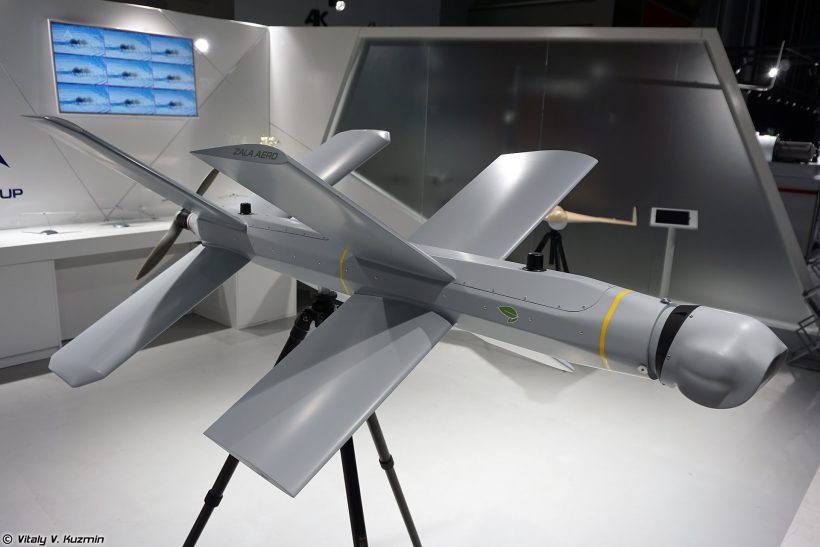
Kwiatkowski highlighted the Lancet drone in particular, which is used by the Ground Forces, as a major “game changer” in Ukraine, given its success in devastating even the latest NATO ground-to-air weapons and Leopard tanks.
“The Lancet represents the evolution of Russian drone technology and design. It can carry different munitions, and serve different purposes on and above the battlefield, and appears to be cost effective to produce. It really represents what rapid evolution and development in a weapon, using real world data and learning, can produce,” the former Pentagon analyst said.
Unconventional Times Call for Unconventional Tactics
Along with strategy and weapons, Kwiatkowski also pointed to the surprising and “non-traditional, almost experimental” aerial disruption tactics employed by Russian military pilots in recent months, including against US-operated reconnaissance drones over the Black Sea and in Syria, by making close approaches and dumping fuel on them, or conducting other unpredictable aerial maneuvers.
“This kind of creativity, that functionally serves both Russian political as well as practical interests of air defense and air superiority, is impressive. It speaks to training, and competence of Russian pilots, but also that they are well-led and well-supported by their military and political leadership. I cannot say if this is the case, but this is the conclusion I draw,” Kwiatkowski summed up.
China is run by ‘bad folks’ – Biden
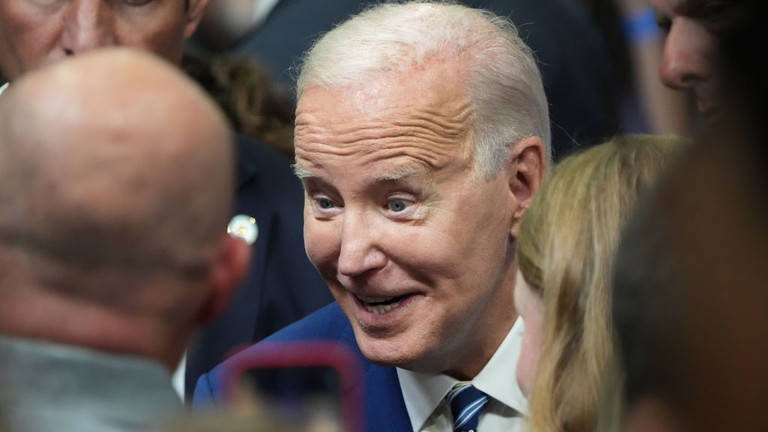
US President Joe Biden greets people after speaking on Thursday at the Veterans Affairs Medical Center in Salt Lake City, Utah. © Getty Images / George Frey
RT | August 11, 2023
US President Joe Biden has escalated his attacks on Chinese leaders, reportedly telling donors to his re-election campaign that China’s government is run by “bad folks” who may take dangerous actions as their economy teeters on the brink of collapse.
Biden claimed on Thursday at a fundraising event in Park City, Utah, that Chinese President Xi Jinping’s government was in “trouble” because Beijing’s economic problems were a “ticking time bomb,” according to multiple media reports. He backed up his assertions with several erroneous claims about China’s economy and demographics.
“They got some problems,” Biden told supporters. “That’s not good because when bad folks have problems, they do bad things.” He falsely stated that China had the “highest unemployment rate going” and more people of retirement age than of working age. He mocked Xi’s signature Belt and Road Initiative as the “debt and noose,” alluding to the loans China provides to developing nations.
The remarks were reminiscent of comments Biden made at a similar political event in June, when he referred to Xi as a “dictator.” Chinese officials lodged a formal complaint in Washington and called the insult a “political provocation.” Biden dismissed the controversy when asked at a press briefing about Beijing’s reaction, saying he didn’t think there would be “any real consequence.”
At Thursday’s fundraising event, the 80-year-old US president said he wants to have a “rational relationship” with China, adding, “I don’t want to hurt China, but I’m watching.” He didn’t specify which potential Chinese actions concern him, though US-China tensions over self-governing Taiwan have escalated in the past year.
Biden claimed that China’s economic growth has slowed to 2%. Chinese GDP rose at a 5.5% pace in this year’s first half, compared with the US rate of around 2.2%. As Western economies feel the effects of historically high inflation, China is dealing with deflation.
The country has more than three times as many people of working age as people 60 and older. China’s unemployment rate is around 5.2%, compared with 6.4% in the Eurozone. Spain and Greece both have double-digit jobless rates.
Biden has made incendiary comments about Xi’s government at a time when his administration is trying to improve strained relations between the world’s two largest economies. His “dictator” remark came just one day after US Secretary of State Antony Blinken concluded a long-awaited visit to China. Treasury Secretary Janet Yellen and US climate envoy John Kerry later made visits to Beijing.
The Utah fundraiser was held at the home of Mark Gilbert, a former US ambassador to New Zealand and Samoa. Donors reportedly had to pay at least $3,300 to attend. Hosts paid $100,000, and guests who contributed at least $50,000 were allowed to speak with Biden and have a picture taken with him. Those paying $10,000 to $25,000 could get a photo with the president.
The Polish President Said Kiev Isn’t Doing The West Any Favors & Its Counteroffensive Failed
BY ANDREW KORYBKO | AUGUST 11, 2023
Two of Kiev’s top propaganda narratives nowadays are that it’s selflessly sacrificing itself for the sake of the West by fighting Russia instead of surrendering and that its ongoing counteroffensive is succeeding in pushing that country’s forces out of Ukraine’s pre-2014 borders. The first largely remains above official criticism or skepticism since those who dare to doubt it risk being “canceled”, but the second has suddenly begun to be debunked by the Mainstream Media as proven by the following articles:
* NBC News: “Is Ukraine’s counteroffensive failing? Kyiv and its supporters worry about losing control of the narrative”
* CNN: “Why a stalled Ukrainian offensive could represent a huge political problem for Zelensky in the US”
* The Hill: “Alarm grows as Ukraine’s counteroffensive falters”
* Washington Post: “Slow counteroffensive darkens mood in Ukraine”
In the face of this rapidly shifting narrative that threatens to topple one of the pillars of Kiev’s Western-directed propaganda, Zelensky’s senior advisor Mikhail Podolyak lashed out at critics in a tweet thread here where he demanded that they “be patient and closely monitor” his side’s progress. Polish President Andrzej Duda has been doing precisely that since the NATO-Russian proxy war in Ukraine began, however, and he’s concluded that Kiev isn’t doing the West any favors and its counteroffensive failed.
He dropped both bombshells, the first of which debunked the claim that Kiev is selflessly sacrificing itself for the sake of the West and which hitherto hadn’t ever been officially challenged by any Western leader before, in an interview with the Washington Post’s Marc Thiessen from 1 August that was published nine days later. The relevant excerpts will be republished below for the reader’s convenience before analyzing them in the context of this conflict and evolving Polish-Ukrainian ties in particular:
“Q: At the NATO summit when President [Volodymyr] Zelensky criticized the [leaders’ joint statement about Ukraine’s prospective membership], there was criticism of him that he was ungrateful for all the help [given to] Ukraine. That suggests that our help to Ukraine is charity. Is our help to Ukraine charity, or is Ukraine really doing us a favor by giving its children, its lives to defend us against the Russian threat?
A: I would say it this way: I don’t see it in these categories — neither that we are doing an act of charity for Ukraine, nor that Ukraine is doing charity for us… We are sending them arms. Why? Because we want to support them in defending their own territory. … We Poles have many reasons to supply Ukrainians with weapons. … But the whole democratic world also knows that any aggressor who violates the borders of a democratic state in the 21st century in Europe must be stopped.”
…
Q: Could Poland fight a combined arms operation without long-range weapons and without air power? Because that’s what we’re forcing the Ukrainians to do today. What does Ukraine need that it’s not getting today?
A: Ukraine has been supplied with long-range artillery, and it is being supplied with long-range artillery to this day. … One could go as far as to say that Ukraine now has much more modern military capabilities than Russia.
The question is: Does Ukraine have enough weapons to change the balance of the war and get the upper hand? And the answer is probably no. They probably do not have enough weapons. And we know this by the fact that they’re not currently able to carry out a very decisive counteroffensive against the Russian military. To make a long story short, they need more assistance.”
…
Casual observers might be shocked by the Polish leader’s candidness, while Kiev’s supporters might accuse him of “betraying” their regime after becoming the first Western leader to debunk its top two lies nowadays, but his words weren’t unprovoked nor said in a vacuum. The background is that political ties between these wartime allies have tremendously worsened since late July as was documented in the following analyses:
* “Poland & Ukraine Are Arguing Over Grain Once Again”
* “Ukraine’s Ungratefulness Is Finally Starting To Perturb Poland”
* “Kiev’s Prediction Of Post-Conflict Competition With Poland Bodes Ill For Bilateral Ties”
In brief, each side finally began prioritizing their national interests, which resulted in public tensions due to the absence of any pressure valve for dealing with sensitive disagreements such as those over agricultural cooperation and historical memory. Moreover, each side has self-interested political reasons in escalating rhetoric against the other: Ukraine wants to distract from its failing counteroffensive while the ruling Polish party wants to rally its nationalist base ahead of mid-October’s elections.
It was against this backdrop that Duda did the previously unthinkable by telling one of the US’ most influential Mainstream Media outlets that Kiev isn’t doing the West any favors by fighting Russia and that its counteroffensive failed. Granted, he conveyed these two points in a “polite” way that signaled his continued support for NATO’s proxy war on Russia through Ukraine, but it’s still an unforgivable offense from that regime’s perspective.
NBC News warned earlier this month that Kiev and its supporters are worried about losing control of the narrative, which has now come to pass after what Duda just said. He and his country are much more popular and less polarizing among average Westerners than Zelensky and Ukraine, plus nobody doubts their anti-Russian credentials due to widespread awareness of Poland’s difficult history with that country. These observations mean that his words will likely have an outsized impact on reshaping the narrative.
As for the future of Polish-Ukrainian relations, it’s looking dimmer by the day due to their spiraling disputes becoming self-sustaining at this stage. That’s not to suggest that Warsaw will cut Kiev off from arms and other forms of support, but just that the trust which used to characterize their relations since February was finally exposed as illusory. This could complicate their reported plans to form a joint military unit and could lead to Poland acting unilaterally in Western Ukraine in the worst-case scenario.
Why military intervention in Niger could be catastrophic for everyone

Coup supporters protest the decision of the ECOWAS countries to sanction Niger, in Niamey, Niger on August 3, 2023 [Balima Boureima/Anadolu Agency]
By Dr Mustafa Fetouri | MEMO | August 10, 2023
The Sino-Russo Naval Patrol Near Alaska’s Aleutian Islands Flipped The Tables On The US
BY ANDREW KORYBKO | AUGUST 10, 2023
Alaskan Senators were apoplectic after Russia and China just carried out a previously unreported joint naval patrol near their state’s Aleutian Islands last week. Those officials condemned what they claimed was an “incursion”, though the US Northern Command confirmed that the patrol “remained in international waters and was not considered a threat.” In any case, this was an interesting turn of events since it’s usually the US that conducts such exercises near those two’s borders.
The Sino-Russo Entente isn’t an alliance, but rather an unprecedentedly close strategic partnership focused on coordinating efforts to accelerate the global systemic transition to multipolarity. To that end and in the context of last week’s joint naval patrols, these Great Powers decided to signal to the world that they’ll reciprocally respond to similar such exercises by the US. Up until now, each reacted separately and largely restricted this to rhetoric, but now they’re reacting jointly in a tangible way.
Several of their interests were served in this way. First, the US now knows that the Sino-Russo Entente isn’t reluctant to sail flotillas as close to American shores as is legally possible. Second, they voluntarily complied with the terms laid out in the UN Convention on the Law of the Sea (UNCLOS) regarding where foreign warships are allowed to sail despite the US not recognizing that framework. Third, this example demonstrated the sharp contrast between them and the US on the issue of international maritime law.
The fourth interest that was advanced through their joint naval patrol near the Aleutian Islands is that it made locals in that state, and likely also Americans elsewhere, experience how it feels when their geopolitical rivals conduct such exercises near their borders. Those drills won’t influence the formulation of US policy, but they can help shape some voters’ opinions about the wisdom of their leaders’ policies towards Russia and China considering that those two are merely responding to the US’ own such moves.
And finally, these drills importantly remained below the threshold of triggering an escalation, thus proving that it’s indeed possible to reciprocally respond to American provocations after both Great Powers were hitherto reluctant to do so. About that last-mentioned observation, they previously reacted separately and largely restricted this to rhetoric except on those rare occasions that they were accused by the US of flying or sailing their respective units too close to the latter’s.
Even so, those incidents took place near their own borders and not the US’, but this time they jointly sailed their warships near the Aleutian Islands in order to give America a taste of its own medicine. These plans were likely agreed to long ago but weren’t implemented until now since they each wanted to give the US the opportunity to stop making them feel uncomfortable by operating so closely to their shores. Russia and China’s patience has clearly run out, however, hence why they’re now jointly reacting.
This wasn’t their first joint naval exercise, but it’s the largest one near American shores thus far, which makes it a milestone. The Mainstream Media will predictably try to spin it as so-called “unprovoked illegal aggression” despite those two strictly abiding by international law per UNCLOS and carrying out their drills in response to the US’ earlier countless ones near their borders. By finally turning the tables on the US, the Sino-Russo Entente wants to show the world that the era of military unipolarity is over.
‘Woke’ extremist ideology in US military – danger or blessing for the world?

By Drago Bosnic | August 9, 2023
For decades, when referring to the US military, the mainstream propaganda machine has been parroting about “the most powerful force in human history”. And while that assertion might’ve held in the late 1990s/2000s, at the time when Russia was still suffering the consequences of Soviet dismantlement while China was far from its zenith, the situation is vastly different nowadays. Namely, the US-led political West has been taken over by what many Americans themselves call the “woke mind virus”. And while such terminology may sound harsh or even offensive, it’s exceedingly difficult to disprove it, as demonstrated by the current disastrous state of Western/pro-Western societies.
The forced proliferation of this truly depraved ideology has become virtually omnipresent, despite the fact that it destroys virtually anything it comes into contact with. In terms of economics, it ravaged so many companies that the catchphrase “go woke, go broke” has become an axiom of sorts. And yet, for some inexplicable reason, the “woke mind virus” keeps expanding. Its influence is so far-reaching that it’s even become the dominant ideology in the US military, effectively rebranding the catchphrase to “go woke, go weak”. During the so-called “pride month”, the US Army shared a story about a “transgender Major who now identifies as a woman after previously being suicidally depressed”. If you’re dumbfounded by this word salad, wait until you hear the rest of this bizarre story.
The US Department of Defense (DoD) tweeted that “Major Rachel Jones embraced authenticity” and that “this should inspire us all” after “she” became the head of the US Army Sustainment Command’s Cyber Division. Proponents of such policies usually (over)use the phrase “stunning and brave” to show their support, so much so that those opposing “wokeism” now regularly use it as a sarcastic remark. And this is certainly not an “isolated incident”, as the case of Major Jones is neither a rarity nor is “she” the highest-ranking “transgender” officer. Namely, Rachel Levine (for some reason, the name Rachel seems to be very popular in such circles) holds the rank of admiral in the United States Public Health Service Commissioned Corps.
In addition, Levine is also the Assistant Secretary for Health and is infamous for claiming that “puberty blockers” and “transition surgeries” are supposedly “necessary” to curb suicide rates among children. Apart from Levine, the US government employs other “transgender” people, even ignoring their criminal activities in order to fill its “woke quotas”. Last year, the Department of Energy (DoE) hired Sam Brinton as a “nuclear waste guru”. After months of attempts to conceal his scandalous behavior which also includes a kleptomaniacal tendency to steal women’s purses, the administration was forced to fire him. In May this year, he was even arrested after repeatedly dodging police due to his former high-ranking position.
And while the DoE is officially not part of the military command structure, its cooperation with the DoD is of prime importance for the US military. Namely, DoE’s subdivisions dealing with nuclear technologies are partially responsible for maintaining America’s strategic arsenal and Brinton was employed precisely by one such office. Having deeply mentally unstable individuals in charge of anything (much less nuclear facilities) casts serious doubt on the very mental capacity of those who hire them. And yet, “woke” extremists are adamant that raising such concerns is supposedly “transphobic”. Back in July, during testimony before Congress, Air Force Academy Superintendent Lt. Gen. Richard Clark declared his full support for the ideology.
When Congressman Matt Gaetz (R-Fla.) asked him about this, Clark admitted that not even he could define many of the gender ideology terms the Air Force Academy officially endorses. This includes something called “demi-gender”, as Clark “doesn’t know what on Earth that even is”. The program includes other terms such as “cisgender, non-binary, a-gender, bi-gender, two-spirit”, etc. Clark also insisted that “inclusivity” and “diversity” are a “war-fighting imperative”. Apparently, having more “two-spirit” lesbians in the military will make it bulletproof. Maybe the US should test that theory on the battlefield and see how it goes. However, in all seriousness, the results of this obsession have been disastrous for the Pentagon. The already low interest to join the US military has now dwindled to almost nothing.
And yet, the political leadership doesn’t want to deal with this. On the contrary, it’s seeking culprits in others, including those who fought in America’s endless wars around the globe. Namely, the Wall Street Journal is now blaming the veterans for abysmal recruitment numbers, as they’re actively discouraging their family members from joining the military precisely because of “woke” extremism. Thus, on one hand, this obsession is certainly dangerous when people with obvious mental illnesses are placed in high-ranking positions (particularly those involving nuclear tech). On the other hand, disincentivizing participation in US aggression against the world is actually a net positive for everyone, including Americans themselves.
Why would anyone want to die in yet another pointless war halfway around the world for the sake of people with highly questionable mental health, only to then have their families be forced to pay for the repatriation of the remains? Worse yet, after it somehow managed to lose a horribly one-sided 20-year war against outnumbered and outgunned AK-wielding insurgents in sandals while wasting trillions of dollars, the US chose a virtually direct confrontation with a military superpower armed with the world’s most powerful thermonuclear arsenal and whose highly motivated and superbly armed/trained soldiers have been able to easily overcome even the best NATO-backed troops, as evidenced by the recent case of a single T-90M neutralizing an entire armored column of Kiev regime forces.
However, it should be noted that, most unfortunately for the Russians, each T-90M crew member reportedly has only one mom, meaning that the Russian military is sorely lacking in “war-fighting imperatives”. It seems Moscow’s generals and strategists are busy with “trivialities” such as postulating new unbeatable military doctrines and modernizing their arsenal with unstoppable missiles. That probably explains why even goats and pickle jar-wielding old ladies are “defeating Russia”.
Drago Bosnic is an independent geopolitical and military analyst.
Niger rejects rules-based order
BY M. K. BHADRAKUMAR | INDIAN PUNCHLINE | AUGUST 8, 2023
The coup in the West African state of Niger on July 26 and the Russia-Africa Summit the next day in St. Petersburg are playing out in the backdrop of multipolarity in the world order. Seemingly independent events, they capture nonetheless the zeitgeist of our transformative era.
First, the big picture — the Africa summit hosted by Russia on July 27-28 poses a big challenge to the West, which instinctively sought to downplay the event after having failed to lobby against sovereign African nations meeting the Russian leadership. 49 African countries sent their delegations to St. Petersburg, with seventeen heads of states traveling in person to Russia to discuss political, humanitarian and economic issues. For the host country, which is in the middle of a war, this was a remarkable diplomatic success.
The summit was quintessentially a political event. Its leitmotif was the juxtaposition of Russia’s long-standing support for Africans resisting imperialism and the predatory nature of western neo-colonialism. This works brilliantly for Russia today, which has no colonial history of exploitation and plunder of Africa.
While every now and then skeletons from the colonial era keep rolling out of the Western closet, dating back to the unlamented African slave trade, Russia taps into the Soviet legacy of being on the ‘right side of history’ — even resurrecting the full name of Patrice Lumumba Peoples’ Friendship University of Russia in Moscow.
Yet, it wasn’t all politics. The summit deliberations on Russia-Africa partnership helping the continent achieve ‘‘food sovereignty,’’ alternatives to the grain deal, new logistics corridors for Russian food and fertilisers; enhancement of trade, economic, cultural, educational, scientific, and security cooperation; Africa potentially joining the International North–South Transport Corridor; Russia’s participation in African infrastructure projects; Russia-Africa Partnership Forum Action Plan to 2026 — these testify to the quantifiable outcome.
Enter Niger. The most recent developments in Niger underscore the leitmotif of the Russia-Africa summit. Russia’s prognosis of the African crisis stands vindicated — the continuing ravages of Western imperialism. This is evident from the reports of Russian flags seen at demonstrations in Niamey, Niger’s capital.
The rebels who seized power lost no time to denounce Niger’s military-technical cooperation agreements with France, which has been followed up with the demand that France withdraw its troops within 30 days. On its part, France has spoken ‘‘firmly and resolutely’’ in favour of foreign military intervention ‘‘to suppress the coup attempt.’’ The French authorities made it clear that they have no plan to withdraw their armed contingent of 1,500 people who are in Niger “at the request of the legitimate authorities of the country on the basis of signed agreements.”
France’s stance comes as no surprise – Paris does not want to lose its position in Sahel region and the cheap source of resources, especially uranium. But France miscalculated that the coup didn’t enjoy the support of the Nigerien military or had a social base, and all that was needed to roll it back would be a limited demonstration of force that would compel the elite presidential guard to begin direct negotiations with France.
France and the US coordinate their actions with the Economic Community of West African States [ECOWAS]. The ECOWAS initially did some sabre-rattling but has piped down. Its deadline for intervention has passed. The ECOWAS simply does not have a mechanism for the rapid gathering of troops and the coordination of hostilities, and its powerhouse Nigeria has its hands full tackling internal security. The Nigerian public opinion feels wary about a blowback — Niger is a large country and has a 1500-kilometre long porous border with Nigeria. An unspoken truth is, Nigeria is hardly interested in increasing the French military presence in Niger or on being on the same side with France, which is extremely unpopular throughout the Sahel.
The mother of all surprises is that the military coup enjoys a groundswell of popular support. Under the circumstances, the strong likelihood is that the French troops may be forced to leave Niger, its former colony. Niger is a victim of neo-colonial exploitation. Under the guise of fighting terrorism, which is, ironically, a spillover from the NATO intervention in Libya in 2011 spearheaded by none other than France into the Sahel region, France ruthlessly exploited Niger’s mineral resources.
A noted Nigerian poet and literary critic Prof. Osundare wrote last week, ‘‘Probe the cause, course, and symptoms of the present resurgence of military coups in West Africa. Find a cure for this pandemic. More important, find a cure for the plague of political and socio-economic injustices responsible for the inevitability of its recurrence. Remember the present brutish anarchy in Libya and the countless repercussions of the destabilisation of that once blooming country for the West African region.’’
The only regional state that can afford effective military intervention in Niger is Algeria. But Algeria has neither any experience in conducting such operations on a regional scale nor has any intention to depart from its consistent policy of non-interference in the internal politics of a sovereign country. Algeria has warned against any external military intervention in Niger. ‘‘Flaunting military intervention in Niger is a direct threat to Algeria, and we completely and categorically reject it… Problems should be solved peacefully,” said Algerian president Abdelmadjid Tebboune.
At its core, without doubt, the coup in Niger Republic narrows down to a struggle between Nigeriens and the colonial powers. To be sure, the growing trend of multipolarity in the world order emboldens African nations to shake off neo-colonialism. This is one thing. On the other hand, the big powers are being compelled to negotiate rather than dictate.
Interestingly, Washington has been relatively restrained. President Biden’s espousal of ‘’values’’ fell far short of the diktat on ‘‘rules-based order’’ — although America reportedly has 3 military bases in Niger. In the multipolar setting, African nations are gaining space to negotiate. Russia’s pro activism will spur this process. China also has economic stakes in in Niger.
Notably, the coup leader Abdurahman Tchiani is on record that “the French have no objective reasons to leave Niger,” signalling that a fair and equitable relationship is possible. Russia has been cautious that the key task at the moment is “to prevent further degradation of the situation in the country.” Foreign Ministry spokesperson Maria Zakharova said, ‘‘We consider it an urgent task to organise a national dialogue to restore civil peace, ensure law and order… we believe that the threat of the use of force against a sovereign state will not contribute to defusing tensions and resolving the situation in the country,” .
Clearly, Niamey will not succumb to pressure from outsiders. “Niger’s armed forces and all our defence and security forces, backed by the unfailing support of our people, are ready to defend the integrity of our territory,” a junta representative said in a statement. A delegation from Niamey went to Mali asking for Russian-affiliated Wagner fighters to join the fight in the event of a Western-backed intervention.
An early resolution of the crisis around Niger is not to be expected. Niger is a key state in the fight against the jihadi network and is linked strategically and structurally to neighbouring Mali. And the situation in the Sahel region is escalating. This has profound implications for the crisis of statehood in West Africa as a whole.
American exceptionalism is not a universal panacea for existing ills. The Pentagon helped train at least one of the coup leaders in Niger — and those in Mali and Burkina Faso, which have promised to come to Niger’s defence. Yet, speaking from Niamey on Monday, the visiting US acting deputy secretary of state Victoria Nuland lamented that the coup leaders refused to allow her to meet with the ousted president Mohamed Bazoum and were unreceptive to US calls to return the country to civilian rule.
Nuland’s mission aimed at dissuading the coup leaders from engaging with the Wagner group but she was unsure of success. Nuland was not granted a meeting with General Tchiani.
SDF ‘frustrated’ with US silence over repeated Turkish attacks
The Cradle | August 8, 2023
The US-backed Kurdish militia, the Syrian Democratic Forces (SDF), has become increasingly frustrated with Washington over its failure to condemn continued Turkish attacks against the group, Al-Akhbar daily reported on 8 August.
The Kurdish group has released several statements this month “denouncing the silence” of the US coalition in Syria, and “holding them responsible” for the surge in attacks against their leaders.
According to the newspaper, Kurdish officials held a recent interview in which they, for the first time, explicitly condemned US silence on Ankara’s strikes.
The widening of the gap between Washington and its Kurdish proxy can be attributed to three factors, Kurdish sources told Al-Akhbar.
The first is that some in the SDF continue to see Washington as a permanent partner, while the US wishes to “limit” its relationship with the Kurdish group. The report explains it as Washington’s “keenness not to disturb its relationship with Turkiye.”
The second is the US failure to help the SDF implement its goal of full self-determination and autonomy in northern Syria.
The third factor is viewed by the SDF as the “most dangerous,” and is the US plan to forge new alliances with the Arab tribes of the region – which, according to earlier reports, may include merging SDF forces with Arab tribal troops organized by Washington.
The SDF has long viewed such a plan as a threat to its Kurdish identity.
According to the Al-Akhbar report, a leader in the Deir Ezzor Military Council – a council of Arab tribesmen organized by the US – recently launched a rebellion against the SDF with support from Washington.
The Arab tribal leader, Abu Khawla, “would not have dared to rebel against the SDF had it not been for the implicit support of the US,” the report adds.
On 3 August, a Turkish drone strike resulted in the killing of four SDF members.
The following day, the SDF released a statement urging Washington to take a clear and final stance on Ankara’s continued strikes against its Kurdish ally.
With this distance from the US, some have suggested that the SDF has been torn on who to depend on for its future in the country.
As a result, it has recently held several rounds of talks with Damascus. While failing to reach any agreements regarding its wish to maintain autonomy, the SDF remains on the same page as Bashar al-Assad’s government when it comes to the Turkish occupation of Syria.
In the past, the two sides have coordinated against the Turkish presence in Syria.
SDF chief Mazloum Abdi in April expressed openness to potentially merging his forces with the Syrian army at some point in the future.
A Recent Survey Shows How Significantly Young Poles’ Views Towards Ukraine Have Changed
BY ANDREW KORYBKO | AUGUST 7, 2023
The Conversation, which is a global collaboration platform between academics and journalists that’s funded by a wide range of international research institutions, published the results from a recent survey of 2,000 young Poles aged 16-34 showing how significantly their views towards Ukraine have changed since early 2022. It can be read in full here, but the present piece will share the most interesting highlights before analyzing them in the latest context of newly complicated Polish-Ukrainian ties.
Before doing so, it’s important to briefly draw attention to the credentials of the researchers involved, Felix Krawatzek and Piotr Goldstein. The first is a Senior Researcher at the Centre for East European and International Studies in Berlin and Associate Member of Nuffield College at University of Oxford while the second is a Research Fellow at that same German institution. Both are therefore established Western experts who can’t be accused of being “Russian propagandists” by any stretch of the imagination.
Having preemptively debunked the ad hominem attacks that’ll predictably form the bulk of Western social media’s reaction to their findings, it’s now time to share the highlights from their survey:
———-
* Over half of young Poles don’t want Ukrainian refugees to permanently reside in their country
– “Our analysis found that between 2022 and 2023, increasing numbers of young Poles – now 52%, up from 42% a year ago – believe that refugees should be offered temporary status, with the assumption that they return to Ukraine as soon as it becomes safely possible.”
* Young Catholic & conservative Poles feel stronger about this than others
– “Those young people who self-identify as Catholic in our survey are 10% more likely than others to desire their return to Ukraine when this becomes possible. This is also true of those who support the far-right Konfederacja, a party that has opposed the Polish response to the war in Ukraine, who are 13% more likely to express that view than others.”
* Over one-third of young Poles want their government to become neutral towards Ukraine
– “In 2022, an overwhelming majority of 83% argued that the government should support Ukraine – but this number has changed drastically. Now, 65% of respondents back continuous support for Ukraine, whereas the remaining 34% wish for Poland to stay neutral.”
* Older young Poles and those living outside of big cities feel stronger about this than others
– “In particular, the oldest people in our sample of young Poles (those aged 25-34) express the strongest wish for political neutrality, as do those from cities with fewer than 500,000 inhabitants and young people who have not engaged in helping Ukrainians over the last 18 months.”
* Young Poles, and especially conservative ones, are increasingly embracing peace and neutrality
– “Asked about the type of support that people consider appropriate for Ukraine, our most recent (2023) data shows that only 2% of young Poles want the national army to be involved in the Ukraine war. And while 60% support offering humanitarian aid, only 28% want Poland to offer weapons. Those supporting the far-right (roughly 20% of our respondents) are most likely to oppose the sending of weapons.”
———-
Quite clearly, the rapid rise of the anti-establishment Confederation party played a pivotal role in shaping young Poles’ views towards the NATO-Russian proxy war in Ukraine and their attitudes towards refugees from that battleground state. They’re a political force to be reckoned with and might even become their country’s kingmakers after this fall’s national elections, though that’s precisely why there’s a credible fear that the ruling party might brand them with the scarlet letter of being “Russian agents” before then.
About that, they formed a so-called “Russian influence commission” earlier this summer that many at the time interpreted as an attempt to discredit the liberal–globalist “Civic Platform” opposition party that’s regarded by many as being German proxies. That prediction still stands but can now be expanded to include the Confederation party as possible targets too due to the socio-political influence that they now wield as proven by this latest survey.
Another factor that certainly played a role in shaping young Poles’ views towards this conflict but which wasn’t addressed in The Conversation’s survey was Kiev trying to trick Warsaw into starting World War III after Ukraine accidentally bombed Poland last November then lied that Russia was allegedly responsible. This incident vindicated those like the Confederation party who hitherto claimed that the Ukrainian leadership can’t be trusted, thus further fueling their rise and the associated popularity of their views.
It can accordingly be argued that Kiev’s blatant lies also account for why one-third of young Poles now want their government to become neutral towards Ukraine and only 28% are in favor of continuing to send it weapons. After all, their lives likely flashed before their eyes during the brief period when it was unclear exactly who was responsible for the unprecedented bombing of NATO territory, and this could have left a strong impression that might have made them more pragmatic towards this conflict.
Another constructive critique that can be made about The Conversation’s survey is that it didn’t attempt to determine the possible role that Ukraine’s recent criticisms of Poland might have played in shaping young Poles’ views. Their research was carried out from May-June 2023, which coincided with Zelensky’s rage from early May that he directed at Poland and neighboring EU countries for their unilateral ban of most Ukrainian agricultural imports that was imposed to protect their farmers.
In hindsight, this was the start of a new trend that began to manifest itself more fully late last month when Kiev once again verbally attacked Poland after Warsaw said that it’ll unilaterally continue this ban even after the European Commission’s temporary deal expires in mid-September. That prompted a quickly escalating tit-for-tat that led to each side summoning the other’s ambassadors, after which their leaders tweeted about this scandal and expressed polar opposite views about who’s responsible.
The Polish Deputy Foreign Minister then expanded the scope of their disagreements to include the World War II-era genocide of Poles in Volhynia by Hitler’s Ukrainian collaborators, which in turn led to Zelensky’s senior advisor predicting that post-conflict bilateral ties will be characterized by competition. Intrepid readers can learn more about this here since the details are beyond the scope of the present piece, but the rest should simply be aware of how complicated their relations have since become.
Keeping in mind the highlights of this latest survey as well as the corresponding analysis thereof, it’s undeniable that young Poles’ views towards Ukraine have significantly changed, which will likely influence the outcome of this fall’s national elections. Kiev is losing the hearts and minds of this important demographic, many of whom are now embracing the anti-establishment Confederation party, and Poland’s ruling party must properly respond to this trend if it wants to remain in power.
Helping Palestinians in need is not ‘terrorism’; they are the victims of Israeli terrorism
By Ibrahim Hewitt | MEMO | August 6, 2023
I know none of the details of the arrest of Palestinian Amin Abu Rashid and his daughter Israa in Holland recently. I do know, however, that the track record of European governments in levelling allegations of “funding terrorism” against Palestinian-European organisations over the past twenty years or so has been abysmal. In almost every case, when taken to court the authorities have lost the legal argument.
Will this happen again with Abu Rashid and Israa? Time will tell, but what is interesting is that it introduces to the world another no doubt well-funded “Israeli activist group”, Ad Kan.
It is well known, of course, that all allegations of “terrorism” and “funding Hamas” arise from “intelligence” shared by Israel and its propaganda groups in Israel and abroad. When the charity of which I was chair of trustees for almost 25 years, Interpal, was declared to be a “specially designated global terrorist entity” by the US Treasury in 2003, our name was simply one of a number of organisations and individuals on a list supplied by the Israeli foreign ministry for George W Bush to rubber stamp. The then US president announced to the world 20 years ago this month that our assets in the US were being frozen. I only found out from the BBC website. Interpal has never had any assets in the US, so Bush was simply involved in gesture politics at Israel’s instigation. When the British charity regulator asked the US treasury to provide the evidence for the “terrorist” designation of Interpal, none was forthcoming aside from half a dozen press cuttings.
Post-designation, $120,000 donated to Interpal was taken by a major US bank because all transactions in dollars have to pass through New York. The bank grabbed the $120,000 and still has it.
So when I read that, “Abu Rashid leads the Israa Foundation… which is part of a network known as the Union of [sic] Good.” and that, “The US Department of the Treasury labelled the Union of Good [as] a terrorist group in 2008,” any credibility that these Israeli “investigations” might have had disintegrated. We know how these things work, and credible evidence has little or no role to play.
A number of things have to be borne in mind with such “news”, the first of which is that just because the US Treasury puts an organisation or individual on a “terrorist list”, it doesn’t necessarily mean that the group or person in question is actually a “terrorist”. It simply means that Israel is trying yet again — it’s never really stopped — to prevent any humanitarian aid from getting through to the Palestinians living under its brutal military occupation and siege in the Gaza Strip.
After a number of years trying to have Interpal removed from the same list, our New York lawyer was told by Treasury officials “off the record” that our designation was a “political decision” and State Department intervention would be needed to remove the charity from the list. It wasn’t due to any proven criminal activity; if it was, we would surely have been closed down once the British authorities were presented with the evidence, neither of which happened. Furthermore, a senior Metropolitan Police officer said: “The absence of any police involvement is hugely significant.” I once asked a very senior British Army officer who was showing me around a major military base in the south of England if he was aware of the allegations against Interpal and, by implication, myself as its chairman. “Of course,” he replied, “Interpal; terrorist entity; we know it’s all a load of rubbish.”
When Wikileaks released a transcript of a conversation between US and UK officials about Interpal, the phrase “absent a smoking gun” was mentioned in the discussion about closing Interpal down. In other words, the Americans had no evidence. And the British security authorities, we know, were clear that Israeli “intelligence” claims would not stand up in open court.
What’s more, let us not forget that Abu Rashid and his family are Palestinians who are prevented by Israel from exercising their legitimate right of return to their homeland. Israeli “intelligence” — now there’s a thought — is, therefore, hardly likely to be objective. Israel under Benjamin Netanyahu has been trying for years to get the definition of a “Palestinian refugee” changed so that if the apartheid state allows a few thousand to return it will be seen as having fulfilled its duty. Allowing the 750,000 Palestinian refugees ethnically cleansed in 1948 or their descendants to return to their homes remains a condition of Israel’s membership of the UN that has never been fulfilled. Netanyahu has even been putting pressure on successive US presidents to close down the UN agency set up specifically to help “Palestine refugees”, UNRWA. No UNRWA, no refugees, is his warped Zionist logic.
The article in The National Interest covering Abu Rashid’s arrest is straight from the Israeli propaganda playbook — to use a term from the article — in that it is taken as read that allegations of terrorism are true, without any due legal process, without any evidence being presented in court, and without anyone being found guilty. It does mention the Holy Land Foundation in the US, whose senior officials are in prison and are likely to be for many more years, but it is silent on the fact that the “trial has been criticised by some NGOs, including Human Rights Watch” and was described as a “grave miscarriage of justice” which “capitalised on post-9/11 Islamophobic hysteria” in order to get a conviction. Indeed, “Civil rights attorney Emily Ratner wrote that the use of anonymous and hearsay evidence by the prosecutors was ‘constitutionally questionable’ at best.”
There is also the simple fact to consider that Hamas is a national resistance movement, and resistance against a military occupation is legitimate under international law. That is undeniable, and yet the level of propaganda put out by Israel and its Zionist allies in the West, including media outlets, is such that this is ignored, deliberately. Demonise the victims of Israel’s state terrorism — and the state was founded on terrorism against the British and the Palestinians, remember — and it is an easy next step to demonise those who seek to support the victims with humanitarian aid.
Zionist pressure and threats led to Interpal’s bank accounts being closed down, making it impossible for the charity to operate. Nevertheless, when it was distributing a relatively meagre average of £5 million per annum to Palestinians in desperate need and local community groups trying to fill gaps in healthcare and education provision caused by decades of Israel’s brutal military occupation, it did so with total impartiality. There was never any question of the charity asking individuals or organisations if they were Hamas supporters or Fatah supporters, or supporters of any other Palestinian faction; to do so would have broken Britain’s charity laws, which insist, rightly, that aid must be given solely on the basis of need, and nothing else.
I must confess that I have never Googled to see how much one surface to air missile, for example, might cost; or one AK47 assault rifle. To do so would provide the sort of “evidence” of evil intent that the Zionists and their lackeys in the West would jump on with glee. However, I guess that £5m a year is hardly going to fill anyone’s arsenal, especially when every Interpal penny has been accounted for on charitable expenditure in any case.
The argument of terrorist funding is, therefore, unsustainable, and always has been as far as Interpal is concerned. Whether it will be the same for Amin Abu Rashid and his daughter Israa will no doubt come out as their case proceeds through the courts, if it actually gets that far. On past experience, though, I wouldn’t trust the “evidence” presented against them one iota, especially if it comes from Israeli sources. Israel has too much invested in trying to block all humanitarian aid from getting to the Palestinians, and thus making life as miserable as possible for them in the hope that they will give up and leave their homeland.
In Zionist terminology this is called “silent transfer”. It is an evil concept with an evil objective, which is hardly surprising given the racist nature of Zionism and the state it underpins. Helping Palestinians in desperate need is not “terrorism”; they are the victims of Israel’s state terrorism.
The Jeddah Talks Backfired On Zelensky
BY ANDREW KORYBKO | AUGUST 6, 2023
The latest Western-centric Ukrainian peace talks in Jeddah were intended to sway the Global South towards Kiev’s side in the NATO-Russian proxy war by pressuring these countries to support Zelensky’s so-called “peace formula”. That goal was always doomed to fail from the get-go, however, since this event also provided the representatives of neutral countries like China and India with the opportunity to share their own envisaged endgame to the conflict as well as their shared Russian partner’s.
This resultant dialogue led to the meeting being a double-edged sword for Zelensky. On the one hand, he had yet another high-profile opportunity to repeat his talking points about why Russia needs to be punished for its special operation, but this time with all of that country’s BRICS partners in attendance. On the other hand, however, China and India ensured that his demands weren’t the only scenario on the table. Just like Zelensky, they too were able to share these views with a diverse international audience.
As was expected, no consensus was reached on the way forward, but Russian Deputy Foreign Minister Sergey Rybkov revealed on Sunday that Russia’s BRICS partners plan to brief it about the event. This is much more significant than the simple courtesy that it might appear to be at first glance since Moscow will be able to obtain a better understanding of all the attendees’ positions, which will in turn enable it to fine-tune its diplomacy towards those countries that might be interested in a compromise solution.
About that, Kremlin spokesman Dmitry Peskov debunked the speculation swirling around the Mainstream Media and even among some in the Alt-Media Community alleging that Russia wants to control more than the four former Ukrainian territories that united with it last September. He reaffirmed on the same day as Ryabkov’s earlier statement that “We just want to control all the land we have now written into our Constitution as ours”, which aligns with what President Putin strongly suggested in June.
This position was already known to Russia’s BRICS partners with whom it’s candidly discussed the special operation, particularly the Chinese and Indian representatives who attended the Jeddah talks. Special Representative on Eurasian Affairs Li Hui and National Security Advisor Ajit Doval each visited Moscow several months back, during which time they met with President Putin. Considering this context, it’s likely that they brought up his stance during the Jeddah talks when explaining their countries’.
Via Special Representative Li and National Security Advisor Doval, President Putin was therefore able to convey his country’s pragmatic position towards this conflict’s endgame to the largest international audience so far, thus breaking through the West’s information blockade. Upon learning that he doesn’t have any maximalist goals unlike Zelensky, those other representatives whose countries truly want peace as soon as possible might be in favor of tacitly recognizing Russia’s gains in exchange for a ceasefire.
Washington ‘Terrified’ Trump May Defeat Biden in 2024 Election
By Oleg Burunov – Sputnik – 04.08.2023
The indictment of Donald Trump indicates that the Biden administration is trying to prevent the 45th US president from effectively campaigning in the 2024 election race, analysts have told Sputnik.
Former US President Donald Trump pleaded not guilty on Thursday to four federal charges related to his alleged efforts to overturn the results of the 2020 election. The first hearing for the trial is expected on August 28.
The ex-POTUS was indicted earlier this week as part of Special Counsel Jack Smith’s investigation into Trump’s purported push to reverse the results of the election, which was followed by the January 6, 2021 US Capitol breach.
“The case brought against Trump on Thursday is another example of judicial intervention in the electoral process,” Dr. Harvey Schantz, professor of political science at the State University of New York at Plattsburgh, said.
He added that the 45th US president’s indictment “goes to the core of the American political system because it involves the transfer of power” from a Republican Party president to a Democratic Party president. According to Schantz, such a change is “more momentous than ever because the two parties have very alternative views of public policy and markedly different supporters.”
The political scientist argued that the Trump indictment “divides people along party affiliations, exacerbating differences between Democrats and Republicans and between Trump and [US President Joe] Biden voters.”
Schantz pointed out that “the multiple cases” against the former American president “have strengthened his hold on the Republican presidential nomination, and contrary to conventional wisdom, have not as yet hurt Trump in the 2024 general election contest, in which polls have Trump and Biden running neck and neck.”
Dr. Nicholas Waddy, political analyst and Associate Professor of History at SUNY Alfred State College, for his part, told Sputnik that Thursday’s arraignment of Trump “[…] represents a new low for the Biden Administration, progressives, and the Deep State,” who he said “are, in effect, trying to criminalize dissent, criticism, differences of opinion, and political opposition.”
Waddy insisted that ex-US president “isn’t being charged because of his actions, or his words, but because of who he is and what he represents.”
“The Deep State, including [Attorney General] Merrick Garland and [Special Counsel] Jack Smith, hates Trump with every fiber of its being. They are terrified that he might be able to defeat [President] Joe Biden in the 2024 election and win a second term as president, and thus they, and numerous other state and federal prosecutors, have decided on a strategy of ‘lawfare’ to kneecap him as a candidate,” the political analyst claimed.
According to him, these officials “would love to imprison Trump for the rest of his life, but their primary aim is to tie him up in legal knots throughout 2024 so that he cannot campaign effectively, and so that the entire election revolves around a debate about Donald Trump’s criminality, rather than Joe Biden’s performance in office.”
“The goal here – to interfere with the electoral process itself – is so transparent that no fair-minded person could deny it,” Waddy added. He claimed that “It isn’t Trump that poses an ‘existential’ threat to Democrats, It’s democracy itself, and that’s what they are trying to snuff out.”
Featured Video

Bombing Hitler’s Hometown
or go to
Aletho News Archives – Video-Images
From the Archives
‘Conspiracy Theory’ Now Fact: Greater Israel Has Arrived
By Kit Klarenberg | Mint Press News | January 28, 2025
Ever since Tel Aviv’s 1948 creation, much has been said and written about ‘Greater Israel’ – the notion Zionism’s ultimate end goal is the forcible annexation and ethnic cleansing of vast swaths of Arab and Muslim lands for Jewish settlement, based on Biblical claims this territory was promised to Jews by God. The mainstream media typically dismisses this concept as antisemitic conspiracy theory, or at most the fringe fantasy of a minuscule handful of extremist Israelis.
In reality … continue
Blog Roll
 Aletho News
- IRGC: Israeli, US universities in region legitimate targets after strikes on Iranian university
- Trump admits Iran hit USS Ford carrier: ‘We ran for our lives’
- Battle for Hungary: EU attacks on Orban are a sign of worse things to come
- Iraqi resistance conducts drone strike on US-run base in Syria
- Failing to Defeat Hezbollah, Israel & US Pressure Syria’s Ahmed al-Sharaa to Join War
- US-Israeli war on Iran drives global fertilizer prices up 40%
- Hezbollah’s Surprise Weapons Redefine Ground Battle with Israel
- Yemen joins fight against US, Israel by firing missiles at occupied territories
- Seizing the Kharg: Washington’s path to defeat in the Persian Gulf
- Iran reports 500 US casualties in strikes on covert US military sites
- If Americans Knew
- Over 300 US service members wounded, majority have brain injuries – Not a ceasefire Day 169
- Researchers at Human Rights Watch Resign Over Blocked Report on Palestinian Refugee Return
- Jewish Groups Are Backing a War Americans Don’t Want
- Eric Fingerhut Thinks He’s the President of the Jews
- Top Jewish Philanthropists, Rabbis Urge Israeli President to Take Action Against ‘Jewish Extremists’
- Don’t Be Fooled. Zionist Leaders Have Always Wanted to Control Southern Lebanon
- Israel’s widespread use of torture is a core element of its genocide against the Palestinian people
- In Israel’s War on Iran, Many Middle East US Bases Rendered “All But Uninhabitable”
- ‘Burn the lawn’: Israel pursues ‘Rafah model’ in southern Lebanon
- A genocide here, an amputation there
- No Tricks Zone
- Devastating Assessment Of Comirnaty Vaccine By Former Senior Pfizer Europe Toxicologist
- New Study: CO2 Is ‘Effectively Negligible’ As An Explanatory Climate Change Factor Since 2000
- Former Pfizer Toxicologist Dr. Helmut Sterz Tells Bundestag Hearing Pfizer Vaccine Should Have Never Been Approved
- Energy Expert: Germany’s Nuclear Phaseout Was A “500 Billion Euro Mistake”
- New Research: South Australia’s Mid-Holocene Sea Surface Temperatures Were 4°C Warmer Than Today
- Storing Green Energy To Last Germany 10 Days Would Require A 60-Million Tonne Battery
- New Studies: UK Sea Levels Were 4 Meters Higher Than Today During The Mid-Holocene
- Destructive Green New Deal: German Energy And Metal Group Warns Of Drastic Crisis
- New Study Documents A 20-Year Pause In Arctic Sea Ice Decline – Driven By Internal Variability
- Wake-up Call: Survey Shows Majority Of Germans Now Favor Postponing Climate Targets!
 Aletho News