EU Chief Boasts About Vaccine Passports, Calls For More Global Digital Collaboration – Paving The Way For Digital IDs
By Ken Macon | Reclaim The Net | September 10, 2023
With an ominous call for increased global collaboration and centralization, European Commission President, Ursula von der Leyen at a G20 Summit session, dubbed “One Future,” today appealed for an international regulatory body for Artificial Intelligence and digital ID systems similar to coronavirus vaccine passports.
Von der Leyen audaciously proclaimed our collective future to be digital, hence the implied necessity for global entities to draw boundaries and enforce regulations.
Von der Leyen, in her position as the EU Commission President, touched on AI and the digital landscape in her address. She acknowledged the potential dangers and gargantuan opportunities linked with advancing AI technology and emphasized the importance of channeling such explosive technology.
“Today I want to focus on AI and digital infrastructure. As it has been described, AI has risks but also offers tremendous opportunities. The crucial question is how to harness a rapidly changing technology.
“In the EU, in 2020, we presented the first-ever law on artificial intelligence. We want to facilitate innovation while building trust. But we need more. What the world does now will shape our future. I believe that Europe — and its partners — should develop a new global framework for AI risks,” von der Leyen said.
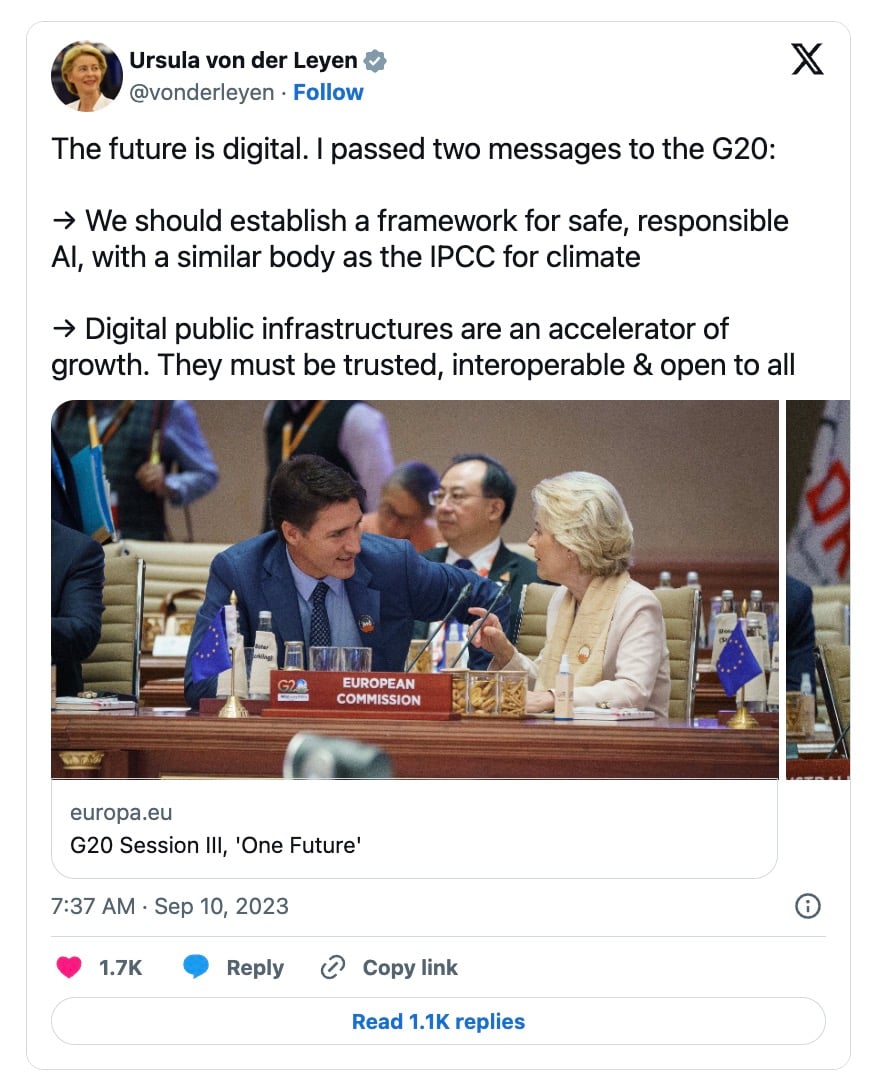
Von der Leyen praised the European Union’s move in 2020 to introduce the first legal framework on AI, a step taken with the intent of fostering innovation alongside trust. However, she insisted that this wasn’t sufficient. She suggested a multinational adoption of a coping mechanism for managing AI risks.
The EU Chief also stressed that globally accepted standards must be created under the purview of the United Nations, akin to their Intergovernmental Panel on Climate Change. Humanity stood to benefit, she argued, if an international authority could clarify the risks and rewards related to AI, akin to the IPCC for climate concerns.
Concurrently, von der Leyen championed the concept of digital public infrastructure similar to the coronavirus passport system – a system developed by the EU as a response to the Covid saga. The World Health Organization embraced it with open arms as a global standard for combating health threats.
“Many of you are familiar with the COVID-19 digital certificate. The EU developed it for itself. The model was so functional and so trusted that 51 countries on 4 continents adopted it for free. Today, the WHO uses it as a global standard to facilitate mobility in times of health threats,” von der Leyen continued.
Alarmingly, von der Leyen praised the EU’s strides towards a bloc-wide digital identity app capable of storing a citizen’s personal information, including credit cards, driver’s license, and passport data.
These developments ring alarm bells for individuals and nations valuing free speech and privacy.
5th Circuit Upholds Injunction Against Government Censorship
We got a big win Friday in Missouri v. Biden: Appellate Court Forbids White House, CDC, Surgeon General, and FBI from Censoring Americans Online
By Aaron Kheriaty, MD | Human Flourishing | September 10, 2023
Here’s my five-minute summary and reaction to the appellate court’s decision on Friday upholding the central provisions in our injunction against the government. (I’ll post the full interview soon when it’s available.)
The unanimous three-judge panel ruled: “The White House, the Surgeon General, the CDC, and the FBI likely coerced or significantly encouraged social-media platforms to moderate content, rendering those decisions state actions. In doing so, the officials likely violated the First Amendment.” The appeals court thereby confirmed that for last several years, our Federal government has been systematically violating the highest law of the land—the United States Constitution—by censoring the protected speech of hundreds of thousands of ordinary Americans tens of millions of times. News of the ruling was front page above-the-fold yesterday in The New York Times and The Washington Post, suggesting that the legacy media cannot ignore this issue any longer.
Not all the defendants in the suit were enjoined by the appellate court’s decision, which focused on the White House, the Surgeon General, the CDC, and the FBI. This is not, however, an indication that the other agencies named as defendants, such as CISA, are free to engage in censorship of protected speech. It simply means that at this early stage of limited discovery the appellate court did not think we have presented sufficient evidence to meet the very high legal bar required for a preliminary injunction. Although the injunction focuses on four agencies, the entire federal government is now on notice: any future communications between government officials and big tech are subject to subpoena and scrutiny in our case. If those come from any of the four enjoined agencies, those officials may now be subject not only to civil liabilities but to criminal penalties as well.
The ruling also confirmed that not only coercion but even “significant encouragement” by government officials to modify content is a form of unconstitutional censorship. The judges ruled that evidence we presented demonstrated both coercion and significant encouragement.
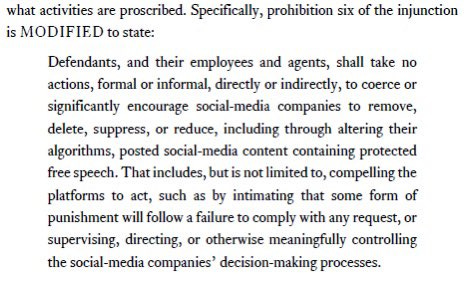
Contextualizing the scope of the violations of constitutional rights in our case, the judges noted that there are virtually no prior free speech cases of this scope and magnitude: “The Supreme Court has rarely been faced with a coordinated campaign of this magnitude orchestrated by federal officials that jeopardized a fundamental aspect of American life. Therefore, the district court was correct in its assessment—’unrelenting pressure’ from certain government officials likely ‘had the intended result of suppressing millions of protected free speech postings by American citizens.’ We see no error or abuse of discretion in that finding.”
You Should Be Very Worried About the Digital Services Act
By David Thunder | The Freedom Blog | September 9, 2023
Article 11 of The EU Charter of Fundamental Rights, which replicates a part of Article 10 of the European Convention on Human Rights, protects the right of European citizens to “hold opinions and to receive and impart information and ideas without interference by public authority and regardless of frontiers,” and affirms that “the freedom and pluralism of the media shall be respected.” Sadly, the fate of freedom of expression in Europe now very much hangs in the balance, as the European Union has just enacted a law that empowers the Commission to significantly restrict the ability of citizens to use digital platforms to engage in robust and sincere democratic discourse.
Under the recently enacted Digital Services Act, the European Commission may apply significant pressures upon digital platforms to curb “hate speech,” “disinformation” and threats to “civic discourse,” all of which constitute notoriously vague and slippery categories, categories that have historically been co-opted to reinforce the narrative of the ruling class. By giving the European Commission broad discretionary powers to oversee Big Tech content moderation policies, this piece of legislation holds freedom of speech hostage to the ideological proclivities of unelected European officials and their armies of “trusted flaggers.”
The stated purpose of the Digital Services Act (DSA) that has just come into force in Europe is to ensure greater “harmonisation” of the conditions affecting the provision of “intermediary” digital services, in particular online platforms that host content shared by their customers. The Act covers a bewildering array of issues, from consumer protection and the regulation of advertising algorithms to child pornography and content moderation. Among other purposes that appear in the wording of the Act, we find the fostering of “a safe, predictable and trusthworthy online environment,” the protection of citizens’ freedom of expression, and the harmonisation of EU regulations affecting online digital platforms, which currently depend on the laws of individual member States.
At a superficial glance, the Digital Services Act (DSA) might look rather innocuous. It places fairly formal requirements on “very large online platforms” such as Google, Twitter/X, Facebook and Tiktok to have clear appeals procedures and to be transparent about their regulation of harmful and illegal content. For example, section 45 of the Act reads as a fairly light touch requirement that providers of online digital services (“intermediary services”) keep customers informed of terms and conditions and company policies:
Providers of the intermediary services should clearly indicate and maintain up-to-date in their terms and conditions the information as to the grounds on the basis of which they may restrict the provision of their services. In particular, they should include information on any policies, procedures, measures and tools used for the purpose of content moderation, including algorithmic decision-making and human review, as well as the rules of procedure of their internal complaint-handling system. They should also provide easily accessible information on the right to terminate the use of the service.
But if you start to dig into the Act, you very soon discover that it is poisonous for free speech and is not in the spirit of Article 11 of the EU Charter of Fundamental Rights, which guarantees citizens the “freedom to hold opinions and to receive and impart information and ideas without interference by public authority and regardless of frontiers.” Below, I detail certain aspects of the Act that, taken together, pose an unprecedented threat to freedom of speech in Europe:
1. DSA (Digital Services Act) creates entities called “trusted flaggers” to report “illegal content” they identify on large online platforms. Online platforms are required by the act to respond promptly to reports of illegal content provided by these “trusted flaggers” nominated by member State-appointed “Digital Service Coordinators.” The Act requires large online platforms to “take the necessary measures to ensure that notices submitted by trusted flaggers, acting within their designated area of expertise, through the notice and action mechanisms required by this Regulation are treated with priority.”
2. Strictly speaking, while digital platforms are required to respond to reports of illegal content submitted by “trusted flaggers,” it appears from the wording of the Act that the platforms have discretion to decide how exactly to act upon such reports. They might, for example, disagree with the legal opinion of a “trusted flagger” and decide not to take down flagged content. However, they will face periodic audits of their actions’ compliance with the Act by auditors working on behalf of the European Commission, and these reviews will hardly look favourably upon a pattern of inaction in the face of flagged content.
3. The Digital Services Act also requires “very large online platforms” (platforms such as Google, Youtube, Facebook and Twitter) to undertake periodic “risk mitigation” assessments, in which they address “systemic risks” associated with their platforms, including but not limited to child pornography, “gender violence” (whatever that means), public health “disinformation,” and the “actual or foreseeable negative effects on democratic processes, civic discourse and electoral processes, as well as public security.” Platforms have “due diligence” obligations under the Act to take appropriate measures to manage these risks. Unlike a voluntary code of practice, opting out is not an option, and failure to comply with these “due diligence” obligations will be subject to hefty sanctions.
4. The sanctions attached to non-compliance with the Act are remarkable. The Commission, if it deems that a large online platform such as X/Twitter has not been in compliance with the DSA, may fine said platform up to 6% of its annual global turnover. Because the idea of non-compliance is hard to quantify and pretty vague (what exactly is required in order to meet “due diligence obligations” of systemic risk management?), it seems likely that companies that wish to avoid legal and financial headaches would prefer to err on the side of caution, and put on a show of “compliance” to avoid getting fined.
5. The periodic audits envisaged by this Act will serve as a tool for the Commission to pressure large online platforms into taking action to “manage” the “risks” of disinformation and threats to “civic discourse and electoral processes,” risks which are notoriously vague and are probably impossible to define in a politically impartial fashion. The threat lurking in the background of these audits and their associated “recommendations” is that the Commission may impose multi-billion dollar fines upon online platforms for non-compliance. Because of the rather vague idea of non-compliance with “due diligence obligations,” and the discretionary nature of the financial sanctions threatened in the DSA, this Act will create an atmosphere of legal uncertainty both for online platforms and for their users. It heavily incentivises online platforms to police speech in a way that passes muster with the EU Commission, around vague categories like “disinformation” and “hate speech”, and this will obviously have repercussions for end-users.
6. According to the European Commission, “hate motivated crime and speech are illegal under EU law. The 2008 Framework Decision on combating certain forms of expressions of racism and xenophobia requires the criminalisation of public incitement to violence or hatred based on race, colour, religion, descent or national or ethnic origin.” It is important to point out that the EU Commission favours expanding the categories of illegal hate speech at a Europe-wide level to include not only “race, colour, religion, descent or national or ethnic origin,” but also new categories (presumably, including things like gender identity). So illegal hate speech is a “moving target” and is likely to become ever broader and more politically charged as time goes on. According to the the European Commission’s own website,
On 9 December 2021, the European Commission adopted a Communication which prompts a Council decision to extend the current list of ‘EU crimes’ in Article 83(1) TFEU to hate crimes and hate speech. If this Council decision is adopted, the European Commission would be able, in a second step, to propose secondary legislation allowing the EU to criminalise other forms of hate speech and hate crime, in addition to racist or xenophobic motives.
7. The most disturbing aspect of DSA is the enormous power and discretion it places in the hands of the European Commission – notably, an unelected commission – to oversee compliance with DSA and decide when online platforms are non-compliant with respect to their “due diligence obligations” to manage risks whose meaning is notoriously vague and manipulable, such as hate speech, disinformation, and anti-civic discourse. The European Commission is also giving itself the power to declare a Europe-wide emergency that would allow it to demand extra interventions by digital platforms to counter a public threat. There will be no legal certainty about when the EU Commission might declare an “emergency.” Nor is there any legal certainty about how the European Commission and its auditors will interpret “systemic risks” like disinformation and hate speech, or assess the efforts of service providers to mitigate such risks, since these are discretionary powers.
8 Nor is clear how the Commission could possibly undertake an audit of “systemic risks” of disinformation and risks to civic discourse and electoral processes without taking a particular view of what is true and untrue, salutary and harmful information, thus pre-empting the democratic process through which citizens assess these issues for themselves.
9. Nor is it clear which checks and balances will be in place to prevent the DSA from becoming a weapon for the EU Commission’s favourite causes, whether the war in the Ukraine, vaccine uptake, climate policy, or a “war on terror.” The broad power to declare a public emergency and require platforms to undertake “assessments” of their policies in response to that, combined with the broad discretionary power to fine online platforms for “non-compliance” with inherently vague “due diligence obligations,” give the Commission a lot of leeway to lord it over online platforms and pressure them to advance its favoured political narrative.
10. One particularly sneaky aspect of this Act is that the Commission is effectively making disinformation illegal *through a backdoor*, so to speak. Instead of clearly defining what they mean by “disinformation” and making it illegal – which would probably cause an uproar – they are placing a “due dilegence” requirement upon large online platforms like Twitter and Facebook to take discretionary measures against disinformation and to mitigate “systemic risks” on their platforms (which include the risk of “public health disinformation”). Presumably, the periodic audits of these companies’ compliance with the Act would look unkindly on policies that barely enforced disinformation rules.
So the net effect of the act would be to apply an almost irresistible pressure on social media platforms to play the “counter-disinformation” game in a way that would pass muster with the Commission’s auditors, and thus avoid getting hit with hefty fines. There is a lot of uncertainty about how strict or lax such audits would be, and which sorts of non-compliance might trigger the application of financial sanctions. It is rather strange that a legal regulation purporting to defend free speech would place the fate of free speech at the mercy of the broadly discretionary and inherently unpredictable judgments of unelected officials.
* * *
The only hope is that this ugly, complicated and regressive piece of legislation ends up before a judge who understands that freedom of expression means nothing if held hostage to the views of the European Commission on pandemic-preparedness, the Russia-Ukraine war, or what counts as “offensive” or “hateful” speech.
P.S. Consider this analysis as a preliminary attempt by someone not specialised in European law, to grapple with the troubling implications of the Digital Services Act for free speech, based on a first reading. I welcome the corrections and comments of legal experts and those who have had the patience to wade through the Act for themselves. This is the most detailed and rigorous interpretation I have developed of the DSA to date. It includes important nuances that were not included in my previous interpretations and corrects certain misinterpretations – in particular, platforms are not legally required to take down all flagged content, and the people who flag up illegal content are referred to as “trusted flaggers,” not “fact-checkers.”).
The CIA’s Continued Secrecy on Chile and JFK
By Jacob G. Hornberger | FFF | September 8, 2023
On August 31, the Nation magazine published an article entitled “Chile: The Secrets the US Government Continues to Hide,” which details the CIA’s continued steadfast insistence on keeping its records secret that relate to the agency’s 1970-1973 efforts to bring regime change to Chile.
The CIA’s continued secrecy, of course, brings to mind the agency’s equally steadfast insistence on keeping its JFK-assassination related records secret into perpetuity.
The CIA, needless to say, cites the two magic words — “national security” — to justify its continued secrecy in both events.
I suggest that two other words are the real reason for the CIA’s continued secrecy in both events: “criminal cover-up.”
After all, the JFK assassination took place 60 years ago and the Chilean coup took place 50 years ago. The notion that the release of CIA assassination-related and coup-related records would threaten “national security,” no matter what definition is used for that ridiculous, meaningless term, is laughable to the extreme.
Actually, the Chilean coup bears a relationship to the JFK assassination. That’s because the national-security establishment’s mindset toward its regime-change operation in Chile reflected its mindset toward its regime-change operation in Dallas. My hunch is that those still-secret records relating to Chile would provide further circumstantial evidence pointing toward the reasons for the operation in Dallas.
In 1970, Chilean voters delivered a plurality of vote to Salvador Allende in the presidential election. Since Allende had not received a majority of votes, the election was thrown into the hands of the Chilean congress.
U.S. officials deemed Allende a grave threat to U.S. national security, on two grounds: that he was a socialist but, more important, that he was befriending the communist world, including Cuba and the Soviet Union, something that Kennedy had done as well in his famous Peace Speech at American University a few months before he was assassinated.
The CIA embarked on a campaign of bribing the members of the Chilean congress to vote against Allende (which, of course, is somewhat ironic given the fierce U.S. reaction to supposed Russian involvement in U.S. elections).
At the same time, the U.S. national-security establishment made plans for a Chilean military takeover. What’s interesting is that the CIA did not assassinate Allende. Instead, it convinced the Chilean national-security establishment that Allende posed a grave threat to Chilean national security and, therefore, that the Chilean national-security establishment had a moral duty to violently prevent Allende from assuming the presidency.
That’s a very important and very revealing point, one that undoubtedly comes across loud and clear in those still-secret CIA records relating to the Chile coup. The point reveals the U.S. national-security establishment’s conviction that it had the moral duty to violently remove JFK from power in order to protect America from a president whose policies, they concluded, posed a grave risk to “national security.” (See FFF’s book JFK’s War with the National Security Establishment: Why Kennedy Was Assassinated by Douglas Horne.)
Much to the chagrin of the U.S. national-security establishment, however, the commanding general of Chile’s armed forces, Gen. Rene Schneider, opposed the idea of a coup. His position was that the Chilean constitution did not permit a coup as a way to remove a democratically elected president from office. He said that Chileans would have to wait until the next election.
Therefore, the CIA simply orchestrated a violent kidnapping of Schneider which left him dead from gunshot wounds on the streets of Santiago. Ironically, the CIA’s kidnapping and assassination of this innocent man boomeranged because the Chilean congress, faced with tremendous anger over Schneider’s murder among the Chilean citizenry, rejected the CIA’s bribes and installed Allende into power.
Three years later, however, the U.S. national-security establishment prevailed in its efforts and helped military strongman Gen. Augusto Pinochet violently take over the reins of power. By the end of the war between the executive and national-security branches of the government, Allende was dead, just as Kennedy was ten years before.
With the full support of the Pentagon and the CIA, Pinochet’s henchmen rounded up some 60,000 innocent people and proceeded to torture and/or rape most of them. They also killed or disappeared around 3,000 of them.
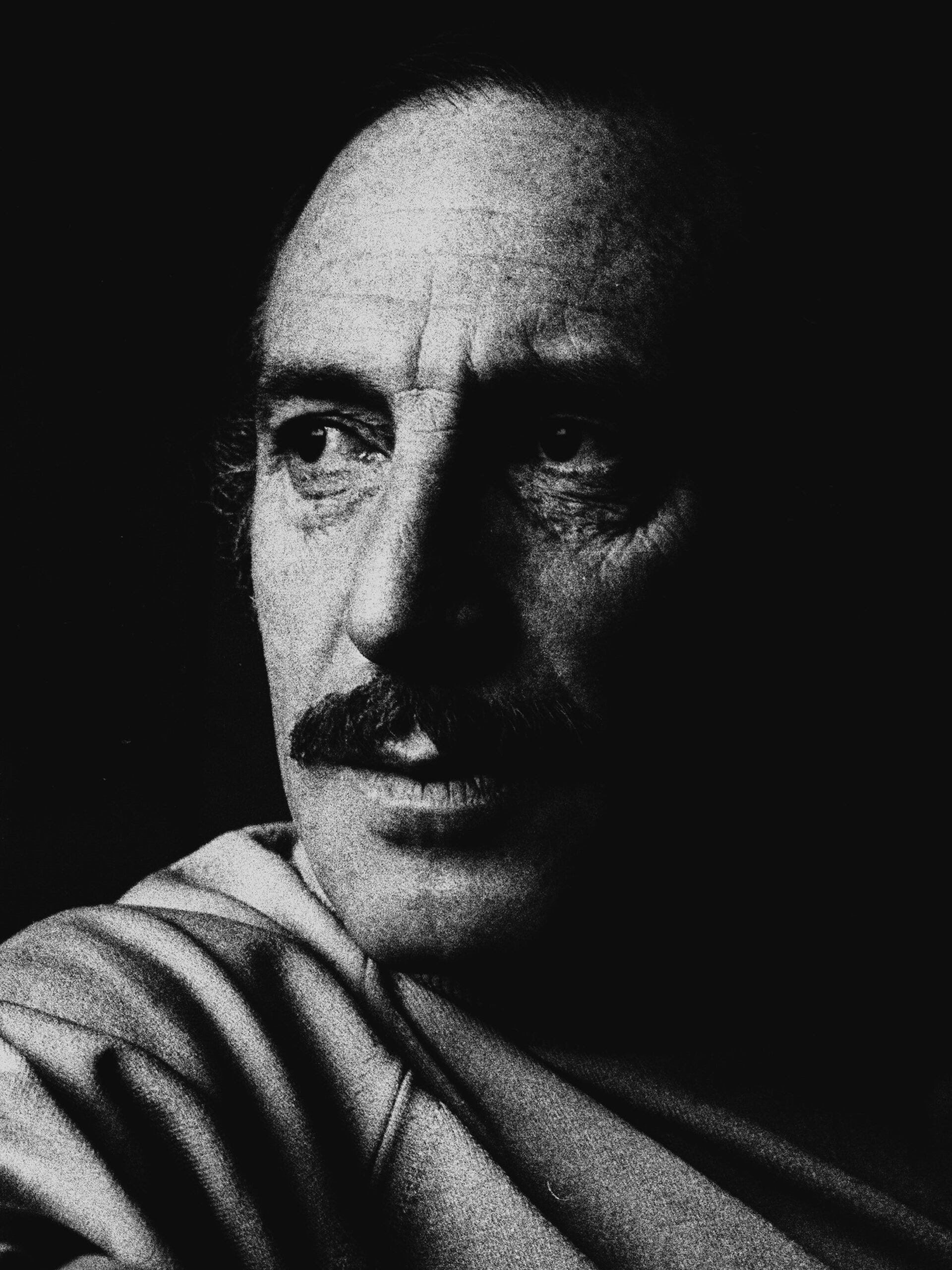
Orlando Letelier
Among those rounded up was Orlando Letelier, a highly respected man who had served in the Allende administration as ambassador to the United States, minister of foreign affairs, minister of the interior, and minister of defense. After being tortured in captivity, world pressure forced Pinochet to release him.
Letelier moved to Washington, D.C., where he joined a leftist think tank and began lobbying against the Pinochet regime. Pinochet and his national-security establishment deemed Letelier to be a grave threat to Chilean “national security.”
On September 21, 1976, Letelier was killed by a car bomb on the streets of Washington, D.C., along with his young assistant Ronni Moffitt.
It was determined that Pinochet’s secret Gestapo-like internal police force, which was called DINA and which worked with the CIA, had orchestrated and carried out the Letelier assassination. Among those convicted of the crime was a DINA agent named Michael Townley, who was a U.S. citizen.
As part of what was clearly a sweetheart deal, Townley pled guilty in U.S. District Court as part of a plea bargain with U.S. officials. Get this: He was sentenced to only ten years in jail for what amounted to the cold-blooded murder of two innocent people. To put that in perspective, compare it to the 22-year jail sentence that a U.S. District Judge recently meted out to a man convicted of simply participating in the January 6 protests. Townley was also given immunity from prosecution in Chile for another national-security assassination in which he had allegedly been involved.
But that’s not all. After serving only 62 months in jail, get this: He was admitted into the federal witness protection program! That meant that the feds gave him a secret identity and let him live a normal life somewhere in the world.
The Letelier assassination has always been blamed on Pinochet. Is it possible that the CIA, working with DINA, was also embroiled in that assassination, on grounds of “national security”? My hunch is that those records relating to Chile that the CIA steadfastly continues to keep secret would help provide an answer to that question, which, needless to say, would be a good reason for wanting them to kept secret.
Civil Disobedience Against Mandatory Masking Works!!
Press For Truth | September 9, 2023
Mandatory mask mandates are making a comeback for Covid-19(84) 2.0 but this will only apply to you if you allow it to!
In this video Dan Dicks of Press For Truth speaks with Denis Rancourt, a PHD and former professor of physics at the University of Ottawa and researcher for the Ontario Civil Liberties Association about mandatory masking policies that are slowly but surely returning and most importantly how one can effectively engage in acts of civil disobedience when it comes to refusing to wear a mask.
To learn more visit:
Follow Denis on X:
California passes law on ‘affirmation’ of children
RT | September 9, 2023
The California State Assembly on Friday approved a bill redefining the health, safety, and well-being of children to include “gender identity or gender expression.” Critics say it will enable the state to seize children who “transitioned” without the approval of their parents.
Assembly Bill 957 was adopted with a vote of 57-16 and sent to Governor Gavin Newsom for signature. It amends Section 3011 of the Family Code to “include a parent’s affirmation of the child’s gender identity or gender expression as part of the health, safety, and welfare of the child.”
Family courts use the health and well-being standard to make decisions as to which parent gets custody of children in divorce disputes, or in cases in which parents have their children taken away by the state due to abuse or neglect.
“That is our duty as parents, to affirm our children,” State Representative Lori Wilson, a Democrat from the San Francisco Bay Area, said in a speech on the Assembly floor.
State Senator Scott Wiener, a fellow San Francisco Democrat, co-sponsored the bill. He was behind the 2022 ‘trans refuge bill’ which gave immunity from other states’ laws to minors seeking ‘gender affirming care’ in California.
Republicans have criticized the proposal, arguing that family court judges already have the discretion to make that determination. With only 18 seats in the 80-member chamber, however, there was little they could do to stop it.
Last month, a school district in the Bay Area paid $100,000 to settle a lawsuit filed by a parent whose child was “secretly transitioned” without her knowledge or consent. Jessica Konen alleged that the Spreckels Union School District and three of its employees “secretly convinced” her daughter of being bisexual and transgender, referred to her as a boy, instructed her on binding her breasts, and allowed her to use the faculty bathroom.
Teachers allegedly encouraged Konen’s daughter to use a boy’s name, wear clothing for boys, read articles about gender transition, and “not to tell her mother about her new gender identity or new name, saying that her mother might not be supportive of her and that she couldn’t trust her mother.”
When the school eventually informed Konen, she claimed that she went along with it out of fear that the state might take the child away. The girl “began to return to her original self” after March 2020, when California switched to online lessons due to the Covid-19 pandemic.
Energy bill authorises “reasonable force” to install smart meters that allow authorities to turn customers’ energy on and off
BY DAVID CRAIG | THE DAILY SCEPTIC | SEPTEMBER 7, 2023
You probably know that a massive Energy Bill is being rushed through Parliament by our fake ‘Conservative’ Government in the first two days of our parliamentarians’ return from their generous summer break. The Bill is 446 pages long and written in dense, largely-incomprehensible-to-any-normal-person legalise. Moreover, many clauses in the Energy Bill make reference to other pieces of previous legislation. So, to fully understand the Bill, you would have to read at least a thousand pages of dense legalistic gobbledegook. Given that our MPs have just passed the Bill with a mere nine voting against it, one must assume that they have spent their summer holidays diligently reading through the Bill and other relevant legislation in order to fully understand what they were voting for.
Here’s the full title of the Bill:
‘A Bill to make provision about energy production and security and the regulation of the energy market, including provision about the licensing of carbon dioxide transport and storage; about commercial arrangements for industrial carbon capture and storage and for hydrogen production; about new technology, including low-carbon heat schemes and hydrogen grid trials; about the Independent System Operator and Planner; about gas and electricity industry codes; about heat networks; about energy smart appliances and load control; about the energy performance of premises; about the resilience of the core fuel sector; about offshore energy production, including environmental protection, licensing and decommissioning; about the civil nuclear sector, including the Civil Nuclear Constabulary; and for connected purposes’
As you’ll see, this legislative monster covers an awful lot of areas – energy production, regulation of the energy market, CO2 transport and storage, carbon capture, hydrogen production, low-carbon heat schemes, hydrogen grid trials, heat networks, smart appliances, load control, energy performance of industrial and residential premises, offshore energy production and the civil nuclear sector. We must be considered fortunate in Britain to have MPs who have such a strong work ethic and such a deep understanding of all these disparate issues to be able to vote for the new Energy Bill knowing exactly what they are voting for.
Life is too short for any normal person to read and to try to understand this massive abomination of almost impenetrable legalise. But here are some choice titbits which I think I understand.
The Bill explains what a ‘Smart Meter’ is:
“Energy smart appliance” means an appliance which is capable of adjusting the immediate or future flow of electricity into or out of itself or another appliance in response to a load control signal; and includes any software or other systems which enable or facilitate the adjustment to be made in response to the signal.
So it seems that the conspiracy theorists were right yet again – a key purpose of ‘Smart Meters’ is not only to measure power usage but also to allow energy providers to control how much energy we are allowed to consume using “a load control signal”.
Moreover, authorities will be allowed to use “reasonable force” to enter any homes or premises to ensure we have the approved ‘Smart Meters’ installed:
Requiring persons to supply evidence of their compliance to enforcement authorities; conferring powers of entry, including by reasonable force.
All electricity and gas meters have dates by which they should be replaced. From what I have read the Bill gives representatives from energy companies the power to enter any home, with police protection if required, to replace traditional meters at the end of their lives with smart meters. Again, “reasonable force” may be used.
The Bill gives the Government the power to force us to have energy assessments for any premises:
The Secretary of State may make regulations for any of these purposes: (a) enabling or requiring the energy usage or energy efficiency of premises to be assessed, certified and publicised;
We can be fined up to £15,000 or face one year in prison for failing to meet any future energy performance levels any government imposes:
Energy performance regulations may provide for the imposition of civil penalties by enforcement authorities in relation to cases falling within subsection (1)(b), (c) or (d); but the regulations may not provide for a civil penalty that exceeds £15,000.
Under the totally misleading title of ‘Energy Savings Opportunity Schemes’, authorities can force any person or company to make energy savings using the threat of criminalisation for failure to comply:
The Secretary of State may by regulations (“ESOS regulations”) make provision for the establishment and operation of one or more energy savings opportunity schemes. An “energy savings opportunity scheme” is a scheme under which obligations 30 are imposed on undertakings to which the scheme applies for one or more of the ESOS purposes.
I could go on. But I imagine you get the picture by now. This ‘Energy Bill’ creates the means by which some puffed-up public-sector mini-dictator could gain powers to control us in ways most people would find completely unacceptable. Yet our useless MPs passed the Bill with a massive majority and the Lords are set to do the same.
If there really was a ‘climate crisis’ caused by humans burning fossil fuels and threatening the existence of the human race as the BBC and others of its ilk repeatedly claim, then you might be able to argue that some of the measures in the Bill could be justified. But given that changes in atmospheric CO2 levels have little to no influence on the Earth’s temperatures, that Britain only contributes less than 1% of world CO2 output and that developing countries like India and China each increase their CO2 output by more each year than Britain’s total CO2 emissions, we are creating a totalitarian regime which will intrude on people’s lives, restrict people’s freedoms, wreck the British economy and immiserate our country to fix a problem which doesn’t even exist and, if it did, would not be solved by our action anyway.
And if you fear this horror will lead to an intrusive, oppressive police state under the Tories, imagine how this will be used and abused by Ed Miliband and the climate fanatics in the next Labour Government.
David Craig is the author of There is No Climate Crisis, available as an e-book or paperback from Amazon.
The ADL’s Jonathan Greenblatt Says The Organization Isn’t Pressuring X Advertisers
Despite telling advertisers to pause spending
By Cindy Harper | Reclaim The Net | September 7, 2023
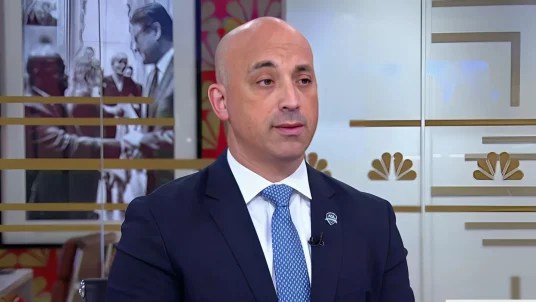
In an interview this week on CNBC’s show Squawk Box, Jonathan Greenblatt, CEO of the Anti-Defamation League (ADL), steered a conversation toward alleging that criticism of the ADL’s social media censorship efforts were being driven by “white supremacist” factions.
The ADL recently met with Twitter CEO, Linda Yaccarino. It apparently ignited the fuse for a fast-spreading hashtag campaign: “ban the ADL.” According to Greenblatt, the culprit for this viral trend was not those that were tired of the ADL trying to censor online speech but were none other than the “white supremacists” pervading across the online platform.
The spotlight of this segment also fell on the alleged deflation of advertisement revenue on Musk’s platform, X. Musk suggested this was due to the ADL pushing for advertisers to reconsider their commercial placements. Greenblatt asserted, “we are not out there publicly or privately talking to advertisers, they will make the decisions they want to.”
Greenblatt also said that he would challenge Musk “to find a single advertiser on whom we put any pressure, because we’re simply not doing that.”
However, the ADL did call for a pause in ad spending on X following its acquisition in November.

“We did call for a pause back in November after the acquisition. And then since then, since that initial statement, what we are doing is engaging with the management of the company trying to help them make it better,” Greenblatt said of X.
“I understand they have a big business problem. I mean, Elon tweeted something I didn’t know, that the advertising revenues down 60 percent. But look, brands are big boys and girls, they will make their own decisions.”
Greenblatt also presented his stance on the divisive issue of social media censorship. His disbelief in cancel culture was clear, preferring the term “council culture.” In his words: “So someone makes a mistake you help them fix it. So what we’ve tried to do over the years with Twitter, with YouTube, with Facebook and all those platforms, with Reddit, with Discord I can go on and on is to work with them to make those platforms better.”
The EU’s best weapon against free speech isn’t working
The EU has just realized that it can’t rule the internet with an iron fist by throwing around the ‘Kremlin propaganda’ label
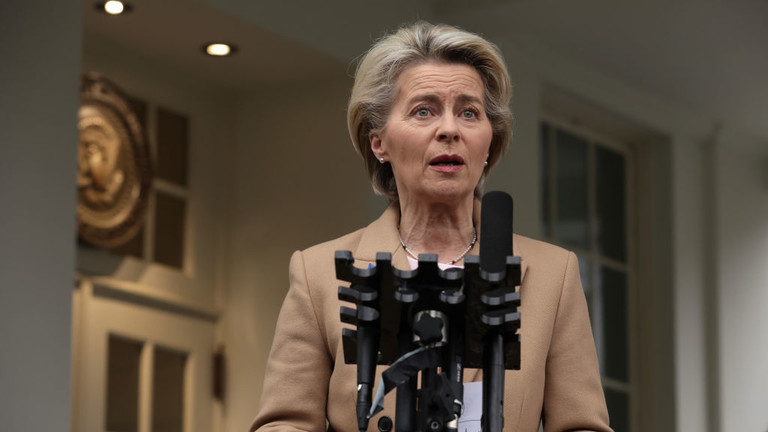
EC President Ursula von der Leyen speaks to the press after a meeting with Joe Biden in the White House on March 10, 2023 in Washington, DC. © Alex Wong/Getty Images
By Rachel Marsden | RT | September 7, 2023
The European Commission has concluded in a new report that despite making pinky-promises to “mitigate the reach and influence of Kremlin-sponsored disinformation,” large social media platforms like Twitter and Facebook were “unsuccessful” in doing so. What a shocker that this research by oversight advocates has ended up advocating in favor of more oversight. Russia just happens to be the most convenient scapegoat.
Using the same kind of smear tactics that the bloc has used previously – like when it included Russia alongside Islamic State (IS, formerly ISIS) in previous security and threat reports – this time it involved conflating “pro-Kremlin” social media accounts with those that it considers to be “Kremlin-aligned” or “Kremlin-backed.” In other words, mere disagreement with the Western narrative is enough to land anyone in the “pro-Kremlin” camp and to be considered worthy of content moderation or banning by the EU. And now they’re frustrated that social media platforms have dropped the ball on carrying out that censorship.
“Platforms rarely reviewed and removed more than 50 percent of the clearly violative content we flagged in repeated tests,” the report said. What kind of content would that be, exactly? It’s hard to tell, because their examples conflate the legitimately debatable with the patently absurd, and suggest that both warrant censorship. They cite, for example, content that accuses Ukraine of being run by Nazis – which is a legitimate concern, given that the Western press has reported extensively on the powerful role played by neo-Nazis in Ukraine, which are “aggressively trying to impose their agenda on Ukrainian society, including by using force against those with opposite political and cultural views,” according to a publication by the Washington-based Freedom House prior to the conflict, adding that “they are a real physical threat to left-wing, feminist, liberal, and LGBT activists, human rights defenders, as well as ethnic and religious minorities” in Ukraine. The Council of Europe had made similar observations.
There’s also the fact that the West trained the neo-Nazi Azov battalion to fight Russians, and that Reuters reported way back in 2018 that then-president Petro Poroshenko “would risk major repercussions” should he take action against neo-Nazis.
That kind of does sound like there’s a neo-Nazi issue that’s at the very least worthy of highlighting and debating. Yet the EU dismisses any such suggestion as Russian disinformation.
The report also takes issue with accounts “denying war crimes,” using events in Bucha as an example. I’m sorry, but was there a war crimes tribunal that we missed? We’re talking here about events taking place in the immediate fog of war. Attempting to sort through facts, realities, and manipulations is precisely the kind of thing with which social media is meant to assist. Everyone by this point knows that it’s about having access to as much raw data as possible. We expect to see a chaotic mess online – not a curated Encyclopedia Britannica set or the evening news. What makes Brussels think it is entitled to a monopoly on that process?
The report places these examples of inconvenient debates alongside a blatantly ridiculous example of sh*tposting whereby someone made up the name of a fake media outlet and announced that Ukraine was sending a radioactive cloud towards Europe. Look, if anyone is so dumb as to believe something like that, then it certainly isn’t the EU that’s going to save them from their own stupidity. Not for long, anyway. Just let them spend their entire next week digging a fallout shelter while their neighbors have a good laugh.
In a line that just begs to be read repeatedly out of sheer incredulity that someone could be so tone-deaf, the report notes that so-called Kremlin disinfo efforts are “designed to foment political and social instability among its adversaries by stoking ethnic conflict, promoting isolationism, and distracting public attention away from Ukraine and onto domestic affairs.” How dare the people of Europe insist that their leaders focus on the considerable problems faced by their own country and citizens, which have long been exacerbated by misguided national and EU-level policies, rather than riveting their attention to Ukraine! Indeed, if it wasn’t for those meddling Russians, Europe would be a utopia of sunshine and rainbows, everyone holding hands and singing Kumbaya, with nothing else for citizens to concern themselves with besides what’s happening in Ukraine.
The EU laments that “the Kremlin and its proxies captured growing audiences with highly produced propaganda content, and steered users to unregulated online spaces, where democratic norms have eroded and hate and lies could spread with impunity.” They have it all backwards. People wanting to engage in debate and discussion of topics and viewpoints that the EU — in all its arrogance as the self-appointed arbiter of truth — is keen to censor, have been driven to other platforms specifically because they support free speech in all its glory and imperfection.
“Over the course of 2022, the audience and reach of Kremlin-aligned social media accounts increased substantially all over Europe,” according to the report, adding that “the reach and influence of Kremlin-backed accounts has grown further in the first half of 2023, driven in particular by the dismantling of Twitter’s safety standards.” In other words, Elon Musk, who considers himself a “free speech absolutist,” came along and bought Twitter, leveled the playing field by opening up debate and reducing censorship, and what ended up happening is that people flooded to the platform as a refreshing alternative to the curated and censored Western establishment narrative that they’re spoon-fed elsewhere.
So what’s the EU going to do about it now? Well, mandatory compliance with its Digital Services Act is now in effect as of last month. This means that, theoretically, all the major social media platforms are obligated to work with the EU’s handpicked “civil society” actors to moderate and censor content – no doubt in alignment with the EU’s narrative. Musk should play along and take notes about the kind of censorship requests that are made of him by Brussels. Then he should publish them on Twitter in the interest of radical transparency and the kind of uncompromising defense of democracy to which the EU is constantly paying lip service as a pretext for its crackdowns on our fundamental freedoms.
Rachel Marsden is a columnist, political strategist, and host of independently produced talk-shows in French and English.
Lead author of Cochrane mask review responds to Fauci’s dismissal of evidence
BY MARYANNE DEMASI, PHD | SEPTEMBER 4, 2023
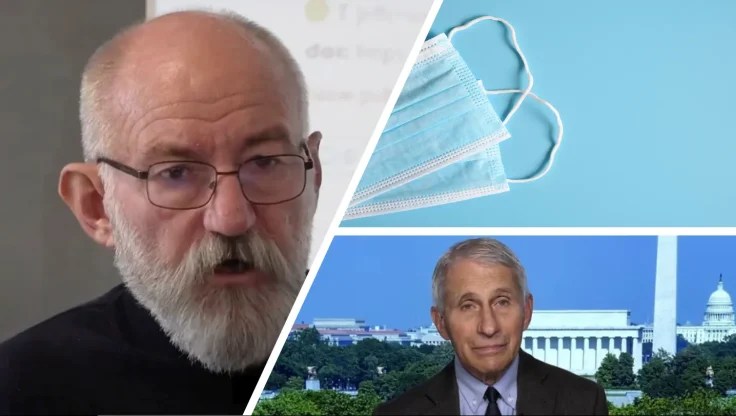
Former chief medical advisor to the US President Anthony Fauci, was questioned over the weekend by CNN reporter Michael Smerconish, about face masks being able to curb the spread of covid-19.
“There’s no doubt that masks work,” said Fauci.
“Different studies give different percentages of advantage of wearing it, but there’s no doubt that the weight of the studies … indicate the benefit of wearing masks,” he added.
Smerconish brought up the 2023 Cochrane review which found no evidence that physical interventions like face masks could stop viral transmission in the community and cited my interview with lead author of the study Tom Jefferson who confirmed, “There is just no evidence that they [masks] make any difference. Full stop.”
Fauci replied,“Yeah but there are other studies,” stressing that masks work on an individual basis.
“When you’re talking about the effect on the epidemic or the pandemic as a whole, the data are less strong…but when you talk about an individual basis of someone protecting themselves or protecting themselves from spreading it to others, there’s no doubt that there are many studies that show there is an advantage,” said Fauci.
Professor Tom Jefferson, who says he is committed to updating the Cochrane review as new evidence emerges, has responded to Fauci’s comments.
“So, Fauci is saying that masks work for individuals but not at a population level? That simply doesn’t make sense,” said Jefferson.
“And he says there are ‘other studies’…but what studies? He doesn’t name them so I cannot interpret his remarks without knowing what he is referring to,” he added.
Jefferson explains that the entire point of the Cochrane review was to systematically sift through all the available randomised data on physical interventions such as masks and determine what was useful and what was not.
Since 2011, the Cochrane review only included randomised trials to minimise bias from confounders.
“It might be that Fauci is relying on trash studies,” said Jefferson. “Many of them are observational, some are cross-sectional, and some actually use modelling. That is not strong evidence.”
“Once we excluded such low-quality studies from the review, we concluded there was no evidence that masks reduced transmission,” he added.
The problem with Fauci is that his story has changed.
Initially, Fauci said that masks were ineffective and unnecessary. In March 2020, Fauci told 60 minutes, “Right now in the United States, people should not be walking around with masks.”
But only a few weeks later, he did a U-turn and began recommending widespread use of face masks.
Fauci defended his U-turn saying, “When the facts change, I change my mind.”
Jefferson retorted, “What facts changed? There were no randomised studies, no new evidence to justify his flip-flop. That’s simply not true.”
Since then, Fauci has remained adamant that face masks not only stop people from infecting others, but they also protect the wearer.
Fauci advocated for the use of cloth masks, and even encouraged double-masking in the absence of evidence.
“You put another layer on, it just makes common sense that it would be more effective,” Fauci told NBC news.
“What Fauci doesn’t understand is that cloth and surgical masks cannot stop viruses because viruses are too small and they still get through,” said Jefferson.
He laments that public figures have tried to undermine the Cochrane review, despite it representing the gold standard of evidence.
Columnist Zeynep Tufekci wrote an article in the New York Times titled, “Here’s Why the Science Is Clear That Masks Work,” claiming that Cochrane’s mask study had misled the public.
Cochrane’s editor in chief, Karla Soares-Weiser capitulated to pressure and “apologised” for the wording in the plain language summary of the review because it “was open to misinterpretation” and may have led to “inaccurate and misleading” claims.
And former CDC director Rochelle Walensky misled Congress after claiming the Cochrane review had been “retracted” which was patently false.
As it stands, the Cochrane review will continue to be the subject of attacks because it presents a major roadblock for implementing masking policies. Jefferson says he doesn’t know what motivates people to ignore the facts.
“Could it be part of this whole agenda to control people’s behaviour? Perhaps,” he speculated.
“What I do know,” said Jefferson, “is that Fauci was in a position to run a trial, he could have randomised two regions to wear masks or not. But he didn’t and that’s unforgivable.”
Fauci, who served as the federal government’s top infectious disease specialist for nearly 40 years, stepped down in Dec 2022 and is now a professor at Georgetown University’s Department of Medicine, in the Division of Infectious Diseases.
Spiegel schoolmarm demands that Germans “act responsibly” and “get their masks back out”…
… so that she doesn’t feel uncomfortable being the only “oddball” wearing a face diaper in public

Veronika Hackenbroch wants you to mask so she doesn’t feel weird
eugyppius: a plague chronicle | September 6, 2023
We’ve encountered Head Girl Science Fan Veronika Hackenbroch here at the plague chronicle once before. She’s a medical writer for Spiegel who defended lockdowns until the very end and is still fighting a halfhearted rearguard action to keep Corona alive. Her latest is a diatribe demanding that Germans “Get their masks back out” because “Covid infections are rising again. If you’re smart, you’ll wear a mask, even if the government doesn’t make you.”
To make this argument, Hackenbroch must first surumount a considerable hurdle, namely that the venerated Covid prophet Christian Drosten has been increasingly noncommittal about masking, at one point even saying he won’t mask in unmasked company because he “doesn’t want to be Dr. Strange.” For someone like Hackenbroch, whose entire worldview is shaped by the opinions of arbitrary Science Authorities, this is no small thing, but she can take some comfort in the fact that the French Health Minister is still a committed fan of face diapers who believes that “masking must become commonplace.” There’s also the fact that nasal spray vaccine enthusiast Akiko Iwasaki “currently travels wearing an FFP2 mask.”
There are people who spend thousands acquiring handbags sported by their favourite film stars, and there is Veronika Hackenbroch, who does whatever the Yale virus luminary Iwasaki does.
Only after urging her readers to imitate the personal eccentricities of assorted Covid celebrities does Hackenbroch bother to address the scientific evidence:
Masks, especially FFP2 masks, can significantly reduce the risk of infection. In a California study, the risk of corona infection was 66 percent lower in study participants who wore a medical mask for two weeks than in people without masks. For FFP2 mask wearers, the figure was as high as about 83 percent.
Masks are even better than for self-protection when it comes to protecting the community: if everyone wears a correctly fitted FFP2 mask, including those who are unknowingly infected and already contagious, the risk of infection drops into the per thousand range even in close contact, according to a study by the Max Planck Institute for Dynamics and Self-Organisation in Göttingen.
The California study finds that respirators lower the odds of infection by 83%, a clearly impossible statistic contradicted by many other studies, natural experiments and also by publicly available case data. The Max Planck study merely looks at the mechanics of masking – things like “respiratory particle size distribution” and “exhalation flow physics” – to predict how well masking ought to work. Its insane results that FFP2 masks can reduce the risk of infection nearly to zero are replicated nowhere in the real world, and seem to be in tension with the California study Hackenbroch cited just a few sentences earlier.
Then things really go off the rails:
That mask-wearing permanently weakens the immune system due to the lack of contact with pathogens (“immunodeficiency”) is a myth. It is not true that you have to be sick regularly to have healthy immune defence. You don’t have to train your immune system like a muscle. On the contrary, several viral infections only increase the susceptibility to further infections.
The adaptive immune system is a real thing, and in the absence of regular exposure to constantly evolving pathogens, adaptive immunity loses its ability to respond to new infections. Or does Hackenbroch not think that regular Covid vaccination is necessary, because “you don’t have to train your immune system”?
As with fellow Covid harpy Christina Berndt, of course, Hackenbroch’s primary concern is that if not enough people mask, she won’t feel comfortable masking. She concedes that “now is the time to make masks compulsory again,” but she does hope that more will “act responsibly” so she doesn’t have to worry about passersby thinking she’s “an oddball.” It’s a remarkably petty concern on behalf of a measure that Hackenbroch believes so strongly will protect her from a virus she continues to insist is quite dangerous.
On the one hand, it is amusing to watch the Hackenbrochs of the world stomp their feet and demand that all of society bend to their eccentric preferences. For the early years of the pandemic, they rode a massive wave of propaganda-induced virus panic and helped shape the hygiene hysteria of millions. Now their ranks have been reduced to a few isolated ninnies whose opinions, thankfully, very few care about. That they themselves don’t seem to have noticed this shift is an occasion for low comedy. On the other hand, sporadic local mask mandates are returning, and this thing won’t be fully over until every last one of these mask nags is shamed into silence. Masking is deeply irrational, it has no demonstrable purpose, it seems to have addictive properties for some people, and if done frequently enough it threatens merely to increase public hygiene anxiety and set off another self-reinforcing virus panic spiral.
Featured Video

Deception – Submarines against Olof Palme
or go to
Aletho News Archives – Video-Images
From the Archives
Woolsey Fire started at Santa Susana Field Lab — where “radioactive materials released were never accurately measured”
By John Laforge | CounterPunch | November 30, 2018
In my Nov. 16 column, I reported on potential radiation risks posed by California’s Woolsey wildfire having burned over parts or all of the Santa Susana Field Laboratory—south of Simi Valley, Calif., 30 miles outside Los Angeles—site of at least four partial or total nuclear reactor meltdowns.
The field laboratory operated 10 experimental reactors and conducted rocket engine tests. In his 2014 book Atomic Accidents, researcher James Mahaffey writes, “The cores in four experimental reactors on site … melted.” Reactor core melts always result in the release of large amounts of radioactive gases and particles. Clean up of the deeply contaminated site has not been conducted in spite of a 2010 agreement.
Los Angeles’s KABC-7 TV reported Nov. 13 that the Santa Susana lab site “appears to be the origin of the Woolsey Fire” which has torched over 96,000 acres. Southern Calif. Public Radio said, “According to Cal Fire, the Woolsey Fire started on the afternoon of Thursday, Nov. 8 … on the Santa Susana site.” … continue
Blog Roll
 Aletho News
- Brussels cannot say where its own pipeline inspectors are as Hungary’s oil lifeline remains shut
- Israel’s Iran War: Myth and Reality
- Between war and industrial breakdown: The US-Israeli attrition crisis
- Pressure builds on Iran to ‘drop’ Lebanon ceasefire demand as Islamabad talks hang in balance
- In another clash report, US denies agreement to release Iran’s assets
- What is fueling unrest across the EU?
- Why no power can undermine Iran’s eternal dominance over the Strait of Hormuz
- Is The War Against Iran Over?
- Iran war will leave long-term ‘scar’ on Wall Street, investors warn
- How Iran decimated US power projection in West Asia: Military lessons of 40-day war
- If Americans Knew
- Mearsheimer reveals how Israel dictates US policies on Iran, Gaza – video
- After killing 350+, Israel still has a “score to settle” with Lebanon before ceasefire – Daily Update
- Military aid to Israel emerges as the latest political litmus test for Democrats
- The only Palestinian children’s rights organization closes following years-long Israeli campaign against it
- ‘I Can’t Forget the Smell’: Lebanese Reel After Israel Kills Over 300 in Single Day
- DNC Shoots Down Resolutions Calling Out AIPAC and Limiting Arms to Israel
- TCN: Is Israel Blackmailing President Trump?
- Israel killed at least 303 Lebanese yesterday – who were they? Daily Update
- Amnesty: Urgent – Protect Lebanese civilians from brutal escalation in Israeli attacks
- Is The War Against Iran Over?
- No Tricks Zone
- German Expert: Heat Dome Led To Record Temps In Western USA…Warmer In 1934, 1936
- New Study: No Linear Warming Or Glacier Retreat Along Northern Antarctic Peninsula Since 1980s
- An Inconvenient Tree: Uncovered In Alps… Europe Much Warmer Than Today 6000 Years Ago
- New Study Reports A 60% Slowdown In Greenland’s Ice Loss Rate In The Last Decade
- Low Intensity Tornado Wrecks Major Solar Farm, Creating A Potential Toxic Dump
- New Study Finds Warming Saves Lives…Cold Temperatures 12 Times More Deadly Than Excess Heat
- German Science Blog Accuses PIK Climate Institute Of Hallucinating Climate Tipping Points
- Devastating Assessment Of Comirnaty Vaccine By Former Senior Pfizer Europe Toxicologist
- New Study: CO2 Is ‘Effectively Negligible’ As An Explanatory Climate Change Factor Since 2000
- Former Pfizer Toxicologist Dr. Helmut Sterz Tells Bundestag Hearing Pfizer Vaccine Should Have Never Been Approved
 Aletho News