Bill Browder Escapes Again
By Philip Giraldi | American Herald Tribune | June 2, 2018
There was some good and bad news last week. The good news was that William Browder, a London-based investor and dedicated foe of Russian President Vladimir V. Putin was arrested by the Spanish police on Wednesday. The bad news is that even though Russia has on six occasions requested Browder’s arrest through Interpol for tax fraud, the Spanish national police determined that Browder had been detained in error because the international warrant was no longer valid and released him.
Interpol, an organization of 190 countries cannot legally enforce any action of a “political character.” This can make it difficult to obtain red notices such as those being sought by Russia on Browder, which are the equivalent of international arrest warrants.
One might reasonably ask why there is a crisis in US-Russia relations at all since Washington and Moscow have much more in common than not, to include confronting international terrorism, stabilizing Syria and other parts of the world that are in turmoil, and preventing the proliferation of nuclear weapons. In spite of all that, the U.S. and Russia are currently locked in a tit-for-tat unfriendly relationship somewhat reminiscent of the Cold War and it is only getting worse as self-appointed “experts” including Browder continue to prowl the fringes of policy making. Browder was in Spain to testify in a case against several Russian companies.
That William Browder might be regarded as controversial is somewhat of an understatement. Many who regard him as a crook serving as a catalyst for the bad policies relating to the U.S.-Russia relationship would like to see him in jail. Israel Shamir, a keen observer of the American-Russian relationship, and celebrated American journalist Robert Parry both think that Browder single-handedly deserves much of the credit for the new Cold War.
William Browder, the grandson of Earl Browder, former head of the American Communist Party, is a hedge fund operator who made his fortune in the corrupt 1990s world of Russian commodities trading. One of many Jewish profiteers who descended on Russia, his current role is symptomatic of why the United States government is so poorly informed about overseas developments as he appears before Congress frequently and is the source of much of the “testimony” contributing to the current bad international climate. He has somehow emerged as a trusted source in spite of the fact that he has considerable interest in cultivating a certain outcome favorable to himself. Also ignored is his renunciation of American citizenship in 1998, reportedly to avoid taxes. He is now a British citizen.
Browder is notoriously the man behind the 2012 Magnitsky Act, which exploited Congressional willingness to demonize Russia and has done so much to poison relations between Washington and Moscow. The Act has sanctioned individual Russian officials, which Moscow has rightly seen as unwarranted interference in the operation of its judicial system.
Browder, a media favorite who self-promotes as “Putin’s enemy #1,” portrays himself as a selfless human rights advocate, but is he? He has used his fortune to threaten lawsuits for anyone who challenges his version of events, effectively silencing many critics. He claims that his accountant Sergei Magnitsky was a crusading “lawyer” who discovered a $230 million tax-fraud scheme that involved the Browder business interest Hermitage Capital but was, in fact, engineered by corrupt Russian police officers who arrested Magnitsky and enabled his death in a Russian jail.
Many have been skeptical of the Browder narrative, suspecting that the fraud was in fact concocted by Browder and his accountant Magnitsky. A Russian court has supported that alternative narrative, ruling in late December 2013 that Browder had deliberately bankrupted his company and engaged in tax evasion. He was sentenced to nine years prison in absentia.
William Browder has also been regularly in the news in connection with testimony related to Russiagate. On December 16, 2017 Senator Diane Feinstein of the Senate Judiciary Committee released the transcript of the testimony provided by Glenn Simpson, founder of Fusion GPS. According to James Carden, Browder was mentioned 50 times, but the repeated citations apparently did not merit inclusion in media coverage of the story by the New York Times, Washington Post and Politico. Browder has become such an essential asset in the media story about “evil” Russia that he has become in a certain sense bullet proof in spite of his own personal very questionable history.
Fusion GPS, which was involved in the research producing the Steele Dossier used to discredit Donald Trump, was also retained to provide investigative services relating to a lawsuit in New York City involving a Russian company called Prevezon. As information provided by Browder was the basis of the lawsuit, his company and business practices while in Russia became part of the investigation. Simmons maintained that Browder proved to be somewhat evasive and his accounts of his activities were inconsistent. He claimed never to visit the United States and not own property or do business there, all of which were untrue, to include his ownership through a shell company of a $10 million house in Aspen Colorado. He repeatedly ran away, literally, from attempts to subpoena him so he would have to testify under oath.
Per Simmons, in Russia, Browder used shell companies locally and also worldwide to avoid taxes and conceal ownership, suggesting that he was likely one of many corrupt businessmen operating in what was a wild west business environment. My question is, “Why was such a man granted credibility and allowed a free run to poison the vitally important US-Russia relationship?” The answer might be follow the money. Israel Shamir reports that Browder was a major contributor to Senator Ben Cardin of Maryland, who was the major force behind the Magnitsky Act.
Cardin and others in Congress have made Russia the bete noir of American politics, finding it convenient to scapegoat Moscow for the failure of the United States to put together a coherent and functioning foreign policy. Bill Browder is an essential component in that effort. Perhaps someone should ask him how he became a billionaire in a corrupt Russia going through political crisis and democratization in the 1990s. It would be interesting to learn what he has to say in his defense.
MEK’s Money Sure Can’t Buy Love
But it can buy a lot of politicians

Maryan Rajavi
By Philip Giraldi • Unz Review • May 29, 2018
Iran’s radical Marxist cult Mohajedeen e Khalq, better known by its acronym MEK, is somewhat reminiscent of the Israel Lobby’s American Israel Public Affairs Committee (AIPAC) in that it operates somewhat in the shadows and is nevertheless able to punch well beyond its weight by manipulating politicians and understanding how American government functions on its dark side. MEK promotes itself by openly supporting a very popular hardline policy of “democratic opposition” advocating “regime change” for Iran while also successfully selling its reform credentials, i.e. that it is no longer a terrorist group. This latter effort apparently convinced then Secretary of State Hillary Clinton on 2013 as she and President Barack Obama responded to the group’s affability campaign by delisting MEK from the government list of terrorist organizations.
This shift in attitude towards MEK was a result of several factors. First, everyone in Washington and the Establishment hates Iran. And second, the Executive Order 13224, which designates Iran’s Revolutionary Guards as a terrorist organization, ipso facto defines any group fighting against it as one of the good guys, justifying the change
MEK is best described as a cult rather than as a political movement because of its internal discipline. Its members are, according to the testimony of those who have somehow escaped, subjected to considerable indoctrination best described as brainwashing. Though not exactly imprisoned, adherents are kept isolated and separated insofar as possible and cannot contact their families. Their possessions are collectivized so they have no money or other resources. If they are in contravention of the numerous rules that guide the organization they are punished, including physically, and there are reports of members being executed for trying to escape.
The current head of the group is Maryam Rajavi, the wife of the deceased co-founder of MEK, Massoud. She is reported to be politically savvy and speaks excellent English learned in part to enable her to communicate with adoring American politicians. The group itself was founded in 1965. Its name means “People’s Holy Warriors,” derived from its Marxist/populist roots and its religiosity. It was not unlike the Taliban which developed in adjacent Afghanistan. During the 1970’s it rebelled against the Shah and was involved in bombing and shooting American targets. It executed U.S. Army Lt. Col. Lewis Hawkins in 1973 as he was walking home from the U.S. Embassy and in 1975 it killed two American Air Force officers in their chauffer driven car, an incident that was studied and used in CIA training subsequently as an example of how not to get caught and killed by terrorists. Between 1976 and 1978 the group bombed American commercial targets and killed three Rockwell defense contractors and one Texaco executive.
MEK welcomed the Iranian revolution and also the occupation of the U.S. Embassy but soon fell afoul of the Ayatollah Khomeini regime. It eventually moved to join Iran’s enemy Saddam Hussein in Iraq and participated on the Iraqi side in the bloodletting that followed when the two countries went to war in 1980-8. For that reason alone, MEK is particularly hated by most Iranians and the repeated assertion that it is some kind of “Iranian democracy” alternative is ridiculous as the people in Iran would never accept it. In terms of the duplicity surrounding its marketing, it is reminiscent of Iraqi con artist Ahmed Chalabi, who also had little following inside Iraq but was able to convince Pentagon geniuses like Paul Wolfowitz that he represented some kind of democratic movement. At the time Chalabi was also secretly working for Iran.
MEK was protected by Saddam and later by the U.S. invaders who found a weapon to use against Iran useful. They were housed in Camp Ashraf near Baghdad, and later, after Ashraf was closed, at so-called Camp Liberty. In 2013, when the Iraqis insisted that they go elsewhere the President Barack Obama facilitated their removal to Albania under the auspices of the United Nations refugee program, with the $20 million dollar bill being footed by Washington. The organization’s political arm, the National Council of Resistance or Iran (NCRI), meanwhile established itself in Paris under the control of Maryam Rajavi, in part to place it closer to the American and European sources of its political legitimacy and financing. In 2001, to make itself more palatable, the group had renounced violence.
The MEK folks in Albania have become a bit of a problem. Through various additional migrations they have multiplied and now number around 3,000 and have largely adhered to their cultish ways even though one of the original objectives of the move into Europe was to somehow deprogram and “deradicalize” them in an environment far removed from Iran-Iraq. Part of the problem is that the Albanian government likes the U.N. subsidies used to support the MEK associates, but it will not let them work as they have no legal status and they cannot resettle or lead normal lives. So they resort to criminal activity that includes promotion of fraudulent charities, drug trafficking and even a form of slavery in which their own people are sold and traded as laborers. The temporary solution has been to move the MEK out of a rundown university property in the capital Tirana to a more remote site in northern Albania dubbed Ashraf-3, but local people believe that that is just kicking the can down the road and that MEK should be forced to go somewhere else, preferably in the United States, which seems to like them so much.
Also, Albania is majority Muslim and has been subjected to the same Saudi Arabian ultra-conservative wahhabi promotion backed by lots of money that has plagued many states in the Middle East. Albanians accustomed to the mild form of Turkish Islam suddenly found themselves confronting the Sunni-Shia divide and also the MEK as agents of both Saudi Arabia and Israel. Many outraged Albanians see the unreformed MEK in their midst as a terror time bomb waiting to go off, but the government, under pressure from the U.S. Embassy has not sought their removal.
Meanwhile back in the United States everything involving the non-deradicalized MEK is just hunky dory. MEK and the NCRI are enemies of Iran and also seem to have plenty of money to spend, so they buy high ranking American speakers to appear at their events. Rudy Giuliani and John Bolton have appeared regularly, as have Senators John McCain, Lindsey Graham and Jeanne Shaheen. At a 2015 appearance in Paris, Giuliani brought the crowd to its feet by calling for “Regime change!” after shouting out that the “Ayatollah must go!” In August 2017, Senators Roy Blunt, John Cornyn, Thom Tillis and Carl Levin met with Rajavi in Paris. Newt Gingrich also considers himself a friend of the Iranian resistance while Elaine Chao, Secretary of Labor and wife of Senate Majority leader Mitch McConnell spoke in Paris for five minutes in 2015 and was paid $50,000. The payments made to the other politicians have not been revealed.
And then there is the Saudi and Israeli angle. Saudi Arabia is now the major funder of MEK/NCRI. It’s intelligence chief Turki al-Faisal spoke before the group in 2017. Israel funded the group in its early days and its external spy service Mossad continues to use MEK stay-behinds in Iran to assassinate scientists and tamper with computer systems. The CIA, which recently expanded its anti-Iran task force, it also working closely with MEK. And Giuliani, Bolton, Chao are all in the White House inner circle, which, not coincidentally, is baying for Iranian blood.
Lost in all of the above is any conceivable American interest. It is difficult to even make the claim that Iran threatens the United States or any vital interest and the drive to decapitate the Mullahs, both literally and figuratively, really comes from Riyadh and Tel Aviv. And there is potential collateral damage where it really might matter as MEK cultists continue to sit and fester in a holding pattern maintained by Washington in the heart of Europe. What comes next? War of some kind with Iran is appearing to be increasingly likely given recent remarks by Secretary of State Mike Pompeo, threatening to crush the Iranians. Is Washington intending to send the MEK warriors on sabotage missions inside Iran, something like the resistance to the Germans in World War II? Maybe Giuliani and Bolton know the answer to that question.
Can the President Lawfully Investigate His Investigators?
By Andrew Napolitano • Unz Review • May 24, 2018
This past weekend, President Donald Trump suggested that his presidential campaign may have been the victim of spies or moles who were FBI informants or undercover agents. He demanded an investigation to get to the bottom of the matter.
At the same time that the president was fuming over this, Republican congressional leaders were fuming about the reluctance of senior officials at the Department of Justice and the FBI to turn over documents that might reveal political origins of the current criminal investigation of the president by special counsel Robert Mueller.
Can the president intercede in a federal criminal investigation of which he himself is a subject? Can Congress intercede in a DOJ criminal investigation? Here is the back story.
Mueller was named special counsel so he could investigate serious and demonstrable evidence of Russian government interference in the 2016 presidential election. Because the Trump campaign met with Russian intelligence officials offering campaign assistance, implicit in that investigation is an inquiry into whether the Trump campaign invited foreign interference and agreed to accept or facilitate it.
Mueller is seeking to determine whether there was an agreement between the Trump campaign and any foreign person, entity or government to receive anything of value for the campaign. Such an agreement plus a material step in furtherance of it taken by any of those who joined the agreement would itself constitute the crime of conspiracy, even if the agreed-upon thing of value never arrived.
In the course of examining evidence for the existence of this alleged conspiracy — which Trump has forcefully denied many times — Mueller’s prosecutors and FBI agents have come upon evidence of other crimes. They have obtained 19 indictments — some for financial crimes, some for lying to FBI agents and some for foreign interference in the election — and four guilty pleas for lying, in which those who pleaded guilty agreed to assist the government.
Nine of the indictments are against Russian intelligence agents, whom the president himself promptly sanctioned by barring their travel here and their use of American banks and commercial enterprises, even though he has called Mueller’s investigation a witch hunt.
Mueller has also come upon evidence of obstruction of justice by the president while in office and financial crimes prior to entering office, all of which Trump has denied. Obstruction of justice consists of interfering with a judicial proceeding — such as a grand jury’s hearing evidence — for a corrupt purpose.
Thus, if Trump fired FBI Director James Comey because he didn’t trust him or because he wanted his own person in that job, that was his presidential prerogative, but Trump’s purpose was corrupt if he fired Comey because Comey would not deny that the president was the subject of a criminal investigation — a basis for firing surprisingly offered publicly by one of the president’s own lawyers.
The potential financial crimes appear to be in the areas of bank fraud — making material misrepresentations to banks to obtain loans — and money laundering, or the passage of ill-gotten gains through numerous bank accounts so as to make the gains appear lawful. These, too, Trump has denied.
It seems that the deeper Mueller and his team dig the more they find. As lawyers and as federal prosecutors, Mueller’s team members have ethical obligations to uncover whatever evidence of crime they come upon and, when professionally feasible and legally appropriate, either prosecute or pass the evidence on to other federal prosecutors, as they did in the case of evidence of fraud against Michael Cohen, a former confidant and lawyer for Trump before he was president.
Now, back to Trump’s eruption about FBI spies or moles.
The president cannot interfere with criminal investigations against himself without running the risk of additional charges of obstruction of justice — interference with a judicial process (the gathering of evidence and its presentation to a grand jury) for a corrupt purpose (impeding his own prosecution or impeachment). Nor can members of Congress see whatever they want in the midst of a criminal investigation, particularly if they might share whatever they see with the person being investigated.
Prosecutors have a privilege to keep their files secret until they reach the time that the law provides for them to go public. Because Mueller is faced with the legal equivalent of assembling a 10,000-piece jigsaw puzzle, he is not yet ready to show his cards. If his cards contain materials from confidential sources — people whose identities he promised not to reveal — or if his cards contain evidence he presented to a grand jury, he may not lawfully reveal what he has until it is time to exonerate the president, indict him or present a report to Mueller’s DOJ superiors that is intended for the House of Representatives.
Can the president investigate his investigators?
Yes — but not until the investigation of him is completed. That’s because no one can fruitfully examine the legitimacy of the origins of the case against Trump without knowing the evidence and the charges. Trump’s allegations are of extreme scandal — the use of FBI assets by the Obama administration to impede his presidential campaign. Yet if he is exonerated, those allegations will lose their sting. If he is charged with crimes or impeachable offenses that do not have their origins in politically charged spying, then his allegations will be moot.
But if he were to force the DOJ to turn over raw investigative files now to politicians who want to help him, he might very well be impeding the criminal case against him. That would be profoundly threatening to the rule of law, for it provides that no man can be the prosecutor or the judge in his own case. Even Trump’s lawyers acknowledge that he could not lawfully do that.
Copyright 2018 Andrew P. Napolitano. Distributed by Creators.com.
Trump takes ‘Criminal Deep State’ to task amid claims FBI spied on his campaign
By Robert Bridge | RT | May 24, 2018
Hounded by claims of ‘Russian collusion’ for most of his presidency, Trump is now calling out the Obama administration over claims it had the FBI spying on his campaign. Can the Republican leader turn the tables on his accusers?
In a series of rapid-fire Tweets, Trump called upon the Justice Department to investigate claims that the FBI infiltrated his campaign for political purposes, possibly at the direct order of former president, Barack Obama.
“I hereby demand, and will do so officially tomorrow, that the Department of Justice look into whether or not the FBI/DOJ infiltrated or surveilled the Trump Campaign for Political Purposes – and if any such demands or requests were made by people within the Obama Administration!”
Needless to say, those are Watergate-level allegations, and it seems Trump may even possess the one thing the Mueller investigation has conspicuously lacked to date: hard-core evidence.
This month, it was revealed that Professor Stefan Halper, a foreign policy scholar at Cambridge University until 2015, was serving as an FBI mole inside of the Trump campaign.
The operation, started in July 2016 and codenamed ‘Crossfire Hurricane’, is a stunning revelation because for the last two years the FBI denied it was spying on the Trump campaign. Now there is the obvious question as to why the federal agency had infiltrated the Trump team in the first place. Was it simply to find evidence of ‘Russian collusion,’ or, as Trump has suggested, was it politically motivated?
Aside from the high creep factor of academics moonlighting as actual spies, Halper allegedly arranged meetings with campaign advisers Carter Page, George Papadopoulos, and Sam Clovis in an apparent effort to build the case for Russia collusion, the Washington Post reported.
As one example of his covert work, Halper reportedly “reached out to George Papadopoulos, an unpaid foreign-policy adviser for the campaign, inviting him to London to work on a research paper.”
Those efforts to dig up dirt on Trump, however, failed to give Robert Mueller his much-anticipated ‘gotcha!’ moment. Indeed, from Paul Manafort (indicted for corruption in Ukraine) to Stormy Daniels (former American porn star) to Evgeny Freidman (New York ‘taxi king’ and tax cheat), and every other shady character in between, Mueller has failed to make anything more than a tenuous connection to Russia.
Now, combine this ‘nothing burger’ with the debunked claims put forth in the Clinton-funded ‘Steele dossier,’ complete with “golden showers” in Moscow, and you have a very good case to “wrap up” the investigation, as Vice President Mike Pence recommended.
Here is why the Trump administration believes they have finally got the deep state blocked in with the latest findings: the FBI and DOJ must have known that there was zero evidence of Russian collusion since their mole (or moles) would have revealed that information long ago. At the same time, Halper is said to have begun his covert activities inside of the Trump campaign before Crossfire Hurricane began, which also complicates matters for the Democrats.
Thus, the entire Mueller investigation, Republicans argue, has been an elaborate farce, designed to tarnish Trump and the Republican Party in the run-up to the monumental midterm elections. Trump is already claiming that the tables have been turned on the Mueller investigation and the deep state.
“Look how things have turned around on the Criminal Deep State. They go after Phony Collusion with Russia, a made up Scam, and end up getting caught in a major SPY scandal the likes of which this country may never have seen before! What goes around, comes around!” he tweeted triumphantly Wednesday morning.
Naturally, Trump’s announcement triggered howls of pain from the Democrats. Senate Minority Leader Chuck Schumer (D-NY) accused the White House on Tuesday of putting “extraordinary, unusual and inappropriate pressure on the Department of Justice and the investigation into Russian meddling in the 2016 election.”
Schumer then lashed out at House Intelligence Chairman Devin Nunes (R-Calif.), who subpoenaed the DOJ for all documents related to the FBI informant earlier this month.
“A man like Devin Nunes, who, I hear privately from my Republican colleagues — they think he’s off the deep end,” he said in a personal affront.
That’s right. Schumer thinks it is Nunes who is “off the deep end” because the Republicans have a solid case for proving high-level political manipulation inside of the Trump campaign. The Senator doth protest too much, methinks. Meanwhile, members of the political right have suggested that Barack Obama, who was the Commander-in-Chief at the time of Trump’s campaign being infiltrated, should be forced to explain what prompted such a decision.
“If he doesn’t know, then it would seem a public explanation is also in order — about his management, and about just how far the ‘deep state’ went without specific presidential approval,” argued James Freeman, assistant editor of the Wall Street Journal.
On Thursday, House Intelligence Committee Chairman Devin Nunes and House Oversight Committee Chairman Trey Gowdy will meet with DOJ officials, who are expected to turn over documents detailing the federal intrusion of the Trump campaign.
I reached out to Lionel, legal analyst at lionelmedia.com and regular RT commentator, for some insight into Trump’s chances for emerging successful as he attempts to gain information from the Department of Justice and FBI.
First, there is the composition of the DOJ, which Lionel described, as only Lionel can, as a “Lernaean Hydra with many facets, divisions, jurisdictions and levels of loyalty.”
“There are lifetime, career prosecutors and agents not necessarily committed to an administration or party and there are the targeted, viz. the politically corrupt, biased, partisan and ‘Deep State’ swamp critters whom President Trump has so affectionately titled,” he explained.
Lionel says “the plot now thickens” as Attorney General Jeff Sessions tapped US Attorney John Huber, a Republican from the red state of Utah, to investigate all matters and issues the Republicans have been demanding.
“Huber is a federal prosecutor with plenary powers to empanel grand juries, obtain indictments and secure results that make those of a Special Prosecutor pale by comparison,” he explained. “Sessions has further ordered Huber to work in coordination with DOJ Inspector General (IG) Michael Horowitz and his staff of 470 that dwarfs any of that of a Special Prosecutor.”
“Moreover, the fact that this [US Attorney] is based in Utah means that he’s far from the fetid swamp that is Washington DC. Far from a potential grand jury pool that is anti-Trump, anti-Sessions and (ahem) anti-justice. The move tactically was brilliant.”
As far as the investigation against Trump, which just entered its second year, “Mueller’s status is an unconstitutional hybrid that normally would require Senate confirmation,” the legal analyst explained via email.
“The good news (or bad news, depending on one’s vantage) is that with a Huber-Horowitz team in place, Mueller’s outgunned, outmatched and outmanned.” In short, with the Huber-Horowitz team in place in distant Utah, this means “checkmate” for team Trump, Lionel believes.
Whether or not that prediction comes true, it will be very interesting to see what move the Democrats and the Mueller investigation makes next, because the available spaces on this chessboard of extremely high stakes are diminishing at a breathtaking pace.
Robert Bridge is an American writer and journalist. Former Editor-in-Chief of The Moscow News, he is author of the book, ‘Midnight in the American Empire,’ released in 2013.
Read more:
University Professor Sacked for Telling-the-Truth

Peter Ridd as a first year undergraduate science student at James Cook University back in 1978 – forty years ago.
By Jennifer Marohasy | May 19, 2018
BACK in 2016, when I asked Peter Ridd if he would write a chapter for the book I was editing I could not possibly have envisaged it could contribute to the end of his thirty-year career as a university professor.
Considering that Peter enrolled at James Cook University as an undergraduate back in 1978, he has been associated with that one university for forty years.
Since Peter was fired on 2 May 2018, the university has attempted to remove all trace of this association: scrubbing him completely from their website.
But facts don’t cease to exist because they are removed from a website. The university has never challenged the veracity of Peter’s legitimate claims about the quality of much of the reef science: science on which billions of dollars of taxpayer-funded research is being squandered. These issues are not going away.
Just yesterday (Friday 18 May), Peter lodged papers in the Federal Court. He is going to fight for his job back! […]
Peter deliberately choose to frame the book chapter about the replication crisis that is sweeping through science.
In this chapter – The Extraordinary Resilience of Great Barrier Reef Coral and Problems with Policy Science – Peter details the major problems with quality assurance when it comes to claims of the imminent demise of the reef.
Policy science concerning the Great Barrier Reef is almost never checked. Over the next few years, Australian governments will spend more than a billion dollars on the Great Barrier Reef; the costs to industry could far exceed this. Yet the keystone research papers have not been subject to proper scrutiny. Instead, there is a total reliance on the demonstrably inadequate peer-review process.
Ex-professor Peter Ridd has also published extensively in the scientific literature on the Great Barrier Reef, including issues with the methodology used to measure calcification rates. In the book he explains:
Like trees, which produce rings as they grow, corals set down a clearly identifiable layer of calcium carbonate skeleton each year, as they grow. The thicknesses and density of the layers can be used to infer calcification rates and are, effectively, a measure of the growth rate. Dr Glenn De’ath and colleagues from the Australian Institute of Marine Science used cores from more than 300 corals, some of which were hundreds of years old, to measure the changes in calcification during the last few hundred years. They claimed there was a precipitous decline in calcification since 1990, as shown in Figure 1.2.
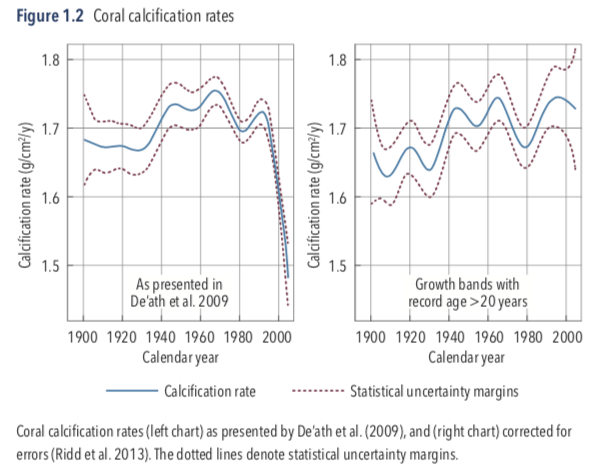
The LHS chart suggests a problem with coral growth rates – but the real problem is with the methodology. When corals of equivalent age are sampled, there has been no decline in growth rates at the Great Barrier Reef – as shown in the RHS chart.
However, I have two issues with their analysis. I published my concerns, and an alternative analysis, in the journal Marine Geology (Ridd et al. 2013). First, there were instrumental errors with the measurements of the coral layers. This was especially the case for the last layer at the surface of the coral, which was often measured as being much smaller than the reality. This forced an apparent drop in the average calcification for the corals that were collected in the early 2000s – falsely implying a recent calcification drop. Second, an ‘age effect’ was not acknowledged. When these two errors are accounted for, the drop in calcification rates disappear, as shown in Figure 1.2.
The problem with the ‘age effect’, mentioned above, arose because in the study De’ath and colleagues included data from corals sampled during two distinct periods and with a different focus; I will refer to these as two campaigns. The first campaign occurred mostly in the 1980s and focused on very large coral specimens, sometimes many metres across. The second campaign occurred in the early 2000s due to the increased interest in the effects of CO2. However, presumably due to cost cutting measures, instead of focusing on the original huge coral colonies, the second campaign measured smaller colonies, many just a few tens of centimetres in diameter.
In summary, the first campaign focused on large old corals, while, in contrast, the second campaign focused on small young corals. The two datasets were then spliced together, and wholly unjustifiable assumptions were implicitly made, but not stated – in particular that there is no age effect on coral growth…
Dr Juan D’Olivo Cordero from the University of Western Australia collected an entirely different dataset of coral cores from the Great Barrier Reef to determine calcification rates. This study determined that there has been a 10% increase in calcification rates since the 1940s for offshore and mid-shelf reefs, which is the location of about 99% of all the coral on the Great Barrier Reef. However, these researchers also measured a 5% decline in calcification rates of inshore corals – the approximately 1% of corals that live very close to the coast. Overall, there was an increase for most of the Great Barrier Reef, and a decrease for a small fraction of the Great Barrier Reef.
While it would seem reasonable to conclude that the results of the study by D’Olivo et al. would be reported as good news for the Great Barrier Reef, their article in the journal Coral Reefs concluded:
Our new findings nevertheless continue to raise concerns, with the inner-shelf reefs continuing to show long-term declines in calcification consistent with increased disturbance from land-based effects. In contrast, the more ‘pristine’ mid- and outer-shelf reefs appear to be undergoing a transition from increasing to decreasing rates of calcification, possibly reflecting the effects of CO2-driven climate change.
Imaginatively, this shift from ‘increasing’ to ‘decreasing’ seems to be based on an insignificant fall in the calcification rate in some of the mid-shelf reefs in the last two years of the 65-year dataset.
Why did the authors concentrate on this when their data shows that the reef is growing about 10% faster than it did in the 1940s?
James Cook university could have used the chapter as an opportunity to start a much-needed discussion about policy, funding and the critical importance of the scientific method. Instead, Peter was first censored by the University – and now he has been fired.
When I first blogged on this back in February, Peter needed to raise A$95,000 to fight the censure.
This was achieved through an extraordinary effort, backed by Anthony Watts, Joanne Nova, John Roskam and so many others.
To be clear, the university is not questioning the veracity of what ex-professor Ridd has written, but rather his right to say this publicly. In particular, the university is claiming that he has not been collegial and continues to speak-out even after he was told to desist.
New allegations have been built on the original misconduct charges that I detailed back in February. The core issue continues to be Peter’s right to keep talking – including so that he can defend himself.
In particular, the university objects to the original GoFundMe campaign (that Peter has just reopened) because it breaches claimed confidentiality provisions in Peter’s employment agreement. The university claims that Peter Ridd was not allowed to talk about their action against him. Peter disputes this.
Of course, if Peter had gone along with all of this, he would have been unable to raise funds to get legal advice – to defend himself! All of the documentation is now being made public – all of this information, and more can be found at Peter’s new website.
‘Independent’ Syrian Observatory for Human Rights receives nearly £200k from UK – Peter Hitchens
By Omar Baggili | RT | May 14, 2018
The British government has given the self-described ‘impartial’ Syrian Observatory for Human Rights (SOHR) £194,769.60 for a project to help fund “communications equipment and cameras,” according to journalist Peter Hitchens.
The Sunday Mail’s Hitchens, a regular critic of British foreign policy, tweeted on Sunday: “Boris Johnson’s Foreign Office admits it gave £194,769.60 to the supposedly ‘independent’ Syrian Human Rights Observatory. How many other ‘independent’ bodies in the Syrian controversy aren’t as ‘independent’ as they look?”
The SOHR declares on its website that it’s “not associated or linked to any political body.” Hitchens in his Sunday Mail blog asks: “Is Boris Johnson’s Foreign Office not a political body?” Hitchens appears to question the legitimacy of the relationship, in relation to the Syrian conflict “in which the British government clearly takes sides.”
Fellow Mail journalist and author of ‘Not the Chilcot Report,’ Peter Oborne has added that the “Syrian Observatory has been treated as a gold standard for information on Syria. Quoted by BBC all the time. Always described as independent.”
The group has come under criticism, being accused by some as a tool of Western propaganda due to its location and lack of staff. Its operation is managed by one man in Coventry in the UK, Rami Abdurrahman, who fled Syria in 2000. He relies on a handful of Syrians to assist him in collating information from “more than 230 activists on the ground”, a network of people from his youth, reports New York Times.
Abdurrahman’s neutrality on the Syrian conflict came under fire when he told Reuters in 2011 he would return to Syria only “when Bashar al-Assad goes,” and according to CNN, was part of a delegation of Syrian opposition officials that met with the then-Foreign Secretary William Hague, that same year.
It’s not the only Syrian-focused human rights group to come under the spotlight with accusations of questionable neutrality because of UK government links. The White Helmets, officially known as the ‘Syria Civil Defence’ has also come under fire. Since 2011, the UK has provided the organization with £38.4m of funding, a freedom of information request has revealed, as reported in The Guardian.
The group operates in areas under the control of the Syrian opposition forces, including Islamist rebels such as Jaysh al-Islam, who controlled the city of Douma until recently, and the location of the latest alleged chemical weapons attack.
According to reports, Theresa May is preparing to increase funding to the White Helmets in response to media claims that President Donald Trump is to withdraw US support for the organization. In March, Trump froze a $200m (£148m) package of US aid to Syria, including money for the White Helmets.
The US President has said he would like to see his country relieve itself of military and humanitarian duties in Syria, calling on other countries to help fill the financial void to fund stabilizing and rebuilding projects in the country after the fight against Islamic State (IS, formerly ISIS), claims ABC news.
Addressing parliament on Wednesday, the UK PM said: “We do support them [the White Helmets], we will continue to support them and … the international development secretary will be looking at the level of support in the future.”
Two Syrian groups claim to be impartial, yet are happy to receive funding from the UK government who, as Hitchens says, are clearly taking sides on the Syrian conflict.
Eclipsing Factionalism: The Missing Story from the Gaza Protests
By Ramzy Baroud | Palestine Chronicle | May 10, 2018
The Gaza border protests must be understood in the context of the Israeli Occupation, the siege and the long-delayed ‘Right of Return’ for Palestinian refugees. However, they should also be appreciated in a parallel context: Palestine’s own factionalism and infighting.
Factionalism in Palestinian society is a deep-rooted ailment that has, for decades, thwarted any unified effort at ending the Israeli military Occupation and Apartheid.
The Fatah and Hamas political rivalry has been catastrophic, for it takes place at a time that the Israel colonial project and land theft in the West Bank are occurring at an accelerated rate.
In Gaza, the siege continues to be as suffocating and deadly. Israel’s decade-long blockade, combined with regional neglect and a prolonged feud between factions have all served to drive Gazans to the brink of starvation and political despair.
The mass protests in Gaza, which began on March 30 and are expected to end on May 15 are the people’s response to this despondent reality. It is not just about underscoring the Right of Return for Palestinian refugees. The protests are also about reclaiming the agenda, transcending political infighting and giving voice back to the people.
Inexcusable actions become tolerable with the passing of time. So has been the case with Israel’s Occupation that, year after year, swallows up more Palestinian land. Today, the Occupation is, more or less, the status quo.
The Palestinian leadership suffers the same imprisonment as its people, and geographic and ideological differences have compromised the integrity of Fatah as much as Hamas, deeming them irrelevant at home and on the world stage.
But never before has this internal division been weaponized so effectively so as to delegitimize an entire people’s claim for basic human rights. ‘The Palestinians are divided, so they must stay imprisoned.
The strong bond between US President Donald Trump and Israel’s Prime Minister, Benjamin Netanyahu, is being accompanied by a political discourse that has no sympathy for Palestinians whatsoever. According to this narrative, even families protesting peacefully at the Gaza the border is termed as a ‘state of war’, as the Israeli army declared in a recent statement.
Commenting on the Israeli killing of scores and wounding of hundreds in Gaza, the US Secretary of State, Mike Pompeo, repeated a familiar mantra while on a visit to the region: “We do believe the Israelis have a right to defend themselves.”
Thus, Palestinians are now trapped – West Bankers are under Occupation, surrounded by walls, checkpoints, and Jewish settlements, while Gazans are under a hermetic siege that has lasted a decade. Yet, despite this painful reality, Fatah and Hamas seem to have their focus and priorities elsewhere.
Since the establishment of the Palestinian Authority in 1994, following the signing of the Oslo Peace Accords, Fatah dominated Palestinian politics, marginalized its rivals and cracked down on any opposition. While it operated under the Israeli military Occupation in the West Bank, it still thrived financially as billions of dollars of aid money poured in.
More, the PA has used its financial leverage to maintain its control over Palestinians, thus compounding the oppressive Israeli Occupation and various forms of military control.
Since then, money has corrupted the Palestinian cause. ‘Donors’ money’, billions of dollars received by the PA in Ramallah has turned a revolution and a national liberation project into a massive financial racket with many benefactors and beneficiaries. Most Palestinians, however, remain poor. Unemployment today is skyrocketing.
Throughout his conflict with Hamas, Abbas never hesitated to collectively punish Palestinians to score political points. Starting last year, he took a series of punitive financial measures against Gaza, including the suspicious PA payments to Israel for electricity supplies to Gaza, while cutting off salaries to tens of thousands of Gaza’s employees who had continued to receive their paycheck from the West Bank authority.
This tragic political theater has been taking place for over ten years without the parties finding common ground to move beyond their scuffles.
Various attempts at reconciliations were thwarted, if not by the parties themselves, then by external factors. The last of such agreements was signed in Cairo last October. Although initially promising, the agreement soon faltered.
Last March, an apparent assassination attempt to kill PA Prime Minister, Rami Hamdallah, had both parties accuse one another of responsibility. Hamas contends that the culprits are PA agents, bent on destroying the unity deal, while Abbas readily accused Hamas of trying to kill the head of his government.
Hamas is desperate for a lifeline to end the siege on Gaza and killing Hamdallah would have been political suicide. Much of Gaza’s infrastructure stands in ruins, thanks to successive Israeli wars that killed thousands. The tight siege is making it impossible for Gaza to be rebuilt, or for the ailing infrastructure to be repaired.
Even as tens of thousands of Palestinians protested at the Gaza border, both Fatah and Hamas offered their own narratives, trying to use the protests to underscore, or hype, their own popularity amongst Palestinians.
Frustrated by the attention the protests have provided Hamas, Fatah attempted to hold counter-rallies in support of Abbas throughout the West Bank. The outcome was predictably embarrassing as only small crowds of Fatah loyalists gathered.
Later, Abbas chaired a meeting of the defunct Palestinian National Council (PNC) in Ramallah to tout his supposed achievements in the Palestinian national struggle.
The PNC is considered the legislative body of the Palestine Liberation Organization (PLO). Like the PLO, it has been relegated for many years in favor of the Fatah-dominated PA. The PA leader handpicked new members to join the PNC, only to ensure the future of all political institutions conforms to his will.
In the backdrop of such dismaying reality, thousands more continue to flock to the Gaza border.
Palestinians, disenchanted with factional division, are laboring to create a new political space, independent from the whims of factions; because, for them, the real fight is that against Israeli Occupation, for Palestinian freedom and nothing else.
– Ramzy Baroud is a journalist, author and editor of Palestine Chronicle. His forthcoming book is ‘The Last Earth: A Palestinian Story’ (Pluto Press, London). Baroud has a Ph.D. in Palestine Studies from the University of Exeter and is a Non-Resident Scholar at Orfalea Center for Global and International Studies, University of California Santa Barbara. His website is http://www.ramzybaroud.net.
Protecting Israel Is Their Full-Time Job
Time to question the loyalty of some legislators and judges
Philip Giraldi • Unz Review • May 8, 2018
I have a number of times discussed how the U.S. and other governments have legislated and otherwise promoted Jewish and Israeli interests in ways that most people would find unacceptable if they were aware of what exactly has been going on. Here in the United States, special Medicare coverage and immigration status have been granted, often concealed in other legislation, to benefit holocaust survivors and Russian Jews seeking to emigrate. State legislatures and the U.S. Congress have meanwhile been working hard to pass legislation that blocks and even criminalizes the non-violent Boycott, Divestment and Sanctions (BDS) protests against Israeli behavior while universities have been banning anti-Israel demonstrators and groups on campus because they apparently are offensive to the sensitivities of some Jewish students.
The latest outrage against the First Amendment comes from South Carolina, the home state of the arch-Zionist poseur and United Nations Ambassador extraordinary Nikki Haley. A new hate speech law was inserted in the state’s recently approved annual budget. The legislation borrows from the U.S. State Department definition of anti-Semitism, which proscribes speech that “demonizes” or applies “double standards” to Israel “by requiring of it a behavior not expected or demanded of any other democratic nation” as anti-Semitic.
While the State Department definition is a guideline, South Carolina’s specific inclusion of it in legislation makes explicit that criticism of Israel as hate speech can be subject to criminal penalties. It also is binding on all the state’s universities and educational institutions.
The law was promoted by Alan Clemmons, a Mormon legislator who has led numerous delegations to Israel and who has been described as “Israel’s biggest supporter in a U.S. state legislature.”
Supporters of the Bill of Rights have been universally opposed to the bill, but pro-Israel groups have praised the initiative and are expecting a “new wave” of legislation all across the United States blocking any criticism of the self-described Jewish State. The Brandeis Center has enthused
“This bill gives South Carolina the tools to protect Jewish students’ and all South Carolina students’ right to a learning environment free of unlawful discrimination. We are hoping this momentous step will result in another national wave to, once and for all, begin defeating rising anti-Semitism.”
Other states will undoubtedly follow the South Carolina lead, so it would appear that any criticism of Israel will become illegal in the public square if the many friends of Prime Minister Benjamin Netanyahu have their way. And they generally do get what they want from the federal level all the way down to the states and local communities, so be prepared.
Israel also is regularly exploiting the American legal system to punish countries that it has defined as its enemies. Its government sponsored lawfare organization called Shurat Hadin has initiated a number of lawsuits in U.S. courts to punish Palestinians and Iranians. Ironically, it is currently seeking to demonstrate that Hamas is committing war crimes in Gaza, where Israel has been using army snipers to kill unarmed demonstrators.
Other lawsuits filed on behalf of mostly Jewish Americans in U.S. courts seeking compensation from Iranians and Palestinians are also pending, with the tribunals in Manhattan particularly prone to being sympathetic to the plaintiffs. Last week, at the Federal Court for the Southern District of Manhattan, Judge George Daniels issued a default judgment relating to his 2011 determination that Iran and Hezbollah materially and directly supported al-Qaeda in the 9/11 attacks and are legally responsible for damages to the hundreds of family members of victims who are named in the case. The judge ordered Iran to pay $6 billion in compensation – “$12,500,000 per spouse, $8,500,000 per parent, $8,500,000 per child, and $4,250,000 per sibling” to the families and estates of the deceased. A 4.96 annual interest rate will also be applied to the amount, starting from September 11, 2001 to the date of the judgement.”
Normally foreign governments have what is referred to as sovereign immunity which prevents their being sued, but that all changed in the U.S. with the passage of the Justice Against Sponsors of Terrorism Act (JASTA) of 2016, which permitted individual lawsuits in any federal court involving any government’s alleged participation in international acts of “terrorism.” This has resulted in a series of multi-billion-dollar lawsuits against Iran, the Palestinians and also Saudi Arabia. Many of the lawsuits have Israeli citizens as plaintiffs, suing in American courts.
Though the lawsuit claimed, and Judge Daniels agreed, that Tehran had supported the 9/11 hijackers with training and other assistance, most authorities would question that judgement. Many would consider it to be ludicrous as Iranian Shi’ites were considered to be kill-on-sight heretics by al-Qaeda. The idea that Iran was somehow involved in 9/11 is in reality a ridiculous Israel Lobby contrivance that was first floated in 2015 by ex-CIA Director James Woolsey, a renowned Zionist stooge and conspiracy theorist who is viewed by many as not completely in possession of all his marbles.
Indeed, it is far more plausible that Israel was involved in 9/11 than was Iran. Israel operated a massive spying operation directed against Arabs in the U.S. and several of its intelligence officers were seen in Jersey City to be filming themselves while dancing and cavorting in delight as the twin towers went down, suggesting some prior knowledge.
But, of course, no one would be allowed to sue Israel in an American court. The 9/11 Commission failed to examine the case against Israel even though it allegedly sought to compile a “full and complete account of the circumstances surrounding” the attacks, but it did investigate the possible ties to Iran. It found the only evidence of any Iranian support to consist of certain 9/11 hijackers travelling through Iran on their way to Afghanistan without having their passports stamped.
In his Farewell Address President George Washington warned that
“… a passionate attachment of one nation for another produces a variety of evils. Sympathy for the favorite nation, facilitating the illusion of an imaginary common interest in cases where no real common interest exists, and infusing into one the enmities of the other, betrays the former into a participation in the quarrels and wars of the latter without adequate inducement or justification. It leads also to concessions to the favorite nation of privileges denied to others which is apt doubly to injure the nation making the concessions; by unnecessarily parting with what ought to have been retained, and by exciting jealousy, ill-will, and a disposition to retaliate, in the parties from whom equal privileges are withheld. And it gives to ambitious, corrupted, or deluded citizens (who devote themselves to the favorite nation), facility to betray or sacrifice the interests of their own country, without odium, sometimes even with popularity; gilding, with the appearances of a virtuous sense of obligation, a commendable deference for public opinion, or a laudable zeal for public good, the base or foolish compliances of ambition, corruption, or infatuation. As avenues to foreign influence in innumerable ways, such attachments are particularly alarming to the truly enlightened and independent patriot.”
If one believes that deference to the special foreign interest of one powerful and wealthy segment of the population is appropriate in a democracy then I suppose the Jewish/Israeli pander has to be considered acceptable. I happen to believe that, as our first president so clearly articulated, it is not, particularly as much of the concession that Jews are somehow to be treated differently than the rest of the community due to their alleged victimhood contributes to a criticism-free ride for an Israel which is eagerly seeking a new war in the Middle East. It would be a war that the United States would inevitably get pulled into by Israel’s friends in Congress and the media. It would also be catastrophic for all parties involved and it all starts with the belief that Israel should somehow be protected and its enemies punished while also being exempt from being made accountable for its actions.
Philip M. Giraldi, Ph.D., is Executive Director of the Council for the National Interest, a 501(c)3 tax deductible educational foundation that seeks a more interests-based U.S. foreign policy in the Middle East. Website is www.councilforthenationalinterest.org, address is P.O. Box 2157, Purcellville VA 20134 and its email is inform@cnionline.org.
Featured Video
The Attack on Pearl Harbor Was No Surprise (Part V)
or go to
Aletho News Archives – Video-Images
From the Archives
Iran Delenda Est
By Stephen J. Sniegoski • Unz Review • July 25, 2019
After Carthage had been significantly weakened by Rome in the Second Punic War (218 to 201 BC), Cato the Elder, a leading Roman senator, is said to have ended all his speeches with the words: “Carthago delenda est!” (“Carthage must be destroyed!”). This destruction ultimately took place in the Third Punic War (149–146 BC). A somewhat similar situation exists today in the United States, where war hawks demand that Iran–which in no way could effectively attack the United States, or even conquer America’s Middle East so-called allies—be stripped of its ability to protect itself.
Of course, what makes the American situation different from ancient Rome’s is that Rome sought to eliminate Carthage for its own interests whereas the United States is largely acting to advance the military interests of Israel… continue
Blog Roll
Recent Comments
eddieb on The Old Testament and the Geno… papasha408 on Trump’s war posturing against… Coronistan on This is How We Should Have Res… Coronistan on NO MANDATES, NO PROFITS: MODER… Lutz Barz on Russia Vows to Protect Its Oil… loongtip on Russia Vows to Protect Its Oil… loongtip on Hamas never agreed to lay down… eddieb on Conspiracy Denial eddieb on WEF Calls for ‘Cultural Revolu… loongtip on Trump wanted to play peacemake… Coronistan on EU member to sue bloc over ‘su… loongtip on Vicious


 Aletho News
- The Attack on Pearl Harbor Was No Surprise (Part V)
- How Human Rights Watch Shattered Yugoslavia
- Hamas rejects Israeli accusations as “lies meant to justify its massacres in Gaza”
- Interior ministry: Israeli strike on police building in Gaza shows disregard for mediators
- West’s hypocrisy over Iran and Gaza proves a regime-change operation in Tehran
- Trump’s war posturing against Iran traces back to Bush’s infamous 2002 ‘axis of evil’ speech
- The Streetlight Effect
- NO MANDATES, NO PROFITS: MODERNA CEO TELLS THE TRUTH
- UK Health Officials Covered Up Reports of Heart Damage Linked to AstraZeneca Vaccine
- This is How We Should Have Responded to COVID-19
- If Americans Knew
- Is Israel opening the Rafah border to depopulate Gaza? – Not a ceasefire Day 113
- NBA Star Stephen Curry’s Ties To Israeli Military Intelligence
- ‘Apocalyptic wasteland’: Biden admin. blocked warning on deteriorating Gaza situation after Oct. 7
- Why Israeli counterterrorism tactics are showing up in Minnesota
- Israel Went to Extremes to Return Ran Gvili’s Body. Why Doesn’t It Accord Dead Palestinians the Same Respect?
- Across the West, speaking for Palestine is now a crime
- A West Bank Bus Trip Through ‘the Best Documented Ethnic Cleansing in History’
- Mike Huckabee’s distorted theology does not speak for Christians worldwide
- CBS Evening News” With Tony Dokoupil Is Ellisons’ & Weiss’s Pro-Israel Show
- A Generation on Hold: Inside Gaza’s Collapsing Education System
- No Tricks Zone
- One Reason Only For Germany’s Heating Gas Crisis: Its Hardcore-Dumbass Energy Policy
- 130 Years Later: The CO2 Greenhouse Effect Is Still Only An Imaginary-World Thought Experiment
- New Study Affirms Rising CO2’s Greening Impact Across India – A Region With No Net Warming In 75 Years
- Germany’s Natural Gas Crisis Escalates … One Storage Site Near Empty …Government Silent
- Polar Colding…Antarctica Saw Its Coldest October In 44 Years!
- New Study: Sea Levels Rose 20 Times The Modern Rate During The Roman Warm Period
- As German Gas Storage Dips Dangerously Low…Shortage Hardly Avoidable
- New Study: Brazil’s Relative Sea Level Was 2+ Meters Higher And SSTs 3-4°C Warmer 6000 Years Ago
- Philosopher Schopenhauer: Climate Science Certainty Stems From Stupidity, Ignorance
- New Study: Species Extinction Rates Declining Since 1980 – ‘Climate Change Is Not An Important Threat’
 Aletho News