US still paying White Helmets despite $200mn-aid freeze for Syria recovery, State Dept confirms
RT | April 20, 2018
As the US is reviewing funding aimed at helping war-ravaged Syria rebuild, it’s not neglecting the White Helmets – a controversial militant-linked group instrumental to the media campaign against Assad and Russia.
At a Thursday press briefing, journalists asked US State Department spokesperson Heather Nauert for an update on the late-March freeze of $200 million earmarked for the recovery of Syria – and if that means Washington will be withholding payments to the White Helmets.
Nauert opened her response with a gushing comment about the organization. “We recognize and appreciate and are very grateful for all the work that the White Helmets continues to do on behalf of the people of their country and on behalf of the US Government and all the coalition forces. They’re doing incredible work in rescuing in some cases, and in other cases it’s recovery efforts. They’re an incredible group of individuals,” she said.
Moreover, she said she “just exchanged emails with them the other day.” Finally cornered into giving a direct answer, she said “As far as I’m aware, all of the work still continues. Peoples’ bills are still being paid.”
The White Helmets (officially called the Syria Civil Defense), a supposedly impartial humanitarian NGO, make no secret of who pays those bills, listing the governments of the UK, Germany, and the US among others on their website. Time and again their reports from the scenes of supposed crimes against civilians by the forces of Syrian President Bashar Assad – who Washington has wanted toppled for years – have been used to justify accusations against Assad and his ally Russia. This includes the latest alleged chemical incident in Douma near Damascus, which led to a series of missile strikes by the US, UK, and France.
These allegations have now been contradicted by multiple sources, including witnesses from the scene, and even people featured in the White Helmets’ video of the “aftermath” of the “attack.”
The White Helmets rely heavily on positive publicity. They have been featured in two documentaries, one of which won an Oscar in the heavily politicized 2017 ceremony.
A recent attempt at gaining publicity and support for their cause, however, fizzled spectacularly. English singer Roger Waters, a founder of Pink Floyd, stopped his Barcelona gig for a minute last week to mention that a representative of the White Helmets wanted to come up on stage and make a statement. However, Waters had a few words of his own to say.
“The White Helmets is a fake organization that exists only to create propaganda for jihadists and terrorists,” he said.
It later turned out that in 2016, the NGO emailed Waters, trying to entice him into a dinner honoring the White Helmets, paid for by a Saudi billionaire. And just days before last week’s concert, a journalist describing himself as “a militant with the Syrian White Helmets” asked Waters for stage time to “send a message to the children of Syria.”
Waters replied to neither email, instead choosing to make his beliefs heard publicly.
“If we were to listen to the propaganda of the White Helmets and others, we would be encouraged to encourage our governments to start dropping bombs on people in Syria,” he said.
Which is exactly what happened a few hours later.
CNN reporter inhales deadly ‘chemical weapons’ on camera: ‘Yeah that stings’
The global Fake News leader’s Arwa Damon sampled a little sarin in the course of her humanitarian propaganda piece on Syria
By Ricky Twisdale | The Duran | April 20, 2018
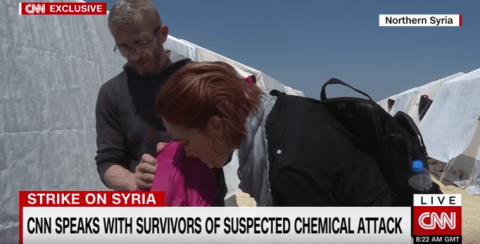
CNN, the world leader in hard hitting, real news (do you sense any irony?), has produced this stupendous report from a refugee camp in Northern Syria, with people it says “survived” the “chemical attack” in Douma earlier this month.
The US, Britain and France alleged Syrian President Bashar al-Assad pointlessly attacked his own people in Douma with sarin nerve agent, prompting the three nations to launch air strikes on Syria on the night of April 13-14th.
CNN correspondent Arwa Damon was at the camp to interview the “survivors” – as well as sample a little sarin herself.
The report (below) shows Damon and others, handling backpacks, clothing and toys allegedly exposed to Syrian government chemical weapons.
Damon plunges her face into one backpack, reacting, “There’s definitely something that stings” after taking her first whiff of sarin.
Neither Damon nor anyone else in the video, uses gloves or any form of protection when handling the articles allegedly contaminated with deadly chemicals.
As a reminder, here are the effects of sarin exposure according to the US government’s Centers for Disease Control (CDC):
- A person’s clothing can release sarin after it has come in contact with sarin vapor, which can lead to exposure of other people.
- Sarin is the most volatile of the nerve agents…People can be exposed to the vapor even if they do not come in contact with the liquid form of sarin.
- Symptoms likely will appear within a few seconds after exposure to the vapor form of sarin
- People may not know that they were exposed because sarin has no odor.
- Even a small drop of sarin on the skin can cause sweating and muscle twitching where sarin touched the skin
- People exposed to a low or moderate dose of sarin by breathing contaminated air…or touching contaminated surfaces may experience some or all of the following symptoms within seconds to hours of exposure:
- Runny nose
- Watery eyes
- Small, pinpoint pupils
- Eye pain
- Blurred vision
- Drooling and excessive sweating
- Cough
- Chest tightness
- Rapid breathing
- Diarrhea
- Nausea, vomiting, and/or abdominal pain
- Increased urination
- Confusion
- Drowsiness
- Weakness
- Headache
- Slow or fast heart rate
- Low or high blood pressure
Those are the symptoms of a low to moderate dose. The CDC webpage goes on to note a large dose immediately leads to convulsions and death.
“There’s definitely something that stings” – yeah that about sums up the symptoms of exposure to the deadly nerve agent.
The CNN fake news report goes on to interview others in the camp, without any proof of where they in fact came from, or more importantly, the political allegiance of the alleged witnesses.
All in a day’s work for the network that now prides itself on promotion of salacious gossip, unverified atrocity claims, and warmongering hysteria.
Russia’s OPCW envoy exposes ‘eight UK lies’ in Skripal case
RT | April 19, 2018
The UK’s narrative in the Skripal case is a “story woven with lies,” with London continuously trying to “deceive” the international community, Russia’s OPCW envoy said, highlighting eight examples of such misinformation.
“We’ve tried to show that everything our British colleagues produce is a story woven with lies,” Russia’s permanent representative to the Organization for the Prohibition of Chemical Weapons (OPCW) Aleksandr Shulgin told reporters on Wednesday, following the organization’s meeting on the Skripal case.
“And, unlike the British, who aren’t used to taking responsibility for their words and unfounded accusations, we showed specific facts why we believe our British partners, to put it mildly, are ‘deceiving’ everyone.” The official provided eight examples of UK-pushed misinformation, surrounding the March 4 events, when the former double agent Sergei Skripal and his daughter Yulia were poisoned in the town of Salisbury.
#1. Russia refuses to answer UK ‘questions’
“In reality, they’ve asked us only two ‘questions’… And both were worded in such way that the existence of an undocumented arsenal of chemical weaponry at Russia’s disposal was presented as an established fact, beyond any doubt.”
It was effectively an ultimatum, pressing Moscow to either confess that it “attacked the UK with chemical weapons,” or to admit that it had “lost control over the chemical warfare arsenal.”
Moscow answered both of these ‘questions’ immediately, stating that it had nothing to do with the Salisbury incident. Apart from that, the official emphasized, it is an established fact that Russia destroyed all its chemical weaponry stockpile ahead of schedule last year.
#2. UK abides by Chemical Weapons Convention rulebook
The OPCW procedures clearly state that if one member state has issues with another, it should send an official request, and thus the other party would be obliged to respond within 10 days, Shulgin said. However, instead, the UK allegedly “instigated by their colleagues from across the pond,” disregarded the established mechanism and came up with a dubious “independent verification” scheme, which violates those very OPCW rules.
#3. Russia refuses to cooperate
While the UK and a number of its allies accuse Russia of “refusing to cooperate to establish the truth,” the situation is exactly the opposite, Shulgin insists. Moscow is interested in a thorough investigation of the incident – especially since the victims are Russian citizens. Moscow repeatedly insisted on a joint probe and urged London to release data on the Skripal case, but all efforts were in vain. Many requests went unanswered by the UK, while others received only a formal reply.
#4. Russia invents versions to distract attention
Despite numerous speculations and allegations by questionable sources, cited by the UK’s own domestic media, it was Moscow that was eventually accused of coming up with some “30 versions” of the Salisbury events, allegedly to “disrupt the investigation,” Shulgin said.
“In reality, the picture is different. In fact, it’s the British tabloids, the so-called independent media, which is multiplying those versions,” the official stated, recalling some of the narratives, most of which entirely contradict each other.
#5. Exterminating traitors is Russia’s official state policy
“They claim that the Russian leadership has, on multiple occasions, stated that extermination of traitors abroad is a state policy of Russia,” Shulgin said. “This is slander, of course. The British cannot produce a single example of such statements, since the Russian leadership has never said anything of the kind.”
#6. Experts pin the blame on Russia
The head of the OPCW mission has clearly said that it was impossible to determine in which country the toxic substance used in Salisbury had originated. Yet the OPCW findings were once again used by the UK officials to claim Moscow was “highly likely” responsible. “Look, the head said it was impossible and they, abandoning all common sense, said ‘They’ve confirmed our evaluations that it was Russia.’ How else can you evaluate this but as a lie?” Shulgin wondered.
#7. ‘Novichok’ is a Soviet invention, so it has to be Russia
The development of the so-called Novichok family of toxic agents more than 30 years ago in the Soviet Union was one of the main cornerstones in the UK narrative, pinning blame for the Skripal incident on Russia. Publicly available sources, however, indicate that “the West has been and still is conducting research and development into such substances,” Shulgin said, giving a fresh example of such activities.
“Not long ago, namely on 1 December 2015, the US Patent and Trademark Office filed a request to its Russian colleagues asking to check patentability … of a chemical weaponry-filled bullet, which could be equipped with Tabun, Sarin or the Novichok family of agents,” the official stated.
#8. Yulia Skripal avoids contact with relatives & refuses Russian consular support
While such a statement was indeed produced by the UK authorities “on behalf” of Yulia, Moscow believes it to be false. According to Shulgin, the situation with Yulia is starting to look like a Russian citizen is effectively being “held hostage” by the UK authorities.
An Alternative Explanation to the Skripal Mystery
By Gareth Porter | Consortium News | April 17, 2018
For weeks, British Prime Minister Theresa May and Foreign Secretary Boris Johnson have insisted that there is “no alternative explanation” to Russian government responsibility for the poisoning of former double agent Sergei Skripal and his daughter Yulia in Salisbury last month.
But in fact the British government is well aware that such an alternative explanation does exist. It is based on the well-documented fact that the “Novichok” nerve agent synthesized by Soviet scientist in the 1980s had been sold by the scientist–who led the development of the nerve agent– to individuals linked to Russian criminal organizations as long ago as 1994 and was used to kill a Russian banker in 1995.
The connection between the Novichok nerve agent and a previous murder linked to the murky Russian criminal underworld would account for the facts of the Salisbury poisoning far better than the official line that it was a Russian government assassination attempt.
The credibility of the May government’s attempt to blame it on Russian President Vladimir Putin has suffered because of Yulia Skripal’s relatively rapid recovery, the apparent improvement of Sergei Skripal’s condition and a medical specialist’s statement that the Skripals had exhibited no symptoms of nerve agent poisoning.
How a Crime Syndicate Got Nerve Agent
The highly independent Russian newspaper Novaya Gazeta has published a detailed account of how Russian organized crime figures obtained nerve agent in 1994 from Leonid Rink, the head of the former Soviet government laboratory that had synthesized it.
The newspaper gleaned the information about the transaction from Rink’s court testimony in the 1995 murder of prominent banker Ivan Kivelidi, the leader of the Russian Entrepreneurs’ Round Table, an organization engaged in a conflict with a powerful group of directors of state-owned enterprises.
Rink testified that after the post-Soviet Russian economic meltdown had begun he filled each of several ampoules with 0.25 grams of nerve agent and stored it in his own garage. Just one such ampoule held enough agent to kill 100 people, according to Rink, the lead scientist in the development of the series of nerve agents called Novichok (“newcomer” in Russian).
Rink further admitted that he had then sold one of the ampoules in 1995 to Artur Talanov, who then lived in Latvia and was later seriously wounded in an attempted robbery of a cash van in Estonia, for less than $1,800.
In 1995, some of that nerve agent was applied to Kivelidi’s telephone receiver to kill him, as the court documents in the murder case reveal. Police found that there were links between Talanov and Vladimir Khutsishvili, who had been a board member of Kivelidi’s bank, according to the Kivelidi murder investigation. Khutsishivili was eventually found guilty of poisoning Kivelidi, although it was found that he hired someone else to carry out the poisoning.
But that wasn’t the only nerve agent that Rink sold to gangsters. Rink admitted in court in 2007 that he had sold four of the vials to someone named Ryabov, who had organized crime connections in 1994. Those vials were said to have been seized later by Federal Security Police.
But the investigation of the Kivelidi murder found that vials had also fallen into the hands of other criminal syndicates, including one Chechen organization. Furthermore, Rink testified that he had given each of the recipients of the nerve agent detailed instructions on how it worked and how to handle it safely.
The Mystery of the Non-Lethal Nerve Agent
The newly-revealed story of how organized crime got control of hundreds of doses of lethal nerve agent from a government laboratory sheds crucial light on the mystery of the poisoning in Salisbury, especially in light of the timeline of the Skripals on the day of the poisoning and their unexpectedly swift recovery.
Reports of their activities on March 4 show that they were strolling in central Salisbury, dining, and visiting a pub for several hours before collapsing on a park bench sometime after 4 pm.
The announcements of Yulia’s rapid recovery on March 28 and that Sergei was now “stable” and “improving rapidly” about a week later appears to be in contradiction with the British insistence that they were poisoned by a Russian government intelligence team. The Novichok-type nerve agent has been characterized as quick acting and highly lethal.
But the official Russian forensic investigation in conjunction with the Kivelidi’s murder, as reported by Novaya Gazeta, concluded that the Novichok did not take effect instantaneously but generally took from one and a half to five hours.
The Russian government has now made an official issue of the fact that the nerve agent used in the poisoning proved not to be lethal. In his news conference on April 14 Russian Foreign Minister Sergey Lavrov said the Swiss Spiez Laboratory, working on the case for the Organization for the Prohibition of Chemical Weapons (OPCW), had found traces in the Skripals’ blood sample, of the nerve agent BZ, which was never developed by Soviet scientists but was in the arsenals of the United States and Britain.
Lavrov also acknowledged that the lab had in addition found traces of “A-234”–one of the nerve agents in the Novichok series – “in its initial state and in high concentration”. Lavrov argued that had the assassins used A-234 nerve agent, which he noted is at least eight times more deadly than VX nerve gas, it “would have killed the Skripals.”
But if the poisoning had been done with some of the A-234 nerve agent that was sold by Rink to organized crime figures, it probably would not have been that lethal.
Vil Mirzayanov, the counter-intelligence specialist on the team that developed Novichok and who later revealed the existence of the Novichok program, explained in an interview with The Guardian that, the agent lost its effectiveness. “The final product, in storage, after one year is already losing 2%, 3%,” Mirzayanov said, “The next year more, and the next year more. In 10-15 years, it’s no longer effective.”
Exposure to even a large dose of such a normally lethal poison more than 25 years after it was first produced could account for the apparent lack of normal symptoms associated with exposure to that kind of nerve agent experienced by the Skripals, as well as for their relatively speedy recovery. That lends further credibility to a possible explanation that someone with a personal grudge against Sergei Skripal carried out the poisoning.
An Absence of Nerve Agent Symptoms?
Also challenging the official British line is a statement by a medical specialist involved in the Salisbury District Hospital’s care for the Skripals revealing that they had not exhibited any symptoms of nerve agent poisoning.
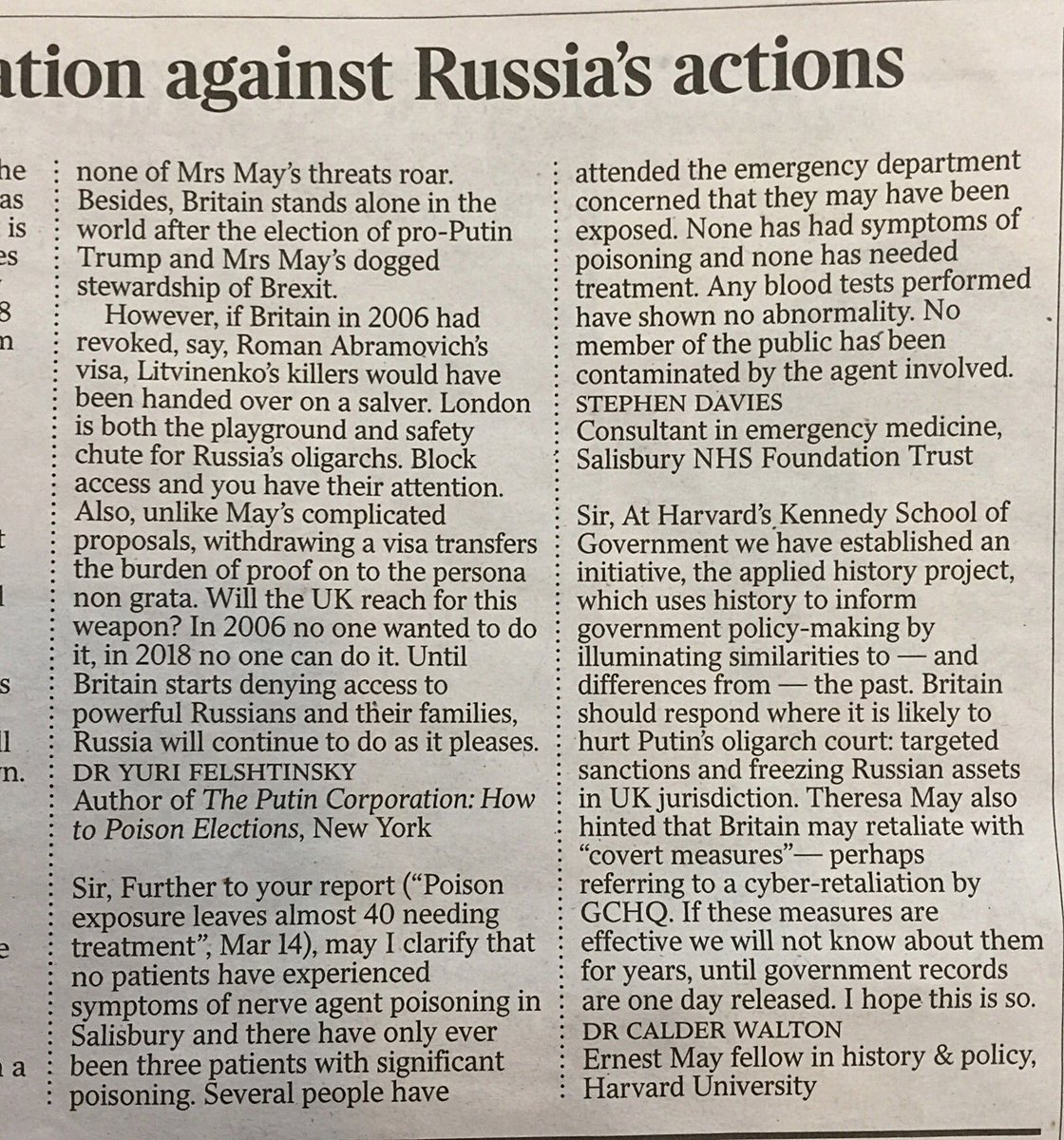
Davies: Letter to The Times
Stephen Davies, a consultant on emergency medicine for the Salisbury NHS Foundation Trust, which runs the Salisbury District Hospital, wrote a letter published in The Times on March 16 that presented a problem for the official British government position. Davies wrote,“[M]ay I clarify that no patients have experienced symptoms of nerve-agent poisoning in Salisbury, and there have only ever been three patients with significant poisoning.” Obviously, Sergei and Yulia Skripal were “patients” in the hospital and were thus included in that statement.
The Times made the unusual decision to cover the Davies letter in a news story, but tellingly failed to quote the crucial statement in the letter that “no patients have experienced symptoms of nerve-agent poisoning in Salisbury” or to report on the significance of the statement.
To rule out the possibility that Davies intended to say something quite different, this writer requested a confirmation or denial of what Davies had written in his letter from the press officer for the Salisbury NHS Foundation Trust, Patrick Butler. But Butler did not respond for a week and then refused directly to deny, confirm or explain the Davies statement.
Instead Butler said in an email, “Three people were admitted and treated as inpatients at Salisbury District Hospital for the effects of nerve agent poisoning as Stephen Davies wrote.” When he was reminded that the letter had actually said something quite different, Butler simply repeated the statement he had just sent and then added, “The Trust will not be providing any further information on this matter.”
Butler did not respond to two separate requests from the writer for assistance in contacting Davies. The refusal of the NHS Foundation Trust to engage at all on the subject underlines the sensitivity of The British government about nerve agent that didn’t work.
There are many individuals in Russia whose feelings about Sergei Skripal’s having become a double agent for Britain’s MI6 – including former colleagues of his – could provide a personal motive for the poisoning. And it is certainly plausible that those individuals could have obtained some of the nerve agent sold by Leonid Rink that entered the black market.
Neither the British government nor the Russian government is apparently eager to acknowledge that alternative explanation. The British don’t want it discussed, because they are determined to use the Salisbury poisoning to push their anti-Russian agenda; and the Russians may be reluctant to talk about it, because it would inevitably get into details of a secret nerve agent research project that they have claimed they closed down in 1992, despite Rink’s testimony in the court case that he was still doing some work for the Russian military until 1994.
Gareth Porter is an independent journalist and winner of the 2012 Gellhorn Prize for journalism. He is the author of numerous books, including Manufactured Crisis: The Untold Story of the Iran Nuclear Scare (Just World Books, 2014).
Western media cover tracks of Trump, May and Macron’s war crime in Syria
By Finian Cunningham | RT | April 17, 2018
With astounding double-think, the US and Britain accuse Russia of “tampering” with the alleged chemical-weapon attack site in Syria’s Douma – just days after the US, UK and France barraged the county with over 100 missiles.
If anyone is guilty of tampering with the alleged crime scene, it is the NATO trio who rushed to bomb Syria just as inspectors belonging to the Organization for the Prohibition of Chemical Weapons (OPCW) arrived in Syria – invited there by the Syrian and Russian governments.
The frenzied Western media campaign to find Syria and Russia guilty of a war crime involving alleged chemical weapons is further highlighted by the reporting this week by award-winning British journalist Robert Fisk.
Fisk, who has been covering Middle East war zones for nearly 40 years, went to Douma city to file his report for The Independent. Credit goes to The Independent for publishing Fisk’s investigative work.
In the aftermath of the weekend’s airstrikes, what he found from interviewing local people and medics is arresting, if not shocking. From Fisk’s witness-gathering report, there was no gas attack carried out on April 7 – in stark contradiction to what the US, British and French governments have been declaring in hysterical tones for the past two weeks.
Those declarations culminated in the US-led bombing of Syria at the weekend. What’s more, the US, British and French leaders are reserving the right to carry out further strikes on Syria – if “the regime repeats its chemical-weapons attacks on civilians.”
What Robert Fisk reports from inside Douma corroborates what the Syrian government and its Russian ally have been saying consistently since the alleged incident on April 7. The incident, they say, was staged by the so-called “first responder” group known as the White Helmets, who work hand-in-glove with notorious terrorist outfits like Jaysh al-Islam and Al-Nusra Front. The White Helmets are also on the pay roll of the American CIA, as well as British and French intelligence agencies.
Similar to Russian Foreign Minister Sergey Lavrov’s earlier claim, Fisk reports that on April 7, a panic scene was engendered in Douma’s hospital by White Helmets activists who shouted that “chemical weapons” were being deployed. These activists began dousing people with water hoses and conveniently had video cameras on hand to capture the chaotic scenes acted out by unwitting civilians. A doctor in the hospital confirmed this to Fisk.
As for the supposed dozens of dead that Western governments and media blamed on “animal Assad” and Russian complicity, there is no evidence of the alleged victims. Video footage of dead people in a war zone is hardly proof.
This means that US President Trump and his British and French counterparts, Theresa May and Emmanuel Macron, just launched a criminal aggression on Syria in grave violation of international law and the country’s sovereignty. This is exactly what many independent observers were decrying at the time of the missile barrage, warning that the presumed evidence for a chemical attack was far from substantiated.
Indeed, the suspicion is that Trump, May and Macron knew that their evidential ground for attacking Syria was impossibly thin, and that is why they rushed to bomb the country. It was a decision hastened by the arrival of the OPCW inspectors heading to Douma. The inspectors are due to start their investigative work on Wednesday – delayed apparently by security concerns.
In all probability, the Douma incident was a propaganda stunt orchestrated by Western-backed anti-government militants and their White Helmets media agents, precisely in order to provoke an external military attack on Syria by the US, Britain and France.
Several things stand out about Robert Fisk’s latest reporting. This is exactly the kind of critical journalism that other Western media outlets should have been engaged in following the alleged chemical weapon attack on April 7. Credit goes to Fisk and The Independent. But it is a shameful case of “too little, too late.”
Also, it is notable how Fisk’s reportage is being roundly ignored – at least so far – by other mainstream Western media outlets. That’s an impressive feat of self-censorship at a crucial time when the US, British and French governments should be open to accusations of committing a war crime on Syria over their latest blitzkrieg.
This is especially so, given their warnings of more to come, over “further” chemical-weapons use. The urgent concern is that these governments are giving themselves a license to act on more false flags. They should be held rigorously to account for their claims.
This disregard for international law is made possible because of the appalling willingness of Western mainstream media to regurgitate self-serving claims made by terrorist-affiliated groups in Syria and their propaganda outlets.
American, British and French mainstream media have given saturated coverage to the White Helmets and the Syrian American Medical Society, and the dodgy one-man-band operation in Coventry known as the Syrian Observatory for Human Rights. CNN, the BBC and France 24 cite these groups as if they are “authoritative” and impartial, when in fact they are all part of the regime-change campaign in Syria sponsored by the US and its British and French allies.
It is telling, too, how Robert Fisk is being assailed as a “Syrian, Russian stooge” on social media. The one Western mainstream journalist who has had the integrity to delve into Syria’s Douma to uncover a very different critical perspective – one that disproves the claims peddled by the US, British and French leaders and other mainstream media – is being vilified for principled journalism.
Western corporate media are a grotesque mockery of public information and critical, independent accounting of government power.
Apart from Robert Fisk, the few other Western journalists to have ventured into Syria to report on what is really happening are independent, “alternative” sources like Eva Bartlett, Vanessa Beeley and Patrick Henningsen. They have exposed the “Oscar-winning” White Helmets group, which is actually complicit in staging atrocities against civilians living under a reign of terror imposed by their terrorist affiliates. It is understood the White Helmets activists behind the Douma provocation on April 7 have since fled the city along with the terrorist gangs under the cover of an evacuation deal with the liberating Syrian and Russian forces, who are now in control of most of the Eastern Ghouta suburbs near Damascus.
Western media journalists, if they were really committed to principles of accuracy and critical investigation, should be poring over the rubble in Douma, interviewing local people and finding out what really happened. But they are not.
That is why, one suspects, they are not there. That is why the US and Britain are now accusing Russia of “tampering” with the site in Douma – because there is no evidence of a chemical-weapons attack, as Robert Fisk reports.
That means the US, British and French governments just committed a brazen war crime.
This would also explain why Western mainstream media have now quickly moved their focus to allegations of “Russian cyberattacks” on American and British infrastructure. This is a classic case of “keeping ahead of the story.” Western governments and their dutiful media do not have a “story” – at least not the one they claim – in Syria, so the imperative is to change to another subject as quickly as possible.
‘Russia’ Instead of ‘US’: Swedish TV Caught Peddling Fake News on Syria
Sputnik – April 18, 2018
Swedish TV-channel TV4 has sparked outrage by offering its viewers a skewed picture of reality by substituting “the US” with “Russia” in a critical news report on the US-backed attacks against the war-torn middle-Eastern country.
In a news report about the conflict in Syria by TV4, a Syrian woman was speaking about the US, which, oddly enough, was rendered as “Russia, Iran and the regime” in the accompanying subtitles. After a public outcry on social media, TV4 recognized its “mistake” while translating the woman’s outspoken message from Arabic into Swedish.
“The attack did not get enough effect, so we want to see more. We want them to avenge us. Russia, Iran and the regime must back off from here because they have stolen our country and our land,” a woman living in Douma was quoted as saying on TV4.
In reality, however, she didn’t mention “Russia” at all, not even once, which was eagerly pointed out on TV4’s Facebook page by Arab-speaking Swedish viewers.
“Why do you cheat your viewers by means of translating errors? The lady said the United States, you wrote ‘Russia, Iran and the regime,'” Katja Jakoub, an Arabic-speaking woman from Gothenburg pointed out in her post.
This post has been shared by thousands of people, including many people of Arab descent who pointed out that the woman clearly said “Amrika,” Arabic for the United States.
They also pointed out that the Syrian woman actually said that “not everything is dependent on the US” and claimed that she “once again felt hope.” It is not clear from the excerpt whether she was referring to the US-backed missile attack against the Syrian government or something else.
In response to the public uproar, TV4 acknowledged that the translation was “incorrect.”
“During yesterday morning’s broadcast, we sent out a feature from Syria in which the footage unfortunately was accompanied by the wrong text. Thus, the translation did not match what was actually said in the footage regarding this particular broadcast. This was discovered shortly afterwards and we rectified this immediately,” TV4 wrote in its reply, stressing that subsequent broadcasts featured a more consistent translation.
“Was this really a mistake from TV4? One translates the US as ‘Russia, Iran and the regime’ and lets it go on air during peak time to hundreds of thousands of viewers. Then one apologizes on TV4’s Facebook page which is only read by several hundred… Looks more like TV4 owners would like get a world war started,” user Christian Christensen wrote.
On April 14, the US, Britain and France launched 103 cruise and air-to-surface missiles at a number of government facilities in Syria, in response to the alleged April 7 chemical attack in the Damascus suburb of Douma. The airstrikes came even before the results of an ongoing investigation into the case by experts from the Organization for the Prohibition of Chemical Weapons were announced. Most of the missiles were intercepted by Syrian air defenses.
The Stockholm-headquartered TV4 is one of Sweden’s largest channels. It is fully owned by the Bonnier Group, which, in turn, is managed by the powerful media tycoon family the Bonniers [see link below], who run a network of about 170 companies in 15 countries, including Sweden’s foremost dailies such as Dagens Nyheter, Expressen and Sydsvenskan.
READ MORE:
Jewish Media Influence in Scandinavia
Sweden Starts Anti-‘Fake News’ Body for Mental Defense Against ‘Russian Threat’
‘Source Critical’ Swedish Daily Draws Ridicule by Posting Fake PM Tweet
Even western mainstream media is reporting that no chemical attack took place in Douma
Medical personnel on the ground in Syria give testimony that those videos show people suffering from hypoxia – not gas poisoning
By Frank Sellers | The Duran | April 18, 2018
On April 7th, an attack was carried out in the town of Douma, just a few kilometers out of Syria’s capital, Damascus, which was occupied by radical terrorist forces. The attack was peddled as a chemical weapons attack using chlorine gas, and it was additionally reported to have included some unknown nerve agent (which apparently the White Helmet guys who were filming the incident were somehow immune to), which was then said to have killed at least 75 people, and, according to the UK Prime Minister Theresa May, also resulted in the deaths of 500 more, all based on social media postings, based on what is being revealed to the public anyway, by groups that have known links and coincidental interests with the very radical terrorists that Western governments are claiming to be fighting.
Additionally, these media outlets and governments have been quick to thrust blame in the direction of Syrian government forces, particularly on the Syrian President Bashar al-Assad, before any independent organization has conducted an investigation to determine whether the attack was of a chemical nature or who carried out the attack in the first place.
The US, UK, and France are, however, continuing to insist that the attack was chemical in nature, and that Assad conducted the attack, of course, without having any of their own assets on the ground to conduct any observations or investigations in Douma, citing “intelligence”, which, of course, is classified, and will not be released to the public in order to bolster their “confidence” that Assad ordered a chemical attack on his own citizens “including young children” at a time when his forces were retaking the town already anyway.
In fact, the US and France have even insisted that they have “proof” that they are “highly confident that they believe in” that Assad did, in fact, conduct a chemical weapons attack on his own civilian population in Douma, once again, including women and young children. Meanwhile, the Kremlin has been warning for months that provocateurs were preparing to launch a chemical attack in Syria in order to blame their opposition, the Syrian government, and provoke a Western military response to help them in their conflict against Assad’s forces.
On the basis of this alleged chemical attack, that the West says that it is highly confident that Assad ordered, a military “precision strike” was conducted by a coalition of US, British, and French forces on the Syrian capital of Damascus, for the purpose of destroying or significantly disrupting the Syrian government’s capability to manufacture, store and employ chemical weapons, as well as to serve as a deterrent against any future chemical weapons attack, which the US ambassador to the UN Nikki Haley says will actually happen again, and which recurrence will be met with yet another coordinated response by the US and its allies.
The strike took place just hours before the UN’s Organization for the Prohibition of Chemical Weapons expert investigators were due to arrive at the scene of the alleged chemical attack to determine if reports about the suspected attack were, or are, in fact, true.
We are being told that the coordinated missile strike, included over 100 missiles, including American Tomahawks, struck chemical weapons research and manufacturing facilities in Damascus, which apparently didn’t result in any dangerous banned chemicals or nerve agents being released into the surrounding area, which would have been utterly devastating to hundreds of people in the area, if not more.
Now, all of the sudden, after conducting a few interviews with witnesses from the site of the attack, even some mainstream Western invesigative journalists are questioning the narrative that has been published about a chemical gas attack in Douma.
The world’s third largest news agency, Agence France-Presse (AFP), and a major British online newspaper, the Independent, are publishing stories which are casting doubt on the whole chemical gas attack narrative that we have been being fed since the date of the attack, and which Western governments are claiming “proof” for, which, of course, they are “highly confident” in, and which was used as a justification for a military intervention in Syria against the capital city of a government that is fighting the same bad guys that these very Western governments say they have spent, and continue to throw money at, billions on.
The AFP spoke with Marwan Jaber, a medical student who witnessed the aftermath of the alleged chemical attack, who said “Some of [the victims] suffered from asthma and pulmonary inflammation. They received routine treatment and some were even sent home, they showed no symptoms of a chemical attack. But some foreigners entered while we were in a state of chaos and sprinkled people with water, and some of them were even filming it.”:
The Syrian regime on Monday (April 16th) organized a press visit to the city of Duma in Eastern Ghouta, where an alleged chemical attack on April 7 killed at least 40 people, shortly before the regime’s forces took over the city, then held by the rebels. The team of the International Organization for the Prohibition of Chemical Weapons (OPCW) had still not been able to enter the city on Monday.
The Independent’s Robert Fisk travelled to the site in Douma, and spoke with medical personnel on the ground in the Syrian town:
It was a short walk to Dr Rahaibani. From the door of his subterranean clinic – “Point 200”, it is called, in the weird geology of this partly-underground city – is a corridor leading downhill where he showed me his lowly hospital and the few beds where a small girl was crying as nurses treated a cut above her eye.
“I was with my family in the basement of my home three hundred metres from here on the night but all the doctors know what happened. There was a lot of shelling [by government forces] and aircraft were always over Douma at night – but on this night, there was wind and huge dust clouds began to come into the basements and cellars where people lived. People began to arrive here suffering from hypoxia, oxygen loss. Then someone at the door, a “White Helmet”, shouted “Gas!”, and a panic began. People started throwing water over each other. Yes, the video was filmed here, it is genuine, but what you see are people suffering from hypoxia – not gas poisoning.”
But, just like the story with Saddam Hussein went, when these very Western governments wanted so bad to follow the American’s blood lust for war in Iraq, this government, so they say, has weapons of mass destruction, and is lead by not just any old tyrannical dictator, but a “monster” who is using these banned WMDs on his own population (apparently for the sheer sadistic pleasure of it), for no good reason. And, of course, without any verifiable intelligence resulting from any on the ground investigation by anyone trained to look for the stuff.
In fact, here we are seeing reports from journalists, western ones, I might add, that report the opposite of what we have been told for the past ten days. No use of WMDs being used in Douma, or at least, no evidence of it anyway. And, based on the fact that the US led strike on Syria’s alleged chemical weapons labs and storehouses didn’t release any of these agents into the area when the strike should have spread the stuff all over the place, it looks like Syria doesn’t have those WMDs, or, at least the West doesn’t know where they’re at, and just randomly shot off a couple of missiles to make it look like they were doing something about those WMDs.
War, Abuse and Other Peoples: A Personal Account
By Tim Anderson | American Herald Tribune | April 17, 2018
Why support other peoples, especially during conflict? Some explanation seems necessary because wartime debates often degenerate into simplistic clichés, personal abuse and confusion. I am one of many who have been subject to this abuse. Even the sanity of the critics of war is attacked, in attempts to disqualify opposing voices. Confusion is sown through the extreme nature of war propaganda, and its invented pretexts.
In the most recent half dozen Middle East wars, all driven by Washington and its minions, it has become common to dismiss dissenters as ‘apologists’ for this or that enemy. In reality, whatever the virtues or flaws of these ‘regimes’, they are all independent, and targeted precisely for their independence. For this same reason they are branded ‘dictatorships’. Consequently the loyal western corporate and state media, on a war footing, replaces reasonable discussion with abuse and shows little interest in respect for other peoples under attack.
The clichés and abuse replicate the aggression of war mentality. People abandon their normal rules of verbal engagement, reducing discussion to combative point scoring. Having been subject to some of these attacks in recent years, mainly for my defence of Syria, here is a personal account of motives and some of that abuse.
As I see it, human society is founded on cooperation and reinforced by communities determining their own affairs and building their own social structures. We are social beings and our natural human urge is to help others. Social dysfunction comes after social cooperation, and the most toxic of all such dysfunctions is imperialism. Those outside interventions are always disastrous, destructive and tainted with the ambitions of the interveners. That is why uninvited interventions are rightly banned, these days, under international law.
I believe that support for popular self-determination, and the defence of peoples under attack, is an essentially human urge. In my opinion this comes before the pathological drive to dominate. The natural sense of support for other human communities must especially include support for formerly colonised peoples. That is consistent with human values such as respect for others, and not putting one’s voice in the place of others.
At any rate, that is the thinking behind my support for independent peoples under threat or attack. In my experience of recent decades this has included support for the peoples of Cuba, Venezuela, Papua New Guinea, East Timor, Palestine, Iraq, Iran and Syria. However I have refused to be part of the multi-billion dollar aid industry, remaining an independent writer, academic and volunteer.
This is not only altruism. Engaging with other peoples in this way is a rewarding learning experience, indeed a privilege. I believe in and remain open to learning from other cultures.
Yet imperial pathology is also a reality. Its demands, the refusal to listen, domineering, interventions and outright war represent a fundamentally anti-social mentality. From that perspective I came to see the wars of the 21st century – propaganda, economic and real wars – as a continuation of the older politics of imperialism, while often adopting the contemporary language of ‘human rights’.
I saw such abuses in my own country’s intervention in neighbouring East Timor, in 2006. There an internal conflict attracted Australian intervention, largely on false pretexts. Australian state media gave prominence to claims that East Timor’s then Prime Minister Mari Alkatiri had killed dozens of political opponents (Jackson 2006). The Prime Minister was deposed, the journalists involved were given awards; but the claims turned out to be quite false (Anderson 2006).
I spent years defending Cuba and Venezuela from a barrage of fake ‘human rights’ propaganda, including from supposedly independent agencies such as Human Rights Watch and Amnesty International (Anderson 2005; Anderson 2010, Anderson 2013).
Amnesty International, for example, attacked Cuba in 2003 for arresting several dozen US-paid agents (dubbed ‘dissidents’ in the US media), just as Havana anticipated that the mad emperor George W. Bush, having just invaded Iraq, was about to invade Cuba (Amnesty 2003). In fact, Cuba had documented US payments to these people as part of a Washington program to overthrow the Cuban government and its constitution (Elizalde and Baez 2003). There is virtually no state in the world that would not criminalise such activity.
Yet these agents became the ‘Cuban dissidents’ of Amnesty, which used ‘human rights’ as the pretext to back US aggression against its island neighbour (Barahona 2005; Anderson 2008; Lamrani 2014). That same human rights group took several years to say anything about the torture prison President Bush established at an illegally occupied part of Cuba, in Guantanamo Bay (Anderson 2009). The prisoners there (unlike the US agents in Cuba) faced no charges or trial, abuses that used to be the substance of Amnesty International’s activity.
Human Rights Watch (HRW), for its part, made repeated savage political attacks on Venezuela and Cuba, while saying next to nothing about the appalling human rights violations by Washington and its close allies. Many western liberals went along for the ride, but the partisan nature of HRW was obvious to any serious observer. A group of academics and writers assailed HRW over its heavily politicised reports on Venezuela (NACLA 2009). Later several Nobel Prize winners condemned HRW for its refusal to cut ties with the US Government (Alternet 2014).
So when this ‘human rights’ industry (Anderson 2018) turned on Libya and Syria I was half-prepared. I had already written on my own country’s shameful involvement in the aggressions against Afghanistan and Iraq, detailing Australian involvement in war crimes in both countries (Anderson 2005b; Kampmark 2008; Doran and Anderson 2011). [I would go on to document Australian war crimes against Syria (Anderson 2017a).]
However in early 2011 I did not have detailed knowledge about Libya or Syria. In March 2011 I had to look on a map to find Daraa, the border town where the violence in Syria began (Anderson 2013a). Further, I did not then know that the petro-monarchy Qatar – owner of the successful Al Jazeera media network – was funding and arming sectarian Islamist terrorists in both Benghazi (Libya) and Daraa (Syria) (Khalaf and Smith 2013; Dickinson 2014).
Once President Gaddafi was murdered and the state was destroyed, Amnesty International (France) would admit that most of the claims they had made against the Libyan President were baseless (Cockburn 2011). US analysts confirmed the fakery (Kuperman 2015).
The violence in both countries deserved scrutiny, especially when Washington, the main aggressor in the world, was urging ‘regime change’, and most independent countries were urging caution. I wrote a dozen articles against the war on Libya, over the NATO ‘double speak’, ‘regime change’ motives and NATO’s ‘humanitarian’ missile attacks (Anderson 2011a, 2011b). Yet that little country, with the highest living standards in Africa, was rapidly destroyed.
My first article on Syria in May 2011, ‘Understanding the Syrian Violence’, simply urged people to read more widely. The conflict was clearly not just ‘demonstrators v. police’ (Anderson 2011). After that I searched on a wider range of sources, of course including Syrian sources. I began to document the ‘propaganda war’, the deceptive doctrine of ‘humanitarian intervention’, the failures of the western ‘left’, and ‘the lies that fuel regime change’. I shared a detailed list of sources for ‘Reading Syria’ and began to explore several ‘false flag’ massacres (Anderson 2011c, 2012, 2012a, 2012b, 2012c).
There was very little western critical discussion of the conflict in Syria so, in 2012, a number of us, mainly Syrian-Australians, formed the group ‘Hands Off Syria’. Later that year I wrote of a ‘malignant consensus’ which had been created over Syria, one which supported a foreign-backed insurgency and a drive to wider war (Anderson 2012d). It was clear to me that a campaign of lies was afoot, just as there had been with the attacks on Afghanistan, Iraq and Libya.
The official war narrative – from Washington and its minions – was that ‘peaceful protestors’ were being slaughtered by the forces of a ‘brutal dictator’ intent on ‘killing his own people’. This was said to be a ‘civil war’, with no foreign aggression (see Anderson 2016: Chapter 3). It was an extraordinary claim, with little reason, but reliance on jihadist-linked sources and repetition of the claims made it effective, at least amongst western populations.
Yet sectarian Islamist insurrections, linked to the banned Muslim Brotherhood, had a long history in Syria. Since the 1950s such violence had always been backed by Syria’s enemies, particularly Washington and Israel. There was virtually no recognition of this in the loyal western media. Their governments demanded an extreme, fabricated story which could serve as a basis for ‘humanitarian’ intervention.
However the ‘peaceful protestor’ lie was contradicted by independent witnesses and fatally undermined by multiple admissions of US Government officials. The witnesses spoke of sectarian violence from the beginning, which drove political reform rallies off the streets. The leaked documents showed that Washington knew, from the beginning, that extremists were fomenting the violence, with the aim of imposing a religious state.
Regardless, Washington, Israel and the former colonial powers Britain and France armed these extremists, both directly and indirectly, through allies such as Saudi Arabia and Qatar (Anderson 2016: Chapters 2, 4, 6 and 12). The ‘peaceful protestors v regime’ fiction served as the basis for arming terrorists, while imposing a cruel economic blockade on the entire Syrian nation.
In late 2013 I helped organise an Australian delegation to Syria, to meet with government and non-government people to find out more about Syria and to express solidarity with a people under attack. Most of us stayed on after the official tour to meet new friends, exploring Damascus. On our return we were attacked by much of the Australian state and corporate media, in particular for a meeting we had with President Bashar al Assad, the principal target of mindless western demonization (Worthington 2013). I had expected criticism from those who backed the war, but the Murdoch media made some special efforts.
In January 2014 Christian Kerr from The Australian newspaper rang me up for a very brief interview about the trip. It lasted less than one minute. The next day Kerr published a 1,600 front page article ‘Academic with a murky past stirs fresh controversy with trip to Damascus’ (Kerr 2014). This was mainly a personal attack, with little reference to the actual visit. The reporter dishonestly claimed that I was on “a pilgrimage to honour a dictator”. The hit piece says I was an ‘extremist’ for supporting Cuba, Venezuela and Palestine, for opposing Aboriginal deaths in custody and for writing about the destructive role of the World Bank in the Pacific.
The Murdoch paper called on then then Education Minister, Christopher Pyne, to “remind” universities that they “should be partners” to the government in the goal to “build revenue … by growing the international student market … and ensure that their reputations support rather than hinder that ambition”. This meant that universities should distance themselves from controversy. Pyne presented a nice summary of the commercial imperatives placed by successive Australian governments on universities. These days that same commercialisation is regarded by an overwhelming majority (84%) of academics as at the root of a decline in the quality of Australian tertiary education (Evans 2017).
Soon after that the Channel Seven television program Today Tonight invited me into their studio for an interview with presenter Nick Etchells. However, once there, the Chanel Seven people placed me in a separate room of the same building, so that I could not hear Etchells’ introduction, which was a vicious personal attack on me. They had only pretended an interest in the Syria visit. They cut out any answers they did not like. The Australian and Channel Seven personal attacks show how closed the Australian corporate media was to hearing another side to the war in Syria.
Over 2014-2015 I wrote a book ‘The Dirty War on Syria’ (Anderson 2016), to address the western myths and to begin a documented history of the conflict. The book was published in Canada in January 2016 and, over the next two years, was translated into and published in ten languages (English, Arabic, German, Greek, Italian, Spanish, Bosnian, Swedish, Farsi and Icelandic). Over 2016-2018 I did an average of 4 or 5 interviews per week, from media in Iran, Lebanon, Syria, Iraq, Korea, Italy, China, Canada, Germany, Russia and the USA. I was invited to speak at conferences in Greece, Iraq and Germany. There was less interest in my own country.
After September 2015, when Russia and Iran began a more direct involvement in the conflict, in defence of Syria, the tide of the war began to turn in Syria’s favour. But the propaganda war remained strong. Personal attacks against me and other prominent defenders of Syria became more organised. Dissident voices were seen as a threat to the war’s legitimacy.
Independent journalists Eva Bartlett (Canada) and Vanessa Beeley (England), in particular, attracted hostile attention for helping expose the grossly distorted western media coverage of the liberation of the city of Aleppo, in late 2016. The UK Guardian for example – a strong backer of the ‘humanitarian war’ against Syria – commissioned a long hit piece from a San Francisco based journalist with no experience in the Middle East (Solon 2017). Britain’s Channel 4 (Worrall 2016) and self-appointed ‘fact checkers’ – like the US family business ‘Snopes’ – pretended to debunk the consistent critical reports from Bartlett and Beeley. The would-be gatekeepers backed the Washington-led ‘humanitarian’ war story on Syria: this was a ‘civil war’ in which ‘we’ had to help the people of Syria overthrow their ‘brutal dictator’.
In early 2017 the new US President Donald Trump ordered a missile attack on Syria’s Shayrat airbase, after a chemical weapon provocation had been carried out by terrorist groups in Khan Sheikhoun (Idlib). This happened just as we were preparing an academic conference on the Syrian conflict at the University of Sydney (CCHS 2017). On social media I called Trump, Obama and Bush ‘the masterminds of terrorism in the Middle East’ (Anderson 2017).
The Murdoch media responded with another personal attack, running front page smears against myself and a colleague. This abuse began with a Daily Telegraph article by Kylar Loussikian (2017), titled ‘Sarin Gasbag: academic claims Trump a terrorist and tyrant Assad didn’t launch chemical attack’, next to a picture of me in Syria. This was a response to my assertions – based on detailed research – that chemical weapons claims against the Syrian Army were baseless (Anderson 2016: Chapter 9). There was not the slightest corporate media interest in evidence over the chemical weapons allegations. When we criticised journalist Loussikian on social media, he ran to university authorities, complaining he was a victim of a ‘personal attack’.
Underlining the absurdity of Trump’s 2017 attack, in 2018 the US Secretary of Defence admitted that, while ‘others’ were saying it, ‘we do not have evidence’ of Syria’s use of sarin gas (Wilkie 2018; Graphic 1). This had been one of the key pretexts for US aggression against Syria, over several years. But war propaganda was never concerned with evidence.

Graphic 1
A similar media attack occurred after I visited North Korea, in July 2017. By this time I had begun studying several countries subject to Washington-led ‘sanctions’. These included Cuba, Lebanon, Syria, Iran, Venezuela and North Korea (DPRK). Not that the loyal western media was interested in any such study.
On seeing some social media photos, Murdoch reporter Loussikian penned another smear story, titled ‘Sydney University’s Tim Anderson praises North Korean leader Kim Jong Un during a solidarity visit’. An introductory paragraph read:
“A controversial Sydney University lecturer who backed Syria’s murderous al Assad regime has travelled to Pyongyang and pledged “solidarity with the North Korean dictatorship against “aggression” from the west (Loussikian 2017a).
It certainly was a solidarity visit, but the lie behind the headline and its sub-head should have been obvious. There was no quote in Loussikian’s article to justify that claim that I had praised any North Korean leader. I did not even mention them. Nor had I mentioned solidarity with the government (‘dictatorship’). In principle, solidarity is always with peoples.
Further, the night before the article Loussikian had asked me, by email: “It was unclear whether you were expressing concern about warfare … or whether you had a view in supporting the North Korean Government”. Because of his previous dishonesty over Syria I did not reply.
This sort of abuse, mostly launched because of my defence of Syria, also came from some of the western ‘left’; or rather what many of us now call ‘the imperial left’. These are small groups of Trotskyists and Anarchists who swallowed the Washington line that the conflicts in Libya and Syria were popular ‘revolutions’. They repeated the western state and corporate media clichés that the highly internationalised conflict in Syria was a ‘civil war’, and that the fanatical jihadist-terrorists were ‘revolutionaries’ (e.g. Karadjis 2014; and in Norton 2014).
Some of these people – having observed that some extreme right wing figures also questioned the war on Syria, or supported Russia, or opposed Israel – decided to smear me with the lie that I ‘work with’ or am ‘friends’ with fascists. The ‘evidence’ they show for this is that some extremist and right figures attended some of my many public talks; and that those figures and I both attended a funeral wake for the murdered Russian Ambassador to Turkey, at the Russian consulate in Sydney. On that basis I was said to ‘work with Nazis’ (see Graphic 2).

Graphic 2
My first response to this sort of childish abuse was to just ignore it. Now I think there might be some educational value in showing others the worst cases.
Such attacks do not mean much from tiny groups, barely relevant except when they oppose imperial wars. Yet many western liberal-leftists today join with Washington, NATO, the Saudis, Israel – and their fanatical, reactionary mercenaries – against the remaining independent states of the Middle East.
What these left-liberals miss is that the new fascism in the world is precisely that chain of wars aimed at destroying independent African, Arab and other West Asian states. Western cheer squads for these wars are necessary to minimise opposition and keep imperial plans alive.
This century’s military, economic and propaganda wars against Afghanistan, Iraq, Iran, Lebanon, Libya and Syria have successfully conscripted western liberals, leftists, NGOs and of course the corporate and state media. Very few question the war narrative; and those who do are abused.
But that is not the future. The world is changing. BRICS and other regional groupings and states, especially in Africa, Asia and Latin America, are on the rise. In my opinion, support and respect is due to all independent peoples. It is not about whether we agree with everything they do. It is about respect for other peoples. Their self-determination is also our human responsibility.
Sources:
Alternet (2014) ‘Nobel Peace Laureates Slam Human Rights Watch’s Refusal to Cut Ties to U.S. Government’, 8 July, online: https://www.alternet.org/world/nobel-peace-laureates-slam-human-rights-watchs-refusal-cut-ties-us-government
Amnesty International (2003) ‘Cuba: Massive crackdown on dissent’, April, AMR 25/008/2003, online: https://www.amnesty.org/download/Documents/104000/amr250082003en.pdf
Anderson, Tim (2005) ‘Contesting ‘Transition’: the US plan for a Free Cuba’, Latin American Perspectives, Vol 32, No 6, November, pp.28-46
Anderson, Tim (2005a) ‘Cuba: the propaganda offensive’, Online Opinion, 15 March, online: http://www.onlineopinion.com.au/view.asp?article=3243&page=0
Anderson, Tim (2005b) ‘Indictment and prosecution of John Winston Howard’, The Guardian, Sydney, 17 August, p.2, online: http://www.cpa.org.au/guardian-pdf/2005/Guardian1241_17-08-2005_screen.pdf
Anderson, Tim (2006) ‘Timor Leste: the second Australian intervention’, Journal of Australian Political Economy, December, pp.62-93
Anderson, Tim (2008) ‘Cuba and the ‘independent journalists’, Green Left Weekly, 24 May, online: https://www.greenleft.org.au/content/cuba-and-independent-journalists
Anderson, Tim (2009) ‘Hypocrisy over Cuba’s ‘political prisoners’, Green left Weekly, 19 September, online: https://www.greenleft.org.au/content/hypocrisy-over-cubas-political-prisoners
Anderson, Tim (2010) ‘How Credible Is Human Rights Watch on Cuba?’, MRonline, 16 February, online: https://mronline.org/2010/02/16/how-credible-is-human-rights-watch-on-cuba/
Anderson, Tim (2011) ‘Understanding the Syrian violence – check your sources’, 7 May, Facebook, online: https://www.facebook.com/notes/tim-anderson/understanding-the-syrian-violence-check-your-sources/10150186018711234
Anderson, Tim (2011a) ‘The Double Speak on Libya: conflict resolution or regime change?’, Facebook, March 19, online: https://www.facebook.com/notes/tim-anderson/the-double-speak-on-libya-conflict-resolution-or-regime-change/10150125374666234
Anderson, Tim (2011b) ‘Humanitarian attack on Libya – first volley, 112 tomahawk missiles hit two cities’, Facebook, 20 March, online: https://www.facebook.com/notes/tim-anderson/humanitarian-attack-on-libya-first-volley-112-tomahawk-misiles-hit-two-cities/10150126117161234
Anderson, Tim (2011c) ‘Propaganda war rages over Syrian violence’, Facebook, 8 August, online: https://www.facebook.com/notes/tim-anderson/propaganda-war-rages-over-syrian-violence/10150273915031234
Anderson, Tim (2012) ‘Humanitarian Intervention and the Left in Imperial Cultures’, Facebook, 1 March, online: https://www.facebook.com/notes/tim-anderson/humanitarian-intervention-and-the-left-in-imperial-cultures/10150603967576234
Anderson, Tim (2012a) ‘The lies that fuel intervention and ‘regime change’ – Iraq, Timor Leste, Libya, Syria’, Facebook, 8 May, online: https://www.facebook.com/notes/tim-anderson/the-lies-that-fuel-intervention-and-regime-change-iraq-timor-leste-libya-syria-/10150806025926234
Anderson, Tim (2012b) ‘Reading Syria’, Facebook, 24 May, online: https://www.facebook.com/notes/tim-anderson/reading-syria/10150862173381234
Anderson, Tim (2012c) ‘Massacres in Syria: the awful truth’, Facebook, online: https://www.facebook.com/notes/tim-anderson/massacres-in-syria-the-awful-truth/10150895942696234
Anderson, Tim (2012d) ‘The malignant consensus on Syria’, The Conversation, 19 September, online: https://theconversation.com/the-malignant-consensus-on-syria-9565
Anderson, Tim (2013) ‘Hugo Chávez, Venezuela and the Corporate Media’, Online Opinion, 9 April, online: http://onlineopinion.com.au/view.asp?article=14882&page=0
Anderson, Tim (2013a) ‘Syria: how the violence began, in Daraa’, OpEd Opinion, 13 May, online: https://www.opednews.com/articles/Syria-how-the-violence-be-by-Tim-Anderson-130513-875.html
Anderson, Tim (2016) The Dirty war on Syria, Global Research, Montreal
Anderson, Tim (2017) ‘Masterminds of terrorism in the Middle East.’, Twitter, 7 April, online: https://twitter.com/timand2037/status/850516689036861440
Anderson, Tim (2017a) ‘Implausible Denials: The Crime at Jabal al Tharda. US-led Air Raid on Behalf of ISIS-Daesh Against Syrian Forces’, Global Research, 17 December, online: https://www.globalresearch.ca/implausible-denials-the-crime-at-jabal-al-tharda-us-led-air-raid-on-behalf-of-isis-daesh-against-syrian-forces/5623056
Anderson, Tim (2018) ‘Syria: the human rights industry in ‘humanitarian war’’, Centre for Counter Hegemonic Studies, Research Paper 1/18, online: https://counter-hegemonic-studies.net/humanitarian-war-rp-1-18/
Barahona, Diana (2005) ‘Reporters Without Borders Unmasked’, Counter Punch, 17 May, online: https://www.counterpunch.org/2005/05/17/reporters-without-borders-unmasked/
CCHS (2017) ‘Syria Conference 2017’, online: https://counter-hegemonic-studies.net/category/conf/sc-2017/
Cockburn, Patrick (2011) ‘Amnesty questions claim that Gaddafi ordered rape as weapon of war’, The Independent, 23 June, online: https://www.independent.co.uk/news/world/africa/amnesty-questions-claim-that-gaddafi-ordered-rape-as-weapon-of-war-2302037.html
Dickinson, Elizabeth (2014) ‘The Case Against Qatar’, Foreign Policy, 30 September, online: http://foreignpolicy.com/2014/09/30/the-case-against-qatar/
Doran, Chris and Tim Anderson (2011) ‘Iraq and the case for Australian war crimes trials’, Crime, Law and Social Change: An Interdisciplinary Journal, 23 August, online: http://www.mapw.org.au/files/downloads/doran-anderson-war-crimes-2011%20%282%29.pdf
Elizalde, Rosa Miriam and Luis Baez (2003) “The Dissidents”, Editora Política, La Habana; partially online here: http://www.redandgreen.org/Cuba/Disidents/index.html
Evans, Michael (2017) ‘State of the Uni Survey: Thousands of uni staff have their say’, NTEU Advocate, online: https://www.nteu.org.au/article/State-of-the-Uni-Survey%3A-Thousands-of-uni-staff-have-their-say-%28Advocate-24-03%29-20157
Jackson, Elizabeth (2006b) ‘E Timor Prime Minister denies new ‘hit squad’ claims’, ABC
Radio, AM, 10 June, online: http://www.abc.net.au/am/content/2006/s1660023.htm
Kampmark, Binoy (2008) ‘John Howard and War Crimes’, CounterPunch, 26 June, online: https://www.counterpunch.org/2008/06/26/john-howard-and-war-crimes-2/
Karadjis, Michael (2014) ‘Why the Syrian rebels oppose U.S. air strikes’, Socialist Worker, 6 October, online: https://web.archive.org/web/20161105044008/https://socialistworker.org/2014/10/06/why-syrian-rebels-oppose-us-air-strikes
Kerr, Christian (2014) ‘Academic with a murky past stirs fresh controversy with trip to Damascus’, The Australian, 4 Jan 2014
Khalaf, Roula and Abigail Fielding Smith (2013) ‘Qatar bankrolls Syrian revolt with cash and arms’, FT, 16 May, online: http://ig-legacy.ft.com/content/86e3f28e-be3a-11e2-bb35-00144feab7de#axzz5BBZYAcu2
Kuperman, Alan J. (2015) ‘Obama’s Libya Debacle’, Foreign Affairs, March/April, online: https://www.foreignaffairs.com/articles/libya/obamas-libya-debacle
Lamrani, Salim (2014) Cuba, the Media, and the Challenge of Impartiality, Monthly review Press, New York
Loussikian, Kylar (2017) ‘Sarin Gasbag: academic claims Trump a terrorist and tyrant Assad didn’t launch chemical attack’, Daily Telegraph, Sydney, 10 April
Loussikian, Kylar (2017a) ‘Sydney University’s Tim Anderson praises North Korean leader Kim Jong Un during a solidarity visit’, Daily Telegraph, 4 September
NACLA (2009) ‘Critics Respond to Human Rights Watch’s Defense of Venezuela Report’, North American Congress on Latin America, 13 January, online: https://nacla.org/news/critics-respond-human-rights-watchs-defense-venezuela-report
Norton, Ben (2017) ‘Michael Karadjis whitewashes Syrian al-Qaeda as “decent revolutionaries”’, 10 May, online: https://bennorton.com/michael-karadjis-syrian-al-qaeda-jabhat-al-nusra/
Solon, Olivia (2017) ‘How Syria’s White Helmets became victims of an online propaganda machine’, The Guardian, 18 September, online: https://www.theguardian.com/world/2017/dec/18/syria-white-helmets-conspiracy-theories
Wilkie, Ian (2018) ‘Now Mattis admits there was no evidence Assad used poison gas on his people’, Newsweek, 8 February, online: http://www.newsweek.com/now-mattis-admits-there-was-no-evidence-assad-using-poison-gas-his-people-801542
Worrall, Patrick (2016) ‘Eva Bartlett’s claims about Syrian children’, 20 December, 4 News, online: https://www.channel4.com/news/factcheck/factcheck-eva-bartletts-claims-about-syrian-children
Worthington, Kerri (2013) ‘Australian delegation condemned for Syria visit’, SBS, 2 January, online: https://www.sbs.com.au/news/australian-delegation-condemned-for-syria-visit
Dr. Tim Anderson is a Senior Lecturer in Political Economy at the University of Sydney. He researches and writes on development, human rights and self-determination in the Asia-Pacific, Latin America and the Middle East. He has published dozens of articles and chapters in academic journals and books, as well as essays in a range of online journals. His work includes the areas of agriculture and food security, health systems, regional integration and international cooperation.
Media Cover-up: Shielding Israel is a Matter of Policy
By Ramzy Baroud | MEMO | April 17, 2018
The term ‘media bias’ does not do justice to the western corporate media’s relationship with Israel and Palestine. The relationship is, indeed, far more profound than mere partiality. It is not ignorance, either. It is a calculated and long-term campaign, aimed at guarding Israel and demonizing Palestinians.
The current disgraceful coverage of Gaza’s popular protests indicates that the media’s position aims at suppressing the truth on Palestine, at any cost and by any means.
Political symbiosis, cultural affinity, Hollywood, the outreaching influence of pro-Israel and Zionist groups within the political and media circles, are some of the explanations many of us have offered as to why Israel is often viewed with sympathetic eyes and Palestinians and Arabs condemned.
But such explanations should hardly suffice. Nowadays, there are numerous media outlets that are trying to offset some of the imbalance, many of them emanating from the Middle East, but also other parts of the world. Palestinian and Arab journalists, intellectuals and cultural representatives are more present on a global stage than ever before and are more than capable of facing off, if not defeating, the pro-Israeli media discourse.
However, they are largely invisible to western media; it is the Israeli spokesperson who continues to occupy the center stage, speaking, shouting, theorizing and demonizing as he pleases.
It is, then, not a matter of media ignorance, but policy.
Even before March 30, when scores of Palestinians in Gaza were killed and thousands wounded, the US and British media, for example, should have, at least, questioned why hundreds of Israeli snipers and army tanks were ordered to deploy at the Gaza border to face-off Palestinian protesters.
Instead, they referred to ‘clashes’ between Gaza youth and the snipers, as if they are equal forces in an equivalent battle.
Western media is not blind. If ordinary people are increasingly able to see the truth regarding the situation in Palestine, experienced western journalists cannot possibly be blind to the truth. They know, but they choose to remain silent.
The maxim that official Israeli propaganda or ‘hasbara’ is too savvy no longer suffices. In fact, it is hardly true.
Where is the ingenuity in the way the Israeli army explained the killing of unarmed Palestinians in Gaza?
“Yesterday we saw 30,000 people,” the Israeli army tweeted on March 31. “We arrived prepared and with precise reinforcements. Nothing was carried out uncontrolled; everything was accurate and measured, and we know where every bullet landed.”
If that is not bad enough, Israel’s ultra-nationalist Minister of Defense, Avigdor Lieberman, followed that self-indictment by declaring there are “no innocent people in Gaza”; thus, legitimizing the targeting of any Gazan within the besieged Strip.
Unfair media coverage is not fueled by the simplistic notion of ‘clever Israel, imprudent Arabs’. Western media is actively involved in shielding Israel and enhancing its diminishing brand, while painstakingly demolishing the image of Israel’s enemies.
Take for example, Israel’s unfounded propaganda that Yasser Murtaja, the Gaza journalist who was killed in cold blood by an Israeli sniper while covering the Great March of Return protests at the Gaza border, was a member of Hamas.
First, ‘unnamed officials’ in Israel claimed that Yasser is ‘a member of the Hamas security apparatus.’ Then, Lieberman offered more (fabricated) details that Yasser was on Hamas’ payroll since 2011 and ‘held a rank similar to a captain.’ Many journalists took these statements and ran with them, constantly associating any news coverage of Yasser’s death with Hamas.
It turned out that, according to the US State Department, Yasser’s start-up media company in Gaza had actually received a small grant from USAID, which subjected Yasser’s company to a rigorous vetting process.
More still, a report by the International Federation of Journalists claimed that Yasser was actually detained and beaten by the Gaza police in 2015, and that Israel’s Defense Minister is engineering a cover-up.
Judging by this, Israel’s media apparatus is as erratic and self-defeating as North Korea; but this is hardly the image conveyed by western media, because it insists on placing Israel on a moral pedestal while misrepresenting Palestinians, regardless of the circumstances.
But there is more to western media’s approach to Palestine and Israel than shielding and elevating Israel, while demonizing Palestinians. Oftentimes, the media works to distract from the issues altogether, as is the case in Britain today, where Israel’s image is rapidly deteriorating.
To disrupt the conversation on Palestine, the Israeli Occupation and the British government’s unconditional support of Israel, British mainstream media has turned the heat on Jeremy Corbyn, the popular leader of the Labor Party.
Accusations of anti-Semitism have dogged the party since Corbyn’s election in 2015. Yet, Corbyn is not racist; on the contrary, he has stood against racism, for the working class and other disadvantaged groups. His strong pro-Palestine stance, in particular, is threatening to compel a paradigm shift on Palestine and Israel within the revived and energised Labor Party.
Sadly, Corbyn’s counter strategy is almost entirely absent. Instead of issuing a statement condemning all forms of racism and moving on to deal with the urgent issues at hand, including that of Palestine, he allows his detractors to determine the nature of the discussion, if not the whole discourse. He is now trapped in a perpetual conversation, while the Labor Party is regularly purging its own members for alleged anti-Semitism.
Considering that Israel and its allies in the media, and elsewhere, conflate between criticism of Israel and its Zionist ideology, on the one hand, and that of Jews and Judaism on the other, Corbyn cannot win this battle.
Nor are Israel’s friends keen on winning, either. They merely want to prolong a futile debate so that British society remains embroiled in distractions and spares Israel any accountability for its action.
If British media was, indeed, keen on calling out racism and isolating racists, why then is there little discussion on Israel’s racist policies targeting Palestinians?
Media spin will continue to provide Israel with the needed margins to carry out its violent policies against the Palestinian people, with no moral accountability. It will remain loyal to Israel, creating a buffer between the truth and its audiences.
It is incumbent on us to expose this sinister relationship and hold mainstream media to account for covering up Israel’s crimes, as well as Israel for committing these crimes in the first place.
Featured Video

Trita Parsi: Israel Set a Trap for Total War in the Region
or go to
Aletho News Archives – Video-Images
Book Review
Why the War on Conspiracy Theories Is Bad Public Policy
By Kevin Barrett • Unz Review • February 1, 2019
 A Review of Conspiracy Theories and Other Dangerous Ideas by Cass Sunstein (based on an earlier paper co-authored with Adrian Vermeule); In Defense of Troublemakers: The Power of Dissent in Life and Business by Charlan Nemeth; and Conspiracy Theories and the People Who Believe Them, edited by Joseph E. Uscinski
On January 25 2018 YouTube unleashed the latest salvo in the war on conspiracy theories, saying “we’ll begin reducing recommendations of borderline content and content that could misinform users in harmful ways—such as videos promoting a phony miracle cure for a serious illness, claiming the earth is flat, or making blatantly false claims about historic events like 9/11.”
At first glance that sounds reasonable. Nobody wants YouTube or anyone else to recommend bad information. And almost everyone agrees that phony miracle cures, flat earthism, and blatantly false claims about 9/11 and other historical events are undesirable.
But if we stop and seriously consider those words, we notice a couple of problems. First, the word “recommend” is not just misleading but mendacious. YouTube obviously doesn’t really recommend anything. When it says it does, it is lying. … continue
Blog Roll
 Aletho News
- Araghchi blasts ‘parasitic’ alliance as US taxpayers pay for Israel’s war on Iran
- Easy fix for Europe’s chaos? Stop fueling war against Russia
- Putin’s key remarks on peace talks and Europe’s ‘schizophrenia’
- Trita Parsi: Israel Set a Trap for Total War in the Region
- Trump’s Iran war is on an Israeli leash
- Saudi oil boss issues global supply warning
- Riyadh Says Its Oil System Is Intact. The Numbers Say Otherwise.
- Trump and Netanyahu Want to “Finish the Job” on Iran
- US ‘one-sided dictation’ not Iran’s beliefs makes rational talks impossible: Baghaei
- Iran’s Next Strike May Not Explode. It Could Shut You Down /Col Doug Macgregor
- If Americans Knew
- The outsourced risk: how newsrooms rely on Gaza’s freelancers without protecting them
- Gaza bakeries forced to shut as Israel blocks flour shipments
- Gaza’s breast cancer patients face a deadly wait for treatment amid Israel’s genocide
- DAILY UPDATE: Latest essential news on Palestine, Israel, & region
- The Israel Lobby’s Changing Fortunes
- AIPAC has become such a political liability that it’s shifting to a more “nimble” approach to buying politicians
- At least 160 Israeli settler attacks in 2 weeks
- Will Gaza’s Ancient Christian Community Disappear Forever?
- Israel’s vision of regional security rests on keeping Arab states weak
- Heidi Levine recounts how Palestinian youths helped save her in settler attack
- No Tricks Zone
- E-Cars Reduce CO2 Emissions By Only 41% Compared To Internal Combustion Engine Vehicles
- Predictions Made By Renowned Climate Professor Over Past Decades Have Been Proven To Be Poor
- New Study Suggests Large Regions Of The Pacific Ocean Have Been Cooling For The Last 80 Years
- Germany’s Green Energy Debacle: High Energy Costs Force Kahla Porzellan to Close After 182 Years!
- New Study: 50 Years Of The Most Aggressive ‘Net Zero’ Policies Can Only Affect The Global Climate By 0.03°C
- US September “Heat” Was No Record…Many Records Set Decades Ago
- Latest European Green Energy Debacle; Portugal’s Largest Flagship Solar Park Insolvent!
- Green Energy Debacle: German Expert Professor Fritz Vahrenholt Warns Of Severe Economic And Social Consequences
- Two More Paleo Reconstructions Affirm Meters-Higher Sea Levels Across Ireland, Brazil 7000-6000 Years Ago
- New Study: Earth And Venus Surface Warmth Largely Explained By Convection And Lapse Rate, Not CO2 Or Radiation

