BBC’s May 14 interview with Gaza aid chief was shameful
By Jonathan Cook | May 14, 2025
There was yet more shameful reporting by BBC News at Ten last night, with international editor Jeremy Bowen the chief culprit this time.
He prefaced an interview with Philippe Lazzarini, head of United Nations refugee agency UNRWA, with an utterly unwarranted disclaimer – as though he was talking to a terrorist, not a leading human rights advocate who has been desperately trying to keep the last aid life-lines open to the people of Gaza as they are being actively starved to death by Israel.
The only time I can remember Bowen prefacing an interview in such apologetic terms was when he interviewed Hamas’ deputy political chief, Khalil al-Hayya, last October.
That was shameful too. But at least on that occasion, Bowen had an excuse: under Britain’s draconian Terrorism Act, saying or doing anything that might be viewed as favouring Hamas can land you with a 14-year prison sentence for supporting terrorism.
But why on earth would Bowen imply that Lazzarini’s remarks – on the intense suffering of Gaza’s population in the third month of a complete Israeli aid blockade – need to be treated with caution, in the same manner as those of a Hamas leader?
For one reason only. Because Israel, quite preposterously and for completely self-serving reasons, claims UNRWA is a front for Hamas. Since January, Israel has outlawed the organisation from operating in the Palestinian territories it continues to illegally occupy. As ever, the BBC is terrified of upsetting the Israelis.
Israel has long wanted UNRWA out of the picture because it is the last significant organisation to uphold the rights of Palestinian refugees enshrined in international law. It is, therefore, a major obstacle to Israel ethnically cleansing Palestinians from what is left of their homeland.
Before airing the interview with Lazzarini, Bowen cautioned: “Israel says he is a liar, and that his organisation has been infiltrated by Hamas. But I felt it was important to talk to him for a number of reasons.
“First off, the British government deals with him, and funds his organisation. Which is the largest dealing with Palestinian refugees. They know a lot of what is going on, so therefore I think it is important to speak to people like him.”
Bowen would never consider prefacing an interview with Benjamin Netanyahu in a similar manner, even though the following would actually be truthful and far more deserved:
“The International Criminal Court has issued an arrest warrant for the Israeli prime minister, accusing him of crimes against humanity. But I felt it was important to talk to him for a number of reasons.
“First off, the British government deals with him, and sends weapons to his military to carry out the crimes he is accused of. As its leader, he obviously knows a lot about what Israel is up to, so therefore I think it is important to speak to someone like him.”
Can you imagine the BBC ever introducing Netanyahu in that way? Of course, you can’t – even though, in journalistic, ethical and legal terms, it would be fully warranted.
But in the case the Lazzarini, there are absolutely no grounds for such a prologue – except to promote an Israeli pro-genocide agenda. Bowen’s remarks suggest he needs to explain why, in the midst of an Israeli-engineered famine in Gaza, the BBC would choose to speak to one of the most knowledgeable public figures about that starvation.
Bowen’s resort to an explanation instantly paints Lazzarini as problematic and controversial. It aligns with, and reinforces, Israel’s entirely bogus conflation of UNRWA and Hamas.
Even were Israel’s claims about UNRWA true of local staff in Gaza – and Israel has supplied precisely no evidence they are, as Lazzarini makes clear in a longer edit of the interview that aired on the BBC’s Six O’Clock News – that would in no way implicate Lazzarini. His remarks in the interview, on the catastrophic suffering of Gaza, are echoed by all aid agencies.
Bowen’s apologetic tone not only served to undercut the power of what Lazzarini was saying, but bolstered Israel’s ridiculous smears of UNRWA. That will have delighted Israel, and given it a little bit more leeway to carry on the starvation of Gaza, even as the first establishment voices tentatively start calling time on the genocide – 19 months too late.
Notice this from Bowen too. He asks Lazzarini: ‘When people look back on what’s been happening in the future, will they see, actually, a big international failure?”
Lazzarini responds: “I think in the coming years we will realise how wrong we have been, how on the wrong side of history we have been. We have, under our watch, let a massive atrocity unfold.”
Bowen jumps in: “Would you include the 7th of October in that?”
Lazzarini answers: “I would definitely include the 7th of October.”
But the set-up from Bowen is entirely unfair. He asks Lazzarini a question about “international failure” in relation to Gaza, and Lazzarini responds about the failure by the West to do anything to stop an atrocity – more properly a genocide – unfold over the past 19 months.
The events of 7 October 2023 are irrelevant to that discussion. There has been no “international failure” to support Israel. The West has armed it to the hilt and prioritised the suffering caused to Israelis by Hamas’ one-day attack over the incomparably greater suffering caused to Palestinians by 19 months of Israel’s slaughter and starvation.
Bowen’s interjected question about 7 October is a nonsense. It is levered in simply to cast further doubt on Lazzarini’s good faith in the hope of placating Israel, or at least providing the BBC with a defence when Israel goes on the offensive against Bowen for speaking to UNRWA.
The atrocities carried out on October 7 occurred in the context of decades of brutal and illegal Israeli military occupation of the Palestinian territories, of settlement expansion and apartheid rule, and of a 16-year siege of Gaza.
The international community was certainly on the “wrong side of history”, but not in the sense Bowen intends or Lazzarini infers from Bowen’s question. The West failed because it did precisely nothing to stop Israel’s brutalisation of the Palestinian people over those many decades – in fact, the West assisted Israel – and thereby guaranteed that Palestinians in Gaza would seek to break out of their concentration camp sooner or later.
Lazzarini’s remarks on the catastrophe in Gaza should be seen as self-evident. But Bowen and the BBC undermined his message by framing him and his organisation as suspect – and all because Israel, a criminal state starving the people of Gaza, has made an entirely unfounded allegation against the organisation trying to stop its crimes against humanity.
This is the same pattern of smears from Israel that has claimed all 36 hospitals in Gaza are Hamas “command and control centres” – again without a shred of evidence – to justify it bombing them all, leaving Gaza’s population without any meaningful health care system as malnutrition and starvation take hold.
Israel struck another hospital yesterday, the European Hospital in Khan Younis, as medics there were waiting to evacuate sick and injured children. The attack killed at least 28 people and injured many more, including a BBC freelance journalist who was conducting an interview there as the missiles hit.
Notably, BBC News at Ten blanked out its journalist’s face, adding: “For his safety, we are not revealing his name.” The BBC did not explain who the journalist needed protecting from, or why.
That is because the BBC rarely mentions that Israel has assassinated more than 200 Palestinian journalists in Gaza, as well as banning all foreign correspondents from entering the enclave, in its attempts to limit news coverage and smear what does come out as Hamas propaganda. Israel understands it is easier to commit genocide in the dark.
You might assume a major news organisation like the BBC would wish to be seen showing at least some solidarity with those being murdered for doing journalism – some of them while working to provide the BBC with news. You would be wrong.
We shouldn’t pretend that it was Bowen’s choice to attach such a disgraceful disclaimer to his interview. We all understand that he is under enormous pressure, both from within the BBC and outside.
BBC executives have appointed and protected Raffi Berg, a man who publicly counts a former senior figure in Israel’s spy agency Mossad as a friend, to oversee the corporation’s Middle East coverage.
And as the late Greg Philo reported in his 2011 book More Bad News from Israel, a BBC News editor told him at that time: “We wait in fear for the telephone call from the Israelis”. Things are far, far worse 14 years on.
Excuses won’t wash any longer. We are 19 months into a genocide. Helping Israel to launder its crimes is to become complicit in them. No journalist should be allowing themselves to be pressured into this kind of moral and professional failure.
Moscow reacts to UN aviation agency’s MH17 vote
RT | May 13, 2025
Russia has rejected the UN civilian aviation agency’s claims that it was responsible for the 2014 downing of the Malaysia Airlines flight over eastern Ukraine. Moscow insisted that the Dutch-led investigation into the incident was politically motivated and relied on “questionable” evidence submitted by Kiev.
“Moscow’s principal position remains that Russia was not involved in the crash of MH17, and that all statements to the contrary by Australia and the Netherlands are false,” the Foreign Ministry said on its website on Tuesday.
The statement came after the Council of the International Civil Aviation Organization (ICAO) voted that Russia failed to uphold its obligation to “refrain from resorting to the use of weapons against civil aircraft in flight.”
Malaysia Airlines Flight 17 (MH17) was shot down in eastern Ukraine on July 17, 2014, killing all 298 people on board, most of whom were Dutch, Malaysian, and Australian nationals. The incident occurred as Ukrainian troops were attempting to retake the self-proclaimed republics of Donetsk and Lugansk, which voted to secede following the Western-backed coup in Kiev. The two entities later voted to become part of Russia in September 2022.
In 2015, the investigation – conducted by the Netherlands, Australia, Belgium, Malaysia, and Ukraine – concluded that the plane was shot down by a Soviet-era Buk surface-to-air missile system delivered by Russia to the Donbass militias. Moscow denied providing heavy weapons to local forces and argued that the aircraft was hit by a version of the missile used by Ukrainian, not Russian, troops. It also criticized its exclusion from the investigation.
The Foreign Ministry condemned the ICAO Council’s decision as politically motivated, alleging “multiple procedural violations.” It said the ICAO ignored “ample and convincing factual and legal evidence” submitted by Russia to demonstrate its non-involvement in the shootdown.
“The conclusions of the Dutch investigation were based on the testimonies of anonymous witnesses – whose identities were classified – as well as on questionable information and materials submitted by a biased party: the Security Service of Ukraine,” the statement read.
The Foreign Ministry added that Ukraine should ultimately be blamed for the tragedy because Kiev “launched a military operation in Donbass under the false pretense of combating terrorism.”
Speaking to reporters on Tuesday, Kremlin spokesman Dmitry Peskov said that, because Russia was not part of the investigation, it “does not accept biased conclusions.”
Media Slam NIH for Axing ‘Safe to Sleep’ Campaign — But Evidence Shows the Program Never Reduced SIDS Deaths
By Brenda Baletti, Ph.D. | The Defender | May 8, 2025
A National Institutes of Health (NIH) program that health officials claimed reduced the number of infants who died suddenly in their sleep fell victim late last month to budget cuts, triggering an outcry from some experts and mainstream media.
The 30-year-old “Safe to Sleep” campaign was overseen by the NIH communications office at the National Institute of Child Health and Human Development. The program cut was part of the ongoing reorganization and streamlining of the NIH.
The program, which includes TV advertisements, was created to provide guidance to parents about safe sleeping practices for infants. It advises parents to place babies on their back to sleep, use a flat firm sleeping surface, keep the sleeping area clear, use a pacifier, and breastfeed, among other lifestyle interventions. That information will remain available on the website.
North Country Public Radio, Mother Jones and other mainstream media decried the program’s cancellation.
In an article published May 5, Mother Jones claimed “Safe to Sleep” was responsible for “years of progress in reducing the number of babies that succumb to Sudden Infant Death Syndrome (SIDS).”
The article smeared Children’s Health Defense (CHD) and others who suggest that the sudden and unexplained death of thousands of infants each year, often within a few days of vaccination, may in some cases be linked to vaccines rather than to sleep hygiene.
However, the plausible association between vaccines and SIDS has been reported in peer-reviewed literature for decades.
And research published in top journals has long shown that claims about the success of the “Safe to Sleep” campaign are mistaken. SIDS deaths didn’t go down after the campaign was launched in the 1990s. The deaths were simply categorized differently because of a change to the codes used by medical examiners.
A short history of SIDS in the U.S.
A SIDS diagnosis is given when an infant under age 1 dies suddenly, typically during sleep, and an investigation into the death fails to yield a cause. However, 95% of SIDS deaths occur in the first six months of life, peaking at ages 2-4 months.
Each year, the U.S. records more than five infant deaths per 1,000 live births, far exceeding the rates in other high-income countries.
After birth defects and prematurity, SIDS is the third leading cause of death among infants. Yet the medical industry claims to remain puzzled about the cause — similar to how health officials say they don’t know what causes autism.
The SIDS diagnosis didn’t exist until the late 1960s, when the category was created in response to a rise in sudden unexplained infant deaths. In 1971, the World Health Organization’s International Classification of Diseases (ICD) assigned a code to SIDS.
The ICD is the list of about 130 categories that coroners globally use to assign the cause of death when a baby dies.
In a 2021 article in the peer-reviewed journal Toxicology Reports, vaccine researcher Neil Z. Miller provides a history of the SIDS diagnosis, noting that the rise of SIDS coincided with the first mass immunization campaigns.
In the early 1960s, the number of vaccines administered to most U.S. infants took off. The federal government began appropriating money so the CDC could work with local health departments to vaccinate all children. The agency established the CDC Advisory Committee on Immunization Practices (ACIP), which makes the recommendations for vaccines to be listed on the childhood immunization schedule.
By the end of the decade, most U.S. infants were receiving the diphtheria, pertussis, and tetanus (DPT), polio and measles vaccines, and mumps and rubella vaccines also became available.
As SIDS rates rose, so did parental concern that SIDS was connected to vaccination, but authorities assured parents that unexplained death following vaccination was “merely coincidental,” Miller wrote.
He also said that before 1979, the ICD included cause-of-death classifications associated with “prophylactic vaccination” as an official cause of death. As a result, “medical examiners are compelled to misclassify and conceal vaccine-related fatalities under alternate cause-of-death classifications.”
Instead of examining the link between vaccines and SIDS, public health researchers developed a “triple-risk model” for explaining SIDS. That model says SIDS occurs when a baby has an unknown medical condition, it is going through an important period of development where the body changes quickly, and it encounters an outside stressor, such as sleeping on its stomach.
Enter the ‘back to sleep’ campaign
The American Academy of Pediatrics (AAP) in 1992 launched a national “Back to Sleep” campaign to inform parents to have children sleep on their backs rather than on their stomachs.
In 1994, the NIH’s National Institute of Child Health and Human Development institutionalized the campaign within the agency, in partnership with organizations like the AAP, and later, companies including Johnson & Johnson and Gerber — both of which have been sued for poisoning children with their products.
NIH renamed the campaign “Safe to Sleep” in 2012.
Between 1992, when the program was started, and 2001, SIDS deaths reportedly declined a whopping 55% — a number touted in every article celebrating the program, making it appear that babies sleeping on their stomachs was the cause of SIDS, not vaccines.
However, at the same time deaths from SIDS decreased, the rate of mortality from “suffocation in bed,” “suffocation other,” “unknown and unspecified causes,” and “intent unknown” all increased significantly.
What had happened was that the classification system had changed. SIDS deaths were being reclassified by medical certifiers, usually coroners, as one of the other similar categories, Miller reported.
Research published in the journal Pediatrics — the flagship journal of the AAP — concluded that deaths previously certified as SIDs were simply being certified as other non-SIDS causes, such as suffocation, that were still essentially SIDS deaths.
That change in classification accounted for more than 90% of the drop in SIDS rates.
The Pediatrics paper showed there was no decline in overall postneonatal mortality, despite the program’s — and the AAP’s — claims to the contrary.
Others verified the Pediatrics paper’s findings, and the trend continued, as reported by multiple studies in top journals. Miller reported that, for example, “From 1999 through 2015, the U.S. SIDS rate declined 35.8 % while infant deaths due to accidental suffocation increased 183.8%.”
In 2020, infant deaths from Sudden Unexpected Infant Death (SUID) — an umbrella category that accounts for both SIDS and other unknown causes began to rise even higher, according to a study published in JAMA Pediatrics.
No codes for vaccine-related sudden deaths
Dr. Paul Thomas, pediatrician and author of “Vax Facts: What to Consider Before Vaccinating at All Ages & Stages of Life,” told The Defender in an interview last year that extensive evidence links SIDS to vaccination.
Thomas said that because there are no ICD codes for vaccination, the deaths are typically recorded as something else.
“When an infant dies, no matter how soon after vaccination, coroners and pathologists do not have any codes for vaccine-related death available as options, so these deaths are generally coded as SIDS, unknown, or suffocation.”
80% of infant deaths reported VAERS between 1990-2019 happened within 7 days of vaccination
Thomas said pediatricians are not educated about the link, so even when it clearly occurs, they don’t recognize it.
“I was taught that SIDS was due to parents smoking in the room, the room being too hot, babies co-sleeping or sleeping on surfaces that were too soft, or moms smothering their babies while nursing,” he wrote, sharing insights from his new book. “While all these factors may plausibly contribute, the primary cause has been right under our noses for decades. The vaccines!”
Miller’s analysis of sudden infant deaths in the Vaccine Adverse Event Reporting System (VAERS) showed that nearly 80% of those deaths reported to the system between 1990 and 2019 happened within seven days of vaccination.
A recent peer-reviewed study found a positive statistical correlation between infant mortality rates and the number of vaccine doses received by babies — confirming findings made by the same researchers a decade ago.
The 2018 Health Affairs study reported that the bifurcation of the U.S. mortality rates from those of other wealthy countries began in the 1980s — the same time the country saw a major uptick in childhood vaccination.
A 2023 study published in the Cureus Journal of Medical Science found that the developed nations requiring the most neonatal vaccine doses tend to have the worst childhood mortality rates.
The CDC currently recommends 76 doses of 18 different vaccines for children ages 0-18.
Child mortality researchers have also noted that sudden unexplained childhood deaths in children over 1 year old are often underestimated, and many such child deaths remain unexplained due to failure to understand or investigate causes.
A recent study in JAMA Pediatrics found that hospitalized preterm infants had a 170% higher incidence of apnea within 48 hours of receiving their routine 2-month vaccinations compared to unvaccinated babies, according to the data in a new study.
Higher infant mortality has also been linked to poor maternal health or other perinatal issues, including premature birth.
This article was originally published by The Defender — Children’s Health Defense’s News & Views Website under Creative Commons license CC BY-NC-ND 4.0. Please consider subscribing to The Defender or donating to Children’s Health Defense.
White House calls out ‘media cover-up’ on Biden’s health
RT | April 30, 2025
The “cover up” of former US President Joe Biden’s poor mental and physical health has led to a decline of public trust in “legacy media”, White House press secretary Karoline Leavitt has claimed.
Throughout Biden’s time in office, Donald Trump and his allies repeatedly argued that he was unfit for the job – claims the Biden administration and US media vociferously denied. Biden only withdrew from the presidential race when he faced pressure from within the Democratic Party and major campaign donors after a disastrous debate performance against Trump last June, in which he appeared confused and struggled to finish his sentences.
“Millions of Americans watched our mentally incompetent president [Biden] struggle with his day-to-day duties of this office. We watched our country be run into the ground as a result. And nobody in the media wanted to write about that,” Leavitt said during a White House briefing on Monday.
The spokeswoman recalled how during Trump’s campaign her warnings about Biden’s “clear mental incompetence” led to her being “accused by people in this room [journalists] of manufacturing deepfake videos trying to persuade the public into not believing what they saw with their own eyes for many years.”
“I think it is about time the legacy media finally admits that was one of the greatest cover-ups and scandals that ever took place in American history,” she insisted.
Leavitt said that the reluctance to report on Biden’s actual physical and mental condition “certainly did contribute to the decline in the trust that Americans have for the legacy media.”
A poll by Gallup earlier this year suggested that confidence in fair reporting of the news by US media has dropped to its lowest point in five decades. Only 31% of those surveyed said they trust the mainstream media “a great deal” or “a fair amount,” while 36% said they do not trust it “at all.”
Yet more legacy media deception on a vital issue
By Alex Berenson | Unreported Truths | April 29, 2025
I can’t believe I have to call out my old editors at the New York Times for running blatantly dishonest journalism for the second day in a row.1
But I do, so here goes.
Yesterday, just past noon local time, the electric systems in Spain and Portugal failed without warning.
Power remained out across both countries for much of the day and wasn’t fully restored until today. The disruption was profound. Subway riders evacuated stalled trains in darkened tunnels. Cellular service (which, unlike landlines, does not have backup batteries) went down. Elevators were stuck. ATMs and traffic lights went out.
Not across a city, or a state, but two nations that together have almost 60 million people. (Small parts of southern France were also affected.)
The outage attracted worldwide attention — and legacy media headscratching.
The usual explanations for blackouts were nowhere in sight. No earthquakes hit, no hurricanes or forest fires were raging. Even climate change, the usual media bugaboo for all disasters natural and manmade, couldn’t be blamed. It’s April, not July, and the weather was mild across the Iberian peninsula, in the 70s from Lisbon to Barcelona, 700 miles northeast. Nor was demand for power particularly high yesterday.
Just after the outage, Portugal’s electric network operator supposedly blamed “extreme temperature variations” in Spain for “induced atmospheric vibration.” Those led to “oscillations” on high voltage lines, according to several newspapers, including England’s Guardian.
“Millions without power in Spain, Portugal after ‘induced atmospheric vibration’,” a USA Today headline incoherently but confidently explained.
Of course. Induced atmospheric vibration. If that sounds like gobbledygook, it’s because it is. By Tuesday morning, the Guardian had disappeared those words, claiming the Portuguese company “said the statement was falsely attributed to it.”
Oh. Other unlikely explanations included cyber attacks and solar flares, eruptions of radiation from the sun that can disrupt powerlines. But solar flares are hard to miss, and none were a problem on Monday.
But even as the legacy media offered bizarre theories, power industry analysts and energy experts on X proposed a far simpler, more plausible explanation: Spain’s near-total reliance on green energy had left it very vulnerable to cascading blackouts.
For all its magic, electricity is actually relatively easy to understand at the theoretical level; it is the flow of electrons — negatively charged particles — that carry energy. Scientists began to understand this fact in the 1700s. A century later they had realized that swinging magnets along coils of wire would produce usable current. The energy to swing the magnets comes from steam heated in coal, oil, natural gas, or nuclear plants, or directly from the flow of water in hydropower dams. (I remember the basics from AP Physics, and Google confirms them.)
After the electricity is produced, grids of wires carry it to homes and businesses, where it makes lights, computers, and motors run.2 Here, the engineering gets complicated. Electric plants produce “alternating” current, because of the way the magnets spin, and most household devices run on it.3 Demand for electricity fluctuates by the second, and supply must exactly match demand to keep the grid functioning properly. Traditional power plants have several different ways to manage this task. Their success in doing so is a key reason that modern, wealthy countries almost never have widespread blackouts.
But solar plants produce direct current, which must be “inverted” into alternating current before it is added to the grid. Wind turbines have their own hurdles adding power. As a result, wind and solar plants cannot manage unexpected changes in frequency nearly as well as older sources.
This risk is not a secret to power companies — or renewable energy suppliers. In 2022, the consortium of companies that runs Europe’s electricity network released a 63-page report on the issue.
It is highly technical and obscure (perhaps deliberately so), but it notes that older plants “have traditionally provided various ‘inherent’ capabilities to the system critical to ensure the stable operation of the power systems…” and that wind and solar power have a “lack of these system capabilities.”
But in the rush last decade to pacify climate change activists and decarbonize the world (except, of course, for India and China), niceties like the realities of physics seem to have been overlooked. European countries have moved quickly away from boring, reliable sources of power generation and towards solar and wind.
No country has moved faster than Spain, which has sol to spare. In mid-April, Spain ran its electricity grid fully on renewable energy on a weekday for the first time.
Oh well. Renewable energy was fun while it lasted. Heck, I’ve got panels on my roof (the tax credit didn’t hurt).
But well-defined theoretical risks that are ignored for political reasons have a strange way of coming true. The strong consensus on X is that the lack of simple, reliable, fossil fuel or nuclear-powered baseload generation with high “inertia,” as the engineers say, is a big reason that Spain’s grid failed so fast and took nearly a day to reboot fully.
Meanwhile, the mainstream media keeps scratching its head and staring into the sun for solar flares. “The cause of the outage remained unclear,” the Times’s current headline explains helpfully.
If this were 2021, the Biden Administration would no doubt call blaming renewables “misinformation” and Twitter and Facebook would be censoring articles like this one as Russian propaganda or whatever. At least now the skeptics can call the media out without fear of being banned.
Progress, I suppose.
Though it doesn’t fix the underlying problem. After two decades of putting up solar and wind farms at massive taxpayer expense, Europe has turned electricity from cheap and reliable to the reverse. If the sun shines too brightly, the lights go out.
Congrats, Greta Thunberg!
I know, you can. As cynical as I’ve become, I guess I’m still not cynical enough.
Along the way the voltage – a measure of the “pressure” causing the electrons to move — is raised in order to reduce the energy wasted as the current flows, then lowered so it is safer for household use.
In Europe, alternating current is produced at 50 hertz, or cycles per second. In the United States, it’s produced at 60.
Trump made no overtures to Russia over Europe’s largest nuclear plant – Lavrov
RT | April 27, 2025
The US has made no offer to Russia regarding the future of the Zaporozhye Nuclear Power Plant, Russian Foreign Minister Sergey Lavrov has told CBS. The diplomat’s remarks followed media reports about Washington’s alleged plans vis-a-vis the installation.
The energy facility, which is Europe’s largest nuclear power plant, has been under Russian control since March 2022. Later that year, Zaporozhye Region’s residents voted to join Russia in a referendum, which Ukraine dismissed as a sham.
When asked during an interview with CBS on Sunday whether US President Donald Trump had approached Moscow over the Zaporozhye Nuclear Power Plant, Lavrov said that “we never received such an offer.” He added that “if we do, we would explain that the power station… is run by the Russian Federation state corporation called Rosatom.”
“It is in very good hands,” the diplomat added, noting that the facility is “being monitored by IAEA personnel permanently stationed at the site.”
“If not for the Ukrainian regular attempts to attack the power plant, and to create a nuclear disaster for Europe and for Ukraine as well, the safety requirements are fully implemented,” Lavrov asserted.
Moscow ready to seek ‘balance of interests’ with Ukraine and US — LavrovREAD MORE: Moscow ready to seek ‘balance of interests’ with Ukraine and US — Lavrov
When further pressed on the issue, the minister reiterated that “I don’t think any change [to the facility’s status] is conceivable.”
“We cannot speculate on something which is really not being mentioned during the negotiations,” he concluded.
On Tuesday, Axios, citing unnamed sources with direct knowledge of the discussions, reported that American officials had presented Kiev’s representatives with President Trump’s “final offer” to end the Ukraine conflict during talks in Paris last week.
According to the outlet, the proposal includes designating the area around the Zaporozhye Nuclear Power Plant as neutral territory under US administration.
Last Sunday, the Wall Street Journal carried a similar report, citing anonymous sources.
In March, Trump claimed that Vladimir Zelensky had proposed that the US assume ownership of his country’s nuclear power plants. The Ukrainian leader, however, refuted this assertion, stating that he and Trump had only discussed potential US investments in the Zaporozhye NPP.
The case of Raffi Berg and BBC: Zionist infiltration of the mainstream media
By David Miller | Press TV | April 26, 2025
British journalist Owen Jones recently wrote at length about the background, commitments, and active role that Raffi Berg plays in enforcing the pro-Zionist line at the BBC.
Berg is the Middle East (West Asia) editor at BBC Online, but he appears to have a much greater gatekeeping role in practice.
Jones’ research amply bears out the view that anti-Zionists have been encouraging for some time now, which is that Zionist infiltration of the media and other public institutions is a significant problem and amounts to colonization of public space on behalf of a genocidal foreign entity.
But this is not how Jones sees things, with the result that he markedly pulls his punches.
It is clear from what Jones writes that Berg is a fanatical, genocidal Jewish supremacist. Jones also makes it clear that Berg plays a pivotal enforcement role inside the corporation, such that all stories about the ‘Middle East’ have to be checked with him. Jones writes:
In addition to what they see as a collective management failure, journalists expressed concerns over bias in the shaping of the Middle East index of the BBC News website. Several allege that Berg “micromanages” this section, ensuring that it fails to uphold impartiality. “Many of us have raised concerns that Raffi has the power to reframe every story, and we are ignored,” one told me… “Almost every correspondent you know has an issue with him,” one said. “He has been named in multiple meetings, but they just ignore it.”… Berg’s influence has a ripple effect, the journalists say. While BBC broadcasters write and produce their own reports, editors and reporters across the organization frequently draw on web articles such as those edited by Berg to flesh out their stories.
Jones also notes the fact that Berg had written a book on the notorious Israeli spy agency Mossad, which is simply a propaganda tract for the agency.
In 2013, Berg became Middle East editor for BBC News Online. It was in this role that he encountered material that would form the basis for his book, “Red Sea Spies: The True Story of Mossad’s Fake Diving Resort,” an account of the Israeli spy services’ efforts to evacuate Jews from Ethiopia between 1979 and 1983. In the book, Berg describes Mossad in glowing terms, calling the agency “much vaunted.” Berg received extensive cooperation from Mossad for the book, including “over 100 hours of interviews” of “past and present agents and Navy and Air Force personnel.” It was published in 2020. In an interview to promote the book, Berg said he collaborated on the project with “Dani,” a former senior Mossad commander he described as a “legend” who later became “a very close friend.”
Berg, gushingly, tweeted in 2020 about the book being sighted on the bookshelf of Israeli premier Benjamin Netanyahu.
Jones was unsurprisingly attacked by the genocidal Zionist enforcer Dave Rich of the Community Security Trust for writing about how a ‘Jewish editor’ is ‘secretly manipulating’ the BBC’s output.
In response, Jones wrote that ‘The fact he’s Jewish isn’t mentioned.’ This is correct. But we might ask, why not?
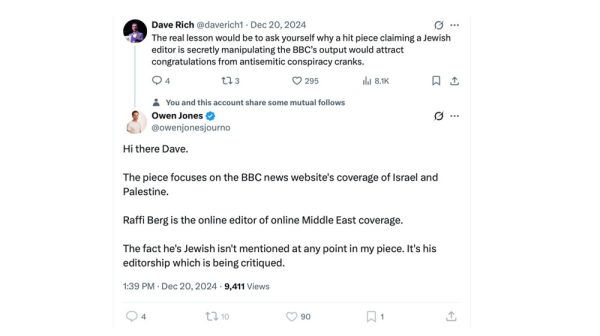
Nor does Jones state that Berg is a Zionist. In fact, the ‘Z word’ is only used twice in the whole piece: once (‘Zionist’) to describe the ‘right wing’ Zionism of Likud-Herut (an organization with whom Berg’s lawyer Mark Lewis is strongly affiliated); and once (‘Zionism’) in a quotation from Mark Lewis emphasizing the importance of “unapologetic Zionism.”
But surely Berg’s Zionism and the fact that he is Jewish — a Jewish supremacist no less — are in fact relevant to this discussion? And surely pretending they are not only undermines the punches that Jones appears to be trying to throw?
How is it that Berg occupies this pivotal location within the BBC? Can we imagine a Catholic, a Hindu, or a Sikh (let’s not even mention a Muslim) being in such a pivotal role on coverage of Palestine? Of course not.
Berg has not been granted or put in that position by the BBC because he is a Zionist. It’s, subconsciously at least, because he is a Jew that he is deferred to. Of course, if he were an anti-Zionist Jew, he would never get into such a position.
Identity politics runs deep in British public institutions — the idea that a Jewish person (or at least the correct type of Jewish person) is the appropriate arbiter of how to cover the occupation of Palestine is seen as common sense.
It is worth extending this analysis to other conflicts. Would a Hindu be asked to adjudicate in BBC HQ on the reporting of Hindutva crimes or a Protestant on Loyalist death squads in the north of Ireland?
We need not even ask about the prospects of the BBC appointing a Palestinian (Muslim, or Christian) to adjudicate coverage of the genocide in Gaza. Extending the analysis says something about the selective implementation of identity politics in the forcefield created by Western official sources and Zionist movement intimidation and bullying of the media.
Recognition that Berg is a genocidal Zionist is crucial to naming the problem and beginning to push back against this kind of Zionist infiltration and subversion of our public institutions.
Of course, Owen Jones appears to want no part of that struggle.
Zionist infiltration at the BBC
There are, of course, many other Zionists (whether Jewish or not) in the BBC, especially in news and current affairs. John Mitchell listed a few very senior employees some years ago:
● James Harding – Director of News & Current Affairs, BBC News (2013–2018) and past editor of the Times, was a hardline Zionist. At a Jewish Chronicle event in 2011, he declared:
“I am pro-Israel. I believe in the state of Israel. I would have had a real problem if I had been coming to a paper with a history of being anti-Israel. And, of course, Rupert Murdoch is pro-Israel.”
● Danny Cohen – Controller of BBC 1, 3, and Director of BBC Television (2007-2015) wrote a letter while still a BBC executive condemning the Boycott, Divestment, and Sanction (BDS) movement, which campaigns to end the Israeli occupation of the Palestinian West Bank and Gaza.
● James Purnell – BBC Director of Radio and BBC’s Director of Strategy (2013-2020) was the chairman of Labour Friends of Israel during his parliamentary career.
We can add to that list some further issues with the most senior management at the BBC.
● Richard Sharp, the former Chairman of the BBC, is a hardline Zionist, former Goldman Sachs and JP Morgan banker, director of the International Rescue Committee, an organization set up with the aid of the CIA, and donor to the British intelligence-created and Zionist-funded Quilliam Foundation.
● Robbie Gibb is reportedly not Jewish, but his brother, the minister, reportedly spent time on a Kibbutz in the Zionist entity when he was young. Both brothers were also part of a Western intelligence operation in the Soviet Union in the 1980s. Gibb went on to lead the consortium to buy out the failing Jewish Chronicle and became the sole director of the company that runs it. He did take a step back from that after concerted pressure was applied over his continuing role at the BBC on the editorial standards committee.
Also on that committee is the CEO of BBC News, the Director General, and the Chair of the BBC (which was Richard Sharp from February 2021 to June 2023 — it is now Samir Shah) and an ‘independent’ member who is currently Nicholas Serota.
Serota has had a long career in the art world and is also a Zionist and opponent of BDS. The ‘CEO’ of the BBC news division, Deborah Turness, is also cited by the BBC as “standing in the way of change” on the question of coverage of Palestine.
Of the five members, either 2 (or 3 when Sharp was in position) are Zionists, and one has blocked complaints on Zionist bias. Given that Director General, Tim Davie, is a former Conservative candidate who has worked for a CIA-supported front group, it is little surprise that the BBC is completely unwilling to cover the genocide properly.
Structural discrimination against Muslims in the BBC
The context of the dominance of Zionism is not just that there are Jewish Zionists in key positions exercising a gatekeeping function, as well as non-Jewish Zionists who provide cover and support for them (such as Robbie Gibb or James Purnell), but that overall there is in the BBC a notable over-representation of Jews and a notable under-representation of Muslims (in relation to their proportion in the population).
Research conducted by the BBC in 2022 shows the corporation at that time employed some 1% of staff who are Jewish, which is twice their proportion in the population, and 3.1% of staff who are Muslim, which is 48% of their proportion in the population.
The differences are more marked when we turn to the News and Current Affairs division of the BBC where Jews make up 2.2% of all staff and 2.5% of leadership staff (proportionally 4.4 times and five times more than their proportion in the population).
By contrast, Muslims are 3% of all News and Current Affairs staff (which is 46% of their proportion in the population) and at the leadership level, there are simply no Muslims at all.
This is itself a problem of structural discrimination, quite apart from what impact it might have on coverage of the genocide. And that impact is not inconsequential. It’s perfectly clear that the Zionists among the BBC News and Current Affairs staff are an aid, as opposed to a hindrance, to the enforcement of Zionist rationality across the BBC.
The gatekeeper
The scandal at the BBC on which Jones reported, is a scandal of Zionist infiltration and gatekeeping. And it’s a scandal that appears to exist in varying ways throughout the media landscape. As the journalist Rivkah Brown has put it:
“I have seen this trend in almost every mainstream media outlet I’ve worked at or reported on: One hardline Zionist who either has decision-making power or aggressively lobbies decision-makers, often with threats of antisemitism. Fearful of scandal, editors cave.”
Brown was reacting to the case of Sky News, which was one of the few media outlets to properly report the violence of Israeli fans in Amsterdam in 2024. Sky then promptly reversed itself. The role of Sandy Rashty as News Editor at Sky was then noted. Rashty is a committed Zionist and writes for the Jewish Chronicle.
It may, as Brown says, take only one advantageously placed Zionist to act as a gatekeeper, but in many news organizations, there are many such placeholders at all levels of the organization, as we have seen with the BBC.
But are these gatekeepers an incidental feature of accidentally employing genocidal Zionists in the newsroom, or is there a wider strategy of infiltration by the Zionist movement?
The strategy of infiltration — The Jerusalem Program
The reality is that the Zionist movement has been involved in a massive push to infiltrate public life in the UK at least since the 1950s, when the movement determined, having reached its objectives in creating a state in 1948, that it would not dissolve itself.
Instead, it adopted the so-called Jerusalem Program, which remains its aim to this day and was most recently revised in 2004. The “foundations” of Zionism, it states, include: the “bond” of the Jewish people to “Eretz Yisrael” which should be settled “as an expression of practical Zionism.”
Every Zionist organization that signs up to the WZO thus supports settler colonialism in “Eretz Israel” (a term usually meaning land far beyond the current occupation, spreading into Lebanon, Syria, Jordan, Iraq, and Egypt); to support a “Jewish” state and “defend” the “right of Jews… as a nation” — meaning structural privileges for Jews — a clearly racist proposition.
Individuals are no longer able (since 1960) to join the WZO directly and must join one of its member organisations. But membership in any Zionist organisation also requires certain “Duties of the individual Zionist”, adopted in 1978. These enjoin Zionists:
“To implement Aliyah [the Zionist term for settler colonialism] to Israel”; and “bring [children] up towards Aliyah”; to “be an active member of the [Zionist Federation]”; “contribute to … Zionist Funds”; and “strengthen Zionist influence within the community.”
In other words, individual Zionists are required to affirm the racist settler colonial ideology and to practically support it. What’s more, they are required to help popularise it in the community.
How this works today can be seen in the approach of the United Jewish Israel Appeal (UJIA), the largest Zionist “charity” group in the UK. UJIA is an anodyne-sounding “charity” which is actually the UK branch of one of the Zionist regime’s four “national institutions,” all based in the same building in King George Street in occupied Jerusalem/Al-Quds.
A 1997 Institute for Jewish Policy Research report, “The Attachment of British Jews to ‘Israel’”, raised an alarm:
“If current trends prevail, attachment to Zionism and the Jewish state could become the concern of only a minority with a mostly Traditional or Orthodox religious outlook.”
As a result, the UJIA refers to their approach as building a ‘lifelong connection’ to “Israel.”
Ruth Wisse: the Army of words
This strategy was memorably enunciated by Harvard professor Ruth Wisse, an open supporter of genocide. The clip on YouTube is just over two minutes long and it’s worth watching in full. For our purposes, the following excerpt is germane:
“American Jews, what do you have to worry about? Your job is to make us [Israel] look good and here’s how you do it: Every one of us has to serve three years in the Army … and then for the rest of our lives you have got to serve two or three years in the army of words you’ve got to learn to fight the political battle which is even more important at this point than the military battle… We’ll fight the military battle we’re not asking you necessarily to come and be lone soldiers although some of you can you’ve got to learn how to fight back on the campuses how to make the arguments now … Don’t let the war of words ever be fought about Israel’s nature, let it be fought about why you can’t accept Israel? Why you have to single out this tiny people? … Push them, teach them how to defend by attacking… You’ve got to make demands on them. They’ve got to serve for three years in the army of words.”
Enrolling all Jews in the ‘army of words’ is the aim of the Zionist movement. They don’t get everyone. But it seems plain they get more than enough to be effective in very many circumstances.
Israel Stalls and the International Court of Justice Complies
By Rick Sterling – Dissident Voice – April 23, 2025
One year ago, the International Court of Justice ruled that Israel had fifteen months to prepare their defense (“counter memorial”) against the charges of genocide filed by South Africa. They were told to present their arguments by 28 July 2025.
That seems like a very long time in a case involving the daily killing of many people, including children. But it was not enough time for Israel, which on 27 March 2025 filed a request to extend the time.
In a very recent decision, the International Court of Justice has obliged and extended the time by six months. Israel can continue killing with impunity, and their defense to the International Court of Justice is not required until 28 January 2026.
There has been very little news of this decision. The ICJ did not issue a press release, despite this being their most sensational case. Accordingly, the decision has not been reported in The New York Times, The Washington Post, or The Guardian. Meanwhile, Israeli media reported, “EXCLUSIVE: Israel secures six month delay in Hague Court proceedings.”
Another important story that has been largely ignored by Western media is regarding the sole Judge who voted in favor of Israel in every single decision so far in this case. That person, Judge Julia Sebutinde, has been revealed to have grossly plagiarized the writings of two ultra-zionists: Douglas Feith and David Brog. Feith is a co-author of the infamous Netanyahu plan, “A Clean Break: A New Strategy for Securing the Realm,” and part of the Bush/Cheney team that campaigned for the 2003 invasion of Iraq. Brog is Jewish but helped to found Christians United for Israel. He is currently the head of Miriam Adelson’s “Maccabee Task Force”. Anti-zionist scholar Norman Finkelstein has discovered that 32% of the ICJ judge’s pro-Israel dissenting opinion was plagiarized from Feith, Brog, and others.
As the saying goes, “Justice delayed is justice denied.” And if nobody reports or knows about it, did it really happen? Along with dead Palestinians in Gaza, Israel is trying and perhaps succeeding in killing the International Court of Justice.
Rick Sterling is an investigative journalist in the SF Bay Area. He can be reached at rsterling1@protonmail.com
Trump axes Biden-era post set up to probe ‘Russian war crimes’
RT | April 23, 2025
The administration of US President Donald Trump has reportedly eliminated a position within the Office of the Director of National Intelligence (ODNI) that was responsible for sharing evidence of alleged Russian war crimes.
Mandated by a bipartisan bill passed in 2022 in response to the escalation of the Ukraine conflict, the Intelligence Community Coordinator for Russia Atrocities Accountability Act (ICCRAA) was enacted as part of the 2023 Intelligence Authorization Act.
According to anonymous sources cited by the Washington Post on Tuesday, both the ICCRAA and the interagency working group it led have been terminated.
Previous reports indicated that the Trump administration had withdrawn from collaboration with an EU-led initiative aimed at investigating Russian nationals in connection with the Ukraine conflict, halted a Justice Department program for training Ukrainian prosecutors on handling these cases, and closed an inquiry into Kiev’s allegations that the Russian authorities kidnapped Ukrainian children.
Two major priorities of the Trump agenda include slashing government spending on programs deemed unnecessary and concluding the Ukraine conflict.
The efforts to resolve the conflict reportedly reached a critical juncture this week, with Washington anticipating reactions from Kiev and European NATO members regarding its proposed compromise ceasefire deal before presenting it to Moscow. Secretary of State Marco Rubio cautioned last week that the US could “move on” to other issues if the negotiations stall.
Neither Rubio nor Trump’s special envoy, Steve Witkoff, who outlined the ideas last week at a gathering in Paris, will attend this week’s discussions with Ukrainian officials in London, according to Axios. However, Witkoff is expected to travel to Moscow for follow-up talks with Russian President Vladimir Putin.
Reports indicate that the US is proposing formal recognition of Russian sovereignty over the former Ukrainian region of Crimea, which voted to join Russia following the 2014 Western-backed coup in Kiev. Ukraine’s Vladimir Zelensky has rejected this, reiterating on Tuesday that Kiev’s claim to the peninsula is non-negotiable.
Chinese satellite company refutes US accusation of supporting Houthi attack on US interests as ‘completely fabricated’
By Fan Wei and Liu Xin | Global Times | April 19, 2025
The US accusations are completely groundless and Chang Guang Satellite Technology has no business dealings with Iran or the Houthi groups, Chang Guang Satellite Technology told the Global Times on Saturday in response to a recent US accusation of supporting Yemen’s Houthis in attacking US interests in the region.
The US State Department spokesperson Tammy Bruce claimed that Chang Guang Satellite Technology Co., Ltd was involved in “directly aiding Iran-backed Houthi rebels in Yemen by providing satellite imagery used to target US and international vessels in the Red Sea,” according to a report from Fox News on Friday.
In response to an inquiry from the Global Times on the US accusation, Chang Guang Satellite Technology said that the company firmly opposed the US groundless accusation and such claims are completely fabricated and maliciously slanderous.
Chang Guang Satellite Technology Co., Ltd has no business dealings with Iran or the Houthi force. The company said that it strives to harness remote sensing data to drive high-quality development across key sectors such as agriculture, forestry, environmental protection, and finance.
“In our global operations, we strictly comply with relevant laws, regulations, and industry standards both in China and internationally. With a mature business model and high-quality services, we are committed to contributing Chinese expertise and solutions to the advancement of the global remote sensing industry,” said the company.
The core US accusation is that Chang Guang Satellite tracked US warships and commercial vessels using commercial remote sensing satellites to guide the Houthis strikes, which is technically unfeasible, Hu Bo, director of South China Sea Strategic Situation Probing Initiative (SCSPI), told the Global Times.
Hu said that according to current public information, it is technically difficult for any global commercial remote sensing satellite constellation — including that of Chang Guang Satellite — to achieve such a capability. The limitations in ephemeris, revisit cycles of the remote sensing satellite, and the ability of existing remote sensing technologies to track moving targets mean that these satellites cannot provide real-time coordinate information to strike mobile targets such as warships and commercial vessels.
Even Planet Labs, the US-based company with the largest number of commercial remote sensing satellites in the world, can only achieve an average once-daily revisit cycle for any given location on Earth. While orbital adjustments and resource concentration on hotspot areas may slightly reduce the revisit interval, this still makes it meaningless for real-time tracking and targeting of moving objects to guide weapon strikes, according to Hu.
The Houthis have their own drone capabilities, which serve as the most practical and effective means of real-time surveillance and reconnaissance against moving targets in narrow waters like the Red Sea. In contrast, reconnaissance satellites offer very limited utility in such scenarios, said Hu.
In response to a media inquiry on the US accusation, Chinese Foreign Ministry spokesperson Lin Jian on Friday said that “I’m not familiar with the specifics you mentioned. Since the situation in the Red Sea escalated, China has been playing a positive role to ease tensions.”
“Who is promoting talks for peace and cooling down the situation, and who is heightening tensions with sanction and pressure? The answer is rather clear to the world. China urges relevant countries to do what is conducive to regional peace and stability, not otherwise,” Lin said.
Wrong, ABC News, Climate Change Didn’t Cause 2025’s Severe Tornado Outbreak
By Linnea Lueken | ClimateREALISM | April 14, 2025
A recent story by ABC News, “Climate and environment updates: Tornado activity doubled March average: NOAA,” classifies recent severe tornado outbreaks under their “climate crisis” category, implying that these storms were caused by global warming. This is false. Climate change is not causing an increase in the number or severity of tornados, nor can it be connected to such a limited event.
ABC warns:
The climate crisis is not a distant threat; it’s happening right now and affecting what matters most to us.
According to a new report from the National Oceanic and Atmospheric Administration, U.S. tornado activity in March was more than twice the monthly average, with over 200 tornadoes recorded.
Although ABC doesn’t explicitly state that this tornado season has been caused by climate change, the story strongly implies it, and as such it cannot be left unchallenged, because it is wrong.
The United States did experience a destructive and violent tornado season in March 2025, but it was not a record breaker in terms of numbers or strength, nor does it reflect a long-term trend that would be necessary to prove the climate connection.
The National Centers for Environmental Information (NCEI) disagree strongly with ABC’s claims. They report that tornado records in the past are spotty, because they are very short lived and aren’t always reported, especially as one moves further back into the past. NCEI reports “[m]any significant tornadoes may not make it into the historical record since Tornado Alley was very sparsely populated during the 20th century.”
Doppler weather radar did not become widespread until the 1990s. Because of the low coverage of weather radar before then, and much higher coverage in recent years, NCEI explains that “observation practices have led to an increase in the number of reported weaker tornadoes, and in recent years EF-0 tornadoes have become more prevalent in the total number of reported tornadoes.”
NCEI continues:
With increased National Doppler radar coverage, increasing population, and greater attention to tornado reporting, there has been an increase in the number of tornado reports over the past several decades. This can create a misleading appearance of an increasing trend in tornado frequency. To better understand the variability and trend in tornado frequency in the United States, the total number of EF-1 and stronger, as well as strong to violent tornadoes (EF-3 to EF-5 category on the Enhanced Fujita scale) can be analyzed. These tornadoes would have likely been reported even during the decades before Doppler radar use became widespread and practices resulted in increasing tornado reports. The bar charts below indicate there has been little trend in the frequency of the stronger tornadoes over the past 55 years.
Data from the National Oceanic and Atmospheric Administration (NOAA) tornado count show no trend in the number of tornadoes since the introduction of widespread Doppler radar. (See figures below)

Figure 1: Trend of all tornadoes counted since 1950. Note that the trend stops increasing once the widespread coverage of Doppler weather radar is achieved in the 1990s. Red are preliminary estimates for this year.
When it comes to the strongest tornadoes, EF-3 and above, there appears to be a downwards trend. (see figure below)
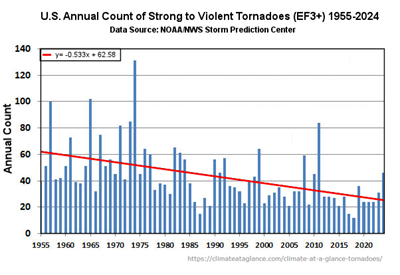
Climate at a Glance: Tornadoes points out that as recently as 2017 through 2018, the United States set records for the longest period in history without a tornado death and the longest period in history without an F3 or stronger tornado. In fact, the two record-low years for number of tornadoes both occurred this past dozen years, in 2014 and 2018.
Moreover, the United Nations Intergovernmental Panel on Climate Change finds that “[t]here is low confidence in observed trends in small spatial-scale phenomena such as tornadoes.”
ABC’s alarming coverage of the 2025 tornado season is at odds with the data. There is no dangerous climate signal in the tornado data, there may even be evidence that the modest warming of the past century is related to the decline in severe tornado outbreaks in the United States. A single severe tornado season, or concentrated outbreak, is not evidence of catastrophic climate change, only a long-term sustained trend would suggest climate change might be a factor, and there is no such trend.
Fact-Checking Peter Marks’ ‘Face the Nation’ Interview on Autism, Vaccines and Measles
By Arthur Weinstein | The Defender | April 17, 2025
Peter Marks, M.D., Ph.D., hasn’t changed the opinions that put him at odds with U.S. Health and Human Services (HHS) Secretary Robert F. Kennedy Jr., and led to his recent resignation from the U.S. Food and Drug Administration (FDA).
Marks appeared April 13 on CBS News’ “Face the Nation with Margaret Brennan” in a wide-ranging interview covering vaccine safety, autism, the Texas measles cases and Kennedy.
When Marks resigned under pressure on March 28 from his role as director of the FDA department responsible for authorizing vaccines, he called out Kennedy in his resignation letter. “It has become clear that truth and transparency are not desired by the Secretary, but rather he wishes subservient confirmation of his misinformation and lies,” Marks wrote.
While Marks avoided using such inflammatory language on “Face the Nation,” the former FDA vaccines regulator did criticize Kennedy, suggesting he had hired a research executive with insufficient credentials, made personnel cuts that would hurt public health and that the results of a landmark autism study announced by Kennedy had in effect already been predetermined.
“What I think we can expect is the expected: that there will be an association determined between vaccines and autism, because it’s already been determined,” Marks said.
During the interview, Marks made several misleading and/or factually inaccurate statements, which we outline here.
Marks and Brennan falsely attributed children’s deaths to measles
Brennan referred to the death of 8-year-old Daisy Hildebrand on April 3 as “the death of a second unvaccinated child in Texas due to measles,” implying the disease caused both deaths.
Dr. Pierre Kory, who analyzed Daisy’s medical records for CHD.TV, disputed Texas health authorities’ statement that she died from “measles pulmonary failure.” He said records indicate she died from acute respiratory distress “secondary to hospital-acquired pneumonia,” which she likely developed during a previous hospital stay.
Brian Hooker, Ph.D., Children’s Health Defense (CHD) chief scientific officer, also reviewed the records and spoke with both of Daisy’s parents. He noted Daisy’s illness and treatment history were complicated during the weeks before her death.
Daisy’s father, Peter Hildebrand, told CHD.TV this week that measles is “absolutely not” what caused his daughter’s death.
“That last doctor we had, he just kept going on and on about measles this and measles that. He was trying to blame everything on the measles … They were so focused on the measles that they didn’t think about testing for anything else, and that is why my daughter is dead today.”
In March, a 6-year-old child in West Texas died after developing pneumonia while recovering from measles. The two deaths have fueled media coverage of a “deadly measles outbreak” in Texas and New Mexico, even though both deaths were attributable to other causes.
Marks cited questionable measles death rate
Marks talked at length about vaccine safety and efficacy, especially the measles-mumps-rubella (MMR) vaccine.
“You want to get your child vaccinated against measles so that they don’t have a one-in-a-thousand chance of dying from measles if they contract it,” Marks said.
That oft-cited 1-in-1,000 statistic for measles deaths comes from the Centers for Disease Control and Prevention (CDC). A CDC webpage updated in May 2024 claims “1 to 3 of every 1,000 children infected with measles will die from respiratory and neurologic complications.”
However, other research and media reports — and even the CDC itself — contradict that figure. On its website, the CDC reports that before the first measles vaccine was developed in 1963, “It is estimated 3 to 4 million people in the United States were infected each year,” resulting in 400 to 500 deaths.
Depending on which figures one uses, that results in a death rate of somewhere between 1 in 6,000 and 1 in 10,000 cases.
A 1994 study by the Institute of Medicine (now the National Academy of Medicine) that reviewed pre-vaccine era data in industrialized countries also found the death rate for measles to be just over 1 per 10,000 cases.
Marks understated MMR vaccine risks
Marks said that unvaccinated children are at serious risk from measles, and he endorsed vaccine safety. He said:
“There’s no reason to put your child at that risk, because the vaccine does not cause death, it does not cause encephalitis and it does not cause autism. So a vaccine that is safe, yes, occasionally kids get fevers. If you don’t keep the fevers down, about 15 in 100,000 will get a convulsion that happens once it goes away. … So, very safe vaccine that is going to potentially protect your child and save its life.”
That statement ignores evidence of the risks associated with the measles vaccine. Between 2000 and 2024, nine measles-related deaths were reported to the CDC. During the same period, 141 deaths following MMR or MMRV vaccination in the U.S. were reported to the Vaccine Adverse Event Reporting System (VAERS). That suggests the MMR vaccine can be deadlier than measles.
The MMR vaccine is also associated with serious health risks. The package insert for Merck’s MMRII states, “M-M-R II vaccine has not been evaluated for carcinogenic or mutagenic potential or impairment of fertility.”
Marks mischaracterized status and credentials of experienced vaccine researcher
Brennan mentioned a recent report by The Washington Post that researcher David Geier has been hired to lead Kennedy’s autism study. Geier’s appointment has not been confirmed. Yet the media questioned his credentials.
Marks repeated the Post’s mischaracterization of Geier’s credentials.
“He’s to the best of my knowledge, he’s not had any training after college in any of the sciences that we value here,” Marks said.
Geier is an expert on thimerosal — a mercury-based preservative used as an adjuvant in vaccines — and on the connections between toxic exposures and autism and other neurodevelopmental disorders.
The researcher is also the lead or second author of hundreds of peer-reviewed articles on vaccine safety.
Marks muddled research on environment versus genetics autism debate
As Brennan asked Marks about Kennedy’s autism study, she touched on the HHS secretary’s belief that environmental factors, not genetics, have sparked the rise of the condition.
Kennedy again voiced that opinion on Wednesday during a news conference, saying, “Genes do not cause epidemics.”
“Is there scientific evidence ruling out genetics as a cause of ASD?” Brennan asked Marks, referring to autism spectrum disorder.
”There’s no scientific evidence ruling out genetics. In fact, there’s data that have been published that say that genetics may contribute to autism. There are obviously data … that suggest that perhaps environmental factors may, but one has to be incredibly careful … about making associations between environmental factors and autism.”
The converse of Marks’ statement is also true; there’s no scientific evidence ruling out environmental factors. Kennedy said Wednesday that while some people may be genetically more susceptible to autism, it takes an environmental exposure to trigger the condition.
“This epidemic denial has become a feature in the mainstream media, and it’s based on an industry canard,” Kennedy said. “Obviously, there are people who don’t want us to look at environmental exposures.”
Brennan also pointed out to Marks that Kennedy appeared on Fox News Wednesday, “and dismissed 14 studies that have shown no link between autism and vaccines.”
A scientific review published Jan. 10 on Preprints.org found the CDC’s “vaccines do not cause autism” stance is based on limited evidence that insufficiently supports that broad claim.
Hooker, one of the co-authors of the review, told The Defender about the limited research on the topic.
“The truth is that CDC has never studied the connection between vaccines and autism except for one vaccine, MMR, and one vaccine component, thimerosal,” Hooker said.
Kennedy’s stance on the environment versus genetics debate has been clear, and he reiterated it Wednesday: He questioned why the National Institutes of Health spends 10 to 20 times more researching genetic causes instead of possible environmental triggers.
This article was originally published by The Defender — Children’s Health Defense’s News & Views Website under Creative Commons license CC BY-NC-ND 4.0. Please consider subscribing to The Defender or donating to Children’s Health Defense.
Featured Video

Daniel Davis: U.S. Military Options & War Narrative Collapse
or go to
Aletho News Archives – Video-Images
Book Excerpt
“Vaccines Do Not Cause Autism!” The Science is Settled. Right?
ICAN urges the IACC to actually study infant vaccines and autism
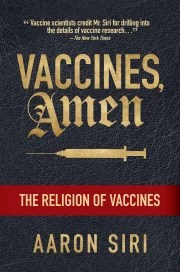 By Aaron Siri | Injecting Freedom | March 16, 2026
On behalf of ICAN, we just sent a copy of chapter 11 of Vaccines, Amen to the newly appointed members of the federal Interagency Autism Coordinating Committee (IACC).
If you haven’t already read this chapter, you can read the whole thing in the attached letter. I trust that after you read it, you’ll see why the statement “vaccines do not cause autism” is a belief, not science!

IACC Public Comment Letter
1.53MB ∙ PDF file
Includes chapter 11 of Vaccines, Amen
Blog Roll
 Aletho News
- Washington’s War on Cuba Is Older Than You Think
- Daniel Davis: U.S. Military Options & War Narrative Collapse
- Protesters call on Brussels university to cut partnership with Israeli defense-linked firm
- Weapons makers cash in on Trump’s Iran war
- Why Trump’s anti-Iran naval coalition in Strait of Hormuz is doomed to fail
- IRGC says regional energy sites linked to US will be reduced to ashes
- Qatar condemns ‘dangerous’ Israeli attack on gas field
- Iran made ‘unexpectedly substantial’ offer during Geneva talks, US envoys ‘dragged’ Trump into war: Report
- Russia condemns Israel’s attack near Bushehr plant, files complaint
- Russia Strongly Condemns Actions Aimed at Harming Health of Iranian Leadership – Kremlin
- If Americans Knew
- How ignorance, misunderstanding and obfuscation ended Iran nuclear talks
- Israeli media reports grotesque settler attack in West Bank
- UK security adviser attended US-Iran talks and judged deal was within reach
- Tucker Carlson says ‘neocons’ will try to destroy Joe Kent over resignation
- Lebanon death toll exceeds 900, another assassination in Iran, bombing in Gaza – Not a ceasefire Day 159
- Trump’s counterterrorism chief, whose own wife was killed by ISIS, quits over Iran War saying Tehran posed ‘no imminent threat’
- Here’s what US could fund instead of Bibi’s war on Iran
- Israel Killed Over a Dozen Lebanese Paramedics in Three Days, Now Claiming That Ambulances Are “Hezbollah” Targets
- War on Iran: These are the heritage sites devastated by US and Israeli attacks
- Four news stories from Israeli media that illustrate Israeli “justice”
- No Tricks Zone
- Energy Expert: Germany’s Nuclear Phaseout Was A “500 Billion Euro Mistake”
- New Research: South Australia’s Mid-Holocene Sea Surface Temperatures Were 4°C Warmer Than Today
- Storing Green Energy To Last Germany 10 Days Would Require A 60-Million Tonne Battery
- New Studies: UK Sea Levels Were 4 Meters Higher Than Today During The Mid-Holocene
- Destructive Green New Deal: German Energy And Metal Group Warns Of Drastic Crisis
- New Study Documents A 20-Year Pause In Arctic Sea Ice Decline – Driven By Internal Variability
- Wake-up Call: Survey Shows Majority Of Germans Now Favor Postponing Climate Targets!
- Televised! Leading German Political Candidate Tells Schoolchildren CO2 Makes Sun Hotter!
- New Study: A Century Warming Of 1.1°C Is ‘Commonplace’ And ‘Not Unusual’ During This Interglacial
- New Study: ‘Internal Noise’ And Volcanic Forcing Can Trigger 10-15°C Warming Within Decades
 Aletho News