A review of Net Zero has recommended that sales of gas boilers must be banned within ten years at the latest. The supposedly ‘independent’ review was commissioned by Liz Truss in her short spell as PM, and was written by Tory MP Chris Skidmore, who as Energy Minister signed the Net Zero Act into law in 2019.
The reality is that virtually nobody who owns a gas boiler is remotely interested in replacing it with a heat pump. Sales of heat pumps in the UK are running at around 35,000 a year, despite generous government subsidies, a long way short of the government target of 600,000 a year.
The reason is obvious. Installing a heat pump, with the new radiators, pipework and extra insulation required, will probably cost upwards of £20,000 for a typical home. Worse, despite the currently high cost of gas, running costs for a heat pump are still higher than a gas boiler.
In practice, a ban on gas boilers would force most people into buying conventional electrical heaters, such as storage heaters. These are cheaper to buy but hugely expensive to run; annual heating costs for a typical home are about £1,500 for a gas boiler, but would rise to £5,000 for electrical heating.
This is not the only mad policy suggestion in Skidmore’s review. He also wants all houses sold to meet EPC C by 2033. EPC is the Energy Performance Certificate, when it is estimated that only 40 per cent of houses meet this standard at the moment. Skidmore’s bright idea will force millions of homeowners and landlords to spend thousands on improving insulation against their will.
Of course, this ‘independent’ review is nothing of the sort. Skidmore, MP for Kingswood, is one of the bunch of extremist green Tories; he even opposed Truss’s attempts to reinstate fracking. It was inevitable that he would rubber-stamp the Net Zero agenda. A truly independent review would have critically assessed all the assumptions, costings and projections for this appalling piece of legislation. Instead we have got a report that might as well have been written by Gummer’s Committee on Climate Change. We get all the same platitudes that we have read many times before in CCC handouts – how cheap renewable energy is, millions of green jobs, how we will all be better off by 2050 (we have to take Skidmore’s word for this), how we must not fall behind the rest of the world in the race for Net Zero.
I have searched the report comprehensively, and cannot find a single reference to the costs which will have to be borne in the medium term by the public, things like heat pumps, insulation and electric cars. These costs will be unaffordable for most households, and will act as a brake on economic growth in the same way as high energy prices are doing now. Nobody cares about how well off they may be in 30 years’ time, and certainly won’t believe anybody who tells them he does know. But people do know that current policies will be extremely expensive.
Neither is there any quantification of the massive costs which will be incurred for upgrading electricity grids and distribution networks, and building hydrogen storage and infrastructure. Or the reliance on unproven carbon capture.
Nor is there any critical assessment as to how the country can run predominantly on intermittent wind and solar power, albeit backed up by nuclear power. Instead Skidmore seems simply to accept the pie-in-the-sky projections of the National Grid, calling for more wind and solar power.
The report does mention CCC estimates of the need to spend £50billion to 60billion a year by the early 2030s. As it points out, most of this will come from private sector investors, who will want high returns. Skidmore does not mention that it will be the poor old consumer who will end up paying for all this. It is no surprise that big business is queuing up for its share of the money pot.
Since its very inception, the Net Zero Act was enacted as a ‘good idea’, without any plan as to how it could be carried out, or a clearly costed budget. This review should have been an ideal opportunity to row back, putting the whole thing on the back burner while these fundamental issues were addressed. Sadly it is a chance missed.
Is climate change killing off the puffins?
Another go-to scare story for climate alarmists is that Atlantic puffins are at risk from global warming. It is a story that comes around every year as regular as clockwork.
According to a recent report in the Telegraph, 70 per cent of Europe’s puffins could be lost in the next 80 years, because of ‘stormy weather caused by climate change’. Naturally no evidence is presented to prove that stormy weather is increasing, probably because it isn’t!
Far from dying out, puffins have been thriving off the Pembrokeshire coast on the islands of Skomer and Skokholm. There are more puffins there now than at any time since the 1940s, when numbers peaked before the population crashed.
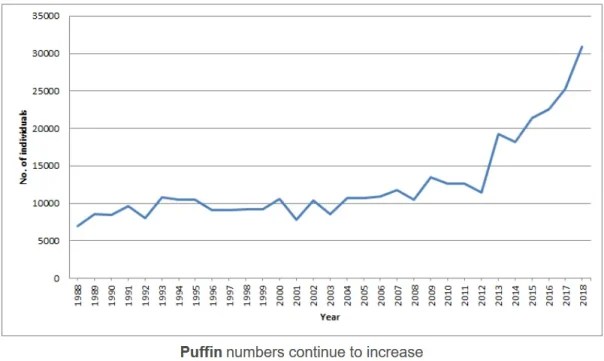
Although there are an estimated 10 million puffins breeding along Europe’s coastline, it has been reported that some populations are declining around the North Sea. But the cause of this is not climate change, but something much more basic – the industrial fishing of sand eels, which make up most of the diet of puffins during their breeding season. If climate change was a factor, we would be seeing the same decline on Skomer.
Less fish available for adult puffins means underfed pufflins, which are less likely to make it to adulthood.
In 2020, 238,000 tons of sand eel were harvested by fishing vessels in the North Sea, all of which goes to Danish oil and fishmeal processing factories. Danish vessels have the largest share of the fishing quota, landing 72 per cent of the catch. Both the EU and Denmark claim that fishing quotas are adequate to maintain the sand eel population. But as is always the case with the EU, vested interests trump any other considerations.
The link between sand eel fishing and seabird populations is well established. A study in 2014 found that ‘the UK’s internationally important seabird populations are being affected by fishing activities in the North Sea. Levels of seabird breeding failure were higher in years when a greater proportion of the North Sea’s sand eels, important prey for seabirds, was commercially fished’. It also noted that seabirds breeding on the UK’s western colonies are faring better than those on the North Sea coast.
But don’t expect the EU to shut down Denmark’s fishmeal industry. It’s much easier to blame climate change!
January 21, 2023
Posted by aletho |
Economics, Malthusian Ideology, Phony Scarcity | UK |
Leave a comment
The Federal Network Agency is planning to ration the power supply to heat pumps and EV charging stations in order to protect the distribution grids from collapse. Charging times of three hours to charge electric cars will be allowed so that they can cover a distance of 50 kilometers.
Electric cars, heat pumps and private solar systems are booming. This is pushing the power grids in cities and communities to their limits.
An expert quoted by the “FAZ” warns that the local power grids are in danger of becoming the bottleneck for the energy transition. According to estimates, expanding it would cost a three-digit billion amount.
The Federal Network Agency wants to ration electricity for consumers to prevent a collapse in supply.
Electric cars are booming, as are heat pumps and private solar systems on roofs. This should only be the beginning of the energy transition in Germany. But the energy industry is already warning that the local power grids in cities and communities are reaching their performance limits. This has been reported by the “Frankfurter Allgemeine Zeitung” (FAZ). According to the report, the Federal Network Agency is planning to temporarily ration the power supply to heat pumps and charging stations in order to protect the distribution grids from overload.
A year ago, the network agency confirmed a “network development plan” in which up to seven million heat pumps in households are expected for 2035. So far there have been around one million heat pump systems.
Enormous growth is also expected in electric vehicles. For large network operators such as Eon, the current figures are a challenge. “The applications for the connection of new systems are going through the roof, and we assume that the growth rates will continue to grow,” said Eon board member Thomas König. According to the “FAZ”, the electricity supplier registered around 100,000 new charging stations for electric cars in 2021.
Local power grids threatened to become the bottleneck for the energy transition, Krzysztof Rudion, professor at the Institute for Energy Transmission and High Voltage Technology at the TU Stuttgart, told the newspaper. “The expansion of the distribution network simply cannot keep up with the boom in heat pumps, electric cars and solar systems.”
In order to arm the distribution grids, between 100 and 135 billion euros would have to be invested in Germany in the next decade and a half, the FAZ reports, citing a new study by the management consultancy Oliver Wyman.
Full story (in German)
Translation Net Zero Watch
January 21, 2023
Posted by aletho |
Malthusian Ideology, Phony Scarcity | Germany, Human rights |
Leave a comment
The World Economic Forum’s annual meeting took place in Davos on January 16-20, 2023. International observers sat down with Sputnik to formulate the main message of the gathering in a nutshell.
“This year’s forum featured the new state of the world: divided, resentful, and grim,” Gal Luft, director of the Washington-based Institute for the Analysis of Global Security, told Sputnik. “Davos has become the dressing room of the West and is more divorced than ever from the rest. It no longer represents the real concerns of most of the world’s population. Its obsession with climate change, social justice, gender and other forms of wokeness has made it a laughing stock and target of disdain for most of the world.”
The World Economic Forum (WEF), an international non-governmental and lobbying organization, was founded in January 1971 by German economist Klaus Schwab. Initially the entity was called “European Management Forum”; it changed its name to the World Economic Forum in 1987.
Bringing together business executives, thought leaders, and prominent politicians, the forum sought to become a global platform to spearhead the ideas of globalization and solve pressing economic and political dilemmas. However, some Western commentators observed that the forum quickly morphed into a technocratic globalist elitist club which sought to dictate rules for the rest of the world.
“Globalization was based on the premise of broad acceptance of global institutions, norms and rules, as well as reasonably free flow of goods, money and information,” Luft said. “Each one of those has been compromised over the past few years, first with the US-China decoupling and second with the war in Europe. Instead, we have global bifurcation into two camps – the collective West plus honorary members and all the others – and the emergence of new institutions, alliances, financial instruments, trade blocs and priority sets.”
“There is no return to the post-WWII system. In addition, we are seeing massive repudiation of some of the institutions and individuals who have been most associated with globalization: the media, Davos, entertainment industry etc. De-globalization can also be seen along cultural fault lines. Western ideas, ethics, and ‘values’ are rejected by billions who see them as dangerous and destabilizing,” the US scholar continued.
Russia’s Independence Doesn’t Fit in Davosian ‘Ideal World’
The necessity to “defeat” Russia became a leitmotif of the gathering, with German Chancellor Olaf Scholz declaring that to end the ongoing conflict in Ukraine, the Russian special operation “must fail.” The chancellor called for stepping up military aid for Ukraine, but fell short of confirming that Berlin would send its Leopard 2 main battle tanks to Kiev, something that the Ukrainian regime, Poland, Finland, and the UK are urging him to do.
For his part, Harvard Professor Kenneth Rogoff, former chief economist at the International Monetary Fund (IMF), urged the West not only to step up anti-Russia sanctions, but to create conditions for “regime change” inside Russia.
“The forum in Davos is a congress of adherents of globalism,” Konstantin Babkin, president of the Rosagromash Association and co-chair of Moscow Economic Forum (MEF), told Sputnik. “These people would like to see a unified world where global corporations rule, dominating even the official state structures. What is happening in Ukraine contradicts their ideas of an ideal world. Many multinational corporations had to leave Russia. So, [Russia] has fallen out of the control of these Western corporations. This contradicts their ideas about the ideal state of affairs.”
While the Davos participants insisted that it is necessary to support Ukraine and to make sure that Russia obeys the rules established by the West, it appears that many countries have tired of this bellicose rhetoric, according to Babkin.
‘Biodiversity’ in Economy & Politics Instead of Global Unification
The Western-centric globalized world order is falling apart at the seams, with other countries adopting a non-aligned status and implementing their own scenarios of development in terms of their financial policies, foreign trade, and tax policies, according to Babkin. The Russian scholar argues that re-industrialization and strengthening of national economies could ensure the world’s stability and diversity of models.
“It would be nice to have different models, different states, different peoples, different cultures,” the Russian scholar said, drawing parallels with natural biodiversity. “[There will be] Iranian model, Indian model, Chinese model, Western model, and rejection of globalism. I think this is a good thing, and Russia needs to develop its own economy. I can also advise Iran, and China, and other large states, and state associations (…) I think the world that Davos is promoting is so unstable.”
Remarkably, major developing nations, including Russia and China, “have shunned the forum and inspired others to do the same,” said Luft, calling these countries a “resistance bloc.”
“In the years to come, with the inevitable departure of Klaus Schwab from the scene, the forum will lose its relevancy and will become just another exclusive overpriced Swiss club with entry ticket of $250,000,” Luft said. “It has already become a symbol of elitism and arrogance, representing the garden as opposed to the jungle, to use Josep Borrell’s terminology, and a platform to advance Western priorities.”
Babkin echoed Luft by saying that even though the Davos forum is likely to continue bringing together Western executives and politicians, it has ceased being a truly international platform and will never become what some call “the world’s government.”
“Globalization the way we know it has died and Davos 2023 was its funeral ceremony,” Luft concluded.
January 21, 2023
Posted by aletho |
Civil Liberties, Malthusian Ideology, Phony Scarcity, Russophobia, Supremacism, Social Darwinism | China, Human rights, Iran, Russia, WEF |
Leave a comment
By 2030, you will OWN NOTHING and be HAPPY.
This is not just a slogan or a conspiracy theory.
This is 1 of the 8 World Economic Forum (WEF) predictions. Watch their video https://www.weforum.org/agenda/2016/11/8-predictions-for-the-world-in-2030/
WEF was born out of a CIA-funded Harvard program headed by Klaus Schwab’s mentor, Henry Kissinger. Sulzer AG, in Schwab’s earlier years, where he was director, would go on to break international law by aiding the South African apartheid regime in its illegal thermonuclear bomb program.
Klaus Schwab, founder & executive Chairman of the WEF, in his book, “COVID-19: The Great Reset” published a few months after the start of Covid 19 outlines his plans for the world. Quoting Schwab, WEF’s Young Global Leaders have penetrated numerous Countries’ Cabinets and become Presidents, Prime Ministers, or CEOs. During the coronavirus pandemic, several WEF Young Global Leaders played prominent roles, promoting zero-covid strategies, lockdowns, mask mandates, and digital ‘vaccine’ passports. In contrast, there was a totally opposite approach from those who are not affiliated with the WEF.
Unfortunately, it is very difficult to get the truth, with the censorship of independent professors, doctors, journalists & politicians and the fact that mainstream media, Google & ‘fact checkers’ are funded & controlled by the same people behind this diabolical plan.
This might be the most important 1 hour 40 min you spend, unless you don’t mind ending up ‘owning nothing’, being tracked & 24/7 surveilled (under your skin, as per WEF Agenda Contributor, Yuval Noah Harari) and ending up with CBDC (Central Bank Digital Currency), UBI (Universal Basic Income) and eventually Social Credit System.
The “Great Reset” echoes the real, unspoken of plans behind UN Agenda 21, now known as Agenda 2030. (more of this in Part 2) Lastly, to understand why they say “you will be happy” when you own nothing, is where the METAVERSE comes in (more of this in Part 2),
Call to action: Please share this film. Knowledge is power. Lets work together to co-create a future independent from the WEF, WHO & UN
Be critical thinkers and do your own research. Here are links to the excerpts used in this video, curated in South Africa:
https://www.corbettreport.com/wef/
https://live.childrenshealthdefense.org/south-africa-vaers-conference-vaccine-victims-experts-data-an-independent-alternative-reporting
https://rumble.com/v1dxzgh-episode-278-radical-truths.html
https://rumble.com/v11p0vo-the-megadeath-intellectuals-of-the-great-reset.html
https://www.youtube.com/watch?v=fI16ylFLLz8
https://www.jrepodcast.com/episode/joe-rogan-experience-1780-maajid-nawaz/
https://odysee.com/@MaajidNawaz:d/EP8-Radical:9
https://senatormastriano.com/2022/03/01/expert-panel-discussion-on-covid-19-and-medical-freedom/
https://odysee.com/@OracleFilms:1/New-Normal—Happen-Network:3
https://www.youtube.com/watch?v=CA_Phpz4woY
https://www.corbettreport.com/how-green-finance-is-monopolizing-the-planet-with-whitney-webb/
https://odysee.com/@QuantumRhino:9/Maajid-Nawaz-with-Joe-Rogan—The-Joe-Rogan-Experience–1780:f
https://edition.cnn.com/videos/world/2019/11/26/yuval-noah-harari-interview-anderson-vpx.cnn
https://www.youtube.com/watch?v=hL9uk4hKyg4
https://www.youtube.com/watch?v=jTfW-cchpYA
https://www.bmj.com/content/371/bmj.m4425/rr-31
https://www.youtube.com/watch?v=JfyIW9wRvB4
https://www.youtube.com/watch?v=-3aPT8MuH_E
https://www.youtube.com/watch?v=JDM1CIwa5Bw
https://www.youtube.com/watch?v=ydWYJSpsCLE
https://live.childrenshealthdefense.org/chd-tv/events/the-nuremberg-code-75th-annual-commemoration–mary-holland–vera-sharav-speeches/
January 21, 2023
Posted by aletho |
Civil Liberties, Full Spectrum Dominance, Malthusian Ideology, Phony Scarcity | Covid-19, Human rights, WEF |
Leave a comment
Suppose that Scotland’s CO2 emissions fell tomorrow to zero, i.e., that, at midnight, the country ceased to exist. Then according to the “Model for the Assessment of Greenhouse Gas Induced Climate Change” (MAGICC), based on the latest IPCC climate models, the reduction in the Earth’s temperature in 2100 would be…undetectable.
Motivated by the moral necessity and urgency of this goal, the Scottish Government is proposing a novel energy policy – its “Energy Strategy and Just Transition Plan”.
This article reviews its major themes and their implications, and considers briefly the probability of success of the Scottish Government implementing it.
In 2022, due to an insufficient quantity of wind and sun, Scotland’s current collection of wind and solar energy-scavenging devices failed to generate about 70% of their nameplate capacity. Recent exhaustive statistical and econometric analysis of wind generation in Scotland by Edinburgh University shows that it is uneconomic and destined for taxpayer bailout. Under the Scottish Government’s novel energy strategy, wind and solar energy-scavenging devices are to be greatly expanded.
Hydrogen, an energy carrier that squanders in waste-heat a gigawatt of power generation for every gigawatt it carries, is elevated in the Scottish Government’s understanding of energy to the category of a fuel, and also greatly expanded.
Hydrocarbon and nuclear – actual fuels – provide the energy to manufacture and endlessly replace wind turbines and solar panels. They also, in Scotland, provide the power sources that run under all conditions to ensure continuity of energy supply during Scotland’s frequent sunless and windless conditions. These are to be discontinued.
Like all advanced economies, Scotland cannot tolerate even a small measure of power supply fluctuation. Without firm dispatchable thermal standby generation capacity to smooth supply fluctuation, the eventual daily around 40GW amplitude power fluctuation resulting from the proposed expansion of weather-dependent electrical generation must be adapted for use in some other way. This will be provided by some form of 180-plus day, grid-scale electricity storage – a technical challenge for which no precedent exists, and therefore no cost estimate is available.
Grid scale battery storage technology doesn’t exist. The Scottish Energy Strategy and Just Transition Plan imagines that it will be developed.
Converting surplus energy to hydrogen for storage and use at grid scale is unprecedented, and fraught with risk.
Fifty per cent of the proposed new intermittent generation capacity, installed at a capital cost of around £26 billion, is to be wasted in the conversion process.
Hydrogen embrittles pipework, renders conventional valves ineffective and, unlike domestic gas, self-ignites under catastrophic decompression. Quantifying the risks of transporting it in bulk on Scottish roads and deploying it as a substitute for domestic gas in Scotland’s densely populated housing estates might be an exciting 10-year research project at the U.K. Government’s Spadeadam industrial hazard testing facility (“the remoteness of the area is key to their operations” – Wikipedia).
But, informed by what the Scottish Government claims is the need for “the fastest possible” transition, it prefers to bypass thorough safety testing, and to impose live hydrogen trials on Scotland’s citizens. Hydrocarbon gas is to be phased out of Scottish homes from 2030.
Energy densities in energy storage sites located next to Scotland’s towns and cities required by the Scottish Government’s reckless abandonment of thermal standby generation capacity will be measured in millions of tonnes of TNT – a risk for which 12-foot thick reinforced concrete containment domes are installed around nuclear facilities to manage. These risks are entirely unrecognised by Scotland’s current planning processes (or citizens).
The cost of adaptive storage, the cost of the new transmission and distribution infrastructure required by dramatically increased electrification of Scotland’s relatively sparsely populated areas, and the cost of Carbon Capture, are not factored into current estimates of Levelised Cost of Electricity (LCOE). These are vast. Grid-scale battery storage, for example, has an implied cost measured in trillions of pounds, and drives LCOE from £50/MWh to over £600/MWh.
Apparently unaware of the role of nuclear and gas in maintaining continuity of supply, and the prohibitive cost of electricity storage as a substitute, the Scottish Government confidently demands that the U.K. Government “break the link between the price of electricity and the cost of gas to help realise the benefits of the low costs [sic] of renewable electricity”.
The policy proposal cites a number of other benefits that it thinks will accrue in addition to the negligible reduction in the Earth’s temperature.
Electric vehicles can’t plough snow or fields, harvest corn, empty buckets, excavate ore, raise wind-turbine masts, or perform any other economic task for which ‘grunt’ is required. Notwithstanding, from 2030, diesel and petrol engines will be prohibited. Car kilometers are to be “reduced” – possibly by fining us if we travel from our home more than a permitted distance.

A child in the Democratic Republic of Congo mining the cobalt needed for the Scottish Government’s Just Transition to ‘clean energy’
The Scottish Government will impose catastrophic environmental damage on the non-OECD countries where millions of tonnes of toxic water and ores are processed to manufacture the EV batteries it is mandating. It will overlook the human rights violations endemic to China’s ‘clean energy industry’. These will have the benefit of promoting what it calls “A Just Transition” – supposedly, a socialist framework for ensuring “a fairer, greener future for all”.
Our security of supply is to be further enhanced by transferring energy generation from domestically produced oil and gas to mechanically unreliable, weather-dependent energy-scavenging devices containing millions of points of failure that are contingent on the supply of rare resources controlled by China – which the U.S. states it will declare war on if it invades Taiwan.
These weather-dependent energy-scavenging devices require oil for, amongst many other things, the manufacture of their exotic advanced materials. A leading energy consultancy records the collapse in 2020 to an 80-year low of replacement oil discovery volumes, and estimates that Western oil firms now have around 15 years of remaining economic oil reserves. It is under these circumstances that the Scottish Government is further enhancing the security of Scotland’s energy supply by discontinuing onshore and offshore conventional and unconventional oil and gas exploration.
To reinforce this enhancement, noting “the damage done by the deindustrialisation of central belt communities in the 1980s”, the Scottish Government is irreversibly disbanding the North East’s oil and gas industry communities and, with them, their 50 years of institutional knowledge of oil and gas operations.
These will be replaced with communities based on livelihoods sustained by a “clean energy industry”. The growth of this imaginary industry has been funded with the imaginary capital (a.k.a. “quantitative easing”) excreted in the response – ironically – to the energy contraction that triggered the ongoing 2008 Great Financial Crash. During this time, U.K. national debt has risen from 60% to over 100% of Gross Domestic Product, exceeded only by the public sector pension deficit (a proxy for the replacement of real industries in the global economy by imaginary ones), which has risen to more than £2 trillion.
As evidence of the sustainability of the policy of funding imaginary industries through the indefinite expansion of imaginary capital (for which, like much of this policy, no precedent exists in human history), the Scottish Government informs us that it has already allocated £5 billion of its record budget deficit to what it refers to as “the Net Zero Economy”.
Winter excess death in the UK’s cold Northern European climate is already around 25,000 a year. Any prolonged interruption of winter energy supply created by the failure of this policy, or further escalation of cost, will plausibly result in the deaths of thousands more of our most vulnerable fellow citizens. The magnitude and uncertainty of the implied costs, coupled to the scale of the energy contraction that this policy deliberately seeks to accelerate, could trigger the collapse of our financial system.
Irreversible impairment of either our energy or financial systems would have a catastrophic impact on the welfare of Scotland’s citizens. Yet few have expressed any desire, much less informed consent, for risk on the scale proposed for such little benefit.
Yet the project, representing a scope of unprecedented scale, cost, pace and technical uncertainty, will be overseen by a Government that is currently struggling to procure two relatively modest ferries for less than the cost that other governments can procure 34 ferries – again, ironically due in large part to cost overruns associated with the attempt to employ novel technologies to reduce CO2 emissions. As evidence of the extent to which the Scottish Government and its advisers have become unmoored from physical reality by the climate catastrophe hypothesis, it’s a document that is fascinating to read, and alarming to contemplate.
After reflecting on it, you may care to offer your feedback, either to the department that compiled it, or your political representative, or on social media.
Richard Lyon is a former senior oil and gas operations manager with 35 years of international experience and academic qualifications in electrical engineering and power systems, petroleum engineering, and energy economics. He maintains the Substack newsletter the State of Britain and can be contacted via LinkedIn.
January 18, 2023
Posted by aletho |
Economics, Malthusian Ideology, Phony Scarcity, Supremacism, Social Darwinism, Timeless or most popular | Human rights, UK |
Leave a comment
 EU citizens who do not want to unknowingly eat insects should be particularly careful: The EU Commission has already approved four types of insects in different forms as “edible insects”.
The most recent approval was on January 5: From now on, after mealworms, grasshoppers and crickets, the grain mold beetle can also be used as an ingredient in foods such as bread, soups, pasta, snacks, peanut butter and chocolate products.
The mealworm received the first approval for a so-called “edible insect” in June 2021 : The EU Commission’s Implementing Regulation 2021/822 approved the placing on the market of dried larvae of Tenebrio molitor (meal beetle) as a “novel food”.
The SAS EAP Group from France has submitted the application and is allowed to market the mealworm in the Union. It may be sold individually or with a maximum content of 10 grams in protein products, cookies, dishes made from legumes and pasta products.
If insects are used, there must be a note on the packaging of the food that consumption may cause allergic reactions in people with known allergies to crustaceans and molluscs and their products and to house dust mites.
In November 2021, the second “edible insect” was approved by Implementing Regulation 2021/1975 : “Fair Insects BV” from the Netherlands has since been allowed to market frozen, dried and powdered Locusta migratoria (migratory locusts) in the EU.
Depending on the form of processing, the locusts may be used as ingredients in different maximum levels in the products such as processed potato products; dishes made from legumes and products made from pasta, meat substitution, soups and soup concentrates, legumes and vegetables in cans/jars, salads, beer-like beverages, alcoholic beverage mixes, chocolate products, frozen milk-based fermented products, cured meats.
Since 2022 and 2023 respectively, the domestic cricket (Acheta domesticus) has been permitted in various forms of processing. Implementing regulation 2022/188 allows the use in frozen, dried and powdered form. The application came again from “Fair Insects BV”. The house cricket, just as locusts, may be used in similar foods.
Since January 3, the Vietnamese company “Cricket One Co. Ltd” has also been allowed to sell “partially defatted powder from Acheta domesticus” in the EU by implementing regulation 2023/5 . Potentially affected foods are multigrain bread and rolls; crackers and breadsticks, cereal bars, dry bakery premixes, cookies, pasta products and many more.
The executive order 2023/58 of January 5 allows “Ynsect NL BV” from the Netherlands to bring larvae of Alphitobius diaperinus (grain mold beetle) in frozen, paste, dried and powdered form as a new food to EU citizens. The list of food categories in which the larvae can be used as an ingredient in most processed foods.
January 18, 2023
Posted by aletho |
Malthusian Ideology, Phony Scarcity | European Union |
Leave a comment
From population bomb to false prophet, Ehrlich, and his protege John Holdren’s, book Ecoscience has a concerning passage about a bioweapon as a “solution” to overpopulation. Meanwhile, history shows Holdren lifted the moratorium on gain-of-function research less than two weeks before Trump’s inauguration in 2017. Another data point to a troubling, ongoing investigation.
When it comes to the COVID-19 vaccine, world-renowned doctors and scientists are jumping ship. Many of those same experts, however, are pivoting sharply, insisting the same skepticism should not be applied to ‘safe and effective’ childhood vaccines. The HighWire host, Del Bigtree, whose 7-year investigation into Vaccine Safety and Policy in America inspired the launch of ICAN (icandecide.org) and The HighWire, explains why ‘it ain’t Just the Covid Vax’ that you should be worried about.
January 18, 2023
Posted by aletho |
Malthusian Ideology, Phony Scarcity, Timeless or most popular, Video, War Crimes | COVID-19 Vaccine, Human rights, United States |
Leave a comment
WEF conference looks set to focus on what the globalist elite can learn from the failures of their “pandemic” narrative
The World Economic Forum’s annual meet-up kicks off tomorrow. Politicians, corporate giants, “philanthropists” and all manner of elite monstrosities gather for a weekend of telling each other how smart they are and making the world generally worse.
But what’s on the menu this year?
Well, here are the five main items up for discussion, according to the WEF’s website:
See if you can notice a pattern:
- Addressing the Current Energy and Food Crises in the context of a New System for Energy, Climate and Nature
- Addressing the Current High Inflation, Low Growth, High Debt Economy in the context of a New System for Investment, Trade and Infrastructure
- Addressing the Current Industry Headwinds in the context of a New System for Harnessing Frontier Technologies for Private Sector Innovation and Resilience
- Addressing the Current Social Vulnerabilities in the context of a New System for Work, Skills and Care
- Addressing the Current Geopolitical Risks in the context of a New System for Dialogue and Cooperation in a Multipolar World
Now, none of this is news. A “new system” for energy is a “green new deal”, a “new system” for international cooperation is some type of global governance, and a “new system” for investment and trade covers a lot of topics, including digital currency.
Like I said, nothing new, but it’s always refreshing to see it in print, with no effort to hide it.
It’s also interesting that they don’t use the phrases “new normal”, “great reset” or “build back better” anywhere on the page, despite the fact it’s obviously what they’re talking about.
A little victory for the alternate media, who have clearly raised enough awareness that those phrases are now considered too tainted to use.
In fact, the WEF brotherhood is clearly concerned about losing control of the narrative, as this article from a few days ago highlights:
The world’s biggest problem solvers need to craft better narratives
It argues:
People are more persuaded by the information presented within a narrative because a good narrative helps to ease information processing. Those trying to solve the world’s most pressing challenges must take notice of this.
The whole article is essentially a very long-winded way of saying “we need to tell better lies”.
We must name the real antagonists: irresponsible politicians, bought scientists and some companies failing to live up to the needs of the transition to net-zero.
We must also stop pretending that there is a debate over the facts of climate change. A false balance is a phenomenon that occurs when a news organization or other media outlet presents an issue as being the subject of a debate, even when there is no actual debate or disagreement among experts on the matter.
The author is talking about climate change, but his points about shifting blame and shutting down debate apply across the board.
Look for a shift of narrative “villains” this year, as well as increased emphasis on positivity and “unity”. Unity likely means attempting to woo back some of the fringe-mainstream elements pushed further to the alternative by the Covid narrative (as they did with Ukraine).
Elsewhere – and on a related note – there is likely to be talk of censorship – or, sorry, “countering misinformation” – as discussed in this WEF article from 6 days ago, headlined:
Digital safety: Applying human rights in the digital world
The article details the “challenges” facing the WEF’s “Global Coalition for Digital Safety” in their efforts to tackle…
the likes of child sexual abuse and exploitation, terrorism and hate speech, misinformation and content related to self-harm and suicide.
Notice how “hate speech” and “misinformation” are thrown in there with the actual crimes? To quote Sesame Street, “one of these things is not like the other”. But that’s no surprise in the age of “legal but harmful”.
To be clear, these people do not care about any of those things. Not at all.
Their businesses exploit children, their state agencies fund terrorism, and their media outlets spit out misinformation at 50 words a minute.
They only really care about control. In this instance that means controlling the internet – more specifically, controlling what you are allowed to say and hear on the internet.
Another potential focus for discussion, highlighted in a couple of places, will be a push for more direct action. What they seem to be calling “tangible solutions”.
The head of Amnesty International – who will be in attendance – has called for Davos attendees to focus on:
tangible solutions that we already know work, rather than opting to protect the existing global economic system at any cost.
Underlining that “now is the time for action” not “empty gestures”, and simultaneously echoing the “new system” messaging.
The “tangible solutions” line is repeated in the “narratives” article mentioned earlier, by financial consultancy giant Mercer on their page about Davos, a WEF “expert panel”, and by Forbes in their article on young leaders at Davos.
Of course “solutions-based thinking” has been corporate talk for decades, and “now is the time for action” is a cliche which does the rounds at every meeting, summit or conference.
Nobody in history has ever said “now is not the time for action, now is the time for gestures”.
So, of course, it could be empty words designed to make the speakers (and their meeting) feel important.
But it could be something else, perhaps a sign that the propaganda stage of the “great reset” is over, and now we transition to the next stage. Signalling a move away from passive manipulation and psychology-driven control mechanisms and toward more direct enforcement.
I guess we’ll just have to wait and see.
Either way, you can broadly define the Davos agenda as four main themes:
- “A new system”: Reforming the global systems of politics and finance
- “controlling the narrative”: Telling more believable lies & limiting public debate
- “countering misinformation”: Censorship, especially of the internet
- “tangible solutions”: Taking more direct action via enforcement and policy.
The Davos talking points, it seems, will be a retrospective focusing on what they can learn from the shortcomings of their “pandemic” narrative.
One final thought, an (unconfirmed) story doing the rounds is both hilarious and telling…if true:
Apparently, DAVOS attendees are deliberately seeking out unvaccinated pilots. Make of that what you will.
January 15, 2023
Posted by aletho |
Civil Liberties, Full Spectrum Dominance, Malthusian Ideology, Phony Scarcity | Human rights, WEF |
Leave a comment
There has been considerable conjecture that billions of dollars worth of assets in the fossil fuel industry will be stranded when fossil fuels are no longer needed because of the energy transition.
But what about the billions being spent by the automobile industry to build factories for the manufacture of batteries and battery-powered vehicles (BEVs)?
What if the market for BEVs doesn’t materialize?
The battery factories and factories to build BEVs won’t be needed. They will become stranded assets.
According to the WSJ, the automobile industry has committed, over the past two years, to invest $70 billion in factories to build batteries and BEVs.
According to the Center for Automotive Research, over half of this investment will be for battery factories.
Here is a chart from the Center of Automotive Research that provides another view of the investments being made for manufacturing BEVs.

It’s also been reported that the automobile industry worldwide will spend $526 billion on factories to build batteries and BEVs.
As noted in the WSJ article:
The capital outlays amount to a collective bet by the car industry that buyers will embrace battery-powered models in numbers large enough to support these investments.
What happens if the market for BEVs in the United States is only one-third the size being predicted?
Or, if it’s even less, say 10% of the predicted market size?
How will the automobile companies pay off their debt? Will they have losses?
Will these factories be stranded investments, unable to pay for themselves?
There is a herd mentality that’s gripped the automobile industry. As one CFO said,
You have to invest now, or you’re going to be left behind in the transition.
Toyota isn’t so sure.
Could Toyota have been right all along?
When anyone considers the volume of materials that must be mined and processed it must raise doubts about the stampede to build these factories.
The book, Clean Energy Crisis has estimated the number of new mines that must be developed to support the worldwide BEV market. One look at this aspect of the BEV market should give anyone pause.
The stranded assets may be in the automobile industry, not the fossil fuel industry.
January 15, 2023
Posted by aletho |
Economics, Malthusian Ideology, Phony Scarcity | United States |
Leave a comment
“It is now expected that the UK will produce 280,000 fully electric cars and vans in 2025, down from previous estimates of 360,000.”
Sales of pure electric cars, BEVs, were 267,000 last year, so this new forecast suggests flatlining.
I am not surprised in the least. A large proportion of EV sales are for company cars, due to the various tax advantages bestowed. Most private buyers however appear to be numpties who think they are saving the planet.
EVs offer nothing to the vast majority of the driving public, and it is hard to see any real breakthrough arriving anytime soon.
By coincidence, I was chatting with a BMW Sales Manager this week, who had just been turfed out of his X6 and given the IX electric model (which he says is crap!). The reason was that BMW had been pre-registering a lot of EVs before the end of the year, in order to meet government targets.
He says BMW were under government pressure to do so, though what that pressure is I cannot tell.
And all of this highlights the immense problems facing our car industry as the 2030 deadline nears. They are being forced to invest billions in setting up new assembly lines and engine plants to cater for the new models, whilst at the same time running down conventional car operations. On top of that, they may find that they cannot sell all of the EVs they are producing; or alternatively if they cut back on EV output, they risk losing market share.
January 14, 2023
Posted by aletho |
Economics, Malthusian Ideology, Phony Scarcity | UK |
Leave a comment
The overwhelming majority of Hungarians are opposed to sanctions the West has imposed on Russia over Ukraine and believe that they are detrimental to the economy, the nation’s government said on Saturday, citing the results of a countrywide questionnaire, or “consultation.”
In a Facebook post, the Hungarian government revealed that “97% of Hungarians reject sanctions that cause serious damage,“ adding that “The message is clear: the Brussels sanctions policy must be reviewed.”
Szentkiralyi Alexandra, a government spokeswoman, said that the restrictions the EU had imposed on Russia over Ukraine had failed to stop the conflict, but caused a lot of economic issues for Europe. In this vein, Hungarians tend to reject oil restrictions and planned gas sanctions, she noted.
“The people taking part in the consultation say a clear ‘no’ to sanctions that further increase food prices or place additional burdens on European tourism,” Szentkiralyi added.
The spokeswoman pointed out that Hungary is the first EU country to poll its citizens about the sanctions’ impact. She also described the consultation as “a guideline for Hungarian public actors,” with the results set to be delivered to EU authorities in Brussels. “This is quite necessary because they want to introduce new sanctions instead of revising the sanctions policy,” Szentkiralyi explained.
She went on to thank about 1.4 million people that took part in the survey, noting that detailed results would be released in the near future. The consultation on the matter was launched in mid-October and included seven questions about sanctions on the oil, gas, raw materials export, and nuclear and tourism spheres.
In recent months, the sanctions the West imposed on Russia over the Ukraine conflict have exacerbated Europe’s energy crisis, causing fuel prices and costs of living to surge.
Hungary, which is heavily dependent on Russian energy, has long been critical of EU sanctions policy. On Friday, Hungarian Prime Minister Viktor Orban said that by promoting sanctions in the bloc, German politicians had “miscalculated,” but do not have the courage to admit that.
Last month, Russian Finance Minister Anton Siluanov said that the sanctions were taking a heavy toll on the European economy. He also claimed the US was the only nation benefiting from them, since it has been selling liquified natural gas to Europe at lucrative prices.
January 14, 2023
Posted by aletho |
Malthusian Ideology, Phony Scarcity, Russophobia | European Union, Hungary |
Leave a comment
Samizdat – 14.01.2023
Gas prices began creeping up in 2021 amid underinvestment in production and fierce competition for limited supplies between European and Asian markets. The supply crunch was exacerbated in 2022, as European countries began rejecting gas from Russia – which accounts for 15 percent of global natural gas output – over the security crisis in Ukraine.
Global instability in natural gas prices and availability won’t be going anywhere in the near term, and Russia will inevitably resume supplying Europe to restore a sense of equilibrium to energy markets, Qatar’s energy minister has indicated.
“It’s going to be a volatile situation for some time to come. We’re bringing a lot of gas to the market, but it’s not enough,” Qatari Energy Minister Saad al-Kaabi said, speaking at an energy forum on Saturday.
Al-Kaabi explained that global energy supply troubles actually started some time before the Ukraine crisis, “where the lack of investment in the oil and gas sector caused really a shortage in gas. And ahead of the Ukraine crisis, the oil and gas prices obviously were clearly going higher due to lack of supply. That lack of investment was driven by many factors, including the bigger push for the green [energy] without having a real plan in how the transition was going to happen. So there was a scarcity of investment over about 5-6 years, and then when the Ukraine situation happened, a big volume was taken out of the market and obviously that would take [prices] even further up.”
Al-Kaabi predicted that the next couple of years would be difficult for Europe, notwithstanding the reprieve granted amid a milder-than-usual winter for much of the region.
“The issue is what’s going to happen when they want to replenish their storages this coming year and the next year. There isn’t much gas coming into the market until 2025, 2026, 2027,” al-Kaabi warned.
The shortages would also mean higher prices, the Qatari official said.
“Prices are a factor of supply-demand. I think some people think that we are very happy for high oil prices and so on. The biggest worry that we would have as oil and gas producers is demand destruction. And you can see that there is demand destruction, whether it’s gas or oil,” he said.
Al-Kaabi also took a jab at Western countries who spent recent years condemning the use of coal for energy on environmental grounds, but turned to the highly polluting resource themselves amid the energy crunch, pointing out that “all the countries that were calling for coal to be stopped are using it at record levels today.”
Buyers Want to Have Their Cake and Eat It Too
Also speaking at the conference was UAE Energy Minister Suhail al-Mazrouei, who echoed al-Kaabi’s concerns about lack of financing in oil and gas, and a basic “lack of understanding what is the future for many countries when it comes to energy strategy – what contributions or what percentages they would have of gas or even the pace of reducing their coal.”
“It’s not clear… And that unclear long-term strategy by many countries put them in a situation where it’s very difficult for them to commit for long-term gas contracts, which has in return made the companies of those who are developing the gas at a very difficult position with their financiers, because they would like to see long-term contracts, and those long-term contracts are not there. Everyone wants to buy, but they want to buy over a two or three year span. And that is not enough for someone to develop gas,” al-Mazrouei said.
Addressing the energy shortages caused by European countries’ politicized decision to reject gas supplies from Russia, the UAE energy minister said the supply crunch was the natural outcome of these policies.
“Of course Russia is a major producer of gas and LNG, and when you shift from one location to another trying to adjust, that takes time. And that’s what happened in 2022 when some of that [Russian] gas had been relocated to another market, and other gas from other markets [was] coming to Europe, especially from the US. But is that sustainable in the longer run? I think you would need more collaboration between the European nations on agreeing on the optimization of the FSRUs [floating storage regasification units, ed.] that are also limited, and also agree on some pipelines. I think that one of the things that contributes to energy security is pipeline gas,” al-Mazrouei said.
Al-Kaabi expressed hope that an “equilibrium” in global energy markets could be achieved after “some kind of a mediation” over Ukraine between Russia and the West, “and the sooner the better.”
“This situation will not last forever, and I understand that the Europeans today are saying there’s no way we’re going back to Russian gas. We’re all blessed to be able to forget and forgive, and I think things get mended with time,” the minister said.
Al-Kaabi clarified that he doesn’t expect countries who relied on Russia for 50, 80, or 100 percent of their gas to return to these same levels of dependence, but emphasized that Russian deliveries will inevitably resume. “They will diversify and they’ll learn from that situation and probably have a much bigger diversity [of supply]. But the Russian gas is going to come back in my view, to Europe. Is it next year, is it in five years, I don’t know, but once this situation is sorted out, and that I think will be a big relief to the whole gas sector, and to the whole market in Europe and will stabilize prices.”
Hypocrisy on Africa’s Energy Needs
Al-Kaabi also addressed the historic underinvestment in energy resources in Africa by Western countries, the World Bank and the International Monetary Fund on the grounds that they failed to meet the criteria of the global green agenda.
“We need growth. One billion people today are deprived of basic electricity that we all enjoy. So we need to be fair. And I think one point I’d like to just add to that on the investment side: it’s very, very unfair of some in the West to say that African countries should not invest in oil and gas and they should remain green or whatever you want to call it while this is God-given wealth that they can create for their national growth for their national growth and for their prosperity, and it is oil and gas that is needed for the world,” the minister said.
Qatar is the world’s fifth-largest producer of natural gas, and the second-largest exporter of liquefied natural gas after Australia, exporting over 106 billion cubic meters in 2021, behind Australia’s 108.1 billion. Doha has announced plans to invest some $45 billion in its maritime fields to more than double production by 2027. The Gulf state ramped up gas exports to Europe through 2022, but warned its European partners that supplies are limited, as much of the new production capacity being brought online has already been reserved by Asian clients.
Russian natural gas deliveries to Europe plummeted last year, with Moscow accusing the Royal Navy of blowing up the Nord Stream gas pipelines running through the Baltic Sea and their combined 110 billion-cubic-meter annual transit capacity. Poland shut down overland pipeline gas deliveries via the Yamal-Europe pipeline. Flows to Europe are now limited to supplies sent through the Soyuz pipeline network, which runs through Ukraine, but have been restricted to between 35 and 43 million cubic meters of gas per day.
January 14, 2023
Posted by aletho |
Economics, Malthusian Ideology, Phony Scarcity, Progressive Hypocrite, Russophobia | Africa, European Union, Russia |
Leave a comment




 Aletho News