EU nations to give Ukraine more tanks
RT | September 6, 2024
Germany, along with Denmark and the Netherlands, will supply 77 more Cold-War-era Leopard 1A5 tanks to Ukraine, Defense Minister Boris Pistorius has announced. In addition, Berlin intends to provide an additional twelve PzH 2000 self-propelled howitzers, he said.
Chancellor Olaf Scholz approved the delivery of German-made tanks to Ukraine back in January 2023. Kiev has since lost an unknown number of these tanks. The Russian military has released numerous videos showing the destruction of such hardware.
Speaking during a meeting of the Ukraine Defence Contact Group at US Ramstein military base in Germany on Friday, Pistorius met with Vladimir Zelensky, who attended personally in a bid to drum up more defense aid. The German minister assured the Ukrainian leader that Berlin “remains in a continuous delivery process for Ukraine.”
Pistorius estimated that Germany, together with Denmark, had already delivered 58 Leopard 1A5 tanks to Ukraine, with 77 more pieces of this hardware to be supplied in the near future.
“We will deliver twelve modern PzH 2000 howitzers to Ukraine, with six expected to arrive in the country by the end of this year,” Pistorius added.
He went on to say that air defense remains a crucial area for Kiev and that more hardware is needed to better fend off Russian missile strikes. According to the minister, Germany is funding the procurement of twelve IRIS-T air defense systems to be shipped to Ukraine. Moreover, Berlin has pledged more medium- and close-range systems, including more than 60 self-propelled Gepard anti-aircraft guns.
Pistorius also stressed that since November 2022, more than 16,000 Ukrainian service members have been trained on German soil.
In mid-July, the Bavarian daily Munchner Merkur, citing government data, claimed that Germany had secretly delivered a “huge” defense aid package to Ukraine between late June and early July. The package reportedly included ten Leopard 1A5 tanks, among other hardware.
The media outlet also alleged at the time that Berlin planned to send by an unspecified date 85 more tanks of this type to Ukraine as part of a joint project with Denmark.
Moscow has consistently warned that deliveries of Western weapons to Ukraine only serve to prolong the bloodshed, without changing the course of the conflict.
UK announces new missiles package for Ukraine
RT | September 6, 2024
London will supply Kiev with £162 million ($213 million) worth of Martlet multirole missiles, with the first shipment set to arrive by the end of the year, the UK Defense Ministry said in a press release on Friday.
This comes after two weeks of Russian strikes on the Ukrainian military industrial and energy sector, as Russia advances in Donbass.
The announcement also comes after a bilateral meeting between UK Defense Secretary John Healey and his Ukrainian counterpart, Rustem Umerov, earlier this week, the press statement said. The UK will begin to deliver £300 million worth of artillery ammunition, as well as 650 Lightweight Multirole Missile (LMM) systems, with the first shipments expected by the end of 2024, according to the press release.
The UK, which is among Ukraine’s biggest war sponsors, has provided Kiev with more than €8.92 billion in military aid since the beginning of the Russia-Ukraine conflict in 2022, according to Germany’s Kiel institute.
Last month, however, Zelensky criticized the UK for its “slowed down” pace in providing weaponry. “We will insist on the need for bold steps, bold decisions,” he said in an address.
The delivery of LMM missiles is meant to boost Kiev’s air defenses against attacks like this week’s Russian strike on Poltava, Healey said.
Moscow struck “the 179th Joint Training Center of the Armed Forces of Ukraine” with two Iskander ballistic missiles in the deadliest attack this year, the Defense Ministry reported on Wednesday. Foreign instructors were preparing Ukrainian communications and electronic warfare specialists, as well as drone operators at the facility, the ministry added. According to Ukrainian officials, the strike killed at least 55 and wounded 328 more.
Kremlin spokesman Dmitry Peskov, speaking on the sidelines of the Eastern Economic Forum in Vladivostok, stressed that the Russian Army only strikes military targets, while Ukraine uses cluster munitions against civilians. Russia is getting better at hitting foreign military instructors and mercenaries in Ukraine, he said, adding that “the direct involvement of foreign states in the conflict is evident.”
Moscow has warned that deliveries of Western weapons to Ukraine, as well as the training of Ukrainian troops by foreign military instructors, makes Kiev’s sponsors direct participants in the conflict. The supplies of weapons, however, will not alter the course of the conflict, but only result in more deaths, Russia has said.
The Increase in Ukrainian Casualties
The Reason Why Military Losses Intensify for the Losing Side at the End of Wars
By Glenn Diesen | September 4, 2024
Ukrainian casualties and loss of military hardware are intensifying, which is shifting the attrition rates even further to Russia’s advantage. The rapid increase in losses with the losing side is a very common phenomenon toward the end of a war, with a common example being the spike in German casualties at the final stages of the Second World War.
In a war of attrition, the losses will naturally increase when the war machine has reached its breaking point. Soldiers have weaker strategic positions, there is a lack of resources, supply chains are not sufficiently defended, communications often break down, and there is a collapse in morale. Once the collapse begins, it often has a cascading effect. An early indicator of a cascading effect was when Ukraine began to struggle with air defence systems, which resulted in Russia being able to bring in its air force equipped with powerful glide bombs. Subsequently, holding strategic positions and avoiding high casualty rates became increasingly challenging and new problems began to emerge.
The Collapse has Begun
It appears that we have entered the final stages of the war due to the cascading effect. Ukraine is seeing its logistics break down, and there is a lack of weapons and ammunition that prevents soldiers from performing optimally.
The greatest challenge appears to be the lack of manpower, in which there are no good solutions. More aggressive mobilisation deprives society of important labour, it creates social upheaval as the public observes their family and fellow citizens being dragged off the streets and thrown into vans. Furthermore, the recruits receive less training and are much less motivated than the soldiers who volunteered at the beginning of the war. Simply put, a new army cannot be built in a rush. As a result, Ukraine began using and losing its best soldiers.
The Ukrainian frontline sees a growing lack of military resources, reinforcements do not turn up, and communication with military command becomes less reliable. The increasingly difficult position on the front causes a spike in soldiers who defect and surrender, while even entire military companies have withdrawn from their positions without permission. Predictably, this unpredictability creates less cohesion along the frontline as unreliable soldiers can be a tremendous liability as the front lines do not hold.
With the Ukrainian frontlines breaking, troops find themselves encircled and their option is either to surrender or to pursue a disorganised withdrawal in which the retreating forces are exposed and can be knocked out by the Russian military. Incrementally, the Ukrainians find themselves with fewer strategic positions, supply lines are severed, there is an even greater shortage of military equipment and manpower, and morale continues to collapse. As the situation deteriorates, communication and coordination unavoidably suffer, as for example, Ukraine seemingly shot down its own F-16 with a patriot missile.
The war has been lost, and with the writing on the wall, the Ukrainian army becomes more vulnerable to its officers striking a deal with Russia. Some are likely angered by a sense of betrayal as the US and NATO provoked the war and sabotaged the Istanbul peace agreements with the promise that Ukraine would receive all the weapons and assistance it needed to defeat Russia. While there is no evidence of Ukrainian officers defecting, it seems as if Russia’s intelligence and spy network has improved over the past weeks.
The Last-Ditch Gamble
Another common feature in a losing war is the desperation that encourages great risks in a last-ditch effort to turn everything around. The invasion of the Russian region of Kursk is a great example as most Ukrainian, Russian and Western observers initially seemed to agree that this was a great risk with a low chance of succeeding. However, the propaganda machine was thereafter turned on as journalists began reporting on successes, measured mostly in terms of humiliating Putin or boosting morale among Ukrainian soldiers. Yet, the temporary victory in the information war eventually gives way to losses in the real world. Ukrainian troops and equipment were diverted away from well-prepared defensive lines in Donbas in favour of being exposed in the open on foreign territory.
In Donbas, the front lines are collapsing, and in Kursk there are massive casualties. The problem was exacerbated by the lack of reliable supply lines for weapons and fuel, while engineering equipment could not be sent in to dig in at the new positions within Russian territory. The few remaining air defence systems and HIMARS had to be brought much closer to the border, which could then be detected by Russian surveillance and destroyed by Russian missiles and drones. Huge amounts of military resources were squandered on territory with hardly any strategic value, which Ukraine is not able to hold. The inability to pull out of Kursk compels Ukraine to double down on failure and the situation goes from bad to worse.
As the collapse intensifies, the winning side in a war typically increases its pressure. Russia has increased its deep missile strikes, and its military is pushing through what used to be well-defended front lines. Russia’s more powerful bombing campaign is also motivated by retaliation for the invasion of Kursk and to restore its deterrence by warning NATO against further escalations. Furthermore, Russia has retaliated by further destroying Ukraine’s energy network which reduces the mobility of the military, and reduces the industrial production and the ability to get through the next winter. Millions of Ukrainian civilians who are suffering greatly under these deteriorating conditions will likely leave the country when winter approaches, which will bring further problems to both Ukraine and Europe.
A Proxy War: How Will NATO Respond to Defeat?
What makes the Ukraine War different from many other wars, is that this is a proxy war in which NATO uses Ukrainians to fight Russia. The uncertain and unpredictable variable is therefore how NATO will react as it loses the proxy war in Ukraine. NATO is already providing weapons, ammunition, training, intelligence, target selection, war planning, managing complex weapon systems, and sending Western mercenaries. NATO’s support for strikes inside Russian territory and the invasion of Russian territory has already taken us to the brink of a direct war. The Americans appear to get ready to cut their losses and instead shift focus on confronting China, but the Europeans have bet everything on defeating Russia militarily. In terms of capabilities, it is the US that matters.
There are simply no good solutions anymore. The only two options are to either negotiate or get increasingly involved in direct fighting. NATO has largely rejected diplomacy and placed itself in a rhetorical trap in which victory is the only acceptable outcome, and the EU even punishes member states such as Hungary that attempt to restore diplomacy and negotiations with Russia. However, more direct NATO involvement will likely trigger a direct war with Russia, the world’s largest nuclear power, and it is unclear what a “victory” would look like that would not first trigger a nuclear exchange.
This is the time to restore diplomacy and return to negotiations, although it will take some time to reverse the propaganda of the past decade and prepare the public for a new narrative. Much like in Afghanistan, the political-media elites will assure us that we are winning until we flee with people falling off planes.
I spoke briefly about the rising Ukrainian casualties on WION
Russia warns NATO about response to ‘terrorism’
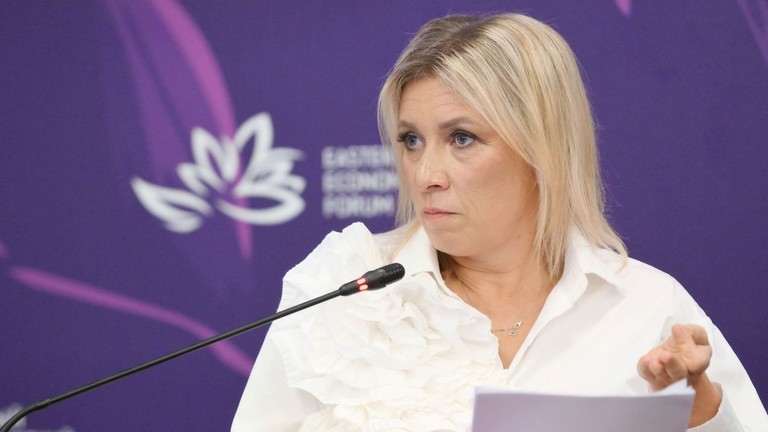
Russian Foreign Ministry spokeswoman Maria Zakharova © Ekaterina Chesnokova; RIA Novosti
RT | September 4, 2024
Russia will give an immediate and painful response to further acts of terrorism committed by Kiev, Russian Foreign Ministry spokeswoman Maria Zakharova warned on Wednesday, directing her comments to EU and NATO leaders.
Speaking on the sidelines of the Eastern Economic Forum (EEF) in Vladivostok, Zakharova stressed that Western leaders are “losing touch with reality” and are “absolutely not thinking about the risks of further dangerous escalation of the conflict, even in the context of their own interests.”
“We would like to warn such irresponsible politicians in the EU, NATO and across the ocean, that if the Kiev regime takes corresponding aggressive steps, Russia’s response will follow immediately,” Zakharova said, adding that this response will be “extremely painful” and that “much of this” has already been visible in recent days, apparently referring to Russia’s recent long-range strikes on targets across Ukraine.
Over the past several days the Russian Defense Ministry has reported carrying out a number of massive strikes on Ukrainian energy and defense-industry facilities, and claimed to have destroyed a number of buildings being used for the production and repair of aircraft, missiles, and UAVs, as well as storage sites, and deployment points for “nationalist formations and foreign mercenaries.” It also reported destroying a training facility housing foreign instructors.
During her address, Zakharova also suggested that Western officials have been ignorant of the potential consequences of their continued support of Kiev.
”I think the Europeans don’t fully understand what they are being dragged into,” the spokeswoman said. “They are being dragged in by the US, the Anglo-Saxons. It seems to me they haven’t yet understood what a plague they have created with their own hands in the form of the terrorist Kiev regime.”
Zakharova warned that the battalions that will be created from Ukrainian citizens recruited from Europe will eventually also strike back at Western European countries themselves. “They have fattened up there, sat it out, and recovered. They will strike in the same way as all international terrorist cells previously created by the West did,” she said.
“For the first time in history, Europe itself has given birth to an international terrorist cell,” the spokeswoman said, warning that “this terrorist monster will operate all over the world” and will strike Western Europe because “they always return to those who created them.”
Carrier Blues: Even the Mainstream is Waking Up
By Bill Buppert | The Libertarian Institute | September 3, 2024
The ice is breaking on the stonewalling of the defense community and external observers to have an honest conversation on the aircraft carrier; they may be getting the message on how indefensible and anachronistic this extraordinarily expensive weapons system is.
The Aircraft Carrier Industrial Base Coalition has already removed me from their Christmas card list.
More and more of the Coprophile Media is reluctantly waking up to the apparently intuitively obvious conclusion. The defense journalism industry, like the cultural critics in Hollywood, tend to be sycophantic and are very careful with criticism because then they lose the public relations contacts and open doors to the trillion dollar defense industry.
Thank goodness for the Congressional Research Service (CRS) and General Accountability Office (GAO) documentation and data palaces that show the keen observer what is really going on (even though I think the ground truth tends to be far worse than we even imagine).
I do wish a foundation with deep pockets or even Elon Musk would create a clearinghouse/analytical cell that goes through these mountains of data and evidence to show just how bad the American (and by extension, the Western) military establishment is. The US is not prepared to conduct a peer or near-peer war much less more than one conflict at the same time. And the trillions of dollars unaccounted for is another issue altogether.
Hence, America’s obsession with expensive and cumbersome aircraft carriers. The United States has not only committed to this weapons platform, but it has become a cultural symbol. That is why the cult of flat tops has taken hold to such a degree that to even point out that great state rivals, such as China and Russia, as well as the proxies for these nations, such as Iran or North Korea, have developed highly effective countermeasures is considered unpatriotic or worse, heretical. But this fixation on the carrier as more than just a weapons platform, as a cultural icon, is precisely what makes it such a terrible weapon to rely upon.
And then they say something in the major media that you dear readers know already.
Thus, Washington’s current war plans play right into China’s and Russia’s anti-access/area-denial (A2/AD) strategies. If actual war erupts between the United States or any of its major rivals, these forces will do what they must to win the war—and that means going-for-broke and trying to sink US carriers before they can become a serious threat to their forces and interests.
One way or another, thanks to the advent of hypersonic weapons and anti-ship missiles, such as China’s DF-21 series, American aircraft carriers will not be as effective against targets defended by these A2/AD systems.
In the history of human warfare, large exquisite platforms always attract plenty of attention from the Roman destruction of Gallic fortresses before the birth of Christ to the use of longbows to defeat very expensive heavy horse at Agincourt to the Maginot Line and battleship dead-ends in the twentieth century.
And everything in between throughout history. The carrier is the crossbow and chariot of the 21st century.
https://nationalinterest.org/blog/buzz/aircraft-carrier-age-could-end-disaster-us-navy-209915
The U.S. Navy’s other Pacific-based carriers are in port or in their maintenance availability period. Out of six carriers in the Pacific, the USS Carl Vinson recently participated in RIMPAC 2024, the USS Nimitz recently completed a six month planned incremental availability period for maintenance, the USS Ronald Reagan recently completed a homeport shift to Naval Base Kitsap, and the USS George Washington will remain in San Diego until the crew and equipment swap from USS Ronald Reagan is complete.
At least the carriers in port will be sunk in shallow water.
US Seeks “Super Weapons” to Reign as Sole Superpower
By Brian Berletic – New Eastern Outlook – 03.09.2024
The US openly declares that it seeks to maintain a monopoly over shaping the “international order” following the Cold War and America’s emergence from it as the sole superpower.
This policy is not new.
The New York Times in a 1992 article titled, “U.S. Strategy Plan Calls for Insuring No Rivals Develop,” would note that the Pentagon sought to create a world, “dominated by one superpower whose position can be perpetuated by constructive behavior and sufficient military might to deter any nation or group of nations from challenging American primacy.”
This policy set the stage for decades of US wars of aggression, political interference, regime change, US-sponsored terrorism, economic sanctions, and a growing confrontation directly between the US and a reemerging Russia as well as a rising China, all of which continue playing out to this day.
Emerging from the Cold War as the sole “superpower,” the US carefully cultivated public perception through likewise carefully chosen conflicts showcasing its military supremacy. While the US still to this day cites its wars with Iraq in 1990 and 2003 along with the toppling of the Libyan government in 2011 as proof of its uncontested military power, in truth, both targeted nations were not nearly as powerful or as dangerous as the Western media claimed at the time.
This facade has crumbled since. “American primacy” is now not only facing serious challenges, the premise it is based on – the notion that a single nation representing a fraction of the global population can or even should hold primacy over the rest of the planet – has been revealed as wholly unsustainable, if not self-destructive.
Not only is US military and economic power visibly waning, the military and economic power of China, Russia, and a growing number of other nations is rapidly growing.
The special interests within the US pursuing global primacy, do so in perpetual pursuit of wealth and power, often at the expense of many of the purposes a modern, functional nation-state exists to fulfill. Often this process includes the deliberate plundering of the key pillars of a modern nation-state’s power – industry, education, culture, and social harmony. This, in turn, only accelerates the collapse of US economic and military power.
Ukraine Lays Bare American Weakness
Washington’s proxy war in Ukraine has laid bare for the world to see this fundamental weakness. US weapons have proven less-than-capable against a peer adversary, Russia.
America’s expensive precision-guided artillery shells, rockets, and missiles were built in smaller numbers than their conventional counterparts, supposedly because they could achieve with just one round what several conventional rounds could. A single US-made 155 mm GPS-guided Excalibur artillery shell, for example, is claimed by Raytheon to achieve what would otherwise require 10 conventional artillery shells.
This myth of quality over quantity has unraveled on and over the battlefield in Ukraine. Russia is not only capable of producing vastly more conventional weapons than the US and its European proxies, it is able to produce vastly more high-tech precision-guided weapons as well, including its own precision-guided artillery shells (the laser-guided Krasnopol), precision-guided multiple launch artillery systems (the Tornado-S), as well as larger quantities of ballistic and cruise missiles (Iskander, Kalibr, and Kh-101).
In other areas, Russia possesses capabilities the US does not have. Russia fields two types of hypersonic missiles, the Kinzhal hypersonic ballistic missile and the Zircon hypersonic cruise missile. Russia also possesses air and missile defense as well as electronic warfare capabilities the US cannot match – not in quality, not in quantity.
If the US is unable to match or exceed the military industrial output of Russia at the expense of losing its proxy war in Eastern Europe, how will US design to encircle and contain China along China’s own coasts unfold?
Growing Disparity and the Super Weapons Sought to Overcome it
The US military fears that any conflict with China would leave the US unprepared and vulnerable. A recent article in Defense One titled, “The Air Force wants to build lots of bases around the Pacific. But it still needs to determine how to protect them,” admits that US air and missile defense systems are too expensive and too few in number to defend the growing number of US military bases being established ahead of potential war with China.
It should be remembered, however, that shortages of US air and missile defense systems, particularly the Patriot missile system, began before the US began sending the systems to Ukraine. US military industrial output was unable to keep up with the demands of just Saudi Arabia amid its conflict with Ansar Allah in Yemen.
Similar concerns exist regarding the number of US military aircraft, naval vessels, and the missiles each will depend on in any potential conflict with China in the Asia-Pacific.
Understanding the large and growing disparity between US ambitions toward global primacy and its actual military means to achieve it, Washington and US-based arms manufacturers are seeking a new design and production philosophy to produce a new generation of cheaper and more numerous munitions.
At the forefront of this effort are “start-up” arms manufacturers, including Ares and Anduril. Both companies believe the US is capable of out-innovating China, based on the notion that the US is somehow inherently more innovative than China. However, their attempts to address this growing disparity reveal how disconnected US foreign policy is from the actual world it seeks to dominate.
Ares: Cheaper but More Numerous Missiles…
The War Zone in an article titled, “New ‘Cheap’ Cruise Missile Concept Flight Tested By Silicon Valley-Backed Start-Up,” explains how Ares seeks to augment America’s existing arsenal of expensive but scarce long-range precision guided missiles with smaller, cheaper, and more numerous missiles.
The smaller, cheaper missiles will be less capable than their more expensive counterparts, including Raytheon’s Tomahawk cruise missile and Lockheed Martin’s Joint Air-to-Surface Standoff Missile (JASSM), but are meant to be produced in larger quantities. The cheaper Ares-built missiles will be used for lower-priority targets, while their more capable but less numerous counterparts are used for critical targets.
The article claims:
Ares does not yet appear to have released any hard specifications, current or planned, but says that it is targeting a $300,000 unit cost for its missiles.
In addition to how far off from reality Ares’ missiles actually are from seeing the battlefield, even the stated goal of building these missiles for $300,000 each seems to fall far short of the sort of revolutionary innovation required to meet or exceed even Russia’s military industrial production, let alone China’s.
This is because according to even Ukrainian-based media, Russia itself is already producing far more capable missiles for as cheap as $300,000 per unit. Defence Express in a 2022 article titled, “What is the Real Price of russian Missiles: About the Cost of ‘Kalibr’, Kh-101 and ‘Iskander’ Missiles,” would place the cost of a Kalibr cruise missile somewhere between $300,000 and $1 million – vastly cheaper than comparable missiles produced in the West.
While the 2022 article was easy to dismiss at the time amid Western headlines claiming Russian missile stockpiles were exhausted, since then it has been admitted by the same Western media that Russia is firing over 4,000 missiles at targets across Ukraine each year. This suggests Russian missile production is as economical as it is vast.
Thus, even before Ares produces its first missile, the very premise of what it is trying to achieve falls far short of what Russia’s military industrial base is already doing on a vast scale, saying nothing of what China’s military industrial base is capable of.
There is also the reality that in addition to higher-end munitions costing as little as Ares’ proposed lower-end missiles, both Russia and China are perfectly capable of augmenting their existing arsenals with cheaper, less-sophisticated munitions as well.
Russia’s deployment of its UMPK-fitted FAB series glide bomb is a perfect example of this. The guided glide bombs went from concept to mass production over the course of the Special Military Operation, with improvements made based on their performance in combat, providing a cheaper, more numerous, yet still effective alternative to more expensive long-range precision-guided munitions.
In many ways, what Ares is attempting to do is a poor imitation of what Russia and China have already done and will continue doing.
Anduril: Out-Innovating China and Russia…
Like Ares, US-based arms manufacturer Anduril imagines cheaper and more numerous systems can help even the odds as Russia out-produces the West amid the conflict in Ukraine and as China’s production of warplanes, ships, and missiles surpasses the US and its European proxies.
Anduril proposes achieving this through “software-defined manufacturing,” a process it claims allowed electric vehicle manufacturer Tesla to build better and more numerous vehicles than legacy car manufacturers by building its vehicles around its own in-house software and electronics.
The advantage is clear. Legacy car manufacturers build the physical cars themselves, but many of the subsystems are outsourced to other companies, including the operating systems used by modern cars, as well as sensors and other electronic components and systems. Often this collection of software, sensors, and other components is outsourced to a large number of different companies. Any change in the car’s design requires working with this large number of companies, making modifications and improvements cumbersome.
By including all subsystems within a single in-house developed software and building the hardware around it, changes can be done faster and larger quantities of higher-quality cars can be made more rapidly as a result.
Anduril imagines using this same process to build vast numbers of drones, missiles, and other weapons and munitions, matching or even outpacing China. The problem for Anduril is that software-defined manufacturing is already extensively used by China’s vast and advanced industrial base. With this “advantage” rendered moot, the US finds itself again at a severe disadvantage. Not only is China capable of producing conventional military arms, ammunition, and equipment in vastly greater quantities than the US, it is also able to build advanced, rapidly improved, software-defined systems like drones and missiles.
This means anything the US attempts to do, China is capable of doing better and on a vastly greater scale.
Flawed Premise, Doomed Outcome
The premise Ares and Anduril operate from is fundamentally flawed. Both companies, like the circles of special interests they serve on Wall Street and in Washington, believe the US is inherently superior to adversaries like Russia and China. In their collective minds, any disadvantage the US finds itself with is incidental and overcoming it merely a matter of summoning sufficient political will. Russia and China having larger and more capable industrial bases is seen as a temporary lapse in America’s own political focus and willpower, and by taking steps to expand America’s own industrial base, the US will inevitably find itself on top again.
In reality, Russia and China’s industrial bases are larger than America’s because of a number of factors, including factors no amount of American political will, can overcome. China in particular has a population four times greater than the US. China graduates millions more each year in the fields of science, technology, engineering, and mathematics than the US, and the physical size of its industrial base – military or otherwise – reflects this demographic disparity.
Even if the US had the political will to reform its military industrial base, stripping away profit-driven private industry and replacing it with purpose-driven state-owned enterprises, even if the US likewise transformed its education system to produce a skilled workforce rather than squeeze every penny from American students, and even if the US invested in its national infrastructure – a fundamental prerequisite for expanding its industrial base – it still faces a reality where China has already done all of this, and done so with a population larger than it and its G7 partners combined.
The premise that the US, representing less than 5% of the global population, should maintain primacy over the other 95% is fundamentally flawed.
Unless Americans were truly, inherently superior to the rest of the world, which they are not, achieving primacy over the world can only be done by dividing and destroying the other 95% of the world’s population. In many ways, this is what has defined generations of Western hegemony over the planet and is what Washington has set out to do today.
Despite this, the rest of the world has caught up in terms of economic and military power, precisely because the US is not inherently superior. Western hegemony was a historical anomaly, not proof of the West’s superiority. With the rest of the world having caught up in terms of economic and military power, and with numbers on their side, the next century will be determined by a multipolar world.
For this emerging multipolar world, the factors that have given it rise – a geopolitical balance of power built on cooperation over conflict, industry and infrastructure driven by purpose over profit, and progress built by practical education and hard work over the blind pursuit of power-must be firmly cemented as the fundamental principles of this new world.
Should the multipolar world weather US attempts to divide and destroy it and continue investing in the principles that gave rise to it in the first place, no type of US-made super-weapon can overcome it.
Brian Berletic is a Bangkok-based geopolitical researcher and writer.
Germany faces political upheaval after historic AfD win
By Dénes Albert | Remix News | September 3, 2024
While the Alternative for Germany (AfD) is the big winner in Sunday’s German state elections, but it is unlikely to change the course of Germany on the national level over the short-term, even if the AfD’s policies could gain ground locally. Still, there are reasons to believe we could see long-term changes on the horizon.
While the AfD is still contained behind the firewall, the results in Thuringia and Saxony effectively “toppled” the governing coalition, and alongside the AfD, a new party, the Sahra Wagenknecht Alliance (BSW) has also become visible on the political scene.
Bence Bauer, director of the Hungarian-German Institute, explained this by saying that both the AfD and BSW agreed on most of the three major issues. These are the migration issue, Germany’s misguided Ukraine and arms transfer policy, and the economic policy vis-à-vis the German government.
With the German government in a very bad position, the AfD and BSW parties were able to ride the social discontent very well, to formulate an alternative.
“This is especially a great success for Sahra Wagenknecht, whose party is eight months old,” Bence Bauer stressed.
Based on initial statements, she would be willing to cooperate with the CDU, but Sahra Wagenknecht is demanding a very high price.
“It’s essentially about changing the CDU’s war policy,” said Samuel Ágoston Mráz, head of the Nézőpont Institute. However, he added, it could be a ploy on her part, as she has no intention for the CDU to actually accept her proposal. In short, it may not be an acceptable demand from the CDU just to form a state government.
Wagenknecht knows that the CDU is looking to 2025, and the east is not their top priority. After all, a Thuringia of only 2 million in a Germany of 80 million cannot be so important that it jeopardizes its showing next year in federal elections.
Another reason to not ultimately strike a deal with BSW is the fact that if BSW gets into government at the state level, this party could take root in the German system. Sahra Wagenknecht is now in two state parliaments, and if she gets into government, that will give her great potential for growth.
“I expect a protracted government formation,” added Mraz Ágoston Samuel. In this context, he recalled the claims that “the German economy will be ruined if the AFD comes close to power.” That is why Samuel believes the “firewall” will remain in place against the AfD.
“There will certainly be protracted coalition talks, I agree that the firewall will remain,” said Zoltán Kiszelly, director of political analysis at the Századvég Centre for Public Policy Studies. As he told our paper, the recent state elections in Germany seemed to be dominated by national issues, showing how dissatisfied voters are with the government. Of the mainstream parties, the CDU has held up best, but it remains to be seen what kind of alliances they will find.
Anti-Establishment Parties Have Triumphed in Germany’s Regional Elections
By Ekaterina Blinova – Sputnik – 02.09.2024
The Eurosceptic party, Alternative for Germany (AfD), won a regional ballot for the first time, surpassing Scholz’s ruling coalition.
AfD secured 32.8% in Thuringia, leading the race, followed by the Christian Democratic Union (CDU) with 23.6%, according to exit polls.
In Saxony, the Eurosceptic party garnered 30.6%, losing to the CDU by a narrow margin.
The Sahra Wagenknecht Alliance (BSW) claimed third place in both races, with 15.8% in Thuringia and 11.8% in Saxony.
Scholz’s “traffic-light” coalition of Social Democrats (SPD), the Greens, and the Free Democrats (FDP) performed poorly. The FDP failed to reach the 5% threshold required to enter either regional legislature, and the Greens did not make it into the parliament in Thuringia.
SPD received 6.1% and 7.3% in Thuringia and Saxony, respectively.
“We are ready to take on government responsibility,” AfD leader in Thuringia, Bjorn Hocke, declared, celebrating what he called a “historic victory.”
Omid Nouripour, co-leader of the Greens, lamented the outcome and described it as “a profound turning point” in German history.
The AfD’s victory sparked a heated debate, with mainstream Western media warning that Germany’s political center is “crumbling” ahead of the next federal election in September 2025. Some outlets noted that Scholz have been “humbled” by the German right-wing party.
Others highlighted the rise of anti-establishment parties in Germany, acknowledging that both AfD and BSW, which advocate halting arms supplies to Ukraine, and imposing immigration controls, have performed notably well.
Point of No Return in Middle East & Ukraine
Odysee
John Mearsheimer, Alexander Mercouris & Glenn Diesen | August 30, 2024
I had a discussion with Professor John Mearsheimer and Alexander Mercouris about the political West being on the brink of two major wars. Both Israel and Ukraine are fighting wars they cannot win, both are doubling down through reckless escalation, and neither is pursuing a diplomatic path to a peaceful resolution.
Consequently, both Israel and Ukraine are desperately seeking to drag the US into a wider war as the only solution. With incremental escalation, no diplomacy and the absence of serious discussions about the deep trouble we are now in – both Israel and Ukraine are successfully getting the US increasingly involved.
Mali Alarmed That Weapons Supplied to Ukraine Fuel Terrorism in Sahel Region – Envoy to UN
Sputnik – 30.08.2024
UNITED NATIONS – Mali is alarmed that the weapons supplied to Ukraine by the collective West are ultimately fueling terrorism in the Sahel region, Malian Ambassador to the United Nations Oumar Daou said in Friday.
“The government of Mali would like to express its alarm with regard to the supply of weapons to Ukraine, because it’s been clearly established that a good part of the weapons … end up fueling terrorism and crime in the Sahel,” Daou said during a meeting of the UN Security Council.
The Malian ambassador also said that the weapons deliveries carry the risk of further destabilizing countries in Africa and exacerbate the suffering of the Malian people, who have already been “sorely tested by several years of conflict with dramatic consequences.”
French media, citing a Malian military source, reported in early August that terrorists from the Malian armed separatist groups traveled to Ukraine to receive training there.
Featured Video

Yemen joins the war – Red Sea could be blocked next – Saudi regime at risk
or go to
Aletho News Archives – Video-Images
From the Archives
A superpower and “the world’s sickest warrior state”
By Paul J. Balles | March 8, 2010
Living through five or six major wars has hardened me to what I thought were the extremes of inhuman cruelty and brutality.
Two things made those extremes almost bearable: the brutality always revealed – at least according to the media coverage – the viciousness of the enemy. It was therefore quite understandable when our “brave men and women” pulverized the enemy.
Films of Japanese torturing captive Americans somehow justified holding Japanese Americans in internment camps during World War II; and only a small percentage of Americans found the bombing of Hiroshima and Nagasaki unreasonably vengeful at best, at worst, depraved.
The media giants in America portrayed the North Koreans as barbaric beasts with their captives, quite unlike their southern counterpoints – our allies during the Korean War. No one ever felt the need to explain how the South Koreans were a civilized breed while the North Koreans were absolute savages, at least according to the official line.
In Vietnam, our warriors justifiably (or so the media made us believe) dropped napalm on the North Vietnamese who had the gall to hide in villages and tunnels to ravage our invaders. At least it was accepted practice until some rogue photojournalist filmed a young girl screaming down a Vietnamese road in flames. … continue
Blog Roll
 Aletho News
- America Racing to Strategic Defeat in Iran: Lt Col Daniel Davis
- FTC Warns Visa, Mastercard, PayPal, Stripe Over Political Debanking
- Russian tanker approaches Cuba despite US oil blockade
- Marandi: Yemen joins the war – Red Sea could be blocked next – Saudi regime at risk
- Pro-Palestinian French member of European Parliament denied entry to Canada
- Pakistan to Host US-Iran Talks
- How Indonesia’s tilt toward the US left it stranded in the Strait of Hormuz
- US has no choice but to retreat from Iranian borders: Top commander
- Iran Retaliation Strikes Chemical Plant Near Dimona
- AWACS’ Destruction is a Major Loss for US Military – Ex-DoW Analyst
- If Americans Knew
- Israeli police block Catholic cardinal from entering Church of the Holy Sepulchre on Palm Sunday
- Israel is assassinating journalists again, more than any other nation, anywhere, ever – Not a ceasefire Day 170
- Over 300 US service members wounded, majority have brain injuries – Not a ceasefire Day 169
- Researchers at Human Rights Watch Resign Over Blocked Report on Palestinian Refugee Return
- Jewish Groups Are Backing a War Americans Don’t Want
- Eric Fingerhut Thinks He’s the President of the Jews
- Top Jewish Philanthropists, Rabbis Urge Israeli President to Take Action Against ‘Jewish Extremists’
- Don’t Be Fooled. Zionist Leaders Have Always Wanted to Control Southern Lebanon
- Israel’s widespread use of torture is a core element of its genocide against the Palestinian people
- In Israel’s War on Iran, Many Middle East US Bases Rendered “All But Uninhabitable”
- No Tricks Zone
- New Study Finds Warming Saves Lives…Cold Temperatures 12 Times More Deadly Than Excess Heat
- German Science Blog Accuses PIK Climate Institute Of Hallucinating Climate Tipping Points
- Devastating Assessment Of Comirnaty Vaccine By Former Senior Pfizer Europe Toxicologist
- New Study: CO2 Is ‘Effectively Negligible’ As An Explanatory Climate Change Factor Since 2000
- Former Pfizer Toxicologist Dr. Helmut Sterz Tells Bundestag Hearing Pfizer Vaccine Should Have Never Been Approved
- Energy Expert: Germany’s Nuclear Phaseout Was A “500 Billion Euro Mistake”
- New Research: South Australia’s Mid-Holocene Sea Surface Temperatures Were 4°C Warmer Than Today
- Storing Green Energy To Last Germany 10 Days Would Require A 60-Million Tonne Battery
- New Studies: UK Sea Levels Were 4 Meters Higher Than Today During The Mid-Holocene
- Destructive Green New Deal: German Energy And Metal Group Warns Of Drastic Crisis
 Aletho News