To preserve the international system based on US hegemony, the US has to prevent the rise of other centres of power. The China-Russia partnership has become the key challenge to US hegemony. The strategy by the Biden administration was to use Ukraine in a proxy war against Russia to knock it out from the ranks of great powers, so the US could focus on China. As NATO lost the proxy war, the US began shifting toward a new strategy of winning Russia over to its side of the ledger and creating some divisions between Russia and China.
The end of February marks three years since the start of Russia’s special military operation in Ukraine and 11 years since the ‘Euromaidan’ coup of February 2014. The coup was the main cause of the current military conflict.
The war in the now-former eastern territories of Ukraine could have been avoided had two successive presidencies in Kiev (Petro Poroshenko, 2014-2019 and Volodomyr Zelensky since 2019) complied with the Minsk 2 peace agreement of February 2015. Minsk 2 (text here), was agreed by Kiev and the pro-autonomy forces in the Donbass region on February 12, 2015. France, Germany, and Russia co-signed the agreement as guarantors. The agreement was unanimously endorsed by no less than the UN Security Council on February 17, 2015.
Minsk 2 envisioned the return of Lugansk and Donetsk (the two rebellious ‘peoples republics’ of the industrialized Donbass region) to the fold of the Ukrainian constitution, this time as semi-autonomous oblasts (provinces). Kiev also agreed to a neutral status for Ukraine. It could apply for membership in the European Union if it chose, but membership in the NATO military alliance was for Russia a non-starter.
EU membership increasingly became a goal of Western-oriented business interests in Ukraine during the decade of the 2000s. That decade followed 10 years of sharp economic decline following the dissolution in 1989-90 of Soviet Ukraine and of the Soviet Union (USSR, of which Soviet Ukraine was a key constituent).
Tragically for the people of post-Soviet Ukraine, the Western countries, particularly the leading powers of NATO, quietly and deceptively opposed Minsk 2. They worked quietly from the get-go to sabotage the agreement.
Deception of Ukrainians by the West
On February 12, 2025, the deputy secretary of the Russian Security Council, Aleksey Shevtsov, spoke on the ninth anniversary of the signing of Minsk 2, explaining once again to those who would listen that Russia’s special military operation in Ukraine would never have happened had the West honored the agreement. He stressed that the people of Ukraine today have every right to demand an accounting for the deceptions that took place in 2015 and after.
On the same day, the Ukrainian online publication Strana published a lengthy commentary in its Telegram messaging service headlined, ‘Why did the Minsk agreement fail?’ Strana wrote, “Russia says that Kiev deliberately refused to fulfill the conditions of the Minsk 2 agreement and instead proceeded to rearm its army and restart armed attacks against the people of Donbass. The Russian government says it can no longer trust the government in Kiev and so there is no possibility of a ‘Minsk 3’.” (‘Minsk 1’ was a first attempt, in September 2014, by the pro-autonomy forces of Donbass to reach a peace agreement with the new administration in Kiev.)
Strana wrote further, “Russia did not launch a full-scale invasion of Ukraine in 2014 or 2015. Perhaps it wanted to, who knows, but it could not do so because it would have been hit with harsh economic sanctions similar to those levied against it by the Western powers beginning in February 2022. It would have faced economic sanctions worse than those initially levied against it following the Crimea referendum of March 2014. The Russian economy was in no shape to easily withstand such sanctions, in contrast to the situation in 2022.
“Additionally, although the Ukrainian army back then was much weaker compared to 2022, this was also the case for the Russian army.”
In their recollections of the events of those years, leaders of today’s Donetsk Peoples Republic (today a constituent of the Russian Federation) say that the main opponent of a major military response to Kiev’s continued military provocations and sabotage of Minsk 2 was the Russian military. Russian military leaders said at the time that the Russian Federation did not have enough combat-ready troops to take on such a large and industrial country as Ukraine.
“From a purely military point of view, the rapid success of Russia in Crimea in the spring of 2014 was due to the fact that Russian troops were already present on the Crimean peninsula [by virtue of a 1997 agreement between Russia and Ukraine; see Wikipedia on the subject]. They needed no time to deploy, and they prevented armed attacks being threatened by the paramilitaries of the new administration in Kiev. At the time, there were no large military formations of the Russian Federation along the lengthy Russian-Ukrainian border. Donbass’s self-defense forces only began to form in the late spring of 2014 and it was several years before they were integrated as auxiliaries of the Russian armed forces.”
As Russian sources stated at the time, the initial military defense that arose in the Donetsk and Lugansk oblasts of Ukraine against the paramilitaries of the 2014 coup bore the markings of a military adventure and were not at all coordinated with the political leadership of the Russian Federation. The self-defense forces hoped to convince or pressure Russia to join a war of defense for which Russia was not ready, not politically, economically nor militarily.
What the Western-incited war in Ukraine has wrought
In the lead-up to and since the 2014 coup, western and central Ukraine has been living the fate of a battering ram to be used by the Western imperialist powers to weaken Russia, regardless of the tragic human consequences and of the prospect of Ukraine being cast off once it is no longer needed for such a role. The results of this cruel and heinous policy are increasingly evident as graveyards continue to spread on Ukraine’s territory with each passing day.
The Politnavigator media outlet explained (as reported on Telegram on February 1) the consequences of such policy for the mortals conscripted into war, many against their will. The report cites Anton Cherny, an officer of the Armed Forces of Ukraine. He explains, “We are being lied to about the value of our soldiers’ lives. I watched the speech of our commander-in-chief that every soldier is valuable to Ukraine and worth his weight in gold. That’s what they tell the people, but it’s not true.”
Cherny says that 90% of the soldiers who die or succumb to injuries on the battlefields are simply buried there and then officially listed as missing. “Everyone there knows perfectly well what is happening.” And the indignities do not end there. The families of those reported as ‘missing’ do not receive the financial compensation to which they are entitled.
Cherny also explains that it is extremely difficult for surviving fighters to exit the grim fighting along the front lines. “It’s hard to get out of there by yourself, it’s unrealistic. How lucky it would be if there were fog, very big snow or some other bad weather.” He explains that Ukrainian lines are under constant surveillance from drones flying overhead. As soon as evacuation vehicles approach from the Ukraine side, the drones threaten to strike them, making it very difficult to evacuate the injured or the dead from the various battlefields.
Politnavigator continues its report:
‘The army doesn’t provide guidelines or instructions for soldiers to somehow make their tasks easier. Its words to this effect are just talk. Soldiers are told to go here or there and ‘do’ something, but as to what, where and why, you have to be some kind of superman to figure it out. It’s unreal,’ Cherny says indignantly.
Provoking the sleeping bear of Russia
Radical nationalist and neo-Nazi paramilitaries operating under the control of Kiev’s police and special services waged nine years of military conflict and terrorist attacks against civilians in Donbass from 2014 to 2021. This was bound to provoke a reaction from the Russian Federation sooner rather than later, as any serious commentator knew and reported.
Ukrainian commentators were writing more than three years ago that Kiev’s deployments of paramilitaries in Donbass and its turning a blind eye to their crimes, backed by promises of weapons by belligerent Western governments, would inevitably provoke Russia into responding, as though provoking a bear with a stick. The weapons of Ukraine, many provided by the West, did indeed, predictably, awaken the bear, and angrily.
In early February 2025, the prime minister of neighboring Georgia, Irakli Kobakhidze, told journalists that back in 2022, his country’s then-government was being encouraged by the West to open a ‘second front’ against Russia. The country was to be used just as Ukraine was being used. According to the Kobakhidze, Georgian officials of the day were told a fable by the Western powers to convince them to act. “They said Ukraine is winning the war; you should not miss this chance to strike against Russia.”
Kobakhidze believes it will now take Ukraine 100 years to return to a state of development comparable where it was prior to the 2014. He asks, “Why was all this done? No one is offering a clear answer to this question. However, there is an answer: some global interests, evil interests, have sacrificed our friendly country Ukraine.”
Full-fledged dictatorship
The eleven years that have elapsed since the Euromaidan coup of 2014 have been years of Ukraine sliding inexorably towards dictatorship, all the while accompanied by rosy phrases from EU leaders claiming that a ‘triumph of democracy’ was taking place. The ideology of Nazism from the World War II era has been officially rehabilitated, while opponents of this course have been targeted by armed, ultra-nationalists and neo-Nazis.
All left-wing parties in Ukraine have been banned. Some of their members and leaders have been killed, while many more have been forced into exile. Protests against, and critics of, the ‘pro-European’ dictatorship in Kiev have been targeted for repression. The Western powers have turned a blind eye to the crimes being committed, while United Nations officials have occasionally issued toothless resolutions expressing ‘concern’ about the civil rights being violated.
In 2021, Zelensky banned more political parties critical of his government, and he closed all television channels deemed non-compliant with his policies. No court or other legal reviews of these decisions have taken place.
With the outbreak of war in February 2022, Zelensky imposed martial law and then canceled national elections for the presidency and the legislature (Rada). These were to take place no later than April 2024, according to the Ukraine constitution. Zelensky has said that Ukraine cannot hold elections until it has fully regained control over its former territories. Since this would be impossible to achieve, his statements on the matter mean that for all intents and purposes, elections will not take place in the remaining territories held by Kiev. Period.
Alexander Dubinsky, a former associate of Zelensky jailed by his administration, writes that the war became for Zelensky an escape from the social explosion building up inside the country and appearing inevitable by the end of 2021. “I think this largely determined why Zelensky promoted military rhetoric in every possible way, and why in March 2022 he ceded to Western government pressures to draw back from a political settlement with the Russian Federation.”
For Dubinsky, the end of the war would mean a loss of political power by Zelensky and his cohorts, and this, in turn, would expose them to direct conflict with all the enemies he has managed to make. He may be able to protect himself from the widows and mothers of the deceased, reasons Dubinsky, but not from the violent, ‘serious men’ who have proliferated under his government.
Detention camps using torture methods under Zelensky
Every day, more and more facts are emerging in Ukraine about the detention camps that Zelensky has created in order to sustain its power and continue the NATO proxy war.
In January, legislator Oleksandr Dubinskyy urged Ukrainians to report to U.S. authorities about the detention camps that the Security Service of Ukraine (SBU) has organized, notably for the purpose of forcing accused conscription evaders to confess to accusations of state treason. According to him, the SBU detention camps are prototypes of what Ukraine as a whole has become under Zelensky.
Dubinskyy has been detained since November 2023 under accusations of financial crimes and treason. He has recently announced from detention his intention to run for president of Ukraine if and when a national election takes place.
Another former associate of Zelensky, legislator Artem Dmytruk, wrote on Telegram on January 30 that the entire special corps of the Lukyanivske pre-trial detention center in Kiev should be called a concentration camp and named ‘Zelensky’s Factory’. Legislators Oleksandr Dubinsky and Yevhen Shevchenko are among those imprisoned there. “90|% of detainees in this center face charges by the office of the expired president Zelensky.”
Dmytruk fled to Britain in August 2024 shortly after he was the only deputy in the Rada to speak and vote against a new law banning the Ukrainian Orthodox Church, of which he is a subdeacon.
The Ukrainian magazine Liberalpublished a lengthy report in February saying that individuals and political formations connected to the Zelensky administration are the only ones in Ukraine not talking about political repression prevailing today in the country.
The authors claim that extensive political repression was being prepared and carried out well before the start of the Russian military intervention in February 2022. According to the publication, thousands of SBU employees were sent to border regions on the eve of the Russian intervention to monitor troop morale and other measures of the military situation.
At the same time, Kiev began to address its shortages of police and prison personnel in Kiev and other regions by recruiting ‘trained athletes’ into the ranks of the SBU after completing three-month courses in western Ukraine. ‘Trained athletes’ is a euphemism in Ukraine for members of criminal gangs.
“Thousands of bone-crackers performing police functions inside the country spread out without the slightest remorse to beat testimony out of Ukrainians using the most brutal forms of violence and creating torture institutions such as the famous ‘Sports Hall’ on Volodymyrska Street [in the center of Kiev],” writes Liberal.
“People were lying on floors, deprived of the right to move and subjected to constant beatings and humiliation. The Ukrainian anthem and nationalist songs were played continuously from loudspeakers. The eyes of the prisoners would be taped shut with duct tape or tied with rags, and they were taken to the toilet only once a day. They were also fed very sparingly, once per day.”
The authors note that political prisoners now account for about half of the prisoners in Ukraine. The main motives for many SBU officers, Liberal notes, have not been security concerns but the robbery of suspects. Detainees have been forced to surrender their personal wealth upon arrest and detention.
Two reports in English on prison conditions in Ukraine were published in 2024, one by a Danish government agency (110 pages) and one by an agency of the Council of Europe (46 pages). Both reports skirt incendiary accusations such as the one published by Liberal and the many ones appearing widely on social media.
On February 12, a German court for the first time approved the extradition of a conscientious objector to military service who had fled Ukraine. Ukraine prohibits men of military age (age 25 to 55, 60 for officers) from leaving the country. Many of the fugitives from Ukraine’s compulsory conscription have chosen to flee to Germany, attracted by Germany’s claimed liberal values. This court decision is the first warning sign that the authorities of European Union countries may begin to conduct forced deportations of the Ukrainian men who have managed by hook or by crook to escape from their homeland’s military conscription. It is reported that in 2024, there are some 200,000 Ukrainian men residing in Germany alone.
Back in September 2022, President of the EU Commission Ursula von der Leyen gave a speech during the State of the Union Address. At the time, she said the following:
“Europe’s solidarity with Ukraine will remain unshakeable. From day one, Europe has stood at Ukraine’s side. With weapons. With funds. With hospitality for refugees.
Russia’s financial sector is on life-support. We have cut off three quarters of Russia’s banking sector from international markets. Nearly one thousand international companies have left the country. The production of cars fell by three-quarters compared to last year. Aeroflot is grounding planes because there are no more spare parts. The Russian military is taking chips from dishwashers and refrigerators to fix their military hardware, because they ran out of semiconductors. Russia’s industry is in tatters.
It is the Kremlin that has put Russia’s economy on the path to oblivion.
The same is true for our financial support to Ukraine. So far Team Europe have provided more than 19 billion euros in financial assistance. And this is without counting our military support. And we are in it for the long haul.”
Fast forward to January this year and here’s what the new NATO Secretary General Mark Rutte had to say at the EU Parliament’s Committee on Foreign Affairs and Subcommittee on Security and Defense:
“When you look what Russia is producing now in three months, it’s what all of NATO is producing from Los Angeles up to Ankara in a full year.”
To better understand the sheer dichotomy of these two statements, here’s a video of both saying it out loud. For the last three years, all of us “conspiracy theorists” from truly independent media (not USAID-style “independent”) have been talking about these disparities between reality and endless myths facilitated by the mainstream propaganda machine. This also explains why we have been able to predict outcomes with far greater precision than anyone in Western media.
The reason for this is that we deal with facts, whether anyone likes them or not, and then we use scientific methods to come to viable conclusions. On the other hand, the political West created a massive echo chamber of endless self-quoting while engaging in the so-called “fact-checking” in an attempt to flag any information that’s not within their ludicrous narratives.
However, NATO still insists on the same long-debunked self-serving myths and outright lies. Namely, Rutte also said that “Russia is not bigger than the Netherlands and Belgium combined as an economy, the two of you together is the Russian economy, and they’re producing in three months what the whole of NATO is producing in the year”. When one claims that the economies of Belgium and the Netherlands are of the same size as Russia’s, it means they either have extreme difficulties with basic understanding of anything or are simply engaged in the most laughable propaganda in recent memory. Namely, Rutte is obviously referring to the nominal GDP, a metric that is often used by the political West to pat itself on the back by waving papers “proving” its supposed “economic superiority” over the entire world.
However, in an analysis of recent Russian military reforms and the resulting budget, I’ve argued that Moscow’s actual defense spending exceeds the equivalent of half a trillion US dollars. How else could one possibly explain Russia’s ability to not only defeat NATO’s crawling “Barbarossa 2.0”, but to also outproduce the world’s most vile racketeering cartel by three or even four times? Who in their right mind could believe that an economy the size of Benelux can outpace the production economies of a billion people living under NATO occupation? What’s more, Rutte himself admitted this indirectly by saying that “when you compare Russian numbers, what you can buy in Russia for the same money is, of course, much more”. He still attributed this to “our high salaries” or “our [massive] bureaucracy”, but conceded that “[Russia] can move at a higher speed”.
Rutte still insisted that the Kremlin “basically created a war economy” and that “the whole industry is now on a war footing”. However, this is not true. Russia is still maintaining a robust economic production, while Russian society is not as affected as the political West claims. All state institutions continue to function as usual, while economic activity is booming, as the sanctions siege resulted in the creation and/or growth of entire industrial sectors that either didn’t exist at all or were fairly small. The Russian market is the single largest in Europe and one of the largest in the world. Its needs didn’t just vanish into thin air when the US and EU/NATO launched their economic siege. Moscow’s carefully implemented import substitution programs have resulted in a massive boost for the domestic production economy.
The results have been staggering, to say the least. In just a few months of 2023, Russia overtook both Germany and Japan, becoming the fourth-largest economy in the world, which is perfectly in line with its ability to counter the entire political West. In addition, throughout 2024, it consistently outpaced both the US and EU in economic growth, despite waging a defensive war against NATO aggression.
Rutte himself confirmed this (albeit not without infusing more laughable propaganda) by saying that NATO “shouldn’t compare [Russian] 8% or 9% defense spending, 1/3 of the 8% or 9% of GDP, 1/3 of the whole state budget being spent on defense”, also adding that “when you cobble it all together, it might be less than what the European NATO is doing, but again, you can buy so much more, do so much more”.
This “much more” results from genuine differences between nominal and real GDP, but nobody in NATO will ever admit this publicly, as it would destroy their endless propaganda narratives. The entire notion of the “superior West” would collapse like a house of cards, which would rattle up the already disturbed North American and European societies. What’s more, even the strategic unity of the political West hangs in the balance as the new Trump administration is looking to either eliminate or drastically reform all Deep State-aligned institutions, be it domestic or “international”. In the case of the latter, this includes both NATO and the EU (as its geopolitical pendant). To that end, Washington DC is trying to appease Moscow, with Trump even saying he wants to ease the official UN General Assembly rhetoric about the “unprovoked Russian aggression”.
The obvious goal of this is to slow down the definite formation of a multipolar security architecture that would prevent the political West’s aggression against the world. However, while Russia and its leadership certainly welcome the defusing of tensions between the world’s two most potent military powers, it’s simply impossible that Moscow would ever sacrifice its role as one of the leaders of multipolarity for the sake of the US/NATO. That train left the station well over a decade ago.
America is Russia’s strategic adversary and this fact won’t change any time soon (if ever). However, if this confrontation between the two superpowers can be controlled to avoid a direct world-ending war, the Kremlin will certainly embrace this idea. It would be best for the entire political West to do the same (provided it really wants to survive).
As for the results of the special military operation (SMO), there have been analyses for the occasion of the two previous anniversaries. Among the things debunked in one of those is the myth that Russia wanted to “take Kiev in three days”, based on statements by former US top general Mark Milley.
However, while this claim sounded completely unrealistic, what would seem even more unlikely is that the Kremlin could inflict a crushing strategic defeat on the entire NATO in just three years. Well, it seems that’s precisely what we’re witnessing now. Moscow tried its best to resolve these issues diplomatically, but the political West understands nothing but the language of force. After centuries of barbaric aggression against the world, it seems it has completely lost touch with the civilized ways and is suffering the consequences.
Drago Bosnic is an independent geopolitical and military analyst.
The Ukraine conflict was “provoked” and it is wrong to solely blame Russia, Steve Witkoff, a senior adviser to US President Donald Trump, has said. Moscow had to respond to a security threat created by the West’s promises to accept Ukraine into NATO, he stated.
Witkoff made the remarks in an interview published by CNN on Tuesday, in which he was asked whether Washington was choosing the right side by holding talks with Moscow instead of continuing to funnel aid to Kiev.
The situation is not black-and-white, with Russians being “the bad guys,” Witkoff told CNN’s Jake Tapper.
“The war didn’t need to happen, it was provoked,” he added. “It doesn’t necessarily mean it was provoked by the Russians.”
According to Witkoff, “there were all kinds of conversations… about Ukraine joining NATO” prior to the conflict that were treated by Moscow as a direct threat to its security and prompted it to respond.
The US official also spoke about Russia’s readiness to swiftly end the conflict through negotiations, pointing to the talks held in Istanbul in the spring of 2022, shortly after Moscow began its military campaign.
The peace process came to an abrupt end in May of that year when Kiev withdrew from the talks after then-British Prime Minister Boris Johnson urged it to continue fighting.
Russian officials “have indicated that they are responsive” to ending the conflict by engaging in “cogent and substantive negotiations” in Istanbul, Witkoff said, adding that the two sides “came very, very close to signing something.”
The Türkiye-facilitated Russian-Ukrainian peace talks in 2022 resulted in a preliminary agreement for a treaty that would have seen Ukraine become a neutral nation with a limited military, backed by security guarantees from major world powers, including Russia.
According to Witkoff, the preliminary Istanbul agreement could be used by Washington as a framework and a “guidepost” for a future peace deal.
Last week, Ukraine’s Vladimir Zelensky described the Istanbul talks as “an important reference point and the platform where the parties came closest to an agreement.” He also named Türkiye an “ideal host” for potential negotiations between Kiev, Moscow, and Washington.
Russian President Vladimir Putin has repeatedly referred to the Istanbul agreements as a potential basis for any future peace deal with Kiev.
Following the Munich Security Conference last week, European Union leaders appeared shell-shocked by US Vice President J.D. Vance’s scathing attack on Europe.
He criticized the continent for multiple reasons, including the lack of free speech, arrests of European citizens for inflammatory social media posts, insufficient commitment to security, and destabilization due to both legal and illegal migration. Although Vance seemed to address Western European politicians and officials, it is likely he was speaking over their heads, directly to the public. His words resonated with widespread discontent about politics and politicians across the region, aligning with the prevailing sense of unfairness felt by many ordinary citizens.
Western European leaders, including British Prime Minister Sir Keir Starmer, appeared agitated and uncomfortable with Washington’s tone. Perhaps the hard truths Vance presented have forced them to reconsider their consistently underfunded armed forces. Vance’s warnings made it clear that they cannot indefinitely rely on the US for military power and financial aid, particularly regarding the Russia-Ukraine war. Ukraine’s Vladimir Zelensky also heard that signal and immediately called for a ‘European Armed Force’. Western European leaders arranged an emergency meeting in Paris hosted by French President Emmanuel Macron and, astonishingly, Starmer indicated British soldiers could be sent to the Ukraine to enforce any peace deal.
The British public and Parliament were caught off guard by what many see as a reckless proposal from their PM. He announced the possibility of “British boots on the ground” just hours after the Munich meeting ended. This decision, or threat, appears to be a unilateral move by Starmer. It is unlikely to gain widespread support across the country and is already sparking outrage, particularly in the “Red Wall” – Britain’s former industrial heartlands. A poll in The Times just last week showed that only 11% of young people in the UK would consider fighting for their country, showing what we all know: that the UK is deeply divided over class, race, and region.
This is a problem for Starmer and the British liberals who have yet again found their war drums that were put away following the disastrous follies in Iraq and Afghanistan. What was once the Labour heartlands, the de-industrialized parts of the country, have also been the typical recruiting fields for the British Soldier – the white working class. These communities have been badly let down by all politicians have become deeply resentful and detached from what is happening within the politics, media and chattering classes of London.
It is no coincidence that those beating the war drums in London are the same individuals who supported the Iraq invasion and opposed the outcome of the EU referendum that led to Brexit. There has been a distinct division throughout the country since Brexit and I suspect Starmer’s reckless offering up of our military to “peacekeep” for the EU is a signal that he wants a closer relationship with the bloc. Unfortunately for Starmer, his brand of Labour – middle-class metropolitan liberals – will never offer up their own children for military service and will look north towards the very people they have spent the nine years since the Brexit referendum accusing of being racists, bigots, and xenophobes.
Starmer and Macron are deeply unpopular in their own countries. Perhaps they think they can paint over the damage done in their countries by successive neo-liberal governments by pulling the patriotic chord through the threat of war. But Starmer must realise that this will never be his Falklands War moment – when an unpopular Margaret Thatcher and her Tory government turned around their unpopularity by going to war with Argentina in 1982. Working-class populations outside the big metropolitan cities, in places like Blyth, Sunderland, Mansfield and Stoke-on-Trent, have traditionally been patriotic and supported the British military, but they will not follow Starmer and the failed EU leaders into a battle they see as ‘not theirs’.
The lesson here for the Western European political leaders is that ignoring sections of the population, allowing deep divisions and inequalities to fester, and then banging the war drums and expecting the working class to go and fight a war for you is not going to work. They can see right through this, and Vance’s words spoke to them more directly than a despised European elite class ever could.
Dr Lisa McKenzie is a working-class academic. She grew up in a coal-mining town in Nottinghamshire and became politicized through the 1984 miners’ strike with her family. At 31, she went to the University of Nottingham and did an undergraduate degree in sociology. Dr McKenzie is the author of ‘Getting By: Estates, Class and Culture in Austerity Britain.’ She’s a political activist, writer and thinker.
NATO is supposedly set to extend its Cold War-era fuel pipeline system from western Germany into Poland and the Czech Republic, according to Der Spiegel citing an internal memo from the Bundeswehr, Germany’s armed forces. The move comes as the bloc makes “operational plans for a possible Russian attack on the eastern states”, the newspaper wrote on Friday.
NATO’s Central European Pipeline System was built in the late 1950s and was designed “to meet operational needs in central Europe in times of peace, crisis and conflict.” It transported large volumes of kerosene, gasoline, and diesel fuel through Germany, France, Belgium, and the Netherlands, and was also used by the United States.
The plans include “storing fuel as far east as possible near the potential area of operations,” according to an internal memo. Now the fuel distribution is limited to NATO’s eastern flank, the existing pipeline network currently ends in western Germany.
The project is to cost €21 billion ($22 billion) and is expected to be largely completed by 2035, according to the report. Germany is ready to contribute more than €3.5 billion ($3,7 billion) to the project, Defense Minister Boris Pistorius told Der Spiegel. “For our soldiers, a reliable fuel supply is one of the essential requirements for their operational readiness,” he added.
A senior NATO official told Der Spiegel that while ammunition and spare parts could be airlifted, fuel transport by plane would be nearly impossible due to “immense consumption”. He told Der Spiegel there are “significant problems in the sustainable supply of fuel to the forces that would have to be relocated to the eastern border if necessary”. “The demand is gigantic,” the official claimed.
However, some factors could delay construction and increase costs, Der Spiegel added. The pipeline is to be laid under several rivers, including the Weser and Elbe, that should be “protected from possible accidents”.
In addition, there might appear “land issues” with the authorities and land owners that should be “clarified”, the newspaper wrote.
Russia has repeatedly argued that the Ukraine conflict was provoked by NATO expansion towards its borders, Kiev’s aspirations to join the US-led military alliance, and Ukraine’s policies toward the Russian-speaking Donbass region. Western officials have suggested that Russia could pose a threat to NATO amid the Ukraine conflict, but Russian President Vladimir Putin dismissed these claims as ‘nonsense,’ arguing they are used to justify Western military spending.
In December 2024, Russian Defense Minister Andrei Belousov stated that Russia must be prepared for any scenario, including a possible military conflict with NATO in Europe within the next decade.
For the first time since the start of Russia’s military operation in Ukraine in 2022, the US has refused to cosponsor a United Nations General Assembly resolution put forward by Europe and Kiev, saying it will instead propose its own resolution.
US Secretary of State Marco Rubio wrote on his X account that on February 24 (the anniversary of the Russia-Ukraine war) his country will submit to the UNGA a resolution on the settlement of the issue.
“The US will propose to the United Nations a landmark resolution the entire UN membership should support in order to chart a path to peace.”
A statement from the US State Department attached to the announcement said that US President Donald Trump is seeking “a resolution to the conflict that would ensure long-term peace.”
According to the US State Department, the resolution is consistent with Trump’s position, and with the principle of peaceful settlement of disputes enshrined in the UN Charter.
According to media reports, the language of the resolution has been significantly softened towards Russia compared to the wording used in earlier documents.
For the first time since the start of the military operation, the resolution does not describe Russia as the original aggressor.
The text of the document expresses grief over the tragic conflict and calls for a speedy end to it.
It “reaffirms the urgent need to end the war this year and redouble diplomatic efforts to reduce the risks of further escalation and achieve a comprehensive, just and lasting peace on the Ukraine.”
In response to years of military and political provocations by the US and European countries, Russia began its special military operation in Ukraine in 2022.
Russia has managed to gain control of a fifth of Ukraine and has been slowly advancing in the east for months. Ukraine’s military, supported by the US and European countries, grapples with manpower shortages and tries to hold a chunk of territory in western Russia.
Russia has demanded an end to the West’s military and political provocations on its borders and Ukraine’s permanent neutrality under any peace deal. Ukraine on the other hand has demanded Russia’s withdrawal from the captured lands and wants NATO membership.
Brazilian President Luiz Inácio Lula da Silva rejected an approach by German Chancellor Olaf Scholz to purchase arms for Ukraine. The Brazilian head of stage stressed he wouldn’t sell weapons “to kill Russians” or anyone else.
Speaking to reporters on Wednesday at a joint media conference with the Portuguese Prime Minister Luís Montenegro, Lula reiterated Brazil’s neutral stance in the ongoing conflict between Kiev and Moscow.
Germany, in contrast, has been among Ukraine’s key backers, having supplied it with billions worth of military aid. Da Silva recalled that in January 2023, Scholz visited Brazil as part of a tour to drum up support for Kiev in South America and requested cannons for the war.
”I told my friend Olaf Scholz: ‘I will not sell weapons to kill a Russian, to kill anyone. So, I want to apologize, but Brazil will not sell the weapons you need because I want peace, and if I want peace, I cannot fuel the war. We want peace between Russia and Ukraine. Now, this is only possible if both are at the negotiating table’,” he said.
Lula has long advocated for talks to resolve the conflict and insisted that supplying arms would only escalate the situation, hindering prospects for peace.
Last May Brasilia and Beijing jointly issued a six-point plan for settling the Ukraine conflict, emphasizing “dialogue and negotiation” as the only “viable way out of the crisis.”
Ukrainian leader Vladimir Zelensky dismissed the proposal as “just a political statement,” accusing them of colluding with Russia.
Lula hit back, saying that Ukraine should heed Brazil’s advice about seeking peace in the conflict. “Those who want to talk to us now could have talked to us before the war had started,” he said.
On Thursday, Russia’s top diplomat Sergey Lavrov and his Brazilian counterpart Mauro Vieira discussed the need to address the root causes of the Ukraine conflict and this week’s Russian-US talks in Riyadh, the foreign ministry in Moscow said. Speaking on the sidelines of G20 foreign ministers’ meeting in Johannesburg, South Africa, they also discussed upcoming high-level meetings and plans for collaboration between Moscow and Brasília, especially within BRICS, the ministry statement added.
European countries are not capable of sending 200,000 troops to Ukraine as demanded by Ukrainian President Volodymyr Zelensky, said Italian General Giorgio Battisti in an interview with Corriere della Sera newspaper. The burden of supporting Ukraine is put on Brussels since US President Donald Trump has already begun the process of ending American contribution to the hot war, but the European Union does not have the military or economic might to support the country alone.
The former commander of NATO Rapid Reaction Force and current chairman of the Military Commission of the Italian Atlantic Committee said that sending 200,000 troops to Ukraine would imply the involvement of at least 600,000 troops, taking into account the necessary rotations every six to eight months.
The newspaper admits this is “beyond the reach” of the European Union, even with the United Kingdom’s involvement, since European governments need to ensure national security and continue participating in international missions.
“Each major country could send about 5,000 troops to Ukraine; perhaps France a little more,” Battisti said.
According to the Italian general, Western countries could assemble a contingent of 60,000 soldiers (20,000 in three periods), but these forces would only be sufficient for patrolling. In addition, there is a risk of “dispersion” of forces along a wide front line.
“Clear conclusion: any military initiative in Ukraine can only work with the support of the United States. But here politics comes in. Donald Trump repeats that he will not send even one marine to the Donbass front,” the general concluded.
What Battisi does not highlight is that any deployment of foreign troops will lead to their liquidation. Russian Foreign Ministry Spokeswoman Maria Zakharova, Deputy Chairman of the Security Council of Russia Dmitry Medvedev, and Foreign Minister Sergey Lavrov have consistently and repeatedly warned that the deployment of foreign troops would make them a “legitimate target” for the Russian military.
Despite the ominous warning, Ukrainian President Volodymyr Zelensky insisted at the World Economic Forum in Davos in January that the West needs to send 200,000 so-called “peacekeepers” to Ukraine to resolve the conflict.
“200,000, it’s a minimum. It’s a minimum, otherwise it’s nothing,” he said, adding that “Europe must establish itself as a strong, global player, as an indispensable player.”
Trump decided to start talks with his Russian counterpart Vladimir Putin to try to reach a political solution to the Ukrainian conflict, which was fueled by the former Biden administration and its European partners since Moscow launched its special operation in February 2022.
As the talks progress and the calls become public, Europe expects a repeat of Trump’s first term in the White House: a supposedly more isolationist stance that imposes on Europeans more responsibility for the defense and security of their own region, bearing their own costs.
Trump’s movements aim to demonstrate that the US has greater responsibility and weight in negotiating the Ukrainian conflict at this time. From now on, Europeans will face the great challenge of showing strength and unity to put their claims on the table.
Weakened by the costs of supporting Ukraine and sanctions against Russia, Europe faces challenges in retaliating directly against the US for not being included by Trump in the negotiations. Internal divisions make unified action difficult, weakening the bloc’s position.
Europe is now suffering immensely to support the Kiev regime. There have been military aid and economic impacts, such as the energy crisis after sanctions against Russia. The US contributed substantially. However, under the new Trump administration, such support no longer occurs. There is much talk of using frozen Russian assets to amortize Europe’s expenses, but such an option is legally complex.
Contrary to what was thought in March 2022, when the conflict became more intense, it is noticeable that the cohesion of NATO, such as generating greater unity and more efficiency, which was expected due to the Ukrainian conflict, occurred in a way that fell short of the expected result.
Although distrust is growing between Washington and Brussels, the transition to a fully autonomous Europe will be slow, given the lack of a unified defense infrastructure and internal political divergences. Trump’s return to the US presidency forces Europe to rethink its strategic dependence on Washington. The European bloc’s ability to respond to Washington’s withdrawal from Ukraine will depend on its unity and investment in autonomy, while the costs of supporting Ukraine will also fall mainly on the Europeans.
Yet, it appears that the Europeans have not woken up to the reality of the situation. Top EU diplomat Kaja Kallas delusionally told Euractiv on December 18, “The Americans can meet with whomever they wish to, but for any peace deal regarding Ukraine to work, it has to involve the Europeans as well as the Ukrainians.”
“If some deal is agreed that we don’t agree to, then it will just fail, because it will not be implemented,” she added.
However, as the Italian general explained, Europe does not have the capabilities to serve Ukraine in the way that Zelensky demands, such as providing the 200,000 so-called peacekeepers. This makes any statements by Kallas and Zelensky about the war redundant and is precisely why Trump and Putin are bypassing Kiev and Brussels in their negotiations to end the fighting.
Ahmed Adel is a Cairo-based geopolitics and political economy researcher.
I disagree strongly with those who seek to exonerate the Trump 45 administration of culpability for the war in Ukraine.
I submit it is indisputable that the trend line of US/NATO preparations of the #MotherOfAllProxyArmies in Ukraine began to go parabolic during the 2017-2021 period.
Sure, the US/NATO had not yet provided the AFU with artillery, armor, or air defense systems — but the AFU didn’t NEED that kind of stuff at the time. They had, by far, the largest and most potent army and air defense array in Europe (ex-Russia).
They were provided with and trained on the use of US/NATO ATGMs (Javelin / NLAW). And it is obvious, in retrospect, that select AFU contingents were already being trained in the use of systems such as the American M-777 howitzer and HIMARS MLRS, both of which were introduced on the battlefield within about 90 days of the beginning of major warfare.
Most importantly — and I believe many are now conveniently overlooking this crucial element — the AFU was provided with and trained on advanced US/NATO secure communications systems and battlefield management software applications.
AFU command and operations were integrated with the US/NATO command structure, and comprehensive access was provided to US/NATO ISR — satellite, airborne, and “on the ground” personnel.
During the Trump 45 period, US “on the ground” intel bases numbering in the double-digits were operated throughout eastern Ukraine — manned by covert and “volunteer” NATO-affiliated personnel.
As I have argued repeatedly, it was precisely this access to US/NATO ISR capabilities that elevated the AFU from “potent” to “very formidable” in this war. And the training and preparation for this aspect of war-fighting rose in a steady crescendo in the five years preceding February 24, 2022.
Perhaps President Trump himself was “kept in the dark” regarding these preparations. I doubt it, but I consent to that possibility. In any case, it does not alter the fact that these developments occurred during his tenure, and constituted the final stages of the preparation for open warfare against Russia that ultimately commenced in early 2022.
Attempting to mitigate the culpability of the Trump 45 administration while simultaneously heaping all the blame on Biden and Zelensky is not only disingenuous, it is historically erroneous.
The empire carefully orchestrated and choreographed “Project Ukraine” over the course of many years spanning multiple US presidential terms, and there was no discernible diminution of their focus and efforts at any point along the time line.
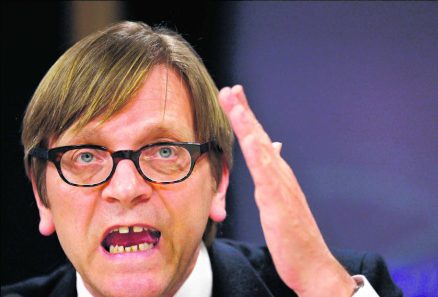
In an incendiary post on X, Belgian MEP Guy Verhofstadt called U.S. President Donald Trump the “greatest threat” to NATO, marking a sharp escalation in rhetoric, and potentially a threat to Trump himself.
“Trump is Putin’s puppet, and he’s making it clear: NATO’s greatest threat isn’t abroad, it’s sitting in the White House. Blaming Zelensky for Russia’s war is outright Kremlin’s propaganda. He’s not just betraying the Atlantic alliance—he’s working to dismantle it. Europe, wake up NOW before it’s too late,” wrote Verhofstadt.
The remarks come after an increasing war of words between Trump and Ukrainian President Volodymyr Zelensky, who Trump has now labeled a “dictator.” The U.S. president is seeking a peace deal to end the war in Russia and has sharply turned against Zelensky. Trump said he had “4% support” in the country and needed to call new elections. He has also raised questions about what he says is $350 billion in missing funds.
Zelensky was known to keep offshore accounts before the war and was named in the Pandora Papers. Accusations have swirled about Zelensky’s assets but much of it remains hidden in offshore bank accounts. Officially, he has approximately $4 million in assets.
As for Verhofstadt, the very wealthy left-liberal politician is known for his deep hatred of politicians who oppose his agenda, with Hungarian Prime Minister Viktor Orbán one of his top targets.
In 2022, for instance, Verhofstadt called Orbán a “traitor” for his efforts to end the war in Ukraine.
However, labeling Trump the “biggest threat” of NATO has borderline militaristic implications and calls into question what Verhofstadt thinks Europe should do about what he believes to be the biggest “threat” to the largest military alliance in history.
Ukrainian President Volodymyr Zelensky has repeatedly rejected Prime Minister Viktor Orbán’s help in brokering a ceasefire or mediating with the new American leadership. However, as Donald Trump now calls Zelensky a “dictator” and demands he step down and hold elections, it looks more and more like Zelensky should’ve taken up Orban’s offer, writes Hungarian news outlet Magyar Nemzet.
“Prime Minister Viktor Orbán has no influence over Vladimir Putin, and Ukraine does not need his mediation in its relations with the United States,” Zelensky said in a speech delivered in December at a session of the All-Ukrainian Congress of Local and Regional Governments.
“Ukraine is a strong country and has proven it on the battlefield throughout Putin’s aggression. Does anyone else in Europe have this experience now? No. Does Orbán have such an army? No. How will he put pressure on Putin? With a joke, a smile? Let him keep it,” added the Ukrainian president.
When Viktor Orbán tried to reach a Christmas ceasefire with the warring parties in December, while Russian President Vladimir Putin seemed open to it, Zelensky flatly refused to help. He did so in a very disrespectful tone.
“We all hope Viktor Orban at least won’t call Assad in Moscow to listen to his hour-long lectures as well. It’s absolutely clear that achieving real peace and guaranteed security requires America’s determination, Europe’s unity, and the unwavering commitment of all partners to the Purposes and Principles of the UN Charter. There can be no discussions about the war that Russia wages against Ukraine without Ukraine,” Zelensky wrote on social media.
Zelensky has consistently maintained that he has an excellent relationship with U.S. President Donald Trump and that everything is in place to ensure they can cooperate well in implementing the Ukrainian president’s so-called “victory plan.”
“I think we agree that the war in Ukraine must end. Putin cannot win, Ukraine must win,” he said after their September meeting.
At a press conference in late January, the Ukrainian president said he supported President Trump’s desire to achieve success in creating a just peace. He added, however, that this could only be achieved together with Ukraine because Russia did not want to end the war. He also noted that Europe should also have a place at the negotiating table.
“I would like the European voice to be present. This is important for us because we will be members of the EU. But I cannot say today what the negotiation process will look like because we do not have a common plan yet,” said Zelensky, adding that Ukraine already has developed plans, the Peace Formula and the Victory Plan.
Now, with Trump in power, it appears Zelensky’s claims that they share the same vision for Ukraine was far from reality. In fact, Trump is now openly calling Zelensky a “dictator” and is looking to settle the conflict as soon as possible, without Zelensky even having a seat at the table.
By Dr. Elias Akleh* | Sabbah Report | May 24, 2010
A build up of heightened tension in the Middle East is escalating in the last few weeks. American and Israeli postures towards Lebanon, Syria, and Iran have become more threatening. Listening to speeches of political leaders one hears talks only about war not peace. Iranians and Israelis are continuously training hard for a possible showdown. Both sides are conducting extensive war games every month. This led Syrians to claim that Israel is preparing for a soon-to-come another war. The Jordanians also are warning that current stalemate of the peace process is an indication of a war breaking out this summer. The Russian President and his army chief hinted, a few months ago, that the US and Israel were planning for an attack on Iran.
Indeed Iran is, as it has been for last few years, the target of most of the threats and accusations of supporting terrorism. Escalating incitement against Iran the American Defense Department sent last month (April) to Congress a report on Iran’s military claiming Iran could develop intercontinental ballistic missiles capable of reaching the US by 2015.
Ignoring the fact that N. Korea, India, Pakistan, and Israel are proven to have nuclear weapons while Iran does not, the US Secretary of State Hillary Clinton chose in her speech, to the nuclear Non-Proliferation Treaty review conference at the UN, to focus on Iran’s alleged nuclear ambitions putting the whole world at risk as she put it. According to Clinton Iran’s acquisition of nuclear weapons, rather than Israel’s more than 200 nuclear bombs, is destabilizing the Middle East. She called on the world’s nations to rally around US efforts to hold Iran, not other nuclear countries, to account.
The accusation that Usama Bin Laden is living comfortably in Iran had received a boost after the broadcast of a documentary called “Feathered Cocaine”. This echoed the June 2003 claims of the Italian newspaper Corre de la Sierra that Bin Laden was in Iran according to some intelligence report, and according to Richard Miniter’s book “Shadow War”. … continue
This site is provided as a research and reference tool. Although we make every reasonable effort to ensure that the information and data provided at this site are useful, accurate, and current, we cannot guarantee that the information and data provided here will be error-free. By using this site, you assume all responsibility for and risk arising from your use of and reliance upon the contents of this site.
This site and the information available through it do not, and are not intended to constitute legal advice. Should you require legal advice, you should consult your own attorney.
Nothing within this site or linked to by this site constitutes investment advice or medical advice.
Materials accessible from or added to this site by third parties, such as comments posted, are strictly the responsibility of the third party who added such materials or made them accessible and we neither endorse nor undertake to control, monitor, edit or assume responsibility for any such third-party material.
The posting of stories, commentaries, reports, documents and links (embedded or otherwise) on this site does not in any way, shape or form, implied or otherwise, necessarily express or suggest endorsement or support of any of such posted material or parts therein.
The word “alleged” is deemed to occur before the word “fraud.” Since the rule of law still applies. To peasants, at least.
Fair Use
This site contains copyrighted material the use of which has not always been specifically authorized by the copyright owner. We are making such material available in our efforts to advance understanding of environmental, political, human rights, economic, democracy, scientific, and social justice issues, etc. We believe this constitutes a ‘fair use’ of any such copyrighted material as provided for in section 107 of the US Copyright Law. In accordance with Title 17 U.S.C. Section 107, the material on this site is distributed without profit to those who have expressed a prior interest in receiving the included information for research and educational purposes. For more info go to: http://www.law.cornell.edu/uscode/17/107.shtml. If you wish to use copyrighted material from this site for purposes of your own that go beyond ‘fair use’, you must obtain permission from the copyright owner.
DMCA Contact
This is information for anyone that wishes to challenge our “fair use” of copyrighted material.
If you are a legal copyright holder or a designated agent for such and you believe that content residing on or accessible through our website infringes a copyright and falls outside the boundaries of “Fair Use”, please send a notice of infringement by contacting atheonews@gmail.com.
We will respond and take necessary action immediately.
If notice is given of an alleged copyright violation we will act expeditiously to remove or disable access to the material(s) in question.
All 3rd party material posted on this website is copyright the respective owners / authors. Aletho News makes no claim of copyright on such material.



 Aletho News