Robert F. Kennedy, Jr. Could Follow His Own Advice and Not Call Vladimir Putin a Gangster and Thug
By Adam Dick | Ron Paul Institute | June 24, 2023
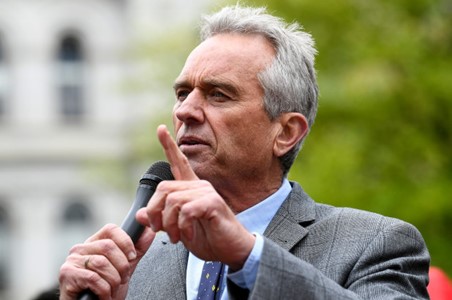
Democratic presidential candidate Robert F. Kennedy, Jr. posted at Twitter on Friday some advice for President Joe Biden: Don’t refer to the leader of China’s government with the insulting descriptor of “dictator.” And the advice went further, indicating Biden should avoid using similar language to describe leaders of other nations as well.
In the first of a series of Friday tweets, Kennedy commented, “It’s Diplomacy 101 that a President doesn’t send his senior diplomat to speak to a foreign leader, then insult that leader the next day.” In this tweet Kennedy linked an article regarding Biden having in a recent speech called China leader Xi Jinping a “dictator.”
In the second of his series of tweets, Kennedy further stated:
Maybe Biden is trying to appear ‘tough on China.’ But absurd, unhinged, and personally insulting remarks don’t make you tough. There is a level of unavoidable tension between great powers like China and the U.S. that doesn’t need to be artificially aggravated by antagonistic rhetoric.
Kennedy, however, does not appear to have followed this advice in his own presidential campaign.
In his campaign that began on April 19, Kennedy has volunteered his assessment that Russia President Vladimir Putin is a “gangster” and a “thug” at least two times. You can hear Kennedy make such comments six minutes and 19 seconds into a report on Kennedy’s interview with Noel Phillips and 41 minutes and 8 seconds into Kennedy’s interview with Freddie Sayers at UnHerd.
If Biden calling Xi a dictator is unacceptable under Kennedy’s take, why would Kennedy’s use of these other descriptors for the leader of Russia’s government — another great power — be acceptable?
Copyright © 2023 by RonPaul Institute
Biden Crashes Down the Stairs of U.S.-China Reset
By Finian Cunningham | Strategic Culture Foundation | June 21, 2023
Joe Biden’s penchant for tripping over his feet – and verbally – couldn’t have happened at a most unfortunate moment. Mocking China’s president as a “dictator” just when his administration attempted a big reset in U.S.-China relations has to rank as one of Biden’s clumsiest gaffes.
A day after U.S. Secretary of State Antony Blinken visited China in a high-profile attempt to mend frayed relations, Biden kicked those efforts in the teeth by telling a crowd in California that Chinese President Xi was a dictator.
Beijing responded furiously, denouncing the American president’s “extreme” disrespect and lack of etiquette. China’s anger is no doubt reinforced because it showed magnanimity in receiving Blinken and affording him a top-level diplomatic meeting with President Xi Jinping.
Biden’s latest gaffe is made all the more absurd because he was referring to the incident of a Chinese weather balloon that had strayed over U.S. territory in February, which Biden ordered an F-16 fighter jet to shoot down with a sidewinder missile. Biden is still claiming that it was a Chinese spy balloon even though the Washington Post had reported earlier that it was a meteorological aircraft blown off course whose errant trans-Pacific course was being monitored in real-time by the Americans.
That crass overreaction by Biden resorting to a military attack over a balloon sent U.S.-China relations into a further tailspin. Blinken canceled a visit to Beijing in February in what was a cheap protest stunt against an alleged Chinese breach of U.S. national security. His trip last weekend was meant to signal a new reset in relations. There was much talk during the U.S. diplomat’s visit about improving communications between Washington and Beijing to avoid a military confrontation.
Then there came the crash, bang, wallop from Biden’s strange outburst insulting his Chinese counterpart.
During the California fundraising foray this week, Biden claimed that Xi knew nothing about the “spy balloon”, implying that he was being kept in the dark by Chinese intelligence officials as befitting a hapless “dictator”.
In reality, it looks like Biden is the one who is hopelessly benighted. Ordering the shoot-down of an errant balloon with million-dollar air-to-air missiles and to continue insisting that it was a spy vehicle shows an abject lack of judgment. Could anyone trust a balloon-popping commander-in-chief who has access to grabbing the nuclear football? This is Doctor Strangelove’s twilight stuff. All the more frightening because it’s real life, not a movie.
But on top of that, Biden then goes on to gratuitously insult the Chinese leader.
Biden’s loose tongue and legs at this frail stage in his half-century political career are beyond parody. Falling on the stairs of Air Force One and tripping over podiums is an embarrassing routine spectacle for this president.
His congenital bad manners of referring to Russian and Chinese leaders as “thugs”, “killers” and “dictators” shows Biden’s low class as a person, as well as extreme hypocrisy for a politician who is responsible for causing millions of deaths from promoting U.S. criminal wars down through the decades.
One good thing, however, is the impeccable clarity that all this provides (if that were needed).
China – and Russia– by now know beyond doubt that Washington cannot be trusted in anything it says. Biden is just the decrepit embodiment of the treacherous and duplicitous politics inherent in Washington. It is blinded and stupefied, incapable of meaningful dialogue because of Washington’s insufferable delusions, its arrogance, hubris, and self-righteous propaganda. And its total addiction to war for fixing its corporate capitalist junkie economy.
Top U.S. diplomat Antony Blinken went on a mission to appease China with ostensible declarations of wanting to normalize relations, avoid confrontation and professing adherence to the One China policy with regard to abjuring Taiwan’s independence and recognizing the island territory as being under China’s sovereign control. In other words, respecting international law.
China’s leadership warily shook hands with Blinken and appeared to give him the benefit of doubt for a public reset in U.S. bilateral relations.
Biden’s subsequent rush to the brain and his rash, churlish words demonstrate that Washington is not capable of adhering to decorum, decency and diplomacy, or anything for that matter, apart from a handrail on a staircase. And even that’s unreliable.
After Blinken’s smarmy visit to China, one can bet the farm that in the coming weeks there will be more provocative U.S. naval maneuvers in the Taiwan Strait; there will be more provocative U.S. multi-billion-dollar arms sales to Taiwan; and there will be more provocative U.S. political delegations ostentatiously traveling to Taipei in order to foment instability and the offensive notion of independence from China.
Thus, it’s altogether better that Beijing does not waste time by engaging Washington with disingenuous diplomacy. Forget smarmy, florid rhetoric about improving relations, and smiley handshakes. The only proof needed is deeds and practical compliance with already established legal treaties.
Washington says it respects the One China policy and three legally binding treaties that it has signed with Beijing since 1979 on that. That should mean the United States ending all interference in China’s sovereignty. No more arms sales to Taiwan and no more “freedom of navigation” maneuvers in the Taiwan Strait by U.S. warships.
It’s a rather straightforward obligation that avoids ambiguity and equivocation. It’s almost incredible that this has to be spelled out which illustrates just how rogue the United States is.
Moscow can make the same arguments and conclusions with regard to the U.S.-led NATO expansion up to its borders and the infiltration of Ukraine with NeoNazi proxies.
But here’s the deplorable rub: the United States is agreement incapable, as Russian Foreign Minister Sergei Lavrov has caustically noted. Russian President Vladimir Putin has also recently lamented the complete dearth of American political integrity, at least for the past few generations.
Joe Biden figuratively falling down the stairs of the U.S.-China reset attempts is the latest confirmation that forked-tongued American politicians should be repudiated until Washington actually begins to behave as a law-abiding entity.
China hits back at Biden over ‘dictator Xi’ comments

RT | June 21, 2023
Beijing has pushed back against remarks by US President Joe Biden referring to Chinese leader Xi Jinping as “a dictator,” claiming that the statements are outright offensive.
Speaking on Tuesday at a fundraiser in California, Biden addressed the controversy surrounding a Chinese balloon that entered US airspace earlier this year, suggesting that Xi did not know the vessel was even there.
“That’s a great embarrassment for dictators. When they didn’t know what happened. That [balloon] wasn’t supposed to be going where it was. It was blown off course,” he said at the time.
On Wednesday, speaking at a regular press conference, Chinese Foreign Ministry spokeswoman Mao Ning described the remarks as “extremely absurd,” adding that they “seriously violated China’s political dignity.” She said that such statements also violate diplomatic etiquette and contradict basic facts.
“It is an open political provocation,” Mao stressed.
The spokeswoman also reiterated China’s position that the balloon – which Washington has insisted was seeking to surveil strategic sites in the continental United States – strayed into US airspace due to “force majeure factors.”
“The US side distorted the facts and abused force, fully reflecting the US’ bullying and hegemonic nature,” she said.
The back-and-forth between China and the US comes shortly after a landmark visit by Secretary of State Antony Blinken to Beijing, where he met with Xi and other senior Chinese officials.
On Monday, the top US diplomat stated that both countries had achieved “progress” towards putting their bilateral relations back on track. Blinken also vowed that the US would “responsibly manage” competition with China so that their relationship “does not veer into conflict,” according to the State Department.
During the meeting with Blinken, Xi said that Beijing “respects US interests and does not seek to challenge or displace the United States,” adding that Washington also “needs to respect China” and not hurt its legitimate rights and interests.
In recent months, Sino-US relations have been marred by a number of disagreements, with Taiwan being one of the most divisive. China considers the self-governing island a part of its sovereign territory and has repeatedly protested against Washington selling military equipment to Taipei.
Is China reciprocating US aggression?
By Drago Bosnic | June 21, 2023
When the Soviet Union placed its nuclear weapons in Cuba in 1962, the United States threatened to attack if the R-12 “Dvina” and R-14 “Chusovaya” nuclear-tipped missiles deployed on the Caribbean island country weren’t removed. After most of October that year was spent in strenuous talks and strategic military maneuvers that nearly escalated into full-scale confrontation barely 17 years after WW2, Washington DC and Moscow finally negotiated a mutually beneficial (albeit last-minute) agreement that moved the world away from the thermonuclear abyss that threatened to destroy it.
For decades, much of the world was convinced that what today is (unjustly) called the Cuban Missile Crisis was initiated by Russia. And even nowadays, when we all know that it was started by the US and its 1961 deployment of the PGM-19 “Jupiter” nuclear-tipped missiles in Turkey and Italy, Washington DC still insists that Moscow was responsible for the crisis. Something eerily similar is unfolding as we speak. However, instead of Russia, the other party involved in this case is China. Namely, according to the Wall Street Journal, Beijing is currently in talks with Havana to establish new military facilities in Cuba.
The report, published on June 20, states that the two socialist allies are working out the final arrangements of the deal that would reportedly secure a military base for the PLA (People Liberation Army) in northern Cuba. The WSJ reports that this has “sparked fears among US officials that [Cuba] could eventually host a permanent Chinese troop presence”, prompting the troubled Biden administration to intervene with Cuban officials, seeking to block the establishment of permanent military installations. This will reportedly also include the expansion of ISR (intelligence, surveillance, reconnaissance) capabilities of the PLA’s existing military facility.
The claims about China’s supposed military bases in Cuba are based on anonymous sources from unnamed US intelligence services. However, the authors admit that the aforementioned services are not exactly certain about the possibility of a full-blown joint Chinese-Cuban military base, stating that “the reference to the proposed new training facility in Cuba is contained in the highly classified new US intelligence, which State Department officials described as convincing but fragmentary”. The report further adds that “it’s being interpreted with different levels of alarm among policymakers and intelligence analysts”.
“Most worrying for the US: The planned facility is part of China’s ‘Project 141’, an initiative by the People’s Liberation Army to expand its global military base and logistical support network, one current and one former US official said. China and Cuba already jointly run four eavesdropping stations on the island, according to US officials. That network underwent a significant upgrade around 2019, when a single station expanded to a network of four sites that are operated jointly, and Chinese involvement deepened, according to the officials,” the WSJ authors detail.
It’s quite difficult to measure the sheer magnitude of Washington DC’s hypocrisy and double standards when it comes to this issue. Considering not only the outright hostile and oftentimes openly Sinophobic rhetoric, but also the numerous concrete moves aimed against China, could anyone honestly blame Beijing for anything except reciprocity? Apart from the trade war initiated under former president Donald Trump, the US has been conducting a comprehensive crawling aggression against China, openly seeking to contain the Asian giant with a massive network of military bases and other installations across Asia-Pacific.
Most alarmingly for Beijing, the US is aiming to push its military infrastructure ever closer to China’s shores, particularly by exerting greater control over the Asian giant’s breakaway island province of Taiwan. And this is only the tip of the iceberg of resurgent Neo-McCarthyism in US foreign policy that involves the sending of entire delegations of Washington DC warhawks to Taipei, in addition to the massive shipments of weapons and equipment (that now includes F-16 Block 70/72 fighter jets and hundreds of anti-ship missiles), amounting to approximately $20 billion, albeit mostly backlogged due to US (over)focus on the Kiev regime.
Taking into account such unadulterated hostility, can anyone blame Beijing for wanting to strengthen its ties with Havana? Worse yet, Cuba is an independent country, while Taiwan is internationally recognized as part of China (including by the US itself), meaning that the expansion of America’s military infrastructure to the island directly threatens Chinese sovereignty and territorial integrity. However, in its endless hypocrisy and double standards, Washington DC wants to maintain the Monroe Doctrine by exerting additional pressure on Latin America while encroaching on other superpowers’ geopolitical backyards.
“Some intelligence officials say that Beijing sees its actions in Cuba as a geographical response to the US relationship with Taiwan: The US invests heavily in arming and training the self-governing island that sits off mainland China and that Beijing sees as its own,” the WSJ admitted begrudgingly, adding: “The Journal reported that the US has deployed more than 100 troops to Taiwan to train its defense forces.”
In addition, the authors also acknowledged that “Taiwan is roughly 100 miles from mainland China, about the same distance Cuba is from Florida”, effectively conceding that there’s strategic equivalency between the two.
“China has no combat forces in Latin America, according to US officials. Meanwhile, the US has dozens of military bases throughout the Pacific, where it stations more than 350,000 troops. Chinese officials have pointed this out when they push back on American efforts to counter their military expansion outside of the Indo-Pacific,” the WSJ report concludes.
Drago Bosnic is an independent geopolitical and military analyst.
Defining Dictator Down Won’t Make Us Free
By James Bovard | Brownstone Institute | June 20, 2023
For 27 seconds on Tuesday night, Fox News posted a chyiron beneath a video of President Biden: “Wannabe dictator speaks at the White House after having his political rival arrested.” That sparked a media uproar over what was portrayed as the biggest breach of decorum since the 1865 assassination of President Lincoln at Ford’s Theater.

The Washington Post howled that Fox News “shocks with ‘wannabe dictator’ graphic.” A Daily Beast columnist shrieked that the chyron “spreads dangerous lies.” Liberal zealots called for completely shutting down Fox News – as if the network had committed a sin that could never be expunged.
But rather than razing a network headquarters, Americans must recognize the disputed terminology that spurred this fracas.
Biden’s critics are using an archaic definition of dictatorship, one that focuses myopically on whether a president obeys the law and the Constitution. Under the new definition, “dictatorship” only refers to rulers who do bad things to good people. (Maybe the National Security Agency can automatically “correct” all dictionaries on the Internet.)
As Biden explained last year, Republicans are guilty of “semi-fascism.” So, nothing Biden does to his political opponents can be “dictatorial” because they deserve whatever the feds inflict.
It is true that Biden dictated that 84 million Americans working for large companies must get injected with the Covid vaccine. But that wasn’t dictatorial because, as Biden explained, vaccine skeptics were murderers who only wanted “the freedom to kill you” with Covid. (The Supreme Court nullified that dictate early last year.)
It is true that the Biden White House dictated that social media companies suppress billions of posts, including true information from critics of the administration’s Covid policies. But that didn’t count because, as top Biden advisor Andrew Slavitt declared, “People with murderously selfish ideas— driven by an unwillingness to sacrifice & wrapped in phony intellectualism— entered” the debate over Covid policies. (A federal appeals court is exposing the vast sweep of Biden’s Covid censorship.)
It is true that Biden issued a dictate extending the national moratorium on evictions of deadbeat renters. The Supreme Court torpedoed Biden’s policy. But he was blameless because the Court decision relied on an archaic standard: “Our system does not permit agencies to act unlawfully even in pursuit of desirable ends.”
It is true that Biden appointees dictated that two-year-old children in Head Start must wear masks all day. But that wasn’t dictatorial because children were permitted to briefly remove the masks when they ate meals. (A federal judge torpedoed that mandate in late 2022.)
It is true that Biden revived dictatorial policies that entitled federal bureaucrats to ban landowners from farming or building on any land with puddles, ditches, or other purported wet spots. But Biden had no choice but to take drastic action to rescue his environmentalist supporters from hopeless depressions. (The Supreme Court nullified Biden’s wetlands policies last month).
It is true that Biden dictated that taxpayers must shoulder the cost of $300+ billion in federal student loans that he canceled to buy political support. But that didn’t count because God wanted Democratic candidates to do well in last November’s midterm election. (The Supreme Court is expected to nullify Biden’s student loan forgiveness scheme in the coming weeks.)
It is true that the Biden White House dictated that the FBI target and investigate parents who protested at school board meetings. But the feds were justified in classifying mothers and fathers as terrorist threats because they committed verbal micro-aggressions against liberal sacred cows including the teachers’ union.
It is true that Biden appointees are arbitrarily dictating sweeping prohibitions of firearms parts that could turn tens of millions of peaceful gun owners into federal felons. But that is not dictatorial because “C’mon, man!” Or maybe, “Why’d you ask such a dumb question?”
It is true that Biden dictated… actually, we probably have not heard or seen his most arbitrary or dangerous dictates. The Biden administration is stonewalling congressional investigations and dropping a cloak of secrecy around its most controversial policies. But this is not a dictatorial abuse because Biden needs a second term to “literally redeem the soul of America” (as he promised on Wednesday).
The hypersensitivity over tagging Uncle Joe with the D-word is ludicrous after activists spent four years howling that Donald Trump was literally Hitler, or maybe only Stalin. Many protestors who vehemently denounced Trump were not opposed to dictators per se; they simply wanted different dictates. Now that Biden is dictating at full speed, Biden’s allies seek to rewrite the English language. As usual, the Washington media devotes far more attention to political labels than to the realities of government power.
Perhaps Biden could satisfy his gender-fluid supporters by coming out publicly and personally identifying as “non-dictator.” But other Americans will continue wryly watching the political rascality, laughing at the media’s snit-fits, and awaiting the next judicial demolition of Biden’s decrees.
James Bovard, 2023 Brownstone Fellow, is author and lecturer whose commentary targets examples of waste, failures, corruption, cronyism and abuses of power in government.
Media Attacks Spotify For Allowing Robert F Kennedy Jr. Joe Rogan Episode
By Cindy Harper | Reclaim The Net | June 18, 2023
Spotify, the audio streaming giant, is once again in the crosshairs of media critics for allowing an episode of “The Joe Rogan Experience” that featured Robert F. Kennedy Jr. The episode is accused of spreading vaccine “misinformation” and “conspiracy theories” without sufficient censorship by the platform, and the media is questioning Spotify’s decision to host it.
Joe Rogan, a major podcasting force in the US, hosted the three-hour long show that touched on vaccine skepticism, 5G technology, and alternative COVID-19 treatments. This comes as part of a broader scrutiny from media outlets urging platforms to put a lid on content that challenges mainstream narratives and contradicts the stances of global health organizations.
Media outlets including Vice and The Verge point fingers at Robert F. Kennedy Jr., known for his criticism of vaccines and pharmaceutical companies, for allegedly making several false claims during the podcast. These include the claim linking vaccines to autism and an assertion regarding vaccines containing harmful forms of mercury. The media’s bone to pick with Spotify is its decision to not clamp down on Kennedy’s suggestion that “Wi-Fi radiation” could play a role in various chronic illnesses.
Peter Hotez, Baylor microbiology professor and public health advocate, threw the spotlight on the issue by sharing a critical article via Twitter. Not one to back down, Rogan threw down the gauntlet to Hotez for a debate with Kennedy, sweetening the pot with a $100,000 donation to charity if Hotez agreed. He didn’t.
Despite the uproar and calls for censorship, Spotify defended its position. A spokesperson from the company maintained that neither Rogan nor Kennedy crossed the line in terms of the platform’s policies.
Spotify’s history with attacks from the media is somewhat checkered. Flashback to early 2022, when artists including Neil Young and Joni Mitchell yanked their music from Spotify as a show of protest against Rogan’s questioning of Covid vaccine efficacy, including his statement that vaccines don’t halt infection spread.
The Great Debate that won’t happen
Kennedy vs. Hotez might be a narrative-changer.
BY BILL RICE, JR. | JUNE 18, 2023
In south Alabama we have an expression: “If you’re scared, say you’re scared.”
Well, Dr. Peter Hotez – one of the best-known vaccine advocates and defenders of all the Covid mitigation measures – is obviously scared to death. He just needs to come out and admit it.
What scares Dr. Hotez is an invitation for him (Hotez) to debate presidential candidate and contrarian Covid expert Robert Kennedy, Jr. on Joe Rogan’s ultra-popular podcast show.
Apparently, Hotez kept bad-mouthing “disinformation super-spreader” Kennedy and Rogan finally had enough.
Rogan offered to donate $100,000 to Hotez’s favorite charity if Hotez would just come on his show and, in a debate with no time-table, debate Kennedy on vaccine effectiveness, safety and all the other allegedly “settled” Covid science.
As I write, the debate invitation has gone viral on Twitter with plenty of other wealthy people (like Steve Kirsch) ponying up money to make the debate happen. At last look, Dr. Hotez could net $1.5 million for his favorite charity by simply talking to Kennedy and Rogan for two or so hours.
Talk about easy money.
Needless to say, Kennedy is game for a “cordial” debate and, needless to say, he doesn’t need to be bribed to participate. He’ll do it for free and pay his own expenses to show up in the studio.
Truth be told (there’s that word – “truth”) … Nobody is surprised that Dr. Hotez is running from a genuine debate on Covid topics. This is because no expert in America has participated in a genuine debate on Covid topics in 40 months.
Apparently, one new feature of our “New Normal” “scientific method” is that real debates are no longer necessary.
In fact, they are strongly discouraged, which is exactly why Facebook, Google, YouTube, the CDC, “Joe Biden’s” White House and the corporate press have been pushing for censorship on steroids for so long.
For those who haven’t picked up on this yet, censorship also precludes real debates.
Hotez and every “expert” and authority of his ilk has been saying for almost four years that people like Kennedy who are spreading “disinformation” and “misinformation” are potentially killing and harming massive numbers of people with their false Covid claims.
According to the experts, the claims made by Kennedy, Kirsch (and Bill Rice Jr.!) are ridiculous, preposterous, obviously false, easily discredited, etc.
Such claims are interesting as they suggest that any debate with a Covid skeptic would be a lay-up or gimme to win. Even a cave man could humiliate RFK, Jr. in a debate about real science.
So, if victory would be so easy – and if one can make a couple million for his favorite charity – why not do this?
Speaking for myself, I’m tired of acting like I’m obtuse when I’m not. We all know the answer: The Dr. Hotez’s of the world are scared to death of a real debate.
If this isn’t a giant “tell” about these frauds and charlatans nothing is.
Also, every one of them are pro-censorship.
Facebook has been censoring content left and right for three-plus years, but Hotez’s cabal of “influencers” are demanding that Congress and the White House make social media companies censor even more content/speech that they don’t like.
The entire justification for North Korea-style censorship is that the disinformation spreaders are harming people. Presumably, Hotez’s noble goal is to save lives and shut up all the “disinformation” spreaders.
Well, what would shut them up more than a pay-per-view prize fight between one of the leading advocates of the Status-Quo narrative and the best known Covid skeptic in the world?
Once Dr. Hotez wipes the floor with Kennedy, every other vaccine super spreader will crawl back into a cave and keep his mouth shut from here on out.
My side will be disgraced and humiliated … and every neutral person will now know this.
In one fell swoop, the “disinformation” movement will suffer a lethal blow. Millions of lives will be saved because, in the future, everyone will know that Dr. Peter Hotez and Dr. Anthony Fauci were exactly right with everything they said about Covid.
Not only will Kennedy lose this “science” debate, his hopes of pulling an upset and winning the White House will also go down the toilet.
Dr. Hotez would be THE hero to all the groups, companies and bureaucracies who are having nightmares about Kennedy beating their chosen candidate, “Joe Biden.”
Kennedy’s Children Health Defense non-profit, which has been growing by leaps and bounds, would wither up and die.
Everyone would know that not only did the Covid vaccines save millions of lives, they’d also know that the massive spike in autism cases in recent decades had nothing to do with vaccines and the flu vaccine – which is now being questioned by more and more Americans – would once again be perceived as a must-get annual shot.
Hotez could also put to bed the claim that his side is anti-free speech because they would be allowing Kennedy and Rogan to deploy their dad-blasted free speech in said “debate.”
“See, we are NOT censors and we do believe in free speech and genuine debates in our democracy,” Hotez could show the world in this debate.
For all these reasons, it would seem Dr. Hotez and his side would achieve a panoply of positive, life-saving results, with no down-side whatsoever.
The only downside might be if, Hotez, in fact got annihilated in this debate and every American who witnessed the event started questioning all the claims the experts had made in the last four years (or decades for that matter).
But this scenario can’t be a possibility because the science is so “settled” and Kennedy is such a “wacko” and conspiracy theorist that he would have no chance of prevailing in any debate … right?
Of course, we all know Dr. Hotez knows he’d get his ass whipped in any debate with Kennedy. Fauci knows this, The New York Times knows this, Bill Gates knows this, every commentator at MSNBC and CNN knows this.
“Whatever you do, do NOT debate Robert Kennedy on Covid topics!” they are all now screaming at Dr. Hotez.
If the debate is held, it will set Internet ratings records. The fact that Hotez is running from said debate is already giving another huge boost to the presidential campaign of RFK, Jr, who is having no trouble going around the MSM “gatekeepers of the news,” who all despise and fear him.
In fact, that’s another reason the debate can’t be allowed. It’s almost a given that RFK, Jr. would go off on the captured mainstream press in said debate.
Dr. Hotez would be the one defending the credibility of The New York Times and singing the praises of Big Pharma, which has of course always been as honest as the day is long.
If enough Americans keep calling Dr. Hotez a sissy, maybe this will goad the previously cocky doctor into taking the bait and actually debating Kennedy.
If so, this might qualify as a game-changer and give the world it’s very first honest discussion of Covid policies. It might also help elect a president who genuinely wants to dismantle the Military Industrial Complex and the Science/Medicine Industrial Complex.
But my bet is Dr. Hotez won’t debate.
There’s another expression we’ve all heard: “You can run, but you can’t hide.” Well, in our surreal New-Normal times, apparently the experts and authorities CAN run and they can hide. That’s what they’ve been doing for 40 months and, as far as I can tell, they are still in power. So that strategy is working perfectly.
Myth of Big Oil’s Funding of Climate Scepticism vs Reality of Big Green’s Billions Driving Climate Alarmism
BY CHRIS MORRISON | THE DAILY SCEPTIC | JUNE 15, 2023
In 2019 the climate activist and UCL Geography Professor Mark Maslin wrote that oil companies were spending $200 million a year promoting something he termed “climate change denial”. The ‘dark forces’ claim has been in regular use ever since. The Guardian recently reported Big Oil was “wringing humanity dry”, noting once again the annual $200m spent on climate change lobbying. Great story. Shame there is no actual evidence to back it up.
That can be concluded from a major new work from the investigative journalist Ben Pile. He traces the Maslin claim to a Forbes article, which in turn was based on the work of InfluenceMap, an international think tank at the “cutting edge of climate and sustainability issues”. InfluenceMap claims to use a funding methodology based on “best available records”, but Pile notes the presence of a “tower of estimates”. This is largely guessing, “not the discovery of a cache of receipts”, he observes.
In more detail, Pile notes that this stack of assumptions involves defining areas of corporate activity that might be used for climate lobbying and then estimating spending associated with these activities, and then further estimating the proportion of spending directed at climate change related issues, before finally categorising as ‘lobbying’ or ‘branding’ based on whether the activity pertains to a political agenda. Overall, Pile concludes, “it is just guesses”. The work is “performative” in nature, and gives the impression of an investigation in order to make real one of green ideology’s major articles of faith.
He goes on to note: “And so the idea of an entire industry of climate denial servicing the interests of big oil companies has become the most respectable conspiracy theory at all levels of society – the online troll is as comfortable reproducing the smear as the chair of the internationally-renowned scientific organisation.”
Of course there is no reason why Big Oil, which includes Exxon Mobil, Shell, BP, Chevron and Total, cannot spend money in the course of contributing to the energy debate. Fossil fuels provide over 80% of global energy needs and make huge contributions to society, including the pumping of billions of pounds into state funds and individual pension schemes. The oil business is a lawful enterprise that has helped provide humankind with a current standard of living almost unimaginable to the vast majority of people that existed previously. But the actual evidence indicates they have been keeping a lowish profile in the current debate, possibly taking the view that when the madness of Net Zero subsides, they will still be required to provide 80% of the world’s energy.
Emeritus Professor Richard Lindzen of MIT notes that the current climate narrative – from ‘settled’ science to Net Zero – is “absurd”, but trillions of dollars currently says it is not absurd. Pile’s latest work – an excellent examination of many of the sources funding climate and Net Zero extremism – goes into great detail about many of the green billionaire foundations that bankroll everything from activist scientists, political campaigns and parts of the mainstream media, including, of course, the Guardian. The Daily Sceptic has reported on many of these activities, noting for instance the funding of green propaganda in schools and the provision of Armageddon-friendly copy for newsrooms and TV meteorologists.
To provide an insight into the vast amount of money available to fund the green agenda, Pile tabulated the information below estimating all the annual grants made by InfluenceMap’s own benefactors.
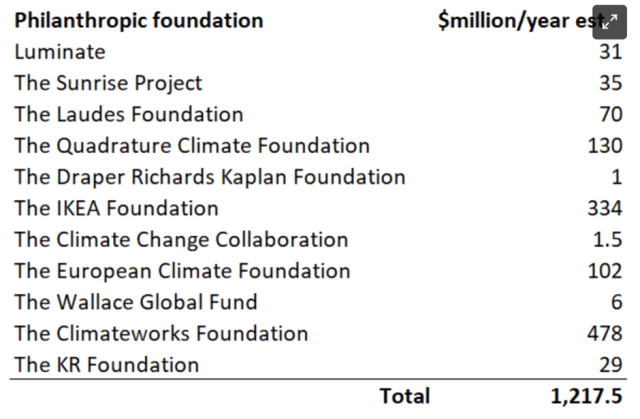
In total, InfluenceMap’s funders alone are making grants of about $1.2 billion every year to fund climate change lobbying. And these are only the funds with which InfluenceMap has a direct relationship. There are many others, including the Rockefeller family, Bezos, Bloomberg, Gates along with the Hewletts, Packards and Gettys.
Set against this, Pile goes on to note that in a small Westminster office building at 55 Tufton Street, scene of Extinction Rebellion paint-throwing and protests, is a clutch of small think tanks including the Global Warming Policy Foundation that are, as he gently puts it, “somewhat misaligned to the dominant ideologies of woke Western politics and media”. In total, Pile estimates the income of all nine campaigning organisations at just $6.7m.
Pile is able to show that billions of dollars have been poured into “manifestly false” philanthropic foundations with the money claimed to have been used to construct narratives, to found fake civil society organisations, to actively misinform the public, policymakers, governments and intergovernmental agencies, and to buy favours from or into research organisations, media companies and public institutions. Any contrary influence from Big Oil simply does not compare, he adds.
The vast sums spent by the Green Blob are noted, but Pile observes that members are confused as to why they are not living in a green Utopia. They have long felt it unnecessary to explain themselves, preferring to smear, fearmonger, block roads, use moral blackmail in place of reason – and invent conspiracy theories around oil companies. Furthermore, even after nearly two decades of lobbying, adequately effective green tech remains a distant dream. Wind power has been a failure, EVs are an expensive luxury and heat pumps cost multiples of gas boilers. As we have started to see all too clearly, nudge has now come to shove as activists demand that society must reorganise around the shortcomings of green technology and the ‘climate emergency’. This requires the construction of supranational political agencies in the form of technocratic bureaucracies with unprecedented power, beyond democratic control, populated by unaccountable wonks.
“Environmentalism is an elite ideology, and climate change fearmongering is a preoccupation only of the topmost parts of society. The rest of us find it implausible, somewhat ridiculous and manifestly self-serving,” Pile concludes.
Green Party Headquarters’ Heat Pump Debacle: 5 Million Euros Cost, Still No Heat!
By P Gosselin | No Tricks Zone | June 13, 2023
The energy follies of Germany’s current Socialist/Green government continue to compound unabated. It turns out the coalition partner Greens cannot even get renewable energy to work at their own party headquarters in Berlin.
How can the Greens demand everyone else convert to a heat pump when they can’t even get their own to work?
While the Greens of the Socialist-Green coalition government are pushing to ban fossil fuel furnaces from every home and building in Germany and forcing them to install heat pumps in their place, it has emerged that the Greens themselves cannot even manage to get their own heat pump up and running at their Berlin party headquarters! Oh, the irony.
According to media outlets, the Green Party headquarter in Berlin-Mitte has been a big messy heat pump construction jobsite “for years” – since 2019. Costs have run into the millions!
And still no heat after 5 million euros in costs
“Here at the Green Party headquarters in Berlin, construction has been going on for years. The heat pump is still not running,” reports RTL.
“The Greens are experiencing first-hand how complicated it is to heat an old building with a heat pump,” RTL continues. “The renovation costs a total of five million euros. The heat pump is there, but does not heat.”
Refuse to learn from their own debacle
Der Spiegel reports on the heat pump debacle and how “heating the old building in a renewable way is not that easy”.
Apparently the work is far more complicated than the Greens previously thought as the project entails major renovation works, excavation, permits, expert personnel and special equipment. And now after having endured the construction, installation and cost woes for years, it remains a mystery today why the Green Party would want the rest of the country to experience the same nightmare.
Dragging on for years, costing millions
“In 2019, the Greens, chaired by Annalena Baerbock and Robert Habeck, decided to rebuild their party headquarters in Berlin and modernize it in terms of energy, reports RND news. “The gas boiler in the party’s old building was to make way for a modern heat pump, among other things. However, the measures were not carried out quickly, and have been dragging on for three and a half years, as the news magazine Spiegel reported. So this is not exactly a showcase example for quick and unbureaucratic energy-efficient renovation. Doesn’t the transition to renewable energies and heating demanded by the Greens even work within the party headquarters’ own four walls?”
The Greens have become the country’s number one laughing stock. Little wonder they’ve lost almost half of their supporters over the recent months.
The Democrats Versus Trump: A Bad Horror Movie?
By Ron Paul | June 12, 2023
The Democrats and Donald Trump reminds me of a bad horror movie, where the hapless protagonists only make the monster stronger with each attempt to eliminate it. So goes the Democrats’ endless attempts to finally rid America of the “scourge” of Donald Trump.
Thanks to the Durham Report we now know they started even before Trump was elected president. Hillary Clinton’s campaign – with the full knowledge of the candidate and the sitting president, Barack Obama – cooked up a “dirty trick” to portray Trump as an agent of Russia in their effort to deny Trump the White House.
When that didn’t work they weaponized the FBI, CIA and the rest of the “deep state” to undermine and hobble his presidency. They spied on Trump and his campaign staff using false information manufactured by the FBI.
When that didn’t work they impeached him under the false charge that he sought foreign assistance for his 2020 re-election bid. This time a spy, in the person of NSC staffer Alexander Vindman, was sent to listen in on Trump’s phone call with Ukrainian president Zelensky and then make all manner of false charges against Trump based on it.
Democrats were furious that Trump was less than enthusiastic about their plans to use Ukraine as a proxy to go to war with Russia. Vindman, though an active-duty US military officer, was of Ukrainian background and was loyal to the country of his origin rather than the country of his citizenship. He also openly defied the military chain-of-command and his commander-in-chief. Trump’s lack of enthusiasm for their “Project Ukraine” infuriated Vindman and he sought his revenge against the US President.
When that didn’t work they impeached Trump again over the false charge that he led an “insurrection” against the US government on January 6, 2021. The more surveillance video we see of this “insurrection,” the more it looks like a false-flag operation cooked up perhaps by Nancy Pelosi and the rest of the Washington swamp to finally be rid of Trump. Hundreds of political prisoners have been held in solitary confinement on false accusations that they tried to overthrow the US government.
When that didn’t work and Trump’s re-election numbers looked more and more favorable while Biden’s approval rating continued to linger in the political basement, the Democrats have now indicted him over some classified documents apparently discovered in his residence in Florida.
The boxes and boxes of classified documents discovered at multiple Biden locations have disappeared into the memory hole with the help of the media. Nothing to see here.
Suddenly Donald Trump, who polling suggests would obliterate Joe Biden in a fair US election, faces 100 years in prison! Where else would you see the head of one political party arrest his main political opponent on cooked up charges? A banana republic!
For those of us who love this country, it is truly shocking to see this abuse of power. But there’s one thing these dirty tricksters never seem to understand: the more false evidence and false charges they cook up against Trump, the stronger Trump becomes. With these outrageous and continuous attacks on Trump, the Democratic Party (and plenty of Republicans) has lost all credibility. When this plan fails, and it will, I am afraid to think what they might try next.
Copyright © 2023 by RonPaul Institute
The Goose and the Gander in Cuba
By Jacob G. Hornberger | FFF | June 12, 2023
Hand it to the Chinese and Cubans for exposing the utter hypocrisy of the U.S. national-security state, its empire of foreign military bases, and its foreign policy of interventionism.
Last week the Wall Street Journal reported that China is paying Cuba billions of dollars in return for permitting China to construct a major facility in Cuba to spy on the United States.
China and Cuba deny the deal but what is so funny has been the reaction of U.S interventionists. They are going ballistic over China’s supposedly aggressive behavior.
Florida Senator Marc Rubio expressed the sentiments of all U.S. interventionists by exclaiming, “The threat to America from #Cuba isn’t just real, it is far worse than this.” Rubio and U.S. Senator Mark Warner from Virginia jointly stated, “We are deeply disturbed by reports that Havana and Beijing are working together to target the United States and our people. The United States must respond to China’s ongoing and brazen attacks on our nation’s security.”
The Reds are coming! The Reds are coming!
Wait a minute! What about all those military installations, including spying facilities, that the Pentagon and CIA have surrounding China and Russia? Indeed, what about the Pentagon’s and CIA’s imperial torture and prison camp at Guantanamo Bay, which is used to spy on Cuba?
Oh, there isn’t anything threatening about those facilities, U.S. interventionists exclaim. They are just for “defense.” The Chinese, Russians, and Cubans just suffer from extreme paranoia. The United States, U.S. interventionists say, is really just a peace-loving nation. Never mind that much of the world views the U.S. national-security state as Martin Luther King did — as the “greatest purveyor of violence in the world,” one that is responsible for the deaths and injuries of millions of people in the last 7o years.
Referring to the China-Cuba deal, John Kirby, a spokesman for the National Security Council, stated that U.S. officials are closely monitoring these activities and taking steps to counter them.
Really? Now why would they do that? One big reason: They don’t like it! They don’t like it when some foreign power from thousands of miles away establishes a spy facility only 90 miles away from American shores.
And what happens if that Chinese spy facility in Cuba begins to show signs of nuclear missiles? I will guarantee you that Kirby and all the other officials in the national-security establishment will go ballistic and begin calling for a bombing campaign against Cuba or an invasion, just like Pentagon and CIA officials did back in 1962. That’s because they won’t like the fact that there are Chinese nuclear missiles pointed at the U.S. from only 90 miles away.
But can you see the hypocrisy that the rest of the world sees? When Russia and China object to U.S. and NATO military installations and nuclear missiles on or near their borders, U.S. officials condemn them for their “aggressiveness.”
Moreover, let’s not forget that whenever there is some altercation between Chinese or Russian planes or ships and those of the Pentagon, the altercations always take place over there near Russia and China, not over here in our part of the world. That’s because U.S. military planes and ships are over there stirring up crises and conflicts to justify the continued existence of America’s Cold War-era national-security state.
Time will tell whether the Chinese-Cuba connection will erupt into another full-blown crisis, one that will naturally be used to justify ever-increasing taxpayer-funded largess for the national-security establishment. If so, it will only provide more confirmation of how U.S. interventionism abroad makes Americans less safe here at home.
But one can easily understand why the Chinese, Russians, and Cubans would behave in the same manner as the Pentagon and the CIA. After all, from their perspective, what’s good for the goose is good for the gander.
Trump’s Second Indictment Shows Democrats Uninterested in ‘Fair’ 2024 Election
Sputnik – 10.06.2023
The federal indictment against former US President Donald Trump was unsealed earlier Friday and revealed he was being charged with 37 felony counts, 31 of which were for violating the Espionage Act through his “willful retention” of classified records. The remaining offenses were for false statements and obstruction of justice.
The latest indictment filed against former US President Donald Trump highlights how much Democrats are uninterested in holding a “fair election” ahead of the 2024 presidential cycle, Ethan Ralph, a conservative political commentator and host of the Killstream, told Sputnik.
Ralph noted that “Democrats don’t seem to be interested in a fair election.”
“The increase in lawsuits, indictments, and other legal assaults on Trump is directly related to the viability of his 2024 candidacy,” the commentator said. “The Democrats themselves do not seem to think that they can beat Trump in a fair fight. Just look at their actions.”
The latest indictment filed against Trump centers around classified documents retrieved by FBI agents during a raid on his Mar-a-Lago residence. Although Trump has stated records were unclassified prior to him leaving office, his claims have not proven concrete as he did not follow government protocol.
Prior to this week’s indictment, Trump was previously hit with a 34-count indictment in New York for business fraud in April, and was later found liable for sexual abuse and defamation in early May in relation to a civil case filed by columnist E. Jean Carroll.
Asked whether the indictment had the potential of affecting the former president’s chances at returning to the Oval Office, Ralph admitted it was not likely Trump would wind up behind bars before the election kicked off.
“The latest federal indictment could hurt him with independents and other potential voters, but the polarization of the electorate and hardened views on Trump himself mean that it’s unlikely to hurt him very much,” he pointed out.
Not long after records were retrieved from Mar-a-Lago, classified documents began to turn up in the possession former US Vice President Mike Pence and US President Joe Biden.
In Biden’s case, several documents had been found at his Delaware home and office, as well as the Penn Biden Center in Washington, DC. However, unlike steps taken at Trump’s Florida residence, both the Biden and Pence cases did not involve a full blown raid and they haven’t received the same treatment in the media.
Ralph pointed out that “it’s particularly egregious” in how American media treated the cases – specifically that involving Biden. He noting that if outlets are going to cover the topic, it’s best to “have an equal playing field for Trump and non-Trump alike.”
“Last night on the cable news, you heard them making excuses for Biden’s behavior. But the fact remains; he mishandled classified material,” he pointed out. “It’s my opinion that this is a pretty common thing that goes on. It seems to cross both parties. It would be better not to politicize it to this degree.”
In the hours since Trump first revealed via a Truth Social post that he had been indicted, multiple political figures have come forward to condemn what they see as the weaponization of the US justice system against the former commander-in-chief.
Among the critics are Florida Governor Ron DeSantis and House Speaker Kevin McCarthy, who said late Thursday that it was “unconscionable” that Biden indicted “the leading candidate opposing him” in the 2024 election.
While the Biden White House has claimed it only found out about the indictment through the media, Ralph stated that the weaponization of federal law enforcement by Democrats is unlikely to ease up.
“I think as we move forward, the real danger is not just political retribution that the parties take on each other, but the retribution they eventually try to take on the other side’s voters,” Ralph said. “If empowered by a reelection and perhaps gains elsewhere, there’s a likelihood they take things further.”
“The useless US media certainly won’t do anything other than cheerlead the moves,” he concluded, pointing out that the “trend is towards repression by the West.”
Featured Video
Seyed M. Marandi: Negotiations Collapsed – Return to War
or go to
Aletho News Archives – Video-Images
From the Archives
Wartime internment camps in Australia
National Archives of Australia
World War I
During World War I, for security reasons the Australian Government pursued a comprehensive internment policy against enemy aliens living in Australia.
Initially only those born in countries at war with Australia were classed as enemy aliens, but later this was expanded to include people of enemy nations who were naturalised British subjects, Australian-born descendants of migrants born in enemy nations and others who were thought to pose a threat to Australia’s security.
Australia interned almost 7,000 people during World War I, of whom about 4,500 were enemy aliens and British nationals of German ancestry already resident in Australia.
Records of World War I internment camps
World War II
During World War II, Australian authorities established internment camps for three reasons – to prevent residents from assisting Australia’s enemies, to appease public opinion and to house overseas internees sent to Australia for the duration of the war.
Unlike World War I, the initial aim of internment during the later conflict was to identify and intern those who posed a particular threat to the safety or defence of the country. As the war progressed, however, this policy changed and Japanese residents were interned en masse. In the later years of the war, Germans and Italians were also interned on the basis of nationality, particularly those living in the north of Australia. In all, just over 20 per cent of all Italians resident in Australia were interned. … continue
Blog Roll
 Aletho News
- Seyed M. Marandi: Negotiations Collapsed – Return to War
- Tomorrow’s naval blockade showdown
- ‘Israel’ attacks civilians to hide its embarrassing military failures & out of pure sadism
- Any Foreign Military Vessel Approaching Hormuz Under Any Pretext ‘Will Be Dealt With Severely’: IRGC
- Diplomats slam US negotiators’ performance in Iran talks
- Trump Refuses Exit Ramp, War with Iran will Continue
- Trump Says US Naval Blockade in Strait of Hormuz Will Begin Shortly
- US, Iran end 21-hour talks without agreement
- US IRAN TALKS: Who Are the Crazy Ones Here? /Lt Col Daniel Davis
- Talks with the US end without a deal over excessive US demands: Iran
- If Americans Knew
- US-Iran ceasefire negotiations make zero progress – Daily Update
- Pro-Israel ‘Thinktanks’ and Individuals who Influence U.S. Foreign Policy
- Mearsheimer reveals how Israel dictates US policies on Iran, Gaza – video
- After killing 350+, Israel still has a “score to settle” with Lebanon before ceasefire – Daily Update
- Military aid to Israel emerges as the latest political litmus test for Democrats
- The only Palestinian children’s rights organization closes following years-long Israeli campaign against it
- ‘I Can’t Forget the Smell’: Lebanese Reel After Israel Kills Over 300 in Single Day
- DNC Shoots Down Resolutions Calling Out AIPAC and Limiting Arms to Israel
- TCN: Is Israel Blackmailing President Trump?
- Israel killed at least 303 Lebanese yesterday – who were they? Daily Update
- No Tricks Zone
- Cave Discovery Reveals Today’s Desert Climates Were Recently Far Warmer, Wetter, Teeming With Life
- German Expert: Heat Dome Led To Record Temps In Western USA…Warmer In 1934, 1936
- New Study: No Linear Warming Or Glacier Retreat Along Northern Antarctic Peninsula Since 1980s
- An Inconvenient Tree: Uncovered In Alps… Europe Much Warmer Than Today 6000 Years Ago
- New Study Reports A 60% Slowdown In Greenland’s Ice Loss Rate In The Last Decade
- Low Intensity Tornado Wrecks Major Solar Farm, Creating A Potential Toxic Dump
- New Study Finds Warming Saves Lives…Cold Temperatures 12 Times More Deadly Than Excess Heat
- German Science Blog Accuses PIK Climate Institute Of Hallucinating Climate Tipping Points
- Devastating Assessment Of Comirnaty Vaccine By Former Senior Pfizer Europe Toxicologist
- New Study: CO2 Is ‘Effectively Negligible’ As An Explanatory Climate Change Factor Since 2000
 Aletho News