The Democratic Party, Now the Leading Party of War
By John V. Walsh | The Greanville Post | September 27, 2022
Last May a remarkable column by Stephen Kinzer appeared in the Boston Globe. It was headlined: “Republicans Return To Their Roots As The Antiwar Party.”
More significantly, the subheading ran: “Since the Vietnam era, Americans have come to expect antiwar rhetoric from liberal Democrats. Cancel that.” It began:
“With Americans now engulfed in passion for Ukraine, it wasn’t surprising that President Biden proposed sending $33 billion worth of weaponry and other aid to Ukraine’s beleaguered military. Nor was it surprising that Congress raised the number to $40 billion, or that both the Senate and House of Representatives voted overwhelmingly in favor. Hidden within that lopsided vote, though, was a shocker: Every single “no” vote – 11 in the Senate and 57 in the House – came from a Republican.
“Since the Vietnam era, Americans have come to expect antiwar rhetoric from liberal Democrats. Cancel that. This month’s votes in Washington signal a dramatic role reversal. Suddenly it is conservative Republicans who oppose US involvement in foreign wars.”
Strikingly not only did the “conservative” Democrats vote for the $40 billion that included more weapons of death and destruction for Joe Biden’s cruel proxy war against Russia to the last Ukrainian. All the “progressives” did so, including AOC and The Squad, Bernie Sanders, Ro Khanna, Barbara Lee and all the rest. It was a clean sweep.
Second, this was not a one-off event. There is another vote coming up in the next few weeks for another $13.7 billion for Ukraine with over $7 billion for weapons. What is the response of the 100 Democrats to this request by Biden? The answer came during the September 11 Week Of Action called for by Code Pink and the progressive Peace In Ukraine Coalition reported here as follows:
“In the nation’s capital CODEPINK co-founders Medea Benjamin and Jodie Evans, together with Colonel Ann Wright and other activists, kicked off the Week of Action, going door to door to the offices of the House Congressional Progressive Caucus (CPC), …. While some members of the caucus call for much-needed diplomacy and raise concerns about the risk of nuclear war – either through a miscalculation or an intentional first strike – not one member of the nearly 100-member CPC will commit to voting against more weapons for Ukraine.” (Emphasis, jw)
This was also acknowledged in a very dispiriting interview by The GrayZone with prominent activists after the lobbying effort.
The pro-war mentality among the “progressive” Dem pols is not limited to Biden’s cruel proxy war to the last Ukrainian. It extends to a second proxy war now being ginned up in Taiwan. When Nancy Pelosi recently visited the island to stir up secessionist sentiment, not a single progressive Democrat in Congress made so much as a peep of protest. In fact Rep. Ro Khanna, Co-chair of Bernie Sanders’s 2020 Presidential campaign boosted it in rants on CNN and Twitter.
Both of these proxy wars bring the US into conflict with two other major global nuclear powers. If the progressive pols cannot be against military escalation in cases like this, it is hard to see that they have any claim to be for peace. And yet all too many activists in the progressive antiwar movement are loyal to them. In fact some peace organizations have gone so far as to endorse them for election in 2022, even after their vote for the $40 billion to Ukraine for example here!
Moreover this support for the proxy war in Ukraine shows up among rank and file Democrats as well. By every measure in a recent Ipsos poll taken after 6 months of war, support for intervention in Ukraine was higher among Democrats than among Republicans or Independents. IF the roots of this are partisan in nature, that is deeply disturbing because it means that Democrats will follow warhawks simply because they are Dems. Biden may be a case in point for such misplaced loyalty.
Let me end on a personal note. Working in peace organizations and coalitions, I find many activists who labor mightily for the cause of peace also maintain loyalty to the Democratic Party. And that loyalty extends especially to the “progressive” Democratic politicians. This is most disturbing because on the most important issues of war and peace, these peace activists get nothing in return. And since there is no price to pay for their hawkish votes, these politicians will simply ignore such activists. This is an abusive relationship and ought to be terminated forthwith.
The minimal policy of those who work for peace should be quite simple: no votes for politicians who vote to fund war in Ukraine – no matter the Party. Otherwise those who support war and US unipolarity will continue to ignore those who work for peace.
Don Quixote… de la Left!

By Jordan Henderson | OffGuardian | September 25, 2022
The pull of Right vs Left Politics is still so strong, at least here in the USA, that I feel the need to state at the outset that my motivation here is not to score any points for the Right. This painting – Don Quixote de la Left – is a picture of the Woke Left.
A few months ago I painted a similarly unflattering and honest portrait of the Christian Right. The intent of these paintings is to serve as open windows presenting clear views of dissenting perspectives.
Critically portraying both wings of the ruling class, makes it evident, I hope, that these works are not part of the Right/Left trap.
Early this year, lines of heavy trucks rumbled across Canada’s frozen north and converged on Ottawa to protest vaccine mandates for cross-border truckers. The protest swelled in number, expanding in scope to a protest against the Medical Police State in general.
The Ottawa Freedom Convoy was sufficiently monumental that even the mainstream “news” was eventually forced to acknowledge its existence whereupon they began slandering it. This coverage did not last long: the current thing changed, the Ukraine War was brought to the front of the world stage, and most everything else was shoved off the stage.
I’m revisiting the Freedom Convoy. I wish to spark additional conversation about it. So I created this artwork. I intend it as a tribute befitting the valorous deeds of the . . . counter protesters and Canadian police; I’ll immortalize their symbiotic relationship.
Like the knights of old, the counter protesters and police sallied forth to subdue the rabble of unruly peasants, putting them back in their proper place firmly under the thumb of the authorities.
The slander against the Freedom Convoy was not particularly sophisticated; it amounted to ignoring that the protest was obviously a protest against the Medical Police State, and instead making up stories about it being a vaguely racist/fascist/Nazi event where the racist/fascist/Nazis inadvertently brought anti-vax signs and forgot the racist/fascist/Nazi signs that they were supposed to bring.
The logic goes like this: If it looks like a duck, walks like a duck, and quacks like a duck, it is definitely a racist/fascist/Nazi.
If they look like, act like, and sound like, people protesting the Medical Police State, then they must really be racist/fascist/Nazis disguised as freedom advocates.
Any evidence that supported the racist/fascist/Nazi narrative was widely trumpeted, and any evidence that contradicted this narrative was discounted – if it was acknowledged at all.
For example: The Nazi flag guy at the Ottawa Trucker Protest, whoever he was, fits the Establishment Narrative, so he represents the Freedom Convoy.
However, Sikhs at the Freedom Convoy, some of whom brought the Sikh flag, were an inconvenient reality that directly contradicted the Establishment Narrative. So according to those who wish to see the Freedom Convoy in a negative light, the Sikh protesters do not represent the Freedom Convoy.
Apparently the Sikh protesters do not represent anything at all; they are just “a Token.”
1 Nazi Flag Guy = Emblematic of the Freedom Convoy.
100 Sikhs = Token/Not Emblematic of the Freedom Convoy.
How does Candice Sero, an Indigenous woman at the protest who was trampled by the RCMP, fit the narrative?
…Well let’s just pretend that didn’t happen; ignore her, ignore tens of thousands of other protesters, ignore why they were there, and what they were about, and let’s get back to focusing on that Nazi Flag Guy.
As a counter-protester helpfully explained:
I tried really hard to de-emphasize issues of vaccination/COVID restrictions that were being used, in my mind, as cynical ‘wedge’ issues, and to emphasize opposing the convoy as a political vehicle of the far-right,”
This determination to see the Freedom Convoy as a racist/fascist/Nazi event, reality be damned, reminded me of the Ingenious Knight Don Quixote de la Mancha.
I built my painting around that famous knight, because tilting at windmills was the principal activity of the Counter Protesters and Police who suppressed the Freedom Convoy.
I present – Don Quixote…de la Left!
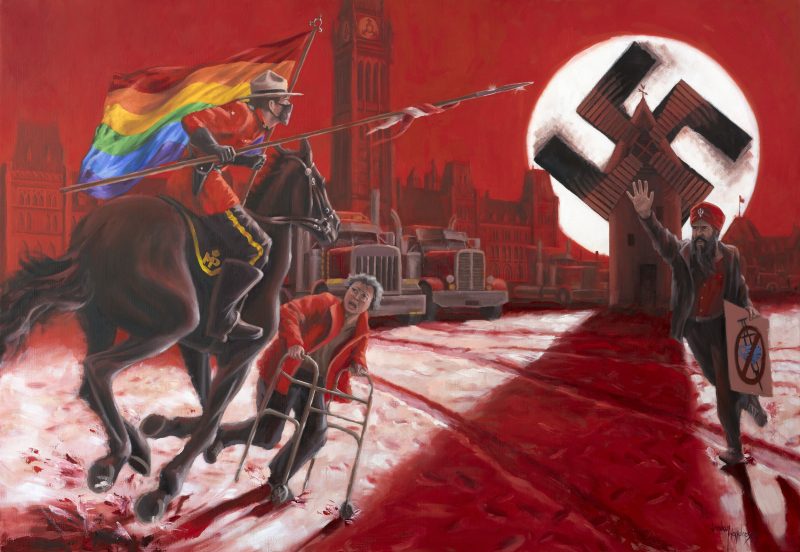
Don Quixote de la Left – Oil Painting by Jordan Henderson – 36×52 inches / 91×132 centimeters
Chile’s Boric wasted an opportunity for Palestine at the UN General Assembly
By Ramona Wadi | MEMO | September 24, 2022
Chilean President Gabriel Boric may currently be the most outspoken leader in Latin America on Palestinian rights and Israeli violations. However, his rhetoric leaves much to be desired. It, in turn, raises questions about how Chile – the country with the largest Palestinian community in the region – can differentiate itself from other countries to become a model to follow, rather than following international consensus over the two-state compromise and Israel’s security narrative.
In his first address to the United Nations General Assembly (UNGA), Boric spoke about Palestine’s right to freedom and sovereignty while mangling his message by including a false equivalence with Israel that eliminates the colonial context. “[Palestinian people] should yield to their inalienable right to establish their own free and sovereign state. In the same way, [let’s] guarantee Israel’s legitimate right to live within secure and internationally recognised borders,” Boric asserted.
Boric’s speech was pronounced “politically correct”, while noting that Chile’s stance has always advocated for the recognition of Palestinian people’s rights and Israel’s rights while promoting the two-state compromise, like the rest of the international community. In which case, Boric’s activist stances as president are unlikely to leave any impact on Chilean diplomacy. Under Boric, the Chilean government is advocating for the same stance that his predecessor Sebastian Pinera adhered to, which is a bonus for Israel, despite the grievances Israeli media aired upon Boric’s electoral victory.
Days before his UNGA speech, Boric postponed accepting the credentials of the new Israeli ambassador to Chile, Gil Artzyeli, in response to the Israeli forces’ killing of 17-year-old Palestinian Odai Trad Salah in Kufr Dan near Jenin. However, his stance, which made headline news in major media outlets worldwide, was diminished by the UNGA speech that attempted equivalence between the coloniser and the colonised while simplifying, to the point of obliteration, the reason why Palestinians are deprived of a state, possibly permanently.
Boric is not unaware of the Palestinian plight as a result of Zionist colonisation. Neither is he oblivious to the fact that Palestinians and the indigenous people of Chile – the Mapuche – have suffered similar forms of aggression because of governments criminalising their struggle for land reclamation and political autonomy. Yet, it is possible that, as president, Boric’s activist stances will be mellowed by diplomatic requirements, such as abiding by the two-state compromise, which has failed Palestinians and become defunct in all but international rhetoric.
Prior to the presidency, Boric stood out as one of the most vocal activists in Chile. As president, Boric is navigating a complex reality that includes the legacy of Augusto Pinochet’s dictatorship and ties to Israel during that period, as well as the country’s reliance on securing military and surveillance equipment from Palestine’s oppressors.
To cast Israel and legitimacy together is an aberration, particularly when using such descriptions to balance advocating for Palestinian rights. Boric wasted an opportunity at his first UNGA speech to call out Israel’s colonial violence and how it invalidates legitimacy. It is not up to the international community to guarantee Israel’s existence, but Boric knows that Chile can play a pivotal role in ensuring that the international community gravitates towards the legitimacy of the Palestinian people’s political demands.
“Political Protest Is Not a White Collar Crime”
By Diana West | OffGuardian | September 23, 2022
On July 30, 2002, President George W. Bush signed the Sarbanes-Oxley Act, a post-Enron law “aimed at fraud in corporations,” as summed up in a headline in the New York Times.
The newspaper elaborated:
The bill, an extensive overhaul of corporate fraud, securities and accounting laws, creates a regulatory board with investigative and enforcement powers to oversee the accounting industry and punish corrupt auditors. It also establishes new standards for prosecuting wrongdoing and gives corporate whistle-blowers broad new protections. Executives who deliberately defrauded investors would face long prison terms.
Did you know that this same bill crafted to stop white-collar-crime is being used as a big stick felony charge against January 6 protestors?
I refer to the provision of the law against “obstruction of an official proceeding.” It’s a crime, the DOJ website tells us, which carries “a maximum sentence of 20 years in prison, fine of $250,000 or twice the monetary gain or loss of the offense.”
The financial penalty — that fine of $250,000 “or twice the monetary gain or loss of the offense” — really gives it all away. That is, the crime this law is meant to prohibit is inextricably connected to financial activity, not political protest.
This provision already has an infamous and unjust past.
Perhaps its very first application was by mad-dog-prosecutor Andrew Weissman, who was able to convince a jury to convict and thus bankrupt the accounting firm Arthur Andersen for its business-as-usual, internal-policy-perfect destruction of Enron documents in the period before the company ever received a subpoena.
The Supreme Court overruled the lower court verdict, 9-0.
Now the misbegotten provision is being totally and willfully misapplied to political protest.
Indeed, in President Bush’s brief remarks on signing the bill twenty years ago, he singled out this one section of the lengthy law to reassure the American people that it would not be used to infringe on the People’s right to protest.
As Bush put it:
To ensure that no infringement on the constitutional right to petition the Government for redress of grievances occurs in the enforcement of section 1512(c) of title 18 of the U.S. Code, enacted by section 1102 of the Act, which among other things prohibits corruptly influencing any official proceeding, the executive branch shall construe the term “corruptly” in section 1512(c)(2) as requiring proof of a criminal state of mind on the part of the defendant.
It’s well worth remembering that the right to petition the Government for redress of grievance, as attorney Joseph D. McBride explains, was continually exercised across the country for much of the year 2020 during the George Floyds protests which preceded the January 6 protest.
“January 6 did not happen in a vacuum,” McBride recently told the Blaze’s Daniel Horowitz. “In the year or so that preceded January 6, you had all the BLM and Antifa riots all over the United States of America. We saw the burning down of cities, the attacking of police officers. Members of antifa out there in black bloc covered head to toe in full riot gear going at it with police, the looting of stores—you name it, we saw it.”
As reported by Deborah Heine in American Greatness :
McBride posited that the left-wing agitators got a pass in 2020 because of new and expanded definitions of “civil disobedience, and political protest” which allowed government entities to view even violent riots “as grounded in the First Amendment, not criminality.
In the wake of this, he explained, the pro-Trump protesters showed up in Washington, D.C. on January 6 with the impression there was this “new and modern definition of political protest.” Of course, most of the January 6 rioters came nowhere near the levels of violence the nation saw during the George Floyd riots, McBride was careful to point out.
Because of who they were, however, (that is, mainly white, middle-class, patriotic, pro-Trump Americans) they were targeted, persecuted, and not given the constitutional protections the much more violent and destructive left-wing rioters were routinely given, he argued.
“For the first time in U.S. history, the political party in power is hunting down and jailing members of the opposition party for political dissidence, and not only that, they’re torturing them in jail,” McBride said. “This is the stuff of dictatorships.”
It is also the stuff of dictatorships to twist the law, hold show trials, and criminalize the state of mind of the political opposition.
Iraqi girl killed during US military drills

The Cradle | September 22, 2022
A 15-year-old Iraqi girl, Zainab Essam Majed al-Khazali, was killed on 20 September by the gunfire of US army troops as they were conducting military drills on Victoria Base, near Baghdad International Airport.
The Iraqi Security Media Cell (ISMC) announced that it has launched an investigation into the murder, which it initially referred to as a “random shooting.”
Iraq’s security forces, however, said: “The killing of Zainab Essam Majed coincided with the presence of training operations for the American forces … the bullet that was taken out of the girl’s head confirms that it is from one of the weapons used by the American forces in the embassy and airport.”
The head of the Asaib Ahl al-Haq resistance group, Qais al-Khazali, demanded via twitter that “intelligence services present a detailed report to the Iraqi people, explaining … this cowardly incident, and how a military base can exist on Iraqi soil in clear violation of the Iraqi constitution … and sovereignty.”
Khazali also condemned the use of live ammunition in the US training and drill exercises, which he said were carried out in a residential area with a disregard for civilian life.
According to reports, the girl, who bears the same family name as the Asaib Ahl al-Haq leader, is the granddaughter of a member of the organization who was martyred, Majed al-Khazali. Her funeral procession was held the following day.
The killing of Zainab al-Khazali took place near the notorious Abu Ghraib prison camp, which was formerly run by US forces during the years following its invasion and occupation of the country in 2003.
Abu Ghraib was the center of several scandals involving the brutal torture, mistreatment, and murder of dozens of Iraqis by US military personnel.
The illegal US occupation of Iraq, which persists until today, has been responsible for the deaths of at least one million Iraqis.
Khazali was killed just days after the death of Mahsa Amini in Iran, whose passing has been used by western media and political leaders to further their attacks against the Islamic Republic.
During his speech at the UN General Assembly (UNGA), US President Joe Biden blasted Tehran for Amini’s death while in police custody, while at the same time failing to make any mention of Khazali.
In This House . . .
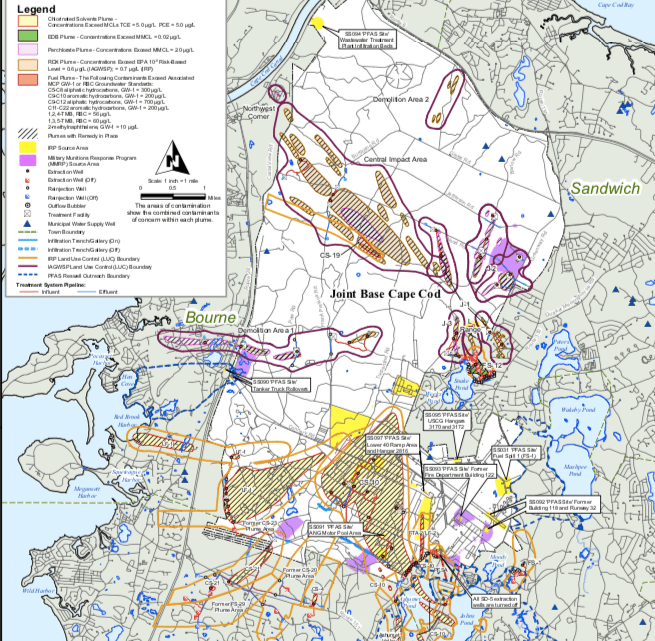
“Joint Base Cape Cod” contaminated groundwater plumes
By Richard Hugus | September 18, 2022
As reported by national news in the US, on September 16, 2022, 50 illegal immigrants from Venezuela were flown from Florida to Martha’s Vineyard, Massachusetts. Officials on the island said they did not have the resources to take care of the immigrants, so they were transported by the Massachusetts National Guard to a military base on Cape Cod. The immigrants were tolerated on Martha’s Vineyard for exactly two days.
The military base they were taken to, with the purposely non-descriptive name, “Joint Base Cape Cod,” is about 30 miles north of the church in Edgartown where the immigrants stayed. The base was formerly known as the Massachusetts Military Reservation, or Otis/Camp Edwards. The base is notorious for being a dump site for the federal government, so it probably seemed to the authorities a logical place to get rid of the immigrants. The 22,000 acre base was designated a Superfund site in 1989 due to massive amounts of fuels and solvents dumped at Otis Air Base into the sandy soil above Upper Cape Cod’s sole-source aquifer. As more and more contaminated groundwater was being discovered on the Air Force side, yet more was discovered from the past dumping of propellants and explosives by the Army at Camp Edwards. At one site on the base in the 1960s, the Air Force dumped up to 6 million gallons of aviation fuel on the ground just to test aircraft emergency release valves. Enough fuel from here and elsewhere got into water supplies in nearby Forestdale to the point that tap water at a kitchen sink could be lit on fire. Meanwhile, the Army was accustomed for years to firing Howitzer and mortar rounds into the base “impact area” whose explosions would shake windows in residential areas all over the Upper Cape. Nearby residents also lived with the frequent sound of machine gun fire from one of many gun ranges. Indeed, the Army National Guard has lately insisted it needs 200 acres of forest clearcut for a new machine gun range, with 5,000 acres reserved for strays and overshoots. For those feigning such concern, this was some place to send a group of helpless refugees. The public has no access to and very little knowledge of this huge area of sunny Cape Cod.
Martha’s Vineyard has had its own episode of Pentagon abuse. A small island called Nomans, just south of the Vineyard, was used as an aerial bombing range for many years, leaving the land littered with unexploded ordnance and contaminated soil. Rather than remediate, the US Navy conveniently handed the land over the Department of Fisheries and Wildlife who simply called it a conservation area, posted No Trespassing signs, and called it a day. The small island, a beautiful gem once inhabited by Wampanoag Indians and early settlers, it is now just a sacrifice zone, like a closed landfill. No one is allowed to set foot on it.
Both Cape Cod and Martha’s Vineyard have a service and tourist economy. Most people who live and work there are not wealthy, but have jobs serving the wealthy in one way or another. They build and repair the homes of the rich, they entertain them, run the restaurants, cook the food, clean the houses, and maintain their boats and cars. Low wage workers and immigrant labor are brought in every year for the summer season as there is evidently not enough money to pay local workers asking for a decent wage. Nor can working people afford houses on local wages. It’s a rentier economy. Poverty is real on both Martha’s Vineyard and the Cape because so many among the rich know very well how to spend as little of their money as possible for the services they receive. While working people there might not be happy about immigrant labor lowering wages and taking jobs, they would not have called the National Guard to come in and remove the strangers from Venezuela. And of course they would not have had the power to do so even if they wanted to. That call had to have come from new world order hopeful Governor Charlie Baker, on orders from Vineyard residents like Barack Obama who don’t want to see the results of the unrestricted immigration that they initiated actually becoming visible in their own neighborhoods. This is why the 50 Venezuelans were brought to eastern Massachusetts’ go-to military dump site, incidentally also home to the Barnstable County Jail — another thing no one wanted to see or hear anywhere else on the Cape.
We might ask why people in Venezuela got to the point of leaving family, home, culture, and country to emigrate in the first place. Obviously, two decades of coup attempts from the Chavez era on, relentless sanctions, and the theft of assets by the US has made life in Venezuela hard for many people. The US government created this problem. The further abuse of Venezuelans in a program of engineered destruction of sovereign countries and cultures, which is what the immigration crisis amounts to worldwide, is the same attack multiplied. Democrats are accusing Republicans of using the 50 immigrants as pawns. Higher powers still are using the Democrats and Republicans as pawns. This is a play inside a play and involves a level of manipulation that is not just cynical, but diabolical.
We’ve all seen the “In This House, We Believe” signs. The signs are displayed by some of the people on Martha’s Vineyard who this past week didn’t mind seeing 50 of the world’s poor carted off to a restricted military base. Between the lines on these cute little emblems of virtue we now read the ugly truth:
In this house, we believe . . .
In complete, shameless hypocrisy
In full totalitarianism, as long as it’s nicely wrapped in self-righteous liberal jargon
Virtue-signaling is better by far (and much easier) than actual virtue
Immigrants are welcome (to mow our lawns and wash our dishes)
Climate change is real (how else do we explain it being sunny one day and cloudy the next?)
All orientations are preferable to heterosexuality — the human race has gone on long enough
We hate humanity
A woman’s rights are human rights (but there is no such thing as a woman, so there is no such thing as “women’s rights”)
Black lives matter (especially when they can be used to create disruption and chaos while we do nothing to actually improve the lives of black people)
No human is illegal (unless he’s too close to my $12 million oceanfront property)
There is no place for hate (unless you’re a white hetero male, a Palestinian, a Muslim, a Christian, a Russian, a ‘right wing extremist’, an anti-vaxxer, a climate ‘denier’, or anyone else on our list)
Science is real (so long as it serves pharmaceutical company profits and ‘great reset’ eugenics)
Love is love, and all other nice-sounding, mystifying, empty tautologies
Kindness is everything (after money, power, and control)
The Specter of Germany Is Rising
By Diana Johnstone | Consortium News | September 12, 2022
The European Union is girding for a long war against Russia that appears clearly contrary to European economic interests and social stability. A war that is apparently irrational – as many are – has deep emotional roots and claims ideological justification. Such wars are hard to end because they extend outside the range of rationality.
For decades after the Soviet Union entered Berlin and decisively defeated the Third Reich, Soviet leaders worried about the threat of “German revanchism.” Since World War II could be seen as German revenge for being deprived of victory in World War I, couldn’t aggressive German Drang nach Osten be revived, especially if it enjoyed Anglo-American support? There had always been a minority in U.S. and U.K. power circles that would have liked to complete Hitler’s war against the Soviet Union.
It was not the desire to spread communism, but the need for a buffer zone to stand in the way of such dangers that was the primary motivation for the ongoing Soviet political and military clampdown on the tier of countries from Poland to Bulgaria that the Red Army had wrested from Nazi occupation.
This concern waned considerably in the early 1980s as a young German generation took to the streets in peace demonstrations against the stationing of nuclear “Euromissiles” which could increase the risk of nuclear war on German soil. The movement created the image of a new peaceful Germany. I believe that Mikhail Gorbachev took this transformation seriously.
On June 15, 1989, Gorbachev came to Bonn, which was then the modest capital of a deceptively modest West Germany. Apparently delighted with the warm and friendly welcome, Gorbachev stopped to shake hands with people along the way in that peaceful university town that had been the scene of large peace demonstrations.
I was there and experienced his unusually warm, firm handshake and eager smile. I have no doubt that Gorbachev sincerely believed in a “common European home” where East and West Europe could live happily side by side united by some sort of democratic socialism.
Gorbachev died at age 91 two weeks ago, on Aug. 30. His dream of Russia and Germany living happily in their “common European home” had soon been fatally undermined by the Clinton administration’s go-ahead to eastward expansion of NATO. But the day before Gorbachev’s death, leading German politicians in Prague wiped out any hope of such a happy end by proclaiming their leadership of a Europe dedicated to combating the Russian enemy.
These were politicians from the very parties – the SPD (Social Democratic Party) and the Greens – that took the lead in the 1980s peace movement.
German Europe Must Expand Eastward
German Chancellor Olaf Scholz is a colorless SPD politician, but his Aug. 29 speech in Prague was inflammatory in its implications. Scholz called for an expanded, militarized European Union under German leadership. He claimed that the Russian operation in Ukraine raised the question of “where the dividing line will be in the future between this free Europe and a neo-imperial autocracy.” We cannot simply watch, he said, “as free countries are wiped off the map and disappear behind walls or iron curtains.”
(Note: the conflict in Ukraine is clearly the unfinished business of the collapse of the Soviet Union, aggravated by malicious outside provocation. As in the Cold War, Moscow’s defensive reactions are interpreted as harbingers of Russian invasion of Europe, and thus a pretext for arms buildups.)
To meet this imaginary threat, Germany will lead an expanded, militarized EU. First, Scholz told his European audience in the Czech capital, “I am committed to the enlargement of the European Union to include the states of the Western Balkans, Ukraine, Moldova and, in the long term, Georgia”. Worrying about Russia moving the dividing line West is a bit odd while planning to incorporate three former Soviet States, one of which (Georgia) is geographically and culturally very remote from Europe but on Russia’s doorstep.
2022 Fall Fund Drive
In the “Western Balkans”, Albania and four extremely weak statelets left from former Yugoslavia (North Macedonia, Montenegro, Bosnia-Herzegovina and widely unrecognized Kosovo) mainly produce emigrants and are far from EU economic and social standards. Kosovo and Bosnia are militarily occupied de facto NATO protectorates. Serbia, more solid than the others, shows no signs of renouncing its beneficial relations with Russia and China, and popular enthusiasm for “Europe” among Serbs has faded.
Adding these member states will achieve “a stronger, more sovereign, geopolitical European Union,” said Scholz. A “more geopolitical Germany” is more like it. As the EU grows eastward, Germany is “in the center” and will do everything to bring them all together. So, in addition to enlargement, Scholz calls for “a gradual shift to majority decisions in common foreign policy” to replace the unanimity required today.
What this means should be obvious to the French. Historically, the French have defended the consensus rule so as not to be dragged into a foreign policy they don’t want. French leaders have exalted the mythical “Franco-German couple” as guarantor of European harmony, mainly to keep German ambitions under control.
But Scholz says he doesn’t want “an EU of exclusive states or directorates,” which implies the final divorce of that “couple.” With an EU of 30 or 36 states, he notes, “fast and pragmatic action is needed.” And he can be sure that German influence on most of these poor, indebted and often corrupt new Member States will produce the needed majority.
France has always hoped for an EU security force separate from NATO in which the French military would play a leading role. But Germany has other ideas. “NATO remains the guarantor of our security,” said Scholz, rejoicing that President Biden is “a convinced trans-atlanticist.”
“Every improvement, every unification of European defense structures within the EU framework strengthens NATO,” Scholz said. “Together with other EU partners, Germany will therefore ensure that the EU’s planned rapid reaction force is operational in 2025 and will then also provide its core.
This requires a clear command structure. Germany will face up to this responsibility “when we lead the rapid reaction force in 2025,” Scholz said. It has already been decided that Germany will support Lithuania with a rapidly deployable brigade and NATO with further forces in a high state of readiness.
Serving to Lead … Where?
In short, Germany’s military buildup will give substance to Robert Habeck’s notorious statement in Washington last March that: “The stronger Germany serves, the greater its role.” The Green’s Habeck is Germany’s economics minister and the second most powerful figure in Germany’s current government.
The remark was well understood in Washington: by serving the U.S.-led Western empire, Germany is strengthening its role as European leader. Just as the U.S. arms, trains and occupies Germany, Germany will provide the same services for smaller EU states, notably to its east.
Since the start of the Russian operation in Ukraine, German politician Ursula von der Leyen has used her position as head of the EU Commission to impose ever more drastic sanctions on Russia, leading to the threat of a serious European energy crisis this winter. Her hostility to Russia seems boundless. In Kiev last April she called for rapid EU membership for Ukraine, notoriously the most corrupt country in Europe and far from meeting EU standards. She proclaimed that “Russia will descend into economic, financial and technological decay, while Ukraine is marching towards a European future.” For von der Leyen, Ukraine is “fighting our war.” All of this goes far beyond her authority to speak for the EU’s 27 Members, but nobody stops her.
Germany’s Green Party foreign minister Annalena Baerbock is every bit as intent on “ruining Russia.” Proponent of a “feminist foreign policy”, Baerbock expresses policy in personal terms. “If I give the promise to people in Ukraine, we stand with you as long as you need us,” she told the U.S. National Endowment for Democracy (NED)-sponsored Forum 2000 in Prague on Aug. 31, speaking in English. “Then I want to deliver no matter what my German voters think, but I want to deliver to the people of Ukraine.”
“People will go on the street and say, we cannot pay our energy prices, and I will say, ‘Yes I know so we will help you with social measures. […] We will stand with Ukraine and this means the sanctions will stay also til winter time even if it gets really tough for politicians.’”
Certainly, support for Ukraine is strong in Germany, but perhaps because of the looming energy shortage, a recent Forsa poll indicates that some 77 percent of Germans would favor diplomatic efforts to end the war – which should be the business of the foreign minister. But Baerbock shows no interest in diplomacy, only in “strategic failure” for Russia – however long it takes.
In the 1980s peace movement, a generation of Germans was distancing itself from that of their parents and vowed to overcome “enemy images” inherited from past wars. Curiously, Baerbock, born in 1980, has referred to her grandfather who fought in the Wehrmacht as somehow having contributed to European unity. Is this the generational pendulum?
The Little Revanchists
There is reason to surmise that current German Russophobia draws much of its legitimization from the Russophobia of former Nazi allies in smaller European countries.
While German anti-Russian revanchism may have taken a couple of generations to assert itself, there were a number of smaller, more obscure revanchisms that flourished at the end of the European war that were incorporated into United States Cold War operations. Those little revanchisms were not subjected to the denazification gestures or Holocaust guilt imposed on Germany. Rather, they were welcomed by the C.I.A., Radio Free Europe and Congressional committees for their fervent anticommunism. They were strengthened politically in the United States by anticommunist diasporas from Eastern Europe.
Of these, the Ukrainian diaspora was surely the largest, the most intensely political and the most influential, in both Canada and the American Middle West. Ukrainian fascists who had previously collaborated with Nazi invaders were the most numerous and active, leading the Bloc of Anti-Bolshevik Nations with links to German, British and U.S. Intelligence.
Eastern European Galicia, not to be confused with Spanish Galicia, has been back and forth part of Russia and Poland for centuries. After World War II it was divided between Poland and Ukraine. Ukrainian Galicia is the center of a virulent brand of Ukrainian nationalism, whose principal World War II hero was Stepan Bandera. This nationalism can properly be called “fascist” not simply because of superficial signs – its symbols, salutes or tatoos – but because it has always been fundamentally racist and violent.
Incited by Western powers, Poland, Lithuania and the Habsburg Empire, the key to Ukrainian nationalism was that it was Western, and thus superior. Since Ukrainians and Russians stem from the same population, pro-Western Ukrainian ultra-nationalism was built on imaginary myths of racial differences: Ukrainians were the true Western whatever-it-was, whereas Russians were mixed with “Mongols” and thus an inferior race. Banderist Ukrainian nationalists have openly called for elimination of Russians as such, as inferior beings.
So long as the Soviet Union existed, Ukrainian racial hatred of Russians had anticommunism as its cover, and Western intelligence agencies could support them on the “pure” ideological grounds of the fight against Bolshevism and Communism. But now that Russia is no longer ruled by communists, the mask has fallen, and the racist nature of Ukrainian ultra-nationalism is visible – for all who want to see it.
However, Western leaders and media are determined not to notice.
Ukraine is not just like any Western country. It is deeply and dramatically divided between Donbass in the East, Russian territories given to Ukraine by the Soviet Union, and the anti-Russian West, where Galicia is located. Russia’s defense of Donbass, wise or unwise, by no means indicates a Russian intention to invade other countries. This false alarm is the pretext for the remilitarization of Germany in alliance with the Anglo-Saxon powers against Russia.
The Yugoslav Prelude
This process began in the 1990s, with the breakup of Yugoslavia.
Yugoslavia was not a member of the Soviet bloc. Precisely for that reason, the country got loans from the West which in the 1970s led to a debt crisis in which the leaders of each of the six federated republics wanted to shove the debt onto others. This favored separatist tendencies in the relatively rich Slovenian and Croatian republics, tendencies enforced by ethnic chauvinism and encouragement from outside powers, especially Germany.
During World War II, German occupation had split the country apart. Serbia, allied to France and Britain in World War I, was subject to a punishing occupation. Idyllic Slovenia was absorbed into the Third Reich, while Germany supported an independent Croatia, ruled by the fascist Ustasha party, which included most of Bosnia, scene of the bloodiest internal fighting. When the war ended, many Croatian Ustasha emigrated to Germany, the United States and Canada, never giving up the hope of reviving secessionist Croatian nationalism.
In Washington in the 1990s, members of Congress got their impressions of Yugoslavia from a single expert: 35-year-old Croatian-American Mira Baratta, assistant to Sen. Bob Dole (Republican presidential candidate in 1996). Baratta’s grandfather had been an important Ustasha officer in Bosnia and her father was active in the Croatian diaspora in California. Baratta won over not only Dole but virtually the whole Congress to the Croatian version of Yugoslav conflicts blaming everything on the Serbs.
In Europe, Germans and Austrians, most notably Otto von Habsburg, heir to the defunct Austro-Hungarian Empire and member of the European Parliament from Bavaria, succeeded in portraying Serbs as the villains, thus achieving an effective revenge against their historic World War I enemy, Serbia. In the West, it became usual to identify Serbia as “Russia’s historic ally”, forgetting that in recent history Serbia’s closest allies were Britain and especially France.
In September 1991, a leading German Christian Democratic politician and constitutional lawyer explained why Germany should promote the breakup of Yugoslavia by recognizing the Slovenian and Croat secessionist Yugoslav republics. (Former CDU Minister of Defense Rupert Scholz at the 6th Fürstenfeldbrucker Symposium for the Leadership of the German Military and Business, held September 23 – 24, 1991.)
By ending the division of Germany, Rupert Scholz said, “We have, so to speak, overcome and mastered the most important consequences of the Second World War … but in other areas we are still dealing with the consequences of the First World War” – which, he noted “started in Serbia.”
“Yugoslavia, as a consequence of the First World War, is a very artificial construction, never compatible with the idea of self-determination,” Rupert Scholz said. He concluded: “In my opinion, Slovenia and Croatia must be immediately recognized internationally. (…) When this recognition has taken place, the Yugoslavian conflict will no longer be a domestic Yugoslav problem, where no international intervention can be permitted.”
And indeed, recognition was followed by massive Western intervention which continues to this day. By taking sides, Germany, the United States and NATO ultimately produced a disastrous result, a half dozen statelets, with many unsettled issues and heavily dependent on Western powers. Bosnia-Herzegovina is under military occupation as well as the dictates of a “High Representative” who happens to be German. It has lost about half its population to emigration.
Only Serbia shows signs of independence, refusing to join in Western sanctions on Russia, despite heavy pressure. For Washington strategists the breakup of Yugoslavia was an exercise in using ethnic divisions to break up larger entities, the USSR and then Russia.
Humanitarian Bombing
Western politicians and media persuaded the public that the 1999 NATO bombing of Serbia was a “humanitarian” war, generously waged to “protect the Kosovars” (after multiple assassinations by armed secessionists provoked Serbian authorities into the inevitable repression used as pretext for the bombing).
But the real point of the Kosovo war was that it transformed NATO from a defensive into an aggressive alliance, ready to wage war anywhere, without U.N. mandate, on whatever pretext it chose.
This lesson was clear to the Russians. After the Kosovo war, NATO could no longer credibly claim that it was a purely “defensive” alliance.
As soon as Serbian President Milosevic, to save his country’s infrastructure from NATO destruction, agreed to allow NATO troops to enter Kosovo, the U.S. unceremoniously grabbed a huge swath territory to build the its first big U.S. military base in the Balkans. NATO troops are still there.
Just as the United States rushed to build that base in Kosovo, it was clear what to expect of the U.S. after it succeeded in 2014 to install a government in Kiev eager to join NATO. This would be the opportunity for the U.S. to take over the Russian naval base in Crimea. Since it was known that the majority of the population in Crimea wanted to return to Russia (as it had from 1783 to 1954), Putin was able to forestall this threat by holding a popular referendum confirming its return.
East European Revanchism Captures the EU
The call by German Chancellor Scholz to enlarge the European Union by up to nine new members recalls the enlargements of 2004 and 2007 that brought in twelve new members, nine of them from the former Soviet bloc, including the three Baltic States once part of the Soviet Union.
That enlargement already shifted the balance eastward and enhanced German influence. In particular, the political elites of Poland and especially the three Baltic States, were heavily under the influence of the United States and Britain, where many had lived in exile during Soviet rule. They brought into EU institutions a new wave of fanatic anticommunism, not always distinguishable from Russophobia.
The European Parliament, obsessed with virtue signaling in regard to human rights, was particularly receptive to the zealous anti-totalitarianism of its new Eastern European members.
Revanchism and the Memory Weapon
As an aspect of anti-communist lustration, or purges, Eastern European States sponsored “Memory Institutes” devoted to denouncing the crimes of communism. Of course, such campaigns were used by far-right politicians to cast suspicion on the left in general. As explained by European scholar Zoltan Dujisin, “anticommunist memory entrepreneurs” at the head of these institutes succeeded in lifting their public information activities from the national, to the European Union level, using Western bans on Holocaust denial to complain, that while Nazi crimes had been condemned and punished at Nuremberg, communist crimes had not.
The tactic of the anti-communist entrepreneurs was to demand that references to the Holocaust be accompanied by denunciations of the Gulag. This campaign had to deal with a delicate contradiction since it tended to challenge the uniqueness of the Holocaust, a dogma essential to gaining financial and political support from West European memory institutes.
In 2008, the EP adopted a resolution establishing August 23 as “European Day of Remembrance for the victims of Stalinism and Nazism” – for the first time adopting what had been a fairly isolated far right equation. A 2009 EP resolution on “European Conscience and Totalitarianism” called for support of national institutes specializing in totalitarian history.
Dujisin explains, “Europe is now haunted by the specter of a new memory. The Holocaust’s singular standing as a negative founding formula of European integration, the culmination of long-standing efforts from prominent Western leaders … is increasingly challenged by a memory of communism, which disputes its uniqueness.”
East European memory institutes together formed the “Platform of European Memory and Conscience,” which between 2012 and 2016 organized a series of exhibits on “Totalitarianism in Europe: Fascism—Nazism—Communism,” traveling to museums, memorials, foundations, city halls, parliaments, cultural centers, and universities in 15 European countries, supposedly to “improve public awareness and education about the gravest crimes committed by the totalitarian dictatorships.”
Under this influence, the European Parliament on Sept. 19, 2019 adopted a resolution “on the importance of European Remembrance for the Future of Europe” that went far beyond equating political crimes by proclaiming a distinctly Polish interpretation of history as European Union policy. It goes so far as to proclaim that the Molotov-Ribbentrop pact is responsible for World War II – and thus Soviet Russia is as guilty of the war as Nazi Germany.
The resolution,
“Stresses that the Second World War, the most devastating war in Europe’s history, was started as an immediate result of the notorious Nazi-Soviet Treaty on Non-Aggression of 23 August 1939, also known as the Molotov-Ribbentrop Pact, and its secret protocols, whereby two totalitarian regimes that shared the goal of world conquest divided Europe into two zones of influence;”
It further:
“Recalls that the Nazi and communist regimes carried out mass murders, genocide and deportations and caused a loss of life and freedom in the 20th century on a scale unseen in human history, and recalls the horrific crime of the Holocaust perpetrated by the Nazi regime; condemns in the strongest terms the acts of aggression, crimes against humanity and mass human rights violations perpetrated by the Nazi, communist and other totalitarian regimes;”
This of course not only directly contradicts the Russian celebration of the “Great Patriotic War” to defeat the Nazi invasion, it also took issue with the recent efforts of Russian President Vladimir Putin to put the Molotov-Ribbentrop agreement in the context of prior refusals of Eastern European states, notably Poland, to ally with Moscow against Hitler.
But the EP resolution:
“Is deeply concerned about the efforts of the current Russian leadership to distort historical facts and whitewash crimes committed by the Soviet totalitarian regime and considers them a dangerous component of the information war waged against democratic Europe that aims to divide Europe, and therefore calls on the Commission to decisively counteract these efforts;”
Thus the importance of Memory for the future, turns out to be an ideological declaration of war against Russia based on interpretations of World War II, especially since the memory entrepreneurs implicitly suggest that the past crimes of communism deserve punishment – like the crimes of Nazism. It is not impossible that this line of thought arouses some tacit satisfaction among certain individuals in Germany.
When Western leaders speak of “economic war against Russia,” or “ruining Russia” by arming and supporting Ukraine, one wonders whether they are consciously preparing World War III, or trying to provide a new ending to World War II. Or will the two merge?
As it shapes up, with NATO openly trying to “overextend” and thus defeat Russia with a war of attrition in Ukraine, it is somewhat as if Britain and the United States, some 80 years later, switched sides and joined German-dominated Europe to wage war against Russia, alongside the heirs to Eastern European anticommunism, some of whom were allied to Nazi Germany.
History may help understand events, but the cult of memory easily becomes the cult of revenge. Revenge is a circle with no end. It uses the past to kill the future. Europe needs clear heads looking to the future, able to understand the present.
Diana Johnstone was press secretary of the Green Group in the European Parliament from 1989 to 1996. In her latest book, Circle in the Darkness: Memoirs of a World Watcher (Clarity Press, 2020), she recounts key episodes in the transformation of the German Green Party from a peace to a war party. Her other books include Fools’ Crusade: Yugoslavia, NATO and Western Delusions (Pluto/Monthly Review) and in co-authorship with her father, Paul H. Johnstone, From MAD to Madness: Inside Pentagon Nuclear War Planning (Clarity Press). She can be reached at diana.johnstone@wanadoo.fr
Prosecuting Trump
By Peter Van Buren | We Meant Well | September 6, 2022
What would you do if you were Merrick Garland? Would you prosecute Trump? Or would you walk away, concerned about accusations you and the FBI were playing politics?
Step One appears easy, put off any decision until after the midterms. Trump is not a candidate, key issues driving the midterms (inflation, Ukraine, Roe) are not his issues and though Trump is actively stumping for many candidates, initiating any prosecution before the midterms is just too obvious. Nothing else about Mar-a-Lago has had an urgency to it (months passed from the initial voluntary turnover of documents and the forced search) and announcing an indictment now would be a terrible opening move. So if you’re Garland, you have some time.
On the other hand waiting until after the midterms can be dangerous if as expected the Republicans do well and take both the House and the Senate. Even with slim majorities Republicans are expected to initiate their own hearings, into Hunter Biden’s laptop and how the FBI played politics with that ahead of the 2020 election. Holding off an indictment until that is underway risks making your case look like retaliation for their case. That’s a bad look for a Department of Justice which claims it is not playing politics. It would look even worse if the Republicans try and cut you off, opening some sort of hearings into the Mar-a-Lago search prior to an indictment. Nope, if you’re Merrick Garland you are caught between a rock and a hard place.
But there is a bigger question: if you are Garland and you indict Trump, can you win? Candidate Trump is already earning a lot of partisan points claiming he is the victim of banana republic politics, and his indictment ahead of 2024 (it matters zero if he has formally announced or not, he is running of course) will allow him to claim he was right all along. An indictment will allow Trump to fire both barrels, one aimed at Garland and the other at the FBI and these, coupled with the dirty tricks a Republican investigation into the FBI and Russiagate will expose will make Trump look very right. He was the victim of partisan use of justice, and the FBI did try to influence both the 2016 election (with Russiagate) and the 2020 (by deep-sixing Hunter Biden’s laptop claiming falsely it was Russian misinformation) and now is taking a swing at 2024 with the Mar-a-Lago documents. If public opinion moves further to Trump’s side, Merrick Garland through his indictment just reelected Trump to the White House as a sympathy candidate. The spooks call that blowback, and it is a real threat in this instance.
Any action against Trump must preserve what is left of faith in the rule of law applied without fear or favor, or risk civil disenfranchisement if not outright civil unrest. Garland will have to address the most obvious precedent case involving former Secretary of State Hillary Clinton, who maintained an unsecured private email server which processed classified material. Her server held e-mail chains classified at the Top Secret/Special Access Program level which included the names of CIA and NSA employees. The FBI found classified intelligence improperly stored on Clinton’s server “was compromised by unauthorized individuals, to include foreign governments or intelligence services, via cyber intrusion or other means.” Clinton and her team destroyed tens of thousands of emails, potential evidence, as well as physical phones and Blackberries which potentially held evidence. She operated the server out of her home kitchen despite the presence of the Secret Service on property who failed to report it. Her purpose in doing all this appeared to have been avoiding Freedom of Information Act requests during her tenure as SecState, and maintaining control over what records became part of the historical archive post-tenure.
Clinton seems to have violated all three statues Trump was searched under. If the FBI is going to take similar fact sets and ignore one while aggressively pursuing another, it risks being seen as partial and political. Any further action against Trump and certainly any prosecution of him must address why Hillary was not searched and prosecuted herself. Fair is fair, and after all nobody is above the law.
The other fear holding Garland back would be that of losing the case outright in court. Classified documents are typically dealt with either via administrative penalties (an officer is sent home for a few days without pay) or as part of some much larger espionage case where the documents were removed illegally as part of the subject spying for a foreign country. Rarely is a case brought all the way to court for simple possession. Most of the laws Trump may have broken require some sort of intent to harm the United States. In other words, Trump would have had to have taken the documents not just for ego or his library or as some uber-souveniers but with the specific intent to commit harm against the United States. Garland certainly does not have that.
Other factors which typically play into documents cases are also not in Garland’s favor. Despite not being kept in line with General Services Administration standards, the documents appear to have been locked away securely at Mar-a-Lago, the premises itself guarded by the Secret Service. Trump has already turned over surveillance video of the documents storage location, which presumably does not show foreign agents wandering in and out of frame. It is much harder to prosecute a case when no actual harm was shown done to national security.
Another factor in documents cases involves the content of the documents themselves. The uninformed press has made much of the classification markings, but Garland will need to show the actual content of the docs was damaging to the U.S., and that Trump knew that. Overclassification will play a role, as will the age and importance of the information itself; after all, it is that information which is classified, not the piece of paper itself marked Secret. Garland will know Trump will fight him page by page, meaning much of the classified will be exposed in court and/or the trial will move to classified sessions to shield the information but feed the conspiracy machine. One can hear Trump arguing his right to a public trial being taken away.
Hyperbole aside, the critical question returns to whether or not prosecutors could prove specific intent on Trump’s part for the more serious charges. Proving a state of guilty mind — mens rea — would be the crux of any actual prosecution based on the Mar-a-Lago documents. What was Trump thinking at the time, in other words, did he have specific intent to injure the United States or to obstruct some investigation he would have had to have known about? Without knowing the exact nature of the documents this is a tough prediction but even with the documents on display in front of us proving to a court’s satisfaction what Trump wanted to do by keeping the documents would require coworkers and colleagues to testify to what Trump himself had said at the time, and that is unlikely to happen. It is thus unlikely based on what we know at present that Trump would go to jail for any of this.
Take for example the charges of tax evasion now levied again the Trump Organization (i.e., not Trump personally and not part of the Mar-a-Lago case.) Trump Organization CFO Allen Weisselberg, as part of a plea deal, will testify against the Organization but not Trump himself as to why the Organization paid certain compensation in the form of things like school tuitions, cars, and the like, all outside the tax system. It will be a bad day for the Organization but loyal to the end, Weisselberg will not testify as to his boss’ mens rea. It is equally unclear who would be both competent and willing to do so against President of the United States Trump. Blue Check enthusiasm aside, he won’t go to jail over this.
The final questions are probably the most important: DOJ knows what the law says. If knowing the chances of a serious conviction are slight, why would the Justice Department take the Mar-a-Lago case to court? Then again, if knowing the chances for a serious conviction are slight, why would the FBI execute a high-profile search warrant in the first place? To gather evidence unlikely ever to be used? No one is above the law, but that includes politics not trumping clean jurisprudence as well.
And then what? If Garland successfully navigates the politics, if he proves his case in court, and if he secures some sort of conviction against Trump which withstands the inevitable appeal, then what? Trump’s Mar-a-Lago “crimes” are relatively minor. Could Garland call Trump having to do some sort of community service during the 2024 campaign a win? Pay a fine? It seems petty. It sure seems Trump wins politically big-picture whether he wins or loses at Mar-a-Lago. If you were Merrick Garland, what would you do?
US imported $6 billion from Russia as it forces others to quit doing business with Moscow
America keeps importing essential commodities from Russia while pressuring others not to do so
By Drago Bosnic | September 8, 2022
After Russia launched its counteroffensive against NATO aggression in Europe, the US-led political West vowed to “isolate“ Russia and “cripple“ its economy. Yet, the Eurasian giant didn’t only weather the storm largely unscathed, but it even managed to profit while the sanctions boomerang started ravaging Western economies. Russia has been able to maintain its economic strength, powering through the sanctions and even establishing alternative payment systems with major global powers such as China and India. And yet, the US, as the leading Western power, the one which pushed its European and other vassals into an economic war with Russia, with devastating consequences for the EU and other economies, continues doing business with Moscow.
The US is currently importing over $1 billion per month in Russian wood, metals, food and other goods. More than 3,600 ships from Russia have arrived at American ports since February 24, according to statistics cited by the Associated Press. While that is nearly 50% less in shipments over the same period compared to last year, it still amounts to over $6 billion in imports. The sheer quantity of goods and commodities from Russia entering the US suggests the troubled Biden administration is directly involved in a failure to “isolate“ the Russian economy, as the US incumbent president promised in late February. Due to so-called “wind down“ periods that allow companies to complete previous deals, many of the products and commodities continue to be imported into the US long after the Biden administration imposed sanctions on those goods, including Russian oil and natural gas.
However, there are exceptions to this as well. The import of other crucial Russian commodities, such as fertilizer, came at the request of the Biden administration itself, which has urged US companies to make up for shortages. Although the US has ordered the seizure of luxury yachts owned by rich Russians with supposed “ties to Russian President Vladimir Putin“, the AP found that many companies from the US and EU are still importing millions of dollars in metal from a Russian firm that makes parts for VKS (Russian Aerospace Forces) fighter jets, highlighting yet another hypocritical discrepancy in Western sanctions campaign. And yet, Washington is trying to exert diplomatic pressure on others to stop doing business with Moscow. While many have followed the US diktat, others are not only keeping their economic ties with Russia, but are even expanding them. For instance, Turkey, a NATO member since 1952, has doubled its oil imports from Russia this year.
This hypocritical approach has made many other countries, including major global powers, such as India, frustrated, as they are being criticized for their ties with Russia, while the US gets to cherry pick which ties with Moscow it can keep in order to prevent disruptions to its economy. This has nearly nullified the US attempts to strengthen ties with India and get New Delhi into its fold, despite the fact that American troops are currently engaged in military exercises with their Indian counterparts. And yet, just like Turkey, New Delhi has similarly significantly increased energy imports from Russia, despite US pressure not to do so. In addition, the Indian rupee has become a major currency for the diamond trade, allowing buyers to bypass anti-Russian sanctions, pushing India even closer to Moscow in this regard.
Although the failed economic siege of Russia was also meant to diminish the Eurasian giant’s nearly unmatched military might (which only the US can compare to), it has so far been completely inconsequential. Worse yet, it even had an opposite effect, as Russia is now expanding and strengthening its military, including the increase in production of weapons such as the Su-57, which has proven itself in the special military operation against the Kiev-based Neo-Nazi junta. This resilience isn’t limited to the Russian military. With Russian energy exports far exceeding last year’s levels in recent months and the Russian ruble rallying against the US dollar, the Eurasian giant’s economy is also faring far better than those of the EU members.
Still, the question remains, what will the EU and other US vassals do when the winter comes? Will Washington send food, oil, gas and other essential commodities? How will the “moral highground“ of “sticking it to Putin“ help heat homes, feed hundreds of millions of hungry (and angry) citizens and power entire economies and countries? How will the EU and other governments explain to their voters that all this is “worth doing“ so that the “young, vibrant democracy in Kiev“ can survive the “unprovoked brutal Russian invasion“?
And what will Europe look like in 2023 after it goes through a complete political unraveling? Whatever happens to Europe and other US vassals, one thing is certain – America will keep importing essential commodities from Russia while pressuring others not to do it. However, this isn’t necessarily bad, as it will be a perfect litmus test of sovereignty for many around the globe and an excellent indicator of who will get the privilege of joining the new multipolar world of sovereign nations.
Drago Bosnic is an independent geopolitical and military analyst.
Sweden’s Psychological Defense Agency: Good disinformation is “basically true”

By Didi Rankovic | Reclaim The Net | September 6, 2022
There is no doubt that Russia, like any other major – and minor – power uses some form of propaganda and disinformation to further its goals, especially in wartime.
What’s difficult to gauge, at least at this time, is how applicable that may be in the current crisis: is Russia really trying to “exploit polarization and sow division,” in countries like Sweden, for example?
But what the fear of Russian disinformation – or apparent fear of it – has clearly managed is to make some state bodies, like Sweden’s Psychological Defense Agency, part ways with basic logic – and not be afraid to admit it to the world.
Hence, some of what is labeled as “disinformation” by this agency whose goal is to bolster the Swedes’ “moral fortitude” includes information that “is actually not false” and is even, “basically true.”
“War is peace. Freedom is slavery. Ignorance is strength,” Orwell wrote.
Psychological Defense Agency head Henrik Landerholm, meanwhile, has as recently as last week been quoted by The Times as coming up with this:
“Good disinformation is actually not false. Good disinformation is basically true and only somewhat tweaked.”
Any arbiter of “good and bad disinformation” operating on such nuance is entering the dangerous territory of becoming the judge and jury of truth, and producing bias that can be used and abused beyond any one crisis and political circumstance.
And it soon becomes clear that the Times piece – even though putting “highly clickable” terms like “Russian” and “disinformation” right in the headline – actually has to do with Sweden’s internal politics and a looming election.
The premise with Sweden is that the society is “plagued by polarization and mistrust.” It has nothing to do with policy on Russia or the war – it’s that the Swedes are apparently fed up with rising crime, and unhappy with the authorities’ policy on immigration.
The “theory” here is that Russians, even if ostensibly quite busy elsewhere, will dedicate resources to exploit what already exists in Swedish society – namely, divisions over these burning issues.
Reuters decides to make it seem Russia is interested in making Sweden Democrats the second biggest party in parliament – and this party is denounced by the agency as having “neo Nazi roots.” But, “center-left” Social Democrats are still projected to win, we are reassured.
Leaked slides detail YouTube’s Ukraine censorship
Samizdat | August 23, 2022
A tutorial for YouTube’s content moderators that emerged on social media on Tuesday shows that the Google-owned platform has labeled a number of critical positions on the conflict in Ukraine “hateful” or “extreme” and can censor or demonetize creators on those grounds. While the parent company Alphabet has not confirmed or denied the screenshots’ authenticity, a Polish contractor who shared them has reportedly been fired.
Six screenshots shared by Russian journalist Andrey Guselnikov on Telegram show internal codes and examples of what YouTube has labeled “harmful” or “hateful” content in an online course mandated for content moderators.
According to the slides, the “glorification/promotion of [the] ‘Z’ symbol associated with the Russian military” is labeled “hate” and “extreme” under policy ID 864. So is saying that the conflict “is to denazify the Ukrainian government,” which is what Russian President Vladimir Putin said in February.
Saying that “Ukraine military is attacking its own people” is also considered problematic, ranging from “harmful-misinformation-moderate” (ID 862) to “harmful-misinformation-extreme” (ID 863) if the powers that be decide it amounts to “promotion or glorification.”
There was no clarification whether either standard would apply to factual reports of Ukrainian artillery targeting Ukrainian citizens living in territories under Russian control, for example.
Another highlighted phrase under policies 862 and 863 is “US funded bioweapons labs in Ukraine.” Presumably the key word here is “bioweapons,” since the existence of “biological research facilities” in Ukraine was recognized by US Under Secretary of State Victoria Nuland in a Senate testimony in March, and the Russian military has repeatedly presented evidence that these labs were funded by the US government, and the Pentagon in particular.
One of the slides shows a list of “out of scope” claims, noting there is no “full-scale block on all content” related to the conflict.
According to Guselnikov, the source of the leaked slides is a Polish national named Kamil Kozera, who used to work for Majorel, a contractor hired by YouTube for content moderation. YouTube somehow identified Kozera from the screenshots and had him fired over the leak. RT cannot independently verify the authenticity of the screenshots, and has reached out to YouTube for comment.
The video hosting platform, owned alongside Google by the Silicon Valley behemoth Alphabet, took the unprecedented step in censorship by globally blocking RT, Sputnik and all channels “associated with Russian state-funded media” in early March, expanding on the original ban ordered by the EU authorities in their jurisdiction. It also “paused” all advertising and “all of the ways to monetize” on the platform – such as sponsorships and superchats – in Russia.
Speaking at the World Economic Forum in Davos in May, YouTube CEO Susan Wojcicki said that the company continues to operate in Russia so it can “deliver independent news” to Russians, noting that “What we’re really seeing in this conflict is that information does play a key role, that information can be weaponized.”
Featured Video
or go to
Aletho News Archives – Video-Images
From the Archives
Three Reasons Macron is a Hypocrite when it Comes to Venezuela
By Jim Carey | Geopolitics Alert | January 29, 2019
Paris – French President Emmanuel Macron recently voiced support for protesters in Venezuela as his own country has been ground to a halt by protests every weekend.
There is an overused saying that “people in glass houses shouldn’t throw stones.” While these few words may be cliche there is definitely one man that they can be applied to after this weekend: Emmanuel Macron.
Even though the French President is into the third month of protests against his government, he has decided to weigh in on the legitimacy of another country’s government and his latest outrageous statements just highlight the hypocrisy of Macron and Western leaders in general. … continue
Blog Roll
Recent Comments
John Edward Kendrick on Regime Change In Iran Is The F… Bill Francis on Australia Passes New Hate Spee… seversonebcfb985d9 on Australia Passes New Hate Spee… Bill Francis on Britain’s AI Policing Plan Tur… loongtip on Miami Beach Resident Questione… loongtip on Israeli agricultural export co… loongtip on The War On Free Speech In Aust… seversonebcfb985d9 on Scott Ritter Hiding the Domina… Richard Ong on Europe Economic Panic Kate on Bird Flu Outbreak 40 Miles Fro… loongtip on US announces Gaza ‘Board of Pe… Richard Jones on Peaceful Finland? Think Twice:…


 Aletho News
- How Syria’s Kurds were erased from the US-led endgame
- Trump presses aides to draw up ‘decisive options’ for strikes on Iran: Report
- Regime Change In Iran Is The Final Phase Of The ‘Clean Break’ Strategy
- How many regime change wars before we wake up?
- When Greenland divides the North Atlantic allies, the world is astonished!
- The CIA’s Blatant Lies About Ukraine and Russia… Intentional or Just Trolling Sy Hersh?
- EU free trade pact on hold as farmers revolt
- Russian gold gains offset frozen asset value – Bloomberg
- Australia Passes New Hate Speech Law, Raising Free Speech Fears
- Miami Beach Resident Questioned by Police After Facebook Post Criticizing Mayor Steven Meiner
- If Americans Knew
- Another baby dies of cold in Gaza, as Rafah crossing remains locked down – Not a ceasefire Day 103
- Brutal Beatings, Arson, and Impunity: A Palestinian Plant Nursery Becomes a Target for Settler Pogroms
- On Iran’s protests, Israeli hypocrisy knows no limits
- A Cease-fire for Israelis and a War for Palestinians
- ‘When will Baba come back?’ Gaza’s widows and orphans struggle to survive
- Genocide research institute levels accusations against Germany for denying Israel’s genocide against Palestinians
- Over 1,200 Israeli truce violations in Gaza – Not a ceasefire Day 102
- Trump has created a monster: Gaza Board of Peace – Not a ceasefire Day 101
- As world leaders squabble over controlling Gaza, another baby freezes to death – Not a ceasefire Day 100
- Trump “Board of Peace” for Gaza is stacked with Israel supporters – Not a ceasefire Day 99
- No Tricks Zone
- As German Gas Storage Dips Dangerously Low…Shortage Hardly Avoidable
- New Study: Brazil’s Relative Sea Level Was 2+ Meters Higher And SSTs 3-4°C Warmer 6000 Years Ago
- Philosopher Schopenhauer: Climate Science Certainty Stems From Stupidity, Ignorance
- New Study: Species Extinction Rates Declining Since 1980 – ‘Climate Change Is Not An Important Threat’
- Denmark Places Climate Protection Above Animal Welfare, Poisoning And Culling Cows
- New Study: Greenland Was 3-7°C Warmer And Far Less Glaciated Than Today 6000-8000 Years Ago
- German Media Report That Current Frigid Weather Can Be Explained By Arctic Warming!
- Berlin Blackout Shows Germany’s $5 Trillion Green Scheme Is “Left-Green Ideological Pipe Dream”
- Modeling Error In Estimating How Clouds Affect Climate Is 8700% Larger Than Alleged CO2 Forcing
- Berlin’s Terror-Blackout Enters 4th Day As Tens Of Thousands Suffer In Cold Without Heat!
 Aletho News
